Healthcare organizations seeking HITRUST i1 certification increasingly rely on Amazon Web Services (AWS) as their cloud foundation. The HITRUST i1 assessment covers 182 curated controls at the Implemented level and is the most widely required HITRUST certification tier in healthcare vendor contracts and Business Associate Agreements required by health plans, hospital systems, and business associates as a condition of working with them.
This guide is designed to close the gap between understanding what HITRUST i1 requires and knowing how to implement it on AWS. It walks cloud architects, security engineers, compliance leads, and assessment preparation teams through the full lifecycle of an i1 engagement from defining the assessment boundary to implementing controls across each technical domain.
What the guide covers
The guide addresses 11 HITRUST i1 technical control domains, with supporting AWS implementation components relative to these domains. The domains include access control, endpoint protection, configuration management, vulnerability management, network protection, transmission protection, incident management, data protection and privacy, audit logging and monitoring, password management, and business continuity and disaster recovery.
The guidance is grounded in a fictional but realistic connected healthcare platform deployed on AWS Landing Zone Accelerator. The scenario is used to make abstract HITRUST concepts concrete, not to suggest that the same architecture or control choices apply universally. HITRUST i1 scoping is inherently organization-specific. The assessment boundary, applicable controls, and evidence requirements are determined by each organization’s system scope and delivered through the HITRUST MyCSF portal. Readers should treat the guidance as a starting point and work with a HITRUST Authorized External Assessor to validate what applies to their specific environment. This guide doesn’t constitute a compliance certification advisory.
AWS HITRUST assurance documentation and the Customer Responsibility Matrix are available through AWS Artifact. For assessment readiness support, visit AWS Security Assurance Services.
If you have feedback about this post, submit comments in the Comments section below.
Palo Alto Networks is pleased to announce the successful completion of a new Cloud Medium security assessment conducted by the Canadian Centre for Cyber Security (Cyber Centre), significantly expanding the number of Palo Alto Networks cloud services assessed for Protected B / Medium Integrity / Medium Availability (PBMM) environments. This assessment includes a broad range of capabilities across our Cortex®, Cortex Cloud and Strata™ platforms. By achieving this milestone, Palo Alto Networks enables organizations handling Canada’s most sensitive data to leverage a unified, AI-driven security architecture without compromising on compliance or operational resilience.
For years, many organizations viewed PBMM as something that only mattered to the Canadian federal government. It was often seen as a procurement requirement—a framework tied to public sector cloud adoption, relevant for departments handling Protected B information, but not necessarily for the private sector.
That assumption is changing.
The reality is that the challenges driving PBMM are no longer unique to government environments. Banks, energy providers, transportation networks, healthcare organizations, crown corporations, and other critical infrastructure operators are now facing many of the same pressures:
Expanding attack surfaces across hybrid and multi-cloud environments.
Increased regulatory scrutiny and privacy obligations.
Greater operational dependence on cloud and AI technologies.
Increased reliance on third-party providers and software supply chains.
The need to maintain operational resilience during cyber incidents and disruptions.
A growing expectation that organizations can demonstrate—not just claim—security maturity.
That is why PBMM matters far beyond Ottawa. At its core, PBMM represents a rigorous approach to validating whether enterprise-grade security platforms can operate securely in environments where trust, resilience, and operational continuity are critical.
Increasingly, that level of assurance matters to everyone.
What PBMM Really Represents
PBMM, a rigorous cybersecurity and data classification standard used by the Canadian Centre for Cyber Security, stands for Protected B / Medium Integrity / Medium Availability. While often associated with federal cloud security requirements, PBMM is not simply a checkbox exercise. It is a comprehensive assessment framework aligned to Canadian cybersecurity guidance and operational security expectations.
What makes PBMM important is that it evaluates whether platforms and services can securely support sensitive and mission-critical workloads in real-world environments.
Palo Alto Networks meeting these rigorous PBMM requirements through three core pillars:
Strata (Network Security): Secures data resiliency and zero trust connectivity, driving robust perimeter and cloud edge protection.
Cortex Cloud (Cloud Security): Provides complete visibility, security governance, and data protection across complex cloud-native architectures.
Cortex (Security Operations): Powers the agentic SOC, combining unified data, AI, and automation to detect and respond to threats in real time.
These are not theoretical requirements. They are practical operational expectations designed for environments where downtime, visibility gaps, or security failures can have significant consequences.
Organizations today are no longer evaluating cybersecurity solely based on features. They are evaluating whether platforms can be trusted to support critical operations at scale.
Why Security Expectations Are Changing
The cybersecurity landscape has evolved dramatically. Infrastructure is distributed across cloud providers, SaaS applications, remote users, third-party integrations, operational technology (OT), AI platforms, and interconnected supply chains. At the same time, attacks have become faster, more automated, and more disruptive.
In this environment, security can no longer be treated as a compliance exercise. Organizations need confidence that their platforms, operational processes, and security controls can function effectively under pressure.
This is why Palo Alto Networks has undertaken independent PBMM assessments across its portfolio, providing customers with greater assurance and trust. By meeting these rigorous standards into Strata and Cortex, we enable non-government entities—like financial institutions and utility providers—to deploy the same defensive rigor used to protect national security systems.
Transforming Critical Infrastructure with a Unified Platform
To effectively manage risk, critical infrastructure operators require a platform approach that helps eliminate security silos, reduce manual intervention, and accelerate threat mitigation.
Key Portfolio Advantages for Critical Infrastructure & Enterprise:
AI-Driven Threat Detection & Response:Cortex XSIAM® and Cortex XDR® unify telemetry across endpoints, network, and cloud to deliver unparalleled visibility and automated threat stitching, neutralizing advanced cyberthreats before they disrupt operations.
Comprehensive Cloud Native Protection:Cortex Cloud secures applications from code to cloud to SOC, offering posture security, data protection, and continuous compliance monitoring tailored to stringent Canadian data standards.
Zero Trust Network Security:Strata enables secure access and consistent policy enforcement across campus, branch, and data center environments, protecting critical OT and IT systems from lateral threat movement.
Elite Incident Response: Backed by Unit 42®, organizations gain access to threat intelligence and rapid incident response services to augment their teams and build long-term cyber resilience.
Operational Resilience Is Becoming a Strategic Requirement
One of the most significant shifts occurring across industries today is the growing focus on operational resilience. Organizations are increasingly asking questions that extend beyond traditional cybersecurity controls:
Can we maintain critical services during a cyber attack?
Do we have visibility across our cloud environments and supply chain dependencies?
Can we rapidly detect, respond to, and recover from disruptions?
Are our governance processes keeping pace with cloud adoption and AI innovation?
As organizations adopt cloud-native architectures, AI-driven technologies, and interconnected digital ecosystems, resilience has become a board-level concern. The ability to prevent incidents remains important, but organizations are equally focused on their ability to withstand, respond to, and recover from them.
This is where frameworks like PBMM provide value. Beyond evaluating security controls, PBMM assesses the governance, operational processes, monitoring capabilities, and risk management practices that help organizations operate securely.
For critical infrastructure operators, resilience is no longer simply an IT objective—it is a business imperative. Increasingly, the organizations that earn trust are those that can demonstrate they are prepared to operate effectively when disruption occurs.
Final Thoughts: PBMM Reflects the Future of Trust
PBMM may have started solely as a government assessment framework, but its relevance now extends far beyond federal environments. It represents something universal: the ability to operate securely, reliably, and transparently in environments where trust matters most.
By expanding our PBMM-assessed offerings across Cortex and Strata, Palo Alto Networks underscores its commitment to securing Canada's digital future. We provide the validated foundation organizations need to innovate with confidence, protect sensitive data, and maintain operational continuity under any circumstance.
Ready to modernize your defenses with PBMM-assessed solutions? Schedule a demo with our team or contact Unit 42 to learn how we can help elevate your organization's resilience against emerging cyber threats.
WhatsApp is quietly rolling out a new safety layer for photos, videos, and documents, and it lives entirely under the hood. It won’t change how you chat, but it will change what happens to the files that move through your chats—especially the kind that can hide malware.
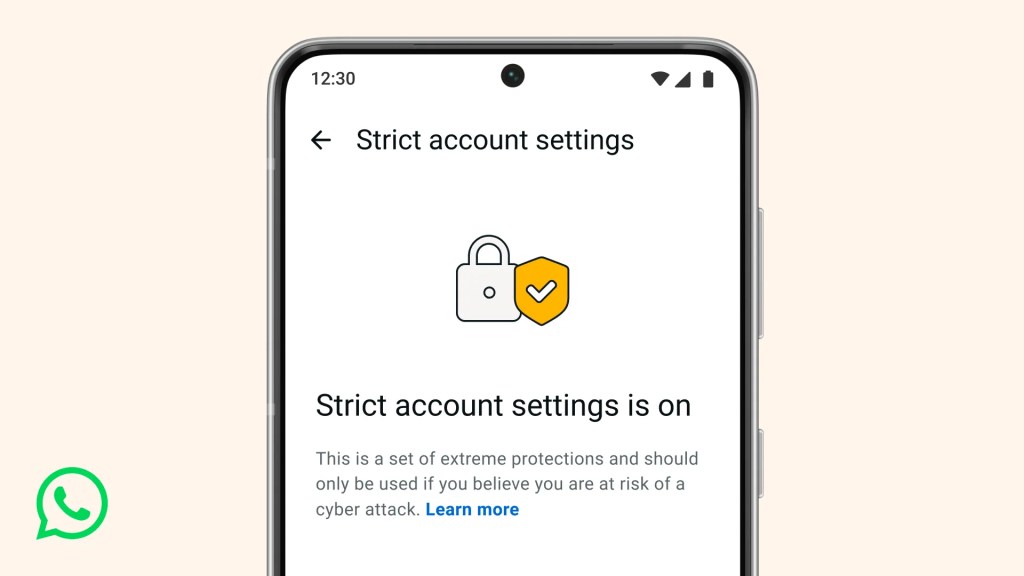
The new feature, called Strict Account Settings, is rolling out gradually over the coming weeks. To see whether you have the option—and to enable it—go to Settings > Privacy > Advanced.
Image courtesy of WhatsApp
Yesterday, we wrote about a WhatsApp bug on Android that made headlines because a malicious media file in a group chat could be downloaded and used as an attack vector without you tapping anything. You only had to be added to a new group to be exposed to the booby-trapped file. That issue highlighted something security folks have worried about for years: media files are a great vehicle for attacks, and they do not always exploit WhatsApp itself, but bugs in the operating system or its media libraries.
In Meta’s explanation of the new technology, it points back to the 2015 Stagefright Android vulnerability, where simply processing a malicious video could compromise a device. Back then, WhatsApp worked around the issue by teaching its media library to spot broken MP4 files that could trigger those OS bugs, buying users protection even if their phones were not fully patched.
What’s new is that WhatsApp has now rebuilt its core media-handling library in Rust, a memory-safe programming language. This helps eliminate several types of memory bugs that often lead to serious security problems. In the process, it replaced about 160,000 lines of older C++ code with roughly 90,000 lines of Rust, and rolled the new library out to billions of devices across Android, iOS, desktop apps, wearables, and the web.
On top of that, WhatsApp has bundled a series of checks into an internal system it calls “Kaleidoscope.” This system inspects incoming files for structural oddities, flags higher‑risk formats like PDFs with embedded content or scripts, detects when a file pretends to be something it’s not (for example, a renamed executable), and marks known dangerous file types for special handling in the app. It won’t catch every attack, but it should prevent malicious files from poking at more fragile parts of your device.
For everyday users, the Rust rebuilt and Kaleidoscope checks are good news. They add a strong, invisible safety net around photos, videos and other files you receive, including in group chats where the recent bug could be abused. They also line up neatly with our earlier advice to turn off automatic media downloads or use Advanced Privacy Mode, which limits how far a malicious file can travel on your device even if it lands in WhatsApp.
WhatsApp is the latest platform to roll out enhanced protections for users: Apple introduced Lockdown Mode in 2022, and Android followed with Advanced Protection Mode last year. WhatsApp’s new Strict Account Settings takes a similar high-level approach, applying more restrictive defaults within the app, including blocking attachments and media from unknown senders.
However, this is no reason to rush back to WhatsApp, or to treat these changes as a guarantee of safety. At the very least, Meta is showing that it is willing to invest in making WhatsApp more secure.
We don’t just report on phone security—we provide it
Using generative AI, scammers can now craft phishing emails that overcome language barriers, respond in real time, and quickly automate large-scale personalized campaigns, making it simpler to impersonate domains and access sensitive information.
Heather Doerges // Of all the services we offer at BHIS, Social Engineering is the most interesting to me. It’s something (and quite possibly the only thing) I completely understand […]
Logan Lembke // Living in the information age is great, isn’t it? With just a visit to the internet you can learn what happened in London on September 2nd, 1666, […]

 Login