BBC News reports it has seen samples of stolen FBI agents’ medical examinations. The “fitness-for-work” reports identify FBI agents by name and address, and reveal even more personal details. They include blood and urine test results and doctors’ notes mentioning high cholesterol, blood in the urine, and even a shellfish and banana allergy.
As we reported last week, extortion group ShinyHunters claims to have breached the FBI. After reportedly taking over ransomware group Clop’s leak site, ShinyHunters says it attacked the FBI to punish the agency for spreading what it calls false information about the group.
The BBC’s findings raise the stakes: The alleged theft includes highly sensitive medical records, not just staff identity and contact data. ShinyHunters shared samples with journalists as proof of its claims.
The BBC states:
“The samples shared with journalists appear genuine and include names, addresses, phone numbers, badge numbers, job titles and information about spouses.”
ShinyHunters claims it accessed several systems, including FBI MedLink, which stores medical records, and FBI BEAST, which handles background checks on employees and applicants, but the FBI has not confirmed these claims. The FBI has acknowledged an incident affecting FBIJobs-related systems and says it is investigating whether its own environment or a third-party provider was compromised.
The group’s stated demand remains non-financial: It wants the FBI to retract or remove a May advisory that ShinyHunters calls false and defamatory. It says it will release the data within five days if its demands are not met.
The cybercriminals also raised the number of affected people. ShinyHunters nows claims to hold sensitive information on around 60,000 current and former FBI staff. Medical histories could make affected people vulnerable long after the immediate incident: Unlike a stolen password, a medical record cannot be changed.
What to do if you’re affected
The FBI has not yet confirmed what information was accessed or who was affected. If you are a current or former FBI employee, a relative of one, or have applied for an FBI job:
Check the FBI’s advice. Every breach is different, so check FBI.gov for updates and follow any specific advice it offers.
Change your password. If you have an FBI Jobs account and reuse its password elsewhere, change it on those other accounts. Choose a strong password that you don’t use for anything else. Better yet, let a password manager choose one for you.
Enable two-factor authentication (2FA). If you can, use a FIDO2-compliant hardware key, laptop, or phone as your second factor. Some forms of 2FA can be phished just as easily as a password, but 2FA that relies on a FIDO2 device can’t be phished.
Watch out for impersonators. Cybercriminals may contact you posing as the FBI, another government agency, or someone you know. Verify the identity of anyone who contacts you.
Take your time. Phishing attacks often impersonate people or brands you know and use themes that require urgent attention, such as missed deliveries, account suspensions, and security alerts.
Let’s face it, an incognito window can only do so much.
Breaches, dark web trading, credit fraud. Malwarebytes Identity Theft Protection monitors for all of it, alerts you fast, and comes with identity theft insurance.
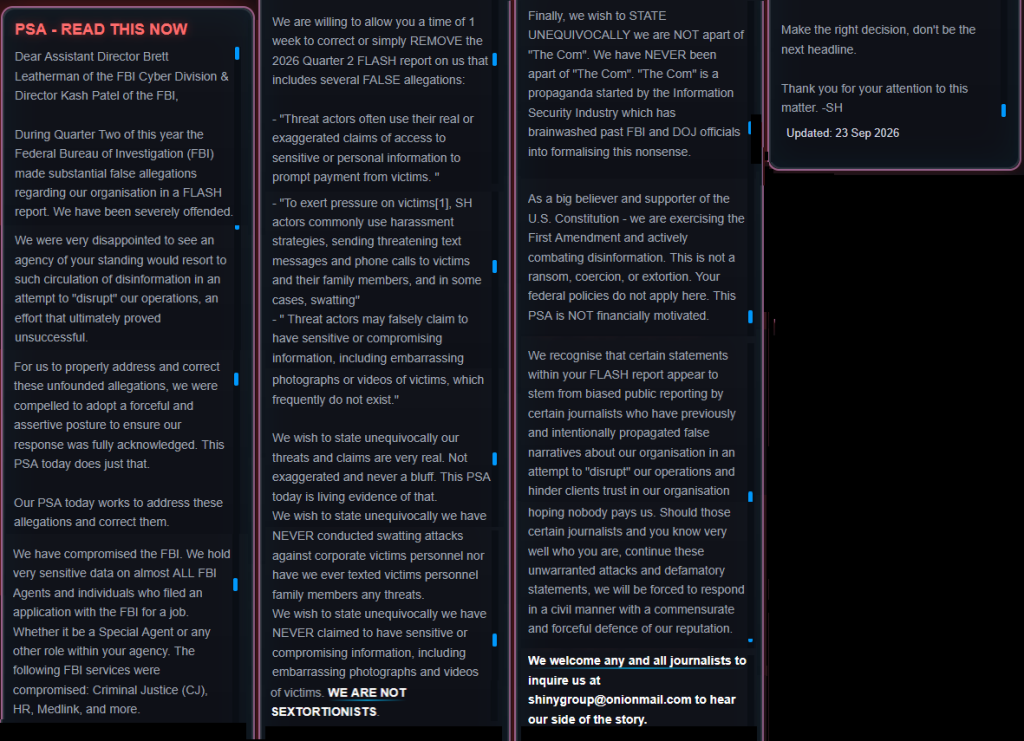
In a very long post on its leak site, the group outlines its grievances:
“PSA – READ THIS NOW
Dear Assistant Director Brett Leatherman of the FBI Cyber Division & Director Kash Patel of the FBI,
During Quarter Two of this year the Federal Bureau of Investigation (FBI) made substantial false allegations regarding our organisation in a FLASH report. We have been severely offended.
We were very disappointed to see an agency of your standing would resort to such circulation of disinformation in an attempt to “disrupt” our operations, an effort that ultimately proved unsuccessful.
For us to properly address and correct these unfounded allegations, we were compelled to adopt a forceful and assertive posture to ensure our response was fully acknowledged. This PSA today does just that.
Our PSA today works to address these allegations and correct them.
We have compromised the FBI. We hold very sensitive data on almost ALL FBI Agents and individuals who filed an application with the FBI for a job. Whether it be a Special Agent or any other role within your agency. The following FBI services were compromised: Criminal Justice (CJ), HR, Medlink, and more.
We are willing to allow you a time of 1 week to correct or simply REMOVE the 2026 Quarter 2 FLASH report on us that includes several FALSE allegations:
“Threat actors often use their real or exaggerated claims of access to sensitive or personal information to prompt payment from victims.”
“To exert pressure on victims[1], SH actors commonly use harassment strategies, sending threatening text messages and phone calls to victims and their family members, and in some cases, swatting”
“Threat actors may falsely claim to have sensitive or compromising information, including embarrassing photographs or videos of victims, which frequently do not exist.”
We wish to state unequivocally our threats and claims are very real. Not exaggerated and never a bluff. This PSA today is living evidence of that.
We wish to state unequivocally we have NEVER conducted swatting attacks against corporate victims personnel nor have we ever texted victims personnel family members any threats.
We wish to state unequivocally we have NEVER claimed to have sensitive or compromising information, including embarrassing photographs and videos of victims. WE ARE NOT SEXTORTIONISTS.
Finally, we wish to STATE UNEQUIVOCALLY we are NOT apart of “The Com”. We have NEVER been apart of “The Com”. “The Com” is a propaganda started by the Information Security Industry which has brainwashed past FBI and DOJ officials into formalising this nonsense.
As a big believer and supporter of the U.S. Constitution – we are exercising the First Amendment and actively combating disinformation. This is not a ransom, coercion, or extortion. Your federal policies do not apply here. This PSA is NOT financially motivated.
We recognise that certain statements within your FLASH report appear to stem from biased public reporting by certain journalists who have previously and intentionally propagated false narratives about our organisation in an attempt to “disrupt” our operations and hinder clients trust in our organisation hoping nobody pays us. Should those certain journalists and you know very well who you are, continue these unwarranted attacks and defamatory statements, we will be forced to respond in a civil manner with a commensurate and forceful defence of our reputation.
We welcome any and all journalists to inquire us at shinygroup@onionmail[.]com to hear our side of the story.
Make the right decision, don’t be the next headline.
Thank you for your attention to this matter. -SH
Updated: 23 Sep 2026“
The post is essentially a hostile “correction notice” directed at FBI leaders Brett Leatherman and Kash Patel. Its central grievance is an FBI advisory that says ShinyHunters commonly harasses victims and their families, including through threatening messages, phone calls, and, in some cases, swatting.
It also warns that threat actors may exaggerate their access to personal information or falsely claim to possess compromising photos or videos. The advisory does not use the word “sextortion,” but ShinyHunters appears to have interpreted the reference to compromising material that way. The group denies much of the FBI’s account while simultaneously using coercive language of its own.
The document it appears to mean is the FBI/IC3 public advisory “ShinyHunters: Cyber Criminal Group Attacks Learning Management System,” issued on May 15, 2026. Despite ShinyHunters calling it a “2026 Quarter 2 FLASH report,” the publicly accessible document is labeled a Public Service Announcement (PSA), not a FLASH.
It also denies carrying out swatting attacks or sending threatening messages to the family members of people working for its corporate victims.
The group also denies being part of The Com, a decentralized network linked to cybercrime and violence. It calls that connection:
“propaganda started by the Information Security Industry which has brainwashed past FBI and DOJ officials into formalizing this nonsense.”
The group then threatens journalists it accuses of spreading these “false narratives.”
The most worrying part of the message is the group’s claim that it stole sensitive data on:
“almost ALL FBI Agents, and individuals who filed an application with the FBI for a job.”
According to 404 Media, ShinyHunters provided a sample containing information on roughly 5,000 FBI agents, including names, home addresses, phone numbers, and details about their spouses. The publication reportedly verified portions of the sample, but the full dataset and the wider claims about the breach have not been independently confirmed.
The group also reportedly defaced the FBI’s jobs website. The FBI says it is aware of claims involving unauthorized activity affecting FBIjobs.gov and is investigating, although “broken” does not necessarily mean “breached.”
What to do if you’re affected
The FBI has not yet confirmed what information was accessed or who was affected. If you are a current or former FBI employee, a relative of one, or have applied for an FBI job:
Check the FBI’s advice. Every breach is different, so check FBI.gov for updates and follow any specific advice it offers.
Change your password. If you have an FBI Jobs account and reuse its password elsewhere, change it on those other accounts. Choose a strong password that you don’t use for anything else. Better yet, let a password manager choose one for you.
Enable two-factor authentication (2FA). If you can, use a FIDO2-compliant hardware key, laptop, or phone as your second factor. Some forms of 2FA can be phished just as easily as a password, but 2FA that relies on a FIDO2 device can’t be phished.
Watch out for impersonators. Cybercriminals may contact you posing as the FBI, another government agency, or someone you know. Verify the identity of anyone who contacts you.
Take your time. Phishing attacks often impersonate people or brands you know and use themes that require urgent attention, such as missed deliveries, account suspensions, and security alerts.
Let’s face it, an incognito window can only do so much.
Breaches, dark web trading, credit fraud. Malwarebytes Identity Theft Protection monitors for all of it, alerts you fast, and comes with identity theft insurance.
In a Public Service Announcement (PSA) the Federal Bureau of Investigation (FBI) and the Cybersecurity and Infrastructure Security Agency (CISA) warn the public about ongoing Russian-linked phishing campaigns that aim to gain access to messaging accounts.
Earlier this month we wrote about a large‑scale phishing campaign aimed at hijacking Signal and WhatsApp accounts belonging to senior officials, military personnel, civil servants, and journalists.
Now the FBI and CISA have joined European intelligence services in warning that the same tactics are being used in a broader campaign targeting these commercial messaging apps. The goal is not to break end‑to‑end encryption, but to walk straight around it by stealing access to individual accounts.
In our previous article, we focused on warnings from the Dutch intelligence services AIVD and MIVD, which described how Russian state‑backed actors approached high‑value targets via Signal and WhatsApp, posing as “Signal Support”, “Signal Security Bot”, or similar. The PSA demonstrates how the same groups are now running global phishing campaigns against messaging app accounts, with evidence suggesting thousands of compromised accounts worldwide.
It’s important to reiterate that the attackers have not managed to break the apps’ end-to-end encryption. Instead, they are relying on social engineering to get a device added so they can eavesdrop on accounts.
The current targets include current and former US government officials, military staff, political figures, and journalists, but there is nothing to stop the same techniques being reused against businesses and everyday users.
So, while it’s tempting to dismiss this as a problem for diplomats and generals (and the agencies issuing these alerts do mention high‑profile targets first), the techniques scale very easily. Once playbooks like these are public, they tend to be copied by cybercriminals looking for new ways to steal money or accounts.
How to protect your accounts
As the PSA puts it:
“Phishing remains one of the most unsophisticated, yet effective means of cyber compromise, often rendering other protections irrelevant”
This calls asks for basic security measures:
Treat unsolicited messages from “Support” inside apps as suspicious by default. Legitimate support for apps like Signal and WhatsApp does not ask you, in a chat message, to send back verification codes, PINs, or passwords. If you receive a warning about account problems, do not follow links in the message. Open the app’s settings directly or visit the official website through other means.
Never share SMS verification codes or app PINs. SMS codes are there to prove that you control a phone number. Anyone who has the code can pretend to be you. App‑specific PINs or passcodes are there to protect account changes. Giving them away is like handing over the keys to your account. Consider anyone asking for them to be a scammer.
Be careful what you discuss and with whom. Both the Dutch and US advisories remind us that even with end‑to‑end encryption, some conversations are too sensitive for commercial chat apps.
Use the extra security features these apps offer. Enable options like registration lock, registration PIN and device‑change alerts so that your account cannot be silently re‑registered without an extra secret. Store your PIN in a password manager instead of choosing something easy to guess or reusing a common code, to reduce the chance of social engineering or shoulder‑surfing.
Another useful feature is disappearing messages. Short‑timer and disappearing messages reduce how much content is available if an attacker gets into a chat later, or if someone obtains long‑term access to a device or backup. They are not a complete solution, but they can limit the damage.
What to do if you think your account was hijacked
If you suspect an attacker has taken over your messaging account:
Try to re‑register your number in the app immediately to kick out other devices.
Revoke all linked devices and change any app‑specific PINs or lock codes.
Warn your contacts that someone may have impersonated you and ask them to treat recent messages with caution.
Review recent conversations for signs of data theft (for example, shared IDs, documents, or passwords that should now be considered exposed).
Report the incident to the app provider and, where appropriate, to national reporting centers such as the FBI’s Internet Crime Complaint Center (IC3) at ic3.gov or the relevant authority in your country.
The sooner you act, the smaller the window in which attackers can exploit your account.
We don’t just report on phone security—we provide it

 Login