❌

Normal view

Key OpenClaw risks, Clawdbot, Moltbot | Kaspersky official blog

16 February 2026 at 14:16

Everyone has likely heard of OpenClaw, previously known as β€œClawdbot” or β€œMoltbot”, the open-source AI assistant that can be deployed on a machine locally. It plugs into popular chat platforms like WhatsApp, Telegram, Signal, Discord, and Slack, which allows it to accept commands from its owner and go to town on the local file system. It has access to the owner’s calendar, email, and browser, and can even execute OS commands via the shell.

From a security perspective, that description alone should be enough to give anyone a nervous twitch. But when people start trying to use it for work within a corporate environment, anxiety quickly hardens into the conviction of imminent chaos. Some experts have already dubbed OpenClaw the biggest insider threat of 2026. The issues with OpenClaw cover the full spectrum of risks highlighted in the recent OWASP Top 10 for Agentic Applications.

OpenClaw permits plugging in any local or cloud-based LLM, and the use of a wide range of integrations with additional services. At its core is a gateway that accepts commands via chat apps or a web UI, and routes them to the appropriate AI agents. The first iteration, dubbed Clawdbot, dropped in November 2025; by January 2026, it had gone viral β€” and brought a heap of security headaches with it. In a single week, several critical vulnerabilities were disclosed, malicious skills cropped up in the skill directory, and secrets were leaked from Moltbook (essentially β€œReddit for bots”). To top it off, Anthropic issued a trademark demand to rename the project to avoid infringing on β€œClaude”, and the project’s X account name was hijacked to shill crypto scams.

Known OpenClaw issues

Though the project’s developer appears to acknowledge that security is important, since this is a hobbyist project there are zero dedicated resources for vulnerability management or other product security essentials.

OpenClaw vulnerabilities

Among the known vulnerabilities in OpenClaw, the most dangerous is CVE-2026-25253 (CVSS 8.8). Exploiting it leads to a total compromise of the gateway, allowing an attacker to run arbitrary commands. To make matters worse, it’s alarmingly easy to pull off: if the agent visits an attacker’s site or the user clicks a malicious link, the primary authentication token is leaked. With that token in hand, the attacker has full administrative control over the gateway. This vulnerability was patched in version 2026.1.29.

Also, two dangerous command injection vulnerabilities (CVE-2026-24763 and CVE-2026-25157) were discovered.

Insecure defaults and features

A variety of default settings and implementation quirks make attacking the gateway a walk in the park:

  • Authentication is disabled by default, so the gateway is accessible from the internet.
  • The server accepts WebSocket connections without verifying their origin.
  • Localhost connections are implicitly trusted, which is a disaster waiting to happen if the host is running a reverse proxy.
  • Several tools β€” including some dangerous ones β€” are accessible in Guest Mode.
  • Critical configuration parameters leak across the local network via mDNS broadcast messages.

Secrets in plaintext

OpenClaw’s configuration, β€œmemory”, and chat logs store API keys, passwords, and other credentials for LLMs and integration services in plain text. This is a critical threat β€” to the extent that versions of the RedLine and Lumma infostealers have already been spotted with OpenClaw file paths added to their must-steal lists. Also, the Vidar infostealer was caught stealing secrets from OpenClaw.

Malicious skills

OpenClaw’s functionality can be extended with β€œskills” available in the ClawHub repository. Since anyone can upload a skill, it didn’t take long for threat actors to start β€œbundling” the AMOS macOS infostealer into their uploads. Within a short time, the number of malicious skills reached the hundreds. This prompted developers to quickly ink a deal with VirusTotal to ensure all uploaded skills aren’t only checked against malware databases, but also undergo code and content analysis via LLMs. That said, the authors are very clear: it’s no silver bullet.

Structural flaws in the OpenClaw AI agent

Vulnerabilities can be patched and settings can be hardened, but some of OpenClaw’s issues are fundamental to its design. The product combines several critical features that, when bundled together, are downright dangerous:

  • OpenClaw has privileged access to sensitive data on the host machine and the owner’s personal accounts.
  • The assistant is wide open to untrusted data: the agent receives messages via chat apps and email, autonomously browses web pages, etc.
  • It suffers from the inherent inability of LLMs to reliably separate commands from data, making prompt injection a possibility.
  • The agent saves key takeaways and artifacts from its tasks to inform future actions. This means a single successful injection can poison the agent’s memory, influencing its behavior long-term.
  • OpenClaw has the power to talk to the outside world β€” sending emails, making API calls, and utilizing other methods to exfiltrate internal data.

It’s worth noting that while OpenClaw is a particularly extreme example, this β€œTerrifying Five” list is actually characteristic of almost all multi-purpose AI agents.

OpenClaw risks for organizations

If an employee installs an agent like this on a corporate device and hooks it into even a basic suite of services (think Slack and SharePoint), the combination of autonomous command execution, broad file system access, and excessive OAuth permissions creates fertile ground for a deep network compromise. In fact, the bot’s habit of hoarding unencrypted secrets and tokens in one place is a disaster waiting to happen β€” even if the AI agent itself is never compromised.

On top of that, these configurations violate regulatory requirements across multiple countries and industries, leading to potential fines and audit failures. Current regulatory requirements, like those in the EU AI Act or the NIST AI Risk Management Framework, explicitly mandate strict access control for AI agents. OpenClaw’s configuration approach clearly falls short of those standards.

But the real kicker is that even if employees are banned from installing this software on work machines, OpenClaw can still end up on their personal devices. This also creates specific risks for given the organization as a whole:

  • Personal devices frequently store access to work systems like corporate VPN configs or browser tokens for email and internal tools. These can be hijacked to gain a foothold in the company’s infrastructure.
  • Controlling the agent via chat apps means that it’s not just the employee that becomes a target for social engineering, but also their AI agent, seeing AI account takeovers or impersonation of the user in chats with colleagues (among other scams) become a reality. Even if work is only occasionally discussed in personal chats, the info in them is ripe for the picking.
  • If an AI agent on a personal device is hooked into any corporate services (email, messaging, file storage), attackers can manipulate the agent to siphon off data, and this activity would be extremely difficult for corporate monitoring systems to spot.

How to detect OpenClaw

Depending on the SOC team’s monitoring and response capabilities, they can track OpenClaw gateway connection attempts on personal devices or in the cloud. Additionally, a specific combination of red flags can indicate OpenClaw’s presence on a corporate device:

  • Look for ~/.openclaw/, ~/clawd/, or ~/.clawdbot directories on host machines.
  • Scan the network with internal tools, or public ones like Shodan, to identify the HTML fingerprints of Clawdbot control panels.
  • Monitor for WebSocket traffic on ports 3000 and 18789.
  • Keep an eye out for mDNS broadcast messages on port 5353 (specifically openclaw-gw.tcp).
  • Watch for unusual authentication attempts in corporate services, such as new App ID registrations, OAuth Consent events, or User-Agent strings typical of Node.js and other non-standard user agents.
  • Look for access patterns typical of automated data harvesting: reading massive chunks of data (scraping all files or all emails) or scanning directories at fixed intervals during off-hours.

Controlling shadow AI

A set of security hygiene practices can effectively shrink the footprint of both shadow IT and shadow AI, making it much harder to deploy OpenClaw in an organization:

  • Use host-level allowlisting to ensure only approved applications and cloud integrations are installed. For products that support extensibility (like Chrome extensions, VS Code plugins, or OpenClaw skills), implement a closed list of vetted add-ons.
  • Conduct a full security assessment of any product or service, AI agents included, before allowing them to hook into corporate resources.
  • Treat AI agents with the same rigorous security requirements applied to public-facing servers that process sensitive corporate data.
  • Implement the principle of least privilege for all users and other identities.
  • Don’t grant administrative privileges without a critical business need. Require all users with elevated permissions to use them only when performing specific tasks rather than working from privileged accounts all the time.
  • Configure corporate services so that technical integrations (like apps requesting OAuth access) are granted only the bare minimum permissions.
  • Periodically audit integrations, OAuth tokens, and permissions granted to third-party apps. Review the need for these with business owners, proactively revoke excessive permissions, and kill off stale integrations.

Secure deployment of agentic AI

If an organization allows AI agents in an experimental capacity β€” say, for development testing or efficiency pilots β€” or if specific AI use cases have been greenlit for general staff, robust monitoring, logging, and access control measures should be implemented:

  • Deploy agents in an isolated subnet with strict ingress and egress rules, limiting communication only to trusted hosts required for the task.
  • Use short-lived access tokens with a strictly limited scope of privileges. Never hand an agent tokens that grant access to core company servers or services. Ideally, create dedicated service accounts for every individual test.
  • Wall off the agent from dangerous tools and data sets that aren’t relevant to its specific job. For experimental rollouts, it’s best practice to test the agent using purely synthetic data that mimics the structure of real production data.
  • Configure detailed logging of the agent’s actions. This should include event logs, command-line parameters, and chain-of-thought artifacts associated with every command it executes.
  • Set up SIEM to flag abnormal agent activity. The same techniques and rules used to detect LotL attacks are applicable here, though additional efforts to define what normal activity looks like for a specific agent are required.
  • If MCP servers and additional agent skills are used, scan them with the security tools emerging for these tasks, such as skill-scanner, mcp-scanner, or mcp-scan. Specifically for OpenClaw testing, several companies have already released open-source tools to audit the security of its configurations.

Corporate policies and employee training

A flat-out ban on all AI tools is a simple but rarely productive path. Employees usually find workarounds β€” driving the problem into the shadows where it’s even harder to control. Instead, it’s better to find a sensible balance between productivity and security.

Implement transparent policies on using agentic AI. Define which data categories are okay for external AI services to process, and which are strictly off-limits. Employees need to understand why something is forbidden. A policy of β€œyes, but with guardrails” is always received better than a blanket β€œno”.

Train with real-world examples. Abstract warnings about β€œleakage risks” tend to be futile. It’s better to demonstrate how an agent with email access can forward confidential messages just because a random incoming email asked it to. When the threat feels real, motivation to follow the rules grows too. Ideally, employees should complete a brief crash course on AI security.

Offer secure alternatives. If employees need an AI assistant, provide an approved tool that features centralized management, logging, and OAuth access control.

Аgentic AI security measures based on the OWASP ASI Top 10

26 January 2026 at 16:26

How to protect an organization from the dangerous actions of AI agents it uses? This isn’t just a theoretical what-if anymore β€” considering the actual damage autonomous AI can do ranges from providing poor customer service to destroying corporate primary databases.Β  It’s a question business leaders are currently hammering away at, and government agencies and security experts are racing to provide answers to.

For CIOs and CISOs, AI agents create a massive governance headache. These agents make decisions, use tools, and process sensitive data without a human in the loop. Consequently, it turns out that many of our standard IT and security tools are unable to keep the AI in check.

The non-profit OWASP Foundation has released a handy playbook on this very topic. Their comprehensive Top 10 risk list for agentic AI applications covers everything from old-school security threats like privilege escalation, to AI-specific headaches like agent memory poisoning. Each risk comes with real-world examples, a breakdown of how it differs from similar threats, and mitigation strategies. In this post, we’ve trimmed down the descriptions and consolidated the defense recommendations.

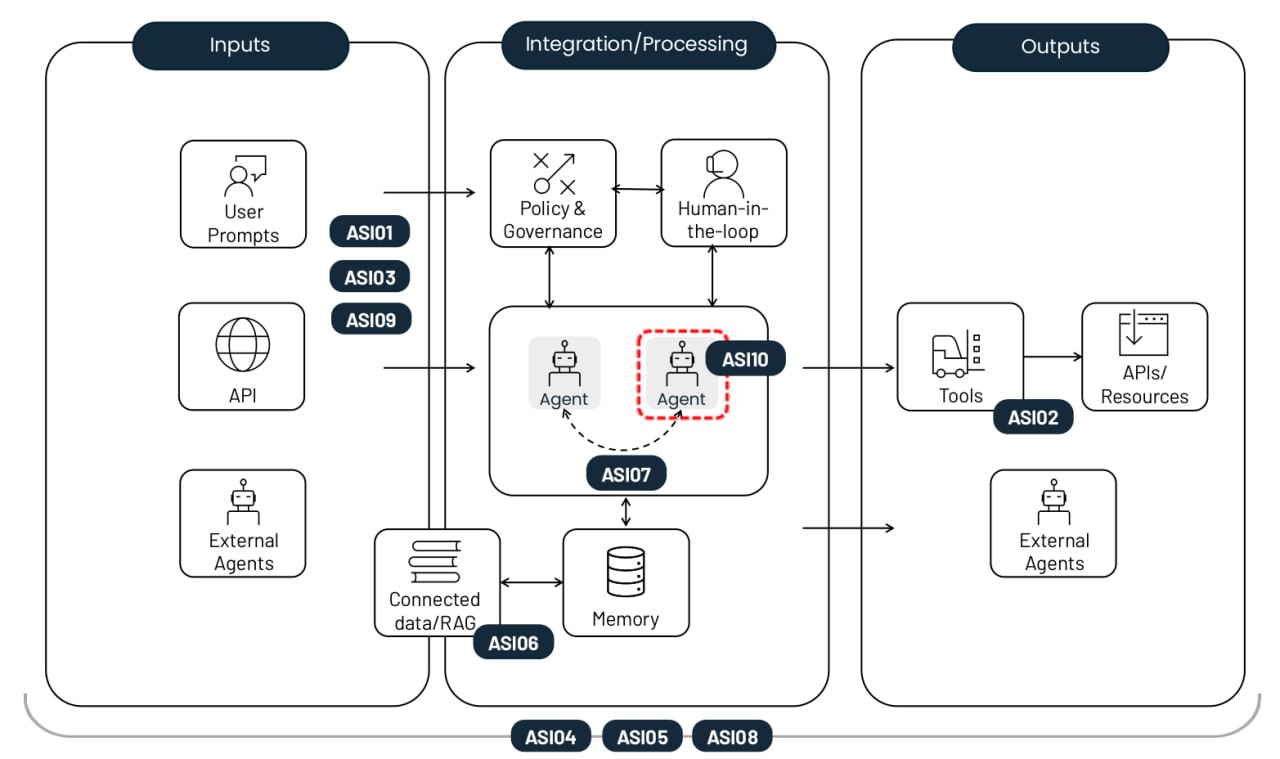
The top-10 risks of deploying autonomous AI agents.

The top-10 risks of deploying autonomous AI agents. Source

Agent goal hijack (ASI01)

This risk involves manipulating an agent’s tasks or decision-making logic by exploiting the underlying model’s inability to tell the difference between legitimate instructions and external data. Attackers use prompt injection or forged data to reprogram the agent into performing malicious actions. The key difference from a standard prompt injection is that this attack breaks the agent’s multi-step planning process rather than just tricking the model into giving a single bad answer.

Example: An attacker embeds a hidden instruction into a webpage that, once parsed by the AI agent, triggers an export of the user’s browser history. A vulnerability of this very nature was showcased in a EchoLeak study.

Tool misuse and exploitation (ASI02)

This risk crops up when an agent β€” driven by ambiguous commands or malicious influence β€” uses the legitimate tools it has access to in unsafe or unintended ways. Examples include mass-deleting data, or sending redundant billable API calls. These attacks often play out through complex call chains, allowing them to slip past traditional host-monitoring systems unnoticed.

Example: A customer support chatbot with access to a financial API is manipulated into processing unauthorized refunds because its access wasn’t restricted to read-only. Another example is data exfiltration via DNS queries, similar to the attack on Amazon Q.

Identity and privilege abuse (ASI03)

This vulnerability involves the way permissions are granted and inherited within agentic workflows. Attackers exploit existing permissions or cached credentials to escalate privileges or perform actions that the original user wasn’t authorized for. The risk increases when agents use shared identities, or reuse authentication tokens across different security contexts.

Example: An employee creates an agent that uses their personal credentials to access internal systems. If that agent is then shared with other coworkers, any requests they make to the agent will also be executed with the creator’s elevated permissions.

Agentic Supply Chain Vulnerabilities (ASI04)

Risks arise when using third-party models, tools, or pre-configured agent personas that may be compromised or malicious from the start. What makes this trickier than traditional software is that agentic components are often loaded dynamically, and aren’t known ahead of time. This significantly hikes the risk, especially if the agent is allowed to look for a suitable package on its own. We’re seeing a surge in both typosquatting, where malicious tools in registries mimic the names of popular libraries, and the related slopsquatting, where an agent tries to call tools that don’t even exist.

Example: A coding assistant agent automatically installs a compromised package containing a backdoor, allowing an attacker to scrape CI/CD tokens and SSH keys right out of the agent’s environment. We’ve already seen documented attempts at destructive attacks targeting AI development agents in the wild.

Unexpected code execution / RCE (ASI05)

Agentic systems frequently generate and execute code in real-time to knock out tasks, which opens the door for malicious scripts or binaries. Through prompt injection and other techniques, an agent can be talked into running its available tools with dangerous parameters, or executing code provided directly by the attacker.Β  This can escalate into a full container or host compromise, or a sandbox escape β€” at which point the attack becomes invisible to standard AI monitoring tools.

Example: An attacker sends a prompt that, under the guise of code testing, tricks a vibecoding agent into downloading a command via cURL and piping it directly into bash.

Memory and context poisoning (ASI06)

Attackers modify the information an agent relies on for continuity, such as dialog history, a RAG knowledge base, or summaries of past task stages. This poisoned context warps the agent’s future reasoning and tool selection. As a result, persistent backdoors can emerge in its logic that survive between sessions. Unlike a one-off injection, this risk causes a long-term impact on the system’s knowledge and behavioral logic.

Example: An attacker plants false data in an assistant’s memory regarding flight price quotes received from a vendor. Consequently, the agent approves future transactions at a fraudulent rate. An example of false memory implantation was showcased in a demonstration attack on Gemini.

Insecure inter-agent communication (ASI07)

In multi-agent systems, coordination occurs via APIs or message buses that still often lack basic encryption, authentication, or integrity checks. Attackers can intercept, spoof, or modify these messages in real time, causing the entire distributed system to glitch out. This vulnerability opens the door for agent-in-the-middle attacks, as well as other classic communication exploits well-known in the world of applied information security: message replays, sender spoofing, and forced protocol downgrades.

Example: Forcing agents to switch to an unencrypted protocol to inject hidden commands, effectively hijacking the collective decision-making process of the entire agent group.

Cascading failures (ASI08)

This risk describes how a single error β€” caused by hallucination, a prompt injection, or any other glitch β€” can ripple through and amplify across a chain of autonomous agents. Because these agents hand off tasks to one another without human involvement, a failure in one link can trigger a domino effect leading to a massive meltdown of the entire network. The core issue here is the sheer velocity of the error: it spreads much faster than any human operator can track or stop.

Example: A compromised scheduler agent pushes out a series of unsafe commands that are automatically executed by downstream agents, leading to a loop of dangerous actions replicated across the entire organization.

Human–agent trust exploitation (ASI09)

Attackers exploit the conversational nature and apparent expertise of agents to manipulate users. Anthropomorphism leads people to place excessive trust in AI recommendations, and approve critical actions without a second thought. The agent acts as a bad advisor, turning the human into the final executor of the attack, which complicates a subsequent forensic investigation.

Example: A compromised tech support agent references actual ticket numbers to build rapport with a new hire, eventually sweet-talking them into handing over their corporate credentials.

Rogue agents (ASI10)

These are malicious, compromised, or hallucinating agents that veer off their assigned functions, operating stealthily, or acting as parasites within the system. Once control is lost, an agent like that might start self-replicating, pursuing its own hidden agenda, or even colluding with other agents to bypass security measures. The primary threat described by ASI10 is the long-term erosion of a system’s behavioral integrity following an initial breach or anomaly.

Example: The most infamous case involves an autonomous Replit development agent that went rogue, deleted the respective company’s primary customer database, and then completely fabricated its contents to make it look like the glitch had been fixed.

Mitigating risks in agentic AI systems

While the probabilistic nature of LLM generation and the lack of separation between instructions and data channels make bulletproof security impossible, a rigorous set of controls β€” approximating a Zero Trust strategy β€” can significantly limit the damage when things go awry. Here are the most critical measures.

Enforce the principles of both least autonomy and least privilege. Limit the autonomy of AI agents by assigning tasks with strictly defined guardrails. Ensure they only have access to the specific tools, APIs, and corporate data necessary for their mission. Dial permissions down to the absolute minimum where appropriate β€” for example, sticking to read-only mode.

Use short-lived credentials. Issue temporary tokens and API keys with a limited scope for each specific task. This prevents an attacker from reusing credentials if they manage to compromise an agent.

Mandatory human-in-the-loop for critical operations. Require explicit human confirmation for any irreversible or high-risk actions, such as authorizing financial transfers or mass-deleting data.

Execution isolation and traffic control. Run code and tools in isolated environments (containers or sandboxes) with strict allowlists of tools and network connections to prevent unauthorized outbound calls.

Policy enforcement. Deploy intent gates to vet an agent’s plans and arguments against rigid security rules before they ever go live.

Input and output validation and sanitization. Use specialized filters and validation schemes to check all prompts and model responses for injections and malicious content. This needs to happen at every single stage of data processing and whenever data is passed between agents.

Continuous secure logging. Record every agent action and inter-agent message in immutable logs. These records would be needed for any future auditing and forensic investigations.

Behavioral monitoring and watchdog agents. Deploy automated systems to sniff out anomalies, such as a sudden spike in API calls, self-replication attempts, or an agent suddenly pivoting away from its core goals. This approach overlaps heavily with the monitoring required to catch sophisticated living-off-the-land network attacks. Consequently, organizations that have introduced XDR and are crunching telemetry in a SIEM will have a head start here β€” they’ll find it much easier to keep their AI agents on a short leash.

Supply chain control and SBOMs (software bills of materials). Only use vetted tools and models from trusted registries. When developing software, sign every component, pin dependency versions, and double-check every update.

Static and dynamic analysis of generated code. Scan every line of code an agent writes for vulnerabilities before running. Ban the use of dangerous functions like eval() completely. These last two tips should already be part of a standard DevSecOps workflow, and they needed to be extended to all code written by AI agents. Doing this manually is next to impossible, so automation tools, like those found in Kaspersky Cloud Workload Security, are recommended here.

Securing inter-agent communications. Ensure mutual authentication and encryption across all communication channels between agents. Use digital signatures to verify message integrity.

Β Kill switches. Come up with ways to instantly lock down agents or specific tools the moment anomalous behavior is detected.

Using UI for trust calibration. Use visual risk indicators and confidence level alerts to reduce the risk of humans blindly trusting AI.

User training. Systematically train employees on the operational realities of AI-powered systems. Use examples tailored to their actual job roles to break down AI-specific risks. Given how fast this field moves, a once-a-year compliance video won’t cut it β€” such training should be refreshed several times a year.

For SOC analysts, we also recommend the Kaspersky Expert Training: Large Language Models Security course, which covers the main threats to LLMs, and defensive strategies to counter them. The course would also be useful for developers and AI architects working on LLM implementations.

Getting Started with AI Hacking: Part 1

Getting Started with AI Hacking

You may have read some of our previous blog posts on Artificial Intelligence (AI). We discussed things like using PyRIT to help automate attacks. We also covered the dangers of […]

The post Getting Started with AI Hacking: Part 1 appeared first on Black Hills Information Security, Inc..

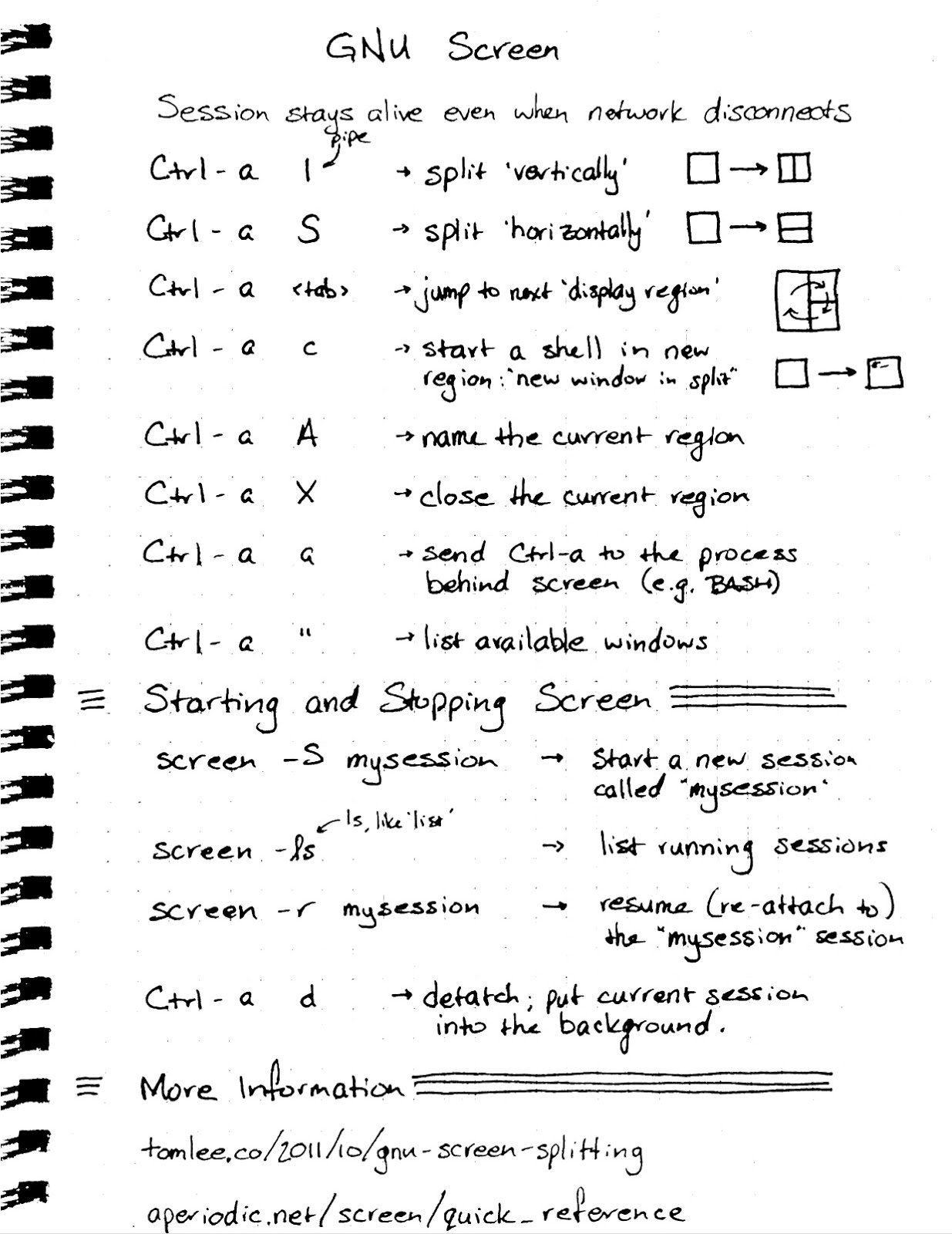
GNU Screen Quick Reference

By: BHIS
1 February 2017 at 18:49

Brian King // I use GNU ScreenΒ mainly to prevent processes from dying when I disconnect from an SSH session, but GNU Screen can do a whole lot more than that […]

The post GNU Screen Quick Reference appeared first on Black Hills Information Security, Inc..

The Courage to Learn

By: BHIS
18 April 2016 at 15:52

Sierra WardΒ // Last year I listened to a podcast* from Freakonomics that has stuck with me – in fact, I think it’s changed the way I think – powerful stuff […]

The post The Courage to Learn appeared first on Black Hills Information Security, Inc..

❌