❌

Normal view

Stop Reviewing Faster: A Practical Model for AppSec at AI Speed

2 October 2026 at 20:50
By Aparna Ash Himmatramka

A developer using an AI assistant can ship a feature in an afternoon. In many organizations, the security review for that feature can still take a week.

Believe it or not, most AppSec programs are still built this way. BSIMM16, which studied 111 organizations, found security feature review in 80.2% of them. Those reviews made sense when teams shipped quarterly. Today they’re the bottleneck. What this means is that teams only review their crown jewels, and everything else goes unexamined.

Having worked in the AppSec field for more than 8 years now, I see this problem repeated over and over again. Until I realized it’s not a technical problem, it’s a gap of how we measure success for these programs.

The usual response is to make reviews faster: better triage, more AI in the review queue, one more hire. It helps for a while, but it doesn’t fix the real problem. Any program that needs a human decision for every change will grow with engineering output, and engineering output is now growing faster than any security team can hire.

So the goal shouldn’t be faster reviews. It should be needing fewer of them.

The model: humans set policy, the environment enforces it

In this model, no security engineer approves or blocks a deployment. Instead, the security team builds the systems that make those decisions automatically. We need a couple of pillars established for this model to run smoothly:

  • Secure defaults. Templates, libraries, and infrastructure modules make the safe choice the easy choice, so fewer vulnerabilities get written in the first place.
  • Automatic risk scoring. Every change gets a risk score based on what it touches and how critical the asset is. Low-risk changes move fast. High-risk changes get a deeper look.
  • AI-filtered findings. Models grounded in your own codebase remove false positives and suggest fixes that look like your developers wrote them.
  • Assurance scores instead of approvals. Every service has a health score that the deployment pipeline reads directly. Healthy services ship freely. Unhealthy services face limits proportional to their risk.
  • Feedback loops. Recurring findings become new secure defaults. When a security engineer makes a call on a new issue, that call becomes a rule, so nobody has to make it twice.

The last one is what makes everything else work. It’s surprising how many programs fix the same bug class over and over across different teams. A program that learns eliminates the class.

What this looks like in practice

Every piece of this model has already worked at scale somewhere. What’s new is putting them together, with AI connecting them.

Netflix replaced reviews with a paved road. Their AppSec team concluded that per-app security assessments didn’t scale anymore and invested in secure-by-default frameworks and self-service guidance instead. One example is Wall-E, a gateway that handles authentication for web applications. The team rewrote their checklists to push developers toward Wall-E as a pre-approved default. When a team couldn’t use it, the security team extended Wall-E instead of granting an exception. By 2021, Wall-E fronted over 350 applications, and its adoption rate was on every leader’s security risk dashboard. Notice that accountability came from a metric, not an approval.

Google shows what happens when you design a vulnerability class out instead of catching it earlier. This isn’t shift left. Shift left moves detection closer to the developer, but someone still has to find and fix every bug. Google moved responsibility for safety away from the developer and into its languages, libraries, and frameworks. Before 2012, frontends like Gmail had a few dozen XSS vulnerabilities a year. After refactoring onto safe-by-design frameworks, that dropped to near zero. This month, an internal Google AI agent found over 500 XSS vulnerabilities across Google’s broader web applications, and only two across the hundreds built on its hardened frameworks.

And this isn’t just for tech companies. Capital One, a heavily regulated bank, built its own policy-as-code guardrails in 2016 to monitor and automatically fix cloud configurations against enterprise policy.

In none of these cases did the review get faster. The need for it went away.

Three lessons for security leaders

1. Accountability doesn’t require approval. The first question every executive asks is: if nobody signs off, who is accountable? The answer is consequences tied to risk. A service that stays unhealthy loses privileges that would increase its exposure, like frequent deploys, new dependencies, or autoscaling. At planning time, security health sits right next to reliability, and teams below the threshold get capacity reserved for recovery. When the constraint comes through engineering planning, it’s no longer a negotiation with the security team.

2. Measure what the program no longer has to do. Counting completed reviews rewards the wrong thing. The single most useful metric is the human touch rate: the percentage of changes that need any security engineer involvement. It should go down every quarter. Pair it with time to
remediate critical findings and the false positive rate. A falling touch rate is also how security coverage grows without headcount growing at the same pace.

3. Plan for the AI being wrong. The worst case is a false positive that blocks a team who knows the finding isn’t real. Therefore, give developers a fast way to escalate. The disputed finding should stop counting against them immediately, a security engineer should review it within hours, and every decision should go back into the model. Also, be honest about what automation can’t do. It doesn’t reliably catch business logic flaws, design complex authorization, or decide how much risk the business should accept. That’s where your senior security talent belongs, and this model gives them the time for it.

Where to start

Don’t start with AI. Models need your organization’s data to be accurate, and that data comes from the basics: consistent scanning, an inventory of services with criticality and data classification, and simple rule-based risk scoring. Make assurance scores visible before you enforce them. Add machine learning once you have several months of history. Expect about a year before the program starts improving on its own.

The takeaway

AppSec used to be measured by how many reviews it did. At AI speed, the better measure is how few reviews the organization needs while risk goes down and delivery speeds up. Make the secure path the easiest path, and let the environment do the enforcing.

About the Author

Aparna Ash Himmatramka leads an application security engineering team at Amazon.com. She will present this model at Hacker Halted 2026. The views expressed are her own.

The post Stop Reviewing Faster: A Practical Model for AppSec at AI Speed appeared first on CISO MAG | Cyber Security Magazine.
Why I Go to the Dark Web Every Day

2 October 2026 at 20:08
By Alex Holden, Chief Information Security Officer Hold Security

For nearly two decades I made the Dark Web a place to be; however, I am a hacker nor a cyber threat actor. I am a cyber threat intelligence professional with a deep passion for cybersecurity.

After spending a decade in the 2000s in corporate security, I realized that as a CISO, I neglected to understand the enemy. The bad guys who are actually trying to hack our systems.

We spent significant amounts of time and resources building defenses. We worried about vulnerabilities, malware, compliance, firewalls, authentication, policies, and the latest technologies promising to make us more secure. But too many of our efforts were driven by reactions to ongoing attacks, fears, industry headlines, and sometimes fear-mongering from vendors.

We were looking at cybersecurity almost entirely from our side of the battlefield.

Turning my eyes toward the Dark Web helped me understand the enemy and scale defenses to the actual threats and approaches being used against us.

Just think about how quickly technology evolves. Tools change. Encryption changes. Evasion becomes more sophisticated. Infrastructure becomes distributed and disposable. Today, AI is accelerating portions of that evolution even further. Our ability to defend gets tougher because the technology on both sides continues to change.

What stayed relatively static?

The threat actors themselves.

They are people too and they dwell amongst us in our society. They make mistakes. They have goals and motivations. They have egos. They need money or information. They trust the wrong people. They get angry. They compete with each other. They brag about success and complain about failure.

And criminals need other criminals.

A successful cyberattack is rarely just somebody sitting alone in a dark room wearing a hoodie. There is an ecosystem behind cybercrime. Someone develops malware. Someone finds vulnerabilities. Someone obtains access. Someone sells access. Someone steals information. Someone launders money. Someone negotiates ransomware payments. Someone buys the stolen data.

Those relationships create intelligence opportunities.

Going to the Dark Web gave me an opportunity to learn about the enemy and gave me more tools to deter and prevent cyberattacks and breaches.

It also taught me that you cannot understand cybercrime simply by collecting indicators of compromise.

An IP address can tell you where something happened. A malware sample can tell you how something works. Logs can tell you what happened inside your environment.

But none of those necessarily tell you why you were attacked, what the criminal was looking for, what they succeeded in taking, what they plan to do next, or whether they are coming back.

For that, sometimes you need to understand the people behind the attack.

Running a diverse team that engages threat actors and keeps an eye on the pulse of the Dark Web allowed us to discover and investigate many of the highest-profile breaches of all time.

Sometimes it means getting inside a ransomware gang and understanding how they function. Who actually makes decisions? How do they choose victims? How much information do the people negotiating with the victim really have? If a victim pays, should they rely on the word of criminals that the stolen information will really be deleted?

Sometimes it means understanding the threat actor’s view of a breach. Companies naturally investigate incidents by looking inward. What systems were compromised? What logs exist? What data could have been accessed?

But attackers may already be talking about what they actually obtained.

That creates a completely different perspective.

There is an enormous difference between information that could have been stolen and information that actually was stolen. There is also a difference between what criminals claim to have and what they really possess. Understanding that difference requires more than automated monitoring. It requires context, history, access, and understanding how these communities operate.

The same applies to tracking nation-state threat actors. Their motivations are different, but they are still people operating within organizations and relationships. Watching their dynamics, infrastructure, interests, tools, and targets helps us understand not only what happened yesterday, but what may become important tomorrow.

There is another misconception about the Dark Web that is especially important.

There is a lot of stolen data on the Dark Web, but data stolen does not always translate to data abused.

That distinction creates opportunity.

Credentials may be stolen before somebody uses them. Corporate access may be offered for sale before ransomware operators purchase it. A database may circulate privately before criminals figure out how to monetize it. Sensitive information may appear in one criminal community before spreading into many others.

Once data has been weaponized, our options become much more limited.

Before that happens, there may still be time.

We can reset credentials. Disable accounts. Investigate compromised systems. Change access rights. Notify organizations. Watch for fraud. Understand how the compromise happened and prevent the next stage of the attack.

This is one of the reasons simply searching the Dark Web for a company name is not enough.

The real question is not just, “Is our data there?”

The questions are: Who has it? Where did it come from? How recent is it? Is it legitimate? Who else is interested in it? What can they do with it? And perhaps most importantly, what are they likely to do next?

That is where information starts becoming actionable intelligence.

The Dark Web has changed considerably during the years I have been watching it. Communities disappear. Criminal marketplaces get seized. New communication platforms replace old ones. Criminals move between public forums, private channels, messaging applications, invitation-only communities, and direct relationships. Artificial Intelligence…

The location changes.

The need for criminals to communicate, collaborate, sell, buy, recruit, and monetize does not.

That is why understanding the Dark Web is not about knowing the address of a few criminal forums. It is about understanding the ecosystem.
The bottom line that every cybersecurity professional needs to be aware of is that the Dark Web is a pulse of cybercrime.

Ignoring it today is dangerous.

You do not need to become a Dark Web investigator yourself, but somebody in your security strategy needs to understand what is happening outside your network, not just what your security tools are telling you from inside it.

I learned a long time ago that defending only from your own point of view leaves a significant blind spot.

Therefore, I go to the Dark Web every single day.

To understand the enemy. To see what is changing. To find opportunities before vulnerable or stolen information becomes weaponized. To defend. To deter.

And to make the cyber world a bit better.

The post Why I Go to the Dark Web Every Day appeared first on CISO MAG | Cyber Security Magazine.

Atlanta Set to Host Hacker Halted and Global CISO Forum 2026, Uniting Practitioners and C-Suite Leaders

17 September 2026 at 21:23

The Westin Peachtree Plaza will anchor a week of hands-on training, offensive security research, and closed-door executive dialogue as EC-Council’s flagship events return to Georgia this October.

Atlanta will once again become a gathering point for the global cybersecurity community this fall, as EC-Council brings Hacker Halted and the Global CISO Forum back to the city for 2026. Running alongside each other at The Westin Peachtree Plaza in downtown Atlanta, the two events pair a practitioner-focused technical conference with an invitation-only executive summit, giving the industry both the hands-on depth and the strategic dialogue it needs heading into 2027.

Hacker Halted’s pre-conference training runs October 4 through 7, with the main two-day conference following on October 8 and 9. This year’s theme, “Cyber Carnival: Where Illusion Meets Intrusion,” leans into the growing role deception plays on both sides of the security fence — from adversaries weaponizing phishing kits and deepfakes to defenders learning to spot the sleight of hand before it costs them. It’s a theme that shows up directly in the speaker lineup: Perry Carpenter, KnowBe4’s Chief Deception Strategist, is among more than two dozen confirmed speakers, alongside Gary Hayslip (CISO in Residence, Halcyon.ai), Alex Holden (CISO and Founder, Hold Security), and practitioners from Amazon, Microsoft, Citi, KPMG, and Coupa Software. The agenda promises more than 20 sessions spanning offensive security, threat intelligence, AI and LLM security, incident response, and enterprise cyber risk, along with the hacking villages and breakout tracks Hacker Halted has built its reputation on.

Running on the same October 8–9 dates, the Global CISO Forum enters its fourteenth year as EC-Council’s closed-door venue for senior security leadership. Attendance is deliberately narrow: CCISO certification holders and students, EC-Council-invited practitioners, and director-level or above information security executives, with marketing and business-development attendees excluded by design. That restriction is the point. The Forum is built around closed-door sessions, curated roundtables, and off-the-record peer exchange, creating space for CISOs to talk candidly about failures and lessons learned in a way that’s harder to do on a conference main stage. For executives who qualify, it functions as the strategic counterpart to Hacker Halted’s technical program — same week, same city, different altitude of conversation.

EC-Council is also widening the door to both events this year. The organization announced complimentary conference admission to Hacker Halted and the Global CISO Forum for U.S. military and government cybersecurity professionals, covering entry to the main events while pre-conference training and optional programs remain separately priced. “Cybersecurity professionals serving government and national defense operate in environments where trust, judgment and clarity are essential,” said Jay Bavisi, EC-Council’s Founder and Group President. Phil Lopez, EC-Council’s Director of DoD/Military Affairs, framed the initiative as a matter of access: “This is about removing barriers and connecting them with practical education, trusted peers and the broader cybersecurity community.”

Taken together, the two events reflect a deliberate structure EC-Council has refined over more than a decade: a public, practitioner-driven conference that surfaces the latest offensive and defensive research, running in parallel with a private executive forum where that research gets translated into strategy. For CISOs, the pairing means a single trip to Atlanta can cover both ends of the job — staying current on how attackers are actually operating, and comparing notes with peers who are wrestling with the same board-level pressures.

Registration for Hacker Halted 2026 is open now through the event’s official site, with military and government professionals encouraged to inquire about complimentary admission directly. Global CISO Forum attendance remains by invitation, extended through EC-Council and its CCISO community.

CISO MAG members get a $49 pass to Hacker Halted and the Global CISO Forum, plus 20% off training at Hacker Halted Academy before the conference.

Use code CISOMAG49 at checkout for the $49 conference pass – Register Here

Use code CISOMAG20 at checkout for 20% off Hacker Halted Academy training – Register Here

The post Atlanta Set to Host Hacker Halted and Global CISO Forum 2026, Uniting Practitioners and C-Suite Leaders appeared first on CISO MAG | Cyber Security Magazine.

From Awareness to Relevance: Rethinking How We Teach Cybersecurity

16 September 2026 at 00:22

Cybersecurity lessons have a better chance to endure when people first understand how the same risks affect their own lives.

By Jim West, based on the “inSECURITY” session for Hacker Halted / Global CISO Forum 2026

“Security awareness asks people to remember a rule. Relevance gives them a reason not to forget it.”

The Problem Is Not Awareness

Most people in an organization, from new hires to executives and security professionals, do not need another definition of phishing. They have heard the litany of warnings about suspicious links, password reuse, multifactor authentication, data handling, social engineering, and keeping software up to date. The problem is not that cybersecurity organizations have failed to distribute information; rather, the information is too often delivered from the business’s perspective rather than from the perspective of the person expected to remember it.

Each year, during compliance training, employees are told to protect corporate data, preserve customer trust, reduce ransomware risk, and follow the policies. While these goals are important for any business, they can feel distant and disconnected from the decisions an individual makes during the workday. Once the annual module ends and the quiz is passed, the lesson competes with every other demand for that person’s attention.

Completion is not comprehension, and comprehension is not retention. If the goal is lasting behavior change, awareness alone is not enough. Cybersecurity must become relevant.

Make It Personal Before You Make It Corporate

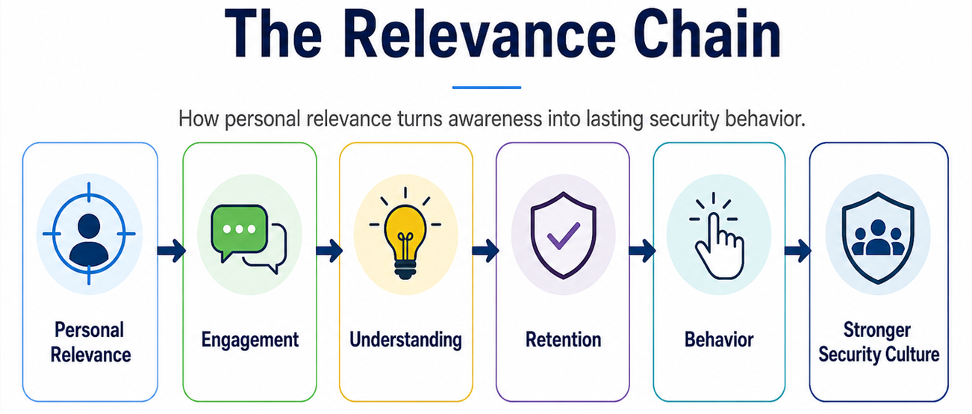
The central idea behind my inSECURITY session at Hacker Halted and the Global CISO Forum is simple. Regardless of role, title, or technical expertise, people are more likely to remember cybersecurity principles when they first understand why those principles matter to them personally.

Consider password reuse. A corporate training module may explain credential stuffing and instruct users not to reuse passwords. That is technically correct, but it starts with the organization’s concern. A relevance-based approach starts somewhere more personal for each attendee. What happens if the password from a forgotten website is exposed? What else could it unlock – their personal email, shopping accounts, social media, cloud photos, or financial information?

Once a person sees the consequence in their own real life, the organizational connection requires very little explanation, and the parallels begin to draw themselves. Replace the personal account being compromised with a corporate account, and the principle is the same. The learner has not merely memorized a rule; the learner understands the reason why the rule exists.

The same approach works with social engineering. Rather than beginning with business email compromise, we should be asking how much a stranger could learn about us as a person from a few minutes of searching publicly available information. A child’s or pet’s name, a favorite sports team, a recent trip, an employer, a colleague, or a supervisor can all become ingredients in a convincing message. When participants recognize how easily their own public information can be contextualized and weaponized, “verify before you trust” stops sounding like corporate policy and starts to sound a lot more like common sense.

Participation Turns Information Into Experience

Participation is the reason why inSECURITY is an interactive event. Rather than asking an audience to consume slides passively, attendees are asked to make personalized choices and answer questions tailored to their point of view to help reveal common assumptions we make and work through familiar situations that connect to real-world cybersecurity concepts, using the connections they’ve made to their personal lives.

For example, I can ask a room to consider where they reuse a password – or even a variation of one – and then progressively identify which personal accounts that credential could expose. Before technical concepts such as credential stuffing or the risks of predictable password variations become the focus, participants have already mapped the threat to their own money, identity, privacy, and memories. The concept is no longer abstract.

Participation creates experience; experience creates relevance. Relevance gives understanding and retention a better chance to take hold. Those better decisions can reinforce a stronger security culture.

Cybersecurity Is Already Part of Daily Life

Each inSECURITY session demonstrates how individuals are already making access-control decisions. When they decide who enters their home, they’re implementing access controls. When they share a restaurant recommendation freely or protect a banking PIN during a transaction, they are already making intuitive information-classification and handling decisions. Audience members understand resilience when they keep copies of irreplaceable family photographs in more than one location because they know a phone, laptop, or home can be lost.

The opportunity for security leaders is not merely to invent analogies, but to reveal the cybersecurity principles people already use. Instead of beginning with a framework and searching for a relatable example, begin with a relatable experience and reveal the framework within it to build stronger associations, encourage more durable recall, and reframe how people think about cybersecurity in daily life.

Shifting away from a business-first perspective when teaching cybersecurity principles changes the learner’s role, from a passive recipient of security rules to a practitioner. They recognize the principle, test it against their own experience, and apply it in a new context. The real test does not occur during the course; it occurs days or months later, when a person must make a decision without a training slide telling them what to do.

What CISOs Should Change

Making this shift does not require abandoning compliance training, phishing simulations, or established awareness programs. It requires changing the objective from “Did people complete the training?” to focusing on “What will trainees still remember when the training is no longer in front of them?” Relevance-based learning does not replace technical controls or secure-by-design systems; it strengthens the human layer that must make decisions where the technology cannot make them automatically.

  • The overarching goal of cybersecurity awareness programs is to influence human behavior and decision-making. Humans rarely make those decisions because a compliance dashboard is green. People are more likely to change behavior when the reason behind the behavior feels meaningful, relevant, and applicable to the decisions they actually make.
  • By starting with an individual-first perspective in training, every lesson should answer “Why does this matter to me?” before asking “What does the organization require?”
  • Designing participation in the lesson asks people to choose, predict, identify, and/or respond rather than just define or explain the security principle.
  • Revisit concepts 30, 60, or 90 days later instead of relying only on an immediate post-training quiz to measure retention of the information over an extended period of time.
  • Measure behavior, not just physical or virtual attendance. Looking beyond completion rates to reporting, recognition, repeat risky behavior, and other indicators shows whether decisions and user behaviors are changing and whether they have changed in response to the effectiveness of the training.

From Awareness to Relevance

Organizations will always need policies, controls, and mandatory training. But the most effective lesson may begin before we mention the organization at all.

Show people how cybersecurity protects their money, privacy, identity, family, reputation, memories, and choices. Let them experience the concept. Then connect that same lesson to the systems and information they protect at work.

Before asking people to protect what matters to the business, show them why cybersecurity matters to them. The goal is not for people to remember the cybersecurity training. The goal is for them to remember the cybersecurity lesson when the training is nowhere in sight.

About the Author

Jim West is a cybersecurity leader, educator, and speaker whose work focuses on making complex security concepts practical, memorable, and relevant for audiences at every organizational level. His interactive “inSECURITY” session is being presented at Hacker Halted / Global CISO Forum 2026.

The post From Awareness to Relevance: Rethinking How We Teach Cybersecurity appeared first on CISO MAG | Cyber Security Magazine.

Understanding Illicit Ecosystems: How Dark Web Forums Structure Cybercrime

Blogs

Blog

Understanding Illicit Ecosystems: How Dark Web Forums Structure Cybercrime

As part of our ongoing series, we analyze how dark web forums operate, breaking down Flashpoint’s tiered classification system and examining how specialized, hybrid platforms function together as an interconnected cybercrime supply chain.

SHARE THIS:
Default Author Image
July 13, 2026

When a high-profile data breach hits headlines, the default assumption is often to view the dark web as a single, centralized marketplace where any illicit service or tool can be bought. While many illicit forums aspire to be seen as a “one-stop shop,” the reality is that the underground economy relies on an interconnected network of specialized hubs that each align with distinct phases of the cybercrime lifecycle.

To understand how cybercrime thrives, it is vital to learn how these online spaces survive and how they play their parts in graduating threat actors from entry-level novices to sophisticated adversaries.

Navigating the Cybercrime Ecosystem: Entry Barriers and Forum Tiering

An illicit community’s survival hinges on its operational value and culture, which is ultimately created by its supporters. In a low-trust environment filled with cybercriminals, hidden law enforcement, and security researchers, these digital spaces are inherently defensive. To protect their communities from competitors’ attacks, surveillance, and eventual takedowns, forums implement rigorous gatekeeping mechanisms.

As such, Flashpoint organizes the cybercrime ecosystem into a tiered structure, separating them into low, mid, or top-tier forums, defined by several key factors such as: 

  • Entry Barriers: The financial or reputational requirements for a user to join the community, indicating the forum’s exclusivity.
  • Technical Expertise: The collective technical skills and proficiency of the forum’s members.
  • Trade Quality: The quality and value of illicit goods and services exchanged, such as advanced hacking tools or high-value data leaks.
  • Operational Security (OP SEC): The extent to which the community upholds strict security protocols and practices.

By analyzing these vectors, the ecosystem naturally separates into three distinct operational tiers.

Low-Tier Forums

These communities are easily accessible, often requiring a small fee or completely free registration with little to no vetting. They host less sophisticated users, beginner hackers, and minor data brokers seeking free material. Because the technical barrier is low, these spaces primarily share low-cost, high-volume data, including large data leaks, generic phishing guides, unchecked stolen accounts, and cracked software.

Consequently, these environments face a persistently high risk of scams and poor quality data. Within low-tier forums, reputation is often built by sharing free data or purchasing a rank or upgrade which is viewable by other users.

Mid-Tier Forums

Moderately accessible via both Tor and the clearnet, entry into these spaces typically require a vouch from an existing member, a minimal registration fee, or an initial deposit. These platforms concentrate on large-scale fraudulent activity and the exchange of various datasets—including bulk carding data, stolen credentials, stealer logs, phishing kits, botnets, and various malware.

The user base includes a mix of vendors, experienced threat actors, affiliates of larger groups, and aspiring cybercriminals looking for training. To protect users from internal fraud, these forums heavily prioritize integrated escrow services and reputation systems, which can be improved by purchasing an internal high-tier status.

Top-Tier Forums

These are highly exclusive platforms dedicated to high-value, highly technical, and targeted criminal operations. New applicants face a stringent vetting process, typically demanding either a formal invitation or a substantial registration payment. This exclusive layer hosts highly skilled, professional threat actors, malware developers, and key decision-makers within major illicit groups.

This is the ecosystem where adversaries build trust through valuable technical contributions or community reputation points and execute complex money laundering schemes, trade zero-day exploits, facilitate ransomware-as-a-service (RaaS) partnerships, and conduct large-scale initial access broker sales.

What Are the Different Types of Dark Web Forums?

Once a community establishes its tier, it usually functions as a specialized hub linked to a specific stage in the overall cybercrime lifecycle. They do this to cultivate talent and expertise, which naturally bridges communities together, creating a supply chain where different forums handle distinct operational and structural needs.

General Information and Community Boards

Modeled after surface-web sites like Reddit, these platforms serve as social and informational hubs. Discussions prioritize coordination, reputation management, and the propagation of best practices regarding OPSEC. Users share news about cybercriminal arrests, look for advice on how to remain anonymous, report potential exit-scams, and provide detailed reviews of specific vendors, particularly those selling illicit drugs.

Financial Theft and Carding Forums

These semi-structured environments blend marketplaces with social networks, utilizing a professionalized supply chain for selling stolen cards, dumps, and fullz. To reduce internal fraud, they rely heavily on reputation-building tools like verified seller statuses and integrated refund systems for invalid data. To ensure operational longevity, they are typically hosted on bulletproof infrastructure located in states that do not comply with international takedown requests, such as the Russian Federation.

Data Leak Forums

Depositories for stolen databases where raw breach information is structured into a tradeable commodity. Leaks are listed by victim name and sector, allowing actors to quickly find credentials or corporate records to repurpose for credential stuffing, extortion, or identity fraud.

Cracking and Hacking Tutorials (Knowledge Bases)

Existing entirely for knowledge exchange and offensive techniques, threat actors share methods, tutorials, fraudulent schemes, and bypass techniques, often encouraging educational sharing through competitions.

High-Skill Exploit and Access Forums

Top-tier platforms hosting the “upper echelons” of the community, such as initial access brokers, exploit developers, and malware creators. They rely heavily on strict arbitration systems, mandatory vendor deposits, and escrow mechanisms to safely conduct high-impact transactions and corporate intrusions.

Low-Barrier Retail Forum

High-traffic segments trading mass-market digital goods like cracked subscription accounts, premium software, and online gaming assets. Characterized by an exceedingly low barrier to entry and a relatively young user base seeking quick profit without the capability for advanced, complex operations.

Map the Illicit Pipeline Using Flashpoint

What makes the cybercriminal ecosystem truly cohesive is that the lines between these various types of forums and communities constantly blur. Most illicit communities are hybrid and transitional, intentionally or naturally blending categories to cater to each other’s needs and boost monetization.

Hybrid forums frequently connect the how-to tutorials with actual stolen data and network access, effectively creating a structural pipeline for threat actor progression. Platforms like BreachForums combine the attention-grabbing aspect of a data leak site with a structured marketplace for selling logs and other sensitive data. This type of hybridization allows a threat actor to progress from a beginner reading tutorials to an active criminal deploying stolen data.

Monitoring these fluid structures and transitions is the only way to understand how threat actors develop, and how the interconnected cybercrime landscape shifts over time. Therefore, it is essential for security teams to look beyond cyber threats as isolated, and recognize the multi-platform strategies these actors employ. Request a demo to gain visibility into these threat actor communities and proactively defend your organization from across the entire cybercrime supply chain.

Check out the rest of our “Understanding Illicit Ecosystems” series:
Understanding Illicit Ecosystems: The Hybrid Threat of “The Com”
Understanding Illicit Ecosystems: XSS and the Current State of the Russian-Speaking Underground
Understanding Illicit Ecosystems: Weaponizing Mainstream Apps and Social Infrastructure

See Flashpoint in Action

The post Understanding Illicit Ecosystems: How Dark Web Forums Structure Cybercrime appeared first on Flashpoint.

❌