Normal view

Kodak Admits Data Breach After ShinyHunters Hack Claims

18 June 2026 at 09:18

Kodak told SecurityWeek it believes there is no threat to its systems or operations as a result of the cybersecurity incident.

The post Kodak Admits Data Breach After ShinyHunters Hack Claims appeared first on SecurityWeek.

24 billion stolen records exposed online. Here’s what to do

17 June 2026 at 12:56

A newly discovered database containing 24 billion stolen records is a reminder that personal information from data breaches, phishing campaigns, and infostealer infections continues to circulate online.

The collection was exposed on the internet before being taken offline. While researchers can’t confirm exactly whose information was included, the discovery is a good opportunity to check whether your email addresses, passwords, or other personal data have already been exposed.

What happened?

Researchers at Cybernews found a publicly exposed database holding more than 8.3 TB of data.

The data, consisting of 24 billion credential records, reportedly came from 36 sources, including numerous Telegram channels, prior breach compilations, collections of infostealer logs, and some datasets apparently exported directly from live servers.

Because the data came from different sources there are some differences in what the records contain and how they are organized.

Some records were structured infostealer logs containing usernames, email addresses, and plaintext passwords, and the associated login URL. Infostealers are a type of malware designed to steal sensitive information from infected devices, such as your home computer.

An infostealer log from a single infected device can include passwords stored across all browsers, active session cookies and tokens (including those that bypass multi-factor authentication), autofill data, device fingerprints, and sometimes crypto wallets or messaging accounts. The complete bundle is what ends up in logs such as those seen by the Cybernews researchers.

Roughly 1.7 billion of the records came from hacking-related Telegram channels, mainly English and Russian, including at least one that was focused on stolen credit card data.

The exposed database was hosted on an Elasticsearch cluster. Elasticsearch is a tool used to quickly store and search lots of data. If an Elasticsearch server lacks passwords, authentication, or network restrictions, it can be accessed by anyone who finds it online. Without protections such as passwords or a firewall, anyone can read, copy, change, or even delete its data.

Other documents in the dataset contained information about known vulnerabilities, articles about breaches, and social media posts about cyberattacks. This suggests the owner actively monitors security news and vulnerabilities and enriches the credential hoard with fresh breach information, either for a commercial “monitoring” service or for offensive use.

A few years ago, we wrote about what was called the “mother of all breaches,” where the source of the dataset was later identified as data breach search engine Leak-Lookup.

This newly discovered 24 billion record exposure is in the same league as that previous mega‑dump, but appears more heavily weighted toward fresh infostealer logs, rather than older, static breach data.

Since the data was taken out of public view soon after the discovery, the researchers were unable to fully retrace everything they had found or determine how many duplicate records it contained. That’s reassuring because it reduces the chances of cybercriminals finding the database, but reused passwords may still put accounts at risk. And we still don’t know the purpose for the data collection in the first place.

What to do now

It’s good to be aware of how much information about you is out there and who’s gathering it, but it’s even more important to know exactly which information they have, since that is what they can use against you.

1. Check if your data has been exposed online using our Digital Footprint Portal.

2. If you discover exposed passwords, change them immediately and make sure you aren’t reusing the same password across multiple accounts. Prioritize updating your important accounts such as email, banking, shopping, and social media accounts.

3. Turn on multi-factor authentication (MFA) wherever possible, since it can help protect accounts even if a password has been exposed.

How to protect your data

Infostealers often spread through malicious ads, fake browser updates, and one-click downloads. Avoid clicking sponsored ads, and instead visit official websites directly. Download software only from trusted sources such as official vendor sites or app stores.

Another increasingly popular technique is ClickFix, a social engineering attack that tricks users into infecting their own devices. Never run commands or scripts copied from websites, emails, or messages unless you trust the source and understand what they do.

Pirated software, game cheats, cracked tools, and shady browser extensions remain common sources of infostealer infections. Stick to reputable software and extensions, and be wary of anything asking for excessive permissions.

Lastly, phishing emails are still a major threat. Be cautious of unexpected attachments, links, and urgent requests. If you’re unsure whether a message is legitimate, verify it through the company’s official website rather than the link in the message.

You can also use Malwarebytes Scam Guard to check individual messages. Just upload a screenshot and we’ll let you know if it’s a scam.


Breaches happen every day. Don’t be the last to know.


24 billion stolen records exposed online. Here’s what to do

17 June 2026 at 12:56

A newly discovered database containing 24 billion stolen records is a reminder that personal information from data breaches, phishing campaigns, and infostealer infections continues to circulate online.

The collection was exposed on the internet before being taken offline. While researchers can’t confirm exactly whose information was included, the discovery is a good opportunity to check whether your email addresses, passwords, or other personal data have already been exposed.

What happened?

Researchers at Cybernews found a publicly exposed database holding more than 8.3 TB of data.

The data, consisting of 24 billion credential records, reportedly came from 36 sources, including numerous Telegram channels, prior breach compilations, collections of infostealer logs, and some datasets apparently exported directly from live servers.

Because the data came from different sources there are some differences in what the records contain and how they are organized.

Some records were structured infostealer logs containing usernames, email addresses, and plaintext passwords, and the associated login URL. Infostealers are a type of malware designed to steal sensitive information from infected devices, such as your home computer.

An infostealer log from a single infected device can include passwords stored across all browsers, active session cookies and tokens (including those that bypass multi-factor authentication), autofill data, device fingerprints, and sometimes crypto wallets or messaging accounts. The complete bundle is what ends up in logs such as those seen by the Cybernews researchers.

Roughly 1.7 billion of the records came from hacking-related Telegram channels, mainly English and Russian, including at least one that was focused on stolen credit card data.

The exposed database was hosted on an Elasticsearch cluster. Elasticsearch is a tool used to quickly store and search lots of data. If an Elasticsearch server lacks passwords, authentication, or network restrictions, it can be accessed by anyone who finds it online. Without protections such as passwords or a firewall, anyone can read, copy, change, or even delete its data.

Other documents in the dataset contained information about known vulnerabilities, articles about breaches, and social media posts about cyberattacks. This suggests the owner actively monitors security news and vulnerabilities and enriches the credential hoard with fresh breach information, either for a commercial “monitoring” service or for offensive use.

A few years ago, we wrote about what was called the “mother of all breaches,” where the source of the dataset was later identified as data breach search engine Leak-Lookup.

This newly discovered 24 billion record exposure is in the same league as that previous mega‑dump, but appears more heavily weighted toward fresh infostealer logs, rather than older, static breach data.

Since the data was taken out of public view soon after the discovery, the researchers were unable to fully retrace everything they had found or determine how many duplicate records it contained. That’s reassuring because it reduces the chances of cybercriminals finding the database, but reused passwords may still put accounts at risk. And we still don’t know the purpose for the data collection in the first place.

What to do now

It’s good to be aware of how much information about you is out there and who’s gathering it, but it’s even more important to know exactly which information they have, since that is what they can use against you.

1. Check if your data has been exposed online using our Digital Footprint Portal.

2. If you discover exposed passwords, change them immediately and make sure you aren’t reusing the same password across multiple accounts. Prioritize updating your important accounts such as email, banking, shopping, and social media accounts.

3. Turn on multi-factor authentication (MFA) wherever possible, since it can help protect accounts even if a password has been exposed.

How to protect your data

Infostealers often spread through malicious ads, fake browser updates, and one-click downloads. Avoid clicking sponsored ads, and instead visit official websites directly. Download software only from trusted sources such as official vendor sites or app stores.

Another increasingly popular technique is ClickFix, a social engineering attack that tricks users into infecting their own devices. Never run commands or scripts copied from websites, emails, or messages unless you trust the source and understand what they do.

Pirated software, game cheats, cracked tools, and shady browser extensions remain common sources of infostealer infections. Stick to reputable software and extensions, and be wary of anything asking for excessive permissions.

Lastly, phishing emails are still a major threat. Be cautious of unexpected attachments, links, and urgent requests. If you’re unsure whether a message is legitimate, verify it through the company’s official website rather than the link in the message.

You can also use Malwarebytes Scam Guard to check individual messages. Just upload a screenshot and we’ll let you know if it’s a scam.


Breaches happen every day. Don’t be the last to know.


Cardiac patients’ medical data stolen and held to ransom

16 June 2026 at 14:49

Cardiac monitoring provider iRhythm has been hit by a data theft followed by an extortion attempt.

In a filing with the Securities and Exchange Commission (SEC), iRhythm revealed it was contacted by someone on June 9 who claimed to have stolen sensitive information, including proprietary data, patient PHI, and other personal information. That person demanded payment in exchange for not publishing the data.

iRhythm provides ambulatory cardiac monitoring and analysis (for example using the Zio patch) and has reportedly processed over two billion hours of heartbeat data from more than twelve million patients.

In the filing, the company said the data was obtained through social engineering and is from “certain third-party-hosted business applications”, without revealing any further details about the amount of data.

On its own website, iRhythm also doesn’t disclose much about the nature of the stolen data, but does seem to imply no financial data was affected:

“We have not identified any impact to our products, our clinical or medical device systems, our connections to customers, our manufacturing and distribution operations, patient safety, or our ability to meet patient needs. In addition, we do not store or retain individual financial account information or payment card information. 

 As we actively investigate, we will notify individuals affected by this incident in accordance with applicable law and take steps as needed to protect and remediate the impact to them.“

However, the SEC filing adds that iRhythm determined that the incident is significant, “in light of the volume of the potentially affected data.” Together with the extortionist’s claims that they have patients’ medical data, that makes the breach one worth noting if you have used iRhythm’s services.

Even without payment data, healthcare breaches have serious downstream effects:

  • Attackers can craft highly convincing emails, texts, or calls that reference specific procedures or monitoring episodes (for example, “about your recent Zio patch recording”) to trick patients into sharing more data or paying fake bills.
  • The breached data can be used to create a fake identity, insurance fraud, or medical identity theft.
  • Exposure of cardiac and other health‑related information can be deeply sensitive and may have employment/insurance ramifications, especially if data is posted publicly or sold to data brokers.

Healthcare breach data tends to circulate for years, and victims may face sporadic fraud and phishing attempts long after the headlines fade.

How to stay safe

If you’ve used iRhythm’s services, keep an eye on your post, email, and patient portals for official breach notifications from iRhythm or your healthcare provider.

In the US, breaches of protected health information that meet certain criteria must be reported to patients and regulators. iRhythm has promised to “notify individuals affected by this incident in accordance with applicable law and take steps as needed to protect and remediate the impact to them.”

To stay out of the hands of phishers and scammers:

  • When you receive a communication about the data breach, verify through other channels that it really came from iRhythm. Go directly to iRhythm’s official website or patient portal, or call a known phone number to confirm the communication is genuine.
  • Be extra suspicious of emails or texts that claim to offer compensation, refunds, or other financial consequences related to this incident.
  • Change passwords for your iRhythm‑linked portals and your cardiology or hospital patient portals, especially if you reused those passwords elsewhere.
  • Log into your health insurer’s portal and check claims on a regular basis.
  • If you see anything suspicious, report it immediately to your insurer and provider and ask them to flag your account for possible identity theft.
  • Do not provide personal or financial information over the phone just because the caller knows details about you which they may have obtained from the stolen data.

Let’s face it, an incognito window can only do so much. 
 
Breaches, dark web trading, credit fraud. Malwarebytes Identity Theft Protection monitors for all of it, alerts you fast, and comes with identity theft insurance. 

Cardiac patients’ medical data stolen and held to ransom

16 June 2026 at 14:49

Cardiac monitoring provider iRhythm has been hit by a data theft followed by an extortion attempt.

In a filing with the Securities and Exchange Commission (SEC), iRhythm revealed it was contacted by someone on June 9 who claimed to have stolen sensitive information, including proprietary data, patient PHI, and other personal information. That person demanded payment in exchange for not publishing the data.

iRhythm provides ambulatory cardiac monitoring and analysis (for example using the Zio patch) and has reportedly processed over two billion hours of heartbeat data from more than twelve million patients.

In the filing, the company said the data was obtained through social engineering and is from “certain third-party-hosted business applications”, without revealing any further details about the amount of data.

On its own website, iRhythm also doesn’t disclose much about the nature of the stolen data, but does seem to imply no financial data was affected:

“We have not identified any impact to our products, our clinical or medical device systems, our connections to customers, our manufacturing and distribution operations, patient safety, or our ability to meet patient needs. In addition, we do not store or retain individual financial account information or payment card information. 

 As we actively investigate, we will notify individuals affected by this incident in accordance with applicable law and take steps as needed to protect and remediate the impact to them.“

However, the SEC filing adds that iRhythm determined that the incident is significant, “in light of the volume of the potentially affected data.” Together with the extortionist’s claims that they have patients’ medical data, that makes the breach one worth noting if you have used iRhythm’s services.

Even without payment data, healthcare breaches have serious downstream effects:

  • Attackers can craft highly convincing emails, texts, or calls that reference specific procedures or monitoring episodes (for example, “about your recent Zio patch recording”) to trick patients into sharing more data or paying fake bills.
  • The breached data can be used to create a fake identity, insurance fraud, or medical identity theft.
  • Exposure of cardiac and other health‑related information can be deeply sensitive and may have employment/insurance ramifications, especially if data is posted publicly or sold to data brokers.

Healthcare breach data tends to circulate for years, and victims may face sporadic fraud and phishing attempts long after the headlines fade.

How to stay safe

If you’ve used iRhythm’s services, keep an eye on your post, email, and patient portals for official breach notifications from iRhythm or your healthcare provider.

In the US, breaches of protected health information that meet certain criteria must be reported to patients and regulators. iRhythm has promised to “notify individuals affected by this incident in accordance with applicable law and take steps as needed to protect and remediate the impact to them.”

To stay out of the hands of phishers and scammers:

  • When you receive a communication about the data breach, verify through other channels that it really came from iRhythm. Go directly to iRhythm’s official website or patient portal, or call a known phone number to confirm the communication is genuine.
  • Be extra suspicious of emails or texts that claim to offer compensation, refunds, or other financial consequences related to this incident.
  • Change passwords for your iRhythm‑linked portals and your cardiology or hospital patient portals, especially if you reused those passwords elsewhere.
  • Log into your health insurer’s portal and check claims on a regular basis.
  • If you see anything suspicious, report it immediately to your insurer and provider and ask them to flag your account for possible identity theft.
  • Do not provide personal or financial information over the phone just because the caller knows details about you which they may have obtained from the stolen data.

Let’s face it, an incognito window can only do so much. 
 
Breaches, dark web trading, credit fraud. Malwarebytes Identity Theft Protection monitors for all of it, alerts you fast, and comes with identity theft insurance. 

VRChat says reported data breach never happened

11 June 2026 at 13:31

A data breach notice has been filed with the Maine Attorney General, saying more than 2.4 million users of VRChat have had their data breached.

The question is, was it VRChat who filed the breach notice, or did someone pretending to represent the company post it instead? On Reddit, a VRChat representative posted:

VRChat did not submit this Notice of Data Incident, and we have no reason to believe that our systems have been compromised. We are in the process of contacting the Maine Attorney General’s office to have this removed.

The breach notice states that VRChat experienced unauthorized access to some account data between May 10 and May 12, 2026. The access supposedly happened in VRChat’s cloud environment and involved user profile and login-related data.

According to the notice, the information exposed varied by account, but may have included:

  • VRChat username
  • Email address associated with the VRChat account
  • VRChat+ subscription status
  • Login history, including device information, hardware identifiers, and IP addresses

VRChat is a social platform designed primarily for virtual reality headsets, allowing users to interact with others through user-created 3D avatars and worlds. Users can access VRChat through Steam for PC, the Meta Quest Store, or as an Android app for compatible devices.

The notice states that no passwords or payment card data was exposed. However, even without passwords or card details, there are still potential risks when it comes to other breached data.

Phishing

Cybercriminals may use usernames and email addresses in targeted phishing attempts. For example, users may receive phishing emails or in‑platform messages claiming to be from “Support,” with fake security alerts or prompts to “confirm your age” via a malicious link.

Knowledge of subscription status could make scams more convincing. A scammer could send tailored lures like “billing issue with your subscription” or refund scams, which tend to have higher click-through rates among paying users.

Account takeover

Cybercriminals may combine usernames and email addresses from one breach with passwords stolen in other data breaches and try them against accounts. This technique, known as credential stuffing, takes advantage of people who reuse passwords across multiple sites.

Valuable accounts may then be sold to other players or used for scams.

Identity correlation

Steam and Meta user IDs linked to breached accounts can help cybercriminals connect identities across gaming and social platforms, especially if the same email or profile name is reused.

IP addresses, login history, device information, and other identifiers can also help build a more detailed advertising or tracking profile of a user.

How to stay safe

Whether or not the breach turns out to be an actual breach, here are some steps you can take to protect yourself:

First and foremost, be cautious of emails, texts, or calls claiming to come from VRChat or the gaming platforms you used it on, as cybercriminals often exploit breaches with phishing scams.

If you’ve used your VRChat password anywhere else, change those accounts immediately, and set up two-factor authentication (2FA) on your VRChat account if you haven’t already.

More general advice can be found in our article on what to do when you find out you’re involved in a data breach.

Update June 11, 2026: Article was updated to reflect VRChat’s post on Reddit.

Before publishing our original article, we tried to contact VRChat on two separate email addresses but received no meaningful response.


Let’s face it, an incognito window can only do so much. 
 
Breaches, dark web trading, credit fraud. Malwarebytes Identity Theft Protection monitors for all of it, alerts you fast, and comes with identity theft insurance. 

VRChat says reported data breach never happened

11 June 2026 at 13:31

A data breach notice has been filed with the Maine Attorney General, saying more than 2.4 million users of VRChat have had their data breached.

The question is, was it VRChat who filed the breach notice, or did someone pretending to represent the company post it instead? On Reddit, a VRChat representative posted:

VRChat did not submit this Notice of Data Incident, and we have no reason to believe that our systems have been compromised. We are in the process of contacting the Maine Attorney General’s office to have this removed.

The breach notice states that VRChat experienced unauthorized access to some account data between May 10 and May 12, 2026. The access supposedly happened in VRChat’s cloud environment and involved user profile and login-related data.

According to the notice, the information exposed varied by account, but may have included:

  • VRChat username
  • Email address associated with the VRChat account
  • VRChat+ subscription status
  • Login history, including device information, hardware identifiers, and IP addresses

VRChat is a social platform designed primarily for virtual reality headsets, allowing users to interact with others through user-created 3D avatars and worlds. Users can access VRChat through Steam for PC, the Meta Quest Store, or as an Android app for compatible devices.

The notice states that no passwords or payment card data was exposed. However, even without passwords or card details, there are still potential risks when it comes to other breached data.

Phishing

Cybercriminals may use usernames and email addresses in targeted phishing attempts. For example, users may receive phishing emails or in‑platform messages claiming to be from “Support,” with fake security alerts or prompts to “confirm your age” via a malicious link.

Knowledge of subscription status could make scams more convincing. A scammer could send tailored lures like “billing issue with your subscription” or refund scams, which tend to have higher click-through rates among paying users.

Account takeover

Cybercriminals may combine usernames and email addresses from one breach with passwords stolen in other data breaches and try them against accounts. This technique, known as credential stuffing, takes advantage of people who reuse passwords across multiple sites.

Valuable accounts may then be sold to other players or used for scams.

Identity correlation

Steam and Meta user IDs linked to breached accounts can help cybercriminals connect identities across gaming and social platforms, especially if the same email or profile name is reused.

IP addresses, login history, device information, and other identifiers can also help build a more detailed advertising or tracking profile of a user.

How to stay safe

Whether or not the breach turns out to be an actual breach, here are some steps you can take to protect yourself:

First and foremost, be cautious of emails, texts, or calls claiming to come from VRChat or the gaming platforms you used it on, as cybercriminals often exploit breaches with phishing scams.

If you’ve used your VRChat password anywhere else, change those accounts immediately, and set up two-factor authentication (2FA) on your VRChat account if you haven’t already.

More general advice can be found in our article on what to do when you find out you’re involved in a data breach.

Update June 11, 2026: Article was updated to reflect VRChat’s post on Reddit.

Before publishing our original article, we tried to contact VRChat on two separate email addresses but received no meaningful response.


Let’s face it, an incognito window can only do so much. 
 
Breaches, dark web trading, credit fraud. Malwarebytes Identity Theft Protection monitors for all of it, alerts you fast, and comes with identity theft insurance. 

23andMe exposed genetic information of millions, lawsuit says

2 June 2026 at 11:53

California has sued the former shell of DNA testing company 23andMe over alleged security failures and misleading statements surrounding its 2023 data breach.

On May 27, 2026, Attorney General Rob Bonta filed suit in San Francisco Superior Court against Chrome Holding Co., the company now handling 23andMe’s remaining assets following its bankruptcy.

California’s complaint accuses 23andMe of failing to implement reasonable security measures to protect sensitive data and alleges violations of several state privacy and consumer protection laws. It also accuses the company of making misleading statements about its security practices.

The 2023 breach used old-school credential-stuffing tactics against 23andMe’s login page. Attackers operated inside the systems for roughly five months without anyone noticing. The direct compromise was modest, affecting about 14,000 accounts, but that was all the attackers needed to steal the data of just under seven million customers.

The intruders pivoted from those accounts through DNA Relatives, the platform’s headline feature, which enabled people to determine who they were connected with through DNA similarity. The lawsuit alleges a critical coding error in that feature enabled the perpetrators to scrape data from millions of other users connected by biological kinship.

The victim-blaming defense became evidence

After the breach went public, 23andMe sent victims’ legal representatives a letter blaming users for reusing passwords from sites that had been compromised earlier. The exposed data, the company suggested, had been shared of the users’ own free will and would not cause “pecuniary harm.”

The harms stemming from genetic data theft extend far beyond financial losses, however. The genetic information that was stolen enabled thieves to determine an individual’s genetic origins.

The data was reportedly offered for sale on the dark web with this information as a selling point, enabling sellers to offer records on Asian American Pacific Islander (AAPI) or Jewish customers, for example. Bonta’s office pointed out that antisemitic violence was on the rise at the time.

In spite of the letter’s attempt to blame users, only about 14,000 accounts were directly compromised through password reuse. The rest of the data was allegedly exposed through 23andMe’s own product. According to the complaint, the coding error in DNA Relatives exposed the data of anyone who had opted into the service, not just those linked to the 14,000 compromised accounts.

Can the state recover damages?

California is seeking statutory penalties ranging from $1,000 to $7,500 per violation. With 855,541 Californians among the affected users, the costs could mount up quickly.

The question is how much of it the state will collect if it wins its case. 23andMe filed for Chapter 11 bankruptcy in March 2025, then sold most of its assets, including the genomic data of more than 15 million customers, to TTAM Research Institute, a nonprofit founded by former 23andMe CEO Anne Wojcicki. California and several other states opposed the sale on Genetic Information Privacy Act grounds, but a federal bankruptcy judge approved it. The states are now appealing that decision.

Chrome Holding Co., the corporate shell that remains of 23andMe, received $305 million from that sale. But others have already been picking over what’s left.

Other regulators have already had their turn. The UK Information Commissioner’s Office fined 23andMe £2.31 million in June last year following a joint investigation with the Privacy Commissioner of Canada. A federal court initially approved a $30 million class-action settlement covering most US customer claims. That settlement later grew to $50 million and received final approval in January 2026.

What customers can do

If you tested with 23andMe, the standard breach hygiene still applies. Reset any password you reused on other sites and turn on multi-factor authentication wherever it’s offered. Credential stuffing only works on usernames and passwords that have already been exposed elsewhere. Also watch for phishing attacks that name-drop 23andMe or the breach itself. And maybe weigh the benefits of using DNA testing services against the security risks.

Because there’s one part of this that no fine and no settlement can solve: stolen genetic data sold on the dark web cannot be taken back. Passwords can be changed. DNA can’t.


Browse like no one’s watching. 

Malwarebytes Privacy VPN encrypts your connection and never logs what you do, so the next story you read doesn’t have to feel personal. Try it free → 

23andMe exposed genetic information of millions, lawsuit says

2 June 2026 at 11:53

California has sued the former shell of DNA testing company 23andMe over alleged security failures and misleading statements surrounding its 2023 data breach.

On May 27, 2026, Attorney General Rob Bonta filed suit in San Francisco Superior Court against Chrome Holding Co., the company now handling 23andMe’s remaining assets following its bankruptcy.

California’s complaint accuses 23andMe of failing to implement reasonable security measures to protect sensitive data and alleges violations of several state privacy and consumer protection laws. It also accuses the company of making misleading statements about its security practices.

The 2023 breach used old-school credential-stuffing tactics against 23andMe’s login page. Attackers operated inside the systems for roughly five months without anyone noticing. The direct compromise was modest, affecting about 14,000 accounts, but that was all the attackers needed to steal the data of just under seven million customers.

The intruders pivoted from those accounts through DNA Relatives, the platform’s headline feature, which enabled people to determine who they were connected with through DNA similarity. The lawsuit alleges a critical coding error in that feature enabled the perpetrators to scrape data from millions of other users connected by biological kinship.

The victim-blaming defense became evidence

After the breach went public, 23andMe sent victims’ legal representatives a letter blaming users for reusing passwords from sites that had been compromised earlier. The exposed data, the company suggested, had been shared of the users’ own free will and would not cause “pecuniary harm.”

The harms stemming from genetic data theft extend far beyond financial losses, however. The genetic information that was stolen enabled thieves to determine an individual’s genetic origins.

The data was reportedly offered for sale on the dark web with this information as a selling point, enabling sellers to offer records on Asian American Pacific Islander (AAPI) or Jewish customers, for example. Bonta’s office pointed out that antisemitic violence was on the rise at the time.

In spite of the letter’s attempt to blame users, only about 14,000 accounts were directly compromised through password reuse. The rest of the data was allegedly exposed through 23andMe’s own product. According to the complaint, the coding error in DNA Relatives exposed the data of anyone who had opted into the service, not just those linked to the 14,000 compromised accounts.

Can the state recover damages?

California is seeking statutory penalties ranging from $1,000 to $7,500 per violation. With 855,541 Californians among the affected users, the costs could mount up quickly.

The question is how much of it the state will collect if it wins its case. 23andMe filed for Chapter 11 bankruptcy in March 2025, then sold most of its assets, including the genomic data of more than 15 million customers, to TTAM Research Institute, a nonprofit founded by former 23andMe CEO Anne Wojcicki. California and several other states opposed the sale on Genetic Information Privacy Act grounds, but a federal bankruptcy judge approved it. The states are now appealing that decision.

Chrome Holding Co., the corporate shell that remains of 23andMe, received $305 million from that sale. But others have already been picking over what’s left.

Other regulators have already had their turn. The UK Information Commissioner’s Office fined 23andMe £2.31 million in June last year following a joint investigation with the Privacy Commissioner of Canada. A federal court initially approved a $30 million class-action settlement covering most US customer claims. That settlement later grew to $50 million and received final approval in January 2026.

What customers can do

If you tested with 23andMe, the standard breach hygiene still applies. Reset any password you reused on other sites and turn on multi-factor authentication wherever it’s offered. Credential stuffing only works on usernames and passwords that have already been exposed elsewhere. Also watch for phishing attacks that name-drop 23andMe or the breach itself. And maybe weigh the benefits of using DNA testing services against the security risks.

Because there’s one part of this that no fine and no settlement can solve: stolen genetic data sold on the dark web cannot be taken back. Passwords can be changed. DNA can’t.


Browse like no one’s watching. 

Malwarebytes Privacy VPN encrypts your connection and never logs what you do, so the next story you read doesn’t have to feel personal. Try it free → 

Carnival confirms data breach impacting nearly 6 million

28 May 2026 at 14:04

Carnival Corporation, parent of Carnival Cruise Line, is sending out fresh “Notice of Cybersecurity Event” letters dated May 27, 2026. If you feel like you’ve read that sentence before, you’re not imagining things. Over the last decade, the world’s largest cruise operator has accumulated a worrying track record of breaches, ransomware incidents, and regulatory penalties, with this 2026 incident adding yet another entry to an already lengthy cybersecurity history.

There are several data breaches involving Carnival Corporation or one of its subsidiaries in our database.

Between 2019 and 2021 alone, Carnival reported four separate cybersecurity events to the New York Department of Financial Services. These included two ransomware attacks and a phishing incident in which attackers deployed malware, accessed and encrypted internal systems, and stole personal customer and employee information.

In this latest case, an attacker used social engineering to trick a Carnival employee into granting access to part of the company’s IT systems on April 14, 2026. By April 22, they used a compromised account to access a “limited portion” of Carnival’s IT systems, where they were able to copy personal data before being blocked.

According to the data breach notice filed in Maine, a total of 5,995,277 people were affected. Carnival determined that the intruder had illegally copied files containing personal information and is now writing to affected individuals to tell them that “data elements” relating to them were obtained.

Researchers cited by Gblock say the stolen data appears to include:

  • Full names
  • Email addresses
  • Dates of birth
  • Genders
  • Mariner Society membership status and tier
  • Internal customer identifiers

The template letter does not list specific data fields. Instead, it uses a placeholder:

“We have determined that your <<data elements>> were obtained.”

This strongly suggests that Carnival is populating each letter with data categories relevant to that particular individual, a common pattern in large breaches where people may have provided different information at different times.

Furthermore, the letters contain the usual content about the speed with which the company acted, involving third‑party experts, and frame the affected systems as a limited subset of the environment. For recipients, the important fact is not how limited the breach was from the company’s point of view, but whether the exposed information could be used for identity theft, fraud, or highly convincing phishing attacks.


Breaches happen every day. Don’t be the last to know.


We do know from past Carnival incidents that exposed data has included names, addresses, dates of birth, passport numbers, health information, and payment details. In previous breaches affecting cruise lines, compromised data has ranged from basic contact details to Social Security numbers and credit card information. Carnival has not publicly disclosed the full categories of data involved in the 2026 incident, but given that this 2026 event again involves “personal information” copied from internal systems, it is reasonable to treat it as a serious privacy incident, even if the exact mix of data varies per person.

The attack was claimed by extortion group ShinyHunters, which is known to steal data and then ask for a ransom. If the victim does not agree to the terms, the data will be published and/or sold to the highest bidder.

ShinyHunters offers Carnival data for download

From a cybercriminal’s perspective, cruise industry data is highly prized. Cruise passengers are often relatively wealthy, and passenger records can combine identity data (names, addresses, dates of birth, passport numbers), contact data (emails, phone numbers), and potentially payment data (card numbers and sometimes bank details), making them valuable for identity theft, targeted phishing, and fraud.

What to do if you’re affected

To mitigate the fallout, Carnival is offering a complimentary 24‑month TransUnion credit‑monitoring package, delivered via the MyTrueIdentity platform and supported by Cyberscout for fraud assistance.

Be cautious of emails, texts, or calls claiming to come from Carnival or credit-monitoring providers, as cybercriminals often exploit breaches with phishing scams. Read our advice on what to do when you find out you’re involved in a data breach.


What do cybercriminals know about you?

Use Malwarebytes’ free Digital Footprint scan to see whether your personal information has been exposed online.

Carnival confirms data breach impacting nearly 6 million

28 May 2026 at 14:04

Carnival Corporation, parent of Carnival Cruise Line, is sending out fresh “Notice of Cybersecurity Event” letters dated May 27, 2026. If you feel like you’ve read that sentence before, you’re not imagining things. Over the last decade, the world’s largest cruise operator has accumulated a worrying track record of breaches, ransomware incidents, and regulatory penalties, with this 2026 incident adding yet another entry to an already lengthy cybersecurity history.

There are several data breaches involving Carnival Corporation or one of its subsidiaries in our database.

Between 2019 and 2021 alone, Carnival reported four separate cybersecurity events to the New York Department of Financial Services. These included two ransomware attacks and a phishing incident in which attackers deployed malware, accessed and encrypted internal systems, and stole personal customer and employee information.

In this latest case, an attacker used social engineering to trick a Carnival employee into granting access to part of the company’s IT systems on April 14, 2026. By April 22, they used a compromised account to access a “limited portion” of Carnival’s IT systems, where they were able to copy personal data before being blocked.

According to the data breach notice filed in Maine, a total of 5,995,277 people were affected. Carnival determined that the intruder had illegally copied files containing personal information and is now writing to affected individuals to tell them that “data elements” relating to them were obtained.

Researchers cited by Gblock say the stolen data appears to include:

  • Full names
  • Email addresses
  • Dates of birth
  • Genders
  • Mariner Society membership status and tier
  • Internal customer identifiers

The template letter does not list specific data fields. Instead, it uses a placeholder:

“We have determined that your <<data elements>> were obtained.”

This strongly suggests that Carnival is populating each letter with data categories relevant to that particular individual, a common pattern in large breaches where people may have provided different information at different times.

Furthermore, the letters contain the usual content about the speed with which the company acted, involving third‑party experts, and frame the affected systems as a limited subset of the environment. For recipients, the important fact is not how limited the breach was from the company’s point of view, but whether the exposed information could be used for identity theft, fraud, or highly convincing phishing attacks.


Breaches happen every day. Don’t be the last to know.


We do know from past Carnival incidents that exposed data has included names, addresses, dates of birth, passport numbers, health information, and payment details. In previous breaches affecting cruise lines, compromised data has ranged from basic contact details to Social Security numbers and credit card information. Carnival has not publicly disclosed the full categories of data involved in the 2026 incident, but given that this 2026 event again involves “personal information” copied from internal systems, it is reasonable to treat it as a serious privacy incident, even if the exact mix of data varies per person.

The attack was claimed by extortion group ShinyHunters, which is known to steal data and then ask for a ransom. If the victim does not agree to the terms, the data will be published and/or sold to the highest bidder.

ShinyHunters offers Carnival data for download

From a cybercriminal’s perspective, cruise industry data is highly prized. Cruise passengers are often relatively wealthy, and passenger records can combine identity data (names, addresses, dates of birth, passport numbers), contact data (emails, phone numbers), and potentially payment data (card numbers and sometimes bank details), making them valuable for identity theft, targeted phishing, and fraud.

What to do if you’re affected

To mitigate the fallout, Carnival is offering a complimentary 24‑month TransUnion credit‑monitoring package, delivered via the MyTrueIdentity platform and supported by Cyberscout for fraud assistance.

Be cautious of emails, texts, or calls claiming to come from Carnival or credit-monitoring providers, as cybercriminals often exploit breaches with phishing scams. Read our advice on what to do when you find out you’re involved in a data breach.


What do cybercriminals know about you?

Use Malwarebytes’ free Digital Footprint scan to see whether your personal information has been exposed online.

Lawmakers Demand Answers as CISA Tries to Contain Data Leak

22 May 2026 at 18:34

Lawmakers in both houses of Congress are demanding answers from the U.S. Cybersecurity & Infrastructure Security Agency (CISA) after KrebsOnSecurity reported this week that a CISA contractor intentionally published AWS GovCloud keys and a vast trove of other agency secrets on a public GitHub account. The inquiry comes as CISA is still struggling to contain the breach and invalidate the leaked credentials.

On May 18, KrebsOnSecurity reported that a CISA contractor with administrative access to the agency’s code development platform had created a public GitHub profile called “Private-CISA” that included plaintext credentials to dozens of internal CISA systems. Experts who reviewed the exposed secrets said the commit logs for the code repository showed the CISA contractor disabled GitHub’s built-in protection against publishing sensitive credentials in public repos.

CISA acknowledged the leak but has not responded to questions about the duration of the data exposure. However, experts who reviewed the now-defunct Private-CISA archive said it was originally created in November 2025, and that it exhibits a pattern consistent with an individual operator using the repository as a working scratchpad or synchronization mechanism rather than a curated project repository.

In a written statement, CISA said “there is no indication that any sensitive data was compromised as a result of the incident.” But in a May 19 a letter (PDF) to CISA’s Acting Director Nick Andersen, Sen. Maggie Hassan (D-NH) said the credential leak raises serious questions about how such a security lapse could occur at the very agency charged with helping to prevent cyber breaches.

“This reporting raises serious concerns regarding CISA’s internal policies and procedures at a time of significant cybersecurity threats against U.S. critical infrastructure,” Sen. Hassan wrote.

A May 19 letter from Sen. Margaret Hassan (D-NH) to the acting director of CISA demanded answers to a dozen questions about the breach.

Sen. Hassan noted that the incident occurred against the backdrop of major disruptions internally at CISA, which lost more than a third of it workforce and almost all of its senior leaders after the Trump administration forced a series of early retirements, buyouts, and resignations across the agency’s various divisions.

Rep. Bennie Thompson (D-MS), the ranking member on the House Homeland Security Committee, echoed the senator’s concerns.

“We are concerned that this incident reflects a diminished security culture and/or an inability for CISA to adequately manage its contract support,” Thompson wrote in a May 19 letter to the acting CISA chief that was co-signed by Rep. Delia Ramirez (D-Ill), the ranking member of the panel’s Subcommittee on Cybersecurity and Infrastructure Protection. “It’s no secret that our adversaries — like China, Russia, and Iran — seek to gain access to and persistence on federal networks. The files contained in the ‘Private-CISA’ repository provided the information, access, and roadmap to do just that.”

KrebsOnSecurity has learned that more a week after CISA was first notified of the data leak by the security firm GitGuardian, the agency is still working to invalidate and replace many of the exposed keys and secrets.

On May 20, KrebsOnSecurity heard from Dylan Ayrey, the creator of TruffleHog, an open-source tool for discovering private keys and other secrets buried in code hosted at GitHub and other public platforms. Ayrey said CISA still hadn’t invalidated an RSA private key exposed in the Private-CISA repo that granted access to a GitHub app which is owned by the CISA enterprise account and installed on the CISA-IT GitHub organization with full access to all code repositories.

“An attacker with this key can read source code from every repository in the CISA-IT organization, including private repos, register rogue self-hosted runners to hijack CI/CD pipelines and access repository secrets, and modify repository admin settings including branch protection rules, webhooks, and deploy keys,” Ayrey told KrebsOnSecurity. CI/CD stands for Continuous Integration and Continuous Delivery, and it refers to a set of practices used to automate the building, testing and deployment of software.

KrebsOnSecurity notified CISA about Ayrey’s findings on May 20. Ayrey said CISA appears to have invalidated the exposed RSA private key sometime after that notification. But he noted that CISA still hasn’t rotated leaked credentials tied to other critical security technologies that are deployed across the agency’s technology portfolio (KrebsOnSecurity is not naming those technologies publicly for the time being).

CISA responded with a brief written statement in response to questions about Ayrey’s findings, saying “CISA is actively responding and coordinating with the appropriate parties and vendors to ensure any identified leaked credentials are rotated and rendered invalid and will continue to take appropriate steps to protect the security of our systems.”

Ayrey said his company Truffle Security monitors GitHub and a number of other code platforms for exposed keys, and attempts to alert affected accounts to the sensitive data exposure(s). They can do this easily on GitHub because the platform publishes a live feed which includes a record of all commits and changes to public code repositories. But he said cybercriminal actors also monitor these public feeds, and are often quick to pounce on API or SSH keys that get inadvertently published in code commits.

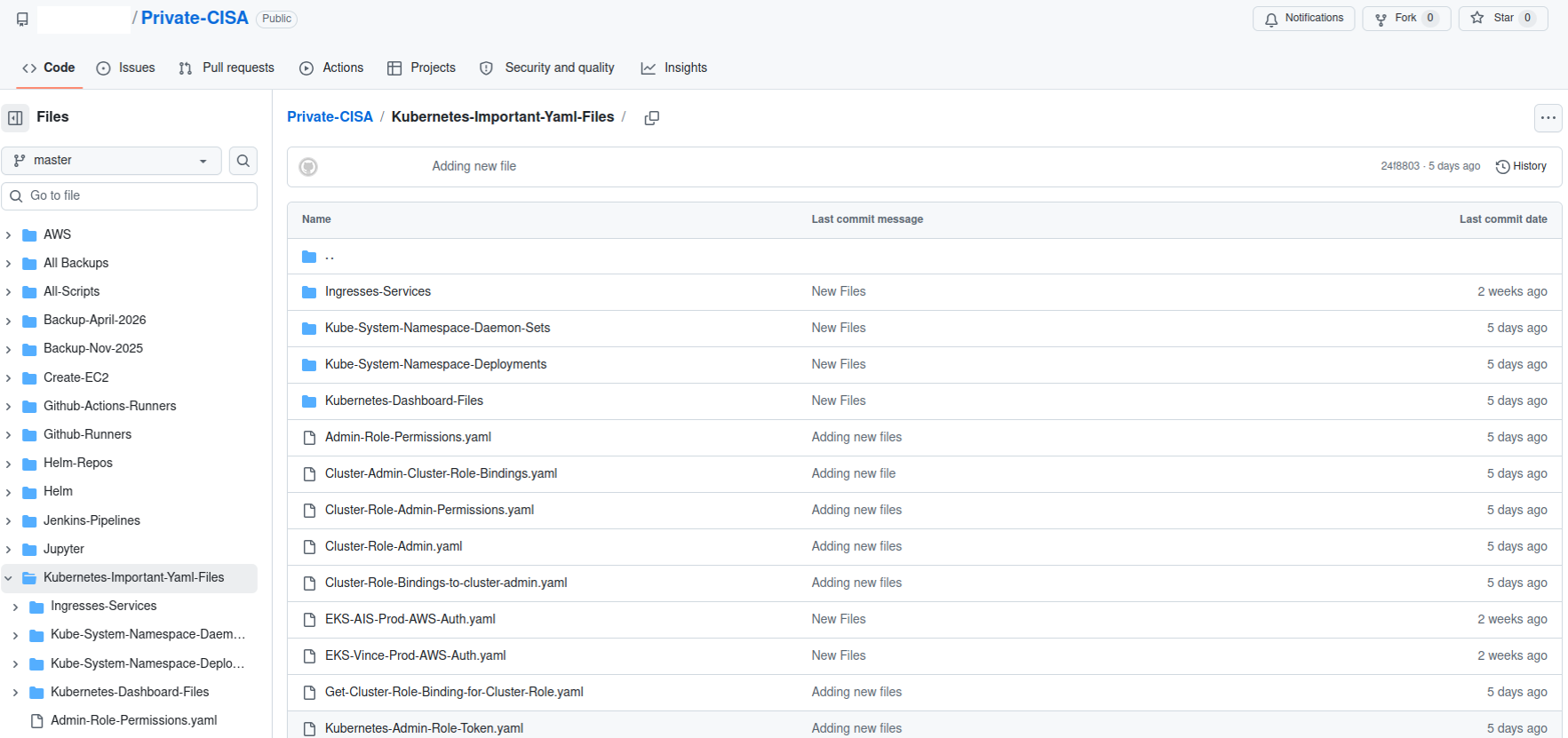
The Private CISA GitHub repo exposed dozens of plaintext credentials to important CISA GovCloud resources. The filenames include AWS-Workspace-Bookmarks-April-6-2026.html, AWS-Workspace-Firefox-Passwords.csv, Important AWS Tokens.txt, kube-config.txt, etc.

The Private-CISA GitHub repo exposed dozens of plaintext credentials to important CISA GovCloud resources.

In practical terms, it is likely that cybercrime groups or foreign adversaries also noticed the publication of these CISA secrets, the most egregious of which appears to have happened in late April 2026, Ayrey said.

“We monitor that firehose of data for keys, and we have tools to try to figure out whose they are,” he said. “We have evidence attackers monitor that firehose as well. Anyone monitoring GitHub events could be sitting on this information.”

James Wilson, the enterprise technology editor for the Risky Business security podcast, said organizations using GitHub to manage code projects can set top-down policies that prevent employees from disabling GitHub’s protections against publishing secret keys and credentials. But Wilson’s co-host Adam Boileau said it’s not clear that any technology could stop employees from opening their own personal GitHub account and using it to store sensitive and proprietary information.

“Ultimately, this is a thing you can’t solve with a technical control,” Boileau said on this week’s podcast. “This is a human problem where you’ve hired a contractor to do this work and they have decided of their own volition to use GitHub to synchronize content from a work machine to a home machine. I don’t know what technical controls you could put in place given that this is being done presumably outside of anything CISA managed or even had visibility on.”

Update, 3:05 p.m. ET: Added statement from CISA. Corrected a date in the story (Truffle Security said it found the repo gained some of its most sensitive secrets in late April 2026, not 2025).

Verizon DBIR 2026: Vulnerability Exploitation Overtakes Credential Theft as Top Breach Vector

20 May 2026 at 02:04

Verizon’s 2026 DBIR finds vulnerability exploitation has overtaken credential abuse as the leading breach vector, as AI accelerates attacks, patching delays worsen, and ransomware and third-party compromises continue to surge.

The post Verizon DBIR 2026: Vulnerability Exploitation Overtakes Credential Theft as Top Breach Vector appeared first on SecurityWeek.

Biometrics, diagnoses, and bank details exposed in major healthcare breach

19 May 2026 at 17:56

NYC Health + Hospitals (NYC H+H) posted a data breach notice about a months‑long breach via a third‑party vendor that exposed highly sensitive patient and employee data for at least 1.8 million people, including medical records, government IDs, geolocation data, and even fingerprint and palm‑print biometrics.

NYC H+H detected suspicious activity on February 2, 2026, and later confirmed that an unauthorized actor had access to parts of its network from roughly late November 2025 through February 2026.

During this window, attackers copied files containing personal, medical, financial, and biometric information. The incident was reported to the US Department of Health and Human Services (HHS) on March 24, 2026, and currently affects at least 1.8 million individuals, making it one of the largest healthcare breaches of 2026 so far.

HHS filing

NYC H+H attributes the intrusion to a breach at an unnamed third‑party vendor that had access to its systems. This fits the current pattern of supply-chain compromises, where a vendor becomes the entry point for attackers to gain access to their clients’ systems or data.

Incidents like these are a textbook example of how deeply personal health data can fuel long‑term fraud, stalkerware‑like abuse, and permanent privacy loss.


Digital Footprint Scan

See if your personal data has been exposed.


Types of data

According to NYC H+H’s notice and related write‑ups, the exposed dataset is unusually broad and detailed.

We can divide the data into three distinct layers:

  • Classical PII, which can be combined with other leaked datasets: Full names and contact details. Government‑issued identifiers, including Social Security Numbers, driver’s license and passport numbers, other government ID numbers, taxpayer IDs, and IRS identity protection PINs. The breach also exposed billing and payment records, plus bank and card data, which can be used for direct financial theft and highly convincing social engineering.
  • Medical and insurance data: Detailed diagnoses, medication lists, and test results expose conditions people may have kept private from employers, family, or insurers, enabling blackmail, targeted scams, and discrimination. Insurance and claims data can be abused to submit fraudulent claims, redirect reimbursements, or impersonate existing identities in healthcare systems.
  • Biometrics: These are at least as sensitive as medical history because they tend to stay with you for life. They are not easy to erase or replace. Once compromised, large biometric databases become long‑term liabilities for everyone who relies on them as trustworthy identifiers.

Unfortunately, this is part of a broader pattern. The FBI’s Internet Crime Complaint Center (IC3) reports that healthcare was the most targeted critical infrastructure sector for ransomware in 2025, with 460 ransomware incidents and 182 reported healthcare data breaches.

The Change Healthcare ransomware attack alone exposed medical and billing data for more than 190 million Americans, highlighting how a single healthcare intermediary can disrupt an entire system.

What to do if you’re involved

If you’ve interacted with NYC Health + Hospitals, there’s a possibility your personal information could be affected.

NYC Health + Hospitals is making identity theft prevention and mitigation services, including credit monitoring, available through Kroll Information Assurance, LLC for a period of 24 months at no cost to all individuals who have worked for or been a patient of NYC Health + Hospitals. For more details check its data breach notice.

If you think you’ve been affected by a data breach, here are steps you can take to protect yourself:

  • Check the company’s advice. Every breach is different, so check with the company to find out what’s happened and follow any specific advice it offers.
  • Change your password. You can make a stolen password useless to thieves by changing it. Choose a strong password that you don’t use for anything else. Better yet, let a password manager choose one for you.
  • Enable two-factor authentication (2FA). If you can, use a FIDO2-compliant hardware key, laptop, or phone as your second factor. Some forms of 2FA can be phished just as easily as a password, but 2FA that relies on a FIDO2 device can’t be phished.
  • Watch out for impersonators. The criminals may contact you posing as the breached platform. Check the official website to see if it’s contacting victims and verify the identity of anyone who contacts you using a different communication channel.
  • Take your time. Phishing attacks often impersonate people or brands you know, and use themes that require urgent attention, such as missed deliveries, account suspensions, and security alerts.
  • Consider not storing your card details. It’s definitely more convenient to let sites remember your card details, but it increases risk if a retailer suffers a breach.
  • Set up identity monitoring, which alerts you if your personal information is found being traded illegally online and helps you recover after.

Let’s face it, an incognito window can only do so much. 
 
Breaches, dark web trading, credit fraud. Malwarebytes Identity Theft Protection monitors for all of it, alerts you fast, and comes with identity theft insurance. 

Biometrics, diagnoses, and bank details exposed in major healthcare breach

19 May 2026 at 17:56

NYC Health + Hospitals (NYC H+H) posted a data breach notice about a months‑long breach via a third‑party vendor that exposed highly sensitive patient and employee data for at least 1.8 million people, including medical records, government IDs, geolocation data, and even fingerprint and palm‑print biometrics.

NYC H+H detected suspicious activity on February 2, 2026, and later confirmed that an unauthorized actor had access to parts of its network from roughly late November 2025 through February 2026.

During this window, attackers copied files containing personal, medical, financial, and biometric information. The incident was reported to the US Department of Health and Human Services (HHS) on March 24, 2026, and currently affects at least 1.8 million individuals, making it one of the largest healthcare breaches of 2026 so far.

HHS filing

NYC H+H attributes the intrusion to a breach at an unnamed third‑party vendor that had access to its systems. This fits the current pattern of supply-chain compromises, where a vendor becomes the entry point for attackers to gain access to their clients’ systems or data.

Incidents like these are a textbook example of how deeply personal health data can fuel long‑term fraud, stalkerware‑like abuse, and permanent privacy loss.


Digital Footprint Scan

See if your personal data has been exposed.


Types of data

According to NYC H+H’s notice and related write‑ups, the exposed dataset is unusually broad and detailed.

We can divide the data into three distinct layers:

  • Classical PII, which can be combined with other leaked datasets: Full names and contact details. Government‑issued identifiers, including Social Security Numbers, driver’s license and passport numbers, other government ID numbers, taxpayer IDs, and IRS identity protection PINs. The breach also exposed billing and payment records, plus bank and card data, which can be used for direct financial theft and highly convincing social engineering.
  • Medical and insurance data: Detailed diagnoses, medication lists, and test results expose conditions people may have kept private from employers, family, or insurers, enabling blackmail, targeted scams, and discrimination. Insurance and claims data can be abused to submit fraudulent claims, redirect reimbursements, or impersonate existing identities in healthcare systems.
  • Biometrics: These are at least as sensitive as medical history because they tend to stay with you for life. They are not easy to erase or replace. Once compromised, large biometric databases become long‑term liabilities for everyone who relies on them as trustworthy identifiers.

Unfortunately, this is part of a broader pattern. The FBI’s Internet Crime Complaint Center (IC3) reports that healthcare was the most targeted critical infrastructure sector for ransomware in 2025, with 460 ransomware incidents and 182 reported healthcare data breaches.

The Change Healthcare ransomware attack alone exposed medical and billing data for more than 190 million Americans, highlighting how a single healthcare intermediary can disrupt an entire system.

What to do if you’re involved

If you’ve interacted with NYC Health + Hospitals, there’s a possibility your personal information could be affected.

NYC Health + Hospitals is making identity theft prevention and mitigation services, including credit monitoring, available through Kroll Information Assurance, LLC for a period of 24 months at no cost to all individuals who have worked for or been a patient of NYC Health + Hospitals. For more details check its data breach notice.

If you think you’ve been affected by a data breach, here are steps you can take to protect yourself:

  • Check the company’s advice. Every breach is different, so check with the company to find out what’s happened and follow any specific advice it offers.
  • Change your password. You can make a stolen password useless to thieves by changing it. Choose a strong password that you don’t use for anything else. Better yet, let a password manager choose one for you.
  • Enable two-factor authentication (2FA). If you can, use a FIDO2-compliant hardware key, laptop, or phone as your second factor. Some forms of 2FA can be phished just as easily as a password, but 2FA that relies on a FIDO2 device can’t be phished.
  • Watch out for impersonators. The criminals may contact you posing as the breached platform. Check the official website to see if it’s contacting victims and verify the identity of anyone who contacts you using a different communication channel.
  • Take your time. Phishing attacks often impersonate people or brands you know, and use themes that require urgent attention, such as missed deliveries, account suspensions, and security alerts.
  • Consider not storing your card details. It’s definitely more convenient to let sites remember your card details, but it increases risk if a retailer suffers a breach.
  • Set up identity monitoring, which alerts you if your personal information is found being traded illegally online and helps you recover after.

Let’s face it, an incognito window can only do so much. 
 
Breaches, dark web trading, credit fraud. Malwarebytes Identity Theft Protection monitors for all of it, alerts you fast, and comes with identity theft insurance. 

CISA Admin Leaked AWS GovCloud Keys on Github

18 May 2026 at 22:48

Until this past weekend, a contractor for the Cybersecurity & Infrastructure Security Agency (CISA) maintained a public GitHub repository that exposed credentials to several highly privileged AWS GovCloud accounts and a large number of internal CISA systems. Security experts said the public archive included files detailing how CISA builds, tests and deploys software internally, and that it represents one of the most egregious government data leaks in recent history.

On May 15, KrebsOnSecurity heard from Guillaume Valadon, a researcher with the security firm GitGuardian. Valadon’s company constantly scans public code repositories at GitHub and elsewhere for exposed secrets, automatically alerting the offending accounts of any apparent sensitive data exposures. Valadon said he reached out because the owner in this case wasn’t responding and the information exposed was highly sensitive.

A redacted screenshot of the now-defunct “Private CISA” repository maintained by a CISA contractor.

The GitHub repository that Valadon flagged was named “Private-CISA,” and it harbored a vast number of internal CISA/DHS credentials and files, including cloud keys, tokens, plaintext passwords, logs and other sensitive CISA assets.

Valadon said the exposed CISA credentials represent a textbook example of poor security hygiene, noting that the commit logs in the offending GitHub account show that the CISA administrator disabled the default setting in GitHub that blocks users from publishing SSH keys or other secrets in public code repositories.

“Passwords stored in plain text in a csv, backups in git, explicit commands to disable GitHub secrets detection feature,” Valadon wrote in an email. “I honestly believed that it was all fake before analyzing the content deeper. This is indeed the worst leak that I’ve witnessed in my career. It is obviously an individual’s mistake, but I believe that it might reveal internal practices.”

One of the exposed files, titled “importantAWStokens,” included the administrative credentials to three Amazon AWS GovCloud servers. Another file exposed in their public GitHub repository — “AWS-Workspace-Firefox-Passwords.csv” — listed plaintext usernames and passwords for dozens of internal CISA systems. According to Caturegli, those systems included one called “LZ-DSO,” which appears short for “Landing Zone DevSecOps,” the agency’s secure code development environment.

Philippe Caturegli, founder of the security consultancy Seralys, said he tested the AWS keys only to see whether they were still valid and to determine which internal systems the exposed accounts could access. Caturegli said the GitHub account that exposed the CISA secrets exhibits a pattern consistent with an individual operator using the repository as a working scratchpad or synchronization mechanism rather than a curated project repository.

“The use of both a CISA-associated email address and a personal email address suggests the repository may have been used across differently configured environments,” Caturegli observed. “The available Git metadata alone does not prove which endpoint or device was used.”

The Private CISA GitHub repo exposed dozens of plaintext credentials for important CISA GovCloud resources.

Caturegli said he validated that the exposed credentials could authenticate to three AWS GovCloud accounts at a high privilege level. He said the archive also includes plain text credentials to CISA’s internal “artifactory” — essentially a repository of all the code packages they are using to build software — and that this would represent a juicy target for malicious attackers looking for ways to maintain a persistent foothold in CISA systems.

“That would be a prime place to move laterally,” he said. “Backdoor in some software packages, and every time they build something new they deploy your backdoor left and right.”

In response to questions, a spokesperson for CISA said the agency is aware of the reported exposure and is continuing to investigate the situation.

“Currently, there is no indication that any sensitive data was compromised as a result of this incident,” the CISA spokesperson wrote. “While we hold our team members to the highest standards of integrity and operational awareness, we are working to ensure additional safeguards are implemented to prevent future occurrences.”

A review of the GitHub account and its exposed passwords show the “Private CISA” repository was maintained by an employee of Nightwing, a government contractor based in Dulles, Va. Nightwing declined to comment, directing inquiries to CISA.

CISA has not responded to questions about the potential duration of the data exposure, but Caturegli said the Private CISA repository was created on November 13, 2025. The contractor’s GitHub account was created back in September 2018.

The GitHub account that included the Private CISA repo was taken offline shortly after both KrebsOnSecurity and Seralys notified CISA about the exposure. But Caturegli said the exposed AWS keys inexplicably continued to remain valid for another 48 hours.

CISA is currently operating with only a fraction of its normal budget and staffing levels. The agency has lost nearly a third of its workforce since the beginning of the second Trump administration, which forced a series of early retirements, buyouts, and resignations across the agency’s various divisions.

The now-defunct Private CISA repo showed the contractor also used easily-guessed passwords for a number of internal resources; for example, many of the credentials used a password consisting of each platform’s name followed by the current year. Caturegli said such practices would constitute a serious security threat for any organization even if those credentials were never exposed externally, noting that threat actors often use key credentials exposed on the internal network to expand their reach after establishing initial access to a targeted system.

“What I suspect happened is [the CISA contractor] was using this GitHub to synchronize files between a work laptop and a home computer, because he has regularly committed to this repo since November 2025,” Caturegli said. “This would be an embarrassing leak for any company, but it’s even more so in this case because it’s CISA.”

❌