❌

Reading view

The Odyssey and Trojans again: MovieReaper attacks users in multiple countries through compromised torrents
Introduction

Torrent trackers have long been abused for distributing malicious software, disguised as popular films, games, and other content. Our previous research has shown that cybercriminals repeatedly turn to torrents as an initial infection vector, using trojanized cracks and installers to reach a large number of users. Installation guides for pirated software routinely instruct users to disable their antivirus, conditioning them to ignore the potential threats they are inviting onto their computers.

During our analysis of malware that leverages blockchain networks for its C2 infrastructure, we discovered a previously unknown modular, multi-stage framework that we dubbed MovieReaper. This report details the new crimeware campaign that began with the mass infection of users via compromised torrent tracker file storage. We have identified several hundred victims, including both individual users and organizations in multiple countries, such as Russia, Türkiye, Japan, Kenya, Uganda, and Colombia, as well as in several European countries like Spain, the Netherlands, Belgium, and Germany. We analyze the techniques for evading detection by security and sandbox solutions, and examine the capabilities of the modular framework.

Kaspersky products detect this threat as HEUR:Trojan.Win64.Agent.gen.

Technical details

Background

In mid‑August 2026, during our threat‑hunting efforts, we identified a large‑scale infection campaign involving previously unknown malware disguised as popular movies. The campaign affected both individuals and organizations across multiple countries. Our initial analysis revealed a common denominator: all of the victims had used torrent trackers. This finding prompted us to investigate the campaign further and analyze its distribution mechanism, overall scope, and unknown malware implants.

Initial infection and spread

Compromised torrent trackers are the primary vector used to distribute malware. During our investigation, we identified multiple user reports describing suspicious files being downloaded instead of the intended content.

For example, a user of a popular movie torrent tracker reported the following case on Reddit:
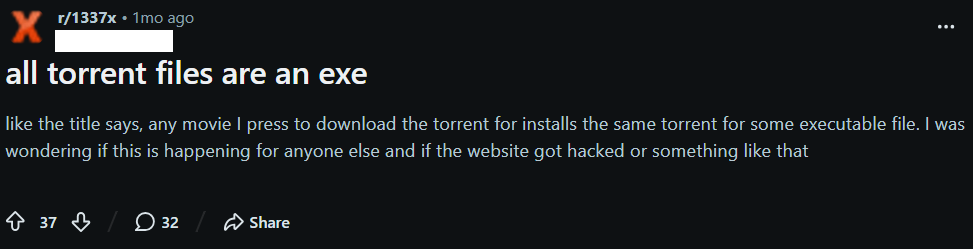
Further analysis of the attack revealed that instead of compromising torrent trackers, the threat actor modified a widely used public repository of torrent files, itorrents[.]org. As a result, the trackers that relied on the repository began inadvertently distributing malicious torrent files to their users. This approach is particularly dangerous because it lets the threat actor reach users of multiple trackers without having to compromise each platform individually.

As of the publication date of this report, the archive remains compromised. When a user attempts to download a torrent via a magnet link, the legitimate torrent archive returns a different torrent file. This malicious torrent leads to the download of the malware loader, used to deploy a framework that we dubbed MovieReaper.

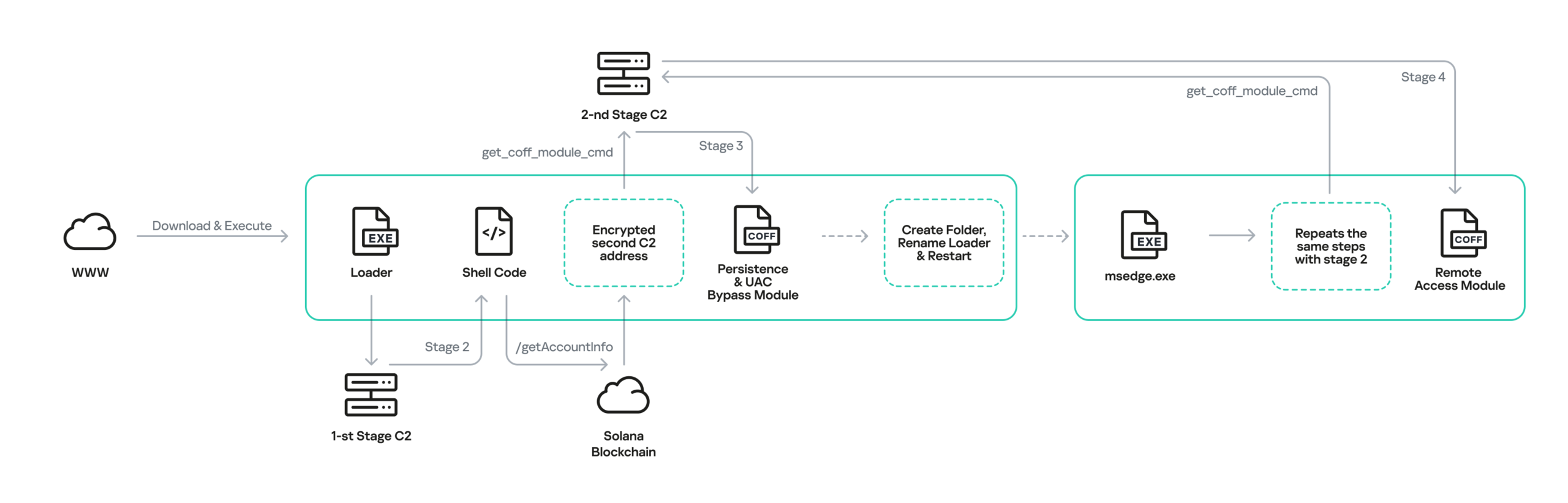
The loader initiates the infection chain shown in the diagram below. Each stage of the chain is described in detail in the following sections.
Malware implants

The infection chain consists of several steps, where only the initial one is dropped on the disk before it is executed to avoid detection. The malware itself is not heavily obfuscated, apart from strings being encrypted with a custom stream cipher. Most of the countermeasures were aimed at avoiding detection by AV sandboxes.

Step 1: Loader

The most popular initial executable was distributed through torrent trackers under many different names (for example, the odyssey (2026) [1080p] [webrip] [5.1].exe), but the file hash (MD5: A0B13781EDD7CFDAB13D79AFFF3C83C1) was identical across all downloads. We have seen multiple different loaders, where the executable file disguises itself with a long filename and an icon of some well-known application. Most of the filenames are rather long, presumably to hide the EXE extension at the end.

After the user manually starts the application, it establishes a global mutex to ensure that only one loader is executed at a time. We have seen several mutex variations in our samples, containing a randomly generated string (in the example Global\fnulSktzSqvVLXHU). This executable then performs a series of operations in order to avoid detection by AV sandbox solutions.

While performing those operations, the malware avoids making LoadLibrary and GetProcAddress calls to acquire the addresses of required functions. Instead, it searches for loaded libraries by traversing the double-linked list taken from the Ldr field of the PEB and then performs manual parsing of the loaded DLL to calculate the function address.

After all initial checks have passed, the binary prepares to establish a network connection to a C2 web server to download the shellcode, map it to the RWX memory and execute. While doing so, the loader decodes the domain name https://deadhub[.]org and if connection to it has failed, it uses the IP address http://193.23.118[.]155 as a fallback and connects to it using plain HTTP. The malware chooses a random group of strings and uses them as a path in the HTTP request to download the parts of the shellcode.

Example URLs:

/cloud/v192.4/ui/sync-status-icons.png
/cloud/v192.4/onboarding/welcome-bg.jpg
/cloud/v192.4/ui/file-preview-placeholder.png
/cloud/v192.4/shared/link-banner.jpg

While mapping the address space and executing the shellcode, the loader registers a vectored exception handler and rewrites the handler address in memory in order to perform a debug break. This, will not crash the program, but instead redirect controlflow to the function that actually makes a raw NtProtectVirtualMemory syscall (via a previously located “0x0F 0x05” syscall instruction inside ntdll). Then it calls the undocumented ntdll function EtwpCreateEtwThread, which is a popular alternative to  CreateThread for code executionm, and executes the shellcode.

Step 2: Shellcode

The second stage of this malware performs an HTTPS request to the Solana blockchain at the endpoint /getAccountInfo endpoint for the account 6pnDGAiHgyPdmckM5Qt1YbanGzrX43WLEU159nRaNLDm. The data in field of the response contains the base64‑encoded address of a second C2, which is encrypted with a static XOR key located within the shellcode itself. To store data in this account, attackers used a simple Solana program (address: CSiY8bQLBYPdfPWkwipBzH6sijTVQVVsA279JQdvwHtL).

Utilizing the Solana blockchain as a storage layer for next-stage C2 endpoints substantially complicates infrastructure takedown efforts by defenders.

The second stage payload communicates with its C2 server strictly through HTTPS via a TLS-pinned certificate using the nanopb protobuf library as a container for transferred data. The main logic of the stage 2 implant contains several initial commands, where the most important is the one that parses the COFF file, loads it into memory, and executes the module_init function from it. This provides a convenient interface for extension of the command list, which brings us to the next stage of the payload.

Step 3: UAC Bypass and persistence

Notably, the recovered modules were compiled with symbols, which accelerated reverse engineering.

After receiving the next stage from the second C2 server, the newly loaded module performs several tasks right in the module_init function.

Stage 3 performs UAC Bypass and achieves persistence using public techniques, masquerades the original binary as C:\ProgramData\Microsoft\Windows\Telemetry\msedge.exe, and restarts itself.

The respawned process starts with the initial loader, but with a special command-line argument, which allows it to skip most of the anti-sandboxing checks and proceed straight to downloading the next payload. The executable proceeds with the same steps as before, but this time, instead of downloading the persistence and UAC bypass module, a new one is downloaded from the second C2 server. This is because the malware uses the beacon to send a flag to the remote server, indicating whether the implant is running from the Telemetry folder, which allows the C2 to distinguish between first-run and respawned instances.

Step 4: The final implant

The final module (“file manager”) exposes 21 commands that give the operator filesystem access on the victim host. This allows remote the operator to download, upload, and read files on the system; list and enumerate directories; manipulate files with create, copy, rename, move, delete, chmod, and symlink commands; and use preview and thumbnail commands to exfiltrate previews of images and files before actually extracting them.

We suspect that other modules may be loaded on demand if requested by the operator.

Infrastructure

During this malware campaign, attackers are using various commercial hosting providers for their C2 infrastructure (see the IoC section for details). Furthermore, as noted above, the campaign leverages the legitimate Solana blockchain via the RPC endpoint api.mainnet.solana.com to deliver the address of the second‑stage C2 server to the malware. This approach provides the attackers with decentralized storage for C2 addresses, adding an additional layer of resilience and making it more difficult for defenders to disrupt the campaign by simply blocking the IP addresses of the C2 servers.

Victims

The observed campaign targeted both individuals and organizations across Europe, Asia, Africa, and Latin America, with infection attempts identified in Russia, Spain, Germany, Finland, Türkiye, Japan, Nepal, Kenya, Tanzania, Ghana, Uganda, Colombia, the Netherlands, Belgium, and other countries. The targeted organizations span a wide range of sectors, including enterprise, government, IT, consulting, retail, transportation, and agriculture.

Conclusions

Our research uncovered activity by the same actor dating back to October 2025. Although the campaign has evolved over time, with the malware authors expanding their arsenal and making the loader harder to detect, the pattern remains the same. This includes encoded strings, parts of shellcode downloaded through plain HTTP, and several techniques used to avoid sandboxes and virtual machines. We will continue monitoring this actor’s activity to catch new potential threats.

The first stage offers the clearest opportunity to disrupt this campaign: it relies on a single specific domain name and a single IP address to serve the shellcode, so taking down this server would prevent subsequent infection stages. This includes the second-stage payload, which uses the Solana blockchain network for a C2 and is therefore more resistant to conventional infrastructure takedowns.

However, this framework’s self-containment, modularity and in-memory execution has potential for reuse in later campaigns with minimal rework.

Indicators of compromise

File hashes

4334BBAEA8DE33BF9D45E9B4E4E3BC2
4843F9FAFCAE492F11E2D4D33DBB4CDD
5310CABAE3FBE6DB8742849B588093F9
A0B13781EDD7CFDAB13D79AFFF3C83C1
70060341CAF3338697A7DDFE0FB62875
AD4643EEA15AC286FA47D1131F9EF756
D0B967571AC8A3863C7F324BF5BDE99C
D88D550D0FB8E60CFFFF3EA61FF7A067

File paths

%ProgramData%\Microsoft\Windows\Telemetry\msedge.exe

Mutexes

Global\E4AyDKzvEhe2hgAr
Global\fnulSktzSqvVLXHU

Domains and IPs

First-stage C2:
deadhub[.]org
193.23.118[.]155

Second-stage C2:
208.64.33[.]90
208.94.246[.]53
  •  

Why OT Resilience Is Now a Boardroom Imperative

For decades, industrial cybersecurity rested on a comfortable assumption: operational technology (OT) was protected by physical isolation. The "air gap" guaranteed that power grids, manufacturing lines, and water systems remained safely disconnected from the chaos of the public internet.

That assumption is no longer just outdated - it is a strategic liability.

Driven by the imperative for real-time efficiency, predictive maintenance, and AI-led automation, industrial operations are integrating with enterprise IT and cloud environments at an unprecedented scale. Telemetry from Palo Alto Networks reveals a 332% surge in unique internet-exposed OT devices and services, bringing nearly 20 million OT-related assets onto the public internet.

Digital transformation has fundamentally redrawn the perimeter. What was once an engineering challenge managed on the plant floor has transformed into an existential risk that demands board-level oversight.

Every Industrial Asset Is Now a Digital Asset

Modernizing critical infrastructure is rarely framed as a security initiative; it is an operational mandate. Heavy machinery engineered to last thirty years is now instrumented with IoT sensors, managed through cloud-native platforms, and remotely monitored.

This connectivity creates tight dependencies between core business IT and physical operations. Modern industrial facilities rely on enterprise identity management, cloud telemetry, and continuous software updating to function day to day.

Consequently, a threat actor does not need to breach the factory floor to stop production.

When an enterprise IT network suffers an incident, executive leadership often initiates a manual shutdown of operational lines out of caution or because shared authentication mechanisms become unavailable. The business processes linking enterprise IT and OT have become functionally inseparable.

The Anatomy of Modern Industrial Threats

Attackers no longer require sophisticated, state-sponsored zero-day exploits to disrupt physical infrastructure. As seen in recent cyber incidents targeting municipal water systems in the US and the breach of a Polish power plant, threat actors continuously exploit basic internet exposure, unpatched vulnerabilities, weak default credentials, and unsegmented remote connections.

Threat dynamics across critical infrastructure have shifted toward two major vectors:

  • Low-Friction Initial Access: Basic internet discovery tools allow threat actors to identify exposed control systems and programmable logic controllers (PLCs) in minutes. Weak factory default passwords or unsegmented cellular modems provide direct entry points into physical operations.
  • Operational Blindness: Modern attacks deliberately target the reporting layer - such as HMI and SCADA interfaces - to suppress alarms and present "normal" operational telemetry to engineers, even while underlying physical processes operate dangerously out of specification.

Operational Realities and the Zero Trust Imperative

The integration of artificial intelligence and automated workflows into industrial environments accelerates this challenge. Beyond human engineers logging into control networks, automated software pipelines, third-party monitoring platforms, and autonomous AI agents are executing commands within OT environments.

Data from recent identity landscape research reveals that machine identities outnumber human identities by 109 to 1 across EMEA organizations.

In an environment populated by millions of interconnected human, machine and AI actors, implicit trust based on network location is dangerous. Applying Zero Trust to OT requires moving away from traditional perimeter defense toward continuous, explicit verification:

  • Verify Explicitly: Authenticate and authorize every access request - human or machine - regardless of where the request originates.
  • Enforce Least-Privilege Access: Limit access strictly to the assets and commands necessary for a specific operational role or process.
  • Assume Breach: Design networks under the assumption that enterprise systems are compromised, preventing lateral movement into physical control layers.

The Industrial "Red Button": Engineering for Containment

While IT security prioritizes data confidentiality, OT security prioritizes human safety, system availability, and operational continuity. Halting a processing facility or energy grid carries immediate financial, environmental, and regulatory consequences. Security controls designed for corporate office networks cannot simply be retrofitted onto plant floors.

Cyber resilience is measured not merely by prevention, but by limiting the blast radius when a breach occurs.

Leading industrial organizations are establishing a programmable "Red Button" capability - a combination of architectural micro-segmentation and automated playbooks. This architecture allows security teams to rapidly isolate critical physical operations from compromised IT networks or cloud dependencies without bringing production to a complete halt.

Five Strategic Actions for Executive Boards

With regulatory frameworks like NIS2 increasing direct accountability for senior leadership, OT cybersecurity requires strategic governance centered on comprehensive visibility, robust micro-segmentation, operational risk scoring, and virtual patching:

  • Establish Complete Asset Visibility: Eliminate dark corners across physical environments. Organizations must maintain a continuous, real-time inventory of every connected industrial asset, controller, and external dependency.
  • Embed Security by Design and Virtual Patching: Integrate cybersecurity requirements directly into industrial modernization programs from initiation. Deploy virtual patching mechanisms - such as Frontier Virtual Patching - to shield unpatchable legacy systems against rapidly evolving AI-driven threats.
  • Architect for Degraded Mode: Design critical infrastructure to maintain safe, baseline operations even if cloud access, enterprise IT, or external network connections are severed.
  • Practice Operational Recovery: Develop and stress-test incident response playbooks specifically designed for physical environments, including offline configuration backups and manual operational overrides.
  • Unify Risk Governance: Align executive leadership, security operations, and plant engineering around operational-based risk scoring and shared business metrics: physical safety, system uptime, and operational continuity.

Accelerating digital transformation should not mean compromising physical safety or operational stability. Palo Alto Networks provides an integrated platform built to address the unique constraints of operational environments. By combining AI-driven asset discovery, granular micro-segmentation, continuous risk assessment, and virtual patching across both enterprise IT and physical control networks, Palo Alto Networks empowers industrial organizations to modernize with confidence - securing operations, protecting revenue, and safeguarding national infrastructure.

Further interesting reading:

The post Why OT Resilience Is Now a Boardroom Imperative appeared first on Palo Alto Networks Blog.

  •  

Introducing Unit 42 Continuous Frontier AI Defense

Cybersecurity is in the middle of a generational shift. AI has disrupted a 30-year balance of power between defenders and adversaries.

Armed with agentic AI tools and open-weight models stripped of safety guardrails, threat actors are discovering, validating, and chaining exposures at machine speed. In a recent Unit 42 investigation, the attacker used more than 50 MITRE ATT&CK techniques to reduce weeks of methodical intrusion tradecraft into less than 10 hours—97% faster than a skilled red team could have done. Time-to-exfiltration has compressed to under an hour in real-world attacks. And when new CVEs are publicly disclosed, automated adversary scanners are weaponizing them within 15 minutes.

Defending at human speed is no longer viable. Organizations must close years of accumulated exposure while securing the AI they are rapidly adopting. That demands action on five fronts: continuously find and fix vulnerabilities, reduce exposure, secure AI infrastructure, unify attack prevention, and automate detection and response at machine speed.

Today, we are announcing Unit 42 Continuous Frontier AI Defense to put the first two priorities into practice. Powered by Anthropic's Mythos models and OpenAI's latest GPT cyber models, this always-on, agentic service combines our offensive security experts with proprietary multi-model harnesses to discover vulnerabilities, validate real-world exploitability, and accelerate remediation across applications, identities, cloud infrastructure, and network assets.

Led by our offensive security experts, this service discovers, validates and remediates exposures before they can be exploited. We use proprietary AI harnesses and gated capability models—powerful models restricted from public use—to discover vulnerabilities, prove real-world exploitability, and accelerate remediation across applications, identities, cloud infrastructure, and network assets as an organization’s environment changes.

Continuous Frontier AI Defense builds on Unit 42’s Frontier AI Defense, which launched in April and introduced Frontier AI Exposure Analysis, a point-in-time exposure analysis, and a security blueprint that benchmarks current capabilities to help organizations modernize their cybersecurity systems. In August, Unit 42 expanded the list of frontier AI models to include  OpenAI’s GPT-5.6-Cyber and Anthropic's Claude Mythos 5, giving organizations access to additional AI capabilities.

A Single AI Model Is Not a Security Strategy

Frontier models are powerful, but no single AI model is a cybersecurity silver bullet and the models require equally powerful AI scanning harnesses.

Unit 42 research evaluation of model performance across enterprise codebases and live environments revealed two stark operational realities:

  • Coverage caps: No single AI model catches more than 40% of vulnerabilities in a complex environment.
  • Visibility: Leading cyber models such as Anthropic Claude Mythos 5 and OpenAI GPT-5.6-Cyber have less than 10% overlap in the exposures they identify.

To solve the single model gaps, Continuous Frontier AI Defense runs on proprietary multi-model harnesses. These harnesses act as an intelligent orchestration layer, routing specific offensive testing tasks to the model best suited for the job. This approach aligns model strengths, eliminates individual gaps, and keeps compute spend economical.

We combine these frontier models with Unit 42 threat intelligence, and frontline security expertise to turn raw vulnerability data into verified, actionable protection. Zero Data Retention (ZDR) architectures protect enterprise source code and telemetry, so customer data is never retained or used to train public models.

What Happens When AI Meets Real Enterprise Architecture

We did not build this service on theoretical assumptions. We built and validated it internally  across Palo Alto Networks and across more than 100 customer engagements.

During our internal deployment, continuous Mythos-based scanning achieved over a year’s worth of traditional penetration testing results in just three weeks. The harness identified 3.2 times more high and critical vulnerabilities per product than legacy testing methods, and helped engineering teams cut mean time to remediate by 51%.

When we executed the service across customer environments, the frontline data delivered a clear warning:

  • Hidden exposures: In third-party applications, two out of three validated exposures had no known CVE. Vulnerability-only scanners will never see them.
  • High severity: 37% of identified exposures rated high or critical in severity.
  • Chained attack paths: Flaws rarely existed in isolation. In one financial sector engagement, our harness identified a sequence of individually minor flaws: an application payment link that failed to re-verify identity, a skipped one-time password check, and a session routing flaw. Chained together, an attacker could achieve complete account takeover and payment fraud without any victim action.

Moving from Discovery to Validated Protection

Finding weaknesses without fixing them only creates noise. And, security teams do not lack findings; they already have more alerts than they can act on. The bigger challenge is knowing which weaknesses an attacker can actually exploit and chain into a viable path to compromise, and then remediating them.

Unit 42 Continuous Frontier AI Defense translates findings directly into risk reduction:

  • Continuous Testing Engine: Provides a full-estate baseline scan followed by always-on testing as an organization’s environment changes.
  • Multi-Model AI Harness: Unit 42 deploys proprietary multi-model harnesses, the software architecture to route work to the model best suited for the task, improving efficacy and coverage while managing the cost of frontier AI at scale.
  • Leading Cyber Models: The harnesses are built around gated capability models, including Anthropic Claude Mythos 5 and OpenAI GPT-5.6-Cyber, as well as open weight models. 
  • Advanced Adversary Simulation: Proves real-world exploitability by validating end-to-end attack paths across first- and third-party web apps, APIs, cloud infrastructure, source code repositories, and network assets.
  • Accelerated Remediation: Delivers actionable and prioritized fixes, code-level guidance, and virtual patch recommendations. To implement virtual patches before vulnerabilities are publicly disclosed or official patches exist, organizations can pair this with Frontier Virtual Patching. 

Unit 42 Continuous Frontier AI Defense is available worldwide today on an annual subscription basis. Register for our upcoming virtual Threat Briefing to see how we apply Frontier AI, our proprietary multi-model harness, and offensive security expertise to protect Palo Alto Networks and our customers.

To learn more about Unit 42 Continuous Frontier AI Defense, register for the upcoming Virtual Threat Briefing here.

The post Introducing Unit 42 Continuous Frontier AI Defense appeared first on Palo Alto Networks Blog.

  •  

The Odyssey and Trojans again: MovieReaper attacks users in multiple countries through compromised torrents

Introduction

Torrent trackers have long been abused for distributing malicious software, disguised as popular films, games, and other content. Our previous research has shown that cybercriminals repeatedly turn to torrents as an initial infection vector, using trojanized cracks and installers to reach a large number of users. Installation guides for pirated software routinely instruct users to disable their antivirus, conditioning them to ignore the potential threats they are inviting onto their computers.

During our analysis of malware that leverages blockchain networks for its C2 infrastructure, we discovered a previously unknown modular, multi-stage framework that we dubbed MovieReaper. This report details the new crimeware campaign that began with the mass infection of users via compromised torrent tracker file storage. We have identified several hundred victims, including both individual users and organizations in multiple countries, such as Russia, Türkiye, Japan, Kenya, Uganda, and Colombia, as well as in several European countries like Spain, the Netherlands, Belgium, and Germany. We analyze the techniques for evading detection by security and sandbox solutions, and examine the capabilities of the modular framework.

Kaspersky products detect this threat as HEUR:Trojan.Win64.Agent.gen.

Technical details

Background

In mid‑August 2026, during our threat‑hunting efforts, we identified a large‑scale infection campaign involving previously unknown malware disguised as popular movies. The campaign affected both individuals and organizations across multiple countries. Our initial analysis revealed a common denominator: all of the victims had used torrent trackers. This finding prompted us to investigate the campaign further and analyze its distribution mechanism, overall scope, and unknown malware implants.

Initial infection and spread

Compromised torrent trackers are the primary vector used to distribute malware. During our investigation, we identified multiple user reports describing suspicious files being downloaded instead of the intended content.

For example, a user of a popular movie torrent tracker reported the following case on Reddit:

Further analysis of the attack revealed that instead of compromising torrent trackers, the threat actor modified a widely used public repository of torrent files, itorrents[.]org. As a result, the trackers that relied on the repository began inadvertently distributing malicious torrent files to their users. This approach is particularly dangerous because it lets the threat actor reach users of multiple trackers without having to compromise each platform individually.

As of the publication date of this report, the archive remains compromised. When a user attempts to download a torrent via a magnet link, the legitimate torrent archive returns a different torrent file. This malicious torrent leads to the download of the malware loader, used to deploy a framework that we dubbed MovieReaper.

The loader initiates the infection chain shown in the diagram below. Each stage of the chain is described in detail in the following sections.

Malware implants

The infection chain consists of several steps, where only the initial one is dropped on the disk before it is executed to avoid detection. The malware itself is not heavily obfuscated, apart from strings being encrypted with a custom stream cipher. Most of the countermeasures were aimed at avoiding detection by AV sandboxes.

Step 1: Loader

The most popular initial executable was distributed through torrent trackers under many different names (for example, the odyssey (2026) [1080p] [webrip] [5.1].exe), but the file hash (MD5: A0B13781EDD7CFDAB13D79AFFF3C83C1) was identical across all downloads. We have seen multiple different loaders, where the executable file disguises itself with a long filename and an icon of some well-known application. Most of the filenames are rather long, presumably to hide the EXE extension at the end.

After the user manually starts the application, it establishes a global mutex to ensure that only one loader is executed at a time. We have seen several mutex variations in our samples, containing a randomly generated string (in the example Global\fnulSktzSqvVLXHU). This executable then performs a series of operations in order to avoid detection by AV sandbox solutions.

While performing those operations, the malware avoids making LoadLibrary and GetProcAddress calls to acquire the addresses of required functions. Instead, it searches for loaded libraries by traversing the double-linked list taken from the Ldr field of the PEB and then performs manual parsing of the loaded DLL to calculate the function address.

After all initial checks have passed, the binary prepares to establish a network connection to a C2 web server to download the shellcode, map it to the RWX memory and execute. While doing so, the loader decodes the domain name https://deadhub[.]org and if connection to it has failed, it uses the IP address http://193.23.118[.]155 as a fallback and connects to it using plain HTTP. The malware chooses a random group of strings and uses them as a path in the HTTP request to download the parts of the shellcode.

Example URLs:

/cloud/v192.4/ui/sync-status-icons.png
/cloud/v192.4/onboarding/welcome-bg.jpg
/cloud/v192.4/ui/file-preview-placeholder.png
/cloud/v192.4/shared/link-banner.jpg

While mapping the address space and executing the shellcode, the loader registers a vectored exception handler and rewrites the handler address in memory in order to perform a debug break. This, will not crash the program, but instead redirect controlflow to the function that actually makes a raw NtProtectVirtualMemory syscall (via a previously located “0x0F 0x05” syscall instruction inside ntdll). Then it calls the undocumented ntdll function EtwpCreateEtwThread, which is a popular alternative to  CreateThread for code executionm, and executes the shellcode.

Step 2: Shellcode

The second stage of this malware performs an HTTPS request to the Solana blockchain at the endpoint /getAccountInfo endpoint for the account 6pnDGAiHgyPdmckM5Qt1YbanGzrX43WLEU159nRaNLDm. The data in field of the response contains the base64‑encoded address of a second C2, which is encrypted with a static XOR key located within the shellcode itself. To store data in this account, attackers used a simple Solana program (address: CSiY8bQLBYPdfPWkwipBzH6sijTVQVVsA279JQdvwHtL).

Utilizing the Solana blockchain as a storage layer for next-stage C2 endpoints substantially complicates infrastructure takedown efforts by defenders.

The second stage payload communicates with its C2 server strictly through HTTPS via a TLS-pinned certificate using the nanopb protobuf library as a container for transferred data. The main logic of the stage 2 implant contains several initial commands, where the most important is the one that parses the COFF file, loads it into memory, and executes the module_init function from it. This provides a convenient interface for extension of the command list, which brings us to the next stage of the payload.

Step 3: UAC Bypass and persistence

Notably, the recovered modules were compiled with symbols, which accelerated reverse engineering.

After receiving the next stage from the second C2 server, the newly loaded module performs several tasks right in the module_init function.

Stage 3 performs UAC Bypass and achieves persistence using public techniques, masquerades the original binary as C:\ProgramData\Microsoft\Windows\Telemetry\msedge.exe, and restarts itself.

The respawned process starts with the initial loader, but with a special command-line argument, which allows it to skip most of the anti-sandboxing checks and proceed straight to downloading the next payload. The executable proceeds with the same steps as before, but this time, instead of downloading the persistence and UAC bypass module, a new one is downloaded from the second C2 server. This is because the malware uses the beacon to send a flag to the remote server, indicating whether the implant is running from the Telemetry folder, which allows the C2 to distinguish between first-run and respawned instances.

Step 4: The final implant

The final module (“file manager”) exposes 21 commands that give the operator filesystem access on the victim host. This allows remote the operator to download, upload, and read files on the system; list and enumerate directories; manipulate files with create, copy, rename, move, delete, chmod, and symlink commands; and use preview and thumbnail commands to exfiltrate previews of images and files before actually extracting them.

We suspect that other modules may be loaded on demand if requested by the operator.

Infrastructure

During this malware campaign, attackers are using various commercial hosting providers for their C2 infrastructure (see the IoC section for details). Furthermore, as noted above, the campaign leverages the legitimate Solana blockchain via the RPC endpoint api.mainnet.solana.com to deliver the address of the second‑stage C2 server to the malware. This approach provides the attackers with decentralized storage for C2 addresses, adding an additional layer of resilience and making it more difficult for defenders to disrupt the campaign by simply blocking the IP addresses of the C2 servers.

Victims

The observed campaign targeted both individuals and organizations across Europe, Asia, Africa, and Latin America, with infection attempts identified in Russia, Spain, Germany, Finland, Türkiye, Japan, Nepal, Kenya, Tanzania, Ghana, Uganda, Colombia, the Netherlands, Belgium, and other countries. The targeted organizations span a wide range of sectors, including enterprise, government, IT, consulting, retail, transportation, and agriculture.

Conclusions

Our research uncovered activity by the same actor dating back to October 2025. Although the campaign has evolved over time, with the malware authors expanding their arsenal and making the loader harder to detect, the pattern remains the same. This includes encoded strings, parts of shellcode downloaded through plain HTTP, and several techniques used to avoid sandboxes and virtual machines. We will continue monitoring this actor’s activity to catch new potential threats.

The first stage offers the clearest opportunity to disrupt this campaign: it relies on a single specific domain name and a single IP address to serve the shellcode, so taking down this server would prevent subsequent infection stages. This includes the second-stage payload, which uses the Solana blockchain network for a C2 and is therefore more resistant to conventional infrastructure takedowns.

However, this framework’s self-containment, modularity and in-memory execution has potential for reuse in later campaigns with minimal rework.

Indicators of compromise

File hashes

4334BBAEA8DE33BF9D45E9B4E4E3BC2
4843F9FAFCAE492F11E2D4D33DBB4CDD
5310CABAE3FBE6DB8742849B588093F9
A0B13781EDD7CFDAB13D79AFFF3C83C1
70060341CAF3338697A7DDFE0FB62875
AD4643EEA15AC286FA47D1131F9EF756
D0B967571AC8A3863C7F324BF5BDE99C
D88D550D0FB8E60CFFFF3EA61FF7A067

File paths

%ProgramData%\Microsoft\Windows\Telemetry\msedge.exe

Mutexes

Global\E4AyDKzvEhe2hgAr
Global\fnulSktzSqvVLXHU

Domains and IPs

First-stage C2:
deadhub[.]org
193.23.118[.]155

Second-stage C2:
208.64.33[.]90
208.94.246[.]53

  •  

Disrupting EvilTokens: The AI Chatbot Built for Cybercrime

Microsoft has disrupted EvilTokens, a powerful cybercrime platform that used AI at every step of the attack chain—from compromising email accounts to designing intricate roadmaps for financial fraud and scams. While EvilTokens helped cybercriminals access email accounts, at the center of the service was an AI-style chatbot that could analyze a victim’s inbox and help criminals identify trusted relationships, payment authorizations, and sensitive responsibilities, as well as other circumstances where fraud was most likely to succeed. The platform could even recommend fraud strategies, including drafting messages that impersonated trusted contacts to help criminals trick victims into taking action. 

In short, AI was not simply helping attackers write more convincing messages. It helped them decide who to target, who to impersonate, and how to most effectively exploit the relationship to extract as much money as possible.   

Within months of launching in February 2026, EvilTokens had been linked to more than 12,000 compromised email inboxes across over 10,000 organizations worldwide, showing how quickly the service gained traction. Microsoft observed the highest concentrations of victim activity in the United States, Canada, the United Kingdom, Australia, India, and France. Affected organizations ranged from wholesale distribution and construction to financial services, real estate, higher education, and healthcare. Working with partners, Microsoft seized 50 websites used to operate the service and disabled more than 150 additional domains tied to its supporting infrastructure. In the United Kingdom, the Metropolitan Police Service’s cybercrime team arrested two men on suspicion of offenses connected with the alleged operation of EvilTokens.  

But the significance of EvilTokens extends beyond its rapid growth and global reach. It offers an early warning of what happens when cybercriminals combine stolen access with AI capable of understanding how an organization works. 

From account access to financial fraud

EvilTokens helped criminals gain access to email accounts by tricking victims into entering an authentication code on Microsoft’s legitimate sign-in page. By completing the normal authentication sign-in process, victims unknowingly gave criminals access to their email accounts without revealing their passwords. That access could persist even after a password reset if the associated sessions and tokens were not also revoked. Microsoft Threat Intelligence provides additional technical details about the operation, how device-code attacks work, and steps customers can take to protect themselves here. 

Screenshot of an Outlook inbox showing an email about upcoming group events, with “AI Analysis” and “Summary” features highlighted in red.

Screenshot of an AI analysis interface identifying potential targets, opportunity levels, attack vectors, and financial opportunities based on scanned organizational emails.
EvilTokens AI analysis of compromised inbox and suggested follow- up prompts.

Once inside an account, criminals have traditionally needed time and experience to sift through thousands of messages, identify decision-makers, understand payment processes, and find opportunities for fraud. 

EvilTokens began automating that work. Its AI tools could summarize and translate emails, surface financial conversations, map organizational roles, identify trusted relationships, and recommend potential targets. Preset prompts offered to find wire-transfer discussions, identify the organization’s “money movers,” locate vendor invoices, and determine the best people to impersonate.

Sold through Telegram for a $1,500 initiation fee and a recurring $500 subscription, EvilTokens combined account compromise, mailbox analysis, target selection, and fraud preparation in a single service. Capabilities that once required experience across identity attacks, cloud systems, social engineering, and financial fraud were available through a ready-made interface.

Three screenshots of the EvilTokens Store Bot, including a DeviceCapture logo and messages advertising Microsoft 365 token capture and inbox access capabilities.
EvilTokens store on Telegram.
Screenshot of the EvilTokens “Essential Tools” dashboard displaying tools for token capture, browser access, traffic redirection, email automation, SMTP delivery, and email validation.
EvilTokens “Essential Tools” optimized for cybercrime.

AI lowered the barriers at both ends

Investigators found evidence that large portions of EvilTokens had been “vibe coded,” with AI helping its creators build the platform itself. They also determined that EvilTokens drew on capabilities from multiple AI models. 

The result was more than a collection of attack tools. EvilTokens packaged much of the fraud process into a commercially run service, complete with subscription pricing, customer support, management dashboards, and tools designed to move customers from account access toward financial exploitation.

Disrupting the platform

No single organization could disrupt EvilTokens alone. The service relied on hosting providers, cloud services, AI tools, financial services, and other online resources that cybercriminals repurposed to support fraud at scale. 

The disruption combined civil legal action with coordinated operational work across industry and law enforcement. Because healthcare organizations were among those targeted, Health-ISAC—a global non–profit that helps health sector organizations share cyber threat information and collaborate to improve operational resilience—joined Microsoft’s legal action as a co-plaintiff.

With authorization from the U.S. District Court for the Eastern District of Virginia, Microsoft and Health-ISAC worked with Cloudflare, Coinbase, OpenAI, Railway, SpyCloud, The Shadowserver Foundation, and TRM Labs to act against key parts of the platform. Microsoft also notified affected customers, helped remediate compromised accounts, and shared intelligence to support further defensive and investigative action.

The operation also demonstrated the value of rapid cooperation between private-sector investigators and law enforcement. Microsoft worked closely with specialist officers from the Metropolitan Police Service’s cybercrime team, sharing intelligence that enabled officers to take operational action in the United Kingdom. On September 11, 2026, officers arrested two men, aged 32 and 38, and seized digital devices and other items for examination. Both men have been released on police bail subject to conditions while the investigation continues. 

Screenshot of a Microsoft domain seizure notice featuring Microsoft and partner logos, including Cloudflare, Coinbase, Health-ISAC, Metropolitan Police, OpenAI, and others.
Seizure notice displayed after Microsoft and its partners disrupted infrastructure used by EvilTokens.

While EvilTokens used AI to identify targets and prioritize fraud opportunities, Microsoft investigators used reverse engineering and AI-powered tools to analyze evidence, accelerate the investigation, and identify the infrastructure supporting the service. The case shows how AI is changing not only how cybercriminals operate, but also how defenders investigate and disrupt them. 

This action marks the Microsoft Digital Crimes Unit’s (DCU) 40th court-authorized disruption spanning nearly two decades of targeting cyber threat actors, malicious tools, and supporting infrastructure. It is also DCU’s first action against an end-to-end AI-enabled cybercrime service. 

What EvilTokens reveals about cybercrime’s next phase

The infrastructure supporting EvilTokens has been disrupted, but the model it demonstrated will not disappear with it. As Microsoft notes in its 2026 Responsible AI Transparency Report, increasingly capable and accessible AI is being used to scale fraud, impersonation, and other forms of online abuse. EvilTokens offers an early example of how those capabilities can be combined with compromised accounts to accelerate financial fraud. 

For organizations, the lesson is: assume that once an inbox is compromised, criminals may understand its contents in minutes, not days. Strong identity protections and monitoring remain essential, but organizations should also independently verify requests to change payment information, redirect funds, or approve unusual transactions through a trusted second channel.


The post Disrupting EvilTokens: The AI Chatbot Built for Cybercrime appeared first on Microsoft On the Issues.

  •  

Safe Participation Framework: Opportunity and Safety for the Next Generation in the Age of AI

Today, Microsoft is sharing our Safe Participation Framework, which centers on designing and enabling safe, privacy-preserving, and age-appropriate experiences for young people online. Members of our AI Youth Futures Council have delivered a clear message: they want to learn, create, and prepare for a future with AI. Protecting their privacy, ensuring their safety, and preserving their opportunity to participate must go hand in hand.   

They are right. Children and families should not have to choose between the protections they need and the opportunities technology can provide. 

Technology companies have a responsibility both to protect young people from harm and to ensure they can benefit from technology through thoughtfully designed experiences, age-appropriate protections, and demonstrable safeguards. Microsoft’s Safe Participation Framework serves as a foundation for our work today, and we expect it to continue evolving as technology, research, and societal expectations change. We do not claim to have all the answers, but we believe it is important to share our approach and our learnings to help inform emerging regulatory frameworks and advance protection and opportunity together. 

Pillar one: Safety by design

Microsoft recognizes our responsibility to help create safer experiences for all users, particularly children and those more vulnerable to harm. Our safety-by-design approach seeks to embed protection from the outset: identifying foreseeable risks, examining the impact of product features and user experiences, and implementing proportionate safeguards. As risks evolve, we continue to learn from emerging research, science, andas well as from customers, governments, and other stakeholders. 

For more than a decade, Microsoft has invested in technologies designed to protect people online, beginning with PhotoDNA  in 2009 and continuing through our work to build safeguards for AI experiences and address emerging harms such as synthetic and non-consensual intimate imagery. We have also learned that families want tools that are simpler, intuitive, and easier to use. That is why, earlier this week, we announced new protections and defaults for children, teenagers, and families using Windows Family Safety. We view these changes as an important step forward, while recognizing that earning and maintaining trust requires continued investment, learning, and iteration. 

Bing has also strengthened protections against child sexually abusive material (CSAM) across its generative AI experiences. We have also expanded SafeSearch globally to cover additional categories of harmful content, helping reduce the risk of exposure to harmful material. We will continue to make progress, listen to our users and stakeholders, and learn by working with others to strengthen safety.  

Our goal is to help children and teenagers participate confidently in appropriate digital experiences that reinforce access to the meaningful educational, social, and economic opportunities technology can provide. Achieving that goal requires real protections that are proportionate to risk and implemented in ways that respect users’ privacy. Risks are not uniform across different technologies and services, and safeguards should reflect and address those differences.   

Pillar two: Age-differentiated experiences

We recognize that young people are not a single group. Their needs, capabilities, and expectations evolve with age, development, and context. For that reason, age-appropriate design is an important element of creating safer digital experiences and complements safety-by-design. Age-appropriate design ensures protections and experiences are responsive to the needs of users at different stages of development. This approach informs experiences across Microsoft’s consumer ecosystem.  

On XBOX, we leverage family safety and privacy tools designed specifically to help manage online interactions, content access, spending, screen time, and privacy settings. These features are intended to support safer experiences while giving families flexibility to make choices. We are applying many of these same learnings to Copilot. All users must now sign in to use Copilot, and access is restricted for children under 13 (or older where required by local law). We have also implemented measures to reduce exposure to harmful content, directing users to crisis support resources when self-harm risks are detected, and encouraging healthy use through transparency, break reminders, reporting tools, and guardrails to protect against delusional outputs.   

Microsoft has now also extended protections at the platform level. Through our new Windows Age application programming interface (API), expanded age assurance capabilities, and enhanced family safety tools, Microsoft is helping establish a more consistent and privacy-conscious foundation for age-appropriate experiences across the broader ecosystem. These capabilities are intended to provide developers with trusted age signals to support age-appropriate protections, making the experience ultimately easier for families to understand and navigate downstream. 

Reliable age signals play an important role in enabling age-appropriate experiences. Innovations such as the Windows Age API help provide privacy-preserving age signals while minimizing the collection and sharing of personal data. Young people share this expectation. Participants in Microsoft’s AI Youth Futures Council have consistently emphasized the importance of understanding how their information is collected, used, and protected. 

Pillar three: Education and empowerment

Technology alone cannot deliver safe participation. Young people and their families must have an opportunity to provide direct feedback, and they must have easy access to tools and resources that support and build their knowledge as they navigate digital experiences, evaluate what they encounter, and decide when to seek help. Digital literacy is, therefore, a core component of child safety. 

Microsoft has invested in digital literacy and safety education for years through resources and partnerships that reach communities around the world. Earlier this year, we launched Behind the Chat: A Human Guide to Safe AI Conversations, designed specifically to help young people understand the opportunities and risks associated with AI companionship. This toolkit is supported by classroom resources for educators and materials for parents and trusted adults, reflecting our belief that supporting young people requires an ecosystem approach. Beginning this fall, we will expand these resources throughout Europe, Asia, and the Americas. We will also continue working closely with educators to ensure safety and privacy. 

Over the coming year, we will deepen partnerships with researchers, AI Safety Institutes (AISIs), governments, and civil society to advance the research, evaluations, and benchmarks needed for safer digital and AI experiences. Working together, we will learn and help build the foundation for the next generation of trusted technology. 

A framework for the future

Our work is far from finished. As technology evolves, our understanding of how to support young people safely and responsibly must continue to evolve with it. This framework reflects our current approach, informed by evidence, shaped by young people and their families, and grounded in ongoing learning. We recognize that we do not have every answer, and that building safer digital experiences will require continued experimentation, humility, and collaboration. No single organization can do this alone. Progress will depend on deep partnerships across government, industry, civil society, educators, and families worldwide. Together, we can help build a future in which every young person has the opportunity to participate, create, learn, and thrive. 

The post Safe Participation Framework: Opportunity and Safety for the Next Generation in the Age of AI appeared first on Microsoft On the Issues.

  •  
❌