Escalation in the Middle East: Tracking “Operation Epic Fury” Across Military and Cyber Domains
This post tracks the convergence of kinetic warfare, psychological operations, and cyber activity as the conflict expands across the Middle East and beyond.
On February 28, the United States and Israel launched coordinated strikes across Iran under Operation Epic Fury (also referenced in reporting as Operation Lion’s Roar). The opening phase focused on decapitating senior Iranian leadership while degrading missile infrastructure, launch systems, and air defenses. In the hours that followed, Iran initiated large-scale retaliation — expanding the conflict beyond Iranian territory and into a region-wide exchange that touched multiple Gulf states and allied military assets.
Since those initial strikes, the conflict has rapidly widened and accelerated. What began as a concentrated campaign against leadership and missile capabilities has developed into a sustained regional war with an expanding set of targets, including economic and logistical infrastructure. Simultaneously, cyber operations and psychological messaging have been used alongside kinetic action, creating a hybrid operating environment in which disruption is shaped as much by information control and infrastructure compromise as it is by missiles and airstrikes.
Flashpoint analysts are tracking the conflict across physical, cyber, and geopolitical domains. The timeline and sections below summarize key developments and risk indicators observed from February 28 through May 4.
Latest Update: Escalation Across Maritime, Cyber, and Economic Domains (Last 24–48 Hours)
The conflict has entered a phase of direct maritime and economic confrontation, with both kinetic and cyber activity intensifying in parallel.
Following the collapse of diplomatic efforts, the United States has formally initiated a naval blockade of Iranian ports, while Iran has responded by deploying midget submarines and reportedly mining key transit routes in the Strait of Hormuz. These developments signal a shift from pressure on infrastructure to direct control over regional shipping and energy flows.
At the same time, cyber operations have escalated beyond disruption into claims of large-scale destructive activity targeting industrial and government systems across the Gulf. While some of these claims remain unverified, the volume and nature of activity indicate a sustained effort to degrade both public-sector and commercial infrastructure.
Timeline of Key Developments
May 4
~06:00 UTC
CENTCOM announces the commencement of “Project Freedom” to secure maritime transit through the Strait of Hormuz.
~08:30 UTC
The IRGC Navy declares a new operational control sector in the Strait, warning that vessels failing to coordinate transit will be “stopped with force”.
10:15 UTC
Iran launches a barrage of four cruise missiles toward the UAE; three are intercepted by UAE air defenses while one falls into the sea.
11:00 UTC
A drone strike targets an ADNOC oil tanker in the Gulf.
13:45 UTC
The South Korean Ministry of Foreign Affairs confirms a South Korean vessel was struck in its engine room while transiting the Strait.
15:30 UTC
Handala Hack announces “Operation Premature Death,” releasing the names and ranks of 400 US Navy officers.
17:00 UTC
IRGC releases footage purportedly showing strikes on US vessels; CENTCOM dismisses these claims as false.
What This Means
This phase of the conflict reflects a shift toward combined economic and operational pressure:
Maritime control is now central: The blockade and countermeasures in the Strait of Hormuz introduce sustained risk to global shipping, energy transport, and supply chains.
Cyber operations are aligning with physical objectives: Activity targeting industrial systems and government infrastructure suggests an intent to create downstream operational disruption, not just visibility or signaling.
Private-sector exposure continues to expand: Western-linked infrastructure—particularly in energy, logistics, and cloud environments—remains within scope of both kinetic and cyber targeting.
Immediate Outlook (Next 48–72 Hours)
Further escalation is highly likely.
Iranian retaliatory activity may target US or Israeli assets in the near term, while continued pressure on maritime routes is expected to sustain volatility in global energy markets. At the same time, divergence among Western partners may create additional operational uncertainty, particularly for organizations relying on regional stability for logistics, infrastructure, or personnel movement.
How the Conflict Evolved
Since the opening strikes on February 28, the conflict has progressed through a series of rapid shifts—each expanding both the scope of targeting and the systems under pressure. What began as a tightly scoped military operation has developed into a sustained, multi-domain conflict affecting regional infrastructure, global markets, and private-sector operations.
This evolution is best understood not as a linear escalation, but as a sequence of overlapping phases that introduced new targets, new tactics, and new forms of risk.
Phase 1: Decapitation and Immediate Regional Spillover
(February 28)
The conflict began with a coordinated US–Israeli campaign targeting senior Iranian leadership and missile infrastructure. The objective was clear: degrade Iran’s ability to project force through its ballistic and air defense systems.
That containment window was brief.
Within hours, Iran launched retaliatory strikes across the Gulf, targeting US and allied military installations in Kuwait, Qatar, and Bahrain. Civilian and commercial systems were immediately affected, including flight disruptions in Dubai and early instability in maritime routes near the Strait of Hormuz.
From the outset, the conflict was regional—not bilateral—and it unfolded across military, commercial, and civilian environments simultaneously.
Phase 2: Regional Expansion and Civilian Exposure
(March 1–3)
Within the first 72 hours, the battlespace widened significantly.
Air operations extended directly over Tehran, signaling degradation of Iranian defensive capabilities. At the same time, new fronts emerged, including Hezbollah activity along Israel’s northern border. Targeting patterns began to shift, with incidents affecting civilian-adjacent infrastructure such as hotels, diplomatic sites, and transit hubs.
This period also marked the early alignment of cyber and information activity with kinetic operations. While still limited in impact, these efforts reflected a broader strategy: shaping disruption beyond the battlefield.
Phase 3: Infrastructure and System-Level Targeting
(March 5–10)
By early March, the conflict moved beyond military objectives and into the systems that sustain state and economic activity.
Energy infrastructure, power grids, logistics hubs, and financial systems became consistent points of pressure. Strikes on refineries and industrial complexes—combined with increasing instability in the Strait of Hormuz—introduced immediate consequences for global energy markets and supply chains.
This phase marked a structural shift. The conflict was no longer defined by territorial or military outcomes alone. It began to affect availability, access, and continuity across critical systems.
Phase 4: Commercial and Private-Sector Targeting
(March 11–13)
The targeting set expanded again—this time explicitly incorporating the private sector.
Iranian-aligned channels began publicly identifying Western technology, cloud, and financial firms as operational targets. In parallel, cyber activity moved deeper into enterprise environments, with disruptions affecting global companies and financial institutions.
At the same time, physical operations reinforced this shift:
Commercial shipping was targeted near the Strait of Hormuz
Banking operations were disrupted or preemptively shut down
Industrial facilities and refineries were forced offline
At this stage, economic pressure was no longer a byproduct of conflict—it had become a deliberate objective.
Phase 5: Hybrid Operations and Distributed Pressure
(Mid–Late March)
As kinetic operations continued, the conflict took on a more distributed and persistent character.
Cyber operations evolved in both scale and intent, expanding from disruption into data destruction, extortion, and psychological operations. Activity linked to groups such as Handala and broader proxy ecosystems demonstrated increasing coordination and willingness to target both regional and international entities.
At the same time, physical targeting patterns shifted toward long-term degradation:
Industrial production sites were struck
Ports and logistics corridors faced sustained pressure
Aviation hubs and transit infrastructure became recurring targets
This phase blurred traditional boundaries. Military, cyber, economic, and information operations were no longer distinct lines of effort—they were operating in parallel against overlapping targets.
A Conflict Without a Single Center of Gravity
By the end of March, the conflict had stabilized into a sustained, multi-domain environment defined by persistence rather than decisive escalation.
Military exchanges continue across multiple fronts, but the broader impact is shaped by pressure on:
Energy production and transport
Maritime and aviation corridors
Financial systems and commercial operations
Digital infrastructure and enterprise environments
Rather than converging toward resolution, the conflict has distributed risk across systems that extend well beyond the immediate region.
Phase 6: Economic Warfare Formalized and Maritime Escalation
(Late March – Early April)
By late March and into early April, economic pressure became formalized as a central objective of the conflict.
Maritime activity in and around the Strait of Hormuz shifted from disruption to active enforcement. Threats to commercial shipping intensified, while both state and proxy actors signaled a willingness to restrict or halt transit entirely. At the same time, targeting patterns expanded further into energy infrastructure, including gas production and refining capacity across the Gulf.
These developments introduced a new level of systemic risk. With a significant portion of global seaborne crude tied to the region, even partial disruption began to influence global pricing, supply planning, and downstream operations far beyond the Middle East.
Phase 7: Ceasefire Fracture and Persistent Hybrid Operations
(Early–Mid April)
Attempts at de-escalation introduced a new layer of complexity rather than stability.
While diplomatic efforts produced temporary pauses in kinetic activity, underlying objectives remained unresolved. In some cases, these pauses created space for continued operations in other domains. Cyber activity, in particular, showed no meaningful reduction, with Iranian-aligned groups continuing campaigns targeting infrastructure, government systems, and private-sector entities.
At the same time, friction points, especially in Lebanon, remained active. The exclusion of key actors from ceasefire terms contributed to continued localized escalation, reinforcing the decentralized nature of the conflict.
This period demonstrated that pauses in military activity do not equate to reduced risk across the broader threat landscape.
Phase 8: Direct Economic Targeting and Globalization of Risk
(Mid April and Beyond)
Following the breakdown of ceasefire dynamics, the conflict moved into a phase defined by direct economic targeting and broader international involvement.
US and allied actions began to focus more explicitly on constraining Iran’s financial and energy systems, while Iranian responses expanded to include threats against Western-affiliated commercial entities, academic institutions, and infrastructure beyond the immediate region.
At the same time, indicators of internationalization became more pronounced:
External actors providing military and technical support across sides
Cyber operations extending into Western and allied networks
Increased risk to global supply chains, energy markets, and financial systems
By this stage, the conflict was no longer confined to regional dynamics. It had evolved into a sustained pressure campaign with global economic and operational implications.
The Escalating Cyber and Information Front
From the earliest hours of the conflict, cyber operations have moved in parallel with kinetic activity—sometimes reinforcing it, and at other times extending its reach beyond the physical battlespace.
What has changed over time is not just the volume of activity, but the role cyber operations play within the broader campaign.
Early Phase: Disruption and Narrative Control
In the opening days, cyber activity focused primarily on disruption and influence.
Coordinated campaigns linked to pro-IRGC and pro-Russian-aligned groups targeted government websites, defense contractors, and public-facing services with distributed denial-of-service (DDoS) attacks and defacements. At the same time, information operations began to take shape, including the manipulation of widely used platforms such as the BadeSaba prayer app, where push notifications were leveraged to deliver messaging at scale.
These efforts were designed to create confusion, shape perception, and amplify the impact of concurrent military operations rather than cause lasting operational damage.
Expansion: Coordinated Campaigns and Infrastructure Access
As the conflict expanded regionally, cyber operations became more coordinated and more ambitious in scope.
Campaigns operating under banners such as #OpIsrael brought together loosely affiliated actors targeting infrastructure across Israel, the Gulf, and allied states. Claims during this period included access to industrial control systems, water infrastructure, and surveillance networks. While not all claims were independently verified, the consistency of targeting pointed to a broader intent: probing critical systems while signaling capability.
At the same time, verified activity—particularly from groups such as MuddyWater—demonstrated continued intrusion into aerospace, defense, and financial networks, reinforcing that espionage objectives remained active alongside disruption efforts.
Escalation: Enterprise Targeting and Data Destruction
By mid-March, cyber activity shifted again—this time toward enterprise environments and private-sector targets.
Incidents linked to groups such as Handala reflected a move beyond disruption into destructive operations. Reported activity included large-scale data wiping, exfiltration, and coordinated doxxing campaigns targeting individuals and organizations tied to Israeli or Western interests.
Equally significant was the reported use of “living-off-the-land” techniques, where attackers leveraged legitimate administrative tools within cloud environments to execute destructive actions. This approach reduces reliance on traditional malware and complicates detection, particularly for organizations dependent on signature-based defenses.
At this stage, cyber operations were no longer operating at the edges of the conflict. They were directly targeting the systems organizations rely on to operate.
Persistence Through Ceasefire: Cyber as a Continuous Pressure Mechanism
Subsequent developments demonstrated that cyber activity is not tied to the tempo of kinetic operations.
During periods of diplomatic pause, Iranian-aligned groups continued to operate with little observable reduction in activity. Public statements from groups such as Handala explicitly reinforced this posture, framing cyber operations as independent from military timelines.
At the same time, targeting patterns shifted rather than paused. Activity expanded to include:
Western and allied government systems
Critical infrastructure, including water and energy sectors
Commercial platforms and authentication systems
This reflects a broader strategic advantage: cyber operations allow actors to maintain pressure, test defenses, and shape outcomes without requiring direct military engagement.
Current State: Distributed, Adaptive, and Blended Operations
At present, cyber activity reflects a blend of objectives:
Espionage, particularly against defense and government networks
Disruption, including DDoS and service degradation
Destruction, through data wiping and system compromise
Psychological operations, leveraging public platforms and data exposure
These activities are carried out by a mix of state-linked groups, proxy actors, and loosely affiliated hacktivist networks, often operating with overlapping targets and messaging.
The result is a distributed and adaptive threat environment in which attribution is complex, timelines are compressed, and the boundary between state and non-state activity is increasingly blurred.
What This Signals
Cyber operations in this conflict are not a supporting element—they are a persistent layer of pressure that operates alongside and, at times, independently from physical conflict.
For organizations, this introduces a different type of risk:
Activity may continue even when kinetic conditions stabilize
Targeting may shift quickly across sectors and geographies
Detection becomes more difficult as attackers rely on legitimate tools and blended tradecraft
While cyber operations extend the reach of the conflict, the most immediate systemic pressure is emerging through physical and economic chokepoints—particularly in energy production and maritime transit.
Strategic Chokepoints and Systemic Risk
As the conflict expanded, physical targeting patterns converged around a small number of systems that carry disproportionate global impact: energy production, maritime transit, and regional mobility infrastructure.
Energy Infrastructure as a Primary Lever
Energy systems have emerged as one of the most consistently targeted elements of the conflict.
Strikes on refineries, gas facilities, and industrial complexes—combined with explicit threats against major Gulf energy assets—reflect a deliberate effort to constrain production and introduce volatility into global markets. Incidents affecting facilities in Saudi Arabia and the UAE, along with threats tied to Iran’s own production infrastructure, indicate that both sides view energy disruption as a means of exerting strategic pressure.
The scale of exposure is significant. A substantial portion of global seaborne crude transits through the region, and even partial disruption has immediate downstream effects on pricing, supply planning, and industrial operations.
This dynamic introduces a level of sensitivity that extends well beyond the region. Energy is a transmission mechanism for global economic impact.
Maritime Transit and the Strait of Hormuz
The Strait of Hormuz has remained the central chokepoint throughout the conflict.
From the earliest days, threats to shipping were used to signal escalation. Over time, those threats evolved into direct action, including strikes on commercial vessels, increased naval activity, and the positioning of maritime assets capable of restricting transit.
In later stages, this pressure became more formalized, with both state and proxy actors signaling a willingness to enforce constraints on shipping aligned with opposing interests. The result has been sustained disruption to maritime traffic, increased insurance and routing costs, and reduced throughput across one of the world’s most critical energy corridors.
For organizations dependent on global supply chains, the implications are immediate:
Longer transit times
Higher costs
Reduced predictability in delivery schedules
Even without a complete shutdown, sustained pressure on the Strait introduces ongoing friction into global trade flows.
Aviation and Regional Mobility
Airspace and aviation infrastructure have also been repeatedly affected.
Early in the conflict, flight suspensions and airport disruptions were driven by proximity to kinetic activity. As the conflict progressed, aviation hubs themselves became targets. Incidents near major transit centers—particularly in the Gulf—demonstrate both the vulnerability and strategic importance of these nodes.
Aviation serves as a critical connector for personnel movement, logistics, and high-value cargo. Disruption at major hubs does not remain localized; it cascades across international routes, affecting scheduling, capacity, and access.
In combination with maritime constraints, this creates a compounding effect: fewer viable routes, increased congestion elsewhere, and limited flexibility for organizations attempting to move people or goods.
Expansion to Commercial and Financial Systems
Over time, economic pressure extended beyond physical infrastructure into commercial and financial environments.
Public warnings and targeting signals began to include:
Banking institutions and financial districts
Commercial office locations tied to Western firms
Technology and cloud infrastructure hubs
In parallel, operational impacts became visible. Banking services were disrupted or preemptively suspended in parts of the Gulf, while threats against commercial centers introduced new considerations for business continuity and personnel safety.
This expansion reflects a shift in how the conflict defines “infrastructure.” It is no longer limited to energy or transport, as it also includes the systems that enable economic activity itself.
Business and Security Implications
As the conflict has expanded into energy systems, maritime corridors, aviation hubs, and commercial infrastructure, enterprise exposure is no longer limited to organizations with a direct regional footprint.
The targeting patterns observed throughout this conflict indicate that the systems underpinning global operations—logistics, cloud infrastructure, financial services, and workforce mobility—are all within scope.
For organizations, this introduces sustained operational friction rather than isolated disruption. Planning assumptions should shift accordingly.
Personnel and Physical Security
Exposure to physical risk has expanded beyond military installations into commercial environments.
Incidents affecting transit hubs, diplomatic facilities, and Western-linked commercial districts, combined with public warning lists identifying specific office locations in Jordan and the UAE, indicate that personnel operating in previously low-profile environments may now fall within the threat envelope.
This shift requires a more dynamic approach to workforce security.
Organizations should:
Reassess travel posture across the UAE, Qatar, Bahrain, Kuwait, and Saudi Arabia
Elevate security protocols at offices, hotels, and logistics sites
Reinforce operational security practices, including routine variation and reduced visibility of affiliation
Monitor diplomatic advisories and local threat reporting in near real time
Reevaluate occupancy and travel policies for personnel in named commercial and financial districts
Supply Chain, Energy, and Commercial Operations
Disruption is not limited to physical logistics. It now extends into the broader commercial operating environment.
Pressure on maritime transit through the Strait of Hormuz, combined with strikes on energy infrastructure and disruptions to financial services, creates a layered risk model: goods may not move, payments may not process, and operations may not continue as planned.
Organizations should plan for sustained instability rather than short-term interruption.
Priorities should include:
Modeling extended disruption to Gulf shipping routes
Identifying alternative logistics pathways, including overland options
Stress-testing supplier dependencies tied to energy inputs and regional ports
Preparing for price volatility and delivery delays
Assessing exposure to regional banking, payment processing, and financial services continuity
Cloud and Technology Infrastructure
The conflict has demonstrated that commercial technology infrastructure is not insulated from physical or cyber spillover.
The reported impact to cloud environments in the Gulf, combined with targeting signals directed at major technology providers, indicates that infrastructure supporting global applications may be exposed to localized disruption.
At the same time, strikes on regional communication and defense systems introduce additional risk to connectivity and resilience.
Organizations should:
Validate geographic redundancy for critical workloads
Confirm recovery timelines for regionally hosted environments
Review third-party dependencies tied to Gulf-based infrastructure
Ensure leadership understands cascading risks from localized outages
Evaluate exposure tied to physical proximity of offices, data centers, and regional tech hubs
ICS / OT Environments
Operational technology environments face elevated risk due to the convergence of cyber and physical targeting.
Claims involving industrial control systems—paired with demonstrated attacks on energy and logistics infrastructure—suggest that disruption may extend beyond IT systems into physical operations.
Organizations operating ICS/SCADA environments should prioritize resilience over detection alone.
Key actions include:
Auditing and restricting remote access pathways
Enforcing phishing-resistant MFA for privileged users
Segmenting industrial networks from corporate IT environments
Validating response plans for destructive or manipulative scenarios
Conducting exercises that assume loss of visibility or control
Ongoing Updates
Flashpoint will continue monitoring developments across physical, cyber, and geopolitical domains. Bookmark this page for updates as the situation evolves.
For organizations seeking deeper visibility into emerging threats, proxy activity, infrastructure targeting, and cross-domain escalation indicators, schedule a demo to see Flashpoint’s intelligence platform deliver timely, decision-ready intelligence.
Navigating 2026’s Converged Threats: Insights from Flashpoint’s Global Threat Intelligence Report
In this post, we preview the critical findings of the 2026 Global Threat Intelligence Report, highlighting how the collapse of traditional security silos and the rise of autonomous, machine-speed attacks are forcing a total reimagining of modern defense.
The cybersecurity landscape has reached a point of total convergence, where the silos that once separated malware, identity, and infrastructure have collapsed into a single, high-velocity threat engine. Simultaneously, the threat landscape is shifting from human-led attacks to machine-speed operations as a result of agentic AI, which acts as a force multiplier for the modern adversary.
Flashpoint’s 2026 Global Threat Intelligence Report
Our report uncovers several staggering metrics that illustrate the industrialization of modern cybercrime:
AI-related illicit activity skyrocketed by 1,500% in a single month at the end of 2025.
3.3 billion compromised credentials and cloud tokens have turned identity into the primary exploit vector.
From January 2025 to December 2025, ransomware incidents rose by 53%, as attackers pivot from technical encryption to “pure-play” identity extortion.
Vulnerability disclosures surged by 12% from January 2025 to December 2025, with the window between discovery and mass exploitation effectively vanishing.
These findings are derived from Flashpoint’s Primary Source Collection (PSC), a specialized operating model that collects intelligence directly from original sources, driven by an organization’s unique Priority Intelligence Requirements (PIR). The 2026 Global Threat Intelligence Report leverages this ground-truth data to provide a strategic framework for the year ahead. Download to gain:
A Clear Understanding of the New Convergence Between Identity and AI Discover how threat actors are preparing to transition from generative tools to sophisticated agentic frameworks. Learn how 3.3 billion compromised credentials are being weaponized via automated orchestration to bypass legacy defenses and exploit the connective tissue of modern corporate APIs.
Intelligence on the “Franchise Model” of Global Extortion Gain deep insight into the professionalized operations of today’s most prolific threat actors. From the industrial efficiency of RaaS groups like RansomHub and Clop to the market dominance of the next generation of infostealer malware, we break down the economics driving today’s cybercrime ecosystem.
A Blueprint for Proactive Defense and Risk Mitigation Leverage the latest trends, in-depth analysis, and data-driven insights driven by Primary Source Collection to bolster your security posture by identifying and proactively defending against rising attack vectors.
“As attackers automate exploitation of identity, vulnerabilities, and ransomware, defenders who rely on fragmented visibility will fall behind. To keep pace, organizations must ground their decisions in primary-source intelligence that is drawn from adversarial environments, so that decision-makers can get ahead of this accelerating threat cycle.”
Josh Lefkowitz, CEO & Co-Founder at Flashpoint
The Top Threats at a Glance
Our latest report identifies four driving themes shaping the 2026 threat landscape:
2026 Is the Era of Agentic-Based Cyberattacks
Flashpoint identified a 1,500% rise in AI-related illicit discussions between November and December 2025, signaling a rapid transition from criminal curiosity to the active development of malicious frameworks. Built on data pulled from criminal environments and shaped by fraud use cases, these systems scrape data, adjust messaging for specific targets, rotate infrastructure, and learn from failed attempts without the need for constant human involvement.
“2026 is the era of agentic-based cyberattacks. We’ve seen a 1,500% increase in AI-related illicit discussions in a single month, signaling increased interest in developing malicious frameworks. The discussions evolve into vibe-coded, AI-supported phishing lures, malware, and cybercrime venues. When iteration becomes cheap through automation, attackers can afford to fail repeatedly until they find a successful foothold.”
Ian Gray, Vice President of Cyber Threat Intelligence Operations at Flashpoint
Identity Is the New Exploit
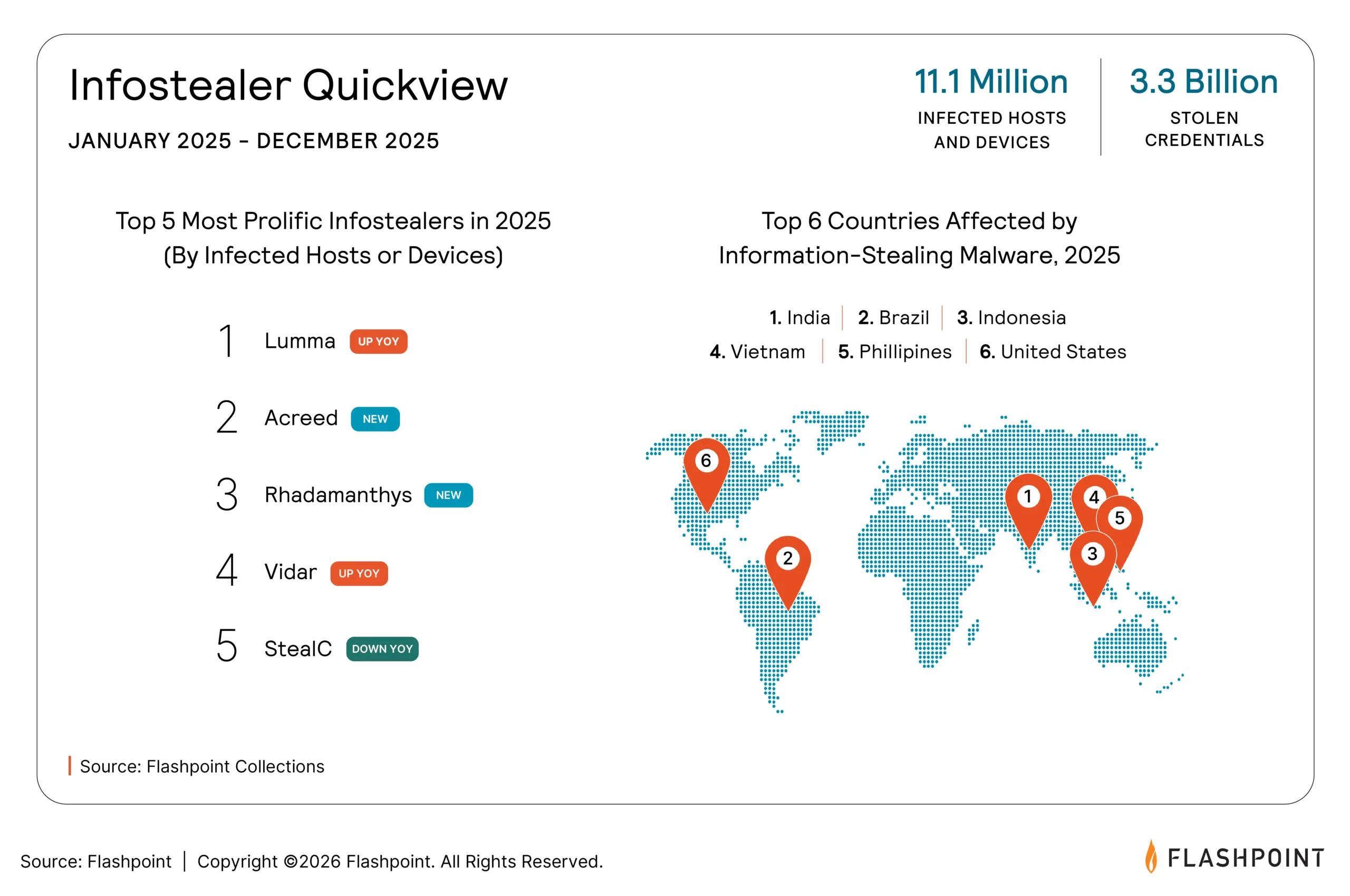
Flashpoint observed over 11.1 million machines infected with infostealers in 2025, fueling a massive inventory of 3.3 billion stolen credentials and cloud tokens. The fundamental mechanics of cybercrime have shifted from breaking in to logging in, as attackers leverage stolen session cookies to behave like legitimate users.
The Patching Window Is Rapidly Closing
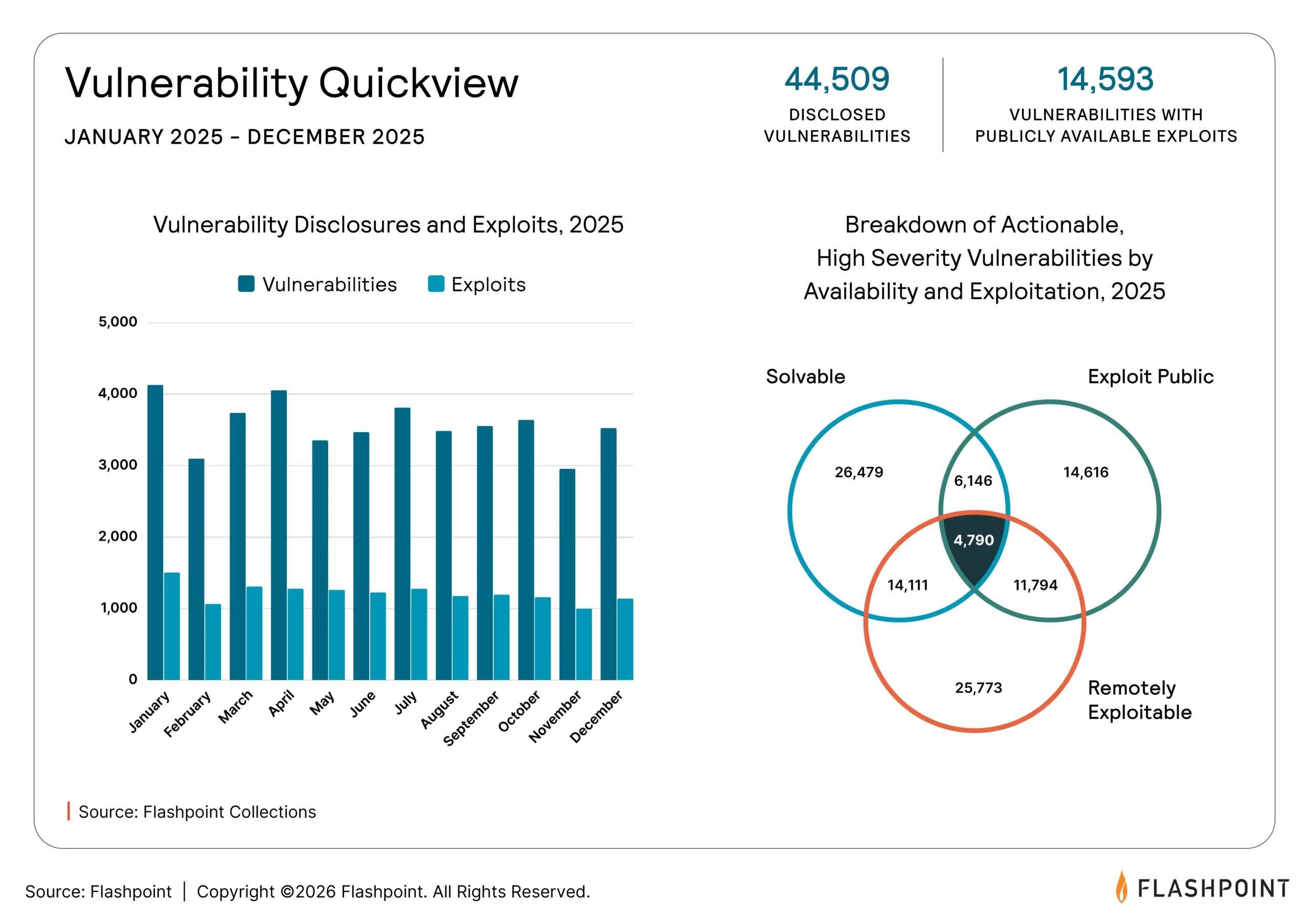
Vulnerability disclosures surged by 12% in 2025, with 1 in 3 (33%) vulnerabilities having publicly available exploit code. The strategic gap between discovery and weaponization is increasingly vanishing, as evidenced by mass exploitation of zero-day vulnerabilities in as little as 24 hours after discovery.
Ransomware Is Hacking the Person, Not the Code
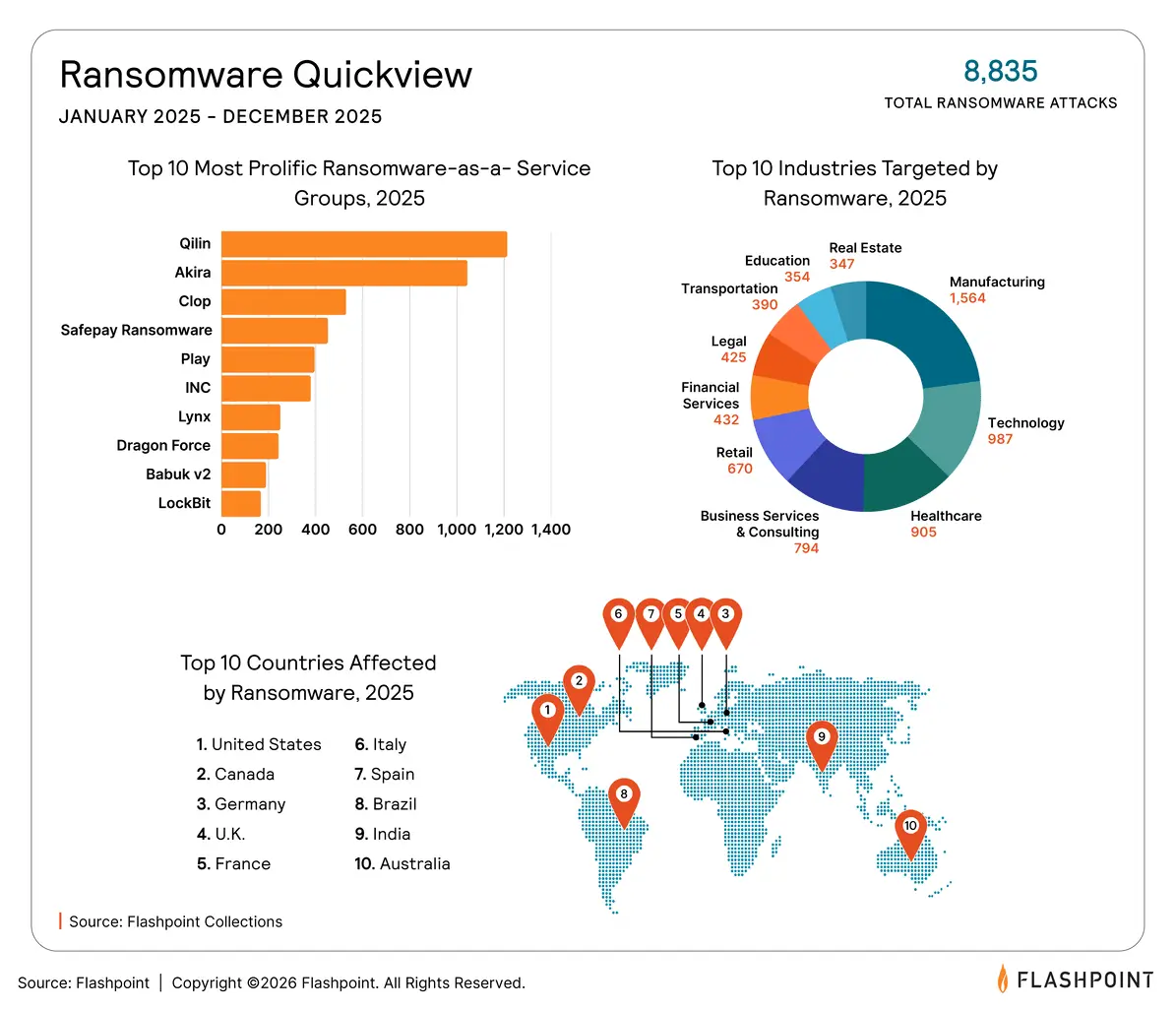
As technical defenses against encryption harden, ransomware groups are pivoting to the path of least resistance: human trust. This approach has led to a 53% increase in ransomware, with RaaS groups being responsible for over 87% of all ransomware attacks.
Build Resilience in a Converged Landscape
The findings in the 2026 Global Threat Intelligence Report make one thing clear: incremental improvements to legacy security models are no longer sufficient. As adversaries transition to machine-speed operations, the strategic advantage shifts to organizations that can maintain visibility into the adversarial environments where these attacks are born.
Protecting organizations and communities requires an intelligence-first approach. Download Flashpoint’s 2026 Global Threat Intelligence Report to gain clarity and the data-driven insights needed to safeguard critical assets.
The rapidly escalating conflict between Anthropic and the Pentagon, which started when the company refused to let the government use its technology to spy on Americans, has now gone to court. The Department of Defense retaliated by designating the company a “supply chain risk” (SCR). Now, Anthropic is asking courts to block the designation, arguing that the First Amendment does not permit the government to coerce a private actor to rewrite its code to serve government ends.
We agree.
As EFF, the Foundation for Individual Rights and Expression, and multiple other public interest organizations explained in a brief filed in support of Anthropic’s motion, the development and operation of large language models involve multiple expressive choices protected by the First Amendment. Requiring a company to rewrite its code to remove guardrails means compelling different expression, a clear constitutional violation. Further, the public record shows that the SCR designation is intended to punish the company both for pushing back and for its CEO’s public statements explaining that AI may supercharge surveillance practices that current law has proven ill-equipped to address.
As we also explain, the company’s concerns about how the government will use its technology are well-founded. The U.S. government has a long history of illegally surveilling its citizens without adequate judicial oversight based on questionable interpretations of its Constitutional and statutory obligations. The Department of Defense acquires vast troves of personal information from commercial entities, including individuals’ physical location, social media, and web browsing data.Other government agencies continue to collect and query vast quantities of Americans’ information, including by acquiring information from third party data brokers.
A growing body of social science research illustrates the chilling effects of these pervasive activities. Fearing retribution for unpopular views, dissenters stay silent. And AI only exacerbates the problem. AI can quickly analyze the government’s massive datasets or combine that information with data scraped off the internet, purchased through the commercial data broker market, or from local police surveillance devices and use all of that data to construct a comprehensive picture of a person’s life and infer sensitive details like their religious beliefs, medical conditions, political opinions, or even sex partners. For example, an agency could use AI to infer an individual’s association with a particular mosque based on data showing that they visited its website, followed its social media accounts, and were located near the mosque during religious services. AI can also deanonymize online speech by using public information to unmask anonymous users.
It is easy to conceive how an agency, a government employee with improper intent, or a malicious hacker could exploit these capabilities to monitor public discourse, preemptively squelch dissent, or persecute people from marginalized communities. Against this background and absent meaningful changes to the governing national security laws and judicial oversight structure, it is entirely reasonable for Anthropic—or any other company—to insist on its own guardrails.
Without action from Congress, the task of protecting your privacy has fallen in large part to Big Tech—something no one wants, including Big Tech. But if Congress won’t do it, companies like Anthropic must be allowed to step in, without facing retribution.
OpenAI, the maker of ChaptGPT, is rightfully facing widespread criticism for its decisions to fill the gap the U.S. Department of Defense (DoD) created when rival Anthropicrefused to drop its restrictions against using its AI for surveillance and autonomous weapons systems. After protests from bothusers and employees who did not sign up to support government mass surveillance—early reports show that ChaptGPT uninstalls rose nearly300% after the company announced the deal—Sam Altman, CEO of OpenAI, conceded that the initial agreement was “opportunistic and sloppy.” He thenre-published an internal memo on social mediastating that additions to the agreement made clear that “Consistent with applicable laws, including the Fourth Amendment to the United States Constitution, National Security Act of 1947, [and] FISA Act of 1978, the AI system shall not be intentionally used for domestic surveillance of U.S. persons and nationals.”
Trouble is, the U.S. government doesn’t believe “consistent with applicable laws” means “no domestic surveillance.” Instead, for the most part, the government has embraced a lax interpretation of “applicable law” that has blessed mass surveillance and large-scale violations of our civil liberties, andthen fought tooth and nail to prevent courts from weighing in.
"After all, many of the world’s most notorious human rights atrocities have historically been “legal” under existing laws at the time."
“Intentionally” is also doing an awful lot of work in that sentence. For years the government has insisted that the mass surveillance of U.S. persons only happens incidentally (read: not intentionally) because their communications with people both inside the United States and overseas are swept up in surveillance programs supposedly designed to only collect communications outside the United States.
The company’samendment to the contract continues in a similar vein, “For the avoidance of doubt, the Department understands this limitation to prohibit deliberate tracking, surveillance, or monitoring of U.S. persons or nationals, including through the procurement or use of commercially acquired personal or identifiable information.” Here, “deliberate” is the red flag given how often intelligence and law enforcement agencies rely on incidental or commercially purchased data to sidestep stronger privacy protections.
Here’s another one: “The AI System shall not be used for unconstrained monitoring of U.S. persons’ private information as consistent with these authorities. The system shall also not be used for domestic law-enforcement activities except as permitted by the Posse Comitatus Act and other applicable law.” What, one wonders, does “unconstrained” mean, precisely—and according to whom?
Lawyers sometimes call these “weasel words” because they create ambiguity that protects one side or another from real accountability for contract violations. As with theAnthropic negotiations, where the Pentagon reportedly agreed to adhere to Anthropic’s red lines only “as appropriate,” the government is likely attempting to publicly commit to limits in principle, but retain broad flexibility in practice.
OpenAI also notes that the Pentagon promised the NSA would not be allowed to use OpenAI’s tools absent a new agreement, and that its deployment architecture will help it verify that no red lines are crossed. But secret agreements and technical assurances have never been enough to rein in surveillance agencies, and they are no substitute for strong, enforceable legal limits and transparency.
OpenAI executives may indeed be trying, as claimed, to use the company’s contractual relationship with the Pentagon to help ensure that the government should use AI tools only in a way consistent with democratic processes. But based on what we know so far, that hope seems very naïve.
Moreover, that naïvete is dangerous. In a time when governments are willing to embrace extreme and unfounded interpretations of “applicable laws,” companies need to put some actual muscle behind standing by their commitments. After all, many of the world’s most notorious human rights atrocities have historically been “legal” under existing laws at the time. OpenAI promises the public that it will “avoid enabling uses of AI or AGI that harm humanity or unduly concentrate power,” but we know that enabling mass surveillance does both.
OpenAI isn’t the only consumer-facing company that is, on the one hand, seeking to reassure the public that they aren’t participating in actions that violate human rights while, on the other, seeking to cash in on government mass surveillance efforts. Despite this marketing double-speak, it is very clear that companies just cannot do both. It’s also clear that companies shouldn’t be given that much power over the limits of our privacy to begin with. The public should not have to rely on asmall group of people—whether CEOs or Pentagon officials—to protect our civil liberties.
Written by: Matthew McWhirt, Bhavesh Dhake, Emilio Oropeza, Gautam Krishnan, Stuart Carrera, Greg Blaum, Michael Rudden
UPDATE (March 13): Added guidance around abuse or misuse of endpoint / MDM platforms.
Background
Threat actors leverage destructive malware to destroy data, eliminate evidence of malicious activity, or manipulate systems in a way that renders them inoperable. Destructive cyberattacks can be a powerful means to achieve strategic or tactical objectives; however, the risk of reprisal is likely to limit the frequency of use to very select incidents. Destructive cyberattacks can include destructive malware, wipers, or modified ransomware.
When conflict erupts, cyber attacks are an inexpensive and easily deployable weapon. It should come as no surprise that instability leads to increases in attacks. This blog post provides proactive recommendations for organizations to prioritize for protecting against a destructive attack within an environment. The recommendations include practical and scalable methods that can help protect organizations from not only destructive attacks, but potential incidents where a threat actor is attempting to perform reconnaissance, escalate privileges, laterally move, maintain access, and achieve their mission.
The detection opportunities outlined in this blog post are meant to act as supplementary monitoring to existing security tools. Organizations should leverage endpoint and network security tools as additional preventative and detective measures. These tools use a broad spectrum of detective capabilities, including signatures and heuristics, to detect malicious activity with a reasonable degree of fidelity. The custom detection opportunities referenced in this blog post are correlated to specific threat actor behavior and are meant to trigger anomalous activity that is identified by its divergence from normal patterns. Effective monitoring is dependent on a thorough understanding of an organization's unique environment and usage of pre-established baselines.
Organizational Resilience
While the core focus of this blog post is aligned to technical- and tactical-focused security controls, technical preparation and recovery are not the only strategies. Organizations that include crisis preparation and orchestration as key components of security governance can naturally adopt a "living" resilience posture. This includes:
Out-of-Band Incident Command and Communication: Establish a pre-validated, "out-of-band" communication platform that is completely decoupled from the corporate identity plane. This ensures that the key stakeholders and third-party support teams can coordinate and communicate securely, even if the primary communication platform is unavailable.
Defined Operational Contingency and Recovery Plans: Establish baseline operational requirements, including manual procedures for vital business functions to ensure continuity during restoration or rebuild efforts. Organizations must also develop prioritized application recovery sequences and map the essential dependencies needed to establish a secure foundation for recovery goals.
Pre-Establish Trusted Third-Party Vendor Relationships: Based on the range of technologies and platforms vital to business operations, develop predefined agreements with external partners to ensure access to specialists for legal / contractual requirements, incident response, remediation, recovery, and ransomware negotiations.
Practice and Refine the Recovery: Conduct exercises that validate the end-to-end restoration of mission-critical services using isolated, immutable backups and out-of-band communication channels, ensuring that recovery timelines (RTO) and data integrity (RPO) are tested, practiced, and current.
Google Security Operations
Google Security Operations (SecOps) customers have access to these broad category rules and more under the Mandiant Intel Emerging Threats, Mandiant Frontline Threats, Mandiant Hunting Rules, CDIR SCC Enhanced Data Destruction Alerts rule packs. The activity discussed in the blog post is detected in Google SecOps under the rule names:
BABYWIPER File Erasure
Secure Evidence Destruction And Cleanup Commands
CMD Launching Application Self Delete
Copy Binary From Downloads
Rundll32 Execution Of Dll Function Name Containing Special Character
Services Launching Cmd
System Process Execution Via Scheduled Task
Dllhost Masquerading
Backdoor Writing Dll To Disk For Injection
Multiple Exclusions Added To Windows Defender In Single Command
Path Exclusion Added to Windows Defender
Registry Change to CurrentControlSet Services
Powershell Set Content Value Of 0
Overwrite Disk Using DD Utility
Bcdedit Modifications Via Command
Disabling Crash Dump For Drive Wiping
Suspicious Wbadmin Commands
Fsutil File Zero Out
Recommendations Summary
Table 1 provides a high-level overview of guidance in this blog post.
Protect the integrity and availability of Kubernetes environments and CI/CD pipelines.
Table 1: Overview of recommendations
1. External-Facing Assets
Identify, Enumerate, and Harden
To protect against a threat actor exploiting vulnerabilities or misconfigurations via an external-facing vector, organizations must determine the scope of applications and organization-managed services that are externally accessible. Externally accessible applications and services (including both on-premises and cloud) are often targeted by threat actors for initial access by exploiting known vulnerabilities, brute-forcing common or default credentials, or authenticating using valid credentials.
To proactively identify and validate external-facing applications and services, consider:
Leveraging a vulnerability scanning technology to identify assets and associated vulnerabilities.
Performing a focused vulnerability assessment or penetration test with the goal of identifying external-facing vectors that could be leveraged for authentication and access.
Verifying with technology vendors if the products leveraged by an organization for external-facing services require patches or updates to mitigate known vulnerabilities.
Any identified vulnerabilities should not only be patched and hardened, but the identified technology platforms should also be reviewed to ensure that evidence of suspicious activity or technology/device modifications have not already occurred.
The following table provides an overview of capabilities to proactively review and identify external-facing assets and resources within common cloud-based infrastructures.
Table 2: Overview of cloud provider attack surface discovery capabilities
Enforce Multi-Factor Authentication
External-facing assets that leverage single-factor authentication (SFA) are highly susceptible to brute-forcing attacks, password spraying, or unauthorized remote access using valid (stolen) credentials. External-facing applications and services that currently allow for SFA should be configured to support multi-factor authentication (MFA). Additionally, MFA should be leveraged for accessing not only on-premises external-facing managed infrastructure, but also for cloud-based resources (e.g., software-as-a-service [SaaS] such as Microsoft 365 [M365]).
When configuring multifactor authentication, the following methods are commonly considered (and ranked from most to least secure):
Fast IDentity Online 2 (FIDO2)/WebAuthn security keys or passkeys
Software/hardware Open Authentication (OAUTH) token
Push notification (least preferred option) using number matching when possible
Phone call
Short Message Service (SMS) verification
Email-based verification
Risks of Specific MFA Methods
Push Notifications
If an organization is leveraging push notifications for MFA (e.g., a notification that requires acceptance via an application or automated call to a mobile device), threat actors can exploit this type of MFA configuration for attempted access, as a user may inadvertently accept a push notification on their device without the context of where the authentication was initiated.
Phone/SMS Verification
If an organization is leveraging phone calls or SMS-based verification for MFA, these methods are not encrypted and are susceptible to potentially being intercepted by a threat actor. These methods are also vulnerable if a threat actor is able to transfer an employee's phone number to an attacker-controlled subscriber identification module (SIM) card. This would result in the MFA notifications being routed to the threat actor instead of the intended employee.
Email-Based Verification
If an organization is leveraging email-based verification for validating access or for retrieving MFA codes, and a threat actor has already established the ability to access the email of their target, the actor could potentially also retrieve the email(s) to validate and complete the MFA process.
If any of these MFA methods are leveraged, consider:
Training remote users to never accept or respond to a logon notification when they are not actively attempting to log in.
Establishing a method for users to report suspicious MFA notifications, as this could be indicative of a compromised account.
Ensuring there are messaging policies in place to prevent the auto-forwarding of email messages outside the organization.
Time-Based One-Time Password
Time-based one-time password (TOTP) relies on a shared secret, called a seed, known by both the authenticating system and the authenticator possessed by an end user. If a seed is compromised, the TOTP authenticator can be duplicated and used by a threat actor.
Detection Opportunities for External-Facing Assets and MFA Attempts
Search for multiple failed MFA prompts for different users from the same source. This may be indicative of multiple compromised credentials and an attempt to "spray" MFA prompts/tokens for access.
External Authentication from an Account with Elevated Privileges
Privileged accounts should use internally managed and secured privileged access workstations for access and should not be accessible directly from an external (untrusted) source.
Adversary in the Middle (AiTM) Session Token Theft
Monitor audit logs for new MFA device registrations (AuthenticationMethodRegistered) occurring within 60 minutes of a sign-in from a new IP or device. Attackers who steal session tokens via AiTM immediately register their own MFA device for persistent access.
Monitor for OAuth application consent grants with high-privilege scopes (Mail.Read, Files.ReadWrite.All) from unrecognized application IDs.
Table 3: Detection opportunities for external-facing assets and MFA attempts
2. Critical Asset Protections
Domain Controller and Critical Asset Backups
Organizations should verify that backups for domain controllers and critical assets are available and protected against unauthorized access or modification. Backup processes and procedures should be exercised on a continual basis. Backups should be protected and stored within secured enclaves that include both network and identity segmentation.
If an organization's Active Directory (AD) were to become corrupted or unavailable due to ransomware or a potentially destructive attack, restoring Active Directory from domain controller backups may be the only viable option to reconstitute domain services. The following domain controller recovery and reconstitution best practices should be proactively reviewed by organizations:
Verify that there is a known good backup of domain controllers and SYSVOL shares (e.g., from a domain controller – backup C:\Windows\SYSVOL).
For domain controllers, a system state backup is preferred.
Note:For a system state backup to occur, Windows Server Backup must be installed as a feature on a domain controller.
The following command can be run from an elevated command prompt to initiate a system state backup of a domain controller.
Figure 1: Command to perform a system state backup
The following command can be run from an elevated command prompt to perform a SYSVOL backup. (Manage auditing and security log permissions must also be configured for the account performing the backup.)
Proactively identify domain controllers that hold flexible single master operation (FSMO) roles, as these domain controllers will need to be prioritized for recovery in the event that a full domain restoration is required.
netdom query fsmo
Figure 3: Command to identify domain controllers that hold FSMO roles
Offline backups: Ensure offline domain controller backups are secured and stored separately from online backups.
Encryption: Backup data should be encrypted both during transit (over the wire) and when at rest or mirrored for offsite storage.
DSRM Password validation: Ensure that the Directory Services Restore Mode (DSRM) password is set to a known value for each domain controller. This password is required when performing an authoritative or nonauthoritative domain controller restoration.
Configure alerting for backup operations: Backup products and technologies should be configured to detect and provide alerting for operations critical to the availability and integrity of backup data (e.g., deletion of backup data, purging of backup metadata, restoration events, media errors).
Enforce role-based access control (RBAC): Access to backup media and the applications that govern and manage data backups should use RBAC to restrict the scope of accounts that have access to the stored data and configuration parameters.
Testing and verification: Both authoritative and nonauthoritative domain controller restoration processes should be documented and tested on a regular basis. The same testing and verification processes should be enforced for critical assets and data.
Business Continuity Planning
Critical asset recovery is dependent upon in-depth planning and preparation, which is often included within an organization's business continuity plan (BCP). Planning and recovery preparation should include the following core competencies:
A well-defined understanding of crown jewels data and supporting applications that align to backup, failover, and restoration tasks that prioritize mission-critical business operations
Clearly defined asset prioritization and recovery sequencing
Thoroughly documented recovery processes for critical systems and data
Trained personnel to support recovery efforts
Validation of recovery processes to ensure successful execution
Clear delineation of responsibility for managing and verifying data and application backups
Online and offline data backup retention policies, including initiation, frequency, verification, and testing (for both on-premises and cloud-based data)
Established service-level agreements (SLAs) with vendors to prioritize application and infrastructure-focused support
Continuity and recovery planning can become stale over time, and processes are often not updated to reflect environment and personnel changes. Prioritizing evaluations, continuous training, and recovery validation exercises will enable an organization to be better prepared in the event of a disaster.
Search for instances where a threat actor will delete volume shadow copies to inhibit system recovery. This can be accomplished using the command line, PowerShell, and other utilities.
The possible values for the registry key noted in Figure 4 are:
0 (default): The DSRM Administrator account can only be used if the domain controller is restarted in Directory Services Restore Mode.
1: The DSRM Administrator account can be used for a console-based log on if the local Active Directory Domain Services service is stopped.
2: The DSRM Administrator account can be used for console or network access without needing to reboot a domain controller.
Table 4: Detection opportunities for backups
IT and OT Segmentation
Organizations should ensure that there is both physical and logical segmentation between corporate information technology (IT) domains, identities, networks, and assets and those used in direct support of operational technology (OT) processes and control. By enforcing IT and OT segmentation, organizations can inhibit a threat actor's ability to pivot from corporate environments to mission-critical OT assets using compromised accounts and existing network access paths.
OT environments should leverage separate identity stores (e.g., dedicated Active Directory domains), which are not trusted or cross-used in support of corporate identity and authentication. The compromise of a corporate identity or asset should not result in a threat actor's ability to directly pivot to accessing an asset that has the ability to influence an OT process.
In addition to separate AD forests being leveraged for IT and OT, segmentation should also include technologies that may have a dual use in the IT and OT environments (backup servers, antivirus [AV], endpoint detection and response [EDR], jump servers, storage, virtual network infrastructure). OT segmentation should be designed such that if there is a disruption in the corporate (IT) environment, the OT process can safely function independently, without a direct dependency (account, asset, network pathway) with the corporate infrastructure. For any dependencies that cannot be readily segmented, organizations should identify potential short-term processes or manual controls to ensure that the OT environment can be effectively isolated if evidence of an IT (corporate)-focused incident were detected.
Segmenting IT and OT environments is a best practice recommended by industry standards such as the National Institute of Standards and Technology (NIST) SP 800-82r3: Guide to Operational Technology (OT) Security and IEC 62443 (formerly ISA99).
According to these best-practice standards, segmenting IT and OT networks should include the following:
OT attack surface reduction by restricting the scope of ports, services, and protocols that are directly accessible within the OT network from the corporate (IT) network.
Incoming access from corporate (IT) into OT must terminate within a segmented OT demilitarized zone (DMZ). The OT DMZ must require that a separate level of authentication and access be granted (outside of leveraging an account or endpoint that resides within the corporate IT domain).
Explicit firewall rules should restrict both incoming traffic from the corporate environment and outgoing traffic from the OT environment.
Firewalls should be configured using the principle of deny by default, with only approved and authorized traffic flows permitted. Egress (internet) traffic flows for all assets that support OT should also follow the deny-by-default model.
Identity (account) segmentation must be enforced between corporate IT and OT. An account or endpoint within either environment should not have any permissions or access rights assigned outside of the respective environment.
Remote access to the OT environment should not leverage similar accounts that have remote access permissions assigned within the corporate IT environment. MFA using separate credentials should be enforced for remotely accessing OT assets and resources.
Training and verification of manual control processes, including isolation and reliability verification for safety systems.
Secured enclaves for storing backups, programming logic, and logistical diagrams for systems and devices that comprise the OT infrastructure.
The default usernames and passwords associated with OT devices should always be changed from the default vendor configuration(s).
Detection Opportunities for IT and OT Segmented Environments
Search for failed logins for accounts limited to one environment attempting to log in within another environment. This can detect threat actors attempting to reuse credentials for lateral movement between networks.
Table 5: Detection opportunities for IT and OT segmented environments
Egress Restrictions
Servers and assets that are infrequently rebooted are highly targeted by threat actors for establishing backdoors to create persistent beacons to command-and-control (C2) infrastructure. By blocking or severely limiting internet access for these types of assets, an organization can effectively reduce the risk of a threat actor compromising servers, extracting data, or installing backdoors that leverage egress communications for maintaining access.
Egress restrictions should be enforced so that servers, internal network devices, critical IT assets, OT assets, and field devices cannot attempt to communicate to external sites and addresses (internet resources). The concept of deny by default should apply to all servers, network devices, and critical assets (including both IT and OT), with only allow-listed and authorized egress traffic flows explicitly defined and enforced. Where possible, this should include blocking recursive Domain Name System (DNS) resolutions not included in an allow-list to prevent communication via DNS tunneling.
If possible, egress traffic should be routed through an inspection layer (such as a proxy) to monitor external connections and block any connections to malicious domains or IP addresses. Connections to uncategorized network locations (e.g., a domain that has been recently registered) should not be permitted. Ideally, DNS requests would be routed through an external service (e.g., Cisco Umbrella, Infoblox DDI) to monitor for lookups to malicious domains.
Threat actors often attempt to harvest credentials (including New Technology Local Area Network [LAN] Manager [NTLM] hashes) based upon outbound Server Message Block (SMB) or Web-based Distributed Authoring and Versioning (WebDAV) communications. Organizations should review and limit the scope of egress protocols that are permissible from any endpoint within the environment. While Hypertext Transfer Protocol (HTTP) (Transmission Control Protocol (TCP)/80) and HTTP Secure (HTTPS) (TCP/443) egress communications are likely required for many user-based endpoints, the scope of external sites and addresses can potentially be limited based upon web traffic-filtering technologies. Ideally, organizations should only permit egress protocols and communications based upon a predefined allow-list. Common high-risk ports for egress restrictions include:
File Transfer Protocol (FTP)
Remote Desktop Protocol (RDP)
Secure Shell (SSH)
Server Message Block (SMB)
Trivial File Transfer Protocol (TFTP)
WebDAV
Detection Opportunities for Suspicious Egress Traffic Flows
Use Case
MITRE ID
Description
External Connection Attempt to a Known Malicious IP
Search for external connection attempts over SMB, as this may be an attempt to harvest credential hashes.
Table 6: Detection opportunities for suspicious egress traffic flows
Virtualization Infrastructure Protections
Threat actors often target virtualization infrastructure (e.g., VMware vSphere, Microsoft Hyper-V) as part of their reconnaissance, lateral movement, data theft, and potential ransomware deployment objectives. Securing virtualization infrastructure requires a Zero Trust network posture as a primary defense. Because management appliances often lack native MFA for local privileged accounts, identity-based security alone can be a high-risk single point of failure. If credentials are compromised, the logical network architecture becomes the final line of defense protecting the virtualization management plane.
To reduce the attack surface of virtualized infrastructure, a best practice for VMware vSphere vCenter ESXi and Hyper-V appliances and servers is to isolate and restrict access to the management interfaces, essentially enclaving these interfaces within isolated virtual local area networks (VLANs) (network segments) where connectivity is only permissible from dedicated subnets where administrative actions can be initiated.
To protect the virtualization control plane, organizations must consider a "defense-in-depth" network model. This architecture integrates physical isolation and east-west micro-segmentation to remove all access paths from untrusted networks. The result is a management zone that remains isolated and resilient, even during an active intrusion.
VMware vSphere Zero-Trust Network Architecture
The primary goal is to ensure that even if privileged credentials are compromised, the logical network remains the definitive defensive layer preventing access to virtualization management interfaces.
Immutable VLAN Segmentation: Enforce strict isolation using distinct 802.1Q VLAN IDs for host management, Infrastructure/VCSA, vMotion (non-routable), Storage (non-routable), and production Guest VMs.
Virtual Routing and Forwarding (VRF): Transition all infrastructure VLANs into a dedicated VRF instance. This ensures that even a total compromise of the "User" or "Guest" zones results in no available route to the management zone(s).
Layer 3 and 4 Access Policies
The management network must be accessible only from trusted, hardened sources.
PAW-Exclusive Access: Deconstruct all direct routes from the general corporate LAN to management subnets. Access must originate strictly from a designated Privileged Access Workstation (PAW) subnet.
Ingress Filtering (Management Zone):
ALLOW: TCP/443 (UI/API) and TCP/902 (MKS) from the PAW subnet only.
DENY: Explicitly block SSH (TCP/22) and VAMI (TCP/5480) from all sources except the PAW subnet.
Restrictive Egress Policy: Enforce outbound filtering at the hardware gateway (as the VCSA GUI cannot manage egress). To prevent persistence using C2 traffic and data exfiltration, block all internet access except to specific, verified update servers (e.g., VMware Update Manager) and authorized identity providers.
Host-Based Firewall Enforcement
Complement network firewalls with host-level filtering to eliminate visibility gaps within the same VLAN.
VCSA (Photon OS): Transition the default policy to "Default Deny" via the VAMI or, preferably, at the OS level using iptables/nftables for granular source/destination mapping.
ESXi Hypervisors: Restrict all services (SSH, Web Access, NFC/Storage) to specific management IPs by deselecting "Allow connections from any IP address."
Similar to vSphere, Hyper-V requires strict isolation of its various traffic types to prevent lateral movement from guest workloads to the management plane.
VLAN Segmentation: Organizations must enforce isolation using distinct VLANs for Host Management, Live Migration, Cluster Heartbeat (CSV), and Production Guest VMs.
Non-Routable Networks: Traffic for Live Migration and Cluster Shared Volumes (CSV) should be placed on non-routable VLANs to ensure these high-bandwidth, sensitive streams cannot be intercepted from other segments.
Layer 3 and 4 Access Policies
The management network must be accessible only from trusted, hardened sources.
PAW-Exclusive Access: Deconstruct all direct routes from the general corporate LAN to management subnets. Access must originate strictly from a designated Privileged Access Workstation (PAW) subnet.
Ingress Filtering (Management Zone):
ALLOW: WinRM / PowerShell Remoting (TCP/5985 and TCP/5986), RDP (TCP/3389), and WMI/RPC (TCP/135 and dynamic RPC ports)strictly from the PAW subnet. If using Windows Admin Center, allow HTTPS (TCP/443) to the gateway.
DENY: Explicitly block SMB (TCP/445), RPC/WMI (TCP/135), and all other management traffic from untrusted sources to prevent credential theft and lateral movement.
Restrictive Egress Policy: Enforce outbound filtering at the network gateway. To prevent persistence using C2 traffic and data exfiltration, block all internet access from Hyper-V hosts except to specific, verified update servers (e.g., internal WSUS), authorized Active Directory Domain Controllers, and Key Management Servers (KMS).
Host-Based Firewall Enforcement
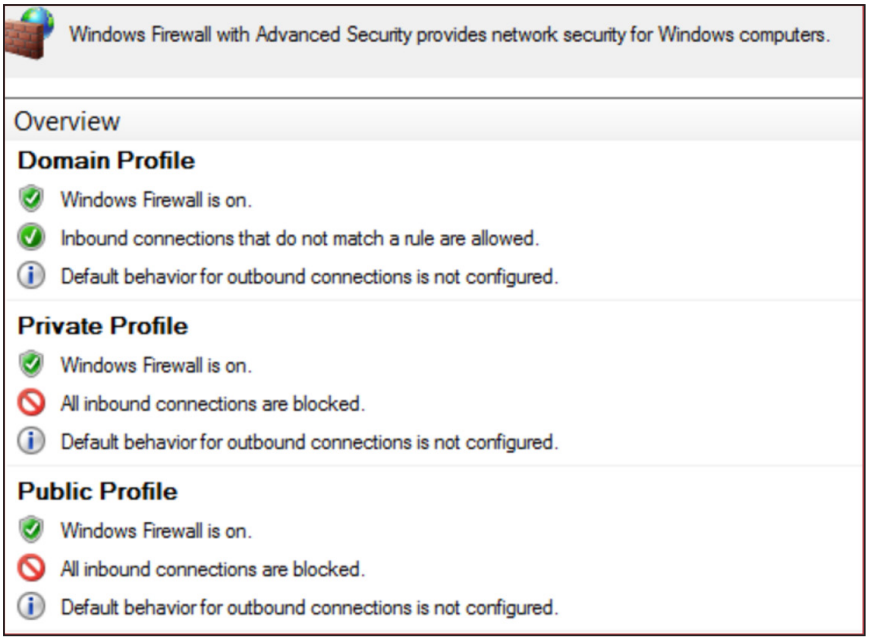
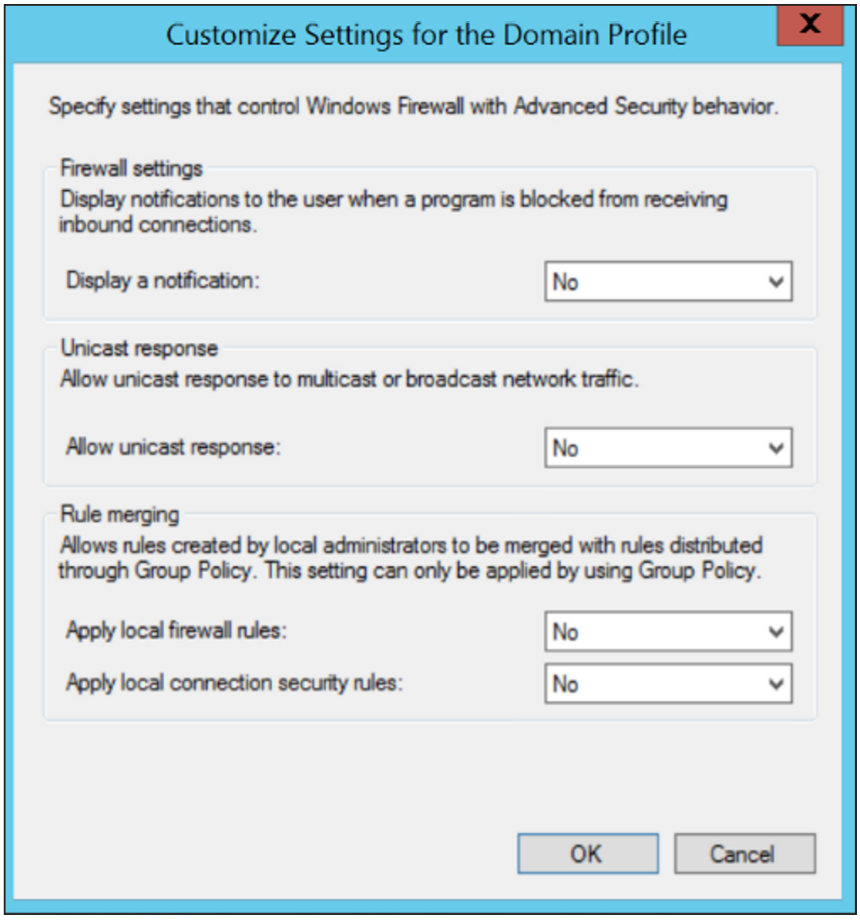
Use the Windows Firewall with Advanced Security (WFAS) to achieve a defense-in-depth posture at the host level.
Scope Restriction: For all enabled management rules (e.g., File and Printer Sharing, WMI, PowerShell Remoting), modify the Remote IP Address scope to "These IP addresses" and enter only the PAW and management server subnets.
Management Logging: Enable logging for Dropped Packets in the Windows Firewall profile. This allows the SIEM to ingest "denied" connection attempts, which serve as high-fidelity indicators of internal reconnaissance or unauthorized access attempts.
To protect management interfaces for VMware vSphere the VMKernel network interface card (NIC) should not be bound to the same virtual network assigned to virtual machines running on the host. Additionally, ESXi servers can be configured in lockdown mode, which will only allow console access from the vCenter server(s). Additional information related to lockdown mode.
The SSH protocol (TCP/22) provides a common channel for accessing a physical virtualization server or appliance (vCenter) for administration and troubleshooting. Threat actors commonly leverage SSH for direct access to virtualization infrastructure to conduct destructive attacks. In addition to enclaving access to administrative interfaces, SSH access to virtualization infrastructure should be disabled and only enabled for specific use-cases. If SSH is required, network ACLs should be used to limit where connections can originate.
Identity segmentation should also be configured when accessing administrative interfaces associated with virtualization infrastructure. If Active Directory authentication provides direct integrated access to the physical virtualization stack, a threat actor that has compromised a valid Active Directory account (with permissions to manage the virtualization infrastructure) could potentially use the account to directly access virtualized systems to steal data or perform destructive actions.
Authentication to virtualized infrastructure should rely upon dedicated and unique accounts that are configured with strong passwords and that are not co-used for additional access within an environment. Additionally, accessing management interfaces associated with virtualization infrastructure should only be initiated from isolated privileged access workstations, which prevent the storing and caching of passwords used for accessing critical infrastructure components.
Protecting Hypervisors Against Offline Credential Theft and Exfiltration
Organizations should implement a proactive, defense-in-depth technical hardening strategy to systematically address security gaps and mitigate the risk of offline credential theft from the hypervisor layer. The core of this attack is an offline credential theft technique known as a "Disk Swap." Once an adversary has administrative control over the hypervisor (vSphere or Hyper-V), they perform the following steps:
Target Identification: The actor identifies a critical virtualized asset, such as a Domain Controller (DC)
Offline Manipulation: The target VM is powered off, and its virtual disk file (e.g., .vmdk for VMware or .vhd/.vhdx for Hyper-V) is detached.
NTDS.dit Extraction: The disk is attached to a staging or "orphaned" VM under the attacker's control. From this unmonitored machine, they copy the NTDS.dit Active Directory database.
Stealthy Recovery: The disk is re-attached to the original DC, and the VM is powered back on, leaving minimal forensic evidence within the guest operating system.
Hardening and Mitigation Guidance
To defend against this logic, organizations must implement a defense-in-depth strategy that focuses on cryptographic isolation and strict lifecycle management.
Virtual Machine Encryption: Organizations must encrypt all Tier 0 virtualized assets (e.g., Domain Controllers, PKI, and Backup Servers). Encryption ensures that even if a virtual disk file is stolen or detached, it remains unreadable without access to the specific keys.
Strict Decommissioning Processes: Do not leave powered-off or "orphaned" virtual machines on datastores. These "ghost" VMs are ideal staging environments for attackers. Formally decommission assets by deleting their virtual disks rather than just removing them from the inventory.
Harden Hypervisor Accounts: Disable or restrict default administrative accounts (such as root on ESXi or the local Administrator on Hyper-V hosts). Enforce Lockdown Mode (VMware ESXi feature) where possible to prevent direct host-level changes outside of the central management plane.
Remote Audit Logging: Enable and forward all hypervisor-level audit logs (e.g., hostd.log, vpxa.log, or Windows Event Logs for Hyper-V) to a centralized SIEM.
Protecting Backups
Security measures must encompass both production and backup environments. An attack on the production plane is often coupled with a simultaneous focus on backup integrity, creating a total loss of operational continuity. Virtual disk files (VMDK for VMware and VHD/VHDX for Hyper-V) represent a high-value target for offline data theft and direct manipulation.
Hardening and Mitigation Guidance
To mitigate the risk of offline theft and backup manipulation, organizations must implement a "Default Encrypted" policy across the entire lifecycle of the virtual disk .
At-Rest Encryption for all Tier-0 Assets: Implement vSphere VM Encryption or Hyper-V Shielded VMs for all critical infrastructure (e.g., Domain Controllers, Certificate Authorities). This ensures that the raw VMDK or VHDX files are cryptographically protected, rendering them unreadable if detached or mounted by an unauthorized party.
Encrypted Backup Repositories: Ensure that the backup application is configured to encrypt backup data at rest using a unique key stored in a separate, hardened Key Management System (KMS). This prevents "direct manipulation" of the backup files even if the backup storage itself is compromised.
Network Isolation of Storage & Backups: Isolate the storage management network and the backup infrastructure into dedicated, non-routable VLANs. Access to the backup console and repositories must require phishing-resistant MFA and originate from a designated Privileged Access Workstation (PAW).
Immutability and Air-Gapping: Use Immutable Backup Repositories to ensure that once a backup is written, it cannot be modified or deleted by any user including a compromised administrator for a set period. This provides a definitive recovery point in the event of a ransomware attack or intentional data sabotage.
Detection Opportunities for Monitoring Virtualization Infrastructure
Use Case
MITRE ID
Description
Unauthorized Access Attempt to Virtualized Infrastructure
Search for instances where an SSH connection is attempted when SSH has not been enabled for an approved purpose or is not expected from a specific origination asset.
Monitor ESXi hostd.log and shell.log for the SSH service being enabled via DCUI, vSphere client, or API calls. Alert on any ESXi SSH enablement event that was not preceded by an approved change request.
Monitor ESXi shell.log for execution of "esxcli system settings encryption set" with "--require-exec-installed-only=F" or "--require-secure-boot=F". Alert on any cryptographic enforcement disablement event that was not preceded by an approved change request.
Monitor vCenter events and vpxd.log for modifications to SSO identity sources, including the addition of new LDAP providers or changes to vshphere.local administrator group membership. Alert on an identity source change not initiated from a designated PAW subnet.
Detect sequences where a virtual disk is removed from a Tier-0 asset via "vim.event.VmReconfiguredEvent" and subsequently attached to an orphaned or non-standard inventory VM.
Correlate with "vim.event.VmRegisteredEvent" events on non-standard datastore paths within the same time window.
Monitor VCSA shell audit logs for execution of high-risk commands (e.g., wget, curl, psql, certificate-manager) by any user following an interactive SSH session. Alert on any instance where these commands are executed outside of an approved change window.
Detects sequences where snapshots are removed across multiple VMs within a short time window via vCenter events. Correlate with "vim-cmd vmsvc/snapshot.removeall" execution in hostd.log to confirm host-level action.
Table 7: Detection opportunities for VMware vSphere
Protecting Against DDoS Attacks
A distributed denial-of-service (DDoS) attack is an example of a disruptive attack that could impact the availability of cloud-based resources and services. Modernized DDoS protection must extend beyond the legacy concepts of filtering and rate-limiting, and include cloud-native capabilities that can scale to combat adversarial capabilities.
In addition to third-party DDoS and web application access protection services, the following table provides an overview of DDoS protection capabilities within common cloud-based infrastructures.
Table 8: Common cloud capabilities to mitigate DDoS attacks
Hardening the Cloud Perimeter
With the hybrid operating model of modern day infrastructure, cloud consoles and SaaS platforms are high-value targets for credential harvesting and data exfiltration. Minimizing these risks requires a dual-defense strategy: robust identity controls to prevent unauthorized access, and platform-specific guardrails to protect access to resources, data, and to minimize the attack surface.
Strong Authentication Enforcement
Strong authentication is the foundational requirement for cloud resilience and securing cloud infrastructure. Similar to on-premises environments, a compromise of a privileged credential, token, or session could lead to unintended consequences that result in a high-impact event for an organization. To mitigate these pervasive risks, organizations must unconditionally enforce strong authentication for all external-facing cloud services, administrative portals, and SaaS platforms.
Organizations should enforce the usage of phishing-resistant authenticators such as FIDO2 (WebAuthn) hardware tokens or passkeys, or certificate based authentication for accounts assigned privileged roles and functions. For non-privileged users, authenticator software (Microsoft Authenticator or Okta Verify) should be configured to utilize device-bound factors such as Windows Hello for Business or TouchID.
Additionally, organizations should leverage the concept of authenticators (identity + device attestation) as part of the authentication transaction. This includes enforcing a validated-device access policy that restricts privileged access to only originate from managed, compliant, and healthy devices. Trusted network zones should be defined in order to restrict access to cloud resources from the open internet. Untrusted network zones should be defined to restrict authentication from anonymizing services such as VPNs or TOR. Using device-bound session credentials where possible mitigates the risk of session token theft.
Identity and Device Segmentation for Privileged Actions
The implementation of privileged access workstations (PAWs) is a critical defense against threat actors attempting to compromise administrative sessions. A PAW is a highly hardened, dedicated hardware endpoint used exclusively for sensitive administrative tasks.
Administrators should leverage a non-privileged account for daily tasks, while privileged actions are restricted to only being permissible from the hardened PAW, or from explicitly defined IP ranges. This "air-gap" between communication and administration prevents an adversary from moving laterally from a compromised non-privileged identity to a privileged context within hybrid environments.
Just-in-Time Access and the Principle of Least Privilege
Static, standing privileges present a security risk in hybrid environments. Following a zero-trust cloud architecture, administrative privileges should be entirely ephemeral. Implementing Just-In-Time (JIT) and Just-Enough-Access (JEA) mechanisms ensures that administrators are granted only the specific, granular permissions necessary to perform a discrete task, and only for a highly limited duration, after which the permissions are automatically revoked. This architectural model provides organizations with the ability to enforce approvals for privileged actions, enhanced monitoring, and detailed visibility regarding any privileged actions taken within a specific session.
Securing Non-Human Identities
Organizations should implement identity governance practices that include processes to rotate API keys, certificates, service account secrets, tokens, and sessions on a predefined basis. AI agents or identities correlating to autonomous outcomes should be configured with strictly scoped permissions and associated monitoring. Non-privileged users should be restricted from authorizing third-party application integrations or creating API keys without organizational approval.
Continuous scanning should be performed to identify and remediate hard-coded secrets and sensitive credentials across all cloud and SaaS environments.
Storage Infrastructure Security and Immutable Backups
The strategic objective of a destructive cyberattack—whether for extortion or sabotage—is to prolong recovery and reconstitution efforts by ensuring data is irrecoverable. Modern adversaries systematically target the backup plane as part of a destructive event. If backups remain mutable or share an identity plane with the primary environment, attackers can delete or encrypt them, transforming an incident into a prolonged and chaotic recovery exercise.
While modern-day redundancy for backups should include multiple data copies across diverse media, geographic separation can be a subverted defensive strategy if logical access is unified. To ensure resilience against destructive attacks, the secondary recovery environment should reside within a sovereign cloud tenant or isolated subscription. This environment should be governed by an independent Identity and Access Management (IAM) plane, using distinct credentials and administrative personas that share no commonality with the production environment.
Backups within an isolated environment must be anchored by immutable storage architectures. By leveraging hardware-verified Write-Once, Read-Many (WORM) technology, the recovery plane ensures that data integrity is mathematically guaranteed. Once committed, data cannot be modified, encrypted, or deleted—even by accounts with root or global administrative privileges, until the retention period expires. This creates a definitive "fail-safe" that ensures a known-good recovery point remains accessible regardless of potential security risks in the primary environment.
Additional defense-in-depth security architecture controls relevant to common cloud-based infrastructures are included in Table 9.
Detect interactive console sign-ins from IPs that previously only performed programmatic API/CLI access. Alert on cloud CLI execution from non-administrative endpoints.
Monitor for cross-service lateral movement where a single identity authenticates to multiple cloud services in a compressed timeframe outside its historical access pattern.
Monitor for unauthorized compute changes including bulk instance creation or deletion deviating from change management baselines.
Alert on snapshot creation of production volumes by non-backup accounts, disk detach/reattach targeting domain controller or database instances for offline credential theft, and network/firewall modifications exposing internal services to public access.
Alert when bulk delete API calls exceed baseline thresholds targeting compute instances, storage, databases, or virtual networks.
Detect deletion or retention reduction of recovery-critical resources including backup vaults, snapshot schedules, and disaster recovery configurations.
Monitor for unauthorized modifications to backup configurations, including changes to WORM retention policies, backup vault access policies, snapshot deletion, or backup schedule disablement.
Alert on backup storage account access from identities other than designated backup service accounts.
Conditional Access or Security Policy Modification
Monitor cloud identity provider audit logs for modifications to Conditional Access Policies, MFA enforcement rules, legacy authentication blocking rules, or PIM/JIT role settings. Alert on changes that add location or device exclusions to MFA policies, disable legacy protocol blocks, extend privilege role activation durations, or register new authentication methods on privileged accounts.
Table 10: Detection opportunities for protecting cloud infrastructure and resources
Securing Endpoint and Mobile Device Management Platforms
Protecting endpoint and Mobile Device Management (MDM) platforms is crucial to ensuring the security and availability of devices used in support of operations. In the context of wiper and destructive-style attacks, these platforms represent the "keys to the kingdom" that threat actors can target to turn an organization’s own infrastructure against itself.
Force Multiplier: MDM and endpoint management tools have the inherent ability to push configurations and scripts to enrolled and managed devices. If compromised, a threat actor can use these legitimate administrative platforms to deploy wiper malware or execute remote wipe commands simultaneously across the entire enterprise, achieving destruction in minutes.
Unlike ransomware, where data might be recoverable via decryption, wiper attacks aim for the permanent destruction of the Master Boot Record (MBR), GUID Partition Table (GPT), Master File Table (MFT), or overwrite the file system making endpoint devices inaccessible.
Proactive Hardening
Enforcing strong identity and network controls for securing the management plane can prevent an attacker from gaining access to endpoint and MDM platforms and abusing intended functionality (e.g., deploying wiper scripts or issuing "Remote Wipe" or "Factory Reset" commands).
Enforce strong authentication (e.g., phishing-resistant MFA, including FIDO2) for identities assigned privileged roles and functions.
Enforce session lifetimes, idle session timeouts and utilize device-bound session protection to protect against token replay attacks.
Require access policies and multi-admin approval for authorization of specific actions.
Reduce long-standing administrative permissions and migrate to a Just-in-Time (JIT) or Just-Enough-Access (JEA) access model for privileged roles and actions.
For Microsoft Intune, leverage a combination of role-based access control (RBAC) and scope tags to reduce the blast radius and minimize the risk of compromised privileged identities being leveraged to impact a large scope of managed devices / endpoints.
Audit admin roles for anything including “Remote tasks/wipe/erase” permissions - and ensure these events are forwarded to a centralized SIEM. Additionally, reduce the scope of administrators that can perform these actions to the minimum required for business operations.
Reduce scope of API token permissions following the principle of least privilege. Remove or expire tokens after a period of inactivity. Rotate tokens on a regular basis.
For cloud-hosted MDM platforms, utilize access policies to enforce network- and location-based allow listing. For local/on-premises MDM servers, utilize firewalls to restrict access to MDM infrastructure (management plane).
If supported, configure wipe protection to prevent against mass device wiping within a specific threshold. An example of this configuration within the Omnissa Workspace ONE platform is available here.
Review existing scripts and configuration profiles deployed via the MDM platform to identify and remediate any hardcoded plain text passwords, API keys, or other sensitive secrets.
Detection Opportunities for Securing Endpoint and Mobile Device Management Platforms
Monitor endpoint management platform audit logs for issuance of remote wipe, factory reset, or retire commands.
Alert on any wipe command targeting more than a threshold number of devices within a defined time window, or wipe commands issued outside approved change windows.
Monitor authentication logs for endpoint management platform admin consoles for sign-ins from unrecognized IPs, non-compliant devices, or locations inconsistent with the administrator’s historical access pattern.
Alert on admin authentication that bypasses Conditional Access or lacks phishing-resistant MFA.
Monitor of mass deployment of new scripts, configuration profiles, or software packages pushed to device groups via the management platform.
Alert when a deployment targets all devices or broad scope tags rather than specific groups, particularly when initiated by an account that has not previously performed bulk deployments.
Monitor for modifications to the platform’s audit logging configuration, including disablement of change management logging, redirection of syslog export destinations, or deletion of audit log entries.
Alert on changes to log retention settings or export configurations.
3. On-Premises Lateral Movement Protections
Endpoint Hardening
Windows Firewall Configurations
Once initial access to on-premises infrastructure is established, threat actors will conduct lateral movement to attempt to further expand the scope of access and persistence. To protect Windows endpoints from being accessed using common lateral movement techniques, a Windows Firewall policy can be configured to restrict the scope of communications permitted between endpoints within an environment. A Windows Firewall policy can be enforced locally or centrally as part of a Group Policy Object (GPO) configuration. At a minimum, the common ports and protocols leveraged for lateral movement that should be blocked between workstation-to-workstation and workstations to non-domain controllers and non-file servers include:
SMB (TCP/445, TCP/135, TCP/139)
Remote Desktop Protocol (TCP/3389)
Windows Remote Management (WinRM)/Remote PowerShell (TCP/80, TCP/5985, TCP/5986)
Windows Management Instrumentation (WMI) (dynamic port range assigned through Distributed Component Object Model (DCOM))
Using a GPO (Figure 5), the settings listed in Table 11 can be configured for the Windows Firewall to control inbound communications to endpoints in a managed environment. The referenced settings will effectively block all inbound connections for the Private and Public profiles, and for the Domain profile, only allow connections that do not match a predefined block rule.
Computer Configuration > Policies > Windows Settings > Security Settings > Windows Firewall with Advanced Security
Figure 5: GPO path for creating Windows Firewall rules
Table 11: Windows Firewall recommended configuration state
Figure 6: Windows Firewall recommendation configurations
Additionally, to ensure that only centrally managed firewall rules are enforced (and cannot be overridden by a threat actor), the settings for Apply local firewall rules and Apply local connection security rules can be set to No for all profiles.
Figure 7: Windows Firewall domain profile customized settings
To quickly contain and isolate systems, the centralized Windows Firewall setting of Block all connections (Figure 8) will prevent any inbound connections from being established to a system. This is a setting that can be enforced on workstations and laptops, but will likely impact operations if enforced for servers, although if there is evidence of an active threat actor lateral pivoting within an environment, it may be a necessary step for rapid containment.
Note:If this control is being used temporarily to facilitate containment as part of an active incident, once the incident has been contained and it has been deemed safe to re-establish connectivity among systems within an environment, the Inbound Connections setting can be changed back to Allow using a GPO.
Figure 8: Windows Firewall - Block All Connections settings
If blocking all inbound connectivity for endpoints during a containment event is not practical, or for the Domain profile configurations, at a minimum, the protocols listed in Table 12 should be enforced using either a GPO or via the commands referenced within the table.
For any specific applications that may require inbound connectivity to end-user endpoints, the local firewall policy should be configured with specific IP address exceptions for origination systems that are authorized to initiate inbound connections to such devices.
Protocol/Port
Windows Firewall Rule
Command Line Enforcement
SMB
TCP/445, TCP/139, TCP/135
Predefined Rule Name:
File and Print Sharing
Remote Desktop
Windows Management Instrumentation (WMI)
Windows Remote Management
Windows Remote Management (Compatibility)
TCP/5986
netsh advfirewall firewall set rule group="File and Printer Sharing" new enable=no
Remote Desktop Protocol
TCP/3389
Predefined Rule Name:
netsh advfirewall firewall set rule group="Remote Desktop" new enable=no
WMI
Predefined Rule Name:
netsh advfirewall firewall set rule group="windows management instrumentation (wmi)" new enable=no
Windows Remote Management/PowerShell Remoting
TCP/80, TCP/5985, TCP/5986
Predefined Rule Name:
netsh advfirewall firewall set rule group="Windows Remote Management" new enable=no
Via PowerShell:
Disable-PSRemoting -Force
Table 12: Windows Firewall suggested block rules
Figure 9: Windows Firewall suggested rule blocks via Group Policy
NTLM Authentication Configurations
Threat actors often attempt to harvest credentials (including Windows NTLMv1 hashes) based upon outbound SMB or WebDAV communications. Organizations should review NTLM settings for Windows-based endpoints, and work to harden, disable, or restrict NTLMv1 authentication requests.
To fully restrict NTLM authentication to remote servers, the following GPO settings can be leveraged:
Computer Configuration > Windows Settings > Security Settings > Local Policies > Security Options > Network Security: Restrict NTLM: Outgoing NTLM traffic to remote servers
Allow all
Audit all
Deny all
Note:If "Deny all" is selected, the client computer cannot authenticate (send credentials) to a remote server using NTLM authentication. Before setting to "Deny all," organizations should configure the GPO setting with the "Audit all" enforcement. With this configuration, audit and block events will be recorded within the Operational event log on endpoints (Applications and Services Log\Microsoft\Windows\NTLM).
If any recorded NTLM authentication events are required, organizations can configure the "Network security: Restrict NTLM: Add remote server exceptions for NTLM authentication" setting to define a listing of remote servers, which are required to use NTLM authentication.
Detection Opportunities for SMB, WMI, and NTLM Communications
Search for potential NTLM authentication attempts using SMB or WebDAV.
NTLM Relay via Coercion
T1187 - Forced Authentication
Monitor for NTLM authentication attempts from Domain Controllers or privileged servers to unexpected destinations, particularly to HTTP endpoints (AD CS web enrollment).
Detect PetitPotam by monitoring for EfsRpcOpenFileRaw calls, DFSCoerce via DFS-related named pipe access, and PrinterBug via SpoolService RPC calls.
Table 13: Detection opportunities for SMB, WMI, and NTLM communications
Remote Desktop Protocol Hardening
Remote Desktop Protocol (RDP) is a common method used by threat actors to remotely connect to systems, laterally move from the perimeter onto a larger scope of internal systems, and perform malicious activities (such as data theft or ransomware deployment). External-facing systems with RDP open to the internet present an elevated risk. Threat actors may exploit this vector to gain initial access to an organization and then perform lateral movement into the organization to complete their mission objectives.
Proactively, organizations should scan their public IP address ranges to identify systems with RDP (TCP/3389) and other protocols (SMB – TCP/445) open to the internet. At a minimum, RDP and SMB should not be directly exposed for ingress and egress access to/from the internet. If required for operational purposes, explicit controls should be implemented to restrict the source IP addresses, which can interface with systems using these protocols. The following hardening recommendations should also be implemented.
Enforce Multi-Factor Authentication
If external-facing RDP must be used for operational purposes, MFA should be enforced when connecting using this method. This can be accomplished either via the integration of a third-party MFA technology or by leveraging a Remote Desktop Gateway and Azure Multifactor Authentication Server using Remote Authentication Dial-In User Service (RADIUS).
Leverage Network-Level Authentication
For external-facing RDP servers, Network-Level Authentication (NLA) provides an extra layer of preauthentication before a connection is established. NLA can also be useful for protecting against brute-force attacks, which often target open internet-facing RDP servers.
NLA can be configured either via the user interface (UI) (Figure 10) or via Group Policy (Figure 11).
Figure 10: Enabling NLA via the UI
Using a GPO, the setting for NLA can be configured via:
Computer Configuration > Policies > Administrative Templates > Windows Components > Remote Desktop Services > Remote Desktop Session Host > Security > Require user authentication for remote connections by using Network Level Authentication
Enabled
Figure 11: Enabling NLA via Group Policy
Some caveats about leveraging NLA for RDP:
The Remote Desktop client v7.0 (or greater) must be leveraged.
NLA uses CredSSP to pass authentication requests on the initiating system. CredSSP stores credentials in Local Security Authority (LSA) memory on the initiating system, and these credentials may remain in memory even after a user logs off the system. This provides a potential exposure risk for credentials in memory on the source system.
On the RDP server, users permitted for remote access using RDP must be assigned the Access this computer from the network privilege when NLA is enforced. This privilege is often explicitly denied for user accounts to protect against lateral movement techniques.
Restrict Administrative Accounts from Leveraging RDP on Internet-Facing Systems
For external-facing RDP servers, highly privileged domain and local administrative accounts should not be permitted access to authenticate with the external-facing systems using RDP (Figure 12).
This can be enforced using Group Policy, configurable via the following path:
Computer Configuration > Policies > Windows Settings > Security Settings > Local Policies > User Rights Assignment > Deny log on through Terminal Services
Figure 12: Group Policy configuration for restricting highly privileged domain and local administrative accounts from leveraging RDP
Searching for anomalous RDP connection attempts over known RDP ports such as TCP/3389.
Table 14: Detection Opportunities for RDP Usage
Disabling Administrative/Hidden Shares
To conduct lateral movement, threat actors may attempt to identify administrative or hidden network shares, including those that are not explicitly mapped to a drive letter and use these for remotely binding to endpoints throughout an environment. As a protective or rapid containment measure, organizations may need to quickly disable default administrative or hidden shares from being accessible on endpoints. This can be accomplished by either modifying the registry, stopping a service, or by using the MSS (Legacy) Group Policy template.
Common administrative and hidden shares on endpoints include:
ADMIN$
C$
D$
IPC$
Note:Disabling administrative and hidden shares on servers, specifically including domain controllers, may significantly impact the operation and functionality of systems within a domain-based environment.
Additionally, if PsExec is used in an environment, disabling the admin (ADMIN$) share can restrict the capability for this tool to be used to remotely interface with endpoints.
Registry Method
Using the registry, administrative and hidden shares can be disabled on endpoints (Figure 13 and Figure 14).
Workstations
HKEY_LOCAL_MACHINE\SYSTEM\CurrentControlSet\Services\LanmanServer\Parameters
DWORD Name = "AutoShareWks"
Value = "0"
Figure 13: Registry value disabling administrative shares on workstations
Servers
HKEY_LOCAL_MACHINE\SYSTEM\CurrentControlSet\Services\LanmanServer\Parameters
DWORD Name = "AutoShareServer"
Value = "0"
Figure 14: Registry value disabling administrative shares on servers
Service Method
By stopping the Server service on an endpoint, the ability to access any shares hosted on the endpoint will be disabled (Figure 15).
Figure 15: Server service properties
Group Policy Method
Using the MSS (Legacy) Group Policy template, administrative and hidden shares can be disabled on either a server or workstation via a GPO setting (Figure 16).
Search for suspicious use of the net command to enumerate systems and file shares within an environment.
Table 15: Detection opportunities for accessing administrative or hidden shares
Hardening Windows Remote Management
Threat actors may leverage Windows Remote Management (WinRM) to laterally move throughout an environment. WinRM is enabled by default on all Windows Server operating systems (since Windows Server 2012 and above), but disabled on all client operating systems (Windows 7 and Windows 10) and older server platforms (Windows Server 2008 R2).
PowerShell remoting (PS remoting) is a native Windows remote command execution feature that is built on top of the WinRM protocol.
Windows client (nonserver) operating system platforms where WinRM is disabled indicates that there is:
No WinRM listener configured
No Windows firewall exception configured
By default, WinRM uses TCP/5985 and TCP/5986, which can be either disabled using the Windows Firewall or configured so that a specific subset of IP addresses can be authorized for connecting to endpoints using WinRM.
WinRM and PowerShell remoting can be explicitly disabled on endpoint using either a PowerShell command (Figure 17) or specific GPO settings.
PowerShell
Disable-PSRemoting -Force
Figure 17: PowerShell command to disable WinRM/PowerShell remoting on an endpoint
Note:Running Disable-PSRemoting -Force does not prevent local users from creating PowerShell sessions on the local computer or for sessions destined for remote computers.
After running the command, the message recorded in Figure 18 will be displayed. These steps provide additional hardening, but after running the Disable-PSRemoting -Force command, PowerShell sessions destined for the target endpoint will not be successful.
Figure 18: Warning message after disabling PSRemoting
To enforce the additional steps for disabling WinRM via PowerShell (Figure 19 through Figure 22):
Figure 22: PowerShell command to configure the registry key for LocalAccountTokenFilterPolicy
Group Policy
Computer Configuration > Policies > Administrative Templates > Windows Components > Windows Remote Management (WinRM) > WinRM Service > Allow remote server management through WinRM
Disabled
If this setting is configured as Disabled, the WinRM service will not respond to requests from a remote computer, regardless of whether any WinRM listeners are configured.
Computer Configuration > Policies > Administrative Templates > Windows Components > Windows Remote Shell > Allow Remote Shell Access
Disabled
This policy setting will manage the configuration of remote access to all supported shells to execute scripts and commands.
Search for network activity over known WinRM ports, such as TCP/5985 and TCP/5986, to identify anomalous connections that deviate from an established baseline.
Search for remote WMI connection attempts using WinRM.
Table 16: Detection opportunities for WinRM use
Restricting Common Lateral Movement Tools and Methods
Table 17 provides a consolidated summary of security configurations that can be leveraged to combat against common remote access tools and methods used for lateral movement within environments.
PsExec (using the current logged-on user account, without the -u switch)
If the -u switch is not leveraged, authentication will use Kerberos or NTLM for the current logged-on user of the source endpoint and will register as a Type 3 (network) logon on the destination endpoint.
PsExec high-level functionality:
Connects to the hidden ADMIN$ share (mapping to the C:\Windows folder) on a remote endpoint via SMB (TCP/445).
Uses the Service Control Manager (SCM) to start the PSExecsvc service and enable a named pipe on a remote endpoint.
Input/output redirection for the console is achieved via the created named pipe.
Option 1:
GPO configuration:
Computer Configuration > Policies > Windows Settings > Security Settings > Local Policies > User Rights Assignment
Deny access to this computer from the network
Deny access to this computer from the network
Deny log on locally
Deny log on through Terminal Services
DCOM:Machine Launch Restrictions in Security Descriptor Definition Language (SDDL) Syntax
Computer Configuration > Policies > Windows Settings > Local Policies > Security Options
DCOM:Machine Access Restrictions in Security Descriptor Definition Language (SDDL) Syntax
Deny access to this computer from the network
Option 2:
Windows Firewall rule:
netsh advfirewall firewall set rule group="File and Printer Sharing" new enable=no
Figure 23: PowerShell command to disable inbound file and print sharing (SMB) for an endpoint using a local Windows Firewall rule
Option 3:
Disable administrative and hidden shares.
PsExec (with Alternative Credentials, via the -u switch)
If the -u switch is leveraged, authentication will use the alternate supplied credentials and will register as a Type 3 (network) and Type 2 (interactive) logon on the destination endpoint.
Option 1:
GPO configuration:
Computer Configuration > Policies > Windows Settings > Security Settings > Local Policies > User Rights Assignment
Option 2:
Windows Firewall rule:
netsh advfirewall firewall set rule group="File and Printer Sharing" new enable=no
Figure 24: PowerShell command to disable inbound file and print sharing (SMB) for an endpoint using a local Windows Firewall rule
Remote Desktop Protocol (RDP)
Option 1:
GPO configuration:
Computer Configuration > Policies > Windows Settings > Security Settings > Local Policies > User Rights Assignment
Option 2:
Windows Firewall rule:
netsh advfirewall firewall set rule group="Remote Desktop" new enable=no
Figure 25: PowerShell command to disable inbound Remote Desktop (RDP) for an endpoint using a local Windows Firewall rule
PS remoting and WinRM
Option 1:
PowerShell command:
Disable-PSRemoting -Force
Figure 26: PowerShell command to disable PowerShell remoting for an endpoint
Option 2:
GPO configuration:
Computer Configuration > Policies > Administrative Templates > Windows Components > Windows Remote Management (WinRM) > WinRM Service > Allow remote server management through WinRM
Option 3:
Windows Firewall rule:
netsh advfirewall firewall set rule group="Windows Remote Management" new enable=no
Figure 27: PowerShell command to disable inbound WinRM for an endpoint using a local Windows Firewall rule
Distributed Component Object Model (DCOM)
Option 1:
GPO configuration:
Computer Configuration > Policies > Windows Settings > Local Policies > Security Options
Both of these settings allow an organization to define additional computer-wide controls that govern access to all DCOM–based applications on an endpoint.
When users or groups that are provided permissions are specified, the security descriptor field is populated with the SDDL representation of those groups and privileges.
Users and groups can be given explicit Allow or Deny privileges for both local and remote access using DCOM.
Option 2:
Windows Firewall rules:
netsh advfirewall firewall set rule group="COM+ Network Access" new enable=no

netsh advfirewall firewall set rule group="COM+ Remote Administration" new enable=no
Figure 28: PowerShell commands to disable inbound DCOM for an endpoint using a local Windows Firewall rule
Third-party remote access applications (e.g., VNC/DameWare/ScreenConnect) that rely upon specific interactive and remote logon permissions being configured on an endpoint.
GPO configuration:
Computer Configuration > Policies > Windows Settings > Security Settings > Local Policies > User Rights Assignment
Table 17: Common lateral movement tools/methods and mitigating security controls
Detection Opportunities for Common Lateral Movement Tools and Methods
Search for anomalous use ofthird-party remote access applications. This type of activity could indicate a threat actor is attempting to use third-party remote access applications as an alternate communication channel or for creating remote interactive sessions.
Monitor for installation or execution of legitimate RMM tools (ScreenConnect/ConnectWise, AnyDesk, Atera, Splashtop, TeamViewer) that are not part of the organization's approved toolset.
Monitor for new service installations matching known RMM tool signatures.
Table 18: Detection opportunities for common lateral movement tools and methods
Additional Endpoint Hardening
To help protect against malicious binaries, malware, and encryptors being invoked on endpoints, additional security hardening technologies and controls should be considered. Examples of additional security controls for consideration for Windows-based endpoints are provided as follows.
Windows Defender Application Control
Windows Defender Application Control is a set of inherent configuration settings within Active Directory that provide lockdown and control mechanisms for controlling which applications and files users can run on endpoints. With this functionality, the following types of rules can be configured within GPOs:
Publisher rules: Can be leveraged to allow or restrict execution of files based upon digital signatures and other attributes
Path rules: Can be leveraged to allow or restrict file execution or access based upon files residing in specific path
File hash rules: Can be leveraged to allow or restrict file execution based on a file's hash
Controlled folder access can help protect data from being encrypted by ransomware. Beginning with Windows 10 version 1709+ and Windows Server 2019+, controlled folder access was introduced within Windows Defender Antivirus (as part of Windows Defender Exploit Guard).
Once controlled folder access is enabled, applications and executable files are assessed by Windows Defender Antivirus, which then determines if an application is malicious or safe. If an application is determined to be malicious or suspicious, it will be blocked from making changes to any files in a protected folder.
Once enabled, controlled folder access will apply to a number of system folders and default locations, including:
Documents
C:\users\<username>\Documents
C:\users\Public\Documents
Pictures
C:\users\<username>\Pictures
C:\users\Public\Pictures
Videos
C:\users\<username>\Videos
C:\users\Public\Videos
Music
C:\users\<username>\Music
C:\users\Public\Music
Desktop
C:\users\<username>\Desktop
C:\users\Public\Desktop
Favorites
C:\users\<username>\Favorites
Additional folders can be added using the Windows Security application, Group Policy, PowerShell, or mobile device management (MDM) configuration service providers (CSPs). Additionally, applications can be allow-listed for access to protected folders.
Note:For controlled folder access to fully function, Windows Defender's Real Time Protection setting must be enabled.
Threat actors will often attempt to disable security features on endpoints. Tamper protection either in Windows (via Microsoft Defender for Endpoint) or integrated within third-party AV/EDR platforms can help protect security tools from being modified or stopped by a threat actor. Organizations should review the configuration of security technologies that are deployed to endpoints and verify if tamper protection is (or can be) enabled to protect against unauthorized modification. Once implemented, organizations should test and validate that the tamper protection controls behave as expected as different products offer different levels of protection.
Monitor for evidence of processes or command-line arguments correlating to security tools/services being stopped.
Table 19: Detection opportunities for tamper protection events
4. Credential Exposure and Account Protections
Identification of Privileged Accounts and Groups
Threat actors will prioritize identifying privileged accounts as part of reconnaissance efforts. Once identified, threat actors will attempt to obtain credentials for these accounts for lateral movement, persistence, and mission fulfillment.
Organizations should proactively focus on identifying and reviewing the scope of accounts and groups within Active Directory that have an elevated level of privilege. An elevated level of privilege can be determined by the following criteria:
Accounts or nested groups that are assigned membership into default domain and Exchange-based privileged groups (Figure 29)
Accounts or nested groups that are assigned membership into security groups protected by AdminSDHolder
Accounts or groups assigned permissions for organizational units (OUs) housing privileged accounts, groups, or endpoints
Accounts or groups assigned specific extended right permissions either directly at the root of the domain or for OUs where permissions are inherited by child objects. Examples include:
DS-Replication-Get-Changes-All
Administer Exchange Information Store
View Exchange Information Store Status
Create-Inbound-Forest-Trust
Migrate-SID-History
Reanimate-Tombstones
View Exchange Information Store Status
User-Force-Change-Password
Accounts or groups assigned permissions for modifying or linking GPOs
Accounts or groups assigned explicit permissions on domain controllers or Tier 0 endpoints
Accounts or groups assigned directory service replication permissions
Accounts or groups with local administrative access on all endpoints (or a large scope of critical assets) in a domain
To identify accounts that are provided membership into default domain-based privileged groups or are protected by AdminSDHolder, the following PowerShell cmdlets can be run from a domain controller.
Figure 29: Commands to identify domain and exchange-based privileged accounts
Any privileged accounts granted membership into additional security groups can provide a threat actor with a potential path to domain administration-level permissions based upon endpoints where the accounts have permissions to log on or remotely access systems.
Ideally, only a small scope of accounts should be provided with highly privileged access within a domain. Accounts with highly privileged permissions should not be leveraged for daily use; used for interactive or remote logons to workstations, laptops, or common servers; or used for performing functions on non-domain controller (Tier 0) assets.For additional recommendations for restricting access for privileged accounts, reference the Privileged Account Logon Restrictions section of this blog post.
Detection Opportunities for Privileged Accounts, Groups, and GPO Modifications
Use Case
MITRE
Description
Interactive or Remote Logon of a Highly Privileged Account to an Unauthorized System
Identify when accounts are added to highly privileged groups. While this can occur as part of normal activity, it should be infrequent and limited to specific accounts.
Monitor for non-domain-controller sources issuing directory replication requests (DS-Replication-Get-Changes and DS-Replication-Get-Changes-All).
Event ID 4662 with properties matching the replication GUIDs (1131f6aa-*, 1131f6ad-*) from non-domain-controller source addresses is a high-fidelity indicator of DCSync.
Table 20: Detection opportunities for privileged accounts, groups, and GPO modifications
Privileged and Service Account Protections
Identify and Review Noncomputer Accounts Configured with an SPN
Accounts with service principal names (SPNs) are commonly targeted by threat actors for privilege escalation. Using Kerberos, any domain user can request a Kerberos service ticket (TGS) from a domain controller for any account configured with an SPN. Noncomputer accounts likely are configured with guessable (nonrandom) passwords. Regardless of the domain function level or the host's Windows version, SPNs that are registered under a noncomputer account will use the legacy RC4-HMAC encryption suite rather than Advanced Encryption Standard (AES). The key used for encryption and decryption of the RC4-HMAC encryption type represents an unsalted NTLM hash version of the account's password, which could be derived via cracking the ticket.
Organizations should review Active Directory to identify noncomputer accounts configured with an SPN. Noncomputer accounts correlated to registered SPNs are likely service accounts and provide a method for a threat actor (without administrative privileges) to potentially derive (crack) the plain-text password for the account (Kerberoasting). To identify noncomputer accounts configured with an SPN, the PowerShell cmdlet referenced in Figure 31 can be run from a domain controller.
Figure 31: PowerShell cmdlet to identify noncomputer accounts configured with an SPN
Where possible, organizations should deregister noncomputer accounts with SPNs configured. Where SPNs are needed, organizations should mitigate the risk associated with Kerberoasting attacks. Accounts with SPNs should be configured with strong, unique passwords (e.g., minimum 25+ characters) with the passwords rotated on a periodic basis for the accounts. Furthermore, privileges should be reviewed and reduced for these accounts to ensure that each account has the minimum required privileges needed for the intended function.
Accounts with SPNs should be considered in-scope for the proactive hardening measures detailed throughout this blog post.
Note:SPNs should never be associated with regular interactive user accounts.
Detection Opportunities for Noncomputer Accounts Configured with an SPN
Monitor Event ID 4768 for Kerberos authentication requests using RC4 encryption (0x17) for accounts with the "Do not require Kerberos preauthentication" flag set. Unlike Kerberoasting (which targets SPNs), AS-REP Roasting targets accounts with disabled preauthentication (which should be reviewed and mitigated).
Table 21: Detection opportunities for noncomputer accounts configured with an SPN
Privileged Account Logon Restrictions
Privileged and service account credentials are commonly used for lateral movement and establishing persistence.
For any accounts that have privileged access throughout an environment, the accounts should not be used on standard workstations and laptops, but rather from designated systems (e.g., privileged access workstations [PAWs]) that reside in restricted and protected VLANs and tiers. Dedicated privileged accounts should be defined for each tier, with controls that enforce that the accounts can only be used within the designated tier. Guardrail enforcement for privileged accounts can be defined within GPOs or by using authentication policy silos (Windows Server 2012 R2 domain-functional level or above).
The recommendations for restricting the scope of access for privileged accounts are based upon Microsoft's guidance for securing privileged access. For additional information, reference:
As a proactive hardening or quick containment measure, consider blocking any accounts with privileged AD access from being able to log in (remotely or locally) to standard workstations, laptops, and common access servers (e.g., virtualized desktop infrastructure).
The settings referenced as follows are configurable using user rights assignments defined within GPOs via the path of:
Computer Configuration > Policies > Windows Settings > Security Settings > Local Policies > User Rights Assignment
Accounts delegated with domain-based privileged access should be explicitly denied access to standard workstations and laptop systems within the context of the following settings (which can be configured using GPO settings similar to what are depicted in Figure 32):
Deny access to this computer from the network (also includeS-1-5-114: NT AUTHORITY\Local account and member of Administrators group) (SeDenyNetworkLogonRight)
Deny logon as a batch job (SeDenyBatchLogonRight)
Deny logon as a service (SeDenyServiceLogonRight)
Deny logon locally (SeDenyInteractiveLogonRight)
Deny logon through Terminal Services (SeDenyRemoteInteractiveLogonRight)
Figure 32: Example of privileged account access restrictions for a standard workstation using GPO settings
Additionally, using GPOs, permissions can be restricted on endpoints to protect against privilege escalation and potential data theft by reducing the scope of accounts that have the following user rights assignments:
Debug programs (SeDebugPrivilege)
Back up files and directories (SeBackupPrivilege)
Restore files and directories (SeRestorePrivilege)
Take ownership of files or other objects (SeTakeOwnershipPrivilege)
Detection Opportunities for Privileged Account Logons
Use Case
MITRE ID
Description
Attempted Logon of a Privileged Account from a Nonprivileged Access Workstation
Search for logon attempts correlating to highly privileged accounts authenticating to systems that reside outside of the Tier 0 layer.
Table 22: Detection opportunities for privileged account logons
Service Account Logon Restrictions
Organizations should also consider enhancing the security of domain-based service accounts to restrict the capability for the accounts to be used for interactive, remote desktop, and, where possible, network-based logons.
Minimum recommended logon hardening for service accounts (on endpoints where the service account is not required for interactive or remote logon purposes):
Computer Configuration > Policies > Windows Settings > Security Settings > Local Policies > User Rights Assignment
Deny logon locally (SeDenyInteractiveLogonRight)
Deny logon through Terminal Services (SeDenyRemoteInteractiveLogonRight)
Additional recommended logon hardening for service accounts (on endpoints where the service accounts is not required for network-based logon purposes):
Computer Configuration > Policies > Windows Settings > Security Settings > Local Policies > User Rights Assignment
Deny access to this computer from the network (SeDenyNetworkLogonRight)
If a service account is only required to be leveraged on a single endpoint to run a specific service, the service account can be further restricted to only permit the account's usage on a predefined listing of endpoints (Figure 33).
Active Directory Users and Computers > Select the account
Account tab
Log On To button > Select the proper scope of computers for access
Figure 33: Option to restrict an account to log onto specific endpoints
Detection Opportunities for Service Account Logons
Search for login attempts for a service account on a new (unexpected) endpoint. This will require baselining service accounts to expected (approved) systems.
Table 23: Detection opportunities for service account logons
Managed/Group Managed Service Accounts
Organizations with static service accounts should review the feasibility of migrating the service accounts to be managed service accounts (MSAs) or group managed service accounts (gMSAs).
MSAs were first introduced with the Windows Server 2008 R2 Active Directory schema (domain-functional level) and provide automatic password management (30-day rotation) for dedicated service accounts that are associated with running services on specific endpoints.
Standard MSA: The account is associated with a single endpoint, and the complex password for the account is automatically managed and changed on a predefined frequency (30 days by default). While an MSA can only be associated with a single computer account, multiple services on the same endpoint can leverage the MSA.
Group managed service account (gMSA): First introduced with Windows Server 2012 and are very similar to MSAs, but allow for a single gMSA to be leveraged across multiple endpoints.
Common uses for MSAs and gMSAs:
Scheduled Tasks
Internet Information Services (IIS) application pools
Structured Query Language (SQL) services (SQL 2012 and later) – Express editions are not supported by MSAs.
Microsoft Exchange services
Network Load Balancing (clustering) – gMSAs only
Third-party applications that support MSAs
Note:Threat actors can potentially discover accounts and groups that have permissions to read/leverage the password for a gMSA for privilege escalation and lateral movement. This can be accomplished by leveraging the get-adserviceaccount PowerShell cmdlet and enumerating the msDS-GroupMSAMembership (PrincipalsAllowedToRetrieveManagedPassword) configuration for a gMSA, which stores the security principals that can access the gMSA password. It is important that when configuring managed service accounts, organizations focus on restricting the scope of accounts and groups that have the ability to obtain and leverage the password for the managed service accounts and enforce structured monitoring of these accounts and groups.
For additional information related to MSAs and gMSAs, reference:
Search for MSAs/gMSAs and the associated PrincipalsAllowedToRetrieveManagedPassword or PrincipalsAllowedToDelegateToAccount permissions, which could provide the ability to leverage the MSA/gMSA for malicious purposes.
Example reconnaissance commands for querying for MSAs/gMSAs and associated attributes:
Figure 34: Example reconnaissance commands for querying for MSAs/gMSAs
Table 24: Detection opportunities for managed/group managed service accounts
Protected Users Security Group
By leveraging the Protected Users security group for privileged accounts, an organization can minimize various exposure factors and common exploitation methods by a threat actor or malware variant obtaining credentials for privileged accounts on disk or in memory from endpoints.
Beginning with Microsoft Windows 8.1 and Microsoft Windows Server 2012 R2 (and above), the Protected Users security group was introduced to manage credential exposure within an environment. Members of this group automatically have specific protections applied to accounts, including:
The Kerberos ticket granting ticket (TGT) expires after four hours, rather than the normal 10-hour default setting.
No NTLM hash for an account is stored in LSASS, since only Kerberos authentication is used (NTLM authentication is disabled for an account).
Cached credentials are blocked. A domain controller must be available to authenticate the account.
WDigest authentication is disabled for an account, regardless of an endpoint's applied policy settings.
DES and RC4 cannot be used for Kerberos preauthentication (Server 2012 R2 or higher); rather, Kerberos with AES encryption will be enforced.
Accounts cannot be used for either constrained or unconstrained delegation (equivalent to enforcing the Account is sensitive and cannot be delegated setting in Active Directory Users and Computers).
To provide domain controller-side restrictions for members of the Protected Users security group, the domain functional level must be Windows Server 2012 R2 (or higher). Microsoft Security Advisory KB2871997 adds compatibility support for the protections enforced for members of the Protected Users security group for Windows 7, Windows Server 2008 R2, and Windows Server 2012 systems.
Successful (Event IDs 303, 304) or failed (Event IDs 100, 104) logon events for members of the Protected Users security group can be recorded on domain controllers within the following event logs:
The event logs are disabled by default and must be enabled on each domain controller. The PowerShell cmdlets referenced in Figure 35 can be leveraged to enable the event logs for the Protected Users security group on a domain controller.
Figure 35: PowerShell cmdlets for enabling event logging for the Protected Users security group on domain controllers
Note:Service accounts (including MSAs) should not be added to the Protected Users security group, as authentication will fail.
If the Protected Users security group cannot be used, at a minimum, privileged accounts should be protected against delegation by configuring the account with the Account is Sensitive and Cannot Be Delegated flag in Active Directory.
Detection Opportunities for the Protected Users Security Group
Search for logon attempts from accounts in the Protected Users group authenticating from workstations of nonprivileged users.
Table 25: Detection opportunities for the Protected Users security group
Clear-Text Password Protections
In addition to restricting access for privileged accounts, controls should be enforced that minimize the exposure of credentials and tokens in memory on endpoints.
On older Windows versions, clear-text passwords are stored in memory (LSASS) to primarily support WDigest authentication. WDigest should be explicitly disabled on all Windows endpoints where it is not disabled by default.
By default, WDigest authentication is disabled in Windows 8.1+ and in Windows Server 2012 R2+.
Beginning with Windows 7 and Windows Server 2008 R2, after installing KB2871997, WDigest authentication can be configured either by modifying the registry or by using the Microsoft Security Guide GPO template from the Microsoft Security Compliance Toolkit.
Figure 36: Registry key and value for disabling WDigest authentication
Another registry setting that should be explicitly configured is the TokenLeakDetectDelaySecs setting (Figure 37), which will clear credentials in memory of logged-off users after 30 seconds, mimicking the behavior of Windows 8.1 and above.
Figure 38: Disabling WDigest authentication via the MS Security Guide Group Policy Template
Additionally, an organization should verify that Allow* settings are not specified within the registry keys referenced in Figure 39, as this configuration would permit the tspkgs/CredSSP providers to store clear-text passwords in memory.
Figure 39: Additional registry keys for hardening against clear-text password storage
Group Policy Reprocessing
Threat actors can manually enable WDigest authentication on endpoints by directly modifying the registry (UseLogonCredential configured to a value of 1). Even on endpoints where WDigest authentication is automatically disabled by default, it is recommended to enforce the GPO settings noted as follows, which will enforce automatic group policy reprocessing for the configured (expected) settings on an automated basis.
Computer Configuration > Policies > Administrative Templates > System > Group Policy > Configure security policy processing
Enabled - Process even if the Group Policy objects have not changed
Computer Configuration > Policies > Administrative Templates > System > Group Policy > Configure registry policy processing
Enabled - Process even if the Group Policy objects have not changed
Note:By default, Group Policy settings are only reprocessed and reapplied if the actual Group Policy was modified prior to the default refresh interval.
As KB2871997 is not applicable for Windows XP, Windows Server 2003, and Windows Server 2008, to disable WDigest authentication on these platforms, prior to a system reboot, WDigest needs to be removed from the listing of LSA security packages within the registry (Figure 40 and Figure 41).
Monitor for processes accessing lsass.exe memory (Sysmon Event ID 10 with GrantedAccess 0x1010 or 0x1FFFFF). Alert on any non-system process opening a handle to LSASS. Deploy LSA Protection (RunAsPPL) and Credential Guard on all supported endpoints.
Table 26: Detection opportunities for WDigest authentication conditions
Credential Protections When Using RDP
Restricted Admin Mode for RDP
Restricted Admin mode for RDP can be enabled for all end-user systems assigned to personnel that perform Remote Desktop connections to servers or workstations with administrative credentials. This feature can limit the in-memory exposure of administrative credentials on a destination endpoint when accessed using RDP.
To leverage Restricted Admin RDP, the command referenced in Figure 43 can be invoked.
mstsc.exe /RestrictedAdmin
Figure 43: Command to invoke restricted admin RDP
When an RDP connection uses the Restricted Admin mode, if the authenticating account is an administrator on the destination endpoint, the credentials for the user account are not stored in memory; rather, the context of the user account appears as the destination machine account (domain\destination-computer$).
To leverage Restricted Admin mode for RDP, settings must be enforced on the originating endpoint in addition to the destination endpoint.
Originating Endpoint (Client Mode - Windows 7 and Windows Server 2008 R2 and above)
A GPO setting must be applied to the originating endpoint initiating the remote desktop session using the Restricted Admin feature.
Computer Configuration > Policies > Administrative Templates > System > Credential Delegation > Restrict delegation of credentials to remote servers
Require Restricted Admin > set to Enabled
Use the Following Restricted Mode > Required Restricted Admin
Configuring this GPO setting will result in the registry keys noted in Figure 44 being configured on an endpoint.
Figure 45: Registry setting for enabling or disabling Restricted Admin RDP
Recommended:Set the registry value to 0 to enable Restricted Admin mode.
With Restricted Admin RDP, another setting that should be configured is the DisableRestrictedAdminOutboundCreds registry key (Figure 46).
HKLM\System\CurrentControlSet\Control\Lsa\DisableRestrictedAdminOutboundCreds
0 = default value (doesn't exist) - Admin Outbound Creds are Enabled
1 = Admin Outbound Creds are Disabled
Figure 46: Registry setting for disabling admin outbound credentials
Recommended:Set the registry value to 1 to disable admin outbound credentials.
Note:With this setting set to 0, any outbound authentication requests will appear as the system (domain\destination-computer$) that a user connected to using Restricted Admin mode. Setting this to 1 disables the ability to authenticate to any downstream network resources when attempting to authenticate outbound from a system that a user connected to using Restricted Admin mode for RDP.
For additional information regarding Restricted Admin mode for RDP, reference:
Search for the Require Restricted Admin option being disabled within a GPO configuration.
Computer Configuration > Policies > Administrative Templates > System > Credential Delegation > Restrict delegation of credentials to remote servers

"Require Restricted Admin" > set to Disabled
Figure 48: Require Restricted Admin being disabled in a GPO
Table 27: Detection opportunities for Restricted Admin Mode for RDP
Windows Defender Remote Credential Guard
For Windows 10 and Windows Server 2016 endpoints, Windows Defender Remote Credential Guard can be leveraged to reduce the exposure of privileged accounts in memory on destination endpoints when Remote Desktop is used for connectivity. With Remote Credential Guard, all credentials remain on the client (origination system) and are not directly exposed to the destination endpoint. Instead, the destination endpoint requests service tickets from the source as needed.
When a user logs in via RDP to an endpoint that has Remote Credential Guard enabled, none of the SSPs in memory store the account's clear-text password or password hash. Note that Kerberos tickets remain in memory to allow interactive (and single sign-on [SSO]) experiences from the destination server.
The Remote Desktop client (origination) host:
Must be running at least Windows 10 (v1703) to be able to supply credentials
Must be running at least Windows 10 (v1607) or Windows Server 2016 to use the user's signed-in credentials (no prompt for credentials)
User's account must be able to sign into both the client (origination) and the remote (destination) endpoint
Must be running the Remote Desktop Classic Windows application
Must use Kerberos authentication to connect to the remote host
The Remote Desktop Universal Windows Platform application does not support Windows Defender Remote Credential Guard.
Note: If the client cannot connect to a domain controller, then RDP attempts to fall back to NTLM. Windows Defender Remote Credential Guard does not allow NTLM fallback because this would expose credentials to risk.
The Remote Desktop remote (destination) host:
Must be running at least Windows 10 (v1607) or Windows Server 2016
Must allow Restricted Admin connections
Must allow the client's domain user to access Remote Desktop connections
Must allow delegation of nonexportable credentials
To enable Remote Credential Guard on the client (origination) host using a GPO configuration:
Computer Configuration > Administrative Templates > System > Credentials Delegation > Restrict delegation of credentials to remote servers
To require either Restricted Admin mode or Windows Defender Remote Credential Guard, choose Prefer Windows Defender Remote Credential Guard.
In this configuration, Remote Credential Guard is preferred, but it will use Restricted Admin mode (if supported) when Remote Credential Guard cannot be used.
Neither Remote Credential Guard nor Restricted Admin mode for RDP will send credentials in clear text to the Remote Desktop server.
To require Remote Credential Guard, choose Require Windows Defender Remote Credential Guard.
In this configuration, a Remote Desktop connection will succeed only if the remote computer meets the requirements for Remote Credential Guard.
To enable Remote Credential Guard on the remote (destination) host, see Figure 49.
Search for the Require Remote Credential Guard option being disabled within a GPO configuration.
Computer Configuration > Administrative Templates > System > Credentials Delegation > Restrict delegation of credentials to remote servers
Figure 52: Remote Credential Guard being disabled in a GPO
Table 28: Detection opportunities for Windows Defender Remote Credential Guard
Restrict Remote Usage of Local Accounts
Local accounts that exist on endpoints are often a common avenue leveraged by threat actors to laterally move throughout an environment. This tactic is especially impactful when the password for the built-in local administrator account is configured to the same value across multiple endpoints.
To mitigate the impact of local accounts being leveraged for lateral movement, organizations should consider both limiting the ability of local administrator accounts to establish remote connections and creating unique and randomized passwords for local administrator accounts across the environment.
KB2871997 introduced two well-known SIDs that can be leveraged within GPO settings to restrict the use of local accounts for lateral movement.
S-1-5-113: NT AUTHORITY\Local account
S-1-5-114: NT AUTHORITY\Local account and member of Administrators group
Specifically, the SID S-1-5-114: NT AUTHORITY\Local account and member of Administrators group is added to an account's access token if the local account is a member of the BUILTIN\Administrators group. This is the most beneficial SID to leverage to help stop a threat actor (or ransomware variant) that propagates using credentials for any local administrative accounts.
Note:For SID S-1-5-114: NT AUTHORITY\Local account and member of Administrators group, if Failover Clustering is used, this feature should leverage a nonadministrative local account (CLIUSR) for cluster node management. If this account is a member of the local Administrators group on an endpoint that is part of a cluster, blocking the network logon permissions can cause cluster services to fail. Be cautious and thoroughly test this configuration on servers where Failover Clustering is used.
Step 1 – Option 1: S-1-5-114 SID
To mitigate the use of local administrative accounts from being used for lateral movement, use the SID S-1-5-114: NT AUTHORITY\Local account and member of Administrators group within the following settings:
Computer Configuration > Policies > Windows Settings > Security Settings > Local Policies > User Rights Assignment
Deny access to this computer from the network (SeDenyNetworkLogonRight)
Deny logon as a batch job (SeDenyBatchLogonRight)
Deny logon as a service (SeDenyServiceLogonRight)
Deny logon through Terminal Services (SeDenyRemoteInteractiveLogonRight)
Debug programs (SeDebugPrivilege: Permission used for attempted privilege escalation and process injection)
Step 1 – Option 2: UAC Token-Filtering
An additional control that can be enforced via GPO settings pertains to the usage of local accounts for remote administration and connectivity during a network logon. If the full scope of permissions (referenced previously) cannot be implemented in a short timeframe, consider applying the User Account Control (UAC) token-filtering method to local accounts for network-based logons.
Once downloaded, the SecGuide.admx and SecGuide.adml files must be copied to the \Windows\PolicyDefinitions and \Windows\PolicyDefinitions\en-US directories respectively.
If a centralized GPO store is configured for the domain, copy the PolicyDefinitions folder to the C:\Windows\SYSVOL\sysvol\<domain>\Policies folder.
GPO Setting
Computer Configuration > Policies > Administrative Templates > MS Security Guide > Apply UAC restrictions to local accounts on network logons
Enabled
Once enabled, the registry value (Figure 53) will be configured on each endpoint.
Figure 53: Registry key and value for enabling UAC restrictions for local accounts
When set to 0, remote connections with high-integrity access tokens are only possible using either the plain-text credential or password hash of the RID 500 local administrator (and only then depending on the setting of FilterAdministratorToken, which is configurable via the GPO setting of User Account Control: Admin Approval Mode for the built-in Administrator account).
The FilterAdministratorToken option can either enable (1) or disable (0) (default) Admin Approval mode for the RID 500 local administrator. When enabled, the access token for the RID 500 local administrator account is filtered and therefore UAC is enforced for this account (which can ultimately stop attempts to leverage this account for lateral movement across endpoints).
GPO Setting
Computer Configuration > Policies > Windows Settings > Security Settings > Local Policies > Security Options > User Account Control: Admin Approval Mode for the built-in Administrator account
Once enabled, the registry value (Figure 54) will be configured on each endpoint.
Figure 54: Registry key and value for requiring Admin Approval Mode for local administrative accounts
Note:It is also prudent to ensure that the default setting for User Account Control: Run all administrators in Admin Approval Mode (EnableLUA option) is not changed from Enabled (default, as shown in Figure 55) to Disabled. If this setting is disabled, all UAC policies are also disabled. With this setting disabled, it is possible to perform privileged remote authentication using plain-text credentials or password hashes with any local account that is a member of the local Administrators group.
GPO Setting
Computer Configuration > Policies > Administrative Templates > MS Security Guide > User Account Control: Run all administrators in Admin Approval Mode
Enabled
Once enabled, the registry value (Figure 55) will be configured on each endpoint. This is the default setting.
Figure 55: Registry key and value for requiring Admin Approval Mode for all local administrative accounts
UAC access token filtering will not affect any domain accounts in the local Administrators group on an endpoint.
Step 2: LAPS
In addition to blocking the use of local administrator accounts from remote authentication to access endpoints, an organization should align a strategy to enforce password randomization for the built-in local administrator account. For many organizations, the easiest way to accomplish this task is by deploying and leveraging Microsoft's Local Administrator Password Solutions (LAPS).
Additional information regarding LAPS, and here too.
Search for remote logon attempts for local accounts on an endpoint.
Table 29: Detection opportunities for local accounts
Active Directory Certificate Services (AD CS) Protections
Active Directory Certificate Services (AD CS) is Microsoft's implementation of Public Key Infrastructure (PKI) and integrates directly with Active Directory forests and domains. It can be utilized for a variety of purposes, including digital signatures and user authentication. Certificate Templates are used in AD CS to issue certificates that have been preconfigured for particular tasks. They contain settings and rules that are applied to incoming certificate requests and provide instructions on how a valid certificate request is provided.
In June of 2021, SpecterOps published a blog post named Certified Pre-Owned, which details their research into possible attacks against AD CS. Since that publication, Mandiant has continued to observe both threat actors and red teamers enhance targeting of AD CS in support of post-compromise objectives. Mandiant's blog postand hardening guide address the continued abuse scenarios and AD CS attack vectors identified through our frontline observations of recent security breaches.
Discover Vulnerable Certificate Templates
Certificate templates that have been configured and published by AD CS are stored in Active Directory as objects with an object class of pKICertificateTemplate and can be discovered by blue teams as well as threat actors. Any account that is authenticated to Active Directory can query LDAP directly, with the built-in Windows command certutil.exe, or with specialized tools such as PSPKIAudit, Certipy, and Certify. Mandiant recommends using one of these methods to discover vulnerable certificate templates.
Harden Vulnerable Certificate Templates
Once discovered, vulnerable certificate templates should be hardened to prevent abuse.
Ensure that all domain controllers and Certificate Authority servers are patched with the latest updates and hotfixes.
After installing Windows update (KB5014754) and monitoring/remediating for Event IDs 39 and 41, configure Active Directory to support full enforcement mode to reject authentications based on weaker mappings in certificates.
Using one of the aforementioned methods, regularly review published certificate templates, specifically for any settings related to SAN specifications configured in existing templates.
Review the security permissions assigned to all published certificate templates and validate the scope of enrollment and write permissions are delegated to the correct security principals.
Review published templates configured with the following Enhanced Key Usages (EKUs) that support domain authentication and verify the operational requirement for these configurations.
Any Purpose (2.5.29.37.0)
Subordinate CA (None)
Client Authentication (1.3.6.1.5.5.7.3.2)
PKINIT Client Authentication (1.3.6.1.5.2.3.4)
Smart Card Logon (1.3.6.1.4.1.311.20.2.2)
For templates with sensitive Enhanced Key Usage (EKU), limit enrollment permissions to predefined users or groups, as certificates with EKUs can be used for multiple purposes. Access control lists for templates should be audited to ensure that they align with the principle of least privilege.Templates that allow for domain authentication should be carefully reviewed to verify that built-in groups that contain a large scope of accounts are not assigned enrollment permissions. Example: built-in groups that could increase the risk for abuse include:
Everyone
NT AUTHORITY\Authenticated Users
Domain Users
Domain Computers
Where possible, enforce "CA Certificate Manager approval" for any templates that include a SAN as an issuance requirement. This will require that any certificate issuance requests be manually reviewed and approved by an identity assigned the "Issue and Manage Certificates" permission on a certificate authority server.
Ensure that Certificate Authorities have not been configured to accept any SAN (irrelevant of the template configuration). This is a non-default configuration and should be avoided wherever possible. This abuse vector is mitigated by KB5014754, but until enforcement of strong mappings is enforced, abuse could still occur based upon historical certificates missing the new OID containing the requester's SID. For additional information, reference the following Microsoft article.
Treat both root and subordinate certificate authorities as Tier 0 assets and enforce logon restrictions or authentication policy silos to limit the scope of accounts that have elevated access to the servers where certificate services are installed and configured.
Audit and review the NTAuthCertificates container in AD to validate the referenced CA certificates, as this container references CA certificates that enable authentication within AD. Before authenticating a principal, AD checks the NTAuthCertificates container for the CA specified in the authenticating certificate's Issuer field to validate the authenticity of the CA. If rogue or unauthorized CA certificates are present, this could be indicative of a security event that requires further triage and investigation.
To avoid the theft of a CA's private keys (e.g., via the DPAPI backup protocol), protect the private keys by leveraging a Hardware Security Module (HSM) on servers where certificate authority services are installed and configured.
Enforce multifactor authentication (MFA) for CA and AD management and operations.
Keep the root CA offline and use subordinate CAs to issue certificates.
Regularly validate and identify potential misconfigurations within existing certificate templates using the built-in Windows command certutil.exe, or with specialized tools such as PSPKIAudit, Certipy, and Certify. Public tools (e.g., PSPKIAudit, Certipy, or Certify) may be flagged by EDR products as they are frequently used by red teams and threat actors.
To mitigate NTLM Relay attacks in AD CS, enable Extended Protection For Authentication for Certificate Authority Web Enrollment and Certificate Enrollment Web Service. Additionally, require that AD CS accept only HTTPS connections. For additional details, reference the following Microsoft Article.
Enable audit logging for Certificate Services on CA servers and Kerberos Authentication Service on Domain Controllers by using group policy. Ensure that event IDs 4886 and 4887 from CA servers and 4768 from domain controllers are aggregated in the organization's SIEM solution.
Enable the audit filter on each CA server. This is a bitmask value that represents the seven different audit categories that can be enabled; if all values are enabled, the audit filter will have a value of 127.
Log and monitor events from the CA servers and domain controllers to enhance detections related to AD CS activities (steps 16 and 17 are needed to ensure the appropriate logs are generated).
Monitor event IDs 4886 (certificate request received) and 4887 (certificate issued) on CA servers. Alert when the requesting account's identity differs from the Subject Alternative Name (SAN) specified in the certificate.
Monitor for NTLM authentication to AD CS HTTP enrollment endpoints from domain controllers or privileged servers. Correlate with PetitPotam coercion indicators. This attack chain provides a direct path from any domain user to Domain Admin.
Table 30: Detection opportunities for AD CS abuse
5. Preventing Destructive Actions in Kubernetes and CI/CD Pipelines
Organizations should implement a proactive, defense-in-depth technical hardening strategy to systematically address foundational security gaps and mitigate the risk of destructive actions across their Kubernetes environments and Continuous Integration/Continuous Delivery or Deployment (CI/CD) pipelines. Adversaries increasingly target the CI/CD pipeline and the Kubernetes control plane because they serve as centralized hubs with direct access to application deployments and underlying infrastructure.
Source and Build Compromise: Threat actors target code repositories (e.g., GitHub, GitLab, Azure DevOps) and build environments to steal injected environment variables and secrets. Attackers can then commit malicious workflow files designed to exfiltrate repository data or deploy unauthorized infrastructure.
Container Registry Poisoning: By compromising developer credentials or CI/CD pipeline permissions, attackers overwrite legitimate application images in the container registry. When the Kubernetes cluster pulls the updated image, it unknowingly deploys a poisoned container embedded with backdoors, ransomware, or destructive data-wiping logic.
Cluster-Level Destruction: Once an attacker gains a foothold inside the Kubernetes cluster, they often abuse over-permissive role-based access control (RBAC) configurations. This provides the capability to execute destructive commands using application programming interfaces (APIs) (e.g., kubectl delete deployments), wipe persistent volumes, or delete critical namespaces, effectively causing a loss of availability and application denial of service.
Secrets Extraction and Lateral Movement: Attackers routinely execute Kubernetes-specific attack tools to harvest secrets from compromised Kubernetes pods. These secrets often contain database passwords and cloud identity and access management (IAM) keys, allowing the attacker to pivot out of the cluster and impact cloud-based resources.
To defend against CI/CD compromises and destructive actions within Kubernetes, organizations must enforce strict identity boundaries, cryptographic trust, and a least-privilege architecture.
Isolate the Kubernetes Control Plane: Disable unrestricted and public internet access to the Kubernetes API server. For managed services like GKE, EKS, and AKS, ensure the control plane is configured as a private endpoint or heavily restricted via authorized network IP allow-listing. Access to the API should only be permitted from trusted, designated internal management subnets or secure corporate VPNs.
Secure Management Interfaces and CI/CD Pipelines: Enforce mandatory MFA for all access to infrastructure management platforms, including source code repositories such as GitLab/GitHub, and container registries. Utilize hardened container images (e.g., Chainguard containers, Docker Hardened Images) as base images. Implement software supply chain security frameworks (like SLSA) by requiring image signing, provenance generation, and admission controllers (such as Binary Authorization). This ensures that the Kubernetes cluster will definitively reject and block any unverified or poisoned container images from running.
Enforce Strict RBAC and Least Privilege: To limit the "blast radius" of a compromised pod, restrict the use of the cluster-admin role and strictly prohibit wildcard (*) permissions for standard service accounts. Workloads must run under strict security contexts—blocking containers from executing as root, preventing privilege escalation, and restricting access to the underlying worker node (e.g., disabling hostPID and hostNetwork).
Implement Immutable Cluster Backups: Protect the cluster's state (etcd) and stateful workload data (Persistent Volumes) by utilizing immutable backup repositories. This ensures that even if an attacker gains administrative access to the cluster or CI/CD pipeline and attempts to maliciously delete all resources, the backups cannot be destroyed or altered.
Enable Audit Logging and Threat Detection: Ensure Kubernetes Control Plane audit logs, node-level telemetry, and CI/CD pipeline logs are actively forwarded to a centralized SIEM. Deploy dedicated container threat detection capabilities to immediately alert on malicious exec commands, suspicious Kubernetes enumeration tools, or bulk data deletion attempts within the pods.
Monitor container registries and Kubernetes admission events for deployment of images that fail signature verification, lack provenance attestation, or originate from untrusted registries.
Monitor Kubernetes audit logs for API calls to /api/v1/secrets or /api/v1/namespaces/*/secrets from service accounts or users that do not normally access secrets.
Alert on bulk secret enumeration and on access to secrets in sensitive namespaces.
Unauthorized Modification to CI/CD Pipeline Configuration
Monitor source code repositories for modifications to CI/CD pipeline configuration files.
Alert on changes to pipeline definitions made by accounts that are not members of designated pipeline-owner groups, or changes pushed code outside of an approved pull request/merge request workflow.
Monitor Kubernetes audit logs for pod creation or modification events requesting privileged security contexts, host namespace access, or volume mounts to sensitive host paths. These configurations allow container escape and direct access to the underlying worker node. Alert on any workload requesting these capabilities outside or pre-approved system namespaces.
Kubernetes Audit Logging or Security Agent Tampering
Monitor for modifications to Kubernetes API server audit policy configurations, deletion or redirection of log export sinks, and disablement or removal of container runtime security agents. Alert on changes to cluster-level logging configurations in managed services (GKE Cloud Audit Logs, EKS Control Plane Logging, AKS Diagnostic Settings) including disablement of API server, authenticator, or scheduler log streams.
Table 31: Detection opportunities for Kubernetes and CI/CD
Conclusion
Destructive attacks, including ransomware, pose a serious threat to organizations. This blog post provides practical guidance on protecting against common techniques used by threat actors for initial access, reconnaissance, privilege escalation, and mission objectives. This blog post should not be considered as a comprehensive defensive guide for every tactic, but it can serve as a valuable resource for organizations to prepare for such attacks. It is based on front-line expertise with helping organizations prepare, contain, eradicate, and recover from potentially destructive threat actors and incidents.
Written by: Casey Charrier, James Sadowski, Zander Work, Clement Lecigne, Benoît Sevens, Fred Plan
Executive Summary
Google Threat Intelligence Group (GTIG) tracked 90 zero-day vulnerabilities exploited in-the-wild in 2025. Although that volume of zero-days is lower than the record high observed in 2023 (100), it is higher than 2024’s count (78) and remained within the 60–100 range established over the previous four years, indicating a trend toward stabilization at these levels.
In 2025, we continued to observe the structural shift, first identified in 2024, toward increased enterprise exploitation. Both the raw number (43) and proportion (48%) of vulnerabilities impacting enterprise technologies reached all-time highs, accounting for almost 50% of total zero-days exploited in 2025. We observed a sustained decrease in detected browser-based exploitation, which fell to historical lows, while seeing increased abuse of operating system vulnerabilities.
State-sponsored espionage groups continue to prioritize edge devices and security appliances as prime entry points into victim networks, with just over half of attributed zero-day exploitation by these groups focused on these technologies. Commercial surveillance vendors (CSVs) maintained an interest in mobile and browser exploitation, adapting and expanding their exploit chains to bypass more recently implemented security boundaries and other mobile security improvements. Multiple intrusions linked to BRICKSTORM malware deployment demonstrated a range of objectives, but the targeting of technology companies demonstrated the potential theft of valuable IP to further the development of zero-day exploits.
Key Takeaways
Complexity drives higher mobile vulnerability counts.Mobile zero-day discovery counts fluctuated over the last three years, dropping from 17 in 2023 to 9 in 2024, before rebounding to 15 in 2025. As vendor mitigations evolve and increasingly prevent more simplistic exploitation, threat actors have been forced to expand or adjust their techniques. In some cases, attackers have increased the number of chained vulnerabilities to reach desired levels of access within highly protected components. Conversely, threat actors have also managed successful exploitation with fewer or singular bugs by targeting lower levels of access within a single capability, such as an application or service.
Enterprise software and edge devices remain prime targets.Marking a new high, 48% of 2025’s zero-days targeted enterprise-grade technology. Increased exploitation of security and networking devices highlights the critical risk that can be posed by trusted edge infrastructure, while targeting of enterprise software exhibits the value of highly interconnected platforms that provide privileged access across networks and data assets. Networking and security appliances continued to be highly targeted, by a variety of threat actors, to gain initial access.
Commercial surveillance vendors (CSVs) further reduce barriers to zero-day access. For the first time since we began tracking zero-day exploitation, we attributed more zero-days to CSVs than to traditional state-sponsored cyber espionage groups. This illustrates the expansion of access to zero-day exploitation via these vendors to a wider array of customers than ever before.
People’s Republic of China (PRC)-nexus cyber espionage groups continue to dominate traditional state-sponsored espionage zero-day exploitation. Consistent with the trend we have observed for nearly a decade, in comparison to other state sponsors, PRC-nexus groups remained the most prolific users of zero-day vulnerabilities in 2025. These groups, such as UNC5221 and UNC3886, continued to focus heavily on security appliances and edge devices to maintain persistent access to strategic targets.
Zero-day exploitation by financially motivated threat groups ties previous high. In 2025, we attributed the exploitation of 9 zero-days to confirmed or likely financially motivated threat groups. This nearly matches the total volume of 2023 and represents a higher proportion of all attributed vulnerabilities in 2025.
2026 Zero-Day Forecast
Targets and Techniques Continue to Expand
As certain vendors continue to drive improvements that have made vulnerability exploitation more difficult, particularly in the browser and mobile space, adversaries will continue to adapt with more expansive techniques and diverse targets. Enterprise exploitation will continue to be further enabled by the breadth of applications used across infrastructure. Increased numbers of software, devices, and applications expand attack surfaces, with successful exploitation requiring only a single point of failure to achieve a breach.
AI Changes the Game
We anticipate that AI will accelerate the ongoing race between attackers and defenders in 2026 creating a more dynamic threat environment. We expect adversaries will utilize AI to automate and scale attacks by accelerating reconnaissance, vulnerability discovery, and exploit development. Reducing the time required for these phases will place further pressure on defenders to better detect and respond to zero-day exploitation. At the same time, AI will empower defenders to harness tools like agentic solutions to enhance security operations. AI agents can proactively discover and help patch previously unknown security flaws, enabling vendors to neutralize vulnerabilities before exploitation.
Using Access for Research
A BRICKSTORM malware campaign in 2025, attributed to PRC-nexus espionage operators, may indicate a new paradigm for zero-day exploitation where data theft has the potential to enable long-term zero-day development. Instead of just exfiltrating sensitive client data, the threat actors targeted intellectual property from the victim companies, potentially including source code and proprietary development documents. This IP could be used to discover new vulnerabilities in the vendor's software, not only posing a threat to the victims themselves but also to victims’ downstream customers.
Scope
This report describes what Google Threat Intelligence Group (GTIG) knows about zero-day exploitation in 2025. GTIG defines a zero-day as a vulnerability that was maliciously exploited in the wild before a patch was made publicly available. The following analysis leverages original research conducted by GTIG combined with reliable open-source reporting, though we cannot independently confirm the reports of every source.
Research in this space is dynamic and the numbers may adjust due to the ongoing discovery of past incidents. Our analysis represents exploitation tracked by GTIG but may not reflect all zero-day exploitation. The numbers presented here reflect our best understanding of current data, and we note that all zero-days included in our 2025 dataset have patches available. GTIG acknowledges that the trends observed and discussed in this report are based on detected and disclosed zero-days, with a cutoff date of Dec. 31, 2025.
A Numerical Analysis
Figure 1: Zero-days by year
GTIG tracked 90 vulnerabilities that were disclosed in 2025 and exploited as zero-days. This number is consistent with a consolidating upward trend that we have observed over the last five years; the total annual volume of zero-days has fluctuated within a 60-100 range over this time period, but has remained elevated compared to pre-2021 levels. As certain categories of exploitation shift over time, whether due to vendor mitigations or newer high-value opportunities, total zero-day counts continue to appear within an expected range, rather than seeing drastic overall decreases or increases.
Enterprise Exploitation Expands Further in 2025
Figure 2: 2025 zero-days in end-user vs enterprise products
Enterprise Technologies
We identified 43 (48%) zero-days in enterprise software and appliances in 2025, up from 36 (46%) in 2024. This consistent proportion underscores the shift toward enterprise infrastructure as a structural change in the threat landscape, reflecting the value of tools that enable privilege escalation, high-level access, and broad scale of impact.
Security & Networking: These vulnerabilities made up about half (21) of the enterprise-related zero-days in 2025, remaining a prominent target for achieving code execution and unauthorized access via privileged infrastructure components. A lack of input validation and incomplete authorization processes were common flaws within these products, demonstrating how basic systemic failures continue to persist, but are fixable with proper implementation standards and approaches. Edge devices–often including security and networking devices–sit at the perimeter of an organization's infrastructure and remain high value targets. The absence of EDR technology on most edge devices, like routers, switches, and security appliances, can create a blind spot for defenders, making it an ideal attack surface. This limitation can hinder the ability to detect anomalies or gather host-based evidence once these devices are compromised. While 14 zero-days in 2025 were identified as affecting edge devices, this figure likely underrepresents the true scale of activity due to inhibited detection capabilities.
Enterprise Software: High-profile exploitation of enterprise tools and virtualization technologies demonstrates that attackers are deeply embedding themselves in critical business infrastructure. Threat actors continue to pursue the most vulnerable and exposed assets to work around mitigations that may exist in specific areas of or products within an infrastructure.
End User Platforms and Products
In 2025, 52% (47) of the tracked zero-days were used to exploit end-user platforms and products.
Operating Systems (OSs): OSs, including both desktop and mobile, were the most exploited product category in 2025, accounting for 44% (39) of all zero-days. This is a rise from previous years when comparing both raw numbers (31 in 2024, and 33 in 2023) and proportions of total zero-day exploitation (40% in 2024 and 33% in 2023). Desktop OS zero-days have fluctuated between 16 and 23 annually while maintaining a gradual upward trajectory, illustrating the foundational role of these platforms and the massive scale of effect permitted by OS-level exploitation.
Mobile Devices: Mobile OS exploitation in particular saw a notable increase, with a total of 15 zero-days in 2025 compared to the 9 identified in 2024. Given that we observed 17 mobile-related zero-days in 2023, the following factors likely accounted for this temporary decline and the subsequent resurgence in activity:
Multiple exploit chains discovered in 2025 included three or more vulnerabilities, inflating the number of individual vulnerabilities required to achieve a single objective.
Threat researchers discovered more complete exploit chains in 2025 than have been found in the past, when sometimes only partial chains or a single vulnerability was identified and could be accounted for.
Threat actors, and CSVs in particular, have found novel techniques to bypass new security boundary implementations.
Browsers: Browsers accounted for less than 10% of 2025 zero-day exploitation, a marked decrease from the browser-heavy years of 2021-2022. This suggests that browser hardening measures are working. However, we also assess that attackers’ operational security has improved and therefore made their actions more difficult to observe and track, potentially reducing the volume of observed exploitation in this space.
Exploitation by Vendor
Figure 3: 2025 zero-day exploitation by vendor
2025’s exploited vendors followed the same pattern we observed last year, with big tech experiencing the most zero-day exploitation and security vendors following directly behind. Big tech companies continue to dominate the user base for consumer products, making them prime targets for exploitation, particularly in desktop OSs, browsers and mobile systems. Cisco and Fortinet remain commonly targeted networking and security vendors, while Ivanti and VMware continue to see exploitation that reflects the high value threat actors place on VPNs and virtualization platforms.
We observed 20 vendors who were exploited by just one zero-day each, further demonstrating threat actors’ success in targeting varying vendors and products to find successful footholds in desired targets.
Types of Exploited Vulnerabilities
As observed in prior years, zero-day exploitation was primarily used to achieve remote code execution, followed by gaining privilege escalation. These were especially common consequences in observed exploitation of big tech and security vendors. Both code execution and unauthorized access were common goals of network and edge infrastructure exploitation, displaying the advantage of exploiting high-privilege assets with widespread reach across systems and networks.
2025 saw an array of both structural design flaws and pervasive implementation issues, exemplifying the omnipresence of known, yet prolific, problems.
Injection & Deserialization: Command injection and deserialization were critical vectors in the enterprise space. These types of vulnerabilities often allow for reliable remote code execution (RCE) without the complexity of memory corruption exploits. SQL and command injection vulnerabilities were common in web-facing enterprise appliances, providing rudimentary avenues for initial access.
Memory Corruption: Threat actors continued to rely on memory corruption, with memory safety issues (particularly use-after-free [UAF] and out-of-bounds write) accounting for roughly 35% of the vulnerabilities. UAF weaknesses remained a top vector for user-centered products like browsers and OS kernels.
Access Control: The prevalence of authentication and authorization bypass vulnerabilities highlights the difficulty edge devices face in securing both the network perimeter and their own administrative interfaces.
Logic and Design Flaws: Frequently exploited in enterprise appliances, these issues represent fundamental architectural weaknesses where the system’s intended logic or design is inherently insecure. Because the software is behaving as designed, these flaws are harder for vendors to detect.
Who Is Driving Exploitation
Figure 4: Attributed 2025 zero-day exploitation
Commercial Surveillance Vendor Exploitation Grows
For the first time since we started tracking zero-day exploitation, we attributed more exploitation to CSVs than to traditional state-sponsored cyber espionage groups. Despite these actors’ increased focus on operational security that likely hinders discovery, this continues to reflect a trend we began to observe over the last several years–a growing proportion of zero-day exploitation is conducted by CSVs and/or their customers, demonstrating a slow but sure movement in the landscape. Historically, traditional state-sponsored cyber espionage groups have been the most prolific attributed users of zero-day vulnerabilities. Over the last few years, the increase of zero-day exploitation attributed to CSVs and their customers has demonstrated the growing ability of these vendors to provide zero-day access to a wider range of threat actors than ever before.
GTIG has reported extensively on the capabilities CSVs provide their clients as well as how many CSV customers use zero-day exploits in attacks which erode civil liberties and human rights. In late 2025, we reported on how Intellexa, a prolific procurer and user of zero-days, adapted its operations and tool suite and continues to deliver extremely capable spyware to high paying customers.
People’s Republic of China (PRC)-Nexus Cyber Espionage Groups Still Most Prolific
Although the proportion of 2025 zero-day exploitation that we attributed to traditional state-sponsored cyber espionage groups was lower than in previous years, these groups remained significant developers and users of zero-day exploits in 2025. Consistent with the trend we have observed for nearly a decade, PRC-nexus cyber espionage groups remained the most prolific users of zero-days across state actors in 2025. We attributed the use of at least 10 zero-days to assessed PRC-nexus cyber espionage groups. This was double what we attributed to these groups in 2024, but below the 12 zero-days we attributed in 2023. PRC-nexus espionage zero-day exploitation continued to focus on edge and networking devices that are difficult to monitor, allowing them to maintain long-term footholds in strategic networks. Examples of this include the exploitation of CVE-2025-21590 by UNC3886 and the exploitation of CVE-2025-0282 by UNC5221.
Observed mass exploitation of vulnerabilities suggests that PRC-nexus espionage operators are increasingly adept at developing, sharing, and distributing exploits among themselves. Historically, zero-day exploits were closely held and leveraged only by the most resourced threat groups. Over time, however, we have observed that an increasing number of activity clusters are exploiting vulnerabilities closer to public disclosure, indicating that PRC-nexus espionage operators have potentially reduced the time to both develop exploits and distribute them among otherwise separate groups. This is reflected not only in the gradual proliferation of exploit code targeting specific vulnerabilities, but also by the shrinking gap between the public disclosure of n-day vulnerabilities and their widespread exploitation by multiple groups.
In sharp contrast to 2024, during which we attributed the exploitation of five zero-days to North Korean state-sponsored threat actors, we did not attribute any zero-days to North Korean groups in 2025.
Financially Motivated Exploitation Spikes
We tracked the exploitation in 2025 of nine zero-days by likely or confirmed financially motivated threat groups, including the reported exploitation of two zero-days in operations that led to ransomware deployment. This almost ties the previous high of 10 zero-days we attributed to financially motivated groups in 2023 and is nearly double the five zero-days we attributed to financially motivated actors in 2024. Although the total volume of zero-day exploitation we have attributed to financially motivated groups has varied year over year, the sustained presence of these threat actors in the zero-day landscape reflects their continued investment in zero-day exploit development and deployment. Financially motivated actors, including ransomware affiliates, were linked to a substantial number of enterprise exploits, reflecting a trend we observed across multiple motivations.
We observed zero-day exploitation by FIN11 or associated clusters in four of the last five years–2021, 2023, 2024, and 2025. In late September 2025, GTIG began tracking a new, large-scale extortion campaign by a threat actor claiming affiliation with the CL0P extortion brand, which has predominantly been used by FIN11. The actor sent a high volume of emails to executives at numerous organizations, alleging the theft of sensitive data from the victims' Oracle E-Business Suite (EBS) environments. Our analysis indicated that the CL0P extortion campaign followed months of intrusion activity targeting EBS customer environments. The threat actor exploited CVE-2025-61882 and/or CVE-2025-61884 as a zero-day against Oracle EBS customers as early as Aug. 9, 2025, weeks before a patch was available, with additional suspicious activity dating back to July 10, 2025.
GTIG identified UNC2165, a financially motivated group that overlaps with public reporting on Evil Corp and has prominent members in Russia, leveraging CVE-2025-8088 to distribute malware in mid-July 2025. This activity marked the first instance where we observed UNC2165 use a zero-day for initial access. Additional evidence from underground activity and VirusTotal RAR archive submissions indicate that CVE-2025-8088 was also exploited during this same period by other actors, including a threat cluster with suspected overlaps with CIGAR/UNC4895 (publicly reported as RomCom). UNC4895 is another Russian threat group that has conducted both financially motivated and espionage operations, including the exploitation of two other zero-days in 2024.
Spotlights: Notable Threat Actor Activity and Techniques
Browser Sandbox Escapes
The discovery of various browser sandbox escapes in 2025 provided an opportunity to evaluate current trends and developments in this area. Analysis of those identified this year revealed a significant trend: none were generic to the browser sandbox itself (e.g., CVE-2021-37973, CVE-2023-6345, CVE-2023-2136); instead, these sandbox escapes were specifically designed to exploit components of either the underlying operating system or hardware used. This section gives a brief technical overview of these vulnerabilities.
Operating System-Based Sandbox Escapes
CVE-2025-2783 targeted the Chrome sandbox on Windows. The vulnerability was caused by the improper handling of sentinel OS handles (-2) that weren’t properly validated. By manipulating inter-process communication (IPC) messages via the ipcz framework, an attacker could relay these special handles back to a renderer process. The exploit allowed a compromised renderer to gain access to handles, leading to code injection within more privileged processes and ultimately to a sandbox escape.
CVE-2025-48543 affected the Android Runtime (ART), the system that translates application bytecode into native machine instructions to improve execution speed and power efficiency. A UAF vulnerability occurred during the deserialization of Java objects, such as abstract classes, that should not be instantiable in the first place. The most notable aspect of the exploit is how the bug can be reached from a compromised Chrome renderer. On recent Android versions, the exploit sent a Binder transaction to deliver a serialized payload embedded into a Notification Parcel object. The subsequent unparceling of the malicious object caused a UAF in ART, leading to arbitrary code execution within system_server, a service that operates with system-level privileges. While this specific vulnerability class and attack vector may be new publicly, we have observed Parcel mismatch n-day vulnerabilities being exploited to achieve Chrome sandbox escapes using the same attack vector in the past.
Device-Specific Sandbox Escapes
CVE-2025-27038 is a UAF vulnerability in the Qualcomm Adreno GPU user-land library that can be triggered through a sequence of WebGL commands followed by a specifically crafted glFenceSync call. The vulnerability allows attackers to achieve code execution within the Chrome GPU process on Android devices. We observed in-the-wild exploitation of this vulnerability in a chain with vulnerabilities in the Chrome renderer (CVE-2024-0519) and the KGSL driver (CVE-2023-33106).
In a similar instance, CVE-2025-6558 targeted the Mali GPU user-land library. This vulnerability was triggered by a sequence of OpenGLES calls that were not properly validated by the browser. Specifically, an out-of-bounds write was caused within the user-land driver due to the issuance of glBufferData() with the GL_TRANSFORM_FEEDBACK_BUFFER parameter while a previous glBeginTransformFeedback() operation remained active. Google addressed this issue in ANGLE by implementing validation to invalidate this specific call sequence. We observed in-the-wild exploitation of this vulnerability in a chain with vulnerabilities in the Chrome renderer (CVE-2025-5419) and in the Linux kernel's posix CPU timers implementation (CVE-2025-38352).
Additionally, CVE-2025-14174 is a vulnerability that affected the Metal backend on Apple devices. In that case, ANGLE incorrectly communicated a buffer size during the implementation of texImage2D operation, resulting in an out-of-bounds memory access within the Metal GPU user-mode driver.
SonicWall Full-Chain Exploit
In late 2025, GTIG collected a multi-stage exploit for SonicWall Secure Mobile Access (SMA) 1000 series appliances. The exploit chain leveraged multiple vulnerabilities to provide either authenticated or unauthenticated remote code execution as root on a targeted appliance, including one that was being leveraged as zero-day.
Authentication Bypass (n-day)
The exploit can be leveraged with or without an authenticated JSESSIONID session token. When executed without a token, the exploit attempts to get one for the built-in admin user by exploiting a weakness in SSO token generation within the Central Management Server feature in SMA 1000.
This vulnerability was patched as a part of CVE-2025-23006. It was reported to SonicWall by Microsoft Threat Intelligence Center (MSTIC), and was reportedly exploited in the wild prior to it being patched in January 2025. GTIG is currently unable to assess if prior exploitation of this vulnerability is linked to use of this new exploit chain.
Remote Code Execution (n-day)
Once the exploit has a valid session cookie for the target, it attempts to attain remote code execution through a deserialization vulnerability, where an object is serialized and encoded with Base64, and then passed between the web application client and the appliance server without any integrity checks. This allows an attacker to forge a malicious Java object and send it to the server, which parses the object and causes arbitrary Java bytecode to be executed. The exploit leverages this primitive to run arbitrary shell commands using a payload generated by ysoserial, a common tool used to assist with exploiting Java serialization-related vulnerabilities.
This vulnerability was patched by encrypting objects with AES-256-ECB prior to sending them to the client, using an ephemeral key generated randomly at server startup and stored in-memory. Payloads mutated without knowledge of the key won't be successfully parsed, which mitigates the risk of deserializing untrusted objects without another vulnerability leaking the encryption key. The patch was silently released in March 2024 without a CVE.
Local Privilege Escalation (0-day)
After exploiting the aforementioned deserialization vulnerability, the exploit is able to execute arbitrary shell commands as the mgmt-server user, which runs the Java process hosting the management web application. To escalate to root privileges, the exploit used a zero-day in ctrl-service, a custom XML-RPC service written in Python and bound to a loopback address on port 8081. This makes it inaccessible directly to a remote attacker, but accessible after already gaining code execution on the device at a lower privilege level. While this vulnerability could be exploited when combined with a newly discovered RCE vulnerability, or with direct console/SSH access to the appliance, we've presently only observed it being chained with the RCE exploit previously discussed.
GTIG reported this vulnerability to SonicWall, who published a patch for it in December 2025 as CVE-2025-40602. To fix this vulnerability, SonicWall added signature verification to the service to prevent it from executing unsigned files.
DNG Vulnerabilities
This section specifically examines samples exploiting CVE-2025-21042, a vulnerability for which GTIG has not confirmed zero-day exploitation; however, we include this discussion of the underlying exploitation techniques because zero-days CVE-2025-21043 and CVE-2025-43300 share identical exploitation conditions.
Between July 2024 and February 2025, several suspicious image files were uploaded to VirusTotal. Thanks to a lead from Meta, these samples came to the attention of Google Threat Intelligence Group. Upon investigation of these images, we discovered that they were digital negative (DNG) images targeting the Quram library, an image parsing library specific to Samsung devices.
The VirusTotal submission filenames of several of these exploits indicated that these images were received over WhatsApp. The final payload, however, indicated that the exploit expects to run within the com.samsung.ipservice process. This is a Samsung-specific system service responsible for providing “intelligent” or AI-powered features to other Samsung applications, and will periodically scan and parse images and videos in Android’s MediaStore.
When WhatsApp receives and downloads an image, it will insert the image in MediaStore. This permits downloaded WhatsApp images (and videos) to hit the image parsing attack surface within the com.samsung.ipservice application. However, WhatsApp does not intend to automatically download images from untrusted contacts. Without additional bypasses, and assuming the image is sent by an untrusted contact, a target would have to click the image to trigger the download and have it added to the MediaStore. This classifies as a “1-click” exploit. GTIG does not have any knowledge or evidence of the attacker using such a bypass to achieve 0-click exploitation.
com.samsung.ipservice comes with a proprietary image parsing library named “Quram,” which is written in C++. The image parsing is done in-process, unsandboxed with respect to the service’s privilege. This breaks the Rule Of 2 and means a single memory corruption vulnerability can grant attackers access to everything to which com.samsung.ipservice has access, i.e. a phone’s entire MediaStore.
This is exactly what the attackers did when they discovered a powerful memory corruption vulnerability (CVE-2025-21042), which allows controlled out-of-bounds write at controlled offsets from a heap buffer. With this single vulnerability, they were able to obtain code execution within the com.samsung.ipservice process and execute a payload with that process’ privileges.
There were no significant hurdles for the attackers aside from some ASLR bypassing tricks. No control flow integrity mitigations, like pointer authentication code (PAC) or branch target identification (BTI), are compiled into the Quram library. This allowed the attackers to use arbitrary addresses as jump-oriented programming (JOP) gadgets and construct a bogus vtable. The scudo allocator also failed to engage proper hardening techniques. The heap spraying primitives - more or less inherent to the DNG format - are powerful and allow for a predictable heap layout, even with scudo’s randomization strategy. The absence of scudo’s “quarantine” feature on Android is also convenient for deterministically reclaiming a free’d allocation.
This case illustrates how certain image formats can provide strong primitives out of the box for turning a single memory corruption bug into 0-click ASLR bypasses and resulting remote code execution. By corrupting the bounds of the pixel buffer using CVE-2025-21042, subsequent exploitation can occur by taking advantage of the DNG specification and its implementation.
The bug exploited in this case is both powerful and quite shallow. As Project Zero’s Reporting Transparency illustrates, several other vulnerabilities in the same component have been discovered over the recent months.
These types of exploits do not need to be part of long and complex exploit chains to achieve something useful for attackers. By finding ways to reach the right attack surface with a single relevant vulnerability, attackers are able to access all the images and videos of an Android’s MediaStore, posing a powerful capability for surveillance vendors.
A more detailed technical analysis of the exploit can be found on Project Zero’s blog.
Prioritizing Defenses and Mitigating Zero-Day Threats
Defenders should prepare for when, not if, a compromise happens. GTIG continues to observe vulnerability exploitation as the number one initial access vector in Mandiant incident response investigations, outnumbering other vectors like stolen credentials and phishing. System architectures should be designed and built with ingrained security awareness, enabling inherent segmentation and least privilege access. Comprehensive defensive measures as well as response efforts require a real-time inventory of all assets to be audited and maintained. While not preventative, continuous monitoring and anomaly detection, within both systems and networks, paired with refined and actionable alerting capabilities is a real-time way to detect and act against threats as they occur.
The following is a non-comprehensive set of approaches and guidelines for defending against zero-day exploitation on both personal devices and within organizational infrastructure:
1. Architectural Hardening & Surface Reduction
Infrastructure:
Ensure your DMZ, firewalls, and VPNs are properly segmented from critical assets, including the core network and domain controllers, in order to prevent lateral movement from compromised external components.
Monitor execution flow within applications in order to block unauthorized database queries and shell commands
Do not expose network ports of devices to the internet when not strictly required
Personal devices:
Turn off the device and/or leave the device at home when under increased risk of exploitation.
Put the device in before first unlock (BFU) mode and USB restricted mode when under increased risk of physical attacks.
Turn off cellular, WiFi and bluetooth when under increased risk of close proximity attacks.
Apply patches as soon as they become available.
Use ad blockers, configure Apple ad privacy settings, and enable the Android privacy sandbox options when possible.
Enable Android Advanced Protection Mode and iOS Lockdown Mode.
Remove applications, and disable services and features- including ones enabled by default- when not used.
2. Advanced Detection & Behavioral Monitoring
Infrastructure:
Enforce strict driver blocklists and flag anomalous kernel-level behavior that traditional EDR might overlook.
Establish a baseline for system processes in order to be able to flag "Living off the Land" (LotL) activity and other persistence mechanisms.
Deploy canary tokens and files to collect high-fidelity alerts of lateral movement.
Personal devices:
Seek expert advice (e.g., Amnesty, CitizenLab, and Access Now) when receiving suspicious links or attachments, as well as when observing suspicious application and or operating system crashes.
Maintain a Software Bill of Materials (SBoM) to reference and locate affected libraries of disclosed zero-days (e.g., Log4j) across the environment.
Establish a process for bypassing standard change management when vulnerabilities require immediate attention.
If a patch is unavailable, isolate systems and components with stop-gap measures such as disabling specific services or blocking specific ports at the perimeter.
Personal devices:
Reboot phone regularly.
Do not click on links or download attachments from unknown contacts.
Prioritization is a consistent struggle for most organizations due to limited resources requiring deciding what solutions are implemented–and for every choice of where to put resources, a different security need is neglected. Know your threats and your attack surface in order to prioritize decisions for best defending your systems and infrastructure.
If you don’t go searching for AI services, they’ll find you all the same. Every major tech company feels a moral obligation not just to develop an AI assistant, integrated chatbot, or autonomous agent, but to bake it into their existing mainstream products and forcibly activate it for tens of millions of users. Here are just a few examples from the last six months:
Google activated Gemini for all U.S. Chrome users, cranked its browser functionality to the max, aggressively expanded the reach of AI Overviews in search results, and baked a whole suite of AI features into its online services (Gmail, Google Docs, and others).
Apple integrated its own Apple Intelligence (conveniently sharing the AI acronym) into the latest OS versions across all device types and most of its native apps.
On the flip side, geeks have rushed to build their own “personal Jarvises” by renting VPS instances or hoarding Mac minis to run the OpenClaw AI agent. Unfortunately, OpenClaw’s security issues with default settings turned out to be so massive that it’s already been dubbed the biggest cybersecurity threat of 2026.
Beyond the sheer annoyance of having something shoved down your throat, this AI epidemic brings some very real practical risks and headaches. AI assistants hoover up every bit of data they can get their hands on, parsing the context of the websites you visit, analyzing your saved documents, reading through your chats, and so on. This gives AI companies an unprecedentedly intimate look into every user’s life.
A leak of this data during a cyberattack — whether from the AI provider’s servers or from the cache on your own machine — could be catastrophic. These assistants can see and cache everything you can, including data usually tucked behind multiple layers of security: banking info, medical diagnoses, private messages, and other sensitive intel. We took a deep dive into how this plays out when we broke down the issues with the AI-powered Copilot+ Recall system, which Microsoft also planned to force-feed to everyone. On top of that, AI can be a total resource hog, eating up RAM, GPU cycles, and storage, which often leads to a noticeable hit to system performance.
For those who want to sit out the AI storm and avoid these half-baked, rushed-to-market neural network assistants, we’ve put together a quick guide on how to kill the AI in popular apps and services.
How to disable AI in Google Docs, Gmail, and Google Workspace
Google’s AI assistant features in Mail and Docs are lumped together under the umbrella of “smart features”. In addition to the large language model, this includes various minor conveniences, like automatically adding meetings to your calendar when you receive an invite in Gmail. Unfortunately, it’s an all-or-nothing deal: you have to disable all of the “smart features” to get rid of the AI.
To do this, open Gmail, click the Settings (gear) icon, and then select See all settings. On the General tab, scroll down to Google Workspace smart features. Click Manage Workspace smart feature settings and toggle off two options: Smart features in Google Workspace and Smart features in other Google products. We also recommend unchecking the box next to Turn on smart features in Gmail, Chat, and Meet on the same general settings tab. You’ll need to restart your Google apps afterward (which usually happens automatically).
How to disable AI Overviews in Google Search
You can kill off AI Overviews in search results on both desktops and smartphones (including iPhones), and the fix is the same across the board. The simplest way to bypass the AI overview on a case-by-case basis is to append -ai to your search query — for example, how to make pizza -ai. Unfortunately, this method occasionally glitches, causing Google to abruptly claim it found absolutely nothing for your request.
If that happens, you can achieve the same result by switching the search results page to Web mode. To do this, select the Web filter immediately below the search bar — you’ll often find it tucked away under the More button.
A more radical solution is to jump ship to a different search engine entirely. For instance, DuckDuckGo not only tracks users less and shows little ads, but it also offers a dedicated AI-free search — just bookmark the search page at noai.duckduckgo.com.
How to disable AI features in Chrome
Chrome currently has two types of AI features baked in. The first communicates with Google’s servers and handles things like the smart assistant, an autonomous browsing AI agent, and smart search. The second handles locally more utility-based tasks, such as identifying phishing pages or grouping browser tabs. The first group of settings is labeled AI mode, while the second contains the term Gemini Nano.
To disable them, type chrome://flags into the address bar and hit Enter. You’ll see a list of system flags and a search bar; type “AI” into that search bar. This will filter the massive list down to about a dozen AI features (and a few other settings where those letters just happen to appear in a longer word). The second search term you’ll need in this window is “Gemini“.
After reviewing the options, you can disable the unwanted AI features — or just turn them all off — but the bare minimum should include:
AI Mode Omnibox entrypoint
AI Entrypoint Disabled on User Input
Omnibox Allow AI Mode Matches
Prompt API for Gemini Nano
Prompt API for Gemini Nano with Multimodal Input
Set all of these to Disabled.
How to disable AI features in Firefox
While Firefox doesn’t have its own built-in chatbots and hasn’t (yet) tried to force upon users agent-based features, the browser does come equipped with smart-tab grouping, a sidebar for chatbots, and a few other perks. Generally, AI in Firefox is much less “in your face” than in Chrome or Edge. But if you still want to pull the plug, you’ve two ways to do it.
The first method is available in recent Firefox releases — starting with version 148, a dedicated AI Controls section appeared in the browser settings, though the controls are currently a bit sparse. You can use a single toggle to completely Block AI enhancements, shutting down AI features entirely. You can also specify whether you want to use On-device AI by downloading small local models (currently just for translations) and configure AI chatbot providers in sidebar, choosing between Anthropic Claude, ChatGPT, Copilot, Google Gemini, and Le Chat Mistral.
The second path — for older versions of Firefox — requires a trip into the hidden system settings. Type about:config into the address bar, hit Enter, and click the button to confirm that you accept the risk of poking around under the hood.
A massive list of settings will appear along with a search bar. Type “ML” to filter for settings related to machine learning.
To disable AI in Firefox, toggle the browser.ml.enabled setting to false. This should disable all AI features across the board, but community forums suggest this isn’t always enough to do the trick. For a scorched-earth approach, set the following parameters to false (or selectively keep only what you need):
ml.chat.enabled
ml.linkPreview.enabled
ml.pageAssist.enabled
ml.smartAssist.enabled
ml.enabled
ai.control.translations
tabs.groups.smart.enabled
urlbar.quicksuggest.mlEnabled
This will kill off chatbot integrations, AI-generated link descriptions, assistants and extensions, local translation of websites, tab grouping, and other AI-driven features.
How to disable AI features in Microsoft apps
Microsoft has managed to bake AI into almost every single one of its products, and turning it off is often no easy task — especially since the AI sometimes has a habit of resurrecting itself without your involvement.
How to disable AI features in Edge
Microsoft’s browser is packed with AI features, ranging from Copilot to automated search. To shut them down, follow the same logic as with Chrome: type edge://flags into the Edge address bar, hit Enter, then type “AI” or “Copilot” into the search box. From there, you can toggle off the unwanted AI features, such as:
Enable Compose (AI-writing) on the web
Edge Copilot Mode
Edge History AI
Another way to ditch Copilot is to enter edge://settings/appearance/copilotAndSidebar into the address bar. Here, you can customize the look of the Copilot sidebar and tweak personalization options for results and notifications. Don’t forget to peek into the Copilot section under App-specific settings — you’ll find some additional controls tucked away there.
How to disable Microsoft Copilot
Microsoft Copilot comes in two flavors: as a component of Windows (Microsoft Copilot), and as part of the Office suite (Microsoft 365 Copilot). Their functions are similar, but you’ll have to disable one or both depending on exactly what the Redmond engineers decided to shove onto your machine.
The simplest thing you can do is just uninstall the app entirely. Right-click the Copilot entry in the Start menu and select Uninstall. If that option isn’t there, head over to your installed apps list (Start → Settings → Apps) and uninstall Copilot from there.
In certain builds of Windows 11, Copilot is baked directly into the OS, so a simple uninstall might not work. In that case, you can toggle it off via the settings: Start → Settings → Personalization → Taskbar→ turn off Copilot.
If you ever have a change of heart, you can always reinstall Copilot from the Microsoft Store.
It’s worth noting that many users have complained about Copilot automatically reinstalling itself, so you might want to do a weekly check for a couple of months to make sure it hasn’t staged a comeback. For those who are comfortable tinkering with the System Registry (and understand the consequences), you can follow this detailed guide to prevent Copilot’s silent resurrection by disabling the SilentInstalledAppsEnabled flag and adding/enabling the TurnOffWindowsCopilot parameter.
How to disable Microsoft Recall
The Microsoft Recall feature, first introduced in 2024, works by constantly taking screenshots of your computer screen and having a neural network analyze them. All that extracted information is dumped into a database, which you can then search using an AI assistant. We’ve previously written in detail about the massive security risks Microsoft Recall poses.
Under pressure from cybersecurity experts, Microsoft was forced to push the launch of this feature from 2024 to 2025, significantly beefing up the protection of the stored data. However, the core of Recall remains the same: your computer still remembers your every move by constantly snapping screenshots and OCR-ing the content. And while the feature is no longer enabled by default, it’s absolutely worth checking to make sure it hasn’t been activated on your machine.
To check, head to the settings: Start → Settings → Privacy & Security →Recall & snapshots. Ensure the Save snapshots toggle is turned off, and click Delete snapshots to wipe any previously collected data, just in case.
How to disable AI in Notepad and Windows context actions
AI has seeped into every corner of Windows, even into File Explorer and Notepad. You might even trigger AI features just by accidentally highlighting text in an app — a feature Microsoft calls “AI Actions”. To shut this down, head to Start → Settings → Privacy & Security → Click to Do.
Notepad has received its own special Copilot treatment, so you’ll need to disable AI there separately. Open the Notepad settings, find the AI features section, and toggle Copilot off.
Finally, Microsoft has even managed to bake Copilot into Paint. Unfortunately, as of right now, there is no official way to disable the AI features within the Paint app itself.
How to disable AI in WhatsApp
In several regions, WhatsApp users have started seeing typical AI additions like suggested replies, AI message summaries, and a brand-new Chat with Meta AI button. While Meta claims the first two features process data locally on your device and don’t ship your chats off to their servers, verifying that is no small feat. Luckily, turning them off is straightforward.
To disable Suggested Replies, go to Settings → Chats → Suggestions & smart replies and toggle off Suggested replies. You can also kill off AI Sticker suggestions in that same menu. As for the AI message summaries, those are managed in a different location: Settings → Notifications → AI message summaries.
How to disable AI on Android
Given the sheer variety of manufacturers and Android flavors, there’s no one-size-fits-all instruction manual for every single phone. Today, we’ll focus on killing off Google’s AI services — but if you’re using a device from Samsung, Xiaomi, or others, don’t forget to check your specific manufacturer’s AI settings. Just a heads-up: fully scrubbing every trace of AI might be a tall order — if it’s even possible at all.
In Google Messages, the AI features are tucked away in the settings: tap your account picture, select Messages settings, then Gemini in Messages, and toggle the assistant off.
Broadly speaking, the Gemini chatbot is a standalone app that you can uninstall by heading to your phone’s settings and selecting Apps. However, given Google’s master plan to replace the long-standing Google Assistant with Gemini, uninstalling it might become difficult — or even impossible — down the road.
If you can’t completely uninstall Gemini, head into the app to kill its features manually. Tap your profile icon, select Gemini Apps activity, and then choose Turn off or Turn off and delete activity. Next, tap the profile icon again and go to the Connected Apps setting (it may be hiding under the Personal Intelligence setting). From here, you should disable all the apps where you don’t want Gemini poking its nose in.
Apple’s platform-level AI features, collectively known as Apple Intelligence, are refreshingly straightforward to disable. In your settings — on desktops, smartphones, and tablets alike — simply look for the section labeled Apple Intelligence & Siri. By the way, depending on your region and the language you’ve selected for your OS and Siri, Apple Intelligence might not even be available to you yet.
Other posts to help you tune the AI tools on your devices:
The U.S. military has officially ended its $200 million contract with AI company Anthropic and has ordered all other military contractors to cease use of their products. Why? Because of a dispute over what the government could and could not use Anthropic’s technology to do. Anthropic had made it clear since it first signed the contract with the Pentagon in 2025 that it did not want its technology to be used for mass surveillance of people in the United States or for fully autonomous weapons systems. Starting in January, that became a problem for the Department of Defense, which ordered Anthropic to give them unrestricted use of the technology. Anthropic refused, and the DoD retaliated.
There is a lot we could learn from this conflict, but the biggest take away is this: the state of your privacy is being decided by contract negotiations between giant tech companies and the U.S. government—two entities with spotty track records for caring about your civil liberties. It’s good when CEOs step up and do the right thing—but it's not a sustainable or reliable solution to build our rights on. Given the government’s loose interpretations of the law, ability to find loopholes to surveil you, and willingness to do illegal spying, we needs serious and proactive legal restrictions to prevent it from gobbling up all the personally data it can acquire and using even routine bureaucratic data for punitive ends.
Imposing and enforcing such those restrictions is properly a role for Congress and the courts, not the private sector.
The companies know this. When speaking about the specific risk that AI poses to privacy, the CEO of Anthropic Dario Amodei said in an interview, “I actually do believe it is Congress’s job. If, for example, there are possibilities with domestic mass surveillance—the government buying of bulk data has been produced on Americans, locations, personal information, political affiliations, to build profiles, and it’s not possible to analyze all of that with AI—the fact that that is legal—that seems like the judicial interpretation of the Fourth Amendment has not caught up or the laws passed by Congress have not caught up.”
The example he cites here is a scarily realistic one—because it’s already happening. Customs and Border Protection has tapped into the online advertising world to buy data on Americans for surveillance purposes. Immigration and Customs Enforcement has been using a tool that maps millions of peoples’ devices based on purchased cell phone data. The Office of the Director of National Intelligence has proposed a centralized data broker marketplace to make it easier for intelligence agencies to buy commercially available data. Considering the government’s massive contracts with a bunch of companies that could do analysis, including Palantir, a company which does AI-enabled analysis of huge amounts of data, then the concerns are incredibly well founded.
But Congress is sadly neglecting its duties. For example, a bill that would close the loophole of the government buying personal information passed the House of Representatives in 2024, but the Senate stopped it. And because Congress did not act, Americans must rely on a tech company CEO has to try to protect our privacy—or at least refuse to help the government violate it.
EFF has, and always will, fight for real and sustainable protections for our civil liberties including a world where our privacy does not rest upon the whims of CEOs and back room deals with the surveillance state.
Modern software development relies on containers and the use of third-party software modules. On the one hand, this greatly facilitates the creation of new software, but on the other, it gives attackers additional opportunities to compromise the development environment. News about attacks on the supply chain through the distribution of malware via various repositories appears with alarming regularity. Therefore, tools that allow the scanning of images have long been an essential part of secure software development.
Our portfolio has long included a solution for protecting container environments. It allows the scanning of images at different stages of development for malware, known vulnerabilities, configuration errors, the presence of confidential data in the code, and so on. However, in order to make an informed decision about the state of security of a particular image, the operator of the cybersecurity solution may need some more context. Of course, it’s possible to gather this context independently, but if a thorough investigation is conducted manually each time, development may be delayed for an unpredictable period of time. Therefore, our experts decided to add the ability to look at the image from a fresh perspective; of course, not with a human eye — AI is indispensable nowadays.
OpenAI API
Our Kaspersky Container Security solution (a key component of Kaspersky Cloud Workload Security) now supports an application programming interface for connecting external large language models. So, if a company has deployed a local LLM (or has a subscription to connect a third-party model) that supports the OpenAI API, it’s possible to connect the LLM to our solution. This gives a cybersecurity expert the opportunity to get both additional context about uploaded images and an independent risk assessment by means of a full-fledged AI assistant capable of quickly gathering the necessary information.
The AI provides a description that clearly explains what the image is for, what application it contains, what it does specifically, and so on. Additionally, the assistant conducts its own independent analysis of the risks of using this image and highlights measures to minimize these risks (if any are found). We’re confident that this will speed up decision-making and incident investigations and, overall, increase the security of the development process.
What else is new in Cloud Workload Security?
In addition to adding API to connect the AI assistant, our developers have made a number of other changes to the products included in the Kaspersky Cloud Workload Security offering. First, they now support single sign-on (SSO) and a multi-domain Active Directory, which makes it easier to deploy solutions in cloud and hybrid environments. In addition, Kaspersky Cloud Workload Security now scans images more efficiently and supports advanced security policy capabilities. You can learn more about the product on its official page.
Google Threat Intelligence Group (GTIG) has identified a new and powerful exploit kit targeting Apple iPhone models running iOS version 13.0 (released in September 2019) up to version 17.2.1 (released in December 2023). The exploit kit, named “Coruna” by its developers, contained five full iOS exploit chains and a total of 23 exploits. The core technical value of this exploit kit lies in its comprehensive collection of iOS exploits, with the most advanced ones using non-public exploitation techniques and mitigation bypasses.
The Coruna exploit kit provides another example of how sophisticated capabilities proliferate. Over the course of 2025, GTIG tracked its use in highly targeted operations initially conducted by a customer of a surveillance vendor, then observed its deployment in watering hole attacks targeting Ukrainian users by UNC6353, a suspected Russian espionage group. We then retrieved the complete exploit kit when it was later used in broad-scale campaigns by UNC6691, a financially motivated threat actor operating from China. How this proliferation occurred is unclear, but suggests an active market for "second hand" zero-day exploits. Beyond these identified exploits, multiple threat actors have now acquired advanced exploitation techniques that can be re-used and modified with newly identified vulnerabilities.
Following our disclosure policy, we are sharing our research to raise awareness and advance security across the industry. We have also added all identified websites and domains to Safe Browsing to safeguard users from further exploitation. The Coruna exploit kit is not effective against the latest version of iOS, and iPhone users are strongly urged to update their devices to the latest version of iOS. In instances where an update is not possible, it is recommended that Lockdown Mode be enabled for enhanced security.
Discovery Timeline
Figure 1: Coruna iOS exploit kit timeline
Initial Discovery: The Commercial Surveillance Vendor Role
In February 2025, we captured parts of an iOS exploit chain used by a customer of a surveillance company. The exploits were integrated into a previously unseen JavaScript framework that used simple but unique JavaScript obfuscation techniques.
The JavaScript framework used these constructs to encode strings and integers
The framework starts a fingerprinting module collecting a variety of data points to determine if the device is real and what specific iPhone model and iOS software version it is running. Based on the collected data, it loads the appropriate WebKit remote code execution (RCE) exploit, followed by a pointer authentication code (PAC) bypass as seen in Figure 2 from the deobfuscated JavaScript.
Figure 2: Deobfuscated JavaScript of the Coruna exploit kit
At that time, we recovered the WebKit RCE delivered to a device running iOS 17.2 and determined it was CVE-2024-23222, a vulnerability previously identified as a zero-day that was addressed by Apple on Jan. 22, 2024 in iOS 17.3 without crediting any external researchers. Figure 3 shows the beginning of the RCE exploit exactly how it was delivered in-the-wild with our annotations.
Figure 3: How the RCE exploit leveraging CVE-2024-23222 was delivered in the wild
Government-Backed Attacker Usage
In summer 2025, we noticed the same JavaScript framework hosted on cdn.uacounter[.]com, a website loaded as a hidden iFrame on many compromised Ukrainian websites, ranging from industrial equipment and retail tools to local services and ecommerce websites. The framework was only delivered to selected iPhone users from a specific geolocation.
The framework was identical and delivered the same set of exploits. We collected WebKit RCEs, which included CVE-2024-23222, CVE-2022-48503, and CVE-2023-43000, before the server was shut down. We alerted and worked with CERT-UA to clean up all compromised websites.
Full Exploit Chain Collection From Chinese Scam Websites
At the end of the year, we identified the JavaScript framework on a very large set of fake Chinese websites mostly related to finance, dropping the exact same iOS exploit kit. The websites tried to convince users to visit the websites with iOS devices, as seen in Figure 4, taken from a fake WEEX crypto exchange website.
Figure 4: Pop-up on a fake cryptocurrency exchange website trying to drive users to the exploits
Upon accessing these websites via an iOS device and regardless of their geolocation, a hidden iFrame is injected, delivering the exploit kit. As an example, Figure 5 shows the same CVE-2024-23222 exploit as it was found on 3v5w1km5gv[.]xyz.
Figure 5: Screenshot of CVE-2024-23222 exploit recovered from a scam site
We retrieved all the obfuscated exploits, including ending payloads. Upon further analysis, we noticed an instance where the actor deployed the debug version of the exploit kit, leaving in the clear all of the exploits, including their internal code names. That’s when we learned that the exploit kit was likely named Coruna internally. In total, we collected a few hundred samples covering a total of five full iOS exploit chains. The exploit kit is able to target various iPhone models running iOS version 13.0 (released in September 2019) up to version 17.2.1 (released in December 2023).
In the subsequent sections, we will provide a quick description of the framework, a breakdown of the exploit chains, and the associated implants we have captured. Our analysis of the collected data is ongoing, and we anticipate publishing additional technical specifications via new blog entries or root cause analyses (RCAs).
The Coruna Exploit Kit
The framework surrounding the exploit kit is extremely well engineered; the exploit pieces are all connected naturally and combined together using common utility and exploitation frameworks. The kit performs the following unique actions:
Bailing out if the device is in Lockdown Mode, or the user is in private browsing.
A unique and hard-coded cookie is used along the way to generate resource URLs.
Resources are referred to by a hash, which needs to be derived with the unique cookie using sha256(COOKIE + ID)[:40] to get their URL.
RCE and PAC bypasses are delivered unencrypted.
The kit contains a binary loader to load the appropriate exploit chain post RCE within WebKit. In this case, binary payloads:
Have unique metadata indicating what they really are, what chips and iOS versions they support.
Are served from URLs that end with .min.js.
Are encrypted using ChaCha20 with a unique key per blob.
Are packaged in a custom file format starting with 0xf00dbeef as header.
Are compressed with the Lempel–Ziv–Welch (LZW) algorithm.
Figure 6 shows what an infection of an iPhone XR running iOS 15.8.5 looks like from a networking point of view, with our annotation of the different parts when browsing one of these fake financial websites.
Figure 6: Coruna exploit chain delivered on iOS 15.8.5
The Exploits and Their Code Names
The core technical value of this exploit kit lies in its comprehensive collection of iOS exploits. The exploits feature extensive documentation, including docstrings and comments authored in native English. The most advanced ones are using non-public exploitation techniques and mitigation bypasses. The following table provides a summary of our ongoing analysis regarding the various exploit chains; however, as the full investigation is still in progress, certain CVE associations may be subject to revision. There are in total 23 exploits covering versions from iOS 13 to iOS 17.2.1.
Type
Codename
Targeted versions (inclusive)
Fixed version
CVE
WebContent R/W
buffout
13 → 15.1.1
15.2
CVE-2021-30952
WebContent R/W
jacurutu
15.2 → 15.5
15.6
CVE-2022-48503
WebContent R/W
bluebird
15.6 → 16.1.2
16.2
No CVE
WebContent R/W
terrorbird
16.2 → 16.5.1
16.6
CVE-2023-43000
WebContent R/W
cassowary
16.6 → 17.2.1
16.7.5, 17.3
CVE-2024-23222
WebContent PAC bypass
breezy
13 → 14.x
?
No CVE
WebContent PAC bypass
breezy15
15 → 16.2
?
No CVE
WebContent PAC bypass
seedbell
16.3 → 16.5.1
?
No CVE
WebContent PAC bypass
seedbell_16_6
16.6 → 16.7.12
?
No CVE
WebContent PAC bypass
seedbell_17
17 → 17.2.1
?
No CVE
WebContent sandbox escape
IronLoader
16.0 → 16.3.116.4.0 (<= A12)
15.7.8, 16.5
CVE-2023-32409
WebContent sandbox escape
NeuronLoader
16.4.0 → 16.6.1 (A13-A16)
17.0
No CVE
PE
Neutron
13.X
14.2
CVE-2020-27932
PE (infoleak)
Dynamo
13.X
14.2
CVE-2020-27950
PE
Pendulum
14 → 14.4.x
14.7
No CVE
PE
Photon
14.5 → 15.7.6
15.7.7, 16.5.1
CVE-2023-32434
PE
Parallax
16.4 → 16.7
17.0
CVE-2023-41974
PE
Gruber
15.2 → 17.2.1
16.7.6, 17.3
No CVE
PPL Bypass
Quark
13.X
14.5
No CVE
PPL Bypass
Gallium
14.x
15.7.8, 16.6
CVE-2023-38606
PPL Bypass
Carbone
15.0 → 16.7.6
17.0
No CVE
PPL Bypass
Sparrow
17.0 → 17.3
16.7.6, 17.4
CVE-2024-23225
PPL Bypass
Rocket
17.1 → 17.4
16.7.8, 17.5
CVE-2024-23296
Table 1: Table with mapping CVE to code names
Photon and Gallium are exploiting vulnerabilities that were also used as zero-days as part of Operation Triangulation, discovered by Kaspersky in 2023. The Coruna exploit kit also embeds reusable modules to ease the exploitation of the aforementioned vulnerabilities. For example, there is a module called rwx_allocator using multiple techniques to bypass various mitigations preventing allocation of RWX memory pages in userland. The kernel exploits are also embedding various internal modules allowing them to bypass kernel-based mitigations such as kernel-mode PAC.
The Ending Payload
At the end of the exploitation chain, a stager binary called PlasmaLoader (tracked by GTIG as PLASMAGRID), using com.apple.assistd as an identifier, facilitates communication with the kernel component established by the exploit. The loader is injecting itself into powerd, a daemon running as root on iOS.
The injected payload doesn’t exhibit the usual capabilities that we would expect to see from a surveillance vendor, but instead steals financial information. The payload can decode QR codes from images on disk. It also has a module to analyze blobs of text to look for BIP39 word sequences or very specific keywords like “backup phrase” or “bank account.” If such text is found in Apple Memos it will be sent back to the C2.
More importantly, the payload has the ability to collect and run additional modules remotely, with the configuration retrieved from http://<C2 URL>/details/show.html. The configuration, as well as the additional modules, are compressed as 7-ZIP archives protected with a unique hard-coded password. The configuration is encoded in JSON and simply contains a list of module names with their respective URL, hash and size.
As expected, most of all identified modules exhibit a uniform design; they are all placing function hooks for the purpose of exfiltrating cryptocurrency wallets or sensitive information from the following applications:
com.bitkeep.os
com.bitpie.wallet
coin98.crypto.finance.insights
org.toshi.distribution
exodus-movement.exodus
im.token.app
com.kyrd.krystal.ios
io.metamask.MetaMask
org.mytonwallet.app
app.phantom
com.skymavis.Genesis
com.solflare.mobile
com.global.wallet.ios
com.tonhub.app
com.jbig.tonkeeper
com.tronlink.hdwallet
com.sixdays.trust
com.uniswap.mobile
All of these modules contain proper logging with sentences written in Chinese:
Network communication is done over HTTPs with the collected data encrypted and POST’ed with AES using the SHA256 hash of a static string as key. Some of the HTTP requests contain additional HTTP headers such as sdkv or x-ts, followed by a timestamp. The implant contains a list of hard-coded C2s but has a fallback mechanism in case the servers do not respond. The implant embeds a custom domain generation algorithm (DGA) using the string “lazarus” as seed to generate a list of predictable domains. The domains will have 15 characters and use .xyz as TLD. The attackers use Google's public DNS resolver to validate if the domains are active.
Conclusion
Google has been a committed participant in the Pall Mall Process, designed to build consensus and progress toward limiting the harms from the spyware industry. Together, we are focused on developing international norms and frameworks to limit the misuse of these powerful technologies and protect human rights around the world. These efforts are built on earlier governmental actions, including steps taken by the US Government to limit government use of spyware, and a first-of-its-kind international commitment to similar efforts.
Acknowledgements
We would like to acknowledge and thank Google Project-Zero and Apple Security Engineering & Architecture team for their partnership throughout this investigation.
Indicators of Compromise (IOCs)
To assist the wider community in hunting and identifying activity outlined in this blog post, we have included IOCs in a free GTI Collection for registered users.
File Indicators
Hashes of the implant and its modules delivered from the crypto related websites.
rule G_Hunting_Exploit_MapJoinEncoder_1 {
	meta:
		author = "Google Threat Intelligence Group (GTIG)"
	strings:
		$s1 = /\[[^\]]+\]\.map\(\w\s*=>.{0,15}String\.fromCharCode\(\w\s*\^\s*(\d+)\).{0,15}\.join\(""\)/
		$fp1 = "bot|googlebot|crawler|spider|robot|crawling"
	condition:
		1 of ($s*) and not any of ($fp*)
}
In early January 2026, KrebsOnSecurity revealed how a security researcher disclosed a vulnerability that was used to build Kimwolf, the world’s largest and most disruptive botnet. Since then, the person in control of Kimwolf — who goes by the handle “Dort” — has coordinated a barrage of distributed denial-of-service (DDoS), doxing and email flooding attacks against the researcher and this author, and more recently caused a SWAT team to be sent to the researcher’s home. This post examines what is knowable about Dort based on public information.
A public “dox” created in 2020 asserted Dort was a teenager from Canada (DOB August 2003) who used the aliases “CPacket” and “M1ce.” A search on the username CPacket at the open source intelligence platform OSINT Industries finds a GitHub account under the names Dort and CPacket that was created in 2017 using the email address jay.miner232@gmail.com.
Image: osint.industries.
The cyber intelligence firm Intel 471 says jay.miner232@gmail.com was used between 2015 and 2019 to create accounts at multiple cybercrime forums, including Nulled (username “Uubuntuu”) and Cracked (user “Dorted”); Intel 471 reports that both of these accounts were created from the same Internet address at Rogers Canada (99.241.112.24).
Dort was an extremely active player in the Microsoft game Minecraft who gained notoriety for their “Dortware” software that helped players cheat. But somewhere along the way, Dort graduated from hacking Minecraft games to enabling far more serious crimes.
Dort also used the nickname DortDev, an identity that was active in March 2022 on the chat server for the prolific cybercrime group known as LAPSUS$. Dort peddled a service for registering temporary email addresses, as well as “Dortsolver,” code that could bypass various CAPTCHA services designed to prevent automated account abuse. Both of these offerings were advertised in 2022 on SIM Land, a Telegram channel dedicated to SIM-swapping and account takeover activity.
The cyber intelligence firm Flashpoint indexed 2022 posts on SIM Land by Dort that show this person developed the disposable email and CAPTCHA bypass services with the help of another hacker who went by the handle “Qoft.”
“I legit just work with Jacob,” Qoft said in 2022 in reply to another user, referring to their exclusive business partner Dort. In the same conversation, Qoft bragged that the two had stolen more than $250,000 worth of Microsoft Xbox Game Pass accounts by developing a program that mass-created Game Pass identities using stolen payment card data.
Who is the Jacob that Qoft referred to as their business partner? The breach tracking service Constella Intelligence finds the password used by jay.miner232@gmail.com was reused by just one other email address: jacobbutler803@gmail.com. Recall that the 2020 dox of Dort said their date of birth was August 2003 (8/03).
Searching this email address at DomainTools.com reveals it was used in 2015 to register several Minecraft-themed domains, all assigned to a Jacob Butler in Ottawa, Canada and to the Ottawa phone number 613-909-9727.
Constella Intelligence finds jacobbutler803@gmail.com was used to register an account on the hacker forum Nulled in 2016, as well as the account name “M1CE” on Minecraft. Pivoting off the password used by their Nulled account shows it was shared by the email addresses j.a.y.m.iner232@gmail.com and jbutl3@ocdsb.ca, the latter being an address at a domain for the Ottawa-Carelton District School Board.
Data indexed by the breach tracking service Spycloud suggests that at one point Jacob Butler shared a computer with his mother and a sibling, which might explain why their email accounts were connected to the password “jacobsplugs.” Neither Jacob nor any of the other Butler household members responded to requests for comment.
The open source intelligence service Epieos finds jacobbutler803@gmail.com created the GitHub account “MemeClient.” Meanwhile, Flashpoint indexed a deleted anonymous Pastebin.com post from 2017 declaring that MemeClient was the creation of a user named CPacket — one of Dort’s early monikers.
Why is Dort so mad? On January 2, KrebsOnSecurity published The Kimwolf Botnet is Stalking Your Local Network, which explored research into the botnet by Benjamin Brundage, founder of the proxy tracking service Synthient. Brundage figured out that the Kimwolf botmasters were exploiting a little-known weakness in residential proxy services to infect poorly-defended devices — like TV boxes and digital photo frames — plugged into the internal, private networks of proxy endpoints.
By the time that story went live, most of the vulnerable proxy providers had been notified by Brundage and had fixed the weaknesses in their systems. That vulnerability remediation process massively slowed Kimwolf’s ability to spread, and within hours of the story’s publication Dort created a Discord server in my name that began publishing personal information about and violent threats against Brundage, Yours Truly, and others.
Dort and friends incriminating themselves by planning swatting attacks in a public Discord server.
Last week, Dort and friends used that same Discord server (then named “Krebs’s Koinbase Kallers”) to threaten a swatting attack against Brundage, again posting his home address and personal information. Brundage told KrebsOnSecurity that local police officers subsequently visited his home in response to a swatting hoax which occurred around the same time that another member of the server posted a door emoji and taunted Brundage further.
Dort, using the alias “Meow,” taunts Synthient founder Ben Brundage with a picture of a door.
Someone on the server then linked to a cringeworthy (and NSFW) new Soundcloud diss track recorded by the user DortDev that included a stickied message from Dort saying, “Ur dead nigga. u better watch ur fucking back. sleep with one eye open. bitch.”
“It’s a pretty hefty penny for a new front door,” the diss track intoned. “If his head doesn’t get blown off by SWAT officers. What’s it like not having a front door?”
With any luck, Dort will soon be able to tell us all exactly what it’s like.
Update, 10:29 a.m.: Jacob Butler responded to requests for comment, speaking with KrebsOnSecurity briefly via telephone. Butler said he didn’t notice earlier requests for comment because he hasn’t really been online since 2021, after his home was swatted multiple times. He acknowledged making and distributing a Minecraft cheat long ago, but said he hasn’t played the game in years and was not involved in Dortsolver or any other activity attributed to the Dort nickname after 2021.
“It was a really old cheat and I don’t remember the name of it,” Butler said of his Minecraft modification. “I’m very stressed, man. I don’t know if people are going to swat me again or what. After that, I pretty much walked away from everything, logged off and said fuck that. I don’t go online anymore. I don’t know why people would still be going after me, to be completely honest.”
When asked what he does for a living, Butler said he mostly stays home and helps his mom around the house because he struggles with autism and social interaction. He maintains that someone must have compromised one or more of his old accounts and is impersonating him online as Dort.
“Someone is actually probably impersonating me, and now I’m really worried,” Butler said. “This is making me relive everything.”
But there are issues with Butler’s timeline. For example, Jacob’s voice in our phone conversation was remarkably similar to the Jacob/Dort whose voice can be heard in this Sept. 2022 Clash of Code competition between Dort and another coder (Dort lost). At around 6 minutes and 10 seconds into the recording, Dort launches into a cursing tirade that mirrors the stream of profanity in the diss rap that Dortdev posted threatening Brundage. Dort can be heard again at around 16 minutes; at around 26:00, Dort threatens to swat his opponent.
Butler said the voice of Dort is not his, exactly, but rather that of an impersonator who had likely cloned his voice.
“I would like to clarify that was absolutely not me,” Butler said. “There must be someone using a voice changer. Or something of the sorts. Because people were cloning my voice before and sending audio clips of ‘me’ saying outrageous stuff.”
In a previous post, we walked through a practical example of how threat attribution helps in incident investigations. We also introduced the Kaspersky Threat Attribution Engine (KTAE) — our tool for making an educated guess about which specific APT group a malware sample belongs to. To demonstrate it, we used the Kaspersky Threat Intelligence Portal — a cloud-based tool that provides access to KTAE as part of our comprehensive Threat Analysis service, alongside a sandbox and a non-attributing similarity-search tool. The advantages of a cloud service are obvious: clients don’t need to invest in hardware, install anything, or manage any software. However, as real-world experience shows, the cloud version of an attribution tool isn’t for everyone…
First, some organizations are bound by regulatory restrictions that strictly forbid any data from leaving their internal perimeter. For the security analysts at these firms, uploading files to a third-party service is out of the question. Second, some companies employ hardcore threat hunters who need a more flexible toolkit — one that lets them work with their own proprietary research alongside Kaspersky’s threat intelligence. That’s why KTAE is available in two flavors: a cloud-based version and an on-prem deployment.
What are the on-prem KTAE advantages over the cloud version?
First off, the local version of KTAE ensures an investigation stays fully confidential. All the analysis takes place right in the organization’s internal network. The threat intelligence source is a database deployed inside the company perimeter; it is packed with the unique indicators and attribution data of every malicious sample known to our experts; and it also contains the characteristics pertaining to legitimate files to exclude false-positive detections. The database gets regular updates, but it operates one-way: no information ever leaves the client’s network.
Additionally, the on-prem version of KTAE gives experts the ability to add new threat groups to the database and link them to malware samples they discovered on their own. This means that subsequent attribution of new files will account for the data added by internal researchers. This allows experts to catalog their own unique malware clusters, work with them, and identify similarities.
What’s the purpose of an attribution plugin for a disassembler?
For a SOC analyst on alert triage, attributing a malicious file found in the infrastructure is straightforward: just upload it to KTAE (cloud or on-prem) and get a verdict, like Manuscrypt (83%). That’s sufficient for taking adequate countermeasures against that group’s known toolkit and assessing the overall situation. A threat hunter, however, might not want to take that verdict at face value. Alternatively, they might ask, “Which code fragments are unique across all the malware samples used by this group?” Here an attribution plugin for a disassembler comes in handy.
Inside the IDA Pro interface, the plugin highlights the specific disassembled code fragments that triggered the attribution algorithm. This doesn’t just allow for a more expert-level deep dive into new malware samples; it also lets Kaspersky researchers refine attribution rules on the fly. As a result, the algorithm — and KTAE itself — keeps evolving, making attribution more accurate with every run.
How to set up the plugin
The plugin is a script written in Python. To get it up and running you need IDA Pro. Unfortunately, it won’t work in IDA Free, since it lacks support for Python plugins. If you don’t have Python installed yet, you’d need to grab that, set up the dependencies (check the requirements file in our GitHub repository), and make sure IDA Pro environment variables are pointing to the Python libraries.
Next, you’d need to insert the URL for your local KTAE instance into the script body and provide your API token (which is available on a commercial basis) — just like it’s done in the example script described in the KTAE documentation.
Then you can simply drop the script into your IDA Pro plugins folder and fire up the disassembler. If you’ve done it right, then, after loading and disassembling a sample, you’ll see the option to launch the Kaspersky Threat Attribution Engine (KTAE) plugin under Edit → Plugins:
How to use the plugin
When the plugin is installed, here’s what happens under the hood: the file currently loaded in IDA Pro is sent via API to the locally installed KTAE service, at the URL configured in the script. The service analyzes the file, and the analysis results are piped right back into IDA Pro.
On a local network, the script usually finishes its job in a matter of seconds (the duration depends on the connection to the KTAE server and the size of the analyzed file). Once the plugin wraps up, a researcher can start digging into the highlighted code fragments. A double-click leads straight to the relevant section in the assembly or binary code (Hex view) for analysis. These extra data points make it easy to spot shared code blocks and track changes in a malware toolkit.
By the way, this isn’t the only IDA Pro plugin the GReAT team has created to make life easier for threat hunters. We also offer another IDA plugin that significantly speeds up and streamlines the reverse-engineering process, and which, incidentally, was a winner in the IDA Plugin Contest 2024.
Last week, Google Threat Intelligence Group (GTIG), Mandiant, and partners took action to disrupt a global espionage campaign targeting telecommunications and government organizations in dozens of nations across four continents. The threat actor, UNC2814, is a suspected People's Republic of China (PRC)-nexus cyber espionage group that GTIG has tracked since 2017. This prolific, elusive actor has a long history of targeting international governments and global telecommunications organizations across Africa, Asia, and the Americas and had confirmed intrusions in 42 countries when the disruption was executed. The attacker was using API calls to communicate with SaaS apps as command-and-control (C2) infrastructure to disguise their malicious traffic as benign, a common tactic used by threat actors when attempting to improve the stealth of their intrusions. Rather than abusing a weakness or security flaw, attackers rely on cloud-hosted products to function correctly and make their malicious traffic seem legitimate. This disruption, led by GTIG in partnership with other teams, included the following actions:
Terminating all Google Cloud Projects controlled by the attacker, effectively severing their persistent access to environments compromised by the novel GRIDTIDE backdoor.
Identifying and disabling all known UNC2814 infrastructure.
Disabling attacker accounts and revoked access to the Google Sheets API calls leveraged by the actor for command-and-control (C2) purposes.
Releasing a set of IOCs linked to UNC2814 infrastructure active since at least 2023.
GTIG’s understanding of this campaign was accelerated by a recent Mandiant Threat Defense investigation into UNC2814 activity. Mandiant discovered that UNC2814 was leveraging a novel backdoor tracked as GRIDTIDE. This activity is not the result of a security vulnerability in Google’s products; rather, it abuses legitimate Google Sheets API functionality to disguise C2 traffic.
As of Feb. 18, GTIG's investigation confirmed that UNC2814 has impacted 53 victims in 42 countries across four continents, and identified suspected infections in at least 20 more countries. It is important to highlight that UNC2814 has no observed overlaps with activity publicly reported as “Salt Typhoon,” and targets different victims globally using distinct tactics, techniques, and procedures (TTPs). Although the specific initial access vector for this campaign has not been determined, UNC2814 has a history of gaining entry by exploiting and compromising web servers and edge systems.
Figure 1:GRIDTIDE infection lifecycle
Initial Detection
Mandiant leverages Google Security Operations (SecOps) to perform continuous detection, investigation, and response across our global customer base. During this investigation, a detection flagged suspicious activity on a CentOS server.
In this case, Mandiant’s investigation revealed a suspicious process tree: the binary /var/tmp/xapt initiated a shell with root privileges. The binary then executed the commandsh -c id 2>&1 to retrieve the system's user and group identifiers. This reconnaissance technique enabled the threat actor to confirm their successful privilege escalation to root. Mandiant analysts triaged the alert, confirmed the malicious intent, and reported the activity to the customer. This rapid identification of a sophisticated threat actor’s TTPs demonstrates the value of Google Cloud’s Shared Fate model, which provides organizations with curated, out-of-the-box (OOB) detection content designed to help organizations better defend against modern intrusions.
[Process Tree]
/var/tmp/xapt
 └── /bin/sh
      └── sh -c id 2>&1
           └── [Output] uid=0(root) gid=0(root) groups=0(root)
The payload was likely named xapt to masquerade as the legacy tool used in Debian-based systems.
Post-Compromise Activity
The threat actor used a service account to move laterally within the environment via SSH. Leveraging living-off-the-land (LotL)binaries, the threat actor performed reconnaissance activities, escalated privileges, and set up persistence for the GRIDTIDE backdoor.
To achieve persistence, the threat actor created a service for the malware at /etc/systemd/system/xapt.service, and once enabled, a new instance of the malware was spawned from /usr/sbin/xapt.
The threat actor initially executed GRIDTIDE via the command nohup ./xapt. This allows the backdoor to continue running even after the session is closed.
Subsequently, SoftEther VPN Bridge was deployed to establish an outbound encrypted connection to an external IP address. VPN configuration metadata suggests UNC2814 has been leveraging this specific infrastructure since July 2018.
The threat actor dropped GRIDTIDE on to an endpoint containing personally identifiable information (PII), including:
Full name
Phone number
Date of birth
Place of birth
Voter ID number
National ID number
We assess the targeting of PII in this engagement is consistent with cyber espionage activity in telecommunications, which is primarily leveraged to identify, track, and monitor persons of interest. We expect UNC2814 used this access to exfiltrate a variety of data on persons and their communications. Similar campaigns have been used to exfiltrate call data records, monitor SMS messages, and to even monitor targeted individuals through the telco’s lawful intercept capabilities.
GTIG did not directly observe UNC2814 exfiltrate sensitive data during this campaign. However, historical PRC-nexus espionage intrusions against telecoms have resulted in the theft of call data records, unencrypted SMS messages, and the compromise and abuse of lawful intercept systems. This focus on sensitive communications historically is intended to enable the targeting of individuals and organizations for surveillance efforts, particularly dissidents and activists, as well as traditional espionage targets. The access UNC2814 achieved during this campaign would likely enable clandestine efforts to similarly surveil targets.
GRIDTIDE
GRIDTIDE is a sophisticated C-based backdoor with the ability to execute arbitrary shell commands, upload files, and download files. The backdoor leverages Google Sheets as a high-availability C2 platform, treating the spreadsheet not as a document, but as a communication channel to facilitate the transfer of raw data and shell commands. GRIDTIDE hides its malicious traffic within legitimate cloud API requests, evading standard network detection. While the GRIDTIDE sample FLARE analyzed as part of this campaign leverages Google Sheets for its C2, the actor could easily make use of other cloud-based spreadsheet platforms in the same manner.
Google Sheets
GRIDTIDE expects a 16-byte cryptographic key to be present in a separate file on the host at the time of execution. The malware uses this key to decrypt its Google Drive configurations using AES-128 in Cipher Block Chaining (CBC) mode.
The Google Drive configuration data contains the service account associated with UNC2814’s Google Sheets document, and a private key for the account. It also contains the Google Spreadsheet ID and the private key to access the document. GRIDTIDE then connects to the malicious Google Spreadsheet using the Google Service Account for API authentication (the threat actor’s Google Service Account and associated Google Workspace have been disabled).
When executed, GRIDTIDE sanitizes its Google Sheet. It does this by deleting the first 1000 rows, across columns A to Z in the spreadsheet, by using the Google Sheets API batchClear method. This prevents previous commands or file data stored in the Sheet from interfering with the threat actor’s current session.
Once the Sheet is prepared, the backdoor conducts host-based reconnaissance. It fingerprints the endpoint by collecting the victim’s username, endpoint name, OS details, local IP address, and environmental data such as the current working directory, language settings, and local time zone. This information is then exfiltrated and stored in cell V1 of the attacker-controlled spreadsheet.
Command Syntax
The threat actor issues instructions using a four-part command syntax: <type>-<command_id>-<arg_1>-<arg_2>.
<type>Commands originating from the threat actor are categorized as type C (Client).
<command_id>
C (Command): Executes Base64-encoded Bash shell commands on the endpoint and redirects the output to the spreadsheet.
U (Upload): Upload the data stored in the cells A2:A<arg_2> to the target endpoint, reconstruct and write to the encoded file path<arg_1>.
D (Download): Reads the data from the encoded local file path on the endpoint<arg_1> and transfers the contents in 45-KB fragments to the spreadsheet across the A2:An range.
In response, the malware posts a Server (S) status message to cell A1, confirming the successful completion of the task (R) or returning an error:
<type> Responses originating from the malware are categorised as type S (Server).
<command_id>Will match the <command_id> value sent by the threat actor.
<arg_1>Indicating the command executed successfully (R), or an error message.
<arg_2>Exfiltrated data is saved within the rangeA2:A<arg_2>. This value displays the upper cell number of the data.
Cell-Based C2
GRIDTIDE’s C2 communication works on a cell-based polling mechanism, assigning specific roles to spreadsheet cells to facilitate communication.
A1: The malware polls this cell via the Google Sheets API for attacker commands, and subsequently overwrites it with a status response upon completion (e.g., S-C-R or Server-Command-Success. If no command exists in the cell, the malware sleeps for one second before trying again. If the number of trials reaches 120, it changes the sleep time to be a random duration between 5–10 minutes, likely to reduce noise when the threat actor is not active. When a command does exist in the cell, GRIDTIDE executes it and resets the wait time to one second.
A2-An: Used for the transfer of data, such as command output, uploading tools, or exfiltrating files.
V1: Stores system data from the victim endpoint. When executed, the malware updates this cell with an encoded string containing host-based metadata.
Obfuscation and Evasion
To evade detection and web filtering, GRIDTIDE employs a URL-safe Base64 encoding scheme for all data sent and received. This encoding variant replaces standard Base64 characters (+ and /) with alternatives (- and _).
Command Execution Lifecycle
Figure 2: GRIDTIDE execution lifecycle
Targeting
Figure 3: Countries with suspected or confirmed UNC2814 victims
UNC2814 is a suspected PRC-nexus threat actor that has conducted global operations since at least 2017. The group's recent activity leveraging GRIDTIDE malware has primarily focused on targeting telecommunications providers on a worldwide scale, but UNC2814 also targeted government organizations during this campaign.
GTIG confirmed 53 intrusions by UNC2814 in 42 total nations globally, and identified suspected targeting in at least 20 other nations. This prolific scope is likely the result of a decade of concentrated effort.
Disrupting UNC2814
GTIG is committed to actively countering and disrupting malicious operations, ensuring the safety of our customers and mitigating the global impact of this malicious cyber activity.
To counter UNC2814’s operations, GTIG executed a series of coordinated disruption actions:
Elimination of GRIDTIDE Access: We terminated all Cloud Projects controlled by the attacker, effectively severing their persistent access to environments compromised by the GRIDTIDE backdoor.
Infrastructure Takedown: In collaboration with partners, we identified and disabled all known UNC2814 infrastructure. This included the sinkholing of both current and historical domains used by the group in order to further dismantle UNC2814’s access to compromised environments.
Account Disruption: GTIG and its partners disabled attacker accounts, revoked access to the Google Sheets, and disabled all Google Cloud projects leveraged by the actor for command-and-control (C2) purposes.
Victim Notifications: GTIG has issued formal victim notifications and is actively supporting organizations with verified compromises resulting from this threat.
Detection Signatures: We have refined and implemented a variety of signatures and signals designed to neutralize UNC2814 operations and intercept malware linked to GRIDTIDE.
IOC Release: We are publicly releasing a collection of IOC’s related to UNC2814 infrastructure that the group has used since at least 2023 to help organizations identify this activity in their networks and better protect customers and organizations around the world.
Conclusion
The global scope of UNC2814’s activity, evidenced by confirmed or suspected operations in over 70 countries, underscores the serious threat facing telecommunications and government sectors, and the capacity for these intrusions to evade detection by defenders. Prolific intrusions of this scale are generally the result of years of focused effort and will not be easily re-established. We expect that UNC2814 will work hard to re-establish their global footprint.
Detection Through Google Security Operations
Google SecOps customers have access to these broad category rules and more under the Mandiant Hunting rule pack. The activity discussed in the blog post is detected in Google SecOps under the rule names:
Suspicious Shell Execution From Var Directory
Suspicious Sensitive File Access Via SSH
Config File Staging in Sensitive Directories
Shell Spawning Curl Archive Downloads from IP
Numeric Permission Profiling in System Paths
Sudo Shell Spawning Reconnaissance Tools
Potential Google Sheets API Data Exfiltration
SecOps Hunting Queries
The following UDM queries can be used to identify potential compromises within your environment.
Suspicious Google Sheets API Connections
Search for a non-browser process initiating outbound HTTPS requests to specific Google Sheets URIs leveraged by GRIDTIDE.
target.url = /sheets\.googleapis\.com/
(
  target.url = /batchClear/ OR
  target.url = /batchUpdate/ OR
  target.url = /valueRenderOption=FORMULA/
)
principal.process.file.full_path != /chrome|firefox|safari|msedge/
Config File Creation in Suspicious Directory
Identify configuration files being created at, modified, or moved to unexpected locations.
(
  metadata.event_type = "FILE_CREATION" OR
  metadata.event_type = "FILE_MODIFICATION" OR
  metadata.event_type = "FILE_MOVE"
)
AND target.file.full_path = /^(\/usr\/sbin|\/sbin|\/var\/tmp)\/[^\\\/]+\.cfg$/ nocase
Suspicious Shell Execution from /var/tmp/
Detects executables with short alphanumeric filenames, launching from the /var/tmp/ directory, and spawning a shell.
principal.process.file.full_path = /^\/var\/tmp\/[a-z0-9]{1,10}$/ nocase AND
target.process.file.full_path = /\b(ba)?sh$/ nocase
Indicators of Compromise (IOCs)
The following IOCs are available in a free Google Threat Intelligence (GTI) collection for registered users.
GRIDTIDE leverages this API endpoint to exfiltrate victim host metadata to cell V1, report command execution output and status messages to cell A1, and to transfer data into the A2:An cell range.
The Secretary of Defense has given an ultimatum to the artificial intelligence company Anthropic in an attempt to bully them into making their technology available to the U.S. military without any restrictions for their use. Anthropic should stick by their principles and refuse to allow their technology to be used in the two ways they have publicly stated they would not support: autonomous weapons systems and surveillance. The Department of Defense has reportedly threatened to label Anthropic a “supply chain risk,” in retribution for not lifting restrictions on how their technology is used. According to WIRED, that label would be, “a scarlet letter usually reserved for companies that do business with countries scrutinized by federal agencies, like China, which means the Pentagon would not do business with firms using Anthropic’s AI in their defense work.”
Anthropic should stick by their principles and refuse to allow their technology to be used in the two ways they have publicly stated they would not support: autonomous weapons systems and surveillance.
In 2025, reportedly Anthropic became the first AI company cleared for use in relation to classified operations and to handle classified information. This current controversy, however, began in January 2026 when, through a partnership with defense contractor Palantir, Anthropic came to suspect their AI had been used during the January 3 attack on Venezuela. In January 2026, Anthropic CEO Dario Amodei wrote to reiterate that surveillance against US persons and autonomous weapons systems were two “bright red lines” not to be crossed, or at least topics that needed to be handled with “extreme care and scrutiny combined with guardrails to prevent abuses.” You can also read Anthropic’s self-proclaimed core views on AI safety here, as well as their LLM, Claude’s, constitution here.
Now, the U.S. government is threatening to terminate the government’s contract with the company if it doesn’t switch gears and voluntarily jump right across those lines.
Companies, especially technology companies, often fail to live up to their public statements and internal policies related to human rights and civil liberties for all sorts of reasons, including profit. Government pressure shouldn’t be one of those reasons.
Whatever the U.S. government does to threaten Anthropic, the AI company should know that their corporate customers, the public, and the engineers who make their products are expecting them not to cave. They, and all other technology companies, would do best to refuse to become yet another tool of surveillance.
Commercial AI services are enabling even unsophisticated threat actors to conduct cyberattacks at scale—a trend Amazon Threat Intelligence has been tracking closely. A recent investigation illustrates this shift: Amazon Threat Intelligence observed a Russian-speaking financially motivated threat actor leveraging multiple commercial generative AI services to compromise over 600 FortiGate devices across more than 55 countries from January 11 to February 18, 2026. No exploitation of FortiGate vulnerabilities was observed—instead, this campaign succeeded by exploiting exposed management ports and weak credentials with single-factor authentication, fundamental security gaps that AI helped an unsophisticated actor exploit at scale. This activity is distinguished by the threat actor’s use of multiple commercial GenAI services to implement and scale well-known attack techniques throughout every phase of their operations, despite their limited technical capabilities. AWS infrastructure was not observed to be involved in this campaign. Amazon Threat Intelligence is sharing these findings to help the broader security community defend against this activity.
This investigation highlights how commercial AI services can lower the technical barrier to entry for offensive cyber capabilities. The threat actor in this campaign is not known to be associated with any advanced persistent threat group with state-sponsored resources. They are likely a financially motivated individual or small group who, through AI augmentation, achieved an operational scale that would have previously required a significantly larger and more skilled team. Yet, based on our analysis of public sources, they successfully compromised multiple organizations’ Active Directory environments, extracted complete credential databases, and targeted backup infrastructure, a potential precursor to ransomware deployment. Notably, when this actor encountered hardened environments or more sophisticated defensive measures, they simply moved on to softer targets rather than persisting, underscoring that their advantage lies in AI-augmented efficiency and scale, not in deeper technical skill.
As we expect this trend to continue in 2026, organizations should anticipate that AI-augmented threat activity will continue to grow in volume from both skilled and unskilled adversaries. Strong defensive fundamentals remain the most effective countermeasure: patch management for perimeter devices, credential hygiene, network segmentation, and robust detection for post-exploitation indicators.
Campaign overview
Through routine threat intelligence operations, Amazon Threat Intelligence identified infrastructure hosting malicious tooling associated with this campaign. The threat actor had staged additional operational files on the same publicly accessible infrastructure, including AI-generated attack plans, victim configurations, and source code for custom tooling. This inadequate operational security provided comprehensive visibility into the threat actor’s methodologies and the specific ways they leverage AI throughout their operations. It’s like an AI-powered assembly line for cybercrime, helping less skilled workers produce at scale.
The threat actor compromised globally dispersed FortiGate appliances, extracting full device configurations that yielded credentials, network topology information, and device configuration information. They then used these stolen credentials to connect to victim internal networks and conduct post-exploitation activities including Active Directory compromise, credential harvesting, and attempts to access backup infrastructure, consistent with pre-ransomware operations.
Initial access: Mass credential abuse
The threat actor’s initial access vector was credential-based access to FortiGate management interfaces exposed to the internet. Analysis of the actor’s tooling supported systematic scanning for management interfaces across ports 443, 8443, 10443, and 4443, followed by authentication attempts using commonly reused credentials.
FortiGate configuration files represent high-value targets because they contain:
SSL-VPN user credentials with recoverable passwords
Administrative credentials
Complete network topology and routing information
Firewall policies revealing internal architecture
IPsec VPN peer configurations
The threat actor developed AI-assisted Python scripts to parse, decrypt, and organize these stolen configurations.
Geographic distribution
The campaign’s targeting appears opportunistic rather than sector-specific, consistent with automated mass scanning for vulnerable appliances. However, certain patterns suggest organizational-level compromise where multiple FortiGate devices belonging to the same entity were accessed. Amazon Threat Intelligence observed clusters where contiguous IP blocks or shared non-standard management ports indicated managed service provider deployments or large organizational networks. Concentrations of compromised devices were observed across South Asia, Latin America, the Caribbean, West Africa, Northern Europe, and Southeast Asia, among other regions.
Following VPN access to victim networks, the threat actor deploys a custom reconnaissance tool, with different versions written in both Go and Python. Analysis of the source code reveals clear indicators of AI-assisted development: redundant comments that merely restate function names, simplistic architecture with disproportionate investment in formatting over functionality, naive JSON parsing via string matching rather than proper deserialization, and compatibility shims for language built-ins with empty documentation stubs. While functional for the threat actor’s specific use case, the tooling lacks robustness and fails under edge cases—characteristics typical of AI-generated code used without significant refinement.
The tool automates the post-VPN reconnaissance workflow:
Ingesting target networks from VPN routing tables
Classifying networks by size
Running service discovery using gogo, an open-source port scanner
Automatically identifying SMB hosts and domain controllers
Integrating vulnerability scanning using Nuclei, an open-source vulnerability scanner, against discovered HTTP services to produce prioritized target lists.
Post-exploitation methodology
Once inside victim networks, the threat actor follows a standard approach leveraging well-known open-source offensive tools.
Domain compromise: The threat actor’s operational documentation details the intended use of Meterpreter, an open-source post-exploitation toolkit, with the mimikatz module to perform DCSync attacks against domain controllers. This allowed the actor to extract NTLM password hashes from Active Directory. In confirmed compromises, the attacker obtained complete domain credential databases. In at least one case, the Domain Administrator account used a plaintext password that was either extracted from the FortiGate configuration through password reuse or was independently weak.
Lateral movement: Following domain compromise, the threat actor attempts to expand access through pass-the-hash/pass-the-ticket attacks against additional infrastructure, NTLM relay attacks using standard poisoning tools, and remote command execution on Windows hosts.
Backup infrastructure targeting: The threat actor specifically targeted Veeam Backup & Replication servers, deploying multiple tools for extracting credentials, including PowerShell scripts, compiled decryption tools, and exploitation attempts leveraging known Veeam vulnerabilities. Backup servers represent high-value targets because they typically store elevated credentials for backup operations, and compromising backup infrastructure positions an attacker to destroy recovery capabilities before deploying ransomware.
Limited exploitation success: The threat actor’s operational notes reference multiple CVEs across various targets (CVE-2019-7192, CVE-2023-27532, and CVE-2024-40711, among others). However, a critical finding from this analysis is that the threat actor largely failed when attempting to exploit anything beyond the most straightforward, automated attack paths. Their own documentation records repeated failures: targeted services were patched, required ports were closed, vulnerabilities didn’t apply to the target OS versions, . Their final operational assessment for one confirmed victim acknowledged that key infrastructure targets were “well-protected” with “no vulnerable exploitation vectors.”
AI as a force multiplier
Amazon Threat Intelligence analysis revealed that the actor uses at least two distinct commercial LLM providers throughout their operations.
AI-generated attack planning: The threat actor used AI to generate comprehensive attack methodologies complete with step-by-step exploitation instructions, expected success rates, time estimates, and prioritized task trees. These plans reference academic research on offensive AI agents, suggesting the actor follows emerging literature on AI-assisted penetration testing. The AI produces technically accurate command sequences, but the actor struggles to adapt when conditions differ from the plan. They cannot compile custom exploits, debug failed exploitation attempts, or creatively pivot when standard approaches fail.
Multi-model operational workflow: Amazon Threat Intelligence identified the actor using multiple AI services in complementary roles. One serves as the primary tool developer, attack planner, and operational assistant. A second is used as a supplementary attack planner when the actor needs help pivoting within a specific compromised network. In one observed instance, the actor submitted the complete internal topology of an active victim—IP addresses, hostnames, confirmed credentials, and identified services—and requested a step-by-step plan to compromise additional systems they could not access with their existing tools.
AI-generated tooling at scale: Beyond the reconnaissance framework, the actor’s infrastructure contains numerous scripts in multiple programming languages bearing hallmarks of AI generation, including configuration parsers, credential extraction tools, VPN connection automation, mass scanning orchestration, and result aggregation dashboards. The volume and variety of custom tooling would typically indicate a well-resourced development team. Instead, a single actor or very small group generated this entire toolkit through AI-assisted development.
Threat actor assessment
Based on comprehensive analysis, Amazon Threat Intelligence assesses this threat actor as follows:
Motivation: Suspected financially motivated, based on widespread, indiscriminate targeting and low sophistication
Language: Russian-speaking, based on extensive Russian-language operational documentation
Skill level: Low-to-medium baseline technical capability, significantly augmented by AI. The actor can run standard offensive tools and automate routine tasks but struggles with exploit compilation, custom development, and creative problem-solving during live operations
AI dependency: Extensive reliance across all operational phases. AI is used for tool development, attack planning, command generation, and operational reporting across multiple commercial LLM providers
Operational scale: Broad. Compromised devices across dozens of countries, with evidence of sustained operations over an extended period
Post-exploitation depth: Shallow. Repeated failures against hardened or non-standard targets, with a pattern of moving on rather than persisting when automated approaches fail
Operational security: Inadequate. Detailed operational plans, credentials, and victim data stored without encryption alongside tooling
Amazon’s response
Amazon Threat Intelligence remains committed to helping protect customers and the broader internet ecosystem by actively investigating and disrupting threat actors.
Upon discovering this campaign, Amazon Threat Intelligence took the following actions:
Shared actionable intelligence, including indicators of compromise, with relevant partners
Collaborated with industry partners to broaden visibility into the campaign and support coordinated defense efforts
Through these efforts, Amazon helped reduce the threat actor’s operational effectiveness and enabled organizations across multiple countries to take steps to disrupt the efficacy of the campaign.
Defending your organization
This campaign succeeded through a combination of exposed management interfaces, weak credentials, and single-factor authentication—all fundamental security gaps that AI helped an unsophisticated actor exploit at scale. This underscores that strong security fundamentals are powerful defenses against AI-augmented threats. Organizations should review and implement the following.
1. FortiGate appliance audit
Organizations running FortiGate appliances should take immediate action:
Ensure management interfaces are not exposed to the internet. If remote administration is required, restrict access to known IP ranges and use a bastion host or out-of-band management network
Change all default and common credentials on FortiGate appliances, including administrative and VPN user accounts
Rotate all SSL-VPN user credentials, particularly for any appliance whose management interface was or may have been internet-accessible
Implement multi-factor authentication for all administrative and VPN access
Review FortiGate configurations for unauthorized administrative accounts or policy changes
Audit VPN connection logs for connections from unexpected geographic locations
2. Credential hygiene
Given the extraction of credentials from FortiGate configurations:
Audit for password reuse between FortiGate VPN credentials and Active Directory domain accounts
Implement multi-factor authentication for all VPN access
Enforce unique, complex passwords for all accounts, particularly Domain Administrator accounts
Review and rotate service account credentials, especially those used in backup infrastructure
3. Post-exploitation detection
Organizations that may have been affected should monitor for:
Unexpected DCSync operations (Event ID 4662 with replication-related GUIDs)
New scheduled tasks named to mimic legitimate Windows services
Unusual remote management connections from VPN address pools
LLMNR/NBT-NS poisoning artifacts in network traffic
Unauthorized access to backup credential stores
New accounts with names designed to blend with legitimate service accounts
4. Backup infrastructure hardening
The threat actor’s focus on backup infrastructure highlights the importance of:
Isolating backup servers from general network access
Patching backup software against known credential extraction vulnerabilities
Monitoring for unauthorized PowerShell module loading on backup servers
Implementing immutable backup copies that cannot be modified even with administrative access
AWS-specific recommendations
For organizations using AWS:
Enable Amazon GuardDuty for threat detection, including monitoring for unusual API calls and credential usage patterns
Use Amazon Inspector to automatically scan for software vulnerabilities and unintended network exposure
Use AWS Security Hub to maintain continuous visibility into your security posture
Use AWS Systems Manager Patch Manager to maintain patching compliance across EC2 instances running network appliances
Review IAM access patterns for signs of credential replay following any suspected network device compromise
Indicators of compromise (IOCs)
This campaign’s reliance on legitimate open-source tools—including Impacket, gogo, Nuclei, and others—means that traditional IOC-based detection has limited effectiveness. These tools are widely used by penetration testers and security professionals, and their presence alone is not indicative of compromise. Organizations should investigate context around matches, prioritizing behavioral detection (anomalous VPN authentication patterns, unexpected Active Directory replication, lateral movement from VPN address pools) over signature-based approaches.
IOC Value
IOC Type
First Seen
Last Seen
Annotation
212[.]11.64.250
IPv4
1/11/2026
2/18/2026
Threat actor infrastructure used for scanning and exploitation operations
185[.]196.11.225
IPv4
1/11/2026
2/18/2026
Threat actor infrastructure used for threat operations
If you have feedback about this post, submit comments in the Comments section below. If you have questions about this post, contact AWS Support.
We recently introduced a policy governing large language model (LLM) assisted contributions to EFF's open-source projects. At EFF, we strive to produce high quality software tools, rather than simply generating more lines of code in less time. We now explicitly require that contributors understand the code they submit to us and that comments and documentation be authored by a human.
LLMs excel at producing code that looks mostly human generated, but can often have underlying bugs that can be replicated at scale. This makes LLM-generated code exhausting to review, especially with smaller, less resourced teams. LLMs make it easy for well-intentioned people to submit code that may suffer from hallucination, omission, exaggeration, or misrepresentation.
It is with this in mind that we introduce a new policy on submitting LLM-assisted contributions to our open-source projects. We want to ensure that our maintainers spend their time reviewing well thought out submissions. We do not completely outright ban LLMs, as their use has become so pervasive a blanket ban is impractical to enforce.
Banning a tool is against our general ethos, but this class of tools comes with an ecosystem of problems. This includes issues with code reviews turning into code refactors for our maintainers if the contributor doesn’t understand the code they submitted. Or the sheer scale of contributions that could come in as AI generated code but is only marginally useful or potentially unreviewable. By disclosing when you use LLM tools, you help us spend our time wisely.
EFF has described how extending copyright is an impractical solution to the problem of AI generated content, but it is worth mentioning that these tools raise privacy, censorship, ethical, and climatic concerns for many. These issues are largely a continuation of tech companies’ harmful practices that led us to this point. LLM generated code isn’t written on a clean slate, but born out of a climate of companies speedrunning their profits over people. We are once again in “just trust us” territory of Big Tech being obtuse about the power it wields. We are strong advocates of using tools to innovate and come up with new ideas. However, we ask you to come to our projects knowing how to use them safely.
The evolution of vulnerability management in the agentic era is characterized by continuous telemetry, contextual prioritization and the ultimate goal of agentic remediation.

 Login
Login


 Table Of Contents