Reading view

Escalation in the Middle East: Tracking “Operation Epic Fury” Across Military and Cyber Domains

Blogs

Blog

Escalation in the Middle East: Tracking “Operation Epic Fury” Across Military and Cyber Domains

This post tracks the convergence of kinetic warfare, psychological operations, and cyber activity as the conflict expands across the Middle East and beyond.


SHARE THIS:

On February 28, the United States and Israel launched coordinated strikes across Iran under Operation Epic Fury (also referenced in reporting as Operation Lion’s Roar). The opening phase focused on decapitating senior Iranian leadership while degrading missile infrastructure, launch systems, and air defenses. In the hours that followed, Iran initiated large-scale retaliation — expanding the conflict beyond Iranian territory and into a region-wide exchange that touched multiple Gulf states and allied military assets.

Since those initial strikes, the conflict has rapidly widened and accelerated. What began as a concentrated campaign against leadership and missile capabilities has developed into a sustained regional war with an expanding set of targets, including economic and logistical infrastructure. Simultaneously, cyber operations and psychological messaging have been used alongside kinetic action, creating a hybrid operating environment in which disruption is shaped as much by information control and infrastructure compromise as it is by missiles and airstrikes.

Flashpoint analysts are tracking the conflict across physical, cyber, and geopolitical domains. The timeline and sections below summarize key developments and risk indicators observed from February 28 through May 4.

Latest Update: Escalation Across Maritime, Cyber, and Economic Domains (Last 24–48 Hours)

The conflict has entered a phase of direct maritime and economic confrontation, with both kinetic and cyber activity intensifying in parallel.

Following the collapse of diplomatic efforts, the United States has formally initiated a naval blockade of Iranian ports, while Iran has responded by deploying midget submarines and reportedly mining key transit routes in the Strait of Hormuz. These developments signal a shift from pressure on infrastructure to direct control over regional shipping and energy flows.

At the same time, cyber operations have escalated beyond disruption into claims of large-scale destructive activity targeting industrial and government systems across the Gulf. While some of these claims remain unverified, the volume and nature of activity indicate a sustained effort to degrade both public-sector and commercial infrastructure.

Timeline of Key Developments

May 4
~06:00 UTC
CENTCOM announces the commencement of “Project Freedom” to secure maritime transit through the Strait of Hormuz.
~08:30 UTC
The IRGC Navy declares a new operational control sector in the Strait, warning that vessels failing to coordinate transit will be “stopped with force”.
10:15 UTC
Iran launches a barrage of four cruise missiles toward the UAE; three are intercepted by UAE air defenses while one falls into the sea.
11:00 UTC
A drone strike targets an ADNOC oil tanker in the Gulf.
13:45 UTC
The South Korean Ministry of Foreign Affairs confirms a South Korean vessel was struck in its engine room while transiting the Strait.
15:30 UTC
Handala Hack announces “Operation Premature Death,” releasing the names and ranks of 400 US Navy officers.
17:00 UTC
IRGC releases footage purportedly showing strikes on US vessels; CENTCOM dismisses these claims as false.

What This Means

This phase of the conflict reflects a shift toward combined economic and operational pressure:

  • Maritime control is now central: The blockade and countermeasures in the Strait of Hormuz introduce sustained risk to global shipping, energy transport, and supply chains.
  • Cyber operations are aligning with physical objectives: Activity targeting industrial systems and government infrastructure suggests an intent to create downstream operational disruption, not just visibility or signaling.
  • Private-sector exposure continues to expand: Western-linked infrastructure—particularly in energy, logistics, and cloud environments—remains within scope of both kinetic and cyber targeting.

Immediate Outlook (Next 48–72 Hours)

Further escalation is highly likely.

Iranian retaliatory activity may target US or Israeli assets in the near term, while continued pressure on maritime routes is expected to sustain volatility in global energy markets. At the same time, divergence among Western partners may create additional operational uncertainty, particularly for organizations relying on regional stability for logistics, infrastructure, or personnel movement.

How the Conflict Evolved

Since the opening strikes on February 28, the conflict has progressed through a series of rapid shifts—each expanding both the scope of targeting and the systems under pressure. What began as a tightly scoped military operation has developed into a sustained, multi-domain conflict affecting regional infrastructure, global markets, and private-sector operations.

This evolution is best understood not as a linear escalation, but as a sequence of overlapping phases that introduced new targets, new tactics, and new forms of risk.

Phase 1: Decapitation and Immediate Regional Spillover

(February 28)

The conflict began with a coordinated US–Israeli campaign targeting senior Iranian leadership and missile infrastructure. The objective was clear: degrade Iran’s ability to project force through its ballistic and air defense systems.

That containment window was brief.

Within hours, Iran launched retaliatory strikes across the Gulf, targeting US and allied military installations in Kuwait, Qatar, and Bahrain. Civilian and commercial systems were immediately affected, including flight disruptions in Dubai and early instability in maritime routes near the Strait of Hormuz.

From the outset, the conflict was regional—not bilateral—and it unfolded across military, commercial, and civilian environments simultaneously.

Phase 2: Regional Expansion and Civilian Exposure

(March 1–3)

Within the first 72 hours, the battlespace widened significantly.

Air operations extended directly over Tehran, signaling degradation of Iranian defensive capabilities. At the same time, new fronts emerged, including Hezbollah activity along Israel’s northern border. Targeting patterns began to shift, with incidents affecting civilian-adjacent infrastructure such as hotels, diplomatic sites, and transit hubs.

This period also marked the early alignment of cyber and information activity with kinetic operations. While still limited in impact, these efforts reflected a broader strategy: shaping disruption beyond the battlefield.

Phase 3: Infrastructure and System-Level Targeting

(March 5–10)

By early March, the conflict moved beyond military objectives and into the systems that sustain state and economic activity.

Energy infrastructure, power grids, logistics hubs, and financial systems became consistent points of pressure. Strikes on refineries and industrial complexes—combined with increasing instability in the Strait of Hormuz—introduced immediate consequences for global energy markets and supply chains.

This phase marked a structural shift. The conflict was no longer defined by territorial or military outcomes alone. It began to affect availability, access, and continuity across critical systems.

Phase 4: Commercial and Private-Sector Targeting

(March 11–13)

The targeting set expanded again—this time explicitly incorporating the private sector.

Iranian-aligned channels began publicly identifying Western technology, cloud, and financial firms as operational targets. In parallel, cyber activity moved deeper into enterprise environments, with disruptions affecting global companies and financial institutions.

At the same time, physical operations reinforced this shift:

  • Commercial shipping was targeted near the Strait of Hormuz
  • Banking operations were disrupted or preemptively shut down
  • Industrial facilities and refineries were forced offline

At this stage, economic pressure was no longer a byproduct of conflict—it had become a deliberate objective.

Phase 5: Hybrid Operations and Distributed Pressure

(Mid–Late March)

As kinetic operations continued, the conflict took on a more distributed and persistent character.

Cyber operations evolved in both scale and intent, expanding from disruption into data destruction, extortion, and psychological operations. Activity linked to groups such as Handala and broader proxy ecosystems demonstrated increasing coordination and willingness to target both regional and international entities.

At the same time, physical targeting patterns shifted toward long-term degradation:

  • Industrial production sites were struck
  • Ports and logistics corridors faced sustained pressure
  • Aviation hubs and transit infrastructure became recurring targets

This phase blurred traditional boundaries. Military, cyber, economic, and information operations were no longer distinct lines of effort—they were operating in parallel against overlapping targets.

A Conflict Without a Single Center of Gravity

By the end of March, the conflict had stabilized into a sustained, multi-domain environment defined by persistence rather than decisive escalation.

Military exchanges continue across multiple fronts, but the broader impact is shaped by pressure on:

  • Energy production and transport
  • Maritime and aviation corridors
  • Financial systems and commercial operations
  • Digital infrastructure and enterprise environments

Rather than converging toward resolution, the conflict has distributed risk across systems that extend well beyond the immediate region.

Phase 6: Economic Warfare Formalized and Maritime Escalation

(Late March – Early April)

By late March and into early April, economic pressure became formalized as a central objective of the conflict.

Maritime activity in and around the Strait of Hormuz shifted from disruption to active enforcement. Threats to commercial shipping intensified, while both state and proxy actors signaled a willingness to restrict or halt transit entirely. At the same time, targeting patterns expanded further into energy infrastructure, including gas production and refining capacity across the Gulf.

These developments introduced a new level of systemic risk. With a significant portion of global seaborne crude tied to the region, even partial disruption began to influence global pricing, supply planning, and downstream operations far beyond the Middle East.

Phase 7: Ceasefire Fracture and Persistent Hybrid Operations

(Early–Mid April)

Attempts at de-escalation introduced a new layer of complexity rather than stability.

While diplomatic efforts produced temporary pauses in kinetic activity, underlying objectives remained unresolved. In some cases, these pauses created space for continued operations in other domains. Cyber activity, in particular, showed no meaningful reduction, with Iranian-aligned groups continuing campaigns targeting infrastructure, government systems, and private-sector entities.

At the same time, friction points, especially in Lebanon, remained active. The exclusion of key actors from ceasefire terms contributed to continued localized escalation, reinforcing the decentralized nature of the conflict.

This period demonstrated that pauses in military activity do not equate to reduced risk across the broader threat landscape.

Phase 8: Direct Economic Targeting and Globalization of Risk

(Mid April and Beyond)

Following the breakdown of ceasefire dynamics, the conflict moved into a phase defined by direct economic targeting and broader international involvement.

US and allied actions began to focus more explicitly on constraining Iran’s financial and energy systems, while Iranian responses expanded to include threats against Western-affiliated commercial entities, academic institutions, and infrastructure beyond the immediate region.

At the same time, indicators of internationalization became more pronounced:

  • External actors providing military and technical support across sides
  • Cyber operations extending into Western and allied networks
  • Increased risk to global supply chains, energy markets, and financial systems

By this stage, the conflict was no longer confined to regional dynamics. It had evolved into a sustained pressure campaign with global economic and operational implications.

The Escalating Cyber and Information Front

From the earliest hours of the conflict, cyber operations have moved in parallel with kinetic activity—sometimes reinforcing it, and at other times extending its reach beyond the physical battlespace.

What has changed over time is not just the volume of activity, but the role cyber operations play within the broader campaign.

Early Phase: Disruption and Narrative Control

In the opening days, cyber activity focused primarily on disruption and influence.

Coordinated campaigns linked to pro-IRGC and pro-Russian-aligned groups targeted government websites, defense contractors, and public-facing services with distributed denial-of-service (DDoS) attacks and defacements. At the same time, information operations began to take shape, including the manipulation of widely used platforms such as the BadeSaba prayer app, where push notifications were leveraged to deliver messaging at scale.

These efforts were designed to create confusion, shape perception, and amplify the impact of concurrent military operations rather than cause lasting operational damage.

Expansion: Coordinated Campaigns and Infrastructure Access

As the conflict expanded regionally, cyber operations became more coordinated and more ambitious in scope.

Campaigns operating under banners such as #OpIsrael brought together loosely affiliated actors targeting infrastructure across Israel, the Gulf, and allied states. Claims during this period included access to industrial control systems, water infrastructure, and surveillance networks. While not all claims were independently verified, the consistency of targeting pointed to a broader intent: probing critical systems while signaling capability.

At the same time, verified activity—particularly from groups such as MuddyWater—demonstrated continued intrusion into aerospace, defense, and financial networks, reinforcing that espionage objectives remained active alongside disruption efforts.

Escalation: Enterprise Targeting and Data Destruction

By mid-March, cyber activity shifted again—this time toward enterprise environments and private-sector targets.

Incidents linked to groups such as Handala reflected a move beyond disruption into destructive operations. Reported activity included large-scale data wiping, exfiltration, and coordinated doxxing campaigns targeting individuals and organizations tied to Israeli or Western interests.

Equally significant was the reported use of “living-off-the-land” techniques, where attackers leveraged legitimate administrative tools within cloud environments to execute destructive actions. This approach reduces reliance on traditional malware and complicates detection, particularly for organizations dependent on signature-based defenses.

At this stage, cyber operations were no longer operating at the edges of the conflict. They were directly targeting the systems organizations rely on to operate.

Persistence Through Ceasefire: Cyber as a Continuous Pressure Mechanism

Subsequent developments demonstrated that cyber activity is not tied to the tempo of kinetic operations.

During periods of diplomatic pause, Iranian-aligned groups continued to operate with little observable reduction in activity. Public statements from groups such as Handala explicitly reinforced this posture, framing cyber operations as independent from military timelines.

At the same time, targeting patterns shifted rather than paused. Activity expanded to include:

  • Western and allied government systems
  • Critical infrastructure, including water and energy sectors
  • Commercial platforms and authentication systems

This reflects a broader strategic advantage: cyber operations allow actors to maintain pressure, test defenses, and shape outcomes without requiring direct military engagement.

Current State: Distributed, Adaptive, and Blended Operations

At present, cyber activity reflects a blend of objectives:

  • Espionage, particularly against defense and government networks
  • Disruption, including DDoS and service degradation
  • Destruction, through data wiping and system compromise
  • Psychological operations, leveraging public platforms and data exposure

These activities are carried out by a mix of state-linked groups, proxy actors, and loosely affiliated hacktivist networks, often operating with overlapping targets and messaging.

The result is a distributed and adaptive threat environment in which attribution is complex, timelines are compressed, and the boundary between state and non-state activity is increasingly blurred.

What This Signals

Cyber operations in this conflict are not a supporting element—they are a persistent layer of pressure that operates alongside and, at times, independently from physical conflict.

For organizations, this introduces a different type of risk:

  • Activity may continue even when kinetic conditions stabilize
  • Targeting may shift quickly across sectors and geographies
  • Detection becomes more difficult as attackers rely on legitimate tools and blended tradecraft

While cyber operations extend the reach of the conflict, the most immediate systemic pressure is emerging through physical and economic chokepoints—particularly in energy production and maritime transit.

Strategic Chokepoints and Systemic Risk

As the conflict expanded, physical targeting patterns converged around a small number of systems that carry disproportionate global impact: energy production, maritime transit, and regional mobility infrastructure.

Energy Infrastructure as a Primary Lever

Energy systems have emerged as one of the most consistently targeted elements of the conflict.

Strikes on refineries, gas facilities, and industrial complexes—combined with explicit threats against major Gulf energy assets—reflect a deliberate effort to constrain production and introduce volatility into global markets. Incidents affecting facilities in Saudi Arabia and the UAE, along with threats tied to Iran’s own production infrastructure, indicate that both sides view energy disruption as a means of exerting strategic pressure.

The scale of exposure is significant. A substantial portion of global seaborne crude transits through the region, and even partial disruption has immediate downstream effects on pricing, supply planning, and industrial operations.

This dynamic introduces a level of sensitivity that extends well beyond the region. Energy is a transmission mechanism for global economic impact.

Maritime Transit and the Strait of Hormuz

The Strait of Hormuz has remained the central chokepoint throughout the conflict.

From the earliest days, threats to shipping were used to signal escalation. Over time, those threats evolved into direct action, including strikes on commercial vessels, increased naval activity, and the positioning of maritime assets capable of restricting transit.

In later stages, this pressure became more formalized, with both state and proxy actors signaling a willingness to enforce constraints on shipping aligned with opposing interests. The result has been sustained disruption to maritime traffic, increased insurance and routing costs, and reduced throughput across one of the world’s most critical energy corridors.

For organizations dependent on global supply chains, the implications are immediate:

  • Longer transit times
  • Higher costs
  • Reduced predictability in delivery schedules

Even without a complete shutdown, sustained pressure on the Strait introduces ongoing friction into global trade flows.

Aviation and Regional Mobility

Airspace and aviation infrastructure have also been repeatedly affected.

Early in the conflict, flight suspensions and airport disruptions were driven by proximity to kinetic activity. As the conflict progressed, aviation hubs themselves became targets. Incidents near major transit centers—particularly in the Gulf—demonstrate both the vulnerability and strategic importance of these nodes.

Aviation serves as a critical connector for personnel movement, logistics, and high-value cargo. Disruption at major hubs does not remain localized; it cascades across international routes, affecting scheduling, capacity, and access.

In combination with maritime constraints, this creates a compounding effect: fewer viable routes, increased congestion elsewhere, and limited flexibility for organizations attempting to move people or goods.

Expansion to Commercial and Financial Systems

Over time, economic pressure extended beyond physical infrastructure into commercial and financial environments.

Public warnings and targeting signals began to include:

  • Banking institutions and financial districts
  • Commercial office locations tied to Western firms
  • Technology and cloud infrastructure hubs

In parallel, operational impacts became visible. Banking services were disrupted or preemptively suspended in parts of the Gulf, while threats against commercial centers introduced new considerations for business continuity and personnel safety.

This expansion reflects a shift in how the conflict defines “infrastructure.” It is no longer limited to energy or transport, as it also includes the systems that enable economic activity itself.

Business and Security Implications

As the conflict has expanded into energy systems, maritime corridors, aviation hubs, and commercial infrastructure, enterprise exposure is no longer limited to organizations with a direct regional footprint.

The targeting patterns observed throughout this conflict indicate that the systems underpinning global operations—logistics, cloud infrastructure, financial services, and workforce mobility—are all within scope.

For organizations, this introduces sustained operational friction rather than isolated disruption. Planning assumptions should shift accordingly.

Personnel and Physical Security

Exposure to physical risk has expanded beyond military installations into commercial environments.

Incidents affecting transit hubs, diplomatic facilities, and Western-linked commercial districts, combined with public warning lists identifying specific office locations in Jordan and the UAE, indicate that personnel operating in previously low-profile environments may now fall within the threat envelope.

This shift requires a more dynamic approach to workforce security.

Organizations should:

  • Reassess travel posture across the UAE, Qatar, Bahrain, Kuwait, and Saudi Arabia
  • Elevate security protocols at offices, hotels, and logistics sites
  • Reinforce operational security practices, including routine variation and reduced visibility of affiliation
  • Monitor diplomatic advisories and local threat reporting in near real time
  • Reevaluate occupancy and travel policies for personnel in named commercial and financial districts

Supply Chain, Energy, and Commercial Operations

Disruption is not limited to physical logistics. It now extends into the broader commercial operating environment.

Pressure on maritime transit through the Strait of Hormuz, combined with strikes on energy infrastructure and disruptions to financial services, creates a layered risk model: goods may not move, payments may not process, and operations may not continue as planned.

Organizations should plan for sustained instability rather than short-term interruption.

Priorities should include:

  • Modeling extended disruption to Gulf shipping routes
  • Identifying alternative logistics pathways, including overland options
  • Stress-testing supplier dependencies tied to energy inputs and regional ports
  • Preparing for price volatility and delivery delays
  • Assessing exposure to regional banking, payment processing, and financial services continuity

Cloud and Technology Infrastructure

The conflict has demonstrated that commercial technology infrastructure is not insulated from physical or cyber spillover.

The reported impact to cloud environments in the Gulf, combined with targeting signals directed at major technology providers, indicates that infrastructure supporting global applications may be exposed to localized disruption.

At the same time, strikes on regional communication and defense systems introduce additional risk to connectivity and resilience.

Organizations should:

  • Validate geographic redundancy for critical workloads
  • Confirm recovery timelines for regionally hosted environments
  • Review third-party dependencies tied to Gulf-based infrastructure
  • Ensure leadership understands cascading risks from localized outages
  • Evaluate exposure tied to physical proximity of offices, data centers, and regional tech hubs

ICS / OT Environments

Operational technology environments face elevated risk due to the convergence of cyber and physical targeting.

Claims involving industrial control systems—paired with demonstrated attacks on energy and logistics infrastructure—suggest that disruption may extend beyond IT systems into physical operations.

Organizations operating ICS/SCADA environments should prioritize resilience over detection alone.

Key actions include:

  • Auditing and restricting remote access pathways
  • Enforcing phishing-resistant MFA for privileged users
  • Segmenting industrial networks from corporate IT environments
  • Validating response plans for destructive or manipulative scenarios
  • Conducting exercises that assume loss of visibility or control

Ongoing Updates

Flashpoint will continue monitoring developments across physical, cyber, and geopolitical domains. Bookmark this page for updates as the situation evolves.

For organizations seeking deeper visibility into emerging threats, proxy activity, infrastructure targeting, and cross-domain escalation indicators, schedule a demo to see Flashpoint’s intelligence platform deliver timely, decision-ready intelligence.

See Flashpoint in Action

The post Escalation in the Middle East: Tracking “Operation Epic Fury” Across Military and Cyber Domains appeared first on Flashpoint.
  •  

Navigating 2026’s Converged Threats: Insights from Flashpoint’s Global Threat Intelligence Report

Blogs

Blog

Navigating 2026’s Converged Threats: Insights from Flashpoint’s Global Threat Intelligence Report

In this post, we preview the critical findings of the 2026 Global Threat Intelligence Report, highlighting how the collapse of traditional security silos and the rise of autonomous, machine-speed attacks are forcing a total reimagining of modern defense.

SHARE THIS:
Default Author Image
March 11, 2026

The cybersecurity landscape has reached a point of total convergence, where the silos that once separated malware, identity, and infrastructure have collapsed into a single, high-velocity threat engine. Simultaneously, the threat landscape is shifting from human-led attacks to machine-speed operations as a result of agentic AI, which acts as a force multiplier for the modern adversary.

Flashpoint’s 2026 Global Threat Intelligence Report

Flashpoint’s 2026 Global Threat Intelligence Report (GTIR) was developed to anchor security leaders — from threat intelligence and vulnerability management teams to physical security professionals and the CISO’s office — with the data required to navigate this year’s greatest threats, rife with infostealers, vulnerabilities, ransomware, and malicious insiders.

Our report uncovers several staggering metrics that illustrate the industrialization of modern cybercrime:

  • AI-related illicit activity skyrocketed by 1,500% in a single month at the end of 2025.
  • 3.3 billion compromised credentials and cloud tokens have turned identity into the primary exploit vector.
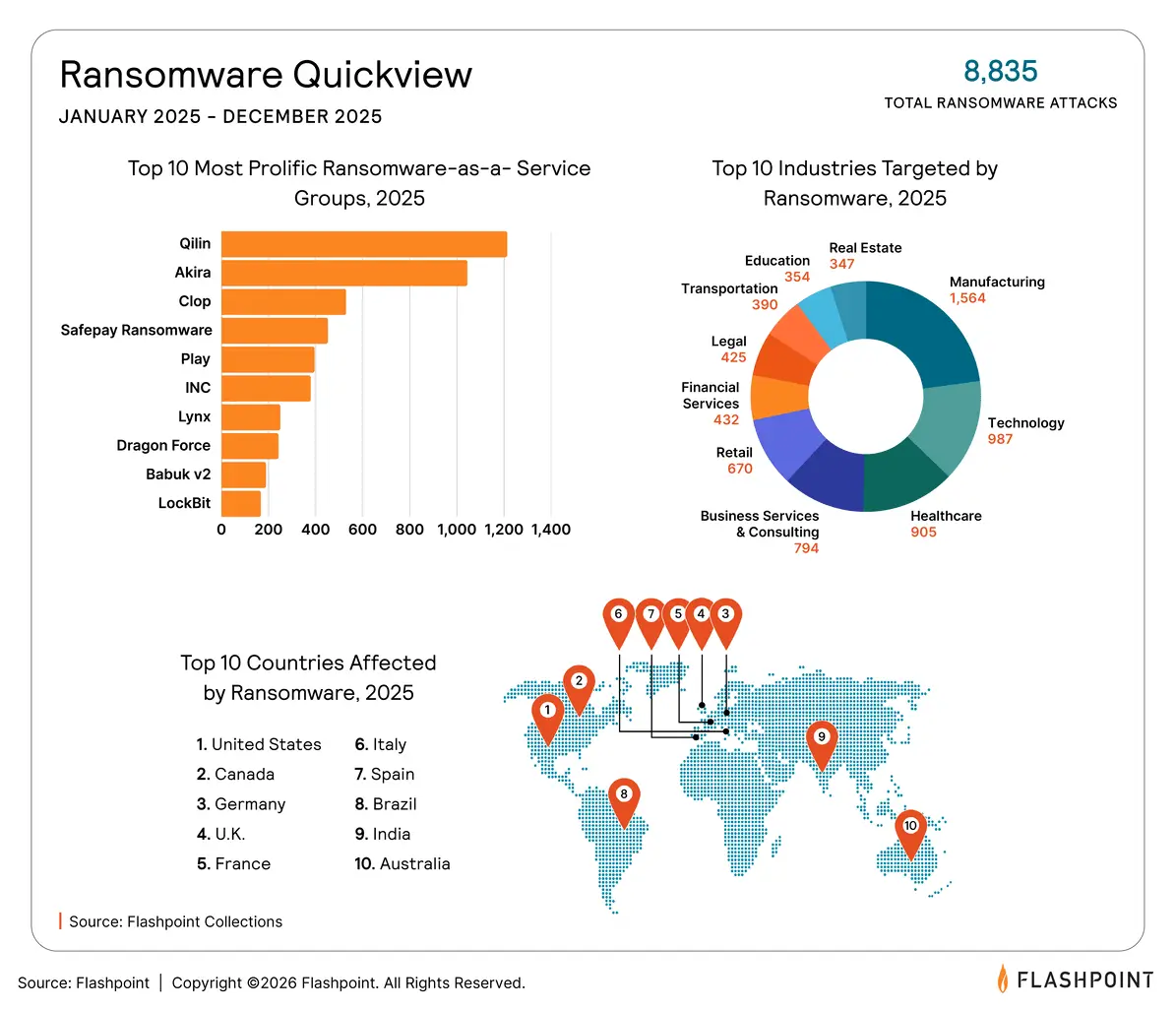
  • From January 2025 to December 2025, ransomware incidents rose by 53%, as attackers pivot from technical encryption to “pure-play” identity extortion.
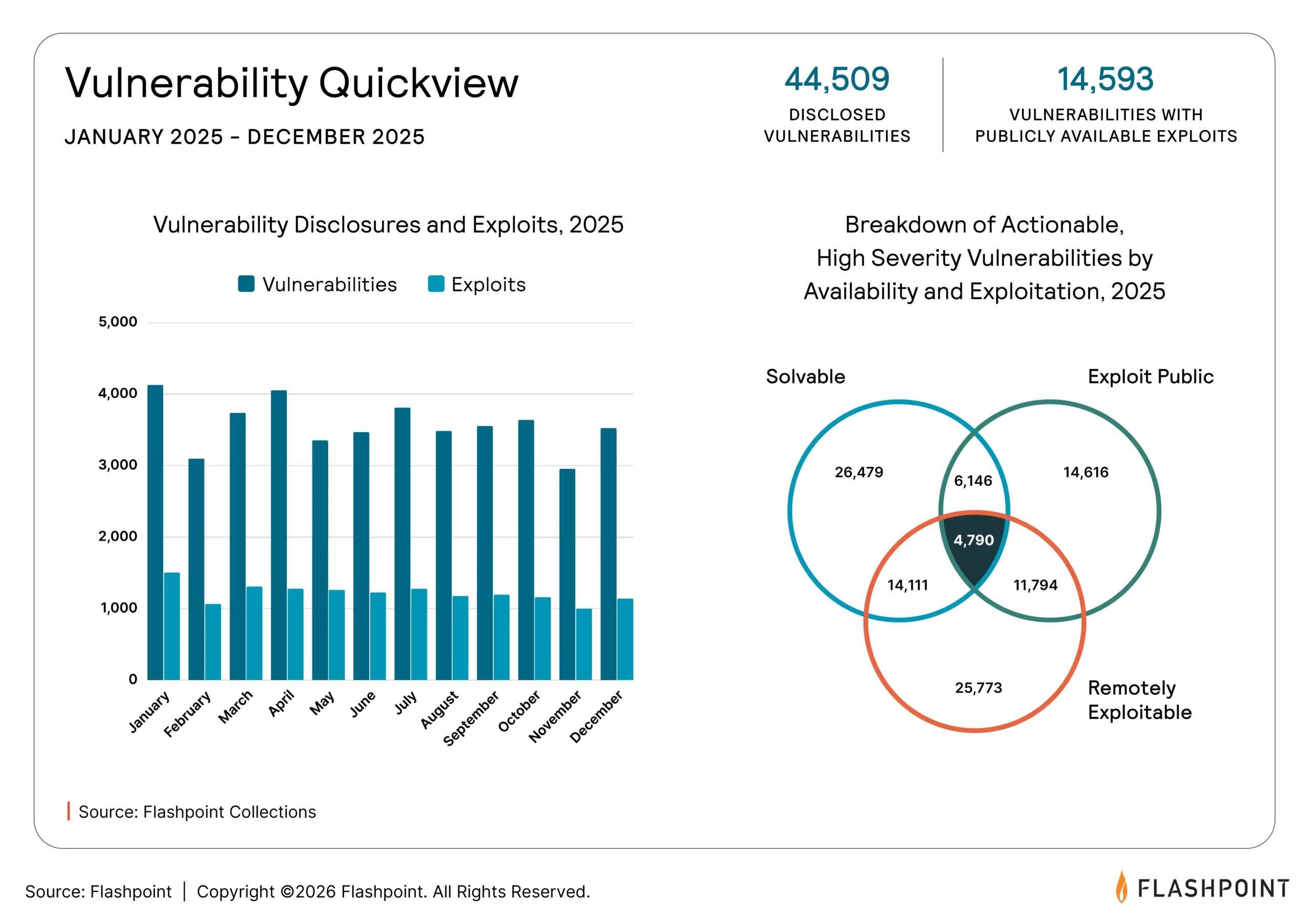
  • Vulnerability disclosures surged by 12% from January 2025 to December 2025, with the window between discovery and mass exploitation effectively vanishing.

These findings are derived from Flashpoint’s Primary Source Collection (PSC), a specialized operating model that collects intelligence directly from original sources, driven by an organization’s unique Priority Intelligence Requirements (PIR). The 2026 Global Threat Intelligence Report leverages this ground-truth data to provide a strategic framework for the year ahead. Download to gain:

  1. A Clear Understanding of the New Convergence Between Identity and AI
    Discover how threat actors are preparing to transition from generative tools to sophisticated agentic frameworks. Learn how 3.3 billion compromised credentials are being weaponized via automated orchestration to bypass legacy defenses and exploit the connective tissue of modern corporate APIs.
  2. Intelligence on the “Franchise Model” of Global Extortion
    Gain deep insight into the professionalized operations of today’s most prolific threat actors. From the industrial efficiency of RaaS groups like RansomHub and Clop to the market dominance of the next generation of infostealer malware, we break down the economics driving today’s cybercrime ecosystem.
  3. A Blueprint for Proactive Defense and Risk Mitigation
    Leverage the latest trends, in-depth analysis, and data-driven insights driven by Primary Source Collection to bolster your security posture by identifying and proactively defending against rising attack vectors.

As attackers automate exploitation of identity, vulnerabilities, and ransomware, defenders who rely on fragmented visibility will fall behind. To keep pace, organizations must ground their decisions in primary-source intelligence that is drawn from adversarial environments, so that decision-makers can get ahead of this accelerating threat cycle.”

Josh Lefkowitz, CEO & Co-Founder at Flashpoint

The Top Threats at a Glance

Our latest report identifies four driving themes shaping the 2026 threat landscape:

2026 Is the Era of Agentic-Based Cyberattacks

Flashpoint identified a 1,500% rise in AI-related illicit discussions between November and December 2025, signaling a rapid transition from criminal curiosity to the active development of malicious frameworks. Built on data pulled from criminal environments and shaped by fraud use cases, these systems scrape data, adjust messaging for specific targets, rotate infrastructure, and learn from failed attempts without the need for constant human involvement.

2026 is the era of agentic-based cyberattacks. We’ve seen a 1,500% increase in AI-related illicit discussions in a single month, signaling increased interest in developing malicious frameworks. The discussions evolve into vibe-coded, AI-supported phishing lures, malware, and cybercrime venues. When iteration becomes cheap through automation, attackers can afford to fail repeatedly until they find a successful foothold.

Ian Gray, Vice President of Cyber Threat Intelligence Operations at Flashpoint

Identity Is the New Exploit

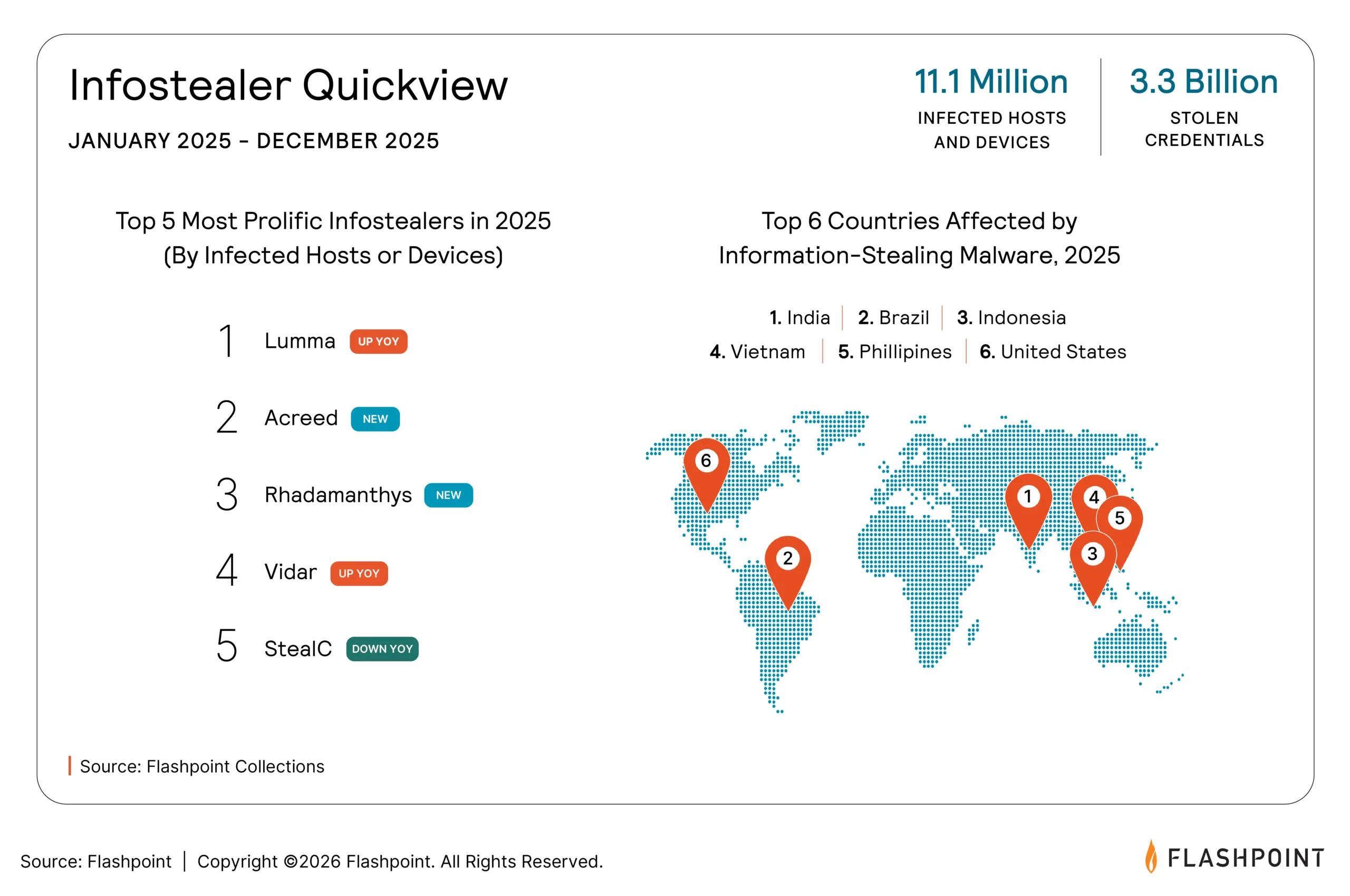
Flashpoint observed over 11.1 million machines infected with infostealers in 2025, fueling a massive inventory of 3.3 billion stolen credentials and cloud tokens. The fundamental mechanics of cybercrime have shifted from breaking in to logging in, as attackers leverage stolen session cookies to behave like legitimate users.

The Patching Window Is Rapidly Closing

Vulnerability disclosures surged by 12% in 2025, with 1 in 3 (33%) vulnerabilities having publicly available exploit code. The strategic gap between discovery and weaponization is increasingly vanishing, as evidenced by mass exploitation of zero-day vulnerabilities in as little as 24 hours after discovery.

Ransomware Is Hacking the Person, Not the Code

As technical defenses against encryption harden, ransomware groups are pivoting to the path of least resistance: human trust. This approach has led to a 53% increase in ransomware, with RaaS groups being responsible for over 87% of all ransomware attacks.

Build Resilience in a Converged Landscape

The findings in the 2026 Global Threat Intelligence Report make one thing clear: incremental improvements to legacy security models are no longer sufficient. As adversaries transition to machine-speed operations, the strategic advantage shifts to organizations that can maintain visibility into the adversarial environments where these attacks are born.

Protecting organizations and communities requires an intelligence-first approach. Download Flashpoint’s 2026 Global Threat Intelligence Report to gain clarity and the data-driven insights needed to safeguard critical assets.

Get Your Copy

The post Navigating 2026’s Converged Threats: Insights from Flashpoint’s Global Threat Intelligence Report appeared first on Flashpoint.

  •  

Defending the gates: How a global coalition disrupted Tycoon 2FA, a major driver of initial access and large-scale online impersonation

One email was all it took. An employee clicked what looked like a routine signin request. Behind the scenes, attackers swiped credentials, slipped past security controls, impersonated a trusted user, and gained access to critical systems. In other cases, similar intrusions delayed paychecks, rerouted invoices, stole sensitive data, locked up entire networks, interrupted patient care, and strained already tight budgets at schools and critical services. 

Those attacks were powered by Tycoon 2FA. Today, Microsoft, Europol, and industry partners announced a coordinated action to disrupt the service responsible for tens of millions of fraudulent emails reaching over 500,000 organizations each month worldwide. 

Disrupting a global phishing operation 

Active since at least 2023, Tycoon 2FA enabled thousands of cybercriminals to impersonate real users and gain unauthorized access to email and online service accounts, including Microsoft 365, Outlook, and Gmail. Unlike traditional phishing kits, Tycoon 2FA was designed to defeat additional security protections, including multifactor authentication, allowing cybercriminals to log in as legitimate users without triggering alerts, even on protected accounts. 

Acting under a court order from the U.S. District Court for the Southern District of New York, and for the first time in coordination with Europol’s Cyber Intelligence Extension Programme (CIEP), Microsoft seized 330 active domains that powered Tycoon 2FA’s core infrastructure, including control panels and fraudulent login pages. The CIEP framework brought public and privatesector partners together to move from simply sharing intelligence to coordinated, crossborder action, accelerating disruption and limiting further harm. 

Taking this infrastructure offline cuts off a major pipeline for account takeovers and helps protect people and organizations from followon attacks such as data theft, ransomware, business email compromise, and financial fraud. 

The scale and realworld impact of Tycoon 2FA 

By mid2025, Tycoon 2FA accounted for approximately 62 percent of all phishing attempts Microsoft blocked, including more than 30 million emails in a single month. That placed Tycoon 2FA among the largest phishing operations globally.  

Despite extensive defenses, the service is linked to an estimated 96,000 distinct phishing victims worldwide since 2023, including more than 55,000 Microsoft customers.  

Healthcare and education organizations were hit hardest. More than 100 members of HealthISAC, a global threat-sharing group for the health sector and a co-plaintiff in this case, were successfully phished. In New York alone, at least two hospitals, six municipal schools, and three universities faced attempted or successful compromise through Tycoon 2FA. These incidents had tangible consequences: disrupted operations, diverted resources, and delayed patient care.  

Why Tycoon 2FA was so dangerous 

Tycoon 2FA combined convincing phishing templates, realistic landing pages, and realtime capture of credentials and authentication codes into an easytouse package that scaled quickly. By lowering the technical barrier to entry, it allowed criminals with limited expertise to run sophisticated impersonation campaigns. 

With each successful phishing victim, attackers could operate with the same level of trust as legitimate users moving laterally across systems, accessing sensitive data, and abusing signon connections without raising alarms. Research from Microsoft Threat Intelligence provides more details on how Tycoon 2FA operated. 

Dark‑themed admin dashboard showing security and login activity. At the top are summary cards for Total Visits (5), Valid (4), Invalid (2), and SSO (0). The center includes a donut chart comparing valid, invalid, and SSO logins, a bar chart of login websites with Microsoft highlighted, and a world map labeled “Visitors by Country.” Below, a table lists valid accounts with columns for email, website, browser, IP, country, 2FA status, and date, with action buttons such as “Copy Zip Pass” and “Download.”
The Tycoon 2FA customer dashboard.

This shift reflects a broader trend in cybercrime: identity, not infrastructure, has become the primary target. A single compromised account can now unlock banking systems, healthcare portals, workplace applications, and social media accounts. 

Inside the impersonation economy

Tycoon 2FA operated like a business within the broader impersonationforhire ecosystem. The primary developer, Saad Fridi, who is believed to be based in Pakistan, worked alongside partners responsible for marketing, payments, and technical support. 

Cybercriminals typically used Tycoon 2FA alongside other illicit services. While Tycoon 2FA captured credentials and session tokens, other services handled mass email delivery, malware distribution, hosting, and access monetization. For example, RedVDS, disrupted by Microsoft in January 2026, provided inexpensive virtual computers, which cybercriminals paired with Tycoon 2FA to deliver phishing campaigns. Together, these different services created an interconnected ecosystem for identitybased attacks. Disrupting one component can have cascading effects across the cybercrime economy. 

Sustained pressure reshapes the market 

Over the past 18 months, Microsoft’s Digital Crimes Unit has targeted multiple services that enable impersonation and initial access, including extensive disruption operations of Lumma StealerRaccoonO365Fake ONNX (aka “Caffeine”), and RedVDS. 

When widely used tools are disrupted, attackers are forced to adapt, often shifting to alternatives like Tycoon 2FA. This substitution pattern shows how sustained pressure prevents any single service from remaining dominant while steadily raising the cost and risk of cybercrime. 

These efforts have led to arrests in Egypt and Nigeria, complete service shutdowns, infrastructure loss, and reputational damage for operators beyond lawenforcement reach. RedVDS alone lost more than 95 percent of its infrastructure since January 2026, significantly degrading its ability to support mass impersonation campaigns and other online scams. 

As pressure increased, many operators tightened access controls, retreated into closed channels, or shut down entirely to avoid legal action. In Tycoon 2FA’s case, Microsoft could not purchase access to the service; the operator rejected attempts by our investigators, requiring a trusted intermediary. In fact, Tycoon 2FA’s operator and the nowarrested developer of RaccoonO365 communicated with one another, highlighting the ecosystem’s interdependence and how disruptions in one area influence activity elsewhere. 

Screenshot of a dark‑mode chat conversation interface. Multiple message bubbles discuss “2FA/MFA” services, with usernames such as “Raccoon0365,” “ItsPump,” and others visible. Messages reference choosing or not choosing a provider, friendship between groups, and competition between services. Timestamps appear next to messages, and emoji reactions are included.
Correspondence suggesting interactions between the operators of RaccoonO365 and Tycoon 2FA.

Global threats require global action 

Cybercrime operates across borders, and effective response must do the same. Disrupting Tycoon 2FA spanned multiple jurisdictions, underscoring why sustained, coordinated pressure is essential, especially as cybercrime becomes more scalable through automation and AI. 

Microsoft Threat Intelligence, joining many security researchers, identified Tycoon 2FA as one of the most significant threats to identity-based attacks. Microsoft’s Digital Crimes Unit consulted with Europol, which also tracked the actor based on intelligence supplied by TrendAI. Through the CIEP, Europol convened partners to take action. Microsoft worked with industry partners to pursue a coordinated infrastructure disruption, while law enforcement authorities in Latvia, Lithuania, Portugal, Poland, Spain, and the United Kingdom conducted seizures of infrastructure and carried out other operational measures linked to Tycoon 2FA. 

Industry partners, including ProofpointIntel 471, and eSentire, expanded visibility through telemetry, threat intelligence, and criminalforum insight. Cloudflare assisted by taking down infrastructure outside U.S. jurisdiction, while HealthISAC quantified impacts on healthcare organizations. SpyCloud contributed key victimology data, Resecurity facilitated access to Tycoon 2FA, and Coinbase helped trace the movement of stolen funds. Finally, the Shadowserver Foundation supported notifications to more than 200 computer emergency response teams worldwide, helping limit further harm. 

No single organization could have assembled this full picture alone.

Splash page appearing on seized domains.

Sustaining pressure, together 

Stopping identitybased cybercrime requires action across individuals, organizations, and governments. Multifactor authentication, scrutiny of unexpected messages, strong session controls, and coordinated threatsharing all reduce risk. Early enforcement matters tooit prevents small intrusions from escalating into systemic harm. Microsoft will continue applying the lessons learned from Tycoon 2FA and prior disruptions to fragment the impersonation economy, limit scale, and make cybercrime riskier and less profitable. 

The post Defending the gates: How a global coalition disrupted Tycoon 2FA, a major driver of initial access and large-scale online impersonation appeared first on Microsoft On the Issues.

  •  

Building an AI-Ready America: Teaching in the AI age

On Tuesday, February 23rd, Microsoft Senior Director of Education and Workforce Policy Allyson Knox testified before the House Education & Workforce Subcommittee on Early Childhood, Elementary, and Secondary Education. To view the proceedings, visit the committee’s website.

STATEMENT OF ALLYSON KNOX

SENIOR DIRECTOR OF EDUCATION AND WORKFORCE POLICY

MICROSOFT CORPORATION

BEFORE THE

EDUCATION AND WORKFORCE COMMITTEE

SUBCOMMITTEE ON EARLY CHILDHOOD, ELEMENTARY, AND SECONDARY EDUCATION

UNITED STATES HOUSE OF REPRESENTATIVES

“BUILDING AN AI-READY AMERICA: TEACHING IN THE AI AGE”

TUESDAY, FEBRUARY 24, 2026

WASHINGTON, D.C.

Good afternoon and thank you, Chairman Kiley, Ranking Member Bonamici, Members of the Subcommittee for inviting me to testify today. My name is Allyson Knox. I am Senior Director of Education and Workforce Policy at Microsoft, and I am pleased to have this opportunity to discuss issues related to artificial intelligence and its impact on teachers.

Today, I will share insights we have gathered from teachers about their experiences, challenges, and needs as they integrate AI in education; outline the steps Microsoft and other organizations are taking to facilitate this transition; and recommend legislative approaches to help policymakers strengthen these efforts. These legislative approaches include supporting professional development for teachers; encouraging public-private partnerships; promoting AI literacy; providing guidance on responsible AI use; and supporting innovation.

I would like to begin by quoting from Microsoft’s vice-chair and president, Brad Smith, in his recent foreword to Degrees of Change: What AI Means for Education and the Next Generation[i]:

“Generative AI has become the fastest-spreading technology in human history, adopted at a pace that even the most seasoned technologists could scarcely imagine. This speed is breathtaking, but it also compels us to pause and ask, “Are we ready for what comes next?” AI’s promise is extraordinary. It can help solve problems that have challenged humanity for decades—improving health outcomes, advancing education, and unlocking new opportunities for economic growth. But, like every transformative technology before it, AI brings new questions and new responsibilities.”

This thought-provoking quote is apt for today’s conversation on how AI is impacting teachers. The speed of AI adoption in our nation’s schools and classrooms is indeed breathtaking. Just three years ago, AI had barely made a mark in education. However, our 2025 Study on AI in Education found that 80% of U.S. K-12 teachers have used AI in their roles or for school-related purposes at least once or twice and one-fifth report daily use of AI. Additionally, 58% of K-12 teachers think AI usage at their school/district will increase in the next year.[ii]

What we are hearing from teachers on the impact of AI:

The breadth of adoption has been profound. We have heard directly from teachers who are using AI to streamline lesson planning, curriculum development, and personalize student learning in ways that were unimaginable a few years ago.[iii] AI is also reducing the time it takes to carry out administrative tasks, allowing more time for teachers to focus on their students.

Despite these benefits, we know teachers face challenges when it comes to AI in the classroom. We found roughly one in three teachers lack confidence in using AI effectively and responsibly. Many teachers also express concerns about how AI can exacerbate cheating and are worried about issues such as data privacy and student safety.

Teachers know AI is here to stay, and based upon countless surveys, forums, and focus groups, teachers are ready to tackle these challenges and ask for support in three main areas:

  1. AI literacy – Teachers want the skills, knowledge, and support to build AI literacy and critical thinking in their students;
  2. AI guardrails – Teachers want students to use AI responsibly and safely; and
  3. AI tools – Teachers want classroom-ready AI tools and opportunities to provide feedback that improve them.

I’m excited to share a few ways Microsoft, along with many of our partners, are committed to providing teachers with the support they are requesting.

1.AI literacy – Teachers want the skills, knowledge, and support to build AI literacy and critical thinking in their students

At the core of this support is listening to and learning from teachers and understanding what they want and need to become AI literate themselves and teach AI literacy to their students. These conversations have resulted in exciting initiatives, including the recent launch of the Microsoft Elevate for teachers program, part of the company’s broader commitment[iii] to help schools and educators build skills, expand opportunities, and ensure everyone benefits from AI.

Microsoft Elevate for Educators

The Microsoft Elevate for Educators program equips educators and school leaders with access to one of the world’s largest and most connected peer educator networks and offers free professional development resources. It will provide free access to a new industry-recognized credential for educators, developed in partnership with one of the leading national nonprofit focused on technology and innovation (ISTE+ASCD).[vi] This partnership is aligned to the AI Literacy Framework, which is intended to help educators gain confidence and expertise in integrating AI into their teaching and learning. As part of this work, we also support ISTE+ASCD in advancing AI in teacher preparation programs.

National Academy for AI Instruction

Along with OpenAI and Anthropic, we are supporting the National Academy for AI Instruction, through a partnership with the American Federation of Teachers and the United Federation of Teachers. The Academy describes itself as a national training hub designed by educators – shaping the future of AI in public education, grounded in safety and people-first technology, and improving student learning. From everything we have heard from teachers, this is exactly the type of support they need to promote AI literacy. The Academy also focuses on building critical thinking skills for students and educators.

Rob Weil, who heads up the Academy, recently shared an update on their work with me. He noted through direct engagement with teachers, they listen to what the primary concerns teachers have around using AI in the classroom are, and then work with them to design trainings that are directly responsive to their concerns and meet them where they are – including using whatever technology they are already using in their classroom.

Their goal is to train 400,000 teachers over the next 5 years. The Academy is centered around a “train the trainer” model, building capacity to provide AI literacy to teachers at scale – providing the potential of millions of teachers to benefit from this initiative. Weil noted that interest and participation in the Academy has been taking off, largely due to word of mouth. This month, 1,000 teachers showed up for a virtual session, and another in-person session was overprescribed had to turn away a hundred interested teachers.

Why the interest? Teachers want to learn from their peers and trusted partners; they also want to ensure they are using AI effectively and safely. Weil explained that one of the most popular aspects of the training is centered around the Academy’s Commonsense Guardrails for Using Advanced Technology in Schools,[v] which helps empower teachers to address the challenges they are facing in implementing AI. Some teachers describe AI as the wild-wild west, and this guide has helped provide a roadmap for understanding how to navigate bringing this technology into the classroom.

The trainings also provide real-world, hands-on experiences with using technology which teachers themselves are bringing to the table. At the trainings, teachers are asked what they could use the most help with and then have time to experiment with different tools to do things like start a draft of a lesson plan or an outline for a rubric – allowing them more time and flexibility to incorporate their expertise. In addition, the Academy creates opportunities for educators to influence the development of AI for schools.

Support for Special Education Teachers

We also recognize the potential that AI holds to support students with disabilities – and the need to ensure special education teachers have the support and resources to fully unlock this technology.

Recently, we launched a course to support educators in exploring how Microsoft AI tools can be thoughtfully used in special education environments to reduce administrative demands, strengthen accessibility, and support clear communication with families. Throughout the learning path, responsible use of AI, privacy, and transparency are emphasized so educators can determine when and how AI fits into their practice in ways that align with student needs and professional values.

After our engagements, we tailored our trainings to special education teachers by incorporating their direct feedback. Key topics included privacy with sensitive medical information and using AI to assist parents and caregivers in IEP meetings. We emphasized clear communication, parental inclusion, and ensuring parents understand the meeting’s goals and how best to support their children.

Finally, special education involves a collaborative team beyond just teachers, and we’ve revised our approach to address the needs of occupational therapists, physical therapists, and all other members involved in special education.

Support for Teachers in Rural America

We have found there’s a significant gap in daily AI usage by urban teachers versus their rural and suburban counterparts (39% vs. 24%).[iv] This gap underscores why ensuring AI tools, resources, and professional development are attuned to the needs of rural teachers is critical.

For the last five years, we’ve been working with the National Future Farmers of America (FFA) and agricultural science teachers to develop FarmBeats for Students and ensure it is responsive to agricultural science teachers’ needs. We engaged in an iterative process with them – collaboratively designing and building curriculum and training with agricultural science teachers from the very beginning of development.

FarmBeats for Students brings AI to agricultural education through a hands-on educational program that brings precision agriculture directly into the classroom. The program consists of an affordable hardware kit and a free curriculum aligned with rigorous educational standards. Activities give students direct experience with topics like digital sensors, data analysis, and AI.

We brought FarmBeats for Students to the National FFA convention and held a series of workshops with teachers across the country. They experimented with the kits and provided input to ensure this technology was directly responsive to what they wanted to see in the classroom.

In addition to our partnership with the National FFA, Microsoft helps meet the needs of rural teachers by deploying the online content referenced above through Elevate, as well as supporting community-based organizations that help facilitate activities and events which promote AI literacy in rural communities.

AI Literacy Frameworks, Standards, and Guidance

Teachers want frameworks that help them integrate AI into their classrooms. We are pleased there is bipartisan interest in establishing strong frameworks around AI and education, especially highlighting the need for widespread AI literacy. Microsoft has provided support, guidance, and input to organizations and initiatives such as Code.org and TeachAI who work to develop and promote frameworks, guidance, and standards.

Microsoft encourages state and local policymakers to review and leverage these resources as they incorporate AI in education:

  • The TeachAI Foundational Policies[vii]: This resource, endorsed by dozens of policy organizations and associations, provides practical guidance for national, state, and local leaders to harness AI’s benefits in teaching and learning while mitigating risks. The policies focus on five priorities—fostering leadership, promoting AI literacy, providing clear guidance, building educator capacity, and supporting responsible innovation—to ensure AI strengthens education systems and prepares learners for an AI‑enabled workforce.
  • The TeachAI AI Guidance for Schools Toolkit[viii]: The Toolkit helps education authorities, school leaders, and educators develop clear, responsible guidance for using AI in K–12 education, balancing potential benefits with risks such as privacy, bias, and academic integrity. It provides a practical framework, principles, sample policies, and communication templates to support safe and human‑centered AI adoption across school systems. The Toolkit has been used by the majority of states in constructing guidance for schools.
  • The AI Literacy Framework[ix]: The AI Literacy Framework defines the knowledge, skills, and attitudes students and educators need to understand, use, and critically evaluate AI in education. It is organized around four core domains—Engaging with AI, Creating with AI, Managing AI, and Designing AI—and emphasizes critical thinking, ethics, and human judgment alongside technical understanding. It also emphasizes the foundational computer science concepts that prepare students to not just use AI but understand how AI works and its societal impacts. The framework is designed to be interdisciplinary, practical, and durable, helping schools integrate AI literacy into curriculum, professional learning, and policy in age‑appropriate ways.

2.AI guardrails – Teachers want students to use AI responsibly and safely

We have heard from teachers that one of the greatest hesitations they have with AI is around safety for students. This includes ensuring AI tools used in the classroom protect student privacy, don’t collect their information, and are safe from a mental health perspective.

Some of the strategies teachers use to promote safety are a significant focus in the professional development referenced earlier. In addition, the frameworks include key components to help teachers understand responsible AI use.

Microsoft takes our responsibility as a developer and deployer of AI technology very seriously. Paramount to deploying this technology in classrooms is ensuring it is responsible. Microsoft has identified six principles that we believe should guide AI development and use.

  • Fairness: AI systems should treat all people fairly.
  • Reliability and Safety: AI systems should perform reliably and safely.
  • Privacy and Security: AI systems should be secure and respect privacy.
  • Inclusiveness: AI systems should empower everyone and engage all people.
  • Transparency: AI systems should be understandable.
  • Accountability: People should be accountable for AI systems.

These principles are the foundation for other tools and resources we share with teachers to provide guidelines for them to deploy AI in the classroom.

As another example of our commitment to safety, earlier this month, on Safer Internet Day, we launched our new Microsoft Education Security Toolkit,[x] which provides educators and IT teams with practical guidance tailored to the realities of modern education.

3. AI tools Teachers want classroom-ready AI tools and opportunities to provide feedback that improve them

Teachers often lack the right AI tools tailored to their needs for boosting student achievement. It’s essential to develop AI solutions based on teacher input rather than just delivering generic options. Microsoft strives to meet this responsibility by designing tools and partnerships that address educators’ needs. We believe this approach creates a critical feedback loop that will allow us to constantly evolve our tools to maximize their benefit in the classroom over time.

In fact, at Microsoft, our engineering teams collaborate closely with educators and students to advance the development of AI tools for classroom use. We partner with teacher organizations and directly engage with the disability community to better understand instructional requirements and design technology that enhance student learning outcomes.  Some examples include:

Reading Progress

One of the tools we offer to teachers is called Reading Progress, which helps teachers analyze students’ fluency and generates reading passages and comprehension questions.

From the beginning of development, we worked with individual teachers through our Educator Insiders program and with entire schools or districts through our Technology Adoption Preview, where educators test prototypes of our products and provide feedback.

For example, teachers asked for a tool that could generate tailored passages to meet the needs of their students. We incorporated that feedback and now, teachers can get as specific as saying they want a passage generated about sports that is for a third-grade reading level and includes specific words their class is learning.

Teachers also told us they wanted reading comprehension questions generated faster and better. With AI, it’s easy to do this in a high-quality way.

Teachers report increased comprehension, higher reading fluency, and higher scores, especially for struggling or reluctant readers.

Teach for America (TFA)

Microsoft has been a proud supporter of TFA’s efforts to improve the education system and expand opportunities for children across the U.S. It has been great to see all of the ways in which TFA has worked to equip their teachers with AI fluency in order to help them integrate this technology into the classroom.

TFA recently completed a cloud migration to Microsoft Azure, unlocking countless avenues to improve program design and delivery, direct the most possible funds toward its mission to ensure all kids have access to an excellent education, and evolve to offer the best learning options inside and outside the classroom.

Where do we go from here

What is both exciting and daunting about AI is that while we can take lessons learned from previous technological transformations in the classroom, much of the book has not been written on AI adoption. Meaning tech companies, teachers, government, and other stakeholders have the opportunity to shape where AI goes in education and beyond.

I want to conclude my remarks today with policy recommendations for the Committee to consider:

  • Support professional development for teachers to effectively teach about AI and responsibly integrate AI tools in the classroom.
    • At the Federal level, this means providing priorities for competitive grant programs, such as those recently proposed by the U.S. Department of Education.
  • Encourage public-private partnerships.
    • Incentivize and prioritize Federal funds and grants that support partnerships between technology companies and educational programs, including apprenticeship and credentialed organizations, to develop up to-date AI curriculum.
  • Promote AI literacy across the U.S.
    • Integrate AI skills and concepts, including their foundational principles, social impacts, and ethical concerns, into existing curriculum and instruction.
  • Provide guidance.
    • Equip schools with guidance on the safe, effective, and responsible use of AI, including considerations related to student privacy, data security, accessibility, transparency, and appropriate human oversight.
  • Invest in innovation.
    • Support research and evaluation to better understand the impacts of AI in education, including its effects on teaching and learning and student outcomes, and to identify effective, scalable practices that mitigate the digital divide.


[i] Smith, Brad. “Foreword.” Degrees of Change: What AI Means for Education and the Next Generation, by Juan M. Lavista Ferres, John Wiley & Sons, 2026.
[ii] See Microsoft 2025 AI in Education Survey Details, August 2025
[iii] See Microsoft 2025 AI in Education Survey Details, August 2025
[iv] See Microsoft Elevate: Putting people first, July 2025
[v] See Commonsense Guardrails for Using Advanced Technology in Schools, March 2025
[vi] See Microsoft 2025 AI in Education Survey Details, August 2025
[vii] See TeachAI Foundational Policies
[viii] See TeachAI AI Guidance for Schools Toolkit
[ix] See AI Literacy Framework
[x] See Microsoft Education Security Toolkit, February 2026

[1] ISTE (International Society for Technology in Education) + ASCD (Association for Supervision and Curriculum Development)


The post Building an AI-Ready America: Teaching in the AI age appeared first on Microsoft On the Issues.

  •  

Celebrating 250 million: Empowering communities to enable the global AI economy

Ahead of Mobile World Congress, where global leaders, governments, and industry convene at the world’s largest connectivity event, Microsoft is marking a major milestone in our efforts to expand digital access worldwide. In 2022, we made a bold commitment to expand internet access to 250 million people by the end of 2025. Today, we are proud to share that we have met and exceeded that goal, extending connectivity coverage to over 299 million people worldwide, including more than 124 million across Africa.

This milestone represents more than a number. It reflects more than a decade of sustained collaboration with governments, nonprofits, local connectivity providers, and development partners around the world. Together, we have worked to reach communities where access has historically been limited, building pathways to education, healthcare, economic opportunity, and digital participation.

Reaching this milestone is also a moment of reflection and renewal. Building on years of progress, Microsoft is evolving its approach to digital access to focus not only on coverage, but on adoption, enablement, and long-term participation in the AI economy.

As part of this next chapter, we are announcing a new collaboration with Starlink. This collaboration expands the set of tools available to help deliver digital access in rural, agricultural, and hard-to-reach communities. Combined with local delivery partners and community institutions, it strengthens the foundation for AI-ready communities around the world.

Why digital access matters in the AI era

Despite continued progress, 2.2 billion people globally remain offline, and many more face barriers related to affordability, reliability, or access to relevant digital services. These gaps already limit opportunity and risk widening as AI becomes more central to how economies grow and societies function.

At Mobile World Congress 2024, Microsoft Vice Chair and President Brad Smith shared our AI Access Principles, underscoring that electricity and connectivity are essential foundations for an inclusive AI economy. Since then, the pace of change has only accelerated. In fact, Microsoft’s 2025 AI Diffusion Report shows that AI is being adopted faster than any general-purpose technology in history, yet adoption remains uneven. As the data illustrates, adoption in the Global North is accelerating faster than in the Global South. Differences in infrastructure, access to tools, and digital readiness all contribute to a growing divide between higher-income and lower-income economies.

This graphic from the 2025 AI Diffusion Report reinforces a clear insight: access to AI alone is not enough. For communities to participate meaningfully in the digital and AI era, connectivity must be paired with reliable energy, affordable devices, digital skills, and technologies designed for real-world use. Where these conditions exist, adoption follows. In Zambia, for example, country-wide generative AI adoption is 12 percent, but among those with internet access, it rises to 34 percent.

Deepening Microsoft’s approach to digital access

Building on what we have learned, Microsoft is advancing a more holistic digital access model that recognizes connectivity as only one part of a broader system. In practice, this means collaboration to deliver not only internet access but also more reliable energy infrastructure, access to water where relevant, devices, digital skills, and cloud and AI tools, all designed and deployed for the communities they serve. By working across organizations and governments to address these foundational needs in parallel, this approach helps ensure that digital access is usable, durable, and capable of supporting real-world outcomes.

A central focus of this work is community-based access models that are financially sustainable, scalable, and aligned with national development priorities. These models bring together local institutions such as schools, health facilities, cooperatives, and community hubs and are implemented in partnership with governments, businesses, nonprofits, and development finance organizations. By integrating infrastructure, enablement, and financing from the outset, these holistic programs can help unlock long-term investment, support responsible growth, and enable communities to fully participate in the digital and AI economy.

Digital access directly complements Microsoft’s Community First AI Infrastructure approach by providing the foundation that enables AI to be adopted, used, and trusted by communities everywhere.

Partnering to deliver impact at scale

Progress at this scale is only possible through strong partnerships rooted in local delivery, community trust, and long-term sustainability. Microsoft’s work to extend connectivity to more than 299 million people has been built alongside partners who understand the realities of last-mile deployment and digital adoption.

In Africa, Microsoft works with partners such as Cassava Technologies to expand regional digital infrastructure and drive high-quality internet access across South Africa, Malawi, Kenya, and Zambia. Collaborations with local providers like Tizeti deliver affordable, reliable connectivity through solar-powered Wi-Fi networks across Nigeria and Ghana.

In Latin America, Microsoft’s partnership with Anditel focuses on expanding internet and energy access for rural and agrarian communities in Colombia through locally led models aligned with national priorities. In India, Microsoft works with AirJaldi to pair affordable connectivity with digital skills training and practical pathways for use, helping communities move beyond basic access toward meaningful adoption.

These partnerships made reaching the 250 million milestone possible. They also reflect a principle that continues to guide our work. Lasting digital access is built with communities, not for them.

Expanding the portfolio: Collaboration with Starlink

Building on this foundation, Microsoft continues to expand and diversify its portfolio to reach communities where traditional infrastructure alone cannot meet demand.

Through our collaboration with Starlink, Microsoft is combining low-Earth orbit satellite connectivity with community-based deployment models and local ecosystem partnerships. This is intended to expand the set of tools available to deliver digital access while remaining firmly embedded in a holistic, partnership-driven approach.

Kenya offers an early example of this model in practice. Working with Starlink and local internet service provider Mawingu Networks, Microsoft is supporting connectivity for 450 community hubs across rural and underserved regions, including farmer cooperatives, aggregation centers, and digital hubs. These deployments combine satellite connectivity with digital skills, tools, and ecosystem coordination to support agricultural productivity, access to markets, and adoption of digital and AI-enabled services.

Beyond 250 million: Building AI-ready communities

Surpassing the 250 million connectivity milestone is a moment to celebrate. It is also a starting point for what comes next.

The next chapter of Microsoft’s digital access work is planned to focus on ensuring that access translates into adoption, use, and long-term opportunity. By continuing to partner with governments, development finance institutions, nonprofits, and private-sector partners, and by expanding into energy access, financing mechanisms, and community-first AI solutions, Microsoft is working to ensure that everyone, everywhere, can participate in the digital and AI economy.


The post Celebrating 250 million: Empowering communities to enable the global AI economy appeared first on Microsoft On the Issues.

  •  
❌