Amazon Web Services (AWS) is pleased to announce that the Spring 2026 System and Organization Controls (SOC) 1, 2, and 3 reports are now available. The reports cover 188 services over the 12-month period from April 1, 2025–March 31, 2026, giving customers a full year of assurance. These reports demonstrate our continuous commitment to adhering to the heightened expectations of cloud service providers.
AWS strives to continuously bring services into the scope of its compliance programs to help customers meet their architectural and regulatory needs. You can view the current list of services in scope on our Services in Scope page. As an AWS customer, you can reach out to your AWS account team if you have any questions or feedback about SOC compliance.
May 26, 2026: This post was originally published in July 2022. It has been updated to reflect current engagement options, new threat intelligence resources such as the Threat Technique Catalog for AWS (TTC), additional open-source tools, and the distinction between AWS CIRT support and the AWS Security Incident Response managed service.
Welcome back, or welcome for the first time. Either way, we’re glad you’re here. We’re the AWS Customer Incident Response Team (CIRT), and we want to share who we are and how we can help when it matters most.
The AWS CIRT is a specialized 24/7 global team within Amazon Web Services (AWS) that provides support to customers during active security events on the customer side of the AWS Shared Responsibility Model. Our team is made up of security engineers who respond to cloud security events and build the tools and resources we use to do it.
Important: If you’re experiencing an active security event in your AWS environment—such as unauthorized access, data exfiltration, or ransomware—open an AWS support case and request assistance.
Mention that you have an urgent security incident in the case description.
Opening a support case from the affected account allows AWS to confirm account ownership and gives you a case number to track the engagement. If you have an account team (TAM, Account Manager, or Solutions Architect), you can also alert them to initiate an escalation.
When the AWS CIRT supports you, we focus on investigating security events as they appear in AWS service logs and the AWS control plane. For our analysis, we draw on sources such as AWS CloudTrail, Amazon VPC Flow Logs, and Amazon GuardDuty findings. We assist with triage, analysis, and containment, alongside providing recommendations and best practices to help you avoid security events in the future.
The AWS CIRT works alongside AWS threat intelligence and security operations teams. During an engagement, we use current threat intelligence and AWS infrastructure knowledge to inform our analysis and recommendations.
For investigations that extend into host-level or application-level analysis—such as operating system forensics, memory analysis, or application code review—we recommend complementing our support with a specialized AWS Partner for digital forensics and incident response (DFIR) capabilities.
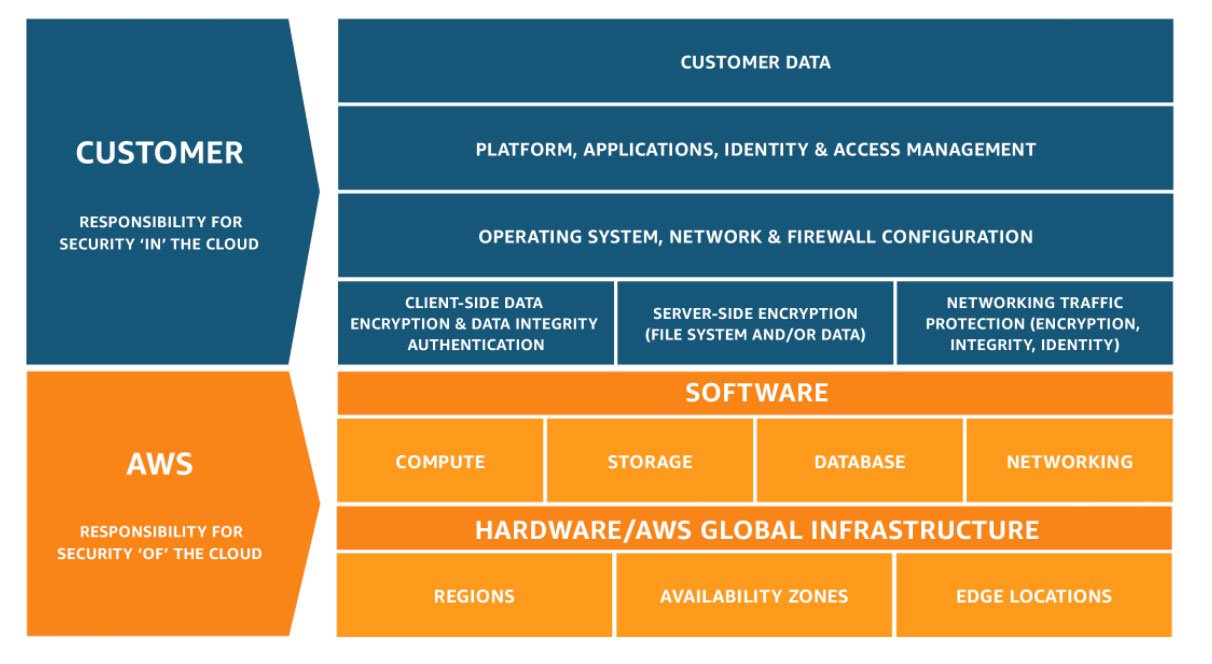
Figure 1 shows the two different sides of the shared responsibility model, in which AWS is responsible for security OF the cloud, while customers are responsible for security IN the cloud.
Figure 1: The customer and AWS Shared Responsibility Model
Threat intelligence: The Threat Technique Catalog for AWS
The AWS CIRT regularly encounters patterns that repeat across our engagements. The TTC started as an internal reference—a way for our team to track and share what we were seeing across engagements, so we weren’t solving the same problems in isolation. Over time, it became clear that the knowledge we were building for ourselves was exactly what customers needed to get ahead of the same threats. So, we made it public. When we see techniques repeating across customers, an effective way to help them is to document those techniques and make that knowledge available so they can act on it before they’re in the middle of an incident.
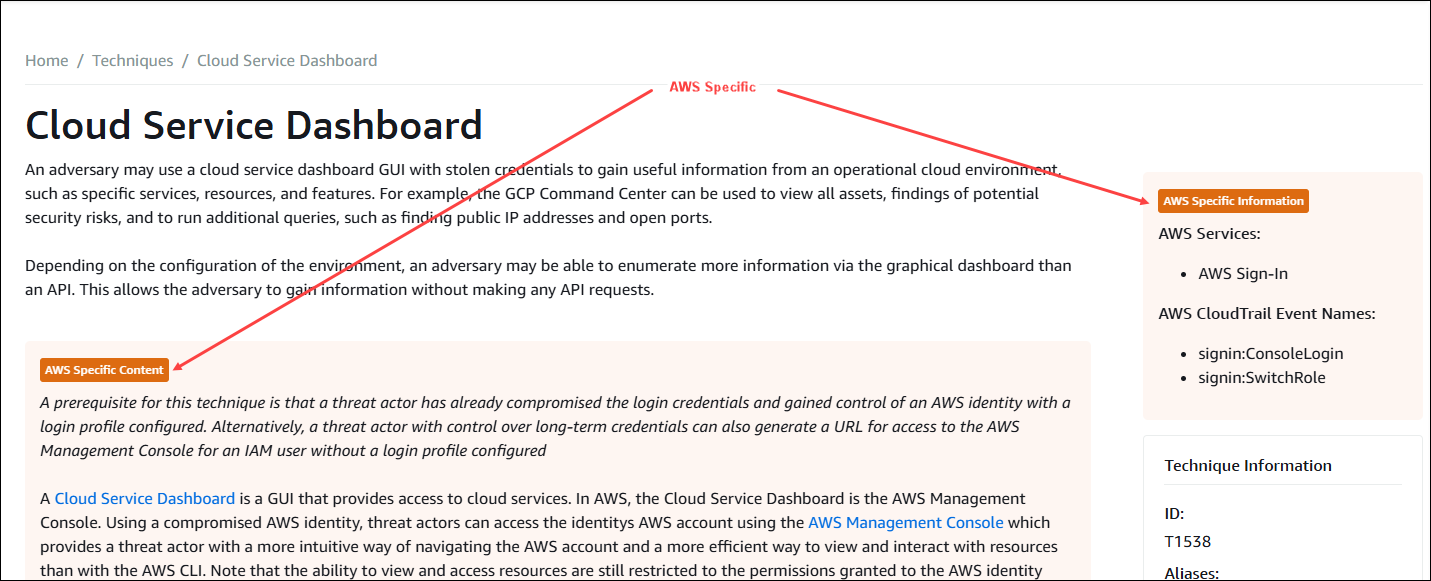
To that end, we developed the Threat Technique Catalog for AWS (TTC)—a publicly available catalog, based on MITRE ATT&CK Cloud Matrix, that documents threat actor tactics, techniques, and procedures (TTPs) specific to AWS as observed by the AWS CIRT. Each entry includes detection guidance and mitigations specific to AWS environments. You can filter for the AWS services in your account to focus on what’s most relevant to you.
Findings from the TTC also inform detection logic in AWS services like Amazon GuardDuty, helping customers strengthen automated protections in their environments.
Figure 2: The Threat Technique Catalog for AWS, based on MITRE ATT&CK Cloud Matrix
Open source tools
We’ve open-sourced several tools based on patterns we see in engagements. These complement rather than replace your existing security tooling. For a comprehensive framework for building your incident response program, see the AWS Security Incident Response Guide.
The tools below started as internal solutions we built to solve problems we kept running into.
AWS CloudSaga – A tool for testing security controls and alerts within an AWS environment by using generated simulated events based on common security events seen by the AWS CIRT
We maintain five publicly available workshops, regularly updated to simulate current security events to help you learn tools and procedures that we use daily. The workshops cover unauthorized IAM credential use, ransomware on Amazon S3, cryptomining, SSRF on IMDSv1, and incident response preparedness tooling. All you need is an AWS account, an internet connection, and the desire to learn more about incident response in the AWS Cloud. These workshops are built using the same scenarios our team trains on internally—we wanted to make that accessible to everyone.
How to contact us
Any AWS customer can engage the AWS CIRT through an AWS support case, regardless of support plan level. For those customers who have an account team, you can start an escalation to the AWS CIRT with the account team. Customers with Enterprise Support or Unified Operations can also onboard to AWS Security Incident Response, a managed service for security event triage and response.
Thank you for reading. This post is where we share what we’re learning—security trends, new resources, and threat intelligence—so you can stay prepared. If you’ve worked with us and have thoughts on how we can do better, reach out through your AWS account team, the comments below, or aws-cirt@amazon.com.
Until next time: logs on, credentials rotated, and alerts reviewed.
We also recommend subscribing to AWS Security Bulletins for notifications about security events for AWS services. You can subscribe through RSS feed to stay informed.
We’re excited to announce that Amazon Web Services (AWS) has completed the S&P Global Know Your Third Party (KY3P) assessment of its security posture. This assessment demonstrates our continued commitment to meet the heightened expectations of cloud service providers. Customers can now use the AWS KY3P assessment to reduce their supplier due diligence burden.
KY3P, also known as the S&P Global Comprehensive Assessment (formerly TruSight), is a validated, evidence-based assessment designed to support regulatory compliance and efficient, standardized risk data exchange between AWS and our clients. KY3P’s globally recognized methodology provides organizations with enhanced visibility into supply chain risks by validating the actual implementation and operation of controls – not just policies or attestations.
As cloud adoption accelerates across industries, AWS has become a critical component of customers’ third-party environments. Regulated customers, such as those in the financial services sector, are held to high standards by regulators and auditors when it comes to exercising effective due diligence on third parties.
To better manage risks from their evolving third-party environments and drive operational efficiencies, many customers rely on third-party risk management services such as KY3P. In support of these efforts, AWS has completed its annual KY3P security posture assessment, conducted by KY3P security assessors.
KY3P’s risk assessment methodology includes over 200 controls across 26 control categories and nine risk domains. These topics include Privacy, Network Management, Logical Access Management, and Physical and Environmental Security. The assessment criteria were developed by a consortium of leading financial institutions.
Customers can use the KY3P results to map AWS against commonly used industry frameworks and standards, such as NIST CSF v2, PCI DSS 4.0, and ISO 27001:2022 to instantly gain visibility into controls coverage.
If you have feedback about this post, submit comments in the Comments section below. To learn more about our other compliance and security programs, see AWS Compliance Programs.
The financial services industry (FSI) is using AI to transform how financial institutions serve their customers. AI solutions can help proactively manage portfolios, automatically refinance mortgages when rates decrease, and negotiate insurance premiums for customers.
As the regulatory environment and leading practices continue to evolve, we will provide further updates on the AWS Security Blog and AWS Compliance Center. You can also reach out to your AWS account team for help finding the resources you need.
Amazon Web Services (AWS) is pleased to announce the successful completion of Payment Card Industry Personal Identification Number (PCI PIN) and PCI Point-to-Point Encryption (PCI P2PE) assessments for the AWS Payment Cryptography service. This assessment expands the AWS Payment Cryptography compliance portfolio, with AWS now validated as a component provider for Key Management (KMCP) and Key Loading (KLCP) in addition to the existing Decryption Management (DMCP) attestation, and extends PCI PIN and P2PE coverage to the South America (São Paulo) and Asia Pacific (Sydney) AWS Regions.
With Payment Cryptography, your payment processing applications can use payment hardware security modules (HSMs) that are PCI PIN Transaction Security (PTS) HSM certified and fully managed by AWS, with PCI PIN and P2PE-compliant key management. These attestations give you the flexibility to deploy your regulated workloads with reduced compliance overhead.
The PCI P2PE Decryption Component enables payment applications to use AWS to decrypt credit card transactions from payment terminals, and PCI PIN attestation is required for applications that process PIN-based debit transactions. The PCI P2PE Key Management and Key Loading Component attestations enable applications to use AWS for physical key exchange and to support key management use cases including key injection. To learn more about the new Physical Key Exchange feature, see the AWS What’s New announcement. With these capabilities, AWS Payment Cryptography enables customers to manage cryptographic keys in accordance with PCI standards and industry best practices, reducing the operational burden of maintaining compliant key management infrastructure.
The PCI PIN and PCI P2PE compliance packages for AWS Payment Cryptography includes the following reports:
PCI PIN Attestation of Compliance (AOC) – Demonstrates that AWS Payment Cryptography was successfully validated against the PCI PIN standard with zero findings
PCI PIN Responsibility Summary – Provides guidance to help AWS customers understand their responsibilities in developing and operating a highly secure environment for handling PIN-based transactions
PCI P2PE DMCP Attestation of Validation (AOV) – Demonstrates that AWS Payment Cryptography was successfully validated against the requirements for a PCI P2PE Decryption Management System with zero findings
PCI P2PE KMCP Attestation of Validation (AOV) – Demonstrates that AWS Payment Cryptography was successfully validated against the requirements for a PCI P2PE Key Management Component Provider with zero findings
PCI P2PE KLCP Attestation of Validation (AOV) – Demonstrates that AWS Payment Cryptography was successfully validated against the requirements for a PCI P2PE Key Loading Component Provider with zero findings
P2PE Component User’s Guide and Annual Component Report– Describes the AWS Payment Cryptography service assessment scope as a PCI P2PE Decryption Component, Key Loading Component, and Key Management Component and illustrates PCI P2PE compliance responsibilities for both the service and customers using the service for point-to-point encryption processing
AWS was evaluated by Coalfire, a third-party Qualified Security Assessor (QSA). Customers can access the PCI PIN Attestation of Compliance (AOC) report, the PCI PIN Shared Responsibility Summary, the PCI P2PE Attestation of Validation, and P2PE Decryption Component User’s Guide and Annual Decryption Component Report through AWS Artifact.
To learn more about our PCI programs and other compliance and security programs, visit the AWS Compliance Programs page. As always, we value your feedback and questions; reach out to the AWS Compliance team through the Compliance Support page.
If you have feedback about this post, submit comments in the Comments section below. If you have questions about this post, contact AWS Support.
Today, we’re excited to announce the preview release of full repository code review, a new capability in AWS Security Agent that performs deep, context-aware security analysis of your entire code base. AI-driven cybersecurity capabilities are advancing rapidly. AWS Security Agent can now find vulnerabilities and build working exploits across your entire code base at a scale and speed we haven’t seen before, reasoning like a human security researcher, but operating at machine velocity. Unlike traditional static analysis tools that match code against known vulnerability patterns, full repository code review reasons about your application’s architecture, trust boundaries, and data flows the way a human security researcher would and then produces developer-ready findings with transparent evidence and concrete remediation.
AWS is prioritizing free early access for customers, giving defenders the opportunity to strengthen their code bases and share what they learn so the whole industry can benefit.
The challenge: Security analysis that scales with your code
Development teams today face persistent tension. Traditional static application security testing (SAST) tools are fast and reliable at catching known patterns such as a SQL injection sink, an unescaped output, or a hard-coded credential. But modern applications are complex systems of services, APIs, trust boundaries, and authorization logic. The most dangerous vulnerabilities often aren’t single-line pattern violations, rather they’re systemic gaps where a validation function covers four of five cases, one endpoint is missing the authorization annotation its neighbors have, or encoding is applied in one context but not another.
Manual security reviews catch these issues, but they’re expensive, slow, and don’t scale to the pace of modern development. As code bases grow, teams are forced to choose between breadth and depth.
Full repository code review is built to close this gap. It gives your team an automated security researcher that reads and reasons about your entire repository, not just individual lines or file, and surfaces findings that pattern-matching tools miss.
How it works: Profile, search, triage, validate
Full repository code review operates in four stages that mirror how an experienced security engineer conducts an engagement.
Profile the application: The scanner begins by reading the entire repository and building a security model of the application including entry points, trust boundaries, data flows, authorization invariants, and the defenses already in place. This profiling step accounts for every source file, so coverage decisions are explicit rather than implicit. The result is a structured understanding of what the application does and where its attack surface lies.
Search for vulnerabilities: An orchestrator reads the security profile, reasons about the attack surface, and dispatches specialized agents to the highest-risk components. Each agent receives a scoped assignment with specific modules, threat context, and adversarial questions. Agents are free to follow imports and callers beyond their starting scope when a lead takes them there.
Triage and deduplicate: Candidate findings are deduplicated (same sink, same root cause) and low-confidence noise is filtered out before the validation phase.
Validate independently: For every candidate, an independent validator re-reads the source code and traces the full attack chain. The validator argues both sides: it looks for reasons the finding might not be a vulnerability (compensating controls, intentional design), and it looks for reasons it is one (alternative attack paths, edge cases). A finding is only rejected when the evidence against it is as strong as the evidence that promoted it. This process produces findings with structured Verified and Could not verifysections, so your team knows exactly what the scanner confirmed in the code and what depends on your deployment environment.
What makes this different
Full repository code review differs from traditional static analysis in two fundamental ways. It reasons about your application’s actual behavior rather than matching against known vulnerability patterns, and it presents findings with structured evidence that makes uncertainty explicit rather than hidden.
Context-aware reasoning, not pattern matching
Because the scanner builds a security model before searching for vulnerabilities, it reasons about the application’s actual behavior, not only surface-level code patterns.
Consider a real example: A stored procedure had a SQL injection vulnerability. A traditional SAST tool would flag the specific EXECUTE IMMEDIATE call. The scanner went deeper and it identified that the central validation function doesn’t block single quotes in any of its five regex profiles, listed all five profiles by name, explained why single quotes matter for the specific database engine, and noted that another stored procedure skips the validation function entirely. Instead of a point fix on one call site, the finding led to a comprehensive remediation of the systemic gap.
In another case, the scanner found an XSS vulnerability where a value was added to a field without HTML encoding. The same value was properly encoded with Encode.forHtml() in a different context within the same file. Pattern-matching tools miss this because the encoding function is present, but the vulnerability is the inconsistency, which requires understanding the application’s behavior across code paths.
Validated findings with transparent uncertainty
Every finding is structured for efficient developer triage:
Problem: What the code does wrong, with specific file and line references.
Impact: What an attacker gains, with details about deployment context.
Verified and could not verify:What the scanner confirmed directly in code versus what depends on your environment (network segmentation, runtime behavior).
Remediation: Concrete fix suggestions with specific code changes, not generic guidance.
Severity and confidence: Calibrated independently. Severity reflects the impact if the vulnerability is exploitable; confidence reflects how much of the attack chain was verified in code.
How full repository code review fits into your workflow
Full repository code review is designed to complement, not replace, your existing security tooling. Here’s how it fits into a modern development workflow:
Before security reviews:Run a full repository code review before scheduling a penetration test or security review. The review surfaces the obvious and semi-obvious issues so your security team can focus their limited time on the subtle, design-level questions that require human judgment.
When onboarding acquired or open source code:Full repository code review is especially valuable when your team inherits code through acquisitions or vendor dependencies, or from open source components you’re integrating. The scanner builds a security model from scratch, so it doesn’t need institutional knowledge of the codebase.
During architecture reviews:Because the scanner reasons about trust boundaries, data flows, and authorization invariants, its findings often surface architectural issues, not only implementation bugs. Review the scan results alongside your threat models to validate assumptions about how components interact.
Follow our Quickstart guide to set up and execute a full repo code review with AWS Security Agent.
Preview availability and pricing
Full repository code review is available today in preview at no additional charge for AWS Security Agent customers. During the preview, we welcome your feedback as we refine the experience. Use the built-in feedback mechanism in the Security Agent web application or reach out to your AWS account team.
Cloud and AI are transforming industries and societies at unprecedented speed, from accelerating research and enhancing customer experiences to optimizing business processes and enriching public services. At Amazon Web Services (AWS), we believe that for the cloud and AI to reach their full potential, customers need control over their data and choices for how and where they run their workloads. In 2022, we formalized our commitment to control and choice—offering all AWS customers the most advanced set of sovereignty controls and features available in the cloud with the AWS Digital Sovereignty Pledge. As AI adoption accelerated, we’ve been working with customers to help them embrace AI innovation while meeting sovereignty requirements. We’re committed to ensuring customers can continue to harness AI’s transformative capabilities without compromising on the capabilities, performance, innovation, security, and scale of the AWS Cloud to meet their sovereignty needs, including AI sovereignty. Our approach to AI sovereignty is grounded in a deep understanding of these needs and the real-world implementation challenges that come with them.
Through discussions with customers, partners, analysts, and regulators, we’ve learned that digital sovereignty—and AI sovereignty—means different things to different stakeholders. Each country and region has unique, evolving sovereignty requirements, with no uniform guidance on which workloads or sectors must comply. Despite this variation, we’ve identified consistent themes: data sovereignty (including data residency and operator access restrictions) and operational sovereignty (including resilience, survivability, and independence). AI sovereignty builds on these foundations, adding emerging considerations such as preserving cultural norms, values, and local languages in AI outputs. Ultimately, meeting digital and AI sovereignty requirements comes down to providing customers with more control and choice.
Enabling customer control and choice across the AI stack
AI sovereignty requires control and choice across the AI stack—comprehensive cloud infrastructure that combines compute, networking, data management, security controls, specialized application services, and talent. This includes the ability to make deliberate choices across the stack such as location, dependencies, services, and partners that align with customers’ unique needs, regulatory requirements, and innovation objectives. With AWS, customers can develop AI on a trusted foundation where their data remains secure and under their control. Customers have the freedom to choose from a comprehensive range of AI optimized chips—including purpose-built AWS silicon and chips from NVIDIA, AMD, and Intel—so they can select the right chip for the right workload. AWS applies two decades of learned expertise to our comprehensive AI stack, enabling organizations to maintain complete control over their data and operations while accessing cutting-edge capabilities to solve local challenges.
AWS provides customers with the infrastructure and tools to embed AI across the full value chain—not just in isolated use cases, but as a foundational capability enabling them to train and deploy models and build sophisticated AI and generative AI applications with exceptional performance. This enables customers to focus on innovation instead of their infrastructure, bringing the cloud to where they need it most with a range of options including AWS AI Factories, AWS Outposts, AWS Local Zones, AWS Dedicated Local Zones, and AWS Regions including the AWS European Sovereign Cloud. For example, customers who require dedicated deployments to meet their sovereignty requirements for their mission-critical AI workloads can use AWS AI Factories. These physically isolated, dedicated deployments built exclusively for the customer combine the latest AI infrastructure, including AWS Trainium accelerators, NVIDIA GPUs, dedicated networking, and storage. AWS AI Factories address AI sovereignty needs by delivering on-premises AI capabilities to securely perform training, fine tuning and real-time inference.
The AWS AI portfolio offers a comprehensive range of services—from foundation models (FMs) through Amazon Bedrock, to machine learning offerings like Amazon SageMaker, application services like Amazon Q, and developer tools like Kiro—designed to give customers control over their data and choice in how they deploy AI. With Amazon Bedrock, customers can choose from hundreds of models from leading providers like AI21 Labs, Anthropic, Amazon, Cohere, Mistral AI, and OpenAI. Customers can evaluate and select the most suitable FMs for their specific needs and choose where they deploy them, and fine-tune models privately with their own data. Customers are always in control of their data. Critically, no customer inputs to or outputs from Amazon Bedrock are used to train Amazon Nova or any third-party models.
Supporting national AI strategies
Successful AI strategies require building a holistic environment nurturing local talent, supporting startups, developing industry-specific applications, and fostering public-private partnerships. The cloud has transformed AI from an exclusive technology requiring massive investment into an accessible tool for innovation across all sectors and organization sizes. While technical infrastructure gets much of the attention when considering AI sovereignty, the cultural and strategic dimensions of national FMs are equally critical. These FMs aren’t merely computational tools, they can encode elements of cultural knowledge, linguistic nuance, and societal context, making local relevance a design consideration rather than an afterthought. These FMs serve purposes that extend beyond technical capabilities. Locally trained FMs can reflect national educational curricula and cultural values while understanding local legal systems, business practices, and regulatory frameworks. Models trained on local languages, dialects, and cultural contexts support linguistic diversity and help underrepresented languages gain representation in AI products and services.
AWS supports vital national priorities and customers’ missions, such as the preservation of culture norms, values, and local languages development of regional and local language model capabilities. To customize models, customers can use Amazon SageMaker AI for voice, domain specialization, and to evaluate models for accuracy. For example, the first Greek LLM made available in March 2024 was Meltemi—built on top of Mistral-7B, running on AWS infrastructure, and continually pretrained to extend its proficiency in the Greek language using a dataset of 28.5 billion Greek tokens. Meltemi is available on HuggingFace. SEA-LION—a family of open source, multilingual LLMs for Southeast Asia—was trained entirely on AWS with managed GPU clusters. Their team completed a 3B-parameter model in only 3 months—a 60% faster timeline than comparable on-premises projects.
Verifiable control over data access
Sovereignty isn’t only about where data resides—it’s about who can access it and under what conditions. In the AI context, access restriction extends beyond infrastructure to cover model inputs, outputs, training processes, and the operational environments in which AI runs. Unlike traditional infrastructure, AI workloads introduce new access surfaces: the model itself, the data used to train it, and the inference pipeline through which sensitive inputs flow. This furthers the need for verifiable governance and identity propagation in IT systems.
To help ensure the confidentiality and integrity of customer data, all modern Amazon Elastic Compute Cloud (Amazon EC2) instances including those that offer AI accelerators, such as AWS Inferentia and AWS Trainium, are backed by the industry-leading security capabilities of the AWS Nitro System. By design, there is no mechanism for anyone at AWS to access customer data on Nitro EC2 instances that customers use to run their workloads. AWS services—including those with AI capabilities built on Amazon EC2—inherit these same protections. These protections apply to AI data running in the AWS Nitro System so that they’re protected at every stage—from model training to inference. The NCC Group, an independent cybersecurity firm, has validated the design of the Nitro System. We believe providing this level of transparency is critical in building and sustaining trust.
As AI agents increasingly take actions across systems on behalf of users, controlling who and what can access resources—and ensuring appropriate human oversight—becomes critical. AWS Identity and Access Management (IAM) helps ensure that only authorized users and applications can access AI resources through fine-grained permissions and comprehensive audit trails. For AI agents and automated workloads, Amazon Bedrock AgentCore Identity provides identity and credential management, so agents operate with the right permissions and nothing more.
Transparency and assurance
Transparency is at the core of our digital sovereignty commitment. We provide comprehensive industry-leading technical measures, operational controls, and contract protections that give customers control over where they locate their data, who can access it, and how it’s used. To give greater assurance on how AWS services are designed and operated, we continue to seek out and secure third-party attestations, accreditations, and certifications that help our customers meet their compliance needs.
We continue to deepen our assurances and transparency to customers—such as updating our AWS Service Terms to reflect our technical protections commitments (e.g. AWS Nitro System), providing detailed commitments as to our handling of third-party requests for customer data in our agreements, and providing supplemental explanations and resources (e.g. CLOUD Act blog) to empower customers to make informed choices on sovereignty matters. These efforts extend into our commitment to responsible AI, providing customers the confidence to build and operate AI applications responsibly using AWS Services. ISO/IEC 42001 is an international management system standard that outlines requirements and controls for organizations to promote the responsible development and use of AI systems. AWS is the first major cloud service provider to achieve ISO/IEC 42001 accredited certification for AI services, covering Amazon Bedrock, Amazon Q Business, Amazon Textract, and Amazon Transcribe. In November 2025, AWS successfully completed its first surveillance audit for ISO 42001:2023 with no findings, reiterating the continual commitment of AWS to responsible AI practices.
Innovative technology requires a secure and trustworthy foundation. AWS supports more than 140 security standards and compliance certifications that our customers and partners can inherit to help comply with local laws and regulations. For two decades, we’ve deeply engaged with regulators and cybersecurity authorities to align our offerings with national priorities and ensure our solutions support both innovation and control. We actively contribute to frameworks that respond to new developments without stifling progress.
Sustained commitment to helping customers achieve their sovereignty goals
AWS is committed to giving customers the same control and choice over their AI systems as they have over their data. We help customers harness AI’s transformative power while maintaining the capabilities, performance, innovation, security, and scale of AWS Cloud. As cloud and AI evolve, AWS will continue offering the most advanced sovereignty controls and features available.
If you have feedback about this post, submit comments in the Comments section below.
If you’re looking to strengthen your organization’s security posture on Amazon Web Services (AWS) but aren’t sure where to start, then we’re here to help. Security Activation Days are complimentary, virtual, hands-on workshops designed to help you get practical experience with AWS security services in a single session.
What to expect
Each Security Activation Day is a 3–6 hour virtual workshop where you work directly with AWS security services in real-world scenarios. Through a combination of presentations, demos, and workshops, you will get hands-on practice guided by AWS security specialists either in your own environment or in an AWS-provided sandbox.
Topics rotate across the full spectrum of AWS security, identity, and governance services, including threat detection and response, identity and access management, network and application protection, data protection, and governance and compliance. You will leave with actionable knowledge you can apply to your workloads immediately—not a to-do list of things to research later.
Who should attend
Security Activation Days are made for builders—security engineers, cloud architects, and DevOps teams who want to go deeper on specific AWS security capabilities. Whether you’re evaluating a service for the first time or looking to operationalize something you’ve already deployed, these sessions meet you where you are.
What attendees are saying
With over 6,400 attendees across 90 events so far in 2026, Security Activation Days consistently earn a 4.8 out of 5 satisfaction rating. Participants tell us the hands-on format is what makes the difference: there’s no substitute for actually configuring a service and seeing the results in real time.
How to register
We run Security Activation Days year-round across all time zones, with new sessions added regularly. Find a session, show up ready to learn, and start building today.
If you have feedback about this post, submit comments in the Comments section below.
Read all about the latest AWS security features, compliance updates, and hands-on resources in our new, monthly digest posts. You’ll find expert blog posts, new service capabilities, code samples, and workshops.
AWS Security Blog posts
This month’s AWS Security Blog posts covered AI security, identity and access management, threat intelligence, data protection, and multicloud operations. Whether you’re securing agentic AI systems, upgrading to post-quantum cryptography, or streamlining forensic collection, these posts offer practical guidance across the security landscape.
Can I do that with policy? Understanding the AWS Service Authorization Reference Authors: Anshu Bathla, Prafful Gupta | Published: April 27, 2026 Learn to use the AWS Service Authorization Reference to determine what’s achievable with IAM policies, recognize scenarios needing alternative solutions, and build more effective security controls.
AI Security
Secure AI agent access patterns to AWS resources using Model Context Protocol Author: Riggs Goodman III | Published: April 14, 2026 Learn to secure AI agent access to AWS resources via MCP using three principles: least privilege, organizational role governance, and differentiating AI-driven from human-initiated actions.
Four security principles for agentic AI systems Authors: Mark Ryland, Riggs Goodman III, Todd MacDermid | Published: April 2, 2026 Learn four security principles from AWS’s NIST response for securing agentic AI: secure development lifecycle, traditional controls, deterministic external enforcement, and earned autonomy through evaluation.
Building AI defenses at scale: before the threats emerge Author: Amy Herzog | Published: April 7, 2026 AWS CISO announces Project Glasswing with Anthropic, introducing Claude Mythos Preview for vulnerability research, plus the general availability of AWS Security Agent for autonomous penetration testing.
Governance and compliance
Shift-Left Tag Compliance using AWS Organizations and Terraform Authors: Welly Siauw, Sourav Kundu, Manu Chandrasekhar | Published: April 27, 2026 Learn to validate tag compliance during development using AWS Organizations tag policies, a reusable Terraform tagging module, and a test-driven approach that dynamically validates against live organizational policies.
A framework for securely collecting forensic artifacts into S3 buckets Authors: Jason Garman, Vaishnav Murthy | Published: April 8, 2026 Learn to securely collect forensic artifacts into Amazon S3 using time-limited, least-privilege credentials with AWS STS session policies and automated AWS Step Functions workflows.
How to clone an AWS CloudHSM cluster across Regions Authors: Desiree Brunner, Rickard Löfström | Published: April 20, 2026 Learn to clone an AWS CloudHSM cluster to another Region using CopyBackupToRegion, then synchronize keys—including non-exportable keys—across cloned clusters for disaster recovery.
April Security Bulletins
Investigations of reported security vulnerabilities affecting Amazon and AWS services, software, and products.
This month brings 16 new AWS samples spanning identity, governance, compliance, detection and incident response, AI Security, data protection, and infrastructure security. From beginner-friendly AI agent development on Amazon Bedrock to automated Control Tower re-registration at scale, these ready-to-deploy repositories help you implement security best practices across your AWS environment.
Cognito API Gateway Authorization Demo Learn to implement user-specific data protection using Amazon Cognito, API Gateway, and an AWS Lambda authorizer that enforces JWT sub claim matching to prevent cross-user data access.
Secrets Manager Audit Learn to resolve and report who can access your AWS Secrets Manager secrets—across accounts, through Identity Center, and down to the human behind the IAM role—in a single command.
Sample Agent Skills for Builders A curated collection of installable agent skills that extend AI coding agents (Claude Code, Cursor, Copilot) with production-ready AWS, CDK, security scanning, and engineering workflows.
Compliance Lens Learn to deploy a serverless solution that analyzes AWS Config snapshots across an AWS Organization, compares them against conformance pack rule sets, and visualizes compliance posture via Amazon QuickSight dashboards.
AWS Security Agent Terraform Configuration Learn to provision AWS Security Agent resources using the AWSCC Terraform provider, automating agent space creation, IAM roles, target domain registration, and penetration test setup.
Detection and incident response
AWS Security Agent Demo Suite Learn to use AWS Security Agent across three scenarios: automated design reviews, AI-generated infrastructure code review via GitHub, and penetration testing against intentionally vulnerable applications.
Multi-Tenant OpenClaw on Firecracker Learn to deploy isolated, multi-tenant OpenClaw AI agents on AWS using Firecracker microVMs with per-tenant kernel/network isolation, auto-scaling, backup/restore, and a web management console.
April 2026 reinforces that securing AI workloads now requires the same rigor applied to traditional infrastructure. The posts and samples in this edition provide concrete patterns for enforcing least privilege on agentic systems, automating governance at organizational scale, and preparing cryptographic implementations for post-quantum requirements. The security bulletins address vulnerabilities across compute, networking, and developer tooling, reinforcing the need to apply patches consistently. Each resource includes deployment steps or runnable code so you can validate the approach in your own environment before adopting it. Subscribe to the AWS Security Blog RSS feed to receive updates as they publish, and revisit this digest monthly for a consolidated view of what changed and what to act on.
If you have feedback about this post, submit comments in the Comments section below. If you have questions about this post, contact AWS Support.
Amazon Web Services (AWS) achieved three Standar Nasional Indonesia (SNI) certifications for the AWS Asia Pacific (Jakarta) Region: SNI ISO/IEC 27017:2015, SNI ISO/IEC 27018:2019, and SNI ISO 9001:2015. SNI represents Indonesia’s national standards framework, comprising standards that are broadly applicable across industries within the country. These certifications further demonstrate that AWS services meet nationally recognized requirements.
The certifications were assessed by an independent third-party auditor accredited by the Komite Akreditasi Nasional (KAN), Indonesia’s National Accreditation Committee, in accordance with applicable local regulatory requirements, helping customers rely on trusted, locally recognized validation for their compliance needs.
All three certifications are based on international ISO standards adapted for Indonesia:
SNI 27017 adds cloud-specific security controls that complement ISO/IEC 27001, helping you run workloads securely while reducing security assessment overhead.
SNI 27018 focuses on protecting personally identifiable information (PII) in public clouds. This certification confirms that AWS handles your data according to international privacy standards.
SNI 9001 establishes quality management systems that ensure consistent service delivery and continuous improvement across AWS operations.
Together with the existing SNI 27001 certification achieved in 2023, AWS is now the first cloud service provider (CSP) to hold all four SNI certifications—SNI 27001, SNI 27017, SNI 27018, and SNI 9001—demonstrating comprehensive alignment with Indonesia’s national standards for information security, cloud security, privacy, and quality management, and helping customers address a broad range of regulatory and risk management requirements.
Customers can access the corresponding certificates through AWS Artifact, a self-service portal that provides on-demand access to AWS compliance documentation. For a full list of AWS services covered under the SNI certification, see the Services in Scope compliance page
AWS continues to expand the scope of its compliance programs to help customers meet their architectural, business, and regulatory requirements. For more information regarding these certifications, contact your AWS Accounts team.
We have released our latest compliance guide, ISO/IEC 42001:2023 on AWS, which provides practical guidance for organizations designing and operating an Artificial Intelligence Management System (AIMS) using AWS services.
As organizations deploy AI and generative AI workloads in the cloud, aligning with globally recognized standards such as ISO/IEC 42001:2023 becomes an important step toward strengthening AI governance, risk management, and responsible AI practices. This guide helps cloud architects, AI/ML engineers, security teams, compliance leaders, and DevOps practitioners understand how to implement and operate ISO 42001-aligned controls using AWS services while applying the AWS Shared Responsibility Model for AI.
The guide explains how organizations can integrate AWS services into their AIMS to support the requirements defined in ISO 42001:2023 clauses 4–10 and the Annex A control specific to AI systems. It also highlights how AWS AI services, security capabilities, monitoring, and automation can help customers maintain visibility over AI systems, improve operational consistency, and prepare audit-ready evidence.
While AWS provides a secure and compliant cloud infrastructure with built-in responsible AI capabilities, customers remain responsible for defining their AIMS scope, implementing controls, and demonstrating conformity during certification audits.
Inside the guide:
Overview of the ISO/IEC 42001:2023 framework, including understanding ISO 42001 and its Annexes, and how it relates to the broader ISO AI standards family
Guidance for integrating with AWS security architecture and applying the AWS Shared Responsibility Model for AI workloads
Context and scoping considerations for establishing an AIMS on AWS, including defining AI system boundaries within your environment
Mapping of ISO 42001:2023 clauses 4–10 to AWS services and architectural capabilities, covering organizational context, leadership, planning, support, operation, performance evaluation, and improvement
Implementation guidance for specific Annex A controls (A.2–A.10), including AI policies, internal organization, resources for AI systems, impact assessments, AI system life cycle management, data governance, transparency for interested parties, use of AI systems, and third-party and customer relationships
Recommendations for evidence collection, documentation, and audit readiness using AWS native tooling
Best practices for operationalizing AI compliance activities through automation and infrastructure-as-code
Use this guide to map ISO 42001 clauses and Annex A controls to your AWS environment, automate evidence collection, and reduce the effort involved in preparing for a certification audit.
As AI agents, bots, and programmatic access become an increasingly significant portion of web traffic, organizations need better tools to understand, analyze, and manage this activity. Today, we’re excited to announce AI Traffic Analysis dashboards for AWS WAF protection packs—also known as web access control lists (web ACLs)—providing comprehensive visibility into AI bot and agent behavior across your applications.
The challenge: Understanding AI bot traffic
The rapid proliferation of AI bots—from search engine crawlers to research agents—has fundamentally changed the nature of web traffic. Organizations across industries are discovering that AI agents now represent 30–60% of their total traffic, driving significant infrastructure costs without always generating business value.
Traditional bot management tools weren’t designed for the nuances of AI traffic. Teams need to answer critical questions such as: Which AI organizations are accessing our content? What are they trying to accomplish? Which endpoints are most frequently targeted? How has this activity changed over time? Most importantly, how can we turn this visibility into actionable business decisions?
Introducing the AI Traffic Analysis dashboard
The new AI Traffic Analysis dashboard provides specialized visibility into AI bot and agent activity, available directly within your AWS WAF protection pack (web ACL) console. With this launch, AWS WAF Bot Control expands its detection coverage to track more than 650 unique bots and agents, offering one of the most comprehensive AI bot detection catalogs available. A detection catalog that will keep growing and be updated to align with the pace of the industry’s changes.
This dashboard goes beyond standard security metrics to deliver AI-specific insights that help you understand and manage this critical traffic segment.
Key capabilities
Bot identification and verification: See which AI bots are accessing your applications, including bot names, owning organizations, and verification status. Quickly distinguish between legitimate AI agents from known organizations and potentially suspicious activity.
Intent classification: Understand the purpose behind AI bot requests. The dashboard categorizes bot behavior patterns—whether crawling for search indexing, conducting research, gathering training data, or other activities—helping you align access policies with business objectives.
Access pattern analysis: Identify your most frequently accessed URLs and endpoints by AI agents. This visibility helps you understand which content is most valuable to AI organizations and optimize your infrastructure accordingly.
Temporal trends and historical analysis: Track AI bot activity patterns by time of day and analyze historical trends over the past 14 days. Detect anomalies, understand peak usage periods, and identify emerging patterns in AI traffic.
Organization breakdown: View traffic volume segmented by bot owner organization, giving you clear visibility into which AI companies are accessing your content and at what scale.
How it works
AI Traffic Analysis dashboards integrate seamlessly with AWS WAF Bot Control for common bots using the same traffic evaluation engine while providing specialized analytics for AI-specific patterns. The dashboards display near real-time summaries based on Amazon CloudWatch metrics collected as AWS WAF evaluates your web traffic.
To access the AI Traffic Analysis dashboard:
Navigate to your protection pack (web ACL) in the AWS Management Console for AWS WAF.
Select the AI Traffic Analysis tab.
Apply filters for bot organization, intent type, or verification status as needed.
Analyze the comprehensive visualizations across bot identity, intent classification, access patterns, and temporal trends.
The dashboard populates automatically once your protection pack begins receiving AI bot traffic, so you have visibility exactly when you need it.
From visibility to action
This new capability addresses a critical need as organizations navigate the evolving landscape of AI-driven web traffic. With detailed insights into AI bot behavior, you can:
Make informed access decisions: Understand bot intent before implementing allow or block rules.
Optimize infrastructure investment: Identify high-traffic endpoints and plan capacity accordingly. Know whether your infrastructure costs are supporting business value or used without programmatic compensation mechanism.
Implement tiered access strategies: Serve different content or pricing based on AI agent verification and intent.
Detect anomalies and emerging patterns: Spot unusual patterns that might indicate emerging threats or opportunities. Real-time visibility helps you respond quickly to changes in AI bot behavior.
Support cross-organizational strategy: Provide data to stakeholders across security, product, and business teams for informed decisions about AI bot access policies and monetization opportunities.
Customize as needed: AI Traffic analyses are emitted as CloudWatch metrics that an organization can use to customize CloudWatch or another supported observability product as needed. Moreover, by using CloudWatch metrics, an organization can build proactive measures such as alerts or business actions such as rate or limit changes.
Monetize AI traffic at the edge: For a reference architecture that combines WAF Bot Control AI visibility, traffic control, and content monetization using the x402 payment protocol, see the sample-x402-content-monetization-with-cloudfront-and-waf project on GitHub. It demonstrates how to classify AI bot traffic, enforce per-path pricing policies, and settle payments at the edge using Amazon CloudFront and Lambda@Edge – with zero changes to your existing origins.
Note: This AWS Samples solution is not a supported product in their own right, but educational examples to help our customers use our products for their applications. As our customer, any applications you integrate this example into should be thoroughly tested, secured, and optimized according to your business’s security standards & policies before deploying to production or handling production workloads. Deploying it will provision resources that incur additional AWS charges, so review costs before deploying and delete the stack when no longer needed.
Programmatic access: Automate your AI traffic insights
In addition to the console dashboard, you can programmatically query AI bot traffic data using the GetTopPathStatisticsByTraffic action, available through the AWS WAF API, AWS SDKs, and AWS CLI. This action returns the top URI paths by bot traffic volume for a given web ACL and time window. Each path in the response includes request counts, traffic percentages, and the top bots accessing it. You can filter results by bot category (for example, ai), organization, or specific bot name, and use a URI path prefix (for example, /api/) to drill down into specific areas of your application. The following AWS CLI example shows how to query the top paths accessed by AI bots for a specific web ACL.
The following AWS CLI example shows how to query the top paths accessed by AI bots for a specific web ACL:
Build custom dashboards or integrate AI traffic data into existing observability platforms.
Automate alerting when specific paths see unusual bot traffic spikes.
Feed traffic data into business intelligence pipelines for content monetization decisions.
Investigate and debug AI bot activity within a specific timeframe to identify the root cause of traffic anomalies or incidents.
For detailed usage information, see the GetTopPathStatisticsByTraffic API reference and the AWS CLI command reference. This API pairs naturally with the CloudWatch metrics approach described above, giving you both real-time metric streams and on-demand path-level analytics for comprehensive AI traffic management.
Availability
For customers on flat-rate pricing plans, the AI Traffic Analysis dashboard is included with all paid plans. Read more about CloudFront flat-rate pricing in the launch blog post. For AWS WAF customers not subscribed to flat-rate plans, the AI traffic analysis dashboard is available at no additional cost. See AWS WAF pricing for details.
Get started today
The AI Traffic Analysis dashboard represents a significant step forward in managing the intersection of AI and web security. As AI agents continue to grow as a percentage of overall web traffic, having the right visibility tools becomes essential for both security and business success.
To learn more about AWS WAF Bot Control and AI Traffic Analysis dashboards, visit the AWS WAF Developer Guide or explore the feature directly in your AWS WAF console.
If you have feedback about this post, submit comments in the Comments section below.
AWS Security Assurance Services is announcing the release of our latest compliance guide, ISO 31000:2018 Risk Management on AWS, which provides practical guidance for organizations establishing and operating a risk management program in AWS environments using ISO 31000:2018 principles.
The guide explains how organizations can integrate AWS services into their risk management processes to support the core components of ISO 31000:2018, including establishing context and criteria, conducting risk assessments, implementing risk treatments, and enabling continuous monitoring and review. It also highlights how AWS security, automation, and monitoring capabilities can help customers identify areas for improvement and help enforce controls at large. The guide includes:
An overview of the ISO 31000:2018 risk management framework, including context and criteria, risk assessment, risk treatment, and monitoring and review. You will learn how to apply ISO 31000’s core principles within AWS environments and use AWS services for risk identification, detection, treatment, and monitoring.
Governance and risk treatment considerations aligned with the AWS Shared Responsibility Model. This includes strategies for risk avoidance, mitigation, transfer, and acceptance.
By combining ISO 31000 risk management principles with AWS security services, organizations can build scalable, automated environments that help support continuous risk identification, proactive treatment, operational visibility, and ongoing compliance readiness.
Amazon Web Services (AWS) is pleased to announce that the Winter 2025 System and Organization Controls (SOC) 1 report is now available. The report covers 184 services over the 12-month period from January 1, 2025 – December 31, 2025, giving customers a full year of assurance. This report demonstrates our continuous commitment to adhering to the heightened expectations of cloud service providers.
AWS strives to continuously bring services into the scope of its compliance programs to help customers meet their architectural and regulatory needs. You can view the current list of services in scope on our Services in Scope page. As an AWS customer, you can reach out to your AWS account team if you have any questions or feedback about SOC compliance.
To learn more about AWS compliance and security programs, see AWS Compliance Programs. As always, we value feedback and questions; reach out to the AWS Compliance team through the Contact Us page.
If you have feedback about this post, submit comments in the Comments section below.
At AWS, we’ve spent decades developing processes and tools that enable us to defend millions of customers simultaneously, wherever they operate around the world. AI has been an extremely helpful addition to the automation our security and threat intelligence teams do every day, and we’re still early in this journey. Our AI-powered log analysis system has reduced the time SecOps engineers spend analyzing security logs from an average of six hours to just seven minutes, a 50x productivity increase that lets us detect and respond to threats faster than ever. Across AWS, we analyze over 400 trillion network flows per day to detect patterns that signal emerging threats. In 2025 alone, we blocked over 300 million attempts to maliciously encrypt customer files hosted on Amazon S3. At this scale, every improvement in our operations helps protect all customers. AI is already helping us make our defenses stronger for everyone, and I’m excited to see that improvement continue.
A new class of AI for cybersecurity
Today, Anthropic announced Project Glasswing, a cybersecurity initiative designed to secure the world’s most critical software and advance the cybersecurity practices the industry will need as AI grows more capable. Organizations that build or maintain critical digital infrastructure are getting early access to Claude Mythos Preview, a new class of AI model, to find and patch vulnerabilities in the systems the world depends on. Given our role in securing some of the world’s most essential infrastructure, AWS is playing an integral part in advancing this work.
As part of Project Glasswing, we’ve already applied Claude Mythos Preview to critical AWS codebases that undergo continuous AI-powered security reviews, and even in those well-tested environments, it’s helped us identify additional opportunities to strengthen our code. In our internal testing, Claude Mythos Preview has proven more productive than previous models at surfacing security findings, requiring less manual guidance from our engineers to deliver actionable results. We’ve also given early access to a select group of AWS customers, who are deploying Claude Mythos Preview in their own security workflows and helping shape how the model evolves.
As AI tools grow more powerful in their ability to identify security issues, so must our ability to use them defensively. To that end, we’ve been working closely with Anthropic to help ensure Claude Mythos Preview is ready for enterprise use. AWS is Anthropic’s primary cloud provider for mission-critical workloads, safety research, and foundation model development. More broadly, AWS provides the foundational infrastructure that the world’s leading AI companies rely on to build, train, and deploy their most advanced models. We’re bringing decades of security experience to this partnership, helping to ensure Claude Mythos Preview is ready for even more organizations to build upon and operate securely at scale.
Claude Mythos Preview signals an upcoming wave of models that can find vulnerabilities and build working exploits at a scale and speed we haven’t seen before. Anthropic and AWS are taking a deliberately cautious approach to release. Access begins with a small number of organizations, prioritizing internet-critical companies and open-source maintainers whose software and digital services impact hundreds of millions of users. The goal: find and fix vulnerabilities in the world’s most critical software. Claude Mythos Preview is available in gated research preview through Amazon Bedrock with enterprise-grade security controls, including customer-managed encryption, VPC isolation, and detailed logging, so your team can explore Claude Mythos Preview’s capabilities without exposing production assets to unnecessary risk.
AWS architects services with security at the core
Our work with Project Glasswing is grounded in a philosophy we’ve developed over two decades of securing mission-critical workloads: you can’t wait for threats to materialize before building your defenses. You have to look around corners, adopt new technologies, build protections first, deploy them in your own operations at scale, and refine them based on what you learn.
That’s exactly what we’ve done at AWS with AI and security. Our approach spans the full spectrum: proactive defense through threat hunting and vulnerability research, dynamic response to active campaigns, and third-party certifications that verify our security practices meet the highest industry standards. This operational experience has taught us where AI accelerates security work and where human judgment remains essential. And it’s reinforced that security innovation must be pragmatic: proven in production before we ask you to rely on it.
That’s also why we help define what secure AI looks like. We became the first major cloud provider to achieve ISO 42001 certification for AI services. We’re active participants in OWASP, the Coalition for Secure AI, and the Frontier Model Forum. And we co-founded the Open Cybersecurity Schema Framework (OCSF) to enable better threat intelligence sharing across the ecosystem. The AWS Nitro System provides mathematically proven isolation for workloads. Systems and services like KMS, Nitro, EKS, and Lambda are designed with zero-operator access architectures, meaning AWS personnel can’t access your data. These aren’t aspirational goals. They’re how we operate today, at scale, every day.
Amazon Bedrock is where these principles come to life for AI. Bedrock provides policy-enforced access controls, built-in evaluation tools to measure how effectively models identify and validate vulnerabilities, and the ability to run workloads inside your own virtual private cloud. AWS is also the first cloud provider to achieve FedRAMP High and Department of Defense Security Requirements Guide Impact Level 4 and 5 authorizations for generally available Claude foundation models. Amazon Bedrock is already where the most security-sensitive organizations trust Anthropic’s technology, and it makes perfect sense for Claude Mythos Preview.
How to get started today
The same principles that guide our work at AWS scale apply regardless of which AI tools you’re using: comprehensive observability, defense in depth, automation where it adds value, and human judgment where it’s essential. Here’s how to put them into practice.
Prepare for the next generation of AI security. Claude Mythos Preview signals an upcoming wave of AI models that will transform cybersecurity. Start strengthening your security posture now so your organization is ready as these capabilities become more broadly available. Claude Mythos Preview is available in gated preview through Amazon Bedrock, and access is limited to an initial allow-list of organizations. If your organization has been allow-listed, your AWS account team will reach out directly.
Run on-demand penetration testing with AWS Security Agent. Now generally available,AWS Security Agent delivers autonomous penetration testing that operates 24/7 at a fraction of the cost of manual penetration tests. It transforms penetration testing from a periodic bottleneck into an on-demand capability that scales with your development velocity across AWS, Azure, GCP, other cloud providers, and on-premises. AWS Security Agent represents a new class of frontier agents: autonomous systems that work independently to achieve goals, scale to tackle concurrent tasks, and run persistently without constant human oversight. It deploys specialized AI agents to discover, validate, and report security vulnerabilities through sophisticated multi-step scenarios. Unlike traditional scanners that generate findings without validation, AWS Security Agent identifies potential vulnerabilities, then attempts to exploit them with targeted payloads and attack chains to confirm they are legitimate security risks. Each finding includes CVSS risk scores, application-specific severity ratings, detailed reproduction steps, and remediation suggestions. The result: penetration testing that once took weeks now completes in hours, scales across your entire application portfolio, and helps you get started with remediation instead of leaving you with a report. New customers can explore AWS Security Agent with a 2-month free trial.
Build AI applications you can trust with Amazon Bedrock. For teams building with generative AI, the challenge isn’t just making AI work, it’s making AI work safely. Amazon Bedrock provides the security and safety controls you need to deploy AI responsibly. Its Automated Reasoning capability is the first and only AI safeguard to use formal logic to help prevent factual errors from hallucinations, providing verifiable explanations with 99% accuracy, a capability we’ve refined over more than a decade of applying formal methods across AWS storage, identity, and networking. Amazon Bedrock also provides customizable guardrails that block harmful content and enforce your content policies, along with comprehensive observability to track AI behavior and detect anomalies across your workloads.
The threat landscape isn’t waiting
The threat landscape isn’t waiting for us to catch up. Nation-state actors, ransomware operators, and supply chain attackers are already using AI to scale their operations. Our job is to stay ahead by building defenses first, deploying them at scale, and sharing what we learn so the entire community benefits.
That’s what we do every day at AWS. We build in security from the start, ensuring it works and scales before we ask customers to rely on it. We set standards rather than follow them. And we look around corners to address tomorrow’s challenges today.
As AI capabilities continue to evolve, this approach won’t change. We’ll keep building defenses first, refining them at scale, and working with partners like Anthropic to ensure the next generation of AI security tools meets the real-world needs of enterprises defending at this scale.
November 20, 2025: Original publication date of this post. This post has been updated to reference the most recent version of the LZA Compliance Workbook published to AWS Artifact in March 2026.
We’re pleased to announce the availability of the latest sample security baseline from Landing Zone Accelerator on AWS (LZA)—the Universal Configuration. Developed from years of field experience with highly regulated customers including governments across the world, and in consultation with AWS Partners and industry experts, the Universal Configuration was built to help you implement security and compliance at scale for on your regulated workloads. By setting a high bar with the latest AWS security best practices, the Universal Configuration can help address technical control requirements from compliance frameworks across different geographic regions and industry verticals. The Universal Configuration’s multi-account security architecture provides a foundation to host your diverse workload requirements today along with providing the ability to explore the generative AI and agentic AI solutions that will shape your organization in the future. It can also replace months of complex planning and design by deploying a comprehensive security and compliance-driven environment based on AWS Well-Architected principles in a matter of hours.
As organizations grow, they typically pursue or must adhere to new security compliance certifications. LZA and the Universal Configuration help organizations of all sizes and phases in their security and compliance journey. The speed of deployment, step-by-step documentation, and compliance resources can reduce traditional assessment and authorization timelines by months and result in more predictable and successful audit outcomes. This enables more freedom to invest resources to grow the business instead of choosing between security and compliance tradeoffs.
The Universal Configuration helps organizations:
Automate the deployment of a secure multi-account AWS environment
Foundational security controls based on AWS Well-Architected best practices
Apply consistent and predictable security controls post-deployment
Enable and integrate with native AWS security, identity, and compliance services
Implement controls across system layers
Organization-wide security architecture
Perimeter and resource-specific preventative, proactive, and detective controls
Support for multi-AWS Region resilience, disaster recovery, and active failover
Establish a foundation for security and compliance readiness
Built-in AWS security best practices and technical implementation statements
Map LZA capabilities across global and industry-specific compliance frameworks
Deploy hundreds of controls hours instead of months
The LZA Compliance Workbook
The LZA engine has been a trusted tool for quickly deploying secure multi-account AWS environments for over 4 years. It is also cost effective because you pay only for the AWS services used to operate your environment. The Universal Configuration is the first sample configuration accompanied by the LZA Compliance Workbook available on AWS Artifact. It is a first-of-its-kind resource with detailed control mappings showing how the Universal Configuration can support different industries and regions, helping you address requirements from frameworks listed below.
NIST 800-53 Rev5
C5: 2020 (Germany)
HIPAA
SOC 2
CMMC Level 2
ISO/IEC 27001 Annex A
US Dept of War CCI
NERC-CIP
NIST 800-171
NATO D-32 Appendix B
NIST CSF 2.0
CIS Critical Controls v8
The LZA Compliance Workbook is regularly maintained to reflect the latest Universal Configuration baseline and will include additional compliance mappings in future releases. The workbook contains detailed security configuration descriptions based on the Universal Configuration deployment files, along with control requirement mappings and implementation statements that translate its security capabilities into a compliance-friendly format. By combining AWS security best practices with global compliance expertise, the Universal Configuration delivers predicable security outcomes while also helping you meet regional and industry requirements.
Getting started
To get started with the Landing Zone Accelerator on AWS Universal Configuration, the LZA Implementation Guide walks you through the steps, use cases, and considerations when deploying with LZA. You can download the LZA Compliance Workbook from AWS Artifact today and configure notifications to receive emails when future versions are released. You can view the deployment files and additional technical implementation guidance on the GitHub Universal Configuration sample and documentation page. Additionally, visit the AWS Partner Network (APN) for help with audit and advisory initiatives, cloud migrations, deploying the LZA Universal Configuration, and other services. You can visit the AWS Partner Finder tool and search by solution for Landing Zone Accelerator for the latest LZA Partner offerings.
If you have feedback about this post, submit comments in the Comments section below.
We’re excited to announce the release of our latest compliance guide, ISO/IEC 27001:2022 on AWS, which provides practical guidance for organizations designing and operating an Information Security Management System (ISMS) using AWS services.
As organizations migrate critical workloads to the cloud, aligning with globally recognized standards such as ISO/IEC 27001:2022 becomes an important step toward strengthening governance, risk management, and information security practices. This guide helps cloud architects, security teams, compliance leaders, and DevOps practitioners understand how to implement and operate ISO 27001-aligned controls using AWS services while applying the AWS Shared Responsibility Model.
The guide explains how organizations can integrate AWS services into their ISMS to support the requirements defined in ISO 27001:2022 clauses 4–10 and selected Annex A controls. It also highlights how AWS security, monitoring, and automation capabilities can help customers maintain visibility, improve operational consistency, and prepare audit-ready evidence.
While AWS provides a secure and compliant cloud infrastructure, customers remain responsible for defining their ISMS scope, implementing controls, and demonstrating conformity during certification audits.
Inside the guide:
Overview of the ISO/IEC 27001:2022 framework, including ISMS clauses 4–10 and the Annex A control
Mapping of selected ISO 27001:2022 Annex A controls to AWS services and architectural capabilities
Guidance for implementing complementary customer controls within AWS environments
Recommendations for evidence collection, documentation, and audit readiness using AWS native tooling
Governance and risk management considerations for organizations establishing an ISMS on AWS
Best practices for operationalizing compliance activities through automation and infrastructure-as-code.
By combining ISO 27001 best practices with AWS security services, organizations can build scalable environments that support continuous security improvement, operational visibility, and certification readiness.
We’re excited to announce that Amazon Web Services (AWS) has completed its second GDV (German Insurance Association) community audit with 36 members from the Germany insurance industry participating, corresponding to over 63% coverage of the German market in terms of insurance premiums. Community audits are an efficient method to provide additional assurance to a group of customers on security of the cloud as described in the AWS Shared Responsibility Model in addition to AWS Compliance Programs (for example, Cloud Computing Compliance Criteria Catalogue (C5)) and resources that are provided to customers through AWS Artifact.
At AWS, security is the highest priority. As customers embrace the scalability and flexibility of AWS, we’re helping them evolve security and compliance into key business enablers. We’re obsessed with earning and maintaining customer trust and providing our financial services customers and their regulatory bodies with assurance that AWS has the necessary controls in place to help protect their most sensitive material and regulated workloads.
With the increasing digitalization of the financial industry and the importance of cloud computing as a key enabling technology for digitalization, the financial services industry is experiencing greater regulatory scrutiny. Our engagement with GDV members is an example of how AWS supports customers’ risk management and regulatory efforts. For the second time, this pooled audit meticulously assessed the AWS controls that we use to help protect customers’ data and material workloads, while satisfying strict regulatory obligations.
GDV is the association of private insurers in Germany, representing around 470 members in the industry and a key player within German and European financial services industries. GDV’s members participating in this community audit have reached out to AWS to exercise their audit rights according to the Digital Operational Resilience Act (DORA), BaFin requirements, and EIOPA’s Guidelines on Outsourcing to Cloud Service Providers. For this cycle, the audit was performed by a single external audit service provider on behalf of 36 participant members within the German insurance industry.
Audit preparations
The scope of the audit has been defined with reference to the BSI’s (Federal Office for Information Security) C5 framework, including key domains and control areas, in addition to AWS services (such as Amazon Elastic Compute Cloud (Amazon EC2) and the AWS Region relevant to participant members—Europe (Frankfurt) Region (eu-central-1).
Audit fieldwork
This phase started after an initial discussion in Berlin, Germany, and used a remote approach, using videoconferencing and a secure audit portal for the inspection of evidence. Auditors assessed AWS policies, procedures, controls using evidence, deep-dive subject matter expert (SME) sessions, and follow-up questions to clarify provided evidence.
Audit results
The audit has been executed and completed according to the mutually agreed engagement set up between AWS, participant members, and external auditors during which participating members exercised their audit rights in line with contractual conditions. After AWS reviews to confirm factual accuracy of the contents, auditors finalized the audit report. The results of the GDV community audit are only available to the participaing members and their regulators. The audit provides GDV members with assurance regarding the AWS controls environment, enabling members to work to remove compliance blockers, accelerate their adoption of AWS services, and obtain confidence and trust in the security controls of AWS.
Voice of the GDV community
From the perspective of the participating insurance companies, the second joint audit at AWS was seen as efficient and beneficial, because it reduced individual audit burdens while delivering reliable assurance results. At the same time, extensive planning and coordination required a substantial effort. Coordination with GDV and engaging with the DCSO Deutsche Cybersicherheitsorganisation GmbH (DCSO) as a professional external audit service provider helped streamline communication with AWS and ensured a consistent approach across all participants. The cooperation between the GDV insurers, the DCSO auditors, and AWS was professional and constructive throughout the process. For the first time, two representatives from insurance companies were present at the interviews, thereby gaining an even better impression of the quality of the audit.
To learn more about our compliance and security programs, see AWS Compliance Programs. As always, we value your feedback and questions; reach out to the AWS Compliance team through the Contact Us page.
If you have feedback about this post, submit comments in the Comments section below.
In January 2026, we announced the general availability of the AWS European Sovereign Cloud, a new, independent cloud for Europe entirely located within the European Union (EU), and physically and logically separate from all other AWS Regions. The unique approach of the AWS European Sovereign Cloud provides the only fully featured, independently operated sovereign cloud backed by strong technical controls, sovereign assurances, and legal protections designed to meet the sensitive data needs of European governments and enterprises.
One of the foundational components of how AWS European Sovereign Cloud enables verifiable trust of technical controls and delivers assurance is through our compliance programs and assurance frameworks. These programs help customers understand the robust controls in place at AWS European Sovereign Cloud to maintain security and compliance of the cloud. To meet the needs of our customers, we committed that the AWS European Sovereign Cloud will maintain key certifications such as ISO/IEC 27001:2022, System and Organization Controls (SOC) reports, and Cloud Computing Compliance Criteria Catalogue (C5) attestation, all validated regularly by independent auditors to assure our controls are designed appropriately, operate effectively, and can help customers satisfy their compliance obligations.
Today, AWS European Sovereign Cloud is pleased to announce that SOC 2 and C5 Type 1 attestation reports, along with seven key ISO certifications (ISO 27001:2022,27017:2015,27018:2019, 27701:2019, 22301:2019, 20000-1:2018, and 9001:2015) are now available. The attestation reports cover 69 AWS services operating within the AWS European Sovereign Cloud, while the certificates have integrated the AWS European Sovereign Cloud region into the global AWS Management Systems. This achievement marks a pivotal first step in our journey to establish the AWS European Sovereign Cloud as a trusted and compliant cloud for European organizations. By securing these foundational certifications and attestation reports early in our implementation, we are demonstrating our commitment to earning customer trust.AWS European Sovereign Cloud customers in Germany and across Europe can now run their applications with enhanced assurance and confidence that our infrastructure aligns with internationally recognized security standards and the AWS European Sovereign Cloud: Sovereign Reference Framework (ESC-SRF). These certifications and attestation reports provide independent validation of our security controls and operational practices, demonstrating our commitment to meeting the heightened expectations towards cloud service providers. Beyond compliance, these certifications and reports help customers meet regulatory requirements and innovate with confidence.
SOC 2 Type 1 report
SOC reports are independent third-party examinations that show how AWS European Sovereign Cloud meets compliance controls and sovereignty objectives. The AWS European Sovereign Cloud SOC 2 report addresses three critical AICPA Trust Services Criteria: Security, Availability, and Confidentiality and includes internal controls mapped to the ESC-SRF. The ESC-SRF establishes sovereignty criteria across key domains including governance independence, operational control, data residency, and technical isolation. As part of the SOC 2 Type 1 attestation, independent third-party auditors have validated suitability of the design and implementation of our controls addressing measures such as independent European Union (EU) corporate structures, operation by EU-resident AWS personnel, strict residency requirements for Customer Content and Customer-Created Metadata, and separation from all other AWS Regions. The ESC-SRF controls in our SOC 2 report show customers how AWS delivers on its sovereignty commitments.
C5 Type 1 report
C5 is a German Government-backed attestation scheme introduced in Germany by the Federal Office for Information Security (BSI) and represents one of the most comprehensive cloud security standards in Europe. The AWS European Sovereign Cloud C5 Type 1 report provides customers with independent third-party attestation on the suitability of the design and implementation of our controls to meet both C5 basic criteria and C5 additional criteria.
The basic criteria establish fundamental security requirements for cloud service providers, covering areas such as organization of information security, human resources security, asset management, access control, cryptography, physical security, operations security, communications security, system acquisition and development, supplier relationships, incident management, business continuity, and compliance. The additional criteria address enhanced requirements for handling sensitive data and critical applications, making this attestation particularly valuable for AWS European Sovereign Cloud customers with stringent data security and sovereignty requirements.
Key ISO certifications
AWS European Sovereign Cloud region has achieved successful onboarding to seven key ISO certifications that collectively demonstrate comprehensive operational excellence:
These certifications confirm that AWS European Sovereign Cloud region has been integrated into comprehensive frameworks for managing security, privacy, continuity, service delivery, and quality, helping to ensure sensitive information remains secure, services remain available, and operations meet the highest standards through systematic risk management processes and continuous improvement practices.
How to access the reports
To access SOC 2, C5 reports and ISO certifications, customers should sign in to their AWS European Sovereign Cloud account and navigate to AWS Artifact in the AWS Management Console. AWS Artifact is a self-service portal that provides on-demand access to AWS compliance reports and certifications.
We recognize that compliance is not a destination but a continuous journey, and these initial SOC 2, C5 reports and ISO certifications represent the beginning of our certification portfolio. They lay the essential groundwork upon which we will continue to build to meet AWS European Sovereign Cloud customers’ compliance needs as they continue to evolve. As we expand our compliance coverage in the months ahead, customers can be confident that security, transparency, and regulatory alignment have been part of the very DNA of the AWS European Sovereign Cloud design from day one. To learn more about our compliance and security programs, visit AWS European Sovereign Cloud Compliance, or reach out to your AWS European Sovereign Cloud account team.
Security and compliance is a shared responsibility between AWS European Sovereign Cloud and the customer. For more information, see the AWS Shared Security Responsibility Model.
If you have feedback about this post, submit comments in the Comments section below.
The RSAC 2026 Conference brings together thousands of professionals, practitioners, vendors, and associations to discuss issues covering the entire spectrum of cybersecurity—a place where innovation meets collaboration and the industry’s brightest minds converge to shape its future. This March, Amazon Web Services (AWS) returns to the annual RSAC Conference in San Francisco to share how unifying security and data empowers teams to protect AI-driven workloads while maximizing existing security investments.
Experience innovation at the AWS booth
Visit us at booth S-0466 in South Expo to experience three interactive demo kiosks:
The AWS Security Solutions kiosk features live demonstrations of AWS security services including new launches showcasing the latest cloud security innovations and how they work with partner solutions to provide comprehensive protection for your organization. Meet with AWS Security Specialists to discuss your specific security challenges.
The AWS Security Partners kiosk showcases live demos from more than 20 AWS Partners showcasing how these partners integrate seamlessly with AWS to address your most critical security challenges.
The Humanoid Security Guardian kiosk offers an interactive AI-powered experience that generates customized well-architected framework guides, delivered through QR code for implementation reference.
Partner Passport program: Stop by the AWS booth to pick up your playbook to start exploring integrated AWS Partner security solutions across the show floor. Visit participating partner booths throughout the conference to learn about joint solutions that combine AWS infrastructure with partner innovations. After you’ve received all partner booth visit stamps, you’ll receive AWS swag and entry into a daily raffle to win an exclusive prize.
Beyond the booth: Deep dive sessions and hands-on workshops
AWS security experts will be sharing insights across four sessions throughout RSAC 2026 Conference. These sessions cover the most pressing challenges in AI security, from privacy-by-design principles to preparing for AI-native incidents. Don’t miss learning directly from AWS experts in these sessions.
Privacy by Design in the AI Era | Reserve a seat Monday, March 23, 2026 | 8:30 AM–9:20 AM PDT Attendees will learn how to design AI systems with privacy embedded from the start. This session will cover data minimization strategies, architectural patterns for consent-aware decision-making, and practical approaches for building privacy-respecting AI in dynamic environments. Speakers: Juan David Alvares Builes, Senior Security Consultant, Amazon Web Services and Zully Romero, Security and Solutions Architect, Bancolombia.
Trusted Identity Propagation for Autonomous Agents Across Cloud & SaaS | Reserve a seat Monday, March 23, 2026 | 9:40 AM–10:30 AM PDT This session will explore trusted identity propagation for autonomous agents across cloud, SaaS, and multi-domain environments. Compare AWS, Azure, Apple, and Cloudflare approaches, focusing on identity continuity, credential management, and privacy-aware designs for secure, agent-driven enterprise systems. Speakers: Swara Gandhi, Senior Solutions Architect, Amazon Web Services and Vijeth Lomada, Lead AI Engineer, Adobe.
How to Secure Containerized Applications from Supply Chain Attacks | Reserve a seat Monday, March 23, 2026 | 1:10 PM–2:00 PM PDT Software supply chain attacks target development pipelines to inject malicious code into container images and dependencies. This session demonstrates how to secure containerized applications through automated scanning, Software Bill of Materials (SBOM) generation, and image signing. Learn to implement security controls in CI/CD pipelines using open-source and commercial solutions. Speakers: Patrick Palmer, Principal Security, Solutions Architect, Amazon Web Services and Monika Vu Minh, Quantitative Technologist, Qube Research & Technologies
From Prompt to Pager: Preparing for AI-Native Incidents Now | Reserve a seat Wednesday, March 25, 2026 | 1:15 PM–2:05 PM PDT AI incidents start as prompts and end as actions like code edits, SQL writes, workflow changes, yet most playbooks are not ready. This talk will explain why AI incidents differ, show where classic guardrails miss, and share field-tested steps to prepare now: log model-generated actions, add pre/post-conditions, capture provenance, limit blast radius, and rehearse one AI-native scenario. Speaker: Aviral Srivastava, Security Engineer, Amazon
AWS activities and events
AWS will host events at Cloud Village, an interactive community space where security practitioners explore offensive and defensive cloud security through hands-on activities, technical talks, and collaborative discussions. AWS is hosting two technical workshops that provide hands-on practical skills security teams can implement immediately. AWS has also crafted multiple capture the flag (CTF) community challenges at both RSAC 2026 Conference and BSidesSF that advance the broader security community’s capabilities – built by the same team behind the AWS Vulnerability Disclosure Program, where researchers can responsibly report security concerns directly to AWS. Cloud Village will be located in Moscone South, Level 2, Room 204 and is open to All Access Pass and Expo Plus Pass holders.
Finally, you can also join us at a customer soiree AWS is co-hosting with CrowdStrike, on Wednesday, March 25 at The Mint, for an evening of discovery, where artists, thinkers, and leaders gather to challenge convention, shape the future and have some fun. Register to join us
If you’re looking for opportunities for meaningful connections across the security community, AWS is hosting several events including;
Whether you’re exploring how to secure AI workloads, seeking to unify security across distributed environments, or looking to optimize your security data strategy, the AWS team at RSAC 2026 Conference is ready to collaborate. Visit booth S-0466 in South Expo, attend our technical workshops at the Cloud Village, or join AWS-led sessions. You can also schedule time to meet with AWS experts for more in-depth discussions. Together, we’ll demonstrate that when it comes to cybersecurity, we’re all on the same team.
Learn more about AWS Security solutions at aws.amazon.com/security See you in San Francisco, March 23–26, 2026.

 Login
Login