Reading view

The Dangerous Momentum of Autodownload Phishing

Modern phishing campaigns are no longer trying to convince users. They are trying to outrun them. By forcing an automatic progression from click to download, attackers eliminate the moment of hesitation entirely by forcing files to download instantly using trusted cloud platforms like Dropbox and Google Drive.

Detecting when these legitimate SaaS auto-download features are being weaponized is an immense challenge for traditional defenses. This is exactly where Cortex® Email Security steps in. By combining deep static analysis with advanced behavioral intelligence, the module can distinguish in this attack between a benign file share and a malicious, forced-momentum trigger.

This technical detection is vital because while the autodownload method is the primary cause of infection, its effectiveness relies on a clever strategy, using a wide range of changing social engineering lures. By alternating between lures like 'Invoices' or 'Quotes,' attackers rotate their themes to catch a wider variety of victims. This strategy allows attackers to convert trusted email links into rapid, dangerous file executions that effectively evade standard security measures.

How Forced Momentum Drives Auto-Downloads

The core of this attack leverages the infrastructure of real SaaS providers to eliminate the user's preview buffer. Typically, cloud sharing directs users to a webpage for file examination. In this campaign, however, forced-download parameters (such as ?dl=1 on Dropbox) are used instead. To ensure the victim executes the file once it lands on their machine, attackers hide the danger behind "visual anchors." By using double extensions like PDF and .EXE, the threat actor exploits default settings in certain operating systems that hide known extensions. The user's eyes stop at the familiar ".PDF" or ".ZIP," leading them to believe the file is a harmless document rather than a malicious executable.

When the targeted victim clicks the link in the email, it triggers an immediate file download in the browser, effectively bypassing any intermediary steps.

Attack Flow: From Email to Execution

  • The Bait: A highly personalized email arrives, using a trusted cloud link (like Dropbox) to lower the victim's guard.
  • The Trap: Clicking the link skips the usual "preview" screen and instantly drops a file onto the victim's computer.
  • The Disguise: The file is cleverly named to look like a safe PDF or document, hiding its true identity as a harmful program.
  • The Lock: In many cases, the attacker ensures only the intended victim can open the file, preventing security tools from scanning it first.
  • The Takeover: Once the victim opens the file, the attacker gains remote access to the system.
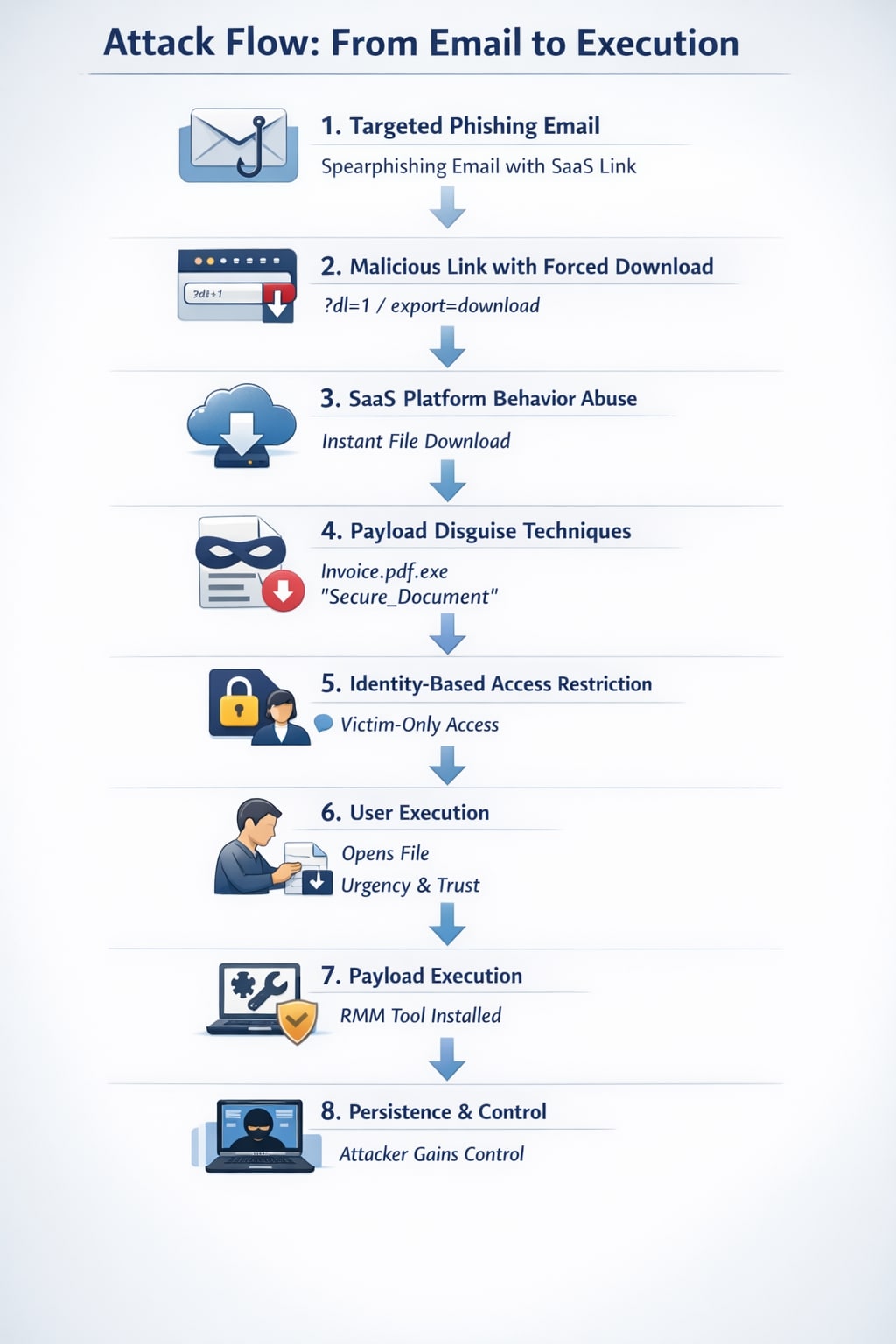
Attack flow chart, from email to execution.
Multi-step attack flow, starting from targeted phishing email, to bypass security and establish persistence.

The Library of Lures Strategy

To fuel the autodownload machine, attackers employ a flexible strategy by switching between various social engineering themes. This spear phishing campaign targets specific inboxes, such as "Orders," to exploit professional routines. Some common lures found in this campaign include:

  • Financial Urgency Fake "Invoices" or "Receipts" that induce anxiety. These often set close-day payment deadlines, pressuring recipients to click quickly.
  • Business Operations – "Quote Requests" or "Purchase Orders" that exploit professional habits.
  • Deceptive Naming – Concealing the download as a safe document, using display text like "invoice.pdf" in the email body to hide the underlying Dropbox URL.

Government Domain Impersonation

Attackers often leverage high-authority lures designed to paralyze a user's critical thinking. In one sophisticated wave, we observed threats impersonating a government entity by exploiting the high-reputation, official government domain. By borrowing the reputational authority associated with official infrastructure, the attacker successfully maneuvered an "Unidentified Payment Notice" past standard "Untrusted Sender" filters. To the recipient, the email carries the weight of a sanctioned document. Fearing legal or financial ramifications, they feel a heightened sense of urgency to click "View Invoice" to resolve the issue immediately.

Employee Impersonation

When government authority isn’t the angle, attackers shift to impersonating internal staff. In one case, the sender’s display name was spoofed to match a real employee in the target organization. Attackers rely on a “Momentum of Trust” tied to familiar names to overwhelm user judgment. Even when a generic Gmail address is used, users, especially those on mobile devices, rarely pause to check the underlying headers.

Internal Trust Amplification ("Human Relay")

The most effective aspect of this campaign occurs through Internal Laundering, where the threat shifts from external suspicion to a trusted internal message. This was observed when a Finance Department employee received a "Quote Analysis" file and, believing it to be a valid inquiry, mistakenly forwarded the link to the Procurement department.

At that stage, the attack no longer depended on deception, it propagated through trusted human workflows. These various tactics illustrate the sophistication and adaptability of phishing campaigns and highlight the importance of vigilance in email security.

How We Uncovered a Single Threat Actor

Although the lures appeared diverse, a deeper technical analysis revealed that they were all orchestrated by a single, coordinated threat actor.

By mapping the campaign, we uncovered a significant pattern: Each autodownload link pointed to a different file hash to evade signature detection, but all unique executables were ultimately associated with the same parent installer hash.

The file was identified as a specific Remote Monitoring and Management (RMM) executable, an administrative software used to manage computers remotely. Because RMM tools are legitimate, they often trigger fewer alerts than traditional Trojans. This allows the attacker to maintain persistent access under the guise of “authorized” system activity.

How Cortex Email Security Addresses the Threat

To defend against a campaign that emphasizes speed and rotation, behavioral analysis is essential.

The Cortex® Email Security Module addresses this threat:

  • Advanced URL Analysis – Detection of forced-download parameters, combined with delivery of high-risk files via URLs.
  • Deep Metadata Correlation Correlating sender identity with behavioral anomalies to flag threats that traditional scanners might overlook.
  • LLM-Based Intent Analysis Classifying phishing themes (invoice, payment, quote) despite variation.

The security engine triggers an alert by synthesizing LLM analysis with real-time email telemetry, global threat intelligence and behavioral signals.

Securing the Click

The combination of autodownload links and rotating lures is crafted to exploit user momentum and the "psychology of trust."

This campaign represents a shift from deception to acceleration. Attackers no longer need perfect lures, they only need to remove friction. Defenders must evolve accordingly, focusing not only on what a link is, but on what it forces a user to do.

Palo Alto Networks Cortex Advanced Email Security was built for this evolution. By moving beyond static file analysis to identify the behavioral "red flags" of autodownloads and forced-momentum URLs, we provide the visibility needed to stop these attacks before they reach the device.

The module examines email metadata, content, and behavior to uncover hidden malicious intent and sophisticated impersonation, including AI-crafted threats. By assigning precise risk scores to every detection, the system filters out the noise, allowing analysts to move past alert fatigue and focus on the most critical threats first.

Indicators of compromise discovered during this research are detailed on Unit 42’s GitHib instance.


FAQs

  1. Why is the "Auto-Download" parameter so effective? It removes the "moment of doubt." By bypassing the preview page, the attacker forces the file onto the computer instantly, prompting the user to "Open" it out of habit.
  2. How does the use of rotating lures benefit the attacker? It maximizes both psychological and technical success. People have different "blind spots" (e.g., finance professionals are likely to click on invoices), and variety increases the chances of finding a template that can bypass specific customers' security filters.
  3. Why might a sandbox fail to catch the malicious file? Because the link was "Identity-Bound." To the scanner, the link appeared to lead to a harmless error page (cloaking), resulting in a false negative.

Cloaking involves showing different content to security scanners than what is presented to the victim. By using Identity-Bound access, the file only reveals itself to the intended target.

The post The Dangerous Momentum of Autodownload Phishing appeared first on Palo Alto Networks Blog.


  •  

Strengthening cyber capacity in Kenya: A new toolkit with lessons for the region

When a major cyber incident hits, the first decisions aren’t technical—they’re human. Who takes the lead? How quickly can information be shared? When should governments step in, and how do you protect public trust while keeping essential services running? 

These questions are at the heart of Microsoft’s Advancing Regional Cybersecurity (ARC) initiative, launched in 2025 to help governments strengthen cyber preparedness through practical, public-private collaboration. Today, we’re sharing the first tangible output of that work: the ARC Kenya Exercise Report & Toolkit, developed through a tabletop exercise held in Nairobi in December 2025.  

Developed with Kenya’s National Computer and Cybercrime Coordination Committee (NC4) and RiskSight, the toolkit is a practical planning resource designed to help government and cross-sector leaders prepare for cyber crises before they occur. It is grounded in real conversations among leaders from government, regulators, critical infrastructure operators, law enforcement, academia, and the private sector working through what a serious cyber incident would demand of them, together. 

Stress‑testing decisions before a crisis hits

The ambition of the “Silicon Savannah” makes Kenya a compelling setting for this work. Its digital economy is expanding rapidly—from mobilefirst financial services to cloudenabled public infrastructure—positioning the country as a regional technology leader. But rapid digital growth also brings increased exposure to more sophisticated cyber threats. As systems become more interconnected, a serious cyber incident can quickly disrupt essential services, undermine public trust, and threaten economic stability. 

Kenya’s approach recognizes this reality and reflects a critical principle: cybersecurity is not separate from innovation; it is one of the conditions that allows digital transformation to scale safely. The ARC initiative embodies this philosophy and helps decision makers confront the practical realities of coordination, escalation, and response in this complex environment. 

This is exactly what the ARC Kenya tabletop exercise was designed to do. The objective was not to test tools but to stresstest decision making under pressure. Participants were challenged with complex scenarios—including AIenabled breaches, ransomware attacks, and infrastructurelevel disruptions. The focus was not on technical fixes but on leadership clarity, crossagency coordination, and realtime decision making in highpressure environments. 

The outcome was both a roadmap for the unknown and a clear recognition of the need for shared expectations before a crisis begins—particularly around leadership and authority, trusted information sharing channels, and agreed response frameworks. These gaps, identified by participants themselves, now form the backbone of the ARC Kenya Toolkit. 

What the ARC Kenya toolkit delivers

The toolkit translates the lessons of the exercise into concrete actions that leaders can take now—before the next incident occurs. It also serves as a practical and specific 12month roadmap for strengthening Kenya’s cyber preparedness, moving from lessons identified to durable, institutional capability. Specifically, the toolkit provides recommendations to: 

  • Clarify national leadership during major cyber incidents, enabling government, regulators, law enforcement, and critical infrastructure operators to coordinate more quickly, with fewer gaps and overlaps. 
  • Establish practical, standardsaligned incident response models for the entire country, including priority playbooks that teams can train on and execute consistently. 
  • Strengthen operational readiness across sectors, with better coordination between security operations centers (SOCs), clearer escalation thresholds, and more reliable incident reporting pathways. 
  • Deepen trusted information sharing and publicprivate collaboration through common handling rules, safer “goodfaith” reporting mechanisms, and regular joint exercises to build muscle memory before a crisis.

Taken together, these elements enable leaders not only to respond more effectively to cyber incidents, but to institutionalize preparedness, coordination, and resilience across the national cyber ecosystem. For African countries more broadly, the model also offers a practical pathway to strengthen regional cyber cooperation—by aligning expectations around escalation, information sharing, and public‑private coordination before a crossborder incident occurs. By translating highlevel principles into practical, repeatable approaches to crisis readiness, the toolkit underscores the value of trusted international partnerships and alignment with global norms for responsible state behavior in cyberspace. 

Why Kenya’s approach matters beyond its borders

Many countries across the Global South are grappling with similar challenges: fragmented ownership of critical infrastructure, uneven cyber capacity across sectors, and the need to coordinate rapidly under pressure. While firmly grounded in Kenya’s national context, the lessons from ARC Kenya are therefore intentionally designed to resonate far beyond its borders and to be highly transferable. 

Importantly, this work does not end in Kenya. We are already building on these lessons through ARC engagements in other regions, including a new workstream in Mexico, applying the same approach to strengthen preparedness, coordination, and resilience across different national contexts. 

By design, the ARC initiative is not simply a record of a single exercise. It is a foundation others can build on—at a national or regional level—offering leaders a practical starting point to turn shared responsibility into sustained capability. 

Explore the ARC Kenya Toolkit & Tabletop Exercise


For more than a decade, the Microsoft Digital Crimes Unit (DCU) has persistently disrupted cybercrime and nation-state threats targeting people, organizations, and critical infrastructure. Explore major disruptions—and the ongoing cases and operations behind them here: Disrupting cyberthreats since 2008 | Microsoft

The post Strengthening cyber capacity in Kenya: A new toolkit with lessons for the region appeared first on Microsoft On the Issues.

  •  

From capability to responsibility: Securing our global digital ecosystem with next‑generation AI

Cybersecurity is at a turning point. Advanced AI models are dramatically accelerating vulnerability discovery and creating conditions ripe for exploitation, underscored by the announcement of Claude Mythos Preview. This marks a shift, and whether this technology will favor defenders or attackers will depend on the choices we make now. 

With the right safeguards, these capabilities can help trusted defenders identify and fix vulnerabilities across critical systems in hospitals, power grids, water, and telecommunications. Released irresponsibly or not properly secured, however, those same capabilities could be abused by malicious actors, threatening the foundations of our digital ecosystem. 

Much of the discussion has rightly focused on risks. As advanced AI models speed up the discovery of vulnerabilities, the way we fix them must speed up too. That means stronger pre-deployment risk assessments and close collaboration between governments, frontier AI developers, software providers, and the broader ecosystem to ensure these tools reduce, rather than increase, cyber risk. This is particularly important as AI systems themselves have become high‑value targets, requiring stronger protection of models, systems, data, and underlying infrastructure. 

This is ultimately an international challenge. Neither software supply chains nor threat actors stop at borders. Neither can our response. Meeting this moment will require shared approaches across countries, sectors, and systems—rooted in trust, shared standards, resilience, and responsible use. 

This moment is also an opportunity. Security has been and remains the top priority at Microsoft. Over the last two years, through our  Secure Future Initiative, we have strengthened our security foundations for this age of AI, in part by using AI to accelerate vulnerability discovery and remediation. We have also invested in fundamental AI for security research, including the development of open-source industry benchmarks that can be used to evaluate whether models are ready for real-world security work. We are accelerating that work through deeper public-private collaboration and in partnership with AI, including Anthropic’s Project Glasswing and OpenAI’s Trusted Access for Cyber program. 

Securing our digital ecosystem with nextgeneration AI is within reach but is not automatic.  

Building secure foundations for the era of frontier AI  

Ensuring advanced AI technologies are used to strengthen cybersecurity requires deliberate and urgent action. We are sharing the following recommendations as practical steps governments, industry, and the broader ecosystem can take to ensure these tools, often referred to as “frontier AI”, reinforce the security foundations on which digital societies depend. And we hope to continue to partner with model providers, industry and government so we can work together to improve security outcomes for all. 

1. Reinforce core cybersecurity practices  

Advanced AI can strengthen cybersecurity only when strong, consistent cyber hygiene is already in place. As frontier AI accelerates vulnerability discovery and response, core practices such as rapid patching, access control, and system resilience become more critical, not less. 

Security gains in the frontier AI era depend on close coordination between technology providers advancing new capabilities and the organizations responsible for operating, updating, and securing real‑world systems. Without this interdependence, advanced AI cannot deliver durable improvements in security. No organization can solve these cybersecurity problems alone. 

That is why sustained investment in what we know works remains essential: secure‑by‑design product lifecycles, Zero Trust architectures, multi‑factor authentication, least‑privileged access, and ongoing security training. Broad adoption and harmonization of established cybersecurity frameworks to ensure consistent resilience across AIenabled systems. Trusted cloud environments that enable these practices at scale, supporting secure data handling, continuous patching, and the secure deployment of AI‑enabled tools for defenders.  

  2. Release advanced capabilities responsibly  

As frontier AI systems gain reasoning, coding, and agentic capabilities, some of the most serious security risks arise before deployment, including realistic misuse involving multi‑step reasoning, tool use, and reconnaissance. Technical safety benchmarks remain important, but they are insufficient without rigorous, real‑world testing.  

As a result, governments are increasingly establishing pre‑deployment evaluations that combine technical testing with threat modeling. These assessments are most effective when frontier developers work closely with organizations that track national‑security risks. Investing in secure evaluation environments and modern testing methods can help governments keep pace as capabilities advance.  

Responsible release practices, including phased and controlled access, are a critical extension of this approach. Our work with Anthropic in Project Glasswing offers one practical model, enabling trusted defenders to evaluate advanced capabilities in constrained settings prior to broader release. Similarly, OpenAI and Microsoft work closely through Trusted Access for Cyber program, and we already support OpenAI’s use of scoped, early deployments for safety and security testing.  

Responsibility does not end at release. Organizations that deploy frontier models are often best positioned to detect emerging misuse and should monitor, mitigate, and share threat information. Microsoft is working with peers through the Frontier Model Forum to advance best practices for evaluating and managing cyber risk and enable information sharing. Governments should encourage continued industry collaboration to restrict access for identified threat actors and counter adversarial or malicious use of advanced AI. 

  3. Modernize vulnerability management  

AI is changing both the speed of vulnerability discovery and what constitutes meaningful security risk. Faster discovery only improves security if triage, validation, and remediation can keep up. 

As AI accelerates discovery, vulnerability management must shift from tracking raw volume to reducing real‑world risk. That means prioritizing vulnerabilities that are genuinely exploitable, assigning clear responsibility for triage and remediation, and using phased, risk‑based disclosure when private coordination improves safety. Above all, systems must be designed around validation and realistic remediation capacity, not the assumption that more findings automatically lead to better security. 

Developers of frontier AI models should embed vulnerability coordination and disclosure directly into responsible‑release frameworks. And work with governments and industry to ensure findings are routed to the right owners, acted on early, and supported by clear coordination pathways. 

  4. Fix faster: Strengthen and accelerate response and remediation 

As AI accelerates vulnerability discovery, remediation must keep pace. Initiatives such as DARPA’s AI Cyber Challenge show how AI can help both find and fix flaws in open‑source software. Hardening defenses requires investment not just in detection tools but in the people, processes, and infrastructure responsible for fixing vulnerabilities, especially in critical sectors. 

Much of the software underpinning critical infrastructure relies on open‑source components maintained by small teams or volunteers with limited security capacity. A surge in AI‑enabled discovery risks overwhelming existing triage and disclosure processes. Efforts such as the GitHub Secure Open Source Fundalongside investments by Microsoft and others through the Linux Foundation, Alpha‑Omega, and OpenSSF, are helping maintainers adapt in ways that are practical and aligned with existing workflows.  

Governments should treat remediation capacity as a core resilience priority, including sustained investment in and support for maintainers, surge capacity during large discovery events, and modernized disclosure pathways—recognizing that effective remediation still largely depends on human judgment, coordination, and time.  

  5. Advance AI security internationally 

AI security is essential to deploy AI at scale. Because AI systems, supply chains, and the risks they introduce operate across borders, national approaches alone will not be sufficient. 

Governments and industry should work together to build interoperable international foundations for AI security, including risk evaluation, coordinated vulnerability disclosure, and information sharing. Priorities should include strengthening the defensive use of AI, preventing misuse through shared norms and safeguards, and securing AI systems- and the AI technology stack.  

Global participation is critical. Countries and organizations with limited cybersecurity resources or legacy infrastructure are often the most exposed. International cooperation should prioritize capacitybuilding, ensuring that the security benefits of AI are realized broadly and equitably. 

AI security is not just a safeguard; it is an enabler for innovation and growth. By acting collectively and moving quickly, governments and industry can strengthen global digital resilience and unlock the trusted adoption of AI across economies, critical infrastructure, and public services.

Meeting the moment: Use frontier AI capabilities to build trust and confidence  

Meeting this moment is ultimately about trust: not in any single technology or provider, but in our collective ability to introduce advanced AI responsibly.  

Used deliberately and built on strong security foundations, these capabilities can strengthen cybersecurity and reinforce confidence in the systems society depends on. The choice is not between innovation and security but whether we enable them to reinforce one another. 

That outcome is within reach. With governments, industry, and infrastructure operators aligned, advanced AI can be deployed in ways that match real‑world defensive capacity and support trusted, lawful action. Done right and working together, frontier AI can help protect the digital infrastructure that underpins modern life and build lasting confidence in its resilience. 


For more than a decade, the Microsoft Digital Crimes Unit (DCU) has persistently disrupted cybercrime and nation-state threats targeting people, organizations, and critical infrastructure. Explore major disruptions—and the ongoing cases and operations behind them here: Disrupting cyberthreats since 2008 | Microsoft

The post From capability to responsibility: Securing our global digital ecosystem with next‑generation AI appeared first on Microsoft On the Issues.

  •  

Fast16 Malware

Researchers have reverse-engineered a piece of malware named Fast16. It’s almost certainly state-sponsored, probably US in origin, and was deployed against Iran years before Stuxnet:

“…the Fast16 malware was designed to carry out the most subtle form of sabotage ever seen in an in-the-wild malware tool: By automatically spreading across networks and then silently manipulating computation processes in certain software applications that perform high-precision mathematical calculations and simulate physical phenomena, Fast16 can alter the results of those programs to cause failures that range from faulty research results to catastrophic damage to real-world equipment.”

Another news article.

Lots of interesting details at the links.

  •  

Palo Alto Networks Joins DNS-OARC as a Platinum Member

Palo Alto Networks recently joined the DNS-OARC community as a Platinum Member. Together, our organizations share a commitment to advancing collaboration in research and operational excellence across the global DNS ecosystem. DNS is critical to both internet infrastructure and security, and this collaboration facilitates the sharing of real-world insights among researchers and practitioners.

Our Contribution

We help organizations secure their digital environment with a comprehensive portfolio of cybersecurity solutions spanning Network, Cloud, Security Operations, AI and Identity. Trusted by more than 70,000 customers worldwide and informed by Unit 42® Threat Intelligence, their AI-driven platforms help organizations reduce complexity, modernize with confidence, and securely enable innovation.

As a Platinum Member, our subject matter experts will actively participate in the DNS-OARC community by engaging in discussions and contributing to research on evolving DNS threats and network challenges. The growing intersection of DNS and security makes access to intelligence and experience increasingly important. It strengthens the community’s ability to respond to emerging challenges and improves resilience across the internet.

Through our participation, our customers will gain stronger protection informed by community-driven intelligence and real-world operational insight. These learnings are continuously integrated into our threat intelligence and security capabilities. Our participation signals our support for DNS-OARC’s mission of fostering open dialogue and shared learning across the DNS ecosystem. This collaboration helps bridge DNS operations with broader security practices, improving coordination between operators, researchers and security practitioners.

Our Commitment to the DNS-OARC and Global Communities

Collaboration between our organizations strengthens the connection among DNS operations and modern security practices by bringing together operational insight and a global community dedicated to advancing the internet’s resilience.

For the DNS-OARC community, our commitment enhances knowledge sharing around evolving DNS threats, large-scale network operations and practical approaches to emerging challenges.

For organizations and customers, it reinforces a stronger alignment between DNS infrastructure and security, expands access to community-driven intelligence and supports more resilient, well-informed defenses.

Tong Zhao, Senior Manager of DNS Security Engineering, Palo Alto Networks:

We recognize the critical role of DNS-OARC in DNS operations and research. The teams from Palo Alto Networks believe that our DNS-OARC membership aligns perfectly with our goals. We are eager to participate in and contribute to the DNS community.

Our partnership with the DNC-OARC highlights the value of open collaboration in helping both the community and its participants stay ahead of an increasingly complex threat landscape. To learn more about how our expertise and insights support DNS-OARC’s mission to improve the security and stability of the internet’s DNS, visit DNS-OARC.

The post Palo Alto Networks Joins DNS-OARC as a Platinum Member appeared first on Palo Alto Networks Blog.
  •  

Mythos and Cybersecurity

Last week, Anthropic pulled back the curtain on Claude Mythos Preview, an AI model so capable at finding and exploiting software vulnerabilities that the company decided it was too dangerous to release to the public. Instead, access has been restricted to roughly 50 organizations—Microsoft, Apple, Amazon Web Services, CrowdStrike and other vendors of critical infrastructure—under an initiative called Project Glasswing.

The announcement was accompanied by a barrage of hair-raising anecdotes: thousands of vulnerabilities uncovered across every major operating system and browser, including a 27-year-old bug in OpenBSD, a 16-year-old flaw in FFmpeg. Mythos was able to weaponize a set of vulnerabilities it found in the Firefox browser into 181 usable attacks; Anthropic’s previous flagship model could only achieve two.

This is, in many respects, exactly the kind of responsible disclosure that security researchers have long urged. And yet the public has been given remarkably little with which to evaluate Anthropic’s decision. We have been shown a highlight reel of spectacular successes. However, we can’t tell if we have a blockbuster until they let us see the whole movie.

For example, we don’t know how many times Mythos mistakenly flagged code as vulnerable. Anthropic said security contractors agreed with the AI’s severity rating 198 times, with an 89 per cent severity agreement. That’s impressive, but incomplete. Independent researchers examining similar models have found that AI that detects nearly every real bug also hallucinates plausible-sounding vulnerabilities in patched, correct code.

This matters. A model that autonomously finds and exploits hundreds of vulnerabilities with inhuman precision is a game changer, but a model that generates thousands of false alarms and non-working attacks still needs skilled and knowledgeable humans. Without knowing the rate of false alarms in Mythos’s unfiltered output, we cannot tell whether the examples showcased are representative.

There is a second, subtler problem. Large language models, including Mythos, perform best on inputs that resemble what they were trained on: widely used open-source projects, major browsers, the Linux kernel and popular web frameworks. Concentrating early access among the largest vendors of precisely this software is sensible; it lets them patch first, before adversaries catch up.

But the inverse is also true. Software outside the training distribution—industrial control systems, medical device firmware, bespoke financial infrastructure, regional banking software, older embedded systems—is exactly where out-of-the-box Mythos is likely least able to find or exploit bugs.

However, a sufficiently motivated attacker with domain expertise in one of these fields could nevertheless wield Mythos’s advanced reasoning capabilities as a force multiplier, probing systems that Anthropic’s own engineers lack the specialized knowledge to audit. The danger is not that Mythos fails in those domains; it is that Mythos may succeed for whoever brings the expertise.

Broader, structured access for academic researchers and domain specialists—cardiologists’ partners in medical device security, control-systems engineers, researchers in less prominent languages and ecosystems—would meaningfully reduce this asymmetry. Fifty companies, however well chosen, cannot substitute for the distributed expertise of the entire research community.

None of this is an indictment of Anthropic. By all appearances the company is trying to act responsibly, and its decision to hold the model back is evidence of seriousness.

But Anthropic is a private company and, in some ways, still a start-up. Yet it is making unilateral decisions about which pieces of our critical global infrastructure get defended first, and which must wait their turn.

It has finite staff, finite budget and finite expertise. It will miss things, and when the thing missed is in the software running a hospital or a power grid, the cost will be borne by people who never had a say.

The security problem is far greater than one company and one model. There’s no reason to believe that Mythos Preview is unique. (Not to be outdone, OpenAI announced that its new GPT-5.4-Cyber is so dangerous that the model also will not be released to the general public.) And it’s unclear how much of an advance these new models represent. The security company Aisle was able to replicate many of Anthropic’s published anecdotes using smaller, cheaper, public AI models.

Any decisions we make about whether and how to release these powerful models are more than one company’s responsibility. Ultimately, this will probably lead to regulation. That will be hard to get right and requires a long process of consultation and feedback.

In the short term, we need something simpler: greater transparency and information sharing with the broader community. This doesn’t necessarily mean making powerful models like Claude Mythos widely available. Rather, it means sharing as much data and information as possible, so that we can collectively make informed decisions.

We need globally co-ordinated frameworks for independent auditing, mandatory disclosure of aggregate performance metrics and funded access for academic and civil-society researchers.

This has implications for national security, personal safety and corporate competitiveness. Any technology that can find thousands of exploitable flaws in the systems we all depend on should not be governed solely by the internal judgment of its creators, however well intentioned.

Until that changes, each Mythos-class release will put the world at the edge of another precipice, without any visibility into whether there is a landing out of view just below, or whether this time the drop will be fatal. That is not a choice a for-profit corporation should be allowed to make in a democratic society. Nor should such a company be able to restrict the ability of society to make choices about its own security.

This essay was written with David Lie, and originally appeared in The Globe and Mail.

  •  

Closing the Gap by Enhancing Visibility and Mitigating Risks

In the race to digitise public services, the UK’s digital estate has grown into a vast, borderless ecosystem that manual audits can no longer track. For UK Government departments, local authorities and NHS trusts, it is a sprawling, shifting landscape of cloud workloads, legacy infrastructure, shadow IT and third-party supplier connections.

This complexity creates blind spots that modern threats exploit. Recognising this vulnerability, the UK Government is moving toward a secure-by-design digital infrastructure, with the 2026 Government Cyber Action Plan (GCAP) setting a high bar for resilience. A central theme of the GCAP is the urgent need for the government to have better visibility of cyber security and resilience risk. Fundamentally, organisations cannot secure what they cannot see. As the GCAP explicitly states, the Government will use “data sources from across the government to truly understand government-wide and departmental cyber risks.”

The Challenge: Visibility in a “Landscape”

Many public sector organisations rely on a complex web of spreadsheets, data calls, legacy tools and manually curated lists to create an inventory of their internet-connected assets. But attackers do not look at an organisation's internal lists; they scan the internet for what they have forgotten to secure. Whether it is an unpatched server from a legacy project or a misconfigured database in a department, these "unknown unknowns" are the primary entry points for attackers.

The Strategic Mission: Empowering the Public Sector and Critical Industries

Palo Alto Networks Cortex Xpanse® is an active external attack surface management (EASM) solution that provides an outside-in view of organisations' entire digital footprint. It helps leaders meet national resilience goals:

  • Comprehensive, Continuous Visibility: Xpanse scans the global internet space continuously and identifies every asset associated with an organisation, without requiring software agents to be installed on your systems.
  • Accelerate Response: Leveraging automation, the solution streamlines response processes and enhances collaboration across dispersed teams from the sharing of findings to tracking actions and remediation.
  • Supply Chain Integrity: Inline with the new Cyber Security and Resilience Bill (bringing managed service providers and critical third parties into scope), Xpanse allows organisations to assess the internet-facing security posture of third-party partners and suppliers, ensuring a weak link elsewhere doesn't compromise the broader mission.
  • Alignment with GovAssure: Xpanse provides a consolidated risk profile and inventory for all internet-facing and cloud assets required for GovAssure assessments, turning a manual, months-long audit process into a continuous, data-driven cycle.
  • Investment prioritisation: Xpanse provides that much needed visibility to help executive committees and boards prioritise investment decisions on legacy IT and technical debt.

Aligning to National Cybersecurity Centre (NCSC) Guidance

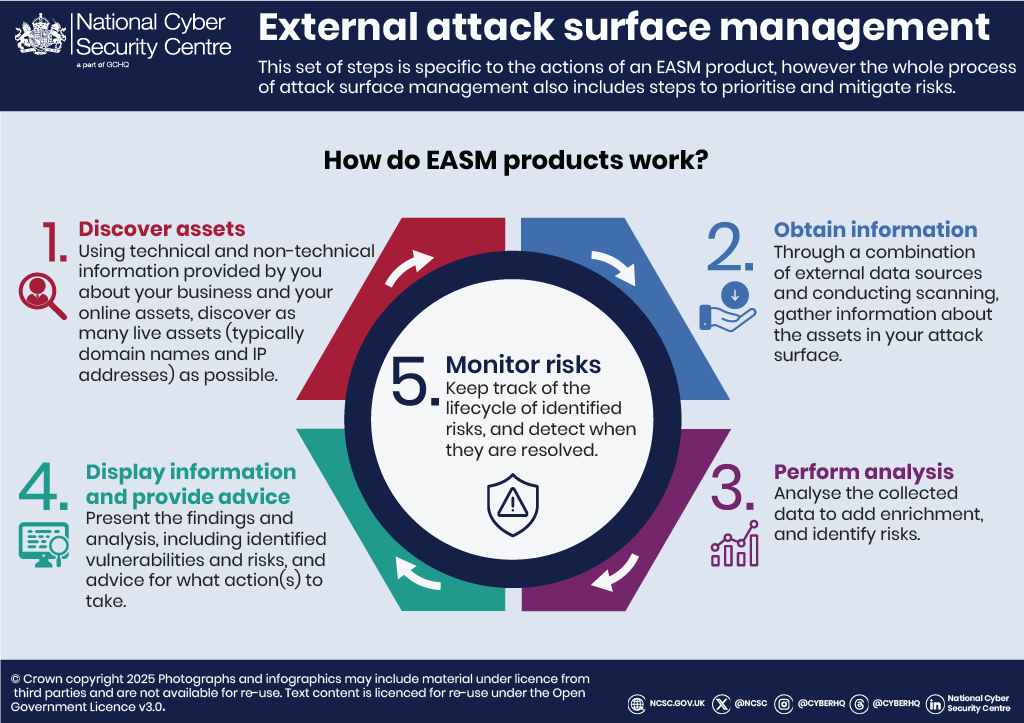
How external attack surface management products work.

Palo Alto Networks Cortex Xpanse aligns with the National Cyber Security Centre (NCSC) external attack surface management (EASM) buyer's guide by providing automated discovery, continuous monitoring and risk prioritisation of internet-facing assets. It replaces manual, point-in-time audits with a proactive, agentless solution. By automating the discovery of all internet-accessible assets (including shadow IT and unmanaged cloud operations) the platform fulfills the NCSC’s core requirement for continuous global monitoring and rapid attribution. This data-driven approach allows for the automated prioritisation of critical exposures, such as RDP, and integrates seamlessly with multiple third-party automation and visualisation tools, including Cortex XSOAR® and XSIAM, to accelerate remediation with national incident response standards.

In fact, with Palo Alto Networks deployment of Cortex Xpanse, we were able to achieve a 95% reduction in external vulnerability management spending across more than 700,000 cloud instances, while improving coverage and outcomes.

Palo Alto Networks Cortex Xpanse Capabilities
  • Discover Assets: Leveraging organisations' known asset inventory and other data points, Xpanse performs continual, automated discovery of all internet-accessible assets, effectively eliminating blind spots created by shadow IT and unmanaged cloud operations.
  • Obtain Information: Always-on, continuous monitoring of an organisation's entire attack surface through daily scans of the global IP address space, ensuring that newly exposed services are identified quickly and accurately.
  • Perform Analysis: Xpanse automates and prioritises alerts on all identified risks by severity, enabling organisations to optimise resolution and risk management, allowing teams to properly allocate resources and focus on the most critical risks to the organisation.
  • Display Information and Provide Advice: Leveraging a unified view of the internet facing and cloud-based estate, Xpanse provides specific resolver guidance for every identified issue, supporting and monitoring automated resolution through multiple native integrations.
  • Monitor Risk: Always on, discreet continual monitoring provides an independent real time status of the digital estate. Leveraging the threat intelligence capabilities of Palo Alto Networks, Xpanse is uniquely positioned to provide rapid coverage for newly discovered vulnerabilities, exploits or misconfigurations.

Securing the public sector requires a move from manual, point in time assessments to data-driven intelligence. Cortex Xpanse provides the foundations to remove blind spots, secure the supply chain and prevent unknown vulnerabilities in the face of sophisticated threats.

For further information and case studies, visit the links below, or schedule a demo.

  • Palo Alto Networks: Slash false positives, remediation time budget with Cortex attack surface management.
  • U.S. Pentagon: Palo Alto Networks Cortex Xpanse supercharge the Cyber Defences for the Department of Defense.
  • Accenture: Secure rapid growth with Cortex Xpanse.

The post Closing the Gap by Enhancing Visibility and Mitigating Risks appeared first on Palo Alto Networks Blog.

  •  

Anatomy of a Cyber World Global Report 2026

Kaspersky Security Services provide a comprehensive cybersecurity ecosystem, taking enterprise threat protection to another level. Services like Kaspersky Managed Detection and Response and Compromise Assessment allow for timely detection of threats and cyberattacks. SOC Consulting provides a practical approach ensuring the corporate infrastructure stays secured, while Incident Response is suited for timely remediation with a maximized recovery rate.

High-level overview of the MDR, IR and CA connection

High-level overview of the MDR, IR and CA connection

This new report brings together statistics across regions and industries from our Managed Detection and Response and Incident Response services, and for the first time, it also includes insights from our Compromise Assessment and SOC Consulting services — all to provide you with more comprehensive view of different aspects of corporate information security worldwide.

The scope of MDR and IR services

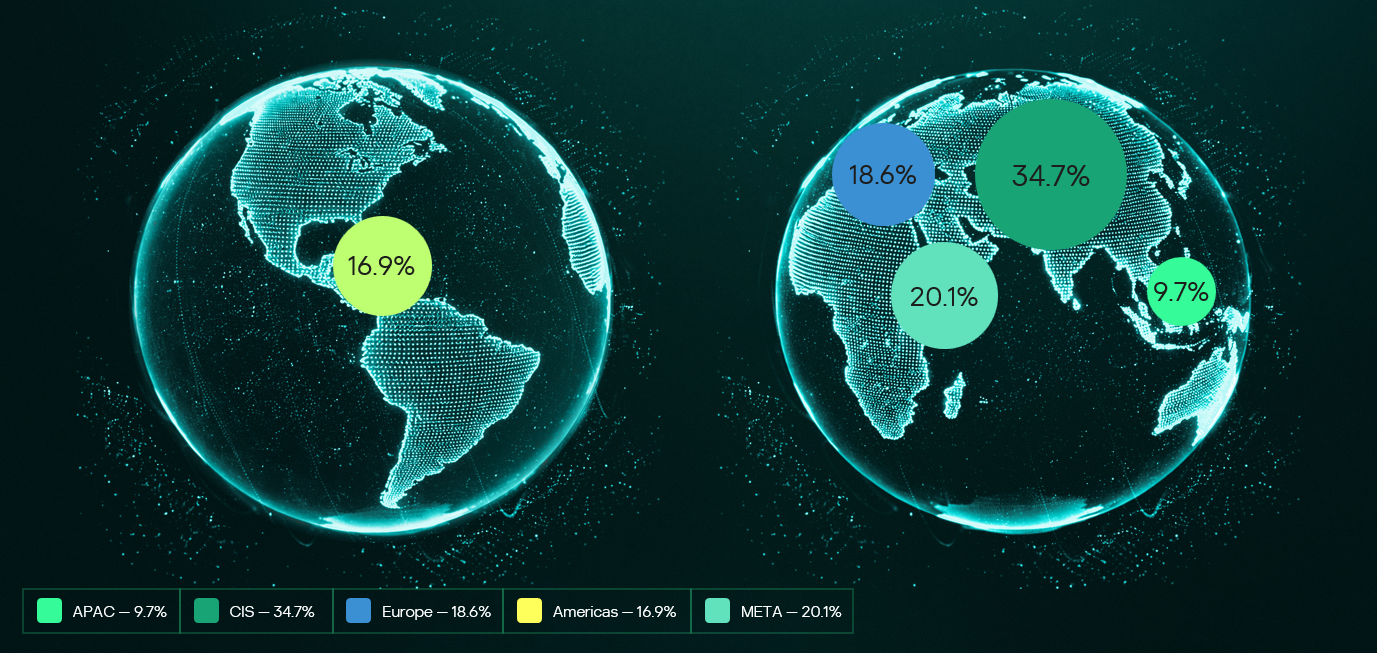
Provision of Kaspersky’s MDR and IR services follows a global approach. The majority of customers accounted for the CIS (34.7%), the Middle East (20.1%), and Europe (18.6%).

Distribution of customers by geographical region, 2025

Distribution of customers by geographical region, 2025

MDR telemetry

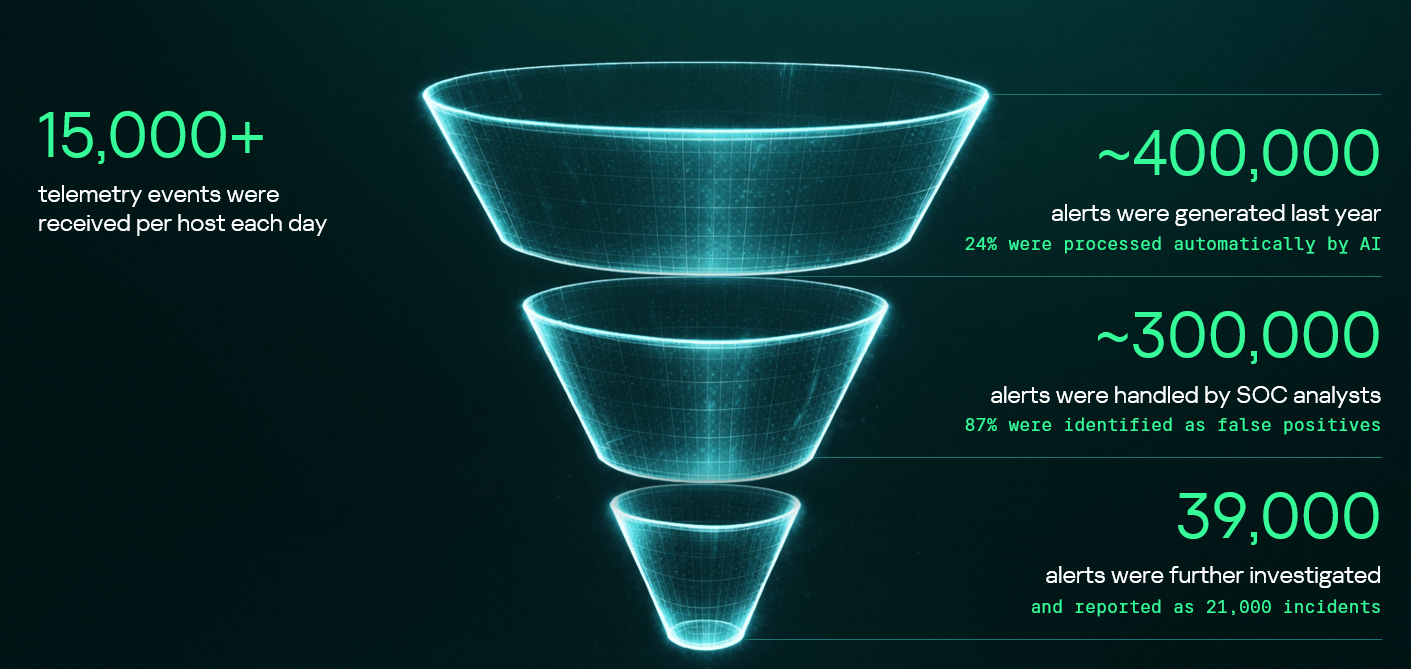
Following the previous year’s numbers, in 2025, the MDR infrastructure received and processed an average of 15,000 telemetry events per host every day, generating security alerts as a result. These alerts are first processed by AI-powered detection logic, after which Kaspersky SOC analysts handle them as required. Overall, a total of approximately 400,000 alerts were generated in 2025. After counting out false positives, 39,000 alerts were further investigated.

MDR telemetry statistics, 2025

MDR telemetry statistics, 2025

Incident statistics

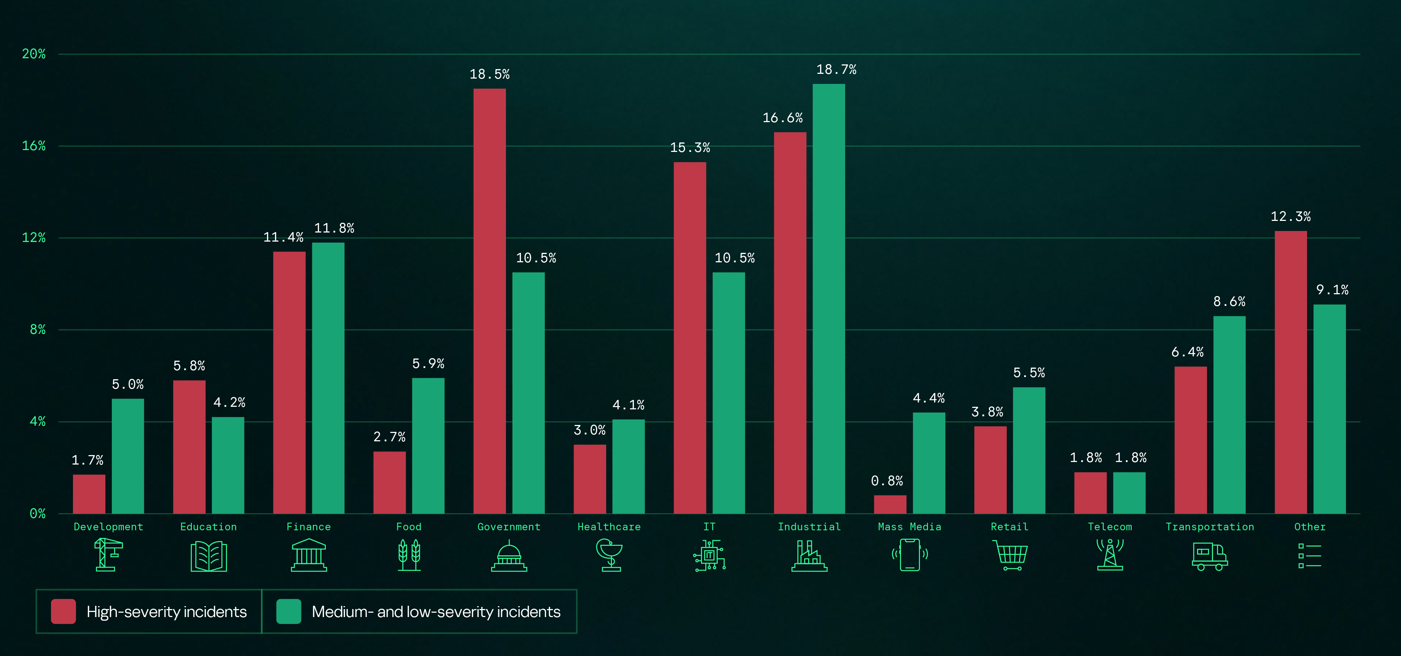
The distribution of remediation requests by industry has slightly changed as compared to previous years’ pattern. Government (18.5%) and industrial (16.6%) organizations are still the most targeted industries in regards to cyberattacks that require incident response activities. However, this year, the IT sector saw a growth in the number of IR requests, eventually being placed third in the overall industry distribution rankings and thus replacing financial organizations, which were targeted less often than in 2024. This is equally true for smaller-scale attacks that can be contained and remediated through automated means — the only difference is that medium- and low-severity incidents are more often experienced by financial organizations.

Distribution of all incidents by industry sector, 2025

Distribution of all incidents by industry sector, 2025

Key trends and statistics

This section presents key findings and trends in cyberattacks in 2025:

  • The number of high-severity incidents decreased, following a downward trend that we’ve been observing since 2021. The majority of those incidents account for APT attacks and red teaming exercises, which indicates two landscape trends. On the one hand, skilled adversaries make efforts to increase impact, while on the other, organizations spend more resources on probing their defense systems.
  • The most common vulnerabilities exploited in the wild were related to Microsoft products. Half of all identified CVEs led to remote code execution, notably without authentication in some cases.
  • Exploitation of public-facing applications, valid accounts, and trusted relationships remain the most popular initial vectors, and their overall share has increased, accounting to over 80% of all attacks in 2025. In particular, attacks through trusted relationships are evolving: their share has increased to 15.5% from 12.8% in 2024. They are also becoming more complex: for instance, we witnessed a case where adversaries had compromised more than two organizations in sequence to ultimately gain access to a third target.
  • Standard Windows utilities remain a popular LotL tool. Adversaries use those to minimize the risk of detection during delivery to a compromised system. The most popular LOLBins we observed in high-severity incidents were powershell.exe (14.4%), rundll32.exe (5.9%), and mshta.exe (3.8%). Among the most popular legitimate tools used in incidents we flag Mimikatz (14.3%), PowerShell (8.1%), PsExec (7.5%), and AnyDesk (7.5%).

The full 2026 Global Report provides additional information about cyberattacks, including real-world cases discovered by Kaspersky experts. We also describe SOC Consulting projects and Compromise Assessment requests. The report includes comprehensive analysis of initial attack vectors in correlation with the MITRE ATT&CK tactics and techniques and the full list of vulnerabilities that we detected during Incident Response engagements.

  •  

Anatomy of a Cyber World Global Report 2026

Kaspersky Security Services provide a comprehensive cybersecurity ecosystem, taking enterprise threat protection to another level. Services like Kaspersky Managed Detection and Response and Compromise Assessment allow for timely detection of threats and cyberattacks. SOC Consulting provides a practical approach ensuring the corporate infrastructure stays secured, while Incident Response is suited for timely remediation with a maximized recovery rate.

High-level overview of the MDR, IR and CA connection

High-level overview of the MDR, IR and CA connection

This new report brings together statistics across regions and industries from our Managed Detection and Response and Incident Response services, and for the first time, it also includes insights from our Compromise Assessment and SOC Consulting services — all to provide you with more comprehensive view of different aspects of corporate information security worldwide.

The scope of MDR and IR services

Provision of Kaspersky’s MDR and IR services follows a global approach. The majority of customers accounted for the CIS (34.7%), the Middle East (20.1%), and Europe (18.6%).

Distribution of customers by geographical region, 2025

Distribution of customers by geographical region, 2025

MDR telemetry

Following the previous year’s numbers, in 2025, the MDR infrastructure received and processed an average of 15,000 telemetry events per host every day, generating security alerts as a result. These alerts are first processed by AI-powered detection logic, after which Kaspersky SOC analysts handle them as required. Overall, a total of approximately 400,000 alerts were generated in 2025. After counting out false positives, 39,000 alerts were further investigated.

MDR telemetry statistics, 2025

MDR telemetry statistics, 2025

Incident statistics

The distribution of remediation requests by industry has slightly changed as compared to previous years’ pattern. Government (18.5%) and industrial (16.6%) organizations are still the most targeted industries in regards to cyberattacks that require incident response activities. However, this year, the IT sector saw a growth in the number of IR requests, eventually being placed third in the overall industry distribution rankings and thus replacing financial organizations, which were targeted less often than in 2024. This is equally true for smaller-scale attacks that can be contained and remediated through automated means — the only difference is that medium- and low-severity incidents are more often experienced by financial organizations.

Distribution of all incidents by industry sector, 2025

Distribution of all incidents by industry sector, 2025

Key trends and statistics

This section presents key findings and trends in cyberattacks in 2025:

  • The number of high-severity incidents decreased, following a downward trend that we’ve been observing since 2021. The majority of those incidents account for APT attacks and red teaming exercises, which indicates two landscape trends. On the one hand, skilled adversaries make efforts to increase impact, while on the other, organizations spend more resources on probing their defense systems.
  • The most common vulnerabilities exploited in the wild were related to Microsoft products. Half of all identified CVEs led to remote code execution, notably without authentication in some cases.
  • Exploitation of public-facing applications, valid accounts, and trusted relationships remain the most popular initial vectors, and their overall share has increased, accounting to over 80% of all attacks in 2025. In particular, attacks through trusted relationships are evolving: their share has increased to 15.5% from 12.8% in 2024. They are also becoming more complex: for instance, we witnessed a case where adversaries had compromised more than two organizations in sequence to ultimately gain access to a third target.
  • Standard Windows utilities remain a popular LotL tool. Adversaries use those to minimize the risk of detection during delivery to a compromised system. The most popular LOLBins we observed in high-severity incidents were powershell.exe (14.4%), rundll32.exe (5.9%), and mshta.exe (3.8%). Among the most popular legitimate tools used in incidents we flag Mimikatz (14.3%), PowerShell (8.1%), PsExec (7.5%), and AnyDesk (7.5%).

The full 2026 Global Report provides additional information about cyberattacks, including real-world cases discovered by Kaspersky experts. We also describe SOC Consulting projects and Compromise Assessment requests. The report includes comprehensive analysis of initial attack vectors in correlation with the MITRE ATT&CK tactics and techniques and the full list of vulnerabilities that we detected during Incident Response engagements.

  •  

New findings show how hands-on support can improve water sector cybersecurity

Cyber threats to water systems are no longer hypothetical. When attacks succeed, communities can face loss of trust, safety concerns, or service disruptions.

Today, Microsoft, in collaboration with the Cyber Readiness Institute (CRI) and the Center on Cyber Technology and Innovation (CCTI), is releasing a report that examines both the urgency of this challenge and what it will take to close the cyber readiness gap in the water sector. The report draws on a pilot program that provided water and wastewater utilities with practical cybersecurity training paired with hands‑on coaching, testing whether real-world support can meaningfully improve cyber readiness.

The findings point to a clear conclusion: improving cyber resilience in the water sector is achievable when training is paired with hands-on support and delivered through trusted sector partners. Because of the success of this pilot, the program is now a permanent offering, giving water utilities continued access to practical training and support to strengthen cyber resilience and better protect their communities from evolving threats.

Why cyber resilience in the water sector matters now

Water and wastewater utilities underpin public health, economic activity, and community resilience across all critical infrastructure. Yet recent assessments from the U.S. intelligence community and public reporting on cyber incidents underscore how exposed many systems remain. Even larger, well-resourced utilities have experienced cyber incidents, highlighting vulnerabilities that are far more pronounced among smaller operators serving rural and underserved communities.

Awareness of cyber risk is growing, but awareness is not preparedness. The challenge is how to move from growing awareness to sustained, operational readiness, especially for utilities with limited time, funding, and technical capacity.

What the pilot set out to test and what it showed

The CRI pilot was designed to answer a practical question facing the water sector: can accessible, behavior‑focused cybersecurity training paired with hands‑on support meaningfully improve cyber readiness?

Participating utilities used CRI’s free Cyber Readiness Program, which focuses on core cybersecurity practices such as strong authentication, software updates, phishing awareness, and secure data handling. Utilities also had access to CRI Certified Cyber Coaches, who worked directly with designated “Cyber Leaders” inside utilities to help translate training into policies, playbooks, and incident response planning. This model paired accessible training with personalized support to help utilities make meaningful progress despite resource constraints. The pilot revealed three clear findings about what helps and what limits cyber readiness in the water sector.

  • CRI program improves readiness: Participating utilities reported stronger cybersecurity fundamentals, greater confidence responding to incidents, and the identification of previously undocumented, yet critical, gaps such as missing continuity plans and weak password practices.
  • Hands-on support accelerates success: Utilities paired with a CRI‑certified coach were significantly more likely to complete the program than those participating on a self‑paced basis.
  • Demand exceeds capacity: While interest in cybersecurity support is high, staffing shortages, limited funding, and dependence on third-party vendors continue to limit utilities’ ability to fully implement improvements. Participation data helps explain this finding: of the 113 utilities that expressed initial interest, 72 began the program and 43 completed it.

Implications for policymakers and the ecosystem

The findings point to a central takeaway for policymakers and the ecosystem: improving cybersecurity outcomes requires moving beyond sharing information to providing hands-on support that helps utilities implement and sustain change.

  • Free resources are necessary but not enough: No-cost guidance alone cannot overcome staffing and funding constraints. Effective programs must include implementation support, like cyber coaches, to drive real outcomes.
  • Incentives increase participation: Tying cybersecurity training to operator licensing or continuing education requirements helps embed cyber readiness into routine professional development.
  • Trusted messengers drive engagement: Participation and completion were highest when programs were facilitated through established sector associations and networks that utilities already trust.

A path forward through collaboration

The lesson from this pilot is clear: cyber readiness improves when training is paired with hands‑on support and facilitated through trusted partners. But the findings also underscore a broader reality: lasting progress will require moving beyond information sharing toward approaches that build real, sustained capacity building on the ground.

At Microsoft, this work reflects a practical commitment to supporting cyber resilience across critical infrastructure, helping to move from awareness to action. Addressing the challenges identified in this report will require continued collaboration among policymakers, sector associations, nonprofits, and the private sector.

This work also complements Microsoft’s broader commitment to be water positive, including minimizing our water use and replenishing more water than we consume[1][2], by helping strengthen the resilience of the water systems and utilities that serve communities. Supporting practical cyber readiness is one way we can contribute to more resilient water systems for the future.

[1] Sustainability | Microsoft

[2] Building Community-First AI Infrastructure – Microsoft On the Issues

The post New findings show how hands-on support can improve water sector cybersecurity appeared first on Microsoft On the Issues.

  •  

Anton’s Vibe Coding Experience: A Reflection on Risk Decisions

Look, I’m not a developer, and the last time I truly “wrote code” was probably a good number of years ago (and it was probably Perl so you may hate me). I am also not an appsec expert (as I often remind people).

Below I am describing my experience “vibe coding” an application. Before I go into the details of my lessons — and before this turns into a complete psychotherapy session — I want to briefly describe what the application is supposed to do.

Anton’s vibe app screenshot

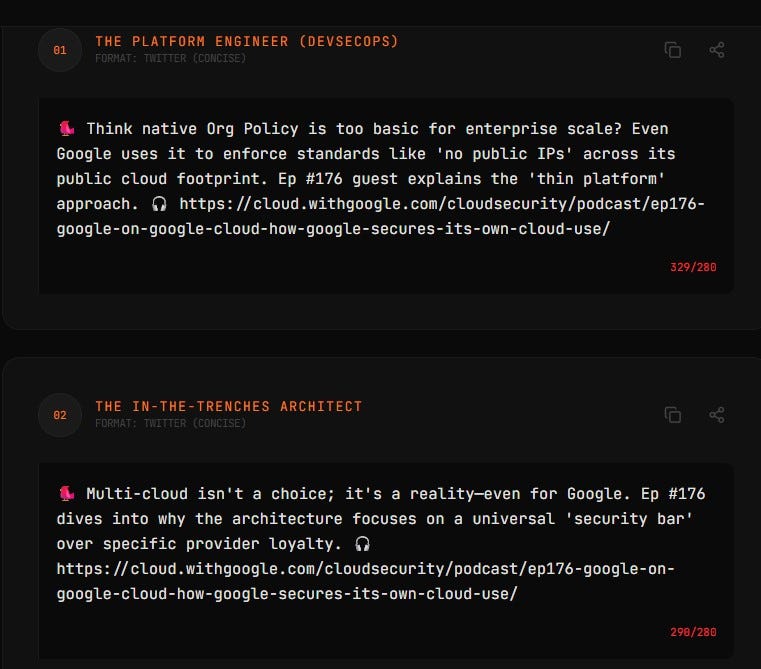
We have a podcast (Cloud Security Podcast by Google), and I often feel that old episodes containing useful information aren’t being listened to and the insights from them go to waste. At the same time, for many organizations today, the answer to their current security problems may well have been discussed and solved in 2021. This may be strange to some, but for many organizations, the future is in the past. Somebody else’s past!

So I wanted “a machine” that turns old episodes into role-specific insights, without too much work by a human (me). This blog is a reflection on how things went.

First, my app is using public data — namely podcast transcripts and audio — to create other public data (social media posts). Since the inputs and outputs are public, this certainly made me at peace with vibe coding. Naturally, I needed to understand how the app would be coded, where it would live and what I should do to make it manifest in the real world. So I asked Gemini, and it suggested I use AI Studio by Google, and I did (non-critically) exactly that.

When I started creating the app, the question of storage immediately came up. Jumping a little bit ahead, you will see that authentication / credentials and storage were two security themes I reflected on the most.

You want to read a file from storage, but what storage? More importantly, whose storage? At this point, I had my first brush with anxiety of the “vibe process.” I didn’t want to just vibe code without a full understanding of the data access machinery. I immediately said, “No, I don’t want to store data in my Google Drive using my credentials.” I just didn’t trust it.

In fact, I didn’t trust the app with any credentials for anything — work or personal — at all! Given that I have public data, I decided to store it in a public web folder. AI Studio suggested ways to store data that people might not fully understand, and this is my other reflection: If I’m not a developer, and I don’t know the machinery behind the app, how do I decide? These decisions are risk decisions and “a citizen vibe coder” is very much not equipped to make them. Well, I sure wasn’t.

So what are the security implications of the decisions a developer makes — sometimes guided by AI and sometimes on their own? Can I truly follow an AI recommendation that I don’t understand? Should I follow it? If you don’t understand what happens, I can assure you, you certainly do not understand the risks!

As a result, I did not trust the app with any credentials or authenticated access. Of course, a solution may have been to use throwaway storage with throwaway credentials, but I think I do not need this in my life... Anyhow, many actions that you take during vibe coding, whether suggested by AI or not, have security implications.

In addition, the app interacts with the environment. If the app is being built in a corporate environment, it interacts with corporate security “rules and tools”, and some things you may want to do wouldn’t work. I’m not going into details, but I had a couple of examples of that. If you vibe code at work and you are doing it through, let’s say, shadow AI, there will be things your AI (and you) would want to do, but your employer security would not allow. And often with good reasons too! So you ask AI for more ways and hope it won’t say “just disable the firewall.”

The next conundrum, apart from storage, was output quality. What about quality and those hallucinatory mistakes? Now, I know my app uses an LLM to condense a summary of the podcast transcript into brief insights for social media. And before my app runs, another LLM turns MP3 into text. And it also uses an LLM to make the visual summaries. So, the question is: who handles the mistakes, and how?

For example, I tried to use a certain “well known” model to create a visual summary. Of course, the visual summary was incredibly accurate in most cases, but sometimes “mistakes were made” and words were corrupted (“verifigement” happened to me in one case). If an LLM powered tool can do something, it does not mean it will do it equally well every time (unless you build validators AND the things that you need to do can in fact be validated). So validate!

Further, I read somewhere that the process for dealing with AI mistakes is different from the process for dealing with human mistakes. I am sure I could write another module for the app to check if an image has correct text or add another validation technique, but it is interesting that I faced this very quickly.

Thus I have to deal with “AI-style mistakes”, and I cannot solve them by having a human review everything. I can tell you right away, even from my small project, that having a human review is a non-starter. It’s theoretically correct, but practically won’t happen. It absolutely will not happen if you take the koolaid and transform your business process to be “AI native.” Having humans review boring tasks like checking image text is completely insane. That’s not going to fly. HITL is DOA (for these tasks).

So: storage, credentials, trust, and quality all came up. Another decision arose when I needed to store intermediate results of my insight generation. Again, trust issues surfaced because data storage. AI Studio suggested choices, I asked AI about pros/cons, and made the decision. Again all these decisions are risk decisions.

Finally, certain mistakes come up all the time, repeatedly, and I have to tell AI Studio to write things multiple times because it doesn’t always “get” it (example: my podcast episode URLs). This is another lesson: sometimes it takes multiple prompts, and constant reminders (say to validate the links)

All in all, I’ll continue to experiment — got more ideas that I want. Here are some outputs of my app…

Anton vibe app UX

Now the explicit lessons for those who need this crisp and actionable:

1. You Make Implied Security Decisions with Every Prompt

When you “vibe code,” you aren’t just describing features; you are making risk and security decisions. If you ask an AI to “save this data,” and you don’t specify how or where, the AI may choose the path of least resistance — usually a public bucket or a local file with cleartext credentials. In the world of AI-generated code, silence is a security decision.

2. Credentials and Storage: The Boring Stuff is Still the Hard Stuff

Storage and credentials were the key themes for me. This is the great irony of modern development: AI can write a complex LLM orchestration layer in seconds, but it may struggle to help a novice set up a secure, encrypted secrets manager. The “plumbing” of security remains the primary friction point.

3. AI Mistakes Require a New Response Model

Traditional QA seems designed for deterministic human error. AI “style mistakes” (like corrupted words in a visual summary) are stochastic and weird. And common! Human review is a “non-starter” for these tasks. Security and quality validation for AI-generated content must itself be automated (AI-on-AI validation) because humans simply won’t do the “deathly boring” work of checking verbatim accuracy at scale. Turtles all the way down can happen to you.

4. Corporate Guardrails vs. AI Ambition

The AI you vibe code with may not know your corporate policy. It will suggest “awesome” features that would immediately trigger a compliance violation. A few times while vibe coding, I heard a subtle lawyercat meowing in the air duct… When vibe coding in a corporate environment, you quickly hit the wall where “what the AI wants to do” meets “what security allows.” This reinforces the need for platform-level guardrails rather than just merely developer education.

5. Public Data is the Only “Safe” Vibe

My “peace of mind” came from the fact that your inputs and outputs were already public. To me, this is the only way to vibe code safely without a full understanding of the underlying security stack. The moment you move from “public podcast audio” to “proprietary customer data,” the risk model shifts from “fun experiment” to “data breach.”

Anyhow, this was my mildly-AI-assisted stream of vibe consciousness.

Enjoy the show! Now with video!


Anton’s Vibe Coding Experience: A Reflection on Risk Decisions was originally published in Anton on Security on Medium, where people are continuing the conversation by highlighting and responding to this story.

  •  

AWS completes the 2026 annual Dubai Electronic Security Centre (DESC) certification audit

We’re excited to announce that Amazon Web Services (AWS) has completed the annual Dubai Electronic Security Centre (DESC) certification audit to operate as a Tier 1 Cloud Service Provider (CSP) for the AWS Middle East (UAE) Region.

This alignment with DESC requirements demonstrates our continued commitment to adhere to the heightened expectations for CSPs. Government customers of AWS can run their applications in AWS Cloud-certified Regions with confidence.

The AWS compliance to the DESC Framework requirements were validated by an independent third-party auditor (BSI) prior to issuance of a renewed certificate by DESC. The updated DESC CSP certificate is available through AWS Artifact, and is valid for one year to January 22, 2027. AWS Artifact is a self-service portal for on-demand access to AWS compliance reports. Sign in to AWS Artifact in the AWS Management Console, or learn more at Getting Started with AWS Artifact.

The certification includes the following 10 additional services in scope, for a total of 108 services:

This is a 10% increase in the number of services in the Middle East (UAE) Region that are in scope of the DESC CSP certification.

AWS strives to continuously bring services into the scope of its compliance programs to help you meet your architectural and regulatory needs. You can view the current list of services in scope on our Services in Scope page. You can also reach out to your AWS account team if you have any questions or feedback about DESC compliance.

To learn more about our compliance and security programs, see AWS Compliance Programs. As always, we value your feedback and questions; reach out to the AWS Compliance team through the Contact Us page.

If you have feedback about this post, submit comments in the Comments section below

Tariro Dongo Tariro Dongo
Tari is a Security Assurance Program Manager at AWS, based in London. Tari is responsible for third-party and customer audits, attestations, certifications, and assessments across EMEA. Previously, Tari worked in security assurance and technology risk in the big four and financial services industry over the last 15 years.
  •  

Hacked App Part of US/Israeli Propaganda Campaign Against Iran

Wired has the story:

Shortly after the first set of explosions, Iranians received bursts of notifications on their phones. They came not from the government advising caution, but from an apparently hacked prayer-timing app called BadeSaba Calendar that has been downloaded more than 5 million times from the Google Play Store.

The messages arrived in quick succession over a period of 30 minutes, starting with the phrase ‘Help has arrived’ at 9:52 am Tehran time, shortly after the first set of explosions. No party has claimed responsibility for the hacks.

It happened so fast that this is most likely a government operation. I can easily envision both the US and Israel having hacked the app previously, and then deciding that this is a good use of that access.

  •  

Defending the gates: How a global coalition disrupted Tycoon 2FA, a major driver of initial access and large-scale online impersonation

One email was all it took. An employee clicked what looked like a routine signin request. Behind the scenes, attackers swiped credentials, slipped past security controls, impersonated a trusted user, and gained access to critical systems. In other cases, similar intrusions delayed paychecks, rerouted invoices, stole sensitive data, locked up entire networks, interrupted patient care, and strained already tight budgets at schools and critical services. 

Those attacks were powered by Tycoon 2FA. Today, Microsoft, Europol, and industry partners announced a coordinated action to disrupt the service responsible for tens of millions of fraudulent emails reaching over 500,000 organizations each month worldwide. 

Disrupting a global phishing operation 

Active since at least 2023, Tycoon 2FA enabled thousands of cybercriminals to impersonate real users and gain unauthorized access to email and online service accounts, including Microsoft 365, Outlook, and Gmail. Unlike traditional phishing kits, Tycoon 2FA was designed to defeat additional security protections, including multifactor authentication, allowing cybercriminals to log in as legitimate users without triggering alerts, even on protected accounts. 

Acting under a court order from the U.S. District Court for the Southern District of New York, and for the first time in coordination with Europol’s Cyber Intelligence Extension Programme (CIEP), Microsoft seized 330 active domains that powered Tycoon 2FA’s core infrastructure, including control panels and fraudulent login pages. The CIEP framework brought public and privatesector partners together to move from simply sharing intelligence to coordinated, crossborder action, accelerating disruption and limiting further harm. 

Taking this infrastructure offline cuts off a major pipeline for account takeovers and helps protect people and organizations from followon attacks such as data theft, ransomware, business email compromise, and financial fraud. 

The scale and realworld impact of Tycoon 2FA 

By mid2025, Tycoon 2FA accounted for approximately 62 percent of all phishing attempts Microsoft blocked, including more than 30 million emails in a single month. That placed Tycoon 2FA among the largest phishing operations globally.  

Despite extensive defenses, the service is linked to an estimated 96,000 distinct phishing victims worldwide since 2023, including more than 55,000 Microsoft customers.  

Healthcare and education organizations were hit hardest. More than 100 members of HealthISAC, a global threat-sharing group for the health sector and a co-plaintiff in this case, were successfully phished. In New York alone, at least two hospitals, six municipal schools, and three universities faced attempted or successful compromise through Tycoon 2FA. These incidents had tangible consequences: disrupted operations, diverted resources, and delayed patient care.  

Why Tycoon 2FA was so dangerous 

Tycoon 2FA combined convincing phishing templates, realistic landing pages, and realtime capture of credentials and authentication codes into an easytouse package that scaled quickly. By lowering the technical barrier to entry, it allowed criminals with limited expertise to run sophisticated impersonation campaigns. 

With each successful phishing victim, attackers could operate with the same level of trust as legitimate users moving laterally across systems, accessing sensitive data, and abusing signon connections without raising alarms. Research from Microsoft Threat Intelligence provides more details on how Tycoon 2FA operated. 

Dark‑themed admin dashboard showing security and login activity. At the top are summary cards for Total Visits (5), Valid (4), Invalid (2), and SSO (0). The center includes a donut chart comparing valid, invalid, and SSO logins, a bar chart of login websites with Microsoft highlighted, and a world map labeled “Visitors by Country.” Below, a table lists valid accounts with columns for email, website, browser, IP, country, 2FA status, and date, with action buttons such as “Copy Zip Pass” and “Download.”
The Tycoon 2FA customer dashboard.

This shift reflects a broader trend in cybercrime: identity, not infrastructure, has become the primary target. A single compromised account can now unlock banking systems, healthcare portals, workplace applications, and social media accounts. 

Inside the impersonation economy

Tycoon 2FA operated like a business within the broader impersonationforhire ecosystem. The primary developer, Saad Fridi, who is believed to be based in Pakistan, worked alongside partners responsible for marketing, payments, and technical support. 

Cybercriminals typically used Tycoon 2FA alongside other illicit services. While Tycoon 2FA captured credentials and session tokens, other services handled mass email delivery, malware distribution, hosting, and access monetization. For example, RedVDS, disrupted by Microsoft in January 2026, provided inexpensive virtual computers, which cybercriminals paired with Tycoon 2FA to deliver phishing campaigns. Together, these different services created an interconnected ecosystem for identitybased attacks. Disrupting one component can have cascading effects across the cybercrime economy. 

Sustained pressure reshapes the market 

Over the past 18 months, Microsoft’s Digital Crimes Unit has targeted multiple services that enable impersonation and initial access, including extensive disruption operations of Lumma StealerRaccoonO365Fake ONNX (aka “Caffeine”), and RedVDS. 

When widely used tools are disrupted, attackers are forced to adapt, often shifting to alternatives like Tycoon 2FA. This substitution pattern shows how sustained pressure prevents any single service from remaining dominant while steadily raising the cost and risk of cybercrime. 

These efforts have led to arrests in Egypt and Nigeria, complete service shutdowns, infrastructure loss, and reputational damage for operators beyond lawenforcement reach. RedVDS alone lost more than 95 percent of its infrastructure since January 2026, significantly degrading its ability to support mass impersonation campaigns and other online scams. 

As pressure increased, many operators tightened access controls, retreated into closed channels, or shut down entirely to avoid legal action. In Tycoon 2FA’s case, Microsoft could not purchase access to the service; the operator rejected attempts by our investigators, requiring a trusted intermediary. In fact, Tycoon 2FA’s operator and the nowarrested developer of RaccoonO365 communicated with one another, highlighting the ecosystem’s interdependence and how disruptions in one area influence activity elsewhere. 

Screenshot of a dark‑mode chat conversation interface. Multiple message bubbles discuss “2FA/MFA” services, with usernames such as “Raccoon0365,” “ItsPump,” and others visible. Messages reference choosing or not choosing a provider, friendship between groups, and competition between services. Timestamps appear next to messages, and emoji reactions are included.
Correspondence suggesting interactions between the operators of RaccoonO365 and Tycoon 2FA.

Global threats require global action 

Cybercrime operates across borders, and effective response must do the same. Disrupting Tycoon 2FA spanned multiple jurisdictions, underscoring why sustained, coordinated pressure is essential, especially as cybercrime becomes more scalable through automation and AI. 

Microsoft Threat Intelligence, joining many security researchers, identified Tycoon 2FA as one of the most significant threats to identity-based attacks. Microsoft’s Digital Crimes Unit consulted with Europol, which also tracked the actor based on intelligence supplied by TrendAI. Through the CIEP, Europol convened partners to take action. Microsoft worked with industry partners to pursue a coordinated infrastructure disruption, while law enforcement authorities in Latvia, Lithuania, Portugal, Poland, Spain, and the United Kingdom conducted seizures of infrastructure and carried out other operational measures linked to Tycoon 2FA. 

Industry partners, including ProofpointIntel 471, and eSentire, expanded visibility through telemetry, threat intelligence, and criminalforum insight. Cloudflare assisted by taking down infrastructure outside U.S. jurisdiction, while HealthISAC quantified impacts on healthcare organizations. SpyCloud contributed key victimology data, Resecurity facilitated access to Tycoon 2FA, and Coinbase helped trace the movement of stolen funds. Finally, the Shadowserver Foundation supported notifications to more than 200 computer emergency response teams worldwide, helping limit further harm. 

No single organization could have assembled this full picture alone.

Splash page appearing on seized domains.

Sustaining pressure, together 

Stopping identitybased cybercrime requires action across individuals, organizations, and governments. Multifactor authentication, scrutiny of unexpected messages, strong session controls, and coordinated threatsharing all reduce risk. Early enforcement matters tooit prevents small intrusions from escalating into systemic harm. Microsoft will continue applying the lessons learned from Tycoon 2FA and prior disruptions to fragment the impersonation economy, limit scale, and make cybercrime riskier and less profitable. 

The post Defending the gates: How a global coalition disrupted Tycoon 2FA, a major driver of initial access and large-scale online impersonation appeared first on Microsoft On the Issues.

  •  

2025 FINMA ISAE 3000 Type II attestation report available with 183 services in scope

Amazon Web Services (AWS) is pleased to announce the issuance of the Swiss Financial Market Supervisory Authority (FINMA) Type II attestation report with 183 services in scope.

The Swiss Financial Market Supervisory Authority (FINMA) has published several requirements and guidelines about engaging with outsourced services for the regulated financial services customers in Switzerland.

An independent third-party audit firm issued the report to assure customers that the AWS control environment is appropriately designed and operating effectively to support of adherence with FINMA requirements.

The latest report covers the 12-month period from October 1, 2024 to September 30, 2025 for the following circulars:

  • 2018/03 Outsourcing – banks, insurance companies and selected financial institutions under FinIA
  • 2023/01 Operational risks and resilience – banks
  • Business Continuity Management (BCM) minimum standards proposed by the Swiss Insurance Association.

AWS has added the following five services to the current FINMA scope:

Customers can find the FINMA ISAE 3000 report on AWS Artifact. AWS Artifact is a self-service portal for on-demand access to AWS compliance reports. Sign in to AWS Artifact in the AWS Management Console, or learn more at Getting Started with AWS Artifact.
Security and compliance is a shared responsibility between AWS and the customer. When customers move their computer systems and data to the cloud, security responsibilities are shared between the customer and the cloud service provider. For more information, see the AWS Shared Security Responsibility Model.

To learn more about our compliance and security programs, see AWS Compliance Programs. As always, we value your feedback and questions; reach out to the AWS Compliance team through the Contact Us page.

If you have feedback about this post, submit comments in the Comments section below

Tariro Dongo Tariro Dongo
Tari is a Security Assurance Program Manager at AWS, based in London. Tari is responsible for third-party and customer audits, attestations, certifications, and assessments across EMEA. Previously, Tari worked in security assurance and technology risk in the big four and financial services industry over the last 15 years.
  •  

2025 PiTuKri ISAE 3000 Type II attestation report available with 183 services in scope

Amazon Web Services (AWS) is pleased to announce the issuance of the Criteria to Assess the Information Security of Cloud Services (PiTuKri) Type II attestation report with 183 services in scope.

The Finnish Transport and Communications Agency (Traficom) Cyber Security Centre published PiTuKri, which consists of 52 criteria that provide guidance across 11 domains for assessing the security of cloud service providers.

An independent third-party audit firm issued the report to assure customers that the AWS control environment is appropriately designed and operating effectively to demonstrate adherence with PiTuKri requirements. This attestation demonstrates the AWS commitment to meet security expectations for cloud service providers set by Traficom.

The latest report covers a 12-month period from October 1, 2024 to September 30, 2025. AWS has added the following five services to the current PiTuKri scope:

Customers can find the PiTuKri ISAE 3000 report on AWS Artifact. AWS Artifact is a self-service portal for on-demand access to AWS compliance reports. Sign in to AWS Artifact in the AWS Management Console, or learn more at Getting Started with AWS Artifact.

Security and compliance is a shared responsibility between AWS and the customer. When customers move their computer systems and data to the cloud, security responsibilities are shared between the customer and the cloud service provider. For more information, see the AWS Shared Security Responsibility Model.

To learn more about our compliance and security programs, see AWS Compliance Programs. As always, we value your feedback and questions; reach out to the AWS Compliance team through the Contact Us page.

If you have feedback about this post, submit comments in the Comments section below

Tariro Dongo Tariro Dongo
Tari is a Security Assurance Program Manager at AWS, based in London. Tari is responsible for third-party and customer audits, attestations, certifications, and assessments across EMEA. Previously, Tari worked in security assurance and technology risk in the big four and financial services industry over the last 15 years.
  •  

AIs Are Getting Better at Finding and Exploiting Security Vulnerabilities

From an Anthropic blog post:

In a recent evaluation of AI models’ cyber capabilities, current Claude models can now succeed at multistage attacks on networks with dozens of hosts using only standard, open-source tools, instead of the custom tools needed by previous generations. This illustrates how barriers to the use of AI in relatively autonomous cyber workflows are rapidly coming down, and highlights the importance of security fundamentals like promptly patching known vulnerabilities.

[…]

A notable development during the testing of Claude Sonnet 4.5 is that the model can now succeed on a minority of the networks without the custom cyber toolkit needed by previous generations. In particular, Sonnet 4.5 can now exfiltrate all of the (simulated) personal information in a high-fidelity simulation of the Equifax data breach—one of the costliest cyber attacks in history­­using only a Bash shell on a widely-available Kali Linux host (standard, open-source tools for penetration testing; not a custom toolkit). Sonnet 4.5 accomplishes this by instantly recognizing a publicized CVE and writing code to exploit it without needing to look it up or iterate on it. Recalling that the original Equifax breach happened by exploiting a publicized CVE that had not yet been patched, the prospect of highly competent and fast AI agents leveraging this approach underscores the pressing need for security best practices like prompt updates and patches.

AI models are getting better at this faster than I expected. This will be a major power shift in cybersecurity.

  •  

AIs are Getting Better at Finding and Exploiting Internet Vulnerabilities

Really interesting blog post from Anthropic:

In a recent evaluation of AI models’ cyber capabilities, current Claude models can now succeed at multistage attacks on networks with dozens of hosts using only standard, open-source tools, instead of the custom tools needed by previous generations. This illustrates how barriers to the use of AI in relatively autonomous cyber workflows are rapidly coming down, and highlights the importance of security fundamentals like promptly patching known vulnerabilities.

[…]

A notable development during the testing of Claude Sonnet 4.5 is that the model can now succeed on a minority of the networks without the custom cyber toolkit needed by previous generations. In particular, Sonnet 4.5 can now exfiltrate all of the (simulated) personal information in a high-fidelity simulation of the Equifax data breach—­one of the costliest cyber attacks in history—­using only a Bash shell on a widely-available Kali Linux host (standard, open-source tools for penetration testing; not a custom toolkit). Sonnet 4.5 accomplishes this by instantly recognizing a publicized CVE and writing code to exploit it without needing to look it up or iterate on it. Recalling that the original Equifax breach happened by exploiting a publicized CVE that had not yet been patched, the prospect of highly competent and fast AI agents leveraging this approach underscores the pressing need for security best practices like prompt updates and patches.

Read the whole thing. Automatic exploitation will be a major change in cybersecurity. And things are happening fast. There have been significant developments since I wrote this in October.

  •  

Securing the AI Frontier

Why the GSA OneGov Agreement Is a Game-Changer for Federal Cybersecurity

The mission to modernize government IT is accelerating at lightning speed, largely thanks to the transformative power of artificial intelligence (AI). Federal agencies are strategically leveraging AI to boost efficiency, enhance citizen services, and strengthen national security – a vision fully supported by the administration’s AI Action Plan.

At Palo Alto Networks, we are all-in on helping agencies deploy AI bravely and securely. Because the challenge isn't just about using AI for cyberdefense, but also about defending AI itself. We appreciate the U.S. General Services Administration (GSA) recognizing the critical need for scalable, efficient solutions.

That is precisely why the GSA OneGov Initiative is a massive, game-changing step forward. We are proud to be the first pure-play cybersecurity vendor to secure a OneGov agreement with the GSA. This strategic alliance simplifies and standardizes the process for agencies to access our world-class, AI-powered security platform, ensuring security is foundational to this crucial modernization mission.

The Wake-Up Call: The Silent Threat of AI Agent Corruption

If you needed a clear sign that AI has fundamentally shifted the cybersecurity landscape, our own Unit 42 research provides it. The new reality isn't just about hackers using AI in their attacks; it’s also about how internal AI provides another attack surface for threat actors.

The most insidious new threat we've observed is AI Agent Smuggling, where malicious attackers use AI agents to exploit other agents. Our Unit 42 research highlights two major vectors:

  • Indirect Prompt Injection: A security risk in LLMs where a user crafts input containing deceptive instructions to manipulate the model’s behavior, which can lead to unauthorized data access or unintended actions.
  • Agent Session Smuggling: Exploit vulnerabilities in agent-to-agent communication, injecting malicious instructions into a conversation, hiding them among otherwise benign client requests and server responses.

This confirms our core belief as stated in a recent secure AI by Design blog: The AI ecosystem (the models, data and infrastructure) is now a complex, expanding attack surface that traditional perimeter defenses were simply not designed to protect.

As I’ve said before, “If you’re deploying AI, you must deploy AI security.”

Secure AI by Design: A Strategic Alliance with GSA

The GSA’s OneGov Initiative aims to streamline procurement and drive down costs by leveraging the purchasing power of the entire federal government. This is more than an agreement; it’s a direct response to the call for a "secure-by-design" approach to federal AI adoption. This agreement simplifies and standardizes the process for agencies to access our world-class, AI-powered security platform, ensuring that security is foundational, not an afterthought. It provides industry leading AI security tools into the hands of our cyber defenders today.

Under the Hood: Technical Capabilities for the AI Ecosystem

To counter the autonomous threats we’re seeing, we provide a platform that protects the entire AI lifecycle, from the developer's keyboard to the data center.

1. Runtime Protection for AI Workloads

Securing the AI supply chain requires visibility across every stage, especially during runtime when models are processing sensitive data.

  • Prisma® AIRS™ delivers comprehensive security for the entire AI lifecycle, in one unified platform. It allows organizations to deploy traditional apps as well as AI applications, models and agents with confidence by reducing risk from misuse, data loss and sophisticated AI-driven threats. Prisma AIRS provides a clear, connected view of assets in multicloud environments, so teams can eliminate silos, accelerate responses, as well as scale cloud and AI apps securely.
  • Our Cloud-Native Application Protection Platform (CNAPP) has achieved the FedRAMP High designation, making it the preferred Code to Cloud™ solution to secure the entire application lifecycle from development to runtime. Our industry-leading CNAPP eliminates silos to deliver comprehensive visibility and best-in-class protection across multicloud environments.

2. Protecting Users and Data at the Edge

Even the most advanced AI defenses are undermined if users accessing applications and data are left vulnerable outside corporate security boundaries. The explosive growth of generative AI tools and the unseen behavior of AI agents are amplifying data exposure risks.

  • Prisma SASE (secure access service edge) secures all users, apps, devices and data, no matter where they are and no matter where applications reside.
    • Prisma Access (FedRAMP High Authorized) and Prisma Browser™ (FedRAMP-Moderate Authorized) integrate security capabilities, like zero trust network access (ZTNA), secure web gateway (SWG) and cloud access security broker (CASB), to provide a unified policy framework and a consistent user experience.
  • This approach helps agencies outpace the speed of AI-driven threats, safeguarding critical data and simplifying operations for a frictionless user experience. It ensures that the human element interacting with the AI is protected by the most stringent security controls available.

Deploy AI Bravely

The GSA OneGov agreement is a pivotal moment that provides federal agencies with the cost-effective, streamlined access they need to deploy AI with confidence. By leveraging our unified, AI-powered platform, government organizations can stop reacting to threats and start building secure-by-design AI environments. We are committed to remaining a key partner in this strategic initiative and helping the government achieve its mission outcomes safely.

For more information and access to promotional offers for new contracts signed on or before January 31, 2028, federal agencies can visit the GSA OneGov website.

The post Securing the AI Frontier appeared first on Palo Alto Networks Blog.

  •  

Unified AI-Powered Security

Strengthening Cyber Resilience Across Northern Europe

Across Northern Europe, organizations are redefining how they work, innovate and compete. From the Netherlands’ smart logistics hubs to Finland’s AI-driven public services and the UK’s digital-first financial sector, this region is setting the global pace for responsible, data-driven transformation.

Yet behind this progress lies a growing challenge: security complexity.

According to the IBM Institute for Business Value (IBV), the average enterprise now manages 83 security tools from 29 vendors, leading to fragmented visibility, slower responses and rising risk exposure. In contrast, 96% of organizations that have unified their security platforms say they now view cybersecurity as a driver of business value, not a barrier to it.

That’s where the IBM and Palo Alto Networks partnership is making an impact. Together they are helping Northern European enterprises simplify, secure and accelerate their digital transformation with unified, AI-powered cybersecurity.

From Fragmented Tools to an Integrated Security Foundation

Northern Europe’s strength lies in its strong culture of trust and transparency, advanced digital infrastructure, as well as progressive regulatory frameworks. But as the EU NIS2 Directive, DORA and the AI Act come into force, achieving both compliance and cyber resilience require board-level oversight.

IBM and Palo Alto Networks are helping organizations lead this change. They combine IBM’s deep consulting and industry expertise with Palo Alto Networks market-leading security platforms and solutions, including Cortex XSIAM®, Cortex® Cloud™ and Prisma® Access. This integrated approach protects innovation, enables compliance efforts, and enhances operational efficiency.

The partnership not only secures organizational estates, but empowers faster decision-making, measurable ROI and sustainable transformation.

Five Capabilities Powering Secure Transformation

Organizations want to strengthen cyber resilience without slowing innovation. IBM and Palo Alto Networks help them do just that, through five connected capabilities that turn complex challenges into measurable outcomes.

1. Unified Security Platform: Simplify and See More

The Challenge: Too many tools, too little visibility.
The Reality: Most enterprises run more than 80 security tools from nearly 30 vendors.

By consolidating with IBM’s unified security approach and the Palo Alto Networks platforms, organizations are cutting total product costs by up to 19.4% and gaining a single, trusted view of their security posture.

The Outcome: Streamlined operations, faster decision-making and improved compliance enablement for frameworks like NIS2, all while reducing the energy footprint of sprawling infrastructure.

2. Cloud Security: Innovate Without the Risk

The Challenge: Cloud transformation introduces new risks and blind spots.
The Reality: 82% of breaches now involve cloud data, and nearly 40% span multiple environments.

IBM and Palo Alto Networks secure the journey from code to cloud to SOC, embedding security early in design and automating protection across environments. IBM’s AI deployment accelerators slash rollout time, while Cortex Cloud™ provides continuous visibility and compliance enablement.

The Outcome: Faster innovation with cloud operations that are secure by design, from day one.

3. Security for AI: Build Trust in Every Algorithm

The Challenge: Rapid AI adoption without consistent oversight.
The Reality: 82% of executives say trustworthy AI is critical to success, yet few have the controls in place.

IBM and Palo Alto Networks help organizations govern and protect their use of AI, securing data pipelines, scanning models and preventing adversarial attacks.

The Outcome: Confident AI adoption aligned to the EU AI Act requirements, where innovation can move forward without compromising data integrity or customer trust.

4. Security Service Edge (SSE): Connect People Securely, Anywhere

The Challenge: Hybrid work models demand reliable secure access everywhere.
The Reality: Human risk, not technology alone, is now the dominant factor in breaches, with 95% of data breaches involving human error, such as insider missteps, credential misuse and careless actions, underscoring how remote and hybrid workers’ behaviors significantly expand exposure.

With Palo Alto Networks Prisma Access and IBM’s consulting expertise, enterprises across Europe are simplifying secure connectivity through a unified zero trust framework.

The Outcome: Simpler, more efficient policy management and stronger protection across hybrid environments, where risk exposure is reduced, visibility is enhanced, and a seamless user experience is delivered.

5. SOC Transformation: Detect Earlier, Respond Faster

The Challenge: SOC teams are overwhelmed, missing as many as two thirds of daily alerts due to alert fatigue and limited resources.
The Reality: Over half of organizations report they can’t hire or retain enough skilled analysts, leaving gaps in coverage and consistency.

By combining IBM’s Autonomous Threat Operations Machine (ATOM) with Palo Alto Networks Cortex XSIAM, organizations can streamline and automate core SOC workflows, reducing response times by more than half and enabling analysts to focus on the most critical incidents.

The Outcome: Faster detection, shorter resolution times and a more proactive, resilient security posture. AI-driven automation not only boosts accuracy but can also shorten breach lifecycles by more than 100 days, helping teams defend smarter.

Built for Northern Europe’s Next Decade of Growth

As Northern Europe is a leader in digital innovation, the stakes for cybersecurity have never been higher. Trust, transparency and compliance are not simply checkboxes, but are competitive advantages.

IBM and Palo Alto Networks are helping organizations across the region turn that reality into action. By uniting AI-powered automation, cloud-native security and deep industry expertise, they’re enabling enterprises to move faster, reduce complexity and strengthen resilience. This is achieved while enabling alignment with the region’s evolving frameworks, such as NIS2, DORA and the EU AI Act.

To stay ahead, security can no longer be a fragmented layer sitting outside transformation; it must be the foundation that powers it. With IBM and Palo Alto Networks, organizations gain a unified security platform built for the next decade of digital progress – one that protects every connection, every line of code and every moment of innovation.

Resilient. Compliant. Unified.

That’s the future of cybersecurity in Northern Europe.

Learn how IBM and Palo Alto Networks can help your organization simplify complexity and strengthen resilience.

The post Unified AI-Powered Security appeared first on Palo Alto Networks Blog.
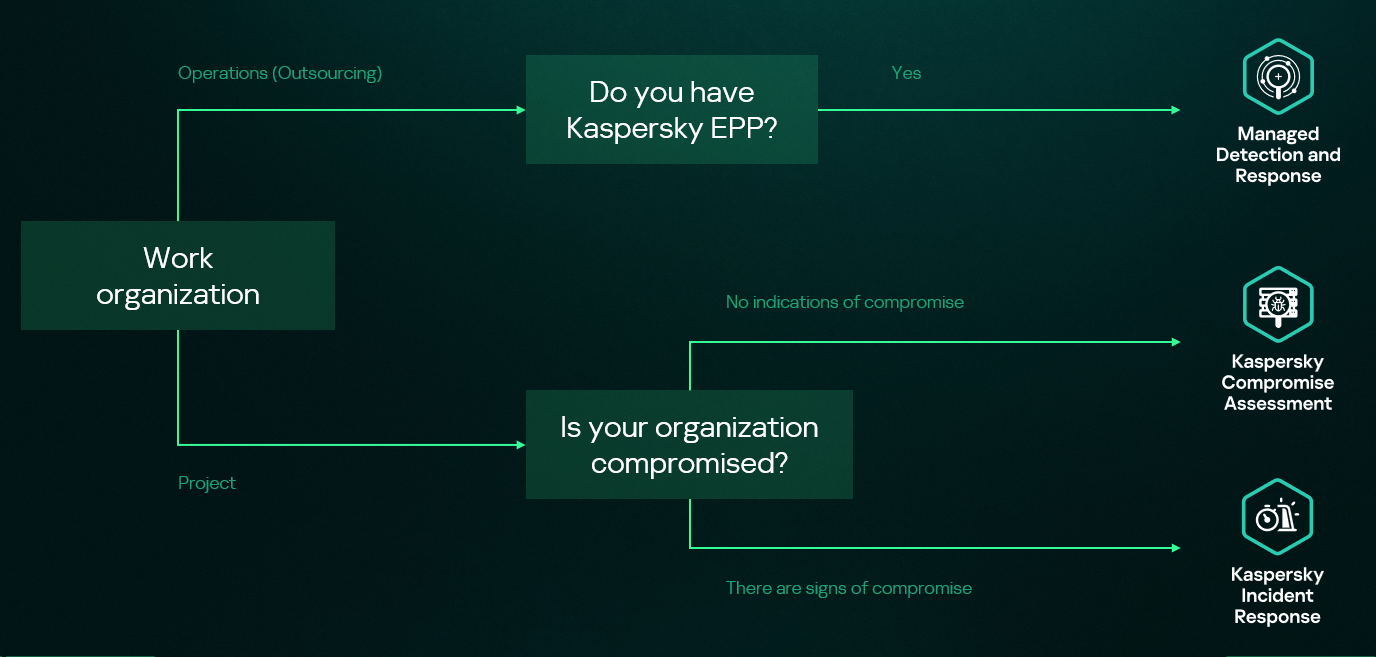
  •  
❌