Login
Login
Google Detects First AI-Generated Zero-Day Exploit
The zero-day was designed to bypass 2FA and it was developed by a prominent cybercrime group.
The post Google Detects First AI-Generated Zero-Day Exploit appeared first on SecurityWeek.

The zero-day was designed to bypass 2FA and it was developed by a prominent cybercrime group.
The post Google Detects First AI-Generated Zero-Day Exploit appeared first on SecurityWeek.
The incident occurred on April 20 and did not affect customer data in the company’s production and staging environments.
The post SailPoint Discloses GitHub Repository Hack appeared first on SecurityWeek.
Also called Copy Fail 2 and tracked as CVE-2026-43284 and CVE-2026-43500, the exploit was disclosed before a patch was released.
The post New ‘Dirty Frag’ Linux Vulnerability Possibly Exploited in Attacks appeared first on SecurityWeek.
Today we published our latest Global AI Diffusion Report. The global adoption of artificial intelligence continued to rise in the first quarter of 2026. During the quarter, AI usage increased by 1.5 percentage points from 16.3% to 17.8% of the world’s working age population. Intensity of use among economies with the highest rates of AI diffusion also increased, with 26 economies now exceeding 30% of the working age population using AI.
At the top of Microsoft’s National AI Leaderboard, the UAE continued to lead global AI diffusion at 70.1%. The United States finally started to move up the national rankings, albeit only from 24th to 21st based on a 31.3% usage rate by the working age population.

Notable developments in the quarter included accelerating AI adoption in Asia driven in part by improving AI capabilities in Asian languages. South Korea, Thailand, and Japan saw the greatest movement. More broadly, the quarter brought continued widening of the AI gap between the Global North and South, with usage now at 27.5% in the North and 15.4% in the South. These trends are discussed below, including a deeper dive on the positive impact of enhanced multilingual AI capabilities in Japan.
To track all these trends, we continue to measure AI diffusion as the share of people worldwide between ages 15 and 64 who have used a generative AI product during the reported period. This measure is derived from aggregated and anonymized Microsoft telemetry and adjusted to reflect differences in OS and device-market share, internet penetration, and country population. Additional details on the methodology are available in our AI Diffusion technical paper.[1]

No single metric is perfect, and this one is no exception. Through the Microsoft AI Economy Institute, we continue to refine how we measure AI diffusion globally, including how adoption varies across countries in ways that best advance priorities such as scientific discovery and productivity gains. For this report, we rely on the strongest cross-country measure available today, and we expect to complement it over time with additional indicators as they emerge and mature.
Sectorally, the quarter saw strengthened AI coding capabilities leading to a dramatic increase in production of software code. This was reflected in production by Anthropic’s Claude Code, the OpenAI’s Codex, and Microsoft’s GitHub Copilot. Git pushes – through which software developers put coding changes online – increased 78% year over year globally. Interestingly, the quarter brought added evidence that, at least for now, AI coding capabilities may be increasing demand for the employment of software developers.
As discussed in more detail in the report, when developer productivity increases, the cost of building software declines. If demand for software is elastic, organizations can respond by building more software across a wider range of use cases. It is still too early to know the full labor-market impact of AI-assisted coding, but the available data shows that in 2025, total U.S. software developer employment reached approximately 2.2 million, rising 8.5% year over year and marking a record high for the profession. Early data for the first quarter of 2026 shows that software developer employment in March 2026 was about 4% higher than in March 2025.
Download the latest Global AI Diffusion report. and explore the data here.
[1] A. Misra, J. Wang, S. McCullers, K. White, and J., L. Ferres, “Measuring AI Diffusion: A Population Normalized Metric for Tracking Global AI Usage,” Nov. 04, 2025, arXiv: arXiv:2511.02781. doi: 10.48550/arXiv.2511.02781.
The post The state of global AI diffusion in 2026 appeared first on Microsoft On the Issues.
 for Cyber Threat Intelligence: Key Takeaways for Security Leaders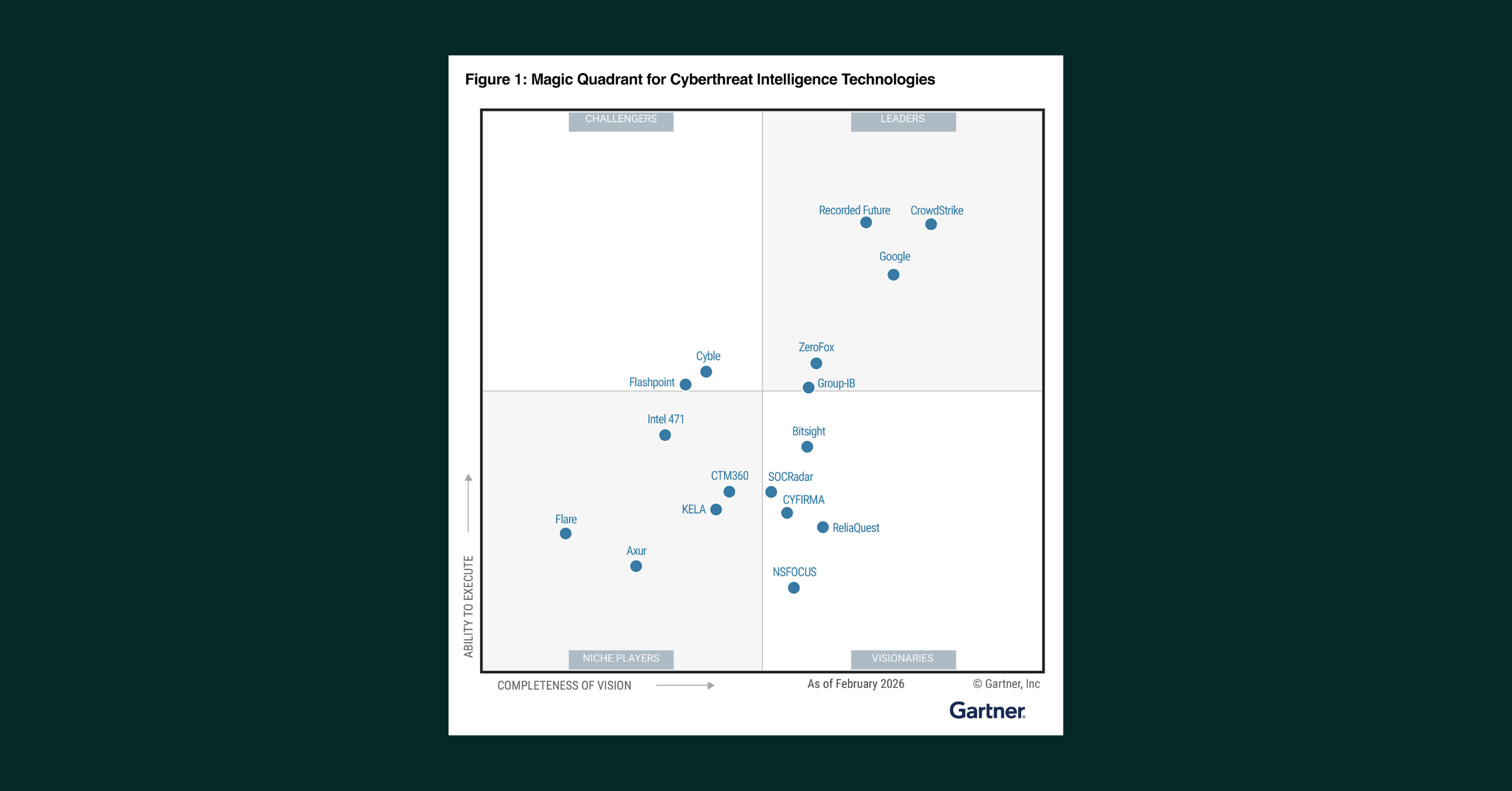
 Table Of Contents
We are proud to share that Flashpoint has been named a Challenger in the inaugural 2026 Gartner® Magic Quadrant for Cyber Threat Intelligence Technologies.
“We see this recognition as a testament to Flashpoint’s ability to execute at the highest levels for the world’s most discerning threat intelligence customers, with our unique combination of primary source collection and human analysis at the core,” — Josh Lefkowitz, CEO at Flashpoint.
The Gartner Magic Quadrant provides organizations with a wide-angle view of vendors in the cyber threat intelligence market. By applying a graphical treatment and a uniform set of evaluation criteria, the Magic Quadrant helps organizations assess how well technology providers are executing their stated visions and performing against Gartner’s market view. Vendors are evaluated based on their Ability to Execute and Completeness of Vision:
“We believe, and our customers consistently validate, that the future of threat intelligence lies at the critical intersection of intelligence depth and application,” says Lefkowitz. “That’s why Flashpoint pairs unmatched access to primary-source environments with the ability to operationalize that intelligence across security workflows, enabling organizations to make faster, more informed decisions.”
A complimentary copy of the Gartner® Magic Quadrant for Cyber Threat Intelligence Technologies is available to download here.
The threat intelligence market has expanded in both scope and strategic importance as organizations contend with a broader and more complex threat environment. What was once a supporting function within security operations is now expected to inform decisions across vulnerability management, fraud prevention, and enterprise risk. This shift has raised the bar for how intelligence is collected, analyzed, and applied.
Gartner describes this evolution as a move toward unified cyber risk intelligence (UCRI) — an approach that brings together diverse internal and external data sources with advanced analytical capabilities to improve decision-making. As noted in The Evolution of Threat Intelligence Is Unified Cyber Risk Intelligence, “the future of threat intelligence is unified cyber risk intelligence (UCRI)… defined by the convergence of multisignal collection and advanced analytical capabilities.” In our opinion, this model reflects the reality that no single source provides sufficient visibility, and that intelligence must be corroborated across environments to be actionable.
At the same time, the scale of available data continues to increase, introducing new challenges around prioritization and context. Gartner notes that organizations “receive vast amounts of threat data, and filtering out false positives, redundant information and irrelevant alerts to extract actionable intelligence remains a significant challenge. This “noise” can overwhelm security teams and lead to important threats being missed.” This is where AI plays a growing role. Techniques such as machine learning and natural language processing are increasingly used to correlate signals, identify patterns, and surface relevant risks faster. As intelligence becomes more integrated across the enterprise, the ability to combine multisource collection with AI-driven analysis is shaping how organizations evaluate platforms and build modern threat intelligence programs.
From Flashpoint’s experience working with the most discerning security and intelligence teams, the value of a threat intelligence platform is measured in how it performs in practice — how quickly it surfaces relevant activity, how much context it provides, and how easily it supports decision-making across workflows.
We see three areas consistently shape how intelligence is evaluated, supported by a combination of human expertise and AI-driven analysis:
These areas are closely tied to how Flashpoint has built its platform and how it supports organizations operating in complex threat environments.
A large part of how intelligence performs in practice comes back to the source of the data itself.
We believe, and our customers continue to validate, that Flashpoint’s approach is centered on primary-source collection. That means accessing environments where threat activity is actively discussed, coordinated, and developed, including closed forums, encrypted messaging platforms, and illicit marketplaces. These environments require sustained access and ongoing validation, but they provide a level of visibility that is difficult to achieve through surface-level collection alone.
From our experience, working from these sources changes how intelligence is used. Activity can be observed earlier and understood with more context, with discussions, relationships, and intent preserved.
In practice, this allows teams to:
Collection alone doesn’t determine whether intelligence is useful. We believe it also has to be delivered in a way that aligns with how teams work.
In our experience, most security teams already have established workflows tied to SIEMs, SOAR platforms, and internal processes. Intelligence that integrates into those workflows can be applied consistently across investigation and response.
In practice, we see this support:
Over time, this consistency allows teams to build repeatable processes around intelligence rather than treating it as a separate function.
The same dynamics apply to vulnerability intelligence.
From our experience, understanding which vulnerabilities exist is only one part of the problem. Determining which ones require attention in a given environment depends on context — how those vulnerabilities are being discussed, shared, or used in active threat activity.
We have seen first-hand that when vulnerability data is connected to real-world activity, teams can:
For organizations evaluating providers, challenge intelligence sources, challenge collection agility, challenge exploit prioritization and above all ask yourself is this a partner with a long-term track record of navigating the world’s most complex threat environments?
To see how Flashpoint, the world’s largest private provider of threat intelligence can help you make better decisions, faster and with confidence, schedule a demo.
Gartner does not endorse any company, vendor, product or service depicted in its publications, and does not advise technology users to select only those vendors with the highest ratings or other designation. Gartner publications consist of the opinions of Gartner’s business and technology insights organization and should not be construed as statements of fact. Gartner disclaims all warranties, expressed or implied, with respect to this publication, including any warranties of merchantability or fitness for a particular purpose.
This graphic was published by Gartner, Inc. as part of a larger research document and should be evaluated in the context of the entire document. The Gartner document is available upon request from Flashpoint.
Gartner, Magic Quadrant for Cyber Threat Intelligence Technologies, Jonathan Nunez, Carlos De Sola Caraballo, Jaime Anderson, May 4, 2026.
Gartner, The Evolution of Threat Intelligence Is Unified Cyber Risk Intelligence, By Jonathan Nunez, 15 September 2025.
Gartner and Magic Quadrant are trademarks of Gartner, Inc., and/or its affiliates.
The post 2026 Gartner® Magic Quadrant™ for Cyber Threat Intelligence: Key Takeaways for Security Leaders appeared first on Flashpoint.
Today, Microsoft is announcing new agreements with the Center for AI Standards and Innovation (CAISI) in the US and the AI Security Institute (AISI) in the UK to advance the science of AI testing and evaluation, including through collaborative work to test Microsoft’s frontier models, assess safeguards, and help mitigate national security and large-scale public safety risks. These agreements matter because ongoing, rigorous testing is essential to building trust and confidence in advanced AI systems. Well-constructed tests help us understand whether our systems are working as intended and delivering the benefits they are designed to provide. Testing also helps us stay ahead of risks, such as AI-driven cyberattacks and other criminal misuses of AI systems, that can emerge once advanced AI systems are deployed in the world.
While Microsoft regularly undertakes many types of AI testing on its own, testing for national security and large-scale public safety risks necessarily must be a collaborative endeavor with governments. This type of testing depends on deep technical, scientific, and national security expertise that is uniquely held by institutions like CAISI in the US and AISI in the UK and the government agencies they work with. By combining that government expertise with Microsoft’s experience building and deploying AI systems at global scale, together we are better positioned to anticipate and manage national security and public safety risks in ways that build public trust and confidence in advanced AI systems.
Advancing the science of AI evaluation requires more than isolated research or one-off testing. It depends on sustained collaboration between industry, government, and research institutions. Through our new and expanded partnerships with the US and UK governments—alongside national security–focused evaluations of model capabilities—Microsoft is bringing technical expertise and operational experience to strengthen AI evaluation methods and practical testing foundations.
These collaborations are designed to improve measurement science, evaluation methodologies, practical testing workflows, and real-world mitigation impact. They reflect a shared commitment to rigorous, practical approaches that can make safeguards stronger and evaluations more reliable.
No organization can address these challenges alone. Our partnerships with CAISI and AISI are a key part of a wider effort to build the institutions, research base, and shared methodologies needed for effective AI testing. This effort also includes:
As AI capabilities advance, so too must the rigor of the testing and safeguards that underpin them. We will apply what we learn from these partnerships directly into how we design, test, and deploy AI systems, ensuring that progress in evaluation science translates into safer, more secure products for our customers. As these partnerships progress, we will share what we learn and look for opportunities to apply insights and best practices to AI testing more broadly.
The post Advancing AI evaluation with the Center for AI Standards (US) and Innovation and the AI Security Institute (UK) appeared first on Microsoft On the Issues.
When a major cyber incident hits, the first decisions aren’t technical—they’re human. Who takes the lead? How quickly can information be shared? When should governments step in, and how do you protect public trust while keeping essential services running?
These questions are at the heart of Microsoft’s Advancing Regional Cybersecurity (ARC) initiative, launched in 2025 to help governments strengthen cyber preparedness through practical, public-private collaboration. Today, we’re sharing the first tangible output of that work: the ARC Kenya Exercise Report & Toolkit, developed through a tabletop exercise held in Nairobi in December 2025.
Developed with Kenya’s National Computer and Cybercrime Coordination Committee (NC4) and RiskSight, the toolkit is a practical planning resource designed to help government and cross-sector leaders prepare for cyber crises before they occur. It is grounded in real conversations among leaders from government, regulators, critical infrastructure operators, law enforcement, academia, and the private sector working through what a serious cyber incident would demand of them, together.
The ambition of the “Silicon Savannah” makes Kenya a compelling setting for this work. Its digital economy is expanding rapidly—from mobile‑first financial services to cloud‑enabled public infrastructure—positioning the country as a regional technology leader. But rapid digital growth also brings increased exposure to more sophisticated cyber threats. As systems become more interconnected, a serious cyber incident can quickly disrupt essential services, undermine public trust, and threaten economic stability.
Kenya’s approach recognizes this reality and reflects a critical principle: cybersecurity is not separate from innovation; it is one of the conditions that allows digital transformation to scale safely. The ARC initiative embodies this philosophy and helps decision makers confront the practical realities of coordination, escalation, and response in this complex environment.
This is exactly what the ARC Kenya tabletop exercise was designed to do. The objective was not to test tools but to stress‑test decision making under pressure. Participants were challenged with complex scenarios—including AI‑enabled breaches, ransomware attacks, and infrastructure‑level disruptions. The focus was not on technical fixes but on leadership clarity, cross‑agency coordination, and real‑time decision making in high‑pressure environments.
The outcome was both a roadmap for the unknown and a clear recognition of the need for shared expectations before a crisis begins—particularly around leadership and authority, trusted information sharing channels, and agreed response frameworks. These gaps, identified by participants themselves, now form the backbone of the ARC Kenya Toolkit.
The toolkit translates the lessons of the exercise into concrete actions that leaders can take now—before the next incident occurs. It also serves as a practical and specific 12‑month roadmap for strengthening Kenya’s cyber preparedness, moving from lessons identified to durable, institutional capability. Specifically, the toolkit provides recommendations to:
Taken together, these elements enable leaders not only to respond more effectively to cyber incidents, but to institutionalize preparedness, coordination, and resilience across the national cyber ecosystem. For African countries more broadly, the model also offers a practical pathway to strengthen regional cyber cooperation—by aligning expectations around escalation, information sharing, and public‑private coordination before a cross‑border incident occurs. By translating high‑level principles into practical, repeatable approaches to crisis readiness, the toolkit underscores the value of trusted international partnerships and alignment with global norms for responsible state behavior in cyberspace.
Many countries across the Global South are grappling with similar challenges: fragmented ownership of critical infrastructure, uneven cyber capacity across sectors, and the need to coordinate rapidly under pressure. While firmly grounded in Kenya’s national context, the lessons from ARC Kenya are therefore intentionally designed to resonate far beyond its borders and to be highly transferable.
Importantly, this work does not end in Kenya. We are already building on these lessons through ARC engagements in other regions, including a new workstream in Mexico, applying the same approach to strengthen preparedness, coordination, and resilience across different national contexts.
By design, the ARC initiative is not simply a record of a single exercise. It is a foundation others can build on—at a national or regional level—offering leaders a practical starting point to turn shared responsibility into sustained capability.
For more than a decade, the Microsoft Digital Crimes Unit (DCU) has persistently disrupted cybercrime and nation-state threats targeting people, organizations, and critical infrastructure. Explore major disruptions—and the ongoing cases and operations behind them here: Disrupting cyberthreats since 2008 | Microsoft
The post Strengthening cyber capacity in Kenya: A new toolkit with lessons for the region appeared first on Microsoft On the Issues.
Cybersecurity is at a turning point. Advanced AI models are dramatically accelerating vulnerability discovery and creating conditions ripe for exploitation, underscored by the announcement of Claude Mythos Preview. This marks a shift, and whether this technology will favor defenders or attackers will depend on the choices we make now.
With the right safeguards, these capabilities can help trusted defenders identify and fix vulnerabilities across critical systems in hospitals, power grids, water, and telecommunications. Released irresponsibly or not properly secured, however, those same capabilities could be abused by malicious actors, threatening the foundations of our digital ecosystem.
Much of the discussion has rightly focused on risks. As advanced AI models speed up the discovery of vulnerabilities, the way we fix them must speed up too. That means stronger pre-deployment risk assessments and close collaboration between governments, frontier AI developers, software providers, and the broader ecosystem to ensure these tools reduce, rather than increase, cyber risk. This is particularly important as AI systems themselves have become high‑value targets, requiring stronger protection of models, systems, data, and underlying infrastructure.
This is ultimately an international challenge. Neither software supply chains nor threat actors stop at borders. Neither can our response. Meeting this moment will require shared approaches across countries, sectors, and systems—rooted in trust, shared standards, resilience, and responsible use.
This moment is also an opportunity. Security has been and remains the top priority at Microsoft. Over the last two years, through our Secure Future Initiative, we have strengthened our security foundations for this age of AI, in part by using AI to accelerate vulnerability discovery and remediation. We have also invested in fundamental AI for security research, including the development of open-source industry benchmarks that can be used to evaluate whether models are ready for real-world security work. We are accelerating that work through deeper public-private collaboration and in partnership with AI, including Anthropic’s Project Glasswing and OpenAI’s Trusted Access for Cyber program.
Securing our digital ecosystem with next‑generation AI is within reach but is not automatic.
Ensuring advanced AI technologies are used to strengthen cybersecurity requires deliberate and urgent action. We are sharing the following recommendations as practical steps governments, industry, and the broader ecosystem can take to ensure these tools, often referred to as “frontier AI”, reinforce the security foundations on which digital societies depend. And we hope to continue to partner with model providers, industry and government so we can work together to improve security outcomes for all.
1. Reinforce core cybersecurity practices
Advanced AI can strengthen cybersecurity only when strong, consistent cyber hygiene is already in place. As frontier AI accelerates vulnerability discovery and response, core practices such as rapid patching, access control, and system resilience become more critical, not less.
Security gains in the frontier AI era depend on close coordination between technology providers advancing new capabilities and the organizations responsible for operating, updating, and securing real‑world systems. Without this interdependence, advanced AI cannot deliver durable improvements in security. No organization can solve these cybersecurity problems alone.
That is why sustained investment in what we know works remains essential: secure‑by‑design product lifecycles, Zero Trust architectures, multi‑factor authentication, least‑privileged access, and ongoing security training. Broad adoption and harmonization of established cybersecurity frameworks to ensure consistent resilience across AI‑enabled systems. Trusted cloud environments that enable these practices at scale, supporting secure data handling, continuous patching, and the secure deployment of AI‑enabled tools for defenders.
2. Release advanced capabilities responsibly
As frontier AI systems gain reasoning, coding, and agentic capabilities, some of the most serious security risks arise before deployment, including realistic misuse involving multi‑step reasoning, tool use, and reconnaissance. Technical safety benchmarks remain important, but they are insufficient without rigorous, real‑world testing.
As a result, governments are increasingly establishing pre‑deployment evaluations that combine technical testing with threat modeling. These assessments are most effective when frontier developers work closely with organizations that track national‑security risks. Investing in secure evaluation environments and modern testing methods can help governments keep pace as capabilities advance.
Responsible release practices, including phased and controlled access, are a critical extension of this approach. Our work with Anthropic in Project Glasswing offers one practical model, enabling trusted defenders to evaluate advanced capabilities in constrained settings prior to broader release. Similarly, OpenAI and Microsoft work closely through Trusted Access for Cyber program, and we already support OpenAI’s use of scoped, early deployments for safety and security testing.
Responsibility does not end at release. Organizations that deploy frontier models are often best positioned to detect emerging misuse and should monitor, mitigate, and share threat information. Microsoft is working with peers through the Frontier Model Forum to advance best practices for evaluating and managing cyber risk and enable information sharing. Governments should encourage continued industry collaboration to restrict access for identified threat actors and counter adversarial or malicious use of advanced AI.
3. Modernize vulnerability management
AI is changing both the speed of vulnerability discovery and what constitutes meaningful security risk. Faster discovery only improves security if triage, validation, and remediation can keep up.
As AI accelerates discovery, vulnerability management must shift from tracking raw volume to reducing real‑world risk. That means prioritizing vulnerabilities that are genuinely exploitable, assigning clear responsibility for triage and remediation, and using phased, risk‑based disclosure when private coordination improves safety. Above all, systems must be designed around validation and realistic remediation capacity, not the assumption that more findings automatically lead to better security.
Developers of frontier AI models should embed vulnerability coordination and disclosure directly into responsible‑release frameworks. And work with governments and industry to ensure findings are routed to the right owners, acted on early, and supported by clear coordination pathways.
4. Fix faster: Strengthen and accelerate response and remediation
As AI accelerates vulnerability discovery, remediation must keep pace. Initiatives such as DARPA’s AI Cyber Challenge show how AI can help both find and fix flaws in open‑source software. Hardening defenses requires investment not just in detection tools but in the people, processes, and infrastructure responsible for fixing vulnerabilities, especially in critical sectors.
Much of the software underpinning critical infrastructure relies on open‑source components maintained by small teams or volunteers with limited security capacity. A surge in AI‑enabled discovery risks overwhelming existing triage and disclosure processes. Efforts such as the GitHub Secure Open Source Fund, alongside investments by Microsoft and others through the Linux Foundation, Alpha‑Omega, and OpenSSF, are helping maintainers adapt in ways that are practical and aligned with existing workflows.
Governments should treat remediation capacity as a core resilience priority, including sustained investment in and support for maintainers, surge capacity during large discovery events, and modernized disclosure pathways—recognizing that effective remediation still largely depends on human judgment, coordination, and time.
5. Advance AI security internationally
AI security is essential to deploy AI at scale. Because AI systems, supply chains, and the risks they introduce operate across borders, national approaches alone will not be sufficient.
Governments and industry should work together to build interoperable international foundations for AI security, including risk evaluation, coordinated vulnerability disclosure, and information sharing. Priorities should include strengthening the defensive use of AI, preventing misuse through shared norms and safeguards, and securing AI systems- and the AI technology stack.
Global participation is critical. Countries and organizations with limited cybersecurity resources or legacy infrastructure are often the most exposed. International cooperation should prioritize capacity‑building, ensuring that the security benefits of AI are realized broadly and equitably.
AI security is not just a safeguard; it is an enabler for innovation and growth. By acting collectively and moving quickly, governments and industry can strengthen global digital resilience and unlock the trusted adoption of AI across economies, critical infrastructure, and public services.
Meeting this moment is ultimately about trust: not in any single technology or provider, but in our collective ability to introduce advanced AI responsibly.
Used deliberately and built on strong security foundations, these capabilities can strengthen cybersecurity and reinforce confidence in the systems society depends on. The choice is not between innovation and security but whether we enable them to reinforce one another.
That outcome is within reach. With governments, industry, and infrastructure operators aligned, advanced AI can be deployed in ways that match real‑world defensive capacity and support trusted, lawful action. Done right and working together, frontier AI can help protect the digital infrastructure that underpins modern life and build lasting confidence in its resilience.
For more than a decade, the Microsoft Digital Crimes Unit (DCU) has persistently disrupted cybercrime and nation-state threats targeting people, organizations, and critical infrastructure. Explore major disruptions—and the ongoing cases and operations behind them here: Disrupting cyberthreats since 2008 | Microsoft
The post From capability to responsibility: Securing our global digital ecosystem with next‑generation AI appeared first on Microsoft On the Issues.
Europe is moving fast to capture the benefits of artificial intelligence, recognizing its potential to raise productivity, strengthen competitiveness, and help modernize public services. At the same time, organizations across Europe are focused on digital sovereignty and resilience: retaining control over their data and critical operations in a period of geopolitical volatility.
These priorities go together. That is why one year ago, we announced a set of European digital commitments to respond to these expectations. They focused on five areas:
Together, they reflect a simple principle: Europe should be able to use global technology at scale, under European rules, with confidence that it will remain available, secure, and under customer control.
One year on, we take stock of how we’ve put those commitments into practice.
A year ago, we detailed plans to increase our European datacenter capacity by 40%, expand cloud operations across 16 European countries, and reach more than 200 datacenters on the continent by 2027. Since then, we have announced new multi-billion euro investments in Portugal, Norway, and the UK, adding to the increased investments announced in Denmark, Germany, France, Italy, Sweden, Spain, Poland, and Switzerland. We also launched new cloud regions in Austria, Denmark, and Belgium. Together, this growing capacity is helping European organizations access cloud and AI capabilities closer to home while supporting sustainable growth through investments such as matching 100% of our annual global electricity consumption with renewable energy.
We emphasize now, as we did when first announcing our digital commitments, that European laws apply to our business practices in Europe, just as local laws govern local practices elsewhere in the world. We remain committed not only to building digital infrastructure for Europe, but also to respecting the role that laws across Europe play in regulating our products and services.
For many customers, digital sovereignty is now about more than where data is stored. Institutions and businesses across Europe also want to know whether they can rely on critical digital services when geopolitical pressures rise, and whether they can adopt advanced AI capabilities without losing control.
We have made our Digital Resilience Commitment legally binding in contracts with European national governments and the European Commission, including a commitment to promptly and vigorously contest in court any order by any government to suspend or cease cloud operations in Europe.
We also committed to continuity measures, including expanded partnerships with European cloud partners that can support our customers’ operational continuity in extreme scenarios. Reinforcing this approach, we launched a European resiliency partnership with Delos Cloud to safeguard business continuity in Europe in times of crisis. This work also supports closer cooperation among Europe’s sovereign cloud providers, including crisis response coordination and continuity options designed to help customers maintain operations even in the event of geopolitical disruptions.
We also expanded our strategic partnership with Capgemini to offer fully integrated, managed sovereign cloud services. In addition, we are deepening our collaboration with Accenture to help organizations design and implement sovereign cloud and AI solutions, supporting customers in highly regulated sectors as they balance innovation with control, compliance, and resilience.
To further strengthen governance and operational oversight in Europe, Microsoft’s European activities are now overseen by a board of directors composed exclusively of European nationals, reinforcing regional accountability and our commitments to cybersecurity, resilience, and compliance under European law.
Privacy, transparency, and customer control remain central to Europe’s expectations for cloud and AI. That’s why over the past year we have built a portfolio of sovereign cloud options, spanning public cloud, private cloud, and national partner solutions, so that customers can choose the level of control and oversight that best fits their legal, operational, and risk requirements. This portfolio spans infrastructure, productivity, and AI workloads across cloud, hybrid, or fully local deployments.
We have continued to implement our Defending Your Data Initiative, including our commitment to challenge government data requests for EU public‑sector or commercial customers where we have a lawful basis to do so.
We also completed the EU Data Boundary, enabling European customer data to be stored and processed within the EU. We have since expanded these commitments to cover AI-powered productivity services, so that the processing of customer data for tools like Copilot can also take place within Europe.
In order to further reinforce transparency and oversight, we announced Data Guardian, which ensures that all remote access by Microsoft engineers to systems that store and process customer data in Europe is approved and monitored by personnel residing in Europe and logged in a tamper-evident ledger.
Over the past year, we have strengthened our sovereign solutions through new contractual assurances, closer partnerships with European providers, and expanded customer support.
The Microsoft Sovereign Cloud has been enhanced to help customers meet Europe’s growing expectations for control, resilience, and compliance without slowing down innovation. Recent updates add new governance and operational controls, expand productivity options for regulated environments, and strengthen encryption, while making it easier to use advanced AI capabilities that are fully customer-controlled. This includes solutions where AI models can run on customer-owned infrastructure with limited connectivity or even in fully disconnected environments. Earlier this week, we added new capabilities to our private cloud offering allowing organizations to run much larger workloads locally.
Sovereign Landing Zone provides a cloud architecture that embeds governance, compliance, and sovereign controls, helping European organizations deploy cloud environments that align with European regulatory requirements, with less complexity.
External validation of this approach continues to grow. Microsoft was named a leader in Forrester’s latest assessment of sovereign cloud platforms, recognizing the strength of our public cloud, private cloud, and partner-operated approach.
To help customers put this into practice, we opened our first three European Sovereignty and Resilience Studios in Munich, Brussels, and Amsterdam, where governments and enterprises work side by side with Microsoft’s engineers, policy experts, and security teams to capture the full promise of cloud and AI. Additional studios are planned to open in Microsoft’s nine other Innovation Hubs across Europe.
Cyber threats don’t stop at national borders, and Europe’s security depends on strong public‑private cooperation. During the last year, we have rolled out our European Security Program (ESP), an offering available at no cost to governments across the UK, EU, EFTA, and EU accession countries. It expands threat intelligence sharing and prioritizes new partnerships and investments to help protect critical infrastructure, disrupt cybercrime, and strengthen Europe’s collective ability to respond to attacks.
This program is live across 27 countries across Europe, providing support at no cost within a clear scope through structured briefings, early warnings, and tailored information sharing relevant to each country’s environment.
We have provided cybersecurity support to NATO, Ukraine, and other European governments, including threat intelligence, election protection, and disrupting attacks targeting European governments, companies, and citizens.
Since the start of Russia’s full-scale invasion of Ukraine in 2022, when we helped move critical data and services to secure datacenters across Europe and defend against sustained cyberattacks and eventual kinetic attacks, Microsoft has continued to support the country without interruption, providing more than $600 million in free technology, security, and financial assistance.
We have also expanded collaboration by embedding investigators with Europol’s European Cybercrime Centre (EC3). Together, we are translating technical threat intelligence into coordinated operational action, linking visibility into cybercriminal infrastructure with law enforcement’s ability to investigate, coordinate, and disrupt. This model underpinned recent cybercrime takedowns, including Tycoon 2FA, Lumma Stealer, and RedVDS. And, through our partnership with CyberPeace Institute, more than 300 European nonprofits are receiving cybersecurity support.
All of this work was reinforced in July with the appointment of Freddy Dezeure as Deputy Chief Information Security Officer, a European national based in Europe, who is coordinating Microsoft’s compliance with European cybersecurity regulations. Our European executive cybersecurity presence and oversight are closely aligned with Microsoft’s broader cybersecurity governance, combining European guidelines with globally consistent security practices.
We continue to support open ecosystems, including open source, to keep our AI and cloud platforms accessible and interoperable, and to give customers deployment options that fit their needs. There are almost 25 million European software developers active on GitHub, making more than 155 million contributions to public projects in the last year alone. Through Microsoft Foundry, customers can choose from more than 11,000 AI models, both open source and commercial, and run them in sovereign public or private clouds from cloud to the edge. This enables customers to deploy the same Microsoft Foundry model catalog within sovereignty‑aligned infrastructure.
But it is also vital that we support AI solutions that are more multilingual and attuned to cultural context. As part of our commitment to advance European commerce and culture, we launched LINGUA in September 2025 to support projects that collect high‑quality speech and text datasets for Europe’s underrepresented languages. Following an open call, we selected 12 projects spanning 16 languages and dialects across 10 countries, bringing together universities, nonprofits, a government language center, and a public broadcaster to create and digitize open datasets, preserve heritage languages, and develop new evaluation resources for multilingual AI.
We have new AI for Culture projects to digitally preserve iconic European sites and artifacts, including a digital replica of Notre Dame with the French Institut du Patrimoine and Iconem, and we are working with leading institutions to digitize historic cinematic model opera sets and enable access to metadata associated with millions of artifacts. We are also working with the Vatican Library on digitization and AI analysis of historic documents. All of this builds on preservation efforts underway since 2019 for landmarks such as St. Peter’s Basilica in Rome, Mont Saint Michel in France, and Ancient Olympia in Greece.
Relatedly, Céline Geissmann was chosen to lead our Microsoft Open Innovation Center in Strasbourg to work at the intersection of AI, languages, culture, open data, and innovation.
These commitments are our North Star for how we engage in Europe, grounded in European law and values, shaped by European priorities, and designed to progress over time.
As Europe’s digital and geopolitical context continues to evolve, we will keep engaging with policymakers, regulators, customers, and partners to test whether what we are delivering matches what Europe needs. Where it does not, we will adapt.
Trust cannot be claimed. It needs to be earned through our actions, day by day. We are committed to earning that trust by listening, acting, and delivering for Europe.
The post One year on: Progress on our European digital commitments appeared first on Microsoft On the Issues.
It targeted high-precision calculation software to tamper with results and packed a self-propagation mechanism.
The post Pre-Stuxnet Sabotage Malware ‘Fast16’ Linked to US-Iran Cyber Tensions appeared first on SecurityWeek.
Locked Shields has grown significantly over the past 16 years, with only four nations participating in the first edition.
The post Locked Shields 2026: 41 Nations Strengthen Cyber Resilience in World’s Biggest Exercise appeared first on SecurityWeek.
The malware provides remote access and control of infected devices and maintains post-patching persistence.
The post US Federal Agency’s Cisco Firewall Infected With ‘Firestarter’ Backdoor appeared first on SecurityWeek.
Tied to a fresh Checkmarx supply chain attack claimed by TeamPCP, the incident references the Shai-Hulud worm.
The post Bitwarden NPM Package Hit in Supply Chain Attack appeared first on SecurityWeek.
The flaw allows attackers to access the SAM database, extract NTLM hashes, and gain System privileges.
The post Recent Microsoft Defender Vulnerability Exploited as Zero-Day appeared first on SecurityWeek.
We are living through a moment that will be defined not only by advanced technology and AI, but by the real-world infrastructure that makes it possible. And that infrastructure will be built the way critical infrastructure has always been built—by electricians, ironworkers, pipefitters, operating engineers, laborers, and the many other skilled professionals who turn plans into places and progress.
In a world that can feel increasingly virtual, there are millions of skilled trade professionals who remind us of a simple truth: what happens next still depends on uniquely human skills and what we can create, build, wire, weld, install, and maintain.
At Microsoft, we are honored to partner with North America’s Building Trades Unions (NABTU) to invest in the people who build with us. Today we are announcing an expanded partnership to support a strong, skilled workforce pipeline and help workers across North America build the skills needed to succeed in an AI-powered economy.
We believe that the North American skilled trades workforce is one of the most talented workforce systems. This week, thousands of these talented workers from across North America gather in Washington, DC for their annual Legislative Conference, an annual convening that reflects both the enduring strength of the trades and the country’s need for what they do.
As part of our Community-First approach to AI infrastructure we committed to investing in the places where we build, in the people who build with us, and in the long-term capacity of local economies. AI is a tool we will use, and I believe it will help in ways we plan and manage work, but it will not replace the experience, judgment, and craft that define the trades. Instead, it can amplify those human skills: helping people work more safely, learning more quickly, and delivering higher-quality outcomes on increasingly complex job sites.
Our collaboration with NABTU is built on a simple but powerful idea: the people building the future should also be equipped to thrive in it.
Over the past year, we have worked together to bring AI literacy directly into the apprenticeship and training infrastructure that NABTU operates across all 50 states and Canada. More than 1,500 instructors in hands-on training centers nationwide have already participated. That early momentum confirmed that when you meet workers where they are, with content designed for how they actually work, the true benefit of AI can be felt.
Today, we are expanding that effort significantly. Beginning now, no-cost AI literacy courses tailored specifically for the skilled trades are available on LinkedIn Learning, open to instructors, apprentices, and journey-level workers across North America. One course is designed for faculty and staff in apprenticeship training environments. The other is built for apprentices and journey-level professionals who are on job sites every day. Upon completion, participants earn an industry-recognized AI literacy credential—a tangible marker of readiness that travels with them throughout their careers.
We are also extending our partnership to TradesFutures, NABTU’s affiliated nonprofit that recruits, prepares, and connects people to union construction apprenticeship programs across 34 states. Through TradesFutures, we will expand awareness of careers in data center construction alongside AI literacy and link opportunity with infrastructure being built today with the skills that will define tomorrow. The training will be available to all TradesFutures Apprenticeship Readiness Programs, which operate in community-based workforce development settings, high schools, correctional facilities, and labor organizations.
There is a question at the center of every conversation about AI and work: who gets to participate?
For too long, the answer has defaulted to those already inside the technology sector or sitting behind desks. But the reality of the AI economy is far broader than any single industry.
At Microsoft, we believe that AI literacy should be as foundational as safety training on a job site. It is not about turning electricians into software engineers. It is about ensuring that an apprentice learning to install electrical systems in a data center also understands the technology those systems support and can use AI tools to work more safely, more efficiently, and with greater confidence.
That philosophy aligns directly with how we think about jobs and skills at Microsoft Elevate—not as a one-time event but as an ongoing investment in human potential that increases the opportunity for all.
This work with NABTU is part of a broader pattern of partnership between Microsoft and the labor community. In December 2023, Microsoft and the AFL-CIO announced a first-of-its-kind partnership between a technology company and a national labor organization focused on AI. That agreement established a framework for sharing AI insights with labor leaders, incorporating worker perspectives into technology development, and shaping public policy that supports frontline workers.
Since then, through our Microsoft Elevate initiative, we have continued to deepen our engagement with workforce organizations, educators, and community institutions. From partnerships with the American Federation of Teachers on the National Academy for AI Instruction to the National Education Association and National Association of Workforce Boards, our work with community colleges across the country, the thread that connects all of this work is a commitment to meeting people where they are—and making sure they have the skills and credentials to move forward.
Technology only fulfills its promise when it lifts people up, and the opportunity here is enormous. For this sector, for every industry that depends on it, for organizations of every size, and for individual workers and entrepreneurs. But it will only be realized if AI is designed and deployed around the realities of the work. In the trades, that means tools that are practical, trusted, and tailored so that AI can help more people stay in the field doing what they love, while opening doors to new kinds of growth.
Think about what that can mean for a contractor who’s running a small shop after a full day on the job: AI that helps draft and send invoices faster, reconcile receipts, and keep paperwork from piling up late at night. Or AI that can sift through public records—permits, zoning updates, capital plans, and procurement notices—to spot building trends in a community and flag where demand is headed next. Or tools that help identify bid opportunities and assemble first-draft scopes and materials lists based on prior jobs. On the job site itself, we believe AI can support safer work, such as summarizing daily plans, translating instructions, and surfacing the right checklist or standard, so people can focus on the work that requires human judgment.
There remain big questions about the impact of AI, and while we do not yet have all the answers, we do know that the future will not be built by technology alone. It will be built by the people who show up every day with skill and purpose to construct the world we all want to live in. If we continue to work together, AI can help expand opportunities: stronger businesses, safer job sites, better projects, and more people able to earn a great living in the communities they call home.
The post Putting AI to work with the building trades appeared first on Microsoft On the Issues.
At AWS, we’ve spent decades developing processes and tools that enable us to defend millions of customers simultaneously, wherever they operate around the world. AI has been an extremely helpful addition to the automation our security and threat intelligence teams do every day, and we’re still early in this journey. Our AI-powered log analysis system has reduced the time SecOps engineers spend analyzing security logs from an average of six hours to just seven minutes, a 50x productivity increase that lets us detect and respond to threats faster than ever. Across AWS, we analyze over 400 trillion network flows per day to detect patterns that signal emerging threats. In 2025 alone, we blocked over 300 million attempts to maliciously encrypt customer files hosted on Amazon S3. At this scale, every improvement in our operations helps protect all customers. AI is already helping us make our defenses stronger for everyone, and I’m excited to see that improvement continue.
Today, Anthropic announced Project Glasswing, a cybersecurity initiative designed to secure the world’s most critical software and advance the cybersecurity practices the industry will need as AI grows more capable. Organizations that build or maintain critical digital infrastructure are getting early access to Claude Mythos Preview, a new class of AI model, to find and patch vulnerabilities in the systems the world depends on. Given our role in securing some of the world’s most essential infrastructure, AWS is playing an integral part in advancing this work.
As part of Project Glasswing, we’ve already applied Claude Mythos Preview to critical AWS codebases that undergo continuous AI-powered security reviews, and even in those well-tested environments, it’s helped us identify additional opportunities to strengthen our code. In our internal testing, Claude Mythos Preview has proven more productive than previous models at surfacing security findings, requiring less manual guidance from our engineers to deliver actionable results. We’ve also given early access to a select group of AWS customers, who are deploying Claude Mythos Preview in their own security workflows and helping shape how the model evolves.
As AI tools grow more powerful in their ability to identify security issues, so must our ability to use them defensively. To that end, we’ve been working closely with Anthropic to help ensure Claude Mythos Preview is ready for enterprise use. AWS is Anthropic’s primary cloud provider for mission-critical workloads, safety research, and foundation model development. More broadly, AWS provides the foundational infrastructure that the world’s leading AI companies rely on to build, train, and deploy their most advanced models. We’re bringing decades of security experience to this partnership, helping to ensure Claude Mythos Preview is ready for even more organizations to build upon and operate securely at scale.
Claude Mythos Preview signals an upcoming wave of models that can find vulnerabilities and build working exploits at a scale and speed we haven’t seen before. Anthropic and AWS are taking a deliberately cautious approach to release. Access begins with a small number of organizations, prioritizing internet-critical companies and open-source maintainers whose software and digital services impact hundreds of millions of users. The goal: find and fix vulnerabilities in the world’s most critical software. Claude Mythos Preview is available in gated research preview through Amazon Bedrock with enterprise-grade security controls, including customer-managed encryption, VPC isolation, and detailed logging, so your team can explore Claude Mythos Preview’s capabilities without exposing production assets to unnecessary risk.
Our work with Project Glasswing is grounded in a philosophy we’ve developed over two decades of securing mission-critical workloads: you can’t wait for threats to materialize before building your defenses. You have to look around corners, adopt new technologies, build protections first, deploy them in your own operations at scale, and refine them based on what you learn.
That’s exactly what we’ve done at AWS with AI and security. Our approach spans the full spectrum: proactive defense through threat hunting and vulnerability research, dynamic response to active campaigns, and third-party certifications that verify our security practices meet the highest industry standards. This operational experience has taught us where AI accelerates security work and where human judgment remains essential. And it’s reinforced that security innovation must be pragmatic: proven in production before we ask you to rely on it.
That’s also why we help define what secure AI looks like. We became the first major cloud provider to achieve ISO 42001 certification for AI services. We’re active participants in OWASP, the Coalition for Secure AI, and the Frontier Model Forum. And we co-founded the Open Cybersecurity Schema Framework (OCSF) to enable better threat intelligence sharing across the ecosystem. The AWS Nitro System provides mathematically proven isolation for workloads. Systems and services like KMS, Nitro, EKS, and Lambda are designed with zero-operator access architectures, meaning AWS personnel can’t access your data. These aren’t aspirational goals. They’re how we operate today, at scale, every day.
Amazon Bedrock is where these principles come to life for AI. Bedrock provides policy-enforced access controls, built-in evaluation tools to measure how effectively models identify and validate vulnerabilities, and the ability to run workloads inside your own virtual private cloud. AWS is also the first cloud provider to achieve FedRAMP High and Department of Defense Security Requirements Guide Impact Level 4 and 5 authorizations for generally available Claude foundation models. Amazon Bedrock is already where the most security-sensitive organizations trust Anthropic’s technology, and it makes perfect sense for Claude Mythos Preview.
The same principles that guide our work at AWS scale apply regardless of which AI tools you’re using: comprehensive observability, defense in depth, automation where it adds value, and human judgment where it’s essential. Here’s how to put them into practice.
Prepare for the next generation of AI security. Claude Mythos Preview signals an upcoming wave of AI models that will transform cybersecurity. Start strengthening your security posture now so your organization is ready as these capabilities become more broadly available. Claude Mythos Preview is available in gated preview through Amazon Bedrock, and access is limited to an initial allow-list of organizations. If your organization has been allow-listed, your AWS account team will reach out directly.
Run on-demand penetration testing with AWS Security Agent. Now generally available, AWS Security Agent delivers autonomous penetration testing that operates 24/7 at a fraction of the cost of manual penetration tests. It transforms penetration testing from a periodic bottleneck into an on-demand capability that scales with your development velocity across AWS, Azure, GCP, other cloud providers, and on-premises. AWS Security Agent represents a new class of frontier agents: autonomous systems that work independently to achieve goals, scale to tackle concurrent tasks, and run persistently without constant human oversight. It deploys specialized AI agents to discover, validate, and report security vulnerabilities through sophisticated multi-step scenarios. Unlike traditional scanners that generate findings without validation, AWS Security Agent identifies potential vulnerabilities, then attempts to exploit them with targeted payloads and attack chains to confirm they are legitimate security risks. Each finding includes CVSS risk scores, application-specific severity ratings, detailed reproduction steps, and remediation suggestions. The result: penetration testing that once took weeks now completes in hours, scales across your entire application portfolio, and helps you get started with remediation instead of leaving you with a report. New customers can explore AWS Security Agent with a 2-month free trial.
Build AI applications you can trust with Amazon Bedrock. For teams building with generative AI, the challenge isn’t just making AI work, it’s making AI work safely. Amazon Bedrock provides the security and safety controls you need to deploy AI responsibly. Its Automated Reasoning capability is the first and only AI safeguard to use formal logic to help prevent factual errors from hallucinations, providing verifiable explanations with 99% accuracy, a capability we’ve refined over more than a decade of applying formal methods across AWS storage, identity, and networking. Amazon Bedrock also provides customizable guardrails that block harmful content and enforce your content policies, along with comprehensive observability to track AI behavior and detect anomalies across your workloads.
The threat landscape isn’t waiting for us to catch up. Nation-state actors, ransomware operators, and supply chain attackers are already using AI to scale their operations. Our job is to stay ahead by building defenses first, deploying them at scale, and sharing what we learn so the entire community benefits.
That’s what we do every day at AWS. We build in security from the start, ensuring it works and scales before we ask customers to rely on it. We set standards rather than follow them. And we look around corners to address tomorrow’s challenges today.
As AI capabilities continue to evolve, this approach won’t change. We’ll keep building defenses first, refining them at scale, and working with partners like Anthropic to ensure the next generation of AI security tools meets the real-world needs of enterprises defending at this scale.
If you have feedback about this post, submit comments in the Comments section below.
For more than 40 years, Microsoft has supported and scaled Canadian innovation. Now, with more than 5,300 employees and 11 offices across Canada, Microsoft Canada’s technology ecosystem is a trusted partner and key driver of economic opportunity across the country, with $60 billion contributed to Canada’s GDP each year through our cloud customers and partner network and more than 426,000 jobs supported—over 2% of Canada’s workforce.
As we look ahead, we are proud to be building the critical infrastructure Canada needs to power its digital future.
In December 2025, Microsoft announced the largest investment in our history in Canada, a $19 billion commitment between 2023 and 2027 to expand cloud and AI infrastructure, strengthen digital sovereignty, advance cybersecurity, and support skills and jobs for Canadians.
Today, as we move from investment to implementation, we want to share how we are putting those commitments into practice through a Community-First approach to AI infrastructure, one that is globally consistent in principle and delivered in ways that reflect Canada’s communities, institutions, and priorities.
AI infrastructure brings enormous opportunity. But we know Canadians also have real questions about affordability, energy and water use, jobs, and the impact large-scale infrastructure has on local communities.
Those questions matter. Technological progress only works when communities see themselves in the benefits.
At Microsoft, we believe communities should share in the benefits of AI infrastructure, and they should not bear the costs. That belief is reflected in five Community–First principles that guide how we build and operate datacentres around the world—and how we partner locally in Canada:

Together, these principles shape how we build and operate our datacentres across Ontario and Québec and how we partner with governments, utilities, educators, community organizations, labour groups, and local nonprofits.
Below, we outline what each principle means in practice and the concrete steps we are taking to put these commitments into action here in Canada.
As Canada expands AI and cloud capacity, electricity systems are under pressure. Microsoft is committed to ensuring that our datacentres do not increase electricity prices for Canadians. In practical terms, this means that our infrastructure growth must be matched by responsible planning, full cost recovery, and investments that support long-term system reliability.
While electricity systems are provincially governed and solutions vary by region, our commitment is consistent across the country: AI infrastructure growth must support grid resilience and affordability for communities.
To deliver on this principle, Microsoft will:
In Ontario and Québec, we are working closely with provincial governments, utilities, system operators, and regulators to align datacentre growth with planned investments in generation and transmission.
We pay the full cost of the electricity we use. We also continue to design and operate next-generation datacentres that are significantly more energy efficient, reducing the amount of energy required for each unit of computing while scaling to meet growing demand.
To date, we have also paid for substations and fully dedicated the substations and land to provincial utilities. By paying our full share and planning ahead, we aim to support Canada’s economic growth without overstressing the electric grid or shifting costs onto households or small businesses.
Canada’s cooler climate is a real advantage when it comes to water stewardship. In Ontario and Québec, our datacentres are designed with a reduction-first approach, relying primarily on outside air and using water for cooling less than 5% of the year. When water is used, it is cycled efficiently through the system multiple times and managed in compliance with local regulations. This results in relatively low projected water withdrawals that reflect both local conditions and responsible designs.
Microsoft’s approach to water in Canada prioritizes:
Where communities identify opportunities to strengthen local water systems, we believe infrastructure investment should contribute to broader watershed health, not compete with it.
To bring this principle to life, Microsoft is taking locally grounded steps to strengthen water systems in the Canadian communities where we operate.
In Ontario and Québec, we will partner on region–specific water projects that improve infrastructure resilience, restore watersheds, and support long-term stewardship. These projects, developed with local governments, conservation partners, and research institutions, include:
Together, these efforts reflect a reduction first approach: minimizing reliance on potable water in our datacentres while investing in the resilience of shared water systems communities depend on every day.
In Canada, Microsoft’s datacentre construction is delivered through unionized skilled trades labour, supporting high quality jobs, strong safety standards, and apprenticeship pathways. Beyond construction, our focus is on building durable pathways into long–term careers connected to AI infrastructure and the digital economy. Through partnerships with educators, workforce organizations, and labour groups, Microsoft is working to ensure that Canadians can access the jobs created by this investment.
We are advancing this principle through several concrete steps:
Datacentres are long–term investments. They contribute directly to municipal tax bases, helping fund essential public services, without asking for special tax treatment.
The arrival of a corporate citizen like Microsoft is a real benefit to our community in L’Ancienne-Lorette, particularly through significant contribution to municipal tax revenues. It also points to a positive impact on community engagement, with discussions already underway.”
- Gaétan Pageau, Mayor, City of L’Ancienne-Lorette
Strong communities are essential to sustainable growth. That is why Microsoft invests not only in infrastructure, but also in the social and economic foundations that support it.
Across Ontario and Québec, we are continuing to expand partnerships that support:
These investments help ensure that AI infrastructure contributes to the vitality of the communities where it is built.
Infrastructure alone is not enough. The real opportunity comes when its benefits are widely shared. It is the foundation upon which others build: startups launching new ideas, researchers advancing discovery, educators preparing the next generation, and governments and communities solving real challenges.
To fully realize the promise of AI, Canadians must have access to the skills, tools, and opportunities to participate in, and shape the AI economy. That means ensuring AI doesn’t remain concentrated in a few places or organizations, but instead diffuses across our economy and communities, empowering people in every sector to innovate, build, and lead.
Microsoft is announcing several new Canada specific actions to expand access to AI and digital skills:
AI infrastructure is most powerful when it is built with trust, transparency, and partnership. That is why our approach starts and ends with communities. We are committed to building AI infrastructure in Canada in a way that earns trust, supports local priorities, and strengthens long –term prosperity. As this work continues, we will keep listening, learning, and engaging, because building the future of AI means building it with communities, not just in them.
The post Building AI infrastructure the Community-First way in Canada appeared first on Microsoft On the Issues.
Today we are sharing news about important changes we are making in our cloud services offerings in the United Kingdom. These changes address issues the Competition and Markets Authority (CMA) has raised and reviewed as part of its Cloud Market Investigation Report, announced in July 2025.
In conjunction with the CMA’s extensive review, today’s changes will apply to UK customers using Microsoft Azure. The changes address the CMA’s commitment to ensuring that UK customers can continue to move, deploy, and operate their workloads in the clouds of their choice with confidence, flexibility, and ever-reduced friction. The changes are focused on data egress, switching, and interoperability, and are described in a more detailed fact sheet accompanying this statement. We will implement all these changes promptly. We will also proactively share information about these changes with other regulators around the world.
We recognize that the CMA will continue to review and assess additional issues relating to our products and services, including in the business software market. We are committed to working quickly and constructively to address these issues, including by providing all the information the CMA needs to move forward with its reviews.
The cloud and AI markets continue to change at an unprecedented pace. The cloud market itself remains intensely competitive, with large investments by Amazon, Google, Oracle, and new neo-cloud entrants and, ironically, with Google, a complainant in this review, growing faster in the last quarter of 2025 than Amazon or Microsoft.
Especially in times of such dynamic change, a thorough regulatory review requires rapid access to real-world market data and customer input. This is the only way regulators can act in a targeted and agile manner that brings faster changes to the market while fostering continued innovation and investment. This type of work always requires dialogue on both sides. We appreciate the opportunity we have had for direct and constructive conversations with the CMA and its staff and look forward to an ongoing dialogue in relation to relevant cloud issues in the future.
Microsoft has long been committed to addressing the competition and antitrust issues raised by regulators and enforcement agencies through constructive engagement, transparency, and a willingness to address concerns promptly and in practical ways. We believe this has served our shareholders and customers well, avoiding protracted litigation, legal defeats, and large fines.
The post Working constructively with the UK CMA to support customer choice and cloud competition appeared first on Microsoft On the Issues.
As we welcome more than 1,500 nonprofit leaders from around the world to Microsoft’s Global Nonprofit Leaders Summit, we are reminded of the extraordinary work nonprofit organizations do every day to strengthen communities and expand opportunity. Today’s gathering comes at a pivotal moment, as nonprofits confront a new set of questions: How can AI help them serve their communities more effectively? And how do they build the skills and capacity to lead this change from within?
Major technological transitions rarely unfold evenly. As AI diffuses across economies and sectors, it creates new opportunities, but it also introduces significant disruption for workers, families, and communities. Nonprofits are uniquely positioned to drive meaningful change in today’s world. They are the organizations people turn to first to support people as they develop new skills, find new pathways to employment, and stay connected to the systems that sustain them.
To help them maximize their impact with greater scale and efficiency, today we are announcing Microsoft Elevate for Changemakers, a new initiative that provides nonprofit leaders with essential AI credentials, access to a strong peer community, and role-based capacity-building resources. This program is designed to empower those at the forefront of social challenges to confidently lead AI adoption in ways that reflect their missions and the communities they serve.
This new program is part of our broader Microsoft Elevate commitment to ensure people can thrive in the AI economy and reflects Microsoft’s 50-year legacy of supporting nonprofits. As an organization, we are proud to partner with nearly one million nonprofits and education systems globally, and in the next year alone we will deliver more than $5 billion in discounts, donations, and grants to help nonprofit organizations address community needs.
Backed by Microsoft’s pledge to ensure everyone has opportunity in the AI era, Microsoft Elevate for Changemakers helps ensure that those working closest to community challenges remain at the leading edge of AI-powered solutions.
The new Microsoft Elevate for Changemakers program includes:
Those ready to make a difference with AI can register their interest today at Aka.ms/MicrosoftElevateforChangemakers.
At its best, AI should expand human agency rather than replace it. The real opportunity is to give people more capacity to solve problems, build new ideas, and strengthen the communities around them.
Across the nonprofit sector, this is already taking shape in practical ways:
These real stories of AI empowering mission-driven organizations are made possible by dedicated individuals within nonprofits who are stepping forward to lead transformative change, often without formal recognition or an official mandate. It is their willingness to embrace new technology, learn new skills, and champion responsible AI adoption that is propelling the sector forward.
The millions of global changemakers, volunteers, and leaders across the nonprofit sector are redefining what is possible, ensuring that AI serves as a tool to amplify human capacity and purpose, rather than replace it. Their commitment and leadership are the driving force behind a future where nonprofits harness AI to deliver greater impact, deepen relationships, and strengthen communities.
The path forward will be shaped by the strength and leadership of the nonprofit sector. Every day, these organizations demonstrate what it means to stay close to communities, respond in moments of change, and help people navigate uncertainty with trust and consistency.
That is what makes this moment different. As AI becomes more widely adopted, the organizations best positioned to ensure its benefits are broadly shared are the ones already doing this work.
At Microsoft, we are building on a tradition of support for this sector that began five decades ago with our founder and continues today. Ours is a long-term commitment. Not just as a technology partner, but as part of a broader effort to help ensure the benefits of AI reach the communities nonprofits serve. We will continue investing in the capacity, tools, and partnerships that support this work and look forward to building what comes next together.
The post Empowering the nonprofit sector to meet tomorrow’s challenges appeared first on Microsoft On the Issues.
At RSA Conference 2026, Flashpoint introduces new capabilities that enable security teams to move from visibility to defensible action by connecting adversary activity to business priorities, assets, and investigations.
 Table Of Contents
Most organizations are not lacking visibility, but they are drowning in large volumes of information that are difficult to prioritize and even harder to tie back to clear action. In practice, this creates a familiar problem.
They can see what vulnerabilities exist.
They can track threat activity.
They can monitor alerts across their environment.
But the questions they struggle to answer are more important:
Which of these exposures actually matter?
What do we fix first — and why?
How does this activity translate to risk for the business?
As a result, teams fall back on patching cycles, compliance requirements, or best-effort prioritization and are left making decisions based on incomplete context.
This gap between data and decision-making has become one of the most persistent challenges in modern security operations.
At RSA Conference 2026, Flashpoint is sharing how we are addressing this gap directly — connecting adversary activity to assets, investigations, and defined business priorities so teams can make more consistent, defensible decisions.
“The industry has reached a tipping point where security teams are drowning in data that fails to align with their most important business requirements and decisions. Visibility alone is no longer a victory; it’s a baseline. By connecting underground adversary activity to an organization’s specific attack surface and strategic requirements, Flashpoint is raising the bar beyond passive observation. We are enabling defenders to stop asking ‘what do we own’ and start answering ‘what do we fix first, and why,’ turning raw data into an engine for risk reduction at speed.”
Josh Lefkowitz
Flashpoint is introducing a set of capabilities designed to connect threat intelligence directly to business risk, assets, and investigations:
Together, these capabilities enable organizations to move beyond passive monitoring and toward intelligence-driven action.
Most organizations maintain an inventory of their external assets, but prioritizing them is a persistent challenge. Traditional EASM tools identify what you own but often fail to answer the critical “so what?”. Without contextual risk, prioritization is often driven by static severity scores, patch cycles, or compliance requirements rather than real-world attacker behavior. As a result, teams are left managing stale data through manual CSV uploads and struggling to determine which exposures actually matter.
Flashpoint’s EASM module transforms this stream of exposure data into a prioritized action plan. It continuously discovers a customer’s external attack surface, including domains, subdomains, and IP addresses, and automatically maps this live inventory directly to Flashpoint’s industry-leading vulnerability intelligence.
This allows security teams to:
By layering deep vulnerability intelligence onto live asset discovery, Flashpoint enables defenders to move from reactive analysis to proactive, intelligence-driven risk reduction.
Many intelligence teams operate without a formal structure that defines what their work is intended to support.
In day-to-day operations, this results in:
Priority Intelligence Requirements (PIRs) are designed to address this, but in many organizations, they are not integrated into operational workflows.
In May, Flashpoint is introducing in-platform Intelligence Requirements to formalize this structure and embed it directly into the way teams work.
Alerts, investigations, and reporting can be tied to defined requirements, allowing teams to:
This creates a more structured intelligence program. Instead of producing outputs based on what is observed, teams can align their work to defined objectives and decision-making needs.
Accessing adversary-controlled environments such as forums, marketplaces, and encrypted platforms is a core part of many intelligence workflows.
However, doing so safely requires careful setup. Analysts typically need to:
This creates operational overhead and can slow down or limit investigation.
The new anonymous browser capability within Flashpoint Managed Attribution is designed to address this by providing a non-persistent, isolated environment for research and immediate triage. This removes setup friction and allows analysts to move immediately from detection, to investigation, to deeper analysis in the same environment.
Analysts can:
Without exposing their identity or internal infrastructure.
By removing the need for manual setup, this allows analysts to move directly into investigation while maintaining operational security.
Security teams are being asked to do more than identify threats. They are expected to prioritize, act decisively, and justify those decisions.
That becomes difficult when the inputs — vulnerabilities, alerts, threat reporting — are not clearly connected to each other or to the business.
Intelligence needs to be tied to assets, aligned to defined priorities, and usable in day-to-day workflows. That’s the focus of Flashpoint’s updates this year.
At RSA Conference 2026, we’ll be walking through how this works in practice—how teams are connecting adversary activity to what they own, what matters, and what they do next. Flashpoint will be sharing more on these new innovations, including threat-informed EASM, in-platform Intelligence Requirements, and the Managed Attribution browser.If you’re attending, stop by Booth S-3341 to see how teams are moving from visibility to action. For a personalized demo, schedule a meeting with us.
Flashpoint is showcasing how its primary-source threat data connects directly to business assets and priorities. At the booth, attendees can get a sneak peek of the upcoming in-platform Priority Intelligence Requirements (PIRs), which formalize how security teams tie investigations to business risk. Flashpoint will also be discussing the upcoming general availability of threat-informed EASM for asset discovery and risk prioritization, alongside the Flashpoint Managed Attribution browser, designed for secure underground research.
Flashpoint External Attack Surface Management (EASM) goes beyond simple asset discovery by automatically mapping your external footprint to our industry-leading vulnerability intelligence. This allows teams to prioritize remediation by identifying which software versions are actually running on key assets, flagging critical risks often missed by public databases.
Flashpoint PIRs provide a formal in-platform structure that ties security alerts and investigations to specific business risks. This helps teams move away from reactive “activity-based” work and toward “decision-based” intelligence that is defensible to executive stakeholders.
The Flashpoint Managed Attribution browser allows threat analysts to safely research the web using a disposable, anonymous environment. This prevents the analyst’s identity from being exposed and protects the corporate network from malware while conducting underground research.
Flashpoint facilitates the CTEM lifecycle by providing the primary source data necessary to move beyond traditional point-in-time scanning. EASM enables organizations to start focusing on the specific vulnerable software and high-risk exposures that threat actors are actively targeting.
The post Connecting Threat Intelligence to Decision-Making: How Flashpoint Is Operationalizing Intelligence in 2026 appeared first on Flashpoint.