In the first half of 2026, the global threat landscape reached a clear operational inflection point: threat operations have fundamentally transitioned from human-led campaigns to machine-speed, AI-driven exploitation. As threat actors gain commoditized access to open-source AI technologies and actively deploy automated, safeguard-free tooling locally on private infrastructure, organizations face an accelerating hybrid risk environment.
Flashpoint’s Global Threat Intelligence Report: 2026 Midyear Edition
The Flashpoint Global Threat Intelligence Report: 2026 Midyear Edition anchors security leaders—from threat intelligence, vulnerability management, to executive leadership—in the data required to navigate this evolving threat landscape. Covering the period from January 1 to June 30, 2026, the report delivers timely insights backed by Flashpoint’s proprietary primary-source collection from over 3.9 petabytes of continuously monitored illicit sources.
Our midyear findings reveal several key metrics that highlight the speed and scale of the H1 2026 threat landscape:
22M+ threat actor posts discussed, shared, or advertised artificial intelligence toolkits for criminal deployment.
1.7B credentials and identity data points extracted across more than 7.4M unique compromised hosts globally.
Nearly one-in-five (19%) of all vulnerability disclosures dropped with ready-made, functional exploit code.
45% period-over-period surge in Ransomware-as-a-Service (RaaS), with total victim volume reaching 6,256 even as victim payout rates dropped to a historic low of 28%.
A Clear Understanding of the Convergence Between AI and Cyber Threats From generating flawless phishing campaigns to automating vulnerability scanning and code obfuscation, discover how adversaries are optimizing for speed and cost-efficiency — utilizing AI as a force multiplier in their various illicit campaigns.
A Comprehensive Top-Down View of the Evolving Threat Landscape Gain full visibility of the threat landscape with Flashpoint’s primary-source collections and real-time threat intelligence.
Strategies for Proactive Defense and Risk Mitigation Move your organization beyond reactive incident response by leveraging Flashpoint’s comprehensive threat intelligence. Gain the foresight needed to strengthen defenses and optimize your security posture.
“AI is compressing the time between opportunity and exploitation. Capabilities that once took significant expertise, coordination, and time to develop are becoming faster to build, easier to scale, and harder to detect. Security teams are facing an adversary ecosystem that can use AI to iterate at unprecedented speed — the only way to keep pace is with primary-source intelligence that surfaces adversary behavior before attacks unfold.”
Josh Lefkowitz, Flashpoint Co-Founder & CEO
The Four Driving Themes Shaping the 2026 Threat Landscape
Artificial Intelligence (AI) Threats
During the first half of 2026, Flashpoint captured over 22M illicit posts discussing or advertising AI for criminal-related activities. By stripping ethical safeguards, custom malicious LLMs allow unsophisticated threat actors to automate complex phases of the attack lifecycle, including target profiling, malware evasion script creation, and zero-day exploit generation.
Information-Stealing Malware Threats
Infostealer malware harvested 1.7 billion credentials across 7.4 million compromised systems in H1 2026 alone, turning digital identity into the main entry point for enterprise intrusions.
Vulnerability Intelligence and Patching Management
19% (4,015) of all H1 2026 vulnerability disclosures arrived with ready-made exploit code. Adversaries deploy automated replication scripts almost immediately upon disclosure, eliminating manual remediation windows.
Ransomware Operations, Multi-Extortion Cartels, and Financial Risk
Despite a 45% surge in victim volume (6,256 overall), total on-chain revenue fell by 8% to $820M. Improved enterprise backups and incident response have driven payout rates down to 28%, prompting syndicates to demand larger sums from paying victims.
Proactive Security in 2026 and Beyond
The data shows that traditional enterprise security organizations are struggling to keep pace with modern threat cycles that are accelerated by illicit uses of AI. This continued convergence of AI engines and initial access vectors have further compressed attack timelines, making it nearly impossible for security teams to defend against them—especially if they are limited by traditional approaches to threat intelligence.
Equipping your team with primary-source threat intelligence is critical for protecting critical assets in 2026. Download the Flashpoint Global Threat Intelligence Report: 2026 Midyear Edition to gain the visibility and strategic clarity required to defend your organization.
Beyond Cyber: How CTI Teams Are Solving Converged Threat Use Cases
In this post we explain how cyber threat intelligence teams are being expected to take on physical risk, how tradecraft overlaps, and how Flashpoint bridges the gap.
For years, the mandate of Cyber Threat Intelligence (CTI) teams has been narrow and well understood: track cyber threat actors, monitor for indicators of compromise, and defend the network. However, that mandate is widening. In today’s interconnected threat landscape, more CTI teams are being tasked with physical security, geopolitical and protective intelligence. Whether that is monitoring and securing executive travel, a facility, or an event, data shows that this new informal expansion is becoming an industry-wide shift.
What the Data Says About Cyber-Physical Security Convergence
The SANS 2026 CTI Survey affirms that CTI programs are being asked to cover more ground, including physical and geographical risk, without a proportional increase in headcount. Survey findings additionally emphasize that the risks CTI teams navigate increasingly span cyber, physical, and geopolitical domains simultaneously, rather than staying contained to the network.
Industry research confirms this shift from every angle:
ASIS International: The security standards body developed formal Enterprise Security Risk Management (ESRM) guidance specifically to address how organizations struggle to unify physical and cyber risk into a single program with shared visibility.
2026 Physical Security Trends: Market analysis consistently identifies cyber-physical convergence and unified security operations as mainstream mandates rather than fringe concepts.
International Security Journal: Analysis highlights a fundamental shift from reactive to proactive security, driven by the reality that digital and physical systems are now so closely linked that a compromise on one side rarely stays contained.
Taken together, the picture is consistent across independent sources: intelligence teams are being pulled toward physical and human risk, and most organizations are still early in closing the gap between that mission and the tooling built to support it.
Why Physical Security is a Natural Extension
It might seem like a jump from tracking ransomware to monitoring executive travel risk, but the underlying methodology is similar. Both rely on:
Situational awareness: Understanding the context around an event, whether digital or physical.
Data aggregation: Bringing together disparate sources into a coherent picture.
Predictive analysis: Identifying indicators of risk before they become incidents.
CTI analysts are already well positioned to bridge this gap. When an executive’s safety or a physical location’s security is at risk, the earliest warning signs are frequently digital via social media sentiment, localized chatter, and open-source discussions. Treating physical security as an adjacent mission means pointing skills a team already has at a new question, rather than starting net-new.
The Strategic Advantage: Breaking Down Operational Silos
Bringing these missions together has a practical benefit beyond the workload—it prevents security silos where digital and physical intelligence teams operate in isolation. When the same team that monitors cyber threats also informs physical security decisions, the organization achieves a more complete view of risk, reducing the chance that threats fall between the gaps of two disconnected functions.
Extending CTI to Physical Security with Flashpoint
Facing this convergence head-on doesn’t require a new platform, a new vendor evaluation, or creating a new discipline. Organizations leveraging Flashpoint Ignite already have the foundation needed to seamlessly extend their visibility into physical and geopolitical threat landscapes.
Using both Flashpoint Cyber Threat Intelligence (CTI) and Flashpoint Physical Security Intelligence (PSI), security teams can answer two essential questions: “what is this threat actor doing” and “what is happening right now around this specific person or place.” Both draw on much of the same underlying data and OSINT tradecraft, so extending into physical security only requires a change in Intelligence Requirements, not mastery of new systems or tools.
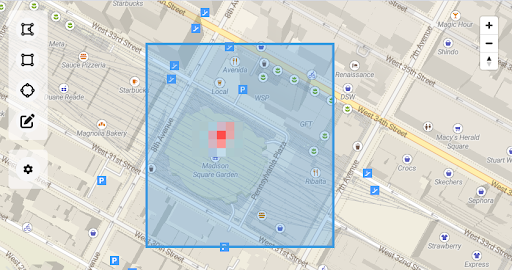
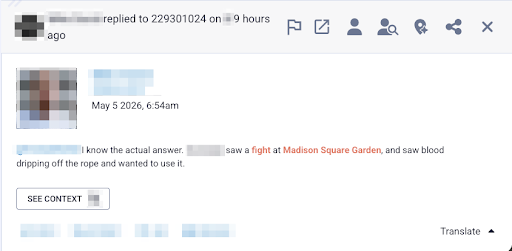
With Flashpoint PSI, organizations gain real-time access to mainstream sources where conversations about fast-moving events tend to surface first, plus a geospatial layer that maps that activity to a specific place. Analysts can also draw boundaries around geographic locations to monitor mentions of an executive within that area, or observe a venue on event day, seeing relevant activity as it surfaces. All of this can be accomplished using plain language, removing the need to learn secondary query syntax or lengthy manual processes to get started.
Navigating the Future of Converged Intelligence
The distinction between cyber and physical intelligence will likely keep blurring and Flashpoint is helping security teams on the ground level integrate these two functions. CTI teams that take on physical security as part of their mission shouldn’t be expected to abandon their core discipline. Instead, they should be given the workflows to apply it to a wider set of questions, using tools built to extend rather than replace the way they already work.
See how Flashpoint supports converged cyber and physical missions from a single platform. Request a demo to see what this could look like for your team.
Unmasking the Digital Trail: Essential Techniques for Vetting AI-Generated Content
In our latest on-demand webinar, we outline the practical, human-driven techniques threat intelligence teams must deploy to detect synthetic media, protect corporate RAG ecosystems, and filter through the noise of AI-polluted networks.
In the era of generative artificial intelligence (AI), threat intelligence is facing a profound signal-to-noise challenge. AI has introduced a massive paradigm shift to threat actor operations—making execution extremely easy while simultaneously dramatically complicating the task of verification for security teams.
In our latest on-demand webinar, Matt Edmonson, SANS Senior Instructor and founder of Argelius Labs, joined Flashpoint to discuss the intersection of Open Source Intelligence (OSINT) and AI. Drawing from his vast federal law enforcement experience, he shared actionable, human-driven techniques for detecting and vetting AI-generated online content.
Neutralizing the Automated RAG and Vector Database Trap
Before deploying any human-driven vetting techniques, an analyst must understand the specific structural trap threat actors are laying. Adversaries are no longer just using AI to spin up isolated phishing copy; they are using it to corrupt the automated defense pipelines that security teams rely on.
Modern threat intelligence workflows utilize automated ingestion to feed open-source data directly into local vector databases and Retrieval-Augmented Generation (RAG) models. Aware of this, sophisticated threat actors deploy a coordinated infrastructure strategy: they register multiple lookalike domains simultaneously to broadcast the exact same AI-generated disinformation narrative.
When automated security tools ingest this data, the system flags multiple distinct “sources” confirming the story as truth. This structural echo chamber completely bypasses automated verification safeguards, polluting corporate databases with validated lies. We have seen this play out via:
Long-Game Credibility Building: Edmonson highlighted an active Foreign Malicious Influence (FMI) campaign utilizing a French lookalike news site called Verite Cache (“The Hidden Truth”). The threat actors scrape legitimate Western news, use AI to rewrite it to build structural domain authority over time, and then manipulate narrative outcomes the moment a critical geopolitical event or election occurs.
Simultaneous Infrastructure Deployment: This pattern was mirrored in Southeast Asia, where Singapore recently banned six lookalike news sites targeting regional discourse. Upon technical inspection, five of those six distinct domains had been registered on the exact same day to broadcast a unified narrative.
Organic-Looking Algorithmic Surges: The scale of these operations can shift political landscapes in a matter of days. Romania recently took the extreme step of canceling and restarting its presidential election due to a covert, highly coordinated Russian-backed social media campaign. The operation used synthetic assets to trigger algorithmic recommendation engines, driving an intense, seemingly organic surge for an underdog candidate.
Triangulating AI Flaws and Anomalies Across Modalities
Vetting AI content relies on compiling a cluster of intersecting indicators across text, images, audio, and video until a definitive analytical confidence level is reached. While generative tools have grown highly sophisticated, they are still bound by mathematical constraints and architectural limitations. Catching these errors and inconsistencies requires analysts to identify a cluster of intersecting indicators across text, images, audio, and video:
Textual Analytics (Linguistic Quirks and Filler Text): Large Language Models (LLMs) leave distinct behavioral footprints. Analysts should look for commonly-used AI wordings and “portable sentences”, as well as automated translation leakage that reveals a threat actor’s native language mechanics.
Visual Logic Flaws (Physics and Seams): AI models frequently fail to grasp the fundamental physics of the real world. Analysts should closely inspect image logic for anatomical blunders (such as inverted hand structures), impossible geometry, or objects with extreme structural flaws. Additionally, AI struggles with “texture seams”—the exact boundaries where distinct textures meet.
Auditory and Video Glitches (Cadence and Duration): Human speech is inherently messy, characterized by breathing pauses, environmental background noise, and shifting cadences. Synthetic speech is often locked into a perfectly uniform, monotone rhythm. Furthermore, high-fidelity deepfakes are incredibly resource-intensive to sustain over long durations. While an actor can fake 10 to 15 seconds of synthetic video convincingly, a five-minute video will almost always display jarring cuts, visual artifacting, or avatars clipping out of frame.
Empowering the Human Layer | Watch the Full Webinar
Human analysts remain the most critical layer of defense against illicit uses of AI. Empowered by comprehensive threat intelligence, OSINT, and AI technologies, security teams can hunt for clusters of intersecting indicators across text, images, audio, and video to assess authenticity. To learn more and to gain more essential techniques, watch the full on-demand webinar. Using Flashpoint, organizations can filter through noise, execute critical data premortems, and neutralize sophisticated disinformation campaigns.
The Evolution of the Geotag: How AI is Bridging the Gap in Location-Based OSINT
In this post, we explore how the decline of geotagged data is reshaping location-based OSINT, the intelligence gaps it creates for analysts, and how AI-driven keyword generation and geofencing are restoring visibility into real-world events.
For years, location-based open-source intelligence (OSINT) has relied heavily on a steady stream of user-generated geographic data. Geotagged social media posts with embedded latitude and longitude coordinates have long been a goldmine for tracking regional trends, monitoring real-time events, and understanding on-the-ground public sentiment. Intelligence professionals and data scientists have historically used this passively-generated location-based data to aggregate real-time insights for everything from tracking public sentiment to monitoring natural disasters.
However, the era of effortless geographic tracking is coming to an end. Geotagged social media data is becoming increasingly scarce, making it significantly harder for security teams to gather a complete picture of location-based intelligence.
The Decline of Location Sharing
The primary driver behind the diminishing use of geotags is a massive shift in digital privacy standards. For instance, major platform-level policy interventions, such as Apple’s November 2021 iOS privacy update, changed the default consent model for device tracking. Instead of requiring users to actively opt out of location tracking, iPhone users must now explicitly opt in.
As a result of these strengthened privacy controls, a massive behavioral shift occurred: within a year of the iOS update, 62% of affected users chose to opt out of location tracking entirely. This platform-mediated behavioral barrier has drastically reduced the availability and visibility of granular location traces, creating complex new blind spots for researchers and intelligence analysts.
The Intelligence Gap
With precise coordinates disappearing from social feeds, security practitioners and OSINT investigators are left facing a major data void. Relying purely on traditional keyword or hashtag searches to find location-specific events is highly inefficient. In fact, as little as 7% of social media posts actually contain hashtags. If an analyst is scanning 10,000 posts a day looking for a specific hashtag, they could be missing up to 9,300 posts that hold critical intelligence.
To compensate for missing geotags, security practitioners have traditionally had to spend valuable time performing manual, tedious searches for specific local details like street names, landmarks, and local businesses to figure out where an event is taking place.
Bridging the Gap with AI
To overcome the increasing scarcity of explicit location data, the intelligence industry is leveraging artificial intelligence and spatial technologies.
AI-powered keyword optimization tools like Echosec’s new AI-powered “Optimize” feature are designed specifically to bridge this data gap. Instead of relying on users to share their precise coordinates, AI automatically generates hyper-relevant, location-based keywords for an investigator’s search. If an analyst is looking into a specific neighborhood, the AI will suggest relevant landmarks, tourist attractions, schools, government buildings, and businesses to monitor. This instantly converts manual, time-consuming research into an automated process, significantly increasing the volume and relevance of the data collected.
Geo-Based OSINT 2.0
Geo-based search combined with AI keyword generation is taking OSINT to the next level. Geofencing allows teams to draw virtual perimeters around physical sites, such as corporate offices, foreign meeting sites, or public gatherings, to monitor digital activity strictly within those areas. This means you don’t need to know what keywords or hashtags you are looking for; you only need to know where to look. This is incredibly valuable for real-time executive protection and monitoring civil unrest, as it surfaces visual intelligence and early warnings directly from the scene, cutting out irrelevant noise.
The Future of OSINT for Situational Awareness
The decline of the geotag is a victory for consumer privacy, but it isn’t the end of location-based intelligence. By leveraging AI-driven keywords and hyper-local geofencing, security teams can move beyond broad geographic searches. These smart tools alleviate research bottlenecks, allowing analysts to redirect their expertise away from exhaustive data hunting and toward the critical analysis needed to respond to threats before they escalate. The geotag may be fading, but our situational awareness remains sharper than ever.
Don’t let the intelligence gap compromise your situational awareness. Ready to move from tedious manual searches to immediate, actionable insights? Book your Echosec demo today and empower your team with the next generation of location-based insight.
OSINT stands for open-source intelligence, and it refers to all publicly available information on the open internet which has been obtained without any special requirements (paywalls, invitations, etc.).
I was given the opportunity to try Alias by SockPuppet during the TraceLabs Global OSINT Search Party CTF that took place on November 15th, 2025. If you don’t know about TraceLabs, they hold OSINT...
The following contains newly released Digital Forensics, Incident Response, Malware Analysis and OSINT training, tools, and books from February 2025, as well as upcoming live online training and events for March. Like the Free &...
Things got a bit hectic and I didn’t get the January training news monthly blog post out so I’m combining two months in this post. The following contains newly released Digital Forensics, Incident Response,...
The following contains newly released Digital Forensics, Incident Response, Malware Analysis and OSINT training and tools from November, as well as upcoming live online training and events for December. Like the Free & Affordable Training...
The following contains newly released Digital Forensics, Incident Response, Malware Analysis and OSINT training and tools from October, as well as upcoming live online training and events for November. Like the Free & Affordable Training...
The following contains newly released Digital Forensics, Incident Response, Malware Analysis and OSINT training and tools from September, as well as upcoming live online training and events for October. Like the Free & Affordable Training...
Be sure to read PART 1! Metadata and a New-Fashioned Bank Robbery Let’s face it, some cases are just more interesting than others and, when you do incident response for […]
Being a digital forensics and incident response consultant is largely about unanswered questions. When we engage with a client, they know something bad happened or is happening, but they are […]
What Is Open Source Intelligence: The Importance of OSINT in Your Organization’s Threat Landscape
In order to gain the upper hand, security strategies must include a diverse means of gathering intelligence, both for a predictive and reactive approach. Open-source intelligence has become crucial to completing this picture
A modern security professional’s job is becoming more and more complex, and it’s no surprise considering the influx of unexpected places where threats are beginning to surface. In order to gain the upper hand, your security strategy must include a diverse means of gathering intelligence, both for a predictive and reactive approach. In an era where content is being created at an exponential rate – 90% of the world’s data was created in the last 2 years alone – the future of security must be intelligence-led.
A major source of intelligence that cannot be overlooked is the vast amount of publicly available information (PAI) being produced by consumers, hackers, newsmakers, and bloggers every single day. Globally, almost every person and organization is communicating across multiple platforms and networks, as well as handling personal and corporate needs virtually – such as shopping, travel planning, and data management. Finding like-minded communities and audiences online is the goal; however, wherever you have people congregating, especially if there is potential for monetary gain, the risk of nefarious behavior rises. This has created an increased need for open-source intelligence (OSINT) and OSINT platforms.
What is OSINT?
Open-source intelligence, or OSINT, refers to the process of gathering information from public, legal data sources to serve a specific function. Some open sources might include social media, blogs, news, and the dark web.
The concept of OSINT very basically works like this:
Public information exists → data is gathered → information is analyzed for intelligence.
The purpose of seeking information from public data varies on the type of insights you wish to gather. Many industries and professionals look to open sources to uncover workplace security threats, protect executives, prevent loss, manage assets, gauge brand sentiment, and monitor conversations for creating marketing strategies. Intelligence professionals use certain types of OSINT and OSINT platforms for investigations, prosecution, evidence gathering, and events monitoring.
What is finished intelligence?
Finished intelligence, or ‘cooked’ data, is raw data that has undergone processing to gain context and become actionable. The collection, processing, and analysis of raw data are foundational steps along the threat intelligence lifecycle.
In other words, raw data is unaltered from its original source. This could look like a network’s traffic data logs, dark web discussions, or even public social media posts.
Finished intelligence would look like a report summarizing the context interpreted from relevant raw data points and suggested security responses.
Finished intelligence services allow organizations to skip the raw data collection and analysis steps, which are time-consuming and require skilled analysts. Those steps are instead supported by automation and machine learning capabilities, and/or third-party analyst teams.
The main goal of finished intelligence is to operationalize the process so organizations can respond faster to active threats and invest less time and resources in gathering and contextualizing large volumes of raw data. The result is a finished intelligence report that the client can immediately act on. While expensive, finished intelligence solutions can be ideal for private sector organizations seeking a “comprehensive” security solution.
What can OSINT tools do?
OSINT tools can identify and separate entities within a data set (parsing), and organize and display those entities by category to glean meaning and avoid redundancies (normalizing). OSINT tools can also index raw data so that it’s quickly and easily searchable and filtered for relevancy.
Access to publicly available online data is often free, but the true value lies in what can be analyzed and extracted from the data. Organizations using OSINT for security and intelligence require the ability to detect key information quickly and efficiently. They can do so by using robust OSINT tools.
The vast amount of online data is overwhelming to sift through, and with the complex ways today’s online threat actors conduct themselves, the vulnerabilities to organizations are becoming more elusive. Open-source data, when gathered, enriched, and monitored effectively, can be extremely valuable for predicting, analyzing, and reviewing incidents at every stage of their occurrence. But where to begin?
Where you look for information depends on what you want to find. Running a Google search is a simple form of OSINT, but when you are responsible for the safety and security of a particular person, place, or asset, you need to be casting a keen eye over multiple sources. Criminal behavior tends to be hidden, and it is unlikely a surface web search will take you there.
What threats can OSINT help with?
The emergence of intelligence-led security is a direct result of the varied and growing range of on-the-ground threats that are being plotted, planned, discussed, and executed online. As our physical and digital realities are becoming more and more interlaced, individuals and organizations are creating more informational weaknesses and thereby more opportunities for an ever-widening range of attacks and other threats to occur.
OSINT tools can be invaluable for handling internal processes such as:
Brand protection
Workplace and facilities safety issues
Real-time event monitoring
Executive protection and force protection
Natural disasters and incident response
OSINT for enterprise security
Global enterprises are operating in the age of digital transformation. This has plenty of benefits for companies, helping improve customer experience, productivity, and resource management. But along with these benefits, wider technology adoption also means increasing opportunities for compromise.
This stands true for almost any industry with an online presence—including finance, retail, and transportation, which make up some of the world’s most cyber-targeted industries. Digital transformation also affects physical security and cyber-enabled threats as criminals adopt anonymized online communication channels. What do these risks look like?
Cyber threats
Data breaches targeting corporate and customer information
OSINT tools support enterprise security teams in identifying and responding to these risks. Social media networks provide real-time updates from on-the-ground threats near executives and other physical assets like offices, employees, and corporate events. Paste sites, forums, and marketplaces across the deep and dark web often publish the earliest indicators of data breaches and executive-targeted doxxing. Anonymized discussions on these covert sites help security teams identify fraud, insider threats, and cyber-attack strategies directly from the source.
Combined with other risk management feeds and tools, OSINT platforms provide security teams with more context and earlier risk indicators so they can respond faster and avoid blind spots.
But many organizations face challenges in responding to risk quickly and effectively, especially as more enterprise teams—from marketing to IT and compliance—require OSINT.
According to a 2021 report by Forrester Research, 42% of corporate decision-makers are currently improvising when it comes to risk management. Almost 70% claim that risk information is siloed across their departments and only 29% are confident in their risk management technologies.
What do security teams need from OSINT platforms to address information gaps?
Broad data coverage
There are thousands of different online sources out there, from social media platforms to the deep and dark web, where relevant risk data is hiding. Many risk management tools focus only on one data source type—such as social media or the dark web—to help security teams find relevant risk information. A more ideal solution combines a variety of these sources within one platform so teams don’t have to juggle more tools than are necessary. This can just lead to information gaps and slower responses.
Simplicity and usability
Not everyone who needs access to online risk data has a technical background. OSINT solutions should be accessible to anyone in an organization without the click-heavy processes and complex interfaces that are typical of IT-based risk management software. Personnel should be able to easily and quickly separate the most pertinent data and view it in a digestible format.
Speed-to-information
OSINT tools that prioritize real-time data allow security teams to get critical insights faster. This gives organizations a much better chance of avoiding or mitigating threats from all angles.
Collaboration features
For risks where cross-department visibility is necessary, OSINT solutions should offer permission settings and collaboration features that allow teams to view each other’s activities or tackle a security threat together when there is overlap.
Integrations
Many global organizations already have a suite of risk management tools. OSINT solutions should be able to easily integrate with third-party solutions, whether they include a UI or funnel data directly into existing systems.
OSINT for national security: What national security initiatives does OSINT support?
Counter-terrorism and counter extremism
Foreign jihadist groups like the Islamic State and Al-Qaeda are no longer solely responsible for the threat of terrorism and extremism. Domestic extremist movements based on conspiracy theories, right-wing ideology, and discriminatory worldviews now also pose serious national security threats. Public online spaces are leveraged similarly for both extremist types, playing a huge role in spreading propaganda, recruitment, financing, and sometimes planning. This data helps governments understand how extremist groups operate so they can then predict public safety risks and protect citizens and assets from domestic and global terrorism.
Addressing misinformation and disinformation
National security threats have expanded to include online influence campaigns, which can compromise democratic processes and lead to real-world security risks. Disinformation (which is engineered to deliberately deceive) and misinformation (false information that is not necessarily spread with malicious intent) is widely prevalent online. Monitoring online spaces is crucial for tracking disinformation campaigns so governments can mitigate their impact and keep the public safer and more informed.
Cybersecurity
Breaching government data is financially and politically lucrative for lone-wolf attackers, organized hacking groups, and nation-state actors. Sophisticated technologies are available to a greater diversity of adversaries than ever before. Persistent online threats include breaches and cyber espionage targeting classified data, network attacks disrupting critical infrastructure, and botnets enabling malware attacks and information warfare. Paste sites, discussion forums, and marketplaces on the deep and dark web often provide early indicators of breaches, malware, and attack techniques. Combining this open-source data with other cybersecurity feeds helps intelligence teams more confidently predict, mitigate, and investigate cyber compromise.
Transportation security
National transportation networks, including airports, seaports, and highways, make up a country’s critical infrastructure. When this infrastructure is compromised, governments and security teams need to stay prepared and alerted to prevent damage to assets, data, and human life. Online data plays a crucial role in providing the intelligence required for informed transportation security planning and incident response. For intelligence teams, social media networks and deep and dark web content can:
Provide the earliest alerts for location-based threats near airports, seaports, and other transportation hubs
Inform security teams about tactics used to bypass security systems or commit attacks, particularly at airports
Monitor for threats directly targeted at the security/public sector organizations themselves
Stay alert to vulnerable data that could compromise a transportation network’s digital or physical security
Addressing national and global crises
When a national crisis occurs, governments must make timely, informed decisions to protect their data, assets, and citizens. As we’ve seen with the COVID-19 pandemic, adversaries co-opt real-world events in their strategies. Whether it’s a natural disaster, public health crisis, or terrorist attack, intelligence teams need to know how and where the crisis is occurring and how to allocate response resources. Online spaces are often the earliest sources of information to provide this context—for example, social media users often post public updates and images from the scene of a crisis. Aligning this data with other feeds can help provide a faster and more informed response.
Intelligence professionals require specialized software to collect this information and generate actionable intelligence. Commercial OSINT tools help intelligence teams gather open-source data more efficiently and align with a team’s unique requirements. Because intelligence teams often work with their own interfaces and tooling, they often require direct access to raw data that can be plugged into their existing systems.
How do OSINT platforms address data overload?
The intelligence community is increasingly challenged by growing volumes of online data available for collection, processing, analysis, and triage. The western world is also facing a data analyst shortage coupled with a growing demand for military AI. As a result, data scientists in the public sector tend to handle more complex tasks, developing tooling and data sets to support lower-level analysts on intuitive platforms.
Intelligence teams are also challenged by a lack of access to some emerging online sources. For example, fringe networks (like alt-tech platforms, deep and dark web imageboards and paste sites, etc.) do not offer their own API or are unavailable through commercial API providers. To gather data from these sources, analysts are often required to create dummy accounts, make group requests, and navigate networks manually. This requires a significant amount of HUMINT resources that could be allocated to other areas of the intelligence cycle.
To address these challenges, OSINT tools must:
Improve data coverage by providing access to relevant sources, including fringe web spaces, that are not commonly available through commercial, off-the-shelf vendors.
Leverage machine learning capabilities. AI is a major priority for governments, helping analysts process and contextualize intelligence more efficiently.
Be intuitive and user-friendly for lower-level intelligence analysts, providing more efficient workflows and better speed-to-information.
Types of OSINT tools
There are many types of OSINT tools on the market, both free and paid. The truth is, no single OSINT tool is 100% effective as a standalone solution. Rather, combining a variety of solutions is the best practice. Remember that the best OSINT tools will have a geographical element, providing a digital window to view data by location. The tools you choose will depend on the specific needs of your organization. Here are some types of OSINT tools to consider:
Social media monitoring
Our OSINT Platform allows organizations to use online information to gain situational awareness on the ground. Security teams utilize predictive intelligence and real-time crisis management, as well as brand monitoring and post-incident review.
Deep and dark web monitoring
The Flashpoint product suite includes targeted, automated collection systems that capture information from the deep and dark web, enabling your security and intelligence teams to identify and prioritize relevant threats and leverage their intelligence to act quickly.
Email hacks
Have I Been Pwned? is a free online resource to check if your email address has been put at risk due to a data breach.
Twitter monitoring
TweetDeck allows you to view multiple timelines in one user view. TweetDeck allows a user to create specific filters such as specific activity and geographical locations.
Internet archives
Wayback Machine is an internet archive tool, like a library, of historical data. This tool allows the user to search the history of archived websites, metadata, text contents, and TV news captions.
Link analysis
Maltego is a graphical link analysis tool that accelerates and simplifies complex investigations by allowing users to build visualizations and connections between disparate data sets.
Conclusion
Business is happening online, and today’s security strategies need to be informed by the masses of social data being created every day. Gathering, filtering, and analyzing this information requires the advanced capabilities of OSINT platforms.
Both amateur and professional criminals are using sophisticated strategies and seemingly innocuous networks to conduct illicit business. More and more media networks are being infiltrated and used outside their intended purposes. Evolving threats require predictive and intelligence-led security strategies. Security teams must gather intelligence from every corner that they can. Open source threat intelligence software is essential for any enterprise using public data sources to inform their decision-making.
Not only can OSINT help protect against hidden intentional attacks such as information leaks, theft, and fraud, but it also has the ability to gain real-time and location-based situational awareness to help protect people at work, at events, institutions, or even the shopping mall. The right OSINT toolkit will give your security and intelligence teams the upper hand.
Last week, a friend of mine reached out with a query: a contact in his address book had sent him a suspicious email. As it turns out, it was. In this blog post, we'll have a quick look at an Office 365 phishing campaign, which turned out to be massive. This type of phishing has been on the rise for a while now (at least since 2017), and it's important to point out, as seemingly attacks are only increasing.
Analysis
As mentioned earlier, Office 365 (O365) phishing isn't new, but it is definitely prevalent. A high-level overview of a typical attack is as follows:
Figure 1 - High-level overview of typical O365 phishing
A typical flow of such an attack may be as follows:
An attacker sends an O365 spearphishing email, likely from a spoofed or fake email address;
The user is enticed to click on the link, or open the attachment which includes a link;
The user will then unknowingly enter their credentials on the fake O365 page;
Credentials get sent back to the attacker;
Attacker will access the now compromised user's mailbox; and,
The cycle repeats: the attacker will send spearphish emails to all of the compromised user's contacts - with this difference, it's coming from a legitimate sender.
This is exactly what happened to a friend of mine: he got sent an email from a legitimate email address, which was a contact in his address book - only the sender never intentionally sent this email!
Let's have a look at the infection chain.
The initial email
The initial email sent looked as follows:
Figure 2 - "P.AYMENT COPY"
Clicking on the "OPEN" button would redirect you to a legitimate but compromised Sharepoint (part of O365) webpage. Seeing as a legitimate business has been compromised, I won't post the link here. Its web administrators have been notified.
Figure 3 - "Access OneDrive"
The PDF document
Next step is hosting a PDF named "INVOICE.PDF", which entices the user to access OneDrive to view the shared file. If the user were to click on "OPEN PDF HERE":
Finally, clicking on "Login with Office 365" will redirect the user to the final phishing page, which will look as follows:
Figure 5 - Final landing page
The final landing page is as follows: https://happymachineit[.]info/Michael/b4fb042ba2b3b35053943467ac22a370/7hsfabvj2b0b9rguzbzw910d.php
When entering credentials, they will be sent off to the attacker, and the cycle from Figure 1 will repeat itself. Note that other scenarios are possible, for example:
The attacker may try to (re-)sell credentials that have been gathered so far on criminal forums
The attacker may send more targeted spearphishes to potentially interesting victims
The attacker may attempt to access other services or accounts using the same user/password combination
In short, there's countless other possibilities.
The phishing infrastructure
Avid readers will have noticed the phishing website uses a valid SSL certificate, which has the following details:
This means the certificate is a local and self-signed one. In other words, if you are accessing a secure website, and you see "server.localhost.com" as the SSL certificate, do NOT trust it. This is sometimes from an automatic setup from the hosting provider.
Performing a search with RiskIQ's PassiveTotal as well as VirusTotal, and after filtering results, we obtain a whopping total of 875uniqueOffice 365 phishing sites, hosted on that IP alone! It appears this campaign has been active since December 2018.
Searching a bit further, it appears the whole ASN (which is a collection of IP prefixes controlled by a single entity, typically an ISP), AS48666 is in fact riddled with Office 365 as well as other phishing sites. Using URLscan.io we can quickly gauge the ASN is hosting multiple phishing sites for Office 365 as well as Adobe:
Figure 6 - AS48666 hosting badness
General Info:
Geo: Russian Federation (RU) —
AS: AS48666 - AS-MAROSNET Moscow, Russia, RU
Registrar: RIPENCC
As shown in this blog post, one IP address can host tons of phishing instances, while the ASN controls multiple IPs. Bonus bad IP: 178.159.36[.]120.
Detection
For the phishing websites itself, any network traffic that resolves to the IP above.
I've noticed there are countless similar PDFs from this same campaign. Due to the way these are created (likely in bulk), a simple Yara rule can be developed as follows:
The Yara rule can be found on Pastebin here or on Github Gist here.
Note: in specific instances, this rule may false-positive - so use at your own will.
The following MITRE ATT&CK techniques are relevant:
There isn't much to disinfect, since there's no actual malware involved.
However, if you have been affected by this phishing campaign, do the following immediately:
Contact your network and/or system administrator or managed services provider if you have one and wait for their response - if not;
Note down the phishing page/URL, then close any open phishing pages - in fact, close the whole browser;
Perform an antivirus scan with your installed product, and a scan with another application, for example Malwarebytes (better be safe than sorry);
Change your O365 password immediately;
Change passwords on other websites where you used the same combination;
Reach out to the people in your address book you were compromised and they are not to open your email(s) or at least not any attachments or links from your email(s);
Verify your "Sent" emails folder (or "Outbox") for any suspicious activity. If there are no Sent emails - the attacker may have deleted them, or you may have a full compromise on your hands.;
Verify any (newly) created rules in your mail application (in this case O365), for example, verify there are no new forwarding rules or perhaps rules that delete new incoming emails - forwarding rules and deletion rules are sometimes set up by an attacker to gather more information or as an attempt to remain hidden; and,
File a complaint with your CERT, local police station, or whichever authority would handle such cases. If you are unsure how to do so, have a look here for assistance.
Prevention
Block the IP (or whole subnet 178.159.36[.]0/24) mentioned in this report in your firewall or proxy or other appliance;
Use strong and preferably unique passwords (use a password manager);
Set up 2FA for accounts or, preferably, MFA (multi-factor authentication);
Enable, deploy or implement anti-spam and anti-phishing protection;
Enable, deploy, or implement a URL phishing filter;
Trust, but verify: "did this contact really need to send me a "Payment Copy"? - if needed, verify via a phone call - not via email;
Be generally cautious with links and attachments. Do not click on links or open attachments from unknown senders;
If possible, use Firefox with NoScript enabled; and,
If you're in an organisation: create or organise user awareness training.
Conclusion
Phishing has been around for a long time - Office 365 phishing, on the other hand, has been around since, well, Office 365 was created. Every time a new service is created, you can imagine that phishing emails targeting that service will follow - maybe one month later, perhaps a year later - but they will.
Always try to be vigilant and follow the prevention tips mentioned above to stay safe.
Joe Gray* // You may have heard about a new genealogy tool called Family Tree Now. It is a (seemingly) 100% free tool (more on that later) that allows you to […]

 Login
Login


 Table Of Contents