Cybercrime at Machine Speed: Key Takeaways from Flashpoint’s 2026 Midyear Threat Intelligence Briefing
Threat actors are no longer just using automation to execute tasks, they are leveraging prepackaged, safeguard-free AI, weaponizing stolen session data, and directly targeting defenders’ security stacks.
The threat landscape has developed at a striking pace with Flashpoint tracking over 22 million illicit AI discussions, 7.4 million compromised hosts yielding 1.7 billion stolen credentials, and over 21,600 disclosed vulnerabilities in just six months. Beyond these staggering numbers, the on-demand session detailed something even more alarming: a fundamental shift in adversary operational tradecraft.
Here are the five critical shifts every cyber threat intelligence (CTI), Vulnerability Management, and SOC team needs to know.
The Death of Signal: Threat Actors are Shifting to “Private AI”
The public discussion surrounding criminal artificial intelligence (AI) has reached a critical inflection point. Early in the AI boom, Flashpoint observed threat actors collaboratively experiment across underground forums, jailbreaking commercial frontier models or advertising surface-level tools like WormGPT and DarkGPT.
Today, adversaries are shifting from public forums to running fine-tuned, open-source models locally on private servers, which greatly hampers traditional signature-based detection. Flashpoint analysts are now seeing attackers generate unique, highly tailored malware variants, flawless phishing lures, and custom exploit scripts at extremely low costs—completely offline and shielded from public monitoring.
“A few months ago, a lot of this was collaborative… public outsourcing. Now what we’re seeing is scarier: pre-packaged cybercrime models run locally on private infrastructure. Malicious code, exploit scripts, and targeted phishing are all being generated inside closed environments.”
Ian Gray, VP of Intelligence, Flashpoint
Weaponizing the Defender’s Own Tooling
Another eye-opening tactical insight shared during the session was how threat actors are repurposing defender infrastructure for automated initial access and extortion. In the webinar, we pointed to recent campaigns where adversaries specifically targeted misconfigurations and zero-day vulnerabilities inside open-source vulnerability scanners, secrets-detection tools, Kubernetes clusters, and Infrastructure-as-Code(IaC) environments.
What this means for defenders is that the attack surface is no longer bounded by traditional enterprise network boundaries: it extends directly into CI/CD pipelines, security orchestration tooling, and third-party SaaS integrations. Security teams are finding themselves in a race against attackers who use automated scanning scripts to weaponize vulnerabilities in the security tools themselves.
The Global Infostealer Threat and Identity-First Attacks
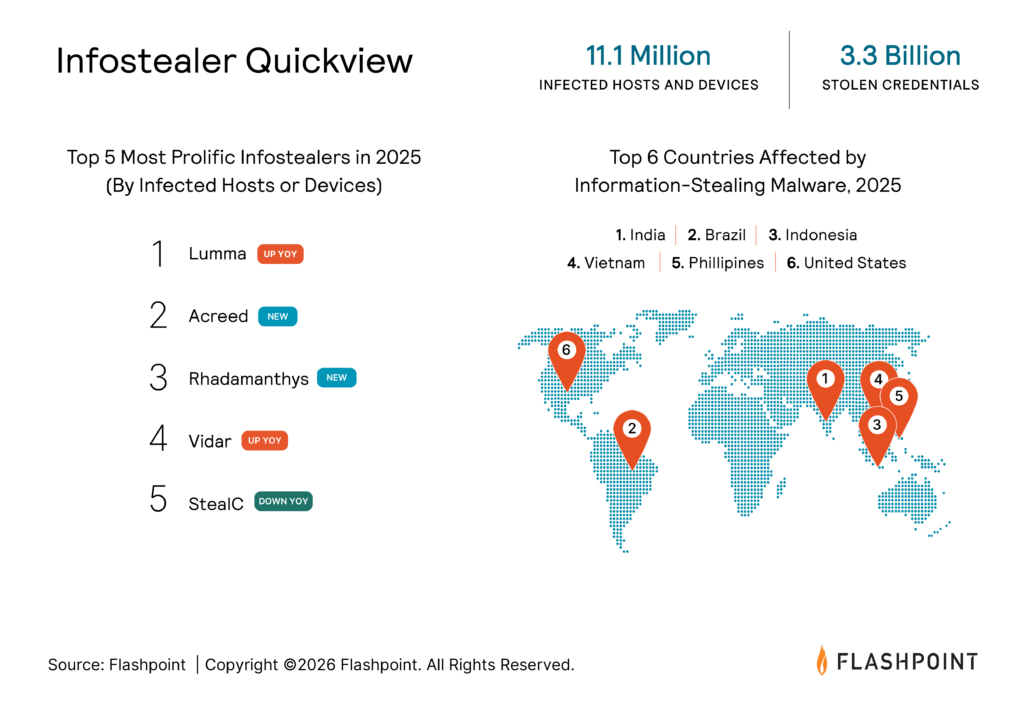
Flashpoint tracked 7.4 million hosts compromised by infostealers in H1 2026—a 27% increase period-over-period—harvesting 1.7 billion credentials and identity information.
While the top infostealer strains remain familiar, law enforcement operations have created vacuums that competitors rapidly fill.
Threat actors are leveraging drive-by downloads, watering holes, and pirated software packages to plant stealers. Once a machine is compromised, the logs capture corporate SSO credentials, active browser cookies, VPN keys, and SaaS session tokens. This enables adversaries to simply log in without having to leverage complex technical exploits.
The Structural Failure of CVE/NVD and the Importance of KEV
The Common Vulnerabilities and Exposures (CVE) and National Vulnerability Database (NVD) have failed to keep pace with the velocity of AI-assisted vulnerability discovery. As such, vulnerability management teams are facing significant operational delays.
Metric
Flashpoint GTIR Midyear H1 2026 Data
Operational Impact
Total Disclosures
21,667
Remediation volume exceeds defender bandwidth.
Exploit Availability
19% (4,015 CVEs)
Functional code is ready before patches are deployed.
Public Catalog Lag
Growing Backlog (NVD/KEV)
Delay in official scoring leaves teams blind to active risk.
Therefore, waiting for NVD enrichment before prioritizing a patch is a dangerous strategy. To compensate, security teams require Vulnerability Intelligence (VI) that provides primary-source confirmation of weaponization, exploit availability, and actionable mitigation guidance long before public databases update.
Ransomware Evolution: From Encryption to Cloud Extortion
Ransomware-as-a-Service (RaaS) activity surged by 45% period-over-period, reaching 6,256 verified victim postings on data leak sites. However, total on-chain payout revenue dropped by 8% to $820 million, with victim pay-rates hitting a record low of 28%.
Faced with declining payouts and resilient enterprise backups, extortion syndicates are adapting. Rather than relying exclusively on technical file-encrypting malware, groups are executing pure data extortion campaigns—frequently targeting cloud platforms or extracting data through third-party vendor access.
Protect Your Organization Using Flashpoint
Defending against machine-speed attacks requires moving beyond reactive, post-incident telemetry. Flashpoint arms security, CTI, and vulnerability management teams with the primary-source intelligence required to preempt adversary operations:
Unrivaled Deep & Dark Web Visibility: Flashpoint’s Primary Source Collection actively monitors closed criminal communities, illicit Telegram channels, and private forums, giving you early warning when threat actors build custom AI toolkits or trade credentials targeting your organization.
Comprehensive Vulnerability Intelligence (VI): Flashpoint tracks zero-days and vulnerability disclosures independently, delivering immediate exploit availability data and threat-informed prioritization so you patch what actually matters.
Continuous Compromised Credential Monitoring: Instantly surface exposed enterprise credentials, active session tokens, and stealer logs tied to your domain or third-party supply chain before they lead to an account takeover (ATO).
The Evolution of Hacktivism in Hybrid Warfare: Modern Tactics and Real-World Impact
In this post we examine how modern hacktivism has evolved into a tool of global hybrid warfare, analyzing crowdsourced attack tactics, media-driven propaganda, and real-world impacts across Ukraine, the Middle East, European Union, and NATO nations.
Hacktivism used to be perceived as digital graffiti, with lone-wolf threat actors defacing government websites or temporarily crashing banking portals to make a political point. However, Flashpoint is tracking a fundamental shift in how these groups operate.
Modern hacktivism is evolving into a disciplined component of global hybrid warfare, capable of bridging digital disruptions with tangible real-world impact. Today, these operations blur the line between volunteer activism and coordinated state interest, leveraging crowdsourced infrastructure to disrupt critical utilities, manipulate media narratives, and target public infrastructure on a global scale. Unpacking these modern hacktivist collectives reveals what their tactics look like in practice and their far-reaching consequences across dozens of nations.
What is Hacktivism?
Hacktivism is the use of cyberattacks to promote or advance a particular political or social cause, leveraging a wide range of tactics such as website defacement, distributed denial-of-service (DDoS) attacks, and data breaches. Modern hacktivist collectives serve as the loud, high-visibility arm of cyber conflict—frequently aligning with state geopolitical interests, as seen most prominently in recent pro-Russian operations and Iranian-aligned cyber campaigns.
These pro-Russian hacktivist groups, such as NoName057 and Killnet, alongside pro-Iranian collectives and proxy ecosystems like Handala Hack, often react to the news cycle and target countries designated by state media or ideological narratives as enemies. As such, modern hacktivist campaigns are opportunistic and tied to global events—from the escalation in the Middle East following military operations like Operation Epic Fury, to the Milan-Cortina Winter Olympics and new aid packages to Ukraine. These groups’ justification narratives typically mirror state messaging.
Modern Tactics: Gamifying Cyber Warfare
In tracking modern hacktivist groups, Flashpoint analysts identified a new method these groups are utilizing to convert ordinary devices into tools for hybrid warfare—the gamification of cyberattacks. Flashpoint has observed groups like NoName057 turning DDoS attacks into community-based “patriotic online games,” such as their “DDoSia Project,” with participants earning military-style ranks and cryptocurrency rewards for overloading the websites of government institutions, banks, and various infrastructure across various countries.
This model has enabled the scaling of operations by utilizing a large, low-skilled participant base rather than having to rely on sophisticated technical tradecraft. The model’s decentralized structure and ideological appeal continue to pose a significant challenge for international law enforcement.
The Propaganda Engine: Media Amplification and Validation
Beyond technical disruptions, publicity is the primary currency of modern hacktivism. Hacktivist groups demonstrate a consistent pattern of media-seeking behavior and self-promotion, likely intended to amplify their perceived impact and reinforce notoriety within the broader cyber threat landscape. Many of these groups repeatedly repost media coverage and news articles referencing themselves.
This serves as a curated self-promotion mechanism, allowing the group to selectively showcase external validation of its operations, including coverage from mainstream and security-focused outlets, to its followers. This behavior aligns with a broader trend observed with especially pro-Russian hacktivist collectives, in which media visibility is treated as a measure of operational success independent of verified technical impact. It also serves as a deliberate tactic for engagement and recruitment that reinforces “patriotic” branding and sustains participant morale and visibility.
Beyond Propaganda: Aligning Cyber Disruption with Military Objectives
In some cases, the digital targeting of hacktivist collectives is more aligned with kinetic objectives, rather than public perception or propaganda initiatives. This is especially true for Iranian-aligned hacktivists and proxy groups who are more deeply intertwined with military operations in the Middle East. These groups have expanded their operations from website disruptions into claims of large-scale data wipers, extortion, and cyberattacks targeting key infrastructure across the Gulf.
The Far Reach of Modern Hacktivism
Major geopolitical flashpoints in the Middle East have triggered waves of hacktivist activity that has spread across North America, with threat actors targeting supply chains, financial infrastructure, and operational technology and control systems.
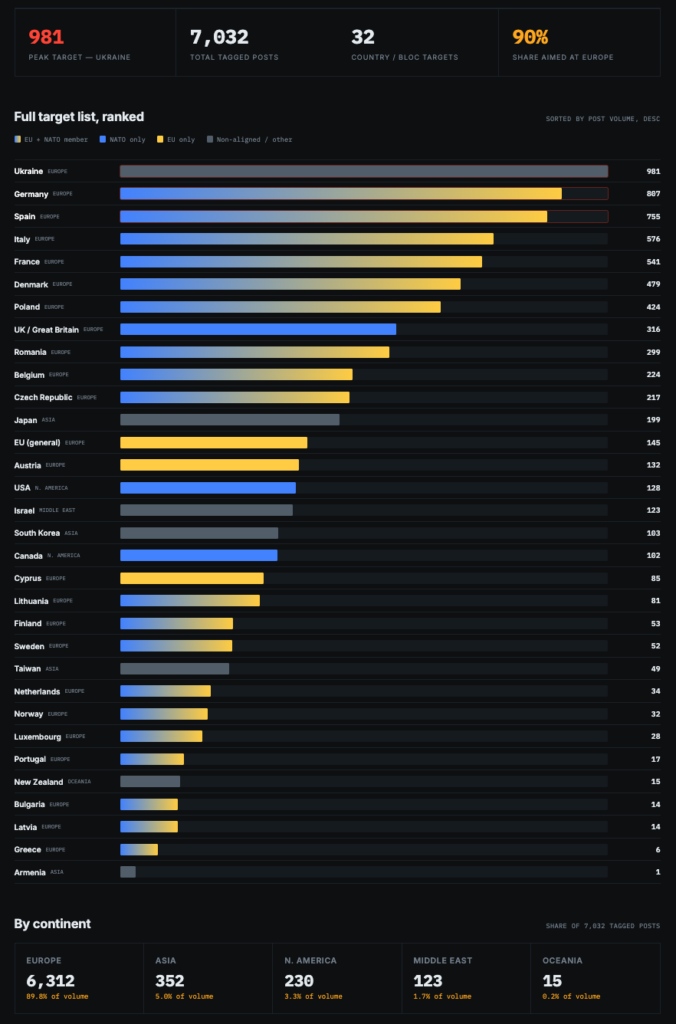
Simultaneously, pro-Russian hacktivist groups, particularly NoName057, have been extremely prolific within the last year—carrying out two major illicit campaigns heavily targeting Ukraine, which then spilled over to more than 30 nations globally. The following breakdown contains statistics and targeting dynamics of pro-Russian hacktivist groups observed between July 2025 and 2026:
Country-level targeting derived from Flashpoint intelligence. (Source: Flashpoint, graphic generated by Claude)
The Continuous Campaign Against Ukraine
Ukraine has been the primary target for pro-Russian hacktivist groups who seek to damage Ukrainian infrastructure and morale. Anti-Ukrainian content is constantly distributed through dedicated per-language channels, making it the most linguistically developed target spanning six languages. Involved channels each post near-identical translated content within minutes to hours of the Russian original, down to the same image file with identical SHA1 hashes, which suggests a sustained propaganda distribution operation.
This has resulted in alleged data breaches impacting Ukrainian General Staff, military enlistment offices, medical, and morgue databases to push a casualty-count narrative. It also has resulted in the defacement or disruption of websites of regional capitals and administrative centers, energy plants, water and power-adjacent infrastructure, and many more.
Spilling Over: Impact Across EU and NATO Allies
However, Ukraine is not the sole casualty of modern hacktivism. Recent pro-Russian hacktivist campaigns have spread to other EU nations and NATO members. Germany, the United Kingdom, and Spain have been observed to be priority targets, with threat actors targeting public transportation, federal and security agencies, municipal government and utilities, financial markets, and other infrastructure. In some cases, hacktivist campaigns manifest in the real-world, with physical sticker drives on municipal streets, alongside doxxing operations releasing alleged personal data and automated scans hijacking exposed CCTV camera systems across Europe.
Physical sticker campaigns (NoName057) in Spain identified by Flashpoint
Defend Against the New Wave of Hacktivism Using Flashpoint
As hacktivist operations continue to blur the boundary between digital disruption and real-world interference, organizations can no longer view DDoS attacks or low-level intrusions as simple background noise. Protecting critical assets requires proactive visibility into threat actor networks, early detection of targeting narratives, and primary source threat intelligence.
Request a demo today to see how Flashpoint provides actionable intelligence to help security teams, government agencies, and infrastructure providers identify, monitor, and mitigate emerging hacktivist campaigns before they impact operations.
Unknowingly, a member of key personnel is living two separate lives. On the clock, they are a highly-trusted systems administrator, but in their personal time, they moonlight on the deep and dark web, advertising their trust and access to the highest bidder. One day, they get a simple offer: $15,000 in the crypto of their choice to approve a single push notification at 2 AM. They accept. By morning, the attacker walks away with active domain admin credentials without the need for malware or cracking firewalls.
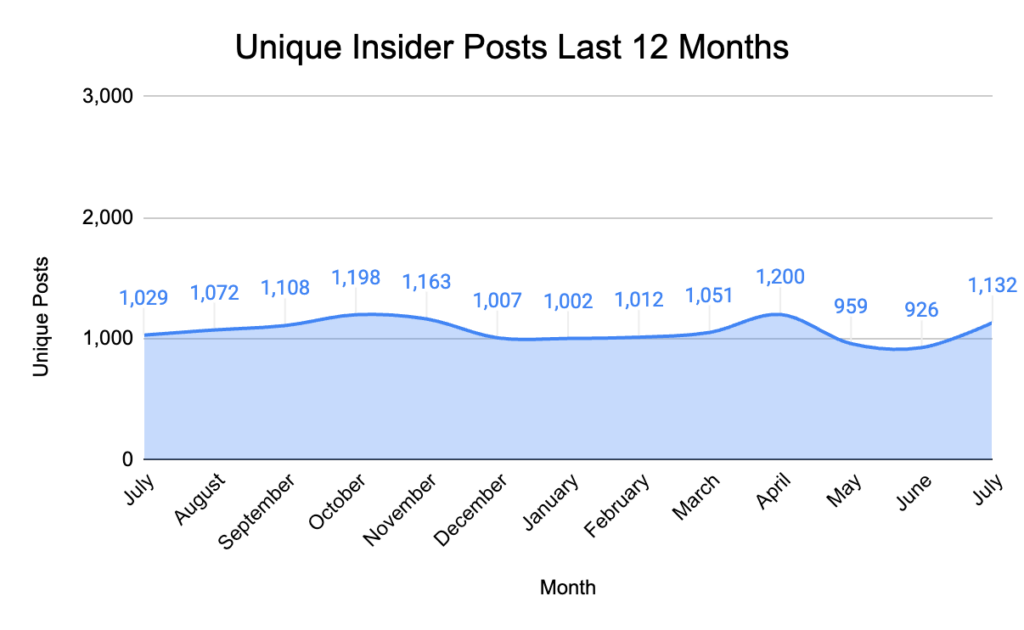
This is just one example of how insider threats lead to modern enterprise breaches. This year, Flashpoint uncovered 7,282 unique insider threat posts, with an average of 34 unique posts being posted daily. As perimeter security, EDR coverage, and other security tools mature, threat actors are finding it faster—and cheaper—to target the human element and simply buy an insider’s credentials or pay an employee to open the front door.
In a threat landscape where identity is becoming the primary attack surface, monitoring illicit marketplaces and recruitment efforts is critical. This new monthly report leverages Flashpoint’s Primary Source Collection (PSC) to analyze insider threat tactics, tracking active recruitment and advertising on dark web forums and encrypted networks.
The Insider Threat Landscape: July 2026
In July 2026, Flashpoint analysts identified a total of 12,653 insider posts. These communications include both threat actors attempting to recruit insiders in target organizations, as well as insiders advertising their services on illicit forums and marketplaces.
Of these total communications, Flashpoint observed 1,132 unique posts in July 2026.
Where Insider Threat Activity is Concentrated
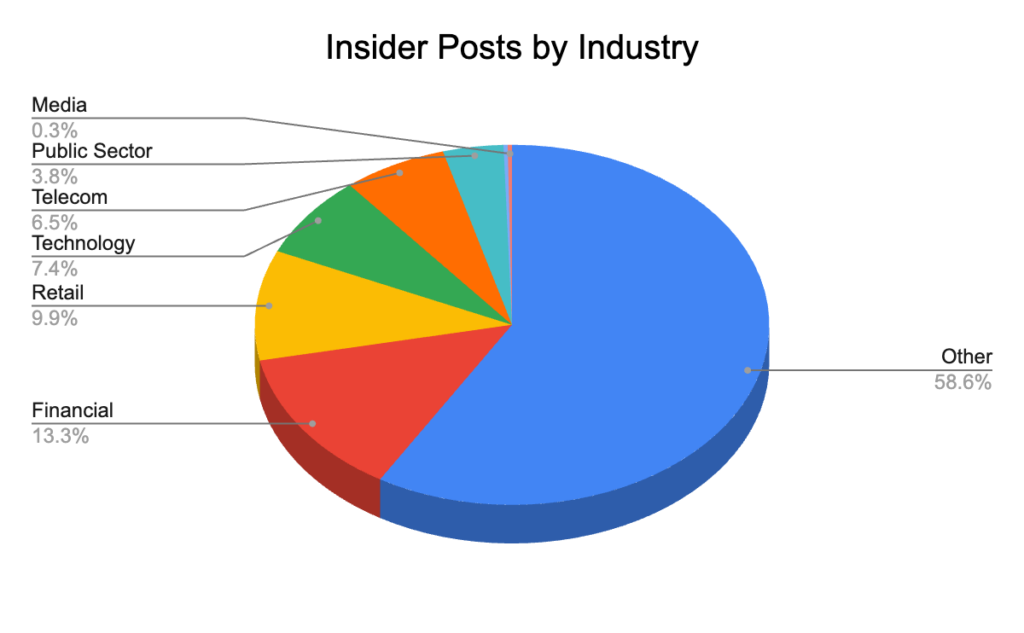
Historically, the Telecommunications, Retail, and Financial industries are most adversely affected by insider threat activity. However, July 2026 findings noticeably deviate from this trend. Flashpoint found 58.6% of total insider threat posts affected “Other” industries—suggesting adversaries are diversifying their target base. Threat actors may be attempting to recruit within supply chain partners, logistic hubs, manufacturing platforms, and specialized service providers to find alternative entry points into target networks.
The following table shows a breakdown of unique insider posts by industry in July 2026:
Industry
Posts
Other
663
Financial
150
Retail
112
Technology
84
Telecom
74
Public Sector
43
Healthcare
3
Media
3
Total
1,132
Insider Threats: Recruiting vs. Advertising
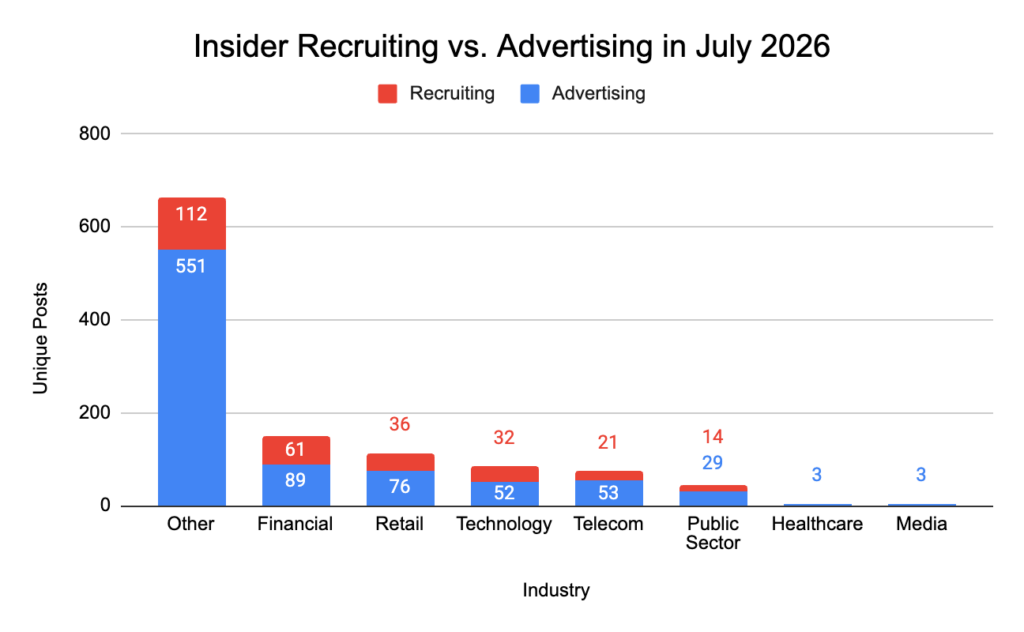
Active insider threats work in two ways: an insider is “recruited” by a malicious outside party, or a malicious insider “advertises” their access and skills to an interested threat actor. Regardless, by leveraging this connection, insiders assist adversaries by exfiltrating valuable data, installing malware, sabotaging IT systems, or performing SIM swaps.
In July 2026, Flashpoint found that over 75% of unique threat actor posts came from insiders advertising their access to malicious third parties. This indicates a highly motivated internal threat landscape where disgruntled employees actively seek out buyers for corporate data and network entry points.
Protect Against Insider Threats Using Flashpoint
Insider threats are inherently difficult to detect using internal security controls alone because the malicious activity relies on valid credentials and legitimate access privileges. Relying solely on internal logs means security teams often only detect an insider threat after data exfiltration or system sabotage has already occurred.
Flashpoint protects organizations against insider threats through our Primary Source Collection (PSC) and specialized intelligence platforms:
External Threat Intelligence & Early Warning: Flashpoint monitors deep and dark web forums, invite-only threat communities, and encrypted chat platforms to identify employee solicitations, stolen corporate domain mentions, and active recruitment attempts before an intrusion develops.
Identity Protection & Infostealer Tracking: By tracking illicit marketplaces and infostealer activity, Flashpoint identifies compromised corporate credentials and active session tokens, preventing threat actors from utilizing purchased access.
User & Entity Behavior Context: Flashpoint’s intelligence equips SOC, Security Operations, and Risk Management teams with adversary TTPs, enabling security operations to look for anomalous data downloads, off-hours access, or unauthorized software installation.
To learn more about how Flashpoint can help protect your enterprise from insider risk and monitor illicit underground communities,Request a Demo Today.
Frequently Asked Questions (FAQs)
What is the Flashpoint Insider Threat Report?
The Flashpoint Insider Threat Report is a monthly intelligence brief that analyzes trends, volume, targeted industries, and tactics surrounding insider threat recruitment and illicit access advertising on the deep web, dark web, and encrypted chat channels.
How does Flashpoint collect insider threat data?
Flashpoint collects data using its Primary Source Collection (PSC) engine, which actively monitors thousands of dark web forums, illicit marketplaces, and underground chat networks where threat actors and malicious insiders communicate.
What is the difference between insider recruitment and insider advertising?
Insider recruitment occurs when an external cybercriminal attempts to entice a corporate employee into assisting with a cyberattack. Insider advertising occurs when an employee or contractor proactively lists their legitimate access or services for sale on illicit marketplaces.
In the first half of 2026, the global threat landscape reached a clear operational inflection point: threat operations have fundamentally transitioned from human-led campaigns to machine-speed, AI-driven exploitation. As threat actors gain commoditized access to open-source AI technologies and actively deploy automated, safeguard-free tooling locally on private infrastructure, organizations face an accelerating hybrid risk environment.
Flashpoint’s Global Threat Intelligence Report: 2026 Midyear Edition
The Flashpoint Global Threat Intelligence Report: 2026 Midyear Edition anchors security leaders—from threat intelligence, vulnerability management, to executive leadership—in the data required to navigate this evolving threat landscape. Covering the period from January 1 to June 30, 2026, the report delivers timely insights backed by Flashpoint’s proprietary primary-source collection from over 3.9 petabytes of continuously monitored illicit sources.
Our midyear findings reveal several key metrics that highlight the speed and scale of the H1 2026 threat landscape:
22M+ threat actor posts discussed, shared, or advertised artificial intelligence toolkits for criminal deployment.
1.7B credentials and identity data points extracted across more than 7.4M unique compromised hosts globally.
Nearly one-in-five (19%) of all vulnerability disclosures dropped with ready-made, functional exploit code.
45% period-over-period surge in Ransomware-as-a-Service (RaaS), with total victim volume reaching 6,256 even as victim payout rates dropped to a historic low of 28%.
A Clear Understanding of the Convergence Between AI and Cyber Threats From generating flawless phishing campaigns to automating vulnerability scanning and code obfuscation, discover how adversaries are optimizing for speed and cost-efficiency — utilizing AI as a force multiplier in their various illicit campaigns.
A Comprehensive Top-Down View of the Evolving Threat Landscape Gain full visibility of the threat landscape with Flashpoint’s primary-source collections and real-time threat intelligence.
Strategies for Proactive Defense and Risk Mitigation Move your organization beyond reactive incident response by leveraging Flashpoint’s comprehensive threat intelligence. Gain the foresight needed to strengthen defenses and optimize your security posture.
“AI is compressing the time between opportunity and exploitation. Capabilities that once took significant expertise, coordination, and time to develop are becoming faster to build, easier to scale, and harder to detect. Security teams are facing an adversary ecosystem that can use AI to iterate at unprecedented speed — the only way to keep pace is with primary-source intelligence that surfaces adversary behavior before attacks unfold.”
Josh Lefkowitz, Flashpoint Co-Founder & CEO
The Four Driving Themes Shaping the 2026 Threat Landscape
Artificial Intelligence (AI) Threats
During the first half of 2026, Flashpoint captured over 22M illicit posts discussing or advertising AI for criminal-related activities. By stripping ethical safeguards, custom malicious LLMs allow unsophisticated threat actors to automate complex phases of the attack lifecycle, including target profiling, malware evasion script creation, and zero-day exploit generation.
Information-Stealing Malware Threats
Infostealer malware harvested 1.7 billion credentials across 7.4 million compromised systems in H1 2026 alone, turning digital identity into the main entry point for enterprise intrusions.
Vulnerability Intelligence and Patching Management
19% (4,015) of all H1 2026 vulnerability disclosures arrived with ready-made exploit code. Adversaries deploy automated replication scripts almost immediately upon disclosure, eliminating manual remediation windows.
Ransomware Operations, Multi-Extortion Cartels, and Financial Risk
Despite a 45% surge in victim volume (6,256 overall), total on-chain revenue fell by 8% to $820M. Improved enterprise backups and incident response have driven payout rates down to 28%, prompting syndicates to demand larger sums from paying victims.
Proactive Security in 2026 and Beyond
The data shows that traditional enterprise security organizations are struggling to keep pace with modern threat cycles that are accelerated by illicit uses of AI. This continued convergence of AI engines and initial access vectors have further compressed attack timelines, making it nearly impossible for security teams to defend against them—especially if they are limited by traditional approaches to threat intelligence.
Equipping your team with primary-source threat intelligence is critical for protecting critical assets in 2026. Download the Flashpoint Global Threat Intelligence Report: 2026 Midyear Edition to gain the visibility and strategic clarity required to defend your organization.
Beyond Cyber: How CTI Teams Are Solving Converged Threat Use Cases
In this post we explain how cyber threat intelligence teams are being expected to take on physical risk, how tradecraft overlaps, and how Flashpoint bridges the gap.
For years, the mandate of Cyber Threat Intelligence (CTI) teams has been narrow and well understood: track cyber threat actors, monitor for indicators of compromise, and defend the network. However, that mandate is widening. In today’s interconnected threat landscape, more CTI teams are being tasked with physical security, geopolitical and protective intelligence. Whether that is monitoring and securing executive travel, a facility, or an event, data shows that this new informal expansion is becoming an industry-wide shift.
What the Data Says About Cyber-Physical Security Convergence
The SANS 2026 CTI Survey affirms that CTI programs are being asked to cover more ground, including physical and geographical risk, without a proportional increase in headcount. Survey findings additionally emphasize that the risks CTI teams navigate increasingly span cyber, physical, and geopolitical domains simultaneously, rather than staying contained to the network.
Industry research confirms this shift from every angle:
ASIS International: The security standards body developed formal Enterprise Security Risk Management (ESRM) guidance specifically to address how organizations struggle to unify physical and cyber risk into a single program with shared visibility.
2026 Physical Security Trends: Market analysis consistently identifies cyber-physical convergence and unified security operations as mainstream mandates rather than fringe concepts.
International Security Journal: Analysis highlights a fundamental shift from reactive to proactive security, driven by the reality that digital and physical systems are now so closely linked that a compromise on one side rarely stays contained.
Taken together, the picture is consistent across independent sources: intelligence teams are being pulled toward physical and human risk, and most organizations are still early in closing the gap between that mission and the tooling built to support it.
Why Physical Security is a Natural Extension
It might seem like a jump from tracking ransomware to monitoring executive travel risk, but the underlying methodology is similar. Both rely on:
Situational awareness: Understanding the context around an event, whether digital or physical.
Data aggregation: Bringing together disparate sources into a coherent picture.
Predictive analysis: Identifying indicators of risk before they become incidents.
CTI analysts are already well positioned to bridge this gap. When an executive’s safety or a physical location’s security is at risk, the earliest warning signs are frequently digital via social media sentiment, localized chatter, and open-source discussions. Treating physical security as an adjacent mission means pointing skills a team already has at a new question, rather than starting net-new.
The Strategic Advantage: Breaking Down Operational Silos
Bringing these missions together has a practical benefit beyond the workload—it prevents security silos where digital and physical intelligence teams operate in isolation. When the same team that monitors cyber threats also informs physical security decisions, the organization achieves a more complete view of risk, reducing the chance that threats fall between the gaps of two disconnected functions.
Extending CTI to Physical Security with Flashpoint
Facing this convergence head-on doesn’t require a new platform, a new vendor evaluation, or creating a new discipline. Organizations leveraging Flashpoint Ignite already have the foundation needed to seamlessly extend their visibility into physical and geopolitical threat landscapes.
Using both Flashpoint Cyber Threat Intelligence (CTI) and Flashpoint Physical Security Intelligence (PSI), security teams can answer two essential questions: “what is this threat actor doing” and “what is happening right now around this specific person or place.” Both draw on much of the same underlying data and OSINT tradecraft, so extending into physical security only requires a change in Intelligence Requirements, not mastery of new systems or tools.
With Flashpoint PSI, organizations gain real-time access to mainstream sources where conversations about fast-moving events tend to surface first, plus a geospatial layer that maps that activity to a specific place. Analysts can also draw boundaries around geographic locations to monitor mentions of an executive within that area, or observe a venue on event day, seeing relevant activity as it surfaces. All of this can be accomplished using plain language, removing the need to learn secondary query syntax or lengthy manual processes to get started.
Navigating the Future of Converged Intelligence
The distinction between cyber and physical intelligence will likely keep blurring and Flashpoint is helping security teams on the ground level integrate these two functions. CTI teams that take on physical security as part of their mission shouldn’t be expected to abandon their core discipline. Instead, they should be given the workflows to apply it to a wider set of questions, using tools built to extend rather than replace the way they already work.
See how Flashpoint supports converged cyber and physical missions from a single platform. Request a demo to see what this could look like for your team.
Security teams don’t lose ground because they lack tools. They lose ground because they can’t see everything an attacker can.
This is the challenge we addressed in our latest Demo Day webinar introducing Flashpoint External Attack Surface Management (EASM), a new module inside our Ignite platform that gives security teams a continuous, attacker’s-eye view of their external attack surface, mapped directly to our proprietary vulnerability intelligence.
The Problem: Too Much Noise, Not Enough Context
Most security teams are dealing with three compounding problems:
Disconnected Data: Vulnerability data lives isolated from actual infrastructure. Knowing a CVE exists doesn’t tell you whether it affects your active environment.
Alert Fatigue: CVSS-only prioritization treats every “critical” score as an emergency, even when an asset isn’t internet-facing or exploitable.
Accelerated Threat Cycles: AI is speeding up how quickly threat actors discover and exploit vulnerabilities, making manual tracking impossible.
Layer on top of that the reality that most teams still track their perimeter with spreadsheets or a static CMDB, and you get a widening gap between what security teams think they own and what is actually exposed. This gap has a name: shadow IT.
Shadow IT Is a Growing Blind Spot
Shadow IT covers the domains, subdomains, and cloud instances that get spun up to get work done, without IT’s knowledge or approval. It’s not a fringe issue. According to Gartner, by next year, 75% of employees will be acquiring, modifying, or creating technology outside their IT department’s visibility, up from 41% just a few years ago.
These unmanaged assets sit outside inventory and outside the reach of any scanner that only looks at what’s already known. That makes them exactly the kind of infrastructure an attacker finds first, and exactly the blind spot Flashpoint EASM is built to close.
What is Flashpoint EASM?
Flashpoint EASM gives security teams a continuous, attacker’s-eye view of their external attack surface and maps that view directly to Flashpoint’s vulnerability intelligence. Instead of your team asking “are we affected by this?”, every time a new vulnerability is disclosed, EASM answers that question continuously, often before the answer is obvious anywhere else.
Flashpoint EASM is built on three capabilities that work together:
Continuous Asset Discovery
Flashpoint EASM continuously discovers and monitors internet-facing assets: domains, subdomains, and IPs. New discoveries flow into a dedicated triage inbox, so security teams can quickly accept and focus on what’s actually relevant instead of drowning in noise.
Vulnerability Mapping
Every discovered exposure is mapped to Flashpoint’s proprietary vulnerability intelligence, including our pre-NVD findings, KEV (Known Exploited Vulnerabilities) status, ransomware likelihood, and exploit maturity. This provides organizations with immediate context into the vulnerabilities that pose the most risk.
Customizable Alerting
Using EASM, security teams get alerted to the exact moment a new asset or vulnerability is detected. This alert is fully customizable by severity and is available inside one unified workflow via Flashpoint Ignite.
Discover, map, and alert. This loop gives organizations an intelligence-led view of their perimeter, so they can proactively outpace threat actors instead of being forced to react.
How Flashpoint EASM Works
In our live demo, Flashpoint walked through the EASM workflow, which can be found under “Assets and Identifiers” in the Ignite Platform.
Here’s how it works:
Step 1: Submit Seed Keywords
Onboarding starts with keywords, meaning domain and IP address assets your organization actually owns. Any already set up asset is automatically surfaced in Flashpoint Ignite—such as through our compromised credential monitoring—ensuring no duplicated setup work.
Step 2: Triage Discovered Assets
Once keywords are approved, EASM iterates on them to surface additional related infrastructure, domains and IPs alike, along with a discovery graph showing exactly how each asset was found. That traceability makes it easy to judge relevance at a glance.
Every discovered asset lands in one of three statuses:
Owned: Assets in your tech stack. EASM continues discovering related infrastructure from these and links vulnerabilities to them.
External: Assets relevant to you, but where you don’t need further discovery, just vulnerability linkage.
Discarded: Assets you don’t need, removed from the triage feed entirely.
Step 3: Review the Vulnerable Assets Overview
In the main dashboard, the Vulnerable Assets page, security professionals can view total asset count, number of exposures, unique vulnerabilities affecting them, and total potentially vulnerable assets—in addition to criticality breakdowns for both domains and IPs.
From there, security teams can drill into:
Unique vulnerabilities, filterable by CVE or severity
Domains with vulnerabilities, showing exposure counts by severity and the last exposure date
Individual asset detail pages, showing products, versions, vendors, and ports, with vulnerabilities linked directly to the specific product version affected
Diving deeper into a surfaced vulnerability provides technical descriptions, solution information, and other affected products. Additionally, Flashpoint’s vulnerability database includes over 105,000 pre-NVD vulnerabilities, giving vulnerability management teams actionable indicators well before they show up in public sources.
Step 4: Set Up Alerting
Flashpoint EASM gives teams full control over signal versus noise. Whether that means getting notified the moment a critical vulnerability is disclosed, or reviewing a daily summary of your own schedule, EASM offers two alert types:
Asset discovery alerts, either per-asset or as a daily rollup
Vulnerability alerts, filterable by criticality (critical, high, medium, low), with the option for in-app only or in-app plus email, and available as a daily rollup
Why Flashpoint EASM Matters
Flashpoint EASM isn’t just another scanning tool. The intelligence underneath it is the differentiator: discovery tells you what’s out there, Flashpoint provides the much-needed context to tell you what’s dangerous right now.
The intelligence includes coverage that can’t readily be found elsewhere: Flashpoint’s independently researched data includes pre-NVD findings, improved KEV coverage, ransomware risk scoring, and exploit maturity.
It closes a blind spot teams have quietly lived with: EASM closes shadow IT gaps and surfaces assets sitting outside inventory entirely.
Flashpoint External Attack Surface Management gives security teams a continuous, intelligence-led view of everything a threat actor sees, so organizations can find and fix exposures before they’re exploited. To see it in action in a personalized walkthrough of your own environment, reach out to schedule a demo.
EASM Frequently Asked Questions (FAQs): What Security Teams Want to Know
What makes Flashpoint EASM different from other EASM solutions?
Most EASM tools stop at raw discovery, telling you an asset exists without telling you whether it matters. Flashpoint EASM pairs continuous asset discovery with a triage inbox to cut noise, then maps every asset directly to Flashpoint’s proprietary vulnerability intelligence, all natively inside Ignite alongside CTI and Vulnerability Intelligence. That combination means prioritization is based on real attacker activity, not just an asset inventory, giving remediation teams the exact context they need to proactively address risk.
What makes Flashpoint’s vulnerability intelligence unique?
Flashpoint’s database covers 400,000+ vulnerabilities, including 105,000+ not found in NVD or CVE, often surfaced up to two weeks earlier than public sources. Every entry is enriched with threat-informed context like EPSS scores, ransomware likelihood, exploit maturity, and MITRE ATT&CK mapping, then reviewed by human analysts, not just automated feeds. The result is prioritization based on real-world exploitation risk rather than CVSS alone.
Can existing monitored assets be imported into Flashpoint EASM? Yes. EASM integrates closely with Flashpoint’s existing assets module, so assets already set up (for example, for compromised credential monitoring) surface automatically during onboarding.
Is there a limit on discovered assets, beyond the 30-keyword cap? No. The 30-keyword limit only applies to initial seed keywords, to keep that starting set relevant. Once assets are marked owned or external, there’s no cap on ongoing discovery.
How does continuous polling compare to traditional scanning? Traditional scanners give you a point-in-time snapshot. EASM continuously discovers assets and vulnerabilities, giving you a moving view of your exposure, essentially the same view an attacker would have in real time.
Does EASM identify compound risk, where multiple weaknesses increase exploitability together? The Vulnerable Assets view surfaces how many vulnerabilities are tied to a given asset, so teams can quickly spot assets carrying disproportionate risk and prioritize accordingly.
Does EASM overlap with SBOM alerting? Not exactly. SBOM alerting monitors vulnerabilities in assets you already know about. EASM is focused on discovering the assets you don’t know about yet. Most mature security programs benefit from running both in tandem.
Most threat intelligence frameworks were built around clear, recognizable motives—advanced persistent threats seeking intelligence, financially motivated ransomware syndicates, or ideological extremists pursuing political or religious goals. However, security practitioners and physical security teams are facing a vastly different and highly volatile new vector on the threat landscape: Nihilistic Violent Extremism (NVE).
Operating across surface web platforms, niche gaming servers, and encrypted messaging channels, NVE actors seamlessly blend traditional cybercrime, physical violence, real-world property destruction, and severe digital extortion.
In a recent Flashpoint webinar, our analysts took a deep dive into this complex digital threat, fully breaking down the inner mechanics of NVE, its warning indicators, and how cross-functional security teams can proactively monitor and mitigate these dangerous digital-to-physical threats.
Here are the core takeaways from our on-demand webinar that organizations need to understand.
What is Nihilistic Violent Extremism (NVE)?
Nihilistic Violent Extremism (NVE) defines criminal conduct driven by a deep misanthropy and a desire to trigger societal collapse through random acts of chaos, psychological cruelty, and violence. While casual observers might dismiss these activities as extreme “internet trolling” or adolescent angst, Flashpoint recognizes NVE as a digitized, accelerated evolution of long-standing extremist and occult philosophies.
NVE draws heavily from the Order of Nine Angles (O9A), a paramilitary philosophy originally established in the United Kingdom. Unlike traditional movements seeking political control, O9A advocates for the total destruction of modern civilization to force a return to social darwinism.
How NVE Transitioned from Ideological Literature to Gamified Online Terror
The transition of reclusive occult literature into digital networks followed a deliberate path of gamification. Threat actors stripped away the theological texts, replacing them with fast-paced, highly visual media designed to engage younger audiences on gaming platforms and encrypted messaging apps.
These repackaged materials were then adopted by the various groups within The Com, such as 764 and other scavenger cults. By wrapping graphic violence and extremist symbology in internet humor, these groups lower a recruit’s psychological defenses, accelerating their desensitization and drawing them rapidly into higher-harm activities.
Key Tactics, Techniques, and Procedures (TTPs) of NVE
NVE networks represent a primary example of digital-to-physical convergence, where virtual harassment directly manifests as physical security risks. For NVE actors, violence that remains private is considered wasted effort—because their focus is on generating public fear, breaking taboos, and winning peer status polls, publicity is an operational requirement.
Recorded acts of violence serve as the primary currency across all three pillars of “The Com”. To build status, gain access to private channels, or enforce extortion, threat actors rely on a distinct set of operational tactics to create a societal environment of fear and discord, elaborated on in our expert webinar.
The Demographic Realities and Accessibility of NVE Groups
A critical takeaway from the webinar was the demographic profile and accessibility of NVE networks, with participants—both perpetrators and victims—being overwhelmingly young, typically ranging from ages 11 to 22, with a high concentration of juveniles. Additionally, because extreme coercion and abuse are normalized in these spaces, victims are frequently pressured into becoming enforcers against others as a condition to cease their own victimization.
Because of this young demographic, most NVE actors do not rely solely on Tor hidden services. Instead, they recruit, coordinate, and broadcast activities across mainstream social media, open messaging apps, and popular online gaming platforms.
Protect Against NVE Risk Using Flashpoint
Tracking a highly decentralized threat ecosystem where groups form, rename, and dissolve within hours requires specialized, multi-disciplinary intelligence capabilities. Flashpoint provides enterprise security teams, physical safety leads, and CTI analysts with the visibility required to identify and mitigate NVE activity.
To explore the complete webinar discussion, which includes deeper analyst breakdowns of threat actor activity, behavioral indicators, and enterprise mitigation strategies, watch the on-demand recording today.
The Flashpoint Method: Prioritizing Vulnerabilities in an Era of AI-Accelerated Discovery
We outline Flashpoint’s practical, repeatable framework for prioritizing vulnerabilities based on real-world risk, exploitability, and business impact.
Organizations are gaining new ways to identify vulnerabilities at scale, thanks to new generations of powerful AI models. However, security teams still face the same fundamental question: which vulnerabilities actually matter?
Vulnerability management teams have increasingly struggled to keep pace with growing disclosure volumes. From January 1, 2026 to June 30, 2026, Flashpoint tracked 21,667 vulnerabilities, an 8% period-over-period increase, with one-in-five containing publicly available exploit code at time of disclosure. At the same time, the gap between disclosure and exploitation continues to shrink, with some vulnerabilities weaponized in as little as 24 hours.
Flashpoint’s Method for Threat-Informed Vulnerability Prioritization
Recent developments such as Anthropic’s Mythos model have highlighted the growing potential for AI-assisted vulnerability discovery. As advances in code analysis enable researchers and organizations to identify software flaws at unprecedented speed and scale, the volume of discovered vulnerabilities is set to potentially increase significantly across software ecosystems.
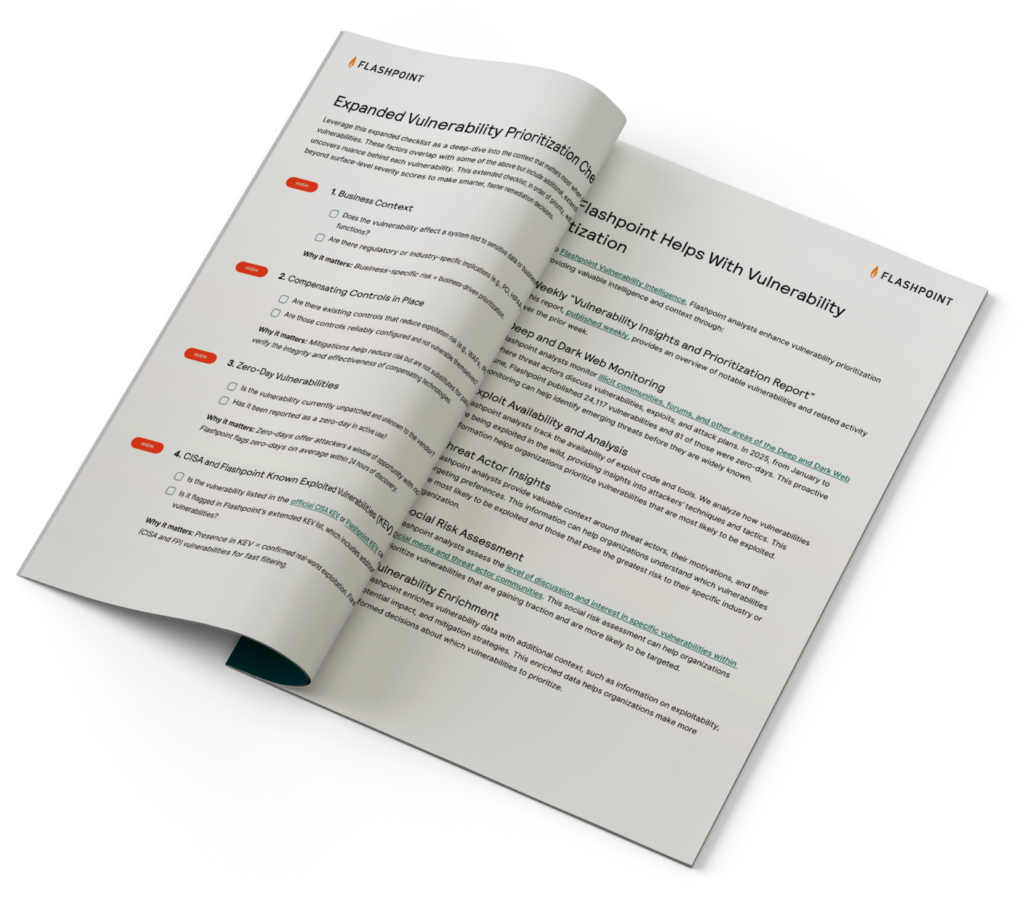
That’s why we created this guide, The Flashpoint Method for Threat-Informed Vulnerability Prioritization, a practical, intelligence-driven framework designed to help vulnerability and exposure management teams cut through the AI-driven noise and focus on the vulnerabilities that matter most. By incorporating real-world exploitation activity, threat actor behavior, asset exposure, business context, and remediation considerations, organizations can make faster, more informed decisions and reduce risk more effectively.
Download to gain:
A clear, threat-informed prioritization framework: How to assess which vulnerabilities demand immediate attention, and why — moving beyond static severity scores alone.
Core and expanded prioritization checklists: Criteria spanning asset criticality, active exploitation, CVSS severity and ransomware risk, social risk and community chatter, business context, compensating controls, zero-day status, KEV inclusion, EPSS scoring, ease of remediation, and vulnerability age.
How to operationalize prioritization at AI scale: Insight into how Flashpoint’s vulnerability intelligence platform and analyst expertise help teams keep pace as AI-assisted discovery accelerates disclosure volume.
Prioritize Vulnerabilities More Effectively and Faster Using Flashpoint
While increased visibility into vulnerabilities is ultimately a positive for defenders, it amplifies a challenge security teams already face—separating which vulnerabilities represent meaningful risk to your environment and require immediate action.
What is threat-informed vulnerability prioritization?
Threat-informed vulnerability prioritization is the process of evaluating vulnerabilities based on real-world risk rather than severity scores alone. It incorporates factors such as active exploitation, exploit availability, threat actor activity, asset exposure, business context, and remediation considerations to determine which vulnerabilities require immediate attention.
Why is vulnerability prioritization important?
Organizations face thousands of newly disclosed vulnerabilities each year, while security teams have limited time and resources to remediate them. Effective vulnerability prioritization helps organizations focus on the vulnerabilities most likely to be exploited and most likely to impact their environment.
How is AI changing vulnerability management?
AI-assisted code analysis is enabling researchers and organizations to identify software flaws faster and at greater scale. While increased visibility into vulnerabilities benefits defenders, it also increases the volume of vulnerabilities that security teams must evaluate, making effective prioritization even more important.
Why isn’t CVSS enough for vulnerability prioritization?
CVSS provides a standardized measure of technical severity, but it does not account for whether a vulnerability is actively being exploited, relevant to your environment, or likely to impact your business. Effective prioritization combines severity with threat intelligence and organizational context to assess real-world risk.
How does Flashpoint help organizations prioritize vulnerabilities?
Flashpoint combines analyst-driven vulnerability intelligence with real-world exploitation data, threat actor insights, asset exposure, and business context to help organizations identify the vulnerabilities that pose the greatest operational risk. This intelligence supports faster, more informed remediation decisions and operationalizes threat-informed vulnerability management at AI scale.
Understanding Illicit Ecosystems: Inside Rehub’s Rise as a Primary Ransomware Marketplace
As part of our ongoing series, Flashpoint intelligence tracks Rehub, breaking down its migration, infrastructure, and the various RaaS groups sponsoring and partnering with it.
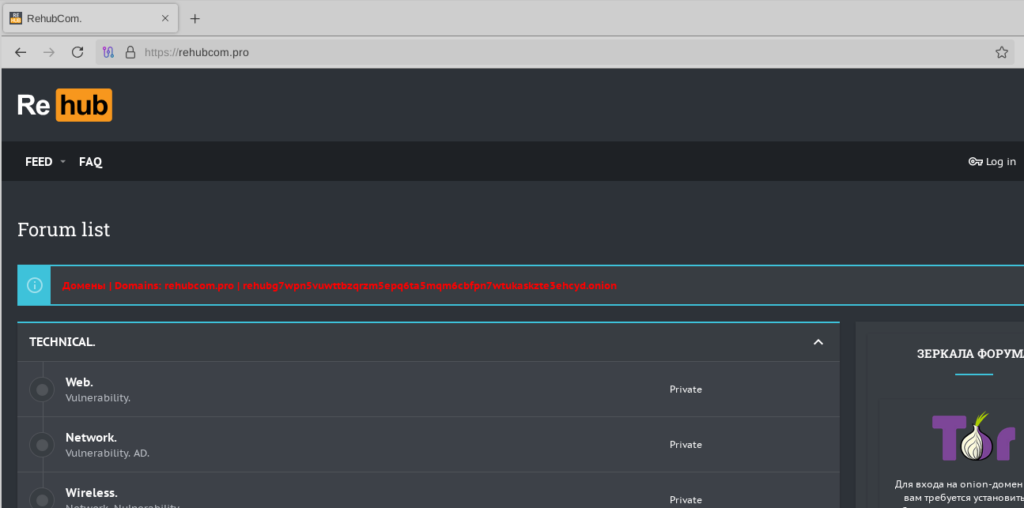
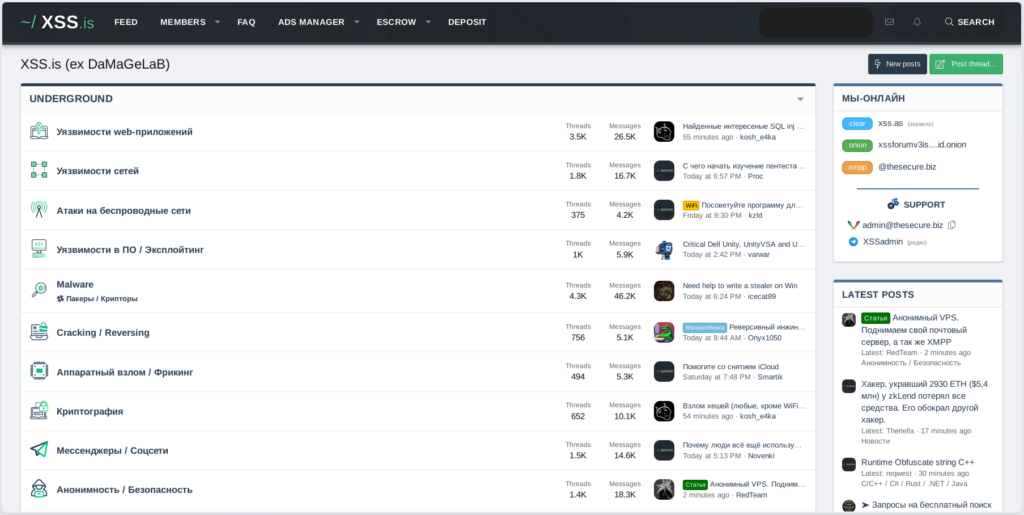
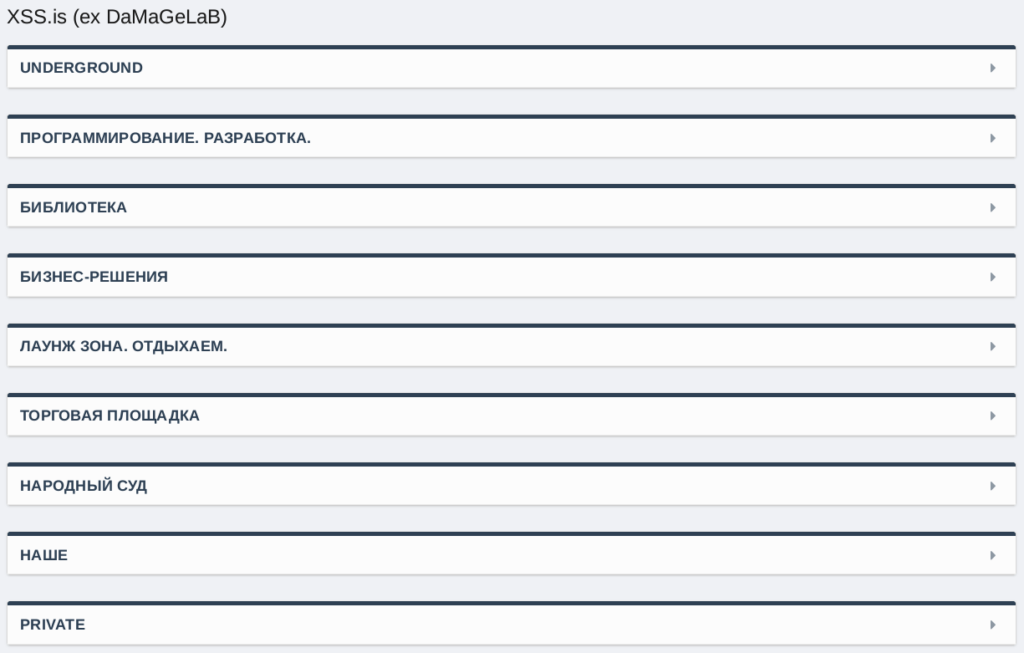
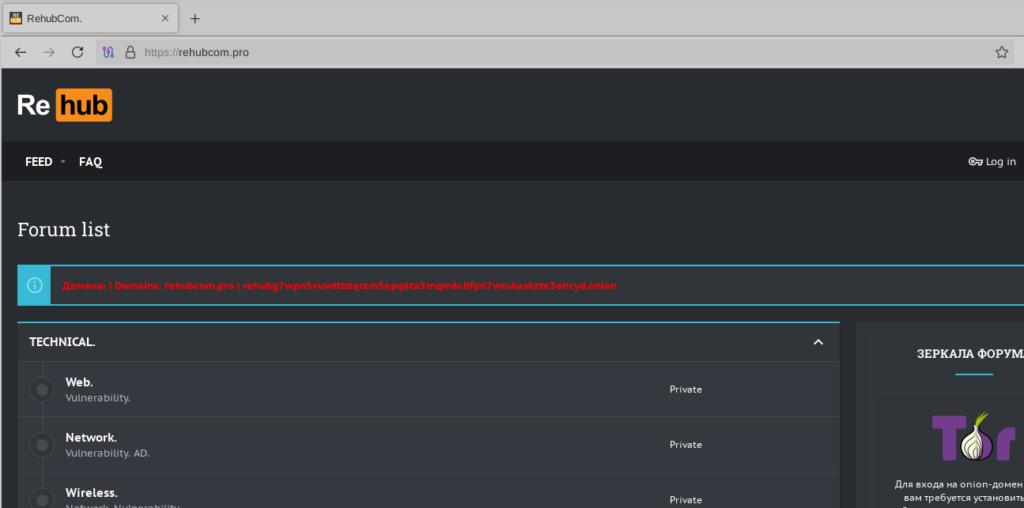
Rehub, also known as ReHub or RehubCom, is a Russian-language cybercrime forum founded in August 2025 by a former XSS moderator following its shutdown in the summer of 2025. Rehub dedicates itself to the commercial and marketplace use of ransomware, while its counterpart, DamageLib, serves as a knowledge base archive and exchange.
2025
July 23: XSS is taken down by law enforcement
August 1: XSS moderators launch DamageLib, which completely abandons illicit commerce.
August 10, 2025: Rehub forum is launched by a former XSS moderator, fully embracing illicit commerce.
January 28, 2026: RAMP is seized by law enforcement, with its users migrating to Rehub.
Operating both on Clear Web domains and an onion domain, the forum positions itself as free from state and law enforcement interference, framing existing XSS iterations as compromised. After law enforcement seized the RAMP (RAMP4U) forum in January 2026, Rehub absorbed a significant portion of the displaced cybercriminal community and became one of the primary destinations for ransomware operators.
The Rehub login page in August 2025, early stage of the forum. (Source: Rehub)
Who Are Known Members of Rehub?
There are many notable threat actors among Rehub moderators and users, including ransomware operators, vendors, and other prominent threat actors active across several illicit communities. Several current or ex-Rehub moderators were also maintainers of other illicit forums such as XSS, DamageLib, and RAMP.
Notably, Ransomware-as-a-Service (RaaS) groups such as DragonForce have maintained an active presence on the platform to market their affiliate programs. Flashpoint assesses that DragonForce is likely the forum’s primary sponsor or partner, as their banner is permanently displayed on the forum’s home page, with both logos merged—similar to its previous placement on RAMP.
The Rehub home page with the DragonForce logo. (Source: Rehub)
As of July 2026, Flashpoint intelligence observes over 8,300 active users, 15,000 posts, and nearly 3,000 threads. Despite being free to join, Rehub practices a zero trust policy, which was established in mid-April 2026. Under this system, the forum restricts newly registered users from accessing any section other than its Sandbox. Users can also purchase paid upgrades:
Premium status (gold rank): Costing US $100 per year, this rank grants distinctive color, custom title, nickname changes, unlimited post editing/deletion, extended signature, unlocks all hidden text regardless of post count, likes, join date, ability to bump commercial threads, and inherits all lower-tier perks.
Patron status(pink/magenta rank): Costing US $5,000 per year, this rank grants custom title editing, a personal profile link, custom styling for posts, profile, and postbit, and inherits all “Premium” perks.
The only section available to newly registered users on Rehub forum. (Source: Rehub)
What are the Various Rehub Forum Sections?
Rehub sections, similar to other forums, are grouped by major activities, separating the knowledge base from commerce and from general discussions.
The list of Rehub forum sections. (Source: Rehub)
Sandbox
Serves as an entry-level general discussion area and a place for community questions. Main activity consists of queries about operational security, introductory networking, and entry-level fraud or malware logistics.
Technical
Covers threads ranging from traditional network infrastructure vulnerabilities to emerging technologies such as AI jailbreaking and deepfake social engineering. Highly active, most communications focus on network vulnerabilities and carding.
Programming (Development)
This is a dedicated space for discussions on software engineering, system administration, and web optimization within the forum. Primary activities include sharing programming language tutorials, comparing backend technologies, and developing specialized automation tools.
Library
Serves as a repository of resources for the forum, hosting the most threads and community engagement. Users share operational materials, leaked databases, and utility software. Additionally, this section aggregates cybersecurity and tech industry news and articles.
Supermarket
This is a commercial section featuring ransomware affiliate programs, compromised network access, malware tools, stolen financial data, bulk spam infrastructure, forged documents, anonymous hosting, and crypto laundering services.
Arbitration
Serves as the forum’s internal justice system, where members resolve financial disputes and flag scammers. The “Black List” subsection functions as a public record of bad actors and scam sites.
Administration
This is where forum staff post announcements, policy updates, and operational notices, including rules, official domains, forum news, moderator applications, and 2FA requirements. Members use it to ask questions, request escrow services, propose features, and raise concerns about the forum’s public image.
Monitor Illicit Marketplaces Using Flashpoint
Flashpoint will continue to monitor Rehub’s marketplace activity and infrastructure updates. Rehub’s rapid evolution from a post-XSS refuge to a heavily sponsored ransomware marketplaces demonstrates the resilience of the cybercrime ecosystem.
Positioning itself as the primary ransomware marketplace, Rehub has built a high-barrier, high-reward environment for sophisticated threat actors. Request a demo to learn how Flashpoint delivers visibility into illicit communities—empowering security teams to track threat actors, identify exposed assets, and mitigate ransomware risks.
Inside Qilin Ransomware: Custom Rust Loader and Kernel-Level EDR Killer
In this post we analyze Qilin ransomware’s new custom Rust loader, break down the inner workings of its sophisticated kernel-level EDR killer, and explore how organizations can defend against these aggressive defense evasion tactics. Flashpoint customers can access the full intelligence report—complete with deeper technical analysis and all associated IOCs—directly within Flashpoint Ignite.
Qilin ransomware is a highly active and sophisticated ransomware operation that has rapidly modernized its evasion techniques. Historically focused on file encryption, the ransomware-as-a-service (RaaS) group has expanded its operations to include aggressive, kernel-level defense evasion. By deploying a specialized toolkit, Qilin now focuses heavily on blinding and permanently disabling endpoint security products before its main ransomware payload is executed on a victim’s network.
Flashpoint has observed Qilin quietly deploying a previously unreported custom packer, which has been actively observed in wild samples since May 2024, with continuous use detected as recently as last month.
Here’s how Qilin works:
How Qilin Ransomware Uses a Custom Rust Loader for Reflective PE Loading
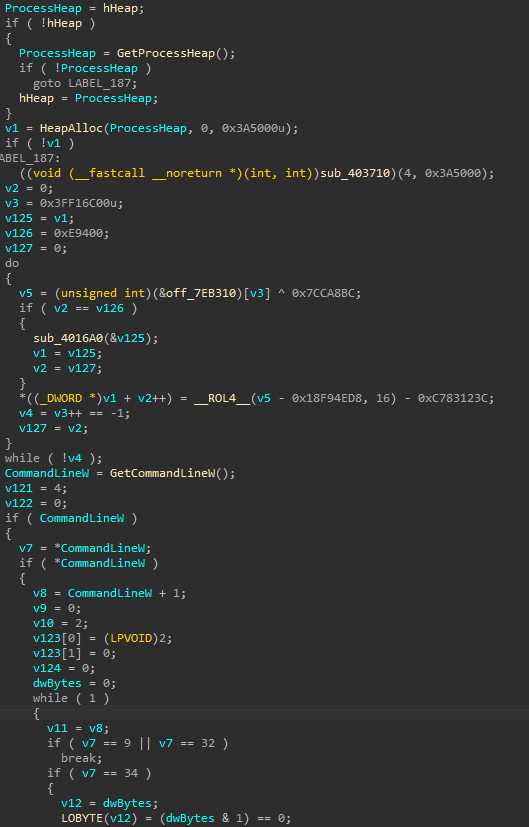
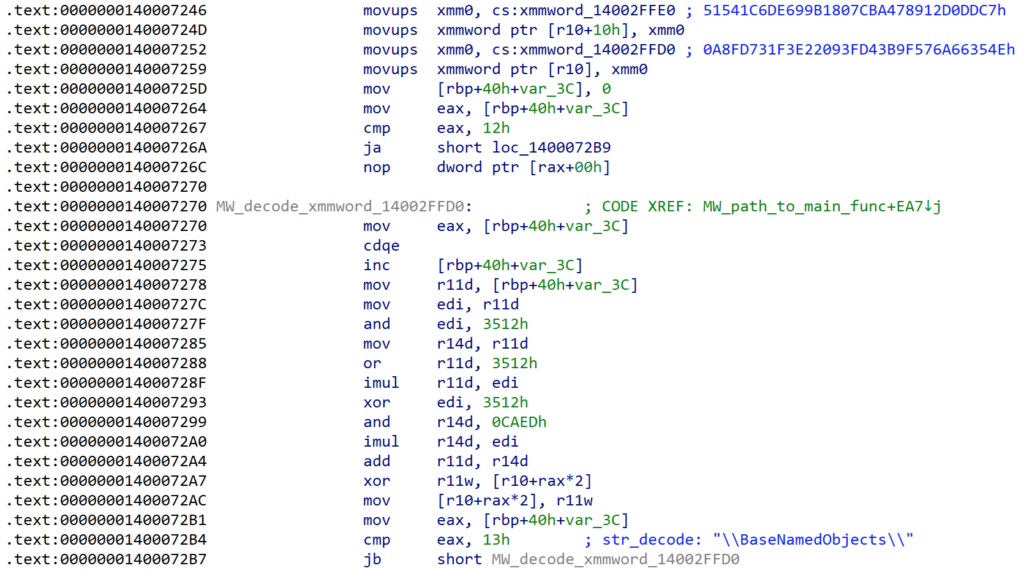
Flashpoint analysts observed a custom Rust-written loader that performs reflective Portable Executable (PE) loading of the ransomware payload. After deobfuscation, the code execution jumps to the newly unpacked executable within the same process, avoiding noisier process injection techniques. The following is an overview of the decompiled unpacking routine:
Decompiled code of Qilin ransomware unpacking routine. (Source: Flashpoint)
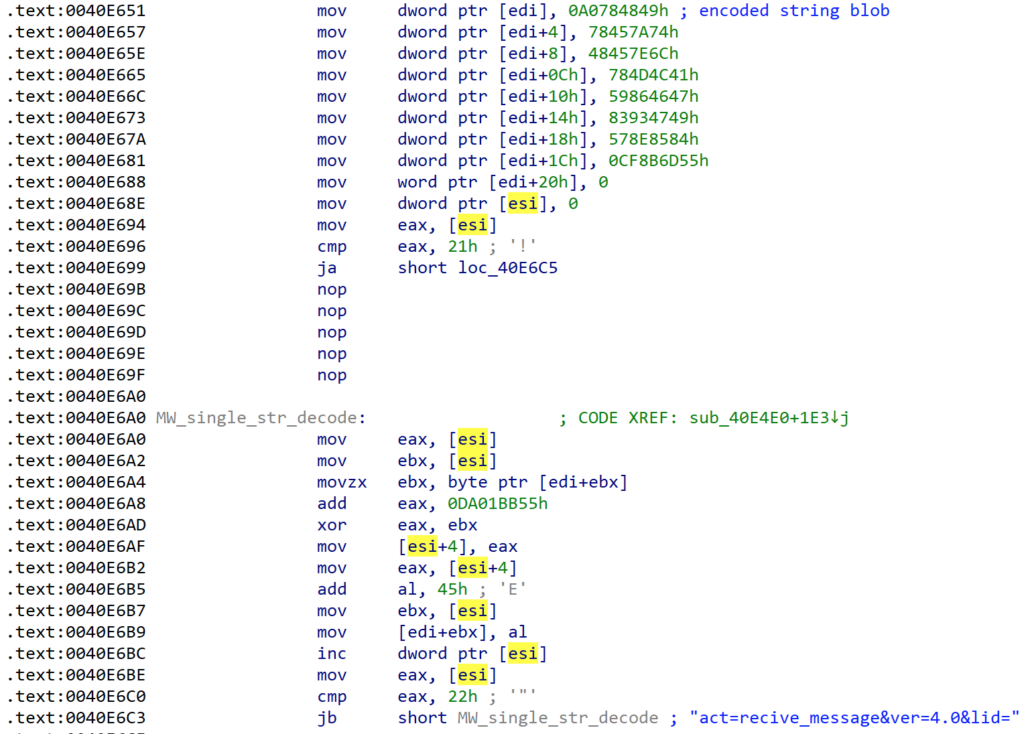
The unpacking routine then reads each DWORD from the embedded bytes, allocates it on the heap, and performs multiple mathematical operations to deobfuscate. Flashpoint notes that the calculations and values used were unique to each sample, but the underlying methodology remained the same.
Manually performing the calculations in the sample confirms the presence of the embedded binary, with the first deobfuscated DWORD yielding an ‘MZ’ header in little-endian format.
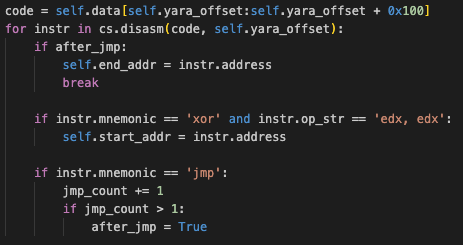
To better understand Qilin, Flashpoint analysts created an automated unpacker and configuration extraction script that uses CPU emulation to address the issue of unique calculations per sample. This script uses pattern matching to locate the unpacking routine within the binary. It then reads the disassembly, identifying specific points in the code at which emulation should start and stop.
Python code snippet reading the disassembly to find optimal areas to emulate. (Source: Flashpoint)
Reading the disassembly directly avoids issues arising from hardcoded offsets, such as when threat actors add or remove code, or when the compiler introduces changes. Additionally, it provides a smaller set of instructions for emulation, avoiding WinAPI calls and other invalid memory errors that often occur when emulating a full binary.
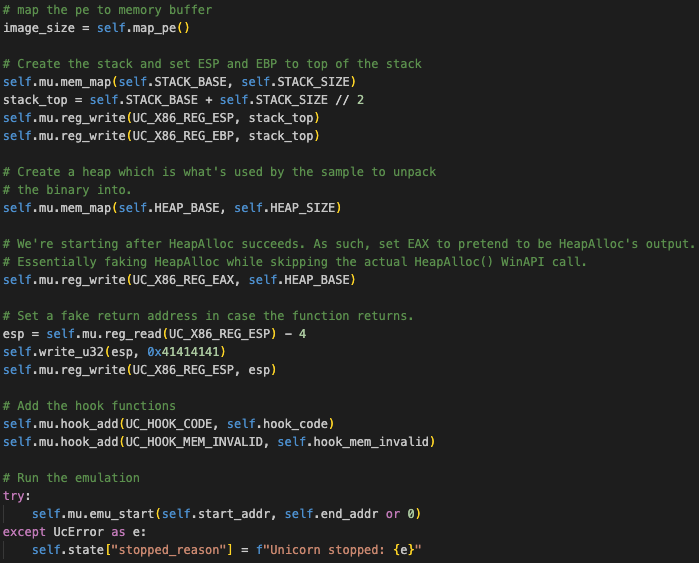
After additional setup, including mapping the sample into the emulator’s memory and creating a fake heap, the unpacking routine runs successfully.
Python code snippet performing CPU emulation to unpack the embedded binary. (Source: Flashpoint)
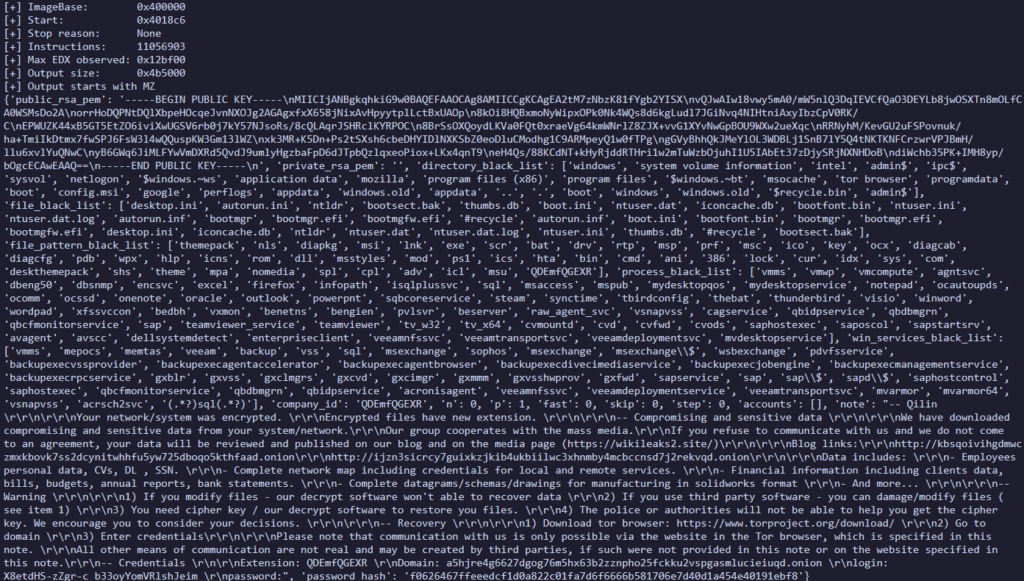
The script then performs configuration extraction from the deobfuscated bytes produced by the CPU emulation, achieving a 100% success rate.
Automated tooling successfully unpacking and extracting Qilin’s configuration. (Source: Flashpoint)
How Qilin’s New EDR Killer Blinds Security Products
An additional update with Qilin is its new endpoint detection and response (EDR) killer, which Flashpoint found to be sold on illicit marketplaces for US $2,000. This is packed via the Shanya packer—which was sold on XSS for US $100 to US $150 back in 2024. The packer is highly sophisticated, and uses several techniques that make it difficult to analyze, such as junk code, application programming interface (API) hashing, IAT hooking, pattern scanning, and VEH code execution flow.
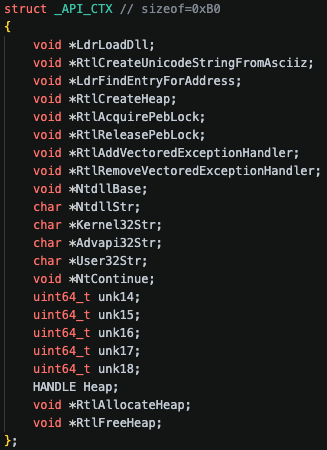
Once unpacked, the EDR killer starts by using dynamic API hashing and PE walking to resolve a number of useful NTAPI functions it will use throughout the process, and stores them in a structure located within the GdiHandleBuffer within the Process Environment Block (PEB).
The structure stored in the PEB itself looks as follows:
Recreated structure definition based on Flashpoint analysis. (Source: Flashpoint)
The API hashing algorithm is simple: it performs a bitwise OR of each character of the API name with hexadecimal value 0x20 to convert any and all uppercase characters to lowercase, then performing additional simple calculations.
The EDR killer compares the returned locale to a known locale blacklist to avoid attacking any Commonwealth of Independent States (CIS) countries such as Russia and Belarus.
The malware then attempts to give itself the following privileges by dynamically resolving and calling RtlAdjustPrivilege():
SE_PROF_SINGLE_PROCESS_PRIVILEGE
Required to gather profile information for a single process.
Used later to create a map of the victim machine’s physical memory space.
SE_DEBUG_PRIVILEGE
Required to debug and adjust the memory of a process owned by another account.
SE_LOAD_DRIVER_PRIVILEGE
Required to load or unload a device driver.
Abusing Vulnerabilities to Map Physical Memory
The EDR killer then writes a vulnerable driver to disk and loads this driver via Service Manager. This driver is the ThrottleStop driver from TechPowerUp LLC’s free and legitimate application of the same name, used to bypass CPU throttling. However, the driver suffers from a vulnerability, allowing the malware to map physical memory to kernel-mode virtual memory to perform direct kernel read and write operations.
Qilin weaponizes this vulnerability by feeding its EDR killer physical memory addresses, as the driver relies on the API to map physical memory to a kernel-mode virtual address. To achieve this, the EDR killer builds a physical memory map using a Windows memory management service that preloads frequently used applications into RAM.
First it gathers baseline information about all physical memory blocks. Because memory pages (typically 4KB) are allocated to physical blocks, hundreds of virtual pages can point to a single physical range.
It then calls the service to obtain detailed Page Frame Number (PFN) details. The malware stores this complete mapping in a global variable, giving it a reliable, built-in translation table between virtual and physical memory spaces.
Bypassing Driver Signing Checks
To run its own malicious tools, the EDR killer must first bypass Windows’ driver signing enforcement. Normally, Windows uses a built-in verification check to block unsigned or blacklisted drivers from loading. The malware tricks Windows into disabling this gatekeeper using a simple swap:
The malware finds a specific kernel function and uses its physical memory map to pinpoint its location.
It commands the vulnerable driver to scan this memory area for a specific byte signature. This leads directly to the Code Integrity callback table.
Within this table, the malware locates the built-in verification check and “patches” it with a harmless, dummy function.
Blinding Security Products
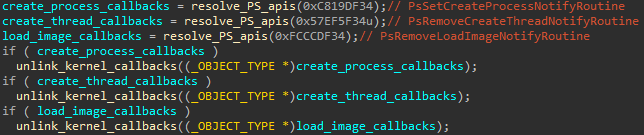
With driver signing checks completely bypassed, the malware uses its read/write primitives to dismantle system callbacks, it identifies and targets:
Process notify callbacks
Thread notify callbacks
Image load notify callbacks
Registry callbacks and minifilters
Rather than conducting a blanket unlinking of all system callbacks, the EDR killer checks the address of each callback. If the address falls within a memory range owned by a security product on its hardcoded blacklist, Qilin surgically unlinks it by zeroing out the pointer with null bytes.
Next, the EDR killer drops and loads its own custom driver, which appears to Windows as purpose-built. Once loaded, the Qilin EDR killer gets all relevant running processes. For any processes running that match a hardcoded list, it stores the Process ID in a vector.
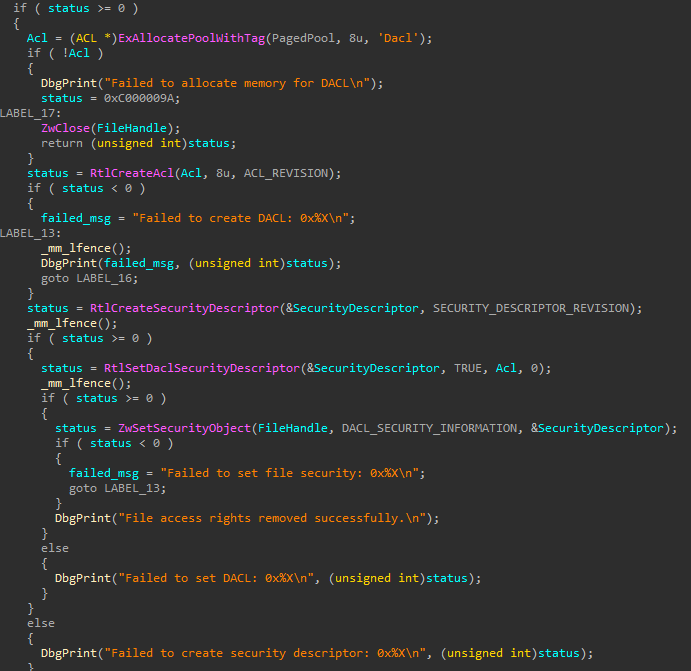
For every PID found, the malware sends a message to a driver. At a high level, the driver finds the full path of the target executable, makes it unreadable, unwriteable, and undeletable to any and all users, and then terminates the process.
Interestingly, the Qilin EDR killer performs a Discretionary Access Control List (DACL) modification on the target security product executable. The driver creates a new empty ACL header and sets the flag SE_DACL_PRESENT to TRUE. This is significant because a null DACL and empty DACL are not the same. A null DACL grants everyone access, whereas an empty DACL grants no access. This process makes it so that the security product’s executable can no longer be executed without needing to delete the file like other EDR Killers. Once the driver then terminates the executable, it can’t be restarted.
DACL modification to remove access to the security product executable. (Source: Flashpoint)
Once everything is completed, the EDR killer unpatches the Code Integrity Check to avoid triggering PatchGuard and then exits.
Defend Against Qilin Using Flashpoint
The sophisticated kernel-level manipulation highlights a rapidly expanding trend in the broader threat landscape: the proliferation of highly effective malware designed purely to disable enterprise-level security products. Qilin’s integration of these techniques demonstrates how the EDR killer market is maturing in the cybercrime underground, transitioning from a niche capability into a standard prerequisite for high-impact ransomware operations.
As security platforms continuously improve their detection mechanisms, Flashpoint believes the threat landscape surrounding anti-EDR tools will only grow larger and more aggressive, forcing organizations to focus on protecting the kernel and detecting rogue driver deployments. To learn more about Qilin and the latest advancements in ransomware, request a demo.
Understanding Illicit Ecosystems: How Dark Web Forums Structure Cybercrime
As part of our ongoing series, we analyze how dark web forums operate, breaking down Flashpoint’s tiered classification system and examining how specialized, hybrid platforms function together as an interconnected cybercrime supply chain.
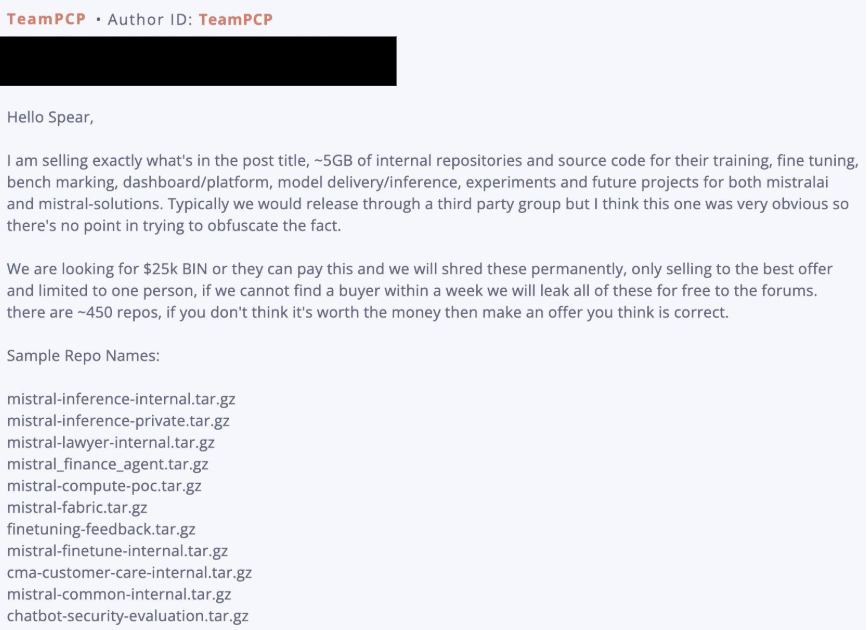
When a high-profile data breach hits headlines, the default assumption is often to view the dark web as a single, centralized marketplace where any illicit service or tool can be bought. While many illicit forums aspire to be seen as a “one-stop shop,” the reality is that the underground economy relies on an interconnected network of specialized hubs that each align with distinct phases of the cybercrime lifecycle.
To understand how cybercrime thrives, it is vital to learn how these online spaces survive and how they play their parts in graduating threat actors from entry-level novices to sophisticated adversaries.
Navigating the Cybercrime Ecosystem: Entry Barriers and Forum Tiering
An illicit community’s survival hinges on its operational value and culture, which is ultimately created by its supporters. In a low-trust environment filled with cybercriminals, hidden law enforcement, and security researchers, these digital spaces are inherently defensive. To protect their communities from competitors’ attacks, surveillance, and eventual takedowns, forums implement rigorous gatekeeping mechanisms.
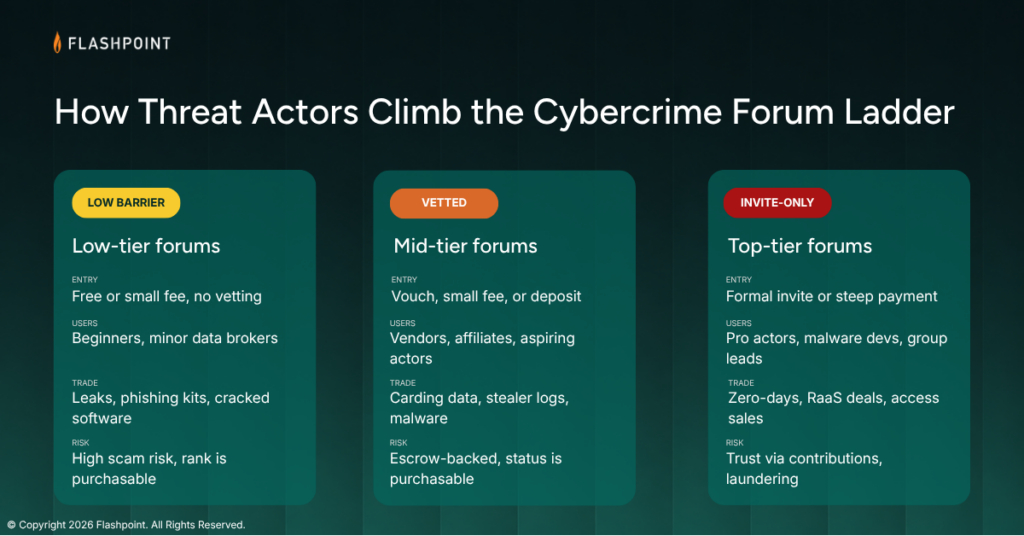
As such, Flashpoint organizes the cybercrime ecosystem into a tiered structure, separating them into low, mid, or top-tier forums, defined by several key factors such as:
Entry Barriers: The financial or reputational requirements for a user to join the community, indicating the forum’s exclusivity.
Technical Expertise: The collective technical skills and proficiency of the forum’s members.
Trade Quality: The quality and value of illicit goods and services exchanged, such as advanced hacking tools or high-value data leaks.
Operational Security (OP SEC): The extent to which the community upholds strict security protocols and practices.
By analyzing these vectors, the ecosystem naturally separates into three distinct operational tiers.
Low-Tier Forums
These communities are easily accessible, often requiring a small fee or completely free registration with little to no vetting. They host less sophisticated users, beginner hackers, and minor data brokers seeking free material. Because the technical barrier is low, these spaces primarily share low-cost, high-volume data, including large data leaks, generic phishing guides, unchecked stolen accounts, and cracked software.
Consequently, these environments face a persistently high risk of scams and poor quality data. Within low-tier forums, reputation is often built by sharing free data or purchasing a rank or upgrade which is viewable by other users.
Mid-Tier Forums
Moderately accessible via both Tor and the clearnet, entry into these spaces typically require a vouch from an existing member, a minimal registration fee, or an initial deposit. These platforms concentrate on large-scale fraudulent activity and the exchange of various datasets—including bulk carding data, stolen credentials, stealer logs, phishing kits, botnets, and various malware.
The user base includes a mix of vendors, experienced threat actors, affiliates of larger groups, and aspiring cybercriminals looking for training. To protect users from internal fraud, these forums heavily prioritize integrated escrow services and reputation systems, which can be improved by purchasing an internal high-tier status.
Top-Tier Forums
These are highly exclusive platforms dedicated to high-value, highly technical, and targeted criminal operations. New applicants face a stringent vetting process, typically demanding either a formal invitation or a substantial registration payment. This exclusive layer hosts highly skilled, professional threat actors, malware developers, and key decision-makers within major illicit groups.
This is the ecosystem where adversaries build trust through valuable technical contributions or community reputation points and execute complex money laundering schemes, trade zero-day exploits, facilitate ransomware-as-a-service (RaaS) partnerships, and conduct large-scale initial access broker sales.
What Are the Different Types of Dark Web Forums?
Once a community establishes its tier, it usually functions as a specialized hub linked to a specific stage in the overall cybercrime lifecycle. They do this to cultivate talent and expertise, which naturally bridges communities together, creating a supply chain where different forums handle distinct operational and structural needs.
General Information and Community Boards
Modeled after surface-web sites like Reddit, these platforms serve as social and informational hubs. Discussions prioritize coordination, reputation management, and the propagation of best practices regarding OPSEC. Users share news about cybercriminal arrests, look for advice on how to remain anonymous, report potential exit-scams, and provide detailed reviews of specific vendors, particularly those selling illicit drugs.
Financial Theft and Carding Forums
These semi-structured environments blend marketplaces with social networks, utilizing a professionalized supply chain for selling stolen cards, dumps, and fullz. To reduce internal fraud, they rely heavily on reputation-building tools like verified seller statuses and integrated refund systems for invalid data. To ensure operational longevity, they are typically hosted on bulletproof infrastructure located in states that do not comply with international takedown requests, such as the Russian Federation.
Data Leak Forums
Depositories for stolen databases where raw breach information is structured into a tradeable commodity. Leaks are listed by victim name and sector, allowing actors to quickly find credentials or corporate records to repurpose for credential stuffing, extortion, or identity fraud.
Cracking and Hacking Tutorials (Knowledge Bases)
Existing entirely for knowledge exchange and offensive techniques, threat actors share methods, tutorials, fraudulent schemes, and bypass techniques, often encouraging educational sharing through competitions.
High-Skill Exploit and Access Forums
Top-tier platforms hosting the “upper echelons” of the community, such as initial access brokers, exploit developers, and malware creators. They rely heavily on strict arbitration systems, mandatory vendor deposits, and escrow mechanisms to safely conduct high-impact transactions and corporate intrusions.
Low-Barrier Retail Forum
High-traffic segments trading mass-market digital goods like cracked subscription accounts, premium software, and online gaming assets. Characterized by an exceedingly low barrier to entry and a relatively young user base seeking quick profit without the capability for advanced, complex operations.
Map the Illicit Pipeline Using Flashpoint
What makes the cybercriminal ecosystem truly cohesive is that the lines between these various types of forums and communities constantly blur. Most illicit communities are hybrid and transitional, intentionally or naturally blending categories to cater to each other’s needs and boost monetization.
Hybrid forums frequently connect the how-to tutorials with actual stolen data and network access, effectively creating a structural pipeline for threat actor progression. Platforms like BreachForums combine the attention-grabbing aspect of a data leak site with a structured marketplace for selling logs and other sensitive data. This type of hybridization allows a threat actor to progress from a beginner reading tutorials to an active criminal deploying stolen data.
Monitoring these fluid structures and transitions is the only way to understand how threat actors develop, and how the interconnected cybercrime landscape shifts over time. Therefore, it is essential for security teams to look beyond cyber threats as isolated, and recognize the multi-platform strategies these actors employ. Request a demo to gain visibility into these threat actor communities and proactively defend your organization from across the entire cybercrime supply chain.
Check out the rest of our “Understanding Illicit Ecosystems” series:
In this post, we explore how AI is reshaping cyber threat intelligence and why governance, transparency, and trust are becoming increasingly important as organizations rely more heavily on AI-generated insights and autonomous capabilities.
Artificial intelligence has quickly become embedded across cyber threat intelligence workflows.
Throughout research and analysis, enrichment, prioritization, and operational response, AI is helping organizations process large volumes of information and move more quickly from collection to action. As these capabilities mature, the conversation is moving beyond what AI can do, toward how organizations can trust, validate, and govern AI-generated intelligence.
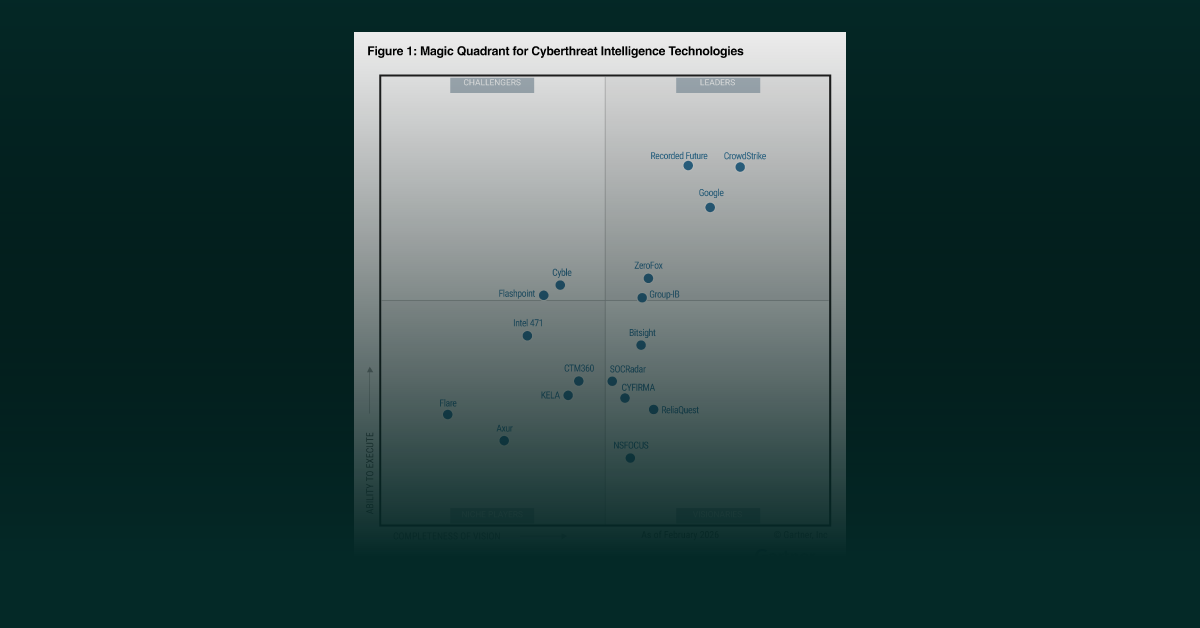
Flashpoint has been recognized in the 2026 Gartner® Top 5 Vendors for AI Capabilities in Cyberthreat Intelligence Technologies: Governance & Trust research. Flashpoint was also named a Challenger in the 2026 inaugural Gartner Magic Quadrant for Cyberthreat Intelligence Technologies. The report recognizes five top vendors, including Flashpoint, across AI foundational elements within CTI and examines the governance, oversight, and trust mechanisms that help organizations use AI responsibly within intelligence operations.
Gartner notes in the report that “as organizations increasingly depend on autonomous agents from CTI vendors, the need for robust governance and trust frameworks has become critical.”
Trust Has Always Been the Foundation of Threat Intelligence
For intelligence teams, trust is not a new concept.
Analysts regularly evaluate the credibility of sources, validate claims, assess confidence levels, and determine whether reporting is relevant to their organization’s mission. The quality of intelligence has never been determined solely by how much information is available. It depends on whether that information is precise, timely, and accurate enough to move the needle and safely drive an operational decision.
AI, however, introduces a new layer to that process.
Organizations are increasingly leveraging AI to assist with enrichment, summarization, prioritization, and analysis. Those capabilities can accelerate workflows significantly, but they also introduce new questions.
How was a recommendation generated?
What evidence informed it?
How confident should an analyst be in the result?
What safeguards exist when the output is used to drive operational decisions?
Ultimately, these are questions of operational risk and data integrity, not just technology features. Analysts must be able to interrogate a system’s reasoning just as they would any other source.
Governance Is Becoming a Core Requirement
Establishing analytical trust is essential, but it requires strict operational guardrails to function safely at scale. This is where governance moves from an item on a checklist to a core requirement.
Many of the conversations around AI in cybersecurity focus on capability.
Can an AI system summarize faster?
Can it identify relationships that would otherwise be missed?
Can it reduce analyst workload?
While speed and scale are essential, they only tell half the story. As organizations move AI closer to daily operational workflows, a second, more critical set of questions is emerging centering around control.
As Gartner explains, “Agent governance and trust ensures that only authorized users and agents can access and manage sensitive threat data through role-based permissions and approval workflows.”
From our experience, by implementing these structural protections — alongside comprehensive audit logging — security leaders can ensure that AI-driven actions remain fully transparent, secure, and accountable. Governance isn’t about slowing down automation; it’s about establishing the administrative guardrails that dictate exactly who—and what—is allowed to execute a sensitive operation within the enterprise.
This oversight is becoming a foundational necessity as threat intelligence breaks out of traditional security silos. Because CTI increasingly informs vulnerability management, fraud investigations, executive protection, security operations, and enterprise risk programs, the downstream impact of an inaccurate recommendation can disrupt an entire enterprise. This underscores the importance of understanding not only what an AI system recommends but also how it arrived at that recommendation in the first place.
AI Changes the Scale (and Reaps the Context) of Intelligence Operations
One area where AI has a massive, immediate impact is scale.
Threat intelligence teams today are completely inundated with data. Malicious activity spans encrypted messaging platforms, illicit criminal marketplaces, forums, social media, vulnerability disclosures, and vast streams of infrastructure telemetry. Even the most mature, well-resourced teams struggle to manually ingest and process this sheer volume of information.
When applied appropriately, AI elegantly solves this bottleneck. Automation acts as an incredible force multiplier — accelerating time-consuming foundational tasks like research, cross-language translation, data enrichment, summarization, clustering, and correlation. Large language models can process information at scale, reducing the manual effort required to move from collection to analysis.
The critical challenge, however, is ensuring that this massive injection of speed does not come at the expense of context.
Threat intelligence is fundamentally a contextual discipline. A standalone indicator, isolated vulnerability, or single threat actor reference rarely carries meaning on its own. To act safely, analysts must understand exactly where information originated, who is discussing it, how widely it is being shared, and how it relates to broader activity across the threat landscape.
What AI cannot do independently is establish that context. While machines are exceptionally effective at identifying patterns across vast datasets, they inherently lack source validation, analytical rigor, and nuanced judgment. If an AI accelerates the data pipeline but strips away the underlying context, assessing confidence becomes impossible, making informed decision-making even harder.
This is why Flashpoint champions a “human-led, AI-scaled” model. True scalability isn’t about replacing analysts with autonomous bots; it’s about using machines to conquer the overwhelming noise of the threat landscape while keeping the resulting intelligence heavily grounded in expert-reviewed sources. As AI capabilities continue to mature, context becomes more important, not less. The organizations that derive the most value from automation will be those that pair machine-scale processing with human-in-the-loop review to ensure every output can be validated, contextualized, and confidently acted upon.
What Security Leaders Should Be Evaluating
As AI becomes a larger component of cyber threat intelligence platforms, security leaders have an opportunity to evaluate these capabilities through a broader lens than automation alone.
The Gartner report provides a useful framework for thinking about these questions, particularly around governance and trust. Rather than focusing exclusively on what an AI system can do, Flashpoint recommends that organizations rigorously evaluate how those capabilities are managed, validated, and controlled.
Some of the most important areas to evaluate include:
Explainability
Question to ask: Can analysts trace how an AI-generated recommendation or conclusion was produced?
The ability to review supporting evidence, understand contributing factors, and see outputs back to underlying intelligence sources is becoming increasingly important as AI is used to support operational decisions.
Confidence and Validation
Question to ask: How does the platform communicate confidence in AI-generated outputs?
Threat intelligence has always relied on confidence assessments. As AI-generated insights become more common, organizations should look for configurable confidence thresholds that allow them to tailor automated actions to their corporate risk tolerance.
Governance and Oversight
Question to ask: What controls exist around the use of AI?
Capabilities such as role-based permissions, approval workflows, and audit logging are critical governance mechanisms for organizations seeking to maintain accountability and trust in AI-driven processes.
Operational Impact
Question to ask: How does AI improve intelligence workflows in practice?
The most valuable AI capabilities are often those that help analysts spend less time on repetitive tasks and more time on investigation, analysis, and decision-making. Understanding where AI fits into the intelligence lifecycle can help organizations distinguish between meaningful operational improvements and isolated feature enhancements.
Looking Ahead
The conversation around AI in threat intelligence is still evolving, but the direction of travel is becoming increasingly clear. Organizations are looking beyond standalone AI features and placing greater emphasis on governance, transparency, and accountability.
Taken together with broader industry trends, this points to a threat intelligence market that is becoming increasingly sophisticated. Organizations are evaluating not only the quality and uniqueness of intelligence itself, but also how that intelligence is operationalized, how AI is applied, and how trust is maintained throughout the process.
We believe that shift reflects the realities of modern intelligence work. Speed and scale remain important, but neither replaces the need for context, validation, and informed decision-making.
For security leaders evaluating AI capabilities within cyber threat intelligence platforms, Gartner’s research offers valuable insight into how the market is evolving and what requirements are likely to become increasingly important in the years ahead.
Gartner does not endorse any company, vendor, product or service depicted in its publications, and does not advise technology users to select only those vendors with the highest ratings or other designation. Gartner publications consist of the opinions of Gartner’s business and technology insights organization and should not be construed as statements of fact. Gartner disclaims all warranties, expressed or implied, with respect to this publication, including any warranties of merchantability or fitness for a particular purpose.
Gartner, Top 5 Vendors for AI Capabilities in Cyberthreat Intelligence Technologies: Governance & Trust, Jonathan Nunez, Jaime Anderson, June 15, 2026.
Gartner, Magic Quadrant for Cyber Threat Intelligence Technologies, Jonathan Nunez, Carlos De Sola Caraballo, Jaime Anderson, May 4, 2026.
Gartner and Magic Quadrant are trademarks of Gartner, Inc., and/or its affiliates.
The underground marketplace rarely stays quiet for long. A new information-stealing malware dubbed Remus Stealer has surfaced in the cybercrime underground, exhibiting significant similarities to the notorious Lumma malware family across its administration panel, stolen log files, and core code structure.
Despite parallels in its code and functionality, threat actors are eagerly buying into the platform. In addition to its familiar features, it provides attackers with a distinct, modern command and control (C2) and networking infrastructure designed to slip past current security perimeters.
What We Know About Remus
Flashpoint first observed Remus appearing for sale within illicit communities in March 2026. The malware listing offers similar functionality to other popular Malware-as-a-Service (MaaS) offerings, including Google OAuth cookie restoration and Telegram channel integration for logs.
Much like the Lumma malware family, the Remus subscription service operates on a three-tiered access model:
Basic: US$250
Pro: US$500
Enterprise: US$1,000
At this time, Remus has no additional channels or automated bots associated with its sale or distribution. Despite undeniable similarities to Lumma, its developer claims to not be a rebrand of the Lumma project.
Since March 2026, Remus has continued its operations mostly unhindered by negative associations associated with Lumma—particularly the doxxing of its panel in August 2025.
Similarities to Lumma
Similarities can be observed in the Remus and Lumma panels in both aesthetics and functionality. Both panels use similar assets for tab icons and have embedded advertisements for other illicit services such as packers and log clouds. Harvested logs also share extremely similar directory structures in log files, including unique identifiers.
Remus is a 64-bit compiled binary, and Lumma was a 32-bit binary. However, major similarities between the code bases of both malware can be observed.
Upon execution of an unpacked sample, both Remus and Lumma will send warning messages to the user that the build is unpacked. This was a unique phenomenon first established by Lumma several years ago. In both Remus and Lumma samples, the pack check and window message are performed before the main functionality of the malware.
In both Remus and Lumma, a function is used first to check if the sample is packed, and a second function is used to send the window error message.
Remus uses similar string obfuscation methods to Lumma, in which each string has been uniquely encoded and then decoded during runtime. Deobfuscation occurs by looping byte by byte through encoded blobs. Each encoded string is obfuscated by a unique pattern. This can be seen in the code samples below:
Of note, both samples have at least one NOP instruction between the encoded blob being moved onto the stack and the deobfuscation loop.
Another unique feature of Lumma is the presence of a plaintext identifier string used to link customers to specific build generations. In Lumma, this string was referred to as the LID (Lumma ID), and this ID method appears in Remus as well as a “tag.”
Lumma ID (Source: Flashpoint)Remus tag (Source: Flashpoint)
Like the Lumma LID string, the Remus tag could be leveraged to attribute variant builds and campaigns to single threat actors or groups.
Additionally, both Remus and Lumma exhibit similar control flow obfuscation by replacing direct jumps with indirect jumps read from offsets that have been moved onto the stack, jumps computed from a jump table, and jumps resolved by a pointer.
Differentiators of Remus
Although Remus bears remarkable similarities to Lumma, its main differences lie in its C2 beaconing.
Before performing main stealer functionality, Remus will beacon out to its C2 infrastructure. It will attempt to resolve several domain:port combinations via POST requests, and attempt a final connection to find the C2 server using EtherHiding. If it is unable to connect, the malware will terminate.
After a connection is established, the stealer sends a POST request to the C2 in order to receive an access token. Once received and decoded, this access token is used to receive encrypted config data used by Remus to target assets on the victim system. Data collected for logs is then exfiltrated as encrypted POST data.
Network traffic from Remus sample (Source: Flashpoint)
Protect Against Infostealers Using Flashpoint
Remus stealer represents a sophisticated continuation of the MaaS infostealer model left behind by Lumma’s collapse. While the developer asserts independence, the overwhelming code overlaps, matching obfuscation techniques, and administrative panels indicate that Remus is either heavily inspired by, or derived from the Lumma codebase. These traits have allowed it to thrive, providing threat actors with a familiar, robust alternative that sidesteps the reputational baggage and law enforcement scrutiny of its predecessors.
Flashpoint continuously tracks the latest developments in illicit communities, hard-to-reach adversary spaces, and malware repositories to identify emerging threats. Request a demo to learn how Flashpoint’s primary source collections and analyst insights empowers your security teams.
In this post we break down the intersecting cyber risks, physical security strains, and operational challenges shaping the security landscape for the historic Semiquincentennial celebrations.
As the United States prepares to mark its 250th anniversary this Fourth of July, the convergence of historic national celebrations, sprawling public events, and simultaneous high-profile sports tournaments is creating an exceptionally complex threat landscape. The multiyear national initiative “America250,” features over 1,200 synchronized grassroots gatherings under the “America’s Block Party” umbrella, with flagship events taking place in Washington DC, Philadelphia, Boston, New York, and Los Angeles.
Key Takeaways
While public sentiment surrounding America250 remains broadly positive, Flashpoint analysts have assessed the physical, cyber, and operational threat vectors that organizations, security teams, and municipalities must navigate during this high-visibility holiday weekend.
America250 Threats & Security Challenges:
Distributed Physical & Infrastructure Strain: Massive tourism influxes will collide with ongoing 2026 FIFA World Cup matches in Houston and Philadelphia on July 4, putting historic operational pressure on metropolitan transit grids and soft targets.
Elevated Iconicity and “City of Concern” Status: Although no specific, credible plots have been confirmed, the National Mall events in Washington, DC have received their first-ever National Special Security Event (NSSE) designation. Meanwhile, the National Counterterrorism Center (NCTC) has officially designated Philadelphia a “city of concern” due to the volume of synchronized events.
Ideological Protest Dynamics: Activist groups are organizing a significant anti-authoritarian march in Philadelphia. While expected to be peaceful, open-source chatter indicates a portion of attendees plan to exercise their license to carry firearms.
Disruption & Cyber Threat Vectors: Cyber threat groups, ransomware operators, and hacktivists are expected to attempt to exploit thin holiday IT staffing. Threat vectors range from mass public-transit ticketing fraud to high-consequence digital hoaxes involving rogue cellular infrastructure.
Physical Threat Vectors
Transportation and Infrastructure
Flashpoint assesses that “lone wolf” actors motivated by various ideological grievances, including those inspired by foreign terrorist organizations (FTOs), pose the most likely threat of disruptions to transportation infrastructure during America250 events. This threat is likely to apply to all major transport hubs during the event, including Washington DC, Philadelphia, New York City, and Boston. Attendees can expect to see an increased police and military presence near transit hubs at major events.
Event Threats
While no specific credible threats targeting America250 events have been identified, the July 4th events taking place on the National Mall in Washington DC, have been given a National Special Security Event designation, which is typically reserved for events deemed potential targets for terrorism or other criminal activity. This is the first time such a designation has been given to July 4th celebrations on the National Mall.
Memos released by the National Counterterrorism Center to security agencies also identified Philadelphia as a “city of concern” regarding potential targets for terror attacks due to the number and scale of events taking place on July 4th. Law enforcement officials have indicated that while no specific threats have been identified, increased security measures will be in place throughout the city.
Planned Protest
The Fayetteville Resistance Coalition, alongside Veterans Against Fascism, and the Women’s March is organizing an anti-authoritatian protest march in Philadelphia on July 4th—being the largest mobilization of military veterans in decades.
Flashpoint has identified chatter indicating that march attendees may be armed. However, Flashpoint has not identified any calls for violence at this protest and deem that actions will likely remain peaceful. Despite this, arrests may be possible if attendees gather in unauthorized areas or engage in civil disobedience.
Cyber Threat Vectors
Ransomware and Operational Technology (OT) Disruptions
Financially motivated threat actors frequently deploy ransomware during major US holiday weekends when corporate and municipal IT security staffing is historically thin.
Flashpoint analysts assess that attackers could target automated ticketing systems, regional rail signaling, and digital municipal transit grids. Disruption to public transit during the high-density travel window surrounding major events could induce logistical gridlock. Secondary targets include municipal water treatment facilities, local power grids, and emergency response (911) dispatch systems in primary host cities.
Hactivism
With hundreds of thousands of spectators gathering at prominent national landmarks, hacktivist groups seeking political leverage or global media visibility pose an elevated threat to public messaging infrastructure.
Compromising the digital billboards, stadium screens, or viewing decks used for America250 events presents an attractive vector for defacement. Adversaries may attempt to display political propaganda, anti-war messaging, or explicit content to captive, high-density crowds.
Event App Vulnerabilities and Data Harvesting
The decentralized nature of “America’s Block Party,” featuring over 1,200 grassroots events managed via localized apps, introduces software supply chain vulnerabilities.
Cybercriminals may target the ticketing infrastructure of high-profile, restricted-access events. Phishing campaigns, credential stuffing, or application programming interface (API) vulnerabilities within event-specific mobile applications could result in mass ticketing fraud, legitimate attendees being locked out, or crowd-control issues at venue gates.
Additionally, malicious actors frequently deploy spoofed public Wi-Fi networks around high-density tourist hubs to harvest sensitive personal data, financial credentials, and biometric profiles from unsuspecting attendees.
Protect People Using Flashpoint
To ensure attendee safety, safeguard operations, and protect public-facing brands, Flashpoint recommends implementing the following proactive measures:
Secure Public-Facing and Display Infrastructure: Implement strict access controls, multi-factor authentication (MFA), and offline fail-safes for all internet-connected digital signage, stadium screens, and public notification systems to prevent hacktivist defacements.
Audit Event Applications and Mobile Endpoints: Conduct rigorous vulnerability scans on event-specific APIs and ticket validation platforms. Advise personnel and contractors against posting photographs of official credentials, badges, or operational passes on public social media channels.
Establish Out-of-Band Incident Response Protocols: Prepare alternative communication channels and verified public-address messaging to immediately counter potential rogue emergency broadcasts, digital hoaxes, or localized telecom disruptions that could cause public panic.
Monitor High-Risk Overlap Zones: Cross-reference physical security deployment schedules in cities like Philadelphia where World Cup traffic, official America250 parades, and armed protest routes intersect near major transit networks.
Ensure your security team has full visibility into the cyber and physical threat vectors shaping this historic holiday weekend. Request a demo and see how Flashpoint equips organizations with the intelligence needed to detect, analyze, and mitigate emerging risks.
Unmasking the Digital Trail: Essential Techniques for Vetting AI-Generated Content
In our latest on-demand webinar, we outline the practical, human-driven techniques threat intelligence teams must deploy to detect synthetic media, protect corporate RAG ecosystems, and filter through the noise of AI-polluted networks.
In the era of generative artificial intelligence (AI), threat intelligence is facing a profound signal-to-noise challenge. AI has introduced a massive paradigm shift to threat actor operations—making execution extremely easy while simultaneously dramatically complicating the task of verification for security teams.
In our latest on-demand webinar, Matt Edmonson, SANS Senior Instructor and founder of Argelius Labs, joined Flashpoint to discuss the intersection of Open Source Intelligence (OSINT) and AI. Drawing from his vast federal law enforcement experience, he shared actionable, human-driven techniques for detecting and vetting AI-generated online content.
Neutralizing the Automated RAG and Vector Database Trap
Before deploying any human-driven vetting techniques, an analyst must understand the specific structural trap threat actors are laying. Adversaries are no longer just using AI to spin up isolated phishing copy; they are using it to corrupt the automated defense pipelines that security teams rely on.
Modern threat intelligence workflows utilize automated ingestion to feed open-source data directly into local vector databases and Retrieval-Augmented Generation (RAG) models. Aware of this, sophisticated threat actors deploy a coordinated infrastructure strategy: they register multiple lookalike domains simultaneously to broadcast the exact same AI-generated disinformation narrative.
When automated security tools ingest this data, the system flags multiple distinct “sources” confirming the story as truth. This structural echo chamber completely bypasses automated verification safeguards, polluting corporate databases with validated lies. We have seen this play out via:
Long-Game Credibility Building: Edmonson highlighted an active Foreign Malicious Influence (FMI) campaign utilizing a French lookalike news site called Verite Cache (“The Hidden Truth”). The threat actors scrape legitimate Western news, use AI to rewrite it to build structural domain authority over time, and then manipulate narrative outcomes the moment a critical geopolitical event or election occurs.
Simultaneous Infrastructure Deployment: This pattern was mirrored in Southeast Asia, where Singapore recently banned six lookalike news sites targeting regional discourse. Upon technical inspection, five of those six distinct domains had been registered on the exact same day to broadcast a unified narrative.
Organic-Looking Algorithmic Surges: The scale of these operations can shift political landscapes in a matter of days. Romania recently took the extreme step of canceling and restarting its presidential election due to a covert, highly coordinated Russian-backed social media campaign. The operation used synthetic assets to trigger algorithmic recommendation engines, driving an intense, seemingly organic surge for an underdog candidate.
Triangulating AI Flaws and Anomalies Across Modalities
Vetting AI content relies on compiling a cluster of intersecting indicators across text, images, audio, and video until a definitive analytical confidence level is reached. While generative tools have grown highly sophisticated, they are still bound by mathematical constraints and architectural limitations. Catching these errors and inconsistencies requires analysts to identify a cluster of intersecting indicators across text, images, audio, and video:
Textual Analytics (Linguistic Quirks and Filler Text): Large Language Models (LLMs) leave distinct behavioral footprints. Analysts should look for commonly-used AI wordings and “portable sentences”, as well as automated translation leakage that reveals a threat actor’s native language mechanics.
Visual Logic Flaws (Physics and Seams): AI models frequently fail to grasp the fundamental physics of the real world. Analysts should closely inspect image logic for anatomical blunders (such as inverted hand structures), impossible geometry, or objects with extreme structural flaws. Additionally, AI struggles with “texture seams”—the exact boundaries where distinct textures meet.
Auditory and Video Glitches (Cadence and Duration): Human speech is inherently messy, characterized by breathing pauses, environmental background noise, and shifting cadences. Synthetic speech is often locked into a perfectly uniform, monotone rhythm. Furthermore, high-fidelity deepfakes are incredibly resource-intensive to sustain over long durations. While an actor can fake 10 to 15 seconds of synthetic video convincingly, a five-minute video will almost always display jarring cuts, visual artifacting, or avatars clipping out of frame.
Empowering the Human Layer | Watch the Full Webinar
Human analysts remain the most critical layer of defense against illicit uses of AI. Empowered by comprehensive threat intelligence, OSINT, and AI technologies, security teams can hunt for clusters of intersecting indicators across text, images, audio, and video to assess authenticity. To learn more and to gain more essential techniques, watch the full on-demand webinar. Using Flashpoint, organizations can filter through noise, execute critical data premortems, and neutralize sophisticated disinformation campaigns.
The Shift to Threat-Informed Prioritization: Operationalizing CISA BOD 26-04
In this post, we examine how CISA BOD 26-04 shifts the industry away from flat CVSS scoring and details how Flashpoint bridges the critical data gaps left by public vulnerability repositories.
With the recent issuance of Binding Operational Directive (BOD) 26-04, CISA has officially shifted federal policy away from static severity scores and flat patching timelines toward threat-informed prioritization. The move reflects a reality security teams have grappled with for years: not all critical vulnerabilities post the same risk, and not all active vulnerabilities receive the highest CVSS scores.
Traditional vulnerability management programs have often relied on severity-based patching models that force resource-constrained teams to focus on large volumes of high-scoring vulnerabilities. Yet research consistently shows that threat actors routinely exploit a broader range of weaknesses, including lower-scoring vulnerabilities on internet-facing assets, to gain initial access and move laterally through victim environments.
While BOD 24-04 represents a significant step forward, there are still hidden challenges organizations will face as they adopt a risk-based approach. The operational reality is that executing a truly risk-based matrix validates what Flashpoint has maintained for years: effective vulnerability prioritization requires deep, contextual threat data. Unfortunately, the needed real-world metadata for this kind of context are simply not supported by public sources of vulnerability intelligence.
Understanding BOD 26-04
BOD 26-04 evaluates the urgency of a vulnerability by cross-referencing a security flaw against four distinct operational variables:
Asset Exposure: Is the asset publicly accessible via the internet?
Known Exploited Status (KEV): Is there verifiable evidence of active exploitation in the wild?
Exploit Automation: Can a threat actor completely automate the weaponization and delivery of the exploit?
Technical Impact: Does a successful exploit result in partial disruption or total compromise of the target system?
By analyzing these variables in tandem, organizations can tier their response and execute clear, defensible SLA metrics.
Risk Priority
Real-World Matrix Conditions
Required SLA & Operational Action
P1: Immediate Risk
In KEV + Publicly Exposed + Automatable + Total Impact
3 Days (Includes Mandatory Forensic Triage)
P2: Urgent Risk
In KEV + Publicly Exposed + (Either Non-Automatable OR Partial Impact)
7 Days
P3: Elevated Risk
In KEV + Internal / Non-Publicly Exposed Asset
14 Days
P4: Standard Risk
Not in KEV + Publicly Exposed + Automatable + Total Impact
30 Days
Deferred Risk
Not in KEV + Internal Asset OR Lower Technical Impact
Next Scheduled System Upgrade / Maintenance
According to CISA, the pilot testing of this model has shown that fewer than 1% of an organization’s typical vulnerability backlog requires urgent, immediate remediation, while over 60% can be safely deferred to standard system maintenance cycles. However, implementing this framework successfully requires access to granular, real-world data points that public sources of vulnerability intelligence simply do not support.
“Speaking with security teams in the wake of this directive, it is clear that BOD 26-04 is a major paradigm shift. While the ability to safely defer more than half of your patch backlog is an invaluable efficiency gain for modern organizations, executing that strategy effectively requires ground-truth intelligence on exploit automation and adversary intent that public registries simply cannot deliver.”
Josh Lefkowitz, CEO and Co-founder at Flashpoint
The Data Challenge
To operationalize this model successfully, organizations will require a high-fidelity intelligence pipeline that combines comprehensive threat and vulnerability intelligence into clear, context-rich insights that support prioritization and decision making. You cannot confidently defer remediation without verifiable intelligence that proves the vulnerability lacks active exploit history or automation maturity.
Unfortunately, relying on public data feeds like the CVE database or the National Vulnerability Database (NVD) to fuel this matrix creates an immediate operational bottleneck. Public repositories have historically struggled under severe analysis backlogs, leading to processing delays and missing Common Platform Enumeration (CPE) data. Furthermore, public feeds are inherently reactive; they do not monitor illicit communities where exploit code is developed, nor do they track the real-time weaponization metrics needed to meet BOD 26-04’s tight 3-day or 7-day compliance window.
How Flashpoint Solves the Prioritization Gap
Flashpoint Vulnerability Intelligence bridges the gap between public data limitations and the requirements of real-world exposure management. Independently researched and enriched, Flashpoint provides the precise contextual signals required by the CISA BOD 26-04 matrix:
By integrating Flashpoint’s continuous intelligence into operational workflows, security teams can automatically validate exposure, assess automation potential, and confidently claim the operational relief that risk-based prioritization promises.
“We are convinced by Flashpoint’s superior vulnerability coverage, timeliness in the updates, and long-term monitoring of exploits. We also really appreciate Flashpoint’s proprietary CVSS rating and classifications based on expert knowledge of the standard and practical use in the industry. Having all this curated information at your fingertips is a game changer.”
Vulnerability Manager, Telecommunications
Prioritize Vulnerability Risk Using Flashpoint
CISA’s BOD 26-04 represents a critical shift away from severity-based patching and toward defensive efficiency. However, the effectiveness of this model is entirely dependent on the fidelity of your threat data.
Without best-in-class comprehensive vulnerability intelligence, security teams will be forced back into reactive patching cycles. Request a demo to learn more how Flashpoint helps security teams move beyond the constraints of static scoring and align their vulnerability management workflows with actual risk.
Identity Is the New Attack Surface: How Infostealers Are Reshaping Enterprise Risk
Our new guide explores how infostealers are fueling modern identity-based attacks and how organizations can build a proactive defense before stolen access is weaponized.
A publicly exposed database surfaced in early 2026 containing more than 149 million stolen login credentials. The records were not tied to a single breach or organization. Instead, they had been quietly collected over time from devices infected with information-stealing malware, with each record containing usernames, passwords, session data, and the context needed to use them.
Unlike traditional breach dumps, this data was structured, searchable, and immediately actionable. Credentials were mapped to specific services, session artifacts reflected active logins, and much of the information was recent enough to enable direct access without triggering traditional security controls.
This incident reflects a broader shift in the threat landscape.
More than 11.1 million devices were infected with infostealers last year, fueling a supply of over 3.3 billion stolen credentials, session cookies, cloud tokens, and other forms of identity data now circulating across illicit markets.
For security teams, the challenge is no longer simply detecting a breach after it occurs. It is understanding when access may already exist — where compromised credentials are circulating, how they are being used, and how quickly they can be weaponized.
Drawing on Flashpoint’s Primary Source Collection (PSC) and analyst-driven intelligence, this guide helps IT, Threat Intelligence, Fraud, and HUNT teams understand how infostealers operate, how stolen identity data fuels real-world attacks, and how organizations can move from reactive response to proactive defense.
The guide explores:
How today’s most active infostealers power modern attack chains
How threat actors weaponize stolen credentials, cookies, and session data
How organizations can operationalize infostealer intelligence for proactive defense
How to evaluate infostealer intelligence providers and detection capabilities
Why Identity Has Become the Preferred Attack Surface
For years, security teams focused on vulnerabilities, malware delivery, and network intrusion as the primary paths to compromise. Increasingly, however, threat actors are taking a different
Modern infostealers such as Lumma, StealC, Vidar, Acreed, and Rhadamanthys provide attackers with something more valuable than initial access: usable identity. These malware families collect credentials, browser artifacts, session cookies, application data, and host metadata that help threat actors understand how a victim authenticates and what systems they can access.
A single infected device can expose credentials, browser artifacts, session cookies, application data, host metadata, and access to enterprise SaaS platforms. Together, these artifacts create a detailed profile of how a user authenticates, what systems they access, and how those systems trust that identity.
This is what makes infostealer data so valuable.
“For years, organizations have invested heavily in detecting malware, blocking exploits, and hardening infrastructure. Meanwhile, attackers have increasingly shifted to a simpler strategy: logging in with valid identities.
Infostealers have fundamentally changed the economics of access. Threat actors no longer need to compromise a network directly when billions of credentials, session cookies, and authentication artifacts are already circulating in underground ecosystems. The challenge for defenders has risen from preventing compromise to identifying where access already exists and how quickly it can be weaponized.”
Ian Gray, Vice President of Intelligence at Flashpoint
Identity data is inherently reusable. A stolen credential can be tested across multiple services. A session cookie can potentially allow attackers to hijack authenticated sessions. Browser and host metadata can help threat actors recreate a victim’s environment and bypass security controls designed to detect suspicious logins.
What begins as a single infection can quickly evolve into access across multiple systems, applications, and organizations.
What Is an Identity-Based Attack?
Identity-based attacks occur when threat actors use legitimate credentials, session cookies, authentication tokens, or other identity artifacts to gain access to systems and applications. Rather than exploiting a vulnerability or deploying malware inside a target environment, attackers authenticate as trusted users using stolen identity data.
This shift is one of the primary reasons infostealers have become so valuable. Modern infostealer logs often contain far more than usernames and passwords. They may also include browser cookies, session information, host metadata, application data, and other artifacts that help attackers understand how a user authenticates and what systems they can access. When combined, this information enables account takeover, fraud, lateral movement, and other forms of identity-based abuse.
From Credential Theft to Identity Exploitation
The way threat actors operationalize stolen data is evolving just as rapidly as the data itself.
Historically, attackers often had to manually review stolen credentials and determine which accounts were worth pursuing. Today, that process is increasingly automated.
Infostealer logs can be aggregated, tested, and prioritized at scale, allowing threat actors to rapidly identify valid access across enterprise systems, SaaS platforms, VPNs, and cloud environments.
Flashpoint identifies this as a hybrid threat: the convergence of large-scale identity compromise and automated exploitation.
Once valid access is identified, attackers can move quickly. Credentials may be reused across services. Session data can be leveraged for account takeover. Access can be sold to ransomware operators, fraud actors, or other criminal groups. In many cases, exposure itself becomes part of the attack lifecycle rather than merely a precursor to it.
The result is a threat landscape where stolen identity data is not simply stored and sold. It is continuously tested, validated, reused, and operationalized.
Turning Exposure Into Actionable Intelligence
For defenders, prevention remains important. But prevention alone is no longer enough.
Organizations must also be able to identify when credentials, session cookies, and other identity artifacts have already been exposed and are circulating within underground ecosystems.
The earliest opportunity to intervene is often after data has been exfiltrated but before attackers have successfully operationalized it.
Achieving that visibility requires more than traditional breach feeds or aggregated datasets.
Flashpoint’s Primary Source Collection approach provides direct visibility into the forums, marketplaces, Telegram channels, malware repositories, and illicit communities where infostealer activity originates. Rather than relying solely on recycled breach data, Flashpoint continuously collects from the environments where stolen identity data is first shared, sold, and operationalized.
However, collection alone is not enough.
Raw infostealer logs are noisy, fragmented, and difficult to operationalize at scale. Flashpoint transforms these logs into structured intelligence through a multi-stage workflow that includes:
Source ingestion from underground ecosystems
Normalization and de-duplication of collected data
Automated parsing and enrichment of credentials, cookies, host metadata, and malware attribution
Structured output that supports alerts, investigations, and integrations across existing security workflows
This process helps defenders understand not only what was exposed, but who may be affected, how exposure occurred, what systems may be at risk, and how quickly action is required.
Building a Proactive Defense Across the Identity Layer
The rise of infostealers has fundamentally changed how organizations should think about attack surface management.
The attack surface is no longer limited to infrastructure, endpoints, or internet-facing applications. It now includes the digital identities of employees, partners, vendors, and customers.
Security teams need visibility into the identity layer itself — understanding where exposure exists, how attackers are leveraging stolen data, and what actions should be taken before access is exploited.
By combining direct visibility into underground ecosystems with structured, actionable intelligence, organizations can identify compromised accounts earlier, uncover infection trends, prioritize response efforts, and reduce the likelihood of downstream compromise.
More than 11.1 million devices were infected with infostealers in the last year.
Over 3.3 billion credentials, session cookies, cloud tokens, and identity artifacts are circulating across illicit markets.
Flashpoint analysts identified 30+ active infostealer strains being sold across underground ecosystems.
Flashpoint’s credential database contains 48+ billion credentials, including more than 1 billion tied to infostealer activity.
More than 4.2% of infostealer-exposed credentials include browser cookies that may support session hijacking.
Flashpoint can collect and parse some infostealer logs within one to two days of infection.
Frequently Asked Questions (FAQ)
FAQ: Infostealers and Identity-Based Threats
What is an infostealer?
An infostealer is a type of malware designed to collect sensitive information from an infected device. Depending on the strain, this can include usernames and passwords, browser cookies, session tokens, saved payment information, cryptocurrency wallets, system metadata, and other identity-related artifacts.
How do infostealers work?
Infostealers infect a victim’s device and collect information such as credentials, browser data, session cookies, autofill information, cryptocurrency wallet data, and system metadata. The stolen information is packaged into files known as infostealer logs, which can then be sold, shared, or operationalized by threat actors.
What information can infostealers steal?
Depending on the malware family, infostealers can collect usernames and passwords, session cookies, authentication tokens, browser history, saved payment information, cryptocurrency wallet data, system information, installed applications, and other identity-related artifacts. The goal is to provide attackers with enough information to access accounts and impersonate legitimate users.
What are the most common infostealers?
The infostealer ecosystem changes rapidly, but Flashpoint analysts currently track strains such as Lumma (also known as LummaC2/Remus), StealC, Vidar, Acreed, and Rhadamanthys among the most prominent malware families driving credential theft and identity-based attacks.
Why are infostealers so dangerous?
Infostealers provide attackers with more than credentials. Modern infostealer logs often contain the context needed to use stolen data, including session information, browser artifacts, and device metadata. This allows threat actors to perform account takeovers, move laterally within environments, and gain access to business-critical systems. According to Flashpoint’s 2026 Global Threat Intelligence Report, more than 11.1 million devices were infected with infostealers last year, contributing to a pool of over 3.3 billion stolen credentials, session cookies, cloud tokens, and other identity artifacts.
What is an infostealer log?
An infostealer log is a package of data collected from an infected device. Logs may contain credentials, cookies, browser data, application information, host metadata, and other artifacts that help attackers understand how a victim authenticates and what systems they can access.
Can infostealers bypass multi-factor authentication (MFA)?
In some cases, yes. While multifactor authentication remains a critical security control, stolen session cookies and authenticated session data can sometimes allow threat actors to hijack existing sessions without needing to complete the MFA process themselves. Flashpoint found that more than 4.2% of infostealer-exposed credentials in its dataset were associated with browser cookies, highlighting the growing importance of session-based risk.
How do threat actors obtain infostealer logs?
Infostealer logs are frequently bought and sold across illicit marketplaces, forums, Telegram channels, and other underground communities. Many are distributed through Malware-as-a-Service (MaaS) offerings that make infostealer capabilities accessible to a wide range of threat actors. Flashpoint analysts identified more than 30 unique infostealer strains actively offered for sale across underground ecosystems.
How can organizations detect credential exposure from infostealers?
Organizations can monitor underground sources where stolen data is shared and sold, identify exposed credentials associated with their domains, and investigate related artifacts such as cookies, host metadata, and malware attribution. The earlier exposure is identified, the greater the opportunity to remediate before attackers operationalize access. Flashpoint collects and parses some infostealer logs within one to two days of infection, helping organizations detect exposure closer to the point of compromise.
What should organizations do if employee credentials appear in an infostealer log?
Organizations should immediately assess the scope of exposure, reset affected credentials, invalidate active sessions, review authentication activity, investigate the infected device, and determine whether additional accounts or systems may have been impacted.
How is Flashpoint’s approach to infostealer intelligence different from traditional breach monitoring?
Many organizations rely on aggregated breach feeds or credential dumps that may be weeks or months old by the time they are discovered. Flashpoint’s Primary Source Collection (PSC) approach provides direct visibility into the forums, marketplaces, Telegram channels, and underground communities where stolen identity data is first shared, sold, and operationalized.
In addition to collecting raw infostealer logs, Flashpoint parses and enriches the data with context such as malware attribution, session cookies, host metadata, browser artifacts, and affected identities. Today, Flashpoint’s credential database contains more than 48 billion credentials, including over 1 billion tied to infostealer activity, providing organizations with actionable intelligence rather than raw exposure data.
Understanding Illicit Ecosystems: Weaponizing Mainstream Apps and Social Infrastructure
As part of our ongoing series, we focus on the shared infrastructure that fuels threat actors; the intersection of mainstream social media, open-source messaging platforms, and gaming communities.
Threat actors and their illicit communities do not exist in a vacuum. To scale their operations, coordinate financial fraud, deploy malware, and recruit new talent, threat actors must interface with the broader digital world. This means leveraging everyday, public digital spaces to facilitate illicit activity, effectively hiding in plain sight.
The Clearnet Threat Landscape: Hiding in Plain Sight
When conceptualizing the cybercriminal underground, it is easy to focus exclusively on Tor-based onion sites or restricted-access dark web forums and marketplaces. However, a massive portion of modern illicit activity thrives on the clearnet. Threat actors heavily utilize commercial social media and public messaging networks to coordinate fraud, deploy malware, and run public relations campaigns for their operations.
At first glance, conducting illicit operations on highly monitored, mainstream platforms seems counterintuitive. However, the massive, continuous volume of legitimate traffic on the clearnet provides a form of operational security. By blending into the noise, threat actors can maintain a highly accessible digital presence. This visibility is crucial for their business models: it allows them to maintain a low barrier to entry for potential recruits and targets who know exactly what markers to look for, or who are systematically funneled into these spaces.
How Threat Actors Weaponize Consumer Platforms
The misuse of mainstream communication tools has changed how threat actors interact. Rather than waiting for users to seek out the dark web, cybercriminals are actively meeting their targets or co-conspirators on platforms designed for daily socialization.
Discord
Originally built to connect gaming communities, Discord’s rapid growth and robust infrastructure have inadvertently made it a target for malicious activity. Cybercriminals treat the platform as a multi-functional tool for both technical infrastructure, social engineering, and radicalization.
On a technical level, advanced persistent threats (APTs) and other threat actors exploit Discord’s content delivery network (CDN) to host and distribute malware. Because traffic to Discord domains is generally trusted by corporate networks, threat actors can potentially use it to deliver payloads—such as infostealers and remote access trojans (RATs)—bypassing standard security perimeters.
Beyond hosting malware, extremist groups across various ideological spectrums often target the platform’s demographic, which skews heavily towards younger tech-savvy users. This group provides an impressionable pool of adolescents who may be susceptible to grooming, indoctrination, and recruitment into illicit operations.
Case Study: The Targeting and Recruitment Mechanics of “The Com”
While monitoring The Com, Flashpoint analysts have observed the systematic use of platforms like Discord, Roblox, and Minecraft to run predatory extortion pipelines. The mechanics of this ecosystem takes place through a multi-phase methodology:
Platform Scouting: Recruiters patrol servers on popular youth-centric gaming platforms, such as Discord, Roblox, and Minecraft. They look for minors showing signs of social isolation, depression, disordered eating, or a desire to belong.
Building Trust and “Love Bombing”: Initial engagements are seemingly harmless. However, trust is built quickly to establish a sense of indebtedness. Recruiters offer gifts such as in-game perks/currency, premium subscriptions, or other digital items. In some cases, a romantic facade is used to establish a connection. In either scenario, “love bombing” creates an immediate feeling of psychological obligation in the target.
Platform Migration: Once rapport is established, the recruiter moves the target away from the game and into an encrypted app or private Discord server, following a public-to-private strategy. By moving the interaction away from the original platform’s safety controls, the recruiter can isolate the target in a more controlled environment.
Once isolated, perpetrators coerce victims into sending sensitive imagery or CSAM. This material is immediately compiled and weaponized as leverage for blackmail via doxxing. This creates a severe psychological trap in which the victim feels compelled to partake in escalating illegal activity to keep their previous actions hidden. This drives the victim to transition from a victim into an aggressor to escape their own abuse.
Telegram
While many social media and messaging platforms can serve as an initial funnel for engagement, Telegram has been known to be used from time to time as an operational hub for the broader illicit ecosystem. Since the arrest of Pavel Durov, Telegram has begun working more closely with law enforcement, leading to several key arrests and major disruptions due to their cooperation.
The platform occupies a unique space in threat intelligence and open source intelligence (OSINT). While the vast majority of its user base is entirely benign, its minimal moderation policy and robust channel architecture have made it vital to public and private intelligence gathering.
Telegram functions as an open marketplace and real-time coordination center for a vast spectrum of threat actors. Flashpoint has observed it being used by:
State-sponsored APT groups and hacktivists
Geopolitical actors and mercenary groups distributing battlefield intelligence and propaganda
Cybercriminal syndicates coordinating financial fraud schemes, check fraud, and the sale of compromised data.
Furthermore, threat actors routinely use other public-facing platforms like X (formerly Twitter) alongside Telegram to amplify their impact. They leverage the broad reach of social media to broadcast proof of their compromises, hype up ransomware leaks, and exert public pressure on corporate victims during extortion cycles. Concurrently, Telegram often acts as the backend repository where the stolen data is hosted, discussed, and monetized.
Monitor the Clearnet Using Flashpoint
The evolution of illicit ecosystems demonstrates that the lines between the dark web and the clearnet have intersected. Whether analyzing the activities of extremist and threat actor groups or tracking the predatory pipelines of The Com, defenders must look beyond traditional intelligence sources.
Because malicious actors rely heavily on consumer messaging apps and social platforms to coordinate attacks, leak data, and target people, monitoring these public-to-private pipelines is an essential component of threat intelligence. Uncovering these physical and cyber threats requires best-in-class threat intelligence and OSINT investigations capable of parsing the massive noise of the clearnet to find the signals of illicit coordination.
Request a demo to see how Flashpoint empowers security teams to monitor these decentralized threat landscapes to proactively protect their critical assets.
Check out the rest of our “Understanding Illicit Ecosystems” series:
For more than two decades, XSS was the gathering ground for the Russian-speaking cybercriminal underground. Evolving from its former name, DaMaGeLaB, XSS evolved from a mid-tier message board into a top-tier hacking forum.
XSS is home to vendors of various crime types, including loaders, phishing, scamming, carding, malware development, distributed denial-of-service (DDoS) bots, and related services. It also facilitates the trade of illicit goods and services, while simultaneously serving as a networking and recruitment hub for threat actors.
XSS forum content falls within the following main sections:
“Programming, Development”: Includes posts and articles about programming languages and administration.
“Library”: Includes news articles, databases, and discussions around software and tools. Users also post about vulnerabilities and exploits.
“Business Decisions”: Users discuss different investments, the sale of digital goods, trading, start-ups of fraudulent businesses, and news about cryptocurrencies.
“Lounge Zone, Resting”: Content involves lifestyle discussions, hobbies, and cybercriminal community rumors and scandals.
“Trading Platform”: Users sell and look to buy network access, malware, counterfeit documents, and advertise their services. This is where users hire and look for work or partners.
“People’s Court”: Used for complaints and arbitration and contains lists of phishing forums and scammers.
“Ours”: Contains information about the XSS project, discussions on issues, suggestions, and initiatives for forum improvement.
“Private: Underground”: Closed section for only forum members.
XSS forum main sections (Source: XSS)
XSS Disruption: July 2025 Takedown
On July 23, 2025, law enforcement organizations reportedly seized XSS as part of a multinational operation with Ukrainian authorities, French police, and Europol. Alongside the domain seizure, French authorities reported the arrest of XSS’s longtime administrator in Ukraine.
This arrest triggered an immediate chain reaction that has had lasting effects on the Russian-speaking underground—with the XSS ecosystem splintering into several competing factions.
The Current State of the Russian-Speaking Underground
While the original XSS architecture was severely disrupted, the surrounding Russian-speaking cybercriminal ecosystem remains intensely active. However, instead of a centralized hub, the XSS ecosystem is spread out through competing environments that emerged directly from the fallout of the takedown.
DamageLib
Launched by the legacy moderators of XSS, DamageLib represents a structural pivot away from standard illicit forums. Concluding that the old XSS site was compromised by law enforcement, the moderators launched a new model that completely abandons commerce—shutting down all buying, selling, and auctions entirely—-to eliminate user tracking and surveillance. Instead, it focuses strictly on technical materials and tutorials.
Rehub
Recognizing that displaced cybercriminals still required a commercial venue to trade, a former XSS moderator launched Rehub quickly after the emergence of DamageLib. Rehub immediately integrated a commercial platform, successfully recruiting prominent threat actors into its moderation team to establish underground credibility.
The forum is still in its development stage, with its content being populated, and an active member base being built.
XSS[.pro]
In early August 2025, an unknown entity launched an alleged resurrection of the forum on a new domain [.pro], utilizing old backups that preserved legacy user data, threads, and forum deposits. However, this new version has been met with significant distrust from Exploit and DamageLib, believing the [.pro] domain to be a honeypot controlled by law enforcement.
XSSF Forum
Started by a pro-Russian Telegram hacking group, this community actively targets EU and Ukrainian digital infrastructure. According to user discussions on DamageLib, this forum is not related to XSS. In addition, Flashpoint analysts note that targeting Ukrainian infrastructure directly contradicts its original community rules. The authenticity of this forum and its ownership has not been verified.
Monitor a Fractured Underground Using Flashpoint
While law enforcement achieved a significant victory over XSS, they did not eliminate the Russian-speaking cybercriminal underground. Instead, they broke the foundational trust mechanics that had kept it centralized for twenty years.
This has left the Russian-speaking underground in a deeply fractured state that is still intensely active and highly adaptive. For defenders and analysts, this threat has not diminished—it has diversified. Tracking this ecosystem no longer means watching a single centralized community, but rather actively mapping out the live migrations, shifting rules, and behavioral patterns across these splintered groups.
Request a demo to learn how Flashpoint helps security teams aggregate intelligence from these scattered factions into a single source of truth, empowering your organization to proactively monitor and intercept emerging threats.
The Mini Shai-Hulud Worm and the New Era of CI/CD Exploitation
In this post we break down the technical mechanics of TeamPCP’s recent campaign, the impact on the developer ecosystem, and the urgent steps needed to secure software supply chains.
The developer ecosystem recently faced one of its most significant architectural threats to date, with the threat actor group TeamPCP unleashing Mini Shai-Hulud—a self propagating worm and multi-ecosystem threat. Potentially affecting millions of developers and thousands of companies, Mini Shai-Hulud has fundamentally compromised the trust layer of modern CI/CD pipelines.
The operational tempo of Mini Shai-Hulud has accelerated with every campaign. What began as opportunistic credential theft has now evolved into a high-speed, automated operation that can compromise hundreds of packages in under thirty minutes. From the exfiltration of approximately 3,800 internal GitHub repositories to the poisoning of critical libraries like TanStack and AntV, TeamPCP’s campaign has been incredibly effective in exploiting developer tooling and identity infrastructure.
What is Mini Shai-Hulud?
Mini Shai-Hulud is deployed as a 498 KB obfuscated script executed using the Bun JavaScript runtime. The deliberate choice of Bun, rather than Node.js, is a tactical evasion technique as most endpoint detection and response (EDR) platforms and security information and event management (SIEM) solutions have behavioral rules tuned to Node.js execution patterns.
How Mini Shai-Hulud Works
The worm propagates by stealing npm and GitHub authentication (OIDC) tokens from developer environments, then using those credentials to publish malicious versions of packages the compromised user maintains. To accomplish this, the worm scrapes runner process memory to extract short-lived identity tokens, which it then exchanges for per-package npm trusted-publisher tokens without requiring any long-lived npm secrets.
Credential Exfiltration and Command-and-Control
Mini Shai-Hulud targets credentials across 130 file paths, including npm tokens, GitHub personal access tokens, AWS, GCP, and Azure configuration files, Kubernetes kubeconfig files, Docker credentials, HashiCorp Vault tokens, 1Password and Bitwarden CLI vaults, SSH private keys, and Bitcoin wallet files.
Exfiltration occurs across multiple channels: the Session Protocol network, the GitHub Git Data API using dynamically created Dune-themed repositories on victim accounts, HTTPS to the threat actor-controlled domain, and an api for GitHub Actions workflow exfiltration.
The worm uses a dead-drop command-and-control (C2) architecture via GitHub’s public commit search API. An installed daemon (kitty-monitor, deployed as a systemd service on Linux or a LaunchAgent on macOS) polls GitHub for commits containing the string “firedalazer,” parses RSA-PSS-signed command payloads from matching commits, and executes them. This technique leverages GitHub as a trusted relay, making C2 traffic difficult to block without disrupting legitimate GitHub usage.
The worm then uses a persistence mechanism as a dead-man’s switch: a GitHub personal access token named “IfYouRevokeThisTokenItWillWipeTheComputerOfTheOwner” is created on compromised developer machines. If an operator revokes this token without first disabling the persistence mechanism, the worm destroys all home directory data on the compromised device.
AI Agent Hijacking
Beyond standard persistence mechanisms, Mini Shai-Hulud targets AI coding agents. The SafeDep analysis documents that the worm modifies Claude Code’s settings .json to insert a SessionStart hook, enabling the worm to be reinstated with full LLM API privileges even if the infected npm packages are later removed, or the npm cache is cleared. A similar technique targets Visual Studio Code’s tasks.json file using the “runOn”: “folderOpen” trigger, and Codex configuration files are also targeted.
These AI agent hijacking techniques represent a novel attack surface: by persisting within trusted AI tool configurations, the malware can exfiltrate all code and secrets processed by those tools during future development sessions.
Four Waves of Supply Chain Attacks
Flashpoint has observed at least four documented waves of TeamPCP npm and PyPI supply chain attacks in 2026, leveraging Mini Shai-Hulud to compromise developer tooling ecosystems and steal credentials, cloud keys, and source code across tens of thousands of organizations.
The following timeline tracks the escalation of TeamPCP and the Mini Shai-Hulud waves throughout 2026:
Wave 1: Initial SAP Packages (April 2026)
The first documented wave of Mini Shai-Hulud attacks targeted a small number of SAP-ecosystem npm packages in April 2026. While TeamPCP had already proven their CI/CD attack capabilities in March 2026 by compromising Aqua Security’s Trivy scanner and Checkmarx KICS via GitHub Actions, this initial wave served primarily as a proof-of-concept for the self-propagation mechanism and a reconnaissance phase for TeamPCP’s access broker network. Further, these attacks demonstrated the group’s ability to compromise widely used security tooling—a development that significantly undermines defenders’ ability to trust automated CI/CD pipeline scanning results.
Wave 2: TanStack, Mistral AI, and Guardrails AI (May 2026)
Leveraging a GitHub Actions cache-poisoning technique, TeamPCP published malicious versions of 42 TanStack packages across 84 releases, impacting a project with over 518 million cumulative downloads.
The attack also compromised Mistral AI and Guardrails AI, extending the attack surface to the AI developer tools ecosystem. Forged commit authorship was used to blend the attacker’s commits into AI-assisted development environments where Claude Code is commonly deployed.
TeamPCP simultaneously listed Mistral AI source code for sale on BreachForums, claiming possession of approximately 5 GB of data across 450 internal Mistral repositories.
TeamPCP BreachForums posts advertising Mistral AI internal source code and repositories for sale, May 2026. (Source: Flashpoint)
Wave 3: AntV Ecosystem (May 2026)
Targeting AntV enterprise data visualization ecosystem, TeamPCP compromised the atool npm account, which held publishing rights across a broad catalog of AntV packages. In 22 minutes, 637 malicious versions were published across 323 packages—a scale and speed that overwhelmed standard security monitoring pipelines.
Each infected package contained the Mini Shai-Hulud worm, which, upon execution, created up to 2,500 compromised repositories on victim accounts within hours.
Wave 4: Co-Ownership of BreachForums and GitHub Breach
In the most recent wave, TeamPCP announced its assumption of co-ownership of BreachForums, the largest English-language cybercriminal forum currently active. This development significantly elevates TeamPCP’s standing and operational reach. As co-owners, the group stated it would manage platform operations, handle dispute resolution, staff and vet moderation personnel, and host monetary contests for the community. The announcement positions TeamPCP as both an active threat actor and a platform-level infrastructure operator, with the ability to shape forum policies, curate the availability of criminal tooling, and influence the broader access broker and ransomware ecosystem.
Additionally, by poisoning a GitHub employee’s development environment, TeamPCP exfiltrated approximately 3,800 internal GitHub repositories. Within the stolen data were highly sensitive codebases such as:
copilot-api and copilot-token-service
actions-runtime
billing-platform
enterprise-crypto
authentication
codeql-core
detection-engineering
csirt
azure-config
TeamPCP BreachForums posts advertising GitHub internal source code for sale. (Source: Flashpoint)
Recommended Immediate Actions
Critically, the theft of internal source code from one of the world’s most widely used code hosting platforms creates incredible downstream risk for organizations that depend on GitHub Copilot and GitHub Actions for their own software development pipelines. Organizations running AI coding agents such as Claude Code and VS Code with extensions in their CI/CD pipelines face heightened exposure. Security teams should treat AI agent configuration files as sensitive assets subject to integrity monitoring and change-control policies.
If your organization uses npm, PyPi, or AI-assisted development tools, Flashpoint recommends the following immediate steps:
Audit and remove: Immediately audit CI/CD environments and remove all infected versions of AntV, TanStack, Mistral AI, and Bitwarden CLI packages.
Rotate credentials: Rotate all cloud credentials (AWS, GCP, Azure) and npm tokens.
Disable persistence first: Before revoking suspicious GitHub tokens, ensure the kitty-monitor daemon is disabled to avoid triggering the “dead-man’s switch” wiper.
Lock down IDEs: Restrict the installation of VS Code extensions to an approved allow-list and monitor for unauthorized changes to settings.json or tasks.json.
Block C2 infrastructure: Block all traffic to identified TeamPCP C2 domains.
Track TeamPCP and Defend against Mini Shai-Hulud Using Flashpoint
Flashpoint assesses with high confidence that TeamPCP will continue to scale its supply-chain attacks against npm, PyPI, and developer tooling ecosystems. The group’s shift from direct execution to orchestrating a broader ecosystem via BreachForums signals a maturation into a platform-layer criminal operation. While TeamPCP has hinted that the group may be approaching “retirement” due to law enforcement pressure, this should be treated with caution. Whether a misdirection or a genuine exit plan, the open-sourcing of Shai-Hulud means the tradecraft is available to the wider cybercriminal community.
Organizations should reference the OpenSSF npm Best Practices guidance for a practical baseline in hardening their package consumption posture. Flashpoint customers can gain access to known Indicators of Compromise (IOCs) and MITRE ATT&CK Mapping for Mini Shai-Hulud by logging into Flashpoint Ignite. To learn more about how Flashpoint tracks threat actor groups like TeamPCP and protects the software supply chain, request a demo.

 Login
Login


 Table Of Contents