Reading view

Infostealers are becoming the go-to phishing payload

Phishing has changed. Slowly but surely, cybercriminals are turning to infostealers instead.

Traditional phishing hasn’t gone away. Far from it. But many attackers are no longer focused solely on tricking victims into entering usernames and passwords on fake login pages. Instead, they are using infostealers to quietly collect passwords, cookies, browser data, and other sensitive information from infected devices.

This approach is attractive because it scales well and reduces friction. Instead of relying on a victim to type credentials into a fake site, the malware can harvest logins already saved in browsers, session tokens, autofill data, cryptocurrency wallet details, and even files that contain useful information.

This makes the attack chain less visible. A traditional phishing email often leaves obvious clues: a suspicious link, a fake login page, or a strange attachment. Infostealers are different. They can arrive through malicious online ads (malvertising), cracked software, fake browser updates, game cheats, or dubious download sites, and once installed, they work in the background, stealing whatever the victim’s device has in store.

Part of this shift could be due to the widespread adoption of multi-factor authentication (MFA). By stealing session cookies, cybercriminals can bypass MFA, so they can access accounts without needing a password or authentication code.

Another factor is the rise of the malware-as-a-service (MaaS) ecosystem. Infostealers are cheap to deploy, easy to scale, and highly profitable. Rather than building a full attack chain themselves, many criminals buy access to ready-made stealer kits, loaders, or initial access services from underground vendors. This lowers the barrier to entry and allows less-skilled attackers to run credential theft operations.

In many cases, infostealers are just the first stage of a larger criminal operation. The stolen data is collected, packaged, and sold to other criminals interested in the harvested information. These buyers may specialize in fraud, account takeover, business email compromise, or ransomware. A single infected machine can generate multiple revenue streams: credentials for one buyer, session cookies for another, and corporate access or wallet data for a third.

That division of labor is one reason infostealers have become so persistent. Operators can update their code, rotate infrastructure, and launch new campaigns with minimal effort, while affiliates handle distribution through phishing, malvertising, fake downloads, or social media lures.

How to stay safe

Because infostealers commonly arrive through malvertising, fake browser updates, and one-click downloads, it’s worth treating ads and pop-ups with healthy skepticism. My personal tip: Never click on sponsored ads. Instead, visit official websites directly and download software only from trusted sources such as official vendor sites or app stores.

Another increasingly popular technique is ClickFix, a social engineering attack that tricks users into infecting their own devices. Never run commands or scripts copied from websites, emails, or messages unless you trust the source and understand the action’s purpose. If a website tells you to execute a command or perform a technical action, check official documentation or contact support before proceeding.


Picked up something you shouldn’t have?


Pirated software, game cheats, and cracked tools remain some of the most common delivery methods for infostealers. These downloads often come bundled with malware that installs alongside the software you intended to get. The same caution applies to many browser extensions and add-ons that promise extra features or convenience. Stick to extensions from reputable developers, check reviews and permissions carefully, and avoid installing any add-on that asks for more access than it plausibly needs.

Phishing emails are still a major threat, but many can be spotted if you slow down and verify before clicking. Even if an email looks like it comes from a trusted brand, treat unsolicited attachments and links with caution, especially when they urge you to open a file, install something urgently, or fix a billing issue. If you’re unsure, check the sender address, look for typos or odd phrasing, and confirm the request through a separate channel such as the company’s official website rather than the link in the email.


We don’t just report on threats—we remove them

Cybersecurity risks should never spread beyond a headline. Keep threats off your devices by downloading Malwarebytes today.

  •  

Infostealers are becoming the go-to phishing payload

Phishing has changed. Slowly but surely, cybercriminals are turning to infostealers instead.

Traditional phishing hasn’t gone away. Far from it. But many attackers are no longer focused solely on tricking victims into entering usernames and passwords on fake login pages. Instead, they are using infostealers to quietly collect passwords, cookies, browser data, and other sensitive information from infected devices.

This approach is attractive because it scales well and reduces friction. Instead of relying on a victim to type credentials into a fake site, the malware can harvest logins already saved in browsers, session tokens, autofill data, cryptocurrency wallet details, and even files that contain useful information.

This makes the attack chain less visible. A traditional phishing email often leaves obvious clues: a suspicious link, a fake login page, or a strange attachment. Infostealers are different. They can arrive through malicious online ads (malvertising), cracked software, fake browser updates, game cheats, or dubious download sites, and once installed, they work in the background, stealing whatever the victim’s device has in store.

Part of this shift could be due to the widespread adoption of multi-factor authentication (MFA). By stealing session cookies, cybercriminals can bypass MFA, so they can access accounts without needing a password or authentication code.

Another factor is the rise of the malware-as-a-service (MaaS) ecosystem. Infostealers are cheap to deploy, easy to scale, and highly profitable. Rather than building a full attack chain themselves, many criminals buy access to ready-made stealer kits, loaders, or initial access services from underground vendors. This lowers the barrier to entry and allows less-skilled attackers to run credential theft operations.

In many cases, infostealers are just the first stage of a larger criminal operation. The stolen data is collected, packaged, and sold to other criminals interested in the harvested information. These buyers may specialize in fraud, account takeover, business email compromise, or ransomware. A single infected machine can generate multiple revenue streams: credentials for one buyer, session cookies for another, and corporate access or wallet data for a third.

That division of labor is one reason infostealers have become so persistent. Operators can update their code, rotate infrastructure, and launch new campaigns with minimal effort, while affiliates handle distribution through phishing, malvertising, fake downloads, or social media lures.

How to stay safe

Because infostealers commonly arrive through malvertising, fake browser updates, and one-click downloads, it’s worth treating ads and pop-ups with healthy skepticism. My personal tip: Never click on sponsored ads. Instead, visit official websites directly and download software only from trusted sources such as official vendor sites or app stores.

Another increasingly popular technique is ClickFix, a social engineering attack that tricks users into infecting their own devices. Never run commands or scripts copied from websites, emails, or messages unless you trust the source and understand the action’s purpose. If a website tells you to execute a command or perform a technical action, check official documentation or contact support before proceeding.


Picked up something you shouldn’t have?


Pirated software, game cheats, and cracked tools remain some of the most common delivery methods for infostealers. These downloads often come bundled with malware that installs alongside the software you intended to get. The same caution applies to many browser extensions and add-ons that promise extra features or convenience. Stick to extensions from reputable developers, check reviews and permissions carefully, and avoid installing any add-on that asks for more access than it plausibly needs.

Phishing emails are still a major threat, but many can be spotted if you slow down and verify before clicking. Even if an email looks like it comes from a trusted brand, treat unsolicited attachments and links with caution, especially when they urge you to open a file, install something urgently, or fix a billing issue. If you’re unsure, check the sender address, look for typos or odd phrasing, and confirm the request through a separate channel such as the company’s official website rather than the link in the email.


We don’t just report on threats—we remove them

Cybersecurity risks should never spread beyond a headline. Keep threats off your devices by downloading Malwarebytes today.
  •  

The Phishing-as-a-Service Pipeline: How a Scalable Fraud Ecosystem Is Driving Global Attacks

Blogs

Blog

The Phishing-as-a-Service Pipeline: How a Scalable Fraud Ecosystem Is Driving Global Attacks

In this post, we examine how phishing-as-a-service (PhaaS) has evolved into a structured cybercrime ecosystem, how threat actors collaborate across infrastructure, delivery, and monetization layers, and why this model continues to drive large-scale financial fraud targeting global organizations.

SHARE THIS:
Default Author Image
April 10, 2026

Phishing is no longer a standalone tactic. It has matured into a service-based ecosystem where specialized actors provide each component of an attack lifecycle, from infrastructure and delivery to credential harvesting and cash-out.

Flashpoint analysts, working with partner financial institutions, have observed a growing number of PhaaS operations operating with a level of coordination and specialization more commonly associated with legitimate software platforms. These ecosystems bring together phishing kit developers, infrastructure providers, spam delivery services, and financially motivated actors into a single, scalable pipeline for fraud.

This shift has significantly lowered the barrier to entry for cybercriminals while increasing the scale, efficiency, and success rate of phishing campaigns.

From Phishing Kits to a Service-Based Fraud Economy

PhaaS emerged from early phishing kits into a full cybercrime-as-a-service model built on commercialization, modular tooling, and operational scalability.

Early phishing activity relied on standalone kits — basic login pages and scripts that allowed attackers to collect credentials. Over time, operators began centralizing these capabilities into subscription-based platforms offering hosting, domain management, campaign tooling, and ongoing support.

Modern PhaaS platforms now operate similarly to legitimate SaaS providers:

  • Subscription-based pricing models
  • Prebuilt templates for major brands and services
  • Integrated delivery mechanisms (email, SMS, QR phishing)
  • Real-time dashboards for campaign tracking and credential harvesting

This model has made sophisticated phishing accessible to low-skill actors. Kits can cost as little as US$10, while full platforms enable large-scale campaigns for relatively modest monthly fees.

MFA Bypass and AI Are Reshaping Phishing Capabilities

As organizations adopted multifactor authentication (MFA), PhaaS operators adapted.

Modern platforms increasingly rely on adversary-in-the-middle (AiTM) techniques, using reverse proxy infrastructure to intercept login sessions in real time. This allows attackers to capture not only credentials, but also MFA tokens and session cookies, effectively bypassing traditional authentication controls.

At the same time, AI is accelerating the scale and effectiveness of phishing campaigns.

Threat actors are using AI to:

  • Generate convincing, localized phishing lures
  • Clone brand interfaces with high fidelity
  • Optimize campaigns through automated testing and iteration

This combination of MFA bypass and AI-driven automation has transformed phishing from a volume-based tactic into a precision-driven access vector.

The PhaaS Pipeline: How the Ecosystem Operates

What distinguishes modern phishing operations is not just tooling, but coordination.

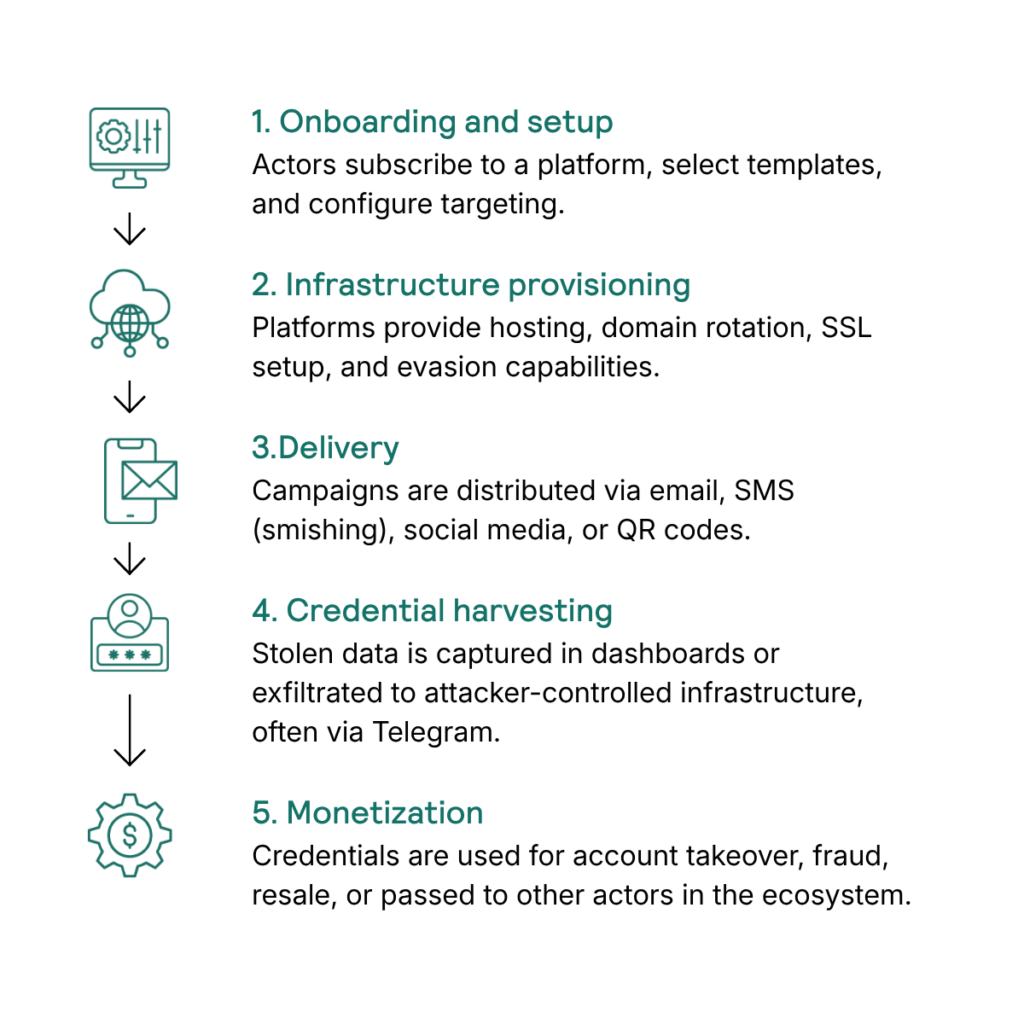
A typical PhaaS campaign follows a structured lifecycle:

This pipeline is supported by a network of specialized providers, each responsible for a different stage of the attack lifecycle.

Infrastructure, Delivery, and Exfiltration Are Increasingly Specialized

Flashpoint analysis highlights how different actors focus on distinct parts of the ecosystem.

Infrastructure and Kit Development

Phishing kit developers provide increasingly sophisticated tooling, including:

  • Reverse proxy (AiTM) capabilities for MFA bypass
  • Anti-bot protections to evade researchers
  • “Live panels” enabling real-time interaction with victims

Platforms such as GhostFrame, Rapid Pages, and MUH Pro Admin illustrate how these tools are being productized and distributed at scale.

SMS Delivery and Spoofing

Smishing has become a critical delivery vector.

Threat actors operate dedicated SMS gateway services capable of sending large volumes of messages via APIs or bulk uploads. Others actively seek advanced spoofing capabilities to bypass authentication controls such as SPF, DKIM, and DMARC, enabling phishing messages to appear legitimate at the protocol level.

Credential Exfiltration and Telegram Integration

Credential collection is increasingly automated and centralized.

Many campaigns exfiltrate stolen credentials directly to Telegram bots or channels, enabling real-time access to victim data. This infrastructure also allows for rapid scaling and coordination across actors participating in the same campaign or ecosystem.

From Credential Theft to Financial Monetization

The ultimate goal of PhaaS operations is monetization.

Stolen credentials are used to enable account takeover (ATO), which allows attackers to:

  • Access financial accounts
  • Lock out legitimate users
  • Initiate fraudulent transactions
  • Launch follow-on scams

Flashpoint analysis of actors such as “JUN JUN,” associated with the Squirtle group, illustrates how these operations extend into structured financial fraud and laundering.

Observed activity shows a progression from acquiring phishing logs (“fish material”) to targeting high-value accounts and ultimately laundering funds through complex mechanisms, including tax fraud and credit card repayment schemes designed to recycle illicit funds.

This highlights how phishing is only the entry point into a broader fraud pipeline.

A Distributed Ecosystem of Threat Actors

The PhaaS landscape is not controlled by a single group, but by a network of loosely connected actors and clusters.

Examples include:

  • Fluffy Spider: Focused on large-scale infrastructure deployment and domain generation
  • IVAN: A more exclusive, high-tier operation leveraging SEO poisoning and advanced evasion techniques
  • Smishing Triad: A highly coordinated group conducting global SMS phishing campaigns
  • System Bot: A modular phishing toolkit with credential harvesting and OTP bypass capabilities

These actors operate across different regions and languages but demonstrate comparable levels of technical capability and operational maturity.

Many of these groups function with enterprise-like structures, including support teams, affiliate models, and performance-based operations, further reinforcing the industrialization of phishing-driven fraud.

Law Enforcement Pressure Is Increasing, but the Model Persists

Recent takedowns, including operations targeting platforms such as Tycoon 2FA, demonstrate growing coordination between public and private sector defenders.

These efforts have:

  • Disrupted infrastructure
  • Increased operational costs for threat actors
  • Accelerated collaboration between intelligence providers and law enforcement

However, the underlying PhaaS model remains resilient.

Even as major platforms are dismantled, operators frequently rebrand, migrate infrastructure, or fragment into smaller services. The demand for scalable, low-cost phishing capabilities continues to sustain the ecosystem.

What This Means for Security Teams

Phishing-as-a-service has evolved from a tactic to an ecosystem that industrializes fraud.

Flashpoint assesses that the increasing coordination between phishing kit developers, infrastructure providers, and financial fraud actors will continue to drive large-scale credential harvesting and account takeover activity targeting global organizations.

For defenders, this means that effective mitigation requires more than user awareness and traditional controls. Organizations must account for:

  • MFA bypass techniques such as AiTM
  • Rapid infrastructure rotation and evasion
  • The integration of phishing into broader fraud and access broker pipelines

Protecting Your Organization from the PhaaS Ecosystem

Understanding how phishing ecosystems operate — from infrastructure and delivery to monetization — is critical for disrupting attacks before they result in fraud.

Flashpoint provides intelligence that helps organizations track phishing campaigns, identify emerging threat actors, and detect compromised credentials in real time. By correlating activity across the full attack lifecycle, security teams can better anticipate threats and respond before they escalate.

To learn how Flashpoint can support your team with actionable intelligence on phishing and fraud ecosystems, schedule a demo.

Begin your free trial today.

The post The Phishing-as-a-Service Pipeline: How a Scalable Fraud Ecosystem Is Driving Global Attacks appeared first on Flashpoint.

  •  
❌