Reading view

Flashpoint EASM: Industry-Leading Vulnerability Intelligence, Mapped to Your Internet-Facing Assets

Blogs

Blog

Flashpoint EASM: Industry-Leading Vulnerability Intelligence, Mapped to Your Internet-Facing Assets

Catch exposures before threat actors do. Here is how Flashpoint’s new module works and the top questions answered from our live demo.


SHARE THIS:
Default Author Image
August 3, 2026

Security teams don’t lose ground because they lack tools. They lose ground because they can’t see everything an attacker can.

This is the challenge we addressed in our latest Demo Day webinar introducing Flashpoint External Attack Surface Management (EASM), a new module inside our Ignite platform that gives security teams a continuous, attacker’s-eye view of their external attack surface, mapped directly to our proprietary vulnerability intelligence.

The Problem: Too Much Noise, Not Enough Context

Most security teams are dealing with three compounding problems:

  1. Disconnected Data: Vulnerability data lives isolated from actual infrastructure. Knowing a CVE exists doesn’t tell you whether it affects your active environment.
  2. Alert Fatigue: CVSS-only prioritization treats every “critical” score as an emergency, even when an asset isn’t internet-facing or exploitable.
  3. Accelerated Threat Cycles: AI is speeding up how quickly threat actors discover and exploit vulnerabilities, making manual tracking impossible.

Layer on top of that the reality that most teams still track their perimeter with spreadsheets or a static CMDB, and you get a widening gap between what security teams think they own and what is actually exposed. This gap has a name: shadow IT.

Shadow IT Is a Growing Blind Spot

Shadow IT covers the domains, subdomains, and cloud instances that get spun up to get work done, without IT’s knowledge or approval. It’s not a fringe issue. According to Gartner, by next year, 75% of employees will be acquiring, modifying, or creating technology outside their IT department’s visibility, up from 41% just a few years ago.

These unmanaged assets sit outside inventory and outside the reach of any scanner that only looks at what’s already known. That makes them exactly the kind of infrastructure an attacker finds first, and exactly the blind spot Flashpoint EASM is built to close.

What is Flashpoint EASM?

Flashpoint EASM gives security teams a continuous, attacker’s-eye view of their external attack surface and maps that view directly to Flashpoint’s vulnerability intelligence. Instead of your team asking “are we affected by this?”, every time a new vulnerability is disclosed, EASM answers that question continuously, often before the answer is obvious anywhere else.

Flashpoint EASM is built on three capabilities that work together:

Continuous Asset Discovery

Flashpoint EASM continuously discovers and monitors internet-facing assets: domains, subdomains, and IPs. New discoveries flow into a dedicated triage inbox, so security teams can quickly accept and focus on what’s actually relevant instead of drowning in noise.

Vulnerability Mapping

Every discovered exposure is mapped to Flashpoint’s proprietary vulnerability intelligence, including our pre-NVD findings, KEV (Known Exploited Vulnerabilities) status, ransomware likelihood, and exploit maturity. This provides organizations with immediate context into the vulnerabilities that pose the most risk.

Customizable Alerting

Using EASM, security teams get alerted to the exact moment a new asset or vulnerability is detected. This alert is fully customizable by severity and is available inside one unified workflow via Flashpoint Ignite.

Discover, map, and alert. This loop gives organizations an intelligence-led view of their perimeter, so they can proactively outpace threat actors instead of being forced to react.

How Flashpoint EASM Works

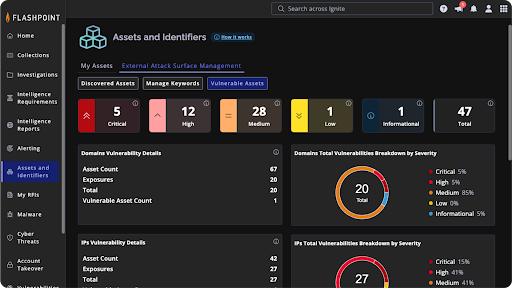
In our live demo, Flashpoint walked through the EASM workflow, which can be found under “Assets and Identifiers” in the Ignite Platform.

Here’s how it works:

Step 1: Submit Seed Keywords

Onboarding starts with keywords, meaning domain and IP address assets your organization actually owns. Any already set up asset is automatically surfaced in Flashpoint Ignite—such as through our compromised credential monitoring—ensuring no duplicated setup work.

Step 2: Triage Discovered Assets

Once keywords are approved, EASM iterates on them to surface additional related infrastructure, domains and IPs alike, along with a discovery graph showing exactly how each asset was found. That traceability makes it easy to judge relevance at a glance.

Every discovered asset lands in one of three statuses:

  • Owned: Assets in your tech stack. EASM continues discovering related infrastructure from these and links vulnerabilities to them.
  • External: Assets relevant to you, but where you don’t need further discovery, just vulnerability linkage.
  • Discarded: Assets you don’t need, removed from the triage feed entirely.

Step 3: Review the Vulnerable Assets Overview

In the main dashboard, the Vulnerable Assets page, security professionals can view total asset count, number of exposures, unique vulnerabilities affecting them, and total potentially vulnerable assets—in addition to criticality breakdowns for both domains and IPs.

From there, security teams can drill into:

  1. Unique vulnerabilities, filterable by CVE or severity
  2. Domains with vulnerabilities, showing exposure counts by severity and the last exposure date
  3. Individual asset detail pages, showing products, versions, vendors, and ports, with vulnerabilities linked directly to the specific product version affected

Diving deeper into a surfaced vulnerability provides technical descriptions, solution information, and other affected products. Additionally, Flashpoint’s vulnerability database includes over 105,000 pre-NVD vulnerabilities, giving vulnerability management teams actionable indicators well before they show up in public sources.

Step 4: Set Up Alerting

Flashpoint EASM gives teams full control over signal versus noise. Whether that means getting notified the moment a critical vulnerability is disclosed, or reviewing a daily summary of your own schedule, EASM offers two alert types:

  • Asset discovery alerts, either per-asset or as a daily rollup
  • Vulnerability alerts, filterable by criticality (critical, high, medium, low), with the option for in-app only or in-app plus email, and available as a daily rollup

Why Flashpoint EASM Matters

  1. Flashpoint EASM isn’t just another scanning tool. The intelligence underneath it is the differentiator: discovery tells you what’s out there, Flashpoint provides the much-needed context to tell you what’s dangerous right now.
  2. The intelligence includes coverage that can’t readily be found elsewhere: Flashpoint’s independently researched data includes pre-NVD findings, improved KEV coverage, ransomware risk scoring, and exploit maturity.
  3. It closes a blind spot teams have quietly lived with: EASM closes shadow IT gaps and surfaces assets sitting outside inventory entirely.

Flashpoint External Attack Surface Management gives security teams a continuous, intelligence-led view of everything a threat actor sees, so organizations can find and fix exposures before they’re exploited. To see it in action in a personalized walkthrough of your own environment, reach out to schedule a demo.

EASM Frequently Asked Questions (FAQs): What Security Teams Want to Know

What makes Flashpoint EASM different from other EASM solutions?

Most EASM tools stop at raw discovery, telling you an asset exists without telling you whether it matters. Flashpoint EASM pairs continuous asset discovery with a triage inbox to cut noise, then maps every asset directly to Flashpoint’s proprietary vulnerability intelligence, all natively inside Ignite alongside CTI and Vulnerability Intelligence. That combination means prioritization is based on real attacker activity, not just an asset inventory, giving remediation teams the exact context they need to proactively address risk.

What makes Flashpoint’s vulnerability intelligence unique?

Flashpoint’s database covers 400,000+ vulnerabilities, including 105,000+ not found in NVD or CVE, often surfaced up to two weeks earlier than public sources. Every entry is enriched with threat-informed context like EPSS scores, ransomware likelihood, exploit maturity, and MITRE ATT&CK mapping, then reviewed by human analysts, not just automated feeds. The result is prioritization based on real-world exploitation risk rather than CVSS alone.

Can existing monitored assets be imported into Flashpoint EASM?
Yes. EASM integrates closely with Flashpoint’s existing assets module, so assets already set up (for example, for compromised credential monitoring) surface automatically during onboarding.

Is there a limit on discovered assets, beyond the 30-keyword cap?
No. The 30-keyword limit only applies to initial seed keywords, to keep that starting set relevant. Once assets are marked owned or external, there’s no cap on ongoing discovery.

How does continuous polling compare to traditional scanning?
Traditional scanners give you a point-in-time snapshot. EASM continuously discovers assets and vulnerabilities, giving you a moving view of your exposure, essentially the same view an attacker would have in real time.

Does EASM identify compound risk, where multiple weaknesses increase exploitability together?
The Vulnerable Assets view surfaces how many vulnerabilities are tied to a given asset, so teams can quickly spot assets carrying disproportionate risk and prioritize accordingly.

Does EASM overlap with SBOM alerting?
Not exactly. SBOM alerting monitors vulnerabilities in assets you already know about. EASM is focused on discovering the assets you don’t know about yet. Most mature security programs benefit from running both in tandem.

See Flashpoint in Action

The post Flashpoint EASM: Industry-Leading Vulnerability Intelligence, Mapped to Your Internet-Facing Assets appeared first on Flashpoint.

  •  

Connecting Vulnerability Intelligence to Real-World Exposure With Flashpoint EASM

Blogs

Blog

Connecting Vulnerability Intelligence to Real-World Exposure With Flashpoint EASM

In this post, we explore how Flashpoint’s External Attack Surface Management (EASM) capability helps organizations continuously discover internet-facing assets, identify exposure to critical vulnerabilities, and prioritize remediation efforts based on real-world risk.

SHARE THIS:
Default Author Image
June 5, 2026

The volume of vulnerability disclosures is higher than ever, yet most security teams are still struggling to act.

From vulnerability scanners to public sources and AI-accelerated discovery, organizations are often drowning in findings, but lack the context to prioritize what affects their perimeter and is actively being exploited. 

Compounding this challenge is the growing issue of unknown and forgotten assets. Up to 95% of a company’s assets change each year, creating critical external blind spots and leaving them vulnerable to attacks on unmonitored infrastructure.

As attack surfaces expand due to cloud adoption, shadow IT, acquisitions, and distributed environments, many organizations struggle to maintain control over what assets they own, what software is running on those assets, and therefore, where exposures exist. You can’t patch what you don’t know is there.

These are the challenges Flashpoint External Attack Surface Management (EASM) is designed to address. With the introduction of EASM in Flashpoint Ignite, organizations can continuously discover internet-facing assets, map them to Flashpoint Vulnerability Intelligence, and prioritize remediation efforts based on actual risk rather than vulnerability volume and severity alone.

“The most effective vulnerability management programs are built on more than vulnerability awareness alone,” said Josh Lefkowitz, Co-Founder and CEO of Flashpoint. “Organizations need to understand where exposure exists within their environment and focus remediation efforts where they will have the greatest impact. Flashpoint EASM helps connect vulnerability intelligence directly to exposed assets, giving security teams a clear path from identification to remediation.”

Understanding the Exposure Gap

For many organizations, vulnerability intelligence is no longer the limiting factor.

Security teams have access to more vulnerability data than ever before. They can track newly disclosed vulnerabilities, monitor exploit activity, review KEV catalogs, and identify emerging threats often within hours of disclosure. And Flashpoint customers get the added advantage of learning about vulnerabilities up to 2 weeks faster than NVD, as well as the growing 105K+ vulnerabilities that never make it to public sources.

But understanding whether those vulnerabilities affect assets the organization actually owns remains a challenge. And that challenge exists because asset visibility and vulnerability intelligence often live in separate workflows.

  • Asset inventories become outdated. 
  • Cloud infrastructure changes constantly. 
  • New internet-facing services appear without centralized oversight. 
  • Acquisitions introduce unfamiliar infrastructure. 
  • Shadow IT creates blind spots that security teams may not discover until after exposure is identified.

As environments become more dynamic, validating exposure often requires analysts to pivot between scanners, spreadsheets, asset inventories, cloud consoles, and vulnerability intelligence sources.

As a result, organizations must face a growing disconnect between understanding which vulnerabilities are out there vs. whether the organization is actually at risk.

Connecting Asset Discovery to Vulnerability Intelligence

Flashpoint EASM begins by discovering internet-facing assets associated with an organization, giving security teams an attacker’s-eye view of their external perimeter. Using seed domains and IP addresses, it initiates ongoing discovery across the external environment, uncovering infrastructure that often evades internal tracking, including:

  • Shadow IT and untracked cloud resources
  • Forgotten infrastructure and legacy internet-facing assets
  • Newly exposed services and subdomains

Once assets are validated, they are surfaced within Ignite and automatically correlated with Flashpoint Vulnerability Intelligence, including pre-NVD findings, KEV intelligence, and proprietary vulnerability coverage beyond public sources. Teams receive alerts when new assets are discovered and when newly identified vulnerabilities affect monitored assets. For a full walkthrough of the workflow, see the Flashpoint EASM product update.

Prioritizing What Actually Requires Action

Not every vulnerability on your attack surface demands the same response. Flashpoint EASM helps teams cut through the noise by combining asset exposure with intelligence on what attackers are actively exploiting, so remediation efforts focus on the vulnerabilities that create meaningful risk.

Rather than focusing on vulnerability severity alone, security teams can now prioritize based on actual exploit activity targeting their attack surface. Flashpoint EASM provides the clarity needed to make that shift.

Building a Continuously Monitored, De-Risked Perimeter

As attack surfaces continue to evolve, organizations need full attack surface visibility, intelligence on what attackers are exploiting, and an efficient path to remediation.

By connecting Flashpoint Vulnerability Intelligence directly to their exposed assets, organizations can move from reactive investigation to having confidence that their external perimeter is continuously monitored and de-risked.

Learn more about Flashpoint External Attack Surface Management and request a demo.

Frequently Asked Questions (FAQ)

What is External Attack Surface Management (EASM)?

External Attack Surface Management (EASM) helps organizations discover, monitor, and assess internet-facing assets that could be exposed to attackers.

This includes domains, subdomains, IP addresses, cloud infrastructure, internet-accessible services, and other externally exposed assets that may introduce security risk.

By continuously monitoring these assets, organizations can better understand their external attack surface and identify exposures that require remediation.

How is Flashpoint EASM different from traditional asset inventories?

Traditional asset inventories, CMDBs, and internal scanners often depend on manual updates and may not reflect the full scope of an organization’s internet-facing environment.

Flashpoint EASM continuously discovers external assets and maps them to Flashpoint Vulnerability Intelligence, helping organizations identify exposures that may otherwise remain difficult to track through static inventories alone.

Why is attack surface visibility important?

As organizations adopt cloud services, acquire new businesses, deploy new applications, and support distributed environments, external attack surfaces change constantly.

Without continuous visibility, security teams may struggle to identify unknown assets, shadow IT, forgotten infrastructure, or newly exposed services that increase organizational risk.

How does Flashpoint EASM help prioritize remediation?

Knowing a vulnerability is severe is only half the picture. Flashpoint EASM correlates discovered assets with our proprietary vulnerability intelligence, including KEV data and pre-NVD findings, so teams can prioritize based on the severity of vulnerabilities present on their actual attack surface.

What vulnerability intelligence is included?

Flashpoint EASM integrates directly with Flashpoint Vulnerability Intelligence, including:

  • Proprietary vulnerability coverage beyond public sources
  • Pre-NVD vulnerability findings
  • Known Exploited Vulnerability (KEV) intelligence
  • Vulnerability enrichment and contextual risk information

This allows organizations to understand both exposure and vulnerability relevance within a single workflow.

Does Flashpoint EASM support continuous monitoring?

Yes. Once assets are discovered and validated, Flashpoint EASM continuously monitors the external attack surface for newly identified assets, vulnerable software, exposed services, and relevant vulnerability findings.

Teams can receive alerts when new exposure risks are identified.

How does Flashpoint EASM reduce alert fatigue?

Traditional vulnerability programs generate large volumes of findings without clarity on whether those assets are actually owned or exposed. Flashpoint EASM’s triage inbox lets teams accept true assets and reject noise, ensuring alerts are scoped only to infrastructure the organization actually owns.

Who should use Flashpoint EASM?

Flashpoint EASM is designed for security teams responsible for:

  • Vulnerability management
  • Attack surface management
  • Exposure management
  • Threat intelligence
  • Security operations
  • Risk management

It is particularly valuable for organizations seeking to connect vulnerability intelligence to real-world asset exposure and remediation priorities.

How does Flashpoint EASM work with Flashpoint Vulnerability Intelligence?

Flashpoint EASM extends the value of Flashpoint Vulnerability Intelligence by helping organizations understand where vulnerable assets exist within their external environment.

Rather than viewing vulnerability intelligence and attack surface visibility separately, organizations can use both capabilities together to identify exposure, prioritize remediation, and reduce risk more effectively.

Request a demo today.

The post Connecting Vulnerability Intelligence to Real-World Exposure With Flashpoint EASM appeared first on Flashpoint.

  •  

Closing the Gap by Enhancing Visibility and Mitigating Risks

In the race to digitise public services, the UK’s digital estate has grown into a vast, borderless ecosystem that manual audits can no longer track. For UK Government departments, local authorities and NHS trusts, it is a sprawling, shifting landscape of cloud workloads, legacy infrastructure, shadow IT and third-party supplier connections.

This complexity creates blind spots that modern threats exploit. Recognising this vulnerability, the UK Government is moving toward a secure-by-design digital infrastructure, with the 2026 Government Cyber Action Plan (GCAP) setting a high bar for resilience. A central theme of the GCAP is the urgent need for the government to have better visibility of cyber security and resilience risk. Fundamentally, organisations cannot secure what they cannot see. As the GCAP explicitly states, the Government will use “data sources from across the government to truly understand government-wide and departmental cyber risks.”

The Challenge: Visibility in a “Landscape”

Many public sector organisations rely on a complex web of spreadsheets, data calls, legacy tools and manually curated lists to create an inventory of their internet-connected assets. But attackers do not look at an organisation's internal lists; they scan the internet for what they have forgotten to secure. Whether it is an unpatched server from a legacy project or a misconfigured database in a department, these "unknown unknowns" are the primary entry points for attackers.

The Strategic Mission: Empowering the Public Sector and Critical Industries

Palo Alto Networks Cortex Xpanse® is an active external attack surface management (EASM) solution that provides an outside-in view of organisations' entire digital footprint. It helps leaders meet national resilience goals:

  • Comprehensive, Continuous Visibility: Xpanse scans the global internet space continuously and identifies every asset associated with an organisation, without requiring software agents to be installed on your systems.
  • Accelerate Response: Leveraging automation, the solution streamlines response processes and enhances collaboration across dispersed teams from the sharing of findings to tracking actions and remediation.
  • Supply Chain Integrity: Inline with the new Cyber Security and Resilience Bill (bringing managed service providers and critical third parties into scope), Xpanse allows organisations to assess the internet-facing security posture of third-party partners and suppliers, ensuring a weak link elsewhere doesn't compromise the broader mission.
  • Alignment with GovAssure: Xpanse provides a consolidated risk profile and inventory for all internet-facing and cloud assets required for GovAssure assessments, turning a manual, months-long audit process into a continuous, data-driven cycle.
  • Investment prioritisation: Xpanse provides that much needed visibility to help executive committees and boards prioritise investment decisions on legacy IT and technical debt.

Aligning to National Cybersecurity Centre (NCSC) Guidance

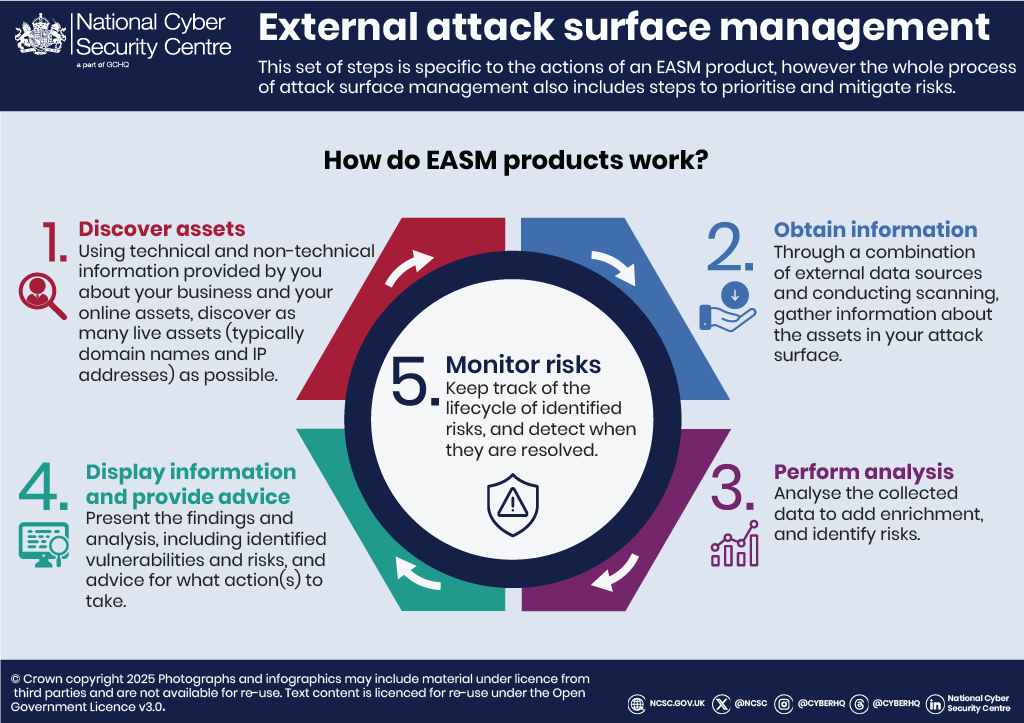
How external attack surface management products work.

Palo Alto Networks Cortex Xpanse aligns with the National Cyber Security Centre (NCSC) external attack surface management (EASM) buyer's guide by providing automated discovery, continuous monitoring and risk prioritisation of internet-facing assets. It replaces manual, point-in-time audits with a proactive, agentless solution. By automating the discovery of all internet-accessible assets (including shadow IT and unmanaged cloud operations) the platform fulfills the NCSC’s core requirement for continuous global monitoring and rapid attribution. This data-driven approach allows for the automated prioritisation of critical exposures, such as RDP, and integrates seamlessly with multiple third-party automation and visualisation tools, including Cortex XSOAR® and XSIAM, to accelerate remediation with national incident response standards.

In fact, with Palo Alto Networks deployment of Cortex Xpanse, we were able to achieve a 95% reduction in external vulnerability management spending across more than 700,000 cloud instances, while improving coverage and outcomes.

Palo Alto Networks Cortex Xpanse Capabilities
  • Discover Assets: Leveraging organisations' known asset inventory and other data points, Xpanse performs continual, automated discovery of all internet-accessible assets, effectively eliminating blind spots created by shadow IT and unmanaged cloud operations.
  • Obtain Information: Always-on, continuous monitoring of an organisation's entire attack surface through daily scans of the global IP address space, ensuring that newly exposed services are identified quickly and accurately.
  • Perform Analysis: Xpanse automates and prioritises alerts on all identified risks by severity, enabling organisations to optimise resolution and risk management, allowing teams to properly allocate resources and focus on the most critical risks to the organisation.
  • Display Information and Provide Advice: Leveraging a unified view of the internet facing and cloud-based estate, Xpanse provides specific resolver guidance for every identified issue, supporting and monitoring automated resolution through multiple native integrations.
  • Monitor Risk: Always on, discreet continual monitoring provides an independent real time status of the digital estate. Leveraging the threat intelligence capabilities of Palo Alto Networks, Xpanse is uniquely positioned to provide rapid coverage for newly discovered vulnerabilities, exploits or misconfigurations.

Securing the public sector requires a move from manual, point in time assessments to data-driven intelligence. Cortex Xpanse provides the foundations to remove blind spots, secure the supply chain and prevent unknown vulnerabilities in the face of sophisticated threats.

For further information and case studies, visit the links below, or schedule a demo.

  • Palo Alto Networks: Slash false positives, remediation time budget with Cortex attack surface management.
  • U.S. Pentagon: Palo Alto Networks Cortex Xpanse supercharge the Cyber Defences for the Department of Defense.
  • Accenture: Secure rapid growth with Cortex Xpanse.

The post Closing the Gap by Enhancing Visibility and Mitigating Risks appeared first on Palo Alto Networks Blog.

  •  
❌