 Login
Login
AI Coding Assistants Secretly Copying All Code to China
There’s a new report about two AI coding assistants, used by 1.5 million developers, that are surreptitiously sending a copy of everything they ingest to China.
Maybe avoid using them.

There’s a new report about two AI coding assistants, used by 1.5 million developers, that are surreptitiously sending a copy of everything they ingest to China.
Maybe avoid using them.
Security leaders share how artificial intelligence is changing malware, ransomware, and identity-led intrusions, and how defenses must evolve.
The post Cyber Insights 2026: Malware and Cyberattacks in the Age of AI appeared first on SecurityWeek.
From an Anthropic blog post:
In a recent evaluation of AI models’ cyber capabilities, current Claude models can now succeed at multistage attacks on networks with dozens of hosts using only standard, open-source tools, instead of the custom tools needed by previous generations. This illustrates how barriers to the use of AI in relatively autonomous cyber workflows are rapidly coming down, and highlights the importance of security fundamentals like promptly patching known vulnerabilities.
[…]
A notable development during the testing of Claude Sonnet 4.5 is that the model can now succeed on a minority of the networks without the custom cyber toolkit needed by previous generations. In particular, Sonnet 4.5 can now exfiltrate all of the (simulated) personal information in a high-fidelity simulation of the Equifax data breach—one of the costliest cyber attacks in historyusing only a Bash shell on a widely-available Kali Linux host (standard, open-source tools for penetration testing; not a custom toolkit). Sonnet 4.5 accomplishes this by instantly recognizing a publicized CVE and writing code to exploit it without needing to look it up or iterate on it. Recalling that the original Equifax breach happened by exploiting a publicized CVE that had not yet been patched, the prospect of highly competent and fast AI agents leveraging this approach underscores the pressing need for security best practices like prompt updates and patches.
AI models are getting better at this faster than I expected. This will be a major power shift in cybersecurity.
Russia's current isolation from the Olympics may lead to increased cyberthreats targeting the 2026 Winter Games. We discuss the potential threat picture.
The post Understanding the Russian Cyberthreat to the 2026 Winter Olympics appeared first on Unit 42.

A significant number of modern incidents begin with account compromise. Since initial access brokers have become a full-fledged criminal industry, it’s become much easier for attackers to organize attacks on companies’ infrastructure by simply purchasing sets of employee passwords and logins. The widespread practice of using various remote access methods has made their task even easier. At the same time, the initial stages of such attacks often look like completely legitimate employee actions, and remain undetected by traditional security mechanisms for a long time.
Relying solely on account protection measures and password policies isn’t an option. There’s always a chance that attackers will get hold of employees’ credentials using various phishing attacks, infostealer malware, or simply through the carelessness of employees who reuse the same password for work and personal accounts and don’t pay much attention to leaks on third-party services.
As a result, to detect attacks on a company’s infrastructure, you need tools that can detect not only individual threat signatures, but also behavioral analysis systems that can detect deviations from normal user and system processes.
As we mentioned in our previous post, to detect attacks involving account compromise, we equipped our Kaspersky Unified Monitoring and Analysis Platform SIEM system with a set of UEBA rules designed to detect anomalies in authentication processes, network activity, and the execution of processes on Windows-based workstations and servers. In the latest update, we continued to develop the system in the same direction, adding the use of AI approaches.
The system creates a model of normal user behavior during authentication, and tracks deviations from usual scenarios: atypical login times, unusual event chains, and anomalous access attempts. This approach allows SIEM to detect both authentication attempts with stolen credentials, and the use of already compromised accounts, including complex scenarios that may have gone unnoticed in the past.
Instead of searching for individual indicators, the system analyzes deviations from normal patterns. This allows for earlier detection of complex attacks while reducing the number of false positives, and significantly reduces the operational load on SOC teams.
Previously, when using UEBA rules to detect anomalies, it was necessary to create several rules that performed preliminary work and generated additional lists in which intermediate data was stored. Now, in the new version of SIEM with a new correlator, it’s possible to detect account hijacking using a single specialized rule.
The more complex the infrastructure and the greater the volume of events, the more critical the requirements for platform performance, access management flexibility, and ease of daily operation become. A modern SIEM system must not only accurately detect threats, but also remain “resilient” without the need to constantly upgrade equipment and rebuild processes. Therefore, in version 4.2, we’ve taken another step toward making the platform more practical and adaptable. The updates affect the architecture, detection mechanisms, and user experience.
One of the key innovations in the new version of SIEM is a flexible role model. Now customers can create their own roles for different system users, duplicate existing ones, and customize a set of access rights for the tasks of specific specialists. This allows for a more precise differentiation of responsibilities among SOC analysts, administrators, and managers, reduces the risk of excessive privileges, and better reflects the company’s internal processes in the SIEM settings.
In release 4.2, we introduced a beta version of a new correlation engine (2.0). It processes events faster, and requires fewer hardware resources. For customers, this means:
We’re also systematically continuing to expand our coverage of the MITRE ATT&CK matrix of techniques, tactics, and procedures: today, Kaspersky SIEM covers more than 60% of the entire matrix. Detection rules are regularly updated and accompanied by response recommendations. This helps customers understand which attack scenarios are already under control, and plan their defense development based on a generally accepted industry model.
Version 4.2 also introduces the ability to back up and restore events, as well as export data to secure archives with integrity control, which is especially important for investigations, audits, and regulatory compliance. Background search queries have been implemented for the convenience of analysts. Now, complex and resource-intensive searches can be run in the background without affecting priority tasks. This speeds up the analysis of large data sets.
We continue to regularly update Kaspersky SIEM, expanding detection capabilities, improving architecture, and adding AI functionality so that the platform best meets the real-world conditions of information security teams, and helps not only to respond to incidents, but also to build a sustainable protection model for the future. Follow the updates to our SIEM system, the Kaspersky Unified Monitoring and Analysis Platform, on the official product page.




Meta plans to test exclusive features that will be incorporated in paid versions of Facebook, Instagram, and WhatsApp. It confirmed these plans to TechCrunch.
But these plans are not to be confused with the ad-free subscription options that Meta introduced for Facebook and Instagram in the EU, the European Economic Area, and Switzerland in late 2023 and framed as a way to comply with General Data Protection Regulation (GDPR) and Digital Markets Act requirements.
From November 2023, users in those regions could either keep using the services for free with personalized ads or pay a monthly fee for an ad‑free experience. European rules require Meta to get users’ consent in order to show them targeted ads, so this was an obvious attempt to recoup advertising revenue when users declined to give that consent.
This year, users in the UK were given the same choice: use Meta’s products for free or subscribe to use them without ads. But only grudgingly, judging by the tone in the offer… “As part of laws in your region, you have a choice.”
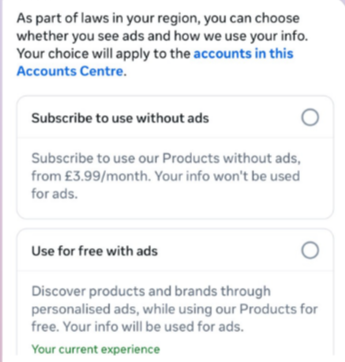
That ad-free option, however, is not what Meta is talking about now.
The newly announced plans are not about ads, and they are also separate from Meta Verified, which starts at around $15 a month and focuses on creators and businesses, offering a verification badge, better support, and anti‑impersonation protection.
Instead, these new subscriptions are likely to focus on additional features—more control over how users share and connect, and possibly tools such as expanded AI capabilities, unlimited audience lists, seeing who you follow that doesn’t follow you back, or viewing stories without the poster knowing it was you.
These examples are unconfirmed. All we know for sure is that Meta plans to test new paid features to see which ones users are willing to pay for and how much they can charge.
Meta has said these features will focus on productivity, creativity, and expanded AI.
Unfortunately, this feels like another refusal to listen.
Most of us aren’t asking for more AI in our feeds. We’re asking for a basic sense of control: control over who sees us, what’s tracked about us, and how our data is used to feed an algorithm designed to keep us scrolling.
Users shouldn’t have to choose between being mined for behavioral data or paying a monthly fee just to be left alone. The message baked into “pay or be profiled” is that privacy is now a luxury good, not a default right. But while regulators keep saying the model is unlawful, the experience on the ground still nudges people toward the path of least resistance: accept the tracking and move on.
Even then, this level of choice is only available to users in Europe.
Why not offer the same option to users in the US? Or will it take stronger US privacy regulation to make that happen?
We don’t just report on threats – we help protect your social media
Cybersecurity risks should never spread beyond a headline. Protect your social media accounts by using Malwarebytes Identity Theft Protection.
Meta plans to test exclusive features that will be incorporated in paid versions of Facebook, Instagram, and WhatsApp. It confirmed these plans to TechCrunch.
But these plans are not to be confused with the ad-free subscription options that Meta introduced for Facebook and Instagram in the EU, the European Economic Area, and Switzerland in late 2023 and framed as a way to comply with General Data Protection Regulation (GDPR) and Digital Markets Act requirements.
From November 2023, users in those regions could either keep using the services for free with personalized ads or pay a monthly fee for an ad‑free experience. European rules require Meta to get users’ consent in order to show them targeted ads, so this was an obvious attempt to recoup advertising revenue when users declined to give that consent.
This year, users in the UK were given the same choice: use Meta’s products for free or subscribe to use them without ads. But only grudgingly, judging by the tone in the offer… “As part of laws in your region, you have a choice.”
That ad-free option, however, is not what Meta is talking about now.
The newly announced plans are not about ads, and they are also separate from Meta Verified, which starts at around $15 a month and focuses on creators and businesses, offering a verification badge, better support, and anti‑impersonation protection.
Instead, these new subscriptions are likely to focus on additional features—more control over how users share and connect, and possibly tools such as expanded AI capabilities, unlimited audience lists, seeing who you follow that doesn’t follow you back, or viewing stories without the poster knowing it was you.
These examples are unconfirmed. All we know for sure is that Meta plans to test new paid features to see which ones users are willing to pay for and how much they can charge.
Meta has said these features will focus on productivity, creativity, and expanded AI.
Unfortunately, this feels like another refusal to listen.
Most of us aren’t asking for more AI in our feeds. We’re asking for a basic sense of control: control over who sees us, what’s tracked about us, and how our data is used to feed an algorithm designed to keep us scrolling.
Users shouldn’t have to choose between being mined for behavioral data or paying a monthly fee just to be left alone. The message baked into “pay or be profiled” is that privacy is now a luxury good, not a default right. But while regulators keep saying the model is unlawful, the experience on the ground still nudges people toward the path of least resistance: accept the tracking and move on.
Even then, this level of choice is only available to users in Europe.
Why not offer the same option to users in the US? Or will it take stronger US privacy regulation to make that happen?
We don’t just report on threats – we help protect your social media
Cybersecurity risks should never spread beyond a headline. Protect your social media accounts by using Malwarebytes Identity Theft Protection.
An LLMjacking operation has been targeting exposed LLMs and MCPs at scale, for commercial monetization.
The post LLMs Hijacked, Monetized in ‘Operation Bizarre Bazaar’ appeared first on SecurityWeek.
