❌

Reading view

Vulnerability & Patch Roundup β€” July 2026

Vulnerability & Patch Roundup β€” July 2026

Running a website means a single unpatched vulnerability can take it offline, harm your reputation, or require cleanup. Most compromises begin with automated attacks exploiting known software flaws, usually reported and disclosed already.

To keep you protected from these threats, we’ve compiled this month’s key security updates and vulnerability patches for the WordPress ecosystem.

If you’re already using theΒ Sucuri Firewall, you’re protected. These vulnerabilities are virtually patched for all clients.

Continue reading Vulnerability & Patch Roundup β€” July 2026 at Sucuri Blog.

  •  

Why Delaying WordPress Updates Increases Security Risks

Why Delaying WordPress Updates Increases Security Risks

WordPress updates help close known vulnerabilities before automated attacks can find and exploit them. Once a patch is released, attackers often move quickly to scan for sites that have not yet updated.

It’s easy to put off updates when everything seems to be working. But once a vulnerability is public, attackers do not need to single out your site. Automated bots scan thousands of sites for outdated WordPress core, plugins, themes, and server setups.

Continue reading Why Delaying WordPress Updates Increases Security Risks at Sucuri Blog.

  •  

Vulnerability & Patch Roundup β€” June 2026

Vulnerability & Patch Roundup β€” June 2026

Running a website means a single unpatched vulnerability can take it offline, harm your reputation, or require cleanup. Most compromises begin with automated attacks exploiting known software flaws, usually reported and disclosed already.

To keep you protected from these threats, we’ve compiled this month’s key security updates and vulnerability patches for the WordPress ecosystem.

If you’re already using the Sucuri Firewall, you’re protected. These vulnerabilities are virtually patched for all clients.

Continue reading Vulnerability & Patch Roundup β€” June 2026 at Sucuri Blog.

  •  

PCI Compliance Isn’t a Checkbox: How to Secure Ecommerce Checkouts Before Attackers Arrive

PCI Compliance Isn’t a Checkbox: How to Secure Ecommerce Checkouts Before Attackers Arrive

A working checkout page is often the moment a business starts to feel real. The products are live, the cart is functional, payments are flowing, and orders are landing in your inbox. That is also when security shifts from a background concern to a real-world risk.

Once your website starts accepting credit card payments, it becomes part of a payment environment attackers actively look for.

That does not mean every small ecommerce store needs an enterprise security team.

Continue reading PCI Compliance Isn’t a Checkbox: How to Secure Ecommerce Checkouts Before Attackers Arrive at Sucuri Blog.

  •  

WordPress PBN Plugin Drops Dual Webshells via Database Injection

WordPress PBN Plugin Drops Dual Webshells via Database Injection

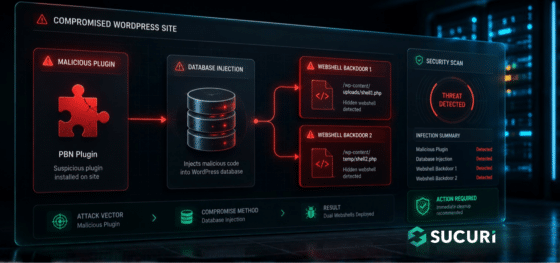
During a recent incident response engagement, our team uncovered a multi-stage WordPress infection that goes beyond the usual file-based malware. The attacker combined a fake plugin, a remote command-and-control server, and two PHP web shells stored directly inside the WordPress database.

The campaign is operated by a Turkish-speaking threat actor and is built around a classic SEO monetization scheme: hidden backlink injection for a Private Blog Network (PBN), most likely tied to the gambling and adult affiliate niche.

Continue reading WordPress PBN Plugin Drops Dual Webshells via Database Injection at Sucuri Blog.

  •  

Vulnerability & Patch Roundup β€” May 2026

Vulnerability & Patch Roundup β€” May 2026

If you run a website, you know that a single unpatched vulnerability can take your site offline, damage your reputation, or leave you cleaning up after an attack. Most compromises we see start with automated attacks targeting known software flaws, often the same ones that have already been reported and disclosed.

To help you stay ahead of these threats, we’ve put together this month’s roundup of critical security updates and vulnerability patches affecting the WordPress ecosystem.

Continue reading Vulnerability & Patch Roundup β€” May 2026 at Sucuri Blog.

  •  

WordPress Site Down? Here’s How to Get Back Online

WordPress Site Down? Here’s How to Get Back Online

If your WordPress site goes offline, every minute costs you lost sales, missed leads, and a dent in visitor trust. Search engines may start flagging errors, and customers see a blank page instead of your business. In that moment, the pressure is real:

What broke, and how do you get back online before the damage adds up?

The good news is that most WordPress outages are fixable. In most cases, your site isn’t lost, it’s blocked by something like a plugin conflict, server hiccup, database error, expired domain, SSL problem, sudden traffic spike, or malware infection.

Continue reading WordPress Site Down? Here’s How to Get Back Online at Sucuri Blog.

  •  

What to Do When a Third-Party Data Breach Puts Your Website at Risk

What to Do When a Third-Party Data Breach Puts Your Website at Risk

Data breach notification letters have become a familiar routine. They usually start with β€œWe value your privacy” and offer a year of free credit monitoring. But the most important part is often hidden in the middle:

A list of what actually got out.

A leaked email address is not a leaked admin password. A hashed credential is not a session token. There is no universal post-breach checklist. The right response depends on the data exposed, so read the notice carefully and match your response to the level of exposure.

Continue reading What to Do When a Third-Party Data Breach Puts Your Website at Risk at Sucuri Blog.

  •  

DNSSEC: The Extra Security Layer That Can Break Your Padlock

DNSSEC: The Extra Security Layer That Can Break Your Padlock

Turning on DNSSEC makes your domain more secure β€” but if it’s misconfigured, newer certificate validation rules can stop SSL renewals in their tracks.

Hey there,

You know that satisfying click when you finally turn on DNSSEC? It feels like adding a shiny new deadbolt to your domain’s front door. You’re doing the responsible thing: locking down your DNS against spoofing and hijacks, and making the internet just a bit safer.

Continue reading DNSSEC: The Extra Security Layer That Can Break Your Padlock at Sucuri Blog.

  •  

Vulnerability & Patch Roundup β€” April 2026

Vulnerability & Patch Roundup β€” April 2026

Vulnerability reports and responsible disclosures are essential for website security awareness and education. Automated attacks targeting known software vulnerabilities are one of the leading causes of website compromises.

To help educate website owners about potential threats to their environments, we’ve compiled a list of important security updates and vulnerability patches for the WordPress ecosystem this past month.

The vulnerabilities listed below are virtually patched by the Sucuri Firewall and existing clients are protected.

Continue reading Vulnerability & Patch Roundup β€” April 2026 at Sucuri Blog.

  •  

What is online gambling spam and what can I do about it?

What is online gambling spam and what can I do about it?

Online gambling spam thrives on dreams of easy money and high stakes. Beating the house at an exotic casino. Splitting sevens. Going all in on the flop. A baccarat dealer calling La grande! For most people, though, the reality falls far short of Monte Carlo and an Aston Martin.

So they turn to online gambling. And bad actors harness that allure to create their scams. They think they’re buying credits at a hot new online casino.

Continue reading What is online gambling spam and what can I do about it? at Sucuri Blog.

  •  

My Website Is Hosting a Phishing Page – Now What?

My Website Is Hosting a Phishing Page – Now What?

Most phishing advice is written for the person staring at a suspicious email. This guide is for the other kind of victim: The website owner whose legitimate site has been quietly turned into the attacker’s weapon.

You didn’t send the message or build the fake login page. You just woke up to a browser warning, a suspended hosting account, or a polite note from someone’s security team asking why your domain is requesting Apple ID credentials.

Continue reading My Website Is Hosting a Phishing Page – Now What? at Sucuri Blog.

  •  

WordPress DDoS Protection: How to Keep Your Site Online

WordPress DDoS Protection: How to Keep Your Site Online

WordPress powers over 40% of the web, which makes it one of the most attractive targets for Distributed Denial of Service (DDoS) attacks. If your site goes down for an hour, you lose revenue, search rankings, and visitor trust. If it goes down repeatedly, you lose much more.

A DDoS attack floods your website with fake traffic until it slows to a crawl or crashes entirely. Unlike hacks that steal data, DDoS attacks are about disruption.

Continue reading WordPress DDoS Protection: How to Keep Your Site Online at Sucuri Blog.

  •  

Joomla SEO Spam Injector: Obfuscated PHP Backdoor Hijacking Site Visitors

Joomla SEO Spam Injector: Obfuscated PHP Backdoor Hijacking Site Visitors

Overview

During a recent malware cleanup investigation, we encountered a compromised Joomla website where the site owner reported a strange issue. Their website displayed a large number of suspicious product links that had nothing to do with their business. These products were not added by the website owner and did not exist in their catalog.

Visitors and search engines were seeing pages that promoted unrelated products, raising immediate concerns about spam injection or remote content manipulation.

Continue reading Joomla SEO Spam Injector: Obfuscated PHP Backdoor Hijacking Site Visitors at Sucuri Blog.

  •  

Why 2FA SMS is a Bad Idea in 2026

Why 2FA SMS is a Bad Idea in 2026

What is 2FA?

Two-factor authentication (2FA) offers a second layer of security to help protect an account from brute force, phishing, and social engineering attacks.

2FA requires an extra step for a user to prove their identity, which reduces the chance of a bad actor gaining access to their account or data. And since notifications are sent to verify the initial authentication via username and passwords, it also gives users and business the ability to monitor for potential indicators of a compromise.

Continue reading Why 2FA SMS is a Bad Idea in 2026 at Sucuri Blog.

  •  

Vulnerability & Patch Roundup β€” March 2026

Vulnerability & Patch Roundup β€” March 2026

Vulnerability reports and responsible disclosures are essential for website security awareness and education. Automated attacks targeting known software vulnerabilities are one of the leading causes of website compromises.

To help educate website owners about potential threats to their environments, we’ve compiled a list of important security updates and vulnerability patches for the WordPress ecosystem this past month.

The vulnerabilities listed below are virtually patched by the Sucuri Firewall and existing clients are protected.

Continue reading Vulnerability & Patch Roundup β€” March 2026 at Sucuri Blog.

  •  

How to Fix β€œNot Secure” Warnings and SSL Issues in WordPress (8 Steps)

How to Fix β€œNot Secure” Warnings and SSL Issues in WordPress (8 Steps)

If you own a WordPress website and ever encountered the β€œNot Secure” warning, you might have worried that visitors would perceive your site as spam or fraudulent. Not only does this warning impact user trust, but it can also create technical search issues when both HTTP and HTTPS versions of your pages remain accessible or when redirects, canonicals, and sitemaps point to different URL versions. Browsers show the visible security warning, while search engines rely on permanent redirects, canonical URLs, and updated sitemaps to understand your preferred HTTPS pages.

Continue reading How to Fix β€œNot Secure” Warnings and SSL Issues in WordPress (8 Steps) at Sucuri Blog.

  •  

The Security Risks of Using Nulled WordPress Plugins

The Security Risks of Using Nulled WordPress Plugins

Every year, thousands of WordPress sites get compromised, and a surprising number of those infections trace back to a single decision: installing a nulled plugin.

Nulled plugins promise premium features for little or no money. The problem is that the β€œsavings” often come attached to malware, broken update paths, SEO damage, and legal headaches that cost far more than a legitimate license ever would. It might seem like a harmless shortcut, but it’s one that can unravel everything you’ve built online.

Continue reading The Security Risks of Using Nulled WordPress Plugins at Sucuri Blog.

  •  

Web Shells: Types, Mitigation & Removal

Web Shells: Types, Mitigation & Removal

Web shells are malicious scripts that give attackers persistent access to compromised web servers, enabling them to execute commands and control the server remotely. These scripts exploit vulnerabilities like SQL injection, remote file inclusion (RFI), and cross-site scripting (XSS) to gain entry.

Once deployed, web shells allow attackers to manipulate the server, leading to data theft, website defacement, or serving as a launchpad for further attacks. They are especially dangerous because they are also a post-compromise access mechanism (backdoor) rather than a standalone infection.

Continue reading Web Shells: Types, Mitigation & Removal at Sucuri Blog.

  •  

Vulnerability & Patch Roundup β€” February 2026

Vulnerability & Patch Roundup β€” February 2026

Vulnerability reports and responsible disclosures are essential for website security awareness and education. Automated attacks targeting known software vulnerabilities are one of the leading causes of website compromises.

To help educate website owners about potential threats to their environments, we’ve compiled a list of important security updates and vulnerability patches for the WordPress ecosystem this past month.

The vulnerabilities listed below are virtually patched by the Sucuri Firewall and existing clients are protected.

Continue reading Vulnerability & Patch Roundup β€” February 2026 at Sucuri Blog.

  •  
❌