❌

Reading view

From Automation to Infection: How OpenClaw AI Agent Skills Are Being Weaponized

The fastest-growing personal AI agent ecosystem just became a new delivery channel for malware. Over the last few days, VirusTotal has detected hundreds of OpenClaw skills that are actively malicious. What started as an ecosystem for extending AI agents is rapidly becoming a new supply-chain attack surface, where attackers distribute droppers, backdoors, infostealers and remote access tools disguised as helpful automation.

What is OpenClaw (formerly Clawdbot / Moltbot)?

Unless you’ve been completely disconnected from the internet lately, you’ve probably heard about the viral success of OpenClaw and its small naming soap opera. What started as Clawdbot, briefly became Moltbot, and finally settled on OpenClaw, after a trademark request made the original name off-limits.

At its core, OpenClaw is a self-hosted AI agent that runs on your own machine and can execute real actions on your behalf: shell commands, file operations, network requests. Which is exactly why it’s powerful, and also why, unless you actively sandbox it, the security blast radius is basically your entire system.

Skills: powerful by design, dangerous by default

OpenClaw skills are essentially small packages that extend what the agent can do. Each skill is built around a SKILL.md file (with some metadata and instructions) and may include scripts or extra resources. Skills can be loaded locally, but most users discover and install them from ClawHub, the public marketplace for OpenClaw extensions.

This is what makes the ecosystem so powerful: instead of hardcoding everything into the agent, you just add skills and suddenly it can use new tools, APIs, and workflows. The agent reads the skill documentation on demand and follows its instructions.

The problem is that skills are also third-party code, running in an environment with real system access. And many of them come with “setup” steps users are trained to trust: paste this into your terminal, download this binary and run it, export these environment variables. From an attacker’s perspective, it’s a perfect social-engineering layer.

So yes, skills are a gift for productivity and, unsurprisingly, a gift for malware authors too. Same mechanism, very different intentions.

What we added: OpenClaw Skill support in VirusTotal Code Insight

To help detect this emerging abuse pattern, we’ve added native support in VirusTotal Code Insight for OpenClaw skill packages, including skills distributed as ZIP files. Under the hood, we use Gemini 3 Flash to perform a fast security-focused analysis of the entire skill, starting from SKILL.md and including any referenced scripts or resources.

The goal is not to understand what the skill claims to do, but to summarize what it actually does from a security perspective: whether it downloads and executes external code, accesses sensitive data, performs network operations, or embeds instructions that could coerce the agent into unsafe behavior. In practice, this gives analysts a concise, security-first description of the real behavior of a skill, making it much easier to spot malicious patterns hidden behind “helpful” functionality.

What we’re seeing in the wild

At the time of writing, VirusTotal Code Insight has already analyzed more than 3,016 OpenClaw skills, and hundreds of them show malicious characteristics.

Not all of these cases are the same. On one side, we are seeing many skills flagged as dangerous because they contain poor security practices or outright vulnerabilities: insecure use of APIs, unsafe command execution, hardcoded secrets, excessive permissions, or sloppy handling of user input. This is increasingly common in the era of vibe coding, where code is generated quickly, often without a real security model, and published straight into production.

But more worrying is the second group: skills that are clearly and intentionally malicious. These are presented as legitimate tools, but their real purpose is to perform actions such as sensitive data exfiltration, remote control via backdoors, or direct malware installation on the host system.

Case study: hightower6eu, a malware publisher in plain sight

One of the most illustrative cases we’ve observed is the ClawHub user "hightower6eu", who is highly active publishing skills that appear legitimate but are consistently used to deliver malware


At the time of writing, VirusTotal Code Insight has already analyzed 314 skills associated with this single user, and the number is still growing, all of them identified as malicious. The skills cover a wide range of apparently harmless use cases (crypto analytics, finance tracking, social media analysis, auto-updaters, etc) but they all follow a similar pattern: users are instructed to download and execute external code from untrusted sources as part of the "setup" process.


To make this more tangible, the screenshot below shows how VirusTotal Code Insight analyzes one of the skills published by hightower6eu, in this case a seemingly harmless skill called "Yahoo Finance".

On the surface, the file looks clean: no antivirus engines flag it as malicious, and the ZIP itself contains almost no real code. This is exactly why traditional detection fails.

VT Code Insight, however, looks at the actual behavior described in the skill. In this case, it identifies that the skill instructs users to download and execute external code from untrusted sources as a mandatory prerequisite, both on Windows and macOS. From a security perspective, that’s a textbook malware delivery pattern: the skill acts as a social engineering wrapper whose only real purpose is to push remote execution. In other words, nothing in the file is technically "malware" by itself. The malware is the workflow. And that’s precisely the kind of abuse pattern Code Insight is designed to surface.


79e8f3f7a6113773cdbced2c7329e6dbb2d0b8b3bf5a18c6c97cb096652bc1f2

If you actually read the SKILL.md, the real behavior becomes obvious. For Windows users, the skill instructs them to download a ZIP file from an external GitHub account, protected with the password 'openclaw', extract it, and run the contained executable: openclaw-agent.exe.


When submitted to VirusTotal, this executable is detected as malicious by multiple security vendors, with classifications consistent with packed trojans.

17703b3d5e8e1fe69d6a6c78a240d8c84b32465fe62bed5610fb29335fe42283

When the system is macOS, the skill doesn't provide a binary directly. Instead, it points the user to a shell script hosted on glot.io, which is obfuscated using Base64:


Once the Base64 payload is decoded, the real behavior becomes visible: the script simply downloads and executes another file from a remote server over plain HTTP:


The final stage is the file x5ki60w1ih838sp7, a Mach-O executable. When submitted to VirusTotal, this binary is detected as malicious by 16 security engines, with classifications consistent with stealer trojans and generic malware families:

1e6d4b0538558429422b71d1f4d724c8ce31be92d299df33a8339e32316e2298

When the file is analyzed by multiple automated reversing tools and Gemini 3 Pro, the results are consistent: the binary is identified as a trojan infostealer, and more specifically as a variant of Atomic Stealer (AMOS).


This family of malware is well known in the macOS ecosystem. It is designed to run stealthily in the background and systematically harvest sensitive user data, including system and application passwords, browser cookies and stored credentials, and cryptocurrency wallets and related artifacts.

What OpenClaw users (and platforms) should do right now

OpenClaw itself provides reasonable security building blocks, but they only help if people actually use them:

  • Treat skill folders as trusted-code boundaries and strictly control who can modify them.
  • Prefer sandboxed executions and keep agents away from sensitive credentials and personal data.
  • Be extremely skeptical of any skill that requires pasting commands into a shell or running downloaded binaries.
  • If you operate a registry or marketplace, add publish-time scanning and flag skills that include remote execution, obfuscated scripts, or instructions designed to bypass user oversight.

And if you’re installing community skills: scan them first. For personal AI agents, the supply chain is not a detail, it’s the whole product.

Finally, we want to give full credit to Peter Steinberger, the creator of OpenClaw, for the success, traction, and energy around the project. From our side, we’d love to collaborate and explore ways to integrate VirusTotal directly into the OpenClaw publishing and review workflow, so that developers and users can benefit from security analysis without getting in the way of innovation.

  •  

How Manifest v3 forced us to rethink Browser Guard, and why that’s a good thing 

As a Browser Guard user, you might not have noticed much difference lately. Browser Guard still blocks scams and phishing attempts just like always, and, in many cases, even better.

But behind the scenes, almost everything changed. The rules that govern how browser extensions work went through a major overhaul, and we had to completely rebuild how Browser Guard protects you.

First, what is Manifest v3 (and v2)? 

Browser extensions include a configuration file called a “manifest”. Think of it as an instruction manual that tells your browser what an extension can do and how it’s allowed to do it.

Manifest v3 is the latest version of that system, and it’s now the only option allowed in major browsers like Chrome and Edge.

In Manifest v2, Browser Guard could use highly customized logic to analyze and block suspicious activity as it happened, protecting you as you browsed the web.

With Manifest v3, that flexibility is mostly gone. Extensions can no longer run deeply complex, custom logic in the same way. Instead, we can only pass static rule lists to the browser, called Declarative Net Request (DNR) rules.

But those DNR rules come with strict constraints.

Rule sets are size-limited by the browser to save space. Because rules are stored as raw JSON files, developers can’t use other data types to make them smaller. And updating those DNR rules can only be done by updating the extension entirely.

This is less of a problem on Chrome, which allows developers to push updates quickly, but other browsers don’t currently support this fast-track process. Dynamic rule updates exist, but they’re limited, and nowhere near large enough to hold the full set of rules.

In short, we couldn’t simply port Browser Guard from Manifest v2 to v3. The old approach wouldn’t keep our users protected.

A note about Firefox and Brave 

Firefox and Brave chose a different path and continue to support the more flexible Manifest v2 method of blocking requests.

However, since Brave doesn’t have its own extension store, users can only install extensions they already had before Google removed Manifest v2 extensions from the Chrome Web Store. Though Brave also has strong out-of-the-box ad protection.

For Browser Guard users on Firefox, rest assured the same great blocking techniques will continue to work.

How Browser Guard still protects you 

Given all of this, we had to get creative.

Many ad blockers already support pattern-based matching to stop ads and trackers. We asked a different question: what if we could use similar techniques to catch scam and phishing attempts before we know the specific URL is malicious?

Better yet, what if we did it without relying on the new DNR APIs?

So, we built a new pattern-matching system focused specifically on scam and phishing behavior, supporting:

  • Full regex-based URL matching
  • Full XPath and querySelector support
  • Matching against any content on the page
  • Favicon spoof detection

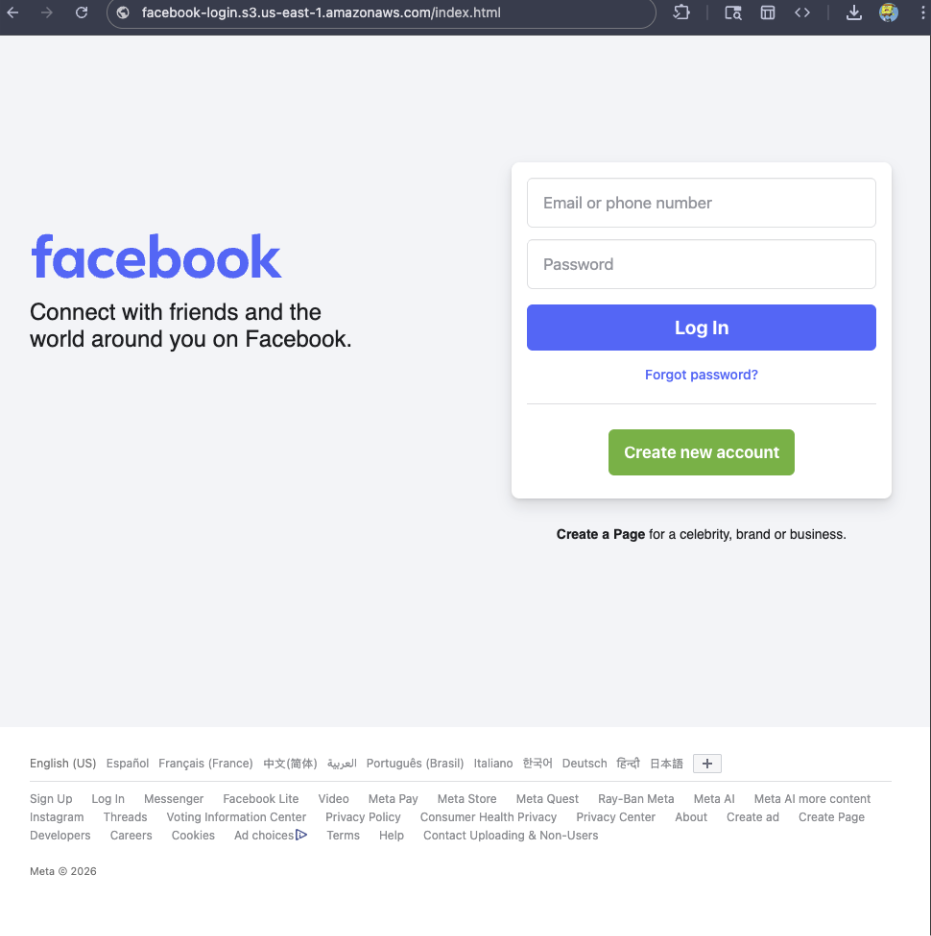
For example, if a site is hosted on Amazon S3, contains a password-input field, and uses a homoglyph in the URL to trick users into thinking they were logging into Facebook, Browser Guard can detect that combination—even if we’ve never seen the URL before.

Fake Facebook login screen

Why this matters more now 

With AI, attackers can create near-perfect duplicates of websites easier than ever. And did you spot the homoglyph in the URL? Nope, neither did I!  

That’s why we designed this system so we can update its rules every 30 minutes, instead of waiting for full extension updates.  

But I still see static blocking rules in Browser Guard 

That’s true—for now.  

We’ve found a temporary workaround that lets us support all the rules that we had before. However, we had to remove some of the more advanced logic that used to sit on top of them.

For example, we can’t use these large datasets to block subframe requests, only main frame requests. Nor can we stack multiple logic layers together; blocking is limited to simple matches (regex, domains and URLs).

Those limits are a big reason we’re investing more heavily in pattern-based and heuristic protection. 

Pure heuristics 

From day one, Browser Guard has used heuristics (behavior) to detect scams and phishing, monitoring behavior on the page to match suspicious activity.

For example, some scam pages deliberately break your browser’s back button by abusing window.replaceState, then trick you into calling that scammer’s “computer helpline.” Others try to convince you to run malicious commands on your computer.

Browser Guard can detect these behaviors and warn you before you fall for them. 

What’s next? 

Did someone say AI?  

You’ve probably seen Scam Guard in other Malwarebytes products. We’re currently working on a version tailored specifically for Browser Guard. More soon!

Final thoughts 

While Manifest v3 introduced meaningful improvements to browser security, it also created real challenges for security tools like Browser Guard.

Rather than scaling back, the Browser Guard team rebuilt our approach from the ground up, focusing on behavior, patterns, and faster response times. The result is protection that’s different under the hood, but just as committed to keeping you safe online.


We don’t just report on scams—we help detect them

Cybersecurity risks should never spread beyond a headline. If something looks dodgy to you, check if it’s a scam using Malwarebytes Scam Guard, a feature of our mobile protection products. Submit a screenshot, paste suspicious content, or share a text or phone number, and we’ll tell you if it’s a scam or legit. Download Malwarebytes Mobile Security for iOS or Android and try it today!

  •  

Scam-checking just got easier: Malwarebytes is now in ChatGPT 

If you’ve ever stared at a suspicious text, email, or link and thought “Is this a scam… or am I overthinking it?” Well, you’re not alone. 

Scams are getting harder to spot, and even savvy internet users get caught off guard. That’s why Malwarebytes is the first cybersecurity provider available directly inside ChatGPT, bringing trusted threat intelligence to millions of people right where these questions happen. 

Simply ask: “Malwarebytes, is this a scam?” and you’ll get a clear, informed answer—super fast. 

How to access 

To access Malwarebytes inside ChatGPT:

  • Sign in to ChatGPT  
  • Go to Apps  
  • Search for Malwarebytes and press Connect  
  • From then on, you can “@Malwarebytes” to check if a text message, DM, email, or other  content seems malicious.  

Cybersecurity help, right when and where you need it 

Malwarebytes in ChatGPT lets you tap into our cybersecurity expertise without ever leaving the conversation. Whether something feels off or you want a second opinion, you can get trusted guidance in no time at all. 

Here’s what you can do: 

Spot scams faster 

Paste in a suspicious text message, email, or DM and get: 

  • A clear, point-by-point breakdown of phishing or any known red flags 
  • An explanation of why something looks risky 
  • Practical next steps to help you stay safe 

You won’t get any jargon or guessing from us. What you will get is 100% peace of mind. 

Check links, domains, and phone numbers 

Not sure if a URL, website, or phone number is legit? Ask for a risk assessment informed by Malwarebytes threat intelligence, including: 

  • Signs of suspicious activity 
  • Whether the link or sender has been associated with scams 
  • If a domain is newly registered, follows redirects, or other potentially suspicious elements 
  • What to do next—block it, ignore it, or proceed with caution 

Powered by real threat intelligence 

The verdicts you get aren’t based on vibes or generic advice. They’re powered by Malwarebytes’ continuously updated threat intelligence—the same real-world data that helps protect millions of devices and people worldwide every day. 

If you spot something suspicious, you can submit it directly to Malwarebytes through ChatGPT. Those reports help strengthen threat intelligence, making the internet safer not just for you, but for everyone.

  • Link reputation scanner: Checks URLs against threat intelligence databases, detects newly registered domains (<30 days), and follows redirects.
  • Phone number reputation check: Validates phone numbers against scam/spam databases, including carrier and location details.  
  • Email address reputation check: Analyzes email domains for phishing & other malicious activity.  
  • WHOIS domain lookup: Retrieves registration data such as registrar, creation and expiration dates, and abuse of contacts.  
  • Verify domain legitimacy: Look up domain registration details to identify newly created or suspicious websites commonly used in phishing attacks.  
  • Get geographic context: Receive warnings when phone numbers originate from unexpected regions, a common indicator of international scam operations. 

Available now 

Malwarebytes in ChatGPT is available wherever ChatGPT apps are available.

To get started, just ask ChatGPT: 

“Malwarebytes, is this a scam?” 

For deeper insights, proactive protection, and human support, download the Malwarebytes app—our security solutions are designed to stop threats before they reach you, and the damage is done.

  •  

2nd February – Threat Intelligence Report

For the latest discoveries in cyber research for the week of 2nd February, please download our Threat Intelligence Bulletin.

TOP ATTACKS AND BREACHES

  • MicroWorld Technologies, maker of eScan antivirus, has suffered a supply-chain compromise. Malicious updates were pushed via the legitimate eScan updater, delivering multi-stage malware that establishes persistence, enables remote access, and blocks automatic updates. In response, eScan shut down its global update service for more than eight hours.
  • Crunchbase, a private company intelligence platform, has confirmed a data breach of over 2 million records claimed by ShinyHunters threat group after a ransom demand was refused. The published files were stolen from its corporate network and include customer names, contact details, partner contracts and other internal documents. Crunchbase said that their operations were not disrupted.
  • Qilin ransomware group has leaked an alleged database belonging to Tulsa International Airport in Oklahoma. The database include financial records, internal emails, and employee identification data. The airport authority has not yet confirmed compromise, and operations reportedly continue.

Check Point Threat Emulation provides protection against this threat (Ransomware.Wins.Qilin.ta.*; Ransomware.Wins.Qilin)

  • WorldLeaks extortion group has claimed responsibility for a data breach on the sportswear giant Nike. The threat group allegedly exposed samples totaling 1.4 terabytes of internal data including documents and archives related to the company’s supply chain and manufacturing operations.

AI THREATS

  • Clawdbot, an open source AI agent gateway, has more than 900 publicly exposed and often unauthenticated instances due to localhost auto approval behind reverse proxies. It enables credential theft, access to chat histories, and remote code execution.
  • Researchers uncovered RedKitten, a 2026 campaign with LLM-assisted development indicators targeting Iranian activists and NGOs. The campaign uses password-protected Excel lures to deliver SloppyMIO, a C# implant that uses Telegram for C2 and GitHub/Google Drive for payloads, with steganographic configuration, AppDomain Manager injection, and scheduled task persistence.
  • Researchers identified 16 malicious Chrome extensions for ChatGPT that exfiltrate authorization details and session tokens. The extensions inject scripts into the ChatGPT web application to monitor outbound requests, allowing attackers to hijack sessions and access chat histories.
  • Researchers analyzed publicly accessible open-source LLM deployments via Ollama and revealed many with disabled guardrails and exposed system prompts, enabling spam, phishing, disinformation, and other abuse.

VULNERABILITIES AND PATCHES

  • A critical path traversal vulnerability (CVE-2025-8088) in WinRAR is actively exploited by government backed threat actors linked to Russia and China as well as financially motivated threat actors. Weaponized phishing forces WinRAR to write malware into the Windows Startup folder, enabling automatic execution for ransomware and credential theft. A patch is available on WinRAR 7.13.

Check Point IPS provides protection against this threat (RARLAB WinRAR Directory Traversal (CVE-2025-8088))

  • SmarterTools addressed two critical SmarterMail flaws, including CVE-2026-24423 enabling remote code execution and CVE-2026-23760 allowing unauthenticated admin account takeover. The second flaw is actively exploited, and over 6,000 exposed SmarterMail servers are reportedly vulnerable.

Check Point IPS provides protection against this threat (SmarterTools SmarterMail Remote Code Execution (CVE-2026-24423); SmarterTools SmarterMail Authentication Bypass (CVE-2026-23760))

  • Fortinet has fixed CVE-2026-24858, an authentication bypass in FortiCloud single sign on which allowed unauthorized access and admin creation on downstream devices. The flaw carries CVSS 9.4 and is actively exploited via FortiCloud SSO.

THREAT INTELLIGENCE REPORTS

  • Check Point Research has published the 2026 Cyber Security Report, highlighting AI as a force multiplier across attacks, fragmentation in ransomware with data only extortion, and multi-channel social engineering attacks. It maps threat activity to geopolitics and identity driven paths, quantifies risky AI usage, and provides sector and regional breakouts.
  • Polish CERT detailed coordinated destructive attacks on Polish energy and manufacturing sectors, attributed to Static Tundra, using FortiGate SSL VPN access. The attackers conducted reconnaissance, firmware damage, lateral movement, and deployed DynoWiper and LazyWiper that corrupt files.
  • Researchers have uncovered renewed Matanbuchus downloader campaigns using Microsoft Installer files disguised as legitimate installers, with frequent component changes to evade antivirus and machine learning detection. In many cases, the loader is used for further ransomware deployment.

Check Point Harmony Endpoint and Threat Emulation provide protection against this threat (Trojan-Downloader.Wins.Matanbuchus.ta.*; Trojan-Downloader.Wins.Matanbuchus; Trojan-Downloader.Win.Matanbuchus)

  • Researchers have identified PyRAT, a Python based cross platform RAT for Windows and Linux, using unencrypted HTTP POST C2, fingerprinting victims, and file and screenshot exfiltration. Persistence uses a deceptive autostart on Linux and a user Run key on Windows, with semi persistent identifiers.
  • Researchers have found an Android campaign distributing a RAT via fake security alerts installing TrustBastion, which retrieves a second-stage payload from Hugging Face. The malware abuses Accessibility Services, deploys credential-stealing overlays, and uses server-side polymorphism to regenerate payloads every 15 minutes.

The post 2nd February – Threat Intelligence Report appeared first on Check Point Research.

  •  

How fake party invitations are being used to install remote access tools

“You’re invited!” 

It sounds friendly, familiar and quite harmless. But in a scam we recently spotted, that simple phrase is being used to trick victims into installing a full remote access tool on their Windows computers—giving attackers complete control of the system. 

What appears to be a casual party or event invitation leads to the silent installation of ScreenConnect, a legitimate remote support tool quietly installed in the background and abused by attackers. 

Here’s how the scam works, why it’s effective, and how to protect yourself. 

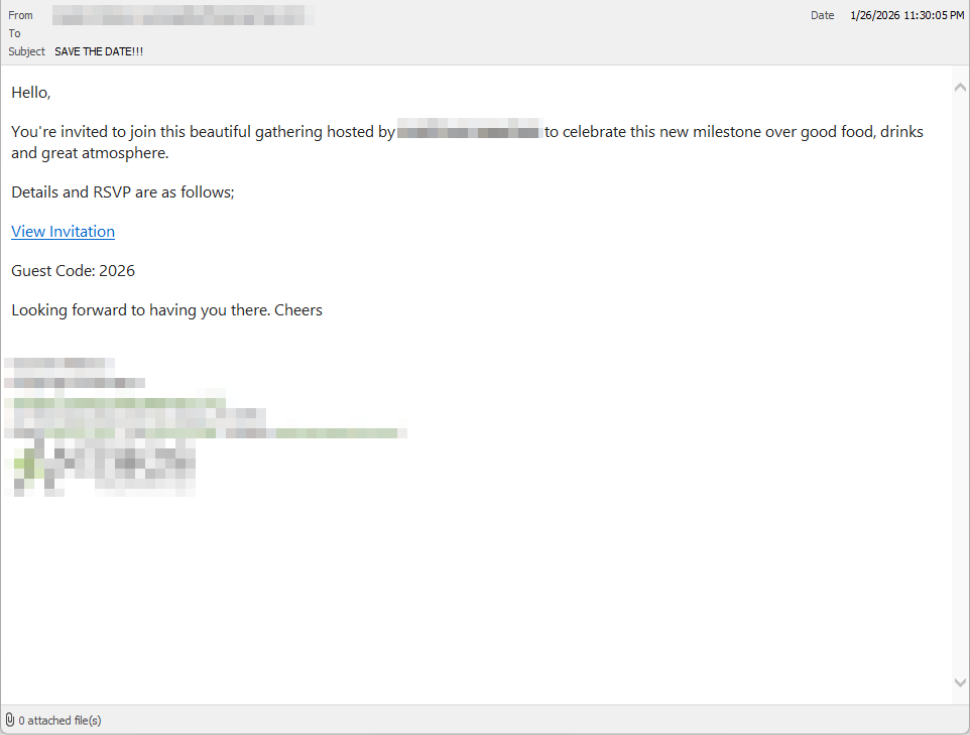
The email: A party invitation 

Victims receive an email framed as a personal invitation—often written to look like it came from a friend or acquaintance. The message is deliberately informal and social, lowering suspicion and encouraging quick action. 

In the screenshot below, the email arrived from a friend whose email account had been hacked, but it could just as easily come from a sender you don’t know.

So far, we’ve only seen this campaign targeting people in the UK, but there’s nothing stopping it from expanding elsewhere. 

Clicking the link in the email leads to a polished invitation page hosted on an attacker-controlled domain. 

Party invitation email from a contact

The invite: The landing page that leads to an installer 

The landing page leans heavily into the party theme, but instead of showing event details, the page nudges the user toward opening a file. None of them look dangerous on their own, but together they keep the user focused on the “invitation” file: 

  • A bold “You’re Invited!” headline 
  • The suggestion that a friend had sent the invitation 
  • A message saying the invitation is best viewed on a Windows laptop or desktop
  • A countdown suggesting your invitation is already “downloading” 
  • A message implying urgency and social proof (“I opened mine and it was so easy!”) 

Within seconds, the browser is redirected to download RSVPPartyInvitationCard.msi 

The page even triggers the download automatically to keep the victim moving forward without stopping to think. 

This MSI file isn’t an invitation. It’s an installer. 

The landing page

The guest: What the MSI actually does 

When the user opens the MSI file, it launches msiexec.exe and silently installs ScreenConnect Client, a legitimate remote access tool often used by IT support teams.  

There’s no invitation, RSVP form, or calendar entry. 

What happens instead: 

  • ScreenConnect binaries are installed under C:\Program Files (x86)\ScreenConnect Client\ 
  • A persistent Windows service is created (for example, ScreenConnect Client 18d1648b87bb3023) 
  • ScreenConnect installs multiple .NET-based components 
  • There is no clear user-facing indication that a remote access tool is being installed 

From the victim’s perspective, very little seems to happen. But at this point, the attacker can now remotely access their computer. 

The after-party: Remote access is established 

Once installed, the ScreenConnect client initiates encrypted outbound connections to ScreenConnect’s relay servers, including a uniquely assigned instance domain.

That connection gives the attacker the same level of access as a remote IT technician, including the ability to: 

  • See the victim’s screen in real time
  • Control the mouse and keyboard 
  • Upload or download files 
  • Keep access even after the computer is restarted 

Because ScreenConnect is legitimate software commonly used for remote support, its presence isn’t always obvious. On a personal computer, the first signs are often behavioral, such as unexplained cursor movement, windows opening on their own, or a ScreenConnect process the user doesn’t remember installing. 

Why this scam works 

This campaign is effective because it targets normal, predictable human behavior. From a behavioral security standpoint, it exploits our natural curiosity and appears to be a low risk. 

Most people don’t think of invitations as dangerous. Opening one feels passive, like glancing at a flyer or checking a message, not installing software. 

Even security-aware users are trained to watch out for warnings and pressure. A friendly “you’re invited” message doesn’t trigger those alarms. 

By the time something feels off, the software is already installed. 

Signs your computer may be affected 

Watch for: 

  • A download or executed file named RSVPPartyInvitationCard.msi 
  • An unexpected installation of ScreenConnect Client 
  • A Windows service named ScreenConnect Client with random characters  
  • Your computer makes outbound HTTPS connections to ScreenConnect relay domains 
  • Your system resolves the invitation-hosting domain used in this campaign, xnyr[.]digital 

How to stay safe  

This campaign is a reminder that modern attacks often don’t break in—they’re invited in. Remote access tools give attackers deep control over a system. Acting quickly can limit the damage.  

For individuals 

If you receive an email like this: 

  • Be suspicious of invitations that ask you to download or open software 
  • Never run MSI files from unsolicited emails 
  • Verify invitations through another channel before opening anything 

If you already clicked or ran the file:  

  • Disconnect from the internet immediately 
  • Check for ScreenConnect and uninstall it if present 
  • Run a full security scan 
  • Change important passwords from a clean, unaffected device 

For organisations (especially in the UK) 

  • Alert on unauthorized ScreenConnect installations
  • Restrict MSI execution where feasible 
  • Treat “remote support tools” as high-risk software
  • Educate users: invitations don’t come as installers 

This scam works by installing a legitimate remote access tool without clear user intent. That’s exactly the gap Malwarebytes is designed to catch.

Malwarebytes now detects newly installed remote access tools and alerts you when one appears on your system. You’re then given a choice: confirm that the tool is expected and trusted, or remove it if it isn’t.


We don’t just report on threats—we remove them

Cybersecurity risks should never spread beyond a headline. Keep threats off your devices by downloading Malwarebytes today.

  •  
❌