Login
Login
Flashpoint EASM: Industry-Leading Vulnerability Intelligence, Mapped to Your Internet-Facing Assets
Blog
Flashpoint EASM: Industry-Leading Vulnerability Intelligence, Mapped to Your Internet-Facing Assets
Catch exposures before threat actors do. Here is how Flashpoint’s new module works and the top questions answered from our live demo.


 Table Of Contents
Security teams don’t lose ground because they lack tools. They lose ground because they can’t see everything an attacker can.
This is the challenge we addressed in our latest Demo Day webinar introducing Flashpoint External Attack Surface Management (EASM), a new module inside our Ignite platform that gives security teams a continuous, attacker’s-eye view of their external attack surface, mapped directly to our proprietary vulnerability intelligence.
The Problem: Too Much Noise, Not Enough Context
Most security teams are dealing with three compounding problems:
- Disconnected Data: Vulnerability data lives isolated from actual infrastructure. Knowing a CVE exists doesn’t tell you whether it affects your active environment.
- Alert Fatigue: CVSS-only prioritization treats every “critical” score as an emergency, even when an asset isn’t internet-facing or exploitable.
- Accelerated Threat Cycles: AI is speeding up how quickly threat actors discover and exploit vulnerabilities, making manual tracking impossible.
Layer on top of that the reality that most teams still track their perimeter with spreadsheets or a static CMDB, and you get a widening gap between what security teams think they own and what is actually exposed. This gap has a name: shadow IT.
Shadow IT Is a Growing Blind Spot
Shadow IT covers the domains, subdomains, and cloud instances that get spun up to get work done, without IT’s knowledge or approval. It’s not a fringe issue. According to Gartner, by next year, 75% of employees will be acquiring, modifying, or creating technology outside their IT department’s visibility, up from 41% just a few years ago.
These unmanaged assets sit outside inventory and outside the reach of any scanner that only looks at what’s already known. That makes them exactly the kind of infrastructure an attacker finds first, and exactly the blind spot Flashpoint EASM is built to close.
What is Flashpoint EASM?
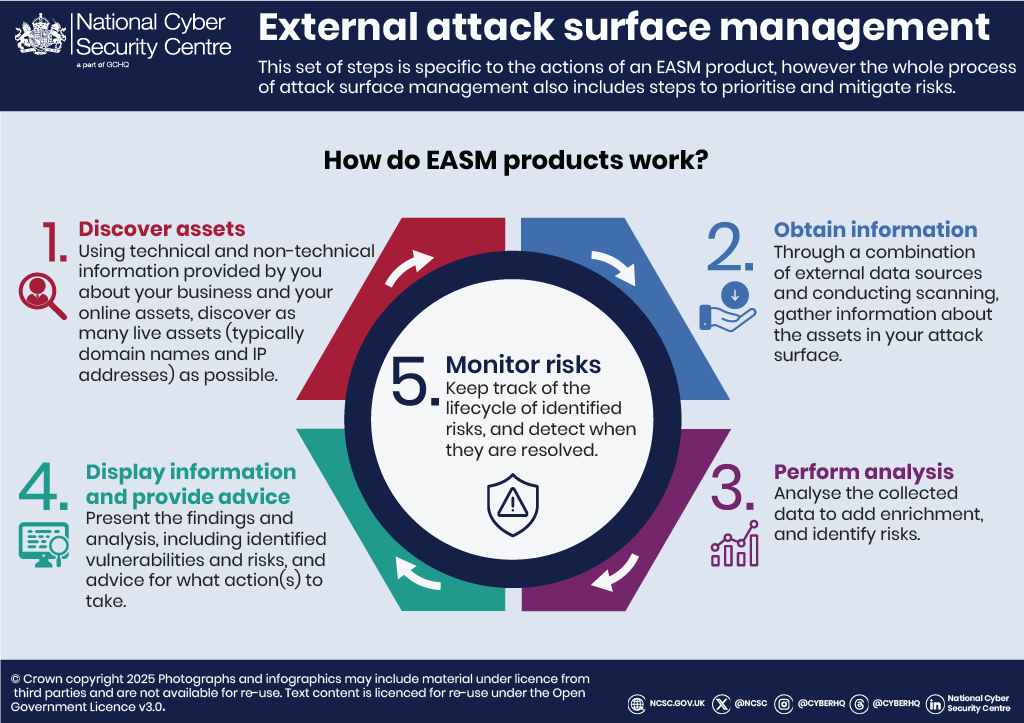
Flashpoint EASM gives security teams a continuous, attacker’s-eye view of their external attack surface and maps that view directly to Flashpoint’s vulnerability intelligence. Instead of your team asking “are we affected by this?”, every time a new vulnerability is disclosed, EASM answers that question continuously, often before the answer is obvious anywhere else.
Flashpoint EASM is built on three capabilities that work together:
Continuous Asset Discovery
Flashpoint EASM continuously discovers and monitors internet-facing assets: domains, subdomains, and IPs. New discoveries flow into a dedicated triage inbox, so security teams can quickly accept and focus on what’s actually relevant instead of drowning in noise.
Vulnerability Mapping
Every discovered exposure is mapped to Flashpoint’s proprietary vulnerability intelligence, including our pre-NVD findings, KEV (Known Exploited Vulnerabilities) status, ransomware likelihood, and exploit maturity. This provides organizations with immediate context into the vulnerabilities that pose the most risk.
Customizable Alerting
Using EASM, security teams get alerted to the exact moment a new asset or vulnerability is detected. This alert is fully customizable by severity and is available inside one unified workflow via Flashpoint Ignite.
Discover, map, and alert. This loop gives organizations an intelligence-led view of their perimeter, so they can proactively outpace threat actors instead of being forced to react.
How Flashpoint EASM Works
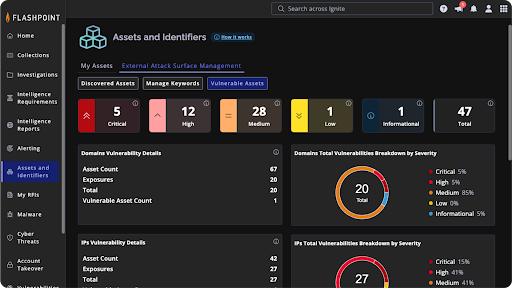
In our live demo, Flashpoint walked through the EASM workflow, which can be found under “Assets and Identifiers” in the Ignite Platform.
Here’s how it works:
Step 1: Submit Seed Keywords
Onboarding starts with keywords, meaning domain and IP address assets your organization actually owns. Any already set up asset is automatically surfaced in Flashpoint Ignite—such as through our compromised credential monitoring—ensuring no duplicated setup work.
Step 2: Triage Discovered Assets
Once keywords are approved, EASM iterates on them to surface additional related infrastructure, domains and IPs alike, along with a discovery graph showing exactly how each asset was found. That traceability makes it easy to judge relevance at a glance.
Every discovered asset lands in one of three statuses:
- Owned: Assets in your tech stack. EASM continues discovering related infrastructure from these and links vulnerabilities to them.
- External: Assets relevant to you, but where you don’t need further discovery, just vulnerability linkage.
- Discarded: Assets you don’t need, removed from the triage feed entirely.
Step 3: Review the Vulnerable Assets Overview
In the main dashboard, the Vulnerable Assets page, security professionals can view total asset count, number of exposures, unique vulnerabilities affecting them, and total potentially vulnerable assets—in addition to criticality breakdowns for both domains and IPs.
From there, security teams can drill into:
- Unique vulnerabilities, filterable by CVE or severity
- Domains with vulnerabilities, showing exposure counts by severity and the last exposure date
- Individual asset detail pages, showing products, versions, vendors, and ports, with vulnerabilities linked directly to the specific product version affected
Diving deeper into a surfaced vulnerability provides technical descriptions, solution information, and other affected products. Additionally, Flashpoint’s vulnerability database includes over 105,000 pre-NVD vulnerabilities, giving vulnerability management teams actionable indicators well before they show up in public sources.
Step 4: Set Up Alerting
Flashpoint EASM gives teams full control over signal versus noise. Whether that means getting notified the moment a critical vulnerability is disclosed, or reviewing a daily summary of your own schedule, EASM offers two alert types:
- Asset discovery alerts, either per-asset or as a daily rollup
- Vulnerability alerts, filterable by criticality (critical, high, medium, low), with the option for in-app only or in-app plus email, and available as a daily rollup
Why Flashpoint EASM Matters
- Flashpoint EASM isn’t just another scanning tool. The intelligence underneath it is the differentiator: discovery tells you what’s out there, Flashpoint provides the much-needed context to tell you what’s dangerous right now.
- The intelligence includes coverage that can’t readily be found elsewhere: Flashpoint’s independently researched data includes pre-NVD findings, improved KEV coverage, ransomware risk scoring, and exploit maturity.
- It closes a blind spot teams have quietly lived with: EASM closes shadow IT gaps and surfaces assets sitting outside inventory entirely.
Flashpoint External Attack Surface Management gives security teams a continuous, intelligence-led view of everything a threat actor sees, so organizations can find and fix exposures before they’re exploited. To see it in action in a personalized walkthrough of your own environment, reach out to schedule a demo.
EASM Frequently Asked Questions (FAQs): What Security Teams Want to Know
What makes Flashpoint EASM different from other EASM solutions?
Most EASM tools stop at raw discovery, telling you an asset exists without telling you whether it matters. Flashpoint EASM pairs continuous asset discovery with a triage inbox to cut noise, then maps every asset directly to Flashpoint’s proprietary vulnerability intelligence, all natively inside Ignite alongside CTI and Vulnerability Intelligence. That combination means prioritization is based on real attacker activity, not just an asset inventory, giving remediation teams the exact context they need to proactively address risk.
What makes Flashpoint’s vulnerability intelligence unique?
Flashpoint’s database covers 400,000+ vulnerabilities, including 105,000+ not found in NVD or CVE, often surfaced up to two weeks earlier than public sources. Every entry is enriched with threat-informed context like EPSS scores, ransomware likelihood, exploit maturity, and MITRE ATT&CK mapping, then reviewed by human analysts, not just automated feeds. The result is prioritization based on real-world exploitation risk rather than CVSS alone.
Can existing monitored assets be imported into Flashpoint EASM?
Yes. EASM integrates closely with Flashpoint’s existing assets module, so assets already set up (for example, for compromised credential monitoring) surface automatically during onboarding.
Is there a limit on discovered assets, beyond the 30-keyword cap?
No. The 30-keyword limit only applies to initial seed keywords, to keep that starting set relevant. Once assets are marked owned or external, there’s no cap on ongoing discovery.
How does continuous polling compare to traditional scanning?
Traditional scanners give you a point-in-time snapshot. EASM continuously discovers assets and vulnerabilities, giving you a moving view of your exposure, essentially the same view an attacker would have in real time.
Does EASM identify compound risk, where multiple weaknesses increase exploitability together?
The Vulnerable Assets view surfaces how many vulnerabilities are tied to a given asset, so teams can quickly spot assets carrying disproportionate risk and prioritize accordingly.
Does EASM overlap with SBOM alerting?
Not exactly. SBOM alerting monitors vulnerabilities in assets you already know about. EASM is focused on discovering the assets you don’t know about yet. Most mature security programs benefit from running both in tandem.
See Flashpoint in Action
The post Flashpoint EASM: Industry-Leading Vulnerability Intelligence, Mapped to Your Internet-Facing Assets appeared first on Flashpoint.