
Normal view

Claude Fable 5 and Mythos 5 “abruptly disabled” after US gov. ban

15 June 2026 at 16:32

Anthropic has been ordered by the US government to cut off its newest Claude Fable 5 and Mythos 5 models for fear of abuse by adversaries.

Reuters reports that Anthropic said it will “abruptly ​disable” its most advanced AI models for all users after the US government ordered it to suspend access to the models for foreign nationals, citing national security ‌concerns.

Officials reportedly believe a jailbreak could turn Fable 5 and Mythos 5 into vulnerability-discovery tools for adversaries, so Anthropic says it is disabling them worldwide rather than try to nationality‑filter access, since it is virtually impossible to verify every user’s nationality.

In a statement on its website, Anthropic says:

“The letter did not provide specific details of its national security concern. Our understanding is that the government believes it has become aware of a method of bypassing, or “jailbreaking” Fable 5. We reviewed a demonstration of this specific technique being used to identify a small number of previously known, minor vulnerabilities. These vulnerabilities all appear relatively simple, and we have found that other publicly-available models are able to discover them as well without requiring a bypass.”

Mythos 5 is the non-public full version, which is currently used only by government agencies and selected corporate partners to harden their systems. Fable 5 is a Mythos-class model that should supposedly be safe for general use.

It makes sense to me that if Fable 5 is easy to jailbreak, that it should fall under the same restrictions as Mythos 5. However, Anthropic maintains that it has built-in safeguards that mean queries on some topics will instead receive a response from the next-most-capable model, Claude Opus 4.8. 

The relationship between the US government and Anthropic had shown signs of easing in parts of the US government after tensions over military use, surveillance, and autonomous weapons. In March, defense Secretary Pete Hegseth designated the San Francisco-based company a “supply-chain risk to national security.”

To understand the nature of the argument, it is necessary to understand that Mythos 5 is described in multiple reports as particularly effective at identifying software vulnerabilities, including long‑standing bugs in complex, legacy systems such as those in banking and other critical infrastructure. Many view this as dual‑use: great for defense hardening, but catastrophic in the wrong hands.

In recent updates from major software vendors like Microsoft and Google, we’ve seen a growth in numbers of patched vulnerabilities after the vendors began using AI-guided search for new vulnerabilities in their own software. We also know that Mozilla found over 270 Firefox vulnerabilities with the aid of Anthropic’s new Claude Mythos model. 

What this means

In the wrong hands these vulnerabilities could definitely do a lot of harm. So, it looks like it will take some time before regular consumers and developers will gain access to Fable 5 and Mythos 5 entirely. However, existing Anthropic models (older Claude variants) remain available.

For home users who were simply chatting with Claude or using it to help with basic scripting, the change will mostly show up as “this specific version is unavailable” rather than a broader AI blackout.

Removing a high‑end vulnerability‑finding model from broad circulation increases the effort required for less‑resourced cybercriminals to automate discovery of complex bugs in consumer‑facing software and services only by so much. There are other models available on the black market that might be just as effective. And for most cybercriminals, turning a vulnerability into a method they can utilize in an exploit is much more relevant.


We don’t just report on threats—we remove them

Cybersecurity risks should never spread beyond a headline. Keep threats off your devices by downloading Malwarebytes today.
Claude Fable 5 and Mythos 5 “abruptly disabled” after US gov. ban

15 June 2026 at 16:32

Anthropic has been ordered by the US government to cut off its newest Claude Fable 5 and Mythos 5 models for fear of abuse by adversaries.

Reuters reports that Anthropic said it will “abruptly ​disable” its most advanced AI models for all users after the US government ordered it to suspend access to the models for foreign nationals, citing national security ‌concerns.

Officials reportedly believe a jailbreak could turn Fable 5 and Mythos 5 into vulnerability-discovery tools for adversaries, so Anthropic says it is disabling them worldwide rather than try to nationality‑filter access, since it is virtually impossible to verify every user’s nationality.

In a statement on its website, Anthropic says:

“The letter did not provide specific details of its national security concern. Our understanding is that the government believes it has become aware of a method of bypassing, or “jailbreaking” Fable 5. We reviewed a demonstration of this specific technique being used to identify a small number of previously known, minor vulnerabilities. These vulnerabilities all appear relatively simple, and we have found that other publicly-available models are able to discover them as well without requiring a bypass.”

Mythos 5 is the non-public full version, which is currently used only by government agencies and selected corporate partners to harden their systems. Fable 5 is a Mythos-class model that should supposedly be safe for general use.

It makes sense to me that if Fable 5 is easy to jailbreak, that it should fall under the same restrictions as Mythos 5. However, Anthropic maintains that it has built-in safeguards that mean queries on some topics will instead receive a response from the next-most-capable model, Claude Opus 4.8. 

The relationship between the US government and Anthropic had shown signs of easing in parts of the US government after tensions over military use, surveillance, and autonomous weapons. In March, defense Secretary Pete Hegseth designated the San Francisco-based company a “supply-chain risk to national security.”

To understand the nature of the argument, it is necessary to understand that Mythos 5 is described in multiple reports as particularly effective at identifying software vulnerabilities, including long‑standing bugs in complex, legacy systems such as those in banking and other critical infrastructure. Many view this as dual‑use: great for defense hardening, but catastrophic in the wrong hands.

In recent updates from major software vendors like Microsoft and Google, we’ve seen a growth in numbers of patched vulnerabilities after the vendors began using AI-guided search for new vulnerabilities in their own software. We also know that Mozilla found over 270 Firefox vulnerabilities with the aid of Anthropic’s new Claude Mythos model. 

What this means

In the wrong hands these vulnerabilities could definitely do a lot of harm. So, it looks like it will take some time before regular consumers and developers will gain access to Fable 5 and Mythos 5 entirely. However, existing Anthropic models (older Claude variants) remain available.

For home users who were simply chatting with Claude or using it to help with basic scripting, the change will mostly show up as “this specific version is unavailable” rather than a broader AI blackout.

Removing a high‑end vulnerability‑finding model from broad circulation increases the effort required for less‑resourced cybercriminals to automate discovery of complex bugs in consumer‑facing software and services only by so much. There are other models available on the black market that might be just as effective. And for most cybercriminals, turning a vulnerability into a method they can utilize in an exploit is much more relevant.


We don’t just report on threats—we remove them

Cybersecurity risks should never spread beyond a headline. Keep threats off your devices by downloading Malwarebytes today.

Microsoft’s biggest-ever Patch Tuesday fixes 206 bugs, including 3 zero-days

10 June 2026 at 14:43

This month’s Patch Tuesday fixes 206 security flaws in Microsoft software, making it the biggest Patch Tuesday release ever.

The update includes 32 critical vulnerabilities, as well as three publicly disclosed zero-days. Microsoft classifies these as zero-days because information about the vulnerabilities became public before patches were available. None are known to have been actively exploited by attackers.

The huge number of fixed vulnerabilities makes this the largest Patch Tuesday since Microsoft launched the program in October 2003. The company introduced the monthly update schedule after the Blaster worm caused disruption in the early days of Windows.

How to apply patches and check if you’re protected

These updates fix security problems and keep your Windows PC protected. Here’s how to make sure you’re up to date:

1. Open Settings

  • Click the Start button (the Windows logo at the bottom left of your screen).
  • Click on Settings (it looks like a little gear).

2. Go to Windows Update

  • In the Settings window, select Windows Update (usually at the bottom of the menu on the left).

3. Check for updates

  • Click the button that says Check for updates.
  • Windows will search for the latest Patch Tuesday updates.
  • If you have selected to get the latest updates as soon as they’re available, you may see this under More options.
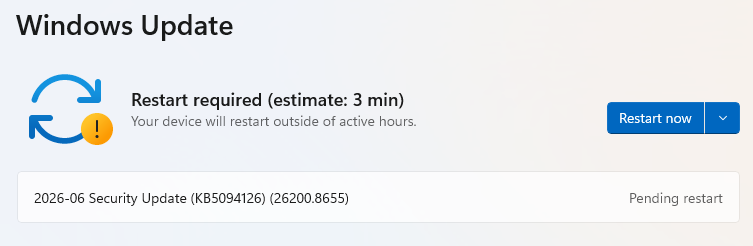
    In which case you may see a Restart required message. Restart your system and the update will complete.
    restart required
  • If not, continue with the steps below.

4. Download and install

  • If updates are found, they’ll start downloading automatically. Once complete, you’ll see a button that says Install or Restart now.
  • Click Install if needed and follow any prompts. Your computer will usually need a restart to finish the update. If it does, click Restart now.

5. Double-check you’re up to date

  • After restarting, go back to Windows Update and check again. If it says You’re up to date, you’re all set!
Windows up to date

Technical details

One publicly disclosed vulnerability is important to mention. This flaw in Windows BitLocker is tracked as CVE-2026-50507 (CVSS score: 6.8 out of 10) and its description states:

“a protection mechanism failure in Windows BitLocker allows an unauthorized attacker to bypass a security feature with a physical attack.”

BitLocker is a built-in Windows security feature that encrypts your entire hard drive, securing your data from unauthorized access if your device is lost or stolen. However, this vulnerability could allow an attacker with physical access to bypass BitLocker Device Encryption and gain access to encrypted data.

Another is CVE-2026-49160 (CVSS score: 7.5 out of 10) in HTTP.sys. This vulnerability can be exploited to launch a remote denial-of-service attack against major web servers using a technique called HTTP/2 Bomb.

The third to discuss is CVE-2026-45586 (CVSS score: 7.8 out of 10) in the Windows Collaborative Translation Framework (CTFMON). An attacker who successfully exploited this vulnerability could gain SYSTEM privileges. These elevation of privilege (EoP) vulnerabilities are especially valuable to attackers because they can be combined with other flaws to gain full control of a compromised system.


We don’t just report on threats—we remove them

Cybersecurity risks should never spread beyond a headline. Keep threats off your devices by downloading Malwarebytes today.

Microsoft’s biggest-ever Patch Tuesday fixes 206 bugs, including 3 zero-days

10 June 2026 at 14:43

This month’s Patch Tuesday fixes 206 security flaws in Microsoft software, making it the biggest Patch Tuesday release ever.

The update includes 32 critical vulnerabilities, as well as three publicly disclosed zero-days. Microsoft classifies these as zero-days because information about the vulnerabilities became public before patches were available. None are known to have been actively exploited by attackers.

The huge number of fixed vulnerabilities makes this the largest Patch Tuesday since Microsoft launched the program in October 2003. The company introduced the monthly update schedule after the Blaster worm caused disruption in the early days of Windows.

How to apply patches and check if you’re protected

These updates fix security problems and keep your Windows PC protected. Here’s how to make sure you’re up to date:

1. Open Settings

  • Click the Start button (the Windows logo at the bottom left of your screen).
  • Click on Settings (it looks like a little gear).

2. Go to Windows Update

  • In the Settings window, select Windows Update (usually at the bottom of the menu on the left).

3. Check for updates

  • Click the button that says Check for updates.
  • Windows will search for the latest Patch Tuesday updates.
  • If you have selected to get the latest updates as soon as they’re available, you may see this under More options.
    In which case you may see a Restart required message. Restart your system and the update will complete.
    restart required
  • If not, continue with the steps below.

4. Download and install

  • If updates are found, they’ll start downloading automatically. Once complete, you’ll see a button that says Install or Restart now.
  • Click Install if needed and follow any prompts. Your computer will usually need a restart to finish the update. If it does, click Restart now.

5. Double-check you’re up to date

  • After restarting, go back to Windows Update and check again. If it says You’re up to date, you’re all set!
Windows up to date

Technical details

One publicly disclosed vulnerability is important to mention. This flaw in Windows BitLocker is tracked as CVE-2026-50507 (CVSS score: 6.8 out of 10) and its description states:

“a protection mechanism failure in Windows BitLocker allows an unauthorized attacker to bypass a security feature with a physical attack.”

BitLocker is a built-in Windows security feature that encrypts your entire hard drive, securing your data from unauthorized access if your device is lost or stolen. However, this vulnerability could allow an attacker with physical access to bypass BitLocker Device Encryption and gain access to encrypted data.

Another is CVE-2026-49160 (CVSS score: 7.5 out of 10) in HTTP.sys. This vulnerability can be exploited to launch a remote denial-of-service attack against major web servers using a technique called HTTP/2 Bomb.

The third to discuss is CVE-2026-45586 (CVSS score: 7.8 out of 10) in the Windows Collaborative Translation Framework (CTFMON). An attacker who successfully exploited this vulnerability could gain SYSTEM privileges. These elevation of privilege (EoP) vulnerabilities are especially valuable to attackers because they can be combined with other flaws to gain full control of a compromised system.


We don’t just report on threats—we remove them

Cybersecurity risks should never spread beyond a headline. Keep threats off your devices by downloading Malwarebytes today.

❌