
Normal view

Firefox 151 packs big privacy upgrades into a small update

20 May 2026 at 13:46

Mozilla has published release notes for Firefox browser version 151.0, and this update includes several genuinely meaningful privacy and security improvements.

Three changes stand out in particular:

  • Stronger anti‑fingerprinting
  • Broader protection for local network access
  • More control over private sessions and permissions

Note that Mozilla says several Firefox 151 features are “part of a progressive roll out,” meaning they will appear for some users first and be expanded over time. So, you may not see all of them immediately.

Privacy

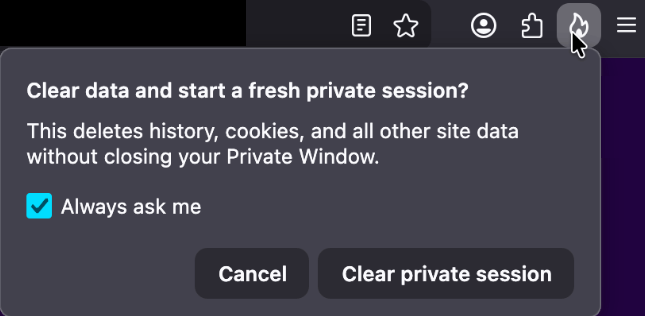
One of the more visible additions is a new “end private session” control in Private Browsing Mode. Instead of closing every private window to clear your traces, you now get a dedicated fire‑icon button next to the address bar that wipes the current private session’s data and immediately starts a fresh one.

End private session button

Under the hood, this clears the usual private browsing artifacts for that session, including history, cookies, cached files, and other site data that would normally disappear only when the last private window closes.

For people who routinely mix normal and private windows, this is safer and less error‑prone than hunting down every private tab before you walk away from the machine.

Firefox 151 also tightens its defenses against browser fingerprinting in the default “Standard” Enhanced Tracking Protection (ETP) mode. Mozilla says Firefox now limits the amount of device and browser information exposed to websites in a way that reduces the number of uniquely identifiable users by about 14% overall, and by roughly 49% on macOS.

This makes it harder for trackers to pick you out of the crowd, especially on platforms with fewer users to begin with (like certain macOS configurations). This reduces the privacy risk surface by default, which makes it harder for phishing and landing pages that redirect visitors to “categorize” you.

Another important change is Firefox’s “local network access restrictions,” which are now rolling out to all users, not just those who turned Enhanced Tracking Protection to Strict.

This means that when a website wants to communicate with devices on your local network, or with apps and services running on your machine, Firefox now asks for permission first. Chrome and Edge have been rolling out similar permission prompts.

Security

Firefox 151 also quietly fixes several security vulnerabilities.

The most notable example is CVE‑2026‑8953, a sandbox escape due to a use‑after‑free in the Disability Access APIs component. While there are currently no reports of in‑the‑wild exploitation for this specific bug at the time of writing, this is the kind of bug cybercriminals love.

A use-after-free (UAF) is a software memory vulnerability where a program attempts to access a memory location after it has been freed. If the program fails to clear the pointer to that freed memory, attackers can manipulate the error to crash the system or execute arbitrary code. A memory corruption leading to a sandbox escape is exactly the kind of link attackers want to complete a browser exploit chain.

How to update

If you’re running Firefox in a home or small‑office environment, we recommend updating to Firefox 151 as soon as possible to get the fingerprinting protections, local network access prompts, and security patches.

To update Firefox:

  • Open Firefox
  • Click the menu (three stacked lines) in the upper-right corner
  • Go to Help > About Firefox
  • Firefox will automatically check for updates and begin downloading them
  • Restart the browser when prompted to complete the update

Once your Firefox browser has been updated, it will show a green checkmark along with the message: “Firefox is up to date.”

Firefox is up to date

Let’s face it, an incognito window can only do so much. 
 
Breaches, dark web trading, credit fraud. Malwarebytes Identity Theft Protection monitors for all of it, alerts you fast, and comes with identity theft insurance. 

Firefox 151 packs big privacy upgrades into a small update

20 May 2026 at 13:46

Mozilla has published release notes for Firefox browser version 151.0, and this update includes several genuinely meaningful privacy and security improvements.

Three changes stand out in particular:

  • Stronger anti‑fingerprinting
  • Broader protection for local network access
  • More control over private sessions and permissions

Note that Mozilla says several Firefox 151 features are “part of a progressive roll out,” meaning they will appear for some users first and be expanded over time. So, you may not see all of them immediately.

Privacy

One of the more visible additions is a new “end private session” control in Private Browsing Mode. Instead of closing every private window to clear your traces, you now get a dedicated fire‑icon button next to the address bar that wipes the current private session’s data and immediately starts a fresh one.

End private session button

Under the hood, this clears the usual private browsing artifacts for that session, including history, cookies, cached files, and other site data that would normally disappear only when the last private window closes.

For people who routinely mix normal and private windows, this is safer and less error‑prone than hunting down every private tab before you walk away from the machine.

Firefox 151 also tightens its defenses against browser fingerprinting in the default “Standard” Enhanced Tracking Protection (ETP) mode. Mozilla says Firefox now limits the amount of device and browser information exposed to websites in a way that reduces the number of uniquely identifiable users by about 14% overall, and by roughly 49% on macOS.

This makes it harder for trackers to pick you out of the crowd, especially on platforms with fewer users to begin with (like certain macOS configurations). This reduces the privacy risk surface by default, which makes it harder for phishing and landing pages that redirect visitors to “categorize” you.

Another important change is Firefox’s “local network access restrictions,” which are now rolling out to all users, not just those who turned Enhanced Tracking Protection to Strict.

This means that when a website wants to communicate with devices on your local network, or with apps and services running on your machine, Firefox now asks for permission first. Chrome and Edge have been rolling out similar permission prompts.

Security

Firefox 151 also quietly fixes several security vulnerabilities.

The most notable example is CVE‑2026‑8953, a sandbox escape due to a use‑after‑free in the Disability Access APIs component. While there are currently no reports of in‑the‑wild exploitation for this specific bug at the time of writing, this is the kind of bug cybercriminals love.

A use-after-free (UAF) is a software memory vulnerability where a program attempts to access a memory location after it has been freed. If the program fails to clear the pointer to that freed memory, attackers can manipulate the error to crash the system or execute arbitrary code. A memory corruption leading to a sandbox escape is exactly the kind of link attackers want to complete a browser exploit chain.

How to update

If you’re running Firefox in a home or small‑office environment, we recommend updating to Firefox 151 as soon as possible to get the fingerprinting protections, local network access prompts, and security patches.

To update Firefox:

  • Open Firefox
  • Click the menu (three stacked lines) in the upper-right corner
  • Go to Help > About Firefox
  • Firefox will automatically check for updates and begin downloading them
  • Restart the browser when prompted to complete the update

Once your Firefox browser has been updated, it will show a green checkmark along with the message: “Firefox is up to date.”

Firefox is up to date

Let’s face it, an incognito window can only do so much. 
 
Breaches, dark web trading, credit fraud. Malwarebytes Identity Theft Protection monitors for all of it, alerts you fast, and comes with identity theft insurance. 

Microsoft Took a Step Toward Human Rights Accountability. Google and Amazon (and Others) Should Pay Attention!

19 May 2026 at 23:03

For years, civil society organizations, workers, journalists, and human rights experts have warned that major technology companies risk enabling grave human rights abuses when they provide cloud computing, AI, and surveillance infrastructure to governments implicated in violations of international and humanitarian law. While many companies pay lip service to evaluating customers and contracts for human rights implications (lip service Exhibit A: Palantir!), too often those processes fail to provide any meaningful accountability when their standards are not met or are simply ignored. But recent developments at Microsoft suggest that accountability for failing to uphold the human rights standards that a company itself sets, even if incomplete, is possible. 

According to recent reporting, Microsoft’s Israel chief has departed amid an escalating ethical controversy surrounding the company’s business relationships with the Israeli Ministry of Defense. The move follows months of scrutiny, internal dissent, and sustained pressure from inside the organization along with press and civil society, especially after a report by The Guardian revealed that Microsoft technologies were used in systems connected to mass surveillance and military targeting operations in Gaza in ways that appeared to violate Microsoft’s own standards. This did not happen overnight.

In September 2025, Microsoft reportedly suspended certain services after initial investigations raised serious concerns about how its cloud and AI infrastructure may have been used. That alone distinguished Microsoft from many of its peers. Rather than simply dismissing mounting concerns or hiding behind vague claims of neutrality, Microsoft appeared to recognize that providing technology in conflict settings creates real human rights responsibilities. Now, after additional investigation and continued public scrutiny, it appears the company has taken another step, one that should send a strong signal to others that violating Microsoft’s human rights commitments could cost you your job. This is important. 

There is still much more Microsoft should do, of course. The company has yet to fully disclose the scope of its findings, explain exactly which services were suspended, or clarify what safeguards remain in place to prevent its technologies from contributing to human rights abuses in the future. We shouldn’t have to infer the connection between this employment action and the company’s investigation. 

Just prior to reports that Microsoft had fired its Israel Country General Manager, EFF joined Access Now, Amnesty International, Fight for the Future, and 7amleh in a joint May 7, 2026 letter to Microsoft leadership calling on the company to publicly release the findings of its investigation, suspend business relationships tied to serious human rights abuses, and implement meaningful safeguards to prevent its technologies from contributing to further harm. The letter detailed allegations regarding Microsoft’s reported provision of Azure cloud and AI services to Israeli military and intelligence units involved in surveillance and targeting operations, while also pressing the company to take concrete human rights due diligence measures going forward. Those demands remain urgent, even as Microsoft appears to be taking some of the steps we urged.

But even as we push for more, it is important to recognize when a company takes steps in the right direction. Because this is what it means to put human rights commitments into practice. It means acknowledging that human rights policies are not just branding exercises or transparency reports. It means accepting that companies providing cloud infrastructure and AI services have responsibilities when credible evidence emerges that their technologies may be enabling violations of international law. And it means taking concrete action when those risks become known.

The allegations facing Microsoft are serious. Human rights organizations and investigative reporting have documented claims that Microsoft Azure services were used by Israeli military and intelligence units to process large-scale surveillance data, support AI-assisted targeting systems, and sustain military cloud infrastructure during the war in Gaza. The concerns raised extend beyond ordinary business risk; they implicate potential complicity in violations of international humanitarian and human rights law.

Faced with these allegations, Microsoft could have chosen the path many tech companies take: deny everything, attack critics, suppress worker dissent, and continue business as usual. Instead, the company appears to have begun responding to the evidence.

Technology companies are not powerless bystanders. Cloud providers and AI companies make choices every day about who gets access to their infrastructure, under what conditions, and with what oversight. When companies claim to uphold human rights principles, those commitments should have operational consequences. Too many companies, in both international and domestic policing contexts, provide technology to institutions that violate people’s human rights and civil liberties, then fall back on the claim that they are merely providing a service that their customers can use how they see fit. This is an ethical failing that falls short of most companies’ publicly expressed commitments. Microsoft’s recent actions suggest that sustained public pressure, worker organizing, investigative journalism, and civil society advocacy can force even the world’s largest technology companies to respond.

Google and Amazon should especially see this as a clear example to follow. Both companies also provide services to the Israeli Ministry of Defense and have faced years of criticism over those contracts and services, including from EFF. Yet neither has demonstrated the level of responsiveness or accountability that Microsoft has shown. If Microsoft can suspend services, investigate allegations, and make leadership changes amid mounting evidence and ethical concerns, then other cloud giants can no longer pretend that meaningful action is impossible.

The technology industry has spent years insisting that ethics and human rights matter. The real test has always been whether those principles survive when profits, government contracts, and geopolitical pressure are on the line. Microsoft’s recent steps are not the end of that story, but they may mark the beginning of what real accountability can look like.

We’re looking at you, Amazon and Google. If Microsoft can do it, why can’t you?

❌