Automated license plate readers (ALPRs) are cameras that photograph passing vehicles, read their number plates, and typically log the time, location, and vehicle details. On their own, the images might be used to find a stolen car or locate a suspect.
But lately there have been a lot of concerns raised about the way they are used. The main worry is caused by what happens when many cameras feed data into a shared, searchable network: it can create a detailed record of where ordinary people travel.
Some agencies have already taken it upon themselves to act on these concerns, as well as those around inaccuracy. Data errors can have serious consequences. At a recent Senate hearing, Florida resident Lindsey Isaacs described being arrested and held for 13 days after data from an AI-enabled plate-reader system incorrectly implicated her in a fatal car crash.
As a result of all this, US lawmakers from both major political parties have introduced proposals aimed at restricting automatic license plate reader networks.
Most of the reasons brought up are about Flock Safety, one of the largest suppliers of these systems in the United States, but they would apply more broadly to other ALPR vendors as well.
Flock says it deploys only 120,000 cameras operating across the country, while a researcher cited by the Senate described a much larger network of connected devices and cameras. The exact size may be disputed, but the central concern is clear: Data from a camera in one location can potentially be searched by an agency elsewhere.
Two different approaches
Reportedly, there are two different proposed laws in the making, while Flock says it supports a legal framework for license-plate readers and argues that the technology can improve public safety when it is used with strong oversight and accountability.
The first proposal, the Stop Flock Abuse Act, doesn’t aim to banish ALPR systems outright, it would create rules for how government agencies and vendors can use them.
Among other measures, the bill would require written approval and a record for every search, regular supervisor audits, encryption, and deletion of most vehicle-location data after ten days. It would also prohibit sharing or selling the data to non-governmental third parties, prevent ALPR networks from incorporating facial-recognition technology, and require data to stay in the US.
A second proposal, the Ban Flock Act, takes a much harder line. It would prohibit US federal agencies from using ALPRs or accessing data they collect. It would also withhold federal grant money from state and local governments that use ALPR systems and allow people to sue the federal government if their rights are violated through ALPR deployment.
Both bills are proposals, not enacted laws. In the US system, each would need to pass both the House of Representatives and the Senate in matching form, then be signed by the President.
Going forward
There is no guarantee either bill will receive a vote, let alone become law. But their introduction shows that ALPR technology is moving from a local procurement issue to a national privacy and civil-liberties debate.
License plate data may seem less sensitive than phone-location data, but a long enough record can reveal a person’s routines, relationships, medical visits, religious activity, or attendance at protests. The debate is therefore not just about cameras on streets to fight crime and find criminals, it is about whether governments and private vendors should be able to build searchable records of everyday movement.
So for consumers, the key question is not only whether a camera is installed on a street or near a business. It is also how long the resulting data is retained, who can search it, whether those searches are logged and reviewed, whether the information can be shared beyond the original agency, and what recourse exists when the system is wrong or abused.
Your name, address, and phone number may already be for sale.
Data brokers collect and sell your personal details to anyone willing to pay. Malwarebytes Personal Data Remover finds them and gets your information removed, then keeps watch so it stays that way.
Automated license plate readers (ALPRs) are cameras that photograph passing vehicles, read their number plates, and typically log the time, location, and vehicle details. On their own, the images might be used to find a stolen car or locate a suspect.
But lately there have been a lot of concerns raised about the way they are used. The main worry is caused by what happens when many cameras feed data into a shared, searchable network: it can create a detailed record of where ordinary people travel.
Some agencies have already taken it upon themselves to act on these concerns, as well as those around inaccuracy. Data errors can have serious consequences. At a recent Senate hearing, Florida resident Lindsey Isaacs described being arrested and held for 13 days after data from an AI-enabled plate-reader system incorrectly implicated her in a fatal car crash.
As a result of all this, US lawmakers from both major political parties have introduced proposals aimed at restricting automatic license plate reader networks.
Most of the reasons brought up are about Flock Safety, one of the largest suppliers of these systems in the United States, but they would apply more broadly to other ALPR vendors as well.
Flock says it deploys only 120,000 cameras operating across the country, while a researcher cited by the Senate described a much larger network of connected devices and cameras. The exact size may be disputed, but the central concern is clear: Data from a camera in one location can potentially be searched by an agency elsewhere.
Two different approaches
Reportedly, there are two different proposed laws in the making, while Flock says it supports a legal framework for license-plate readers and argues that the technology can improve public safety when it is used with strong oversight and accountability.
The first proposal, the Stop Flock Abuse Act, doesn’t aim to banish ALPR systems outright, it would create rules for how government agencies and vendors can use them.
Among other measures, the bill would require written approval and a record for every search, regular supervisor audits, encryption, and deletion of most vehicle-location data after ten days. It would also prohibit sharing or selling the data to non-governmental third parties, prevent ALPR networks from incorporating facial-recognition technology, and require data to stay in the US.
A second proposal, the Ban Flock Act, takes a much harder line. It would prohibit US federal agencies from using ALPRs or accessing data they collect. It would also withhold federal grant money from state and local governments that use ALPR systems and allow people to sue the federal government if their rights are violated through ALPR deployment.
Both bills are proposals, not enacted laws. In the US system, each would need to pass both the House of Representatives and the Senate in matching form, then be signed by the President.
Going forward
There is no guarantee either bill will receive a vote, let alone become law. But their introduction shows that ALPR technology is moving from a local procurement issue to a national privacy and civil-liberties debate.
License plate data may seem less sensitive than phone-location data, but a long enough record can reveal a person’s routines, relationships, medical visits, religious activity, or attendance at protests. The debate is therefore not just about cameras on streets to fight crime and find criminals, it is about whether governments and private vendors should be able to build searchable records of everyday movement.
So for consumers, the key question is not only whether a camera is installed on a street or near a business. It is also how long the resulting data is retained, who can search it, whether those searches are logged and reviewed, whether the information can be shared beyond the original agency, and what recourse exists when the system is wrong or abused.
Your name, address, and phone number may already be for sale.
Data brokers collect and sell your personal details to anyone willing to pay. Malwarebytes Personal Data Remover finds them and gets your information removed, then keeps watch so it stays that way.
St. Lucie County in Florida discovered (alt link) a dozen Flock cameras whose ownership it can’t identify, and that the county government had not permitted.
I am reminded of the decade-old story of StingRay cell phone surveillance devices in Washington, DC, whose operators were also unknown.
My guess is that in the StingRay case, the devices were operated by foreign actors. This Flock case is more likely some local government entity that didn’t bother getting approval. Were I a foreign actor, I would rather hack the existing Flock network—like Israel did with Tehran’s surveillance cameras—than risk installing my own.
Regardless, once we normalize a surveillance infrastructure, both friends and foes will take advantage of it.
In a new blow to Ola Bini’s legal guarantees, Ecuadorean authorities retained the free software developer and security expert yesterday in Quito and ordered his immediate deportation from the country. He is barred from returning to Ecuador for 10 years.
According to information released by his lawyer, Bini was intercepted by a car with four people who identified themselves as immigration agents. He was then taken to an immigration office without further information or a formal order from a competent authority. There, officials told Bini that his visa had been revoked but didn’t show any supporting document.
Bini's defense filed a habeas corpus to safeguard his freedom and prevent his deportation. Yet, Ecuadorian authorities affirmed that the developer represents a threat or risk to public security and the state structure, and must leave the country. The ground for deportation is a secret report which allegedly asserts that Bini committed acts against the security of Ecuador. The defense could not access its contents.
The deportation hearing started yesterday at 5pm Quito time. Human rights organizations tried to attend the hearing but were denied entry. The hearing was suspended but later reconvened establishing his immediate deportation. Ola Bini was relocated to Quito's airport and must stay there until he flies back to Sweden.
The case that led to Bini's unfounded criminal conviction has expired (the statute of limitations ran out) and the court had already formally lifted all precautionary measures against him. Yesterday's events open a new chapter in the nefarious persecution of Ola Bini by Ecuadorean authorities.
Since Bini’s arbitrary arrest in 2019, EFF has reported about his criminal prosecution fraught with misconceptions and rights violations. The script of what happened yesterday follows the same patterns we saw in the entire case, from its outset with unjustified allegations that Bini was a national security risk. The Observation Mission of Ola Bini’s case, joined by EFF and other digital and human rights organizations, has published reports and raised international awarenness about the perils of this case to the protection of rights online and the beneficial work of security experts.
In a case surrounded by political interests, Ola Bini’s unanimous acquittal by the lower court in 2023 was overturned after the prosecution’s appeal. The majority of the appeals court convicted Biniforattempted unauthorized access of a telecommunications system without actual evidence to corroborate the accusation claims.
Now, once again we must sound the alarm.Ecuadorean authorities must explain the accusations against the security expert. We will remain vigilant andensure that at least this time his rights are respected.
When state lawmakers attempt to rewrite how the internet works, users rely on courts to recognize that laws can’t make technical impossibilities a reality. That’s why we were happy to see that a court has blocked Utah’s attempt to outlaw the privacy protections of Virtual Private Networks (VPNs).
In a win for digital rights, a federal judge has issued a preliminary injunction blocking Utah’s SB 73, the state’s draconian anti-VPN age verification law. The decision comes as EFF submitted our comments to the Utah Department of Commerce, detailing how forcing platforms to detect and block privacy-preserving tools undermines user privacy and security worldwide while demanding the impossible.
What SB 73 Does
Signed into law earlier this year, SB 73 attempted to regulate adult websites by requiring them to block VPN users or to identify the physical location of visitors using them or similar tools that mask their network traffic. It even went so far as to prohibit websites from offering instructions on how to use a VPN to bypass these checks. This made Utah, to EFF’s knowledge, the first state in the nation to target the use of VPNs to avoid legally mandated age-verification gates.
The Utah federal court halted enforcement of the law's VPN provisions last week, ruling that the law likely violates the U.S. Constitution’s prohibition on passing laws that significantly burden businesses and people outside Utah’s borders.
SB 73 burdens the rights of all internet users outside of Utah because it requires adult websites to either know every visiting user’s physical location, and then block those in Utah, or to verify every visitor’s age just in case they might be in Utah. The law’s “actual-location provision in practice requires an entity to perform age verification services for every user visiting its site from any location because the entity would violate the law if even one of those users happened to be obfuscating,” the court wrote. The court essentially ruled that Utah has less-burdensome ways to prevent Utah minors from accessing adult websites than requiring all users in the world to comply with SB 73.
Aylo’s lawsuit does not challenge SB 73’s provision prohibiting the websites covered by the law from sharing information about VPNs.
The Legal Challenge
This court order follows months of legal maneuvering.
Initially set to go into effect in May 2026, SB 73 sparked an immediate constitutional challenge from Aylo, the parent company of major online adult platforms like Pornhub. In response to the lawsuit, Utah and Aylo initially agreed that the state would pause enforcement while the court considered the preliminary injunction request or until administrative rules setting specific compliance terms were finalized. Those proposed compliance rules (R152-78B, see Utah State Bulletin, page 6) were published by the Utah Department of Commerce’s Division of Consumer Protection on September 1st, and EFF submitted formal comments to the Department in opposition. According to the notice, the proposed rules could be effective as soon as October 8, 2026. However, Judge Barlow’s decision means that it cannot be enforced pending further action by the court.
The Ruling
EFF welcomes Judge Barlow’s ruling, which recognizes the fundamental disconnect between state legislation of the internet and how technology works. In his ruling, Judge Barlow noted that the statute requires a technical impossibility on pain of legal liability. “Aylo is correct that the statute, as amended, now essentially imposes strict liability for entities like it when it comes to determining the location of its websites’ users.”
The court recognized that the problem is that SB 73 “requires entities like Aylo to geolocate its website users with perfection to avoid liability.” But, at the same time, the court acknowledged “that geolocation perfection is not presently possible.”
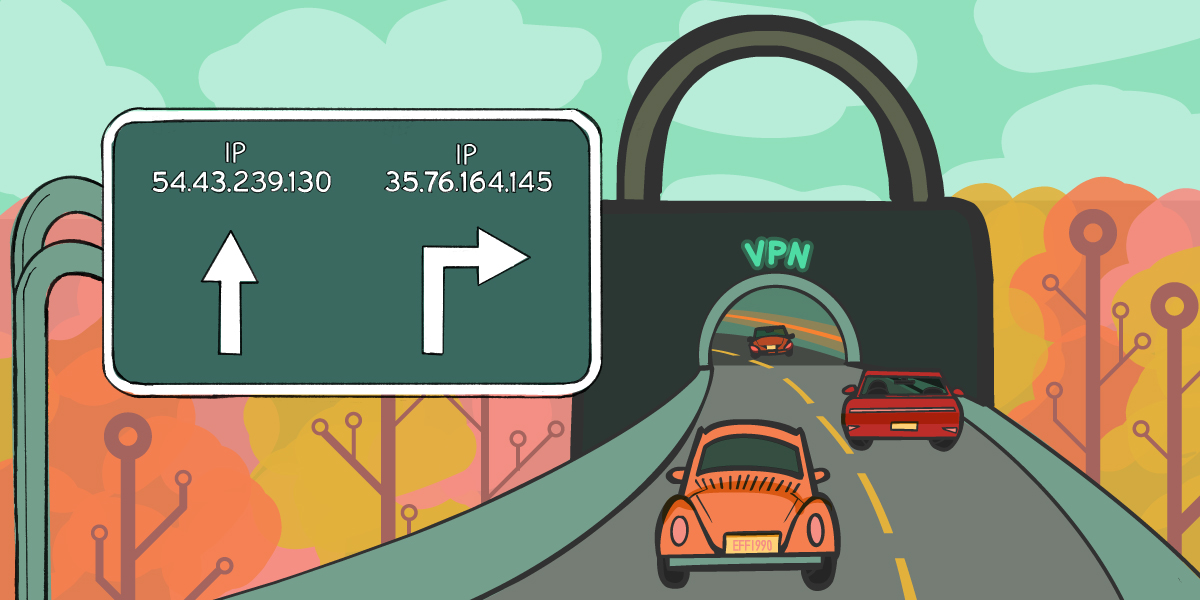
EFF explained this technical impossibility in our comment to the Department of Commerce. VPNs protect user privacy by routing web traffic through intermediary servers. Because destination websites only see the IP address of the VPN server, they have no reliable mechanism to tell whether a connection originates from Salt Lake City, Seattle, or Shanghai. So, under Utah's current statutory framework, platforms are left with an impossible choice: completely block all VPN traffic nationwide or withdraw access from Utah entirely. Judge Barlow agreed, asserting:
Because the law requires perfection in the absence of perfect geolocation tools, Aylo would need to verify those 28 million users—whether located in Salt Lake City, Boston, New Orleans, Anchorage, or Honolulu—to ensure compliance and avoid liability.
The Rulemaking
The administrative rules drafted by the state compelled commercial entities to implement "commercially reasonable geolocation obfuscation detection systems", which is a directive, we argue, that demands a technical impossibility.
In our submission to the Utah Department of Commerce, EFF also detailed how these rules force an invasive data collection regime onto internet users everywhere. So, in response to internet users trying to avoid invasive data collection required by age-verification requirements, SB 73 requires even greater surveillance of internet users’ online activities. The Department’s suggested detection heuristics (like monitoring connection latency or device time zones) are notoriously unreliable and easily skewed by normal network conditions. This active surveillance inevitably leads to widespread misclassification, unwarranted access blocks, and severe impacts on users’ privacy far beyond Utah's borders.
You can read EFF’s full comments to the Department of Commerce here.
What Now?
As we’ve said time and time again: the internet will always route around censorship.
Mandating invasive tracking and punishing the use of essential security tools turns genuine privacy concerns into mere compliance theater and requires more state-mandated surveillance of internet users who rely on VPNs. As is the case in heavily censored regions, VPN services and obfuscation tools will simply adapt, making this framework fundamentally unsustainable.
As we’ve said time and time again: the internet will always route around censorship.
While Utah legislators have indicated they may attempt to revise the law during the next legislative session, the court's preliminary injunction sets an important precedent: state lawmakers should not weaponize age verification to force dragnet tracking or undermine essential security tools.
As other states consider similar anti-VPN proposals, EFF will continue pushing back against these technically impossible mandates and defending users’ privacy and anonymity. Thus, we urge legislators and regulators to reject anti-privacy rules, prioritize real user security, and safeguard constitutional protections for all users.
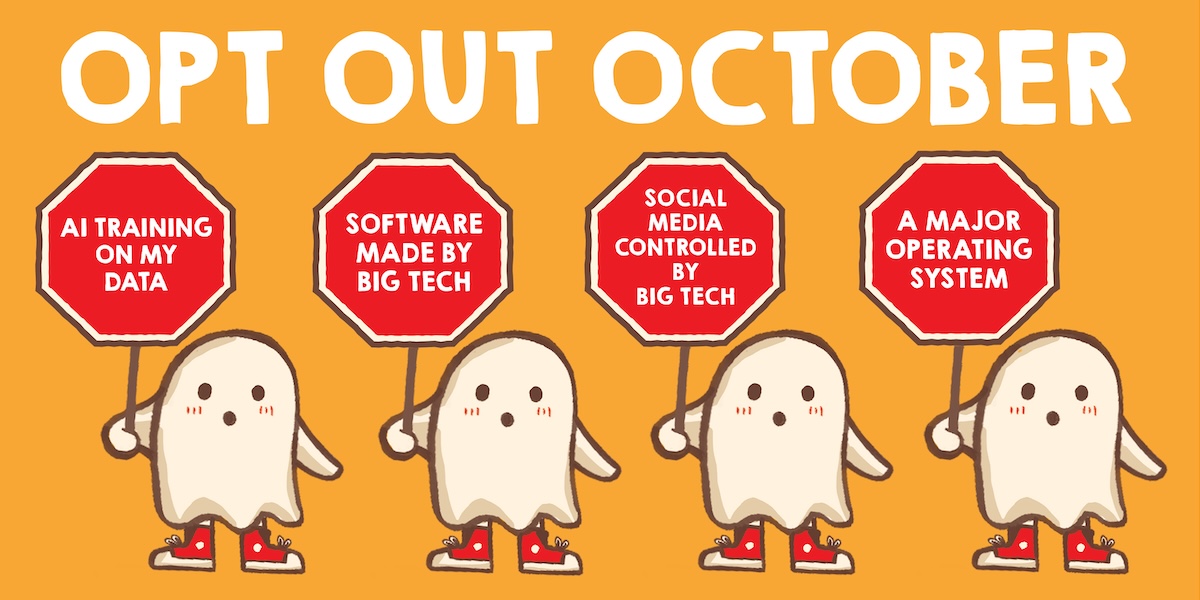
Over the years, the major tech companies have found all sorts of ways to embed themselves into our lives. We often use their software, their AI tools, their social media, and their operating systems by default without even thinking about potential alternatives. It’s time to rethink that relationship.
Last year, we created Opt Out October to help remind ourselves of the variety of ways we can take back control of our data through small steps inside apps, operating systems, and other various forms. This year, we highlight the idea that sometimes the best way to control your data is to leave a platform, app, or operating system altogether.
To do so, we’ve created a hub of resources sharing ways to find new software that isn’t made by the tech giants, take advantage of the growing universe of new social media options, install a whole new operating system, and better control how various popular tools and software use your data for AI training.
As an incentive, we’ve made merit badges like the one below to help you track your own wins and share them with others. Complete any of these tasks and let the world know by sharing that accomplishment on social media or changing your profile image! Better, more privacy-respecting, and less-enshittified tools are out there. We just have to find and use them.
Head over to our Opt Out October landing page and start taking the first steps to regaining control of the tools and software you use.
Researchers at Northeastern University, in collaboration with Consumer Reports, evaluated how much modern cars spy in their drivers:
The new Northeastern study shows, for the first time, data flowing among the vehicles, the vehicle apps you download when you buy your car, and third-party companies, documenting exactly what kind of data gets siphoned from our vehicles and which companies are receiving that information.
Basically, your car’s manufacturer has you under constant surveillance, and they use that data against you.
The companies on the receiving end of your data, our investigation has found, include car insurers and lenders that are partners in “telematics data exchanges,” which compile driving data on millions of drivers, thousands of data brokers that create personalized risk scores, companies selling infotainment and WiFi hotspot products, and even local and state government agencies working on planning, traffic, and safety initiatives.
Nearly every automaker sent data to outside companies.
Even more troubling, almost a quarter of the vehicle apps were found to be sending out personally identifiable information, including vehicle owners’ names, vehicle identification numbers (VINs), and precise geographic locations. That information can make it easy for companies to link driving behavior to personal data profiles created by data brokers and marketers. Such profiles are routinely sold to banks, insurers, pharmaceutical companies, lenders, and retailers, who can use it for personalized loan terms and filtered bank and insurance offers, a CR and CalMatters investigation found.
Remember the adage “If you’re not the customer, then you’re the product”? (The sentiment is older than you think.) Turns out that with modern internet-connected everything, you’re the product even if you are the customer.
The US government is alerting millions of people that their personal information was stolen during a breach of the Pentagon’s personnel records at the Defense Manpower Data Center (DMDC).
The DMDC is a central US Department of Defense (DoD) organization that manages personnel records, ID credentials, and benefit entitlements for military and civilian staff, veterans, and their families. It maintains over 60 million records for US military and civilian staff and their family members to help determine benefits and entitlements, such as healthcare and retirement.
Reportedly, cybercriminals had access from October 2025 to July 2026. CNN reports that the Pentagon confirmed the breach affects 2.76 million living individuals, potentially including current and former defense personnel or their dependents, and 294,000 deceased individuals.
“A small number of unauthorized users accessed files on a server containing unencrypted PII.”
PII means personally identifiable information. The attackers gained access by exploiting a security vulnerability in an unspecified file-sharing system. The Pentagon says it has “no indication” of misuse. It hasn’t explained how it reached that conclusion or what it considers misuse, and it doesn’t rule out future misuse of the exposed information.
The exposed data is said to include Social Security numbers, names, dates of birth, sex, race, and service details. Some records also include contact information and occupational specialty.
Besides the risk that this data could help foreign intelligence services track US personnel, affected people face a lasting risk of identity theft. Birth dates cannot be changed, and Social Security numbers can only be changed in limited circumstances.
Breaches happen every day. Don’t be the last to know.
The Pentagon is offering 12 months of credit monitoring through IDX. If you receive a notification letter, take up the offer and consider a credit freeze with all three major credit bureaus: Equifax, Experian, and TransUnion. A freeze is free and restricts access to your credit report, helping prevent someone from opening new credit accounts in your name.
Other recommendations are:
Get an IRS Identity Protection PIN to prevent someone else from filing a federal tax return using your Social Security number.
Be suspicious of unexpected calls, emails, and texts, especially ones that mention your unit, rank, or job. Attackers can use the stolen details to make phishing attempts more convincing.
Verify requests through official channels you look up yourself, rather than through contact details in the message.
Follow instructions in the breach letter and further official communications and report any suspicious approach to your security officer.
Let’s face it, an incognito window can only do so much.
Breaches, dark web trading, credit fraud. Malwarebytes Identity Theft Protection monitors for all of it, alerts you fast, and comes with identity theft insurance.
The US government is alerting millions of people that their personal information was stolen during a breach of the Pentagon’s personnel records at the Defense Manpower Data Center (DMDC).
The DMDC is a central US Department of Defense (DoD) organization that manages personnel records, ID credentials, and benefit entitlements for military and civilian staff, veterans, and their families. It maintains over 60 million records for US military and civilian staff and their family members to help determine benefits and entitlements, such as healthcare and retirement.
Reportedly, cybercriminals had access from October 2025 to July 2026. CNN reports that the Pentagon confirmed the breach affects 2.76 million living individuals, potentially including current and former defense personnel or their dependents, and 294,000 deceased individuals.
“A small number of unauthorized users accessed files on a server containing unencrypted PII.”
PII means personally identifiable information. The attackers gained access by exploiting a security vulnerability in an unspecified file-sharing system. The Pentagon says it has “no indication” of misuse. It hasn’t explained how it reached that conclusion or what it considers misuse, and it doesn’t rule out future misuse of the exposed information.
The exposed data is said to include Social Security numbers, names, dates of birth, sex, race, and service details. Some records also include contact information and occupational specialty.
Besides the risk that this data could help foreign intelligence services track US personnel, affected people face a lasting risk of identity theft. Birth dates cannot be changed, and Social Security numbers can only be changed in limited circumstances.
Breaches happen every day. Don’t be the last to know.
The Pentagon is offering 12 months of credit monitoring through IDX. If you receive a notification letter, take up the offer and consider a credit freeze with all three major credit bureaus: Equifax, Experian, and TransUnion. A freeze is free and restricts access to your credit report, helping prevent someone from opening new credit accounts in your name.
Other recommendations are:
Get an IRS Identity Protection PIN to prevent someone else from filing a federal tax return using your Social Security number.
Be suspicious of unexpected calls, emails, and texts, especially ones that mention your unit, rank, or job. Attackers can use the stolen details to make phishing attempts more convincing.
Verify requests through official channels you look up yourself, rather than through contact details in the message.
Follow instructions in the breach letter and further official communications and report any suspicious approach to your security officer.
Let’s face it, an incognito window can only do so much.
Breaches, dark web trading, credit fraud. Malwarebytes Identity Theft Protection monitors for all of it, alerts you fast, and comes with identity theft insurance.
A study testing 21 cars from 19 brands and 30 companion apps found connections to advertising and tracking companies, and evidence that some apps shared sensitive personal data.
Modern cars can unlock remotely, route around traffic, stream entertainment, summon roadside help, and cool or heat the cabin before you get in. But those conveniences come with a privacy cost that drivers may struggle to see and are unable to refuse.
We’ve covered cars and privacy a few times before, especially after Mozilla researchers described cars as a “privacy nightmare.”
Texas Attorney General Ken Paxton investigated car manufacturers seeking details of their data collection and sharing practices, and sued General Motors over allegations that it sold customer driving data to third parties.
Researchers from Northeastern University, working with Consumer Reports, tested vehicles from model years 2022 through 2025 and companion apps, observing network traffic while cars were stationary, driven, and used through their apps. The results reinforce an uncomfortable reality: connected vehicles are data-collection platforms on wheels.
The results in a nutshell:
Both vehicles and companion apps contacted third-party domains, including those associated with advertising and tracking.
19 of 21 vehicles contacted at least one third party over Wi-Fi.
7 of 30 apps transmitted sensitive identifiers to third parties associated with advertising and tracking.
The troubling part is not that a car talks to its manufacturer. After all, a connected vehicle needs some network access for safety alerts, navigation, account functions, and maintenance. The bigger issue is the potential combination of identifiers. A vehicle identification number (VIN) can link a particular vehicle to its owner, while precise location can reveal highly sensitive patterns: where someone sleeps, works, worships, seeks medical care, spends time with friends, or travels. Add an email address or a name, and that information can be easier to connect to the detailed consumer profiles held by advertisers and data brokers.
Consent is a weak safeguard when drivers have to accept extensive terms to use functions advertised as part of the vehicle. Several manufacturers said their connected services were opt-in, but declining can mean losing useful functionality. For example, Consumer Reports noted a Tesla warning that refusing its agreement may result in:
“reduced functionality, serious damage, or inoperability.”
That hardly sounds like freely given, informed consent.
There was one sign that scrutiny can matter: after researchers presented their findings, Honda told Consumer Reports it had directed vendor Amplitude to delete location data it received and stopped sending it going forward. But consumers should not need an academic study to discover who their car or its app is sharing data with.
Especially when Amazon, Google, Meta, and Microsoft—companies that already know plenty about us—were among the leading recipients of the driver data.
Until automakers collect less data and provide clear privacy settings, meaningful opt-outs, and deletion controls, drivers should treat a connected car, and especially its companion app, as another privacy-sensitive device. Review app permissions, turn off optional data-sharing settings, avoid linking unnecessary accounts, and ask manufacturers what data they retain, share, and delete.
Browse like no one’s watching.
Malwarebytes Privacy VPN encrypts your connection and never logs what you do, so the next story you read doesn’t have to feel personal. Try it free →
A study testing 21 cars from 19 brands and 30 companion apps found connections to advertising and tracking companies, and evidence that some apps shared sensitive personal data.
Modern cars can unlock remotely, route around traffic, stream entertainment, summon roadside help, and cool or heat the cabin before you get in. But those conveniences come with a privacy cost that drivers may struggle to see and are unable to refuse.
We’ve covered cars and privacy a few times before, especially after Mozilla researchers described cars as a “privacy nightmare.”
Texas Attorney General Ken Paxton investigated car manufacturers seeking details of their data collection and sharing practices, and sued General Motors over allegations that it sold customer driving data to third parties.
Researchers from Northeastern University, working with Consumer Reports, tested vehicles from model years 2022 through 2025 and companion apps, observing network traffic while cars were stationary, driven, and used through their apps. The results reinforce an uncomfortable reality: connected vehicles are data-collection platforms on wheels.
The results in a nutshell:
Both vehicles and companion apps contacted third-party domains, including those associated with advertising and tracking.
19 of 21 vehicles contacted at least one third party over Wi-Fi.
7 of 30 apps transmitted sensitive identifiers to third parties associated with advertising and tracking.
The troubling part is not that a car talks to its manufacturer. After all, a connected vehicle needs some network access for safety alerts, navigation, account functions, and maintenance. The bigger issue is the potential combination of identifiers. A vehicle identification number (VIN) can link a particular vehicle to its owner, while precise location can reveal highly sensitive patterns: where someone sleeps, works, worships, seeks medical care, spends time with friends, or travels. Add an email address or a name, and that information can be easier to connect to the detailed consumer profiles held by advertisers and data brokers.
Consent is a weak safeguard when drivers have to accept extensive terms to use functions advertised as part of the vehicle. Several manufacturers said their connected services were opt-in, but declining can mean losing useful functionality. For example, Consumer Reports noted a Tesla warning that refusing its agreement may result in:
“reduced functionality, serious damage, or inoperability.”
That hardly sounds like freely given, informed consent.
There was one sign that scrutiny can matter: after researchers presented their findings, Honda told Consumer Reports it had directed vendor Amplitude to delete location data it received and stopped sending it going forward. But consumers should not need an academic study to discover who their car or its app is sharing data with.
Especially when Amazon, Google, Meta, and Microsoft—companies that already know plenty about us—were among the leading recipients of the driver data.
Until automakers collect less data and provide clear privacy settings, meaningful opt-outs, and deletion controls, drivers should treat a connected car, and especially its companion app, as another privacy-sensitive device. Review app permissions, turn off optional data-sharing settings, avoid linking unnecessary accounts, and ask manufacturers what data they retain, share, and delete.
Browse like no one’s watching.
Malwarebytes Privacy VPN encrypts your connection and never logs what you do, so the next story you read doesn’t have to feel personal. Try it free →
People are increasingly concerned about the ways in which mass surveillance is tracking our every move: from Flock license plate readers to face recognition to creepy ads that – based on what we see and do online – seem to know everything we’re thinking and planning. It didn’t have to be this way, and since the early days of the internet, a dedicated band of activists, lawyers and technologists have fought for a better, more secure and private digital future – a future that’s still attainable.
Cindy Cohn, who just finished a 26-year run with the Electronic Frontier Foundation including 11 years as its executive director, has lived this fight. She says privacy isn’t just about secrecy: It's ultimately about power – who has it, and who has the ability to protect themselves from it.
Welcome to the first episode of “Privacy’s Defenders,” a podcast about the people – lawyers, journalists, hackers, and others – who’ve fought to secure your digital liberties since before most people even knew what the internet was.
In this episode, Cindy talks with EFF cofounder John Gilmore about how he – an early employee at Sun Microsystems – came together with Lotus Development cofounder Mitch Kapor and cattle rancher, philosopher and Grateful Dead lyricist John Perry Barlow to create EFF as a bulwark against government investigation and prosecution of early internet users.
It’s a story of the Secret Service’s “Operation Sundevil,” jet-setting tech titans, tie-dyed cypherpunks, and a fateful house party in San Francisco’s Haight-Ashbury district amid the earliest days of online communications, setting the stage for the battles that created the internet as we know it and issues we still grapple with today.
The “Privacy’s Defenders” podcast is a follow-up to Cindy’s book, “Privacy’s Defender: My Thirty-Year Fight Against Digital Surveillance,” bringing to life pivotal moments in the voices of those who fought for your rights. Sales of “Privacy’s Defender” benefit EFF, so pick up your copy today!
Joanne Elgart Jennings co-produced and created this podcast.
Jarrod Sport co-produced, mixed, and mastered it.
Corinne Ruff is our story editor.
We had additional help from Rachel Estabrook and Alison Broverman.
The original music was composed and performed by Nat Keefe of Hot Buttered Rum with Ben Andrews on the fiddle.
And other archival sound came from the Internet Archive's amazing collection, including the snippet of the Grateful Dead song “Cassidy” that John Perry Barlow co-wrote.
The Irish Data Protection Commission (DPC) has fined Google €403 million ($459 million) for violating European privacy law. The penalty follows a six-year inquiry into Google’s management of user location data between May 2018 and February 2020.
During that time, Google collected users’ location data without making clear that it could be used to infer their interests and shape the ads they saw.
Google’s location history keeps track of users’ locations when using their devices. It’s an opt-in service that includes a Timeline feature to display a private map of the places they’ve visited. A separate Android feature, Location Accuracy, helps devices determine their location more accurately than GPS alone.
Google had told users that they could stop Location History tracking by turning off that setting. But a report by the Associated Press in 2018 found that doing so wasn’t enough to stop Google from saving some of that location data. Researchers at Princeton University later confirmed the AP’s findings.
One reason was Web & App Activity, a separate Google account setting that can save information about what Google account holders have been browsing on the web and doing with their apps. That service was also collecting location data. Turning off Location History did not turn off Web & App Activity.
This issue led to payouts in multiple US jurisdictions. Google agreed to pay $85 million to Arizona in October 2022, $392 million to 40 states that November, and $9.5 million to the District of Columbia the following month. It also agreed to pay $39.9 million to Washington State in 2023, $1.38 billion to Texas in May 2025 as part of a two-suit settlement. Last September, a jury awarded $425 million in a separate class action case.
The DPC first looked into the issue in 2018 after the AP investigation and launched an official statutory inquiry in February 2020. Along with the fine, it has ordered Google to bring its location data processing into compliance within six months. The DPC says it will publish the full text of its decision in due course.
Google told Bloomberg that it had revised its practices since 2019 and launched tools to make location data easier to manage. In December 2023, Google announced that it would change its Timeline feature to keep its data on users’ devices. It also said that, for people turning on Location History for the first time, the default period before data is automatically deleted would fall from 18 months to 3 months.
ABC Australia reports that researchers from NSB Cyber and Abstract Shield tested two inexpensive pairs, costing A$60 and A$110 (around US$42 and US$78), and found more than a dozen flaws across the smart glasses themselves, their app, and an associated website.
The main problem they uncovered was insecure Bluetooth pairing: If the glasses were powered on and not connected to their owner’s phone, an attacker could connect first, with no password or meaningful pairing confirmation.
After connecting, an attacker could reportedly control the glasses to capture photos or recordings, copy existing media, and intercept data moving between the glasses and the phone. An attacker could also make another device appear to be the victim’s glasses, allowing it to connect to the owner’s mobile app.
The testing also found that a Bluetooth-visible device identifier could allegedly be used with a weakness in the app’s website to retrieve a user’s email address and date of birth.
The research uncovered another privacy issue. ABC reports that voice or text submitted to the built-in AI, along with images sent to it, was first transmitted to a server in Shenzhen and could be forwarded elsewhere, depending on the function. The tests did not establish how the data was subsequently used.
The server locations, combined with some of the AI’s answers to specific questions, led researchers to conclude that the chatbot companion relied at least in part on Chinese sovereign AI models. Professor Kimberlee Weatherall, a technology regulation expert involved in the testing, said the failure to identify China in the privacy policy appeared to violate the Australian Privacy Principles,
The timing of the testing is also relevant because Australia’s smart-device security standards apply to most consumer smart devices manufactured on or after March 4, 2026. They require, among other measures, no universal default passwords, a way to report vulnerabilities, and information about the minimum security-update period. Devices made before that date are outside the requirements.
Experts quoted by ABC said the devices violated Australia’s privacy laws and were also likely to breach several sections of the Cyber Security Act. However, whether the new smart-device standards apply would depend partly on when the glasses were manufactured, and the rules have not yet been tested in a known enforcement action.
Professor Weatherall said:
“The rules say that the password must be unique. It doesn’t even seem like they were applying a password, which might mean that their standards are so low they don’t even technically breach that rule, which I find amazing.”
What to do
We’re not fans of smart glasses, expensive or cheap. But if you own a pair:
Avoid pairing or using inexpensive camera glasses that lack a clear physical pairing step, account authentication, a published security-contact process, and a stated update-support period.
Stop using their AI or cloud features for sensitive material, remove unnecessary permissions from the companion app, check for firmware and app updates, and consider returning the product if the vendor cannot document a fix.
Ask permission before recording people, and check your local laws to understand what is and isn’t allowed.
From reporting threats to removing them.
Cybersecurity risks should never spread beyond a headline. Keep threats off your devices by downloading Malwarebytes today.
VPN use is growing around the world, with the worldwide average holding steady at 20% growth per year. Users have come to appreciate everything a VPN offers: it encrypts your connection, shields you from relentless ISP tracking (and the targeted ads that often come with it), hides your IP address and location, and lets you keep using your favorite paid services while traveling. This matters most at big public events, like international football tournaments, the Olympics, or concerts by popular performers, where the odds of scammers intercepting an unprotected Wi-Fi connection go up sharply.
That said, VPNs come with their own frustrations. One of the biggest is that many smart devices – including TVs, game consoles, streaming boxes, and smart-home gadgets – can’t run a VPN at all. On top of that, you usually have to set up the VPN separately on every single device in your home. Installing the VPN directly on your home router solves both problems at once: it protects your entire home network, including newly added devices. Here’s a closer look at what benefits that setup gives you.
1. Every device gets VPN protection
Turn on a VPN on your router, and every device connected to your home Wi-Fi automatically sends its traffic through that protected, encrypted connection. There’s nothing extra to do: connect your phone, laptop, or TV to the Wi-Fi, and its traffic is already routed through the VPN.
Many paid VPN services cap the number of devices you can use under a single subscription. But your router only counts as one device on that list, even though it might be protecting a dozen or more gadgets in your home at once.
It’s worth noting that installing a VPN on a router is usually only possible with paid VPN services. Free plans typically don’t offer this option, or only allow it in a very limited way.
2. Set it up and forget it
Setting up a VPN on every phone and computer in the house can get tedious fast. And if your home devices run on a mix of operating systems, you’ve to start by locating the VPN settings on each one, since Android, Windows, iOS, and macOS all handle this differently.
With a router setup, you configure the VPN once, and it automatically covers any new device you connect later too.
3. Protection even for devices that don’t support VPN
Plenty of devices can’t run a VPN at all. That includes smart TVs, streaming boxes, game consoles, and nearly every piece of smart-home tech out there, from baby monitors to robot vacuums. A VPN on your router protects all of them, and you don’t have to tinker with your vacuum cleaner or smart bulb’s settings separately.
4. No need to worry about turning the VPN on and off
Many people want to make sure that not a single byte of their data leaves their device before the VPN kicks in. The problem is that there’s always a short gap between turning on a computer or phone and the VPN firing up, and during that window, data travels over the internet unencrypted.
The usual fixes are to turn on special features – such as Always On VPN or a VPN kill switch – in the operating system or VPN app. A more effective option though is running the VPN on the router itself. That way, “not a byte without the VPN” becomes true automatically for every device on your home network. But for complete peace of mind, you’ll still want to set up a kill switch on the router too, so that if the VPN ever disconnects (say, the VPN server becomes temporarily unavailable), your devices lose their internet connection entirely rather than falling back to an unprotected one.
5. Working remotely with two VPNs at once
Another common headache is needing to run two VPN services at the same time. This usually comes up with remote work: you need a corporate VPN to connect to your company’s network, while also wanting a personal VPN for everything else. On many devices, running two VPN connections at once for different purposes is either a real hassle to configure or not possible at all. Constantly switching between the two isn’t convenient either, and it opens up privacy and security gaps.
A VPN on your router solves this too. You simply turn on the corporate VPN on your work computer, and it runs on top of your Wi-Fi connection, which is already protected by your personal VPN on the router. In effect, you end up with one VPN nested inside the other (corporate VPN → Wi-Fi → VPN → internet), but this layered setup rarely causes any issues.
6. Getting around apps that block VPNs
Some banking and streaming apps can detect when a VPN app is running on your device and simply refuse to work. Usually, they can’t tell what kind of VPN it is or why you’re using it. They just object to any VPN connection being active at all. If the VPN runs on your router instead of on the device itself, this problem disappears.
7. Protecting guests on your home network
Any device belonging to friends or family that connects to your Wi-Fi automatically gets VPN protection too, with no setup required on their end.
8. Less strain on your devices
Since the router handles the encryption workload, your phones, tablets, and other lightweight devices can use less computing power and drain less battery than they would if running a VPN themselves.
9. Simplified VPN management
Need to switch VPN servers, change protocols, or tweak other settings? Just do it once, on the router. There’s no need to reconfigure every device separately.
Precautions and things to keep in mind
For all its advantages, running a VPN on your router does come with a few trade-offs worth knowing about.
Encrypting traffic for an entire network takes real processing power, so on an underpowered router, your connection speed may end up limited.
Some routers don’t support VPNs at all, or only work with older, less secure protocols like PPTP.
If your router was issued by your ISP, you may not have enough permissions to install a VPN on it.
In any of these cases, you can buy a more capable router that supports VPNs, and use it either instead of, or alongside the ISP-issued box, setting up your home network and VPN on your own hardware.
With this setup, your devices connect as follows: device → Wi-Fi or Ethernet → personal VPN on router → internet. For computers that also connect to a corporate VPN, the path looks slightly different: corporate VPN on computer → Wi-Fi or Ethernet → personal VPN on router → internet.
If you can’t connect your own router directly to your ISP’s network because your model lacks the right port (for example, with a fiber connection), you can use an Ethernet cable to plug your personal router’s input into your provider’s box. In that case, you can either switch the ISP-issued router into bridge mode or simply turn off its Wi-Fi so it doesn’t add unnecessary wireless clutter, since its only job now is connecting to the provider’s network and passing that connection along to your own router.
It’s also worth noting that some online services – like banks, government sites, online stores, and streaming platforms – may restrict or block access entirely when they detect a foreign IP address through a VPN. To get around this, you can either turn off Wi-Fi on your phone and use your mobile data instead, or take a more sophisticated approach to your router setup, as described below.
Most modern routers let you create more than one Wi-Fi network, usually supporting at least a separate home and guest network, each with their own settings. You can use this to create two networks: one with the VPN always on, and one without. Then, for services that don’t play well with VPNs, you can simply switch to the unsecured Wi-Fi network instead.
If you’re willing to spend some more time on setup, there’s an even more convenient option, known as split tunneling: individually configuring certain services or websites to bypass the VPN while sending everything else through your secure VPN connection as usual. To do this, you’ll need to specify the addresses of the sites that should skip the VPN.
Many feature-rich routers also let you divide your home devices into groups and set different connection rules for each group. That way, you could set things up so your smart TV reaches streaming services without a VPN, while your smart home devices, computers, and phones only ever connect to the internet through the protected channel.
How to set up a VPN on your router
Setting up a VPN on your router might sound more complicated than installing it on individual devices, but it delivers far more comfort and protection for your whole home network.
To do this, you’ll need a router that supports VPNs, and a subscription to a VPN service that can generate configuration files for routers using modern VPN protocols. Kaspersky VPN supports the two most widely used VPN protocols – OpenVPN and WireGuard – for connecting routers to the service.
You can create a Kaspersky VPN configuration file for your router by following our detailed guide. For instructions specific to your router model, we recommend searching online or asking an AI assistant something like “how to set up a VPN on {your router model}“.
Online sports betting company DraftKings is using AI to target customers who are most likely to place losing bets and respond to gambling promotions. This kind of targeting is a form of online behavioral advertising, which is when companies personalize the ads they show you based on the data they’ve collected about you. The more data a company has, the more personalized the ad can be. While DraftKings is using AI to supercharge the harmful effects of online behavioral advertising, EFF has long argued that all behavioral advertising should be banned.
According to the New York Times, DraftKings is using its customers’ betting records to train a machine learning model to find losing gamblers. Once found, DraftKings sends these customers targeted advertising designed to lure them back to the site to place more bets—bets that DraftKings thinks will be losing ones. DraftKings has a business incentive to keep losing gamblers coming back to their site, because these are the users actually making DraftKings money. Unfortunately, those considered “problem gamblers” (people who repeatedly gamble despite harm to themselves, their finances, and their relationships) are highly likely to be targeted by this model. By re-engaging these individuals through targeted promotions aimed at keeping them on the platform, DraftKings is capitalizing on their vulnerability for profit instead of mitigating their risk.
Predatory online behavioral advertising isn’t new, but companies’ use of AI to process data and target customers has magnified its harms. Online behavioral advertising incentivizes the collection of vast quantities of data to power ad tech. Adding AI into the mix means that even more data is collected to train and refine models. Because AI operates as a black box, the humans building the models can rarely predict which data points are the most useful to the AI, driving them to continuously collect more data. AI also allows companies to process enormous data sets much faster, and, as a result, supercharges the harms of online behavioral advertising.
A direct consequence of online behavioral advertising is that it provides the data the surveillance industry needs to run. Data collected for targeted placement of ads is being sold to insurance companies, banks, and state and federal government law enforcement agencies such as CBP. ICE is also taking an interest in the data fueling ad tech: earlier this year, ICE published a Request for Information “seeking information to better understand how the industry’s commercial Big Data and Ad Tech providers can directly support investigations activities.”
DraftKings seems to be using solely “first party data” to target their ads, meaning that they’re using only the data they collect directly from their users and are not buying any additional data from third parties to fuel their machine learning model. This highlights how policy solutions that only limit third-party data sharing and selling would not be enough to prevent these predatory advertisements. Rather, policymakers must ban online behavioral ads.
What DraftKings is doing with their targeted promotions is just one example of how online behavioral advertising causes real harm to real people. But there are ways to take back control over your own data: EFF offers resources such as our Surveillance Self Defense project, along with other tips for how you can protect yourself on mobile apps and on websites.
DraftKings’ use of AI to target losing gamblers illustrates how ad tech evolves and how companies find new ways to use our data against us. This is why EFF believes that all behavioral advertising should be banned. If companies can’t send personalized ads, they’ll have less incentive to collect the behavioral data powering them.
The Irish Data Protection Commission (DPC) has fined Google €403 million ($459 million) for violating European privacy law. The penalty follows a six-year inquiry into Google’s management of user location data between May 2018 and February 2020.
During that time, Google collected users’ location data without making clear that it could be used to infer their interests and shape the ads they saw.
Google’s location history keeps track of users’ locations when using their devices. It’s an opt-in service that includes a Timeline feature to display a private map of the places they’ve visited. A separate Android feature, Location Accuracy, helps devices determine their location more accurately than GPS alone.
Google had told users that they could stop Location History tracking by turning off that setting. But a report by the Associated Press in 2018 found that doing so wasn’t enough to stop Google from saving some of that location data. Researchers at Princeton University later confirmed the AP’s findings.
One reason was Web & App Activity, a separate Google account setting that can save information about what Google account holders have been browsing on the web and doing with their apps. That service was also collecting location data. Turning off Location History did not turn off Web & App Activity.
This issue led to payouts in multiple US jurisdictions. Google agreed to pay $85 million to Arizona in October 2022, $392 million to 40 states that November, and $9.5 million to the District of Columbia the following month. It also agreed to pay $39.9 million to Washington State in 2023, $1.38 billion to Texas in May 2025 as part of a two-suit settlement. Last September, a jury awarded $425 million in a separate class action case.
The DPC first looked into the issue in 2018 after the AP investigation and launched an official statutory inquiry in February 2020. Along with the fine, it has ordered Google to bring its location data processing into compliance within six months. The DPC says it will publish the full text of its decision in due course.
Google told Bloomberg that it had revised its practices since 2019 and launched tools to make location data easier to manage. In December 2023, Google announced that it would change its Timeline feature to keep its data on users’ devices. It also said that, for people turning on Location History for the first time, the default period before data is automatically deleted would fall from 18 months to 3 months.
ABC Australia reports that researchers from NSB Cyber and Abstract Shield tested two inexpensive pairs, costing A$60 and A$110 (around US$42 and US$78), and found more than a dozen flaws across the smart glasses themselves, their app, and an associated website.
The main problem they uncovered was insecure Bluetooth pairing: If the glasses were powered on and not connected to their owner’s phone, an attacker could connect first, with no password or meaningful pairing confirmation.
After connecting, an attacker could reportedly control the glasses to capture photos or recordings, copy existing media, and intercept data moving between the glasses and the phone. An attacker could also make another device appear to be the victim’s glasses, allowing it to connect to the owner’s mobile app.
The testing also found that a Bluetooth-visible device identifier could allegedly be used with a weakness in the app’s website to retrieve a user’s email address and date of birth.
The research uncovered another privacy issue. ABC reports that voice or text submitted to the built-in AI, along with images sent to it, was first transmitted to a server in Shenzhen and could be forwarded elsewhere, depending on the function. The tests did not establish how the data was subsequently used.
The server locations, combined with some of the AI’s answers to specific questions, led researchers to conclude that the chatbot companion relied at least in part on Chinese sovereign AI models. Professor Kimberlee Weatherall, a technology regulation expert involved in the testing, said the failure to identify China in the privacy policy appeared to violate the Australian Privacy Principles,
The timing of the testing is also relevant because Australia’s smart-device security standards apply to most consumer smart devices manufactured on or after March 4, 2026. They require, among other measures, no universal default passwords, a way to report vulnerabilities, and information about the minimum security-update period. Devices made before that date are outside the requirements.
Experts quoted by ABC said the devices violated Australia’s privacy laws and were also likely to breach several sections of the Cyber Security Act. However, whether the new smart-device standards apply would depend partly on when the glasses were manufactured, and the rules have not yet been tested in a known enforcement action.
Professor Weatherall said:
“The rules say that the password must be unique. It doesn’t even seem like they were applying a password, which might mean that their standards are so low they don’t even technically breach that rule, which I find amazing.”
What to do
We’re not fans of smart glasses, expensive or cheap. But if you own a pair:
Avoid pairing or using inexpensive camera glasses that lack a clear physical pairing step, account authentication, a published security-contact process, and a stated update-support period.
Stop using their AI or cloud features for sensitive material, remove unnecessary permissions from the companion app, check for firmware and app updates, and consider returning the product if the vendor cannot document a fix.
Ask permission before recording people, and check your local laws to understand what is and isn’t allowed.
From reporting threats to removing them.
Cybersecurity risks should never spread beyond a headline. Keep threats off your devices by downloading Malwarebytes today.
The EU Commission draft law to restrict young people’s access to the internet that it presented last week will come at a high cost: it will put online services behind age gates, expand the use of intrusive age verification, and undermine the privacy of all users.
The EU Kids Act aims to protect children from risks associated with social media, video games, and AI systems by introducing age-based access rules, safety requirements, and stronger enforcement and oversight measures. It presents itself as building on the Digital Services Act (DSA) and puts into “hard law” some of the safety-by-design measures specified in the non-binding DSA guidelines on minors’ protection.
The proposal is built around the following elements: social media age “delay”, safety by design, age assurance and parental responsibility, and strong enforcement. Each of these measures are concerning.
Mandatory Age Gates for Social Media and Video-Sharing Platforms
Following the advice of an expert panel, the proposal would create a phased access to social media and video-sharing platforms deemed risky—a threshold met simply by relying on personalized recommender systems or offering “uninterrupted content consumption”: no service accounts for children under 13; restricted accounts under tight parental supervision from 13 to 15; and autonomous accounts in a safe-by-design environment from 15 to 18. Full online access is therefore reserved for adults.
However they’re designed, age gates undermine civil liberties, reduce safety, and create barriers to internet entry, often at the expense of marginalized groups.
If this sounds complex and like a compliance nightmare, that’s because it is. The access delay comes with privacy-intrusive age verification across the board, relying on the EU age verification scheme. For teenagers, this law means significant control in the hands of their parents, who must set up accounts and prove that they are, in fact, parents, adding yet another problematic layer of verification.
In fairness, the Kids Act’s gradual approach at least appears to be designed with some proportionality considerations, rather than imposing a blanket social media ban. Just last month a French court declared such undifferentiated bans unconstitutional. The EU Kids Act distinguishes between age groups and certain services and follows a risk-based approach. This means, for example, that age verification is not required for existing accounts if the provider can tell with a “high degree of confidence” that the user is above the age threshold—a vaguely specified standard.
Yet, the law still indiscriminately covers social media and video-sharing, with virtually all mainstream services being covered by the proposal. The broad scope also sits uneasy with the use of age thresholds, which remain a blunt proxy for maturity. What is more, by focusing heavily on safety and harms, the EU Kids Act pays little attention to the privacy and freedom of expression rights of users, as well as the right of children themselves to access information and to participate online. However they’re designed, age gates undermine civil liberties, reduce safety, and create barriers to internet entry, often at the expense of marginalized groups. They also create a powerful infrastructure for control and further entrench the power of big tech.
The proposal exempts not-for-profit encyclopedias, scientific repositories and educational services, as well as open-source software-developing and-sharing platforms. However, no exceptions are foreseen for small and medium-sized enterprises, which will only foster the dominance of resource-laden tech companies that were already investing in similar measures. And we know that most companies are well-advised to play it safe and use privacy-unfriendly age checks across their platforms.
Safety by Design Across Covered Services
The proposal’s second pillar, “safety by design”, casts a wider net. It applies across social media, video-sharing, online games, AI companions, chatbots and even app stores—with varying requirements. Providers must generally make child-safe design the default and can relax from the requirements only if they use age assurance to establish that the user is an adult.
For example, rules on addictive features such as infinite scrolling, safe account settings, and more choice over recommender systems are to provide a safe internet experience to young people. As regards AI companions and chatbots, the proposal requires companies to design their services to reduce minors’ exposure to emotional dependencies and harmful interactions. Online games are covered as well: they must come with contact protections. The law also makes app stores the gate keeper for age-appropriate access, based on an age-rating system.
The devil of these measures lies in the details, but all of them raise fundamental rights concerns and some of them seem poorly suited, if at all, to the decentralized architecture of the Fediverse. The requirement for very large online platforms to set up compliance plans before rolling out new services raises additional questions about the risks of transplanting product-safety doctrines of conformity and risk control into speech regulation. Deciding what is “safe” can easily become a question of what content people can access or share.
Next Steps
By choosing to regulate all these aspects through the Kids Act, the Commission not only but creates a privacy minefield, it also intermingles the digital fairness agenda with the more fundamental-rights heavy questions of age assurance and access to information. An unfortunate policy choice that will politicize well-intentioned efforts to curb manipulative and addictive design practices (read our position on the DFA).
It speaks volume that the Kids Act has not gone through a full impact assessment process, which would typically require a systemic check of alternative policy options and stakeholder consultations. Looking forward, we call on the EU lawmakers to pull the teeth of the most harmful suggestions and to make sure that the new measures don’t erode the fundamental rights of all users.

 Login