❌

Normal view

ICYMI: April 2026 @AWS Security

7 May 2026 at 20:52

Read all about the latest AWS security features, compliance updates, and hands-on resources in our new, monthly digest posts. You’ll find expert blog posts, new service capabilities, code samples, and workshops.

AWS Security Blog posts

This month’s AWS Security Blog posts covered AI security, identity and access management, threat intelligence, data protection, and multicloud operations. Whether you’re securing agentic AI systems, upgrading to post-quantum cryptography, or streamlining forensic collection, these posts offer practical guidance across the security landscape.

Identity

    Access control with IAM Identity Center session tags
    Author: Rashmi Iyer | Published: April 28, 2026
    Learn to combine AWS IAM Identity Center permission sets with session tags from Microsoft Entra ID to implement fine-grained attribute-based access control (ABAC) across multiple AWS accounts.

    Can I do that with policy? Understanding the AWS Service Authorization Reference
    Authors: Anshu Bathla, Prafful Gupta | Published: April 27, 2026
    Learn to use the AWS Service Authorization Reference to determine what’s achievable with IAM policies, recognize scenarios needing alternative solutions, and build more effective security controls.

    AI Security

    Secure AI agent access patterns to AWS resources using Model Context Protocol
    Author: Riggs Goodman III | Published: April 14, 2026
    Learn to secure AI agent access to AWS resources via MCP using three principles: least privilege, organizational role governance, and differentiating AI-driven from human-initiated actions.

    Four security principles for agentic AI systems
    Authors: Mark Ryland, Riggs Goodman III, Todd MacDermid | Published: April 2, 2026
    Learn four security principles from AWS’s NIST response for securing agentic AI: secure development lifecycle, traditional controls, deterministic external enforcement, and earned autonomy through evaluation.

    Designing trust and safety into Amazon Bedrock powered applications
    Author: Victor Lungu | Published: April 29, 2026
    Learn to integrate responsible AI concepts into Amazon Bedrock applications, including abuse detection, Amazon CloudWatch monitoring, Bedrock Guardrails configuration, and the abuse response process.

    Building AI defenses at scale: before the threats emerge
    Author: Amy Herzog | Published: April 7, 2026
    AWS CISO announces Project Glasswing with Anthropic, introducing Claude Mythos Preview for vulnerability research, plus the general availability of AWS Security Agent for autonomous penetration testing.

    Governance and compliance

      Shift-Left Tag Compliance using AWS Organizations and Terraform
      Authors: Welly Siauw, Sourav Kundu, Manu Chandrasekhar | Published: April 27, 2026
      Learn to validate tag compliance during development using AWS Organizations tag policies, a reusable Terraform tagging module, and a test-driven approach that dynamically validates against live organizational policies.

      Detection and incident response

      What the March 2026 Threat Technique Catalog update means for your AWS environment
      Authors: Shannon Brazil, Cydney Stude | Published: April 28, 2026
      The AWS CIRT’s latest Threat Technique Catalog update covers Amazon Cognito refresh token abuse, AMI image deletion targeting recovery, and trust policy modifications for persistence and privilege escalation.

      A framework for securely collecting forensic artifacts into S3 buckets
      Authors: Jason Garman, Vaishnav Murthy | Published: April 8, 2026
      Learn to securely collect forensic artifacts into Amazon S3 using time-limited, least-privilege credentials with AWS STS session policies and automated AWS Step Functions workflows.

      Transform security logs into OCSF format using a configuration-driven ETL solution
      Authors: Vivek Gautam, Arpit Gupta, Ryan Gomes | Published: April 17, 2026
      Learn to transform custom security logs into OCSF format using an AWS ProServe configuration-driven ETL solution with AWS Step Functions, AWS Glue or Amazon EMR Serverless, and Amazon Security Lake integration.

      A technical walkthrough of multicloud full-stack security using AWS Security Hub Extended
      Authors: Matt Meck, Michael Fuller | Published: April 22, 2026
      Learn how AWS Security Hub Extended simplifies multicloud security procurement and operations through curated partner solutions, unified billing, and OCSF-based findings consolidation.

      Data protection

        Protecting your secrets from tomorrow’s quantum risks
        Authors: StΓ©phanie Mbappe, Tobias Nickl | Published: April 24, 2026
        Learn to upgrade AWS Secrets Manager clients to use hybrid post-quantum TLS with ML-KEM, protecting secrets against harvest-now-decrypt-later attacks, and verify connections via AWS CloudTrail.

        How AWS KMS and AWS Encryption SDK overcome symmetric encryption bounds
        Authors: Panos Kampanakis, Matthew Campagna, Patrick Palmer | Published: April 3, 2026
        Learn how AWS Key Management Service and the AWS Encryption SDK use derived key methods to automatically handle AES-GCM encryption limits, eliminating the need to manually track bounds or rotate keys.

        How to clone an AWS CloudHSM cluster across Regions
        Authors: Desiree Brunner, Rickard LΓΆfstrΓΆm | Published: April 20, 2026
        Learn to clone an AWS CloudHSM cluster to another Region using CopyBackupToRegion, then synchronize keysβ€”including non-exportable keysβ€”across cloned clusters for disaster recovery.

        April Security Bulletins

        Investigations of reported security vulnerabilities affecting Amazon and AWS services, software, and products.

        AWS Samples

        This month brings 16 new AWS samples spanning identity, governance, compliance, detection and incident response, AI Security, data protection, and infrastructure security. From beginner-friendly AI agent development on Amazon Bedrock to automated Control Tower re-registration at scale, these ready-to-deploy repositories help you implement security best practices across your AWS environment.

        Identity

          Amazon Cognito OAuth2 Token Proxy with Caching
          Learn to deploy an Amazon API Gateway proxy for Cognito’s OAuth2 token endpoint with intelligent caching and AWS WAF protection, reducing M2M authentication costs by over 90%.

          Cognito API Gateway Authorization Demo
          Learn to implement user-specific data protection using Amazon Cognito, API Gateway, and an AWS Lambda authorizer that enforces JWT sub claim matching to prevent cross-user data access.

          Securely Connecting On-Premises Data Systems to Amazon Redshift with IAM Roles Anywhere
          Learn to deploy a fully private environment connecting on-premises workloads to Amazon Redshift using X.509 certificate authentication via IAM Roles Anywhere for short-lived credentials.

          AWS IAM Access Key Lifecycle Management with Human Approval
          Learn to automate organization-wide detection, disabling, and deletion of unused IAM access keys using Step Functions, IAM Access Analyzer, and a secure human-in-the-loop approval workflow.

          Secrets Manager Audit
          Learn to resolve and report who can access your AWS Secrets Manager secretsβ€”across accounts, through Identity Center, and down to the human behind the IAM roleβ€”in a single command.

          Governance

          Control Tower Organization Re-Registration Automation
          Learn to automate AWS Control Tower OU re-registration and account updates at scale using lifecycle events, Amazon EventBridge, and AWS Lambda to resolve mixed governance after landing zone changes.

          Sample Agent Skills for Builders
          A curated collection of installable agent skills that extend AI coding agents (Claude Code, Cursor, Copilot) with production-ready AWS, CDK, security scanning, and engineering workflows.

          How to Stop AI Agent Hallucinations: 5 Techniques + Production on Amazon Bedrock AgentCore
          Learn to detect, prevent, and self-correct AI agent hallucinations using Graph-RAG, semantic tool selection, multi-agent validation, neurosymbolic guardrails, and agent steering with Strands Agents.

          Compliance

          Compliance Lens
          Learn to deploy a serverless solution that analyzes AWS Config snapshots across an AWS Organization, compares them against conformance pack rule sets, and visualizes compliance posture via Amazon QuickSight dashboards.

          AWS Security Agent Terraform Configuration
          Learn to provision AWS Security Agent resources using the AWSCC Terraform provider, automating agent space creation, IAM roles, target domain registration, and penetration test setup.

          Detection and incident response

          AWS Security Agent Demo Suite
          Learn to use AWS Security Agent across three scenarios: automated design reviews, AI-generated infrastructure code review via GitHub, and penetration testing against intentionally vulnerable applications.

          Agentic SOC Workshop β€” CDK Infrastructure
          Learn to build an AI-powered Security Operations Center agent that investigates Amazon GuardDuty findings, queries CloudTrail logs, and takes automated containment actions using Amazon Bedrock AgentCore.

          Data Protection

          Implementing Kerberos Authentication for Apache Spark Jobs on Amazon EMR on EKS to Access a Kerberos-Enabled Hive Metastore
          Learn to configure Kerberos authentication for Spark jobs on Amazon EMR on Amazon Elastic Kubernetes Service, connecting to a Kerberos-enabled Hive Metastore using Microsoft Active Directory as the KDC.

          AWS Nitro Enclaves with Kubernetes – Hello World Example
          Learn to deploy a Hello World application inside an AWS Nitro Enclave on Amazon EKS, covering cluster creation, device plugin setup, and enclave image building.

          Infrastructure security

            Multi-Tenant OpenClaw on Firecracker
            Learn to deploy isolated, multi-tenant OpenClaw AI agents on AWS using Firecracker microVMs with per-tenant kernel/network isolation, auto-scaling, backup/restore, and a web management console.

            AI Security

            Amazon Bedrock for Beginners – From First Prompt to AI Agent
            Learn to build AI applications on Amazon Bedrock, from basic API calls to a full agent with RAG, guardrails, tool use, and the Strands Agents SDK.

            Conclusion

            April 2026 reinforces that securing AI workloads now requires the same rigor applied to traditional infrastructure. The posts and samples in this edition provide concrete patterns for enforcing least privilege on agentic systems, automating governance at organizational scale, and preparing cryptographic implementations for post-quantum requirements. The security bulletins address vulnerabilities across compute, networking, and developer tooling, reinforcing the need to apply patches consistently. Each resource includes deployment steps or runnable code so you can validate the approach in your own environment before adopting it. Subscribe to the AWS Security Blog RSS feed to receive updates as they publish, and revisit this digest monthly for a consolidated view of what changed and what to act on.


            If you have feedback about this post, submit comments in the Comments section below. If you have questions about this post, contact AWS Support.


            Rodolfo Brenes

            Rodolfo Brenes

            Rodolfo is a Principal Solutions Architect focused on Cloud Governance and Compliance. With over 18 years of experience, he currently leads a technical field community in AWS helping customers scale and improve their security and governance frameworks. Besides work, Rodolfo enjoys video games, playing with his four cats, and won’t say no to a good outdoor adventure.

            Anna Brinkmann

            Anna Brinkmann

            Anna is a project manager and editor with more than 18 years of experience with content management in the technology space. For the past 6 years, she has run the AWS Security Blog. In her free time, Anna gardens, spends time with family and friends, and learns new slang words from her kids.

            AWS achieves SNI 27017, SNI 27018, and SNI 9001 certifications for the AWS Asia Pacific (Jakarta) Region

            7 May 2026 at 18:03

            Amazon Web Services (AWS) achieved three Standar Nasional Indonesia (SNI) certifications for the AWS Asia Pacific (Jakarta) Region: SNI ISO/IEC 27017:2015, SNI ISO/IEC 27018:2019, and SNI ISO 9001:2015. SNI represents Indonesia’s national standards framework, comprising standards that are broadly applicable across industries within the country. These certifications further demonstrate that AWS services meet nationally recognized requirements.

            The certifications were assessed by an independent third-party auditor accredited by the Komite Akreditasi Nasional (KAN), Indonesia’s National Accreditation Committee, in accordance with applicable local regulatory requirements, helping customers rely on trusted, locally recognized validation for their compliance needs.

            All three certifications are based on international ISO standards adapted for Indonesia:

            • SNI 27017 adds cloud-specific security controls that complement ISO/IEC 27001, helping you run workloads securely while reducing security assessment overhead.
            • SNI 27018 focuses on protecting personally identifiable information (PII) in public clouds. This certification confirms that AWS handles your data according to international privacy standards.
            • SNI 9001 establishes quality management systems that ensure consistent service delivery and continuous improvement across AWS operations.

            Together with the existing SNI 27001 certification achieved in 2023, AWS is now the first cloud service provider (CSP) to hold all four SNI certificationsβ€”SNI 27001, SNI 27017, SNI 27018, and SNI 9001β€”demonstrating comprehensive alignment with Indonesia’s national standards for information security, cloud security, privacy, and quality management, and helping customers address a broad range of regulatory and risk management requirements.

            Customers can access the corresponding certificates through AWS Artifact, a self-service portal that provides on-demand access to AWS compliance documentation. For a full list of AWS services covered under the SNI certification, see the Services in Scope compliance page

            AWS continues to expand the scope of its compliance programs to help customers meet their architectural, business, and regulatory requirements. For more information regarding these certifications, contact your AWS Accounts team.

            Ignatius Lee

            Ignatius Lee

            Ignatius is a Security Assurance professional based in Singapore, responsible for third-party audits in Indonesia. He joined Security Assurance in early 2025 and has delivered and contributed to key audit programs across Hong Kong, Singapore, and Australia.

            Introducing AI traffic analysis dashboards for AWS WAF

            5 May 2026 at 20:56

            As AI agents, bots, and programmatic access become an increasingly significant portion of web traffic, organizations need better tools to understand, analyze, and manage this activity. Today, we’re excited to announce AI Traffic Analysis dashboards for AWS WAF protection packsβ€”also known as web access control lists (web ACLs)β€”providing comprehensive visibility into AI bot and agent behavior across your applications.

            The challenge: Understanding AI bot traffic

            The rapid proliferation of AI botsβ€”from search engine crawlers to research agentsβ€”has fundamentally changed the nature of web traffic. Organizations across industries are discovering that AI agents now represent 30–60% of their total traffic, driving significant infrastructure costs without always generating business value.

            Traditional bot management tools weren’t designed for the nuances of AI traffic. Teams need to answer critical questions such as: Which AI organizations are accessing our content? What are they trying to accomplish? Which endpoints are most frequently targeted? How has this activity changed over time? Most importantly, how can we turn this visibility into actionable business decisions?

            Introducing the AI Traffic Analysis dashboard

            The new AI Traffic Analysis dashboard provides specialized visibility into AI bot and agent activity, available directly within your AWS WAF protection pack (web ACL) console. With this launch, AWS WAF Bot Control expands its detection coverage to track more than 650 unique bots and agents, offering one of the most comprehensive AI bot detection catalogs available. A detection catalog that will keep growing and be updated to align with the pace of the industry’s changes.

            This dashboard goes beyond standard security metrics to deliver AI-specific insights that help you understand and manage this critical traffic segment.

            Key capabilities

            • Bot identification and verification: See which AI bots are accessing your applications, including bot names, owning organizations, and verification status. Quickly distinguish between legitimate AI agents from known organizations and potentially suspicious activity.
            • Intent classification: Understand the purpose behind AI bot requests. The dashboard categorizes bot behavior patternsβ€”whether crawling for search indexing, conducting research, gathering training data, or other activitiesβ€”helping you align access policies with business objectives.
            • Access pattern analysis: Identify your most frequently accessed URLs and endpoints by AI agents. This visibility helps you understand which content is most valuable to AI organizations and optimize your infrastructure accordingly.
            • Temporal trends and historical analysis: Track AI bot activity patterns by time of day and analyze historical trends over the past 14 days. Detect anomalies, understand peak usage periods, and identify emerging patterns in AI traffic.
            • Organization breakdown: View traffic volume segmented by bot owner organization, giving you clear visibility into which AI companies are accessing your content and at what scale.

            How it works

            AI Traffic Analysis dashboards integrate seamlessly with AWS WAF Bot Control for common bots using the same traffic evaluation engine while providing specialized analytics for AI-specific patterns. The dashboards display near real-time summaries based on Amazon CloudWatch metrics collected as AWS WAF evaluates your web traffic.

            To access the AI Traffic Analysis dashboard:

            1. Navigate to your protection pack (web ACL) in the AWS Management Console for AWS WAF.
            2. Select the AI Traffic Analysis tab.
            3. Apply filters for bot organization, intent type, or verification status as needed.
            4. Analyze the comprehensive visualizations across bot identity, intent classification, access patterns, and temporal trends.

            The dashboard populates automatically once your protection pack begins receiving AI bot traffic, so you have visibility exactly when you need it.

            From visibility to action

            This new capability addresses a critical need as organizations navigate the evolving landscape of AI-driven web traffic. With detailed insights into AI bot behavior, you can:

            • Make informed access decisions: Understand bot intent before implementing allow or block rules.
            • Optimize infrastructure investment: Identify high-traffic endpoints and plan capacity accordingly. Know whether your infrastructure costs are supporting business value or used without programmatic compensation mechanism.
            • Implement tiered access strategies: Serve different content or pricing based on AI agent verification and intent.
            • Detect anomalies and emerging patterns: Spot unusual patterns that might indicate emerging threats or opportunities. Real-time visibility helps you respond quickly to changes in AI bot behavior.
            • Support cross-organizational strategy: Provide data to stakeholders across security, product, and business teams for informed decisions about AI bot access policies and monetization opportunities.
            • Customize as needed: AI Traffic analyses are emitted as CloudWatch metrics that an organization can use to customize CloudWatch or another supported observability product as needed. Moreover, by using CloudWatch metrics, an organization can build proactive measures such as alerts or business actions such as rate or limit changes.
            • Monetize AI traffic at the edge: For a reference architecture that combines WAF Bot Control AI visibility, traffic control, and content monetization using the x402 payment protocol, see the sample-x402-content-monetization-with-cloudfront-and-waf project on GitHub. It demonstrates how to classify AI bot traffic, enforce per-path pricing policies, and settle payments at the edge using Amazon CloudFront and Lambda@Edge – with zero changes to your existing origins.

              Note: This AWS Samples solution is not a supported product in their own right, but educational examples to help our customers use our products for their applications. As our customer, any applications you integrate this example into should be thoroughly tested, secured, and optimized according to your business’s security standards & policies before deploying to production or handling production workloads. Deploying it will provision resources that incur additional AWS charges, so review costs before deploying and delete the stack when no longer needed.

            Programmatic access: Automate your AI traffic insights

            In addition to the console dashboard, you can programmatically query AI bot traffic data using the GetTopPathStatisticsByTraffic action, available through the AWS WAF API, AWS SDKs, and AWS CLI. This action returns the top URI paths by bot traffic volume for a given web ACL and time window. Each path in the response includes request counts, traffic percentages, and the top bots accessing it. You can filter results by bot category (for example, ai), organization, or specific bot name, and use a URI path prefix (for example, /api/) to drill down into specific areas of your application. The following AWS CLI example shows how to query the top paths accessed by AI bots for a specific web ACL.

            The following AWS CLI example shows how to query the top paths accessed by AI bots for a specific web ACL:

            aws wafv2 get-top-path-statistics-by-traffic \
              --web-acl-arn "arn:aws:wafv2:us-east-1:123456789012:global/webacl/ExampleWebACL/a1b2c3d4-5678-90ab-cdef-EXAMPLE11111" \
              --scope "CLOUDFRONT" \
              --time-window StartTime=2026-02-25T00:00:00Z,EndTime=2026-02-26T00:00:00Z \
              --bot-category "ai" \
              --uri-path-prefix "/api/" \
              --limit 5 \
              --number-of-top-traffic-bots-per-path 3

            A sample response:

            {
              "TopPathStatistics": [
                {
                  "Path": "/api/v1/products",
                  "RequestCount": 145320,
                  "TrafficPercentage": 32.4,
                  "TopBots": [
                    { "BotName": "ExampleBotA", "Organization": "ExampleOrgA", "RequestCount": 98210 },
                    { "BotName": "ExampleBotB", "Organization": "ExampleOrgB", "RequestCount": 47110 },
                    { "BotName": "ExampleBotC", "Organization": "ExampleOrgC", "RequestCount": 0 }
                  ]
                },
                {
                  "Path": "/api/v2/search",
                  "RequestCount": 87650,
                  "TrafficPercentage": 19.5,
                  "TopBots": [
                    { "BotName": "ExampleBotA", "Organization": "ExampleOrgA", "RequestCount": 52300 },
                    { "BotName": "ExampleBotC", "Organization": "ExampleOrgC", "RequestCount": 35350 },
                    { "BotName": "ExampleBotB", "Organization": "ExampleOrgB", "RequestCount": 0 }
                  ]
                }
              ],
              "TimeWindow": {
                "StartTime": "2026-02-25T00:00:00Z",
                "EndTime": "2026-02-26T00:00:00Z"
              }
            }

            Programmatic access enables you to:

            • Build custom dashboards or integrate AI traffic data into existing observability platforms.
            • Automate alerting when specific paths see unusual bot traffic spikes.
            • Feed traffic data into business intelligence pipelines for content monetization decisions.
            • Investigate and debug AI bot activity within a specific timeframe to identify the root cause of traffic anomalies or incidents.

            For detailed usage information, see the GetTopPathStatisticsByTraffic API reference and the AWS CLI command reference. This API pairs naturally with the CloudWatch metrics approach described above, giving you both real-time metric streams and on-demand path-level analytics for comprehensive AI traffic management.

            Availability

            For customers on flat-rate pricing plans, the AI Traffic Analysis dashboard is included with all paid plans. Read more about CloudFront flat-rate pricing in the launch blog post. For AWS WAF customers not subscribed to flat-rate plans, the AI traffic analysis dashboard is available at no additional cost. See AWS WAF pricing for details.

            Get started today

            The AI Traffic Analysis dashboard represents a significant step forward in managing the intersection of AI and web security. As AI agents continue to grow as a percentage of overall web traffic, having the right visibility tools becomes essential for both security and business success.

            To learn more about AWS WAF Bot Control and AI Traffic Analysis dashboards, visit the AWS WAF Developer Guide or explore the feature directly in your AWS WAF console.

            If you have feedback about this post, submit comments in the Comments section below.

            Christopher Jen

            Christopher Jen

            Christopher is a go-to-market leader at Amazon Web Services (AWS), specializing in Edge Services, Cyber Security, AI Security, and Agentic Identification. Based in London, he’s a seasoned business development and partnerships executive with a track record of driving growth across cloud, security, and emerging technology domains.

            Eitav Arditti

            Eitav Arditti

            Eitav is an AWS Senior Solutions Architect with over 15 years of experience in the AdTech industry. He specializes in Edge computing, Serverless, Containers, and Platform Engineering. Eitav helps organizations design cost-efficient, large-scale AWS architectures that integrate cloud-focused and Edge services such as CloudFront and WAF to deliver secure, performant, and globally scalable solutions that accelerate business growth.

            Author

            Kaustubh Phatak

            Kaustubh is a product leader specializing in AI/ML systems and enterprise security solutions. He has led cross-functional teams in deploying AI-powered products at scale, working closely with security architects and CISOs to address the intersection of AI innovation and cybersecurity risk. His work focuses on translating complex technical capabilities into business value, particularly in emerging technology domains where traditional frameworks don’t apply.

            Designing trust and safety into Amazon Bedrock powered applications

            29 April 2026 at 21:27

            Generative AI brings promising innovation, transforming how individuals and organizations approach everything from customer service to content creation and more. As AI continues to expand its capabilities, organizations are increasingly focused on how they can integrate the responsible AI concepts into the development lifecycle of their AI applications.

            Research from Accenture and Amazon Web Services (AWS) reveals compelling evidence for the business value of responsible AI practices, both internally within their organizations and externally to their users. Organizations that communicate a mature approach to responsible AI see an 82% improvement in employee trust in AI adoption, which directly leads to increased innovation. Additionally, companies that offer responsible AI-enabled products and services experience a 25% increase in customer loyalty and satisfaction.

            Understanding the core dimensions of responsible AI

            AWS identifies these key dimensions that form the backbone of responsible AI implementation:

            • Safety focuses on preventing harmful system output and misuse. This dimension focuses on steering AI systems to prioritize user and system safety.
            • Controllability focuses on mechanisms that monitor and steer AI system behavior. This dimension refers to the ability to manage, guide, and constrain AI systems to operate within specific parameters.
            • Fairness considers the impacts of AI on different groups of users.
            • Explainability focuses on understanding and evaluating system outputs.
            • Security and privacy focuses on making sure that data and models are appropriately obtained, used, and protected.
            • Veracity and robustness focuses on achieving correct system outputs, even with unexpected or adversarial inputs.
            • Governance makes sure that development, deployment, and management of AI systems align with ethical standards, legal requirements, and societal values.
            • Transparency focuses on understanding how AI systems make decisions, why the systems produce specific results, and what data the systems use.

            It’s a best practice to review and apply all these dimensions to your AI implementation. For more information, see Considerations for addressing the core dimensions of responsible AI for Amazon Bedrock applications.

            The responsible AI lifecycle

            When you implement AI systems, you should build safety into every phase of the AWS responsible AI lifecycle. The responsible AI lifecycle consists of the following three phases, each with distinct responsibility considerations for the safety dimension:

            1. In the design and development phases, thoroughly evaluate potential safety risks. Understand what you want your AI application to do, what you don’t want it to do, and what you want to prevent it from doing. You should build safety guardrails into your systems from the beginning and make sure that your development teams understand the capabilities and limits of your AI application.
            2. In the deployment phase, theory meets reality. During this phase, you should implement robust safety measures through multiple layers, from comprehensive user training to proactive monitoring and review processes. Every application, product, and feature must include clear safety protocols and user guidelines. You must think beyond the launch of an application and consider how to launch a holistic safety framework. This frameworkβ€”which can contain steps such as red team testingβ€”must protect your brand, users, and stakeholders.
            3. In the operations phase, it’s important to maintain vigilance. Safety, like security, isn’t something you set up once and then ignore. Safety requires continuous monitoring and adaptation. To catch potential safety issues early, you can implement real-time feedback mechanisms to conduct regular performance evaluations. You can also continuously monitor for shifts in how your application is used, or functions that could compromise safety. Because safety considerations and risks evolve as technology evolves, it’s crucial to understand that adjustments are necessary over time.

            For more information, see the Responsible use of AI guide.

            Abuse detection

            Foundation models in Amazon Bedrock are inherently designed with safety mechanisms to prevent harmful outputs. However, you can implement additional input safety systems in production environments to provide critical early detection capabilities to identify problematic content, users, or patterns.

            Note: Amazon Bedrock might implement automated abuse detection mechanisms to identify potential violations of the AWS Acceptable Use Policy (AUP) and Service Terms, including the Responsible AI Policy or a third-party model provider’s AUP.

            See the Amazon Bedrock abuse detection document for more information.

            AI abuse prevention tools and techniques

            To maintain trust in your AI services, preventative action is key, while also efficiently planning and managing development resources. Introduce observability and safety guardrails early in development to support long-term scalability and help identify potential issues before they affect your users. To begin this process, thoroughly scope your AI use case with the following actions:

            • Understand your users
            • Anticipate potential misuse scenarios
            • Define your risk tolerance

            This scope guides your development of a precise safety framework that addresses the specific risks of your AI implementation while you maintain expected performance. For this scope, you can use AWS specialized tools designed specifically to monitor and protect Amazon Bedrock applications.

            Using CloudWatch to monitor Amazon Bedrock

            Amazon CloudWatch provides essential visibility into AI system behavior and performance. When you configure comprehensive logging, you can capture important information across user segments and interaction types, such as the following:

            • Request volumes
            • Response latencies
            • Rejection rates
            • Content filtering triggers

            You can use this information to identify potential abuse patterns or unexpected behaviors before they affect operations. CloudWatch dashboards visualize metrics according to monitoring priorities, and automated alerts provide prompt notification when you exceed thresholds. This infrastructure transforms interaction data into actionable insights and supports continuous safety improvement.

            Note: By default, Amazon Bedrock logging is turned off. You must turn on logging for your application. To configure this, contact your account manager.

            Using Amazon Bedrock Guardrails to customize safeguards

            Amazon Bedrock Guardrails offers configurable protection mechanisms tailored to specific risk profiles and content policies. You can customize Bedrock Guardrails to match your application requirements, such as:

            • Define domain-relevant undesirable topics
            • Configure appropriate content filtering thresholds
            • Configure sensitive information detection and redaction parameters aligned with data policies

            Additionally, you can configure controls that prioritize accuracy and prevent hallucinations while maintaining creative flexibility based on your application needs. When you thoughtfully configure Guardrails, you can balance performance and safety according to your specific use case requirements and risk factors.

            The abuse response process

            As AI safety evolves and new risks emerge, abuse might still occur even if you implement safety mechanisms. If you receive an abuse report from the AWS Trust & Safety team, then complete the following steps to help effectively address the issue:

            1. Acknowledge receipt: Acknowledge the receipt of the abuse report within 24 hours. If your team is still conducting their investigation, then inform AWS that the investigation is ongoing. Provide the number of days expected to complete the investigation.
            2. Investigate the issue: Thoroughly investigate the issue, including examining the logs (if enabled), reviewing Amazon Bedrock inputs, and checking for unauthorized access. While AWS abuse reports include a small sample of prompt IDs for you to investigate, investigate usage of your Amazon Bedrock application. Check for patterns to see if there’s a systemic issue that’s leading to abuse.
            3. Take appropriate action: If appropriate, take action to implement fixes, update safeguards, address violating users, or redesign features. Consider if you need systemic or root-cause fixes, rather than addressing one abusive end user. An abuse incident by one user could indicate vulnerabilities in your safety mechanisms that can lead to continuous abuse.
            4. Report back to AWS Trust & Safety: Following your investigation and implementation of fixes, provide an update to AWS Trust & Safety on your findings and remediation steps. Be transparent about what happened and how you addressed the issue. If you think that no violation occurred, then provide context on how you came to this conclusion. Include examples of the prompts and your business use case where possible.

            Conclusion

            To learn more about safety and responsible AI development, explore AWS resources, including the Responsible AI portal and machine learning best practices documentation. These resources provide additional tools and frameworks to build safe, effective AI systems that drive innovation and maintain safety standards.

            Victor Lungu Victor Lungu
            Victor is a Trust & Safety AI Abuse Specialist at AWS, based in Dublin. Victor works across a broad range of AI safety domains including content safety and emerging AI risks

            Winter 2025 SOC 1 report is now available with 184 services in scope

            22 April 2026 at 02:12

            Amazon Web Services (AWS) is pleased to announce that the Winter 2025 System and Organization Controls (SOC) 1 report is now available. The report covers 184 services over the 12-month period from January 1, 2025 – December 31, 2025, giving customers a full year of assurance. This report demonstrates our continuous commitment to adhering to the heightened expectations of cloud service providers.

            Customers can download the Winter 2025 SOC 1 report through AWS Artifact, a self-service portal for on-demand access to AWS compliance reports. Sign in to AWS Artifact in the AWS Management Console, or learn more at Getting Started with AWS Artifact.

            AWS strives to continuously bring services into the scope of its compliance programs to help customers meet their architectural and regulatory needs. You can view the current list of services in scope on our Services in Scope page. As an AWS customer, you can reach out to your AWS account team if you have any questions or feedback about SOC compliance.

            To learn more about AWS compliance and security programs, see AWS Compliance Programs. As always, we value feedback and questions; reach out to the AWS Compliance team through the Contact Us page.

            If you have feedback about this post, submit comments in the Comments section below.

            Tushar Jain

            Tushar Jain
            Tushar is a Compliance Program Manager at AWS where he leads multiple security and privacy initiatives Tushar holds a Master of Business Administration from Indian Institute of Management Shillong, India and a Bachelor of Technology in electronics and telecommunication engineering from Marathwada University, India. He has over 14 years of experience in information security and holds CISM, CCSK and CSXF certifications.

            Michael Murphy

            Michael Murphy
            Michael is a Compliance Program Manager at AWS where he leads multiple security and privacy initiatives. Michael has over 14 years of experience in information security and holds a master’s degree and a bachelor’s degree in computer engineering from Stevens Institute of Technology. He also holds CISSP, CRISC, CISA, and CISM certifications.

            Atulsing Patil

            Atulsing Patil
            Atulsing is a Compliance Program Manager at AWS and has over 28 years of consulting experience in information technology and information security management. Atulsing holds a Master of Science in Electronics degree and professional certifications such as CCSP, CISSP, CISM, CDPSE, ISO 42001 Lead Auditor, ISO 27001 Lead Auditor, HITRUST CSF, Archer Certified Consultant, and AWS CCP.

            Nathan Samuel

            Nathan Samuel
            Nathan is a Compliance Program Manager at AWS where he leads multiple security and privacy initiatives. Nathan has a Bachelor of Commerce degree from the University of the Witwatersrand, South Africa, and has over 21 years of experience in security assurance. He holds the CISA, CRISC, CGEIT, CISM, CDPSE, and Certified Internal Auditor certifications.

            Jeff Cheung

            Jeff Cheung
            Jeff is a Compliance Program Manager at AWS where he leads multiple security and privacy initiatives across business lines. Jeff has Bachelors degrees in Information Systems, and Economics from SUNY Stony Brook, and has over 20 years of experience in information security and assurance. Jeff has held professional certifications such as CISA, CISM, and PCI-QSA.

            Noah Miller

            Noah Miller
            Noah is a Compliance Program Manager at AWS and leads multiple security and privacy initiatives. Noah has 7 years of experience in information security. He has a master’s degree in Cybersecurity Risk Management and a bachelor’s degree in Informatics from Indiana University.

            Will Black Will Black
            Will is a Compliance Program Manager at Amazon Web Services where he leads multiple security and compliance initiatives. Will has 10 years of experience in compliance and security assurance and holds a degree in Management Information Systems from Temple University. Additionally, he is a PCI Internal Security Assessor (ISA) for AWS and holds the CCSK and ISO 27001 Lead Implementer certifications.
            Allen Beam Allen Beam
            Allen is a Compliance Program Manager at Amazon Web Services supporting third-party security and privacy compliance initiatives. He has over 10 years of experience in external IT security audits, security control design and implementation, and audit readiness and control deficiency remediation. He has a Bachelor’s Degree in Economics and Finance from James Madison University.
            Ziv Wand Ziv Wand
            Ziv is a Compliance Program Manager at AWS and leads multiple security and privacy initiatives. Ziv has over 6 years of experience in information security assurance, external IT security audits, security control design and implementation, and audit readiness. He holds a Bachelor of Science in Management Information Systems from Binghamton University.
            Shalini Mishra Shalini Mishra
            Shalini is a Compliance Program Manager at AWS. She has over 5 years of experience leading end-to-end compliance programs across ISO, SOC, and cloud security frameworks, with deep expertise in third-party risk management and enterprise governance. Shalini holds a Master of Science degree in Information Systems and a CRISC certification.

            AWS European Sovereign Cloud achieves first compliance milestone: SOC 2 and C5 reports plus seven ISO certifications

            10 March 2026 at 21:06

            In January 2026, we announced the general availability of the AWS European Sovereign Cloud, a new, independent cloud for Europe entirely located within the European Union (EU), and physically and logically separate from all other AWS Regions. The unique approach of the AWS European Sovereign Cloud provides the only fully featured, independently operated sovereign cloud backed by strong technical controls, sovereign assurances, and legal protections designed to meet the sensitive data needs of European governments and enterprises.

            One of the foundational components of how AWS European Sovereign Cloud enables verifiable trust of technical controls and delivers assurance is through our compliance programs and assurance frameworks. These programs help customers understand the robust controls in place at AWS European Sovereign Cloud to maintain security and compliance of the cloud. To meet the needs of our customers, we committed that the AWS European Sovereign Cloud will maintain key certifications such as ISO/IEC 27001:2022, System and Organization Controls (SOC) reports, and Cloud Computing Compliance Criteria Catalogue (C5) attestation, all validated regularly by independent auditors to assure our controls are designed appropriately, operate effectively, and can help customers satisfy their compliance obligations.

            Today, AWS European Sovereign Cloud is pleased to announce that SOC 2 and C5 Type 1 attestation reports, along with seven key ISO certifications (ISO 27001:2022, 27017:2015, 27018:2019, 27701:2019, 22301:2019, 20000-1:2018, and 9001:2015) are now available. The attestation reports cover 69 AWS services operating within the AWS European Sovereign Cloud, while the certificates have integrated the AWS European Sovereign Cloud region into the global AWS Management Systems. This achievement marks a pivotal first step in our journey to establish the AWS European Sovereign Cloud as a trusted and compliant cloud for European organizations. By securing these foundational certifications and attestation reports early in our implementation, we are demonstrating our commitment to earning customer trust. AWS European Sovereign Cloud customers in Germany and across Europe can now run their applications with enhanced assurance and confidence that our infrastructure aligns with internationally recognized security standards and the AWS European Sovereign Cloud: Sovereign Reference Framework (ESC-SRF). These certifications and attestation reports provide independent validation of our security controls and operational practices, demonstrating our commitment to meeting the heightened expectations towards cloud service providers. Beyond compliance, these certifications and reports help customers meet regulatory requirements and innovate with confidence.

            SOC 2 Type 1 report

            SOC reports are independent third-party examinations that show how AWS European Sovereign Cloud meets compliance controls and sovereignty objectives. The AWS European Sovereign Cloud SOC 2 report addresses three critical AICPA Trust Services Criteria: Security, Availability, and Confidentiality and includes internal controls mapped to the ESC-SRF. The ESC-SRF establishes sovereignty criteria across key domains including governance independence, operational control, data residency, and technical isolation. As part of the SOC 2 Type 1 attestation, independent third-party auditors have validated suitability of the design and implementation of our controls addressing measures such as independent European Union (EU) corporate structures, operation by EU-resident AWS personnel, strict residency requirements for Customer Content and Customer-Created Metadata, and separation from all other AWS Regions. The ESC-SRF controls in our SOC 2 report show customers how AWS delivers on its sovereignty commitments.

            C5 Type 1 report

            C5 is a German Government-backed attestation scheme introduced in Germany by the Federal Office for Information Security (BSI) and represents one of the most comprehensive cloud security standards in Europe. The AWS European Sovereign Cloud C5 Type 1 report provides customers with independent third-party attestation on the suitability of the design and implementation of our controls to meet both C5 basic criteria and C5 additional criteria.

            The basic criteria establish fundamental security requirements for cloud service providers, covering areas such as organization of information security, human resources security, asset management, access control, cryptography, physical security, operations security, communications security, system acquisition and development, supplier relationships, incident management, business continuity, and compliance. The additional criteria address enhanced requirements for handling sensitive data and critical applications, making this attestation particularly valuable for AWS European Sovereign Cloud customers with stringent data security and sovereignty requirements.

            Key ISO certifications

            AWS European Sovereign Cloud region has achieved successful onboarding to seven key ISO certifications that collectively demonstrate comprehensive operational excellence:

            These certifications confirm that AWS European Sovereign Cloud region has been integrated into comprehensive frameworks for managing security, privacy, continuity, service delivery, and quality, helping to ensure sensitive information remains secure, services remain available, and operations meet the highest standards through systematic risk management processes and continuous improvement practices.

            How to access the reports

            To access SOC 2, C5 reports and ISO certifications, customers should sign in to their AWS European Sovereign Cloud account and navigate to AWS Artifact in the AWS Management Console. AWS Artifact is a self-service portal that provides on-demand access to AWS compliance reports and certifications.

            We recognize that compliance is not a destination but a continuous journey, and these initial SOC 2, C5 reports and ISO certifications represent the beginning of our certification portfolio. They lay the essential groundwork upon which we will continue to build to meet AWS European Sovereign Cloud customers’ compliance needs as they continue to evolve. As we expand our compliance coverage in the months ahead, customers can be confident that security, transparency, and regulatory alignment have been part of the very DNA of the AWS European Sovereign Cloud design from day one. To learn more about our compliance and security programs, visit AWS European Sovereign Cloud Compliance, or reach out to your AWS European Sovereign Cloud account team.

            Security and compliance is a shared responsibility between AWS European Sovereign Cloud and the customer. For more information, see the AWS Shared Security Responsibility Model.

            If you have feedback about this post, submit comments in the Comments section below.

            Julian Herlinghaus

            Julian Herlinghaus

            Julian is a Manager in AWS Compliance & Security Assurance based in Berlin, Germany. He is the third-party audit program lead for EMEA and has worked on compliance and assurance for the AWS European Sovereign Cloud. He previously worked as an information security department lead of an accredited certification body and has multiple years of experience in information security and security assurance and compliance.

            Tea Jioshvili

            Tea Jioshvili

            Tea is a Manager in AWS Compliance & Security Assurance based in Berlin, Germany. She leads various third-party audit programs across Europe. She previously worked in security assurance and compliance, business continuity, and operational risk management in the financial industry for 20 years.

            Atul Patil

            Atulsing Patil
            Atulsing is a Compliance Program Manager at AWS. He has 29 years of consulting experience in information technology and information security management. Atulsing holds a Master of Science in Electronics degree and professional certifications such as CCSP, CISSP, CISM, ISO 42001 Lead Auditor, ISO 27001 Lead Auditor, HITRUST CSF, Archer Certified Consultant, and AWS CCP.

            AWS Security Hub is expanding to unify security operations across multicloud environments

            10 March 2026 at 15:51

            After talking with many customers, one thing is clear: the security challenge has not gotten easier. Enterprises today operate across a complex mix of environments, including on-premises infrastructure, private data centers, and multiple clouds, often with tools that were never designed to work together. The result is enterprise security teams spend more time managing tools than managing risk, making it harder to stay ahead of threats across an increasingly complex environment.

            At Amazon Web Service (AWS), we believe security should be simple, integrated, and built for the way enterprises actually operate. This belief is what drove us to reimagine AWS Security Hub, delivering full-stack security through a single experience, and this vision is driving our next chapter.

            Building on a foundation of unified security

            We transformed Security Hub into a unified security operations solution by bringing together AWS security services, including Amazon GuardDuty, Amazon Inspector, AWS Security Hub Cloud Security Posture Management (Security Hub CSPM), and Amazon Macie, into a single experience that automatically and continuously analyzes security signals across threats, vulnerabilities, misconfigurations, and sensitive data. Security Hub delivers a common foundation, bringing together findings from across your AWS environment so your security team spends less time translating signals and more time acting on them. Built on top of that foundation, a unified operations layer gives security teams near real-time risk analytics, automated analysis, and prioritized insights, helping them focus on what matters most, at scale.

            We also introduced new capabilities (the Extended plan) that simplify how enterprises procure, deploy, and integrate a full-stack security solution across endpoint, identity, email, network, data, browser, cloud, AI, and security operations. Now, customers can use Security Hub to expand their security portfolio through a curated selection of AWS Partner solutions (at launch: 7AI, Britive, CrowdStrike, Cyera, Island, Noma, Okta, Oligo, Opti, Proofpoint, SailPoint, Splunk (a Cisco company), Upwind, and Zscaler), all through one unified experience. With AWS as the seller of record, you benefit from pay-as-you-go pricing, a single bill, and no long-term commitments. Our goal is simple: unified security, everywhere your enterprise operates.

            Freedom to innovate, wherever your workloads are

            At AWS, interoperability means giving customers the freedom to choose solutions that best suit their needs, and the ability to use them wherever their workloads run. But freedom to innovate across multicloud environments also means that it is critical to secure them consistently, and without adding operational complexity.

            What’s coming for Security Hub

            In the coming months, we are expanding Security Hub with new multicloud capabilities that extend unified security operations beyond AWS. The foundation of this expansion is a common data layer that unifies security signals from wherever your workloads run. On top of that, a unified policy and operations layer delivers consistent posture management, exposure analysis, and risk prioritization, so your security team operates from a single view of risk rather than a fragmented collection of consoles.

            Security Hub will deliver unified risk analytics that surface critical risks across your multicloud estate. You’ll be able to manage cloud security posture with Security Hub CSPM checks that give you consistent posture visibility, and extend vulnerability management with expanded Amazon Inspector capabilities, including virtual machine scanning, container image scanning, and serverless scanning. Security Hub will also deliver external network scanning that enriches security findings with context about internet-facing exposure across your multicloud environment, including for resources not running in AWS.

            The result is more comprehensive risk coverage across your enterprise. It’s about giving your security team a single, unified experience to detect and respond to risks, wherever you operate.

            Security as a business enabler

            The security leaders I speak with aren’t just asking for better tools. They’re asking for a way to get ahead of risk, not just manage it. They want security that keeps pace with the business, not security that slows it down.

            That’s the vision behind AWS Security Hub: unified security through a single, integrated security operations experience, built on a common data foundation, powered by intelligent analytics, and delivered through a consistent operations layer, to help reduce security risk, improve team productivity, and strengthen security operations across AWS and beyond.

            Our multicloud expansion is underway, and we are just getting started.

            You can learn more at aws.amazon.com/security-hub, or visit us at the AWS booth (S-0466) at RSA Conference, March 23–26 in San Francisco.

            Gee Rittenhouse Gee Rittenhouse
            Gee is the Vice President of Security Services at AWS, overseeing key services including Security Hub, GuardDuty, and Inspector. He holds a PhD from MIT and brings extensive leadership experience across enterprise security and cloud. He previously served as CEO of Skyhigh Security and Senior Vice President and General Manager of Cisco’s Security Business Group, where he was responsible for Cisco’s worldwide cybersecurity business.

            AWS completes the 2026 annual Dubai Electronic Security Centre (DESC) certification audit

            5 March 2026 at 18:46

            We’re excited to announce that Amazon Web Services (AWS) has completed the annual Dubai Electronic Security Centre (DESC) certification audit to operate as a Tier 1 Cloud Service Provider (CSP) for the AWS Middle East (UAE) Region.

            This alignment with DESC requirements demonstrates our continued commitment to adhere to the heightened expectations for CSPs. Government customers of AWS can run their applications in AWS Cloud-certified Regions with confidence.

            The AWS compliance to the DESC Framework requirements were validated by an independent third-party auditor (BSI) prior to issuance of a renewed certificate by DESC. The updated DESC CSP certificate is available through AWS Artifact, and is valid for one year to January 22, 2027. AWS Artifact is a self-service portal for on-demand access to AWS compliance reports. Sign in to AWS Artifact in the AWS Management Console, or learn more at Getting Started with AWS Artifact.

            The certification includes the following 10 additional services in scope, for a total of 108 services:

            This is a 10% increase in the number of services in the Middle East (UAE) Region that are in scope of the DESC CSP certification.

            AWS strives to continuously bring services into the scope of its compliance programs to help you meet your architectural and regulatory needs. You can view the current list of services in scope on our Services in Scope page. You can also reach out to your AWS account team if you have any questions or feedback about DESC compliance.

            To learn more about our compliance and security programs, see AWS Compliance Programs. As always, we value your feedback and questions; reach out to the AWS Compliance team through the Contact Us page.

            If you have feedback about this post, submit comments in the Comments section below

            Tariro Dongo Tariro Dongo
            Tari is a Security Assurance Program Manager at AWS, based in London. Tari is responsible for third-party and customer audits, attestations, certifications, and assessments across EMEA. Previously, Tari worked in security assurance and technology risk in the big four and financial services industry over the last 15 years.

            2025 ISO and CSA STAR certificates are now available with one additional service and one new region

            5 March 2026 at 01:18

            Amazon Web Services (AWS) successfully completed the annual recertification audit with no findings for ISO 9001:2015, 27001:2022, 27017:2015, 27018:2019, 27701:2019, 20000-1:2018, 22301:2019, and Cloud Security Alliance (CSA) STAR Cloud Controls Matrix (CCM) v4.0. The objective of the audit was to enable AWS to expand their ISO and CSA STAR certifications to include one new AWS Region and one new AWS service to the scope. The ISO standards cover areas including quality management, information security, cloud security, privacy protection, service management, and business continuity. The certifications demonstrate the commitment of AWS to maintaining robust security controls and protecting customer data across our services.

            As part of this recertification audit, one new Region [Asia Pacific (Taipei)] and one new service (AWS Deadline Cloud) were added into the scope since the last certification issued November 25, 2025.

            For a full list of AWS services that are certified under ISO and CSA Star, see the AWS
            ISO and CSA STAR Certified page.
            Customers can also access the certifications in the AWS Management Console through AWS Artifact.

            If you have feedback about this post, submit comments in the Comments section below.

            Chinmaee Parulekar

            Chinmaee Parulekar

            Chinmaee is a Compliance Program Manager at AWS. She has 6 years of experience in information security. Chinmaee holds a Master of Science degree in Management Information Systems and professional certifications such as CISA, HITRUST CCSF practitioner.

            Atul Patil

            Atulsing Patil
            Atulsing is a Compliance Program Manager at AWS. He has 27 years of consulting experience in information technology and information security management. Atulsing holds a Master of Science in Electronics degree and professional certifications such as CCSP, CISSP, CISM, CDPSE, ISO 27001 Lead Auditor, HITRUST CSF, ISO 42001 Lead Auditor, Archer Certified Consultant, and AWS CCP.

            Enhanced access denied error messages with policy ARNs

            4 March 2026 at 18:19

            To help you troubleshoot access denied errors, we recently added the Amazon Resource Name (ARN) of the denying policy to access denied error messages. This builds on our 2021 enhancement that added the type of the policy denying the access to access denied error messages. The ARN of the denying policy is only provided in same-account and same-organization scenarios. This change is gradually rolling out across all AWS services in all AWS Regions.

            What changed?

            We added the policy ARN to access denied error messages for AWS Identity and Access Management (IAM) and AWS Organizations policies. Because of this change, you can now pinpoint the exact policy causing the denial. You don’t have to evaluate all the policies of the same type in your AWS environment to identify the culprit. The policy types covered in this update are service control policies (SCPs), resource control policies (RCPs), permissions boundaries policies, session policies, and identity-based policies.

            For example, when a developer attempts to perform the ListRoles action in IAM and is denied because of an SCP:

            Before:
            An error occurred (AccessDenied) when calling the ListRoles operation: User: arn:aws:iam::123456789012:user/Matt is not authorized to perform: iam:ListRoles on resource: arn:aws:iam::123456789012:role/* with an explicit deny in a service control policy

            Enhanced:
            An error occurred (AccessDenied) when calling the ListRoles operation: User: arn:aws:iam::123456789012:user/Matt is not authorized to perform: iam:ListRoles on resource: arn:aws:iam::123456789012:role/* with an explicit deny in a service control policy: arn:aws:organizations::987654321098:policy/o-qv5af4abcd/service_control_policy/p-2kgnabcd

            How this enhancement works

            This enhancement is designed with three principles:

            • Limited scope – Same account and same organization only: Policy ARNs are only included when the request originates from either the same AWS account or the same organization as the policy. This limits the scope of the flow of information.
            • Additional context in the form of ARN only and not policy content: The additional context covers only the policy ARN, which is a resource identifier, not the policy document itself. It does not reveal the policy’s permissions or conditions that you would have to update to grant access. Users would still need appropriate permissions to read the policy content or take actions.
            • No change to authorization logic: This enhancement only affects the error message displayed, not the authorization decision-making process. The same policies deny or allow access as before, and we are not changing how the decision is made.

            How this benefits you

            This accelerates troubleshooting across your organization. Previously, when you received an access denied error from a policy, for example an SCP, you had to review all SCPs in your organization, determine which applied to the account, and evaluate each oneβ€”a process that could take time. Now, with the specific SCP ARN included in the error message, whoever has the necessary permission can review the identified SCP and more quickly resolve the issue. This precision reduces the investigative burden. Clear error messages with policy ARNs also improve communication between teams who need access and teams who troubleshoot issues by providing a common reference point, eliminating ambiguity and reducing back-and-forth communication. Lastly, when validating security controls, the policy ARN in access denied errors provides immediate confirmation of which policy is enforcing the restriction, enabling customers to quickly verify their policies are correctly denying access.

            How you can use the new information

            Let’s say you’re trying to describe your Amazon Relational Database Service (Amazon RDS) snapshots in the us-east-2 Region by calling this API:
            aws rds describe-db-snapshots --region us-east-2

            Unfortunately you get an access denied error. The error message shows:
            An error occurred (AccessDenied) when calling the DescribeDBSnapshots operation: User: arn:aws:sts::123456789012:assumed-role/ReadOnly/ReadOnlySession is not authorized to perform: rds:DescribeDBSnapshots on resource: arn:aws:rds:us-east-2:123456789012:snapshot:* with an explicit deny in a service control policy: arn:aws:organizations::987654321098:policy/o-qv5af4abcd/service_control_policy/p-lvi9abcd

            You can see the context to understand what happens:

            • It’s an explicit deny. This means there’s a policy that denies this action for a specific context
            • The deny comes from the SCP with this ARN: arn:aws:organizations::987654321098:policy/o-qv5af4abcd/service_control_policy/p-lvi9abcd

            Here’s how you can troubleshoot this error:

            1. Ensure you have necessary permission to view the SCP. If you don’t, contact your administrator and provide the message that includes the policy ARN.
            2. If you have the necessary permission, go to the AWS Management Console for AWS Organizations to access the SCP.
            3. Check for a Deny statement for the action. In the preceding example, the action is rds:DescribeDBSnapshots.
            4. You can alter the statement to remove the Deny if it’s no longer applicable. For more information, see Update a service control policy (SCP).
            5. Re-try your operation. Repeat the troubleshooting process if you get other access denied errors due to different reasons or policies.

            When will this change become available?

            This update is gradually rolling out across all AWS services in all AWS Regions, beginning early 2026.

            Need more assistance?

            If you have any questions or issues, contact AWS Support or your Technical Account Manager (TAM).

            Stella Hie

            Stella Hie

            Stella is a Senior Technical Product Manager for AWS Identity and Access Management (IAM). She specializes in improving developer experience and tooling while maintaining strong security standards. Her work focuses on making IAM straightforward to use and improving the troubleshooting experience for AWS customers. In her free time, she enjoys playing piano and bouldering.

            2025 FINMA ISAE 3000 Type II attestation report available with 183 services in scope

            3 March 2026 at 20:30

            Amazon Web Services (AWS) is pleased to announce the issuance of the Swiss Financial Market Supervisory Authority (FINMA) Type II attestation report with 183 services in scope.

            The Swiss Financial Market Supervisory Authority (FINMA) has published several requirements and guidelines about engaging with outsourced services for the regulated financial services customers in Switzerland.

            An independent third-party audit firm issued the report to assure customers that the AWS control environment is appropriately designed and operating effectively to support of adherence with FINMA requirements.

            The latest report covers the 12-month period from October 1, 2024 to September 30, 2025 for the following circulars:

            • 2018/03 Outsourcing – banks, insurance companies and selected financial institutions under FinIA
            • 2023/01 Operational risks and resilience – banks
            • Business Continuity Management (BCM) minimum standards proposed by the Swiss Insurance Association.

            AWS has added the following five services to the current FINMA scope:

            Customers can find the FINMA ISAE 3000 report on AWS Artifact. AWS Artifact is a self-service portal for on-demand access to AWS compliance reports. Sign in to AWS Artifact in the AWS Management Console, or learn more at Getting Started with AWS Artifact.
            Security and compliance is a shared responsibility between AWS and the customer. When customers move their computer systems and data to the cloud, security responsibilities are shared between the customer and the cloud service provider. For more information, see the AWS Shared Security Responsibility Model.

            To learn more about our compliance and security programs, see AWS Compliance Programs. As always, we value your feedback and questions; reach out to the AWS Compliance team through the Contact Us page.

            If you have feedback about this post, submit comments in the Comments section below

            Tariro Dongo Tariro Dongo
            Tari is a Security Assurance Program Manager at AWS, based in London. Tari is responsible for third-party and customer audits, attestations, certifications, and assessments across EMEA. Previously, Tari worked in security assurance and technology risk in the big four and financial services industry over the last 15 years.

            2025 PiTuKri ISAE 3000 Type II attestation report available with 183 services in scope

            3 March 2026 at 18:17

            Amazon Web Services (AWS) is pleased to announce the issuance of the Criteria to Assess the Information Security of Cloud Services (PiTuKri) Type II attestation report with 183 services in scope.

            The Finnish Transport and Communications Agency (Traficom) Cyber Security Centre published PiTuKri, which consists of 52 criteria that provide guidance across 11 domains for assessing the security of cloud service providers.

            An independent third-party audit firm issued the report to assure customers that the AWS control environment is appropriately designed and operating effectively to demonstrate adherence with PiTuKri requirements. This attestation demonstrates the AWS commitment to meet security expectations for cloud service providers set by Traficom.

            The latest report covers a 12-month period from October 1, 2024 to September 30, 2025. AWS has added the following five services to the current PiTuKri scope:

            Customers can find the PiTuKri ISAE 3000 report on AWS Artifact. AWS Artifact is a self-service portal for on-demand access to AWS compliance reports. Sign in to AWS Artifact in the AWS Management Console, or learn more at Getting Started with AWS Artifact.

            Security and compliance is a shared responsibility between AWS and the customer. When customers move their computer systems and data to the cloud, security responsibilities are shared between the customer and the cloud service provider. For more information, see the AWS Shared Security Responsibility Model.

            To learn more about our compliance and security programs, see AWS Compliance Programs. As always, we value your feedback and questions; reach out to the AWS Compliance team through the Contact Us page.

            If you have feedback about this post, submit comments in the Comments section below

            Tariro Dongo Tariro Dongo
            Tari is a Security Assurance Program Manager at AWS, based in London. Tari is responsible for third-party and customer audits, attestations, certifications, and assessments across EMEA. Previously, Tari worked in security assurance and technology risk in the big four and financial services industry over the last 15 years.

            AWS successfully completed its first surveillance audit for ISO 42001:2023 with no findings

            26 February 2026 at 23:45

            In November 2024, Amazon Web Services (AWS) was the first major cloud service provider to announce the ISO/IEC 42001 accredited certification for AI services, covering: Amazon Bedrock, Amazon Q Business, Amazon Textract, and Amazon Transcribe.

            In November 2025, AWS successfully completed its first surveillance audit for ISO 42001:2023, Artificial Intelligence Management System with no findings.

            This demonstrates the continual commitment of AWS to responsible AI practices. With this independent validation, our customers can gain further assurances around the AWS commitment to responsible AI and their ability to build and operate AI applications responsibly using AWS services.

            For a full list of AWS services that are certified under ISO and CSA STAR, see the AWS ISO and CSA STAR Certified page. Customers can also access the certifications in the AWS Management Console through AWS Artifact.

            If you have feedback about this post, submit comments in the Comments section below.
            Β 

            Atul Patil

            Atulsing Patil
            Atulsing is a Compliance Program Manager at AWS. He has 27 years of consulting experience in information technology and information security management. Atulsing holds a Master of Science in Electronics degree and professional certifications such as CCSP, CISSP, CISM, CDPSE, ISO 27001 Lead Auditor, HITRUST CSF, Archer Certified Consultant, and AWS CCP.

            IAM Identity Center now supports IPv6

            26 January 2026 at 21:17

            Amazon Web Services (AWS) recommends using AWS IAM Identity Center to provide your workforce access to AWS managed applicationsβ€”such as Amazon Q Developerβ€”and AWS accounts. Today, we announced IAM Identity Center support for IPv6. To learn more about the advantages of IPv6, visit the IPv6 product page.

            When you enable IAM Identity center, it provides an access portal for workforce users to access their AWS applications and accounts either by signing in to the access portal using a URL or by using a bookmark for the application URL. In either case, the access portal handles user authentication before granting access to applications and accounts. Supporting both IPv4 and IPv6 connectivity to the access portal helps facilitate seamless access for clients, such as browsers and applications, regardless of their network configuration.

            The launch of IPv6 support in IAM Identity Center introduces new dual-stack endpoints that support both IPv4 and IPv6, so that users can connect using IPv4, IPv6, or dual-stack clients. Current IPv4 endpoints continue to function with no action required. The dual stack capability offered by Identity Center extends to managed applications. When users access the application dual-stack endpoint, the application automatically routes to the Identity Center dual-stack endpoint for authentication. To use Identity Center from IPv6 clients, you must direct your workforce to use the new dual-stack endpoints, and update configurations on your external identity provider (IdP), if you use one.

            In this post, we show you how to update your configuration to allow IPv6 clients to connect directly to IAM Identity Center endpoints without requiring network address translation services. We also show you how to monitor which endpoint users are connecting to. Before diving into the implementation details, let’s review the key phases of the transition process.

            Transition overview

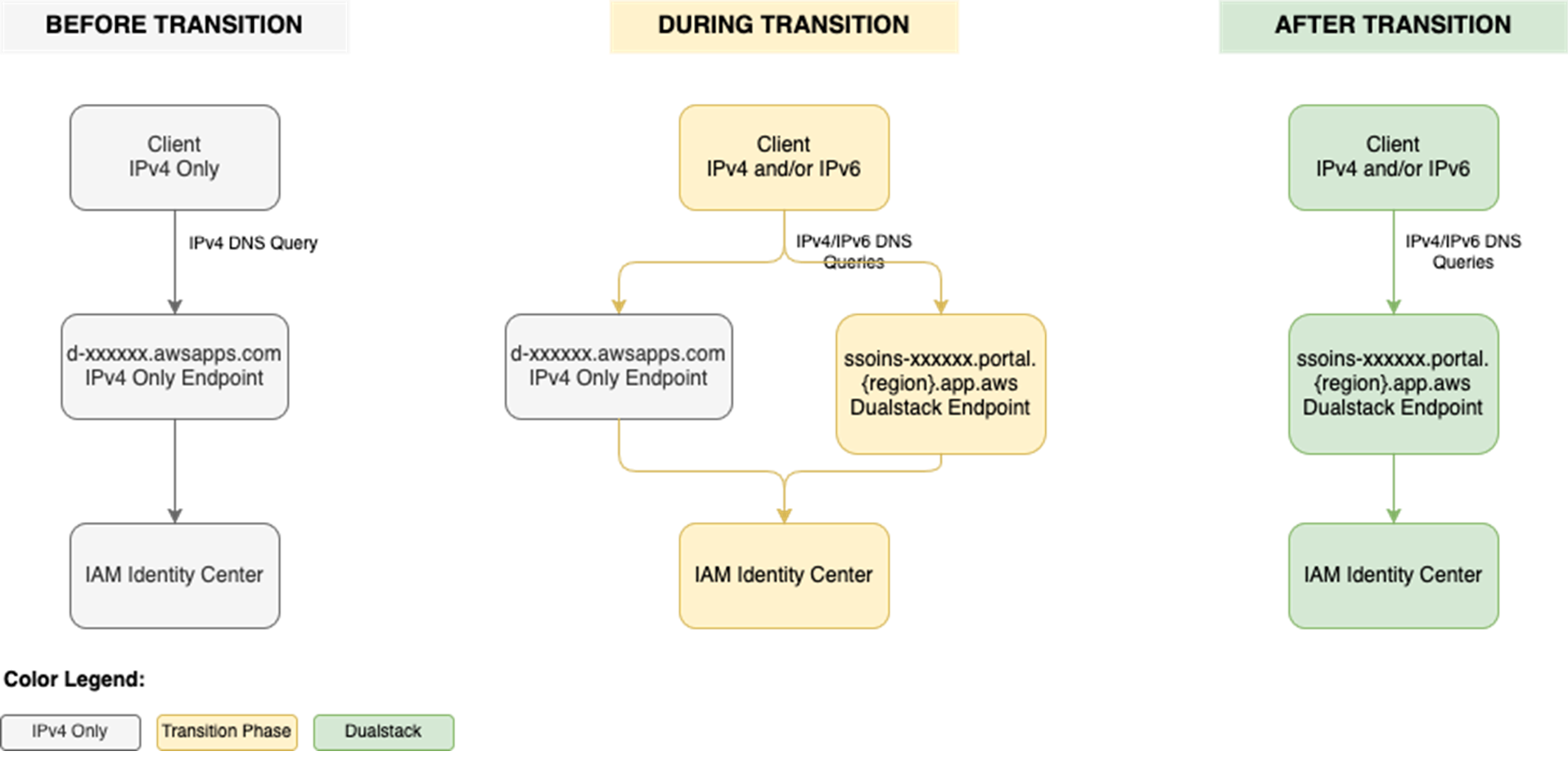
            To use IAM Identity Center from an IPv6 network and client, you need to use the new dual-stack endpoints. Figure 1 shows what the transition from IPv4 to IPv6 over dual-stack endpoints looks like when using Identity Center. The figure shows:

            • A before state where clients use the IPv4 endpoints.
            • The transition phase, when your clients use a combination of IPv4 and dual-stack endpoints.
            • After the transition is complete, your clients will connect to dual-stack endpoints using their IPv4 or IPv6, depending on their preferences.

            Figure 1: Transition from IPv4-only to dual-stack endpoints

            Figure 1: Transition from IPv4-only to dual-stack endpoints

            Prerequisites

            You must have the following prerequisites in place to enable IPv6 access for your workforce users and administrators:

            • An existing IAM Identity Center instance
            • Updated firewalls or gateways to include the new dual-stack endpoints
            • IPv6 capable clients and networks

            Work with your network administrators to update the configuration of your firewalls and gateways and to verify that your clients, such as laptops or desktops, are ready to accept IPv6 connectivity. If you have already enabled IPv6 connectivity for other AWS services, you might be familiar with these changes. Next, implement the two steps that follow.

            Step 1: Update your IdP configuration

            You can skip this step If you don’t use an external IdP as your identity source.

            In this step, you update the Assertion Consumer Service (ACS) URL from your IAM Identity Center instance into your IdP’s configuration for single sign-on and the SCIM configuration for user provisioning. Your IdP’s capability determines how you update the ACS URLs. If your IdP supports multiple ACS URLs, configure both IPv4 and dual-stack URLs to enable a flexible transition. With that configuration, some users can continue using IPv4-only endpoints while others use dual-stack endpoints for IPv6. If your IdP supports only one ACS URL, to use IPv6 you must update the new dual-stack ACS URL in your IdP and transition all users to using dual-stack endpoints. If you don’t use an external IdP, you can skip this step and go to the next step.

            Update both the SAML single sign-on and the SCIM provisioning configurations:

            1. Update the single sign-on settings in your IdP to use the new dual-stack URLs. First, locate the URLs in the AWS Management Console for IAM Identity Center.
              1. Choose Settings in the navigation pane and then select Identity source.
              2. Choose Actions and select Manage authentication.
              3. in Under Manage SAML 2.0 authentication, you will find the following URLs under Service provider metadata:
                • AWS access portal sign-in URL
                • IAM Identity Center Assertion Consumer Service (ACS) URL
                • IAM Identity Center issuer URL
            2. If your IdP supports multiple ACS URLs, then add the dual-stack URL to your IdP configuration alongside existing IPv4 one. With this setting, you and your users can decide when to start using the dual-stack endpoints, without all users in your organization having to switch together.

              Figure 2: Dual-stack single sign-on URLs

              Figure 2: Dual-stack single sign-on URLs

            3. If your IdP does not support multiple ACS URLs, replace the existing IPv4 URL with the new dual-stack URL, and switch your workforce to use only the dual-stack endpoints.
            4. Update the provisioning endpoint in your IdP. Choose Settings in the navigation pane and under Identity source, choose Actions and select Manage provisioning. Under Automatic provisioning, copy the new SCIM endpoint that ends in api.aws. Update this new URL in your external IdP.

              Figure 3: Dual-stack SCIM endpoint URL

              Figure 3: Dual-stack SCIM endpoint URL

            Step 2: Locate and share the new dual-stack endpoints

            Your organization needs two kinds of URLs for IPv6 connectivity. The first is the new dual-stack access portal URL that your workforce users use to access their assigned AWS applications and accounts. The dual-stack access portal URL is available in the IAM Identity Center console, listed as the Dual-stack in the Settings summary (you might need to expand the Access portal URLs section, shown in Figure 4).

            Figure 4: Locate dual-stack access portal endpoints

            Figure 4: Locate dual-stack access portal endpoints

            This dual-stack URL ends with app.aws as its top-level domain (TLD). Share this URL with your workforce and ask them to use this dual-stack URL to connect over IPv6. As an example, if your workforce uses the access portal to access AWS accounts, they will need to sign in through the new dual-stack access portal URL when using IPv6 connectivity. Alternately, if your workforce accesses the application URL, you need to enable the dual-stack application URL following application-specific instructions. For more information, see AWS services that support IPv6.

            The URLs that administrators use to manage IAM Identity Center are the second kind of URL your organization needs. The new dual-stack service endpoints end in api.aws as their TLD and are listed in the Identity Center service endpoints. Administrators can use these service endpoints to manage users and groups in Identity Center, update their access to applications and resources, and perform other management operations. As an example, if your administrator uses identitystore.{region}.amazonaws.com to manage users and groups in Identity Center, they should now use the dual-stack version of the same service endpoint which is identitystore.{region}.api.aws, so they can connect to service endpoints using IPv6 clients and networks.

            If your users or administrators use an AWS SDK to access AWS applications and accounts or manage services, follow Dual-stack and FIPS endpoints to enable connectivity to the dual-stack endpoints.

            After completing these two steps, your workforce and administrators can connect to IAM Identity Center using IPv6. Remember, these endpoints also support IPv4, so clients not yet IPv6-capable can continue to connect using IPv4.

            Monitoring dual-stack endpoint usage

            You can optionally monitor AWS CloudTrail logs to track usage of dual-stack endpoints. The key difference between IPv4-only and dual-stack endpoint usage is the TLD and appears in the clientProvidedHostHeader field. The following example shows the difference between these CloudTrail events for the CreateTokenWithIAM API call.

            IPv4-only endpoints Dual-stack endpoints
            "CloudTrailEvent": {
              "eventName": "CreateToken",
              "tlsDetails": {
                 "tlsVersion": "TLSv1.3",
                 "cipherSuite": "TLS_AES_128_GCM_SHA256",
                 "clientProvidedHostHeader": "oidc.us-east-1.amazonaws.com"
              }
            }
            "CloudTrailEvent": {
              "eventName": "CreateToken",
              "tlsDetails": {
                 "tlsVersion": "TLSv1.3",
                 "cipherSuite": "TLS_AES_128_GCM_SHA256",
                 "clientProvidedHostHeader": "oidc.us-east-1.api.aws"
              }
            }

            Conclusion

            IAM Identity Center now allows clients to connect over IPv6 natively with no network address translation infrastructure. This post showed you how to transition your organization to use IPv6 with Identity Center and its integrated applications. Remember that existing IPv4 endpoints will continue to function, so you can transition at your own pace. Also, no immediate action is required by you. However, we recommend planning your transition to take advantage of IPv6 benefits and meet compliance requirements. If you have questions, comments, or concerns, contactΒ AWS Support, or start a new thread in the IAM Identity Center re:Post channel.

            Β 
            If you have feedback about this post, submit comments in the Comments section below. If you have questions about this post, contact AWS Support.

            Β 

            Suchintya Dandapat Suchintya Dandapat
            Suchintya Dandapat is a Principal Product Manager for AWS where he partners with enterprise customers to solve their toughest identity challenges, enabling secure operations at global scale.

            Updated PCI PIN compliance package for AWS CloudHSM now available

            26 January 2026 at 19:11

            Amazon Web Services (AWS) is pleased to announce the successful completion of Payment Card Industry Personal Identification Number (PCI PIN) audit for the AWS CloudHSM service.

            With CloudHSM, you can manage and access your keys on FIPS 140-3 Level 3 validated hardware, protected with customer-owned, single-tenant hardware security module (HSM) instances that run in your own virtual private cloud (VPC). This PCI PIN attestation gives you the flexibility to deploy your regulated workloads with reduced compliance overhead. CloudHSM might be suitable when operations supported by the service are integrated into a broader solution that requires PCI-PIN compliance. For payment operations, such as PIN translation, we encourage you to consider AWS Payment Cryptography as a fully managed alternative for PCI-PIN compliance.

            The PCI PIN compliance report package for AWS CloudHSM includes two key components:

            • PCI PIN Attestation of Compliance (AOC) – demonstrating that AWS CloudHSM was successfully validated against the PCI PIN standard with zero findings
            • PCI PIN Responsibility Summary – provides guidance to help AWS customers understand their responsibilities in developing and operating a highly secure environment for handling PIN-based transactions

            AWS was evaluated by Coalfire, a third-party Qualified Security Assessor (QSA). Customers can access the PCI PIN Attestation of Compliance (AOC) and PCI PIN Responsibility Summary reports through AWS Artifact.

            To learn more about our PCI program and other compliance and security programs, see the AWS Compliance Programs page. As always, we value your feedback and questions; reach out to the AWS Compliance team through the Contact Us page.

            If you have feedback about this post, submit comments in the Comments section below. If you have questions about this post, contact AWS Support.

            Tushar Jain

            Tushar Jain

            Tushar is a Compliance Program Manager at AWS. He leads multiple security and privacy initiatives within AWS. Tushar holds a Master of Business Administration from Indian Institute of Management Shillong, India and a Bachelor of Technology in electronics and telecommunication engineering from Marathwada University, India. He has over 13 years of experience in information security and holds CCSK and CSXF certifications.

            Will Black

            Will Black

            Will is a Compliance Program Manager at Amazon Web Services. He leads multiple security and compliance initiatives within AWS. He has ten years of experience in compliance and security assurance and holds a degree in Management Information Systems from Temple University. Additionally, he holds the CCSK and ISO 27001 Lead Implementer certifications.

            Updated PCI PIN compliance package for AWS Payment Cryptography now available

            24 January 2026 at 00:14

            Amazon Web Services (AWS) is pleased to announce the successful completion of Payment Card Industry Personal Identification Number (PCI PIN) audit for the AWS Payment Cryptography service.

            With AWS Payment Cryptography, your payment processing applications can use payment hardware security modules (HSMs) that are PCI PIN Transaction Security (PTS) HSM certified and fully managed by AWS, with PCI PIN-compliant key management. This attestation gives you the flexibility to deploy your regulated workloads with reduced compliance overhead.

            The PCI PIN compliance report package for AWS Payment Cryptography includes two key components:

            • PCI PIN Attestation of Compliance (AOC) – demonstrating that AWS Payment Cryptography was successfully validated against the PCI PIN standard with zero findings
            • PCI PIN Responsibility Summary – provides guidance to help AWS customers understand their responsibilities in developing and operating a highly secure environment for handling PIN-based transactions

            AWS was evaluated by Coalfire, a third-party Qualified Security Assessor (QSA). Customers can access the PCI PIN Attestation of Compliance (AOC) and PCI PIN Responsibility Summary reports through AWS Artifact.

            To learn more about our PCI programs and other compliance and security programs, visit the AWS Compliance Programs page. As always, we value your feedback and questions; reach out to the AWS Compliance team through the Compliance Support page.

            If you have feedback about this post, submit comments in the Comments section below. If you have questions about this post, contact AWS Support.

            Tushar Jain

            Tushar Jain

            Tushar is a Compliance Program Manager at AWS. He leads multiple security and privacy initiatives within AWS. Tushar holds a Master of Business Administration from Indian Institute of Management Shillong, India and a Bachelor of Technology in electronics and telecommunication engineering from Marathwada University, India. He has over 13 years of experience in information security and holds CCSK and CSXF certifications.

            Will Black

            Will Black

            Will is a Compliance Program Manager at Amazon Web Services. He leads multiple security and compliance initiatives within AWS. He has ten years of experience in compliance and security assurance and holds a degree in Management Information Systems from Temple University. Additionally, he holds the CCSK and ISO 27001 Lead Implementer certifications.

            AWS achieves 2025 C5 Type 2 attestation report with 183 services in scopeΒ 

            23 January 2026 at 22:39

            Amazon Web Services (AWS) is pleased to announce a successful completion of the 2025 Cloud Computing Compliance Criteria Catalogue (C5) attestation cycle with 183 services in scope. This alignment with C5 requirements demonstrates our ongoing commitment to adhere to the heightened expectations for cloud service providers. AWS customers in Germany and across Europe can run their applications in the AWS Regions that are in scope of the C5 report with the assurance that AWS aligns with C5 criteria.

            The C5 attestation scheme is backed by the German government and was introduced by the Federal Office for Information Security (BSI) in 2016. AWS has adhered to the C5 requirements since their inception. C5 helps organizations demonstrate operational security against common cybersecurity threats when using cloud services.

            Independent third-party auditors evaluated AWS for the period of October 1, 2024, through September 30, 2025. The C5 report illustrates the compliance status of AWS for both the basic and additional criteria of C5. Customers can download the C5 report through AWS Artifact, a self-service portal for on-demand access to AWS compliance reports. Sign in to AWS Artifact in the AWS Management Console or learn more at Getting Started with AWS Artifact.

            AWS has added the following five services to the current C5 scope:

            The following AWS Regions are in scope of the 2025 C5 attestation: Europe (Frankfurt), Europe (Ireland), Europe (London), Europe (Milan), Europe (Paris), Europe (Stockholm), Europe (Spain), Europe (Zurich), and Asia Pacific (Singapore). For up-to-date information, see the C5 page of our AWS Services in Scope by Compliance Program.

            Security and compliance is a shared responsibility between AWS and the customer. When customers move their computer systems and data to the cloud, security responsibilities are shared between the customer and the cloud service provider. For more information, see the AWS Shared Security Responsibility Model.

            To learn more about our compliance and security programs, see AWS Compliance Programs. As always, we value your feedback and questions; reach out to the AWS Compliance team through the Contact Us page.

            Reach out to your AWS account team if you have questions or feedback about the C5 report.
            If you have feedback about this post, submit comments in the Comments section below.

            Tea Jioshvili

            Tea Jioshvili

            Tea is a Manager in AWS Compliance & Security Assurance based in Berlin, Germany. She leads various third-party audit programs across Europe. She previously worked in security assurance and compliance, business continuity, and operational risk management in the financial industry for 20 years.

            ❌