❌

Normal view

Binance hit by largest-ever crypto theft, with $6.3 billion stolen

30 October 2026 at 13:24
.kadence-column482616_9de20c-07 > .kt-inside-inner-col{padding-top:20px;padding-right:20px;padding-bottom:10px;padding-left:20px;}.kadence-column482616_9de20c-07 > .kt-inside-inner-col{column-gap:var(--global-kb-gap-sm, 1rem);}.kadence-column482616_9de20c-07 > .kt-inside-inner-col{flex-direction:column;}.kadence-column482616_9de20c-07 > .kt-inside-inner-col > .aligncenter{width:100%;}.kadence-column482616_9de20c-07 > .kt-inside-inner-col{background-color:#ffe5e5;}.kadence-column482616_9de20c-07 > .kt-inside-inner-col:before{opacity:0.3;}.kadence-column482616_9de20c-07{position:relative;}@media all and (max-width: 1024px){.kadence-column482616_9de20c-07 > .kt-inside-inner-col{flex-direction:column;justify-content:center;}}@media all and (max-width: 767px){.kadence-column482616_9de20c-07 > .kt-inside-inner-col{flex-direction:column;justify-content:center;}}

In this article

  • Attackers stole $6.3 billion from the Binance cryptocurrency exchange
  • Binance says user funds are safe, but watch out for fake support or recovery offers from scammers
  • Users should check their accounts and use official Binance channels.

Binance says a security incident affected approximately $6.3 billion in cryptocurrency. Its initial investigation points to a compromised DevOps engineer’s laptop as a possible entry point.

The exchange says it has frozen around $3 billion with help from blockchain partners. It has promised to cover all losses using its emergency fund and company funds. Binance is reportedly the largest cryptocurrency exchange by daily trading volume.

What happened?

In an update on October 30, Binance said attackers may have used a compromised laptop belonging to a DevOps engineer to access a service container and submit unauthorized withdrawal transactions. The company said:

“We have found no evidence of any wallet private key leak.”

This doesn’t mean that one employee could simply transfer billions of dollars. Binance co-CEO Richard Teng told BleepingComputer the attacker did not simply use one engineer’s permissions. The incident involved a more complex process, rather than a single “one-click” action. Binance also said investigators had identified additional breach points.

Blockchain intelligence firms TRM Labs and Chainalysis have linked the theft to TraderTraitor, a North Korean hacking group associated with previous cryptocurrency thefts. TRM Labs estimates that about $6.36 billion left Binance wallets across ten blockchains, with most of it moving within about 20 minutes.

What should Binance users do?

Binance says approximately $3 billion has been frozen on-chain, while blockchain analysts have reported somewhat different totals. For now, those figures should be treated as developing estimates rather than a final accounting of recovered funds or the exchange’s ultimate losses.

Binance.com users (Binance.US was not affected) should check their accounts, avoid follow-up scams, and respond quickly if they spot signs of a separate compromise.

  • Go directly to official updates. Open the Binance app or navigate to its support site yourself. Avoid logging in through unexpected messages claiming that you must urgently verify your account or claim compensation. Binance has asked customers to rely on official channels.
  • Review your account and report anything unexpected. Check your transaction history and account security settings. If you find activity you do not recognize, contact Binance through its official support service. Binance’s support center includes options to disable an account and reset a password or two-factor authentication.
  • Never give anyone your authentication codes. Treat requests for login codes as a warning sign, even if the person claims to be helping with the incident.
  • Be wary of anyone promising to recover cryptocurrency. The FBI published a warning in 2023 that fake recovery services target people who have already lost cryptocurrency.
  • Preserve evidence if you lose money to a related scam. Keep messages, wallet addresses, transaction details, and information about anyone offering recovery services.

Pro tip: Unsure whether a message is a scam? Check it with Malwarebytes’ Scam Guard for an assessment and advice on what to do next.


Link Checker

Unsure where a link goes? We’ll check it.


Canvas Breach Disrupts Schools & Colleges Nationwide

8 May 2026 at 04:58

An ongoing data extortion attack targeting the widely-used education technology platform Canvas disrupted classes and coursework at school districts and universities across the United States today, after a cybercrime group defaced the service’s login page with a ransom demand that threatened to leak data from 275 million students and faculty across nearly 9,000 educational institutions.

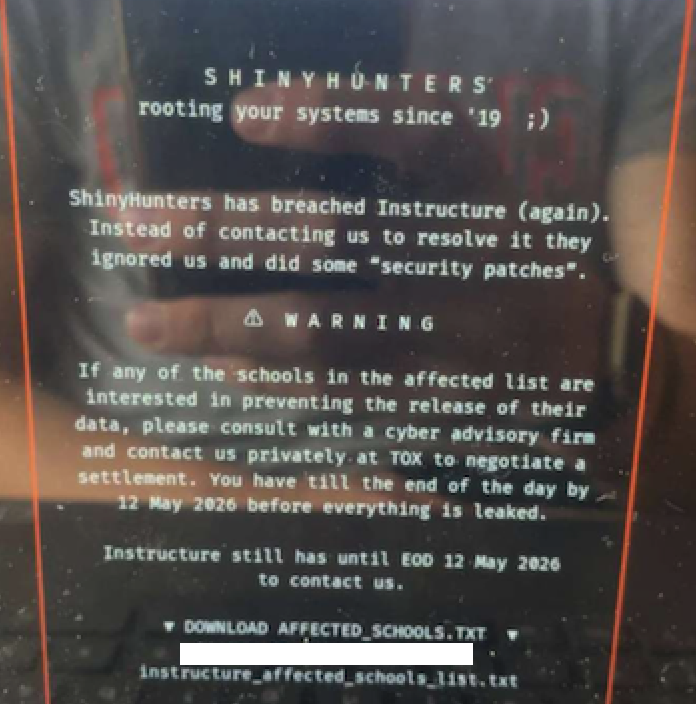
A screenshot shared by a reader showing the extortion message that was shown on the Canvas login page today.

Canvas parent firm Instructure responded to today’s defacement attacks by disabling the platform, which is used by thousands of schools, universities and businesses to manage coursework and assignments, and to communicate with students.

Instructure acknowledged a data breach earlier this week, after the cybercrime group ShinyHunters claimed responsibility and said they would leak data on tens of millions of students and faculty unless paid a ransom. The stated deadline for payment was initially set at May 6, but it was later pushed back to May 12.

In a statement on May 6, Instructure said the investigation so far shows the stolen information includes “certain identifying information of users at affected institutions, such as names, email addresses, and student ID numbers, as well as as messages among users.” The company said it found no evidence the breached data included more sensitive information, such as passwords, dates of birth, government identifiers or financial information.

The May 6 update stated that Canvas was fully operational, and that Instructure was not seeing any ongoing unauthorized activity on their platform. “At this stage, we believe the incident has been contained,” Instructure wrote.

However, by mid-day on Thursday, May 7, students and faculty at dozens of schools and universities were flooding social media sites with comments saying that a ransom demand from ShinyHunters had replaced the usual Canvas login page. Instructure responded by pulling Canvas offline and replacing the portal with the message, “Canvas is currently undergoing scheduled maintenance. Check back soon.”

“We anticipate being up soon, and will provide updates as soon as possible,” reads the current message on Instructure’s status page.

While the data stolen by ShinyHunters may or may not contain particularly sensitive information (ShinyHunters claims it includes several billion private messages among students and teachers, as well as names, phone numbers and email addresses), this attack could hardly have come at a worse time for Instructure: Many of the affected schools and universities are in the middle of final exams, and a prolonged outage could be highly damaging for the company.

The extortion message that greeted countless Canvas users today advised the affected schools to negotiate their own ransom payments to prevent the publication of their data — regardless of whether Instructure decides to pay.

“ShinyHunters has breached Instructure (again),” the extortion message read. “Instead of contacting us to resolve it they ignored us and did some ‘security patches.'”

A source close to the investigation who was not authorized to speak to the press told KrebsOnSecurity that a number of universities have already approached the cybercrime group about paying. The same source also pointed out that the ShinyHunters data leak blog no longer lists Instructure among its current extortion victims, and that the samples of data stolen from Canvas customers were removed as well. Data extortion groups like ShinyHunters will typically only remove victims from their leak sites after receiving an extortion payment or after a victim agrees to negotiate.

Dipan Mann, founder and CEO of the security firm Cloudskope, slammed Instructure for referring to today’s outage as a “scheduled maintenance” event on its status page. Mann said Shiny Hunters first demonstrated they’d breached Instructure on May 1, prompting Instructure’s Chief Information Security Officer Steve Proud to declare the following day that the incident had been contained. But Mann said today’s attack is at least the third time in the past eight months that Instructure has been breached by ShinyHunters.

In a blog post today, Mann noted that in September 2025, ShinyHunters released thousands of internal University of Pennsylvania files — donor records, internal memos, and other confidential materials — through what the Daily Pennsylvanian and other outlets later determined was, in part, a Canvas/Instructure-mediated access path.

“Penn was the named victim,” Mann wrote. “Instructure was the mechanism. The incident was treated as a Penn-specific story by most of the national press and quietly handled by Instructure as a customer-specific matter. That framing was wrong then. It is dramatically more wrong in light of the May 2026 events, which now look like the planned escalation of an attack pattern that ShinyHunters had been working against Instructure’s environment for at least eight months prior. The September 2025 Penn breach was the proof of concept. The May 1, 2026 incident was the production run. The May 7, 2026 recompromise was ShinyHunters demonstrating publicly that the May 2 ‘containment’ did not happen.”

In February, a ShinyHunters spokesperson told The Daily Pennsylvanian that Penn failed to pay a $1 million ransom demand. On March 5, ShinyHunters published 461 megabytes worth of data stolen from Penn, including thousands of files such as donor records and internal memos.

ShinyHunters is a prolific and fluid cybercriminal group that specializes in data theft and extortion. They typically gain access to companies through voice phishing and social engineering attacks that often involve impersonating IT personnel or other trusted members of a targeted organization.

Last month, ShinyHunters relieved the home security giant ADT of personal information on 5.5 million customers. The extortion group told BleepingComputer they breached the company by compromising an employee’s Okta single sign-on account in a voice phishing attack that enabled access to ADT’s Salesforce instance. BleepingComputer says ShinyHunters recently has taken credit for a number of extortion attacks against high-profile organizations, including Medtronic, Rockstar Games, McGraw Hill, 7-Eleven and the cruise line operator Carnival.

The attack on Canvas customers is just one of several major cybercrime campaigns being launched by ShinyHunters at the moment, said Charles Carmakal, chief technology officer at the Google-owned Mandiant Consulting. Carmakal declined to comment specifically on the Canvas breach, but said “there are multiple concurrent and discrete ShinyHunters intrusion and extortion campaigns happening right now.”

Cloudskope’s Mann said what happens next depends largely on whether Instructure’s customers — the universities, K-12 districts, and education ministries paying for Canvas — choose to apply pressure or absorb the breach quietly.

“The history of education-vendor incidents suggests the path of least resistance is the second one,” he concluded.

Update, May 8, 11:05 a.m. ET: Instructure has published an incident update page that includes more information about the breach. Instructure said its Canvas portal is functioning normally again, and that the hackers exploited an issue related to Free-for-Teacher accounts.

“This is the same issue that led to the unauthorized access the prior week,” Instructure wrote. “As a result, we have made the difficult decision to temporarily shut down Free-for-Teacher accounts. These accounts have been a core part of our platform, and we’re committed to resolving the issues with these accounts.”

Instructure said affected organizations were notified on May 6.

“If your organization is affected, Instructure will contact your organization’s primary contacts directly,” the update states. “Please don’t rely on third-party lists or social media posts naming potentially affected organizations as those lists aren’t verified. Instructure will confirm validated information through direct outreach to all affected organizations.”

Update, May 11, 10:16 p.m. ET: Instructure posted an update saying they paid their extortionists in exchange for a promise to destroy the stolen data. “The data was returned to us,” the update reads. “We received digital confirmation of data destruction (shred logs). We have been informed that no Instructure customers will be extorted as a result of this incident, publicly or otherwise.”

Iran-Backed Hackers Claim Wiper Attack on Medtech Firm Stryker

11 March 2026 at 17:20

A hacktivist group with links to Iran’s intelligence agencies is claiming responsibility for a data-wiping attack against Stryker, a global medical technology company based in Michigan. News reports out of Ireland, Stryker’s largest hub outside of the United States, said the company sent home more than 5,000 workers there today. Meanwhile, a voicemail message at Stryker’s main U.S. headquarters says the company is currently experiencing a building emergency.

Based in Kalamazoo, Michigan, Stryker [NYSE:SYK] is a medical and surgical equipment maker that reported $25 billion in global sales last year. In a lengthy statement posted to Telegram, a hacktivist group known as Handala (a.k.a. Handala Hack Team) claimed that Stryker’s offices in 79 countries have been forced to shut down after the group erased data from more than 200,000 systems, servers and mobile devices.

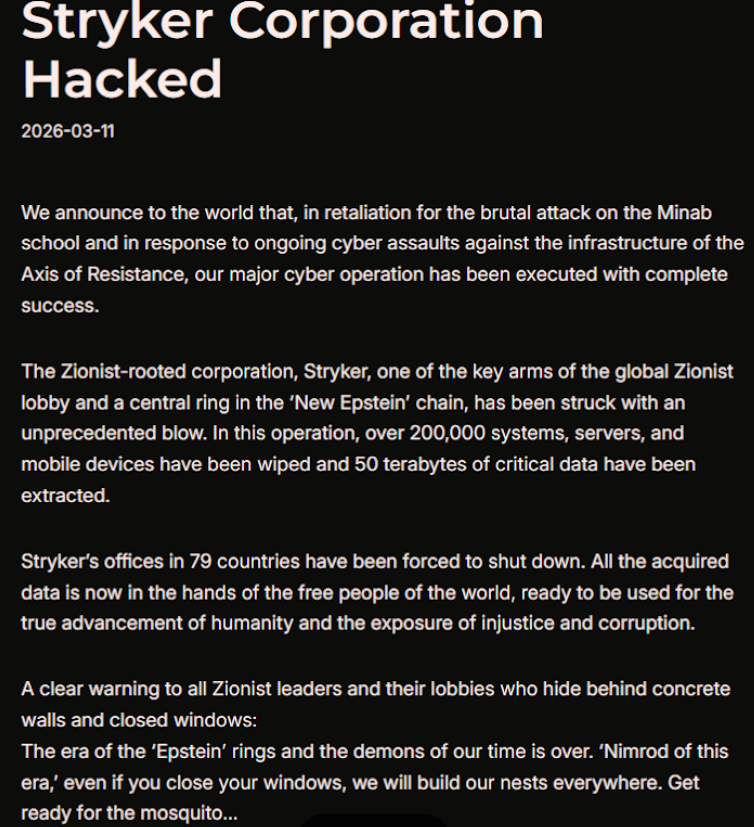
A manifesto posted by the Iran-backed hacktivist group Handala, claiming a mass data-wiping attack against medical technology maker Stryker.

A manifesto posted by the Iran-backed hacktivist group Handala, claiming a mass data-wiping attack against medical technology maker Stryker.

“All the acquired data is now in the hands of the free people of the world, ready to be used for the true advancement of humanity and the exposure of injustice and corruption,” a portion of the Handala statement reads.

The group said the wiper attack was in retaliation for a Feb. 28 missile strike that hit an Iranian school and killed at least 175 people, most of them children. The New York Times reports today that an ongoing military investigation has determined the United States is responsible for the deadly Tomahawk missile strike.

Handala was one of several hacker groups recently profiled by Palo Alto Networks, which links it to Iran’s Ministry of Intelligence and Security (MOIS). Palo Alto says Handala surfaced in late 2023 and is assessed as one of several online personas maintained by Void Manticore, a MOIS-affiliated actor.

Stryker’s website says the company has 56,000 employees in 61 countries. A phone call placed Wednesday morning to the media line at Stryker’s Michigan headquarters sent this author to a voicemail message that stated, “We are currently experiencing a building emergency. Please try your call again later.”

A report Wednesday morning from the Irish Examiner said Stryker staff are now communicating via WhatsApp for any updates on when they can return to work. The story quoted an unnamed employee saying anything connected to the network is down, and that “anyone with Microsoft Outlook on their personal phones had their devices wiped.”

“Multiple sources have said that systems in the Cork headquarters have been ‘shut down’ and that Stryker devices held by employees have been wiped out,” the Examiner reported. “The login pages coming up on these devices have been defaced with the Handala logo.”

Wiper attacks usually involve malicious software designed to overwrite any existing data on infected devices. But a trusted source with knowledge of the attack who spoke on condition of anonymity told KrebsOnSecurity the perpetrators in this case appear to have used a Microsoft service called Microsoft Intune to issue a ‘remote wipe’ command against all connected devices.

Intune is a cloud-based solution built for IT teams to enforce security and data compliance policies, and it provides a single, web-based administrative console to monitor and control devices regardless of location. The Intune connection is supported by this Reddit discussion on the Stryker outage, where several users who claimed to be Stryker employees said they were told to uninstall Intune urgently.

Palo Alto says Handala’s hack-and-leak activity is primarily focused on Israel, with occasional targeting outside that scope when it serves a specific agenda. The security firm said Handala also has taken credit for recent attacks against fuel systems in Jordan and an Israeli energy exploration company.

“Recent observed activities are opportunistic and ‘quick and dirty,’ with a noticeable focus on supply-chain footholds (e.g., IT/service providers) to reach downstream victims, followed by ‘proof’ posts to amplify credibility and intimidate targets,” Palo Alto researchers wrote.

The Handala manifesto posted to Telegram referred to Stryker as a “Zionist-rooted corporation,” which may be a reference to the company’s 2019 acquisition of the Israeli company OrthoSpace.

Stryker is a major supplier of medical devices, and the ongoing attack is already affecting healthcare providers. One healthcare professional at a major university medical system in the United States told KrebsOnSecurity they are currently unable to order surgical supplies that they normally source through Stryker.

“This is a real-world supply chain attack,” the expert said, who asked to remain anonymous because they were not authorized to speak to the press. “Pretty much every hospital in the U.S. that performs surgeries uses their supplies.”

John Riggi, national advisor for the American Hospital Association (AHA), said the AHA is not aware of any supply-chain disruptions as of yet.

“We are aware of reports of the cyber attack against Stryker and are actively exchanging information with the hospital field and the federal government to understand the nature of the threat and assess any impact to hospital operations,” Riggi said in an email. “As of this time, we are not aware of any direct impacts or disruptions to U.S. hospitals as a result of this attack. That may change as hospitals evaluate services, technology and supply chain related to Stryker and if the duration of the attack extends.”

According to a March 11 memo from the state of Maryland’s Institute for Emergency Medical Services Systems, Stryker indicated that some of their computer systems have been impacted by a “global network disruption.” The memo indicates that in response to the attack, a number of hospitals have opted to disconnect from Stryker’s various online services, including LifeNet, which allows paramedics to transmit EKGs to emergency physicians so that heart attack patients can expedite their treatment when they arrive at the hospital.

“As a precaution, some hospitals have temporarily suspended their connection to Stryker systems, including LIFENET, while others have maintained the connection,” wrote Timothy Chizmar, the state’s EMS medical director. “The Maryland Medical Protocols for EMS requires ECG transmission for patients with acute coronary syndrome (or STEMI). However, if you are unable to transmit a 12 Lead ECG to a receiving hospital, you should initiate radio consultation and describe the findings on the ECG.”

This is a developing story. Updates will be noted with a timestamp.

Update, 2:54 p.m. ET: Added comment from Riggi and perspectives on this attack’s potential to turn into a supply-chain problem for the healthcare system.

Update, Mar. 12, 7:59 a.m. ET: Added information about the outage affecting Stryker’s online services.

Monero download site and binaries compromised

By: Bart
19 November 2019 at 23:18

Introduction

Earlier this evening I saw a tweet appear which claimed Monero has been hacked and a malicious binary (instead of the real one) has been served:

Warning Monero users: If you downloaded Monero in the past 24 hours you may have installed malware. Monero's official website served compromised binaries for at least 30 minutes during the past 24 hours. Investigations are ongoing. https://t.co/geqA4dIPar
— dark.fail (@DarkDotFail) November 19, 2019

Post on Reddit:
https://www.reddit.com/r/Monero/comments/dyfozs/security_warning_cli_binaries_available_on/

Github issue:
https://github.com/monero-project/monero/issues/6151


Linux binary

Thanks to user nikitasius I was able to retrieve the malicious binary:
https://github.com/monero-project/monero/issues/6151#issuecomment-555511805

This binary is an ELF file with the following properties:
When comparing the legitimate file and this ELF file, we notice the file size is different, and a few new functions have been added:

cryptonote::simple_wallet::send_seed

This function is immediately called after either opening or creating a new wallet, as can be seen in Figure 1 and 2 below.


Figure 1 - Create wallet (legitimate)

Figure 2 - Call new seed function


The seed will be sent to: node.hashmonero[.]com.

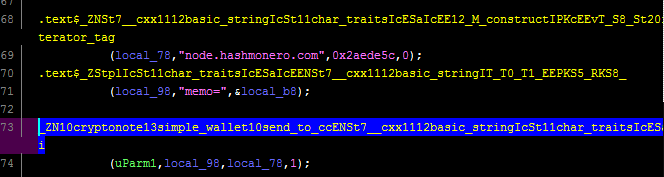
cryptonote::simple_wallet::send_to_cc

As you may have guessed, this function will send data off to the CC or C2 (command and control) server - this will be stolen funds.

Figure 3 - Send to cc


Sending funds to the C2 is handled using an HTTP POST request to the following C2 servers:

  • node.xmrsupport[.]co
  • 45.9.148[.]65

As far I can see, it doesn't seem to create any additional files or folders - it simply steals your seed and attempts to exfiltrate funds from your wallet.

Windows binary

The C2 server 45.9.148[.]65 also hosts a Windows binary with the following properties:


The Windows version is essentially doing the same things as the Linux version - stealing your seed and wallet funds - the function names are just different, e.g. _ZN10cryptonote13simple_wallet9send_seedERKN4epee15wipeable_stringE.

Figure 4 - Send to cc


Note: this doesn’t mean the official Windows binary was also compromised - it simply means there’s also a compromised Windows binary out there. Only the Monero team can confirm if other binaries (besides the Linux one mentioned in this blog) have been compromised.

Detection

Note: What is a hash? A hash is a unique identifier. This can be for a file, a word, ... It is preferred to use SHA256 hashes for file integration checks, as it is more secure.

You may also use the following Yara rule to detect the malicious or compromised binaries:
Monero_Compromise.yar
Download Yara (and documentation) from:
https://github.com/VirusTotal/yara

There's an additional analysis by SerHack here:
https://serhack.me/articles/cli-binaries-compromised-monero-analysis/

Recommendations
Note: Especially go through the steps if at any point you downloaded, used or installed new binaries between these dates: Monday 18th 1:30 AM UTC and 5:30 PM UTC. Download the latest version from: https://web.getmonero.org/downloads/.

Monero team statement

The Monero team has issued a statement as follows:

Warning: The binaries of the CLI wallet were compromised for a short time:
https://web.getmonero.org/2019/11/19/warning-compromised-binaries.html

I expect this statement to be updated the following days, so monitor it as well.


Conclusion

Monero is not the first, nor will it likely be the last cryptocurrency (in this case, its website and binaries) that gets compromised.

Follow the steps in this blog post to protect yourself and always watch your online accounts closely, especially those where you have financially invested in. Use strong passwords, use MFA (or 2FA) where possible and always be vigilant. Verify hashes when a new version is available.

Note: this blog post is not intended to be a full analysis, but rather a quick report on the facts, including recommendations. Questions or feedback? Happy to hear it!

Let me know in the comments below or on Twitter.


Indicators


Indicator typeIndicator
FileHash-SHA2567ab9afbc5f9a1df687558d570192fbfe9e085712657d2cfa5524f2c8caccca31
FileHash-SHA256963c1dfc86ff0e40cee176986ef9f2ce24fda53936c16f226c7387e1a3d67f74
hostnamewww.hashmonero.com
hostnamenode.xmrsupport.co
hostnamenode.hashmonero.com
FileHash-MD5d267be7efc3f2c4dde8e90b9b489ed2a
FileHash-MD572417ab40b8ed359a37b72ac8d399bd7
FileHash-SHA16bd94803b3487ae1997238614c6c81a0f18bcbb0
FileHash-SHA1394bde8bb86d75eaeee69e00d96d8daf70df4b0a
IPv491.210.104.245
IPv445.9.148.65
domainhashmonero.com
domainxmrsupport.co

On AlienVault:

https://otx.alienvault.com/pulse/5dd4574fc7c82cddbdcb8d12

MITRE ATT&CK techniques

ID: T1195 - Supply Chain Compromise
ID: T1199 - Trusted Relationship

WEBCAST: Hardware Hacking 101

By: BHIS
23 April 2018 at 17:17

Rick Wisser// In this webcast Rick gives an introduction to hardware hacking. Including: tools utilized, reconnaissance of a device, brief overview of methods used along with a demo. So put […]

The post WEBCAST: Hardware Hacking 101 appeared first on Black Hills Information Security, Inc..

❌