❌

Normal view

The Enterprise Threat Intelligence Report: 2026

Threat intelligence teams are heading into 2027 with more than ever to monitor, driven by an acceleration in the AI threat landscape. However, their expanded mandate typically doesn’t come with a proportional budget windfall. Instead, teams are under pressure to get greater value from the intelligence, systems, and analyst expertise already available to them.

New independent research commissioned by Flashpoint shows where that pressure is being felt most. Alert noise and false positives are the most frequently cited challenges affecting threat intelligence program effectiveness, followed by analyst bandwidth, changes in the threat landscape, and integration across security tools. At the same time, AI-related threats have emerged as the leading area where practitioners want to expand intelligence coverage.

These findings point to some of the decisions that will shape threat intelligence programs in the year ahead: where to focus finite analyst capacity, how intelligence requirements need to evolve, and where AI can meaningfully support the work. Organizations are already evaluating agentic AI across threat intelligence workflows, but the research also shows that greater autonomy comes with higher expectations around accuracy, control, and measurable value.

For security leaders planning their 2027 threat intelligence strategy and budgets, this report examines:

  • Which operational challenges are putting the greatest pressure on analyst capacity and threat intelligence programs today.
  • How intelligence requirements are changing as AI-enabled threats create new coverage priorities.
  • How threat intelligence budgets are trending in the next 12 months, and where incremental budgets will go.
  • Where practitioners see the strongest applications for agentic AI, and which AI-powered workflows face a higher threshold for trust and autonomy.
  • What teams need to prove before expanding AI investment, including the metrics practitioners are using to evaluate time savings, accuracy, risk reduction, and ROI.

Together, the findings provide a practical benchmark for teams evaluating their own intelligence operations: where to focus limited analyst time, where automation may have the greatest impact, and what to measure as AI becomes part of the workflow.

Executive Summary

As threat intelligence teams plan for 2027, the research shows them managing two simultaneous pressures: intelligence requirements are expanding, while the capacity available to address them remains constrained. AI is intensifying that pressure as adversaries adopt new capabilities, but also becoming part of how organizations are thinking about scaling their ability to defend their organizations.

“2027 will test whether threat intelligence programs can scale their reach as fast as AI is reshaping the threat landscape. The opportunity for agentic AI on the defensive side is significant, and our research shows security leaders are ready to invest. But they aren’t swayed by the hype. They’re holding agentic AI to a high bar, and they want to know where it improves their work, whether they can trust the output, and where human judgment must remain part of the process.”

Josh Lefkowitz
Co-Founder and CEO, Flashpoint

Four findings stand out:

  • The AI threat landscape is accelerating faster than threat intelligence teams can keep up. Alert noise and false positives were the most frequently cited challenge, identified by 65% of respondents, while 55% cited insufficient analyst bandwidth and half pointed to integration gaps across their security tools.
  • Threat intelligence budgets are rising to close the gap. Half of respondents expect their budgets to increase over the next 12 months, including 35% anticipating meaningful increases of 10% or more. Another 40% expect spending to remain essentially flat. No respondents anticipate a decrease. Where budgets are growing, organizations are directing investment toward areas including AI-related threat coverage, additional intelligence feeds and modules, and broader program development.
  • AI-related threats are the leading priority for expanded coverage and new investment. Practitioners pointed to deepfake detection, AI-accelerated vulnerability exploitation, and emerging AI-enabled threat vectors as areas where their intelligence requirements are expanding.
  • Agentic AI adoption is underway, but teams are setting a high bar. Just 25% of organizations interviewed are using agentic AI in production today. Another 20% are piloting it, while 35% are planning adoption within the next 12 to 24 months. Rather than rushing toward autonomy, teams are evaluating where agents can improve workflows while maintaining intelligence quality, appropriate controls, and human oversight.

Taken together, the findings show where threat intelligence teams are feeling the greatest pressure, where they see opportunities to extend their capabilities with AI, and what will determine whether those tools earn a lasting place in the intelligence workflow. The sections that follow examine each of these findings in greater detail and what they mean for threat intelligence programs.

Operational Challenges Are Putting Pressure on Analyst Capacity

The rising AI threat landscape is increasing pressure on organizations to get more capacity from the people and systems they already have. Threat intelligence leaders therefore say the biggest barriers to program effectiveness are operational: too much noise, limited analyst bandwidth, and disconnected tools.

Alert noise and false positives emerged as the leading challenge affecting threat intelligence programs, cited by 65% of respondents. Analyst bandwidth followed at 55%, while half of respondents pointed to both the evolving threat landscape and integration gaps across their security tools.

chart visualization

The impact of these challenges becomes clearer at the workflow level. One healthcare practitioner described receiving alerts about email breaches that were seven or eight years old, with the same data resurfacing each time it was resold and requiring another investigation. Practitioners also described manual steps between intelligence feeds, SIEMs, SOAR platforms, ticketing systems, and response workflows.

Each unnecessary investigation or manual handoff consumes time that could otherwise go toward analysis. That becomes difficult to solve through hiring alone because threat intelligence expertise takes time to develop. As one healthcare threat intelligence leader explained:

“Good analysts take time to develop and train, and we can’t hire our way out of that problem.”

The research suggests an opportunity to look for capacity within the intelligence workflow itself. Reducing repetitive investigations, improving integration between systems, and helping analysts identify relevant intelligence faster can return more of their time to work that depends on context and judgment.

Threat Intelligence Investment Remains Resilient Heading Into 2027

The rise of AI-driven threats is driving increases in the intelligence budgets of many organizations. Among respondents who provided a budget outlook, 50% expect their threat intelligence budgets to increase over the next 12 months, while the remaining 40% expect budgets to stay essentially flat. None anticipate a decrease.

More than a third (35%) expect meaningful growth of at least 10%, suggesting that for many organizations, threat intelligence remains an area of active investment heading into 2027.

chart visualization

Where organizations are increasing investment is equally important. Respondents expecting meaningful growth described spending on AI defense capabilities, expanded threat intelligence feeds and modules, and broader program development. AI-related threat coverage also emerged across both flat and growing budgets as the most frequently cited area where teams want to expand coverage.

For teams heading into 2027, the findings suggest that the question is increasingly where to direct threat intelligence investment for the greatest impact. Organizations are evaluating how existing resources can address new intelligence requirements, where additional capabilities are needed, and which investments can demonstrate clear operational value.

AI-Related Threats Are Driving New Coverage Priorities

As organizations decide where to focus threat intelligence investment in the year ahead, AI is the clear priority. AI-related threats were the most frequently cited area where organizations want to expand intelligence coverage, including among teams with relatively flat budgets. Practitioners specifically pointed to deepfake detection, AI-accelerated vulnerability exploitation, and emerging AI-enabled threat vectors.

These priorities reflect activity already visible across the threat landscape. During the first half of 2026, Flashpoint tracked more than 22 million threat actor posts discussing, sharing, or advertising AI toolkits for criminal deployment. Flashpoint analysts observed AI being used across phishing, malware development, evasion, and vulnerability exploitation.

For threat intelligence teams, expanding AI coverage requires more specificity than treating “AI threats” as a single monitoring category. Deepfakes may matter because of executive impersonation or fraud. AI-accelerated exploitation may change vulnerability monitoring and prioritization. New attack tooling may affect the adversaries or TTPs a team already tracks.

The challenge extends beyond visibility into these threats. Organizations also need the expertise to understand how AI is changing adversary behavior and attack chains. That expertise is still developing. As one practitioner put it, “everybody’s learning it at the same time.”

Connecting those developments to existing PIRs and business risks gives analysts clearer collection priorities and helps teams determine what new sources, expertise, and monitoring they actually need.

Those requirements are also expanding at a time when analyst bandwidth is already constrained, creating a second question for threat intelligence leaders: where can AI support the intelligence workflow itself?

Agentic AI Adoption Is Underway

Nearly half of the organizations interviewed are already using or piloting agentic AI in threat intelligence workflows, while another 35% are planning adoption within the next 12 to 24 months. That makes agentic AI an important part of 2027 planning, but despite the attention surrounding it, threat intelligence teams are taking a measured approach. They are looking for clear business value, evidence that AI can maintain the quality of their intelligence workflows, and appropriate human oversight as agents take on more consequential tasks.

chart visualization

The work being handed to agents already varies considerably, from information retrieval and alert prioritization to more active tasks such as blocking IP addresses, updating blacklists, and monitoring suspicious traffic. Organizations in the pilot stage also described use cases spanning detection, validation, context generation, SIEM alert analysis, TIP querying, MITRE ATT&CK mapping, and reversible response actions.

As agents move from retrieving and analyzing information to taking actions that can directly affect security operations, accuracy and trust become increasingly important. One respondent captured the concern succinctly:

“An agent that’s confidently wrong is worse than one that’s slow.”

That concern is reflected across the research. Practitioners raised questions around data leakage, auditability, regulatory requirements, cost, and the level of control agents should have over security workflows. One retail respondent, for example, would only consider read-only AI assistants because of the risks associated with granting agents write permissions.

For teams evaluating agentic AI, that makes the workflow itself an important part of the decision. Tasks with reviewable outputs, reversible actions, and clear success criteria provide a practical starting point. As autonomy increases, teams need equally clear controls around what an agent can access, what it can change, where human approval is required, and how its actions are audited.

What the Findings Mean for Threat Intelligence Programs

As threat intelligence leaders plan for 2027, the research points to a clear set of priorities. Teams have more to monitor, limited analyst capacity, and growing interest in AI as a way to scale the work their programs already perform.

The findings also show that practitioners are selective about where they see that value. PIR coverage monitoring and intelligence briefings can extend coverage and reduce recurring work while keeping analysts involved in the intelligence process. As agents take on more consequential actions, questions around accuracy, permissions, auditability, and human oversight become more important.

For teams setting priorities for the year ahead, that creates a practical path forward: understand where analyst capacity is being consumed, connect new intelligence requirements to the risks that matter to the organization, identify workflows where automation can meaningfully extend the team, and establish clear measures of success before deployment.

The challenge for 2027 will be turning expanding intelligence requirements into an operating model that can scale for threat intelligence programs. That means making better use of existing data, systems, and analyst expertise while being deliberate about where agentic AI can extend those capabilities and where human judgment remains essential.

Methodology

Flashpoint commissioned independent qualitative research among a select group of more than 20 threat intelligence budget owners and influencers at large North American enterprises across financial services and insurance, healthcare and biotech, retail, and information technology and telecommunications during the early fall of 2026. 

See Flashpoint in Action

The post The Enterprise Threat Intelligence Report: 2026 appeared first on Flashpoint.

Call for Presentations Open for 2026 CISO Forum Virtual Summit

28 September 2026 at 17:15

SecurityWeek seeks original, vendor-neutral presentations that help cybersecurity leaders navigate emerging threats, strengthen resilience, and address the strategic challenges facing today’s enterprise security programs.

The post Call for Presentations Open for 2026 CISO Forum Virtual Summit appeared first on SecurityWeek.

2026 ISO and CSA STAR certificates are now available with two additional services

20 July 2026 at 18:40

Amazon Web Services (AWS) successfully completed an onboarding audit with no findings for ISO 9001:2015, 27001:2022, 27017:2015, 27018:2019, 27701:2019, 20000-1:2018, and 22301:2019, and Cloud Security Alliance (CSA) STAR Cloud Controls Matrix (CCM) v4.0. EY Certify Point auditors conducted the audit and reissued the certificates on May 31, 2026. The objective of the audit was to enable AWS to expand their ISO and CSA STAR certifications to include two additional services. The ISO standards cover areas including quality management, information security, cloud security, privacy protection, service management, and business continuity. The certifications demonstrate AWS’s commitment to maintaining robust security controls and protecting customer data across our services.

During this onboarding audit, we added two additional AWS services to the scope since the last certification issued on February 25, 2026.
Following are the two additional services:

For a full list of AWS services that are certified under ISO and CSA Star, see the AWS ISO and CSA STAR Certified page. Customers can also access the certifications in the AWS Management Console through AWS Artifact.

If you have feedback about this post, submit comments in the Comments section below.


Atulsing Patil

Atulsing is a Compliance Program Manager at AWS. He has 29 years of consulting experience in information technology and information security management. Atulsing holds a Master of Science in Electronics degree and professional certifications such as CCSP, CISSP, CISM, ISO 42001 Lead Auditor, ISO 27001 Lead Auditor, HITRUST CSF, Archer Certified Consultant, and AWS CCP.

Shalini Mishra

Shalini Mishra

Shalini is a Compliance Program Manager at AWS. She has 5+ years of experience leading end-to-end compliance programs across ISO, SOC, and cloud security frameworks, with deep expertise in third-party risk management and enterprise governance, driving measurable improvements in security posture and audit readiness. Shalini holds a Master of Science degree in Information Systems, CRISC and ISO 27001 lead auditor certification.

The Invisible CEO of Crisis: Breaking the Cycle of CISO Burnout

18 June 2026 at 22:55

When a major cyber incident hits, all eyes are on the CISO.

They become the invisible CEO of crisis, steering the entire enterprise through the storm, managing stakeholders and making major decisions under immense pressure. The clock is ticking. Every minute can mean more systems affected, more data exposed, greater operational disruption and a growing risk to customer trust and corporate reputation.

And this on top of an already expanded day-to-day role, where they are expected to make decisions with incomplete information, brief the board, support legal and communications teams, manage technical response and reassure the business, all while knowing that any delay could increase the damage.

But a troubling pattern often emerges once the smoke clears. The CISO may find themselves held responsible for the incident that just happened, and in some cases personally liable, while still being expected to prevent the next one. Yet, at the same time, their influence over the strategic decisions that shape cyber risk can quickly diminish. 

This cycle takes a toll. Across EMEA, we are seeing the personal and organisational impact of that pressure, from burnout and leadership turnover to growing concerns about long-term resilience.

That pressure often comes at a demanding stage of life too. Many security leaders reach the CISO role when career responsibility is peaking at the same time as responsibilities outside work, from ageing parents and family commitments to their own health.

With an average CISO tenure now reduced to between 18 and 26 months, and nine out ten reporting feeling moderate to high stress, a more sustainable model is needed for structural and personal resilience.

Cybersecurity is far more complex than it was a decade ago. AI-powered attacks and autonomous agents are increasing the speed and scale of threats. At the same time, the CISO has never had more potential influence over business strategy. The challenge is ensuring the support around the role evolves as quickly as the threat landscape.

That is why it’s time to stop treating cybersecurity as a technical function alone and recognise the CISO as a strategic business leader.

Structural equity - breaking the cycle of isolation

The burden of cyber resilience should not rest on one individual. Yet too often, organisations place responsibility on the CISO without providing the support, influence or measures of success needed to help them thrive.

Part of the problem is how the role is measured. CISOs are judged by whether incidents happen, rather than by the quality of preparation, resilience planning, risk reduction and secure business enablement.

And preparation can really help reduce the pressure. Regular red teaming, tabletop exercises and incident simulations mean the CISO is not carrying the crisis alone when a breach happens. The organisation has rehearsed its roles, decision points and escalation paths before the stakes are at their highest. 

But after a crisis, organisations also often fall back into day-to-day survival mode, undoing the progress made when security was treated as a critical part of business planning rather than a technical function. Strong resilience requires the CISO to have a permanent seat at the table for all strategic decisions, from M&A to digital transformation.

That influence only comes with strong foundations. This includes visibility of critical assets and risks, security controls that are fit for purpose and the operational discipline to maintain them over time.

  • Invest in leadership as much as certifications: The modern CISO needs diplomacy, judgement and the ability to translate risk into business terms. Different backgrounds can strengthen that role, bringing fresh perspective when solving problems that are no longer purely technical
  • The ‘Shared CISO’ model: Cyber resilience should not rest on one pair of shoulders. The most resilient organisations embed responsibility for cybersecurity across the business, while creating stronger support structures around the CISO through deputies, shared ownership of cyber risk and clear succession planning. This reduces pressure on individual leaders and helps ensure resilience is built into the organisation itself

Strategic diplomacy - aligning people and purpose

Cyber resilience depends on people as much as technology, and a CISO’s success depends on building alliances across the business. The strategic diplomat CISO focuses on moving the conversation from ‘no’ to ‘how?’ by building deep relationships with other leaders, every team and every department across the organisation.

By understanding the business’ growth drivers, the CISO can align security goals with the board’s priorities. That means agreeing meaningful measures of risk and readiness, preparing for difficult questions and giving the business a clear view of where it is exposed. 

Security and growth must be seen as a single strategic fabric. Integrating security into the development of internal AI tools and customer-facing products helps ensure innovation is secure by design, rather than being a hurdle to overcome later.

The post The Invisible CEO of Crisis: Breaking the Cycle of CISO Burnout appeared first on Palo Alto Networks Blog.

The other half of the AI SOC: Intezer, now inside your AI workspace

18 June 2026 at 10:50

Two kinds of work you want AI to do in a SOC

  1. Work you want off your plate. Alert triage is the obvious example: every alert deserves a real investigation, most of them turn out to be noise, and they arrive at 3am as happily as at noon. Nobody wants help with this work. They want it gone. That’s the half Intezer has spent years building. Autonomous triage that investigates every alert at forensic depth, around the clock, and only interrupts a human when something actually needs human judgment.
  2. Work you want to keep, but accelerate. Deciding what to do with an escalation. Writing the incident report. Picking apart the weird binary someone found on a build server. Chasing a hunch across five systems. For this work you don’t want a replacement. You want to be a 10x version of yourself.

Today we’re shipping the second half.

We rebuilt the Intezer MCP server from the ground up, and it turns the AI platform your team already lives in, Claude, Codex, Cursor, or any MCP client, into a full security workspace: your cases, your alerts, file and URL verdicts, live SIEM and EDR telemetry, tuning rules, all of it. We had an MCP server before, and it was a fine way to ask Intezer questions from a chat window. This one is built around a bigger idea: your AI workspace should be able to do everything you can do in Intezer, then combine it with everything else you have access to.

If you read our piece on making sense of the 2026 SOC stack, this release is the missing connection between the top two layers. Detection tools are the hardware. The AI SOC is the operating system that turns raw signals into investigated verdicts and institutional memory. AI platforms like Claude are the applications where people actually work. This release plugs the operating system into the applications.

Watch one investigation, end to end

The video walks through one escalated case, but the pattern behind it is the real story. Intezer’s autonomous triage investigates every alert to forensic depth and resolves what it can on its own. What lands in front of a human is the residue. Cases where the technical facts are settled but the decision still needs judgment, usually because it turns on business context no security tool can see. Was this data share authorized? Is this vendor one we actually work with? Escalating those isn’t a triage failure, rather it’s the line where execution ends and judgment begins.

Putting Intezer inside your AI workspace is what makes that handoff productive. Pick up a case in Claude, Codex, or Cursor and you inherit the full investigation Intezer already ran, plus its recommendation, with a partner that can reach the context security tools never had: your email, Slack, the ticket queue. You keep the decision; it does the legwork around you at machine speed, pulling the case, cross-referencing your systems, documenting the verdict, writing a tuning rule. What used to be an afternoon of pivoting between consoles becomes a short, supervised exchange.

That’s the point of the combination: the autonomous half absorbs the scale, the assistive half carries the judgment, and every call you make feeds back as logic that makes the autonomous half smarter. You’re not handing off your work; you’re making judgment calls with the context, evidence, and follow-through already assembled around you.

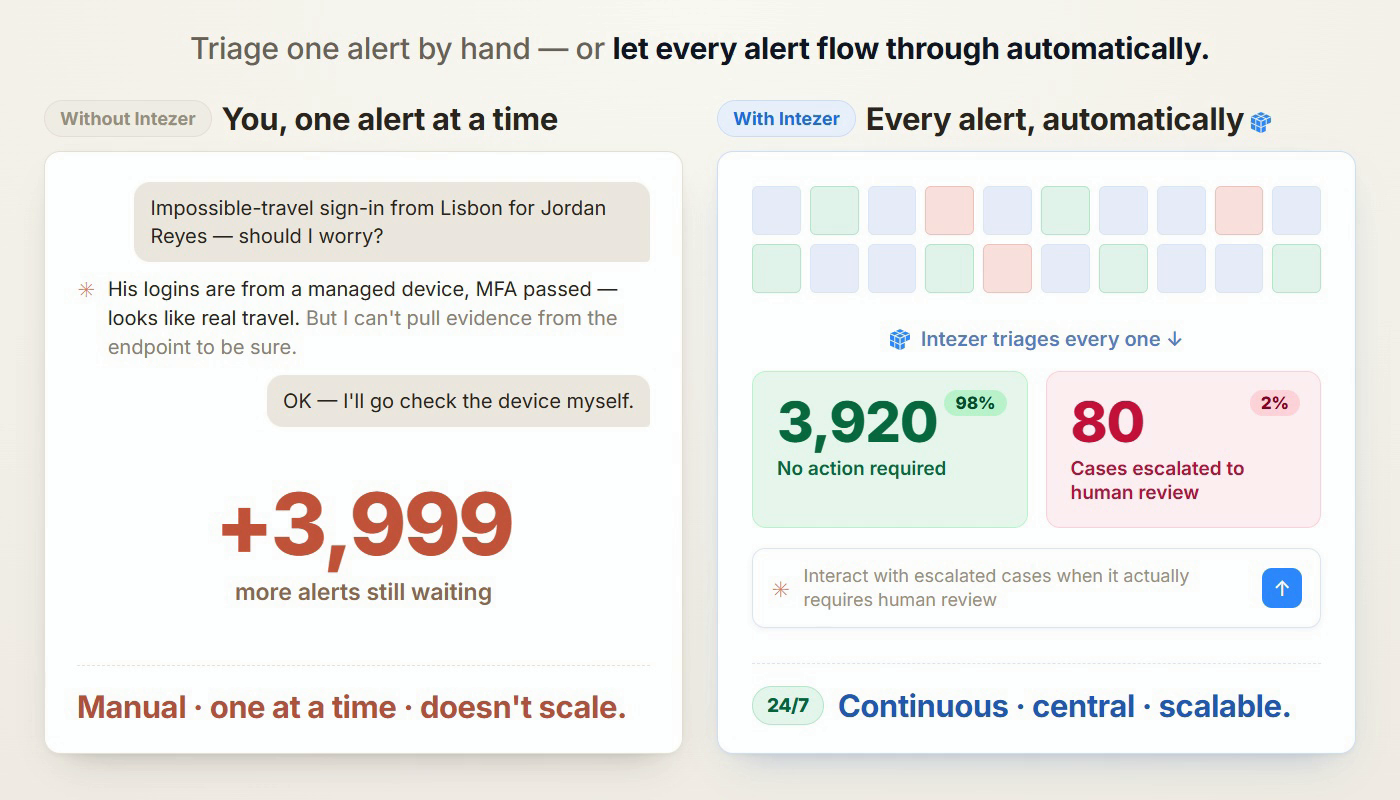
The same question, with and without Intezer

Triage before and after Intezer

Same alert, two ways to handle it. On the left, Claude on its own takes the impossible-travel sign-in and works it by hand. It reasons well and gets close — managed device, MFA passed, probably real travel — but it can’t collect evidence from the endpoint to confirm, so the last step falls back to a human checking the laptop. And that’s one alert; almost 4,000 more are still waiting behind it. One analyst, one alert at a time, with no way to run it across the whole team. On the right, the same alert inside the AI SOC: Intezer triages every alert around the clock, closes the ~98% that need no action, and escalates only the ~2% that genuinely need a person. Claude is where you pick those up so you can stop grinding the queue and start supervising the few cases that actually need you.

Most of the org knowledge an investigation needs is already centralized in Intezer. That’s the whole point of the platform. But some context only ever lives with you: a procurement thread in someone’s inbox, a Slack message from three weeks ago, a calendar invite. With Intezer connected on one side and your IT and communication stack on the other, your AI workspace can cross-reference both in a single investigation.

Why not plug Claude into all security tools directly?

You could also wire your AI client straight into each security tool yourself. Most of them ship an MCP these days. Two things make that a worse deal than it looks. First, the integration work is now yours: stitching a dozen connectors together, learning each product’s query quirks, and getting back a pile of disconnected results instead of one correlated picture. Second, raw tool access still isn’t investigation. With every EDR, SIEM, and intel feed wired in, the model can read your data, but it can’t collect evidence off an endpoint, run memory forensics, or weigh conflicting signals into a verdict it will actually stand behind, which is exactly where Claude stalls on the left in above image.

Intezer already did both jobs. One connector hands the model a SOC’s worth of normalized cases, verdicts backed by real forensic evidence, and cross-tool correlation. An AI platform does its best work standing on a real foundation of security knowledge, not on a dozen raw feeds it has to assemble itself.

Investigate and close the cases Intezer escalates to you

This is where analyst hours should go, so it’s where the MCP goes deepest. Whatever the alert type, the shape is the same: pull the case, build on everything the autonomous triage already found, cross-reference your other systems, decide interactively with you, and close with evidence.

And “pull the case” carries real weight here. A case from Intezer is not a bare ticket. It arrives with everything triage already did: the evidence it collected, the SIEM and EDR queries it ran, the forensic analysis of each artifact, the verdicts it reached. You’re not starting from a blank page; you’re picking up a deep investigation and taking it the last mile.

“Pick up the oldest escalated open case and let’s investigate it together.”

The clip above takes an impossible-travel alert. The MCP brings the full login history including every IP and geo, and who else touched the same address as well as your AI workspace cross-references calendar and Slack for travel context. When the evidence still isn’t conclusive, it can ask the user directly and close on their answer, so the one human check that actually mattered takes seconds instead of becoming a follow-up ticket.

Make tomorrow’s autonomous triage smarter

If a case should never have reached you, closing it is half the job. The other half is making sure it never reaches you again.

“We keep getting this exact false positive. Write a tuning rule so it never escalates again, then retriage the case.”

Claude inspects the alert’s triage indicators, drafts a narrowly scoped tuning rule, and tests the pattern against the real alert object before proposing anything. It checks whether an existing rule should be extended instead of creating a near-duplicate. It asks the question every detection engineer should ask: could an attacker hide inside this rule? Then it pushes the rule to Intezer for your approval and retriages the affected alerts so the fix applies immediately.

Tuning runs both directions, too. The same mechanism can tell the autonomous triage to always escalate a pattern it can’t yet call malicious with confidence, so the genuinely ambiguous cases land in front of a human by design, not by luck.

This is where the two halves of the AI SOC meet. Every rule your AI workspace writes makes the autonomous half smarter, which means fewer escalations next month, which means the time you spend supervising keeps shrinking. The system compounds.

From case to incident report in one prompt

When a case turns into a real incident, the hours after containment go to reconstruction: which alerts were related, which machines were touched, what happened first, and what to tell leadership.

“Write an incident report for the latest case we worked on — timeline, affected assets, and an exec summary I can send to the CISO.”

Your AI workspace pulls the case and its full activity trail from Intezer, expands across the users, devices, and IPs involved, and rebuilds the timeline from the forensic evidence already on file. Then it writes the report with an executive summary up top, technical detail below, in your template if you have one, and finally exports it to a clean, brand-styled PDF you can send as-is. The data was always in Intezer; the report was just assembly. Now assembly is one prompt.

Threat hunting: start from a lead, not an alert

Not every investigation starts in the queue. Sometimes it starts with your CISO forwarding an article about a campaign that’s hitting your industry.

“Here’s a writeup of a new campaign [link]. Check whether any of these IOCs appear anywhere in our environment, and analyze anything you find.”

Your AI workspace extracts the indicators and techniques from the writeup, sweeps your environment through Intezer’s SIEM and EDR query tools, and returns the matching assets, alerts, and artifacts for analysis. When you find something worth a closer look, you can fire deep forensics to go one step further with your hunt.

How it works

How Intezer AI SOC works with Claude and other AI platforms

The Intezer MCP server is hosted by us. You authorize over OAuth from any MCP client: Claude (Desktop, Code, or claude.ai), ChatGPT, Codex, Cursor, or anything else that speaks the protocol.

Under the hood it exposes 66 tools covering the full case lifecycle: search and fetch cases and alerts, file and URL analysis, live queries against more than a dozen SIEM and EDR products in their native query languages (KQL, SPL, XQL, SDL, and the rest, with per-vendor syntax guides built in so the model gets them right), tuning rules and AI instructions, retriage, and case editing.

This architecture is what makes the two halves described above work as one system: the autonomous half clears work off your plate, while the assistive half accelerates the tasks where you still want to stay in the loop.

Getting started

  1. If you’re already an Intezer customer, an Intezer admin creates an MCP OAuth application under Account Settings → MCP OAuth Applications.
  2. Add Intezer as a custom connector in your AI client such as Claude, ChatGPT, or any MCP client. Point it at the hosted server, and authorize with your own Intezer login over OAuth.
  3. Open with one prompt: ask it to pick up your oldest open escalation.

The autonomous half investigates everything, around the clock, so your team only sees what matters. The assistive half makes the time you spend on what matters dramatically shorter. One system of record and detection logic underneath both: your cases, your verdicts, your tuning rules, your institutional memory, working for you whether the investigation runs inside Intezer or inside your AI workspace.

AI executes. Humans supervise. And now the supervising got a lot faster too.

If you’re not an Intezer customer yet, book a demo and we’ll show you both halves at once: autonomous triage working every alert around the clock, and a co-pilot that helps your analysts close the escalations that do reach them 10x faster.

The post The other half of the AI SOC: Intezer, now inside your AI workspace appeared first on Intezer.

How AI and Evasion Demand a Radical Shift in Network Threat Prevention

The Future of Threat Defense Resides at the IP Layer

For years, network security operated on a relatively predictable premise: inspect traffic, identify malicious content, and block it. Because deep content inspection created a seemingly robust defense in depth, relatively static legacy approaches—like reliance on threat intelligence feeds—were allowed to simply persist in the background.

The weaponization of agentic AI and highly evasive techniques has fundamentally shattered that model. Attackers are no longer just iterating on old threats. They are launching attacks at staggering velocity, completely outpacing threat feeds, and employing evasion tactics that actively starve legacy prevention solutions of the content they rely on to inspect.

Our new research report from Unit 42, Attackers Are Evading Threat Prevention at the Internet Edge, reveals how adversaries are actively exploiting the contextual vacuum at the IP layer to bypass standard security controls. For security leaders, understanding this shift is no longer optional. As the nature of the threat fundamentally changes, our strategic approach to network security must definitively change with it.

The AI-Accelerated, Evasive Attack Lifecycle

To understand why legacy defenses are failing, we must look at how adversaries are accelerating and obfuscating every stage of the attack lifecycle. As these threats progress, the commonly used network indicators we have long relied upon are vanishing, collapsing traditional defenses and leaving defenders with little to act on.

Powered by frontier AI, adversaries now automate reconnaissance and exploitation at huge scale and speed, while using anonymizers to mask their intent. Once an intrusion is launched, orchestration shifts to highly evasive command and control (C2). Attackers hide communications using advanced encryption and AI-built malware-less techniques. They’re also bypassing traditional web and DNS inspection entirely by routing traffic directly to IP addresses—a tactic Unit 42 found in 23% of modern malware

Ultimately, the takeaway is clear: network threat prevention can no longer rely solely on detecting malicious payloads. As AI-driven attacks continue to minimize their footprint, security strategies must augment content inspection with real-time IP layer monitoring to left-shift threat detection and counter these rapid, machine-speed threats at the network foundation.

Existing Approaches Aren’t Working

Where content-based detection falls short, many security vendors and organizations still rely on IP threat intelligence feeds to pick up the slack in an attempt to filter out malicious connections on the network layer. However, after years of operating under this model, the results are in—the traditional feed is showing its age.

Attackers have long relied on proxies, anonymizers, residential routers and public cloud providers as a tactic to evade detection. However, agentic AI morphs this process, enabling rapid infrastructure rotation and stealth at an unprecedented scale. As this autonomous evasion accelerates, experienced network defenders continue to run into the well-known limitations of classic IP blocklists:

  • Too slow to keep pace: Unit 42 found an average 20-day lag time before new threats hit popular feeds. Because agentic AI enables adversaries to autonomously rotate proxy IPs in hours, these lists are obsolete at the moment of delivery.
  • Fundamentally incomplete: IP feeds are unable to see a massive portion of the modern attack surface. Unit 42 research indicates that 52% of malicious IPs used for direct-to-IP connections are completely absent from these lists.
  • Unactionable on shared infrastructure: Even known threats are often impossible to block. The Unit 42 team reports that 37% of direct-to-IP traffic uses reputable CDNs and cloud providers. IP feeds cannot distinguish malicious connections from legitimate ones, making blocking too risky for business continuity.
  • A management nightmare: Among the security teams that Unit 42 polled, 30% indicate resource-intensive vetting and false-positive triage as their top pain point. To avoid breaking legitimate traffic, feeds are frequently relegated to an alert-only mode, defeating the entire purpose of prevention.

If modern and agentic AI-enabled attacks can outrun traditional network payload-based detections, we need a new weapon in the network defender’s arsenal. We can no longer depend on yesterday’s IP feeds to secure such an extremely agile threat environment.

The Blueprint for Modernizing the Internet Edge

To outpace the impact of agentic AI and advanced evasion on network threat prevention, security leaders must redefine their defense strategy and shift-left to track the attacker infrastructure itself—monitoring the exact IP layer locations where adversaries build and control their campaigns. Deep content inspection remains essential, but securing the modern edge requires establishing the context and intent of a connection before a session is established.

To achieve this goal, organizations must move beyond the limitations of static defense and adopt a modern security blueprint:

  • Proactive protection against attacker infrastructure: While high-quality threat feeds remain essential for SOC investigations and incident response, relying on them for frontline, real-time prevention creates major blind spots. Instead, security teams must use real-world, global telemetry to proactively identify and block connections to attacker-controlled hosts before requesting a URL or file.
  • Zero trust principles applied to the network layer: An IP address without a negative reputation does not equal a safe connection. Continuous verification requires extending zero trust down to the network foundation. It validates the real-time behavior and intent of every single session to ensure attackers cannot hide in the contextual vacuum of the IP layer.  
  • Reducing the attack surface with rich contextual attributes: Traditional IP blocking is like a blunt instrument that creates unacceptable false positives and alert fatigue. To modernize the edge, security teams need deep, attribute-based visibility across the entire Internet address space to reduce noise and replace legacy IP feeds entirely.  

By moving away from point-in-time assumptions and embracing real-time, inline protection, security leaders can reclaim the advantage at the network foundation.

To see how these evasion tactics operate in the wild, read the latest Unit 42 report, Attackers Are Evading Threat Prevention at the Internet Edge. You’ll find this report valuable in understanding the systemic gaps in legacy risk models and learning why continuous verification must be our new mandate.

The post How AI and Evasion Demand a Radical Shift in Network Threat Prevention appeared first on Palo Alto Networks Blog.

Generalist AI for your SOC: When and where to use it

5 May 2026 at 20:46

Many security leader are asking the same question right now. We already pay for Microsoft Copilot, ChatGPT Enterprise, or Claude. Why buy anything else?

It is a fair question. These are genuinely impressive platforms. And the honest answer is that they can help with some things. Just not the things that matter most for most SOC teams.

This post is a practical guide to where generalist AI earns its place in a SOC and where it runs out of road.

Where generalist AI platforms actually add value

Let’s be direct about what generalist AI platforms do well in a security context.

They are good at drafting, incident summaries, policy documentation, communication templates, and post-mortems. If an analyst needs to translate a technical finding into plain language for an executive, a general-purpose LLM can accelerate that substantially.

They are useful for on-demand research. Asking a question about a CVE, looking up MITRE ATT&CK techniques, or getting a quick primer on an unfamiliar attack class. These are real productivity wins.

They can assist with simple scripting and query construction. Writing a KQL query for a Sentinel rule, generating a Python snippet to parse a log format. Useful, time-saving work.

The common thread is that these are assistance tasks. A human still needs to initiate the process while the AI is a capable co-pilot. And for these use cases, a general-purpose tool is perfectly appropriate.

Where generalist AI runs out of road

The problem is that none of those use cases address the actual constraint facing most SOC teams.

Security teams are not failing because analysts lack knowledge or work too slowly. They are constrained by investigative capacity. Alert volumes are rising. Environments are growing. Attacks are moving faster. And the operating model still assumes humans will triage and investigate the majority of what comes in.

When that assumption breaks down, investigation becomes selective. High-severity alerts get attention. Medium alerts accumulate. Low-severity alerts are deferred or auto-closed. And the uncomfortable truth is that real attacks frequently begin as weak signals. Credential misuse, living-off-the-land techniques, early-stage lateral movement. They rarely present as critical alerts. They appear ordinary until someone actually investigates them.

Generic AI does not fix this. Here is why.

Generalist AI is built for breadth, not depth

ChatGPT and Microsoft Copilot are built for general-purpose text generation. Forensic investigation of a suspicious process execution chain, or a cloud misconfiguration alert at 3am, requires domain-specific knowledge and structured reasoning those platforms were not designed to provide.

Generalist AI assists but does not execute 

Even with a great prompt, a general-purpose AI is accelerating an analyst’s workflow, not replacing the need for one. The investigation still depends on human capacity. And human capacity does not scale as fast as the alert surface grows.

Generalist AI KPIs are increased token usage

Microsoft’s KPI, for example, is token usage. More engagement equals more revenue, regardless of whether your security outcomes improved. That is not a subtle difference. It shapes every product decision, every definition of success. And this can result in very high costs for SOC teams heavily relying on these platforms. This is in stark contrast to Intezer AI SOC which selectively uses LLMs while primarily executing forensic investigations with highly scalable tools and processes. 

Read more about how Intezer Forensic AI SOC follows Anthropic’s best practices.

A practical AI decision framework

Use generalist AI when:

  • The task requires drafting or synthesizing text and security context is not critical to the output
  • An analyst is researching something unfamiliar and needs a starting point
  • The work is advisory and a human will validate and act on every output
  • Speed of completion matters more than forensic accuracy

Consider purpose-built AI when:

  • You need investigation to happen without an analyst driving every step
  • Alert volume has outpaced the team’s capacity to investigate manually
  • Medium and low-severity alerts are going uninvestigated because there simply is not time
  • You need verdicts accurate enough to act on, not just suggestions to review

The line between these two categories comes down to one question. Do you need AI assistance, or do you need AI execution?

What autonomous execution actually requires

This distinction matters because it shapes what you need from a platform.

Assistance is achievable with a good LLM and a capable prompt. Execution requires something harder: accuracy and forensic depth at investigation time.

General-purpose AI tools and many first-generation AI SOC products rely primarily on LLM analysis and SIEM queries. That is not enough to produce verdicts you can trust without a human checking every one.

Intezer AI SOC is built for the execution side of that line. Automated evidence collection, threat intelligence correlation, network forensics, endpoint forensics, and reverse engineering. That additional depth is what generates the high-confidence verdicts that allow organizations to trust the outcome without a human reviewing every decision.

Below a certain threshold of accuracy and depth, AI assists humans. Above it, organizations can safely offload Tier 1 and Tier 2 work entirely. The threshold is not crossed through breadth. It is crossed through domain specialization and forensic rigor.

Intezer’s investigations produce evidence-based verdicts with 98% accuracy. Up to 2% of alerts are escalated as real incidents while the rest are resolved automatically. That is not a productivity improvement. That is a fundamentally different operating model.

The closed loop of triage and detection engineering

There is one more dimension where general-purpose tools fall short and that is detection engineering.

When a generic AI tool helps an analyst triage an alert, that interaction is largely isolated. The outcome does not feed back into your SIEM rules. It does not surface coverage gaps. It does not help you get better at detecting the same class of threat next time.

Intezer’s investigation outcomes feed directly into detection engineering at the source, continuously identifying broken or noisy rules, flagging coverage gaps against the MITRE ATT&CK framework, and generating deployment-ready detection rules informed by real investigation results. The system improves with every alert it processes. Detection gets better based on evidence, not assumptions.

That closed loop is the difference between a productivity tool and an operating model.

Is a single generalist interface with multiple plugins the answer?

There is also an important architectural point worth making. Generalist AI platforms are increasingly effective at consolidating workflows into a single interface, and in theory, you could extend them into security operations through plugins and MCPs. The building blocks exist.


But in practice, stitching together the specialist capabilities needed for real alert triage such as forensic evidence collection, threat intelligence correlation, reverse engineering, network analysis, etc.  means sourcing, integrating, and maintaining a patchwork of plugins across multiple providers. Each one has its own update cycle, its own failure modes, and its own gaps. The integration burden falls on your team, and keeping it all working reliably over time is its own operational overhead.


At some point the question becomes whether the effort of assembling and maintaining a DIY investigation pipeline inside a generalist platform is worth it — or whether it makes more sense to use a purpose-built system where those capabilities are already unified, tested, and working together out of the box.

The bottom line

Generalist AI platforms have a real role to play in the SOC. Use them for drafting, research, and analyst-driven assistance tasks. It is good at those things and it is likely already paid for.

But do not confuse that with solving the capacity problem. When investigation still depends on human bandwidth, the alert backlog does not disappear. It just accumulates more slowly.

The future SOC is one where AI executes investigation and humans supervise outcomes. Getting there requires technology purpose-built for that job.

Learn more about Intezer AI SOC.

The post Generalist AI for your SOC: When and where to use it appeared first on Intezer.

AI SOC Live at Nasdaq: Real conversation about modern security operations

20 April 2026 at 18:58

The SOC is broken. Not because of a lack of talent or effort, but because human capacity does not scale. Alert volumes keep rising. Attacks move faster. And the operating model still assumes analysts will investigate most of what comes in, which means the vast majority of alerts never get looked at.

Our AI SOC Report 2026, based on analysis of 25 million alerts across our global customer base, put a sharp number on the problem. Over 60% of alerts are never reviewed by SOC and MDR teams. Nearly 1% of all incidents trace back to alerts classified at the lowest severity levels, signals most teams never touch. With average enterprises generating around 450,000 alerts annually, that equates to roughly one real threat per week hiding in the backlog, undetected.

That is not a tool problem. It is an operating model problem.

On April 27, we are bringing together the security leaders who are doing something about it.

Get your invite to AI SOC Live at the NASDAQ today.

What is AI SOC Live

AI SOC Live is a monthly, online event where security leaders discuss the latest issues facing the cyber industry. This month, AI SOC Live will be a full-day, invitation-only event at the Nasdaq in New York City. It is designed for CISOs, security directors, SOC managers, and MSSPs who are not just watching AI transform security operations from the sidelines, but are in the middle of it, making decisions about how their teams operate, what they invest in, and where the humans actually need to be.

This event is a full day of sessions, panels, and conversations built around the people, processes, and technology required to run a world-class SOC in 2026.

Who you will hear from at AI SOC Live Nasdaq

The speaker lineup reflects how seriously we have curated this event.

Itai Tevet, CEO and Founder of Intezer, will open the day with a session on the new SOC operating model, what it means when AI executes investigation and humans supervise outcomes, and why that shift changes security results structurally, not incrementally.

Alon Cohen, Founder and Executive Chairman of both Intezer and CyberArk, will speak to the broader impact of AI on security, drawing on decades of experience building foundational security companies.

Pavi Ramamurthy, Global CISO & CIO at Blackhawk Network as well as a founding member of the Professional Association of CISOs, and a venture advisor at YL Ventures. She will be speaking about the role of humans in the SOC.

David Spark, Founder and Executive Producer of the CISO Series Podcast, will host a live recording of the show featuring Nick Vigier, CISO at Oscar Health, digging into AI SOC beyond the hype.

You will also hear from CISOs at WCG Clinical, and ION Group, alongside practitioners from Realm Security, Legato Security, Upwind Security, and Monad. Sessions cover cloud security for the AI era, the blueprint for AI SOC success, and what every CISO needs to manage not only their security, but their executive board as well. 

And Mitchem Boles, Field CISO at Intezer, and Marcus Mingo, Detection Engineer at Intezer, will be there all day, available for the kind of real, technical conversations that rarely happen at larger conferences. See the full list of speakers.

What the day looks like

The agenda moves quickly and stays practical.

The morning opens with sessions on the new operating model and AI’s impact on security, followed by a CISO panel on the role of humans in the SOC and a session from Realm Security on building a data-first AI SOC. After a working lunch with interactive product demos, the afternoon covers cloud security, a live CISO Series recording, and a panel on advancing SOC outcomes at the C-suite level.

The day closes with a photo opportunity in front of the iconic Nasdaq billboard, followed by a cocktail reception overlooking New York City.

Attendees also earn CPE credits through the event’s partnership with ISC2.

Why this conversation matters now

The 2026 data makes the stakes clear. Our report found that more than half of confirmed compromised endpoints had been marked as “mitigated” by the EDR vendor, meaning teams believed those machines were clean when they were not. 

The gap between what organizations believe is covered and what is actually investigated is where real risk lives. Closing that gap requires a different operating model, one where AI investigates every alert, including the low-severity signals that human teams deprioritize, and humans supervise outcomes instead of grinding through queues.

That is the conversation happening at AI SOC Live.

Who should attend

This event is designed for CISOs, VPs and Directors of Information Security, SOC managers, and MSSPs from large enterprises who are responsible for security strategy, risk decisions, and operational outcomes. Whether you are evaluating AI for the first time or scaling capabilities you already have deployed, the sessions and conversations are built for leaders making real decisions, not attendees collecting swag.

Space is limited and invitations are by request.

Request your invitation at intezer.com/ai-soc-live-nasdaq


The post AI SOC Live at Nasdaq: Real conversation about modern security operations appeared first on Intezer.

Introducing the Landing Zone Accelerator on AWS Universal Configuration and LZA Compliance Workbook

4 April 2026 at 23:35

November 20, 2025: Original publication date of this post. This post has been updated to reference the most recent version of the LZA Compliance Workbook published to AWS Artifact in March 2026.


We’re pleased to announce the availability of the latest sample security baseline from Landing Zone Accelerator on AWS (LZA)—the Universal Configuration. Developed from years of field experience with highly regulated customers including governments across the world, and in consultation with AWS Partners and industry experts, the Universal Configuration was built to help you implement security and compliance at scale for on your regulated workloads. By setting a high bar with the latest AWS security best practices, the Universal Configuration can help address technical control requirements from compliance frameworks across different geographic regions and industry verticals. The Universal Configuration’s multi-account security architecture provides a foundation to host your diverse workload requirements today along with providing the ability to explore the generative AI and agentic AI solutions that will shape your organization in the future. It can also replace months of complex planning and design by deploying a comprehensive security and compliance-driven environment based on AWS Well-Architected principles in a matter of hours.

As organizations grow, they typically pursue or must adhere to new security compliance certifications. LZA and the Universal Configuration help organizations of all sizes and phases in their security and compliance journey. The speed of deployment, step-by-step documentation, and compliance resources can reduce traditional assessment and authorization timelines by months and result in more predictable and successful audit outcomes. This enables more freedom to invest resources to grow the business instead of choosing between security and compliance tradeoffs.

The Universal Configuration helps organizations:

  • Automate the deployment of a secure multi-account AWS environment
    • Foundational security controls based on AWS Well-Architected best practices
    • Apply consistent and predictable security controls post-deployment
    • Enable and integrate with native AWS security, identity, and compliance services
  • Implement controls across system layers
    • Organization-wide security architecture
    • Perimeter and resource-specific preventative, proactive, and detective controls
    • Support for multi-AWS Region resilience, disaster recovery, and active failover
  • Establish a foundation for security and compliance readiness
    • Built-in AWS security best practices and technical implementation statements
    • Map LZA capabilities across global and industry-specific compliance frameworks
    • Deploy hundreds of controls hours instead of months

The LZA Compliance Workbook

The LZA engine has been a trusted tool for quickly deploying secure multi-account AWS environments for over 4 years. It is also cost effective because you pay only for the AWS services used to operate your environment. The Universal Configuration is the first sample configuration accompanied by the LZA Compliance Workbook available on AWS Artifact. It is a first-of-its-kind resource with detailed control mappings showing how the Universal Configuration can support different industries and regions, helping you address requirements from frameworks listed below.

  • NIST 800-53 Rev5
  • C5: 2020 (Germany)
  • HIPAA
  • SOC 2
  • CMMC Level 2
  • ISO/IEC 27001 Annex A
  • US Dept of War CCI
  • NERC-CIP
  • NIST 800-171
  • NATO D-32 Appendix B
  • NIST CSF 2.0
  • CIS Critical Controls v8

The LZA Compliance Workbook is regularly maintained to reflect the latest Universal Configuration baseline and will include additional compliance mappings in future releases. The workbook contains detailed security configuration descriptions based on the Universal Configuration deployment files, along with control requirement mappings and implementation statements that translate its security capabilities into a compliance-friendly format. By combining AWS security best practices with global compliance expertise, the Universal Configuration delivers predicable security outcomes while also helping you meet regional and industry requirements.

Getting started

To get started with the Landing Zone Accelerator on AWS Universal Configuration, the LZA Implementation Guide walks you through the steps, use cases, and considerations when deploying with LZA. You can download the LZA Compliance Workbook from AWS Artifact today and configure notifications to receive emails when future versions are released. You can view the deployment files and additional technical implementation guidance on the GitHub Universal Configuration sample and documentation page. Additionally, visit the AWS Partner Network (APN) for help with audit and advisory initiatives, cloud migrations, deploying the LZA Universal Configuration, and other services. You can visit the AWS Partner Finder tool and search by solution for Landing Zone Accelerator for the latest LZA Partner offerings.

If you have feedback about this post, submit comments in the Comments section below.

Kevin Donohue

Kevin Donohue

Kevin is a Senior Security Compliance Engineer at AWS, where he builds solutions and resources to help AWS customers achieve their security and compliance goals. Prior to joining the Landing Zone Accelerator team in AWS Professional Services in 2024, Kevin began his tenure with AWS Security in 2019 specializing in FedRAMP compliance and the shared responsibility model.

Christine Screnci

Christine Screnci

Christine is a Principal Technical Product Manager at AWS, where she specializes in developing and scaling enterprise-level solutions. Christine began her tenure with AWS in 2016 working with Worldwide Public Sector customers to improve the migration and modernization journey through globally scaled solutions. She is passionate about hypothesis-driven development and experimentation to improve customer experiences with AWS technologies.

Bhavish Khatri

Bhavish is a Senior Delivery Engineer at AWS, where he builds enterprise-scale solutions to help large organizations achieve their compliance goals. Bhavish started at AWS in 2018, specializing in multi-account AWS deployments and focusing on LZA and the Universal Configuration solution. He helps organizations build secure, scalable cloud environments that align with global compliance frameworks and regulatory requirements across diverse sectors.

2025 ISO and CSA STAR certificates are now available with one additional service and one new region

5 March 2026 at 01:18

Amazon Web Services (AWS) successfully completed the annual recertification audit with no findings for ISO 9001:2015, 27001:2022, 27017:2015, 27018:2019, 27701:2019, 20000-1:2018, 22301:2019, and Cloud Security Alliance (CSA) STAR Cloud Controls Matrix (CCM) v4.0. The objective of the audit was to enable AWS to expand their ISO and CSA STAR certifications to include one new AWS Region and one new AWS service to the scope. The ISO standards cover areas including quality management, information security, cloud security, privacy protection, service management, and business continuity. The certifications demonstrate the commitment of AWS to maintaining robust security controls and protecting customer data across our services.

As part of this recertification audit, one new Region [Asia Pacific (Taipei)] and one new service (AWS Deadline Cloud) were added into the scope since the last certification issued November 25, 2025.

For a full list of AWS services that are certified under ISO and CSA Star, see the AWS
ISO and CSA STAR Certified page.
Customers can also access the certifications in the AWS Management Console through AWS Artifact.

If you have feedback about this post, submit comments in the Comments section below.

Chinmaee Parulekar

Chinmaee Parulekar

Chinmaee is a Compliance Program Manager at AWS. She has 6 years of experience in information security. Chinmaee holds a Master of Science degree in Management Information Systems and professional certifications such as CISA, HITRUST CCSF practitioner.

Atul Patil

Atulsing Patil
Atulsing is a Compliance Program Manager at AWS. He has 27 years of consulting experience in information technology and information security management. Atulsing holds a Master of Science in Electronics degree and professional certifications such as CCSP, CISSP, CISM, CDPSE, ISO 27001 Lead Auditor, HITRUST CSF, ISO 42001 Lead Auditor, Archer Certified Consultant, and AWS CCP.

Alert fatigue is costing you: Why your SOC misses 1% of real threats

3 February 2026 at 15:04

Introducing the 2026 Intezer AI SOC Report for CISOs

For years, security leaders have lived with an uncomfortable truth. It has been to date, simply impossible to investigate every alert. As alert volumes exploded and teams failed to scale, SOCs, whether in-house or outsourced, normalized “acceptable risk” with the deprioritization of low-severity and informational alerts.

Our latest research shows that this approach is no longer defensible.

Intezer has just released the 2026 AI SOC Report for CISOs, based on the forensic analysis of more than 25 million security alerts across live enterprise environments. The findings reveal a critical disconnect between how security teams prioritize alerts and where real threats actually originate, and the cost of that gap is far higher than most organizations realize .

Why “acceptable risk” is no longer acceptable 

Across endpoint, cloud, identity, network, and phishing telemetry, Intezer found that nearly 1% of confirmed incidents originated from alerts initially labeled as low-severity or informational. On endpoints, that figure climbed to nearly 2%.

At enterprise scale, that percentage is not noise.

For a typical organization generating roughly 450,000 alerts per year, this translates to ~50 real threats annually, about one per week, never investigated by a SOC or MDR team. These are not theoretical risks. They are real compromises hiding in plain sight, dismissed not because they were benign, but because teams lacked the capacity to look.

What the data revealed across the attack surface

Because Intezer AI SOC investigates 100% of alerts using forensic-grade analysis, the report exposes how attackers actually operate once you remove triage bias from the equation.

Endpoint security is more fragile than reported

More than half of endpoint alerts were not automatically mitigated by endpoint protection tools. Of those, nearly 9% were confirmed malicious. Even more concerning, 1.6% of endpoints undergoing live forensic scans were still actively compromised despite being reported as “mitigated” by EDR tools.

See the full endpoint threat data → Download the 2026 AI SOC Report

Low-severity does not mean low-risk

Within endpoint alerts alone, 1.9% of low-severity and informational alerts were real incidents, the exact alerts most SOCs never review.

Attackers favor stealth over noise

Cloud telemetry was dominated by defense evasion and persistence techniques, reflecting a shift toward long-term access, token abuse, and misuse of legitimate services rather than overt exploitation.

Phishing has moved into trusted platforms and browsers

Fewer than 6% of malicious phishing emails contained attachments. Most relied on links, language, and abuse of legitimate services such as cloud file sharing, code sandboxes, CAPTCHA mechanisms, where traditional controls have limited visibility.

Cloud misconfigurations persist as silent risk multipliers

Most cloud posture findings stemmed from legacy or default configurations, especially in Amazon S3, including missing encryption, weak access controls, and lack of logging—issues often classified as “low severity,” yet repeatedly exploited once attackers gain a foothold.

To read the full report and all the findings, download the CISOs guide to AI SOC 2026 here. 

Why traditional SOCs fail: capacity, fragmentation and judging alerts by their severity

Modern SOC failures are rarely the result of a single broken tool or negligent team. They are the outcome of structural tradeoffs that every traditional SOC—internal or MDR—has been forced to make.

Capacity is the first constraint.
Human analysts do not scale linearly with alert volume. As telemetry expands across endpoint, cloud, identity, network, and SaaS, SOCs hit a hard ceiling. The only way to cope is aggressive triage: close most alerts automatically, investigate only what looks “important,” and hope severity labels align with reality. The 2026 AI SOC Report shows that this assumption is false at scale.

Tool fragmentation compounds the problem.
Most SOC stacks are collections of siloed detections, EDR, SIEM, identity, cloud posture, email, each optimized for a narrow signal. Severity is assigned locally, without cross-surface context or forensic validation. As a result, alerts are scored based on abstract rules, not evidence of compromise. When SOCs trust these labels blindly, they inherit the tools’ blind spots.

Process tradeoffs lock risk in place.
Once triage rules are defined, they become institutionalized. Low-severity alerts are ignored by design. MDR providers codify this into SLAs. Internal SOCs bake it into runbooks. Crucially, there is no closed-loop feedback: missed threats do not automatically improve detections, because they were never investigated in the first place.

The outcome is not an occasional failure. It is systematic, repeatable risk, embedded directly into how SOCs operate.

Real-world examples of missed threats hiding in plain sight

The data in the 2026 AI SOC Report makes clear that missed threats are not exotic edge cases. They are ordinary attacks progressing quietly through environments because no one looked.

Endpoints marked “mitigated” but still compromised
In over 1.6% of live forensic endpoint scans, Intezer found active malicious code running in memory even though the EDR had already reported the threat as resolved. These cases included stealers, RATs, and post-exploitation frameworks, often originating from low-severity alerts that never triggered deeper inspection. Without memory-level forensics, these compromises would have remained invisible.

Phishing hosted on trusted platforms
Attackers increasingly host phishing pages on legitimate developer platforms like Vercel and CodePen, or abuse trusted cloud services such as OneDrive and PayPal. The parent domains appear reputable, so alerts are downgraded or ignored. Yet behind them are live credential-harvesting pages that bypass email gateways and browser-based defenses alike.

Cloud misconfigurations as delayed breach accelerators
Many cloud posture findings such as unencrypted S3 buckets, missing access logs and permissive cross-account policies rarely trigger action. But once an attacker gains any foothold, these long-standing misconfigurations dramatically accelerate lateral movement, persistence, and data exposure.

In every case, the failure was not detection. The signal existed. The failure was investigation.

How attackers deliberately exploit SOC blind spots

Attackers understand SOC economics better than most defenders.

They know which alerts generate fatigue.
They know which detections are noisy.
They know which categories are deprioritized by default.

As a result, modern attackers design their campaigns to blend into the backlog, not trigger alarms.

Stealth over speed
Cloud intrusions favor defense evasion, persistence, and token abuse over loud exploitation. These behaviors generate alerts, but rarely high-severity ones. The report shows cloud telemetry dominated by exactly these tactics, indicating attackers are optimizing for long-term access rather than immediate impact.

Living off trusted infrastructure
Phishing campaigns increasingly abuse legitimate brands, file-sharing services, CAPTCHA frameworks, and developer platforms. These environments inherit trust by default, allowing attackers to operate under severity thresholds that SOCs routinely ignore.

Multi-stage loaders and memory-only execution
On endpoints, attackers rely on layered loaders, in-memory payloads, and obfuscation techniques that evade static detections. Initial alerts may look benign or incomplete. Without forensic follow-through, SOCs miss the actual compromise entirely.

Attackers are not evading detection systems alone, rather they are exploiting SOC decision-making models.

What this means for your SOC operations

For CISOs and SOC leaders, the implication is stark:
Risk is no longer defined by what you detect, but by what you choose not to investigate.

If your SOC:

  • Ignores low-severity alerts by default
  • Relies on severity labels without forensic validation
  • Limits investigations based on human capacity
  • Operates without a feedback loop between outcomes and detections

Then missed threats are not anomalies, they are guaranteed.

The organizations that will reduce risk in 2026 are not adding more dashboards or rewriting triage rules. They are adopting operating models where investigation is no longer a scarce resource.

This is why AI-driven, forensic-grade SOC platforms fundamentally change the equation. When every alert is investigated:

  • Severity becomes evidence-based, not assumed
  • Detection quality improves through real-world validation
  • Attackers lose the ability to hide in “acceptable risk”
  • SOC teams regain control without scaling headcount

This is the shift behind the Intezer AI SOC model and why the concept of acceptable risk must be redefined for the modern threat landscape.

This all changes when you can investigate everything

The data in the 2026 AI SOC Report points to a different reality, one where AI-driven forensic analysis removes investigation capacity as a constraint.

When every alert is investigated:

  • “Low severity” stops being a proxy for “safe”
  • Detection quality improves through real-world validation
  • Missed threats drop from dozens per year to near zero
  • Escalations fall below 2%, without sacrificing coverage
  • Risk tolerance is defined by evidence, not exhaustion

This is the operating model behind Intezer AI SOC, powered by ForensicAI™ and it is why the definition of acceptable risk must be reset.

Download the report and join the discussion

The 2026 AI SOC Report for CISOs is grounded in:

  • 25 million alerts analyzed
  • 10 million monitored endpoints and identities
  • 82,000 forensic endpoint investigations, including live memory scans
  • Telemetry from 7 million IP addresses, 3 million domains and URLs, and over 550,000 phishing emails

All data was aggregated and anonymized across Intezer’s global enterprise customer base.

👉 Download the full report to explore the findings in detail, and
👉 Join Intezer’s research team on Wednesday, February 4th at 12 p.m. ET for a live webinar breaking down what this data means for SOC leaders and CISOs.

Because in 2026, the biggest risk is no longer what you detect, it’s what you choose not to investigate.

The post Alert fatigue is costing you: Why your SOC misses 1% of real threats appeared first on Intezer.

Cyber Fraud Overtakes Ransomware as Top CEO Concern: WEF 

13 January 2026 at 09:16

Ransomware remains the biggest concern for CISOs in 2026, according to WEF’s Global Cybersecurity Outlook 2026 report.

The post Cyber Fraud Overtakes Ransomware as Top CEO Concern: WEF  appeared first on SecurityWeek.

Cyber Insights 2026: What CISOs Can Expect in 2026 and Beyond

12 January 2026 at 16:00

Here we examine the CISO Outlook for 2026, with the purpose of evaluating what is happening now and preparing leaders for what lies ahead in 2026 and beyond.

The post Cyber Insights 2026: What CISOs Can Expect in 2026 and Beyond appeared first on SecurityWeek.

The 7 CISO requirements for AI SOC in 2026

21 December 2025 at 14:52

I recently participated in a security leader roundtable hosted by Cybersecurity Tribe. During this session, I got to hear firsthand from security leaders at major organizations including BNP Paribas, the NFL, ION Group, and half a dozen other global enterprises.

Across industries and maturity levels, their priorities were remarkably consistent. When it comes to AI-powered SOC platforms, these are the seven capabilities every CISO is asking for.

1. Trust and traceability

If there was one theme that came up more than anything else, it was trust. Security leaders don’t want “mysterious” AI. They want transparency.

They repeatedly insisted that AI outputs must be auditable, explainable, and reproducible.
They need to show the work, for compliance auditors, for internal governance boards, and increasingly to address emerging legal and regulatory risk.

Black-box decisions won’t cut it. AI must generate evidence, not just conclusions.

2. Reduction of alert fatigue (operational efficiency)

Every leader I spoke with is wrestling with alert overload. Even mature SOCs are drowning in low-value notifications and pseudo-incidents.

A measurable reduction in alerts escalated to humans is now a top KPI for evaluating AI platforms. Leaders want an environment where analysts spend their time on exploitable, high-impact threats, not noise.

If AI can remove repetitive triage work, that’s not just helpful,  it’s transformational.

3. Contextual, risk-based prioritization (beyond CVSS)

No one wants yet another dashboard that nags them about high CVSS scores on systems nobody actually cares about.

CISOs want AI that can fuse:

  • Telemetry
  • Vulnerability data
  • Identity information
  • Business context (asset criticality, job role, data sensitivity, process impact)

The goal is prioritization that reflects real organizational risk, not arbitrary severity scores.

They want AI to tell them: “This is the one alert that actually matters today and here’s why.”

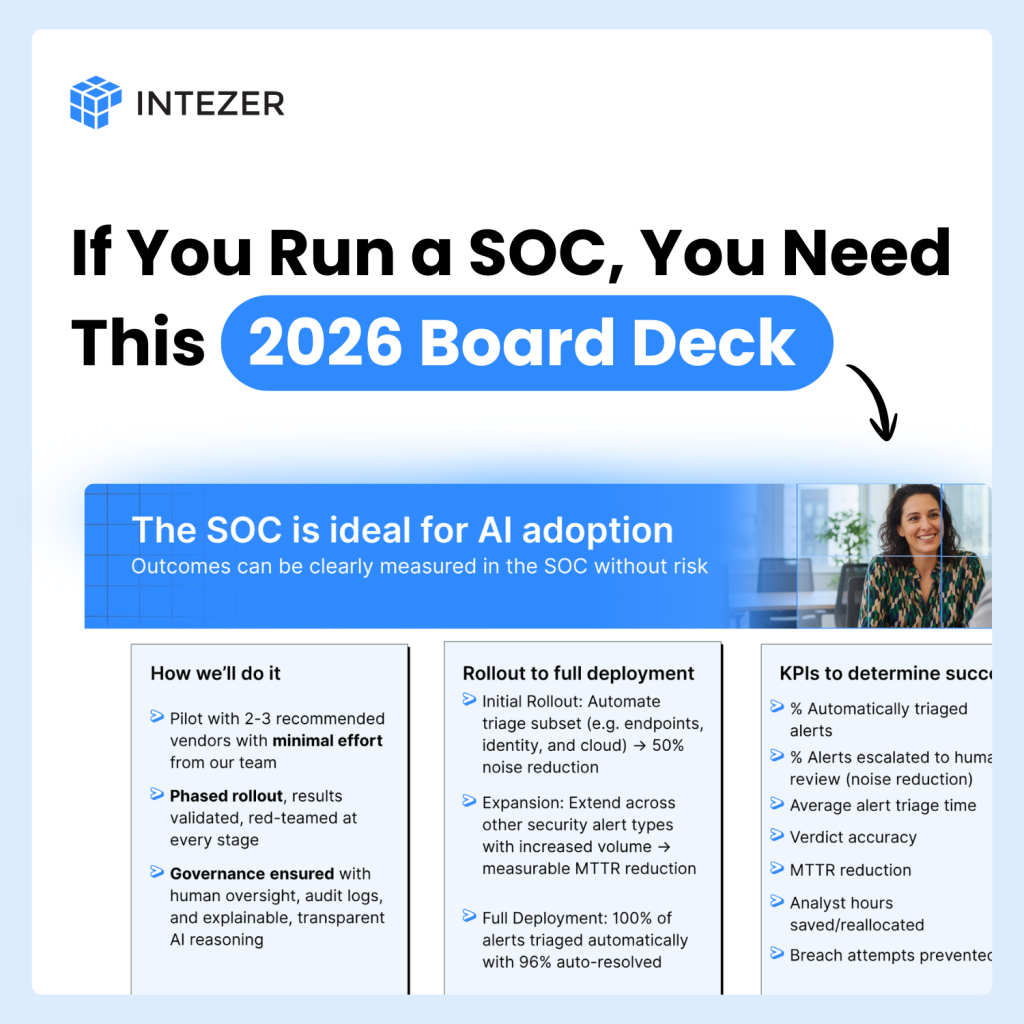
Get your editable copy of the one deck you need to pitch your board for 2026 AI SOC budget.

4. Safe automation with human-in-the-loop for high-impact actions

Most leaders are open to selective autonomous remediation, but only in narrow, well-defined, high-confidence scenarios.

For example:

  • Rapid ransomware containment
  • Isolation of clearly compromised endpoints
  • Automatic execution of repeatable hygiene tasks

But for broader or higher-impact actions, CISOs still want human review. The tone was clear:
AI should move fast where appropriate, but never at the expense of control.

5. Integration and practical telemetry coverage

Every leader emphasized that an AI platform is only as good as the data it can consume.

The must-have list included:

  • Cloud telemetry (AWS, Azure, GCP)
  • Identity providers (Okta, Entra ID, Ping)
  • EDR/XDR
  • SIEM logs
  • Ticketing/ITSM
  • Custom threat intelligence feeds

They don’t want a magical AI that promises answers without good data.
They want a connected system that can see across the entire environment.

6. Executive & board alignment with demonstrable ROI

CISOs aren’t implementing AI in a vacuum. Their boards and executive leadership teams are pressuring them from two very different angles:

  • Some are mandating AI adoption as a strategic priority.
  • Others are slowing everything down with extensive governance, risk, and compliance processes.

To navigate this dynamic, CISOs need clear, defensible ROI:

  • Reduced operating costs
  • Faster mean-time-to-respond
  • Fewer escalations
  • More predictable outcomes

AI without measurable value is no longer acceptable.
They need something they can put in front of the board and say, “Here’s the impact.”

7. Accountability and legal clarity

Before enterprises allow AI to autonomously take security actions, CISOs need a fundamental question answered:

“Who is accountable when the AI acts?”

This isn’t just a theoretical concern. It’s a gating requirement for adoption.

Until there is clear guidance on liability, responsibility, and governance, many organizations will keep AI on a tight leash.

Closing thoughts

Across all of these conversations, the message was consistent:
AI in the SOC is inevitable, but it must be safe, transparent, integrated, and measurable.

CISOs aren’t looking for science fiction. They’re looking for credible, operational AI that enhances their teams, strengthens their defenses, and aligns with business realities.

Read about why the best LLMs are not enough for the AI SOC.

The post The 7 CISO requirements for AI SOC in 2026 appeared first on Intezer.

❌