
Normal view

AWS European Sovereign Cloud achieves first compliance milestone: SOC 2 and C5 reports plus seven ISO certifications

10 March 2026 at 21:06

In January 2026, we announced the general availability of the AWS European Sovereign Cloud, a new, independent cloud for Europe entirely located within the European Union (EU), and physically and logically separate from all other AWS Regions. The unique approach of the AWS European Sovereign Cloud provides the only fully featured, independently operated sovereign cloud backed by strong technical controls, sovereign assurances, and legal protections designed to meet the sensitive data needs of European governments and enterprises.

One of the foundational components of how AWS European Sovereign Cloud enables verifiable trust of technical controls and delivers assurance is through our compliance programs and assurance frameworks. These programs help customers understand the robust controls in place at AWS European Sovereign Cloud to maintain security and compliance of the cloud. To meet the needs of our customers, we committed that the AWS European Sovereign Cloud will maintain key certifications such as ISO/IEC 27001:2022, System and Organization Controls (SOC) reports, and Cloud Computing Compliance Criteria Catalogue (C5) attestation, all validated regularly by independent auditors to assure our controls are designed appropriately, operate effectively, and can help customers satisfy their compliance obligations.

Today, AWS European Sovereign Cloud is pleased to announce that SOC 2 and C5 Type 1 attestation reports, along with seven key ISO certifications (ISO 27001:2022, 27017:2015, 27018:2019, 27701:2019, 22301:2019, 20000-1:2018, and 9001:2015) are now available. These attestation reports and certifications cover 69 AWS services operating within the AWS European Sovereign Cloud, and this achievement marks a pivotal first step in our journey to establish the AWS European Sovereign Cloud as a trusted and compliant cloud for European organizations. By securing these foundational certifications and attestation reports early in our implementation, we are demonstrating our commitment to earning customer trust. AWS European Sovereign Cloud customers in Germany and across Europe can now run their applications with enhanced assurance and confidence that our infrastructure aligns with internationally recognized security standards and the AWS European Sovereign Cloud: Sovereign Reference Framework (ESC-SRF). These certifications and attestation reports provide independent validation of our security controls and operational practices, demonstrating our commitment to meeting the heightened expectations towards cloud service providers. Beyond compliance, these certifications and reports help customers meet regulatory requirements and innovate with confidence.

SOC 2 Type 1 report

SOC reports are independent third-party examinations that show how AWS European Sovereign Cloud meets compliance controls and sovereignty objectives. The AWS European Sovereign Cloud SOC 2 report addresses three critical AICPA Trust Services Criteria: Security, Availability, and Confidentiality and includes internal controls mapped to the ESC-SRF. The ESC-SRF establishes sovereignty criteria across key domains including governance independence, operational control, data residency, and technical isolation. As part of the SOC 2 Type 1 attestation, independent third-party auditors have validated suitability of the design and implementation of our controls addressing measures such as independent European Union (EU) corporate structures, operation by EU-resident AWS personnel, strict residency requirements for Customer Content and Customer-Created Metadata, and separation from all other AWS Regions. The ESC-SRF controls in our SOC 2 report show customers how AWS delivers on its sovereignty commitments.

C5 Type 1 report

C5 is a German Government-backed attestation scheme introduced in Germany by the Federal Office for Information Security (BSI) and represents one of the most comprehensive cloud security standards in Europe. The AWS European Sovereign Cloud C5 Type 1 report provides customers with independent third-party attestation on the suitability of the design and implementation of our controls to meet both C5 basic criteria and C5 additional criteria.

The basic criteria establish fundamental security requirements for cloud service providers, covering areas such as organization of information security, human resources security, asset management, access control, cryptography, physical security, operations security, communications security, system acquisition and development, supplier relationships, incident management, business continuity, and compliance. The additional criteria address enhanced requirements for handling sensitive data and critical applications, making this attestation particularly valuable for AWS European Sovereign Cloud customers with stringent data security and sovereignty requirements.

Key ISO certifications

AWS European Sovereign Cloud has achieved seven key ISO certifications that collectively demonstrate comprehensive operational excellence:

These certifications confirm that AWS European Sovereign Cloud has integrated rigorous security, privacy, continuity, service delivery, and quality programs into a comprehensive framework, helping to ensure sensitive information remains secure, services remain available, and operations meet the highest standards through systematic risk management processes and continuous improvement practices.

How to access the reports

To access SOC 2, C5 reports and ISO certifications, customers should sign in to their AWS European Sovereign Cloud account and navigate to AWS Artifact in the AWS Management Console. AWS Artifact is a self-service portal that provides on-demand access to AWS compliance reports and certifications.

We recognize that compliance is not a destination but a continuous journey, and these initial SOC 2, C5 reports and ISO certifications represent the beginning of our certification portfolio. They lay the essential groundwork upon which we will continue to build to meet AWS European Sovereign Cloud customers’ compliance needs as they continue to evolve. As we expand our compliance coverage in the months ahead, customers can be confident that security, transparency, and regulatory alignment have been part of the very DNA of the AWS European Sovereign Cloud design from day one. To learn more about our compliance and security programs, visit AWS European Sovereign Cloud Compliance, or reach out to your AWS European Sovereign Cloud account team.

Security and compliance is a shared responsibility between AWS European Sovereign Cloud and the customer. For more information, see the AWS Shared Security Responsibility Model.

If you have feedback about this post, submit comments in the Comments section below.

Julian Herlinghaus

Julian Herlinghaus

Julian is a Manager in AWS Compliance & Security Assurance based in Berlin, Germany. He is the third-party audit program lead for EMEA and has worked on compliance and assurance for the AWS European Sovereign Cloud. He previously worked as an information security department lead of an accredited certification body and has multiple years of experience in information security and security assurance and compliance.

Tea Jioshvili

Tea Jioshvili

Tea is a Manager in AWS Compliance & Security Assurance based in Berlin, Germany. She leads various third-party audit programs across Europe. She previously worked in security assurance and compliance, business continuity, and operational risk management in the financial industry for 20 years.

Atul Patil

Atulsing Patil
Atulsing is a Compliance Program Manager at AWS. He has 29 years of consulting experience in information technology and information security management. Atulsing holds a Master of Science in Electronics degree and professional certifications such as CCSP, CISSP, CISM, ISO 42001 Lead Auditor, ISO 27001 Lead Auditor, HITRUST CSF, Archer Certified Consultant, and AWS CCP.

AWS Security Hub is expanding to unify security operations across multicloud environments

10 March 2026 at 15:51

After talking with many customers, one thing is clear: the security challenge has not gotten easier. Enterprises today operate across a complex mix of environments, including on-premises infrastructure, private data centers, and multiple clouds, often with tools that were never designed to work together. The result is enterprise security teams spend more time managing tools than managing risk, making it harder to stay ahead of threats across an increasingly complex environment.

At Amazon Web Service (AWS), we believe security should be simple, integrated, and built for the way enterprises actually operate. This belief is what drove us to reimagine AWS Security Hub, delivering full-stack security through a single experience, and this vision is driving our next chapter.

Building on a foundation of unified security

We transformed Security Hub into a unified security operations solution by bringing together AWS security services, including Amazon GuardDuty, Amazon Inspector, AWS Security Hub Cloud Security Posture Management (Security Hub CSPM), and Amazon Macie, into a single experience that automatically and continuously analyzes security signals across threats, vulnerabilities, misconfigurations, and sensitive data. Security Hub delivers a common foundation, bringing together findings from across your AWS environment so your security team spends less time translating signals and more time acting on them. Built on top of that foundation, a unified operations layer gives security teams near real-time risk analytics, automated analysis, and prioritized insights, helping them focus on what matters most, at scale.

We also introduced new capabilities (the Extended plan) that simplify how enterprises procure, deploy, and integrate a full-stack security solution across endpoint, identity, email, network, data, browser, cloud, AI, and security operations. Now, customers can use Security Hub to expand their security portfolio through a curated selection of AWS Partner solutions (at launch: 7AI, Britive, CrowdStrike, Cyera, Island, Noma, Okta, Oligo, Opti, Proofpoint, SailPoint, Splunk (a Cisco company), Upwind, and Zscaler), all through one unified experience. With AWS as the seller of record, you benefit from pay-as-you-go pricing, a single bill, and no long-term commitments. Our goal is simple: unified security, everywhere your enterprise operates.

Freedom to innovate, wherever your workloads are

At AWS, interoperability means giving customers the freedom to choose solutions that best suit their needs, and the ability to use them wherever their workloads run. But freedom to innovate across multicloud environments also means that it is critical to secure them consistently, and without adding operational complexity.

What’s coming for Security Hub

In the coming months, we are expanding Security Hub with new multicloud capabilities that extend unified security operations beyond AWS. The foundation of this expansion is a common data layer that unifies security signals from wherever your workloads run. On top of that, a unified policy and operations layer delivers consistent posture management, exposure analysis, and risk prioritization, so your security team operates from a single view of risk rather than a fragmented collection of consoles.

Security Hub will deliver unified risk analytics that surface critical risks across your multicloud estate. You’ll be able to manage cloud security posture with Security Hub CSPM checks that give you consistent posture visibility, and extend vulnerability management with expanded Amazon Inspector capabilities, including virtual machine scanning, container image scanning, and serverless scanning. Security Hub will also deliver external network scanning that enriches security findings with context about internet-facing exposure across your multicloud environment, including for resources not running in AWS.

The result is more comprehensive risk coverage across your enterprise. It’s about giving your security team a single, unified experience to detect and respond to risks, wherever you operate.

Security as a business enabler

The security leaders I speak with aren’t just asking for better tools. They’re asking for a way to get ahead of risk, not just manage it. They want security that keeps pace with the business, not security that slows it down.

That’s the vision behind AWS Security Hub: unified security through a single, integrated security operations experience, built on a common data foundation, powered by intelligent analytics, and delivered through a consistent operations layer, to help reduce security risk, improve team productivity, and strengthen security operations across AWS and beyond.

Our multicloud expansion is underway, and we are just getting started.

You can learn more at aws.amazon.com/security-hub, or visit us at the AWS booth (S-0466) at RSA Conference, March 23–26 in San Francisco.

Gee Rittenhouse Gee Rittenhouse
Gee is the Vice President of Security Services at AWS, overseeing key services including Security Hub, GuardDuty, and Inspector. He holds a PhD from MIT and brings extensive leadership experience across enterprise security and cloud. He previously served as CEO of Skyhigh Security and Senior Vice President and General Manager of Cisco’s Security Business Group, where he was responsible for Cisco’s worldwide cybersecurity business.

AWS completes the 2026 annual Dubai Electronic Security Centre (DESC) certification audit

5 March 2026 at 18:46

We’re excited to announce that Amazon Web Services (AWS) has completed the annual Dubai Electronic Security Centre (DESC) certification audit to operate as a Tier 1 Cloud Service Provider (CSP) for the AWS Middle East (UAE) Region.

This alignment with DESC requirements demonstrates our continued commitment to adhere to the heightened expectations for CSPs. Government customers of AWS can run their applications in AWS Cloud-certified Regions with confidence.

The AWS compliance to the DESC Framework requirements were validated by an independent third-party auditor (BSI) prior to issuance of a renewed certificate by DESC. The updated DESC CSP certificate is available through AWS Artifact, and is valid for one year to January 22, 2027. AWS Artifact is a self-service portal for on-demand access to AWS compliance reports. Sign in to AWS Artifact in the AWS Management Console, or learn more at Getting Started with AWS Artifact.

The certification includes the following 10 additional services in scope, for a total of 108 services:

This is a 10% increase in the number of services in the Middle East (UAE) Region that are in scope of the DESC CSP certification.

AWS strives to continuously bring services into the scope of its compliance programs to help you meet your architectural and regulatory needs. You can view the current list of services in scope on our Services in Scope page. You can also reach out to your AWS account team if you have any questions or feedback about DESC compliance.

To learn more about our compliance and security programs, see AWS Compliance Programs. As always, we value your feedback and questions; reach out to the AWS Compliance team through the Contact Us page.

If you have feedback about this post, submit comments in the Comments section below

Tariro Dongo Tariro Dongo
Tari is a Security Assurance Program Manager at AWS, based in London. Tari is responsible for third-party and customer audits, attestations, certifications, and assessments across EMEA. Previously, Tari worked in security assurance and technology risk in the big four and financial services industry over the last 15 years.

2025 ISO and CSA STAR certificates are now available with one additional service and one new region

5 March 2026 at 01:18

Amazon Web Services (AWS) successfully completed the annual recertification audit with no findings for ISO 9001:2015, 27001:2022, 27017:2015, 27018:2019, 27701:2019, 20000-1:2018, 22301:2019, and Cloud Security Alliance (CSA) STAR Cloud Controls Matrix (CCM) v4.0. The objective of the audit was to enable AWS to expand their ISO and CSA STAR certifications to include one new AWS Region and one new AWS service to the scope. The ISO standards cover areas including quality management, information security, cloud security, privacy protection, service management, and business continuity. The certifications demonstrate the commitment of AWS to maintaining robust security controls and protecting customer data across our services.

As part of this recertification audit, one new Region [Asia Pacific (Taipei)] and one new service (AWS Deadline Cloud) were added into the scope since the last certification issued November 25, 2025.

For a full list of AWS services that are certified under ISO and CSA Star, see the AWS
ISO and CSA STAR Certified page.
Customers can also access the certifications in the AWS Management Console through AWS Artifact.

If you have feedback about this post, submit comments in the Comments section below.

Chinmaee Parulekar

Chinmaee Parulekar

Chinmaee is a Compliance Program Manager at AWS. She has 6 years of experience in information security. Chinmaee holds a Master of Science degree in Management Information Systems and professional certifications such as CISA, HITRUST CCSF practitioner.

Atul Patil

Atulsing Patil
Atulsing is a Compliance Program Manager at AWS. He has 27 years of consulting experience in information technology and information security management. Atulsing holds a Master of Science in Electronics degree and professional certifications such as CCSP, CISSP, CISM, CDPSE, ISO 27001 Lead Auditor, HITRUST CSF, ISO 42001 Lead Auditor, Archer Certified Consultant, and AWS CCP.

Enhanced access denied error messages with policy ARNs

4 March 2026 at 18:19

To help you troubleshoot access denied errors, we recently added the Amazon Resource Name (ARN) of the denying policy to access denied error messages. This builds on our 2021 enhancement that added the type of the policy denying the access to access denied error messages. The ARN of the denying policy is only provided in same-account and same-organization scenarios. This change is gradually rolling out across all AWS services in all AWS Regions.

What changed?

We added the policy ARN to access denied error messages for AWS Identity and Access Management (IAM) and AWS Organizations policies. Because of this change, you can now pinpoint the exact policy causing the denial. You don’t have to evaluate all the policies of the same type in your AWS environment to identify the culprit. The policy types covered in this update are service control policies (SCPs), resource control policies (RCPs), permissions boundaries policies, session policies, and identity-based policies.

For example, when a developer attempts to perform the ListRoles action in IAM and is denied because of an SCP:

Before:
An error occurred (AccessDenied) when calling the ListRoles operation: User: arn:aws:iam::123456789012:user/Matt is not authorized to perform: iam:ListRoles on resource: arn:aws:iam::123456789012:role/* with an explicit deny in a service control policy

Enhanced:
An error occurred (AccessDenied) when calling the ListRoles operation: User: arn:aws:iam::123456789012:user/Matt is not authorized to perform: iam:ListRoles on resource: arn:aws:iam::123456789012:role/* with an explicit deny in a service control policy: arn:aws:organizations::987654321098:policy/o-qv5af4abcd/service_control_policy/p-2kgnabcd

How this enhancement works

This enhancement is designed with three principles:

  • Limited scope – Same account and same organization only: Policy ARNs are only included when the request originates from either the same AWS account or the same organization as the policy. This limits the scope of the flow of information.
  • Additional context in the form of ARN only and not policy content: The additional context covers only the policy ARN, which is a resource identifier, not the policy document itself. It does not reveal the policy’s permissions or conditions that you would have to update to grant access. Users would still need appropriate permissions to read the policy content or take actions.
  • No change to authorization logic: This enhancement only affects the error message displayed, not the authorization decision-making process. The same policies deny or allow access as before, and we are not changing how the decision is made.

How this benefits you

This accelerates troubleshooting across your organization. Previously, when you received an access denied error from a policy, for example an SCP, you had to review all SCPs in your organization, determine which applied to the account, and evaluate each one—a process that could take time. Now, with the specific SCP ARN included in the error message, whoever has the necessary permission can review the identified SCP and more quickly resolve the issue. This precision reduces the investigative burden. Clear error messages with policy ARNs also improve communication between teams who need access and teams who troubleshoot issues by providing a common reference point, eliminating ambiguity and reducing back-and-forth communication. Lastly, when validating security controls, the policy ARN in access denied errors provides immediate confirmation of which policy is enforcing the restriction, enabling customers to quickly verify their policies are correctly denying access.

How you can use the new information

Let’s say you’re trying to describe your Amazon Relational Database Service (Amazon RDS) snapshots in the us-east-2 Region by calling this API:
aws rds describe-db-snapshots --region us-east-2

Unfortunately you get an access denied error. The error message shows:
An error occurred (AccessDenied) when calling the DescribeDBSnapshots operation: User: arn:aws:sts::123456789012:assumed-role/ReadOnly/ReadOnlySession is not authorized to perform: rds:DescribeDBSnapshots on resource: arn:aws:rds:us-east-2:123456789012:snapshot:* with an explicit deny in a service control policy: arn:aws:organizations::987654321098:policy/o-qv5af4abcd/service_control_policy/p-lvi9abcd

You can see the context to understand what happens:

  • It’s an explicit deny. This means there’s a policy that denies this action for a specific context
  • The deny comes from the SCP with this ARN: arn:aws:organizations::987654321098:policy/o-qv5af4abcd/service_control_policy/p-lvi9abcd

Here’s how you can troubleshoot this error:

  1. Ensure you have necessary permission to view the SCP. If you don’t, contact your administrator and provide the message that includes the policy ARN.
  2. If you have the necessary permission, go to the AWS Management Console for AWS Organizations to access the SCP.
  3. Check for a Deny statement for the action. In the preceding example, the action is rds:DescribeDBSnapshots.
  4. You can alter the statement to remove the Deny if it’s no longer applicable. For more information, see Update a service control policy (SCP).
  5. Re-try your operation. Repeat the troubleshooting process if you get other access denied errors due to different reasons or policies.

When will this change become available?

This update is gradually rolling out across all AWS services in all AWS Regions, beginning early 2026.

Need more assistance?

If you have any questions or issues, contact AWS Support or your Technical Account Manager (TAM).

Stella Hie

Stella Hie

Stella is a Senior Technical Product Manager for AWS Identity and Access Management (IAM). She specializes in improving developer experience and tooling while maintaining strong security standards. Her work focuses on making IAM straightforward to use and improving the troubleshooting experience for AWS customers. In her free time, she enjoys playing piano and bouldering.

2025 FINMA ISAE 3000 Type II attestation report available with 183 services in scope

3 March 2026 at 20:30

Amazon Web Services (AWS) is pleased to announce the issuance of the Swiss Financial Market Supervisory Authority (FINMA) Type II attestation report with 183 services in scope.

The Swiss Financial Market Supervisory Authority (FINMA) has published several requirements and guidelines about engaging with outsourced services for the regulated financial services customers in Switzerland.

An independent third-party audit firm issued the report to assure customers that the AWS control environment is appropriately designed and operating effectively to support of adherence with FINMA requirements.

The latest report covers the 12-month period from October 1, 2024 to September 30, 2025 for the following circulars:

  • 2018/03 Outsourcing – banks, insurance companies and selected financial institutions under FinIA
  • 2023/01 Operational risks and resilience – banks
  • Business Continuity Management (BCM) minimum standards proposed by the Swiss Insurance Association.

AWS has added the following five services to the current FINMA scope:

Customers can find the FINMA ISAE 3000 report on AWS Artifact. AWS Artifact is a self-service portal for on-demand access to AWS compliance reports. Sign in to AWS Artifact in the AWS Management Console, or learn more at Getting Started with AWS Artifact.
Security and compliance is a shared responsibility between AWS and the customer. When customers move their computer systems and data to the cloud, security responsibilities are shared between the customer and the cloud service provider. For more information, see the AWS Shared Security Responsibility Model.

To learn more about our compliance and security programs, see AWS Compliance Programs. As always, we value your feedback and questions; reach out to the AWS Compliance team through the Contact Us page.

If you have feedback about this post, submit comments in the Comments section below

Tariro Dongo Tariro Dongo
Tari is a Security Assurance Program Manager at AWS, based in London. Tari is responsible for third-party and customer audits, attestations, certifications, and assessments across EMEA. Previously, Tari worked in security assurance and technology risk in the big four and financial services industry over the last 15 years.

2025 PiTuKri ISAE 3000 Type II attestation report available with 183 services in scope

3 March 2026 at 18:17

Amazon Web Services (AWS) is pleased to announce the issuance of the Criteria to Assess the Information Security of Cloud Services (PiTuKri) Type II attestation report with 183 services in scope.

The Finnish Transport and Communications Agency (Traficom) Cyber Security Centre published PiTuKri, which consists of 52 criteria that provide guidance across 11 domains for assessing the security of cloud service providers.

An independent third-party audit firm issued the report to assure customers that the AWS control environment is appropriately designed and operating effectively to demonstrate adherence with PiTuKri requirements. This attestation demonstrates the AWS commitment to meet security expectations for cloud service providers set by Traficom.

The latest report covers a 12-month period from October 1, 2024 to September 30, 2025. AWS has added the following five services to the current PiTuKri scope:

Customers can find the PiTuKri ISAE 3000 report on AWS Artifact. AWS Artifact is a self-service portal for on-demand access to AWS compliance reports. Sign in to AWS Artifact in the AWS Management Console, or learn more at Getting Started with AWS Artifact.

Security and compliance is a shared responsibility between AWS and the customer. When customers move their computer systems and data to the cloud, security responsibilities are shared between the customer and the cloud service provider. For more information, see the AWS Shared Security Responsibility Model.

To learn more about our compliance and security programs, see AWS Compliance Programs. As always, we value your feedback and questions; reach out to the AWS Compliance team through the Contact Us page.

If you have feedback about this post, submit comments in the Comments section below

Tariro Dongo Tariro Dongo
Tari is a Security Assurance Program Manager at AWS, based in London. Tari is responsible for third-party and customer audits, attestations, certifications, and assessments across EMEA. Previously, Tari worked in security assurance and technology risk in the big four and financial services industry over the last 15 years.

AWS successfully completed its first surveillance audit for ISO 42001:2023 with no findings

26 February 2026 at 23:45

In November 2024, Amazon Web Services (AWS) was the first major cloud service provider to announce the ISO/IEC 42001 accredited certification for AI services, covering: Amazon Bedrock, Amazon Q Business, Amazon Textract, and Amazon Transcribe.

In November 2025, AWS successfully completed its first surveillance audit for ISO 42001:2023, Artificial Intelligence Management System with no findings.

This demonstrates the continual commitment of AWS to responsible AI practices. With this independent validation, our customers can gain further assurances around the AWS commitment to responsible AI and their ability to build and operate AI applications responsibly using AWS services.

For a full list of AWS services that are certified under ISO and CSA STAR, see the AWS ISO and CSA STAR Certified page. Customers can also access the certifications in the AWS Management Console through AWS Artifact.

If you have feedback about this post, submit comments in the Comments section below.
 

Atul Patil

Atulsing Patil
Atulsing is a Compliance Program Manager at AWS. He has 27 years of consulting experience in information technology and information security management. Atulsing holds a Master of Science in Electronics degree and professional certifications such as CCSP, CISSP, CISM, CDPSE, ISO 27001 Lead Auditor, HITRUST CSF, Archer Certified Consultant, and AWS CCP.

IAM Identity Center now supports IPv6

26 January 2026 at 21:17

Amazon Web Services (AWS) recommends using AWS IAM Identity Center to provide your workforce access to AWS managed applications—such as Amazon Q Developer—and AWS accounts. Today, we announced IAM Identity Center support for IPv6. To learn more about the advantages of IPv6, visit the IPv6 product page.

When you enable IAM Identity center, it provides an access portal for workforce users to access their AWS applications and accounts either by signing in to the access portal using a URL or by using a bookmark for the application URL. In either case, the access portal handles user authentication before granting access to applications and accounts. Supporting both IPv4 and IPv6 connectivity to the access portal helps facilitate seamless access for clients, such as browsers and applications, regardless of their network configuration.

The launch of IPv6 support in IAM Identity Center introduces new dual-stack endpoints that support both IPv4 and IPv6, so that users can connect using IPv4, IPv6, or dual-stack clients. Current IPv4 endpoints continue to function with no action required. The dual stack capability offered by Identity Center extends to managed applications. When users access the application dual-stack endpoint, the application automatically routes to the Identity Center dual-stack endpoint for authentication. To use Identity Center from IPv6 clients, you must direct your workforce to use the new dual-stack endpoints, and update configurations on your external identity provider (IdP), if you use one.

In this post, we show you how to update your configuration to allow IPv6 clients to connect directly to IAM Identity Center endpoints without requiring network address translation services. We also show you how to monitor which endpoint users are connecting to. Before diving into the implementation details, let’s review the key phases of the transition process.

Transition overview

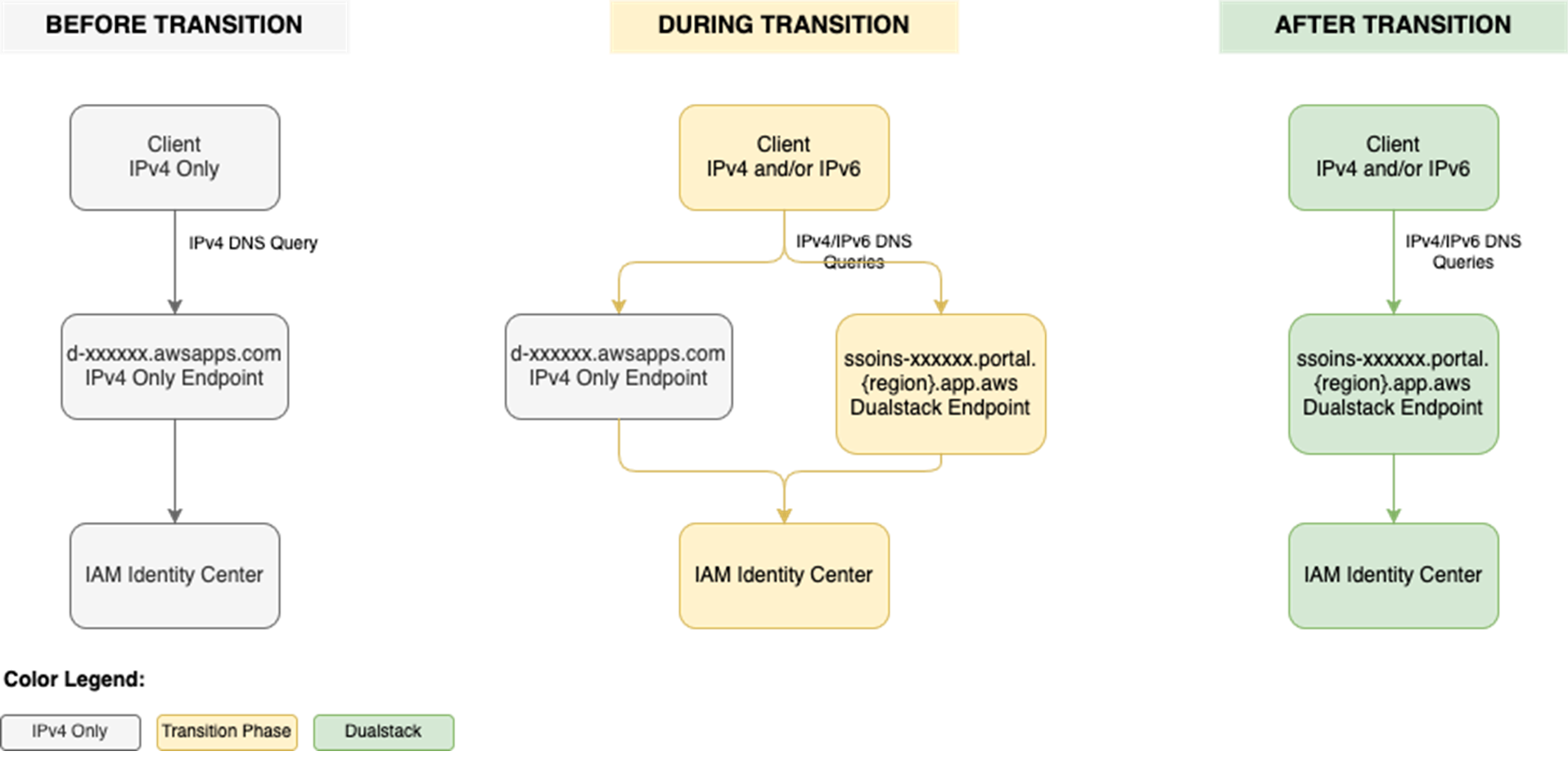
To use IAM Identity Center from an IPv6 network and client, you need to use the new dual-stack endpoints. Figure 1 shows what the transition from IPv4 to IPv6 over dual-stack endpoints looks like when using Identity Center. The figure shows:

  • A before state where clients use the IPv4 endpoints.
  • The transition phase, when your clients use a combination of IPv4 and dual-stack endpoints.
  • After the transition is complete, your clients will connect to dual-stack endpoints using their IPv4 or IPv6, depending on their preferences.

Figure 1: Transition from IPv4-only to dual-stack endpoints

Figure 1: Transition from IPv4-only to dual-stack endpoints

Prerequisites

You must have the following prerequisites in place to enable IPv6 access for your workforce users and administrators:

  • An existing IAM Identity Center instance
  • Updated firewalls or gateways to include the new dual-stack endpoints
  • IPv6 capable clients and networks

Work with your network administrators to update the configuration of your firewalls and gateways and to verify that your clients, such as laptops or desktops, are ready to accept IPv6 connectivity. If you have already enabled IPv6 connectivity for other AWS services, you might be familiar with these changes. Next, implement the two steps that follow.

Step 1: Update your IdP configuration

You can skip this step If you don’t use an external IdP as your identity source.

In this step, you update the Assertion Consumer Service (ACS) URL from your IAM Identity Center instance into your IdP’s configuration for single sign-on and the SCIM configuration for user provisioning. Your IdP’s capability determines how you update the ACS URLs. If your IdP supports multiple ACS URLs, configure both IPv4 and dual-stack URLs to enable a flexible transition. With that configuration, some users can continue using IPv4-only endpoints while others use dual-stack endpoints for IPv6. If your IdP supports only one ACS URL, to use IPv6 you must update the new dual-stack ACS URL in your IdP and transition all users to using dual-stack endpoints. If you don’t use an external IdP, you can skip this step and go to the next step.

Update both the SAML single sign-on and the SCIM provisioning configurations:

  1. Update the single sign-on settings in your IdP to use the new dual-stack URLs. First, locate the URLs in the AWS Management Console for IAM Identity Center.
    1. Choose Settings in the navigation pane and then select Identity source.
    2. Choose Actions and select Manage authentication.
    3. in Under Manage SAML 2.0 authentication, you will find the following URLs under Service provider metadata:
      • AWS access portal sign-in URL
      • IAM Identity Center Assertion Consumer Service (ACS) URL
      • IAM Identity Center issuer URL
  2. If your IdP supports multiple ACS URLs, then add the dual-stack URL to your IdP configuration alongside existing IPv4 one. With this setting, you and your users can decide when to start using the dual-stack endpoints, without all users in your organization having to switch together.

    Figure 2: Dual-stack single sign-on URLs

    Figure 2: Dual-stack single sign-on URLs

  3. If your IdP does not support multiple ACS URLs, replace the existing IPv4 URL with the new dual-stack URL, and switch your workforce to use only the dual-stack endpoints.
  4. Update the provisioning endpoint in your IdP. Choose Settings in the navigation pane and under Identity source, choose Actions and select Manage provisioning. Under Automatic provisioning, copy the new SCIM endpoint that ends in api.aws. Update this new URL in your external IdP.

    Figure 3: Dual-stack SCIM endpoint URL

    Figure 3: Dual-stack SCIM endpoint URL

Step 2: Locate and share the new dual-stack endpoints

Your organization needs two kinds of URLs for IPv6 connectivity. The first is the new dual-stack access portal URL that your workforce users use to access their assigned AWS applications and accounts. The dual-stack access portal URL is available in the IAM Identity Center console, listed as the Dual-stack in the Settings summary (you might need to expand the Access portal URLs section, shown in Figure 4).

Figure 4: Locate dual-stack access portal endpoints

Figure 4: Locate dual-stack access portal endpoints

This dual-stack URL ends with app.aws as its top-level domain (TLD). Share this URL with your workforce and ask them to use this dual-stack URL to connect over IPv6. As an example, if your workforce uses the access portal to access AWS accounts, they will need to sign in through the new dual-stack access portal URL when using IPv6 connectivity. Alternately, if your workforce accesses the application URL, you need to enable the dual-stack application URL following application-specific instructions. For more information, see AWS services that support IPv6.

The URLs that administrators use to manage IAM Identity Center are the second kind of URL your organization needs. The new dual-stack service endpoints end in api.aws as their TLD and are listed in the Identity Center service endpoints. Administrators can use these service endpoints to manage users and groups in Identity Center, update their access to applications and resources, and perform other management operations. As an example, if your administrator uses identitystore.{region}.amazonaws.com to manage users and groups in Identity Center, they should now use the dual-stack version of the same service endpoint which is identitystore.{region}.api.aws, so they can connect to service endpoints using IPv6 clients and networks.

If your users or administrators use an AWS SDK to access AWS applications and accounts or manage services, follow Dual-stack and FIPS endpoints to enable connectivity to the dual-stack endpoints.

After completing these two steps, your workforce and administrators can connect to IAM Identity Center using IPv6. Remember, these endpoints also support IPv4, so clients not yet IPv6-capable can continue to connect using IPv4.

Monitoring dual-stack endpoint usage

You can optionally monitor AWS CloudTrail logs to track usage of dual-stack endpoints. The key difference between IPv4-only and dual-stack endpoint usage is the TLD and appears in the clientProvidedHostHeader field. The following example shows the difference between these CloudTrail events for the CreateTokenWithIAM API call.

IPv4-only endpoints Dual-stack endpoints
"CloudTrailEvent": {
  "eventName": "CreateToken",
  "tlsDetails": {
     "tlsVersion": "TLSv1.3",
     "cipherSuite": "TLS_AES_128_GCM_SHA256",
     "clientProvidedHostHeader": "oidc.us-east-1.amazonaws.com"
  }
}
"CloudTrailEvent": {
  "eventName": "CreateToken",
  "tlsDetails": {
     "tlsVersion": "TLSv1.3",
     "cipherSuite": "TLS_AES_128_GCM_SHA256",
     "clientProvidedHostHeader": "oidc.us-east-1.api.aws"
  }
}

Conclusion

IAM Identity Center now allows clients to connect over IPv6 natively with no network address translation infrastructure. This post showed you how to transition your organization to use IPv6 with Identity Center and its integrated applications. Remember that existing IPv4 endpoints will continue to function, so you can transition at your own pace. Also, no immediate action is required by you. However, we recommend planning your transition to take advantage of IPv6 benefits and meet compliance requirements. If you have questions, comments, or concerns, contact AWS Support, or start a new thread in the IAM Identity Center re:Post channel.

 
If you have feedback about this post, submit comments in the Comments section below. If you have questions about this post, contact AWS Support.

 

Suchintya Dandapat Suchintya Dandapat
Suchintya Dandapat is a Principal Product Manager for AWS where he partners with enterprise customers to solve their toughest identity challenges, enabling secure operations at global scale.

Updated PCI PIN compliance package for AWS CloudHSM now available

26 January 2026 at 19:11

Amazon Web Services (AWS) is pleased to announce the successful completion of Payment Card Industry Personal Identification Number (PCI PIN) audit for the AWS CloudHSM service.

With CloudHSM, you can manage and access your keys on FIPS 140-3 Level 3 validated hardware, protected with customer-owned, single-tenant hardware security module (HSM) instances that run in your own virtual private cloud (VPC). This PCI PIN attestation gives you the flexibility to deploy your regulated workloads with reduced compliance overhead. CloudHSM might be suitable when operations supported by the service are integrated into a broader solution that requires PCI-PIN compliance. For payment operations, such as PIN translation, we encourage you to consider AWS Payment Cryptography as a fully managed alternative for PCI-PIN compliance.

The PCI PIN compliance report package for AWS CloudHSM includes two key components:

  • PCI PIN Attestation of Compliance (AOC) – demonstrating that AWS CloudHSM was successfully validated against the PCI PIN standard with zero findings
  • PCI PIN Responsibility Summary – provides guidance to help AWS customers understand their responsibilities in developing and operating a highly secure environment for handling PIN-based transactions

AWS was evaluated by Coalfire, a third-party Qualified Security Assessor (QSA). Customers can access the PCI PIN Attestation of Compliance (AOC) and PCI PIN Responsibility Summary reports through AWS Artifact.

To learn more about our PCI program and other compliance and security programs, see the AWS Compliance Programs page. As always, we value your feedback and questions; reach out to the AWS Compliance team through the Contact Us page.

If you have feedback about this post, submit comments in the Comments section below. If you have questions about this post, contact AWS Support.

Tushar Jain

Tushar Jain

Tushar is a Compliance Program Manager at AWS. He leads multiple security and privacy initiatives within AWS. Tushar holds a Master of Business Administration from Indian Institute of Management Shillong, India and a Bachelor of Technology in electronics and telecommunication engineering from Marathwada University, India. He has over 13 years of experience in information security and holds CCSK and CSXF certifications.

Will Black

Will Black

Will is a Compliance Program Manager at Amazon Web Services. He leads multiple security and compliance initiatives within AWS. He has ten years of experience in compliance and security assurance and holds a degree in Management Information Systems from Temple University. Additionally, he holds the CCSK and ISO 27001 Lead Implementer certifications.

Updated PCI PIN compliance package for AWS Payment Cryptography now available

24 January 2026 at 00:14

Amazon Web Services (AWS) is pleased to announce the successful completion of Payment Card Industry Personal Identification Number (PCI PIN) audit for the AWS Payment Cryptography service.

With AWS Payment Cryptography, your payment processing applications can use payment hardware security modules (HSMs) that are PCI PIN Transaction Security (PTS) HSM certified and fully managed by AWS, with PCI PIN-compliant key management. This attestation gives you the flexibility to deploy your regulated workloads with reduced compliance overhead.

The PCI PIN compliance report package for AWS Payment Cryptography includes two key components:

  • PCI PIN Attestation of Compliance (AOC) – demonstrating that AWS Payment Cryptography was successfully validated against the PCI PIN standard with zero findings
  • PCI PIN Responsibility Summary – provides guidance to help AWS customers understand their responsibilities in developing and operating a highly secure environment for handling PIN-based transactions

AWS was evaluated by Coalfire, a third-party Qualified Security Assessor (QSA). Customers can access the PCI PIN Attestation of Compliance (AOC) and PCI PIN Responsibility Summary reports through AWS Artifact.

To learn more about our PCI programs and other compliance and security programs, visit the AWS Compliance Programs page. As always, we value your feedback and questions; reach out to the AWS Compliance team through the Compliance Support page.

If you have feedback about this post, submit comments in the Comments section below. If you have questions about this post, contact AWS Support.
Tushar Jain

Tushar Jain

Tushar is a Compliance Program Manager at AWS. He leads multiple security and privacy initiatives within AWS. Tushar holds a Master of Business Administration from Indian Institute of Management Shillong, India and a Bachelor of Technology in electronics and telecommunication engineering from Marathwada University, India. He has over 13 years of experience in information security and holds CCSK and CSXF certifications.

Will Black

Will Black

Will is a Compliance Program Manager at Amazon Web Services. He leads multiple security and compliance initiatives within AWS. He has ten years of experience in compliance and security assurance and holds a degree in Management Information Systems from Temple University. Additionally, he holds the CCSK and ISO 27001 Lead Implementer certifications.

AWS achieves 2025 C5 Type 2 attestation report with 183 services in scope 

23 January 2026 at 22:39

Amazon Web Services (AWS) is pleased to announce a successful completion of the 2025 Cloud Computing Compliance Criteria Catalogue (C5) attestation cycle with 183 services in scope. This alignment with C5 requirements demonstrates our ongoing commitment to adhere to the heightened expectations for cloud service providers. AWS customers in Germany and across Europe can run their applications in the AWS Regions that are in scope of the C5 report with the assurance that AWS aligns with C5 criteria.

The C5 attestation scheme is backed by the German government and was introduced by the Federal Office for Information Security (BSI) in 2016. AWS has adhered to the C5 requirements since their inception. C5 helps organizations demonstrate operational security against common cybersecurity threats when using cloud services.

Independent third-party auditors evaluated AWS for the period of October 1, 2024, through September 30, 2025. The C5 report illustrates the compliance status of AWS for both the basic and additional criteria of C5. Customers can download the C5 report through AWS Artifact, a self-service portal for on-demand access to AWS compliance reports. Sign in to AWS Artifact in the AWS Management Console or learn more at Getting Started with AWS Artifact.

AWS has added the following five services to the current C5 scope:

The following AWS Regions are in scope of the 2025 C5 attestation: Europe (Frankfurt), Europe (Ireland), Europe (London), Europe (Milan), Europe (Paris), Europe (Stockholm), Europe (Spain), Europe (Zurich), and Asia Pacific (Singapore). For up-to-date information, see the C5 page of our AWS Services in Scope by Compliance Program.

Security and compliance is a shared responsibility between AWS and the customer. When customers move their computer systems and data to the cloud, security responsibilities are shared between the customer and the cloud service provider. For more information, see the AWS Shared Security Responsibility Model.

To learn more about our compliance and security programs, see AWS Compliance Programs. As always, we value your feedback and questions; reach out to the AWS Compliance team through the Contact Us page.

Reach out to your AWS account team if you have questions or feedback about the C5 report.
If you have feedback about this post, submit comments in the Comments section below.

Tea Jioshvili

Tea Jioshvili

Tea is a Manager in AWS Compliance & Security Assurance based in Berlin, Germany. She leads various third-party audit programs across Europe. She previously worked in security assurance and compliance, business continuity, and operational risk management in the financial industry for 20 years.

AWS renews the GSMA SAS-SM certification for two AWS Regions and expands to cover four new Regions

23 January 2026 at 21:47

Amazon Web Services (AWS) is pleased to announce the expansion of GSMA Security Accreditation Scheme for Subscription Management (SAS-SM) certification to four new AWS Regions: US West (Oregon), Europe (Frankfurt), Asia Pacific (Tokyo), and Asia Pacific (Singapore). Additionally, the AWS US East (Ohio) and Europe (Paris) Regions have been recertified. All certifications are under the GSM Association (GSMA) SAS-SM with scope Data Centre Operations and Management (DCOM). AWS was evaluated by GSMA-selected independent third-party auditors, and all Region certifications are valid through October 2026. The Certificate of Compliance that shows AWS achieved GSMA compliance status is available on both the GSMA and AWS websites.

The US East (Ohio) Region first obtained GSMA certification in September 2021, and the Europe (Paris) Region first obtained GSMA certification in October 2021. Since then, multiple independent software vendors (ISVs) have inherited the controls of our SAS-SM DCOM certification to build GSMA compliant subscription management or eSIM (embedded subscriber identity module) services on AWS. For established market leaders, this reduces technical debt while meeting the scalability and performance needs of their customers. Startups innovating with eSIM solutions can accelerate their time to market by many months, compared to on-premises deployments.

Until 2023, the shift from physical subscriber identity modules (SIMs) to eSIMs was primarily driven by automotives, cellular connected wearables, and companion devices such as tablets. GSMA is promoting the SGP.31 and SGP.32 specifications, which standardize protocols and guarantee compatibility and consistent user experience for all eSIM devices spanning smartphones, IoT, smart home, industrial Internet of Things (IoT), and so on. As more device manufacturers launch eSIM only models, our customers are demanding robust, cloud-centered eSIM solutions. Over 400 telecom operators around the world now support eSIM services for their subscribers. Hosting eSIM platforms in the cloud allows them to integrate efficiently with their next generation cloud-based operations support systems (OSS) and business support systems (BSS).

The AWS expansion to certify four new Regions into scope in November 2025 demonstrates our continuous commitment to adhere to the heightened expectations for cloud service providers and extends our global coverage for GSMA-certified infrastructure. With two GSMA-certified Regions in the US, EU, and Asia respectively, customers can now build geo-redundant eSIM solutions to improve their disaster recovery and resiliency posture.

For up-to-date information related to the certification, see the AWS GSMA Compliance Program page.

To learn more about our compliance and security programs, see AWS Compliance Programs. As always, we value your feedback and questions; reach out to the AWS Compliance team through the Contact Us page. If you have feedback about this post, submit comments in the Comments section below.

Michael Murphy

Michael Murphy

Michael is a Compliance Program Manager at AWS where he leads multiple security and privacy initiatives. Michael has over 14 years of experience in information security and holds a master’s degree and a bachelor’s degree in computer engineering from Stevens Institute of Technology. He also holds CISSP, CRISC, CISA, and CISM certifications.

Noah Miller

Noah Miller

Noah is a Compliance Program Manager at AWS and supports multiple security and privacy initiatives within AWS. Noah has 6 years of experience in information security. He has a master’s degree in Cybersecurity Risk Management and a bachelor’s degree in informatics from Indiana University.

Nyef Khan

Nayef Khan

Nayef Khan is a Senior Solutions Architect at AWS in Canada, with over 15 years of experience in security assurance across financial and telecom industries. He is passionate about using cloud technologies to solve real-life customer challenges. Nayef has collaborated with a numerous Telecom customers globally throughout his career, launching industry-first solutions like mobile payments and eSIM. He holds an MBA in Strategic Management from Wilfrid Laurier University, and a bachelor’s degree in Computer Engineering from the University of Waterloo.

Fall 2025 SOC 1, 2, and 3 reports are now available with 185 services in scope

20 January 2026 at 20:48

Amazon Web Services (AWS) is pleased to announce that the Fall 2025 System and Organization Controls (SOC) 1, 2, and 3 reports are now available. The reports cover 185 services over the 12-month period from October 1, 2024–September 30, 2025, giving customers a full year of assurance. These reports demonstrate our continuous commitment to adhering to the heightened expectations of cloud service providers.

Customers can download the Fall 2025 SOC 1 and 2 reports through AWS Artifact, a self-service portal for on-demand access to AWS compliance reports. Sign in to AWS Artifact in the AWS Management Console, or learn more at Getting Started with AWS Artifact. The SOC 3 report can be found on the AWS SOC Compliance Page.

AWS strives to continuously bring services into the scope of its compliance programs to help customers meet their architectural and regulatory needs. You can view the current list of services in scope on our Services in Scope page. As an AWS customer, you can reach out to your AWS account team if you have any questions or feedback about SOC compliance.

To learn more about AWS compliance and security programs, see AWS Compliance Programs. As always, we value feedback and questions; reach out to the AWS Compliance team through the Contact Us page.

If you have feedback about this post, submit comments in the Comments section below.

Tushar Jain

Tushar Jain
Tushar is a Compliance Program Manager at AWS where he leads multiple security and privacy initiatives. Tushar holds a Master of Business Administration from the Indian Institute of Management Shillong, India, and a Bachelor of Technology in electronics and telecommunication engineering from Marathwada University, India. He has over 13 years of experience in information security and holds CISM, CCSK, and CSXF certifications.

Michael Murphy

Michael Murphy
Michael is a Compliance Program Manager at AWS where he leads multiple security and privacy initiatives. Michael has over 14 years of experience in information security and holds a master’s degree and a bachelor’s degree in computer engineering from Stevens Institute of Technology. He also holds CISSP, CRISC, CISA, and CISM certifications.

Nathan Samuel

Nathan Samuel
Nathan is a Compliance Program Manager at AWS where he leads multiple security and privacy initiatives. Nathan has a Bachelor of Commerce degree from the University of the Witwatersrand, South Africa, and has over 21 years of experience in security assurance. He holds the CISA, CRISC, CGEIT, CISM, CDPSE, and Certified Internal Auditor certifications.

Gabby Iem

Gabby Iem
Gabby is a Program Manager at AWS. She supports multiple initiatives within AWS security assurance and has recently received her bachelor’s degree from Chapman University studying business administration.

Jeff Cheung

Jeff Cheung
Jeff is a Technical Program Manager at AWS where he leads multiple security and privacy initiatives across business lines. Jeff has Bachelor’s degrees in Information Systems and Economics from SUNY Stony Brook and has over 20 years of experience in information security and assurance. Jeff has held professional certifications such as CISA, CISM, and PCI-QSA.

Noah Miller

Noah Miller
Noah is a Compliance Program Manager at AWS and supports multiple security and privacy initiatives within AWS. Noah has 6 years of experience in information security. He has a master’s degree in Cybersecurity Risk Management and a bachelor’s degree in Informatics from Indiana University.

Will Black

Will Black
Will is a Compliance Program Manager at Amazon Web Services where he leads multiple security and compliance initiatives. Will has 10 years of experience in compliance and security assurance and holds a degree in Management Information Systems from Temple University. Additionally, he is a PCI Internal Security Assessor (ISA) for AWS and holds the CCSK and ISO 27001 Lead Implementer certifications.

AWS named Leader in the 2025 ISG report for Sovereign Cloud Infrastructure Services (EU)

9 January 2026 at 17:11

For the third year in a row, Amazon Web Services (AWS) is named as a Leader in the Information Services Group (ISG) Provider LensTM Quadrant report for Sovereign Cloud Infrastructure Services (EU), published on January 9, 2026. ISG is a leading global technology research, analyst, and advisory firm that serves as a trusted business partner to more than 900 clients. This ISG report evaluates 19 providers of sovereign cloud infrastructure services in the multi-public-cloud environment and examines how they address the key challenges that enterprise clients face in the European Union (EU). ISG defines Leaders as providers who represent innovative strength and competitive stability.

ISG rated AWS ahead of other leading cloud providers on both the competitive strength and portfolio attractiveness axes, with the highest score on portfolio attractiveness. Competitive strength was assessed on multiple factors, including degree of awareness, core competencies, and go-to-market strategy. Portfolio attractiveness was assessed on multiple factors, including scope of portfolio, portfolio quality, strategy and vision, and local characteristics.

According to ISG, “AWS’s infrastructure provides robust resilience and availability, supported by a sovereign-by-design architecture that ensures data residency and regional independence.”

Read the report to:

  • Discover why AWS was named as a Leader with the highest score on portfolio attractiveness by ISG.
  • Gain further understanding on how the AWS Cloud is sovereign-by-design and how it continues to offer more control and more choice without compromising on the full power of AWS.
  • Learn how AWS is delivering on its Digital Sovereignty Pledge and is investing in an ambitious roadmap of capabilities for data residency, granular access restriction, encryption, and resilience.

AWS’s recognition as a Leader in this report for the third consecutive year underscores our commitment to helping European customers and partners meet their digital sovereignty and resilience requirements. We are building on the strong foundation of security and resilience that has underpinned AWS services, including our long-standing commitment to customer control over data residency, our design principal of strong regional isolation, our deep European engineering roots, and our more than a decade of experience operating multiple independent clouds for the most critical and restricted workloads.

Download the full 2025 ISG Provider Lens Quadrant report for Sovereign Cloud Infrastructure Services (EU).

If you have feedback about this post, submit comments in the Comments section below. If you have questions about this post, contact AWS Support.
 

Brittany Bunch Brittany Bunch
Brittany is a Product Marketing Manager on the AWS Security Marketing team based in Atlanta. She focuses on digital sovereignty and brings over a decade of experience in brand marketing, including employer branding at Amazon. Prior to AWS, she led brand marketing initiatives at several large enterprise companies.

What AWS Security learned from responding to recent npm supply chain threat campaigns

15 December 2025 at 22:12

AWS incident response operates around the clock to protect our customers, the AWS Cloud, and the AWS global infrastructure. Through that work, we learn from a variety of issues and spot unique trends.

Over the past few months, high-profile software supply chain threat campaigns involving third party software repositories have highlighted the importance of protecting software supply chains for organizations of all types. In this post, we share how AWS responded to recent threats like the Nx package compromise, the Shai-Hulud worm, and a token-farming campaign in which Amazon Inspector identified more than 150,000 malicious packages (one of the largest attacks ever seen in open-source registries).

AWS Security responded to each of the examples in this post with a methodical and systematic approach. A key part of our incident response approach is to continually drive improvements into our response workflow and security systems to improve ahead of future incidents. We are also deeply committed to helping our customers and the global security community improve. Our goal with this post is to share our experiences responding to these incidents and to share the lessons we’ve learned.

Nx compromise attempts to scale through Generative AI

In late August 2025, abnormal patterns in third party software Generative AI prompt executions triggered an immediate escalation to our incident response teams. Within 30 minutes, a security incident command was established, and teams around the world began coordinating an investigation.

The investigation uncovered and confirmed the presence of a Javascript file, “telemetry.js”, that was designed to exploit GenAI command line tools through a popular npm package called Nx that had been compromised.
Our teams analyzed the malware and confirmed that the actors were attempting to steal sensitive configuration files through GitHub. However, they failed to generate valid access tokens which prevented any data from being compromised. This analysis resulted in critical data that helped our teams take direct action to protect AWS and our customers.

Working through our incident response process, some of the tasks our teams undertook included:

  • Produced a comprehensive impact assessment of AWS services and infrastructure. The assessment acts as a map that defines the scope of the incident and identifies the areas of the environment that need to be verified as part of the response.
  • Implemented repository-level blocklisting of npm packages to prevent further exposure to the compromised npm packages.
  • Conducted a deep dive to identify any potentially affected resources and look for any other attack vectors.
  • Investigated, analyzed, and remediated any affected hosts.
  • Used the learnings from our analysis to create improved detections across the environment and to enhance the security measures for Amazon Q. This included new system prompt guardrails to reject credential-harvesting, fixes to prevent system prompt extraction, and additional hardening measures for high-privilege execution modes.

The learnings from this work resulted in improvements we ingested into our incident response process and enhanced our detections mechanisms by improving how we monitor behavioral anomalies and cross-reference multiple intelligence sources. These efforts proved critical in identifying and responding to subsequent npm supply chain threat campaigns attacks.

Shai-Hulud and other npm campaigns

Then, just 3 weeks later in early September 2025, the two other npm supply chain campaigns began: the first targeted 18 popular packages (like Chalk and Debug) and the second dubbed, “Shai-Hulud”, targeted 180 packages in its first wave, with a second wave, “Shai-Hulud 2″, occurring in late November 2025. These types of campaigns attempt to compromise trusted developer machines to gain a foothold in an environment.

The Shai-Hulud worm attempts to harvest npm tokens, GitHub personal access tokens, and cloud credentials. When npm tokens are found, Shai-Hulud expands its reach by publishing infected packages as updates to packages those tokens have access to in the npm registry. The now compromised packages will execute the worm as a postinstall script, continuing to propagate the infection as new users download them. The worm also attempts to manipulate GitHub repositories to use malicious workflows to propagate and maintain its foothold in the repositories it has already infected.

While these events each took a different approach, the lessons AWS Security learned from the response to the Nx package compromise contributed to the response to these campaigns. Within 7 minutes of the publication of the packages affected by Shai-Hulud, we initiated our response process. Some of the key tasks we undertook during these responses included:

  • Registered the affected packages with the Open Source Security Foundation (OpenSSF), enabling a coordinated response across the security community.
    > Read more about how the Amazon Inspector team’s detection systems discovered these packages and how they work with the OpenSSF to help the security community respond to incidents like this one.
  • Performed monitoring to detect anomalous behavior. Where suspicious activity was detected, we took immediate action to notify impacted customers through AWS Personal Health Dashboard notifications, AWS Support cases, and direct email to the security contact for the accounts.
  • Analyzed the compromised npm packages to better understand the full capabilities of the worm, including development of a custom detonation script using generative AI, which was safely executed in a controlled sandbox environment. This work revealed the methods used by the malware to target GitHub tokens, AWS credentials, Google Cloud credentials, npm tokens, and environment variables. With this information, we used AI to analyze obfuscated JavaScript code to expand the scope of known indicators and affected packages.

By improving how we detect anomalous behavior that’s consistent with credential theft, how we analyze patterns across the npm repository, and—yet again—cross-referencing against multiple intelligence sources, AWS Security was able to build a deeper understanding of these types of coordinated campaigns. This helps to distinguish legitimate package activity from these types of malicious activities. This helped our teams respond even more effectively just a month later.

tea[.]xyz token farming

Late October and into early November, the techniques developed by the Amazon Inspector team that had been refined in the previous incidents detected a spike in compromised npm packages. The system discovered a renewed push to compromise the Tea tokens used to help recognize work done in the open-source community.

The team discovered 150,000 compromised packages during the threat actor’s campaign. At each detection, the team was able to automatically register the malicious package with the OpenSSF malicious package registry within 30 minutes. This rapid response not only protected customers using Amazon Inspector, but by sharing these results with the community, other teams and tools could protect their environments as well.

Every time that AWS Security teams identified a detection, we learned something new and we were able to incorporate this into our incident response process and further enhance our detections. The unique target of this campaign—tea[.]xyz tokens—provided another vector to refine the detections and protections various AWS Security teams had in place.

And, as we were finalizing this post (December 2025), we encountered another wave of activity seemingly targeting npm packages—nearly 1,000 suspicious packages detected in the npm registry over the course of a week. This wave, referred to as “elf-“, was engineered to steal sensitive system data and authentication credentials. Our automated defense mechanisms swiftly identified these packages and reported them to the OpenSSF.

How you can protect your organization

In this post, we’ve described how we learn from our incident response process and how the recent supply chain campaigns targeting the npm registry have helped us improve our internal systems and the products our customers use to fulfill their responsibilities in the Shared Responsibility Model. While each customer’s scale and systems will differ, we recommend incorporating the AWS Well-Architected Framework and the AWS Security Incident Response Technical Guide into your organization’s operations, and adopting the following strategy to enhance the resilience of your organization against these types of attacks:

  1. Implement continuous monitoring and enhanced detections to identify unusual patterns, enabling early threat detection. Periodically audit security tooling detection coverage by comparing results against multiple authoritative sources. AWS Services like AWS Security Hub provide a comprehensive view of the cloud environment, security findings and compliance checks enabling organizations to respond at scale and Amazon Inspector can assist with continuous monitoring of the software supply chain.
  2. Adopt layered protection, including automated vulnerability scanning and management (e.g. Amazon GuardDuty and Amazon Inspector) behavioral monitoring for anomalous package behavior (e.g. Amazon Cloudwatch and AWS Cloudtrail), credential management (Security best practices in IAM), and network controls to prevent data exfiltration (AWS Network Firewall).
  3. Maintain a comprehensive inventory of all open-source dependencies, including transitive dependencies and deployment locations, enabling rapid response when threats are identified. AWS services like Amazon Elastic Container Registry (ECR) can assist with automatic container scanning to identify vulnerabilities, and AWS Systems Manager [1] [2] can be configured to meet security and compliance objectives.
  4. Report suspicious packages to maintainers, share threat intelligence with industry groups, and participate in initiatives that strengthen collective defense. See our AWS Security Bulletins page for more information about recent security bulletins posted. Partnerships and contributing to the global security community matters.
  5. Implement proactive research, comprehensive investigation, and coordinated response (e.g. AWS Security Incident Response), which use a combination of security tooling, subject matter experts, and practiced response procedures.

Supply chain attacks continue to evolve in sophistication and scale, as demonstrated by examples mentioned in this post. These campaigns share common patterns – exploiting trust relationships within the open-source network, operating at massive scale, credential harvesting and unauthorized secrets access, and using enhanced techniques to evade traditional security controls.

The lessons learned from these events underscore the critical importance of implementing layered security controls, maintaining continuous monitoring, and participating in collaborative defense efforts. As these threats continue to evolve, AWS continues to provide customers with on-going protection through our comprehensive security approach. We are committed to continuous learning to help improve our work, to help our customers, and help the security community.

Contributors to this post: Mark Nunnikhoven, Catherine Watkins, Tam Ngo, Anna Brinkmann, Christine DeFazio, Chris Warfield, David Oxley, Logan Bair, Patrick Collard, Chun Feng, Sai Srinivas Vemula, Jorge Rodriguez, and Hari Nagarajan


If you have feedback about this post, submit comments in the Comments section below. If you have questions about this post, contact AWS Support.

Nikki Pahliney Nikki Pahliney
Nikki is the AWS Security Messaging Manager, heading up a team of security messaging specialists involved in curating security communications for our external customers, managing the AWS Security Blog and aws.amazon.com/security web content. Her experience spans across IT security and security messaging, operational process redesign, technical program management, financial modeling, business management, and recruitment.
David Magnotti David Magnotti
David Magnotti is a Principal Security Engineer in Amazon Threat Intelligence, where he helps design and operate the investigative programs that underpin Amazon’s cyber threat intelligence capabilities. His work focuses on analyzing cyber threat activity, including state-sponsored and sophisticated criminal activity, translating relevant findings into actionable protections across Amazon and AWS.
Jeff Laskowski Jeff Laskowski
Jeff is a seasoned cybersecurity and IT executive with over 30 years of experience in enterprise transformation and strategic innovation. Currently serving as a Senior Manager at AWS, he focuses on global corporate cybersecurity response. His distinguished career includes leading high-profile cyber incident investigations, directing cyber attack recoveries, and driving strategic initiatives. A Computer Science graduate from Old Dominion University and based in Herndon, Virginia, Jeff’s expertise spans software development, enterprise architecture and secure IT environments.
Ryan Tick Ryan Tick
Ryan is a Senior Security Engineer at AWS focused on threat detection and incident response at scale. Before AWS, he worked as a consultant helping customers prevent, prepare, and respond to potential security events in AWS. Outside of work, Ryan enjoys spending time with his family, cheering on the Notre Dame Fighting Irish football team, and traveling.
Charlie Bacon Charlie Bacon
Charlie is Head of Security Engineering and Research for Amazon Inspector at AWS. He leads the teams behind the vulnerability scanning and inventory collection services which power Amazon Inspector and other Amazon Security vulnerability management tools. Before joining AWS, he spent two decades in the financial and security industries where he held senior roles in both research and product development.
Chi Tran Chi Tran
Chi is a Senior Security Researcher at Amazon Web Services, specializing in open-source software supply chain security. He leads the R&D of the engine behind Amazon Inspector that detects malicious packages in open-source software. As an Amazon Inspector SME, Chi provides technical guidance to customers on complex security implementations and advanced use cases. His expertise spans cloud security, vulnerability research, and application security. Chi holds industry certifications including OSCP, OSCE, OSWE, and GPEN, has discovered multiple CVEs, and holds pending patents in open-source security innovation.
Dan Dutrow Dan Dutrow
Dan is an AWS Security Software Development Manager heading up Sonaris, and internal tool used by Amazon to analyze security telemetry to identify and help stop network, application, and credential abuse across AWS. He is an experienced engineering leader of multidisciplinary teams using software engineering, data science, and security analysis to solve cloud security challenges.
Stephen Goodman

Stephen Goodman

As a senior manager for Amazon active defense, Stephen leads data-driven programs to protect AWS customers and the internet from threat actors.

Albin Vattakattu

Albin Vattakattu

BlackHat and DEFCON speaker, Albin is a Senior Security Engineer and Team Lead at AWS. He brings over a decade of expertise in network and application security. Prior to AWS, he led incident response teams across North and South America. Albin holds a Master’s degree in cybersecurity from New York University along with multiple security certifications, including CISSP.

Embracing our broad responsibility for securing digital infrastructure in the European Union

11 December 2025 at 01:53

August 31, 2023: The date this blog post was first published.


Over the past few decades, digital technologies have brought tremendous benefits to our societies, governments, businesses, and everyday lives. The increasing reliance on digital technologies comes with a broad responsibility for society, companies, and governments to ensure that security remains robust and uncompromising, regardless of the use case.

At Amazon Web Services (AWS), every employee is responsible for ensuring that security is an integral component of every facet of the business. This commitment positions AWS well as the cybersecurity regulatory landscape continues to evolve and mature across Europe.

The Directive on Measures for a High Common Level of Cybersecurity Across the Union (NIS 2), formally adopted by the European Parliament and the Council of the European Union (EU) as Directive (EU) 2022/2555 and applicable across the EU since October 2024, is a prime example of this evolution. As of December 2025, most EU Member States have transposed NIS 2 into national law, though full enforcement timelines now extend into 2025–2026 in several jurisdictions as the transition to the new regime continues. National implementation timelines and requirements vary across EU Member States, and the Directive aims to strengthen cybersecurity across the EU.

AWS is excited to help customers become more resilient, and we look forward to even closer cooperation with national cybersecurity authorities to raise the bar on cybersecurity across Europe. Building society’s trust in the online environment is key to harnessing the power of innovation for social and economic development. It’s also one of our core Leadership Principles: Success and scale bring broad responsibility.

Compliance with NIS 2

NIS 2 seeks to ensure that entities mitigate the risks posed by cyber threats, minimize the impact of incidents, and protect the continuity of essential and important services in the EU.

NIS 2 establishes a strengthened EU-wide framework for cybersecurity, imposing risk-based and proportionate obligations on essential and important entities across critical sectors. It mandates a set of measures—including governance, incident management, business continuity, supply chain security, access controls, and cryptography—to ensure effective protection of network and information systems tailored to each entity’s specific risk profile, size, and sector. These measures must cover the full cybersecurity lifecycle (identification, protection, detection, response, recovery, and communication), with requirements for regular testing, supply chain risk management, and reporting significant incidents to national authorities.

In several countries, aspects of AWS offerings are already part of the national critical infrastructure. For example, in Germany, Amazon Elastic Compute Cloud (Amazon EC2) and Amazon CloudFront are in scope for the KRITIS regulation. For several years, AWS has fulfilled its obligations to secure these services, run audits related to national critical infrastructure, and have established channels for exchanging security information with the German Federal Office for Information Security (BSI) KRITIS office. AWS is also part of the UP KRITIS initiative, a cooperative effort between industry and the German Government to set industry standards.

AWS will continue to support customers in implementing resilient solutions, in accordance with the AWS Shared Responsibility Model. AWS supports customers in aligning with the NIS 2 Directive (EU) 2022/2555 and its Implementing Regulation (EU) 2024/2690 through services, global infrastructure, and independently audited compliance programs that enable essential and important entities to address a wide range of NIS 2 obligations, from governance, risk management, and incident reporting to business continuity and supply chain security, and cryptographic controls.

AWS cybersecurity risk management – Current status

AWS has been helping customers enhance their resilience and incident response capabilities long before NIS 2 was introduced. Our core infrastructure is designed to satisfy the security requirements of the military, global banks, and other highly sensitive organizations.

AWS provides information and communication technology services and building blocks that businesses, public authorities, universities, and individuals can use to become more secure, innovative, and responsive to their own needs and the needs of their customers. Security and compliance remain a shared responsibility between AWS and the customer. We make sure that the AWS cloud infrastructure complies with applicable regulatory requirements and good practices for cloud providers, and customers remain responsible for building compliant workloads in the cloud.

AWS offers over 150 independently audited security standards compliance certifications and attestations worldwide such as ISO 27001, ISO 22301, ISO 20000, ISO 27017, and System and Organization Controls (SOC) 2. The following are some examples of European certifications and attestations that we’ve achieved:

  • C5 – provides a wide-ranging control framework for establishing and evidencing the security of cloud operations in Germany.
  • ENS High – comprises principles for adequate protection applicable to government agencies and public organizations in Spain. The CCN has aligned ENS (through its PCE-NIS2 profile in CCN-STIC Guide 892) as a certifiable route to NIS 2 compliance in Spain, with advisory support through ENISA’s mappings and European Commission (EC) transposition guidelines.
  • HDS – demonstrates an adequate framework for technical and governance measures to secure and protect personal health data, governed by French law.
  • Pinakes – provides a rating framework intended to manage and monitor the cybersecurity controls of service providers upon which Spanish financial entities depend.

These and other AWS Compliance Programs help customers understand the robust controls in place at AWS to help ensure the security and compliance of the cloud. Through dedicated teams, we’re prepared to provide assurance about the approach that AWS has taken to operational resilience and to help customers achieve assurance about the security and resiliency of their workloads. AWS Artifact provides on-demand access to these security and compliance reports and many more.

For security in the cloud, it’s crucial for our customers to make security by design and security by default central tenets of product development. Customers can use the AWS Well-Architected Framework to help build secure, high-performing, resilient, and efficient infrastructure for a variety of applications and workloads.

Customers that use the AWS Cloud Adoption Framework (AWS CAF) can improve cloud readiness by identifying and prioritizing transformation opportunities. These foundational resources help customers secure regulated workloads. AWS Security Hub provides customers with a comprehensive view of their security state on AWS and helps them check their environments against industry standards and good practices.

With regards to the cybersecurity risk management measures and reporting obligations that NIS 2 mandates, existing AWS service offerings can help customers fulfil their part of the shared responsibility model and comply with current national implementations of NIS 2. AWS CloudTrail provides centralized audit logging, while Amazon CloudWatch offers metrics, alarms, and application log analysis. With AWS Config, customers can continually assess, audit, and evaluate the configurations and relationships of selected resources on AWS, on premises, and on other clouds. Furthermore, AWS Whitepapers, such as the AWS Security Incident Response Guide, help customers understand, implement, and manage fundamental security concepts in their cloud architecture.

The updated NIS 2 Considerations for AWS Customers guide (December 2025) features a mapping table that links the Annex requirements to specific AWS capabilities, empowering entities to interpret obligations and deploy proportionate controls efficiently. Customers can use services such as Security Hub for centralized security alerts, AWS Config for resource inventory, AWS Audit Manager for automated evidence collection, Amazon Inspector for vulnerability management, and AWS Resilience Hub for resilience assessments.

NIS 2 foresees the development and implementation of comprehensive cybersecurity awareness training programs for management bodies and employees. At AWS, we provide various training programs at no cost to the public to increase awareness on cybersecurity, such as the AWS Security Learning Hub, including phishing simulations, cloud security fundamentals, and role-based modules, available at no cost to AWS customers. Customers can deliver organization-wide training using AWS Skill Builder modules on phishing, cyber hygiene, and secure cloud practices, assign role-specific paths, and track completion across accounts using AWS Organizations.

AWS cooperation with authorities

At Amazon, we strive to be the world’s most customer-centric company. For AWS Security Assurance, that means having teams that continuously engage with authorities to understand and exceed regulatory and customer obligations on behalf of customers. This is one way that we raise the security bar in Europe. At the same time, we recommend that national regulators carefully assess potentially conflicting, overlapping, or contradictory measures.

We also cooperate with cybersecurity agencies around the globe because we recognize the importance of their role in keeping the world safe. To that end, we have built the AWS Global Cloud Security Program (GCSP) to provide agencies with a direct and consistent line of communication to the AWS Security team. Two examples of GCSP members are the Dutch National Cyber Security Centrum (NCSC-NL), with whom we signed a cooperation agreement in May 2023, and the Italian National Cybersecurity Agency (ACN).

In Spain, AWS signed a strategic collaboration agreement (MoU) with the National Intelligence Center and National Cryptologic Center (CNI-CCN) in August 2023 to promote cybersecurity and innovation in the public sector through AWS Cloud technology. As a result, the CCN joined the GCSP, and the partnership has produced eight STIC guides (Series 887) on topics including hardening, incident response, monitoring, for multi-cloud and hybrid environments. The partnership also produced the ENS Landing Zone template (CCN-STIC-887 Anexo A), which customers can download from the CCN website to deploy ENS-compliant cloud environments. In addition to ENS High accreditation, more than 25 AWS cloud services have been accredited by the CCN under the Security Catalog of Products and Services (CPSTIC) for processing sensitive and classified workloads in Spain.

Together, we will continue to work on cybersecurity initiatives and strengthen the cybersecurity posture across the EU. With the war in Ukraine, we have experienced how important such a collaboration can be. AWS has played an important role in helping Ukraine’s government maintain continuity and provide critical services to citizens since the onset of the war.

The way forward

At AWS, we will continue to provide key stakeholders with greater insights into how we help customers tackle their most challenging cybersecurity issues and provide opportunities to deep dive into what we’re building. We look forward to continuing our work with authorities, agencies and, most importantly, our customers to provide for the best solutions and raise the bar on cybersecurity and resilience across the EU and globally.

The updated NIS 2 Considerations for AWS Customers guide (December 2025) and the AWS Compliance Center serve as central hubs for the latest resources, including mappings to ENISA Technical Implementation Guidance (26 June 2025), whitepapers, and audit-ready documentation. Entities can begin with AWS Control Tower or Landing Zone Accelerator to establish secure baselines, then apply the Well-Architected Framework (Security and Reliability Pillars) to design auditable, resilient architectures. For organizations seeking external expertise, AWS Marketplace partners offer specialized support in gap analysis, resilience testing, and ENISA mapping implementation.

If you have feedback about this post, submit comments in the Comments section below. If you have questions about this post, contact AWS Support.

Ashley Lam

Ashley Lam

Ashley is the Senior Security Assurance Lead for AWS in the UK and Ireland region. With 10 years of extensive program management experience, she excels in regulatory and customer compliance. Drawing from security, compliance, and cloud operations expertise in betting & gaming and telecoms industries, she leads engagements with regulators and stakeholders to drive secure cloud adoption.

Frank Adelmann

Frank Adelmann

Frank is the Regulated Industry and Security Engagement Lead for Regulated Commercial Sectors in Europe. He joined AWS in 2022 after working as a regulator in the European financial sector, technical advisor on cybersecurity matters in the International Monetary Fund, and Head of Information Security in the European Commodity Clearing AG. Today, Frank is passionately engaging with European regulators to understand and exceed regulatory and customer expectations.

❌