Normal view

Navigating 2026’s Converged Threats: Insights from Flashpoint’s Global Threat Intelligence Report

Blogs

Blog

Navigating 2026’s Converged Threats: Insights from Flashpoint’s Global Threat Intelligence Report

In this post, we preview the critical findings of the 2026 Global Threat Intelligence Report, highlighting how the collapse of traditional security silos and the rise of autonomous, machine-speed attacks are forcing a total reimagining of modern defense.

SHARE THIS:
Default Author Image
March 11, 2026

The cybersecurity landscape has reached a point of total convergence, where the silos that once separated malware, identity, and infrastructure have collapsed into a single, high-velocity threat engine. Simultaneously, the threat landscape is shifting from human-led attacks to machine-speed operations as a result of agentic AI, which acts as a force multiplier for the modern adversary.

Flashpoint’s 2026 Global Threat Intelligence Report

Flashpoint’s 2026 Global Threat Intelligence Report (GTIR) was developed to anchor security leaders — from threat intelligence and vulnerability management teams to physical security professionals and the CISO’s office — with the data required to navigate this year’s greatest threats, rife with infostealers, vulnerabilities, ransomware, and malicious insiders.

Our report uncovers several staggering metrics that illustrate the industrialization of modern cybercrime:

  • AI-related illicit activity skyrocketed by 1,500% in a single month at the end of 2025.
  • 3.3 billion compromised credentials and cloud tokens have turned identity into the primary exploit vector.
  • From January 2025 to December 2025, ransomware incidents rose by 53%, as attackers pivot from technical encryption to “pure-play” identity extortion.
  • Vulnerability disclosures surged by 12% from January 2025 to December 2025, with the window between discovery and mass exploitation effectively vanishing.

These findings are derived from Flashpoint’s Primary Source Collection (PSC), a specialized operating model that collects intelligence directly from original sources, driven by an organization’s unique Priority Intelligence Requirements (PIR). The 2026 Global Threat Intelligence Report leverages this ground-truth data to provide a strategic framework for the year ahead. Download to gain:

  1. A Clear Understanding of the New Convergence Between Identity and AI
    Discover how threat actors are preparing to transition from generative tools to sophisticated agentic frameworks. Learn how 3.3 billion compromised credentials are being weaponized via automated orchestration to bypass legacy defenses and exploit the connective tissue of modern corporate APIs.
  2. Intelligence on the “Franchise Model” of Global Extortion
    Gain deep insight into the professionalized operations of today’s most prolific threat actors. From the industrial efficiency of RaaS groups like RansomHub and Clop to the market dominance of the next generation of infostealer malware, we break down the economics driving today’s cybercrime ecosystem.
  3. A Blueprint for Proactive Defense and Risk Mitigation
    Leverage the latest trends, in-depth analysis, and data-driven insights driven by Primary Source Collection to bolster your security posture by identifying and proactively defending against rising attack vectors.

As attackers automate exploitation of identity, vulnerabilities, and ransomware, defenders who rely on fragmented visibility will fall behind. To keep pace, organizations must ground their decisions in primary-source intelligence that is drawn from adversarial environments, so that decision-makers can get ahead of this accelerating threat cycle.”

Josh Lefkowitz, CEO & Co-Founder at Flashpoint

The Top Threats at a Glance

Our latest report identifies four driving themes shaping the 2026 threat landscape:

2026 Is the Era of Agentic-Based Cyberattacks

Flashpoint identified a 1,500% rise in AI-related illicit discussions between November and December 2025, signaling a rapid transition from criminal curiosity to the active development of malicious frameworks. Built on data pulled from criminal environments and shaped by fraud use cases, these systems scrape data, adjust messaging for specific targets, rotate infrastructure, and learn from failed attempts without the need for constant human involvement.

2026 is the era of agentic-based cyberattacks. We’ve seen a 1,500% increase in AI-related illicit discussions in a single month, signaling increased interest in developing malicious frameworks. The discussions evolve into vibe-coded, AI-supported phishing lures, malware, and cybercrime venues. When iteration becomes cheap through automation, attackers can afford to fail repeatedly until they find a successful foothold.

Ian Gray, Vice President of Cyber Threat Intelligence Operations at Flashpoint

Identity Is the New Exploit

Flashpoint observed over 11.1 million machines infected with infostealers in 2025, fueling a massive inventory of 3.3 billion stolen credentials and cloud tokens. The fundamental mechanics of cybercrime have shifted from breaking in to logging in, as attackers leverage stolen session cookies to behave like legitimate users.

The Patching Window Is Rapidly Closing

Vulnerability disclosures surged by 12% in 2025, with 1 in 3 (33%) vulnerabilities having publicly available exploit code. The strategic gap between discovery and weaponization is increasingly vanishing, as evidenced by mass exploitation of zero-day vulnerabilities in as little as 24 hours after discovery.

Ransomware Is Hacking the Person, Not the Code

As technical defenses against encryption harden, ransomware groups are pivoting to the path of least resistance: human trust. This approach has led to a 53% increase in ransomware, with RaaS groups being responsible for over 87% of all ransomware attacks.

Build Resilience in a Converged Landscape

The findings in the 2026 Global Threat Intelligence Report make one thing clear: incremental improvements to legacy security models are no longer sufficient. As adversaries transition to machine-speed operations, the strategic advantage shifts to organizations that can maintain visibility into the adversarial environments where these attacks are born.

Protecting organizations and communities requires an intelligence-first approach. Download Flashpoint’s 2026 Global Threat Intelligence Report to gain clarity and the data-driven insights needed to safeguard critical assets.

Get Your Copy

The post Navigating 2026’s Converged Threats: Insights from Flashpoint’s Global Threat Intelligence Report appeared first on Flashpoint.


Ransomware attacks on schools and colleges | Kaspersky official blog

6 March 2026 at 18:30

Back when ransomware was just a startup industry, the primary goal of the attackers was simple: encrypt data, then extort a ransom in exchange for decrypting it. Because of this, cybercriminals mostly targeted commercial enterprises — companies that valued their data enough to justify a hefty payout. Schools and colleges were generally left alone — hackers assumed educators didn’t have the kind of data worth paying a ransom for.

But times have changed, and so has the ransomware groups’ business model. The focus has shifted from payment for decryption, to extortion in exchange for non-disclosure of stolen data. Now, the “incentive” to pay isn’t just about restoring the company’s normal operations, but rather avoiding regulatory trouble, potential lawsuits, and reputational damage. And it’s this shift that’s put educational institutions in the crosshairs.

In this post, we discuss several cases of ransomware attacks on educational organizations, why they took place, and how to keep cybercriminals out of the classroom.

Attacks on educational institutions in 2025–2026

In February 2026, the Sapienza University of Rome, one of Europe’s oldest and largest higher education institutions, suffered a ransomware attack. Internal systems were down for three days. According to sources familiar with the incident, the cybercriminals sent the university’s administration a link leading to a ransom demand. Upon clicking the link, a countdown timer started on the site that opened — counting down from  72 hours: the time the attackers demands needed to be met. As of now, there’s still no word on whether the university administration paid up or not.

Unfortunately, this case isn’t an exception. At the very end of 2025, attackers targeted another Italian educational institution — a vocational training center in the small city of Treviso. Things aren’t looking much better in the UK, either: in the same year, Blacon High School was hit by ransomware. Its administration had to shut its doors for two days to restore its IT systems, assess the scale of the incident, and prevent the attack from spreading further through the network.

In fact, a UK government study suggests these incidents are just part of a broader trend. According to its 2025 data, cyberincidents hit 60% of secondary schools, 85% of colleges, and 91% of universities. Across the pond, American researchers also noted that in the first quarter of 2025, ransomware attacks in the global education sector surged by 69% year on year. Clearly, the trend is global.

Why schools and universities are becoming easy targets

The core of the problem is that modern educational organizations are rapidly incorporating digital services into their operations. A typical school or university infrastructure now manages a dizzying array of services:

  • Electronic gradebooks and registers
  • Distance learning platforms
  • Admission systems and databases for storing applicants’ personal data
  • Cloud storage for educational materials
  • Internal staff and student portals
  • Email for faculty, students, and the administration to communicate

While these systems make education more convenient and manageable, they also drastically expand the attack surface. Every new service and every additional user account is a potential doorway for a phishing campaign, access compromise, or a personal data leak.

According to a UK study, the primary vector for these attacks is basic phishing. But that’s not all that surprising: since the education sector was off the cybercriminals’ radar for so long, cybersecurity training for both staff and students was hardly a priority. As a result, even the most seasoned professors can find themselves falling for a fake email purportedly sent by the “dean” or the “school principal”.

But it’s not just the faculty. Students themselves often unwittingly act as mules for malware. In many institutions, students still frequently hand in assignments on USB flash drives. These drives travel across various home or public devices, picking up malicious digital hitchhikers along the way. All it takes is one infected USB drive plugged into a campus workstation to give an attacker a foothold in the internal network.

It’s worth noting that while USB drives aren’t as ubiquitous as they were a decade ago, they remain a staple in the educational environment. Dismissing the threats they carry isn’t a good idea.

How to ensure the cybersecurity of educational infrastructure

Let’s face it: training every literature and biology teacher to spot phishing emails is now easy, quick task. Similarly, the educational system isn’t going to cut down on USB usage overnight.

Fortunately, a robust security solution (such as Kaspersky Small Office Security) can do the heavy lifting for you. It’s ideal for schools and colleges that need set-it-and-forget-it protection without a steep learning curve. Plus, it’s affordable even for institutions operating on a tight budget, and doesn’t require constant management.

At the same time, Kaspersky Small Office Security addresses all the threats we’ve discussed above: it blocks clicks on phishing links, automatically scans USB drives the moment they’re plugged in, and prevents suspicious files from executing on devices connected to the school’s network.

Iranian Conflict Intelligence Dashboard Immediately Available for ThreatConnect

6 March 2026 at 15:00

The escalation of geopolitical tensions specifically focused on the Iranian Conflict over the last days of February 2026 has intensified the significant cyber and physical security risks to organizations globally. 

With threat activity emanating from advanced Iranian state-sponsored actors, aligned hacktivist collectives, and opportunistic criminal groups, security teams must remain agile, informed, and proactive. 

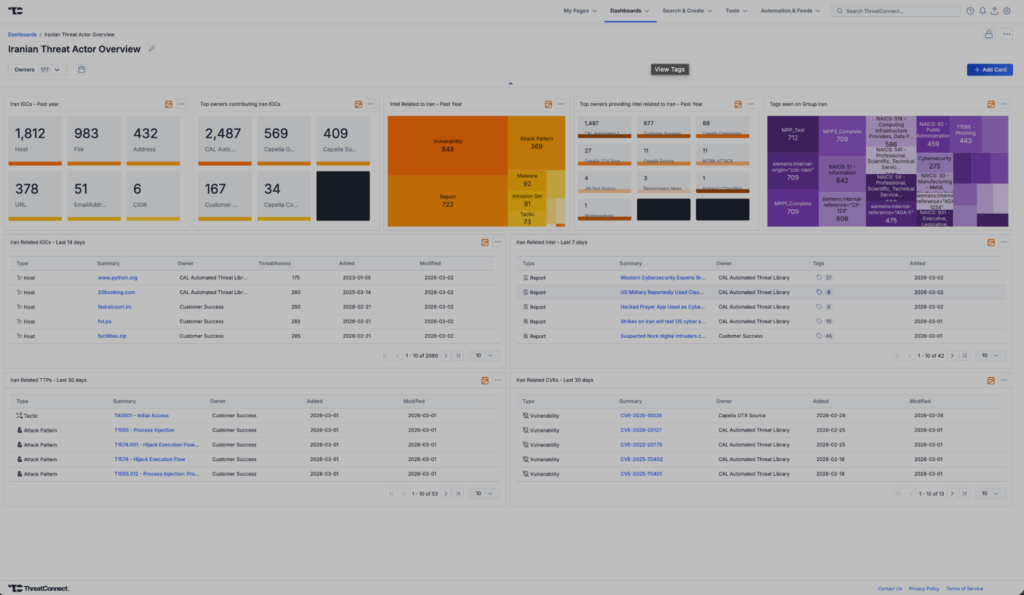
The Iranian Conflict Intelligence Dashboard has been updated to equip defenders with timely, high-fidelity intelligence that specifically reflects the dynamic threat environment shaped by this high-profile regional conflict with a heightened focus on Iran-linked activity.

Key Threat Actor Groups & Campaign Themes Tracked Include:

  • IRGC-affiliated Cyber Units (e.g., APT33, APT34, APT39, APT42): Tracking activity from primary state-sponsored groups.
  • Proxies and Ideological Hacktivist Actors: Monitoring activity from groups like CyberAv3ngers, APT IRAN, Handala Hack, Lulzsec, Dark Storm Team, GhostSec, Cyber Islamic Resistance, and others aligned with Iranian strategic interests.
  • Coordinated Influence and Disinformation Campaigns.
  • OT and Critical Infrastructure Targeting Efforts, particularly those targeting Israeli and Western assets.

Rather than tracking isolated threats, the –Iranian Conflict Intelligence Dashboard dashboard provides strategic context and operational detail across the broader cyber conflict spectrum, enabling faster detection, response, and mitigation.

Key Benefits:

  • Conflict-Centric Intelligence Aggregation – Centralized indicators of compromise (IOCs), TTPs, and threat insights related to Iranian-linked campaigns, sourced from open source intelligence (OSINT), premium threat feeds, and internal telemetry.
  • Live Threat Environment Tracking – Monitors shifts in activity across major adversary groups, cyber incidents, defacements, DDoS campaigns, and geopolitical events fueling escalation.
  • Accelerated Incident Response – Enriched and correlated intelligence to support triage, prioritization, and response activities during periods of elevated tension or retaliatory operations.
  • Custom Visualization & Analysis – Interactive dashboards featuring timeline analysis, actor overlap matrices, infrastructure clustering, and geographic threat origination maps.
  • ThreatConnect Automation Integration – Seamless correlation with existing ThreatConnect adversary profiles, intrusion sets, and signature-based alerts to identify high-risk overlaps with organizational environments.

Leveraging this dashboard allows security teams to anticipate conflict-related threats, understand attacker motivations, and tailor defenses to emerging risks as the Iranian cyber conflict evolves.

Specific Intelligence Focus: Iranian Malware List

  • APT42: tamecat, tabbycat, vbrevshell, powerpost, brokeyolk, chairsmack, asyncrat
  • APT34: powbat, powruner, bondupdater
  • APT33: shapeshift, dropshot, turnedup, nanocore, netwire, alfa shell
  • Other Related Malware: Gh0st Rat, quasarrat, amadey, bittersweet, cointoss, lateop

Specific Intelligence Focus: Iranian ICS Targets

ICS Systems Likely to be targeted by Iranian threat actors (based on analysis like the Censys report):

  • “Unitronics” or (“Vision” AND (PLC OR HMI))
  • “Tridium” or “Niagara”
  • “Orpak” or “SiteOmat”
  • “red lion”

Dashboard Components Include:

  1. Indicators linked to state-sponsored and proxy cyber operations.
  2. Threat groups aligned to Iranian strategic cyber interests.
  3. Reports and advisories referencing the conflict, regional escalations, or actor-attributed activity.
  4. Campaign tracking with attribution timelines, victimology insights, and strategic objectives.
  5. MITRE ATT&CK techniques used by affiliated groups, mapped to known incidents.
  6. Keyword and tag intelligence trends across conflict-related reporting.
  7. Infrastructure associations (e.g., shared IPs, domains, malware hashes).
  8. Actor and alias mapping, including cross-reference to public and private sector intelligence.
  9. Vulnerabilities linked to recent Iran intelligence activity.

Screen Capture of Iranian Conflict Intelligence Dashboard

Lead Contributor – Adrian Dela Cruz , Customer Success Engineer

To gain access to the Iranian Conflict Intelligence Dashboard, please reach out to your Customer Success team or reach out to us through our contact form.

The dashboard is also available here, and can be added manually to your ThreatConnect instance.

The post Iranian Conflict Intelligence Dashboard Immediately Available for ThreatConnect appeared first on ThreatConnect.

❌