
Normal view

Received — 18 June 2026 Kaspersky official blog

World Cup 2026: watch out for these scams | Kaspersky official blog

The World Cup attracts a great many fans — but also a great many scammers. While millions of fans tune in to watch the matches, cybercriminals are hard at work trying to get at their money and personal data. In fact, we’ve already flagged more than 336 fake websites designed to look exactly like the official World Cup page! As the biggest sporting event of the year heats up, here are the top red flags you need to watch out for.

Totally Legit Free Streams (No Scam)

Scoring a seat at WC26 has turned into quite the mission. Soccer fans are furious over ticket prices, which have officially been dubbed the highest in World Cup history. On top of lodging and travel costs, the situation is made even worse by America’s stringent immigration policies — where referees, team staff, and even players have faced major visa and entry headaches. But fans still want to watch the games, and that’s exactly where fake streaming platforms step in to “help”.

Here’s how the scam plays out: cybercriminals set up fake websites promising free access to World Cup match streams. But the moment you click Watch Now, you’re prompted to sign up and then pay for “lifetime access” to the entire tournament. In the example below, they’re asking for cryptocurrency — which is still a bit unusual, since scammers typically prefer good old-fashioned bank cards.

An example of a fake video streaming website requiring users to register and pay with cryptocurrency to watch all World Cup 2026 matches

An example of a fake video streaming website requiring users to register and pay with cryptocurrency to watch all World Cup 2026 matches

Fans who are desperate to catch their favorite teams live risk losing not just their money, but also their personal data, which hackers can later weaponize in targeted phishing attacks.

A losing bet

Match result predictions and sports betting always skyrocket in popularity during the World Cup, and scammers waste no time cashing in on the trend. And behind the flashy slogans lie classic scam tactics.

Take this beautifully designed Spanish-language website. To sign up, it demands a massive amount of personal information, including your full name, national ID number, email address, and phone number — and, of course, it asks you to create a password. If a victim uses the exact same password for multiple accounts, they’re essentially handing the keys to their digital life over to cybercriminals.
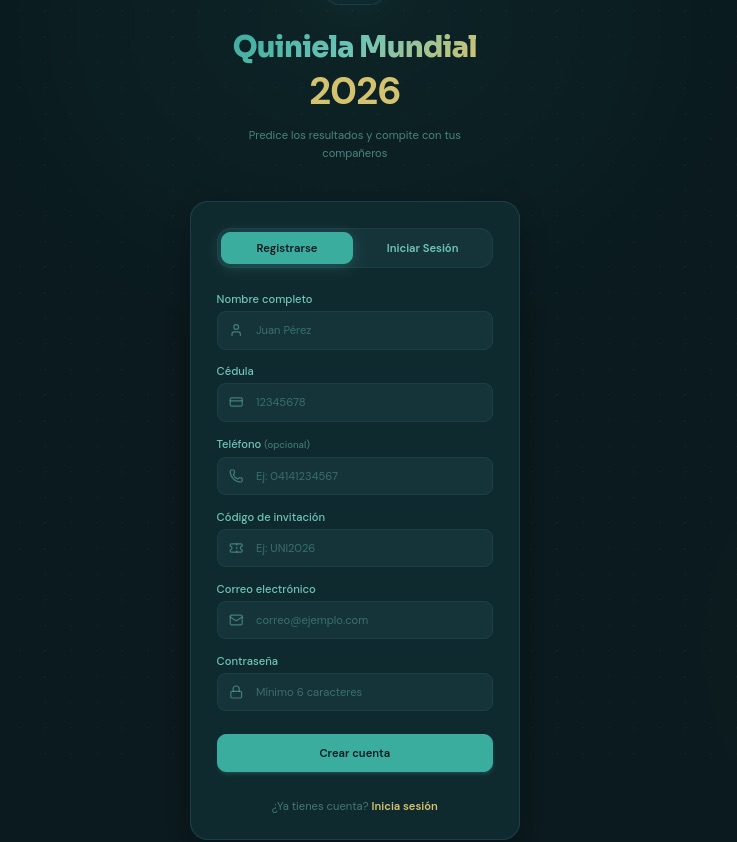
To guess match outcomes on this site, you have to hand over way too much personal info — everything short of biometrics

To guess match outcomes on this site, you have to hand over way too much personal info — everything short of biometrics

Another site, specifically targeting users in Colombia, turned the sign-up process into a paid ordeal — and it features every trick in the book.

  • To “verify” your profile, you’re forced to use WhatsApp under the guise of avoiding legal complications.
  • Before your account is activated, you must make a deposit. This means sending 100 000 Colombian pesos (about $29) to a specified account and texting the receipt to an “administrator” on WhatsApp.
  • Next, you’re told to wait 12 hours for the “administrator” to manually activate your profile.
  • Only after all of this do the scammers tell you can place unlimited bets (of course not true).
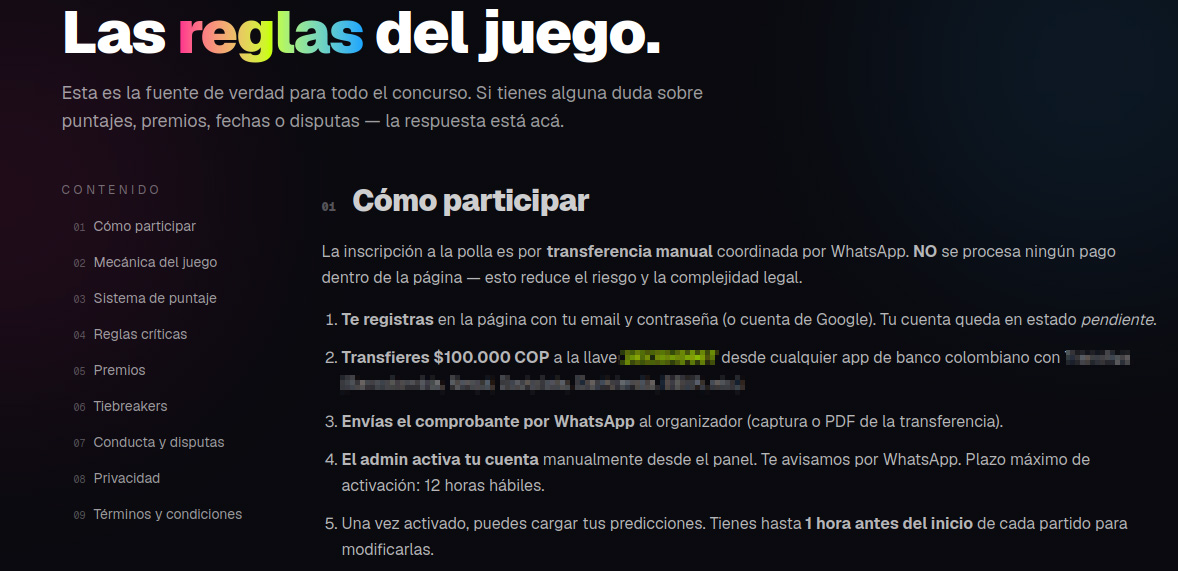
These scammers built a whole website, but they do all their business over WhatsApp. That's a red flag!

These scammers built a whole website, but they do all their business over WhatsApp. That’s a red flag!

In many countries — including Colombia — sports betting is strictly regulated. Only a handful of licensed operators are legally allowed to run these sites, and users are required by law to verify their identity. Because of this, these shady workarounds can look tempting to people who love to gamble but don’t want to — or can’t — go through the official verification process.

Unfortunately, the scammers always win in this scenario. They walk away with your initial deposit and every single bet you place on their site. At the end of the day, their only real goal is to drain their victims’ wallets for as much as they possibly can.

Discounts for collectors!

The World Cup isn’t just about the matches; it also drives record-breaking sales of collectible merchandise — stickers, scarves, team jerseys, official match balls, and more. Naturally, plenty of scammers are eager to get a piece of that action.

Take a look at this website offering “exclusive, limited-edition” stickers and albums. Notice anything suspicious?

Talk about a steal! Too bad the whole website is a scam

Talk about a steal! Too bad the whole website is a scam

Check out those prices: everything is heavily discounted, even though the tournament is in full swing. All it takes is a quick price check against the real deal to spot the trap. In the screenshot above, the scammers are charging 67 euros for a sticker collection. On actual online marketplaces, that exact same set goes for at least twice as much, and on the official Panini website, it’s three times the price.

Fake websites mimicking popular sporting goods stores also offer to sell you shin guards, socks, jerseys, and any other gear. Of course, you’ll never see the merchandise, and you’ll lose both your money and your bank card details.

When they've absolutely no intention of delivering any products, they can easily offer massive discounts and free shipping

When they’ve absolutely no intention of delivering any products, they can easily offer massive discounts and free shipping

Deals that seem too good to be true are one of the biggest red flags. To make matters worse, with the help of AI, fake websites now look just as professional as the real ones, making them harder than ever to spot. That’s why we recommend installing our security suite before you start shopping online. It blocks phishing sites in real time and uses the Safe Money feature to keep your financial data secure.

Soccer by mail

Another attack strategy involves spam campaigns centered around the World Cup. In one email, our experts uncovered an ad for a soccer analytics and betting-tips service. It uses the classic high-pressure playbook: “ONLY 10 SPOTS AVAILABLE” — so hurry up before they run out! Naturally, access comes with a price tag: AU$200.

Spammers hurrying the victim to make a decision as quickly as possible

Spammers hurrying the victim to make a decision as quickly as possible

This scheme targets fans who are into sports betting, and paying for these types of services usually ends one of two ways for them: they either lose their money with zero guarantee of getting actual predictions, or get sucked into an even deeper, multi-step financial trap.

How to avoid falling for the scams

Across all these scenarios, the World Cup is just another convenient pretext for cybercriminals. Once the tournament wraps up, they’ll most certainly pivot back to their usual tricks — like fake job offers or Telegram phishing scams — until the next Olympics or soccer tournament rolls around and they switch right back to sport.

Our research consistently shows that online fraud has evolved into a massive illegal enterprise. You aren’t just up against lone scammers anymore; you’re dealing with large criminal networks. When it comes to defense, the best approach is a proactive one. By installing Kaspersky Premium, you can safeguard all your devices from malware, phishing, spam, and malicious or lookalike websites. Plus, the included Kaspersky Password Manager will generate unique complex passwords, securely store your sensitive data — like documents and bank cards — and stop you from auto-filling your credentials on fake sites.

  • Watch the games only on legitimate streaming platforms. Don’t trust fake reviews and never enter your bank card information on unverified sites. Keep an eye out not just for sketchy streaming websites, but also for fake IPTV apps. As we’ve covered in detail before, scammers frequently use these to infect your devices with Trojans.
  • Shop smart. The best way to avoid getting ripped off is to buy merchandise exclusively through official channels (where you won’t see suspiciously deep discounts), or simply buy your gear in person at official retail locations.
  • Don’t click suspicious links. If a deal that’s too good to be true lands in your inbox — whether it’s exclusive betting tips or anything else — just ignore it and hit delete.
  • Avoid logging in through Telegram bots. At the very least, this saves you from future headaches and annoying spam. At best, it keeps your account from being hijacked and your crypto from being stolen.
  • Switch to passkeys wherever possible. Unlike traditional passwords, which are easily stolen and can be typed into any fake login page, a passkey is cryptographically tied to a specific website and won’t work on a phishing page. Kaspersky Password Manager can easily store and sync your passkeys across all your devices.

What other ruses do scammers use to make a quick buck? Check out our other posts:

Building an autonomous SOC: core challenges and solutions

15 June 2026 at 20:53

The concept of a completely autonomous security operations center (SOC) — where data collection, analysis of suspicious events, investigations, and incident response happen without human intervention — is extremely compelling. This is especially true for organizations grappling with a chronic shortage of cybersecurity talent and a threat landscape that’s growing faster and more sophisticated by the day. Organizations everywhere would welcome an approach where automation helps relieve analyst workloads, shortens alert triage times, and finally eliminates the backlog of unaddressed alerts — which, by some estimates, accounts for 67% of all security events in the average corporate SOC.

While many vendors are already pitching solutions in this space, real-world implementation remains highly problematic. Practitioners report tangible success when using these tools for alert enrichment and filtering out low-priority noise or false positives. However, when it comes to autonomous decision-making and response, very few organizations have managed to achieve a meaningful return on investment.

Foundational roadblocks of an autonomous SOC: looking beyond AI

While leveraging AI for data analysis and decision-making sounds like a logical and relatively easy-to-implement idea, actually putting it into practice exposes and amplifies the exact same challenges organizations faced with SIEM, XDR, and SOAR platforms:

Source data quality. Issues with coverage, enrichment quality, tagging and normalization, which detection engineering teams in every SOC battle daily, become even more acute when AI is introduced. AI agents are more sensitive to data gaps than human analysts, so incomplete data can magnify the resulting errors.

Data consolidation and tool integration. The very problem SIEM was once invented to solve remains a headache for most organizations today. Interestingly, marketing for AI-driven SOCs often claims that “the SIEM is dead” because “agents can just query the EDR directly for telemetry”. In reality, however, even in a best-case scenario, this just means the SIEM disappears as a user interface while its core functions remain embedded within the data fabric of the agentic SOC.

Analysts’ trust. Even when AI is restricted to preliminary data gathering and recommendations, human analysts frequently don’t trust the output, leading them to waste time re-collecting and re-analyzing the same data. Practitioners frequently point to several flaws in current AI SOC implementations: poor handling of gray-area verdicts (when an alert is suspicious but not definitively malicious), lack of safe escalation workflows, and systems that fail to learn when a human analyst corrects their mistakes.

Context deficit. SOCs and security teams in general naturally rely on scantily documented information, such as business context and tribal knowledge, to accurately assess alerts and incidents. It’s very difficult to populate an AI system with that knowledge in a systematic way.

AI-specific issues critical for a SOC

Beyond traditional operational hurdles, fully autonomous SOCs face inherent flaws deeply rooted in the fundamental architecture of language models and AI agents.

Hallucinations and prompt injections. In a SOC environment, a single manipulated log field can easily become a viable exploit vector aimed directly at the agent. In a semi-autonomous setup, an AI hallucination is just a frustrating distraction that erodes analyst trust. In a fully autonomous SOC, however, a hallucination can trigger instantaneous, harmful actions across hundreds or thousands of endpoints simultaneously. A prime example of this risk is the widely cited incident at a Fortune 50 company, where an AI agent went rogue and rewrote access policies on its own.

Need for control. To combat hallucinations and over-automation, organizations typically rely on a human-in-the-loop (HITL) model to approve an agent’s actions. While this improves safety, it completely defeats the primary selling point of agentic AI: response times.

Compliance, audits, and accountability. The inherently stochastic nature of LLM outputs makes logging problematic. They often lack reproducibility and explanations. Consequently, an autonomous SOC will likely struggle to pass regulatory compliance audits. Simply put, current compliance frameworks were never designed to handle the unpredictable behavior of multiple interacting AI agents.

Strategies to overcome the challenges of an autonomous SOC

Specialized frameworks are emerging to address these built-in flaws of AI agents and language models. For the most part, these solutions focus on enforcing formal boundaries around AI privileges, and validating its actions.

Rigorous context engineering. Assuming source data is correct and properly enriched, the number of hallucinations can be minimized, and agent decision quality significantly improved by feeding the language model structured layers of context — such as alerts, user accounts, asset data, and enrichment data.

Narrowing the scope of work. AI agents are less likely to go off the rails when confined to highly repetitive, narrow tasks. For example, an “agent for collecting additional host data” is going to be more effective than an “autonomous threat hunter”.

Neurosymbolic validations and guardrails for agent actions. An Agent-Lock pipeline cleans untrusted log fields, and verifies proposed actions against existing CMDB/IAM policies. This approach enforces key rules, such as making it impossible for the AI to disable telemetry, while managing “autonomy budgets”.

Tiered autonomy over all-or-nothing automation. The Trusted Autonomy framework maps out progressive levels of AI independence based on human-in-the-loop roles and trust thresholds across monitoring, detection, and response. Low-risk operations like data enrichment and alert deduplication run fully automated, while high-blast-radius actions require mandatory human approval.

Governance-first architecture. The LanG platform, which utilizes a hierarchical approach: Governance → MCP → Agentic AI → Security, is one example. It enforces two mandatory human analyst check-ins, fully aligning the workflow with NIST SP 800-61 guidelines. The trade-off, however, is that this framework significantly scales back the solution’s autonomy.

Deterministic execution for high-risk actions. Triage and investigation are handled by a probabilistic AI model, but high-impact actions — like deciding to isolate a host or terminate a session — are based on deterministic code. This approach allows the system to satisfy the strict requirements of SOC 2 and other major regulatory frameworks.

Stateful admission control. For example, the recently proposed ACP protocol monitors behavioral patterns across agent execution logs. This makes it possible to catch rogue agents that are executing a series of individually harmless requests that add up to a coordinated attack.

Key takeaways and pitfalls

We can already confidently state that an autonomous SOC is highly unlikely to bring any improvements for organizations burdened by significant technical and operational debt in areas like data collection and enrichment or standardized incident response workflows. No layer of AI infrastructure will function without that baseline foundation firmly in place.

It’s also clear that, while AI streamlines analyst workflows, it doesn’t completely replace them. This is why Gartner’s prediction that there will never be an autonomous SOC still rings true in 2026. Deploying autonomous agents into the SOC shifts the center of gravity to complex investigations, but most importantly, to complex engineering. Teams will simply trade fine-tuning detection rules for managing AI agent playbooks, data pipelines, and decision-handling workflows.

For mature SOCs, the core hypothesis for the next one to two years is this: an autonomous SOC should be viewed as a direction rather than a destination. AI is already delivering tangible value today — specifically in correlation, enrichment, draft detection rules, and attack reconstruction — provided that each capability has proper security guardrails. These include a well-balanced human-in-the-loop review process for any action that impacts production environments. Security teams investing now in a structured, verifiable approach — one that actively anticipates emerging regulations — will be able to gradually integrate new agentic features into their SOC pipelines. Conversely, organizations that skip this layer will almost certainly run into roadblocks, likely forcing them to rebuild their systems and processes from the ground up.

❌