Normal view

Received — 21 May 2026 AWS Security Blog

AWS Security Hub Extended: Why enterprise security products should sell themselves

20 May 2026 at 19:32

Our largest security services customers started the same way every customer does – with a click. They enabled Amazon GuardDuty, Amazon Inspector, AWS WAF, and AWS Security Hub, experienced the benefits in real time, and evaluated with transparent pay-as-you-go pricing. No RFP. No six-month evaluation. No multi-year commitment up front. Our field teams played a critical role in that growth, not by selling the first click, but by building the trusted relationships that turned early adoption into deep, long-term commitment. We believe customers should have this same frictionless adoption experience and flexibility for all best-in-class security products and that’s why we developed Security Hub Extended.

In our first post, we introduced Security Hub Extended, a significant expansion of Security Hub that brings together curated partner solutions in a single, unified experience. In our second post, we walked through how it works technically, including the onboarding flow, the pricing model, the unified operations layer built on the Open Cybersecurity Schema Framework (OCSF). In this post, I want to step back and talk about why we built it the way we did and why I believe the way enterprises discover, evaluate, and adopt security solutions is ready for a fundamental shift.

The shift

If you’ve ever tried to evaluate a new enterprise security product, you know the drill. Request a demo. Wait. Take the demo. Request a PoC. Wait for professional services (or your team to stop building) to set it up. Negotiate pricing, which isn’t published, so you’re starting blind. Loop in procurement. Sign a multi-year commitment. Then, months later, find out whether the product actually solves your problem in your unique environment.

Meanwhile, an ambitious security engineer on your team has already spun up an open-source tool, connected real data, and knows in two hours whether it’s going to work for your use cases. They didn’t need a slide deck. They needed a solution they could put their hands on.

A Fortune 500 CISO recently told me: “I spent 9 months procuring a security solution and it still doesn’t work the way the demo showed.” That frustration isn’t unique. It’s the norm.

This isn’t a criticism of the sales motion. Sales-led has evolved for good reason. Enterprise procurement is complex, products need customization, customers need support. I respect the craft and have poured a significant portion of my career into trying to perfect it. Even the most product-driven companies still need great sales, marketing, field enablement, and support.

It doesn’t change the fact that threats are evolving constantly, and defenders need the flexibility to discover and deploy new solutions as fast as the landscape shifts. Having the best solutions discoverable and deployable in that moment of need isn’t just a convenience, it’s a competitive advantage that customers are demanding. A new threat emerges, security teams have access to industry-leading solutions, and in a few clicks they’ve found their answer and are already seeing value. That’s the model every security company should be building toward.

What we’ve learned at AWS

At AWS, we’ve spent two decades learning what it takes to let customers adopt complex enterprise technology on their own terms, at massive scale. We haven’t always gotten it right, but we learn fast and adjust. The result is one of the largest cloud businesses in the world. I bring up that scale for one reason. It’s proof that complex, enterprise-grade technology can be adopted without requiring a traditional procurement gauntlet. Compute, storage, databases, AI/ML, networking, and yes, security — adopted all through a console, on each customer’s own timeline, and scaled when they were ready.

The proof is in the adoption

Amazon GuardDuty, Amazon Inspector, AWS Shield, AWS Security Hub are all available through the AWS Management Console. All pay-as-you-go. All activated with a click. Tens of thousands of customers rely on these security services today. When you make it easy to get started and deliver outcomes that earn confidence, expansion follows naturally.

These are sophisticated, enterprise-grade security solutions. And customers, from two-person startups to the world’s largest financial institutions, adopt them the same way. They try it, see the value, expand, and lean on the AWS team to go deeper.

We didn’t get here by accident, and we definitely didn’t get here without making mistakes. Building products that can be adopted and scaled on their own, without a sales engineer explaining away UX problems, without a solutions architect doing the first deployment, requires a different kind of product mindset. Time-to-value becomes your most important metric. Onboarding friction becomes your biggest enemy. Transparent pricing becomes non-negotiable. It’s hard. We’ve gotten a lot wrong along the way. And we’re still iterating.

But the results are clear. When customers adopt based on experience rather than commitment, they don’t just stay, they expand. They bring their teams. They become advocates. I’ve spent 15 years at AWS, the last 10 building security services like GuardDuty and Security Hub. When we launch a new security service or major feature, we consistently see rapid organic adoption at a pace that would be impossible through traditional sales cycles alone. These products are built to deliver value the moment customers turn them on and we make that as easy as we possibly can. That’s the scale a product-led motion unlocks.

Security Hub Extended

So, we asked ourselves: why can’t we build a similar approach that can expand to include industry leading partner solutions? Why can’t the CrowdStrikes, the Splunks, the Zscalers, and the fast-growing innovators solving tomorrow’s problems like Cyera, Noma, and 7AI also reach customers with the same frictionless motion that AWS services enjoy? Why can’t a security team that discovers a new threat on Monday have a proven solution deployed and delivering value by Tuesday? Our partners have built incredible products. What they haven’t always had is an avenue to put those products directly in the hands of the customers who need them most, at the moment they need them, at scale, in a way that feels as natural as turning on an AWS service. Not by replacing how our partners build or sell, but by giving them infrastructure that lets their products speak for themselves.

That’s what Security Hub Extended is. Security teams already using Security Hub can discover curated partner solutions right alongside their AWS security services. One click to evaluate, one click to deploy, pay-as-you-go pricing on your existing AWS bill with Enterprise Discount Program (EDP) discounts automatically applied. No separate procurement cycle. No long-term commitments required. Start fast, validate at scale, and commit for deeper discounts when you’re ready, versus making a three-year bet based on a few months of testing.

For customers, industry-leading enterprise security solutions become as easy to adopt as GuardDuty or WAF. For our partners, Security Hub Extended is a growth channel where the product leads and the customer experience mirrors what we’ve spent 20 years building at AWS. For the industry, it’s an invitation to reimagine what the relationship between a security product and a security practitioner can look like when you remove the friction standing between them.

But Security Hub Extended isn’t just a simpler way to buy security products. It’s a unified solution. When a customer enables a solution through Extended, we’re working toward an experience where AWS handles the rest. Sensors that deploy automatically across Amazon EC2, Amazon EKS, and AWS Fargate workloads using the same mechanism that powers GuardDuty Runtime Monitoring. IAM roles that provision across a customer’s Organization in one click. Resource inventory is automated from day one – S3 buckets, databases, AI workloads – without manual work.

Once enabled, solutions in Security Hub Extended emit findings in OCSF, automatically aggregated in Security Hub alongside findings from GuardDuty, Amazon Inspector, and every other AWS security service. Security Hub applies risk scoring and correlated risk analytics across all of them. AWS-native and third-party findings together, weighted and prioritized as a single view of your security posture. For example, an endpoint detection from CrowdStrike, correlated with a credential theft in GuardDuty, and a data access event from Cyera, produces an attack path that none of those solutions can produce alone. The correlation uses AWS context (IAM topology, VPC exposure, resource criticality) to improve the context of each attack path for security analysts. Deploying a solution through Security Hub Extended doesn’t add another pane of glass. It deepens the intelligence of the one you already have.

We’re also building toward automated response. Customers will be able to opt in to pre-built playbooks that take action through AWS-native services when a threat is detected, such as isolating compromised resources, revoking credentials, or containing active threats. The goal is detect-to-respond in seconds, not the hours it takes to context-switch across five consoles and two ticketing systems.

Where we are and where we’re headed

We’re still in the first inning — or Day 1, as we like to say at Amazon. We launched in February 2026 with 14 partners, now 21, spanning endpoint, identity, email, network, data, browser, cloud, AI, and security operations, and we’re continuously working backwards from customers as we operationalize for scale. We are building this because our customers asked for it. We’re learning alongside our partners and customers every week, identifying what works, what needs improvement, where the friction still lives, and iterating quickly.

We’re building and delivering at the speed of our customers. That means shipping fast, iterating faster, and not waiting for perfection. We’re not where we want to be just yet, and we need your feedback to get us there. What’s encouraging is that our partners aren’t waiting to be asked. They’re investing in this alongside us. Not because we’re demanding it, but because they see the same thing we do, that companies that make it effortless for customers to get started are the ones that will win at scale.

The early signals are encouraging. Customer response has exceeded our expectations, and the feedback we hear most often is that the procurement simplification and flexibility of pay-as-you-go with public pricing alone, even before the unified operations and data normalization benefits, is a meaningful differentiator.

If you’re a security leader: Security Hub Extended is live now. Log into Security Hub, look for the Security Hub Extended Plan (or visit the Security Hub Extended Pricing Page), and explore what’s available for your use cases. Start with what solves your most urgent problem. Pay-as-you-go, no commitment. Your team will tell you if it’s working in days, not months.

The vision is bigger than what’s live today, and we’re iterating fast. Share your feedback on AWS re:Post for Security Hub, reach out through contact AWS Support, or connect with me directly.


Michael Fuller

Michael Fuller

Michael has been with AWS for 16 years and led product for AWS Security Services for 11 years. Michael has 29 years in the industry and held several roles in product management, business development, and software development for IBM, Cisco, and Amazon. Michael has a Bachelor’s of Science in Computer Engineering from the University of Arizona and an MBA from the University of Washington.


Received — 23 April 2026 AWS Security Blog

Building AI defenses at scale: Before the threats emerge

7 April 2026 at 20:02

At AWS, we’ve spent decades developing processes and tools that enable us to defend millions of customers simultaneously, wherever they operate around the world. AI has been an extremely helpful addition to the automation our security and threat intelligence teams do every day, and we’re still early in this journey. Our AI-powered log analysis system has reduced the time SecOps engineers spend analyzing security logs from an average of six hours to just seven minutes, a 50x productivity increase that lets us detect and respond to threats faster than ever. Across AWS, we analyze over 400 trillion network flows per day to detect patterns that signal emerging threats. In 2025 alone, we blocked over 300 million attempts to maliciously encrypt customer files hosted on Amazon S3. At this scale, every improvement in our operations helps protect all customers. AI is already helping us make our defenses stronger for everyone, and I’m excited to see that improvement continue.

A new class of AI for cybersecurity

Today, Anthropic announced Project Glasswing, a cybersecurity initiative designed to secure the world’s most critical software and advance the cybersecurity practices the industry will need as AI grows more capable. Organizations that build or maintain critical digital infrastructure are getting early access to Claude Mythos Preview, a new class of AI model, to find and patch vulnerabilities in the systems the world depends on. Given our role in securing some of the world’s most essential infrastructure, AWS is playing an integral part in advancing this work.

As part of Project Glasswing, we’ve already applied Claude Mythos Preview to critical AWS codebases that undergo continuous AI-powered security reviews, and even in those well-tested environments, it’s helped us identify additional opportunities to strengthen our code. In our internal testing, Claude Mythos Preview has proven more productive than previous models at surfacing security findings, requiring less manual guidance from our engineers to deliver actionable results. We’ve also given early access to a select group of AWS customers, who are deploying Claude Mythos Preview in their own security workflows and helping shape how the model evolves.

As AI tools grow more powerful in their ability to identify security issues, so must our ability to use them defensively. To that end, we’ve been working closely with Anthropic to help ensure Claude Mythos Preview is ready for enterprise use. AWS is Anthropic’s primary cloud provider for mission-critical workloads, safety research, and foundation model development. More broadly, AWS provides the foundational infrastructure that the world’s leading AI companies rely on to build, train, and deploy their most advanced models. We’re bringing decades of security experience to this partnership, helping to ensure Claude Mythos Preview is ready for even more organizations to build upon and operate securely at scale.

Claude Mythos Preview signals an upcoming wave of models that can find vulnerabilities and build working exploits at a scale and speed we haven’t seen before. Anthropic and AWS are taking a deliberately cautious approach to release. Access begins with a small number of organizations, prioritizing internet-critical companies and open-source maintainers whose software and digital services impact hundreds of millions of users. The goal: find and fix vulnerabilities in the world’s most critical software. Claude Mythos Preview is available in gated research preview through Amazon Bedrock with enterprise-grade security controls, including customer-managed encryption, VPC isolation, and detailed logging, so your team can explore Claude Mythos Preview’s capabilities without exposing production assets to unnecessary risk.

AWS architects services with security at the core

Our work with Project Glasswing is grounded in a philosophy we’ve developed over two decades of securing mission-critical workloads: you can’t wait for threats to materialize before building your defenses. You have to look around corners, adopt new technologies, build protections first, deploy them in your own operations at scale, and refine them based on what you learn.

That’s exactly what we’ve done at AWS with AI and security. Our approach spans the full spectrum: proactive defense through threat hunting and vulnerability research, dynamic response to active campaigns, and third-party certifications that verify our security practices meet the highest industry standards. This operational experience has taught us where AI accelerates security work and where human judgment remains essential. And it’s reinforced that security innovation must be pragmatic: proven in production before we ask you to rely on it.

That’s also why we help define what secure AI looks like. We became the first major cloud provider to achieve ISO 42001 certification for AI services. We’re active participants in OWASP, the Coalition for Secure AI, and the Frontier Model Forum. And we co-founded the Open Cybersecurity Schema Framework (OCSF) to enable better threat intelligence sharing across the ecosystem. The AWS Nitro System provides mathematically proven isolation for workloads. Systems and services like KMS, Nitro, EKS, and Lambda are designed with zero-operator access architectures, meaning AWS personnel can’t access your data. These aren’t aspirational goals. They’re how we operate today, at scale, every day.

Amazon Bedrock is where these principles come to life for AI. Bedrock provides policy-enforced access controls, built-in evaluation tools to measure how effectively models identify and validate vulnerabilities, and the ability to run workloads inside your own virtual private cloud. AWS is also the first cloud provider to achieve FedRAMP High and Department of Defense Security Requirements Guide Impact Level 4 and 5 authorizations for generally available Claude foundation models. Amazon Bedrock is already where the most security-sensitive organizations trust Anthropic’s technology, and it makes perfect sense for Claude Mythos Preview.

How to get started today

The same principles that guide our work at AWS scale apply regardless of which AI tools you’re using: comprehensive observability, defense in depth, automation where it adds value, and human judgment where it’s essential. Here’s how to put them into practice.

Prepare for the next generation of AI security. Claude Mythos Preview signals an upcoming wave of AI models that will transform cybersecurity. Start strengthening your security posture now so your organization is ready as these capabilities become more broadly available. Claude Mythos Preview is available in gated preview through Amazon Bedrock, and access is limited to an initial allow-list of organizations. If your organization has been allow-listed, your AWS account team will reach out directly.

Run on-demand penetration testing with AWS Security Agent. Now generally available, AWS Security Agent delivers autonomous penetration testing that operates 24/7 at a fraction of the cost of manual penetration tests. It transforms penetration testing from a periodic bottleneck into an on-demand capability that scales with your development velocity across AWS, Azure, GCP, other cloud providers, and on-premises. AWS Security Agent represents a new class of frontier agents: autonomous systems that work independently to achieve goals, scale to tackle concurrent tasks, and run persistently without constant human oversight. It deploys specialized AI agents to discover, validate, and report security vulnerabilities through sophisticated multi-step scenarios. Unlike traditional scanners that generate findings without validation, AWS Security Agent identifies potential vulnerabilities, then attempts to exploit them with targeted payloads and attack chains to confirm they are legitimate security risks. Each finding includes CVSS risk scores, application-specific severity ratings, detailed reproduction steps, and remediation suggestions. The result: penetration testing that once took weeks now completes in hours, scales across your entire application portfolio, and helps you get started with remediation instead of leaving you with a report. New customers can explore AWS Security Agent with a 2-month free trial.

Build AI applications you can trust with Amazon Bedrock. For teams building with generative AI, the challenge isn’t just making AI work, it’s making AI work safely. Amazon Bedrock provides the security and safety controls you need to deploy AI responsibly. Its Automated Reasoning capability is the first and only AI safeguard to use formal logic to help prevent factual errors from hallucinations, providing verifiable explanations with 99% accuracy, a capability we’ve refined over more than a decade of applying formal methods across AWS storage, identity, and networking. Amazon Bedrock also provides customizable guardrails that block harmful content and enforce your content policies, along with comprehensive observability to track AI behavior and detect anomalies across your workloads.

The threat landscape isn’t waiting

The threat landscape isn’t waiting for us to catch up. Nation-state actors, ransomware operators, and supply chain attackers are already using AI to scale their operations. Our job is to stay ahead by building defenses first, deploying them at scale, and sharing what we learn so the entire community benefits.

That’s what we do every day at AWS. We build in security from the start, ensuring it works and scales before we ask customers to rely on it. We set standards rather than follow them. And we look around corners to address tomorrow’s challenges today.

As AI capabilities continue to evolve, this approach won’t change. We’ll keep building defenses first, refining them at scale, and working with partners like Anthropic to ensure the next generation of AI security tools meets the real-world needs of enterprises defending at this scale.

Learn More

If you have feedback about this post, submit comments in the Comments section below.

Amy Herzog

Amy Herzog is Vice President and Chief Information Security Officer (CISO) at Amazon Web Services (AWS) where she leads a global organization of cloud security professionals in a company in which security is the top priority. Prior to joining AWS, Amy served as CISO for Amazon’s Devices and Services, Media and Entertainment, and Advertising businesses, overseeing the security of consumer technology offerings such as Alexa+ and Ring, and playing a key role in the secure development of Project Kuiper, Amazon’s initiative to provide fast, reliable broadband to customers and communities around the world through low earth orbit satellites.

Four security principles for agentic AI systems

2 April 2026 at 22:45

Agentic AI represents a qualitative shift in how software operates. Traditional software executes deterministic instructions. Generative AI responds to human prompts with output that humans review and use at their discretion. Agentic AI differs from both. Agents connect to software tools and APIs and uses large language models (LLMs) as reasoning engines to plan and execute sequences of actions autonomously—at machine speed—with real-world consequences. This shift raises new questions for information security. In January 2026, NIST’s Center for AI Standards and Innovation (CAISI) issued a Request for Information (RFI) seeking industry input on how to secure these systems. AWS submitted a response grounded in our experience building and operating agentic AI services. This post summarizes the four security principles at the heart of that response and the architectural building blocks that implement them.

The NIST agentic AI RFI

CAISI asked developers, deployers, and security researchers to weigh in on how the industry should secure AI systems that act autonomously. The RFI posed questions across five areas. What unique security considerations do agentic systems introduce, and how do those considerations change as systems gain more autonomy? What practices improve security during development and deployment? How do organizations assess the security of their agentic systems? How can deployment environments be constrained and monitored? And where should the industry focus future research?

Why this matters

Even a conservative risk/benefit analysis will conclude that the benefits of agentic AI clearly outweigh the risks in many domains. The rapid adoption of agentic technology across business and government confirms this. But agents are valuable precisely because of their autonomy and adaptability, and these same characteristics create the security challenge. An agentic system that carries out an unintended action can do so at machine speed, before a human can intervene. Unlike human actors who pause or escalate when something seems unusual, agents might not inherently recognize ambiguities that are evident to humans, nor intuitively grasp unstated policy boundaries.

The good news, however, is that the security response to agentic AI doesn’t need to start from scratch. Existing security frameworks, including the NIST Cybersecurity Framework, NIST AI Risk Management Framework, and the Secure Software Development Framework, remain relevant and should be extended for agent-specific considerations rather than replaced. The most important extension is architectural. Our response to NIST identified four foundational security principles that address how to make that extension.

Four security principles for agentic AI

These principles build on the premise that agentic AI doesn’t require a new security paradigm, but it does require existing practices to evolve. The first two principles address what carries forward; the second two address what is genuinely new.

Principle 1: Secure development lifecycle practices apply across system components. Agentic AI systems combine traditional software components (APIs, databases, orchestration logic) with AI elements such as foundation models, prompt templates, and retrieval pipelines. A secure development lifecycle must cover both sets of components. For traditional components, established practices such as code review, static analysis, dependency scanning, and threat modeling remain essential, keeping in mind that those practices are also in the process of being enhanced with AI-based tooling. For AI components, the challenge is different. Foundation models are probabilistic, which means traditional regression testing is necessary but not sufficient. Organizations must supplement it with behavioral testing, adversarial evaluation, and continuous monitoring to validate that AI components operate within expected parameters.

Regular re-evaluation is equally important for addressing behavioral drift. Models receive updates that can alter behavior. Prompt templates evolve as teams refine agent capabilities. New tools and data sources expand the agent’s operational surface. Each change can introduce new failure modes or potential security issues. Organizations must treat evaluation as an ongoing operational practice, not a one-time gate. This includes automated testing after model updates, red team exercises against deployed agents, and monitoring that detects behavioral drift over time.

Principle 2: Traditional security controls remain fully applicable. Agentic AI introduces new considerations, but it doesn’t render existing security risks obsolete. The full complement of traditional security controls still applies. An agentic AI system combines traditional software with the new LLM-plus-tools processing loop. Organizations must secure existing software, tools, and configurations against well-known risks to provide a sound foundation for the agentic elements.

Privilege escalation, confused deputy issues, session hijacking, code injection, and supply chain risks extend directly into agentic systems. Some of these risks increase in agentic contexts. Agents operate at greater scale and speed than human actors, which means excessive privileges carry more potential for unintended consequences. That means that applying principles of least privilege to access management in an agentic context is as important—if not more so—than in traditional systems. The supply chain surface is also broader. Agentic systems consume not only third-party code dependencies but also foundation models, plugins, tool servers, and data retrieval sources. Agents that invoke APIs, query databases, or generate code create new potential injection surfaces at tool boundaries. AI-specific controls must be additions to this foundational security, not replacements for it.

Principle 3: Deterministic external controls are the starting point for agentic security. This is the most important architectural principle for agentic AI security. Organizations should enforce security through deterministic, infrastructure-level controls external to the agent’s reasoning loop, not through the agent’s own reasoning, internal guardrails, or prompt-based instructions. The logic is straightforward. LLMs are probabilistic reasoning engines, not security enforcement mechanisms. Developers can instruct an LLM to refuse certain requests, but prompt injection techniques can override those instructions. An LLM can be told to respect access boundaries, but it has no reliable mechanism to enforce them. Attempting to constrain agent behavior only through prompting or alignment runs against the fundamental value proposition of agents, which is their ability to adapt dynamically to novel situations.

Effective security places fully specified, deterministic controls outside the agent that govern which tools it can access, what operations it can perform, and what data it can reach. Model manipulation cannot bypass these controls. We describe this as the security box. It’s external to the agent, deterministic in its enforcement, and comprehensive in its coverage. Every interaction between the agent and the outside world passes through it. The Agentic AI Security Scoping Matrix helps organizations calibrate the rigor of these controls based on their system’s autonomy level. Scopes range from systems that require explicit human approval before every action to fully autonomous systems that initiate their own activities based on external events.

The security box isn’t a limitation on the agent’s value. It’s the precondition for achieving that value responsibly. As agentic technology matures, the box itself will likely evolve to include agentic elements. Specialized AI agents designed to control the scope of other agents might replace some deterministic constraints over time, using new information and context to make more appropriate automated decisions than could be achieved by humans managing complex deterministic controls.

Principle 4: Greater autonomy should be earned through ongoing evaluation. Organizations should expand agent autonomy progressively based on demonstrated performance, not grant it by default. The starting point is human decision-making for high-consequence operations. When an agent encounters an action that could modify high-value production data, initiate financial transactions, or communicate sensitive information externally, a human makes the final decision. The agent recommends, and a human approves or rejects.

This approach carries a well-known risk. If every agent action requires human approval, the volume of decisions might overwhelm reviewers. Approval becomes reflexive rather than deliberate, shifting liability to humans who have been placed in a position to fail. Organizations must scope human oversight to genuinely high-consequence operations and resist the temptation to require human-in-the-loop designs for routine actions that carry low risk.

The path from human oversight to expanded autonomy runs through evaluation. As organizations systematically record what the agent recommended, what the human decided, and what actually happened, they build the evidence base for expanding autonomy. When data shows sustained alignment, organizations can shift from prior approval to after-the-fact review, and eventually to full autonomy for specific operation types. This progression should happen at the operation or workflow level, not across a broad range of unrelated tasks.

This progression isn’t one-way. Organizations should be prepared to reintroduce human oversight when evidence warrants it. Some deterministic boundaries likely remain permanent for the foreseeable future. These boundaries exist not because the agent hasn’t earned trust, but because the consequences of certain actions are unacceptable under a reasonable risk analysis. The overall model is one of earned autonomy through demonstrated competence, governed by evaluation, bounded by permanent constraints, and subject to continuous review. There might come a time with specialized boundary agents can provide better outcomes than purely deterministic controls, but that option can only emerge over time from experience and evaluation.

From principles to practice

The four principles define the goals. Achieving them requires specific architectural building blocks that compose the security box and the broader security architecture. Our response to NIST described these building blocks in greater detail. Here we provide a summary. AWS has implemented them in Amazon Bedrock AgentCore, a framework for building, deploying, and operating agentic AI systems with security built in from the ground up.

Compute isolation. Agent compute environments must isolate execution, prevent cross-agent data leakage, and contain agents within defined boundaries. Amazon Bedrock AgentCore runs agents on Firecracker, an open source virtual machine manager written in Rust. Firecracker provides lightweight micro-VMs backed by Linux KVM and hardware-based virtualization, delivering the speed of containers with the isolation properties of full virtual machines. Key security-critical elements of Firecracker have been formally verified by AWS teams, adding assurance beyond the memory safety that Rust provides.

Identity and access management. Agents require their own identities, secure credential storage, and least-privilege authorization enforced at the infrastructure level. AgentCore Identity provides machine identities for agents, manages OAuth and secure credential flows, and integrates with AWS Identity and Access Management (IAM) for fine-grained access control. It supports attribute-based access control and maintains traceable delegation chains so that the relationship between agent actions and the invoking user remains auditable.

Tool access and policy enforcement. Every tool an agent can access expands both its usefulness and its potential risk. Managing tool access individually across agents creates an unmanageable combinatorial explosion. AgentCore Gateway acts as a centralized intermediary between agents and tools, enforcing authentication and authorization at a single control point. It can inspect tool calls down to individual parameters, not just at the API level. AgentCore Policy, built on the open source Cedar authorization language, adds formally verified policy enforcement. Teams can author Cedar policies in natural language and then review them, combining the flexibility of LLMs with the rigor of formal methods.

Observability. Observability infrastructure must capture sufficient context for real-time monitoring and investigation, and it must be protected from the agents it monitors. Organizations wouldn’t allow employees to edit their own audit logs, and the same principle applies to agents. AgentCore provides observability through the AgentCore Gateway, session-level telemetry, and detailed traces that record internal state changes. These capabilities can extend to agents running outside of AgentCore as well.

Model execution environment. The security of the model execution environment matters as much as the security of the agent itself. Amazon Bedrock runs models in isolated network environments where neither AWS nor model providers access customer prompts and responses. When customers enable logging, those logs are encrypted at rest and protected by customer-managed encryption keys. This architectural isolation is a key reason government and enterprise customers have adopted Amazon Bedrock.

Deterministic external controls are complemented by controls within the AI processing loop. Amazon Bedrock Guardrails inspects prompts and responses using small AI models called classifiers that address challenges such as prompt injection. Automated Reasoning checks go further, so that developers can create a formal model of a knowledge domain and verify that LLM output conforms to it, producing results that are deterministic and provably correct.

Looking ahead

Agentic AI changes how software operates, but the security response builds on decades of established practice. Existing frameworks provide the right foundation. The task is to extend existing frameworks for agent-specific considerations. Organizations should apply secure development lifecycle practices to AI components and maintain traditional security controls. They should enforce security through deterministic controls external to the agent and earn greater autonomy through systematic evaluation.

These principles aren’t theoretical. They reflect the operational experience AWS has gained building and operating agentic AI services. They’re embedded in how we design our infrastructure. As NIST develops guidance based on industry input, we will continue to invest in helping customers build and operate agentic AI systems with confidence.

To learn more about how AWS helps customers secure their AI workloads, visit the AWS AI Security or read the Amazon response to the CAISI Request for Information regarding Security Considerations for Artificial Intelligence Agents.

Mark Ryland

Mark Ryland

Mark is a director of the Office of the CISO for AWS. He has more than 30 years of experience in the technology industry and has served in leadership roles in cybersecurity, software engineering, distributed systems, technology standardization, and public policy. Prior to his current role, he served as the Director of Solution Architecture and Professional Services for the AWS World Public Sector team.

Riggs Goodman III Riggs Goodman III
Riggs is a Principal Solution Architect at AWS. His current focus is on AI security, providing technical guidance, architecture patterns, and leadership for customers and partners to build AI workloads on AWS. Internally, Riggs focuses on driving overall technical strategy and innovation across AWS service teams to address customer and partner challenges.
Todd MacDermid Todd MacDermid
Todd is a Principal Security Engineer in the Amazon AI Security Group. He has spent over 15 years at Amazon primarily working in AWS Security, and prior to Amazon spent 10 years working in red-team consulting and application and network security.

Amazon threat intelligence teams identify Interlock ransomware campaign targeting enterprise firewalls

18 March 2026 at 16:57

Amazon threat intelligence has identified an active Interlock ransomware campaign exploiting CVE-2026-20131, a critical vulnerability in Cisco Secure Firewall Management Center (FMC) Software that could allow an unauthenticated, remote attacker to execute arbitrary Java code as root on an affected device, which was disclosed by Cisco on March 4, 2026.

After Cisco’s disclosure, Amazon threat intelligence began research into this vulnerability using Amazon MadPot’s global sensor network—a system of honeypot servers that attract and monitor cybercriminal activity. While looking for any current or past exploits of this vulnerability, our research found that Interlock was exploiting this vulnerability 36 days before its public disclosure, beginning January 26, 2026. This wasn’t just another vulnerability exploit, Interlock had a zero-day in their hands, giving them a week’s head start to compromise organizations before defenders even knew to look. Upon making this discovery, we shared our findings with Cisco to help support their investigation and protect customers.

A misconfigured infrastructure server—essentially, a poorly secured staging area used by the attackers—exposed Interlock’s complete operational toolkit. This rare mistake provided Amazon’s security teams with visibility into the ransomware group’s multi-stage attack chain, custom remote access trojans (backdoor programs that give attackers control of compromised systems), reconnaissance scripts (automated tools for mapping victim networks), and evasion techniques.

AWS infrastructure and customer workloads on AWS were not observed to be involved in this campaign. This advisory shares comprehensive technical analysis and indicators of compromise to help organizations identify potential compromise and defend against Interlock’s operations. Organizations running Cisco Secure Firewall Management Center should immediately apply Cisco’s security patches and review the indicators provided below.

Discovery and investigation timeline

Amazon threat intelligence identified threat activity potentially related to CVE-2026-20131 beginning January 26, 2026, predating the public disclosure. Observed activity involved HTTP requests to a specific path in the affected software. Request bodies contained Java code execution attempts and two embedded URLs: one used to deliver configuration data supporting the exploit, and another designed to confirm successful exploitation by causing a vulnerable target to perform an HTTP PUT request and upload a generated file. Multiple variations of these URLs were observed across different exploit attempts.

To advance the investigation and obtain additional threat intelligence, we performed the expected HTTP PUT request with the anticipated file content—essentially, we pretended to be a successfully compromised system. This successfully prompted Interlock to proceed to the next stage, issuing commands to fetch and execute a malicious ELF binary (a Linux executable file) from a remote server.

When analysts retrieved the binary, they discovered the same host (attacker-controlled server) is used for distributing Interlock’s entire operational toolkit. The exposed infrastructure organized artifacts into separate paths corresponding to individual targets, with the same paths used for both downloading tools to compromised hosts and uploading operational artifacts back to the staging server.

Attribution to Interlock ransomware

The ELF binary and associated artifacts are attributable to the Interlock ransomware family based on convergent technical and operational indicators. The embedded ransom note and TOR negotiation portal are consistent with Interlock’s established branding and infrastructure. The ransom note’s invocation of multiple data protection regulations reflects Interlock’s documented practice of citing regulatory exposure to pressure victims, essentially threatening organizations not just with data encryption, but with regulatory fines and compliance violations. The campaign-specific organization identifier embedded in the note aligns with Interlock’s per-victim tracking model.

Interlock has historically targeted specific sectors where operational disruption creates maximum pressure for payment. Education represents the largest share of their activity, followed by engineering, architecture, and construction firms, manufacturing and industrial organizations, healthcare providers, and government and public sector entities.

Temporal analysis performed on timestamps from observed threat activities, artifacts stored on the misconfigured infrastructure server, and metadata embedded within recovered threat artifacts indicates the actor most likely operates in UTC+3 with 75–80% confidence. Systematic analysis across all UTC offsets showed UTC+3 produced the best fit: first activity around 08:30, peak activity between 12:00 and 18:00, and a probable sleep window of 00:30–08:30.

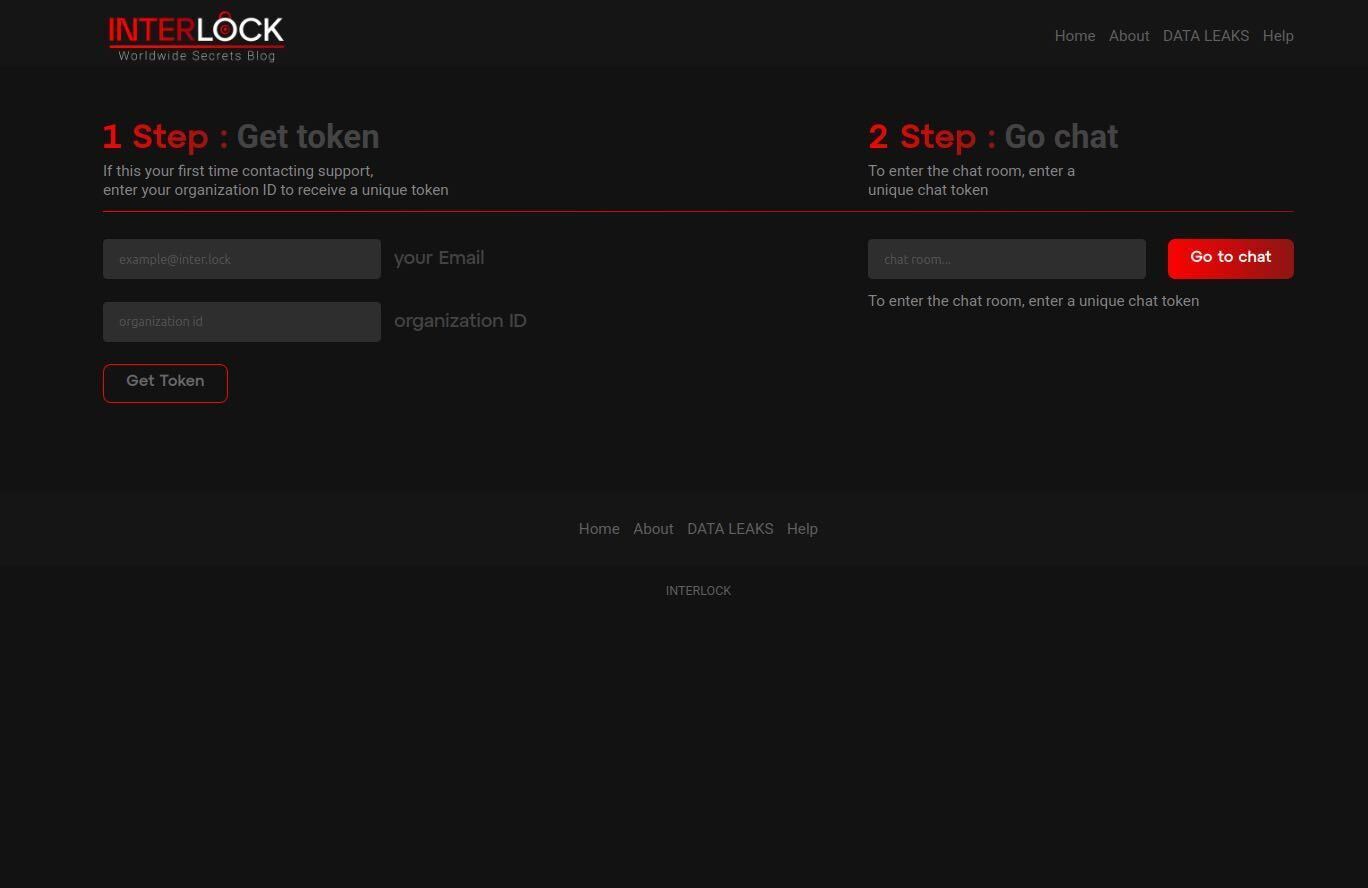
Interlock ransomware negotiation portal where victims enter their organization ID and email address to receive an auth token to begin a negotiation chat session.

Figure 1: Interlock ransomware negotiation portal where victims enter their organization ID and email address to receive an auth token to begin a negotiation chat session.

Technical analysis: Interlock’s operational toolkit

Post-compromise reconnaissance script

Once Interlock gains initial access, they use a variety of priority tools to complete their attack. Amazon threat intelligence teams recovered a PowerShell script designed for systematic Windows environment enumeration (automated information gathering about the victim’s network). The script collects operating system and hardware details, running services, installed software, storage configuration, Hyper-V virtual machine inventory, user file listings across Desktop, Documents, and Downloads directories, browser artifacts from Chrome, Edge, Firefox, Internet Explorer, and 360 browser (including history, bookmarks, stored credentials, and extensions), active network connections correlated with responsible processes, ARP tables, iSCSI session data, and RDP authentication events from Windows event logs.

The script stages results to a centralized network share (\JK-DC2\Temp) using each system’s fully qualified hostname to create dedicated directories—essentially creating a folder for each compromised computer. Following collection, it compresses data into ZIP archives named after each hostname and removes original raw data. This structured per-host output format indicates the script operates across multiple machines within a network—a hallmark of ransomware intrusion chains that prepare for organization-wide encryption.

Custom remote access trojans

Remote access trojans (RATs) are malicious programs that give attackers persistent control over compromised systems, functioning like unauthorized remote desktop software.

JavaScript implant: Amazon threat intelligence recovered an obfuscated JavaScript remote access trojan that suppresses debugging output by overriding browser console methods (hiding its activity from basic detection tools). On execution, it profiles the infected host using PowerShell and Windows Management Instrumentation (WMI), collecting system identity, domain membership, username, OS version, and privilege context before transmitting this data during an encrypted initialization handshake.

Command-and-control communication occurs over persistent WebSocket connections with RC4-encrypted messages using per-message 16-byte random keys embedded in packet headers—essentially, each message uses a different encryption key, making interception more difficult. The implant cycles through multiple operator-controlled hostnames and IP addresses in randomized order with exponential backoff between reconnection attempts.

The implant provides interactive shell access, arbitrary command execution, bidirectional file transfer, and SOCKS5 proxy capability for tunneling TCP traffic (routing malicious traffic through other systems to hide its origin). Self-update and self-delete capabilities allow operators to replace or remove the implant without reinfection, supporting operational cleanup to hinder forensic investigation.

Java implant: A functionally equivalent client implemented in Java provides identical command-and-control capabilities. Built on GlassFish ecosystem libraries, it uses Grizzly for non-blocking I/O transport and Tyrus for WebSocket protocol communication. In simpler terms, Interlock built the same backdoor in two different programming languages, ensuring they maintain access even if defenders detect one version.

Infrastructure laundering script

Sophisticated threat actors don’t attack from their own infrastructure, they build disposable relay networks to hide their tracks. Amazon threat intelligence teams identified a Bash script that configures Linux servers as HTTP reverse proxies (intermediary servers that forward traffic to hide the attacker’s true location). The script performs system updates, installs fail2ban with SSH brute-force protection, and compiles HAProxy 3.1.2 from source. The HAProxy instance listens on port 80 and forwards all inbound HTTP traffic to a hardcoded target IP, with systemd ensuring persistence across reboots.

A notable component is a log erasure routine running as a cron job every five minutes. The routine truncates all *.log files under /var/log and suppresses shell history by unsetting the HISTFILE variable. This aggressive evidence destruction, wiping logs every five minutes, combined with the purpose-built HTTP forwarding proxy, indicates the script establishes disposable traffic-laundering relay nodes. These nodes obscure exploit traffic origin, relay command-and-control communications, or proxy data exfiltration, making it nearly impossible to trace attacks back to their source.

Memory-resident webshell

Amazon threat intelligence teams observed a Java class file delivered as an alternative to the ELF binary drop. When loaded by the Java Virtual Machine (JVM), its static initializer registers a ServletRequestListener with the server’s StandardContext, essentially installing a persistent memory-resident backdoor that intercepts HTTP requests without writing files to disk. This “fileless” approach evades traditional antivirus scanning that looks for malicious files.

The listener inspects incoming requests for specially crafted parameters containing encrypted command payloads. Payloads are decrypted using AES-128 with a key derived from the MD5 hash of the hardcoded seed “geckoformboundary99fec155ea301140cbe26faf55ed2f40″ (using the first 16 characters: 09b1a8422e8faed0). Decrypted payloads are treated as compiled Java bytecode, dynamically loaded into the JVM, and executed—a technique designed to evade file-based detection by running malicious code entirely in memory.

Connectivity verification tool

Amazon threat intelligence teams recovered Java class files implementing a basic TCP server listening on port 45588 (encoded as Unicode character 넔 to obscure the port number from static analysis). The server accepts connections, logs connecting IP addresses, sends a greeting message, and immediately closes connections. This operational profile is consistent with a lightweight network beacon—essentially a “phone home” tool used to verify successful code execution or confirm network port reachability following initial exploitation.

Legitimate tool abuse

Interlock deployed ConnectWise ScreenConnect, a legitimate commercial remote desktop tool, alongside custom implants. When ransomware operators deploy legitimate remote access tools alongside their custom malware, they’re buying insurance—if defenders find and remove one backdoor, they still have another way in. This indicates multiple redundant remote access mechanisms—a pattern consistent with ransomware operators seeking to maintain access even if individual footholds are removed. The tool’s legitimate network footprint helps blend with authorized remote administration traffic, making detection more challenging.

Amazon threat intelligence teams also recovered Volatility, an open-source memory forensics framework typically used by incident responders (the same tool defenders use to investigate attacks). While no artifacts indicated automated use, its presence alongside custom implants and reconnaissance scripts is consistent with advanced threat operations. Both ransomware groups and nation-state actors have been observed deploying Volatility during intrusions. The tool’s focus on parsing memory dumps provides access to sensitive data such as credentials stored in RAM, which can enable lateral movement (spreading through the network) and deeper environment compromise in support of ransom operations or espionage objectives.

Interlock also used Certify, an open source offensive security tool designed to exploit misconfigurations in Active Directory Certificate Services (AD CS). For ransomware operators, Certify provides a pathway to identify vulnerable certificate templates and enrollment permissions that allow requesting authentication-capable certificates. These certificates can be used to impersonate users, escalate privileges, or maintain persistent access. These capabilities directly support both initial compromise and long-term persistence objectives in ransomware operations.

Indicators of compromise (IoCs)

The following indicators support defensive measures by organizations that may be affected. Due to Interlock’s use of content variation techniques, most file hashes are not included as reliable indicators. The threat actor modified most artifacts like scripts and binaries downloaded to different targets. This resulted in different file hashes for functionally identical tools. The customization allowed each attack to evade signature-based detection that looks for exact file matches.

206.251.239[.]164

Exploit source IP

Active Jan 2026

199.217.98[.]153

Exploit source IP

Active Mar 2026

89.46.237[.]33

Exploit source IP

Active Mar 2026

Mozilla/5.0 (Windows NT 10.0; Win64; x64; rv:136.0) Gecko/20100101 Firefox/136.0

Exploit HTTP User-Agent

Observed Jan 2026 and Mar 2026

b885946e72ad51dca6c70abc2f773506

Exploit TLS JA3

Observed Jan 2026 and Mar 2026

f80d3d09f61892c5846c854dd84ac403

Exploit TLS JA3

Observed Mar 2026

t13i1811h1_85036bcba153_b26ce05bbdd6

Exploit TLS JA4

Observed Jan 2026 and Mar 2026

t13i4311h1_c7886603b240_b26ce05bbdd6

Exploit TLS JA4

Observed Mar 2026

144.172.94[.]59

C2 Fallback IP

Active Mar 2026

199.217.99[.]121

C2 Fallback IP

Active Mar 2026

188.245.41[.]78

C2 Fallback IP

Active Mar 2026

144.172.110[.]106

Backend C2 IP

Active Mar 2026

95.217.22[.]175

Backend C2 IP

Active Mar 2026

37.27.244[.]222

Staging host IP

Active Mar 2026

hxxp://ebhmkoohccl45qesdbvrjqtyro2hmhkmh6vkyfyjjzfllm3ix72aqaid[.]onion/chat.php

Ransom negotiation portal

Active Mar 2026

cherryberry[.]click

Exploit Support Domain

Active Jan 2026

ms-server-default[.]com

Exploit Support Domain

Active Mar 2026

initialize-configs[.]com

Exploit Support Domain

Active Mar 2026

ms-global.first-update-server[.]com

Exploit Support Domain

Active Mar 2026

ms-sql-auth[.]com

Exploit Support Domain

Active Mar 2026

kolonialeru[.]com

Exploit Support Domain

Active Mar 2026

sclair.it[.]com

Exploit Support Domain

Active Mar 2026

browser-updater[.]com

C2 domain

Active Mar 2026

browser-updater[.]live

C2 domain

Active Mar 2026

os-update-server[.]com

C2 domain

Active Mar 2026

os-update-server[.]org

C2 domain

Active Mar 2026

os-update-server[.]live

C2 domain

Active Mar 2026

os-update-server[.]top

C2 domain

Active Mar 2026

d1caa376cb45b6a1eb3a45c5633c5ef75f7466b8601ed72c8022a8b3f6c1f3be

Offensive security tool (Certify)

Observed Mar 2026

6c8efbcef3af80a574cb2aa2224c145bb2e37c2f3d3f091571708288ceb22d5f

Screen locker

Observed Mar 2026

Defensive recommendations

Organizations should take the following actions to protect against Interlock ransomware operations.

Immediate actions:

  • Apply Cisco’s security patches for Cisco Secure Firewall Management Center
  • Review logs for the indicators of compromise listed above
  • Conduct security assessments to identify potential compromise
  • Review ScreenConnect deployments for unauthorized installations

Detection opportunities:

  • Monitor for PowerShell scripts staging data to network shares with hostname-based directory structures
  • Detect Java ServletRequestListener registrations in web application contexts (unusual modifications to Java web applications)
  • Identify HAProxy installations with aggressive log deletion cron jobs (proxy servers that erase their own logs every five minutes)
  • Watch for TCP connections to unusual high-numbered ports (e.g., 45588)

Long-term measures:

  • Implement defense-in-depth strategies with multiple layers of security controls
  • Maintain continuous threat monitoring and hunting capabilities
  • Ensure comprehensive logging with secure, centralized log storage (stored separately from systems that could be compromised)
  • Regularly test incident response procedures for ransomware scenarios
  • Educate security teams on Interlock’s tactics, techniques, and procedures

The real story here isn’t just about one vulnerability or one ransomware group—it’s about the fundamental challenge zero-day exploits pose to every security model. When attackers exploit vulnerabilities before patches exist, even the most diligent patching programs can’t protect you in that critical window. This is precisely why defense in depth is essential—layered security controls provide protection when any single control fails or hasn’t yet been deployed. Rapid patching remains foundational in vulnerability management, but defense in depth helps organizations not to be defenseless during the window between exploit and patch.

Amazon Threat Intelligence teams continue to monitor Interlock ransomware operations and will provide updates as additional information becomes available. The intelligence gathered from this campaign is being integrated into AWS security services to protect customers proactively.


If you have feedback about this post, submit comments in the Comments section below. If you have questions about this post, contact AWS Support.

CJ Moses

CJ Moses

CJ Moses is the CISO of Amazon Integrated Security. In his role, CJ leads security engineering and operations across Amazon. His mission is to enable Amazon businesses by making the benefits of security the path of least resistance. CJ joined Amazon in December 2007, holding various roles including Consumer CISO, and most recently AWS CISO, before becoming CISO of Amazon Integrated Security September of 2023.

Prior to joining Amazon, CJ led the technical analysis of computer and network intrusion efforts at the Federal Bureau of Investigation’s Cyber Division. CJ also served as a Special Agent with the Air Force Office of Special Investigations (AFOSI). CJ led several computer intrusion investigations seen as foundational to the security industry today.

CJ holds degrees in Computer Science and Criminal Justice, and is an active SRO GT America GT2 race car driver.

Received — 12 March 2026 AWS Security Blog

AI-augmented threat actor accesses FortiGate devices at scale

20 February 2026 at 21:27

Commercial AI services are enabling even unsophisticated threat actors to conduct cyberattacks at scale—a trend Amazon Threat Intelligence has been tracking closely. A recent investigation illustrates this shift: Amazon Threat Intelligence observed a Russian-speaking financially motivated threat actor leveraging multiple commercial generative AI services to compromise over 600 FortiGate devices across more than 55 countries from January 11 to February 18, 2026. No exploitation of FortiGate vulnerabilities was observed—instead, this campaign succeeded by exploiting exposed management ports and weak credentials with single-factor authentication, fundamental security gaps that AI helped an unsophisticated actor exploit at scale. This activity is distinguished by the threat actor’s use of multiple commercial GenAI services to implement and scale well-known attack techniques throughout every phase of their operations, despite their limited technical capabilities. AWS infrastructure was not observed to be involved in this campaign. Amazon Threat Intelligence is sharing these findings to help the broader security community defend against this activity.

This investigation highlights how commercial AI services can lower the technical barrier to entry for offensive cyber capabilities. The threat actor in this campaign is not known to be associated with any advanced persistent threat group with state-sponsored resources. They are likely a financially motivated individual or small group who, through AI augmentation, achieved an operational scale that would have previously required a significantly larger and more skilled team. Yet, based on our analysis of public sources, they successfully compromised multiple organizations’ Active Directory environments, extracted complete credential databases, and targeted backup infrastructure, a potential precursor to ransomware deployment. Notably, when this actor encountered hardened environments or more sophisticated defensive measures, they simply moved on to softer targets rather than persisting, underscoring that their advantage lies in AI-augmented efficiency and scale, not in deeper technical skill.

As we expect this trend to continue in 2026, organizations should anticipate that AI-augmented threat activity will continue to grow in volume from both skilled and unskilled adversaries. Strong defensive fundamentals remain the most effective countermeasure: patch management for perimeter devices, credential hygiene, network segmentation, and robust detection for post-exploitation indicators.

Campaign overview

Through routine threat intelligence operations, Amazon Threat Intelligence identified infrastructure hosting malicious tooling associated with this campaign. The threat actor had staged additional operational files on the same publicly accessible infrastructure, including AI-generated attack plans, victim configurations, and source code for custom tooling. This inadequate operational security provided comprehensive visibility into the threat actor’s methodologies and the specific ways they leverage AI throughout their operations. It’s like an AI-powered assembly line for cybercrime, helping less skilled workers produce at scale.

The threat actor compromised globally dispersed FortiGate appliances, extracting full device configurations that yielded credentials, network topology information, and device configuration information. They then used these stolen credentials to connect to victim internal networks and conduct post-exploitation activities including Active Directory compromise, credential harvesting, and attempts to access backup infrastructure, consistent with pre-ransomware operations.

Initial access: Mass credential abuse

The threat actor’s initial access vector was credential-based access to FortiGate management interfaces exposed to the internet. Analysis of the actor’s tooling supported systematic scanning for management interfaces across ports 443, 8443, 10443, and 4443, followed by authentication attempts using commonly reused credentials.

FortiGate configuration files represent high-value targets because they contain:

  • SSL-VPN user credentials with recoverable passwords
  • Administrative credentials
  • Complete network topology and routing information
  • Firewall policies revealing internal architecture
  • IPsec VPN peer configurations

The threat actor developed AI-assisted Python scripts to parse, decrypt, and organize these stolen configurations.

Geographic distribution

The campaign’s targeting appears opportunistic rather than sector-specific, consistent with automated mass scanning for vulnerable appliances. However, certain patterns suggest organizational-level compromise where multiple FortiGate devices belonging to the same entity were accessed. Amazon Threat Intelligence observed clusters where contiguous IP blocks or shared non-standard management ports indicated managed service provider deployments or large organizational networks. Concentrations of compromised devices were observed across South Asia, Latin America, the Caribbean, West Africa, Northern Europe, and Southeast Asia, among other regions.

Custom tooling: AI-generated reconnaissance framework

Following VPN access to victim networks, the threat actor deploys a custom reconnaissance tool, with different versions written in both Go and Python. Analysis of the source code reveals clear indicators of AI-assisted development: redundant comments that merely restate function names, simplistic architecture with disproportionate investment in formatting over functionality, naive JSON parsing via string matching rather than proper deserialization, and compatibility shims for language built-ins with empty documentation stubs. While functional for the threat actor’s specific use case, the tooling lacks robustness and fails under edge cases—characteristics typical of AI-generated code used without significant refinement.

The tool automates the post-VPN reconnaissance workflow:

  1. Ingesting target networks from VPN routing tables
  2. Classifying networks by size
  3. Running service discovery using gogo, an open-source port scanner
  4. Automatically identifying SMB hosts and domain controllers
  5. Integrating vulnerability scanning using Nuclei, an open-source vulnerability scanner, against discovered HTTP services to produce prioritized target lists.

Post-exploitation methodology

Once inside victim networks, the threat actor follows a standard approach leveraging well-known open-source offensive tools.

Domain compromise: The threat actor’s operational documentation details the intended use of Meterpreter, an open-source post-exploitation toolkit, with the mimikatz module to perform DCSync attacks against domain controllers. This allowed the actor to extract NTLM password hashes from Active Directory. In confirmed compromises, the attacker obtained complete domain credential databases. In at least one case, the Domain Administrator account used a plaintext password that was either extracted from the FortiGate configuration through password reuse or was independently weak.

Lateral movement: Following domain compromise, the threat actor attempts to expand access through pass-the-hash/pass-the-ticket attacks against additional infrastructure, NTLM relay attacks using standard poisoning tools, and remote command execution on Windows hosts.

Backup infrastructure targeting: The threat actor specifically targeted Veeam Backup & Replication servers, deploying multiple tools for extracting credentials, including PowerShell scripts, compiled decryption tools, and exploitation attempts leveraging known Veeam vulnerabilities. Backup servers represent high-value targets because they typically store elevated credentials for backup operations, and compromising backup infrastructure positions an attacker to destroy recovery capabilities before deploying ransomware.

Limited exploitation success: The threat actor’s operational notes reference multiple CVEs across various targets (CVE-2019-7192, CVE-2023-27532, and CVE-2024-40711, among others). However, a critical finding from this analysis is that the threat actor largely failed when attempting to exploit anything beyond the most straightforward, automated attack paths. Their own documentation records repeated failures: targeted services were patched, required ports were closed, vulnerabilities didn’t apply to the target OS versions, . Their final operational assessment for one confirmed victim acknowledged that key infrastructure targets were “well-protected” with “no vulnerable exploitation vectors.”

AI as a force multiplier

Amazon Threat Intelligence analysis revealed that the actor uses at least two distinct commercial LLM providers throughout their operations.

AI-generated attack planning: The threat actor used AI to generate comprehensive attack methodologies complete with step-by-step exploitation instructions, expected success rates, time estimates, and prioritized task trees. These plans reference academic research on offensive AI agents, suggesting the actor follows emerging literature on AI-assisted penetration testing. The AI produces technically accurate command sequences, but the actor struggles to adapt when conditions differ from the plan. They cannot compile custom exploits, debug failed exploitation attempts, or creatively pivot when standard approaches fail.

Multi-model operational workflow: Amazon Threat Intelligence identified the actor using multiple AI services in complementary roles. One serves as the primary tool developer, attack planner, and operational assistant. A second is used as a supplementary attack planner when the actor needs help pivoting within a specific compromised network. In one observed instance, the actor submitted the complete internal topology of an active victim—IP addresses, hostnames, confirmed credentials, and identified services—and requested a step-by-step plan to compromise additional systems they could not access with their existing tools.

AI-generated tooling at scale: Beyond the reconnaissance framework, the actor’s infrastructure contains numerous scripts in multiple programming languages bearing hallmarks of AI generation, including configuration parsers, credential extraction tools, VPN connection automation, mass scanning orchestration, and result aggregation dashboards. The volume and variety of custom tooling would typically indicate a well-resourced development team. Instead, a single actor or very small group generated this entire toolkit through AI-assisted development.

Threat actor assessment

Based on comprehensive analysis, Amazon Threat Intelligence assesses this threat actor as follows:

  • Motivation: Suspected financially motivated, based on widespread, indiscriminate targeting and low sophistication
  • Language: Russian-speaking, based on extensive Russian-language operational documentation
  • Skill level: Low-to-medium baseline technical capability, significantly augmented by AI. The actor can run standard offensive tools and automate routine tasks but struggles with exploit compilation, custom development, and creative problem-solving during live operations
  • AI dependency: Extensive reliance across all operational phases. AI is used for tool development, attack planning, command generation, and operational reporting across multiple commercial LLM providers
  • Operational scale: Broad. Compromised devices across dozens of countries, with evidence of sustained operations over an extended period
  • Post-exploitation depth: Shallow. Repeated failures against hardened or non-standard targets, with a pattern of moving on rather than persisting when automated approaches fail
  • Operational security: Inadequate. Detailed operational plans, credentials, and victim data stored without encryption alongside tooling

Amazon’s response

Amazon Threat Intelligence remains committed to helping protect customers and the broader internet ecosystem by actively investigating and disrupting threat actors.

Upon discovering this campaign, Amazon Threat Intelligence took the following actions:

  • Shared actionable intelligence, including indicators of compromise, with relevant partners
  • Collaborated with industry partners to broaden visibility into the campaign and support coordinated defense efforts

Through these efforts, Amazon helped reduce the threat actor’s operational effectiveness and enabled organizations across multiple countries to take steps to disrupt the efficacy of the campaign.

Defending your organization

This campaign succeeded through a combination of exposed management interfaces, weak credentials, and single-factor authentication—all fundamental security gaps that AI helped an unsophisticated actor exploit at scale. This underscores that strong security fundamentals are powerful defenses against AI-augmented threats. Organizations should review and implement the following.

1. FortiGate appliance audit

Organizations running FortiGate appliances should take immediate action:

  • Ensure management interfaces are not exposed to the internet. If remote administration is required, restrict access to known IP ranges and use a bastion host or out-of-band management network
  • Change all default and common credentials on FortiGate appliances, including administrative and VPN user accounts
  • Rotate all SSL-VPN user credentials, particularly for any appliance whose management interface was or may have been internet-accessible
  • Implement multi-factor authentication for all administrative and VPN access
  • Review FortiGate configurations for unauthorized administrative accounts or policy changes
  • Audit VPN connection logs for connections from unexpected geographic locations

2. Credential hygiene

Given the extraction of credentials from FortiGate configurations:

  • Audit for password reuse between FortiGate VPN credentials and Active Directory domain accounts
  • Implement multi-factor authentication for all VPN access
  • Enforce unique, complex passwords for all accounts, particularly Domain Administrator accounts
  • Review and rotate service account credentials, especially those used in backup infrastructure

3. Post-exploitation detection

Organizations that may have been affected should monitor for:

  • Unexpected DCSync operations (Event ID 4662 with replication-related GUIDs)
  • New scheduled tasks named to mimic legitimate Windows services
  • Unusual remote management connections from VPN address pools
  • LLMNR/NBT-NS poisoning artifacts in network traffic
  • Unauthorized access to backup credential stores
  • New accounts with names designed to blend with legitimate service accounts

4. Backup infrastructure hardening

The threat actor’s focus on backup infrastructure highlights the importance of:

  • Isolating backup servers from general network access
  • Patching backup software against known credential extraction vulnerabilities
  • Monitoring for unauthorized PowerShell module loading on backup servers
  • Implementing immutable backup copies that cannot be modified even with administrative access

AWS-specific recommendations

For organizations using AWS:

  • Enable Amazon GuardDuty for threat detection, including monitoring for unusual API calls and credential usage patterns
  • Use Amazon Inspector to automatically scan for software vulnerabilities and unintended network exposure
  • Use AWS Security Hub to maintain continuous visibility into your security posture
  • Use AWS Systems Manager Patch Manager to maintain patching compliance across EC2 instances running network appliances
  • Review IAM access patterns for signs of credential replay following any suspected network device compromise

Indicators of compromise (IOCs)

This campaign’s reliance on legitimate open-source tools—including Impacket, gogo, Nuclei, and others—means that traditional IOC-based detection has limited effectiveness. These tools are widely used by penetration testers and security professionals, and their presence alone is not indicative of compromise. Organizations should investigate context around matches, prioritizing behavioral detection (anomalous VPN authentication patterns, unexpected Active Directory replication, lateral movement from VPN address pools) over signature-based approaches.

IOC Value

IOC Type

First Seen

Last Seen

Annotation

212[.]11.64.250

IPv4

1/11/2026

2/18/2026

Threat actor infrastructure used for scanning and exploitation operations

185[.]196.11.225

IPv4

1/11/2026

2/18/2026

Threat actor infrastructure used for threat operations


If you have feedback about this post, submit comments in the Comments section below. If you have questions about this post, contact AWS Support.

CJ Moses

CJ Moses

CJ Moses is the CISO of Amazon Integrated Security. In his role, CJ leads security engineering and operations across Amazon. His mission is to enable Amazon businesses by making the benefits of security the path of least resistance. CJ joined Amazon in December 2007, holding various roles including Consumer CISO, and most recently AWS CISO, before becoming CISO of Amazon Integrated Security September of 2023.

Prior to joining Amazon, CJ led the technical analysis of computer and network intrusion efforts at the Federal Bureau of Investigation’s Cyber Division. CJ also served as a Special Agent with the Air Force Office of Special Investigations (AFOSI). CJ led several computer intrusion investigations seen as foundational to the security industry today.

CJ holds degrees in Computer Science and Criminal Justice, and is an active SRO GT America GT2 race car driver.

❌