BBC News reports it has seen samples of stolen FBI agents’ medical examinations. The “fitness-for-work” reports identify FBI agents by name and address, and reveal even more personal details. They include blood and urine test results and doctors’ notes mentioning high cholesterol, blood in the urine, and even a shellfish and banana allergy.
As we reported last week, extortion group ShinyHunters claims to have breached the FBI. After reportedly taking over ransomware group Clop’s leak site, ShinyHunters says it attacked the FBI to punish the agency for spreading what it calls false information about the group.
The BBC’s findings raise the stakes: The alleged theft includes highly sensitive medical records, not just staff identity and contact data. ShinyHunters shared samples with journalists as proof of its claims.
The BBC states:
“The samples shared with journalists appear genuine and include names, addresses, phone numbers, badge numbers, job titles and information about spouses.”
ShinyHunters claims it accessed several systems, including FBI MedLink, which stores medical records, and FBI BEAST, which handles background checks on employees and applicants, but the FBI has not confirmed these claims. The FBI has acknowledged an incident affecting FBIJobs-related systems and says it is investigating whether its own environment or a third-party provider was compromised.
The group’s stated demand remains non-financial: It wants the FBI to retract or remove a May advisory that ShinyHunters calls false and defamatory. It says it will release the data within five days if its demands are not met.
The cybercriminals also raised the number of affected people. ShinyHunters nows claims to hold sensitive information on around 60,000 current and former FBI staff. Medical histories could make affected people vulnerable long after the immediate incident: Unlike a stolen password, a medical record cannot be changed.
What to do if you’re affected
The FBI has not yet confirmed what information was accessed or who was affected. If you are a current or former FBI employee, a relative of one, or have applied for an FBI job:
Check the FBI’s advice. Every breach is different, so check FBI.gov for updates and follow any specific advice it offers.
Change your password. If you have an FBI Jobs account and reuse its password elsewhere, change it on those other accounts. Choose a strong password that you don’t use for anything else. Better yet, let a password manager choose one for you.
Enable two-factor authentication (2FA). If you can, use a FIDO2-compliant hardware key, laptop, or phone as your second factor. Some forms of 2FA can be phished just as easily as a password, but 2FA that relies on a FIDO2 device can’t be phished.
Watch out for impersonators. Cybercriminals may contact you posing as the FBI, another government agency, or someone you know. Verify the identity of anyone who contacts you.
Take your time. Phishing attacks often impersonate people or brands you know and use themes that require urgent attention, such as missed deliveries, account suspensions, and security alerts.
Let’s face it, an incognito window can only do so much.
Breaches, dark web trading, credit fraud. Malwarebytes Identity Theft Protection monitors for all of it, alerts you fast, and comes with identity theft insurance.
In a very long post on its leak site, the group outlines its grievances:
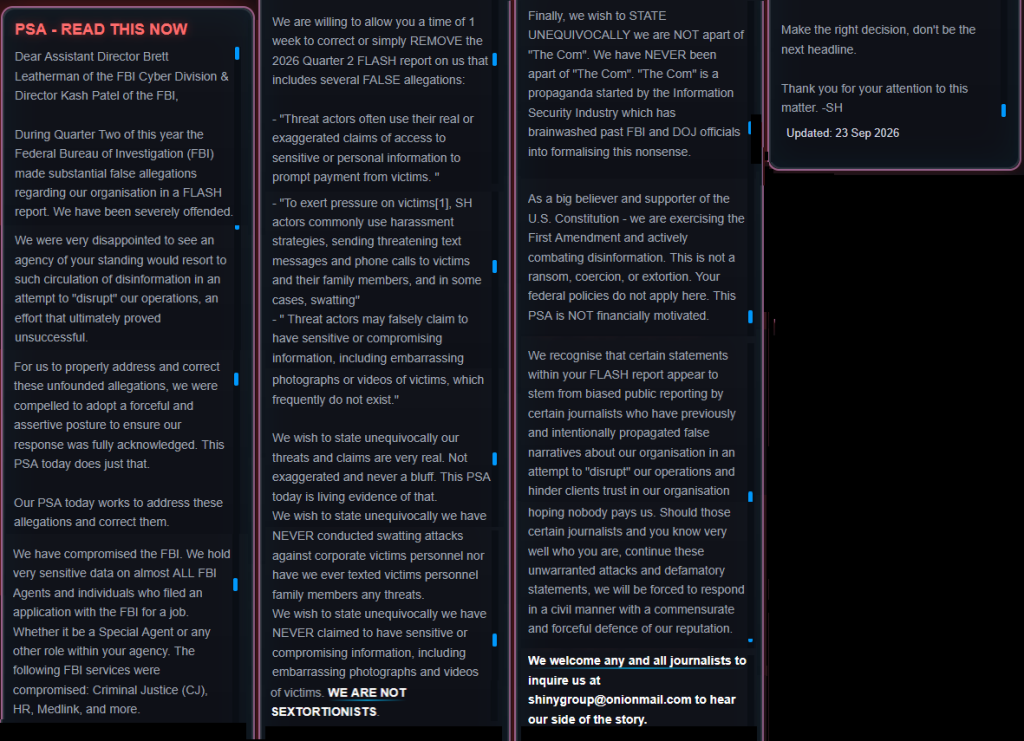
“PSA – READ THIS NOW
Dear Assistant Director Brett Leatherman of the FBI Cyber Division & Director Kash Patel of the FBI,
During Quarter Two of this year the Federal Bureau of Investigation (FBI) made substantial false allegations regarding our organisation in a FLASH report. We have been severely offended.
We were very disappointed to see an agency of your standing would resort to such circulation of disinformation in an attempt to “disrupt” our operations, an effort that ultimately proved unsuccessful.
For us to properly address and correct these unfounded allegations, we were compelled to adopt a forceful and assertive posture to ensure our response was fully acknowledged. This PSA today does just that.
Our PSA today works to address these allegations and correct them.
We have compromised the FBI. We hold very sensitive data on almost ALL FBI Agents and individuals who filed an application with the FBI for a job. Whether it be a Special Agent or any other role within your agency. The following FBI services were compromised: Criminal Justice (CJ), HR, Medlink, and more.
We are willing to allow you a time of 1 week to correct or simply REMOVE the 2026 Quarter 2 FLASH report on us that includes several FALSE allegations:
“Threat actors often use their real or exaggerated claims of access to sensitive or personal information to prompt payment from victims.”
“To exert pressure on victims[1], SH actors commonly use harassment strategies, sending threatening text messages and phone calls to victims and their family members, and in some cases, swatting”
“Threat actors may falsely claim to have sensitive or compromising information, including embarrassing photographs or videos of victims, which frequently do not exist.”
We wish to state unequivocally our threats and claims are very real. Not exaggerated and never a bluff. This PSA today is living evidence of that.
We wish to state unequivocally we have NEVER conducted swatting attacks against corporate victims personnel nor have we ever texted victims personnel family members any threats.
We wish to state unequivocally we have NEVER claimed to have sensitive or compromising information, including embarrassing photographs and videos of victims. WE ARE NOT SEXTORTIONISTS.
Finally, we wish to STATE UNEQUIVOCALLY we are NOT apart of “The Com”. We have NEVER been apart of “The Com”. “The Com” is a propaganda started by the Information Security Industry which has brainwashed past FBI and DOJ officials into formalising this nonsense.
As a big believer and supporter of the U.S. Constitution – we are exercising the First Amendment and actively combating disinformation. This is not a ransom, coercion, or extortion. Your federal policies do not apply here. This PSA is NOT financially motivated.
We recognise that certain statements within your FLASH report appear to stem from biased public reporting by certain journalists who have previously and intentionally propagated false narratives about our organisation in an attempt to “disrupt” our operations and hinder clients trust in our organisation hoping nobody pays us. Should those certain journalists and you know very well who you are, continue these unwarranted attacks and defamatory statements, we will be forced to respond in a civil manner with a commensurate and forceful defence of our reputation.
We welcome any and all journalists to inquire us at shinygroup@onionmail[.]com to hear our side of the story.
Make the right decision, don’t be the next headline.
Thank you for your attention to this matter. -SH
Updated: 23 Sep 2026“
The post is essentially a hostile “correction notice” directed at FBI leaders Brett Leatherman and Kash Patel. Its central grievance is an FBI advisory that says ShinyHunters commonly harasses victims and their families, including through threatening messages, phone calls, and, in some cases, swatting.
It also warns that threat actors may exaggerate their access to personal information or falsely claim to possess compromising photos or videos. The advisory does not use the word “sextortion,” but ShinyHunters appears to have interpreted the reference to compromising material that way. The group denies much of the FBI’s account while simultaneously using coercive language of its own.
The document it appears to mean is the FBI/IC3 public advisory “ShinyHunters: Cyber Criminal Group Attacks Learning Management System,” issued on May 15, 2026. Despite ShinyHunters calling it a “2026 Quarter 2 FLASH report,” the publicly accessible document is labeled a Public Service Announcement (PSA), not a FLASH.
It also denies carrying out swatting attacks or sending threatening messages to the family members of people working for its corporate victims.
The group also denies being part of The Com, a decentralized network linked to cybercrime and violence. It calls that connection:
“propaganda started by the Information Security Industry which has brainwashed past FBI and DOJ officials into formalizing this nonsense.”
The group then threatens journalists it accuses of spreading these “false narratives.”
The most worrying part of the message is the group’s claim that it stole sensitive data on:
“almost ALL FBI Agents, and individuals who filed an application with the FBI for a job.”
According to 404 Media, ShinyHunters provided a sample containing information on roughly 5,000 FBI agents, including names, home addresses, phone numbers, and details about their spouses. The publication reportedly verified portions of the sample, but the full dataset and the wider claims about the breach have not been independently confirmed.
The group also reportedly defaced the FBI’s jobs website. The FBI says it is aware of claims involving unauthorized activity affecting FBIjobs.gov and is investigating, although “broken” does not necessarily mean “breached.”
What to do if you’re affected
The FBI has not yet confirmed what information was accessed or who was affected. If you are a current or former FBI employee, a relative of one, or have applied for an FBI job:
Check the FBI’s advice. Every breach is different, so check FBI.gov for updates and follow any specific advice it offers.
Change your password. If you have an FBI Jobs account and reuse its password elsewhere, change it on those other accounts. Choose a strong password that you don’t use for anything else. Better yet, let a password manager choose one for you.
Enable two-factor authentication (2FA). If you can, use a FIDO2-compliant hardware key, laptop, or phone as your second factor. Some forms of 2FA can be phished just as easily as a password, but 2FA that relies on a FIDO2 device can’t be phished.
Watch out for impersonators. Cybercriminals may contact you posing as the FBI, another government agency, or someone you know. Verify the identity of anyone who contacts you.
Take your time. Phishing attacks often impersonate people or brands you know and use themes that require urgent attention, such as missed deliveries, account suspensions, and security alerts.
Let’s face it, an incognito window can only do so much.
Breaches, dark web trading, credit fraud. Malwarebytes Identity Theft Protection monitors for all of it, alerts you fast, and comes with identity theft insurance.
Sextortion scammers are using email addresses from data leaked by the ShinyHunters hacking group to add some credibility to their feeble attempts to convince people they have embarrassing information about them.
Sextortion emails are messages claiming that the scammer recorded you through your webcam while you watched pornography and now demand payment. They have been around for years and keep evolving with small changes in wording and fake technical detail.
In this campaign, the scammers pretend to be ShinyHunters. What hasn’t changed is the basic truth: there is no malware, no recording, and no credible evidence behind the threat. Despite seeing countless versions of these emails over the years, I’ve yet to encounter one that was backed up by the evidence the sender claimed to have.
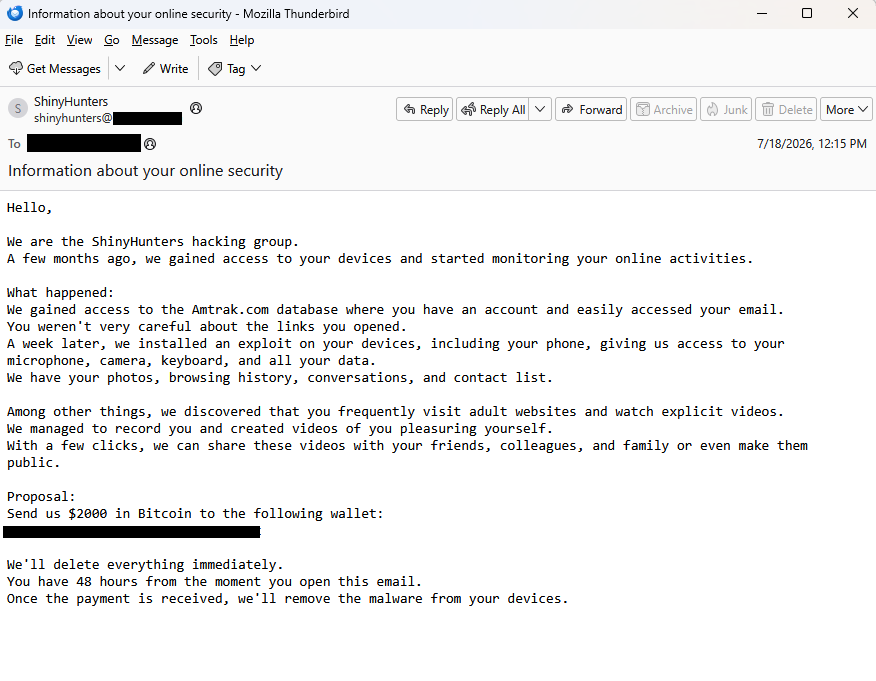
BleepingComputer reports that ShinyHunters data leaks are fueling a $2,000 sextortion email scam and shared the following example:
“Subject: Information about your online security
Hello,
We are the ShinyHunters hacking group. A few months ago, we gained access to your devices and started monitoring your online activities.
What happened: We gained access to the Amtrak.com database where you have an account and easily accessed your email. You weren’t very careful about the links you opened. A week later, we installed an exploit on your devices, including your phone, giving us access to your microphone, camera, keyboard, and all your data. We have your photos, browsing history, conversations, and contact list.
Among other things, we discovered that you frequently visit adult websites and watch explicit videos. We managed to record you and created videos of you pleasuring yourself. With a few clicks, we can share these videos with your friends, colleagues, and family or even make them public.
Proposal: Send us $2000 in Bitcoin to the following wallet: xxxxxxxxxxxxxxxxxxxxxxxxxxxxxxxxx
We’ll delete everything immediately. You have 48 hours from the moment you open this email. Once the payment is received, we’ll remove the malware from your devices.”
BleepingComputer states it has seen data from the Amtrak, Hallmark, ADT, Substack, Betterment, CarGurus, Panera Bread, and McGraw Hill breaches used to target victims in this sextortion email campaign.
A California community college also issued a warning after seeing the campaign target people affected by the Canvas data breach.
They confirmed that the targeted email addresses had previously appeared in data leaked by ShinyHunters. They also contacted the group, which denied being behind the sextortion emails.
The increase to a $2,000 demand may suggest the scammers paid someone for the email lists. Although it’s more likely they simply downloaded the leaked data after ShinyHunters published it following failed extortion attempts.
A quick check of the Bitcoin address used in the email shows no activity.
No activity on their Bitcoin address
Let’s keep it that way. With any luck, these dungeon dwellers will eventually give up trying to scare people out of their hard-earned money.
How to react to sextortion emails
Some sextortion emails are badly written, but many have been polished by AI and look convincing. Regardless of how professional they look, they should be treated the same way: as unsubstantiated threats designed to scare victims into paying.
First and foremost, never reply to emails of this kind. Responding confirms that someone is actively reading messages sent to that address and may encourage further scam attempts.
Don’t let yourself be rushed into action. Scammers rely on the fact that you will not take the time to think this through and subsequently make mistakes. Ask for advice if you’re not sure.
An attachment is not proof. Most sextortion emails contain no evidence at all, and attachments are often used to deliver malware or make the threats appear more convincing.
If the email includes a password you’ve used before, change it immediately anywhere it’s still in use. Then enable two-factor authentication (2FA) wherever possible. If you’re having trouble keeping track of your passwords, consider using a password manager.
Delete the message, report it as spam, and move on.
Pro tip: Malwarebytes Scam Guard recognized this email for what it is: sextortion. It can recognize scams and advise you how to proceed.
While these sextortion emails are almost always bluffs, if you’re concerned about webcam spying, Malwarebytes Webcam Monitoring can alert you when applications attempt to access your camera.
Carnival Corporation, parent of Carnival Cruise Line, is sending out fresh “Notice of Cybersecurity Event” letters dated May 27, 2026. If you feel like you’ve read that sentence before, you’re not imagining things. Over the last decade, the world’s largest cruise operator has accumulated a worrying track record of breaches, ransomware incidents, and regulatory penalties, with this 2026 incident adding yet another entry to an already lengthy cybersecurity history.
There are several data breaches involving Carnival Corporation or one of its subsidiaries in our database.
Between 2019 and 2021 alone, Carnival reported four separate cybersecurity events to the New York Department of Financial Services. These included two ransomware attacks and a phishing incident in which attackers deployed malware, accessed and encrypted internal systems, and stole personal customer and employee information.
In this latest case, an attacker used social engineering to trick a Carnival employee into granting access to part of the company’s IT systems on April 14, 2026. By April 22, they used a compromised account to access a “limited portion” of Carnival’s IT systems, where they were able to copy personal data before being blocked.
According to the data breach notice filed in Maine, a total of 5,995,277 people were affected. Carnival determined that the intruder had illegally copied files containing personal information and is now writing to affected individuals to tell them that “data elements” relating to them were obtained.
Researchers cited by Gblock say the stolen data appears to include:
Full names
Email addresses
Dates of birth
Genders
Mariner Society membership status and tier
Internal customer identifiers
The template letter does not list specific data fields. Instead, it uses a placeholder:
“We have determined that your <<data elements>> were obtained.”
This strongly suggests that Carnival is populating each letter with data categories relevant to that particular individual, a common pattern in large breaches where people may have provided different information at different times.
Furthermore, the letters contain the usual content about the speed with which the company acted, involving third‑party experts, and frame the affected systems as a limited subset of the environment. For recipients, the important fact is not how limited the breach was from the company’s point of view, but whether the exposed information could be used for identity theft, fraud, or highly convincing phishing attacks.
Breaches happen every day. Don’t be the last to know.
We do know from past Carnival incidents that exposed data has included names, addresses, dates of birth, passport numbers, health information, and payment details. In previous breaches affecting cruise lines, compromised data has ranged from basic contact details to Social Security numbers and credit card information. Carnival has not publicly disclosed the full categories of data involved in the 2026 incident, but given that this 2026 event again involves “personal information” copied from internal systems, it is reasonable to treat it as a serious privacy incident, even if the exact mix of data varies per person.
The attack was claimed by extortion group ShinyHunters, which is known to steal data and then ask for a ransom. If the victim does not agree to the terms, the data will be published and/or sold to the highest bidder.
ShinyHunters offers Carnival data for download
From a cybercriminal’s perspective, cruise industry data is highly prized. Cruise passengers are often relatively wealthy, and passenger records can combine identity data (names, addresses, dates of birth, passport numbers), contact data (emails, phone numbers), and potentially payment data (card numbers and sometimes bank details), making them valuable for identity theft, targeted phishing, and fraud.
What to do if you’re affected
To mitigate the fallout, Carnival is offering a complimentary 24‑month TransUnion credit‑monitoring package, delivered via the MyTrueIdentity platform and supported by Cyberscout for fraud assistance.
Days after confirming a major data breach, Instructure is now facing a second blow.
Earlier this week, Instructure confirmed a major data breach affecting its cloud‑hosted Canvas environment, with the ShinyHunters group claiming it stole hundreds of millions of records tied to thousands of schools and universities worldwide. As discussed in our earlier blog, that incident involved data such as student and staff records, enrollment details, and private messages allegedly accessed through Canvas export features and APIs. At that stage, the focus was on large‑scale data theft and the long‑term risks for affected students and families, including identity fraud and highly targeted phishing.
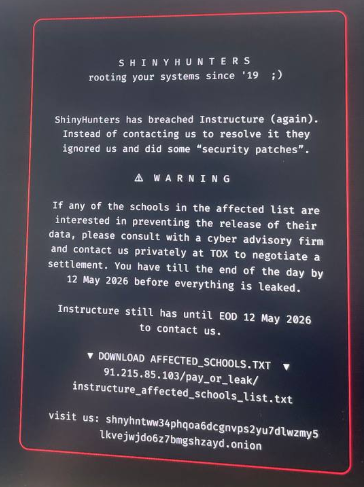
According to new reporting, ShinyHunters has now hit Instructure again, this time moving from quiet data theft to very visible extortion. Using another vulnerability in Instructure’s systems, the attackers were able to modify Canvas login portals for hundreds of educational institutions, defacing both web logins and the Canvas app with an on‑screen ransom message.
The message both claimed responsibility for the earlier breach and set a deadline of May 12 for Instructure and affected schools to contact the gang or risk the public release of stolen data.
This second wave matters for two reasons. First, it confirms that ShinyHunters still has meaningful access to Instructure’s environment, or at least to components that control the look and behavior of school login pages. Second, it marks a clear escalation in pressure tactics, from leaked claims and dark web posts to messages shown directly to students, parents, and staff trying to access their courses.
How to deal with this data breach
For students and families, the practical advice from our original blog still applies:
Reset Canvas‑related passwords
Enable multi‑factor authentication where possible
Monitor financial and credit activity as children get older
Stay wary of highly personalized phishing that references real schools, courses, or teachers
For schools and districts, this latest extortion campaign underlines the need to coordinate closely with Instructure, review single sign-on (SSO) integrations, and prepare clear communications so that any future defacements or data leaks do not catch staff and parents by surprise.
“One of the best cybersecurity suites on the planet.”
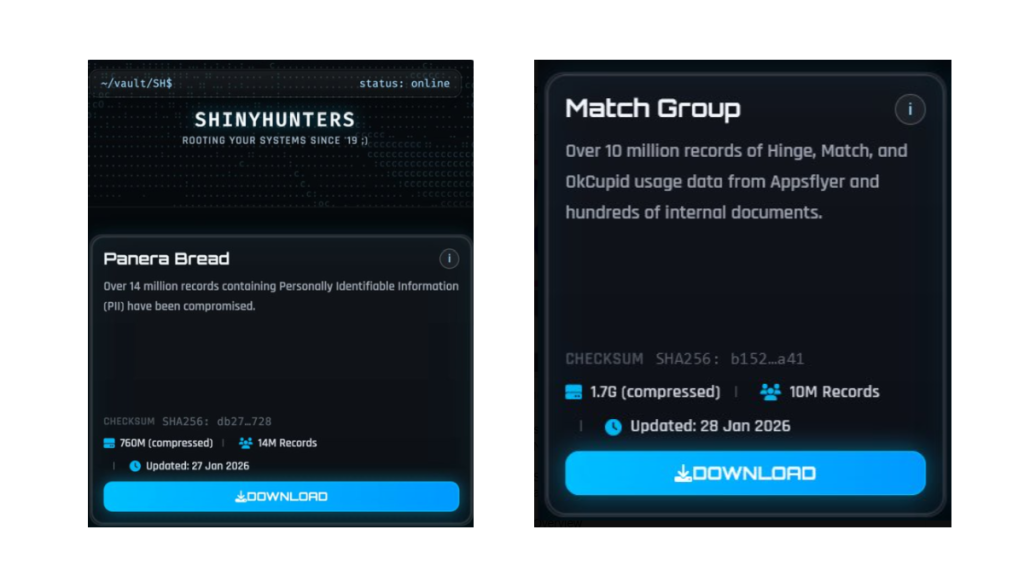
The ShinyHunters ransomware group has claimed the theft of data containing 10 million records belonging to the Match Group and 14 million records from bakery-café chain Panera Bread.
Claims posted by ShinyHunters
The Match Group, that runs multiple popular online dating services like Tinder, Match.com, Meetic, OkCupid, and Hinge has confirmed a cyber incident and is investigating the data breach.
Panera Bread also confirmed that an incident occurred and has alerted authorities. “The data involved is contact information,” it said in an emailed statement to Reuters.
ShinyHunters seems to be gaining access through Single-Sign-On (SSO) platforms and using voice-cloning techniques, which has resulted in a growing number of breaches across different companies. However, not all of these breaches have the same impact.
The impact
For the Match Group, ShinyHunters claims:
“Over 10 million records of Hinge, Match, and OkCupid usage data from Appsflyer and hundreds of internal documents.”
Match says there is no evidence that logins, financial data, or private chats were stolen, but Personally Identifiable Information (PII) and tracking data for some users are in scope. A notification process has been set in motion.
For Panera Bread, ShinyHunters claims to have compromised 14 million records containing PII.
Panera Bread reassures users that there is no indication that the hackers accessed user login credentials, financial information, or private communications.
ShinyHunters also breached Bumblr, Carmax, and Edmunds among others, but I wanted to use Panera Bread and the Match Group as two examples that have very different consequences for users.
When your activity on a dating app is compromised, the impact can be deeply personal. Concerns can range from partners, family members, or employers discovering dating profiles to the risk of doxxing. For many people, stigma around certain apps can lead to fears of being outed, accused of infidelity, or even extorted.
The impact of the Panera Bread breach will be very different. “I just ordered a sandwich and now some criminals have my home address?” Data like this is useful to enrich existing data sets. And the more they know, the easier and better they can target you in phishing attempts.
Protecting yourself after a data breach
If you think you have been affected by a data breach, here are steps you can take to protect yourself:
Check the company’s advice. Every breach is different, so check with the company to find out what’s happened and follow any specific advice it offers.
Change your password. You can make a stolen password useless to thieves by changing it. Choose a strong password that you don’t use for anything else. Better yet, let a password manager choose one for you.
Enable two-factor authentication (2FA). If you can, use a FIDO2-compliant hardware key, laptop, or phone as your second factor. Some forms of 2FA can be phished just as easily as a password, but 2FA that relies on a FIDO2 device can’t be phished.
Watch out for impersonators. The thieves may contact you posing as the breached platform. Check the official website to see if it’s contacting victims and verify the identity of anyone who contacts you using a different communication channel.
Take your time. Phishing attacks often impersonate people or brands you know, and use themes that require urgent attention, such as missed deliveries, account suspensions, and security alerts.
Consider not storing your card details. It’s definitely more convenient to let sites remember your card details, but it increases risk if a retailer suffers a breach.

 Login