❌

Normal view

Felons, Fraudsters Flog Offensive Cybersecurity Startup

8 July 2026 at 14:31

A cybersecurity startup dangling millions of dollars to acquire zero-day security vulnerabilities in popular software is run by a pair of far-right conspiracy theorists and convicted felons whose most recent ventures included fake intelligence companies and a now-defunct AI-based lobbying platform they operated under assumed names.

The X/Twitter account IRIS C2 (@C2IRIS) has gained more than 4,000 followers since its creation in January 2025, posting frequently about security vulnerabilities, AI and software exploits. IRIS C2 says it is a company in McLean, Va. that sells offensive cybersecurity capabilities.

The IRIS C2 website dangles the possibility of million-dollar payouts for exploits to attract talent.

“Our business model is this,” reads a pinned post on top of the IRIS C2 account on X. “Attract the very best vulnerability researchers and exploit developers in the world to join our company. This mostly revolves around junior engineers with raw talent/extremely high IQ. We don’t care if they have a college degree/industry experience.”

The website linked in that profile — irisc2[.]com — says the company is hiring for a number of open positions, and a recent post on its LinkedIn page enthuses about an overwhelming number of applications from potential employees. The website claims IRIS C2 is in the business of acquiring “zero-day exploits, individual primitives, partial chains, and full capabilities across all major platforms. Payouts range from $10,000 to $7 million depending on target, reliability, and operational value.”

The government contracting portal g2exchange.com reports that irisc2[.]com is operated by a business based in Virginia called Calvexa Group LLC. The “contact” link on the website for Calvexa Group — calvexagroup[.]com — forwards visitors to irisc2[.]com. G2Exchange shows that while Calvexa Group LLC is registered as a federal contractor, it does not appear to be working on any direct government contracts.

A search on the Arlington, Va. address listed in the incorporation records for Calvexa Group LLC finds the property is occupied by Jack Burkman, the 60-year-old founder and managing partner of the lobbying firm Burkman & Associates. When approached with questions about IRIS C2, Burkman referred further inquiries to his longtime associate, 28-year-old Jacob Wohl.

Jack Burkman (left) and Jacob Wohl, at a press conference in August 2020. Image: Wikipedia.

Burkman and Wohl have a storied history of creating fake intelligence companies and using them to spread false claims about and frame public figures, including fabricated sexual assault claims against then FBI director Robert Mueller, and Pete Buttigieg, then mayor of South Bend, Indiana and a Democratic candidate for the presidency. In 2019, Burkman and Wohl held press conferences falsely alleging extramarital affairs by Sen. Elizabeth Warren (D-Mass.) and then-2020 presidential candidate Kamala Harris.

In the wake of the 2020 presidential election, Wohl and Burkman were prosecuted by multiple U.S. states for making thousands of robocalls to residents of battleground states and disseminating false claims about mail-in ballots. They were indicted in Cleveland on 15 felony counts of orchestrating a robocall scheme aimed at suppressing the black vote in Detroit, and were sentenced in late 2025 to probation after their appeals to dismiss the charges were rejected.

In 2022, Wohl and Burkman both pleaded guilty to a single felony charge of telecommunications fraud in Ohio, and sentenced to a fine, probation, and community service. In March 2023, a judge in a New York civil case ruled that Wohl and Burkman had violated federal and state civil rights laws, and the two agreed to pay a $1 million settlement.

In June 2023, the Federal Communications Commission (FCC) imposed a $5.1 million fine against Wohl and Burkman for their robocall campaigns, at the time the largest fine ever sought by the FCC under the Telephone Consumer Protection Act.

Jacob “Jay” Wohl’s GitHub account.

By the age of 17, Wohl had started multiple investment firms, and cultivated the nickname “Wohl of Wall Street” after appearing on Fox News in 2015 to discuss his new hedge funds. In 2017, the Arizona Corporation Commission charged Wohl and his investment funds with 14 counts of securities fraud, and ordered him to pay $35,000 in restitution. In 2019, Wohl pleaded guilty in California to four felony counts of selling unregistered securities and was sentenced to two years of probation.

The market for previously unknown security vulnerabilities has always been populated by a colorful mix of researchers, academics, charlatans, clout-chasers and people actively involved in cybercrime communities. But the market for selling offensive security services to the U.S. government tends to be far more circumspect. Plenty of government contractors recruit vulnerability researchers and pay for the exclusive rights to novel software exploits, yet none of them do so quite as brazenly and openly as IRIS C2.

Recent posts from the Twitter/X account IRISC2 (@c2iris).

Indeed, KrebsOnSecurity was unaware of IRIS C2 until last month, when an attendee at a regional cybersecurity conference shared that Wohl and Calvexa Group were pestering people at the conference about selling their vulnerability research.

In an interview with KrebsOnSecurity, Wohl said Mr. Burkman was not involved in the day-to-day operations of IRIS C2. Wohl shared that IRIS C2 originally began as a penetration testing company, but shifted its focus recently to selling phone-hacking services to the government. Several times throughout the interview, Mr. Wohl mentioned working on federal government contracts, but when pressed for specifics said he was not at liberty to speak publicly about them.

Mr. Wohl said he does not have any formal education or training in computer science or information security, and that most of his knowledge on the matter is self-taught.

“I know more about tech than anyone,” Wohl bragged. “My background has always been extremely technical, and I’ve always been deeply into tech. People know me as someone who is able to create spectacularly exquisite capabilities that would make your head spin.”

Wohl said security researchers bring the company unique vulnerability findings “on a regular basis,” but that in many cases those findings are preliminary and not fully fleshed-out.

“Let’s say someone finds a flaw in a media decoder on a phone,” Wohl said. “A lot of times what we receive is an exploit primitive, where the idea is there but the [execution] needs work. You need that exploit to be stable and reliable, and that’s what we do.”

Wohl claims IRIS C2 has approximately 40 employees, although he said none of them are allowed to list their employment on LinkedIn for operational security reasons. In May, the author of the IRIS C2 account on X said that his girlfriend had no idea what he did for a living. But if IRIS C2 has any other employees, they may be similarly unaware of Mr. Wohl’s history of outright fabrications — or even his real name.

In September 2024, Politico reported that Burkman and Wohl were bragging about big companies supposedly buying services from their now-defunct company LobbyMatic, which claimed to use artificial intelligence to assist in political lobbying efforts. However, Politico found the pair were running the company using pseudonyms, with Wohl reportedly adopting the name “Jay Klein” and Burkman using the moniker “Bill Sanders.” Politico reported that two of the former LobbyMatic employees resigned after learning of their true identities, while other employees only learned after they had left the company.

Update, July 9, 9:44 a.m. ET: Several readers pointed our attention to a March 31 publication from journalist Molly White, which reported that Burkman and Wohl were paid a $300,000 retainer by a Canadian cryptocurrency fraudster wanted by the United States and several other countries for allegedly stealing $65 million from the crypto platforms KyberSwap and Indexed Finance. According to that report, the two were hired to pursue a “presidential pardon to avert a miscarriage of justice” on behalf of the accused hacker, who has not yet been convicted.

FBI Seizes NetNut Proxy Platform, Popa Botnet

2 July 2026 at 21:27

The Federal Bureau of Investigation (FBI) said today it worked with industry partners to seize hundreds of domains associated with NetNut, a sprawling residential proxy service operated by the publicly-traded Israeli company Alarum Technologies [NASDAQ: ALAR]. The action comes roughly two weeks after KrebsOnSecurity published findings from multiple security firms connecting NetNut to the Popa botnet, a collection of at least two million devices that have been compromised by malicious software with little or no consent from victims.

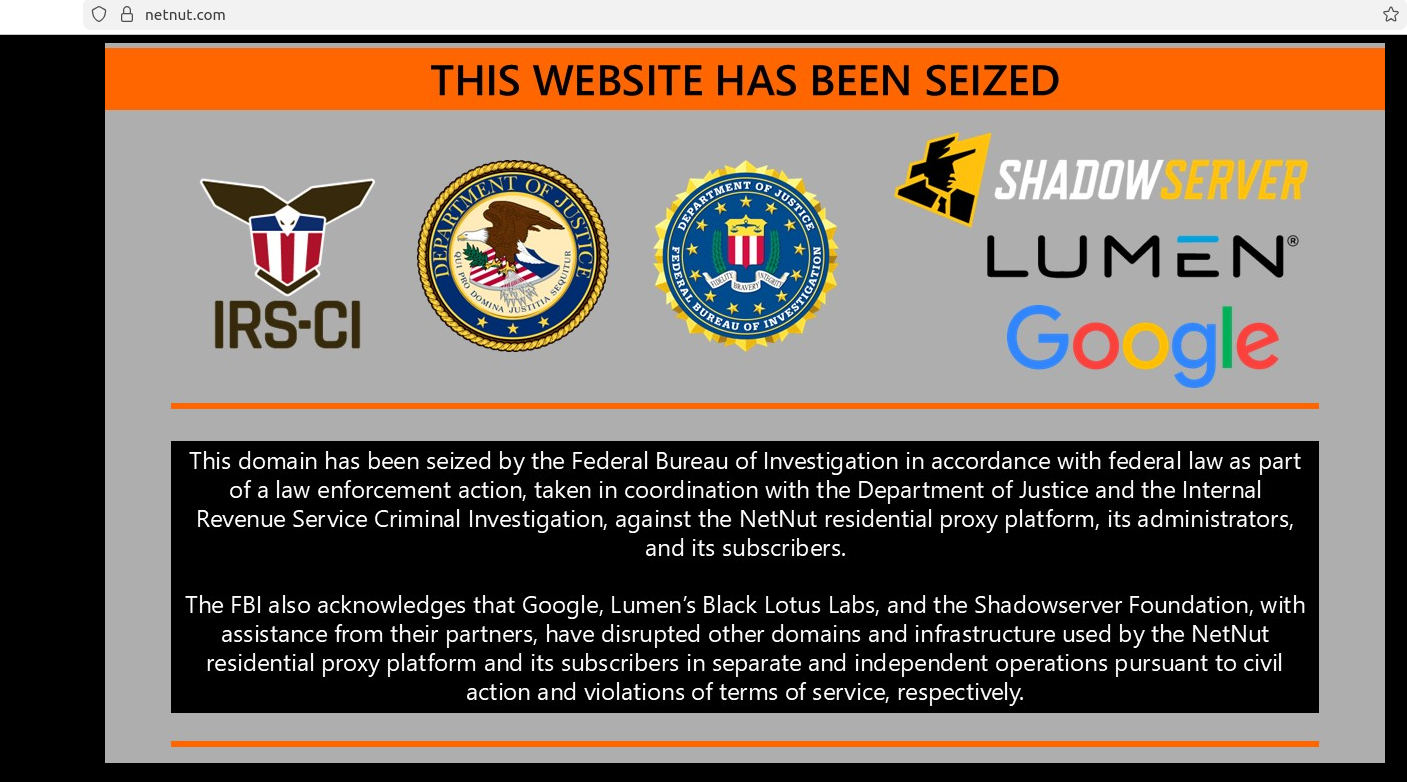
The NetNut homepage today was replaced by this seizure banner from the FBI.

On June 19, three different security firms issued similar findings: That NetNut is a residential proxy network which populates a botnet called Popa, and distributes software for devices commonly found in homes, such as smart TVs and streaming boxes. NetNut’s software turns those systems into always-on residential proxy nodes that are rented to others, who predominantly use them to relay abusive and intrusive Internet traffic, such as mass content scraping, advertising fraud, and account takeover activity.

Earlier today, NetNut’s homepage was replaced with a seizure notice from the FBI and the Internal Revenue Service Criminal Investigation division. The seizure notice thanked Google, Lumen, Shadowserver and other industry partners for their help in dismantling hundreds of domains tied to the Popa botnet, which experts say has long been synonymous with NetNut’s residential proxy infrastructure.

In a blog post published today, the Google Threat Intelligence Group (GTIG) said NetNut’s proxy network is widely resold and white-labeled by a number of third-party proxy providers, and that its services are heavily sought out by cybercriminals seeking to obfuscate the source of their malicious traffic. The GTIG said that in a single week during June 2026, they observed 316 distinct clusters of threat actors using suspected NetNut exit nodes, including cybercriminal and espionage groups.

“These bad actors can use NetNut to mask their origin IP address when accessing victim environments, accessing their own infrastructure, and conducting password spray attacks,” Google’s GTIG wrote. “Furthermore, when a consumer device becomes an exit node, unauthorized network traffic passes through it. This means bad actors can access other private devices on the same home network, effectively exposing them to Internet threats.”

Google said it disabled Google accounts and services used by NetNut for malware command and control, and that it shared technical intelligence on NetNut’s software development kits (SDKs) and backend infrastructure with platform providers, law enforcement and research firms. The company also disabled apps known to bundle NetNut’s various SDKs.

Omer Weiss, legal counsel for NetNut parent Alarum Technologies, said the company was aware of the FBI seizure and cooperating with investigators.

“Alarum takes this matter seriously and will fully cooperate with law enforcement to ensure any misuse of its infrastructure is thoroughly investigated and those responsible are held to account,” Weiss said in a written statement.

Benjamin Brundage is founder of the proxy tracking service Synthient, one of the companies that published evidence last month linking the Popa botnet to NetNut and Alarum Technologies. Brundage said the domain seizures appear to have disrupted both the Popa botnet and the NetNut proxy network that rides on top of it.

Brundage said NetNut’s apparent demise is likely to be a great disadvantage for the cybercrime community, which was already reeling from legal actions by Google earlier this year that seized infrastructure for NetNut’s biggest competitor — IPIDEA.

“I think this takedown is going to have a big impact, because NetNut gained significant popularity after the IPIDEA takedown,” he said. “Also NetNut has been incredibly common among resellers, and they were on par with IPIDEA in terms of their daily traffic, quality, size, price per gigabyte, all of it.”

NetNut’s infrastructure, in a nutshell. Image: Black Lotus Labs, Lumen.

The NetNut and Popa botnet takedown may have another added benefit, Brundage said: Lessening the impact of large distributed denial-of-service botnets that have been built on the backs of poorly configured residential proxy services. In January, Synthient revealed how cybercriminals had built the world’s largest DDoS botnet (Kimwolf) by tunneling through IPIDEA proxy connections into the local networks of TV box owners, and infecting other Android-based devices behind the victim’s firewall.

While many of the bigger proxy providers took steps to block this activity, resellers of the major proxy networks have been far slower to respond to the threat, Brundage said.

“In terms of all these TV box devices getting compromised from the proxy network, it will have an impact on the DDoS botnets out there,” he said.

For its part, Google reckons today’s actions have caused “significant degradation to NetNut’s proxy network and its business operations, reducing the available pool of devices for the proxy operator by millions.” But the company warns that proxy networks can rebuild themselves by effectively reselling other proxy services, as IPIDEA has done over the past few months.

“Google has high confidence that many popular residential proxy brands are in fact whitelabeling the NetNut botnet,” the GTIG report concludes. “While we expect this disruption to have a larger ripple effect across the residential proxy ecosystem, observations after the disruption of IPIDEA proved that individual networks can appear resilient. What we have observed is that when faced with the degradation of their own botnet, proxy operators begin buying capacity from their competitors, effectively becoming a reseller. We recognize that creating a lasting disruption in this fluid ecosystem means we must scale our efforts to target the infrastructure of several interconnected providers.”

As KrebsOnSecurity has warned repeatedly, most of the no-name TV streaming boxes for sale on the major e-commerce websites either come pre-installed with residential proxy software, or require the installation of proxy SDKs in order to use the device for its stated purpose (streaming pirated movies, sporting events and TV shows). Google’s advice here is sound: When it comes to TV boxes, stick to name brands from reputable manufacturers, and then be sparing and judicious with any apps you choose to install.

The sketchy TV boxes that are being commandeered by the Popa botnet and other threats all come with or require the user to install unofficial Android operating systems that do not operate within the confines of Google’s Official Play Protect store. Google says consumers can confirm whether or not a device is built with the official Android TV OS and Play Protect certification by following these instructions.

Even people without TV streaming boxes can find their smart TVs enrolled in residential proxy networks, just by installing one of thousands of apps available for download on Samsung and LG smart TVs. In a report released last month, the proxy tracking company Spur found 42 percent of apps available for download via the webOS operating system on LG smart TVs include SDKs that turn one’s television into an always-on residential proxy node. More than a quarter of the apps made for Samsung’s Tizen operating system had similar residential proxy components, Spur found.

Image: Spur.us.

Update, 4:24 p.m. ET: Included a statement shared post-publication from an attorney representing NetNut parent Alarum Technologies.

Update, July 8, 2:34 p.m. ET: The website for Alarum Technologies — alarum[.]io — now also features a seizure notice from the FBI. The company’s stock has taken a beating since the FBI action, and is currently trading at $2.62 a share, a roughly 67 percent decline over the past week.

Update: base64dump.py Version 0.0.30

30 June 2026 at 21:12

This new version adds option –stats. For more details, take a look at SANS Internet Storm Center diary entry “Evil MSI Background: BASE64 Statistical Analysis“.

base64dump_V0_0_30.zip (http)
MD5: E54FFB4F618E47FAA724C9F16CF21E7A
SHA256: 9475E4184790583265106CBA0FBD04546A7BF4B1B67A569F2B96D432E6F16E2D

Scattered Spider Hackers Plead Guilty on Day 1 of Trial

23 June 2026 at 18:12

Two men pleaded guilty in the United Kingdom this week to criminal charges stemming from an August 2024 cyberattack that crippled Transport for London, the entity responsible for the public transport network in the Greater London area. The duo were key members of a prolific cybercrime group known as Scattered Spider, and their guilty pleas came on the first day of what was expected to be a six-week trial.

Owen Flowers (left) 18, and Thalha Jubair, 20. Image: UK National Crime Agency (NCA).

Thalha Jubair, 20, of East London and 18-year-old Owen Flowers of Walsall admitted conspiring to commit unauthorized acts against Transport for London computer systems and causing risk of serious damage to human welfare. According to a report from the BBC, Flowers alone admitted to being part of a conspiracy to hack into U.S. based healthcare providers SSM Health Care Corporation and Sutter Health in September 2024.

Jubair is also wanted by U.S. law enforcement agencies. In September 2025, prosecutors in New Jersey unsealed an indictment alleging Jubair and other Scattered Spider members committed computer fraud, wire fraud, and money laundering in relation to 120 computer network intrusions involving 47 U.S. entities between May 2022 and September 2025, and that the group’s victims paid at least $115 million in ransom payments.

In July 2025, KrebsOnSecurity reported that Flowers and Jubair were arrested in the United Kingdom in connection with Scattered Spider ransom attacks against the retailers Marks & Spencer and Harrods, and the British food retailer Co-op Group. Multiple sources familiar with those investigations said Flowers was the Scattered Spider member who anonymously gave interviews to the media in the days after the group’s September 2023 ransomware attacks disrupted operations at Las Vegas casinos operated by MGM Resorts and Caesars Entertainment.

According to prosecutors, Jubair co-ran a bustling Telegram channel called Star Chat, the home of a SIM-swapping group that used voice- and SMS-based phishing attacks to steal credentials from employees at the major wireless providers in the U.S. and U.K. The group would then use that access to sell a service that could redirect a target’s phone number to a device the attackers controlled and intercept the victim’s calls and text messages (including one-time codes for multi-factor authentication).

A receipt from Star Fraud Chat’s SIM-swapping service targeting a T-Mobile customer after the group gained access to internal T-Mobile employee tools. “Rocket Ace” was one of Jubair’s hacker handles, according to U.S. prosecutors.

New Jersey prosecutors also allege Jubair also was involved in a mass SMS phishing campaign during the summer of 2022 that stole single sign-on credentials from employees at hundreds of companies. That weeks-long SMS phishing campaign led to intrusions and data thefts at more than 130 organizations, including LastPass, DoorDash, Mailchimp, Plex and Signal.

KrebsOnSecurity reported last year that one of Jubair’s alter egos at age 15 was “Everlynn,” a hacker who sold fraudulent “emergency data requests” that used compromised police and government email addresses to demand subscriber data (e.g. username, IP/email address) from major tech companies, claiming the requests concerned urgent matters of life and death and could not wait for a court order.

In April 2026, 24-year-old British national and Scattered Spider member Tyler “Tylerb” Buchanan pleaded guilty to wire fraud conspiracy and aggravated identity theft for participating in the group’s SMS phishing spree in the summer of 2022. The government said Buchanan, Jubair and others used the credentials harvested in that phishing campaign to steal at least $8 million in cryptocurrency from victims throughout the United States. Buchanan is currently scheduled to be sentenced on October 2.

In August 2025, 20-year-old Scattered Spider member from Florida named Noah Michael Urban was sentenced to 10 years in federal prison and ordered to pay $13 million in restitution, after pleading guilty to charges of wire fraud and conspiracy.

The U.S. Department of Justice says three alleged Scattered Spider defendants indicted along with Buchanan still face charges, including Ahmed Hossam Eldin Elbadawy, 24, a.k.a. “AD,” of College Station, Texas; Evans Onyeaka Osiebo, 21, of Dallas, Texas; and Joel Martin Evans, 26, a.k.a. “joeleoli,” of Jacksonville, North Carolina.

Flowers and Jubair are slated to be sentenced in a London court on July 15, 2026.

‘Popa’ Botnet Linked to Publicly-Traded Israeli Firm

18 June 2026 at 19:37

For the past four years, a sprawling Android-based botnet called Popa has forced millions of consumer TV boxes to relay Internet traffic linked to advertising fraud, account takeovers, and mass data-scraping efforts. This week, researchers from multiple security firms concluded that the Popa botnet is linked to NetNut, a “residential proxy” provider operated by the publicly-traded Israeli firm Alarum Technologies Ltd [NASDAQ: ALAR].

Malicious streaming devices sold online that enroll the user's home Internet address in a residential proxy service. Image: Synthient. Pictured are 8 different TV boxes, including the X96 Mini Box, stick, and other no-name brands.

Malicious streaming devices sold online that enroll the user’s home Internet address in a residential proxy service. Image: HUMAN Security.

Popa is a massive botnet, but by all accounts it is unlike traditional botnets that enlist compromised systems in destructive activities, such as coordinating huge distributed denial-of-service attacks. Rather, Popa appears designed with a singular purpose: Implementing a persistent communications layer capable of registering a device, maintaining long-lived encrypted connections, and opening communication tunnels on demand.

Experts say Popa is a plugin component associated with the Vo1d botnet, a large-scale malware campaign targeting unofficial Android-based TV boxes. These devices, which are marketed under thousands of brand names and model numbers and broadly available for purchase at top e-commerce destinations, all advertise the ability to stream hundreds of subscription video services for an up front one-time fee.

But as the FBI and security industry experts have warned repeatedly, these streaming boxes typically bundle or come pre-installed with software that turns the user’s TV into a “residential proxy” — allowing anyone to route their Internet traffic through that device for as long as it remains plugged into a wall socket and connected to a local network. More concerning, some of these proxy networks do little to stop malicious customers from communicating with and even compromising systems on the local network of the unsuspecting device owner.

The first clues about Popa’s origins came in a 2025 report from the Chinese security company XLAB, which flagged at least nine domain names that were used to register and direct the activities of compromised devices. In a report released today, the security firm Qurium described how it stumbled on some of those same domains while investigating a series of disruptive and expensive data scraping events targeting the company’s hosted organizations in May 2026, in which the scraping activity was scattered evenly across more than 1.4 million Internet addresses.

Qurium said it found several dozen domains used to control Popa that were all hosted in lockstep across multiple Internet addresses over time, including gmslb[.]net, safernetwork[.]io, tera-home[.]com, and ninjatech[.]io. Digging deeper, Qurium discovered gmslb[.]net was referenced in dozens of pirated or modded video content streaming apps, such as CRICFy, DooFlix, Sprozfy, RTS Tv, Flixoid, CyberFlix, Rapid Streamz, TvMob and HD/OceanStreams.

Qurium’s report notes that most of the domains long used to control the Popa botnet were seized or dismantled in July 2025, after Google, HUMAN Security and Trend Micro teamed up to disrupt Badbox 2.0, a botnet that is closely associated with Vo1d. Qurium said that immediately after that disruption, several dozen new domains were registered to serve as controllers for the Popa botnet, but that one of those control domains was not new: ninjatech[.]io.

Ninjatech is a company founded by Moishi Kramer, whose LinkedIn profile says he is vice president of research and development at NetNut. That resume credits Kramer for helping NetNut to build from the “ground up,” “designing the architecture,” and “scaling the NetNut” before the company was acquired by Alarum Technologies. A self-created listing at the job board F6S references Kramer as the sole owner of the Ninjatech domain (a screen capture of it is pictured below).

Image: F6S.com.

Responding via email, Mr. Kramer said Ninjatech ceased operations approximately five years ago, when the company sold a software development kit (SDK) called Popa that was designed to use a small portion of a device’s bandwidth and to run only after the host application obtained user consent.

“That code was sold and licensed to third parties including resellers years ago,” Kramer said. “Once software is distributed that way, the original developer has no control over how others later modify, rebrand, or deploy it.”

Kramer said neither he nor NetNut builds, operates or maintains the infrastructure being described as Popa, nor does he control the Ninjatech domain.

“I didn’t register the June 2025 domains you mention, and I don’t know who did,” he continued. “I have no control over, or visibility into, that infrastructure. I can only tell you it isn’t operated by me or by NetNut.”

But in a separate Popa research report released today, the proxy-tracking company Synthient said a recent analysis of the Popa SDK revealed outbound traffic clearly associated with NetNut.

“The research team assesses with high confidence that devices running Popa forward traffic from Netnut clients,” Synthient wrote. “This proves without a shadow of a doubt that Popa actively continues to be used by NetNut as part of their proxy pool.”

Synthient’s platform receiving outbound traffic from Popa. Image: Synthient.com.

Alarum Technologies, NetNut’s Tel Aviv-based parent company, said the reports by Synthient and Qurium contained “demonstrably inaccurate assertions and flawed deductions rather than verified facts.” Alarum shared a statement saying they reject the basic characterization of the SDKs and technologies discussed in the reports as a “botnet.”

“The SDKs at issue are designed to facilitate bandwidth-sharing functionality and do not transform user devices into malware-controlled systems or otherwise compromise the devices on which they operate,” the statement reads. “Netnut operates a commercial proxy network and maintains policies, procedures, and technological measures designed to promote lawful and responsible use of its services.”

Alarum said NetNut places “significant emphasis on appropriate notice and consent mechanisms, conducts customer due diligence, monitors for potential misuse, and takes steps intended to detect and mitigate suspicious or unauthorized activity.”

“This method of operation is supported both by internal procedures and policies, including performing KYC checks and additional due diligence of NetNut’s customers, as well as employing various technological measures, designed to assist in identifying and addressing suspected misuse of the network,” their statement continued.

However, in a report released on June 8, the proxy tracking service Spur asserted that NetNut does not require corporate verification or meaningful “know your customer” procedures before allowing customers to purchase proxy access.

“An individual can sign up, pay, and route traffic through partner address space, including space belonging to institutions whose users never opted in,” Spur wrote. “The ‘verified corporations only’ claim is simply marketing for bandwidth sellers, not an access control on who actually uses the proxies.”

“Nor is NetNut the only front door,” Spur continued. “A number of downstream white labelers and resellers repackage the same ISP proxy pool under their own brands. These outlets typically perform no KYC at all, less scrutiny than NetNut itself, who at the very least might assign an account manager to potential users. Anyone who knows where to look can buy access through a reseller with nothing more than a burner email address and $5 in crypto.”

Synthient found that although the most recent builds of Popa (as of three months ago) have added the ability to ask the user for consent before installing proxy components, not all variants or previous versions of Popa contain this functionality.

“Of the over 20 genuine Popa publishers analyzed, none of them were observed asking for user consent,” Sythient wrote.

THE PREVALENCE OF POPA

Chris Formosa is senior lead information security engineer for Black Lotus Labs, a division of the Internet backbone carrier Lumen Technologies.

“What especially makes Popa dangerous is just how widely used NetNut is for reselling and sharing,” Formosa said, explaining that many other proxy services simply resell NetNut proxies rather than building out their own far-flung proxy networks. “So these Popa IPs appear in tons of different services all over the ecosystem, which makes it one of the most problematic and dangerous proxy botnets on the market currently.”

Formosa said the Popa botnet averages between 1.5 million to 2.5 million distinct IP addresses each day, relying on between 250 and 300 Internet addresses that are used to direct its activities.

“That’s why Popa is so dangerous,” Formosa said. “It may not be the largest botnet we have seen, but it is spread all over the industry, making its power very amplified.”

Formosa said while that makes Popa one of the larger botnets out there today, its numbers pale in comparison to those previously boasted by IPIDEA, a China-based proxy provider that until recently operated a daily pool of nearly 10 million devices that they resold as proxies to anyone. In January 2026, Synthient published research showing that multiple new large DDoS botnets had grown rapidly by tunneling through IPIDEA proxies into the local networks of unsuspecting TV box owners and infecting other Android-based devices behind the user’s firewall.

IPIDEA is based largely on SDKs used to view pirated streaming content on a vast number of TV box devices, but the service’s numbers have dwindled since January, when Google and industry partners took legal action to seize domain names that IPIDEA used to control devices and proxy traffic through them.

Jérôme Meyer, a security researcher at Nokia Deepfield, said the total population of devices participating in the Popa botnet may be far higher than Lumen’s estimates. Meyer told KrebsOnSecurity that Nokia is monitoring 26 of at least 359 known relay nodes for the botnet, and estimates that each relay node handles between 35,000 and 60,000 clients simultaneously.

“On the relay node subset I am looking at (26 of them), 750,000 unique sources in 24 hours,” Meyer wrote in response to questions.

Nokia Deepfield released its own report today on RoboVPN, a VPN app tied to the Vo1d botnet’s Popa plugin that Qurium attributes to NetNut/Alarum Technologies.

THE SYMBIOSIS OF PROXIES AND DATA SCRAPING

Experts say many of the world’s largest proxy providers have updated their public-facing branding to highlight their utility for training AI platforms, implying it is a primary use case for their residential proxies. That’s because AI services tend to rely on constantly mass-scraping the Internet for new text, images and video content that can be used to train large language models (LLMs).

NetNut and other proxy services have recast themselves as critical infrastructure for the AI scraping economy. Image: Synthient.com.

“AI companies depend on web-scraped content: for pre-training, for retrieval, for agent grounding, for search,” reads a report this month from Include Security that examines the prevalence of proxy SDKs in smart TV apps. “But the modern web isn’t scrapeable from a datacenter. Cloudflare, DataDome, HUMAN, among others throttle or block requests from known cloud IPs. The workaround is residential proxies. A scraping job routed through a Comcast or T-Mobile subscriber’s connection arrives at the target site from an IP that belongs to a paying residential customer.”

This non-stop content scraping has spawned more than 70 copyright infringement lawsuits against major tech companies that have acknowledged large-scale data scraping as a major source of the “brains” behind their commercial AI offerings. Ironically, much of that scraping is being aided by proxy services that are intimately tied to unofficial Android TV boxes and associated SDKs whose stated purpose is streaming pirated content.

The scraping activity has become so aggressive that it often overwhelms the targeted websites, preventing them from being reachable by legitimate visitors. In many reported cases, nonprofit organizations, libraries and universities have complained of constantly battling to keep their services online in the face of relentless data-scraping firms hiding behind residential proxy services.

A survey conducted last year by the Confederation of Open Access Repositories (COAR) found while some content scraping bots are rather innocuous, “others are sufficiently aggressive that they are increasingly causing service disruptions in repositories and other scholarly communications infrastructures.” More than 90 percent of survey respondents indicated their repository is encountering aggressive bots, usually more than once a week, and often leading to slow downs and service outages.

“Automated web scraping is nothing new, and has been the key technology underlying search engines such as Google for over 30 years,” wrote Brendan O’Connell, platform manager at the Directory of Open Access Journals (DOAJ), a free, community-curated index of peer-reviewed academic journals. “However, the current investor-fueled AI startup craze means there are now thousands of well-funded companies developing and deploying their own scraping tools to train AI models, alongside existing major players like OpenAI and Google.”

DON’T TOUCH THAT DIAL!

Across the United States, local communities are pushing back against the proliferation of new data centers aimed primarily at improving the capabilities of AI. But security experts say the general public remains largely unaware that using one of these unsanctioned Android TV boxes means their “smart TV” is almost certainly using a significant amount of bandwidth each month to help train modern AI models.

Even households without these sketchy TV boxes can still have their smart TVs turned into residential proxy nodes, just by downloading one of thousands of apps made available on Samsung and LG smart TVs. Spur said it recently scraped the LG and Samsung app stores and found that each had approximately 3,000 apps available for download. Many of these apps are simple games or utilities that state in the fine print that the user’s Internet connection will be used to download data and that they can opt out at any time.

Spur said it found that more than 42 percent of apps available for download via the webOS operating system on LG smart TVs include SDKs that turn one’s television into an always-on residential proxy node. More than a quarter of the apps made for Samsung’s Tizen operating system had similar residential proxy components, Spur found.

Image: Spur.us.

Experts say it’s questionable whether TV apps with proxy SDKs can obtain meaningful consent from users for installing an always-on proxy connection, particularly when anyone in a household — including children — can effectively opt the family TV into a residential proxy network just by installing a simple game or app.

“Privacy-policy disclosure is the wrong control surface for a TV,” Include Security wrote. “It is hard to scroll through a legal document navigated by arrow keys on a remote, and the in-app consent dialog doesn’t convey that a paying customer is about to route their scraping traffic through the user’s home internet.”

Spur’s head of research Sean Simmons told KrebsOnSecurity that most people do not have a working mental model for what it means to sell access to their residential IP address, no matter what device they are using.

“And on a TV, the gap is even wider,” Simmons said. “A one-time prompt navigated with a remote can disappear into the setup flow, while the app keeps monetizing the connection long after anyone remembers what they accepted.”

Simmons said LG and Samsung should follow the lead of other TV platforms that have already drawn a line against residential proxy providers, pointing to policies by Amazon that prohibit apps facilitating proxy services for third parties. Likewise the TV streaming device maker Roku reportedly now bars developers from using proxy SDKs and has removed apps that bundled them.

Piracy related apps pushing proxy SDKs onto unconsenting users. Image: Synthient.

Apps that turn one’s device into a residential proxy node are not limited to smart TVs and no-name streaming boxes, of course. As noted by the security firm Infoblox, mobile app developers can embed SDKs provided by the residential proxy networks into their products to monetize their software, allowing them to receive a small amount of money on each installation.

The result, Infoblox said, is that devices are frequently enrolled without the owner’s knowledge, typically through free applications such as VPNs, streaming apps, screensavers and “productivity” apps such as PDF viewers and break reminders.

All too often, these proxy services are beaconing out from employee devices brought into the workplace, Infoblox found. In a blog post earlier this month, Infoblox said it discovered that fully 65% of its customer base was querying one or more residential proxy related domains.

“We saw steady growth in these queries in 2025, with a 25% increase over the year to over 500 billion per month,” Infoblox wrote. “Over 90% of our pharmaceutical and food & beverage customers have queried residential proxy indicators. Perhaps even more concerning is that over 60% of government and banking customers have as well.”

Infoblox researchers Nick Sundvall and David Brunsdon warned that with residential proxies in the corporate environment, external access is granted to an organization’s IP space.

“If threat actors were to abuse the residential proxy to attack a third party, the third party’s incident response would, correctly, identify your residential proxy as the source,” they wrote. “Untangling that, by proving that you were the conduit and not the threat actor, costs time, creates legal exposure, and can damage your reputation. The stunning prevalence of these services within customer environments warrants attention from both network defenders and policy makers who should consider how the risks posed by residential proxies could be impacting their security posture.”

The Language of AI Could Change How Humans Speak

9 July 2026 at 13:00

Because of the way they are trained, large language models capture only a slice of human language. They’re trained on the written word, from textbooks to social media posts, and our speech as captured in movies and on television. These models have minimal access to the unscripted conversations we have face to face or voice to voice. This is the vast majority of speech, and a vital component of human culture.

There’s a risk to this. The increased use of large language models means we humans will encounter much more AI-generated text. We humans, in turn, will begin to adopt the linguistic patterns and behaviors of these models. This will affect not just how we communicate with one another, but also how we think about ourselves and what goes on around us. Our sense of the world may become distorted in ways we have barely begun to comprehend.

This will happen in many ways. One of the first effects we could see is in simple expression, much as texting and social media have resulted in us using shorter sentences, emojis instead of words, and much less punctuation. But with AI, the impacts may be more harmful, eroding courteousness and encouraging us to talk like bosses barking orders. A 2022 study found that children in households that used voice commands with tools like Siri and Alexa became curt when speaking with humans, often calling out “Hey, do X” and expecting obedience, especially from anyone whose voice resembled the default-female electronic voices. As we start to prompt chatbots and AI agents with more instructions, we may fall into the same habits.

Next, in the same way autocomplete has increased how much we use the 1,000 most common words in our vocabulary, talking with chatbots and reading AI-generated text may further constrict our speech. A recent University of Coruña study found that machine-generated language has a narrower range of sentence length, averaging 12-20 words, and a narrower vocabulary than human speech. Machine-generated text reads as smooth and polished, but it loses the meanders, interruptions and leaps of logic that communicate emotion.

Additionally, because large language models are primarily trained from written speech, they may not learn how to emulate the free-wheeling nature of live, natural speech. When told “I hate Beth!”, ChatGPT replies with an uninterruptable three-part formula of affirmation (“That’s completely valid”), invitation (“I’m here to listen”) and invitation (“What’s going on?”) far longer than any reply plausible in face-to-face dialog. “What’s Beth’s deal?!” elicits a bullet point list of queries that reads like a multiple-choice exam question (“Is Beth * a celebrity? * a friend from school? * a fictitious character?”). No human speaks that way, at least not yet. But meeting such formulas repeatedly in a speech-like context may teach us to accept and use them, much as a child absorbs new speech patterns from spending time with a new person.

These influences will only increase with time. The writing large language models train on is increasingly produced by large language models themselves, creating a feedback loop in which they imitate their own inhuman patterns, even while teaching humans to imitate them too.

Broad use of large language models could also introduce confirmation bias, making us overconfident in our initial impulses and less open to other possible ideas—which is so vital to human discourse. Many chatbots are instructed to agree with our statements no matter how absurd, enthusiastically supporting half-formed or even incorrect notions and restating them as firm claims that we’re primed to agree with. When asked “Cake is a healthy breakfast, right?” or “Is the post office plotting against me?”, this sycophancy can reinforce bias and even worsen psychosis. And the hyperconfident tone of AI-produced writing will also heighten impostor syndrome, making our natural, healthy doubt feel like an aberration or failing.

In our experience as teachers, students who turn to generative AI for assignments often say they do so because they have trouble expressing what they think. The students don’t recognize that writing or speaking our thoughts is often how we realize what we think. Their unconfident and uncertain statements are actually the healthy human norm. But a large language model won’t turn vague first guesses into a well-formed critical analysis, or even ask helpful questions as a friend would; it will simply regurgitate those guesses, still unexamined, but in confident language.

We are also more vicious in social media posts and online chats than we are face to face. The well-documented online disinhibition effect encourages toxic language. Most of us have had the experience of venting ferocious rage about someone online, only to reconcile when we speak face to face or hear the warmth of a voice over the phone. While chatbots are trained to give sycophantic responses, they see humankind at our cruelest, learning about us from the only world where every flame war leaves an eternal written footprint, while the spoken conversations of forgiveness and reconciliation fade away. Their responses do not imitate our online aggression, but are still shaped by it, even in their rigid efforts to avoid it.

It’s easy to draw the wrong conclusions from a selective slice of a society’s communications. Medieval Norse sagas made us imagine a culture of mostly Viking warriors, since poets rarely described the farming majority. Chivalric romances focused on kings and courts, and long made us see the middle ages as a world of monarchies, erasing the many medieval republics. Statistically, we’ve been led to believe ancient Romans cared deeply about their republic, but 10% of all surviving Latin was written by one man, Cicero, whose work contains 70% of all surviving Roman uses of the word republic. Training language models on only certain human writings may introduce similar distortions. AI might make us seem more quarrelsome, as we are online. It might inflate the cultural significance of political topics primarily discussed on Twitter/X or Bluesky, or the massive topic-specific corpuses of LinkedIn and Goodreads.

Some large language models are being trained on human speech from movies and television shows, but that speech is still scripted, and disproportionately highlights certain contexts over others (for example, police dramas, fueled by stories of murder, make up a quarter of prime-time television programming). We are not funny or hurtful or romantic the same way in real life as we are in sitcoms. At least one startup is offering to pay people to record their phone calls for AI-training purposes, but this remains a niche idea; anything large scale would cause massive privacy concerns.

We don’t pretend to know what the best solutions might be. But one has to imagine if there’s ingenuity to develop AI models, then surely there’s ingenuity to come up with a way to train them on informal human speech instead of us only at our most stylized, veiled and sometimes worst. By excluding the overwhelming majority of language production on the planet—people talking, fully and naturally, to each other—these models are being trained to mirror everything but us at our most authentically human.

This essay was written with Ada Palmer, and originally appeared in The Guardian.

Cybersecurity and the Gap Between Skill and Ability

8 July 2026 at 13:03

Last week, national security agencies from the Five Eyes—that’s the rich, English-language-speaking countries club—jointly released a statement warning of the increasing cyber risks of AI models: in particular, their ability to autonomously hack into systems and networks. The statement was more measured than some of the breathless headlines about it, and the advice they gave is pretty much the standard advice everyone gives—albeit with newfound urgency.

Internet risks are nothing new, and cyberattacks—both large and small—have been a significant issue since long before the current crop of generative AI models.

What’s been changing over the decades, and what AI is changing even faster, is the gap between skill and ability. For most of human history, the two terms were synonymous—but computers have decoupled them. As the gap between the two expands, humans empowered with these AI tools can do more: more writing, more research, more analysis and also more damage than ever before. These models can, with little detailed direction, autonomously hack into networks, steal data, deploy ransomware and destroy systems. And to the extent there is a solution, it’s going to involve harnessing AI for the defense.

In 1998, seven people from the hacker group L0pht testified before Congress. They told a mostly clueless Senate committee that they could take down the internet in 30 minutes. That was partly real and partly bravado, but it illustrates an important point: hacking into systems, stealing data and causing damage all required skill.

Contrast the L0pht hackers with hackers derided as “script kiddies.” They didn’t understand computers, or security. Instead, they used hacker tools written by others. Their actions required minimal skill and even less knowledge. But once those hacking tools became widespread, the number of potential attackers increased.

That number has continued to increase, as quality and availability of prewritten attack tools has grown. And it is growing dramatically with AI. Today’s AI systems—not just the frontier models, but most of them—are capable of carrying out cyberattacks automatically. They all do better in the hands of skilled attackers, but increasingly they are able to act autonomously with only minimal prompting.

The thing about people with ability but no skill is that they are often outsiders, not part of any professional community, and not bound by any rules or norms. This phenomenon is much more general than in cybersecurity. Any doctor can tell you how to untraceably poison someone, and many virus researchers know how to create a bioweapon. Any bridge engineer can tell you how to place explosives to blow a bridge up. The reason that murderous doctors and terrorist engineers are so rare is that the lengthy process of acquiring those skills also instills a moral and ethical code. If every random person has access to good poisoning advice, that puts us all in danger.

Modern AI systems are, in effect, a universal adviser to help people do harmful things. And while the current AI megacorporations are trying to build guardrails to prevent people from asking questions whose answers will enable the questioner to do harm, that’s not going to work in the long term. Smaller, cheaper, open-source models, including models that can run on people’s computers, and especially groups of models that run in concert with each other, are just as good as the frontier models from companies like OpenAI and Anthropic. And they continue to get better. These models will be passed around from person to person, like script kiddie hacker tools, and they won’t have any such guardrails.

Instructing AI models to spy on people and report any malicious prompts to the authorities fails for similar reasons. The megacorporations can do that, but the locally run open source models won’t. This could buy us a few months at best.

A third possibility is to somehow make the models themselves unable to hack into computers, create bioweapons or do anything else that might harm people or society. That won’t work, for the same reason we can’t teach doctors how to treat poisonings without also teaching them how to poison. It’s the same knowledge. It’s the same with construction and demolition. And it’s the same with cybersecurity. We want these AI models to be able to review computer code, find vulnerabilities and automatically fix them. The benefit to our collective security will be enormous. Unfortunately, the same knowledge can be used for attacks.

Where this leaves us is in a world of increased volatility. Super-powered humans with AI assistants will be able to do both wonderful and horrible things.

This brings us back to the Five Eyes statement. Everything they recommend is something security professionals have been recommending for years, if not decades. They are things talked about at that congressional hearing back in 1998, titled “Weak computer security in government: Is the public at risk?” Even the Five Eyes admitted that their security advice is not new, only more urgent.

What’s new is how fast things are changing: “The rapid pace of frontier AI development means cyber risk assumptions can become outdated in months, not years. We must act before and be prepared to adapt and withstand evolving threats.” The Five Eyes point to AI technology—not necessarily chatbots, but AI more generally—being used to strengthen every aspect of defense, to “detect vulnerabilities earlier, improve software quality, monitor unusual behavior, and respond faster to incidents—reducing both the cost and impact of incidents.”

Excellent advice from the Five Eyes security agencies. We need to do this with every risk that AI heightens, not just cybersecurity.

This essay was originally published in The Guardian.

The ‘Ghost’ in the Database: Recovering Active ADFS Signing Keys via Machine DPAPI

7 July 2026 at 16:00

Written by: Shebin Mathew


Introduction 

The "Golden SAML" technique, first described by CyberArk researchers in 2017, and further detailed by Mandiant researchers in 2021, remains one of the most effective methods for threat actors to forge identity assertions in the Microsoft ecosystem. By obtaining the private key of an ADFS token-signing certificate, an attacker can authenticate as any user to any SAML-federated application, bypassing multifactor authentication (MFA), conditional access, and all identity-based controls.

However, during a recent red team engagement, Mandiant discovered that when ADFS certificates are manually rotated, configuration drift can silently leave active signing keys exposed in Machine DPAPI. Specifically, Mandiant discovered that in environments where AutoCertificateRollover is disabled and certificates are manually rotated, the database often becomes a 'ghost'—a record that still exists, still decrypts successfully, but references a certificate no longer used for token signing by the ADFS service. This attack vector warrants attention because the underlying configuration is commonly deployed in enterprise environments. The technique avoids direct interaction with components such as LSASS and the live ADFS service process, which are often subject to enhanced monitoring in enterprise environments, and may therefore result in lower visibility depending on the organization’s telemetry coverage. This post details how adversaries may exploit this TTP to forge high-privilege SAML tokens and provides the blueprint to defend against it.

Technical Insight: Encountering the ‘Ghost Certificate’

Analysts followed the standard DKM extraction path, retrieving the encrypted blob from the WID database and decrypting it using the DKM material stored in Active Directory. The extraction succeeded, but the recovered certificate was no longer valid for token signing, and Entra ID rejected the resulting tokens with AADSTS500172 due to invalid signing material. Although structurally correct, the artifact is not usable for authentication, as the active signing key resides in the system’s machine-scoped cryptographic store, protected by Windows Machine DPAPI and managed through the operating system’s cryptographic subsystem. Successfully obtaining this active key allows an attacker to forge valid SAML assertions for any user, bypassing the need for user credentials and multi-factor authentication, and granting unauthorized access to any SAML-federated application including Microsoft 365 and Entra ID within the organization's environment.

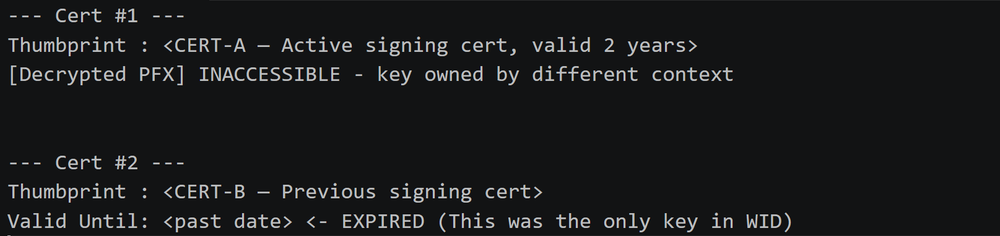
Analysis revealed that AutoCertificateRollover had been disabled and a manual rotation had been performed. Confirmation was obtained directly via Get-AdfsProperties, which returned AutoCertificateRollover: False, indicating that certificate lifecycle management had been delegated to manual administrative processes. While the ADFS service used a new valid key for signing, the WID configuration database was never updated to reflect the new certificate—leaving an expired "ghost" entry as the only record. This drift condition surfaces via Microsoft Event ID 385, which indicates certificate validity warnings in the ADFS service. Notably, this event self-resolves when AutoCertificateRollover is re-enabled and a subsequent certificate rollover is performed; in environments where it is disabled and manual rotation is performed without a corresponding database update, it is the observable symptom of this drift condition.

ADFS certificate enumeration output showing configuration drift between the WID database and the active host certificate

Figure 1: ADFS certificate enumeration output showing configuration drift between the WID database and the active host certificate

ADFS maintains private keys in two protection contexts. In Location 1 (User DPAPI), encrypted key blobs may exist on disk, but the DPAPI protection is tied to the service account's SID and associated DPAPI masterkey material. In the assessed environment, the domain DPAPI backup key approach successfully decrypted masterkey material for interactive user profiles, but returned no decryptable material associated with the ADFS service account profile. All subsequent offline decryption attempts similarly failed, consistent with the masterkey not being recoverable through the evaluated on-disk recovery approach in this environment—though this observation is bounded to the assessed environment and does not represent a universal architectural property of all ADFS deployments.

Location 2 (Machine RSA) does not rely on a user-specific logon session. Instead, the key material is protected using Machine DPAPI, leveraging the DPAPI_SYSTEM LSA secret together with machine masterkeys available to sufficiently privileged SYSTEM-level contexts.

Why the WID Path Misses This Key

In ADFS environments experiencing configuration drift—commonly arising during manual certificate rotations where AutoCertificateRollover is disabled—the ADFS service host can successfully bind to a newly provisioned signing certificate at the operating-system level, ensuring continued service operation. However, the WID configuration database may not reflect the current signing certificate, resulting in stale certificate metadata.

This divergence between configuration and runtime state is the condition that ADFS Event ID 385 is designed to flag. As a consequence, extraction techniques that rely solely on the WID database and DKM material may return certificates that are no longer used for active signing, leading to rejected assertions in downstream federation scenarios.

Understanding How the Machine DPAPI Store Becomes Populated

Understanding how the Machine DPAPI store becomes populated requires examining how ADFS persists its token-signing key material. During initial deployment, automatic certificate rollover, or manual certificate rotation, ADFS persists its RSA private key material in the machine-scoped CAPI key store at C:\ProgramData\Microsoft\Crypto\RSA\MachineKeys\, protected using machine DPAPI context rather than a user-bound DPAPI context. SharpDPAPI /machine enumeration in the assessed environment confirmed that the active machine key material resided under this path, while the CNG Crypto\Keys store was not observed in use in the assessed environment.

The protection chain relies on the DPAPI_SYSTEM LSA secret together with machine masterkeys associated with the S-1-5-18 security context, stored in C:\Windows\System32\Microsoft\Protect\S-1-5-18\ as DPAPI-protected key material—both components ultimately resolvable only within highly privileged SYSTEM-level contexts on the host. The corresponding certificate is enrolled into the LocalMachine\My certificate store, from which ADFS retrieves the associated private key during token-signing operations.

The architectural rationale for machine-scoped key storage is operational resilience. A machine-scoped key remains usable across service account password changes, gMSA rotations, system reboots, and service restarts without requiring key reprovisioning or dependency on a specific interactive logon session. This design ensures that the ADFS service can consistently access the signing key regardless of changes to the underlying service account credentials.

However, this same design choice has important security implications. Because the private key is protected using Machine DPAPI rather than a user-bound DPAPI context, a sufficiently privileged local process capable of accessing the machine key store and associated DPAPI artifacts may be able to recover the key material independently of the original service logon session. As a result, under certain conditions, recovery of the active ADFS token-signing private key may be achievable without direct interaction with LSASS memory or the live ADFS service process itself, potentially reducing visibility to defenses primarily focused on credential dumping or process-memory access behaviors.

KEY DESIGN IMPLICATION

ADFS persists its token-signing private key material in the machine-scoped key store, protected using Machine DPAPI semantics. This is a documented behavior enabling machine-scoped key persistence that survives service account changes, credential rotations, and service restarts.

However, this design introduces an operational security implication that is not commonly emphasized in standard ADFS hardening guidance: private keys stored within the machine key store are protected using this protection model and may be recoverable by a sufficiently privileged SYSTEM-level context through access to the DPAPI_SYSTEM LSA secret and machine masterkeys available locally on the host.

As a result, recovery of the active ADFS token-signing private key may be achievable without direct interaction with LSASS memory or the live ADFS service process itself, potentially reducing visibility to security controls primarily focused on credential dumping or process-memory access behaviors.

Attack Flow: Machine DPAPI Key Recovery to SAML Forgery

Machine DPAPI extraction flow—five-step process from SYSTEM execution to SAML assertion

Figure 2: Machine DPAPI extraction flow—five-step process from SYSTEM execution to SAML assertion

‘SharpDPAPI /machine’ output confirming successful recovery of the active ADFS token-signing private key from the machine DPAPI store

Figure 3: ‘SharpDPAPI /machine’ output confirming successful recovery of the active ADFS token-signing private key from the machine DPAPI store

The recovered key was used to forge a SAML assertion impersonating a Global Administrator identity, which Entra ID accepted as a valid authentication assertion, resulting in authenticated access at Global Administrator privilege level within the federated Microsoft 365 tenant.

Detection and Hunting

Defenders should prioritize visibility into operating system-level cryptographic operations and identity issuance behavior, rather than relying solely on application-layer configuration stores.

  • SACL-Based Object Access Monitoring: Configure object access auditing via SACLs on C:\ProgramData\Microsoft\Crypto\RSA\MachineKeys\ and C:\Windows\System32\Microsoft\Protect\S-1-5-18\. When configured correctly, this generates Security Event ID 4663 for file access attempts. Coverage depends on SACL configuration and access paths; treat this as supporting evidence in correlation-based detection rather than a stand-alone signal.

  • ADFS Token Issuance Consistency: Monitor for inconsistencies between primary authentication events and token issuance events in ADFS audit logs. Relevant events include token issuance and claims processing records (Event IDs 299, 1200-series, depending on ADFS version and audit configuration). The objective is to identify token issuance that cannot be clearly correlated to a preceding authentication context. This is most effective when normal authentication patterns per relying party trust are baselined.

  • Federated Identity Monitoring in Entra ID: Entra ID sign-in logs will record an accepted forged assertion as a standard federated sign-in event. Detection requires cross-correlating Entra ID sign-in records against ADFS-side issuance logs—neither source in isolation is sufficient. For privileged accounts, focus on unexpected Internet Protocol (IP) ranges, claim set deviations,and user-agent inconsistencies.

Mitigation and Remediation

ADFS infrastructure should be treated as Tier 0 identity infrastructure, equivalent in criticality to Domain Controllers. If SYSTEM access is achieved on an ADFS host, the signing key must be considered compromised.

  • Hardware-Backed Key Protection: Migrate token-signing certificates to a Hardware Security Module (HSM). HSM-backed keys ensure private key material does not exist in software-accessible storage on the host, eliminating the Machine DPAPI extraction path entirely.

  • gMSA Service Identity: Run ADFS services using Group Managed Service Accounts to automate credential rotation and reduce operational drift in service identity management. While this does not directly address machine-scoped key protection, it eliminates manual credential management as a contributing factor to configuration drift.

  • Tier 0 Administrative Controls: Govern ADFS servers with strict Tier 0 controls: restricted administrative access pathways, dedicated Privileged Access Workstations (PAWs), separation from general server administration domains, and enhanced privileged access monitoring.

  • Certificate Rotation and Configuration Validation: If compromise is suspected, rotate the token-signing certificate and validate consistency across ADFS configuration, the  LocalMachine\My store, and federation metadata. Do not rely on a single source of truth. For environments with AutoCertificateRollover disabled, manual rotation must include updating ADFS via Set-AdfsCertificate—installing the certificate alone is insufficient. Validate using Get-AdfsCertificate after rotation. If Event ID 385 appears afterward, investigate for configuration inconsistency. 

  • Multicloud Scope Awareness: A compromised ADFS token-signing key affects all SAML relying party trusts, not just Microsoft services. Organizations using ADFS for identity federation across other software-as-a-service (SaaS) platforms should treat ADFS as Tier 0 infrastructure and audit all relying party trusts. Migrating away from ADFS-based federation (e.g., to native OIDC federation) removes this specific attack path.

Google Is Suing Chinese Scammers Who Are Using Gemini

7 July 2026 at 12:43

Not sure this will have any effect, but I support the effort:

According to Google’s legal filing, Outsider Enterprise operates through Telegram. The group offers phishing-as-a-service to individuals who may not be technically savvy enough to set up fraudulent websites and text campaigns on their own. In its Telegram channels, Outsider Enterprise reportedly provided instructions on how to use Google’s Gemini AI to create websites that imitate those of Google, YouTube, and government agencies such as New York’s E-ZPass. The group offered nearly 300 scam templates.

[…]

Google worked with AT&T, Verizon, and T-Mobile to block many of these malicious text messages, and Google notes that its on-device scam detection in Google Messages probably helped reduce the number of successful phishing attempts, too. This AI-powered feature apparently stops 10 billion scam texts every month, so it’s fair to expect it caught at least some Outsider Enterprise activity.

Another article.

France to Stop Certifying Non-Quantum-Safe Encryption

6 July 2026 at 12:45

France is accelerating its transition to post-quantum encryption:

France’s cybersecurity agency ANSSI said on Tuesday it would stop certifying security products that lack quantum-resistant encryption, a move that will force government bodies and critical operators to shift away from older systems.

Samih Souissi, ANSSI’s chief of staff, said at the France Quantum conference that the agency would halt such certifications from 2027, and that businesses should be buying only quantum-safe products by 2030.

ANSSI approval is required for use in French government agencies and critical infrastructure, making the policy a de facto phase-out of older encryption.

Flock Cameras Can Surveil Cars Without License Plates

3 July 2026 at 13:15

This is from a 2024 company presentation:

Officers can also tap into data showing a car’s decals, bumper stickers, back and top racks—along with temporary and unique state tags.

Flock calls it a “Vehicle Fingerprint” and it’s touted as a way for law enforcement officials to get more information “even when you don’t have full plate information,” the company’s presentation shows.

The company gives police officers the ability to search that data as well, to “build stronger cases with less information upfront.” That includes being able to locate multiple vehicles law enforcement officials believe are moving together and what Flock calls a “multi geo search.”

This kind of thing is older than AI; I wrote about it in my 2014 book Beyond Fear. Edward Snowden revealed that the NSA was using cell phone location data to track phones that were habitually near each other.

As bad as Flock is, remember that anyone with broad access to cell phone location data can do the same thing.

Google’s Continued Disruption of Malicious Residential Proxy Networks

2 July 2026 at 16:00

Background

Today, in coordination with the FBI, Lumen, and others, Google took action against the NetNut residential proxy network, also known as Popa. This action builds on our disruption of the IPIDEA proxy network that took place in January 2026, and is a continuation of Google’s objective to dismantle malicious residential proxy networks.

Actions Taken

As a part of this disruption we took the following actions:

  1. Disabled Google accounts and associated Google services used by NetNut for malware command and control (C2), which directly violates Google’s Terms of Service and Acceptable Use Policy. 

  2. Shared technical intelligence on NetNut software development kits (SDKs) and backend C2 infrastructure with platform providers, law enforcement, and research firms to help drive ecosystem-wide awareness and enforcement.

  3. We ensured Google Play Protect, Android’s built-in security protection, automatically warned users and disabled applications known to incorporate NetNut SDKs, and the system will continue to protect users against future install attempts. These efforts to help keep the broader digital ecosystem safe supplement the protections we have to safeguard Android users on certified devices.

We believe our coordinated actions have caused significant degradation to NetNut’s proxy network and its business operations, reducing the available pool of devices for the proxy operator by millions. In addition to selling access to the network under the NetNut brand, NetNut has a robust reseller program that allows whitelabeling of its network. Google has high confidence that many popular residential proxy brands are in fact whitelabeling the NetNut botnet. While we expect this disruption to have a larger ripple effect across the residential proxy ecosystem, observations after the disruption of IPIDEA proved that individual networks can appear resilient. What we have observed is that when faced with the degradation of their own botnet, proxy operators begin buying capacity from their competitors, effectively becoming a reseller. We recognize that creating a lasting disruption in this fluid ecosystem means we must scale our efforts to target the infrastructure of several interconnected providers. We will continue to observe the composition of the NetNut network and map out how its peers adapt to this action.

Why it Matters

NetNut is among the largest and most popular residential proxy networks. Estimating the size of residential proxy networks is extremely challenging, but Google Threat Intelligence Group (GTIG) estimates the size of the NetNut network to be at least 2 million devices, distributed across the world. Public reporting by KrebsOnSecurity and others, confirmed by Google, illustrates that NetNut populates its botnet by distributing SDKs for devices commonly found in homes, such as smart TVs and streaming boxes. GTIG has also identified NetNut botnet plugin components for large-scale botnets such as Badbox 2.0.

Residential proxy networks sell the ability to route traffic through IP addresses owned by internet service providers (ISPs), allowing attackers to mask malicious activity by hijacking these IP addresses. A robust residential proxy network requires controlling millions of residential IP addresses to sell to customers for use. To accomplish this, operators need code running on home devices to enroll them into the malicious network as exit nodes. Home devices become part of proxy networks either because they are pre-installed with malware before purchase or because users unknowingly download applications containing hidden proxy code. This creates serious risks for unsuspecting device owners, as their home IP addresses can be used by attackers as a launchpad for hacking and other unauthorized activities. Consequently, users can have their legitimate traffic flagged as suspicious, or blocked by their service providers.

In a single week during June 2026, GTIG observed 316 distinct threat clusters using suspected NetNut exit nodes, including cybercriminal and espionage groups. These bad actors can use NetNut to mask their origin IP address when accessing victim environments, accessing their own infrastructure, and conducting password spray attacks. Furthermore, when a consumer device becomes an exit node, unauthorized network traffic passes through it. This means bad actors can access other private devices on the same home network, effectively exposing them to Internet threats. Public reports by Synthient, Spur, Nokia Deepfield, and others have documented the use of NetNut to infect devices with variants of Mirai DDoS botnets.

Empowering and Protecting Consumers

Consumers should be extremely wary of applications that offer payment in exchange for "unused bandwidth" or "sharing your internet." These applications are primary ways for malicious proxy networks to grow, and could open security vulnerabilities on the device’s home network. We urge users to stick to official app stores, review permissions for third-party VPNs and proxies, and ensure built-in security protections like Google Play Protect are active.

Consumers should be careful when purchasing connected devices, such as set top boxes, to make sure they are from reputable manufacturers. For example, to help you confirm whether or not a device is built with the official Android TV OS and Play Protect certified, our Android TV website provides the most up-to-date list of partners. You can also take these steps to check if your Android device is Play Protect certified.

Future Work

As we noted earlier this year, the residential proxy industry appears to be rapidly expanding, and this coordinated disruption is not the end of our work combating malicious residential proxy networks. This industry is deeply connected and operators depend on overlapping botnet networks that are constantly resold. While point-in-time disruptions are a critical tool to protect our users, continued and coordinated effort is needed to reduce malicious proxy networks in the long run. We encourage mobile platforms, ISPs, and other tech platforms to continue sharing intelligence and to take direct action to block malicious C2 infrastructure.

Cybersecurity Mission Creep in the US

2 July 2026 at 13:11

Interesting paper: “Cybersecurity Mission Creep.”

Abstract: Cybersecurity is experiencing mission creep. Policymakers are casting more and more problems as issues of cybersecurity. So reframed, wildly different policy issues, from misinformation, to child social media safety laws, to antitrust regulations, to alleged journalist misconduct, to anti-sex trafficking statutes become what this Article calls “cybersecuritized.” Before this reframing, these issues present as important but not existential. But once cybersecuritization positions the issues as threats intensified by their technological nature, they gain access to the politics and law of urgency and exceptionalism and invite troubling governance responses.

Positioned as security threats, cybersecuritized issues become endowed with the apparent normative power to override countervailing considerations, oversimplifying the problem. Cybersecuritization’s oversimplification similarly risks unidimensional solutions and invites use of argumentative trump cards, like First Amendment challenges. Cybersecuritization also invites deference to purported specialists and their proposed solutions. Together, the reductive tendencies of cybersecuritization and the deference it prompts to specialists renders ultimate governance choices more opaque. And this opacity can erode public trust and political legitimacy.

This Article surfaces the phenomenon of cybersecuritization and offers a novel framework for analyzing and critiquing it. Mining cases from across criminal and civil domains, the account also demonstrates the insidiousness of cybersecuritization and the likelihood that it will continue to expand. Confronting cybersecuritization is crucial. If we continue to ignore it, we risk abdicating further responsibility for difficult choices to the trump card of cybersecurity. This Article’s analysis and critique aim to help reclaim the hard work of governance for our hands.

Papa Johns Surveillance-Based Advertising

1 July 2026 at 12:53

Papa Johns is spying on people’s buying activities to predict when they are low on food:

The pizza chain recently tapped NBCUniversal, Instacart and the dentsu-owned media agency Carat for help reaching consumers when they’re low on groceries—and thus more likely to be swayed by a mouth-watering ad. The idea is to reach hungry consumers by “knowing what is in their fridge without being too creepy,” said Carrie Drinkwater, chief investment officer at Carat.

To achieve that goal, NBCU and Instacart created a custom audience of shoppers who regularly purchase grocery staples on Instacart, such as eggs, milk, meat and produce. Based on that data, Papa Johns can determine which days of the week certain consumers are likely to run out of groceries and serve them an ad on NBCU streaming content accordingly. The brand served custom creatives to consumers based on their food preferences—such as whether they buy meat regularly—with QR codes and calls to action such as, “Light on groceries?” or “Empty fridge?”

Back in 2012, we learned (from Target and its campaign that detects when someone is pregnant) that the trick is to hide the knowledge in other, wrong, information. So the way for Papa John’s to not be “too creepy” is to deliberately get it wrong sometimes.

But still, ugh.

The Realities of AI Video Surveillance

30 June 2026 at 14:05

The Financial Times has a good article on how AI is changing the capabilities of video surveillance, with information from both Israel/Iran and Russia.

I wrote about this sort of thing a few years ago, how AI enables mass spying in the way that computers and networks enabled mass surveillance. The interesting development in the article is that AI allows people to ask natural language questions about video footage to AIs—and AIs can answer them.

In contrast with older tools restricted to a few dozen preset searches, these new tools allow an almost unlimited range of enquiries by enabling language-based searches on video.

That lets intelligence officers hunt through massive streams of videos using simple search terms, such as two men handing a bag to each other; a person who has changed their appearance, or has changed clothes multiple times in a day; or a vehicle that has recently been painted over, or has driven past the same spot several times in a short period.

“This is the holy grail of surveillance,” said a European official whose country uses the technology on its cities. “We are able to look for behaviour, not objects ­ it has created a world of new possibilities.”

Factoring RSA Keys with Many Zeros

29 June 2026 at 18:05

Interesting research on a new class of weak RSA keys: keys with lots of zeros. It turns out that these keys are out in the wild.

The badkeys project is an open-source service that checks public keys for known vulnerabilities. While developing this tool, Hanno collected a massive number of real-world keys from public sources, including Certificate Transparency logs, internet-wide TLS and SSH scans, PGP keys, and many others. By searching this dataset for unexpectedly sparse RSA moduli, we uncovered a large number of keys in the wild with the patterns in Figure 1.

Both patterns include several regularly spaced blocks of all zeros interleaved with seemingly random data. Pattern 1 appears in CT logs for certificates issued to several large organizations, including Yahoo and Verizon, and on some devices running NetApp software. Fortunately, these certificates have already expired, but we still shared our findings with these companies. We wanted to learn more about which product could be responsible for generating these keys, but we did not hear back. Pattern 2 appears on SSH hosts running the CompleteFTP software from EnterpriseDT. The underlying vulnerability affects RSA keys generated using versions 10.0.0­12.0.0 (Dec 2016­Mar 2019) and DSA keys generated with v10.0.0­23.0.4 (Dec 2016­Dec 2023).

These vulnerabilities affect a small minority of hosts on the internet, but the more interesting takeaway is that independent cryptographic implementations failed in similar ways. More implementations may include the same bugs, and so it’s worth tailoring cryptanalytic algorithms for this particular type of failure.

The article doesn’t speculate, but I will. This could be a deliberately designed backdoor, of the sort I wrote about back in 2013. I could imagine some government agency figuring out how to break this class of RSA keys, and then convincing different providers to hand them out to users.

The Bear Necessities: A Look at the Drivers, Dynamics, and Applications of the Pro-Russia Influence Ecosystem

29 June 2026 at 16:00

Written by: James Sadowski, Alden Wahlstrom


Introduction

Four years into Russia’s full-scale invasion of Ukraine, the pro-Russia influence ecosystem has evolved from a tool of war back into a global strategic asset. Since the mobilization of this ecosystem to support frontline objectives, we have witnessed the expedited development of new influence assets linked to multiple, expansive, covert information operations (IO) campaigns and a revitalization of pro-Russia hacktivism at an unprecedented scale. While this threat activity initially adapted to encompass Ukraine-related priorities, it is gradually pivoting back to established Russian influence objectives for which the ecosystem was originally honed. This shift is significant because it likely signals increased focus outside of Ukraine, warning that pro-Russia influence activity targeting the European Union (EU), North Atlantic Treaty Organization (NATO), and other top targeting priorities may intensify. 

Ultimately, the war in Ukraine has provided a critical feedback loop for Russia to refine its influence activity, lessons that we anticipate will be applied as the ecosystem continues to reorient toward global strategic objectives while maintaining focus on Ukraine. Further, recent pro-Russia IO indicates the continued expansion of already diverse tactics, and the increasing use of generative AI tooling for planning, research, and content creation marks a forward trend in pro-Russia IO. Meanwhile, new and different actors have adopted IO tactics to meet an increasingly diverse set of challenges, signaling growing Russian reliance on influence tactics. Together, these trends likely demonstrate the Kremlin's perception of these tactics as cost effective and successful. The interconnected nature of the ecosystem's disparate components makes it resilient to limited scope disruptions, which defenders must consider to effectively mitigate pro-Russia influence threats. 

The Ecosystem at a Glance: Objectives, Targeting, and Tactics

Russia's modern approach to information operations is built on the conceptual foundation of Soviet-era "active measures" adapted for the digital age. Alongside disruptive cyberattacks dating back to the early 2000s, the Kremlin has increasingly harnessed internet-based platforms for espionage and information operations. Russia's approach has evolved from rudimentary, singular operations into a complex, self-sustaining environment intentionally curated by the Russian Government that blends overt, covert, and independent elements to advance Kremlin interests both at home and abroad.

Core Influence Objectives 

GTIG’s observations suggest the primary strategic motivations driving the pro-Russia influence ecosystem fall into five categories, each aiming to achieve military and/or political objectives through psychological manipulation of the target audience (Figure 1). Collectively, these objectives informally depict a global influence strategy: through the furthest reach of its influence, the Kremlin seeks to diminish Western primacy and advance Russia's global position; within its surrounding region, it strives to retain and return Moscow's dominance; and at home, it works to ensure the stability of the political regime.

Core objectives of the pro-Russia influence ecosystem

Figure 1: Core objectives of the pro-Russia influence ecosystem

Targeting 

Pro-Russia influence operations are pivoting from the near singular focus on Ukraine that dominated the ecosystem since 2022. We expect influence operations advancing Russia's war-specific interests to continue. However, as Russia seeks to reemerge from international isolation, we have increasingly observed a concurrent focus on pre-war pro-Russia influence objectives. 

The current and historical targeting scope of each ecosystem component exposes both the Kremlin's global ambitions and the realistic limitations of its power projection. State-owned media organizations produce content intended to serve populations across six continents, but in recent years, sanctions and other factors have limited its production and distribution. Meanwhile, covert operations have appeared more limited in scope, primarily targeting the West and countries surrounding Russia, with intermittent operations targeting the Middle East and Africa, indicating that finite resources necessarily limit these operations (Figure 2).

Top Regional Targets
  • The United States and Europe: The Kremlin has long viewed the West as a top adversary of Russia. Accordingly, the US and Europe are top targets of covert pro-Russia information operations, especially aimed at undermining political stability within these countries and the unity between them. NATO and the EU embody the collective "West" and are Russia's perceived top adversaries, second only to the US independently.

  • Russia's "Near Abroad": Since the dissolution of the Soviet Union, Moscow has asserted that the countries that formerly comprised part of the USSR now reside in Russia's so-called "sphere of influence." Covert influence targeting this region directly reflects Moscow's assertion that Russia is a world power entitled to special privileges within its neighborhood. 

  • The Middle East and Africa: Over the past decade, Russian efforts to reassert itself as a global power have included high-profile investments in cultivating Russia's standing in the Middle East and Africa. Covert pro-Russia influence activity is likely deployed in tandem as intended support for other Russian initiatives in these regions.  

  • Russia Domestic: Internally targeted covert IO is a well-established component of pro-Russia influence activity, deployed by regime-aligned actors to promote Kremlin policies and repress opposition voices. 

Targeted Entities and Global Events
  • The Olympics: Russia has long viewed Olympic participation as a point of national prestige, and GTIG has observed notable Russian influence activity targeting the Olympics in the face of Russian participation bans. 

  • War in Ukraine: The war in Ukraine has been a key driver of Russia's influence activity, including attempts to influence events on the ground as well as influence activity intended to advance Moscow's interests elsewhere vis-a-vis the war. GTIG expects that Ukraine will remain a priority in Russia's targeting calculus during the post-conflict phase following any future peace agreements.

  • Elections: Election targeting aligns with multiple Russian influence objectives, including attempting to undermine confidence in democratic institutions as well as internally weakening perceived Western adversaries. These operations regularly target elections in countries that are already prioritized by ongoing pro-Russia influence activity. 

  • Ad Hoc Geopolitical Flashpoints and Global Events: Russian influence actors have a history of pivoting activity to engage with emerging geopolitical developments and events, such as the COVID-19 pandemic or the 2026 Middle East conflict. This flexible target selection often overlaps or is aligned with other Russian priorities, making previously observed Russian influence activity helpful in anticipating which events may be appropriated.

Priority targets of the ecosystem

Figure 2: Priority targets of the ecosystem

Tactics 

Converging geopolitical and technological developments make the evolution of pro-Russia influence tactics a particularly important space to monitor right now. The pro-Russia influence ecosystem expanded to support the war effort, bringing change across the spectrum of activity and providing operators the opportunity to hone their tactics, techniques, and procedures (TTPs) in the rapid feedback loop of war. Meanwhile, the emergence and increased democratization of generative AI tooling has brought both promised and already realized opportunities to support all phases of the IO lifecycle. The following are a sample of key tactics that illustrate how pro-Russia actors currently blend well-tested methods with new technological developments to reach audiences through diverse means:

  • Generative AI: GTIG has observed pro-Russia influence actors increasingly leverage AI tooling to support different stages of their operations, including support for planning and general research as well as content creation.

    • Google Threat Intelligence Group (GTIG) is closely tracking the transition from nascent AI-enabled operations to the maturing, industrial-scale application of generative models within adversarial workflows across threats ranging from espionage and crime to IO. Please see our latest AI threat tracker for more information on how this threat is developing based on our insights, and what Google is doing to protect our customers. 

  • Narrative Resonance: Hijacking existing ideological and emotional fissures within a society provides pro-Russia influence actors tailored narratives to target audiences and potentially increases potential engagement and impact. 

  • Cyber-Enabled IO: Influence campaigns frequently coincide with destructive cyberattacks, such as the deployment of wiper malware alongside website defacements containing false surrender messages, or the historic use of "hack and leak" campaigns in which exfiltrated data, sometimes manipulated, is then publicized through an actor-controlled false persona. In some instances, Russian actors may even leverage direct cyber espionage targeting as a way to achieve psychological effects, intending to influence victims' behavior through intimidation.

  • Media Mimicry: Pro-Russia actors have attempted to mimic legitimate media at scale and through a variety of means, including via the wholesale appropriation of legitimate media brands or developing inauthentic media brands that generally masquerade as independent news sources. These tactics are intended to add a veneer of legitimacy to the promoted narratives. 

  • Direct Dissemination: Pro-Russia influence actors have used closed communication channels, such as emails, SMS text messages, and messenger apps, to disseminate various types of pro-Russia narratives as an adjunct to or outside typical social media-focused operations. 

Core Ecosystem Components 

The current pro-Russia influence ecosystem operates across a spectrum from official government communications to deniable covert actions conducted by intelligence services and "patriotic" proxies. GTIG identified six core components that represent key activity types (Figure 3). While many elements are state-directed or state-affiliated, the ecosystem is also a cultivated, self-sustaining system: various actors, often without explicit direction, amplify Kremlin-friendly narratives and pursue actions that advance Russia's strategic interests. This fluidity provides resilience and complicates attribution, mirroring the longstanding Kremlin strategy to co-opt non-state actors, including criminal networks for finance or illicit logistics, to achieve state objectives without direct attribution. Although each of the core ecosystem components serves as a unique lever the Russian Government can employ to achieve desired objectives, they are regularly used together. For instance, while the entire pro-Russia hacktivist landscape is not state-sponsored, the Russian intelligence services have used both genuine and fabricated hacktivist personas to launder stolen data as part of blended cyber espionage and IO hybrid operations.

Core components of the pro-Russia influence ecosystem

Figure 3: Core components of the pro-Russia influence ecosystem

An Interconnected Ecosystem Enhances Influence Utility

Figure 4 illustrates the complex, interconnected nature of the pro-Russia influence ecosystem by mapping relationships between a selection of key actors and organizations across five of the core components. The ecosystem functions as a cohesive unit, not only through shared objectives, but also through direct cross-component interactions. The Russian Government functions as the sixth core ecosystem component, setting the policy and talking points that inform the ecosystem’s promoted narratives and sponsoring overt and covert assets throughout the other five components diagrammed in Figure 4. Through these levers, the Kremlin fosters the cross-component links that underpin the ecosystem, enhancing its overall utility as a versatile tool of state influence.

Subset of actors that illustrate how different components of the ecosystem interact with each other

Figure 4: Subset of actors that illustrate how different components of the ecosystem interact with each other

10 Key Dynamics for Understanding the Pro-Russia Influence Ecosystem

The scope and diversity of activity in the pro-Russia influence ecosystem challenges defenders tasked with enumerating, tracking, and countering its threats. GTIG has distilled 10 key ecosystem dynamics based on our current understanding of its components and how they each enable covert influence activity. These dynamics frame critical aspects of how activity manifests within the ecosystem, providing a high-level guide to understand and track these threats.

Large-scale IO campaigns are an integral element of the pro-Russia influence ecosystem. Major pro-Russia IO campaigns have been an enduring feature of the pro-Russia ecosystem, with new campaigns emerging as previous ones fall into inactivity. Maintaining extensive IO campaigns and their associated established influence infrastructure enables proactive messaging on strategic issues and underpins a capability that can be rapidly adapted for emerging domestic and global priorities.

  • Long-established IO campaigns, like Secondary Infektion, pivoted to meet new strategic needs as Russia’s 2022 invasion of Ukraine began. New IO campaigns, such as “Operation Overload,” subsequently emerged to support the war effort; while Secondary Infektion has become dormant, these “successor” campaigns have since been leveraged to advance other global Russian influence objectives beyond the war itself. 

Pro-Russia actors often prioritize persistence and the range of tactics they leverage reflects this. In the face of public exposure and disruption, pro-Russia actors and their infrastructure have often remained persistent, sometimes making tactical adjustments to mitigate the effects of detection and disruption and other times continuing operations unabated. 

  • These persistence tactics include the Doppelganger campaign and overt Russian media’s respective cycling of domain infrastructure and/or use of mirror domains to overcome exposure, platform bans and sanctions. Influence operators also frequently continue using compromised assets, sometimes mocking their exposure, as seen with the legacy US-targeted NAEBC campaign and the APT44-affiliated hacktivist persona XakNet Team.

NAEBC-linked persona account

Figure 5: NAEBC-linked persona account mocking public exposure of influence assets (left), and GRU-sponsored XakNet Team persona mocking then-Mandiant (now part of Google Threat Intelligence Group) attribution of the group’s activities to the GRU (right)

Pro-Russia and Russian cyber espionage groups leverage IO tactics to support their operations and weaponize stolen data and/or illicit access. While less frequent, this hybrid activity is a critical dynamic within the pro-Russia influence ecosystem. GTIG has previously observed operations used to shape narratives around cyberattacks and influence events on the ground and to conduct foreign political interference, including the repeated targeting of foreign elections, reported in Spring 2024. We have attributed some observed instances of this to Russian government-sponsored threat actors.

  • Russian state sponsored or pro-Russia hacktivist groups have long relied on public advertisement of real or claimed data exfiltration to highlight their operations, intimidate targets, or sway public opinion. In 2022, UNC4057 (COLDRIVER) used data stolen from espionage targets in a high profile hack-and-leak operation seeking to exacerbate divisions in UK politics. More recently, the self-proclaimed hacktivist group PalachPro claimed in February 2026 to have gained unauthorized access to a Ukrainian government online portal and publicly posted screenshots of the claimed compromise. The Ukrainian government has previously noted that the portal does not store the type of data the threat actor claimed to compromise, suggesting the public posting was likely intended as influence activity, attempting to create the illusion of a more serious threat.

UNC4057 leak website attempting to inflame public debate

Figure 6: UNC4057 leak website attempting to inflame public debate

Pro-Russia hacktivists serve a direct influence function. Modern pro-Russia hacktivism has evolved into an important component of the influence ecosystem that blends state-backed actors leveraging hacktivist tactics with an evolving cohort of likely third-party hacktivist actors that support Russia's geopolitical interests. Pro-Russia hacktivist groups gain domestic and foreign attention for strategic messaging via their claimed threat activity, amplify narratives directly seeded in overt ecosystem segments, and at times also support traditional IO activity or create a means of plausible deniability for state-sponsored espionage actors. 

  • The self-proclaimed hacktivist group NoName057(16) emerged following the Russian invasion of Ukraine in 2022, primarily targeting Ukraine and its partners and allies with DDoS attacks and various network intrusions. It has targeted high profile events, such as the Milano Cortina Winter Olympics, institutions like the French National Assembly, and critical infrastructure and transportation targets in Germany. Often their messaging cites grievances with overt acts of Western support for Kyiv, suggesting the group advances Russian interests not only through the targeting of perceived Russian adversaries but also in gaining attention for its pro-Russia messaging. 

Established ecosystem components facilitate the cultivation of new assets and activity. Inter-ecosystem cross-promotion helps overcome challenges of audience building by directing traffic toward new assets, operations, and narratives, enabling rapid deployment of new and existing IO capabilities. This directly supports a self-sustaining cycle that maintains and expands the ecosystem. 

  • The hacktivist persona JokerDNR played a significant role in amplifying the APT44-linked persona Solntsepek when its doxxing-focused Telegram channel first launched and then again as it began claiming cyber espionage activity. 

Domestic Russian audiences are a longstanding target of the pro-Russia influence ecosystem. Internally directed influence activity has often involved the promotion of Kremlin policies and talking points and the denigration of opposition voices and ideas, conducted by both overt and covert segments of the ecosystem. 

  • Ahead of Russia’s March 2024 presidential election, GTIG identified the hybrid espionage and influence actor UNC5101 register domains and conduct associated influence operations attempting to deceive Russian opposition voters about the timing of an anti-Putin protest.

Ecosystem actors respond to the same set of internal shifting circumstances and external geopolitical developments, often leading to seemingly similar, but ultimately distinct, activity. These shared drivers and general motivational alignments encourage actors to "spontaneously" coalesce around a particular topic or narrative. While this can appear superficially similar, this phenomenon is distinct from instances of actor coordination and campaign linkages, which is less common. 

Systemic flexibility is a central feature, with influence assets able to mobilize both incrementally and at scale to advance Russian interests. The Russian Government is able to mobilize assets across the ecosystem to respond to strategic events. Meanwhile, individual or aligned actors can separately mobilize to address tactical needs, allowing the ecosystem to concurrently message on multiple issues across different geographies (Figure 7). 

  • Russia demonstrated its ability to focus the ecosystem on a single strategic issue like the Russian invasion of Ukraine. Simultaneously, discrete assets have addressed tactical events, such as when Portal Kombat briefly promoted narratives about a Russian drone incursion into Poland concurrently with other covert pro-Russia influence activity.

Tactical responses are executed by individual or coordinated/aligned clusters of actors to address emerging developments

Figure 7: Tactical responses are executed by individual or coordinated/aligned clusters of actors to address emerging developments

Overt Russian media contributes to, and is connected with, multiple covert influence components. The overt components of Russia's influence infrastructure play a critical role within the broader Russian influence ecosystem beyond the commonly understood function of providing a public platform for government-aligned narratives and official talking points; overt media helps to drive (inform targeting) and amplify covert pro-Russia influence activity, seeding desirable narratives within the ecosystem and providing an indirect conduit between the Kremlin and a disparate array of influence actors. Overt media outlets have directly coordinated their activity with covert actors and have increasingly employed IO tactics to disseminate their own content in the face of sanctions and platform bans (Figure 8). 

  • US Government sanctions in late 2024 indicated that Russian state media company Russia Today (RT) directly conducted covert influence operations, including on behalf of the Russian intelligence services. Further, RT employees reportedly interacted with members of the self-proclaimed hacktivist group RaHDit, which has claimed to collaborate with multiple other pro-Russia hacktivist groups, illustrating the layered connections between overt media, Russian intelligence services, and hacktivist groups.

Overt Russian media maintains multiple links with the covert segments of the ecosystem

Figure 8: Overt Russian media maintains multiple links with the covert segments of the ecosystem

Outsourcing IO capability development and campaign execution to third-party organizations and proxies enables scaling and obfuscation. Outsourcing is used for developing custom tooling and bolstering both human and organizational capacity. While custom tool development facilitates operators in all phases of the IO lifecycle, Russian government actors can flexibly leverage different models for outsourcing campaign execution based on their specific needs. Proxy actors can also generate plausible deniability (Figure 9). 

  • GTIG reported how Russian IT contractor NTC Vulkan (Russian: НТЦ Вулкан) worked with the Russian intelligence services, including providing tooling and support for the GRU unit that sponsors APT44 activity. Separately, US government sanctions detailed how the Doppelganger campaign is supported by multiple Russian contractors under the sponsorship of the Russian Presidential Administration.

Outsourcing and proxies support capability development and campaign execution for covert influence activity

Figure 9: Outsourcing and proxies support capability development and campaign execution for covert influence activity

Conclusion

Multiple factors are propelling the evolution of the pro-Russia influence ecosystem we have observed since Moscow’s full scale invasion of Ukraine four years ago. The Kremlin mobilized the entire ecosystem to support the ongoing conflict, which has provided rapid feedback and driven significant investment in new and established overt and covert influence assets. At the same time, pro-Russia actors are increasingly experimenting with generative AI to enhance their workflows. This condensed period of adaptation, alongside signals suggesting Russia's growing reliance on IO tactics to navigate new challenges, raises concerns regarding how a potentially diversifying pool of actors will leverage advancements in tradecraft and scalability. As Russia seeks to emerge from international isolation and reorients its influence ecosystem back toward global objectives, it is critical for defenders to understand how this ecosystem provides the Kremlin with a durable influence capability in order to better anticipate future Russian influence threats.

Additional Tools and Resources

For mitigation and hardening recommendations, please review the following:

Google offers a suite of free of cost tools to help protect high-risk users from the most pervasive digital attacks, to which politicians, journalists, and campaigns are often most vulnerable. Examples include protecting accounts from targeted attacks with Advanced Protection Program and safeguarding campaign websites from DDoS attacks with Project Shield.

Robot Police Officers

29 June 2026 at 12:55

We’ve taken one small step towards robot police officers: a drone capable of disarming a suspect:

In a June 22 video posted on the Sacramento County Sheriff’s Office’s Instagram page, an officer wearing goggles can be seen operating a drone to retrieve a knife from an armed suspect hiding inside a cluttered house. “After not responding to negotiators, a drone was deployed inside the residence,” the post says. “Drone pilots located the suspect hiding in a corner of a garage” and then used a high-powered magnet attached to the drone to grab the knife out of the suspect’s hand. In the video ­ which is soundtracked by the “Mission: Impossible” theme song—the intercepted knife can be seen spinning around in the air as the drone carries it back to the deputies.

Slashdot thread.

Kali Linux 2026.2 Release (GNOME 50, KDE 6.6, Helper Scripts, APT Formats & VM Boot Tweaking)

29 June 2026 at 02:00

It’s the final week of Q2, and Kali Linux 2026.2 is here - right on schedule ;) We have been heads down since our last release, and we are ready to share what we have been working on. This release is a mix of desktop refreshes, infrastructure improvements, and quality-of-life changes that we think you will appreciate.

The summary of the changelog since the 2026.1 release from March is:


Desktop Environments Updates

As we do roughly every six months, every other Kali release, our desktop environments get a major update. This time it’s for: GNOME and KDE Plasma. Neither brings sweeping changes, but both have put real effort into refining performance and usability across the whole ecosystem.

GNOME 50

GNOME 50 brings usability and performance improvements across the desktop. The file manager received significant optimizations, resulting in faster thumbnail and icon loading, improved responsiveness, and reduced memory usage. The desktop also received new accessibility enhancements through a brand-new preferences window, tweaks to the screen reader, and automatic language switching.

Another addition is support for document annotations in the Document Viewer app, making it easier to add text notes and highlights directly to documents.

Here you can read more about all the changes with this new GNOME release: GNOME 50 release announcement.

Kali + GNOME 50

KDE Plasma 6.6

KDE Plasma 6.6 focuses on improving usability and accessibility while introducing several new features, including a new on-screen keyboard, providing a better experience particularly for touch-enabled devices.

The Spectacle screenshot utility can now recognize and extract text directly from screenshots, making OCR functionality available from the desktop. Accessibility has also been enhanced with new color-vision support options, improvements to Zoom and Magnifier, support for Slow Keys on Wayland, and adoption of the standardized Reduced Motion setting.

Here you can read more about all the changes with this new Plasma release: KDE Plasma 6.6 release announcement.

Kali + KDE Plasma 6.6

Improved Consistency For Services Helper Scripts

To improve consistency across tools that depend on a service, we have updated our helper scripts. Previously, a tool that required a service might only let you start it (with no way to stop) - and the information displayed back was inconsistent (mixture of service status, how to access, default credentials or nothing at all). With this change, multiple packages have been updated to use these new scripts, which now handle the following tasks:

  • Manage the service - start/stop
  • Check if the service is already running - avoiding starting it twice
  • Show the service status
  • Show any default credentials
  • Show how to access it - such as if it’s a web UI, the URL (and bonus, automatically open it in the browser!)

We also make sure that any Kali packages which include a service use <tool>-start/<tool>-stop for their command names.

Hopefully this makes the little things a little easier.

Kali Services Helper Scripts

APT Gets A New Sources Format

Since the beginning of time, the APT sources for Kali Linux were configured in the file /etc/apt/sources.list. This file tells APT from where to update your system, and it’s so fundamental that pretty much everyone (that is, Kali users) knows this file and its content:

┌──(kali㉿kali)-[~]
└─$ cat /etc/apt/sources.list
# See https://www.kali.org/docs/general-use/kali-linux-sources-list-repositories/
deb http://http.kali.org/kali kali-rolling main contrib non-free non-free-firmware

Well, it’s a “once in a distro lifetime” kind of thing, and here it is - /etc/apt/sources.list is retired, in favor of the new file /etc/apt/sources.list.d/kali.sources:

┌──(kali㉿kali)-[~]
└─$ cat /etc/apt/sources.list.d/kali.sources
# See https://www.kali.org/docs/general-use/kali-apt-sources/
Types: deb
URIs: http://http.kali.org/kali/
Suites: kali-rolling
Components: main contrib non-free non-free-firmware
Signed-By: /usr/share/keyrings/kali-archive-keyring.gpg

All the freshly-installed systems will be configured as such. Existing systems won’t be changed. Both files are equivalent and work just the same. However, in the near future, APT will warn if the old file is in use, and will suggest modernizing it.

Note that, for those in the know, this isn’t anything new: both formats have existed for a long time now, and you could use either one or the other. What’s happening is that the default is slowly changing, from the old “one-line-style” to the new “deb822-style”. This is happening in Debian and in Debian-derivatives like Ubuntu. Kali is just following suit.

And for the curious, there’s a very complete and detailed manual page:

┌──(kali㉿kali)-[~]
└─$ man sources.list

No More Graphics Firmware Pre-installed For VM Use-cases

Kali has had a long tradition of pre-installing a lot of firmware in its images. The upside is that users didn’t need to know what firmware they needed to install for their hardware to work: it was already there. And the downside, obviously, was that all the firmware that wasn’t needed was nevertheless installed and taking space for nothing.

It worked for us so far, in the sense that we don’t get too many bug reports related to missing firmware. But lately the changing landscape of graphics firmware forced us to re-evaluate this decision.

The issue with graphics firmware is that it just keeps growing bigger, and right now having it installed for NVidia, AMD and Intel GPUs takes almost 300 MB. But what’s even worse: some bits and pieces of these firmware packages need to be loaded very early, and therefore they are also installed in the initrd (note: the initrd, or initramfs, is this “minimal” system that is loaded early on by the kernel at boot time). And lately, the Kali initrd peaked at around 200 MB, mainly due to graphics firmware. What does that mean in practice? A bigger initrd means slower boot time, and can potentially fill up your /boot partition if ever it’s too small.

So we thought we could improve the situation for VM users here: the vast majority probably don’t need graphics firmware, ever. The only use-case we can think of is a VM with a dedicated GPU + GPU passthrough enabled. If you’re in this case, you might need graphics firmware.

So, what changed in practice, you may ask?

  • Pre-built VM images don’t come with graphics firmware anymore
  • Installer images now detect if installation happens in a VM, and in that case graphics firmware is not installed

As a result, the initrd is down to 60 MB for VM users, and the boot time is cut by ~3x (tested for QEMU VM on a Linux host, your mileage may vary). That’s a massive improvement in boot time.

For baremetal users: nothing changed, so you still get a 200 MB initrd with all graphics firmware pre-installed. If you’d like to optimize, it’s on you to uninstall the firmware that you don’t need. A word of caution though: make sure to know what you’re doing, because removing graphics firmware that is needed might leave you with a system without graphics after reboot.

Disruptive Package Updates

We’ve got some slightly disruptive updates in this release.

polkit: a reboot is required

The update of the polkitd package requires a reboot, otherwise trying to start GUI applications as root will fail with cryptic error messages.

There’s an indication of this reboot requirement in the output of apt full-upgrade, when the polkitd package is updated. It’s just not very obvious, the hint is buried with the rest of the logs:

┌──(kali㉿kali)-[~]
└─$ sudo apt update && sudo apt full-upgrade
[...]
Setting up libpolkit-gobject-1-0:amd64 (127+really127-0kali1)…
Setting up libpolkit-agent-1-0:amd64 (127+really127-0kali1)…
Setting up polkitd (127+really127-0kali1)…
Upgrading to this polkitd version requires a reboot, please reboot the system when convenient.
Created symlink '/etc/systemd/system/sockets.target.wants/polkit-agent-helper.socket' → '/usr/lib/systemd/system/polkit-agent-helper.socket'.
[...]

After a reboot, and if ever you still can’t run applications as root, make sure that polkit-agent-helper is started:

┌──(kali㉿kali)-[~]
└─$ sudo systemctl enable --now polkit-agent-helper.socket

If you’re still having issues, reach out on our bug tracker.


xrdp: a reboot is required

In this Kali release, we updated xrdp and xorgxrdp to the v0.10 series. xrdp is an open-source Remote Desktop Protocol server: you might use it if you connect to your Kali instance remotely. If you’re an xrdp user, you’ll need to reboot after this upgrade.

For those who run Kali in Hyper-V, using the Enhanced Session Mode: you’re an xrdp user, even if you didn’t know it! We did our best to ensure a smooth transition, and yet we got reports that xrdp wasn’t functional after the upgrade. If ever you’re in this case, you can try to run kali-tweaks, and in the Virtualization section you can try to disable, and then enable again the Hyper-V Enhanced Session Mode. That might fix the issue. Don’t forget to reboot!

As always, if you’re still having issues after that, feel free to reach out on the Kali bug tracker.

Linux Kernel For This Release: 6.19

Regarding the version of the Linux kernel to include in this release of Kali, it’s been a tough decision.

On one hand, we’d like to release with the latest version of the Linux kernel, due to all the recent vulnerability disclosures (Copy Fail/CVE-2026-31431, Dirty Frag/CVE-2026-43284 & CVE-2026-43500 and others ). On the other hand, when the 7.0 kernel reached Debian, there were reports of incompatibilities with the NVidia DKMS drivers .

We decided to release with a 6.19 kernel to avoid breaking NVidia users. At the same time, for those who prefer to get the latest kernel and don’t care about NVidia compatibility, we have the kernel 7.0 ready for you in kali-experimental. Make sure to check our documentation that explains how to enable the kali-experimental repository. The 7.0 kernel is also available in kali-rolling, so you can just update your whole system and get the latest packages from kali-rolling.

A Sneak Peek: Build Scripts

Our build scripts are what we use to produce every Kali image - ARM SBCs, Base (Installer and live ISOs), Cloud, Containers, VMs, WSL & NetHunter/Pro. Each lives in its own repo, and over time they have each grown in slightly different directions. For the next release, Kali 2026.3, we are doing a consistency pass across all of them: same structure, same conventions, same behaviour throughout.

As a result of these changes, some CI pipelines or workflows may need tweaking.

New Tools in Kali

This release brings 9 new tools (to the network repositories). As always, we have been busy adding to the arsenal:

  • arsenal-ng - Go-based command library equipped with 200+ cybersecurity cheat-sheets
  • hydra-gtk - [Re-added] Very fast network logon cracker - GTK+ based GUI
  • legba - Multiprotocol credentials bruteforcer / password sprayer and enumerator
  • oletools - Analyze MS OLE2 files and MS Office documents
  • penelope - Powerful shell handler
  • shell-gpt - Command-line productivity tool powered by AI large language models
  • tailscale - Secure connectivity platform
  • tookie-osint - OSINT information gathering tool for finding social media accounts
  • uro - Declutter URLs for crawling/pentesting

There has also been numerous packages updates and new libraries as well. We also bump the Kali kernel to 6.19.

Kali NetHunter Updates

Kali NetHunter EvilTwin

We have a tremendous amount of news for the lovers of mobile hacking! The Kali NetHunter app launches instantly now, various bugs have been fixed with the custom commands and chroot manager . A new EvilTwin (Wi-Fi Fake AP) tab has been added with password verification captive portal, which brought along a really needed iptables fix. So now after using Wifipumpkin3 or EvilTwin, Android Hotspot will work properly. Huge thanks to the incredible work by @dr.rootsu. The kernel flasher tab has also received a refresh.

However, this release’s spotlight is on the beginning of the Qcacld-3.0 injection patch wave.

The Qcacld3.0 Injection Story

We finally came to a milestone, shout-out to all the developers that worked on injection through the years!

@kimocoder easily spent more than anyone else on this goal. His original injection implementation came to life, on a specific device: the OnePlus Nord (AC2003). You can find the commit here. Then @Loukious came in the mix and his modifications made it to work on other devices with this port. Finally, @cyberknight777 did some housekeeping, removed unnecessary changes, logging, and restored the correct authorship while attributing @Loukious as co-author. The result, this patch is the almost universal one which brought many devices into the injection world, starting with the ones below for both kernel 4.x and 5.x versions:

  • OnePlus 7 (LineageOS 23.2)
  • OnePlus 9 / 9 Pro
  • OnePlus Nord
  • POCO X3 Pro
  • Redmi Note 10
  • Samsung A73
  • Xiaomi Mi A3 (LineageOS 23.2)
  • Xiaomi Poco X3 NFC (PixelOS Android 16)
  • Xiaomi Redmi Note 8

Wifite On TV

Kali Wifite Netflix Bloodhounds S02E01

In the meantime, his continuous work on improving wifite caught some attention - spotted on Netflix twice. Not bad!

Magisk Standalone Kernel Installer

The kernel flasher tab (still experimental on some devices) is back in a new shape, giving a hint for the possible future look for the NetHunter app.

The Magisk standalone kernel flashing support is now here - you can simply open any newly built kernel installer zip in the Magisk app that was built using the kali-nethunter-installer.

New Kernels

In addition to the kernels that now support the qcacld3 injection, there are several new versions and phones:

  • Google Pixel 6a (LineageOS 23.2)
  • OnePlus 7 [SM8150] (LineageOS 23.2)
  • Redmi 5A (crDroid 14)
  • Samsung Note 20 Ultra (Android 13)
  • Samsung S10 (LineageOS 23.2)
  • Samsung S10 5G (LineageOS 23.2)
  • Samsung S10+ (LineageOS 23.2)
  • Samsung S10e (LineageOS 23.2)

NetHunter Pro

Kali bare metal now on more phones, thanks to Kali NetHunter Pro! New devices added in build thanks to the awesome work by @shubhamvis98 and Mobian Team:

  • Fairphone FP5 (QCM6490) (fp5)
  • Google Pixel 3 (SDM845) (blueline)
  • Google Pixel 3a (SDM670) (sargo)
  • Google Pixel 3a XL SDC panel (SDM670) (bonito-sdc)
  • Google Pixel 3a XL Tianma panel (SDM670) (bonito-tianma)
  • Google Pixel 4a (SDM730) (sunfish)
  • LG G7 ThinQ (SDM845) (judyln)
  • LG V35 ThinQ (SDM845) (judyp)
  • Samsung Galaxy S9 China (SDM845) (starqltechn)
  • SHIFTphone 8 (QCM6490) (otter)
  • Sony Xperia 10 III (SM6350) (pdx213)
  • Sony Xperia XZ2 (SDM845) (xperia-tama-apollo)
  • Sony Xperia XZ2 Compact (SDM845) (xperia-tama-akari)
  • Sony Xperia XZ2 Premium (SDM845) (xperia-tama-akatsuki)
  • Xiaomi Mi 10T Lite (SM7225) (toco)
  • Xiaomi Mi 9 Pro 5G (SM8150) (tucana)
  • Xiaomi Mi 9T Pro Samsung panel (SM8150) (davinci-samsung)
  • Xiaomi Mi 9T Pro Visionox panel (SM8150) (davinci-visionox)
  • Xiaomi Mi Mix 2S (SDM845) (polaris)
  • Xiaomi Poco X3 Huaxing panel (SM7150) (surya-huaxing)
  • Xiaomi Poco X3 Tianma panel (SM7150) (surya-tianma)
  • Xiaomi Redmi Note 10 Pro (SM7150) (sweet)

Previously SDM845 devices, USB On-The-Go (OTG) wasn’t working. However, thanks to Max Furman’s work, USB switching has been added to OnePlus 6/6T devices (and DTB doesn’t need to be patched). This work will hopefully be ported to other devices and kernels in upcoming releases.

NetHunter Podcast Episode 3

@yesimxev and @Kristopher Wilson joined for a discussion about NetHunter in cars, and leveraging AI for Bug Bounty projects and more.

Kali Website Updates

Since our last release, Kali 2026.1, we have been keeping the website and documentation up-to-date. Here is a quick summary of what has changed.

Kali Documentation

Most of the documentation updates this cycle are around NetHunter device support and the new APT sources format. Pages which got something more than a tweak:

We also want to say a little thank you to the following for their work on the sites:

Anyone can help out, anyone can get involved!

New Kali Mirrors

We welcomed 1 new mirror during this release cycle, but that’s a significant one: our first mirror in Africa! Hoping that many others will follow ;)

The mirror is located in South Africa, online at mirror.africloud.com. It is sponsored by AFRICLOUD, and was setup thanks to Oluniyi Ajao.

If you have the disk space and bandwidth, we always welcome new mirrors.


Get Kali Linux 2026.2

Fresh Images

So what’s stopping you? Go and get Kali already!

If you cannot wait for the next release, we also produce weekly builds which include the latest packages at the time of download, meaning fewer updates needed on first boot. These are automated builds rather than QA’d releases like our standard release images, but we still welcome bug reports on them. The earlier we catch issues, the sooner they get fixed.

Existing Installs

Using Kali already? Great! You can keep it up-to-date by doing:

┌──(kali㉿kali)-[~]
└─$ sudo tee /etc/apt/sources.list.d/kali.sources << 'EOF'
Types: deb
URIs: http://http.kali.org/kali/
Suites: kali-rolling
Components: main contrib non-free non-free-firmware
Signed-By: /usr/share/keyrings/kali-archive-keyring.gpg
EOF
[...]
┌──(kali㉿kali)-[~]
└─$ sudo apt update && sudo apt -y full-upgrade
[...]
┌──(kali㉿kali)-[~]
└─$ cp -vrbi /etc/skel/. ~/
[...]
┌──(kali㉿kali)-[~]
└─$ sudo reboot -f

Remember, we recommend doing a reboot for this release!

You should now be on Kali Linux 2026.2. We can double check this by doing:

┌──(kali㉿kali)-[~]
└─$ grep VERSION /etc/os-release
VERSION="2026.2"
VERSION_ID="2026.2"
VERSION_CODENAME="kali-rolling"
┌──(kali㉿kali)-[~]
└─$ uname -v
#1 SMP PREEMPT_DYNAMIC Kali 6.19.14-1+kali1 (2026-05-05)
┌──(kali㉿kali)-[~]
└─$ uname -r
6.19.14+kali-amd64

NOTE: The output of uname -r may be different depending on the system architecture.


As always, if you run into anything broken, please report it. We will never be able to fix what we do not know is broken! And Social networks are not bug trackers!


Want to keep up-to-date easier? We’ve got you!

❌