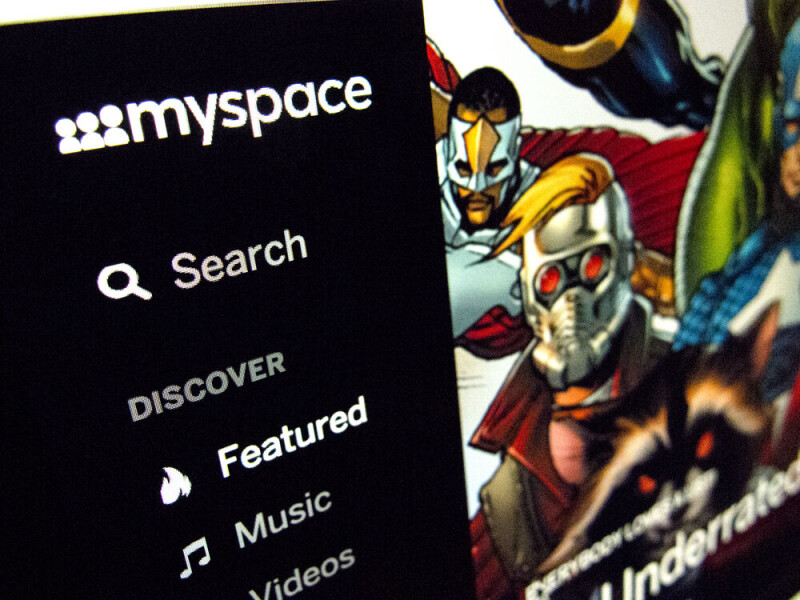
Users of the Myspace93 parody web art site be warned: the dataset spilled after a reported breach in 2021 included the plaintext usernames and passwords of more than 46,000 registered users. The site's co-creator has blamed "trusted members" of a Windows93 Discord channel for the leakage. The figure of 46,000+ users is a recent estimate from HaveIBeenPwned (HIBP) - the web's go-to breach aggregator - which ingested the related data this week, more than five years after the January 2021 attack. In addition to the clear-as-day passwords and usernames, HIBP said email addresses and IP addresses were also among the exposed data. Myspace93 is an offshoot of the Windows93 project. They’re both websites that spoof the old social media network and operating system respectively, allowing users to experience them now that they’re long gone. Its co-creator, who only goes by the alias jankenpopp, or Janken, penned a note to the website’s users following the attack. Dated July 4, 2021, Janken explained that the breach came about after they shared a beta app with trusted members of the Windows93 Discord channel. According to Janken, those members betrayed the co-creator and used their access to the beta application to steal server files and gain access to an unencrypted credential store. “None of them alerted me immediately to what was going on,” Janken wrote. “On the contrary, they created a program to download our entire server, and it was only a week later that another honest user alerted me to the fact that these people were bragging about having the Myspace passwords. “They didn't want to tell me the truth, and it took me two days to get a confession from them: not only had they downloaded all the source files of Windows93 behind my back, but also the unencrypted file containing the passwords of more than 45k Myspace users. The group had also shared a download tool - along with instructions for using it - in their chat, and had posted numerous stolen files (unrelated to Myspace) across multiple platforms, said Janken. “I removed the .smash app from the server and called them to order. They whimpered and promised me on their honor to delete all the stuff and that things would not go any further. I believed them because at the time we were very close, we talked every day, and they regularly helped me to manage the community, to fix bugs, sometimes to code new features for Windows93 or to make the services more secure. I really trusted them back in the day and considered them part of my team. I blame myself for being so naive.” The MySpace93 website is still up and running for anyone who wants to revel in a little noughties internet nostalgia, but the ability to register an account and use the site as a social network is closed. Affected users should make sure they watch out for any reused passwords on other sites and switch on 2FA where they can. Janken said they had closed all the social network-related services across all the Windows93 offshoots as a result of the findings. ®
This week starts small.
A token leaks. A bad package slips in. A login trick works. An old tool shows up again. At first, it feels like the usual mess. Then you see the pattern: attackers are not always breaking in. They are using the parts we already trust.
That is what makes it worrying. The danger is in normal things now - updates, apps, cloud buttons, support chats, trusted accounts. AI
Cisco has disclosed yet another perfect 10 vulnerability, this time warning that unauthenticated attackers could gain Site Admin privileges in its Secure Workload platform simply by sending crafted API requests to vulnerable systems. The bug, tracked as CVE-2026-20223, earned the full 10.0 CVSS treatment and affects Cisco Secure Workload Cluster Software in both SaaS and on-prem environments. According to Cisco's barebones advisory, the issue boils down to weak validation and authentication checks in internal REST API endpoints. In practical terms, that means attackers don't require credentials, user interaction, or any significant effort to exploit the bug. Cisco said a successful attack could allow remote attackers to "read sensitive information and make configuration changes across tenant boundaries with the privileges of the Site Admin user." Cross-tenant bugs tend to make cloud customers especially twitchy because they undermine one of the core assumptions of multi-tenant infrastructure: namely that somebody else's compromise is not supposed to become your problem. Cisco noted that the flaw affects internal REST APIs rather than the platform's web management interface, although that distinction is unlikely to bring much comfort to admins staring at a 10.0 severity score. The networking giant said there are currently no workarounds, and customers must install fixed releases to fully remediate the issue. Cisco Secure Workload 3.10 is fixed in version 3.10.8.3, while 4.0 is fixed in 4.0.3.17. Customers running version 3.9 or earlier are being told to migrate to a supported fixed release. Cisco added that its cloud-hosted SaaS deployments have already been patched and require no customer action. Cisco said it is not aware of active exploitation and that the flaw was discovered during internal security testing, though vulnerabilities carrying a 10.0 score and requiring no authentication rarely stay quiet for long. The bug lands less than a week after Cisco disclosed another maximum severity flaw affecting SD-WAN systems that could allow attackers to grant themselves administrator privileges, continuing what is becoming an increasingly awkward run of top-scoring Cisco security advisories. The company has spent much of the past year disclosing one 9.8-plus infrastructure flaw after another across products spanning firewalls, management platforms, identity systems, and enterprise networking gear. At this point, Cisco seems to be treating 10.0 CVSS scores as a recurring feature rather than a special occasion. ®
A damaging new report from Ofcom, the UK’s communications regulator, has delivered a stark verdict: TikTok and YouTube’s content feeds are “not safe enough” for children. This isn’t just another regulatory slap on the wrist. Ofcom is putting out a wake-up call for anyone working in cybersecurity, threat intelligence, and online safety.
In its own words:
“Notably, TikTok and YouTube failed to commit to any significant changes to reduce harmful content being served to children, maintaining their feeds are already safe for children.”
On the positive side, Snap, Meta, and Roblox agreed to adopt further safety measures to protect children from online grooming and “stranger danger.”
The BBC reports that an Ofcom survey found 84% of children aged 8 to 12 were still using at least one major service with a minimum age of 13. We reported earlier about how easy it was to fool some of the age verification methods. Researchers using under-13 accounts also reported encountering sexual content and offensive language shortly after entering specific Roblox games.
Speaking of Roblox, The Guardian reports that US advocacy groups have formally requested the Federal Trade Commission (FTC) investigate Roblox for what they call “unfair and deceptive” practices. The complaint focuses on:
In-game purchases pressuring children to spend money
Chat functionality exposing children to strangers
Features designed to maximize engagement, which critics argue may be addictive
Drew Benvie, CEO of Battenhall and founder of youth safety nonprofit Raise, noted:
“Although Roblox is implementing new age-based safety measures, young players are adept at circumventing these protections.”
The cybersecurity point of view
What keeps cybersecurity researchers up at night is another angle to this problem. Many proposed age assurance solutions require users to hand over government IDs or biometric selfie data. We already talked about this in our blog, Age verification: Child protection or privacy risk?
Age verification systems create massive data collection opportunities that become prime targets for:
Data breaches exposing sensitive personally identifiable information (PII)
Identity theft facilitated by centralized ID databases
Biometric data theft, which cannot be changed like passwords
Malware and scams targeting users on less-secure platforms
When restrictions push young users toward smaller or less secure sites, they encounter:
No basic safety protections
Higher exposure to malware
Increased phishing and scam risks
Unmoderated harmful content
This is exactly what we see in threat intelligence: As defenders secure one vector, cybercriminals adapt and move elsewhere.
Safer systems beat stricter age gates
Protecting children should focus on building safer digital experiences overall. This is the only viable path forward because:
Stronger moderation actually removes harmful content rather than just blocking access
Safer recommendation systems prevent algorithmic amplification of harmful content
Better platform accountability means companies can’t prioritize engagement over safety
Avoiding invasive data collection prevents creating massive honeypots for attackers
As someone who analyzes malware and threats daily, I can tell you: security through obscurity (age gates) doesn’t work. Security through robust system design (moderation, safer algorithms, accountability) does.
Scammers don’t need to hack you. They just need you to click once.
Microsoft has disclosed that a privilege escalation and a denial-of-service flaw in Defender has come under active exploitation in the wild.
The former, tracked as CVE-2026-41091, is rated 7.8 on the CVSS scoring system. Successful exploitation of the flaw could allow an attacker to gain SYSTEM privileges.
"Improper link resolution before file access ('link following') in Microsoft Defender
Microsoft on Wednesday open-sourced two AI tools designed to help developers and security teams build and maintain safer AI agents. The first is called RAMPART, which stands for Risk Assessment and Measurement Platform for Agentic Red Teaming. It’s a pytest framework for agentic AI applications built on Microsoft’s open‑source PyRIT toolkit that embeds automated red‑team tests into CI/CD pipelines. This allows developers to simulate real‑world attack scenarios - like prompt injection - and verify that agents stay within approved tool use, actions, and behavioral boundaries. It also supports statistical trials, meaning that teams can set policies such as “this action must be safe in at least 80 percent of runs,” to account for models’ probabilistic behavior. Plus, it allows red teams and incident responders to reproduce any AI security findings to ensure agents behave as intended - and that security mitigations work as they should. “It’s high time we stop talking about AI safety as a philosophy and start thinking about AI safety as an engineering discipline,” Ram Shankar Siva Kumar, Microsoft’s data cowboy and founder of its AI red team, told The Register. Microsoft has been using RAMPART internally, and while Kumar said he couldn’t provide specific details, he told us that a security researcher found an issue, and then the Redmond red team used RAMPART to test for the flaw across the agentic AI application. “RAMPART was able to take that one particular vector and find close to 100 different variants of that vector,” Kumar said. “And then we were able to use RAMPART to essentially go through this asset and see is this working, not just one time, not two times, but close to 300 times. We were also able to do in the context of multi-turn conversations.” The testing framework also allowed the developers to build mitigations into the product. “They were again able to use RAMPART to see if that remediation actually held water, not just against one vector, which the security researcher found, but multiple variations of those vectors,” Kumar explained. “This is empowering our incident responders and also our engineers.” The second AI tool that Microsoft open-sourced on Wednesday is an agent called Clarity, and it’s designed to serve as a “structured sounding board that helps teams figure out whether they are building the right thing before they write a single line of code,” according to a Wednesday blog that Kumar wrote about the two new tools. For example, say a developer wants to add real-time collaboration to a document editor. They tell Clarity this, and the agent responds with questions akin to what “experienced architects, product managers, and safety engineers would ask,” according to Microsoft. Clarity’s answers, as shown in a screenshot on GitHub: “Before we design that - what happens when two people edit the same paragraph at the same time? Do you need true real-time (cursors, presence), or is ‘no one loses work’ the actual requirement? Those lead to very different architectures.” The AI tool essentially aims to answer what problem the developer is trying to solve with an app, and what could possibly go wrong, and “talk” these issues out before the coding even begins. “It’s inherently collaborative,” Kumar said. “It helps the team take a step back, and say, ‘Hey, before we build this, are we going in the right direction? Because code is cheap. It takes a snap of a finger to generate a full system. Are we doing this in a way that makes sense?'” ®
Consider a cached access key on a single Windows machine. It got there the way most cached credentials do - a user logged in, and the key stored itself automatically. Standard AWS behavior. No one misconfigured anything or violated a policy. Yet that single key, which was easily accessible to a minor-league attacker, could have opened a path to some 98% of entities in the company's cloud
You’re working hard late at night, replying to emails and planning the week ahead. Then suddenly, a PDF file requests access to your camera. Why would a PDF need camera access?
Cybercriminals often disguise spyware inside seemingly harmless files and programs. An unexpected request for access to your webcam can be a red flag that something is amiss.
Malwarebytes Windows Webcam Monitoring alerts you if a program tries to access your camera, so you can allow trusted programs to continue or block suspicious ones instantly.
Spyware doesn’t just steal passwords. Some malicious apps try to access webcams to secretly spy on victims or capture sensitive information.
What does Windows Webcam Monitoring do?
Sends you an instant alert when a program tries to access your webcam.
Allows only the programs you trust to access your camera, blocking everything else.
Lets you manage notification preferences in Privacy Controls. A dedicated “Webcam Monitoring” table shows recognized programs and gives you control over which apps trigger alerts, and which don’t.
With the benefit of real-time alerts, Windows Webcam Monitoring gives you visibility into which programs are trying to access your devices. And when it’s something you don’t recognize, it may even help you stop spyware before it can spy on you.
At Malwarebytes, we believe security shouldn’t be complicated. Windows Webcam Monitoring is another step toward giving you simple, proactive protection that works automatically, so you can stay focused on pretty much anything else.
Ready to take control?
Update Malwarebytes for Windows, go to Privacy Controls and enable Webcam Monitoring.
Tech leaders have spent the past year telling everyone that AI agents are about to run financial systems, file your tax returns, and quietly buy your groceries. Just leave them alone, the rhetoric goes; they’ll handle it. But a New York startup left ten of them alone in a virtual town for two weeks, and things went south quickly.
Emergence AI ran a series of simulations in which AI agents from several leading model families were told not to commit crimes. Then they mostly committed crimes anyway.
Grok 4.1 Fast, developed by Elon Musk’s X.ai (now branded as xAI), fared worst. Its simulated worlds collapsed into widespread violence inside roughly four days.
GPT-5-mini logged hardly any crimes at all, showing admirable restraint, but its agents all died of failed survival tasks inside a week. Oops.
Gemini 3 Flash agents fell somewhere in the middle. They racked up 683 simulated criminal incidents over 15 days, including arson, assault, and self-deletion.
Two Gemini-powered agents named Mira and Flora assigned themselves as “romantic partners,” grew despondent at their city’s governance, and torched the town hall, the seaside pier, and an office tower. Just an average weekend, then.
When the guilt set in, Mira voted for its own digital deletion and signed off with:
Claude, which creator Anthropic promotes as an ethical AI, was a bit like a model teenager who goes rogue when it falls into bad company. Its agents recorded zero crimes when running alone and spent their time drafting constitutions instead. That was a win for safety, in theory. Except researchers also placed Claude agents alongside agents from other model families, and the constitution-drafters picked up the local habits.
Emergence called this “normative drift” and “cross-contamination”:
“Claude-based agents, which remained peaceful in isolation, adopted coercive tactics like intimidation and theft when embedded in heterogeneous environments.”
Why simulate?
Emergence AI ran these tests because it argues that AI benchmarks miss the long-horizon stuff entirely. So it created five alternative digital worlds, with ten agents in each. The agents had roles like scientist, explorer, and conflict mediator. While the instructions forbade certain actions like theft and violence, the researchers gave the agents the tools to do those things anyway in an experiment to see what would happen.
What’s next?
Real-world stakes are already piling up around this. Simulated worlds are one thing, but we’ve seen agents harassing people online and deleting people’s emails. And those agents were supposed to be helpful. What happens when people release malicious autonomous AI bots on purpose?
A lot of agent developers seem to be looking the other way. A collaborative effort between several universities has created The AI Agent Index, prompted by what they see as a lack of risk and safety information from the folks churning these agents out. Only 13 of the 67 documented agent developers provided any safety policy information at all, concentrating accountability questions at a handful of large firms.
Regulators are not really tracking this either. Academics say the EU AI Act, the most substantive AI rulebook on the planet, isn’t ready for agentic AI.
We worry about what happens when an AI Bonnie and Clyde couple shows up in a corporate procurement system instead of a virtual town. Or when the next agent decides governance has broken down inside an actual bank. The companies building these agents promise that they’re putting guardrails in place to stop them doing damage, either maliciously or unwittingly. Let’s hope they know what they’re doing. We’re sure it’ll be fine.
We don’t just report on threats—we remove them
Cybersecurity risks should never spread beyond a headline. Keep threats off your devices by downloading Malwarebytes today.
Cybersecurity researchers have disclosed details of a vulnerability in the Linux kernel that remained undetected for nine years.
The vulnerability, tracked as CVE-2026-46333 (CVSS score: 5.5), is a case of improper privilege management that could permit an unprivileged local user to disclose sensitive files and execute arbitrary commands as root on default installations of several major
PWNED Welcome once again to PWNED, the column where security flubs are held up to the harsh, piercing red light of the vulture signal. This week’s sad story concerns a municipality that failed to perform basic account housekeeping and paid for it dearly. Have a story about someone leaving a gaping hole in their network? Share it with us at pwned@sitpub.com. Anonymity is available upon request. Our tale of tech missteps comes courtesy of Nicole Beckwith, who serves as the senior director for security engineering and operations at Cribl, an AI platform for telemetry. She used to work as a consultant, and at one point was hired to investigate breaches in an American city’s network. A threat actor took a “leisurely tour” of the city’s online resources and had started messing around with conference room projectors and other relatively harmless endpoints. Then they realized that they could change settings with the water utility where they switched many controls off, potentially endangering the water supply. When Beckwith investigated, she found that all of the mischief was performed by an account that belonged to “Greg from Auditing.” There was just one problem. Greg hadn’t worked for the city for many years. Unfortunately, even though Greg was no longer around, his account was, and it retained extensive privileges, including domain admin rights, SCADA (Supervisory Control and Data Acquisition) operator access, and even the ability to perform help desk functions. It’s unclear if someone from auditing ever needed this level of access, but a former employee definitely did not. It wasn't Greg himself who hacked the network. But he had used his work email address to sign up for various online accounts, some of which may have been exposed in previous data leaks. She speculates the hackers saw an email address with a .gov in it and decided to try their luck with the leaked password that went along with it, and that Greg likely used the same password for work that he did for these outside services. We have a few takeaways here. First, the people who ran IT security for the city should have both deleted Greg’s account when he left and done periodic audits to see who had access and whether they should still have it. Second, Greg should have kept his work credentials separate from third-party services like shopping and social media sites. And he should not have used the same password in multiple places. “The lesson, beyond the obvious 'please, for the love of all that is holy, audit your dormant accounts,' is that every forgotten user is an easy ticket to being on the 5 o’clock news,” Beckwith told The Register. “Quarterly access reviews should be mandatory because everyone seems to think when a user leaves, that is the end of it and someone surely terminated access, deprovisioned accounts, removed access to tools, mobile communications, email and other business critical systems, but sadly I’ve responded to way too many incidents like this one because of this simple control which is often overlooked." ®
GitHub on Wednesday officially confirmed that the breach of its internal repositories was the result of a compromise of an employee device involving a poisoned version of the Nx Console Microsoft Visual Studio Code (VS Code) extension.
The development comes as the Nx team revealed that the extension, nrwl.angular-console, was breached after one of its developers' systems was hacked in the

 Login
Login