Meta also replaces a legacy C++ media-handling security library with Rust
Users of Meta's WhatsApp messenger looking to simplify the process of protecting themselves are in luck, as the company is rolling out a new feature that combines multiple security settings under a single, toggleable option. …
U.S. Homeland Security Secretary Kristi Noem last week posted a photo of the arrest of Nekima Levy Armstrong, one of three activists who had entered a St. Paul, Minn. church to confront a pastor who also serves as acting field director of the St Paul Immigration and Customs Enforcement (ICE) office.
A short while later, the White House posted the same photo – except that version had been digitally altered to darken Armstrong’s skin and rearrange her facial features to make it appear she was sobbing or distraught. The Guardian one of many media outlets to report on this image manipulation, created a handy slider graphic to help viewers see clearly how the photo had been changed.
This isn’t about “owning the libs” — this is the highest office in the nation using technology to lie to the entire world.
The New York Times reported it had run the two images through Resemble.AI, an A.I. detection system, which concluded Noem’s image was real but the White House’s version showed signs of manipulation. "The Times was able to create images nearly identical to the White House’s version by asking Gemini and Grok — generative A.I. tools from Google and Elon Musk’s xAI start-up — to alter Ms. Noem’s original image."
Most of us can agree that the government shouldn’t lie to its constituents. We can also agree that good government does not involve emphasizing cruelty or furthering racial biases. But this abuse of technology violates both those norms.
“Accuracy and truthfulness are core to the credibility of visual reporting,” the National Press Photographers Association said in a statement issued about this incident. “The integrity of photographic images is essential to public trust and to the historical record. Altering editorial content for any purpose that misrepresents subjects or events undermines that trust and is incompatible with professional practice.”
This isn’t about “owning the libs” — this is the highest office in the nation using technology to lie to the entire world.
Reworking an arrest photo to make the arrestee look more distraught not only is a lie, but it’s also a doubling-down on a “the cruelty is the point” manifesto. Using a manipulated image further humiliates the individual and perpetuate harmful biases, and the only reason to darken an arrestee’s skin would be to reinforce colorist stereotypes and stoke the flames of racial prejudice, particularly against dark-skinned people.
But in an age when we can create or alter a photo with a few keyboard strokes, when we can alter what viewers think is reality so easily and convincingly, the danger of abuse by government is greater.
Had the Trump administration not ham-handedly released the retouched perp-walk photo after Noem had released the original, we might not have known the reality of that arrest at all. This dishonesty is all the more reason why Americans’ right to record law enforcement activities must be protected. Without independent records and documentation of what’s happening, there’s no way to contradict the government’s lies.
This incident raises the question of whether the Trump Administration feels emboldened to manipulate other photos for other propaganda purposes. Does it rework photos of the President to make him appear healthier, or more awake? Does it rework military or intelligence images to create pretexts for war? Does it rework photos of American citizens protesting or safeguarding their neighbors to justify a military deployment?
In this instance, like so much of today’s political trolling, there’s a good chance it’ll be counterproductive for the trolls: The New York Times correctly noted that the doctored photograph could hinder the Armstrong’s right to a fair trial. “As the case proceeds, her lawyers could use it to accuse the Trump administration of making what are known as improper extrajudicial statements. Most federal courts bar prosecutors from making any remarks about court filings or a legal proceeding outside of court in a way that could prejudice the pool of jurors who might ultimately hear the case.” They also could claim the doctored photo proves the Justice Department bore some sort of animus against Armstrong and charged her vindictively.
In the past, we've urged caution when analyzing proposals to regulate technologies that could be used to create false images. In those cases, we argued that any new regulation should rely on the established framework for addressing harms caused by other forms of harmful false information. But in this situation, it is the government itself that is misusing technology and propagating harmful falsehoods. This doesn't require new laws; the government can and should put an end to this practice on its own.
Any reputable journalism organization would fire an employee for manipulating a photo this way; many have done exactly that. It’s a shame our government can’t adhere to such a basic ethical and moral code too.
Plus, the gang says it got in via Microsoft Entra SSO
ShinyHunters says it stole several slices of data from Panera Bread, but that's just the yeast of everyone's problems. The extortionist gang also claims to have stolen data from CarMax and Edmunds, in addition to three other organizations it posted to its blog last week.…
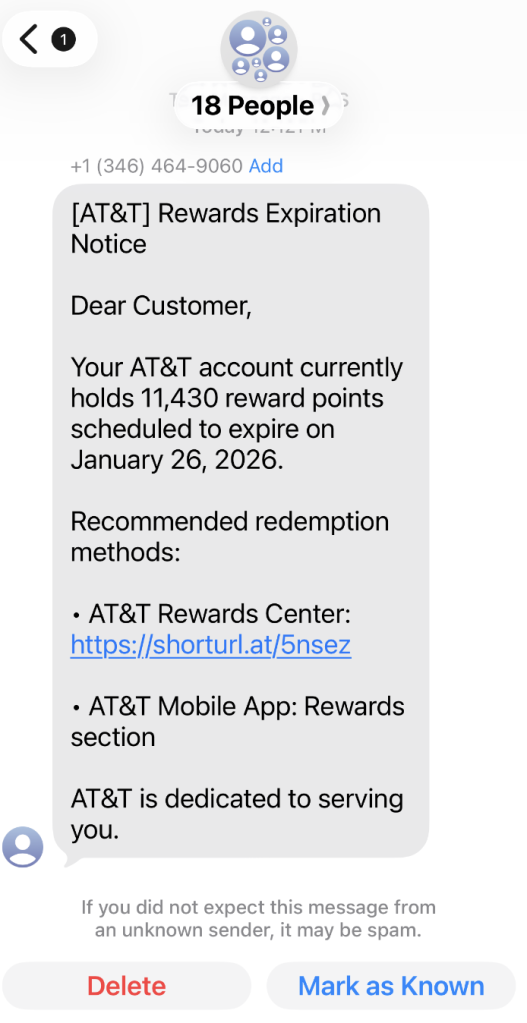
A coworker shared this suspicious SMS where AT&T supposedly warns the recipient that their reward points are about to expire.
Phishing attacks are growing increasingly sophisticated, likely with help from AI. They’re getting better at mimicking major brands—not just in look, but in behavior. Recently, we uncovered a well-executed phishing campaign targeting AT&T customers that combines realistic branding, clever social engineering, and layered data theft tactics.
In this post, we’ll walk you through the investigation, screen by screen, explaining how the campaign tricks its victims and where the stolen data ends up.
This is the text message that started the investigation.
“Dear Customer, Your AT&T account currently holds 11,430 reward points scheduled to expire on January 26, 2026. Recommended redemption methods: – AT&T Rewards Center: {Shortened link} – AT&T Mobile App: Rewards section AT&T is dedicated to serving you.”
The shortened URL led to https://att.hgfxp[.]cc/pay/, a website designed to look like an AT&T site in name and appearance.
All branding, headers, and menus were copied over, and the page was full of real links out to att.com.
But the “main event” was a special section explaining how to access your AT&T reward points.
After “verifying” their account with a phone number, the victim is shown a dashboard warning that their AT&T points are due to expire in two days. This short window is a common phishing tactic that exploits urgency and FOMO (fear of missing out).
The rewards on offer—such as Amazon gift cards, headphones, smartwatches, and more—are enticing and reinforce the illusion that the victim is dealing with a legitimate loyalty program.
To add even more credibility, after submitting a phone number, the victim gets to see a list of available gifts, followed by a final confirmation prompt.
At that point, the target is prompted to fill out a “Delivery Information” form requesting sensitive personal information, including name, address, phone number, email, and more. This is where the actual data theft takes place.
The form’s visible submission flow is smooth and professional, with real-time validation and error highlighting—just like you’d expect from a top brand. This is deliberate. The attackers use advanced front-end validation code to maximize the quality and completeness of the stolen information.
Behind the slick UI, the form is connected to JavaScript code that, when the victim hits “Continue,” collects everything they’ve entered and transmits it directly to the attackers. In our investigation, we deobfuscated their code and found a large “data” section.
The stolen data gets sent in JSON format via POST to https://att.hgfxp[.]cc/api/open/cvvInterface.
This endpoint is hosted on the attacker’s domain, giving them immediate access to everything the victim submits.
What makes this campaign effective and dangerous
Sophisticated mimicry: Every page is an accurate clone of att.com, complete with working navigation links and logos.
Layered social engineering: Victims are lured step by step, each page lowering their guard and increasing trust.
Quality assurance: Custom JavaScript form validation reduces errors and increases successful data capture.
Obfuscated code: Malicious scripts are wrapped in obfuscation, slowing analysis and takedown.
Centralized exfiltration: All harvested data is POSTed directly to the attacker’s command-and-control endpoint.
How to defend yourself
A number of red flags could have alerted the target that this was a phishing attempt:
The text was sent to 18 recipients at once.
It used a generic greeting (“Dear Customer”) instead of personal identification.
The sender’s number was not a recognized AT&T contact.
The expiration date changed if the victim visited the fake site on a later date.
Beyond avoiding unsolicited links, here are a few ways to stay safe:
Only access your accounts through official apps or by typing the official website (att.com) directly into your browser.
Check URLs carefully. Even if a page looks perfect, hover over links and check the address bar for official domains.
Cybersecurity risks should never spread beyond a headline. If something looks dodgy to you, check if it’s a scam using Malwarebytes Scam Guard, a feature of our mobile protection products. Submit a screenshot, paste suspicious content, or share a text or phone number, and we’ll tell you if it’s a scam or legit. Download Malwarebytes Mobile Security for iOS or Android and try it today!
Reports say Salt Typhoon attackers accessed handsets of senior govt folk
Chinese state-linked hackers are accused of spending years inside the phones of senior Downing Street officials, exposing private communications at the heart of the UK government.…
The Google Threat Intelligence Group (GTIG) has identified widespread, active exploitation of the critical vulnerability CVE-2025-8088 in WinRAR, a popular file archiver tool for Windows, to establish initial access and deliver diverse payloads. Discovered and patched in July 2025, government-backed threat actors linked to Russia and China as well as financially motivated threat actors continue to exploit this n-day across disparate operations. The consistent exploitation method, a path traversal flaw allowing files to be dropped into the Windows Startup folder for persistence, underscores a defensive gap in fundamental application security and user awareness.
In this blog post, we provide details on CVE-2025-8088 and the typical exploit chain, highlight exploitation by financially motivated and state-sponsored espionage actors, and provide IOCs to help defenders detect and hunt for the activity described in this post.
To protect against this threat, we urge organizations and users to keep software fully up-to-date and to install security updates as soon as they become available. After a vulnerability has been patched, malicious actors will continue to rely on n-days and use slow patching rates to their advantage. We also recommend the use of Google Safe Browsing and Gmail, which actively identifies and blocks files containing the exploit.
Vulnerability and Exploit Mechanism
CVE-2025-8088 is a high-severity path traversal vulnerability in WinRAR that attackers exploit by leveraging Alternate Data Streams (ADS). Adversaries can craft malicious RAR archives which, when opened by a vulnerable version of WinRAR, can write files to arbitrary locations on the system. Exploitation of this vulnerability in the wild began as early as July 18, 2025, and the vulnerability was addressed by RARLAB with the release of WinRAR version 7.13 shortly after, on July 30, 2025.
The exploit chain often involves concealing the malicious file within the ADS of a decoy file inside the archive. While the user typically views a decoy document (such as a PDF) within the archive, there are also malicious ADS entries, some containing a hidden payload while others are dummy data.
The payload is written with a specially crafted path designed to traverse to a critical directory, frequently targeting the Windows Startup folder for persistence. The key to the path traversal is the use of the ADS feature combined with directory traversal characters.
For example, a file within the RAR archive might have a composite name like innocuous.pdf:malicious.lnk combined with a malicious path: ../../../../../Users/<user>/AppData/Roaming/Microsoft/Windows/Start Menu/Programs/Startup/malicious.lnk.
When the archive is opened, the ADS content (malicious.lnk) is extracted to the destination specified by the traversal path, automatically executing the payload the next time the user logs in.
State-Sponsored Espionage Activity
Multiple government-backed actors have adopted the CVE-2025-8088 exploit, predominantly focusing on military, government, and technology targets. This is similar to the widespread exploitation of a known WinRAR bug in 2023, CVE-2023-38831, highlighting that exploits for known vulnerabilities can be highly effective, despite a patch being available.
Figure 1: Timeline of notable observed exploitation
Russia-Nexus Actors Targeting Ukraine
Suspected Russia-nexus threat groups are consistently exploiting CVE-2025-8088 in campaigns targeting Ukrainian military and government entities, using highly tailored geopolitical lures.
UNC4895 (CIGAR): UNC4895 (also publicly reported as RomCom) is a dual financial and espionage-motivated threat group whose campaigns often involve spearphishing emails with lures tailored to the recipient. We observed subjects indicating targeting of Ukrainian military units. The final payload belongs to the NESTPACKER malware family (externally known as Snipbot).
Figure 2: Ukrainian language decoy document from UNC4895 campaign
APT44 (FROZENBARENTS): This Russian APT group exploits CVE-2025-8088 to drop a decoy file with a Ukrainian filename, as well as a malicious LNK file that attempts further downloads.
TEMP.Armageddon (CARPATHIAN): This actor, also targeting Ukrainian government entities, uses RAR archives to drop HTA files into the Startup folder. The HTA file acts as a downloader for a second stage. The initial downloader is typically contained within an archive packed inside an HTML file. This activity has continued through January 2026.
Turla (SUMMIT): This actor adopted CVE-2025-8088 to deliver the STOCKSTAY malware suite. Observed lures are themed around Ukrainian military activities and drone operations.
China-Nexus Actors
A PRC-based actor is exploiting the vulnerability to deliver POISONIVY malware via a BAT file dropped into the Startup folder, which then downloads a dropper.
Financially Motivated Activity
Financially motivated threat actors also quickly adopted the vulnerability to deploy commodity RATs and information stealers against commercial targets.
A group that has targeted entities in Indonesia using lure documents used this vulnerability to drop a .cmd file into the Startup folder. This script then downloads a password-protected RAR archive from Dropbox, which contains a backdoor that communicates with a Telegram bot command and control.
A group known for targeting the hospitality and travel sectors, particularly in LATAM, is using phishing emails themed around hotel bookings to eventually deliver commodity RATs such as XWorm and AsyncRAT.
A group targeting Brazilian users via banking websites delivered a malicious Chrome extension that injects JavaScript into the pages of two Brazilian banking sites to display phishing content and steal credentials.
In December and January 2026, we have continued to observe malware being distributed by cyber crime exploiting CVE-2025-8088, including commodity RATS and stealers.
The Underground Exploit Ecosystem: Suppliers Like "zeroplayer"
The widespread use of CVE-2025-8088 by diverse actors highlights the demand for effective exploits. This demand is met by the underground economy where individuals and groups specialize in developing and selling exploits to a range of customers. A notable example of such an upstream supplier is the actor known as "zeroplayer," who advertised a WinRAR exploit in July 2025.
The WinRAR vulnerability is not the only exploit in zeroplayer’s arsenal. Historically, and in recent months, zeroplayer has continued to offer other high-priced exploits that could potentially allow threat actors to bypass security measures. The actor’s advertised portfolio includes the following among others:
In November 2025, zeroplayer claimed to have a sandbox escape RCE zero-day exploit for Microsoft Office advertising it for $300,000.
In late September 2025, zeroplayer advertised a RCE zero-day exploit for a popular, unnamed corporate VPN provider; the price for the exploit was not specified.
Starting in mid-October 2025, zeroplayer advertised a zero-day Local Privilege Escalation (LPE) exploit for Windows listing its price as $100,000.
In early September 2025, zeroplayer advertised a zero-day exploit for a vulnerability that exists in an unspecified drive that would allow an attacker to disable antivirus (AV) and endpoint detection and response (EDR) software; this exploit was advertised for $80,000.
zeroplayer’s continued activity as an upstream supplier of exploits highlights the continued commoditization of the attack lifecycle. By providing ready-to-use capabilities, actors such as zeroplayer reduce the technical complexity and resource demands for threat actors, allowing groups with diverse motivations—from ransomware deployment to state-sponsored intelligence gathering—to leverage a diverse set of capabilities.
Conclusion
The widespread and opportunistic exploitation of CVE-2025-8088 by a wide range of threat actors underscores its proven reliability as a commodity initial access vector. It also serves as a stark reminder of the enduring danger posed by n-day vulnerabilities. When a reliable proof of concept for a critical flaw enters the cyber criminal and espionage marketplace, adoption is instantaneous, blurring the line between sophisticated government-backed operations and financially motivated campaigns. This vulnerability’s rapid commoditization reinforces that a successful defense against these threats requires immediate application patching, coupled with a fundamental shift toward detecting the consistent, predictable post-exploitation TTPs.
Indicators of Compromise (IOCs)
To assist the wider community in hunting and identifying activity outlined in this blog post, we have included indicators of compromise (IOCs) in a GTI Collection for registered users.
Austrian education ministry unaware of tracking software until campaigners launched case
Updated Microsoft illegally installed cookies on a school pupil's devices without consent, according to a ruling by the Austrian data protection authority (DSB).…
The US Supreme Court is considering the constitutionality of geofence warrants.
The case centers on the trial of Okello Chatrie, a Virginia man who pleaded guilty to a 2019 robbery outside of Richmond and was sentenced to almost 12 years in prison for stealing $195,000 at gunpoint.
Police probing the crime found security camera footage showing a man on a cell phone near the credit union that was robbed and asked Google to produce anonymized location data near the robbery site so they could determine who committed the crime. They did so, providing police with subscriber data for three people, one of whom was Chatrie. Police then searched Chatrie’s home and allegedly surfaced a gun, almost $100,000 in cash and incriminating notes.
Chatrie’s appeal challenges the constitutionality of geofence warrants, arguing that they violate individuals’ Fourth Amendment rights protecting against unreasonable searches.
WhatsApp is going through a rough patch. Some users would argue it has been ever since Meta acquired the once widely trusted messaging platform. User sentiment has shifted from “trusted default messenger” to a grudgingly necessary Meta product.
Privacy-aware users still see WhatsApp as one of the more secure mass-market messaging platforms if you lock down its settings. Even then, many remain uneasy about Meta’s broader ecosystem, and wish all their contacts would switch to a more secure platform.
Back to current affairs, which will only reinforce that sentiment.
Google’s Project Zero has just disclosed a WhatsApp vulnerability where a malicious media file, sent into a newly created group chat, can be automatically downloaded and used as an attack vector.
The bug affects WhatsApp on Android and involves zero‑click media downloads in group chats. You can be attacked simply by being added to a group and having a malicious file sent to you.
According to Project Zero, the attack is most likely to be used in targeted campaigns, since the attacker needs to know or guess at least one contact. While focused, it is relatively easy to repeat once an attacker has a likely target list.
And to put a cherry on top for WhatsApp’s competitors, a potentially even more serious concern for the popular messaging platform, an international group of plaintiffs sued Meta Platforms, alleging the WhatsApp owner can store, analyze, and access virtually all of users’ private communications, despite WhatsApp’s end-to-end encryption claims.
How to secure WhatsApp
Reportedly, Meta pushed a server change on November 11, 2025, but Google says that only partially resolved the issue. So, Meta is working on a comprehensive fix.
Google’s advice is to disable Automatic Download or enable WhatsApp’s Advanced Privacy Mode so that media is not automatically downloaded to your phone.
And you’ll need to keep WhatsApp updated to get the latest patches, which is true for any app and for Android itself.
Turn off auto-download of media
Goal: ensure that no photos, videos, audio, or documents are pulled to the device without an explicit decision.
Open WhatsApp on your Android device.
Tap the three‑dot menu in the top‑right corner, then tap Settings.
Go to Storage and data (sometimes labeled Data and storage usage).
Under Media auto-download, you will see When using mobile data, when connected on Wi‑Fi. and when roaming.
For each of these three entries, tap it and uncheck all media types: Photos, Audio, Videos, Documents. Then tap OK.
Confirm that each category now shows something like “No media” under it.
Doing this directly implements Project Zero’s guidance to “disable Automatic Download” so that malicious media can’t silently land on your storage as soon as you are dropped into a hostile group.
Stop WhatsApp from saving media to your Android gallery
Even if WhatsApp still downloads some content, you can stop it from leaking into shared storage where other apps and system components see it.
In Settings, go to Chats.
Turn off Media visibility (or similar option such as Show media in gallery). For particularly sensitive chats, open the chat, tap the contact or group name, find Media visibility, and set it to No for that thread.
WhatsApp is a sandbox, and should contain the threat. Which means, keeping media inside WhatsApp makes it harder for a malicious file to be processed by other, possibly more vulnerable components.
Lock down who can add you to groups
The attack chain requires the attacker to add you and one of your contacts to a new group. Reducing who can do that lowers risk.
In Settings, tap Privacy.
Tap Groups.
Change from Everyone to My contacts or ideally My contacts except… and exclude any numbers you do not fully trust.
If you use WhatsApp for work, consider keeping group membership strictly to known contacts and approved admins.
Set up two-step verification on your WhatsApp account
Read this guide for Android and iOS to learn how to do that.
We don’t just report on phone security—we provide it
Victim and Big Brother Watch will argue the Met's policies are incompatible with human rights law
The High Court will hear from privacy campaigners this week who want to reshape the way the Metropolitan Police is allowed to use live facial recognition (LFR) tech.…
TikTok may have found a way to stay online in the US. The company announced late last week that it has set up a joint venture backed largely by US investors. TikTok announced TikTok USDS Joint Venture LLC on Friday in a deal valued at about $14 billion, allowing it to continue operating in the country.
This is the culmination of a long-running fight between TikTok and US authorities. In 2019, the Committee on Foreign Investment in the United States (CFIUS) flagged ByteDance’s 2017 acquisition of Musical.ly as a national security risk, on the basis that state links between the app’s Chinese owner would make put US users’ data at risk.
In his first term, President Trump issued an executive order demanding that ByteDance sell the business or face a ban. That was order was blocked by courts, and President Biden later replaced it with a broader review process in 2021.
In April 2024, Congress passed the Protecting Americans from Foreign Adversary Controlled Applications Act (PAFACA), which Biden signed into law. That set a January 19, 2025 deadline for ByteDance to divest its business or face a nationwide ban. With no deal finalized, TikTok voluntarily went dark for about 12 hours on January 18, 2025. Trump later issued executive orders extending the deadline, culminating in a September 2025 agreement that led to the joint venture.
Three managing investors each hold 15% of the new business: database giant Oracle (which previously vied to acquire TikTok when ByteDance was first told to divest), technology-focused investment group Silver Lake, and the United Arab Emirates-backed AI (Artificial Intelligence) investment company MGX.
Other investors include the family office of tech entrepreneur Michael Dell, as well as Vastmere Strategic Investments, Alpha Wave Partners, Revolution, Merritt Way, and Via Nova.
Original owner ByteDance retains 19.9% of the business, and according to an internal memo released before the deal was officially announced, 30% of the company will be owned by affiliates of existing ByteDance investors. That’s in spite of the fact that PAFACA mandated a complete severance of TikTok in the US from its Chinese ownership.
A focus on security
The company is eager to promote data security for its users. With that in mind, Oracle takes the role of “trusted security partner” for data protection and compliance auditing under the deal.
Oracle is also expected to store US user data in its cloud environment. The program will reportedly align with security frameworks including the National Institute of Standards and Technology (NIST) Cybersecurity Framework. Other TikTok-owned apps such as CapCut and Lemon8 will also fall under the joint venture’s security umbrella.
Canada’s TikTok tension
It’s been a busy month for ByteDance, with other developments north of the border. Last week, Canada’s Federal Court overturned a November 2024 governmental order to shut down TikTok’s Canadian business on national security grounds. The decision gives Industry Minister Mélanie Joly time to review the case.
Why this matters
TikTok’s new US joint venture lowers the risk of direct foreign access to American user data, but it doesn’t erase all of the concerns that put the app in regulators’ crosshairs in the first place. ByteDance still retains an economic stake, the recommendation algorithm remains largely opaque, and oversight depends on audits and enforcement rather than hard technical separation.
In other words, this deal reduces exposure, but it doesn’t make TikTok a risk-free platform. For users, that means the same common-sense rules still apply: be thoughtful about what you share and remember that regulatory approval isn’t the same as total data safety.
We don’t just report on data privacy—we help you remove your personal information
Cybersecurity risks should never spread beyond a headline. With Malwarebytes Personal Data Remover, you can scan to find out which sites are exposing your personal information, and then delete that sensitive data from the internet.

 Login
Login