AI is becoming both an attack tool and a high-value target, with attacks by AI-enabled adversaries rising 89 percent in 2025, according to CrowdStrike. The security firm's annual Threat Hunting Report details criminal gangs and nation states using AI throughout the attack chain. Attackers are also targeting organizations' AI infrastructure and poisoning popular software packages to compromise their users. "AI is both the weapon and the target," CrowdStrike counter adversary division senior VP Adam Meyers told reporters. "AI is a high-value attack surface, and it's being used by more and more threat actors." These attacks include LLMjacking, in which criminals steal corporate credentials to access frontier-model APIs, and cost harvesting – deliberately inflating a victim's AI usage to run up its bill. In one campaign, CrowdStrike documented a token thief sending about 200,000 API requests in just two minutes. The security vendor's threat hunting team now tracks AI agent-triggered leads at 2.5x the rate of human-triggered threats, and Meyers said this increased volume remains true across both government-backed goons and financially motivated criminals. CrowdStrike tracks more than 290 adversary groups, having added about ten this year. Of the 290, a North Korean crew it tracks as Famous Chollima – a sub-unit operating under the Lazarus Group umbrella and best known for its fake IT worker scams – "demonstrated the most advanced AI usage" over the second half of 2025 and first half of 2026, according to the report. This government-backed crew created "entire fake companies with AI-generated websites, GitHub accounts, and email infrastructure to support insider threat operations," the authors wrote. AI supply-chain compromise was the second most common MITRE ATLAS technique used by attackers to gain initial access, and Famous Chollima's campaign targeting AI-focused development environments "was one of the most sophisticated examples of this technique in practice," the report noted. This included a supply-chain attack in January and February targeting cryptocurrency and blockchain companies. In these attacks, the Norks published trojanized repositories, primarily hosted on GitHub, that contained legitimate-looking project files alongside hidden, malicious scripts. When developers opened these repos, malicious scripts automatically executed commands that gave Famous Chollima access to their environments. "AIs themselves are being targeted through that supply chain and through the CI/CD pipelines that they're dependent on," Meyers said. Threat hunters suspect another Lazarus Group offshoot, tracked as Stardust Chollima or Sapphire Sleet, was behind the March Axios supply chain attack. Last week, Amazon attributed four npm compromises over the past 18 months to the same North Korean crew. Meanwhile, a financially motivated crew tracked by CrowdStrike as Altered Spider and elsewhere as TeamPCP targeted developers' AI tools, compromising more than 300 software dependencies in one day. It harvested credentials and secrets before pivoting into cloud environments for theft and extortion. Altered Spider "hits the endpoint in seconds and within minutes, they're inside of the cloud," Meyers said. "It gives you a sense of how quickly they can move throughout that environment, and this is all tied again to software supply chains." Patching window slams shut CrowdStrike argues that AI is helping attackers exploit newly disclosed vulnerabilities at machine speed. From January to June, 88 percent of the exploitation observed by CrowdStrike using public proof-of-concept (PoC) code occurred within 48 hours of the code's release. The company said China-linked groups such as Vault Panda and Genesis Panda moved even faster, launching attacks within 24 hours of disclosure. "Vulnerabilities are weaponized through the use of AI," Meyers said. "This is creating a rich ecosystem of vulnerabilities for attackers to use against various systems, and what this really means is that the 30-day patch window, which frankly, was aspirational, is completely obsolete. We're down to 24-hour, 48-hour patch cycles, and organizations are really struggling under that." Meanwhile, as anyone who follows Microsoft's Patch Tuesday – or any other software vendors' vulnerability disclosures over the past few months – knows, AI is also really good at finding bugs in code. This means more CVEs and more patching for sysadmins racing to fix flaws before miscreants reverse-engineer the updates and develop exploits. "In 2025, there were something like 48,200 CVEs that were registered," Meyers said. "We're already, as of last week, at 43,000 for this year. We're not even into August yet, and we're already coming very close to the number from last year." June alone saw more than 7,600 software bugs reported and tracked through CVEs, he added. "The vulnerability ecosystem is going to be the big story for the next couple of months." ®
We have been tracking two new backdoors, OctLurk and SilkLurk, observed in attacks against government organizations primarily in Central Asia since January 2025. Identified victims are located in Afghanistan, Kyrgyzstan, Tajikistan, Uzbekistan, Kazakhstan, and the Syrian Arab Republic. These organizations operate across several sectors, including healthcare, research, government offices, ministries of foreign affairs, logistics, law‑enforcement agencies, urban planning and facilities management, and public educational establishments.
The backdoor loaders are customized for each victim and use information from the victim’s machine to decrypt the payload. Both the loaders and the backdoors are heavily obfuscated, making analysis more complicated. OctLurk and SilkLurk can download and inject additional plugins to perform further malicious actions, including launching command shells, performing file system activity, synthesizing keyboard and mouse events, network scanning, credential dumping, keylogging, password theft from browsers, email collection, and remote access. Furthermore, the attackers deployed a specialized utility we named LurkProxy, which we also cover in this report. While it has a highly similar architecture to the OctLurk backdoor, it is not a backdoor itself.
Our investigation shows that the same threat actor operates both SilkLurk and OctLurk , and some victims infected with SilkLurk also contain OctLurk. We assess with medium confidence that the same actor is behind both backdoors, and that they are Chinese‑speaking. However, at the time of publication, we couldn’t attribute this activity to any known group.
OctLurk
OctLurk Deployment
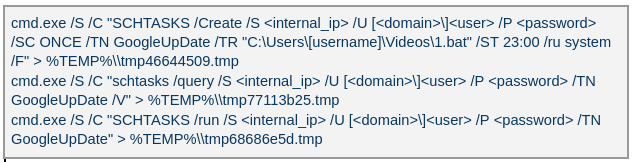
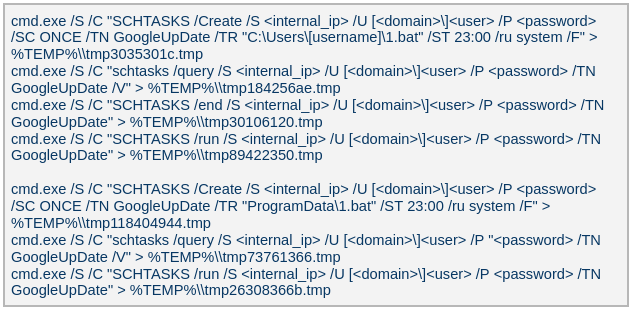
The attacker created a scheduled task named GoogleUpDate on remote machines using admin credentials. The task runs once with System account privileges right after it was created, executing the batch script located at C:\Users\<username>\Videos\1.bat (MD5 6ecf84fb18f6747ed08d7598364d853a). Prior to executing the task, the actor queries its status. It is then run, as shown below.
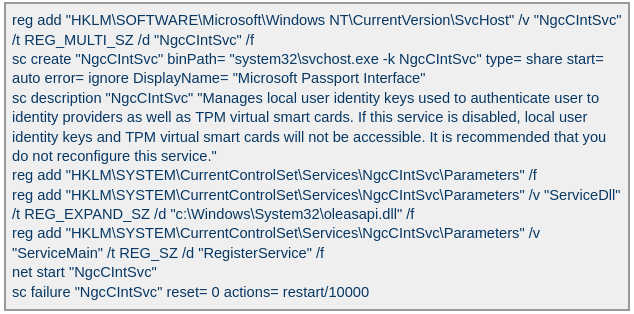
The 1.bat script creates a service named NgcCIntSvc, which loads the loader DLL named oleasapi.dll (MD5 082d49ef9f14e6811d68c7e0e82e5069). The ServiceMain parameter in the service’s registry entry is set to invoke the RegisterService function of oleasapi.dll as shown below.
LurkPoxy Deployment
In another case, the attacker at first checked connectivity to the domain dns[.]ssentialserv[.]xyz as shown below. At the time of our research, the domain was resolving to the address 154[.]196[.]162[.]76 which is used as a LurkProxy C2 server.
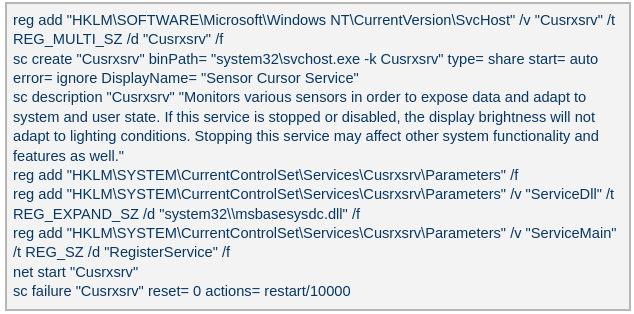
After confirming that the C2 server was reachable, the attacker executed the batch script C:\Users\[username]\Desktop\auto.bat (MD5 b874123a80fc4f40e06872b9cb54ebc6). The script created a service named Cusrxsrv, which loads a DLL named msbasesysdc.dll. In the service registry, the ServiceMain parameter was set to call the RegisterService function of msbasesysdc.dll as shown below.
We identified several service names — specitsrc, cmtastsvc, PNRPHostSvc, vmictimerosync, and vmicagent — that the attackers used to load a malicious DLL onto compromised machines.
OctLurk loader
The loader DLL exports two methods, Refresh and RegisterService. The previously created service first calls RegisterService, which in turn invokes Refresh, the method that contains the malicious code. To locate the payload, the loader double-XOR-decrypts and then zlib-decompresses a set of hard‑coded bytes, yielding the payload file path. The payload bytes itself undergoes the same double‑XOR decryption and zlib decompression to produce the backdoor DLL bytes.
The double‑XOR decryption uses two distinct multibyte keys:
Key 1: hard‑coded in the loader
Key 2: derived from the serial number of the C: drive
The backdoor DLL is reflectively injected into memory and its entry point is executed. The loader can then call the DLL’s exported methods either by name or by ordinal; both the method name and the ordinal number are hard‑coded in the loader and are decrypted using the same double‑XOR and zlib‑decompression process applied to the payload path and bytes.
OctLurk backdoor
The loader invokes the backdoor’s curl_easy_escape function (ordinal 2). The backdoor then creates a stream socket using a hard‑coded C2 address (dns[.]multitoconference[.]com) and port 443. It gathers the following information from the victim machine:
OS information as RTL_OSVERSIONINFOW structure
Computer name
User name
Local host name
Local IP address in format %u.%u.%u.%u, with local hostname-to-IP-address translation
Current local date and time as SYSTEMTIME struct
To encrypt the collected data, the backdoor employs a hard‑coded XOR key, which in most cases we observed was the string FDrertgr##@QEWASGkio865ehyf98foidsjzhug874392dfsREFDfdsAGH43wea98h. In addition, it generates 0x53 (83) random bytes — this length is also hard‑coded in the sample — and uses them as a second XOR key. The collected victim information is first compressed with zlib (deflate), and then XOR‑encrypted twice, first with the hard‑coded string key and then with the randomly generated byte sequence. The final data is arranged as follows:
The backdoor initially transmits a 16‑byte header that specifies the size of the incoming data packet, as shown below. It then sends the actual data packet.
0x00: randomly picked 10 chars from the string “zyxwvutsrqponmlkjihgfedcbaABCDEFGHIJKLMNOPQRSTUVWXYZ9876543210-_”
0x0A: \x00\x00
0x0C: next_packet_size
The first packet received is 16 bytes long, and its last four bytes specify the size of the subsequent data packet. The format of the subsequent data packet is shown below.
0x00: XOR key; size 83 bytes
0x53: compressed data size
0x57: compressed data in the format: <uncompressed_size> <deflate(data)>
The received data is decrypted using a double‑XOR method: first with the XOR key contained in the packet, then with a hard‑coded XOR key. After the XOR decryption, the data is zlib decompressed. The data may be a command or a plugin code.
OctLurk loads plugins from the C2 server directly into memory to perform various tasks. Each plugin exports two methods — ins_ctl_db and oct_lk_col — with the actual functionality implemented in oct_lk_col. Our analysis shows that the plugins listed below are commonly deployed on victim machines.
Command Shell: provides a command shell
File Manager: performs filesystem interaction
Interaction Manager: synthesizes keyboard and mouse events
The table below provides a detailed description of operations performed by these plugins, where each switch case value denotes command ID.
Plugin type
Description
File Manager
● case 0x10020: for each drive, retrieve the following information: volume GUID path, drive letter, volume name, file system name, drive type, volume serial number, total size in bytes, and free space in bytes.
● case 0x10030: search for a file that matches a specified name and retrieve the following information: file attributes, creation time, last access time, last write time, file size, the file’s name, and its short (8.3) name.
● case 0x10040: recursively list all files in a specified location, including only those whose size, creation time, last write time, and last access time fall within the threshold values defined by C2. For each listed file, retrieve the following details: file attributes, creation time, last access time, last write time, file size, file name and alternative name for the file
● case 0x10050: use the ShellExecuteExW API to open the specified file path, which may be an executable, a document, or a folder.
● case 0x10051: execute the specified command line using the CreateProcessAsUserW API.
● case 0x10060: perform the following file‑system operations: copy, delete, move, and rename — using the SHFileOperationW API.
● case 0x10070: create a directory.
● case 0x10080: set the attributes for a file or directory.
● case 0x10090: for the filename provided by C2, set the file created, last accessed, and last modified timestamps to the values received from C2.
● case 0x20010: get the size of a file.
● case 0x20020: read a file from the system in chunks, starting at a specified offset.
● case 0x20030: calculate the CRC32 of each file data chunk, and retrieve the file created, last accessed, and last written times.
● case 0x20040: close the file handle and free the associated metadata (file path, handle, and size).
● case 0x20110: create a file at the specified path and write the bytes received from C2 into it. Then set the file created, last accessed, and last modified times using the timestamps supplied by C2.
Command Shell
● case 0x3E9: launch cmd.exe as shell.
● case 0x3EA: send the exit command to close the command shell.
● case Default: if a command string is received from the C2 and the shell is running, write the command to the shell. Then read the shell’s output and send it back to the C2.
If a command string is received from the C2 server and the shell is not already running, execute the command using C:\Windows\System32\cmd.exe /S /C "<command_string>" > %TEMP%\tmp%d%x.tmp where %d and %x are random values. Afterwards, read the output from the temporary file tmp%d%x.tmp and then delete the file.
Interaction Manager
● case 0x3E9: capture the entire screen as a BMP image.
● case 0x3EA: capture the entire screen at specified intervals.
● case 0x3EC: retrieve clipboard data.
● case 0x3ED: copy the data to the clipboard.
● case 0x3F3: MOUSEEVENTF_LEFTDOWN: set the cursor to the specified position and press the left mouse button.
● case 0x3F5: MOUSEEVENTF_LEFTDOWN | MOUSEEVENTF_LEFTUP: move the cursor to the specified position, then press and release the left mouse button.
● case 0x3F6: MOUSEEVENTF_RIGHTDOWN: set the cursor to the specified position and press the right mouse button.
● case 0x3F7: MOUSEEVENTF_RIGHTUP: set the specified cursor position and release the right mouse button.
● case 0x3F8: MOUSEEVENTF_MOVE: move the mouse cursor to specific coordinates, simulating a mouse movement event.
● case 0x3F9: MOUSEEVENTF_WHEEL: move the mouse wheel by a specified amount.
● case 0x3FD: press the key indicated by the virtual‑key code.
● case 0x3FE: KEYEVENTF_KEYUP: release the key identified by the virtual-key code.
● case DEFAULT: MOUSEEVENTF_LEFTUP: move the cursor to the specified position and release the left mouse button.
Post-compromise activity
The attacker used the command‑shell plugin installed via the OctLurk backdoor to perform the following actions:
Victim fingerprinting
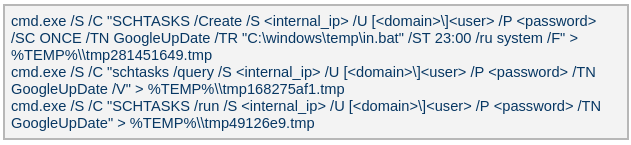
The attacker used admin credentials to create a scheduled task named GoogleUpDate on remote machines. This task runs once with System account privileges, executing the script located at C:\windows\temp\in.bat (MD5 45cf5916fab4272a1313c26e67aa9220, 4e6d5c4770d5a822d7fcce6a74f7ad73). After querying the task’s status, the attacker triggers its execution, as shown below.
The batch script runs a series of commands that collect comprehensive information about the machine’s hardware, software, and network configuration as shown in the table below. The results are saved in three files — info.txt, <hostname>.datb, and <hostname>_logs.datb — all stored in the %TEMP% directory.
Command
Description
chcp 1256
Changes the system’s code page to 1256, which supports Arabic characters.
powershell $PSVersionTable
Retrieves the version information of PowerShell.
qwinsta
Views all active sessions on the local machine.
klist sessions
Displays a list of logon sessions on this computer (Including Kerberos).
TASKLIST /V
Lists all running tasks with detailed information.
findstr /i /c:”explorer.exe”
Searches for explorer.exe in a case-insensitive manner. Used together with TASKLIST /V.
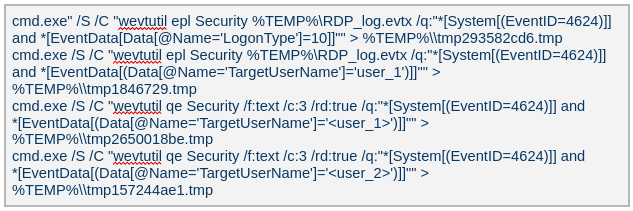
wevtutil qe Security /f:text /c:5 /rd:true /q:”*[System[(EventID=4624)]] and *[EventData[Data[@Name=’LogonType’]=10]]”
Retrieves the last 5 events from the Security event log where the event ID is 4624 (successful logon event) and the logon type is 10 (remote interactive logon e.g., Remote Desktop Protocol).
Displays detailed information about the current user, including their security identifiers (SIDs), privileges, group memberships, and authentication details.
Searches the Windows Registry under HKEY_LOCAL_MACHINE (HKLM) for entries where the value name is “ProfileImagePath” and the type is REG_EXPAND_SZ. It points to the location of a user’s profile folder.
cmd.exe /c dir /b c:\users
Lists the contents of the C:\Users directory.
wmic startup get caption,command | findstr exe
Filters startup items for executable files.
powershell “get-MpComputerStatus”
Retrieves the status and configuration details of Microsoft Defender Antivirus (formerly Windows Defender) on a Windows system.
Queries exclusion settings for Microsoft Defender Antivirus. This is where you can configure files, folders, processes, and extensions that should be excluded from being scanned by Defender.
wevtutil gli Security
Configures the Security event log.
wevtutil gl Security /f:xml
Retrieves events from the Security log in XML format.
wevtutil gli “Windows PowerShell”
Configures the Windows PowerShell event log.
wevtutil gl “Windows PowerShell” /f:xml
Retrieves events from the Windows PowerShell log in XML format.
wevtutil gli System
Configures the System event log.
wevtutil gl System /f:xml
Retrieves events from the System log in XML format.
schtasks /query /fo LIST /v | findstr “TaskName> Status> ‘Task To Run’> ‘Run As User’>”
Lists all scheduled tasks in verbose mode and extracts the following fields: Status, Task To Run, Run As User, and TaskName.
Provides network configuration details, such as IP address, DNS, DHCP status, etc.
ipconfig /all
Displays detailed network configuration.
netstat -e -s
Displays detailed network protocol statistics.
certutil -urlcache
Displays URL cache entries.
ipconfig /displaydns
Displays the contents of the DNS client resolver cache.
Event log collection
The attackers ran commands to export successful logon events for remote interactive logons (e.g., Remote Desktop Protocol) and to query those events for specific users.
Credential harvesting
Impacket — secretsdump
Attackers ran a malicious file named Adobe.exe (MD5 32a5985543433a4f60da2fafd873b927), which is a portable‑executable version of Impacket’s secretsdump.py tool. Using this tool, they extracted password hashes from domain controllers, the critical servers in an Active Directory environment. Immediately after harvesting the hashes, they issued commands to list all members of the “Domain Controllers” group, likely to identify and target additional domain controllers for further compromise.
Keylogger
Attackers dropped and executed a keylogger located at C:\Users\Public\Pictures\AnyDesk.exe (MD5: 2a571f6cee42a17d873f4c942649813f). They then created a scheduled task named AnyDesk to run the keylogger whenever any user logged on as shown below.
The keylogger creates two files: C:\Users\Public\Libraries\msect\dev0, which stores captured keystrokes, and C:\Users\Public\Libraries\msect\dev1, which holds clipboard data. Before writing to these files, the captured data is encoded by subtracting 2 from each byte.
Browser Password Decryptor
The Browser Password Decryptor tool C:\users\[username]\libraries\64.exe (MD5 37dc84e4bcad92fa28f1e7778d088283) is used to extract passwords from browsers. The tool offers two options: -help to extract passwords from Chrome and -exit to extract passwords from Firefox. For Chrome, the tool targets the Login Data and Local State databases located at %LOCALAPPDATA%\Google\Chrome\User Data\Default\Login Data and %LOCALAPPDATA%\Google\Chrome\User Data\Local State, respectively. The Local State contains the master key, which is essential for decrypting encrypted login information stored in the Login Data database file. For Firefox, the tool targets the logins.json file located at %APPDATA%\Mozilla\Firefox\Profiles\{profile folder}. The logins.json file in Firefox stores encrypted usernames and passwords for websites.
Pandora RC agent provides remote control of a victim’s computer, allowing attackers to monitor and manipulate the system. Using administrative credentials, the attacker creates a scheduled task named GoogleUpDate on the compromised machines. This task runs once with System account privileges and executes the script 1.bat, which can be found at either C:\Users\[username]\1.bat or C:\ProgramData\1.bat (MD5 5e26df131ff0a679a0a2699b723b46e3). The task’s status is first queried, then it is executed, as shown below.
The batch script 1.bat executes a command that downloads and installs the Pandora RC agent using the arguments shown below.
EHUSER: a Pandora RC user
STARTEHORUSSERVICE: start the agent after the installation finishes (default = 1)
EHORUSINSTALLFOLDER: specify the folder where you want to install the agent (default: %ProgramFiles%\_agent)
DESKTOPSHORTCUT: 0: do not create a desktop shortcut
Network scan: FSCAN
Fscan is a comprehensive internal‑network scanning tool that offers a range of functions, including network discovery, vulnerability assessment, reverse‑shell creation, and brute forcing of common services. The executable is dropped to %TEMP%\fc.exe (MD5: cf903e4a1629aa0582fd0363b5786676) and writes its output to %TEMP%\result.txt. Using Fscan, both internal and public networks were scanned to identify services running on specific ports, such as Secure Shell (SSH) on port 22 and MySQL on port 3306. The tool also attempted to access these services using credentials from the password file pp.txt.
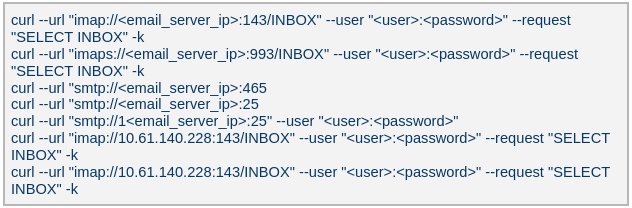
Email harvesting
The attackers used the curl command to connect to an email server, authenticate with a username and password, and issue a command to select the Inbox folder. Typically, the goal is to:
Verify that a connection to the email server is working
Authenticate the user
Prepare the Inbox folder for reading or manipulating messages (e.g., listing, fetching, or deleting emails)
LurkProxy
In a similar manner to the OctLurk backdoor, the attacker also deployed another implant we named LurkProxy, which uses a heavily obfuscated version of the OctLurk loader. While LurkProxy has a nearly identical architecture to the OctLurk backdoor, its primary role is to proxy network traffic. Like the OctLurk, it exports a function named curl_escape_easy, which the loader invokes. Once executed, LurkProxy listens on all interfaces on hard‑coded port 64980 and establishes a TLS‑encrypted connection to the C2 server (154[.]196[.]162[.]76). The C2 communication uses a proprietary binary protocol, where each packet is compressed with zlib, encrypted with a double‑XOR scheme, and follows the structure outlined below.
Offset
Data
Type
0x00 (00)
Unused
–
0x08 (08)
Packet control flags. Bit 0 indicates high priority packet, bit 1 indicates single packet
bit array
0x0C (12)
Command number
int
0x10 (16)
Handler number (unique identifier for each proxy client in the first mode)
int
0x14 (20)
Command integer argument
int
0x18 (24)
Unused
–
0x1C (28)
Data 1 payload size
int
0x20 (32)
Data 2 payload size
int
0x24 (36)
Data 1 byte stream
bytes
0x24 (36) + N
Data 2 byte stream
bytes
LurkProxy can function as a reverse proxy in two distinct modes as described below. The mode is selected by a static flag, meaning the proxy can operate in only one mode at a time. In the implant we examined, the first (SOCKS5) mode was used.
Mode 1: SOCKS5 proxy
When a client connects, LurkProxy sends to the C2 the command 0x1000010, indicating that the connection has been established and includes the target address in the packet data. The C2 server then opens a connection to that address, enabling bidirectional communication through the appropriate commands.
Mode 2: transparent proxy
In this mode, the target address and port are hard‑coded. Upon startup, LurkProxy immediately connects to the predefined target via the C2 channel using the same command. All subsequent client connections are routed through this single, fixed target. This mode handles raw network traffic directly, bypassing the SOCKS5 layer.
Command ID
Direction
Description
Arguments
0x1000010
Implant -> C2
When a new proxy client connects, it creates a proxy session and notifies C2 of the successful configuration
Target port in command integer argument
UTF-16 encoded connection hostname in data 1
0x1000010
C2 -> Implant
Used to control the session, allowing it to pause or stop proxying
Action in command integer argument (1 to pause, or any other value to terminate)
0x1000030
Implant -> C2
Sent when the LurkProxy is shut down
–
0x1000050
Implant -> C2
Forwards the received bytes from the client to C2
Raw TCP bytes in data 1
0x1000050
C2 -> Implant
Forwards the received bytes from the proxy target to the client
Raw TCP bytes in data 1
SilkLurk
Deployment
The attacker created a service that executes legitimate binaries, such as NetSetSvc.exe (NVIDIA debug dump), nvgwls.exe (NVIDIA background tool responsible for autotuning), RtkSmbus.exe (Realtek Semiconductor’s noise‑cancelling program), and RtkNGUI64.exe (Realtek High‑Definition Audio Manager), to side‑load malicious loader DLLs: nvml.dll, vulkan-1.dll, RtkSmbusLoc.dll, and RtkNGUI64Loc.dll, respectively. These DLLs act as a loader that will inject SilkLurk backdoor into the process memory.
SilkLurk loader
SilkLurk loader working logic
The loader first verifies that it is running within the legitimate executable that loads it. Next, it moves the payload file (in the analyzed sample, it was named OneDrive.dat) from its module location (C:\ProgramData\Microsoft\Network\Connections in the analyzed sample) to the hard‑coded payload path (C:\ProgramData\Microsoft OneDrive\setup in the analyzed sample). Note that the hard-coded payload path may vary depending on the loader.
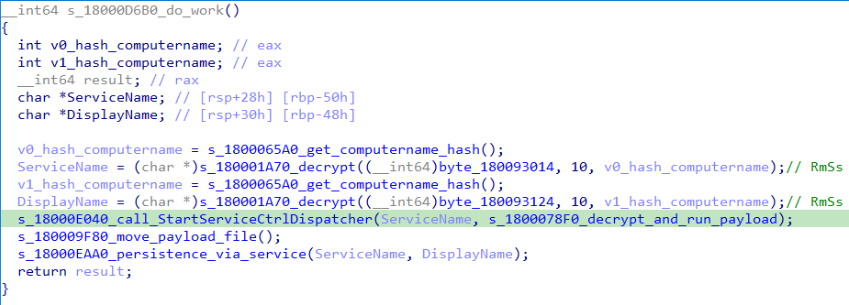
Next, the loader creates a service named RmSs to maintain persistence. The service will run the legitimate module binary (C:\ProgramData\Microsoft\Network\Connections\nvgwls.exe) that loads the malicious loader (vulkan-1.dll). The service is configured with the parameters mentioned below. Additionally, the service configuration is modified to restart the service in the event of a failure. Finally, the loader starts the service.
Service Type:SERVICE_WIN32_OWN_PROCESS
Start Type:SERVICE_AUTO_START
Error Control:SERVICE_ERROR_NORMAL
On service start, loader calls StartServiceCtrlDispatcher, which will invoke ServiceProc. The ServiceProc then calls the routine s_1800078F0_decrypt_and_run_payload. This routine computes a 32-bit hash (dword) of the victim’s computer name. The dword hash is used by a custom algorithm made up of arithmetic and logical operations to decrypt the hardcoded payload file path. The payload bytes themselves are decrypted with the same algorithm that decoded the file path. By using the victim’s computer name in the decryption of both the file path and the payload bytes, the loader becomes specific to each victim. The decrypted bytes contain shellcode with the following structure:
Shellcode offset
Description
0x000 (0)
Stub code, which performs reflective code injection
0x770 (1904)
Hardcoded value 0x11113F68, XORed with the computer name hash
0x774 (1908)
Hardcoded byte 0xD9, used as XOR key to decrypt import DLL names and APIs
0x775 (1909)
Size of the encrypted backdoor
0x779 (1913)
Encrypted backdoor data blob
The stub code decrypts and injects the backdoor blob into memory. To decrypt the blob, it first computes a dword hash of the computer’s name. This hash is then fed into a custom algorithm — a series of arithmetic and logical operations — that performs the decryption. This algorithm differs from the one used to decrypt the payload file.
The IMAGE_DOS_HEADER of the backdoor binary is zeroed out. Information in the IMAGE_NT_HEADERS, such as ImageSize and NumberOfSections, is XOR-decrypted using the hash of the computer name. The first three sections are decrypted again using a custom algorithm (a series of arithmetic and logical operations) before being injected into memory.
During import resolution, DLL names and API names are XOR‑decrypted using a hard‑coded single‑byte key. After the import DLL is loaded and the API addresses are resolved, the DLL and API name strings are zeroed out.
During relocation, the size of each relocation block, the value of each relocation entry, and the bytes to be relocated are XOR‑decrypted using the dword hash of the computer name. Afterward, the entry point is also XOR‑decrypted with the same hash and then invoked.
SilkLurk backdoor
The backdoor contains a hardcoded configuration of 0x4AC (1196) bytes, with the first 0x10 (16) bytes holding a mutex string and the remaining 0x49C (1180) bytes comprising encrypted configuration data; this configuration is written to a hardcoded filename (e.g., 2470b666bece868f, 27879a4df1a740ff) that differs across samples and is placed in the %APPDATA% directory. The configuration is decrypted using a custom algorithm involving a series of arithmetic and logical operations that is distinct from the algorithm used to decrypt the encrypted backdoor blob and payload file. The configuration has the following structure:
Offset
Description
0x00 (000)
C2 Host 1
0x64 (100)
C2 Host 2
0xC8 (200)
C2 Host 3
0x12C (300)
C2 Host 4
0x190 (400)
Port for C2 Host 1
0x192 (402)
Port for C2 Host 2
0x194 (404)
Port for C2 Host 3
0x196 (406)
Port for C2 Host 4
0x198 (408)
Unknown 21 bytes
0x1AD (429)
Proxy address 1
0x22A (554)
Proxy username 1
0x2A7 (679)
Proxy password 1
0x324 (804)
Proxy address 2
0x3A1 (929)
Proxy username 2
0x41E (1054)
Proxy password 2
The backdoor creates a TCP socket and connects to the C2 server defined in the configuration. If proxy details are provided, it attempts to establish the C2 connection through the proxy. The proxy request uses the following format:
After successfully connecting to the C2 server, it generates a random 32‑byte (0x20) network key that will be used to encrypt and decrypt network packets. This key is appended to the magic dword, as shown in the table below, creating a 40‑byte block that is then encrypted with a custom algorithm: a series of arithmetic and logical operations that differs from the one used to decrypt the configuration.
Field offset
Field size (in bytes)
Field value
0x00 (00)
0x04 (04)
0x0C7FFBE86h (magic dword)
0x04 (04)
0x04 (04)
0
0x08 (08)
0x20 (32)
Network key (will be used to encrypt and decrypt network traffic)
It then prepares a packet to send the key to the command‑and-control server, as shown in the table below. The packet contains a 0xC (12‑byte) header, a 0x28 (40‑byte) block of encrypted network‑key data (see the table above), and a randomly generated payload whose size ranges from 0x14 (20) to 0xB4 (180) bytes.
Encrypted network key data (as mentioned in above table)
0x34 (52)
size between 0x14 (20) and 0xB4 (180)
Random data bytes
After sending the key, the backdoor collects the following victim information: local computer name, DNS domain assigned to the local computer, user’s logon name, processor architecture, OS major version and build number, host IP address, current process ID, tick count value, and backdoor module name. The collected victim information is first compressed and then encrypted using the network key. The custom algorithm (a series of arithmetic and logical operations) used to encrypt collected victim information is different from the algorithms used to decrypt the configuration and encrypt the network key. Before sending the victim information, a 0x0F (15) byte header is generated and encrypted using the same custom algorithm used to encrypt the collected victim data. The header follows the format as shown in the table below.
Field offset
Field size (in bytes)
Field value
0x00 (00)
0x04 (04)
0xC7FFBE86 (magic dword)
0x04(04)
0x04 (04)
Message type (1 means victim information)
0x08 (08)
0x04 (04)
Data size (size of encrypted victim information)
0x0C (12)
0x01 (01)
Compression flag (1 means compressed)
0x0D (13)
0x02 (02)
Size of random bytes, between 0x14 and 0x96 bytes
Finally, the encrypted header and victim information are formatted as shown below and transmitted to the C2 server.
Once the backdoor has transmitted the victim information, it waits for a 0x13‑byte (19‑byte) response from the C2 server. This response follows the structure presented in the table below.
Field offset
Field size (in bytes)
Field value
0x00 (00)
0x04 (04)
Random dword
0x04 (04)
0x0F (15)
Encrypted header data
The encrypted header contained in the response is decrypted with the network key that was generated and shared with the C2 server. After decryption, the header retains the same size and structure as the one used in the victim information message.
The message type field in the header (offset 0x04) determines which operation (command) to perform. Next, the backdoor figures out the size of the command data to receive by adding up the size of the encrypted data (found at position 0x08 in the received header) and the size of the random bytes (found at position 0x0D in the received header). The received command data is first decompressed, based on the compression flag located at position 0x0D in the received header, and then decrypted using the custom algorithm that was used to encrypt the sent data. The backdoor supports the following commands:
Command (message type)
Description
03
Based on subcommand, perform the following operations:
00: Get target system’s local time
01: Set sleep time in milliseconds, after which to reconnect to the C2 server
04
Send current backdoor configuration
05
Update backdoor configuration
06
Receive and inject additional payloads (plugins) into memory. Based the on subcommand, perform the following operations:
01: Inject payload (plugin) bytes into memory and execute payload’s entry point
03: Call export method of injected plugin
Post-compromise activity
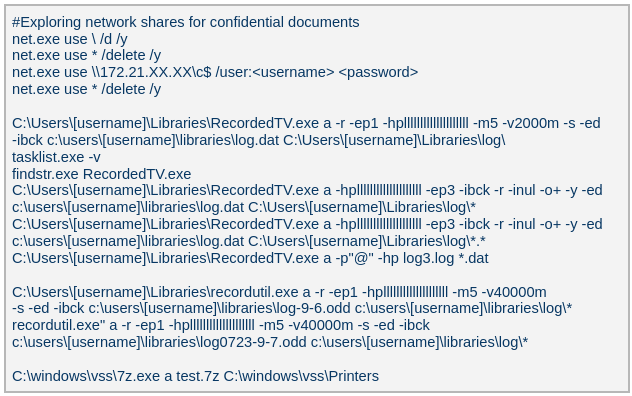
The threat actor operating the SilkLurk backdoor first used it to invoke cmd.exe to launch PowerShell. Within PowerShell, they ran commands such as net use to connect to shared network resources with administrative credentials. After establishing the connection, they searched the shared drives for confidential documents to exfiltrate. Once the search was complete, they disconnected from the network share to erase evidence of which internal servers had been accessed. To archive the stolen data, they employed legitimate archiving tools: WinRAR and 7‑Zip.
Below are the paths and names of the WinRAR and 7Zip binaries used by the attackers.
The SilkLurk backdoor opened a command shell (cmd.exe). Using this shell, the attacker executed the file C:\ProgramData\microsoft\html help\kmsonline.exe (MD5: 3c9a1ba8e0c7475706adc6376e9d7b7c). The kmsonline.exe binary acted as a dropper for the PlugX malware, deploying the malicious files listed below.
Our Kaspersky Threat Attribution Engine (KTAE) also identified a strong degree of similarity between kmsonline.exe (MD5: 3c9a1ba8e0c7475706adc6376e9d7b7c) and PlugX.
PlugX was configured to communicate with the C2 domain gycudore[.]kozow[.]com and the IP address 64[.]7[.]198[.]130. Below are the extracted configuration fields from PlugX.
Config field name
Value
Injection Target Process
%SystemRoot%\system32\svchost.exe
Home Directory
%ALLUSERSPROFILE%\Symantec
Persistence Name
SymantecRAS
Service Display Name
SymantecRAS
Service Description
Symantec RAS Services
Campaign ID
KG_MFA
Infrastructure
The threat infrastructure relies on VPS servers. Some OctLurk and LurkProxy C2 addresses are referenced in a public report by Kazakhstan’s State Technical Service (STS) company. According to available data, a campaign targeting critical infrastructure in Kazakhstan was discovered in March 2025. During this campaign, attackers employed the TrustFall (STS internal designation) remote access malware, also known as MystRodX (Qianxin) and SilentRaid (Cisco) and designed for Linux-based operating systems. Subsequently, in October 2025, STS researchers found additional TrustFall samples, while also discovering its new C2 servers via active probing. Notably, three observed TrustFall C2 addresses were also leveraged by OctLurk and LurkProxy. This overlap points to shared infrastructure across multiple OS-targeting campaigns, though it remains unclear whether these activities ran concurrently or at different times.
Attribution
We identified multiple artifacts confirming that OctLurk and SilkLurk are operated by the same threat actor. Several users infected with OctLurk were also found to be infected with SilkLurk, and in some cases both malware families used the same staging directory. Below are examples of these artifacts.
In one incident, the attackers created the service C:\Windows\system32\svchost.exe -k ExAstSrc -s ExAstSrc to deploy OctLurk. They used OctLurk to obtain a command shell and were observed dropping the SilkLurk loader vulkan-1.dll (MD5 be4731c09734da2e8eb6814a9c82f266) via this shell, as shown below.
In another incident, we observed attackers using the same directory C:\ProgramData\intel\ to drop both the OctLurk and SilkLurk loader DLLs.
In one incident, the attacker used SilkLurk to obtain a command shell (cmd.exe) and then deployed and executed the PlugX malware. The PlugX sample was configured to contact gycudore[.]kozow[.]com as its command‑and‑control (C2) server, while the SilkLurk backdoor used ctyuhjerf[.]kozow[.]com for C2. PlugX is a well‑known modular remote‑access Trojan (RAT) that has been active since at least 2008 and historically linked to Chinese-speaking threat actors. This suggests that both OctLurk and SilkLurk were also developed and operated by a Chinese‑speaking actor, although at this time, we cannot attribute this activity to a known threat group.
Conclusions
The emergence of the OctLurk and SilkLurk multi‑plugin malware framework highlights how threat actors continuously refine their tactics to evade detection and maintain control over compromised networks. Both families operate primarily in memory, leaving only a minimalistic loader on disk that relies on machine‑specific data (OctLurk uses the drive serial number, and SilkLurk uses the computer name) to decode payload locations and contents. This victim‑specific encoding makes reverse engineering and automated detection considerably harder.
In addition to sophisticated obfuscation, the attackers establish redundant access channels, harvest credentials, and deploy well‑known remote access and monitoring tools. These secondary pathways ensure persistence even if the original infection vector is discovered or neutralized.
Europol and its partners' investigators flagged 4,340 “horrific” URLs for removal over several weeks in June and July as part of an ongoing crackdown on The Com (short for community), a loosely knit network of online groups whose young members participate in a range of illicit activities. These range from hacking, swatting, and digital extortion to real-life shootings, stabbings, and other physical violence. Europol’s recent Referral Action Days, aimed at disrupting The Com’s online ecosystem and stopping the spread of its propaganda, is part of the larger Project Compass operation. Project Compass began in 2025, and its partner law-enforcement agencies span the US, UK, and EU member states. Investigators from Belgium, Finland, Hungary, Ireland, Luxembourg, the Netherlands, Portugal, Spain, and Sweden participated in the Referral Action Days during June and July. Various groups linked to The Com post content online to recruit members and groom young victims using social media, gaming platforms, and messaging apps. “The more extreme and harmful the content a user or group can produce or extort, the higher their status within the online community,” according to Europol. “These acts are often livestreamed on social media platforms, where online bystanders cheer them on, and later saved and disseminated.” The URLs flagged for removal during this latest push to disrupt The Com’s recruiting activities included “violent videos and images depicting self-harm, suicide, child sexual abuse material (CSAM), animal cruelty, and violent attacks,” the international cops said. This, the European cops say, includes so-called blood walls, which are paintings made with blood that display the extorter’s alias and group affiliation, and cut-signs, where the victims are forced to carve the extorter’s name into their bodies. It also includes videos of street attacks and arson, plus manuals on how to commit these violent attacks, along with instructions on grooming and extorting vulnerable minors, and conducting doxxing and swatting. Europol says its European Counter Terrorism Centre has received “hundreds” of requests from member states and others over the past two years to help investigate crimes linked to The Com. It describes the online network as a “global threat, particularly concerning minors as both victims and perpetrators.” Last year, both the UK and US issued similar warnings about a subset of The Com that recruits children and teens for contract shootings, kidnappings, and other real-life violent crimes. In July 2025, the FBI said that In Real Life (IRL) Com had become increasingly brazen in its swat-for-hire and violence-as-a-service solicitations. The FBI's alert followed a similar notice from the UK National Crime Agency about a "deeply concerning" trend of The Com recruiting teenage boys to commit a range of criminal acts, from cyber fraud and ransomware to child sexual abuse.®
Not sure this will have any effect, but I support the effort:
According to Google’s legal filing, Outsider Enterprise operates through Telegram. The group offers phishing-as-a-service to individuals who may not be technically savvy enough to set up fraudulent websites and text campaigns on their own. In its Telegram channels, Outsider Enterprise reportedly provided instructions on how to use Google’s Gemini AI to create websites that imitate those of Google, YouTube, and government agencies such as New York’s E-ZPass. The group offered nearly 300 scam templates.
[…]
Google worked with AT&T, Verizon, and T-Mobile to block many of these malicious text messages, and Google notes that its on-device scam detection in Google Messages probably helped reduce the number of successful phishing attempts, too. This AI-powered feature apparently stops 10 billion scam texts every month, so it’s fair to expect it caught at least some Outsider Enterprise activity.
Cybercrime now accounts for more than 30 percent of all offenses across the Asia and South Pacific (ASP) region, according to the latest figures from Interpol. The international cop shop said on Wednesday that the region has seen “a dramatic increase” in the number of recorded cybercrimes, driven largely by an uptake of digital infrastructure, new technologies, and the increasingly organized nature of criminal networks. Interpol’s latest ASP Cyberthreat Assessment Report states that online scams and phishing attacks dominate cybercrime in the region. Data taken from 2024-2025 shows that phishing campaigns have matured beyond the spray-and-pray mass emails of yesteryear and now resemble the more sophisticated techniques deployed elsewhere in the world. Targeted spear phishing is more common nowadays, and the growing use of AI helps even low-skilled script kiddies to apply a layer of authenticity to their attacks. The region’s problem with organized scamming gangs that run camps where hundreds of people are compelled to commit crimes is especially pronounced and well-documented. A United Nations report published last year described scam call centers across Southeast Asia as an epidemic that is metastasizing across the region “like a cancer.” These compounds can be found across countries such as Cambodia, Laos, Myanmar, and the Philippines, and often see vulnerable individuals trafficked into the scam centers to work under poor conditions – or even as slaves. Interpol cited Singaporean research, which estimated the regional scam industry generates close to $40 billion each year. AI tools, especially those capable of generating convincing deepfake imagery, have also proven popular with cybercriminals across ASP, just as they have beyond the region. In 2024, the same scam compounds were found using deepfake imagery to support romance scams. In February 2024, an employee at a multinational business in Hong Kong was duped into authorizing a $25 million payment because the faces of company execs were convincingly deepfaked on a video call. A similar case was also reported in Singapore in March 2025, when a finance director at a different multinational was tricked into transferring more than $499 million following a Zoom call in which fraudsters assumed the identities of company chiefs, including the CEO and CFO. Interpol’s report highlights how cyber threats are evolving into large-scale challenges for multiple jurisdictions, and no longer represent relatively uncommon, isolated incidents. While digitization across the region is growing, opening new economic opportunities for these countries, law enforcement agencies are struggling to keep pace with the increase in cybercrime. Many lack the skills and tools needed to investigate these crimes. The issue is especially pronounced in developing countries and small island states in the Pacific, which face “significant resource and capacity constraints,” and are thus more vulnerable to direct targeting in attacks by criminals who have a greater chance of evading consequences. Neal Jetton, cybercrime director at Interpol, said: “The findings in this report highlight a rapidly evolving cyber threat landscape across Asia and the South Pacific, where cybercriminals are leveraging artificial intelligence, ransomware-as-a-service models, and sophisticated social engineering techniques on an industrial scale. “As digital adoption accelerates across the region, strengthening operational cooperation, information sharing, and cyber resilience remains essential to protecting communities and critical infrastructure.” Some improvement Interpol lauded many jurisdictions and governments within the ASP region for their proactive approaches to countering cybercrime growth. Hong Kong and the Republic of Korea are two areas that have made strides by introducing new cybersecurity legislation, while others have established national task forces, codified national action plans, and launched awareness campaigns. But even in more developed countries globally, and those with more mature cybersecurity regulatory and legislative landscapes, the issue of increasing rates of cybercrime persists. While Interpol does not collect cybercrime figures for other regions, such as Europe and North America, in the same way that it does for ASP, it’s easy to see that problems persist everywhere. The UK’s Office for National Statistics (ONS) publishes crime rates by type across England and Wales each year, and while computer misuse offenses in 2025 decreased by 58 percent compared to 2017’s figures, there were still an estimated 735,000 cases across the year. Expanding the data to look beyond pure cyber offenses to cyber-supported crimes, such as banking and credit fraud, these offenses account for more than 2.7 million of the circa 9.6 million total crimes committed. The FBI in the US produces its annual IC3 report examining the rates of cybercrime across the country. Although it doesn’t compare it to total offenses or other crime types, the latest report reflecting 2025’s figures showed cybercrime reports topped one million for the first time, and total losses reached a record $20.87 billion. ®
UPDATED If you have a Fortinet firewall, it's time to stop and change your passwords. Intruders somehow gained access to around 75,000 Fortinet firewall devices and stole credentials belonging to major corporations across 194 countries, in some cases leading to full network compromise. Security researchers say that they have verified the data, and the cracked FortiGate passwords belong to accounts spanning multinational corporations including FoxConn, Samsung, Comcast, Siemens, Lenovo, FedEx, PxW, Accenture, Oracle and many others. Check to see if your organization made the list of affected domains – and immediately rotate all passwords associated with Fortinet VPN and administrative interfaces. Make sure multi-factor authentication is turned on, too, as this type of massive credential leak can lead to very serious consequences, giving attackers full, remote access to not only the firewall but the entire corporate network. Hudson Rock, which analyzed the data, said the leak affects 21,632 unique domains. “The scale of this breach touches nearly every sector of the global economy, sparing no industry. The threat actors have built a verified database of working credentials for some of the largest enterprises on the planet,” the security shop said on its Infostealer blog. Researcher Volodymyr “Bob” Diachenko first spotted the intrusions and attributed them to a Russian-speaking group. “They intercept SSL VPN authentication, crack hashes on a 45-GPU cluster managed via Hashtopolis, and pivot into internal Active Directory environments,” he wrote on LinkedIn. “The operation processed 1.16 billion credential attempts against 320,777 FortiGate targets and 2.1 billion attempts against 163,650 MSSQL servers.” Plus, according to Diachenko, the criminals fully pwned at least four organizations, including a Turkish NATO defense contractor, and, in that case, stole classified defense documents. Security sleuth Kevin Beaumont, who also verified the stolen credentials, said “the data is legit.” “I have worked with several orgs listed, and can confirm the logins and passwords are real,” Beaumont wrote. “Many of the devices sampled are on fairly recent patches.” According to device search engine Shodan, the massive heist comprises about half of all internet-facing Fortinet firewalls. Plus, Beaumont noted, most of the compromised Fortinet devices remain online. So if you’re still reading this story: stop now, and go reset your Fortinet firewall passwords stat. After we first published this story, Fortinet responded to us, denying that the attacks are fresh and claiming that the data showing up on the dark web comes from prior breaches. "Based on our analysis, the data involved is a resharing of data from previous incidents, as well as bruteforcing of credentials, and is not related to any recent incident or advisory," a Fortinet spokesperson told El Reg. Organizations that follow routine best practices, including regularly refreshing security credentials, as per guidance in this March blog, face minimal risk from credential compromise detail referenced in the reporting.” The Register reached out to the companies affected by the so-called FortiBleed campaign for comment, Lenovo said it was looking into it; we didn't receive responses from the others. ® Updated at 2118 with a statement from Fortinet.
Six people suspected of bank helpdesk fraud are in custody after Dutch cops stormed an Amsterdam residence and caught them in conversation with a potential victim. Police say the individuals were aged between 15 and 30 and operated out of a makeshift call center they had established in an Amsterdam home. Authorities believe the accused committed bank helpdesk fraud, which has become increasingly popular across the Netherlands. Offenders were recently targeted as part of Game Over?!, a novel law enforcement scheme that successfully shamed criminals into submitting themselves to authorities. Helpdesk scammers typically operate call victims on the phone, using methods similar to voice phishing, or "vishing." They present themselves as bank employees contacting victims under various guises, all designed to steal their money. In this case, police say the alleged criminals tried to convince victims to "increase their limits," and in "several" cases, succeeded in stealing funds from their accounts. The precise cover story is largely irrelevant, however. The aim of the game is the same each time: Convince a prospective victim to surrender enough details to access their bank accounts and steal their money. While these scams mostly take place remotely, Dutch police said in their announcement on Tuesday that the crew sent members to visit victims in person, purportedly offering hands-on assistance to secure their accounts. The same tactic can often be observed with fake police officer shakedowns, which have also become popular in the country. Police say tens of thousands of elderly people, who make up the majority of targets for such scams, have fallen victim to the confidence scams. In these cases, fraudsters visit elderly individuals' houses and pretend to represent law enforcement, offering a service to safeguard their valuables. The crooks then steal those valuables, and police say previous cases have turned violent. Some have also ended in fatalities. Multiple victims of the helpdesk frauds reported their respective cases, according to the cops. The National Intervention Team for Digital Crime was called in to investigate, and during a raid on June 10, officers found the suspects mid-call with a potential victim. Officers seized multiple laptops and phones after apprehending the six suspects, and found several bank cards at the property. Further arrests have not been ruled out. ®
A cyberattack on Australia’s second-largest sugar producer has forced farmers to keep crops in the ground, and looks like denting their incomes. Mackay Sugar, based in the Australian state of Queensland, processes sugar cane farmed in nearby districts. The company disclosed a cyberattack on June 10 and limited operations while it dealt with the fallout. Some operations remain restricted, but the company said on Monday that it managed to perform some manual crushing at its Farleigh Mill site, working with sugar cane that was harvested before the attack. “Significant progress has been made over the weekend in restoring the systems that support cane supply, harvesting, and mill operations,” Mackay Sugar said in a statement. “Steam trials are now underway, and subject to final validation activities, some harvesting is expected to recommence this week in preparation for the staged restart of crushing operations later this week.” While the company is optimistic it can resume crushing, it's advised growers not to harvest their crops for the time being. That edict works for Mackay Sugar because sugar producers need to process crops within 48 hours of harvest. Doing so preserves high sugar content and overall yield. Delaying the processing for any longer after harvesting could result in sucrose converting to simple sugars, unwanted fermentation, and lower yields. But late harvesting can reduce the quality of cane, reducing the price they earn for their crops. Interrupted harvesting also impacts the railways used to move cane from farms to mills. Mackay Sugar acknowledged the impact its downtime could have on growers and other partners, and committed to restoring systems safely. “We are communicating directly and regularly with our employees, growers, and key partners,” it said. “We recognise the impact this incident is having on our growers, and we are doing everything we can to support them and to safely resume full operations as soon as possible. “We take our responsibility to protect our systems, operations, and information very seriously. We apologise for any disruption this incident has caused and will continue to provide updates as we continue our investigation.” The company operates three mills across Queensland, two of which were operating at a limited capacity due to the attack. Its Racecourse Mill, described as the heart of the business and home to its corporate offices, was among those affected. Racecourse Mill typically generates 213,000 tons of raw sugar and 58,000 tons of molasses a year, and the site’s cogeneration plant generates 156,000 MWhs of renewable electricity a year, around 71 percent of which is sent back into the national electricity grid. Mackay’s mill in Farleigh, the company’s oldest, was also affected. It typically produces around 196,000 tons of raw sugar and 49,000 tons of molasses per year. The company’s largest and most productive factory, Marian Mill, was unscathed. Ungentlemanly conduct Cybercrime group The Gentlemen claimed responsibility for the attack on Mackay Sugar, posting the company to its data leak site without offering any details about the attack or whether it stole data to use as leverage for extortion demands. Cyber threat intelligence professionals have known of the group for almost a year, after spotting it in July 2025 and classifying it as a ransomware-as-a-service provider. However, there is no evidence that ransomware was used in the attack on Makay Sugar. The company has never mentioned ransomware in its statements, referring to the attack only as a “cyber security incident.” However, The Gentlemen is known for using file-encrypting malware in its double extortion attacks. The group caught the attention of Microsoft’s researchers, who last month published a deep dive into how it carries out attacks. Microsoft’s report noted that not only do The Gentlemen affiliates have access to a powerful file encryptor, but also one that self-propagates, which “increases the likelihood of widespread impact once initial access is achieved.” It has also recently established a partnership with BreachForums, which allows the group to recruit prospective new affiliates with different skillsets, such as penetration testers and initial access brokers. ®
Cybercrims deploying DragonForce ransomware appear to have gained access to a major US services company's network, then spent two months up to no good while disguising their command-and-control activities as legitimate Microsoft Teams traffic. Researchers at security firm Symantec said the intrusion began with attackers gaining access to the victim's environment before deploying a custom Go-based backdoor, tracked as "Backdoor.Turn," to maintain communication with the compromised systems. Rather than reaching out to attacker-controlled infrastructure that might raise alarms, the backdoor hid its activity inside traffic associated with Microsoft's widely used collaboration platform. To anyone monitoring network traffic, the compromised systems appeared to communicate only with legitimate Microsoft servers. "The attackers in this campaign use exceptionally sophisticated cyber tradecraft," Symantec said. "The configuration of Backdoor.Turn means that security products only see C&C traffic going to legitimate Teams servers, leaving defenders unaware that data is being siphoned away by malicious actors." Symantec said the attackers installed Backdoor.Turn on systems after deploying DragonForce ransomware, potentially giving them a way back into compromised networks or access they could later sell to other criminals. To connect to Microsoft's infrastructure, the backdoor first requested an anonymous visitor token from Microsoft Teams and Skype back-end services. It then used a Microsoft-operated TURN relay server – infrastructure typically used to help establish communication between users – before establishing a direct QUIC connection to a malicious command-and-control server. Symantec said this is the first known case of malware using this particular technique. The security firm did not identify the victim beyond describing it as a major US services company, nor did it say whether the Teams-based communications channel had been observed in other DragonForce incidents. The ransomware operation has become increasingly prominent over the past year, operating a ransomware-as-a-service model that allows affiliates to conduct attacks under the DragonForce banner. It has been linked to the prolific Scattered Spider group, which has conducted a string of high-profile attacks, including intrusions targeting major retailers in the UK. While attackers have long abused legitimate cloud services to conceal malicious traffic, Symantec's findings suggest that DragonForce operators continue to look for ways to blend into the software and infrastructure that organizations trust most. ®
Heart monitoring biz iRhythm says thieves made off with patient health information and tried to turn it into a payday. The California-based cardiac monitoring specialist offers customers a wearable device that collects data, then analyzes it to create reports about heart health. The company said it detected unauthorized activity on June 8 and launched an investigation with the help of third-party cybersecurity experts. A day later, the company received messages from a cybercriminal claiming to have obtained sensitive information, including proprietary company data, protected health information, and other personal information. According to iRhythm's filing with the US Securities and Exchange Commission, the attackers demanded payment in exchange for not publicly disclosing the stolen data. The company confirmed that data had been exfiltrated and, on June 10, determined that the incident was material due to the volume of information potentially affected. While the company disclosed the extortion demand and the existence of stolen data, it made no mention of negotiations. iRhythm spent a good chunk of the filing explaining what the attackers didn't get. According to the company, the intrusion was confined to business applications and never reached its clinical systems, medical devices, or customer connections. Patient care and day-to-day operations were unaffected. The company has not yet disclosed how many individuals may be affected, what data was accessed, or which third-party-hosted applications were involved in the breach. It has also not identified the threat actor behind the attack, and The Reg has found no evidence of major ransomware groups claiming responsibility. The company's filing states the attackers gained access through social engineering. Exactly how that happened remains unclear, although healthcare organizations have increasingly found themselves dealing with phishing campaigns, help desk impersonation scams, and other forms of human-targeted intrusion designed to bypass technical defenses. As of the filing date, iRhythm said it had not identified any ongoing unauthorized access to its systems and believed the incident was unlikely to have a material impact on its financial condition or operating results. The company added that it maintains cyber insurance that may cover some of the losses associated with the breach. iRhythm's disclosure comes less than a week after drug giant Novo Nordisk revealed that attackers had copied patient data from some clinical trials, adding another healthcare name to a growing list of organizations dealing with data theft and extortion attempts. ®
ShinyHunters claims to have breached the Council of Europe and stolen more than 297 GB of data after exploiting a zero-day flaw in Oracle PeopleSoft and abusing that hole to hack more than 100 organizations. According to a post on the extortion crew’s data-leak site, the 429,000 pilfered files contain HR and payroll records, payslips, purchase-order records, CVs, and employees’ salary, banking, tax, and medical records. A Council of Europe spokesperson told The Register that it is “currently investigating the matter and assessing the situation,” but declined to comment further. A spokesperson for the cybercrime group told us that the Council is yet another victim of the Oracle PeopleSoft heist. Oracle has yet to respond to The Register’s inquiries, and it's unclear if the vulnerability, tracked as CVE-2026-35273, has been patched. ShinyHunters previously told us that the gang exploited the CVE to compromise more than 100 organizations across 300 vulnerable instances, and that these victims included the University of Nottingham. Last week, the crims listed the UK uni on their leak site, then dumped data belonging to around 454,600 current and former students, including personal and academic records. Meanwhile, a Google threat report published late last week noted malicious activity, “consistent with the exploitation of CVE-2026-35273,” between May 27 and June 9, and said that its incident responders notified more than 100 global orgs “whose IP addresses correlated with potentially vulnerable endpoints." Most of these are US-based organizations, and 68 percent operated within the higher education sector. This latest heist follows another ShinyHunters intrusion targeting data belonging to university and K-12 students, teachers, and staff. In mid-May, ed-tech giant Instructure said it “reached an agreement” - this is corporate-speak for “paid the ransom demand” - with the data theft and extortion crew after ShinyHunters breached its Canvas digital learning platform and accessed data tied to 275 million students, teachers, and staff. In March, ShinyHunters claimed it stole data from K-12 software provider Infinite Campus as part of a broader wave of Salesforce-related intrusions. The ed tech company did not pay up, and the group subsequently published data they claim was stolen from Infinite Campus, including 137,000 individuals’ email addresses along with names, phone numbers, physical addresses and support tickets. Infinite Campus, in its data breach notification, said that the leaked files largely consisted of “names and contact information for school staff" and that “the majority is directory information commonly found on school websites.” ®
Data theft and extortion group ShinyHunters has exploited a critical Oracle PeopleSoft bug as a zero-day to compromise more than 100 organizations, including the University of Nottingham, across 300 vulnerable instances. A spokesperson for the cybercrime crew on Thursday told The Register that they exploited CVE-2026-35273 to break into the university’s PeopleSoft system and steal 40 GB of personal data and billing records belonging to hundreds of thousands of current and former students. ShinyHunters posted the UK university on its data leak site on Tuesday before publishing the stolen files later that same day, presumably because the school refused to pay the extortion demand. “University of Nottingham on our leak site is one of the first publicly confirmed incidents,” a ShinyHunters spokesperson told us. “We have only just started outreach to affected orgs and are actively looking to reach an agreement with affected orgs.” They didn’t say when they planned to post the other 100 or so claimed victims. A Google threat intelligence report published Thursday afternoon corroborated ShinyHunters’ claims to have compromised more than 100 organizations. Google said it spotted malicious activity, “consistent with the exploitation of CVE-2026-35273,” between May 27 and June 9, and notified more than 100 global orgs “whose IP addresses correlated with potentially vulnerable endpoints." Most of these, we’re told, are based in the US and 68 percent are in the higher-education sector. PeopleSoft is a widely used enterprise software suite that large corporations and institutions use to manage their human resources, payroll and billing applications, supply chains, and student records. CVE-2026-35273 is a 9.8 CVSS-rated vulnerability that allows remote, unauthenticated attackers with network access via HTTP to compromise PeopleSoft Enterprise PeopleTools and fully take over the platform. On Wednesday, a day after ShinyHunters leaked the school’s data, the University of Nottingham confirmed the breach and Oracle issued an out-of-band security alert. It’s unclear, however, if the software provider has issued a patch to fix the security flaw. The Register reached out to Oracle, and did not receive any response to our questions. Google-owned Mandiant Chief Technology Officer Charles Carmakal, in a brief LinkedIn post on Thursday, warned that PeopleSoft was one of two zero-day vulnerabilities “actively being exploited in the wild.” “Oracle released mitigations,” Carmakal wrote. “Patches should come soon.” The other zero-day, for the record, is this Cisco Catalyst SD-WAN Manager vulnerability.®
As if the Miasma situation weren't bad enough, now this weapon is spreading like wildfire. Someone open sourced the entire Miasma worm supply-chain attack toolkit, likely using previously compromised developers' accounts to publish GitHub repositories containing the self-spreading malware’s source code over the last 24 hours. SafeDep, a company focused on open source supply chain security that developed Package Management Guard (PMG), spotted the malicious repos, named “Miasma-Open-Source-Release,” and said that they started appearing on Monday. Its researchers analyzed one of these before GitHub nixed it, and described the code as more than just a supply chain worm. “It is a full supply chain attack toolkit that allows the operator to execute various attacks via stolen credentials against arbitrary or targeted packages on public registries (PyPI, npm, RubyGems), JFrog Artifactory, GitHub repositories and GitHub Actions, AI coding tools config poisoning, SSH based lateral movement and other attack vectors,” the SafeDep team said. While we don’t know who is behind this publicly released worm, it follows in the footsteps of TeamPCP, which developed and then open sourced the mini Shai-Hulud worm last month, announcing a supply-chain attack contest on BreachForums and spawning copycat open source package poisonings. One of these copycat worms, Miasma, first hit upwards of 100 Red Hat and Microsoft open source projects before spreading to other victims, with app-security firm Socket tracking 473 affected package artifacts as of Tuesday. “The Miasma repository is an evolution of the Mini Shai-Hulud toolkit, and was open-sourced June 8 via four previously compromised users,” Rami McCarthy, principal threat researcher at Wiz, told The Register. “Since we had already reversed the payload, this public release isn’t particularly useful for sophisticated defenders, and we haven't observed any opportunistic adoption of it yet.” This, he added, mimics what happened when TeamPCP open sourced mini Shai-Hulud last month. “We didn't see attackers weaponize it either,” McCarthy said. “It's not clear [whether] attackers benefit from adopting this out-of-the-box toolkit versus vibe coding their own. And while it raises concerns about muddying attribution, attackers tend to continue developing their private fork of the malware, providing a clear payload progression to track and deconflict from anyone utilizing the open-source version.” An interesting aspect of both of these worms and other recent attacks like this one dubbed “Comment-and-Control” by AI bug hunter Aonan Guan is that they run entirely in GitHub - they don’t require any custom command-and-control (C2) infrastructure - and use the code-hosting platform for all stages of the attack including remote command execution, configuration, and data exfiltration. “This is a key behavioural shift because traditional network based detection and protection tools rely on baselining and anomaly detection,” SafeDep researchers noted. “Defenders now have to operate closer to application protocol to identify behavioural anomaly instead of network based anomalies.” The Miasma worm uses three independent GitHub commit search channels for C2, and each has a different search string and purpose. One of these, "DontRevokeOrItGoesBoom," discovers attacker-controlled personal access tokens (PATs) to exfiltrate credentials and other sensitive data. These PATs are AES-256-CBC encrypted in the commit message. The second, "TheBeautifulSandsOfTime," delivers JavaScript for immediate command execution. It’s checked once at startup, and, after validation, it passes the payload to eval() to execute at runtime. Finally, “firedalazer” delivers Python script URLs for the persistent monitor. All three are unauthenticated by default, use GitHub’s public commit search API, and use a different validation or decryption key, which means compromising one doesn’t automatically compromise the other two.®
The patient tally from the Synnovis ransomware attack continues to grow two years later, with Mid and South Essex NHS Foundation Trust confirming it was caught up in the breach. The trust told The Register that the Synnovis breach affected about 2,380 records relating to patients who underwent specialist diagnostic testing. The disclosure follows a similar announcement by Bedfordshire Hospitals NHS Foundation Trust, which earlier this month said that almost 33,000 patient records had been caught up in the same breach. According to Mid and South Essex, some of the compromised data cannot yet be directly linked to individual patients, meaning the trust is still unable to determine the final number of people affected. It also said the precise time period covered by the stolen records has yet to be established, although patients tested after June 3, 2024, the day of the attack, were not affected. "We are still waiting for confirmation on exact numbers," Dawn Scrafield, deputy chief executive of Mid and South Essex, told The Register. "Once we have established who those patients are, we will be in contact with any who have been affected." The disclosure highlights the drawn-out fallout from the attack. Synnovis told us it completed its forensic review by the end of last summer and said it had notified all affected organizations by November. However, Mid and South Essex said it was only informed in December 2025 and is still trying to work out exactly which patients are tied to the compromised records six months later. "Any decision on patient notification, including the number of patients to be notified, is made by the affected organization as part of their assessment," a Synnovis spokesperson said in a statement. "Synnovis, as the Processor of the data, is not involved in any of the assessments regarding if, when or how many patients a Controller determines necessary to notify." The company said it does not believe the stolen information presents a high risk to individuals because of its fragmented nature, but acknowledged that affected organizations are still assessing what was taken and whether patients should be contacted. The breach was one of the most disruptive cyber incidents ever to hit the NHS. The Qilin attack crippled pathology services across south east London, forcing hospitals to cancel thousands of appointments and operations while clinicians struggled with delays to blood testing and transfusion services. Patient data was later published online after the gang's extortion attempt failed. However, the fallout wasn't limited to canceled operations and delayed blood tests. Last year, King's College Hospital NHS Foundation Trust confirmed that delays caused by the outage contributed to the death of a patient, marking one of the first officially acknowledged fatalities linked to a ransomware attack. ®
Check Point released an emergency fix on Monday for a critical authentication bypass vulnerability affecting its Remote Access VPN and Mobile Access deployments - but attackers, including ransomware criminals, got a month-long head start. Attacks against the bug, tracked as CVE-2026-50751, began on May 7, according to Check Point VP of research Lotem Finkelstein, and picked up in early June. The security software vendor spotted suspicious activity and began investigating the zero-day on June 4, Finkelstein said in a Monday blog. “We have observed indications that exploitation has been limited to a relatively small number of targeted organizations (several dozen globally), primarily over the past few days,” Finkelstein wrote, adding that, in at least one case, investigators observed post-compromise activity associated with a Qilin ransomware affiliate. This same ransomware scum is also likely exploiting other VPN-related vulnerabilities in Palo Alto Networks, Fortinet, and F5 products, Finkelstein said. CVE-2026-50751 is due to a logic-flow weakness in the Remote Access and Mobile Access certificate validation process, and it allows remote attackers to bypass authentication and establish a remote access VPN connection without a user password. It affects Mobile Access/SSL VPNs, Remote Access VPNs, and Spark Firewalls configured to use the deprecated IKEv1 key exchange protocol. While investigating CVE-2026-50751 and affected VPN components, Check Point found another vulnerability, CVE-2026-50752, in its Security Gateways and Spark Firewall products. It’s due to a bug in the certificate validation logic of the deprecated IKEv1 key exchange method, and can lead to man-in-the-middle attacks on the VPN site-to-site configuration. Check Point says that it hasn’t received any reports of in-the-wild exploitation of CVE-2026-50752. Check Point urges customers running vulnerable gateways and firewalls to apply the hotfixes, and the vendor also provided alternative mitigation options with instructions in the security advisories. The software provider also published a list of indicators of compromise, including attacker IPs, and recommends customers search Check Point SmartConsole logs for possible VPN certificate authentication attempts associated with observed attacker infrastructure and certificate subject names for at least May 7 through June 5. ®
An Illinois high school won't reopen until Wednesday at the earliest after suffering a ransomware attack on Sunday, June 7. Evanston Township High School (ETHS), located 14 miles north of Chicago, said it would be closed today and tomorrow, and that the closure also affected summer school, sports camps, and on-campus activities, which are all canceled. "Upon discovering the incident, we immediately activated our incident response procedures and engaged external cyber breach attorneys and cybersecurity forensic experts to assist with the investigation and recovery process," ETHS said in a statement issued via a dedicated information page. "We are working with these specialists to determine precisely what information may have been accessed or acquired and to restore normal systems operations as quickly as possible. The district is cooperating with the Federal Bureau of Investigation (FBI) as part of the ongoing investigation." It said that phone systems are down and staff have limited access to emails. Children and their families may also not be able to access certain online resources, all of which suggests the institution may still be in the containment phase of remediation. Among the online resources currently offline is Home Access Center, which is powered by PowerSchool. PowerSchool itself was was at the center of a cybersecurity disaster in late 2024. However, ETHS has not linked the platform to the ransomware attack. All staff other than safety and operations workers were told to work from home, although their work will be limited since, for the time being, they're locked out of the district's Google accounts and "other network systems, including eSchool." "We understand this situation is disruptive and appreciate your patience and flexibility," ETHS went on to say. "Additional updates and instructions will be provided as they become available." No major ransomware group has claimed responsibility for the intrusion at the high school yet. Education under attack The ETHS incident follows a separate attack on the education sector disclosed on June 4 that affected 13 schools in Powys, Wales. Powys Council set up its own information page about the attack, although it has not revealed much, saying it is awaiting the outcome of investigations by external specialists. However, it said the attack has affected "some school systems" and personal data belonging to both staff and pupils was accessed. The council identified 13 affected schools, although the compromised data only appears to have been taken from one of these, according to current information. Its information page repeatedly uses the phrase "because of the sensitive nature of the data." The council cites this as the reason for not revealing information such as which schools were affected, how many individuals are affected, what types of data have been accessed, and whether this included sensitive or safeguarding-related data. It also refused to say whether the attack involved ransomware or who was responsible for it. However, it said the risk of identity fraud would vary by individual, hinting that different types of personal data may have been accessed. Powys Council confirmed that all schools across the region remain open, and the cyberattack does not affect their day-to-day safety or operations. Education remains a strong target for cybercriminals. Given the sensitivity of the data these organizations store, it makes the sector one of the most attractive for financially motivated criminals looking for an extortion payment. In the UK, the Information Commissioner's Office said that between 2022 and 2024, pupils were responsible for 57 percent of 214 school data breaches, often using stolen login details. ®

 Login
Login