Normal view

Fake Fortnite rewards are stealing players’ accounts

31 July 2026 at 18:16

Fortnite scam pages like the ones below appear by the dozen every day, recycled endlessly under different names and designs.

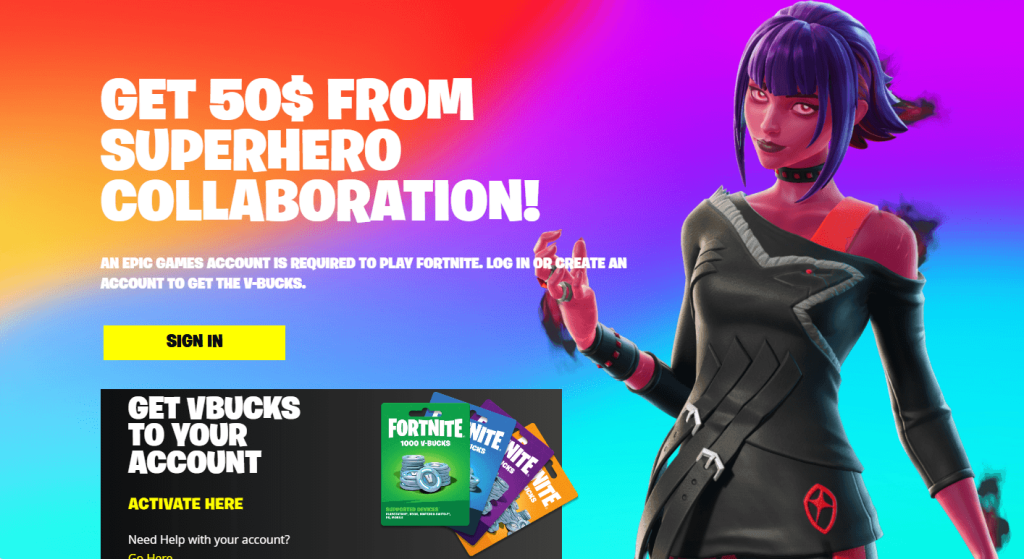
One version promises $50 from a fake superhero collaboration. Another claims it can calculate what your locker is worth. Both lead to the same destination: a fake Epic Games login page designed to steal your account. It’s an old trick, but it still catches people out.

The short version

If a website promises free V-Bucks, cash, or a tool to calculate your locker’s value, then asks you to log in with your Epic account to get it, it’s not run by Epic.

Epic doesn’t offer an official tool that values accounts, and no legitimate giveaway requires you to sign in through a third-party site. You’re just handing your Epic username and password to scammers.

If you or your child entered your Epic login details on one of these sites, assume the account has been compromised. Change the password immediately, turn on two-factor authentication, and don’t reuse that password on any other accounts.

Why do they want your login?

A stolen Fortnite account can be worth real money. Criminals can take over accounts with rare skins, spend any saved payment methods, sell the account on underground marketplaces, or use it to scam the owner’s friends. They may also try the same username and password on other online accounts, hoping the password has been reused.

Why Fortnite?

Fortnite still attracts around 110 million monthly players and has more than 650 million registered accounts. That alone makes it an attractive target for cybercriminals.

The audience’s age matters too. In December 2022, the US Federal Trade Commission (FTC) fined Epic Games a record $520 million, after alleging that the company knew children made up a substantial share of its player base and left voice and text chat turned on by default, exposing them to strangers. The Consumer Financial Protection Bureau (CFPB) also cites industry experts who say young gamers are especially vulnerable to phishing because they spend more time on social media and are less familiar with social engineering.

The game is also built around visible status. Skins, emotes, and pickaxes cost real money, making the idea that “your locker has a price” feel plausible. Rare or discontinued skins really do sell for hundreds of dollars on unofficial marketplaces, even though Epic offers no official way to cash out V-Bucks and selling accounts violates its terms of service. That kernel of truth is exactly what these locker-value scams exploit.

That’s also what makes them more convincing than a simple V-Bucks giveaway. Instead of promising something for nothing, they play on curiosity about something the player already owns. That’s probably why this version keeps coming back.

How the scam works

Some pages promise rewards:

Fake Fortnite giveaway

Others skip the free-reward pitch and frame the locker itself as hidden value the player is owed:

  • Fake Fortnite offers and tools
  • Fake Fortnite offers and tools
  • Fake Fortnite offers and tools

Others frame it as competition instead of currency:

  • Fake Fortnite competition
  • Fake Fortnite competition

The hook changes, but the fake login page doesn’t. These sites all do the same thing. They ask you to sign in with your Epic account so they can steal your username and password.

Another variant: Fake settlement claims

This one borrows a real story. Epic did settle with the FTC for $520 million, and real payments are still going out in 2026. But the real settlement pays actual dollars through the FTC’s own process, not in-game V-Bucks through an “Epic Games Locker,” and the claim window closed in July 2025.

References to an “EU Regulatory Mandate” and the case number shown on these pages don’t match any genuine legal action.

How to stay safe

Fortnite scams change constantly, but the advice doesn’t.

  • Use Malwarebytes Browser Guard to block known phishing sites before they have a chance to steal your login details.
  • Only sign in to your Epic account at epicgames.com. If another website asks for your Epic login, leave.
  • Be sceptical of offers that sound too good to be true. Free V-Bucks, locker valuations, and surprise rewards are all common phishing lures.
  • Verify refunds and settlements on the official source. If a page claims you’re owed money, check the regulator’s website yourself instead of following its links.
  • Turn on two-factor authentication (2FA). It can stop attackers from accessing your account even if they steal your password.
  • Use Malwarebytes Scam Guard. It can help you identify suspicious links and messages before you click.

What to do if you clicked

  • Change the Epic password immediately, going directly to epicgames.com, not through the suspicious link.
  • Turn on two-factor authentication if you haven’t already.
  • Check your linked email for password reset requests or login alerts you didn’t make.
  • Review connected devices/services on the account and remove anything unfamiliar.
  • If you entered payment details anywhere, contact your card issuer and monitor your statements.
  • Report the page to Epic’s support and flag it as phishing in your browser.
  • If the page claims to be part of a settlement or refund, verify it on the regulator’s official website. For the Epic settlement, that’s ftc.gov.

Stop threats before they can do any harm.

Malwarebytes Browser Guard blocks phishing pages and malicious sites automatically. Free, one click to install. Add it to your browser →
Buying TikTok views or followers? Here’s what you’re really getting

29 July 2026 at 18:54

A whole industry has sprung up around selling TikTok “growth.”

Cheap views by the hundred, pre-made ad accounts, and polished sales pages promising a repeatable path to serious revenue.

None of it is officially sanctioned by TikTok, and depending on what you’re buying, you could end up wasting money, losing your account, or handing your login details to scammers.

Scam 1: Sites selling cheap likes and engagement

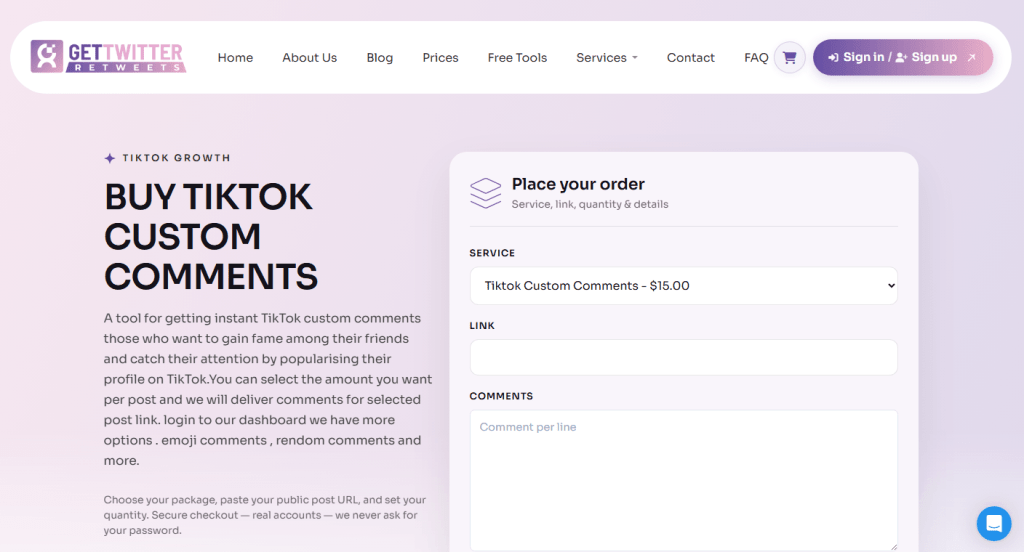
Sites selling bulk engagement all look remarkably similar.

They offer small bundles of views, likes, or followers for a few pounds, usually alongside identical packages for YouTube, Instagram, and other platforms.

The sales pitch is almost always the same: “100% real profiles,” “no bots, no click farms,” and “completely safe.”

Those claims are worth reading carefully because they’re addressing the biggest concern buyers already have.

At this price point, bulk engagement is usually generated through bots, click farms, or other artificial means—the very thing these sites insist they don’t use.

Even if your engagement numbers increase initially, TikTok’s fraud detection systems can remove artificial engagement, and accounts that repeatedly use these services risk being flagged or restricted.

Scam 2: The “aged” ad account marketplace

Another common offer is bulk TikTok Ads accounts sold as “aged” or “trusted,” often bundled with a replacement guarantee if an account stops working. The pitch is that you skip the hassle of setting up and verifying a new advertising account.

The problem is that you don’t know how those accounts were created. Many are built using stolen or synthetic identities, compromised payment details, or other deceptive methods. Buying one means inheriting that history—and the very real risk that TikTok detects it and suspends the account, along with any campaigns or ad budget attached to it. A replacement guarantee won’t help if your advertising is suddenly brought to a halt.

Scam 3: The growth framework

A third type of offer is less obviously a scam and more of a marketing funnel.

Slick landing pages—often hosted on free platforms and paired with an embedded video—promise a “proven blueprint” for turning TikTok into a major source of income, usually backed by impressive but unverifiable claims about past clients.

Companies offering TikTok growth frameworks

The immediate goal is usually to collect your email address, and sometimes your phone number, before revealing what’s actually for sale. That might be a paid course, a “done-for-you” management service, or a request for direct access to your TikTok Shop or Ads account.

What happens next varies, but the common thread is the same: you’re being asked to trust an unverified third party with your business, your money, or your account.

What you’re really signing up for

Not every TikTok marketing service is a scam. But if someone’s offering thousands of views for a few pounds, bulk “aged” ad accounts, or guaranteed growth, you’re in a very different part of the market.

These services promise shortcuts. What they often deliver is fake engagement, accounts with questionable histories, or requests for access to your own account.

At best, you’ve wasted your money on engagement TikTok later strips away. At worst, you’re buying an account built on stolen information or giving an untrusted third party full access to your own.

Our advice

  • Don’t pay for views, likes, or followers. Artificial engagement isn’t real growth and can put your account at risk under TikTok’s rules.
  • Never share your TikTok username and password with a “boosting” service, regardless of how it’s presented.
  • Don’t buy or sell TikTok Ads or Business accounts outside TikTok’s own account creation process.
  • Treat “guaranteed revenue” frameworks and courses like any other business opportunity: they’re sales pages first, educational content second.

None of this is unique to TikTok. The platform’s explosive growth has simply given a familiar ecosystem of low-effort scams a new audience.


Scammers don’t need to hack you. They just need you to click once. 

Malwarebytes Identity Theft Protection catches suspicious activity before it becomes a problem.

We found 120 fake Walmart stores trying to steal your credit card

29 July 2026 at 12:32

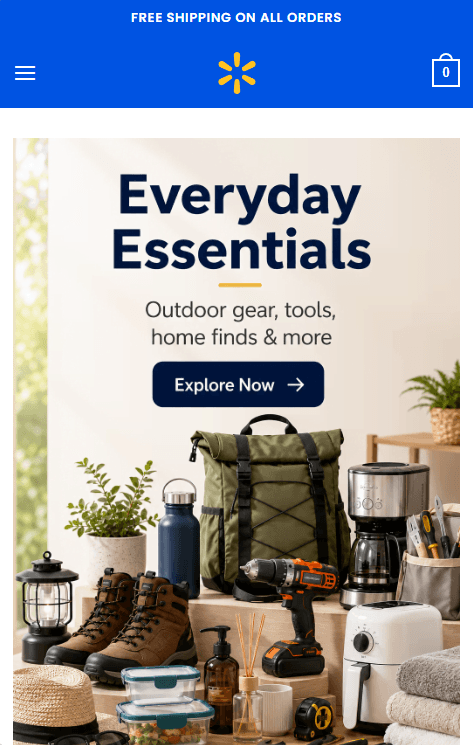
Shoppers browsing on their phones are landing on convincing Walmart lookalike sites offering name-brand liquor at 40% to 70% off, only to be led straight to a checkout page asking for a full credit card number, expiry date, and CVV.

The sites have no connection to Walmart. They’re part of a network of more than 120 near-identical domains built to look like a legitimate retailer just long enough to steal your card details.

Fake Walmart websites

The name “Walmart” is doing most of the work here. It’s one of the most recognized retailers in the world, and it’s that familiarity that makes people lower their guard. A shopper who’d hesitate on an unfamiliar website may think nothing of an unusually large discount because the logo, colours, and layout look familiar.

That trust hasn’t been earned by the site. It’s borrowed from a brand that has nothing to do with it.

If you’ve entered your card details on one of these pages, the safest assumption is that your card has been compromised.

How the scam works

The scam follows a simple pattern: a Walmart-branded homepage, category pages stacked with heavily discounted liquor, and a checkout form asking for full card details.

The discounts do much of the persuading. Seeing premium brands advertised at 60% or 70% off encourages people to buy first and ask questions later.

Heavy discounts offered on a fake Walmart site
Product pages on a fake Walmart site
Collecting card details on a fake Walmart site

The same WordPress/WooCommerce template powers every site in the network. They share the same product catalogue, prices, and images. The only differences are fabricated US business addresses and phone numbers that are swapped out for each domain.

How to avoid this scam

  • Be sceptical of discounts that don’t match a retailer’s usual promotions, especially on liquor or electronics.
  • Check the address bar before entering payment details. A genuine Walmart sale won’t send you to an unfamiliar .shop domain.
  • Use tools that can identify scam websites automatically, such as Malwarebytes Browser Guard on desktop, or ask Scam Guard if it thinks a domain is suspicious.
  • On mobile, where these sites are designed to work, Malwarebytes Mobile Security can block known phishing and scam domains before you reach the checkout.

If you already entered your card details

  • Contact your card issuer immediately. Explain what happened and ask whether the card should be cancelled and replaced.
  • Watch your account for unauthorized charges, including small “test” transactions.
  • Report the domain through your browser’s phishing reporting feature and to the FTC at reportfraud.ftc.gov if you’re in the US.

The simplest defence is also the most effective: if a retailer needs a lookalike domain to sell you something, it’s probably a scam.

Indicators of Compromise (IOCs)

allgoodscenter.shop, allneedsbay.shop, allneedslane.shop, allneedsmarket.shop, allneedsstore.shop, allpurposebay.shop, basketandmore.shop, broadbasket.shop, broadbasketbay.shop, broadbasketco.shop, broadbasketlane.shop, broadbasketplace.shop, broadbasketway.shop, broadchoice.shop, broadgoodsbay.shop, broadgoodscenter.shop, broadgoodsplace.shop, broadgoodsway.shop, broadmarketplacehub.shop, broadutility.shop, broadutilityhub.shop, broadvalue.shop, broadvaluebay.shop, broadvalueplace.shop, cartandcrate.shop, completehomegoods.shop, dailybasketport.shop, dailybasketway.shop, dailychoiceway.shop, dailycrate.shop, dailyfindslane.shop, dailygoodscrest.shop, dailygoodsfield.shop, dailygoodspark.shop, dailygoodsridge.shop, dailygoodsway.shop, dailygoodswayhub.shop, dailyhomemarket.shop, dailyutilitybay.shop, dailyutilityway.shop, everydaycartshop.shop, everydayneedsco.shop, everydayvaluebay.shop, generalcart.shop, generalcartlane.shop, generalgoodsport.shop, generalgoodsridge.shop, generalgoodsway.shop, generalgoodsyard.shop, generalmarketbay.shop, generalmarketfield.shop, generalneedsplace.shop, generalvaluebay.shop, goodsandhomebay.shop, goodsandhomeco.shop, goodsandhomehub.shop, goodsandlivinghub.shop, goodsandmoreco.shop, goodsandvaluehub.shop, goodsdistrict.shop, goodslanding.shop, goodsmeadow.shop, goodsroute.shop, goodsvalley.shop, homeandutility.shop, homebasketlane.shop, homebasketway.shop, homecartcenter.shop, homefieldmarket.shop, homefindsco.shop, homegoodscrate.shop, homegoodsport.shop, homegoodsway.shop, homelivinggoods.shop, homeneedslane.shop, homeneedsmarket.shop, homeparcel.shop, homesteadmart.shop, homeutilitystore.shop, homevaluebay.shop, homevalueplace.shop, homevalueway.shop, marketbasketcenter.shop, marketcanvas.shop, marketchoicebay.shop, marketchoiceplace.shop, marketfieldhub.shop, marketfindsbay.shop, marketfoundry.shop, marketgrovehub.shop, markethomeplace.shop, marketpillar.shop, marketpine.shop, marketridge.shop, markettrailway.shop, marketwarehouse.shop, modernsupplyhub.shop, smartbasketplace.shop, smartdailygoods.shop, smartneedshub.shop, smartutilityhub.shop, smartvaluebay.shop, trustedgoods.shop, usefulbasketlane.shop, usefulcartcenter.shop, usefulchoicebay.shop, usefuldailyhub.shop, usefulgoodsbay.shop, usefulgoodscenter.shop, usefulgoodspark.shop, usefulgoodsway.shop, usefulgoodswayhub.shop, usefulgoodsyard.shop, usefulmarket.shop, usefulmarketbay.shop, usefulshelf.shop, usefulutility.shop, usefulvalueplace.shop, utilitygoods.shop, valuechoicebay.shop, valuegoodspark.shop, valuegoodsridge.shop, valuegrove.shop, valueparcel.shop


Stop threats before they can do any harm.

Malwarebytes Browser Guard blocks phishing pages and malicious sites automatically. Free, one click to install. Add it to your browser →
Sextortion scammers are exploiting ShinyHunters data leaks

27 July 2026 at 17:00

Sextortion scammers are using email addresses from data leaked by the ShinyHunters hacking group to add some credibility to their feeble attempts to convince people they have embarrassing information about them.

Sextortion emails are messages claiming that the scammer recorded you through your webcam while you watched pornography and now demand payment. They have been around for years and keep evolving with small changes in wording and fake technical detail.

In this campaign, the scammers pretend to be ShinyHunters. What hasn’t changed is the basic truth: there is no malware, no recording, and no credible evidence behind the threat. Despite seeing countless versions of these emails over the years, I’ve yet to encounter one that was backed up by the evidence the sender claimed to have.

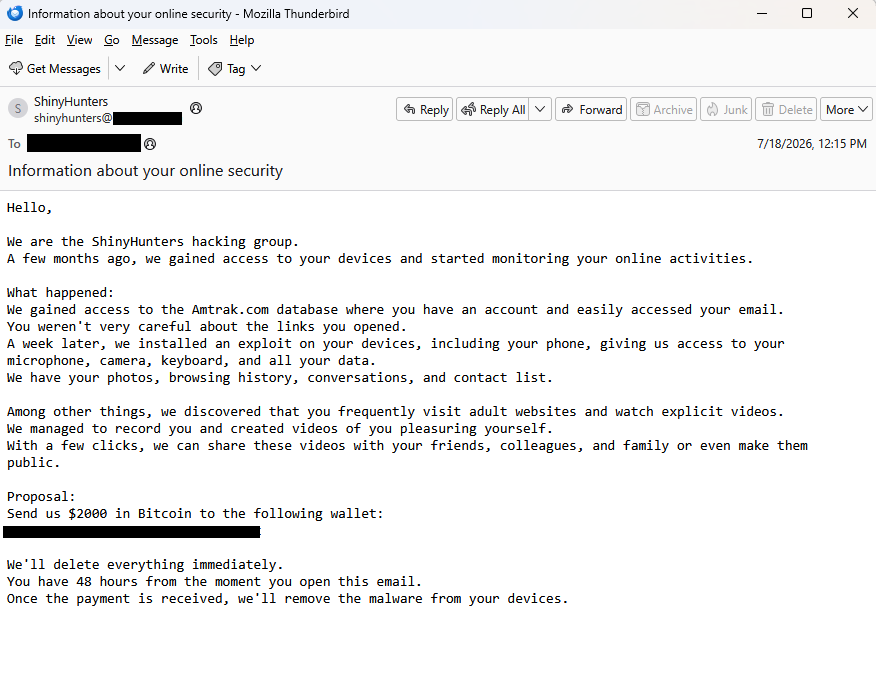
BleepingComputer reports that ShinyHunters data leaks are fueling a $2,000 sextortion email scam and shared the following example:

Example sextortion email from ShinyHunters

“Subject: Information about your online security

Hello,

We are the ShinyHunters hacking group.
A few months ago, we gained access to your devices and started monitoring your online activities.

What happened:
We gained access to the Amtrak.com database where you have an account and easily accessed your email.
You weren’t very careful about the links you opened.
A week later, we installed an exploit on your devices, including your phone, giving us access to your microphone,
camera, keyboard, and all your data.
We have your photos, browsing history, conversations, and contact list.

Among other things, we discovered that you frequently visit adult websites and watch explicit videos.
We managed to record you and created videos of you pleasuring yourself.
With a few clicks, we can share these videos with your friends,
colleagues, and family or even make them public.

Proposal:
Send us $2000 in Bitcoin to the following wallet:
xxxxxxxxxxxxxxxxxxxxxxxxxxxxxxxxx

We’ll delete everything immediately.
You have 48 hours from the moment you open this email.
Once the payment is received, we’ll remove the malware from your devices.”

BleepingComputer states it has seen data from the Amtrak, Hallmark, ADT, Substack, Betterment, CarGurus, Panera Bread, and McGraw Hill breaches used to target victims in this sextortion email campaign.

A California community college also issued a warning after seeing the campaign target people affected by the Canvas data breach.


Digital Footprint Scan

See if your personal data has been exposed.


They confirmed that the targeted email addresses had previously appeared in data leaked by ShinyHunters. They also contacted the group, which denied being behind the sextortion emails.

The increase to a $2,000 demand may suggest the scammers paid someone for the email lists. Although it’s more likely they simply downloaded the leaked data after ShinyHunters published it following failed extortion attempts.

A quick check of the Bitcoin address used in the email shows no activity.

blockchain report of scammer's Bitcoin address
No activity on their Bitcoin address

Let’s keep it that way. With any luck, these dungeon dwellers will eventually give up trying to scare people out of their hard-earned money.

How to react to sextortion emails

Some sextortion emails are badly written, but many have been polished by AI and look convincing. Regardless of how professional they look, they should be treated the same way: as unsubstantiated threats designed to scare victims into paying.

  • First and foremost, never reply to emails of this kind. Responding confirms that someone is actively reading messages sent to that address and may encourage further scam attempts.
  • Don’t let yourself be rushed into action. Scammers rely on the fact that you will not take the time to think this through and subsequently make mistakes. Ask for advice if you’re not sure.
  • An attachment is not proof. Most sextortion emails contain no evidence at all, and attachments are often used to deliver malware or make the threats appear more convincing.
  • If the email includes a password you’ve used before, change it immediately anywhere it’s still in use. Then enable two-factor authentication (2FA) wherever possible. If you’re having trouble keeping track of your passwords, consider using a password manager.
  • Delete the message, report it as spam, and move on.

Pro tip: Malwarebytes Scam Guard recognized this email for what it is: sextortion. It can recognize scams and advise you how to proceed.

Scam Guard recognizes this email as a sextortion scam

While these sextortion emails are almost always bluffs, if you’re concerned about webcam spying, Malwarebytes Webcam Monitoring can alert you when applications attempt to access your camera.


Scam or legit? Scam Guard knows.


Don’t get fooled by TikTok resin art scams

24 July 2026 at 16:56

Resin art has become a popular corner of TikTok, with some videos attracting millions of views. But not every glossy, colorful post is what it claims to be. Scammers are using the look of handmade resin art to trick buyers, collectors, and even fellow artists into sending money for work that either doesn’t exist or wasn’t created by the person posting it.

There are plenty of genuine resin artists on TikTok. Unfortunately, the platform has also attracted scammers who steal videos and impersonate legitimate creators.

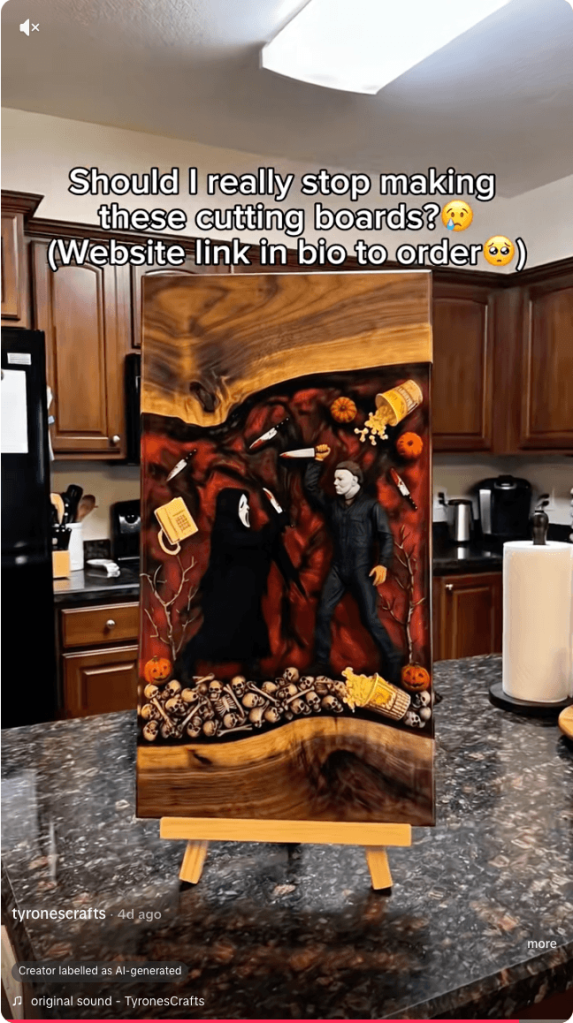
  • Fake resin art
  • Fake resin art
  • Fake resin art
  • Fake resin art
  • Fake resin art
  • Fake resin art

The scam is fairly straightforward. A TikTok account presents itself as a resin artist, posts satisfying videos, and invites people to “DM to order.” In some cases, the videos are stolen from other creators, the account has no real process footage, and the seller disappears after receiving payment.

One resin artist discovered that scammers were using their videos to impersonate them and scam TikTok users. They shared the following comment:

Ridiculous TikTok scammer…lol. Profile says they’re a resin artist and to DM them to order, but none of the videos are theirs. When I wrote to them asking them to take down the many videos of mine that they posted, passing them off as their own with no credit, their answer was that they aren’t a resin artist and are just sharing videos they like 🤣🤣 Literally about 1/4 of “their” videos are mine 🙄

These scams often rely on trust and urgency. The account may show polished clips of poured resin, finished coasters, trays, jewelry, or wall art, then push buyers to move the conversation into direct messages. Once the buyer moves to a different platform, the scammer typically requests a deposit, full payment, or personal details with little chance of being held accountable.

And real artists don’t just get their work ripped off. A scammer may contact a creator claiming to want to buy, feature, or license their work, but the real goal is to extract fees, banking information, or other sensitive data. Social media art scams are often repetitive because they are built from the same templates and scripts.

Script is similar across many videos in resin art scams
Different videos, same script

How to spot a TikTok resin art scam

The safest approach is the boring one: verify before you pay. If the artwork looks amazing but the seller’s identity is vague, the risk is real.

Check the TikTok account

Before ordering, look for signs that the artist is genuine:

  • The account didn’t appear overnight and has a history of original posts.
  • The same videos don’t appear under multiple creator names or belong to another artist.
  • The creator shows themselves making the artwork, with consistent process videos, a recognizable workspace, and works in progress.
  • The videos don’t contain obvious AI artifacts, such as impossible resin effects or objects moving after they’ve supposedly been sealed inside hardened resin.
  • Comments raising concerns haven’t been deleted or buried under generic praise.
  • The seller isn’t pushing you to order only through direct messages or asking for payment before you’ve verified who they are.

Check the website

If you do click through to a website, spend a few minutes checking it before you buy:

  • Look for a genuine returns and refunds policy, a physical business address, company or VAT details (where applicable), and consistent contact information.
  • Check how old the website is. Scam sites often use domains that were registered only weeks or months ago, especially when they claim to have been selling handmade products for years.
  • Search for recent independent reviews rather than relying on testimonials published on the site itself.
  • Run a reverse image search on the product photos to see whether they’ve been copied from another artist.
  • Only pay using a method that offers buyer protection, such as a credit card or PayPal. If a seller insists on a bank transfer, cryptocurrency, or another irreversible payment method, walk away.

Not every resin art account is a scam. Many belong to genuine artists, and that’s why impersonation scams can be so convincing.

If you’re unsure, paste the website address into Malwarebytes Scam Guard and ask whether it shows signs of being fraudulent. It can help identify suspiciously new domains and other common scam indicators.

Use Malwarebytes Scam Guard to check whether a social media post or website is part of a scam.

Use real-time web protection to block known fraudulent and malicious websites, like Browser Guard did for this web shop:

Browser Guard blocks the web shop due to likely fraud
Browser Guard blocks the fraudulent website

Both are free—making them much cheaper than sending money to a scammer.


Something feel off? Check it before you click.  

Malwarebytes Scam Guard helps you analyze suspicious links, texts, and screenshots instantly.  

Available with Malwarebytes Premium Security for all your devices, and in the Malwarebytes app for iOS and Android.  

Try it free → 

❌