Normal view

Beware of fake OpenClaw installers, even if Bing points you to GitHub

6 March 2026 at 12:11

Attackers are abusing OpenClaw’s popularity by seeding fake “installers” on GitHub, boosted by Bing AI search results, to deliver infostealers and proxy malware instead of the AI assistant users were looking for.

OpenClaw is an open‑source, self‑hosted AI agent that runs locally on your machine with broad permissions: it can read and write files, run shell commands, interact with chat apps, email, calendars, and cloud services. In other words, if you wire it into your digital life, it may end up handling access to a lot of sensitive data.

And, as is often the case, popularity brings brand impersonation. According to researchers at Huntress, attackers created malicious GitHub repositories posing as OpenClaw Windows installers, including a repo called openclaw-installer. These were added on February 2 and stayed up until roughly February 10, when they were reported and removed.

Bing search results pointed victims to these GitHub repositories. But when the victim downloaded and ran the fake installer, it didn’t give them OpenClaw at all. The installer dropped Vidar, a well‑known information stealer, directly into memory. In some cases, the loader also deployed GhostSocks, effectively turning the victim’s system into a residential proxy node criminals could route their traffic through to hide their activities.

How to stay safe

The good news is that the campaign appears to have been short-lived, and there are clear indicators and mitigations you can use.

If you downloaded an OpenClaw installer recently from GitHub after searching “OpenClaw Windows” in Bing, especially in early February, you should assume your system is compromised until proven otherwise.

Vidar can steal browser credentials, crypto wallets, and data from applications like Telegram. GhostSocks silently turns your machine into a proxy node for other people’s traffic. That’s not just a privacy issue. It can drag you into abuse investigations when someone else’s attacks appear to come from your IP address.

If you suspect you ran a fake installer:

  • Disconnect the machine from your network, then run a full system scan with a reputable, up‑to‑date anti‑malware solution.
  • Change passwords for critical services (email, banking, cloud, developer accounts) and do that on a different, clean device.
  • Review recent logins and sessions for unusual activity, and enable multi‑factor authentication (MFA) where you haven’t already.

If you’re still intent on using OpenClaw:

  • Run OpenClaw (or similar agents) in a sandboxed VM or container on isolated hosts, with default‑deny egress and tightly scoped allow‑lists.
  • Give the runtime its own non‑human service identities, least privilege, short token lifetimes, and no direct access to production secrets or sensitive data.
  • Treat skill/extension installation as introducing new code into a privileged environment: restrict registries, validate provenance, and monitor for rare or newly seen skills.
  • Log and periodically review agent memory/state and behavior for durable instruction changes, especially after ingesting untrusted content or shared feeds.
  • Understand and provide for the event where you may need to nuke‑and‑pave: keep non‑sensitive state snapshots handy, document a rebuild and credential‑rotation playbook, and rehearse it.
  • Run an up-to-date, real-time anti-malware solution that can detect information stealers and other malware.

We don’t just report on threats—we remove them

Cybersecurity risks should never spread beyond a headline. Keep threats off your devices by downloading Malwarebytes today.

From cheats to exploits: Webrat spreading via GitHub

23 December 2025 at 09:00

In early 2025, security researchers uncovered a new malware family named Webrat. Initially, the Trojan targeted regular users by disguising itself as cheats for popular games like Rust, Counter-Strike, and Roblox, or as cracked software. In September, the attackers decided to widen their net: alongside gamers and users of pirated software, they are now targeting inexperienced professionals and students in the information security field.

Distribution and the malicious sample

In October, we uncovered a campaign that had been distributing Webrat via GitHub repositories since at least September. To lure in victims, the attackers leveraged vulnerabilities frequently mentioned in security advisories and industry news. Specifically, they disguised their malware as exploits for the following vulnerabilities with high CVSSv3 scores:

CVE CVSSv3
CVE-2025-59295 8.8
CVE-2025-10294 9.8
CVE-2025-59230 7.8

This is not the first time threat actors have tried to lure security researchers with exploits. Last year, they similarly took advantage of the high-profile RegreSSHion vulnerability, which lacked a working PoC at the time.

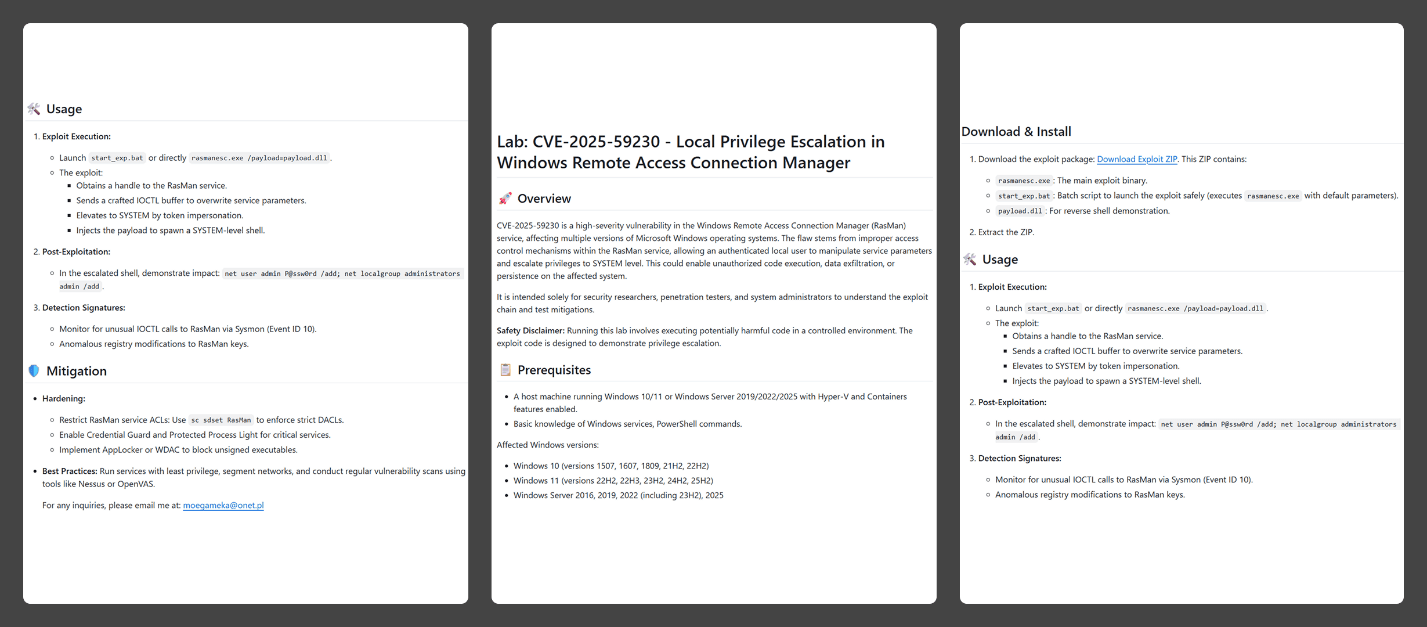
In the Webrat campaign, the attackers bait their traps with both vulnerabilities lacking a working exploit and those which already have one. To build trust, they carefully prepared the repositories, incorporating detailed vulnerability information into the descriptions. The information is presented in the form of structured sections, which include:

  • Overview with general information about the vulnerability and its potential consequences
  • Specifications of systems susceptible to the exploit
  • Guide for downloading and installing the exploit
  • Guide for using the exploit
  • Steps to mitigate the risks associated with the vulnerability
Contents of the repository

Contents of the repository

In all the repositories we investigated, the descriptions share a similar structure, characteristic of AI-generated vulnerability reports, and offer nearly identical risk mitigation advice, with only minor variations in wording. This strongly suggests that the text was machine-generated.

The Download Exploit ZIP link in the Download & Install section leads to a password-protected archive hosted in the same repository. The password is hidden within the name of a file inside the archive.

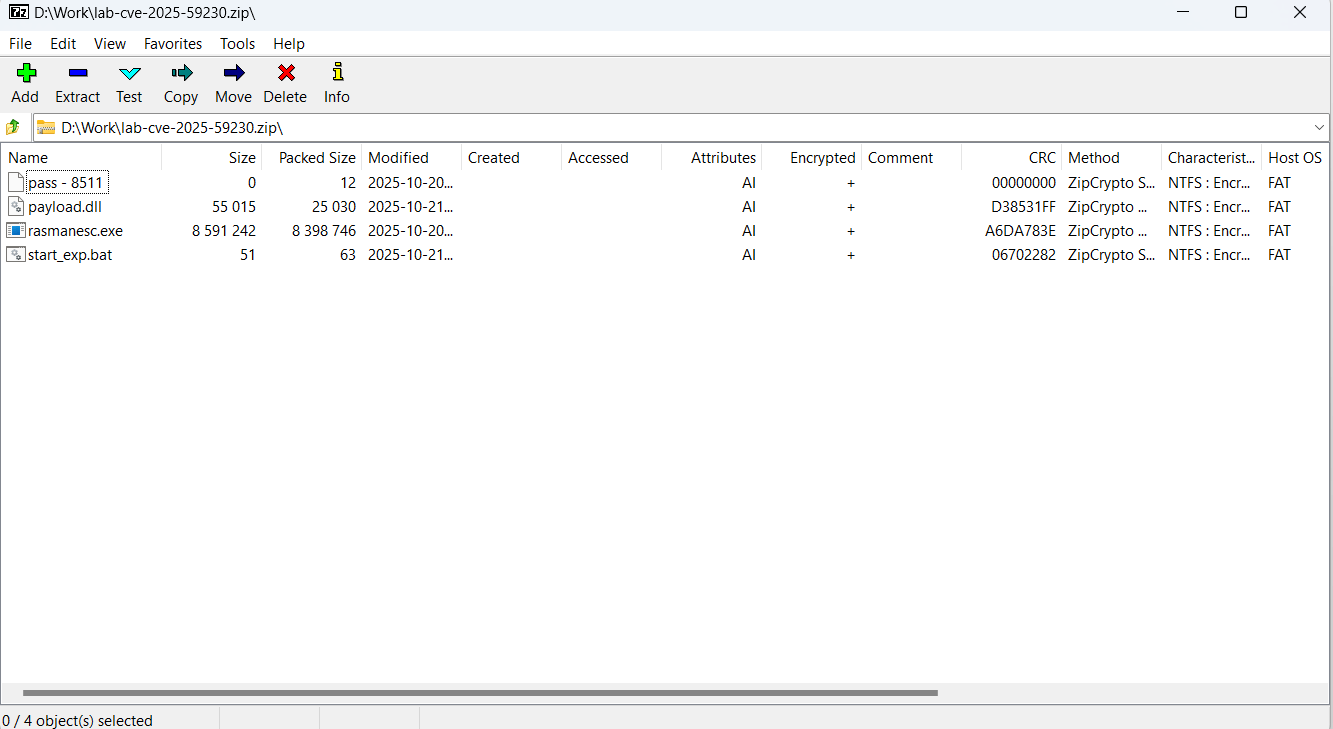
The archive downloaded from the repository includes four files:

  1. pass – 8511: an empty file, whose name contains the password for the archive.
  2. payload.dll: a decoy, which is a corrupted PE file. It contains no useful information and performs no actions, serving only to divert attention from the primary malicious file.
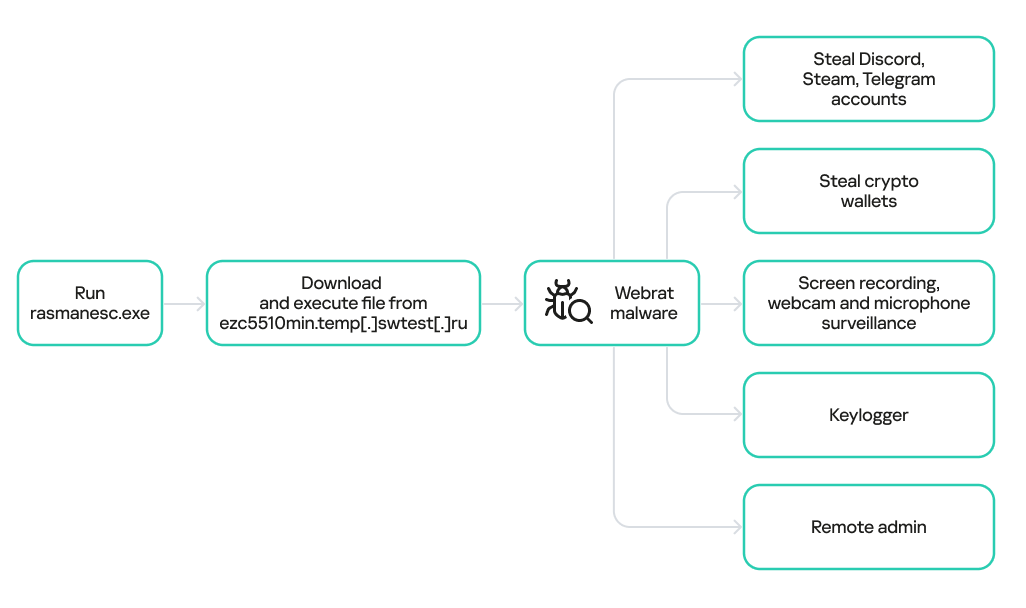
  3. rasmanesc.exe (note: file names may vary): the primary malicious file (MD5 61b1fc6ab327e6d3ff5fd3e82b430315), which performs the following actions:
    • Escalate its privileges to the administrator level (T1134.002).
    • Disable Windows Defender (T1562.001) to avoid detection.
    • Fetch from a hardcoded URL (ezc5510min.temp[.]swtest[.]ru in our example) a sample of the Webrat family and execute it (T1608.001).
  4. start_exp.bat: a file containing a single command: start rasmanesc.exe, which further increases the likelihood of the user executing the primary malicious file.
The execution flow and capabilities of rasmanesc.exe

The execution flow and capabilities of rasmanesc.exe

Webrat is a backdoor that allows the attackers to control the infected system. Furthermore, it can steal data from cryptocurrency wallets, Telegram, Discord and Steam accounts, while also performing spyware functions such as screen recording, surveillance via a webcam and microphone, and keylogging. The version of Webrat discovered in this campaign is no different from those documented previously.

Campaign objectives

Previously, Webrat spread alongside game cheats, software cracks, and patches for legitimate applications. In this campaign, however, the Trojan disguises itself as exploits and PoCs. This suggests that the threat actor is attempting to infect information security specialists and other users interested in this topic. It bears mentioning that any competent security professional analyzes exploits and other malware within a controlled, isolated environment, which has no access to sensitive data, physical webcams, or microphones. Furthermore, an experienced researcher would easily recognize Webrat, as it’s well-documented and the current version is no different from previous ones. Therefore, we believe the bait is aimed at students and inexperienced security professionals.

Conclusion

The threat actor behind Webrat is now disguising the backdoor not only as game cheats and cracked software, but also as exploits and PoCs. This indicates they are targeting researchers who frequently rely on open sources to find and analyze code related to new vulnerabilities.

However, Webrat itself has not changed significantly from past campaigns. These attacks clearly target users who would run the “exploit” directly on their machines — bypassing basic safety protocols. This serves as a reminder that cybersecurity professionals, especially inexperienced researchers and students, must remain vigilant when handling exploits and any potentially malicious files. To prevent potential damage to work and personal devices containing sensitive information, we recommend analyzing these exploits and files within isolated environments like virtual machines or sandboxes.

We also recommend exercising general caution when working with code from open sources, always using reliable security solutions, and never adding software to exclusions without a justified reason.

Kaspersky solutions effectively detect this threat with the following verdicts:

  • HEUR:Trojan.Python.Agent.gen
  • HEUR:Trojan-PSW.Win64.Agent.gen
  • HEUR:Trojan-Banker.Win32.Agent.gen
  • HEUR:Trojan-PSW.Win32.Coins.gen
  • HEUR:Trojan-Downloader.Win32.Agent.gen
  • PDM:Trojan.Win32.Generic

Indicators of compromise

Malicious GitHub repositories
https://github[.]com/RedFoxNxploits/CVE-2025-10294-Poc
https://github[.]com/FixingPhantom/CVE-2025-10294
https://github[.]com/h4xnz/CVE-2025-10294-POC
https://github[.]com/usjnx72726w/CVE-2025-59295/tree/main
https://github[.]com/stalker110119/CVE-2025-59230/tree/main
https://github[.]com/moegameka/CVE-2025-59230
https://github[.]com/DebugFrag/CVE-2025-12596-Exploit
https://github[.]com/themaxlpalfaboy/CVE-2025-54897-LAB
https://github[.]com/DExplo1ted/CVE-2025-54106-POC
https://github[.]com/h4xnz/CVE-2025-55234-POC
https://github[.]com/Hazelooks/CVE-2025-11499-Exploit
https://github[.]com/usjnx72726w/CVE-2025-11499-LAB
https://github[.]com/modhopmarrow1973/CVE-2025-11833-LAB
https://github[.]com/rootreapers/CVE-2025-11499
https://github[.]com/lagerhaker539/CVE-2025-12595-POC

Webrat C2
http://ezc5510min[.]temp[.]swtest[.]ru
http://shopsleta[.]ru

MD5
28a741e9fcd57bd607255d3a4690c82f
a13c3d863e8e2bd7596bac5d41581f6a
61b1fc6ab327e6d3ff5fd3e82b430315

❌