
Reading view

The Dangerous Momentum of Autodownload Phishing

Modern phishing campaigns are no longer trying to convince users. They are trying to outrun them. By forcing an automatic progression from click to download, attackers eliminate the moment of hesitation entirely by forcing files to download instantly using trusted cloud platforms like Dropbox and Google Drive.

Detecting when these legitimate SaaS auto-download features are being weaponized is an immense challenge for traditional defenses. This is exactly where Cortex® Email Security steps in. By combining deep static analysis with advanced behavioral intelligence, the module can distinguish in this attack between a benign file share and a malicious, forced-momentum trigger.

This technical detection is vital because while the autodownload method is the primary cause of infection, its effectiveness relies on a clever strategy, using a wide range of changing social engineering lures. By alternating between lures like 'Invoices' or 'Quotes,' attackers rotate their themes to catch a wider variety of victims. This strategy allows attackers to convert trusted email links into rapid, dangerous file executions that effectively evade standard security measures.

How Forced Momentum Drives Auto-Downloads

The core of this attack leverages the infrastructure of real SaaS providers to eliminate the user's preview buffer. Typically, cloud sharing directs users to a webpage for file examination. In this campaign, however, forced-download parameters (such as ?dl=1 on Dropbox) are used instead. To ensure the victim executes the file once it lands on their machine, attackers hide the danger behind "visual anchors." By using double extensions like PDF and .EXE, the threat actor exploits default settings in certain operating systems that hide known extensions. The user's eyes stop at the familiar ".PDF" or ".ZIP," leading them to believe the file is a harmless document rather than a malicious executable.

When the targeted victim clicks the link in the email, it triggers an immediate file download in the browser, effectively bypassing any intermediary steps.

Attack Flow: From Email to Execution

  • The Bait: A highly personalized email arrives, using a trusted cloud link (like Dropbox) to lower the victim's guard.
  • The Trap: Clicking the link skips the usual "preview" screen and instantly drops a file onto the victim's computer.
  • The Disguise: The file is cleverly named to look like a safe PDF or document, hiding its true identity as a harmful program.
  • The Lock: In many cases, the attacker ensures only the intended victim can open the file, preventing security tools from scanning it first.
  • The Takeover: Once the victim opens the file, the attacker gains remote access to the system.
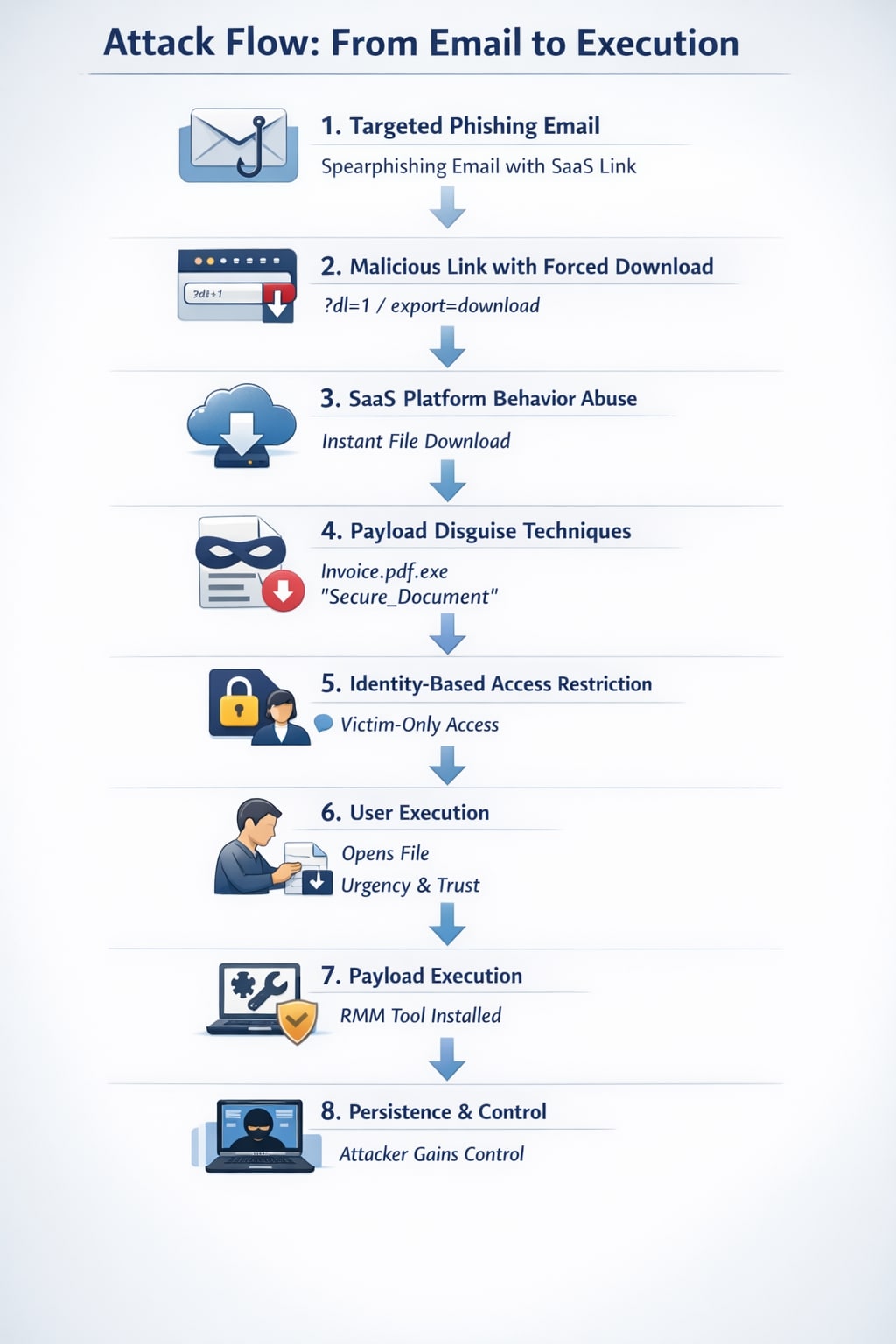
Attack flow chart, from email to execution.
Multi-step attack flow, starting from targeted phishing email, to bypass security and establish persistence.

The Library of Lures Strategy

To fuel the autodownload machine, attackers employ a flexible strategy by switching between various social engineering themes. This spear phishing campaign targets specific inboxes, such as "Orders," to exploit professional routines. Some common lures found in this campaign include:

  • Financial Urgency Fake "Invoices" or "Receipts" that induce anxiety. These often set close-day payment deadlines, pressuring recipients to click quickly.
  • Business Operations – "Quote Requests" or "Purchase Orders" that exploit professional habits.
  • Deceptive Naming – Concealing the download as a safe document, using display text like "invoice.pdf" in the email body to hide the underlying Dropbox URL.

Government Domain Impersonation

Attackers often leverage high-authority lures designed to paralyze a user's critical thinking. In one sophisticated wave, we observed threats impersonating a government entity by exploiting the high-reputation, official government domain. By borrowing the reputational authority associated with official infrastructure, the attacker successfully maneuvered an "Unidentified Payment Notice" past standard "Untrusted Sender" filters. To the recipient, the email carries the weight of a sanctioned document. Fearing legal or financial ramifications, they feel a heightened sense of urgency to click "View Invoice" to resolve the issue immediately.

Employee Impersonation

When government authority isn’t the angle, attackers shift to impersonating internal staff. In one case, the sender’s display name was spoofed to match a real employee in the target organization. Attackers rely on a “Momentum of Trust” tied to familiar names to overwhelm user judgment. Even when a generic Gmail address is used, users, especially those on mobile devices, rarely pause to check the underlying headers.

Internal Trust Amplification ("Human Relay")

The most effective aspect of this campaign occurs through Internal Laundering, where the threat shifts from external suspicion to a trusted internal message. This was observed when a Finance Department employee received a "Quote Analysis" file and, believing it to be a valid inquiry, mistakenly forwarded the link to the Procurement department.

At that stage, the attack no longer depended on deception, it propagated through trusted human workflows. These various tactics illustrate the sophistication and adaptability of phishing campaigns and highlight the importance of vigilance in email security.

How We Uncovered a Single Threat Actor

Although the lures appeared diverse, a deeper technical analysis revealed that they were all orchestrated by a single, coordinated threat actor.

By mapping the campaign, we uncovered a significant pattern: Each autodownload link pointed to a different file hash to evade signature detection, but all unique executables were ultimately associated with the same parent installer hash.

The file was identified as a specific Remote Monitoring and Management (RMM) executable, an administrative software used to manage computers remotely. Because RMM tools are legitimate, they often trigger fewer alerts than traditional Trojans. This allows the attacker to maintain persistent access under the guise of “authorized” system activity.

How Cortex Email Security Addresses the Threat

To defend against a campaign that emphasizes speed and rotation, behavioral analysis is essential.

The Cortex® Email Security Module addresses this threat:

  • Advanced URL Analysis – Detection of forced-download parameters, combined with delivery of high-risk files via URLs.
  • Deep Metadata Correlation Correlating sender identity with behavioral anomalies to flag threats that traditional scanners might overlook.
  • LLM-Based Intent Analysis Classifying phishing themes (invoice, payment, quote) despite variation.

The security engine triggers an alert by synthesizing LLM analysis with real-time email telemetry, global threat intelligence and behavioral signals.

Securing the Click

The combination of autodownload links and rotating lures is crafted to exploit user momentum and the "psychology of trust."

This campaign represents a shift from deception to acceleration. Attackers no longer need perfect lures, they only need to remove friction. Defenders must evolve accordingly, focusing not only on what a link is, but on what it forces a user to do.

Palo Alto Networks Cortex Advanced Email Security was built for this evolution. By moving beyond static file analysis to identify the behavioral "red flags" of autodownloads and forced-momentum URLs, we provide the visibility needed to stop these attacks before they reach the device.

The module examines email metadata, content, and behavior to uncover hidden malicious intent and sophisticated impersonation, including AI-crafted threats. By assigning precise risk scores to every detection, the system filters out the noise, allowing analysts to move past alert fatigue and focus on the most critical threats first.

Indicators of compromise discovered during this research are detailed on Unit 42’s GitHib instance.


FAQs

  1. Why is the "Auto-Download" parameter so effective? It removes the "moment of doubt." By bypassing the preview page, the attacker forces the file onto the computer instantly, prompting the user to "Open" it out of habit.
  2. How does the use of rotating lures benefit the attacker? It maximizes both psychological and technical success. People have different "blind spots" (e.g., finance professionals are likely to click on invoices), and variety increases the chances of finding a template that can bypass specific customers' security filters.
  3. Why might a sandbox fail to catch the malicious file? Because the link was "Identity-Bound." To the scanner, the link appeared to lead to a harmless error page (cloaking), resulting in a false negative.

Cloaking involves showing different content to security scanners than what is presented to the victim. By using Identity-Bound access, the file only reveals itself to the intended target.

The post The Dangerous Momentum of Autodownload Phishing appeared first on Palo Alto Networks Blog.

  •  

Strengthening cyber capacity in Kenya: A new toolkit with lessons for the region

When a major cyber incident hits, the first decisions aren’t technical—they’re human. Who takes the lead? How quickly can information be shared? When should governments step in, and how do you protect public trust while keeping essential services running? 

These questions are at the heart of Microsoft’s Advancing Regional Cybersecurity (ARC) initiative, launched in 2025 to help governments strengthen cyber preparedness through practical, public-private collaboration. Today, we’re sharing the first tangible output of that work: the ARC Kenya Exercise Report & Toolkit, developed through a tabletop exercise held in Nairobi in December 2025.  

Developed with Kenya’s National Computer and Cybercrime Coordination Committee (NC4) and RiskSight, the toolkit is a practical planning resource designed to help government and cross-sector leaders prepare for cyber crises before they occur. It is grounded in real conversations among leaders from government, regulators, critical infrastructure operators, law enforcement, academia, and the private sector working through what a serious cyber incident would demand of them, together. 

Stress‑testing decisions before a crisis hits

The ambition of the “Silicon Savannah” makes Kenya a compelling setting for this work. Its digital economy is expanding rapidly—from mobilefirst financial services to cloudenabled public infrastructure—positioning the country as a regional technology leader. But rapid digital growth also brings increased exposure to more sophisticated cyber threats. As systems become more interconnected, a serious cyber incident can quickly disrupt essential services, undermine public trust, and threaten economic stability. 

Kenya’s approach recognizes this reality and reflects a critical principle: cybersecurity is not separate from innovation; it is one of the conditions that allows digital transformation to scale safely. The ARC initiative embodies this philosophy and helps decision makers confront the practical realities of coordination, escalation, and response in this complex environment. 

This is exactly what the ARC Kenya tabletop exercise was designed to do. The objective was not to test tools but to stresstest decision making under pressure. Participants were challenged with complex scenarios—including AIenabled breaches, ransomware attacks, and infrastructurelevel disruptions. The focus was not on technical fixes but on leadership clarity, crossagency coordination, and realtime decision making in highpressure environments. 

The outcome was both a roadmap for the unknown and a clear recognition of the need for shared expectations before a crisis begins—particularly around leadership and authority, trusted information sharing channels, and agreed response frameworks. These gaps, identified by participants themselves, now form the backbone of the ARC Kenya Toolkit. 

What the ARC Kenya toolkit delivers

The toolkit translates the lessons of the exercise into concrete actions that leaders can take now—before the next incident occurs. It also serves as a practical and specific 12month roadmap for strengthening Kenya’s cyber preparedness, moving from lessons identified to durable, institutional capability. Specifically, the toolkit provides recommendations to: 

  • Clarify national leadership during major cyber incidents, enabling government, regulators, law enforcement, and critical infrastructure operators to coordinate more quickly, with fewer gaps and overlaps. 
  • Establish practical, standardsaligned incident response models for the entire country, including priority playbooks that teams can train on and execute consistently. 
  • Strengthen operational readiness across sectors, with better coordination between security operations centers (SOCs), clearer escalation thresholds, and more reliable incident reporting pathways. 
  • Deepen trusted information sharing and publicprivate collaboration through common handling rules, safer “goodfaith” reporting mechanisms, and regular joint exercises to build muscle memory before a crisis.

Taken together, these elements enable leaders not only to respond more effectively to cyber incidents, but to institutionalize preparedness, coordination, and resilience across the national cyber ecosystem. For African countries more broadly, the model also offers a practical pathway to strengthen regional cyber cooperation—by aligning expectations around escalation, information sharing, and public‑private coordination before a crossborder incident occurs. By translating highlevel principles into practical, repeatable approaches to crisis readiness, the toolkit underscores the value of trusted international partnerships and alignment with global norms for responsible state behavior in cyberspace. 

Why Kenya’s approach matters beyond its borders

Many countries across the Global South are grappling with similar challenges: fragmented ownership of critical infrastructure, uneven cyber capacity across sectors, and the need to coordinate rapidly under pressure. While firmly grounded in Kenya’s national context, the lessons from ARC Kenya are therefore intentionally designed to resonate far beyond its borders and to be highly transferable. 

Importantly, this work does not end in Kenya. We are already building on these lessons through ARC engagements in other regions, including a new workstream in Mexico, applying the same approach to strengthen preparedness, coordination, and resilience across different national contexts. 

By design, the ARC initiative is not simply a record of a single exercise. It is a foundation others can build on—at a national or regional level—offering leaders a practical starting point to turn shared responsibility into sustained capability. 

Explore the ARC Kenya Toolkit & Tabletop Exercise


For more than a decade, the Microsoft Digital Crimes Unit (DCU) has persistently disrupted cybercrime and nation-state threats targeting people, organizations, and critical infrastructure. Explore major disruptions—and the ongoing cases and operations behind them here: Disrupting cyberthreats since 2008 | Microsoft

The post Strengthening cyber capacity in Kenya: A new toolkit with lessons for the region appeared first on Microsoft On the Issues.

  •  

From capability to responsibility: Securing our global digital ecosystem with next‑generation AI

Cybersecurity is at a turning point. Advanced AI models are dramatically accelerating vulnerability discovery and creating conditions ripe for exploitation, underscored by the announcement of Claude Mythos Preview. This marks a shift, and whether this technology will favor defenders or attackers will depend on the choices we make now. 

With the right safeguards, these capabilities can help trusted defenders identify and fix vulnerabilities across critical systems in hospitals, power grids, water, and telecommunications. Released irresponsibly or not properly secured, however, those same capabilities could be abused by malicious actors, threatening the foundations of our digital ecosystem. 

Much of the discussion has rightly focused on risks. As advanced AI models speed up the discovery of vulnerabilities, the way we fix them must speed up too. That means stronger pre-deployment risk assessments and close collaboration between governments, frontier AI developers, software providers, and the broader ecosystem to ensure these tools reduce, rather than increase, cyber risk. This is particularly important as AI systems themselves have become high‑value targets, requiring stronger protection of models, systems, data, and underlying infrastructure. 

This is ultimately an international challenge. Neither software supply chains nor threat actors stop at borders. Neither can our response. Meeting this moment will require shared approaches across countries, sectors, and systems—rooted in trust, shared standards, resilience, and responsible use. 

This moment is also an opportunity. Security has been and remains the top priority at Microsoft. Over the last two years, through our  Secure Future Initiative, we have strengthened our security foundations for this age of AI, in part by using AI to accelerate vulnerability discovery and remediation. We have also invested in fundamental AI for security research, including the development of open-source industry benchmarks that can be used to evaluate whether models are ready for real-world security work. We are accelerating that work through deeper public-private collaboration and in partnership with AI, including Anthropic’s Project Glasswing and OpenAI’s Trusted Access for Cyber program. 

Securing our digital ecosystem with nextgeneration AI is within reach but is not automatic.  

Building secure foundations for the era of frontier AI  

Ensuring advanced AI technologies are used to strengthen cybersecurity requires deliberate and urgent action. We are sharing the following recommendations as practical steps governments, industry, and the broader ecosystem can take to ensure these tools, often referred to as “frontier AI”, reinforce the security foundations on which digital societies depend. And we hope to continue to partner with model providers, industry and government so we can work together to improve security outcomes for all. 

1. Reinforce core cybersecurity practices  

Advanced AI can strengthen cybersecurity only when strong, consistent cyber hygiene is already in place. As frontier AI accelerates vulnerability discovery and response, core practices such as rapid patching, access control, and system resilience become more critical, not less. 

Security gains in the frontier AI era depend on close coordination between technology providers advancing new capabilities and the organizations responsible for operating, updating, and securing real‑world systems. Without this interdependence, advanced AI cannot deliver durable improvements in security. No organization can solve these cybersecurity problems alone. 

That is why sustained investment in what we know works remains essential: secure‑by‑design product lifecycles, Zero Trust architectures, multi‑factor authentication, least‑privileged access, and ongoing security training. Broad adoption and harmonization of established cybersecurity frameworks to ensure consistent resilience across AIenabled systems. Trusted cloud environments that enable these practices at scale, supporting secure data handling, continuous patching, and the secure deployment of AI‑enabled tools for defenders.  

  2. Release advanced capabilities responsibly  

As frontier AI systems gain reasoning, coding, and agentic capabilities, some of the most serious security risks arise before deployment, including realistic misuse involving multi‑step reasoning, tool use, and reconnaissance. Technical safety benchmarks remain important, but they are insufficient without rigorous, real‑world testing.  

As a result, governments are increasingly establishing pre‑deployment evaluations that combine technical testing with threat modeling. These assessments are most effective when frontier developers work closely with organizations that track national‑security risks. Investing in secure evaluation environments and modern testing methods can help governments keep pace as capabilities advance.  

Responsible release practices, including phased and controlled access, are a critical extension of this approach. Our work with Anthropic in Project Glasswing offers one practical model, enabling trusted defenders to evaluate advanced capabilities in constrained settings prior to broader release. Similarly, OpenAI and Microsoft work closely through Trusted Access for Cyber program, and we already support OpenAI’s use of scoped, early deployments for safety and security testing.  

Responsibility does not end at release. Organizations that deploy frontier models are often best positioned to detect emerging misuse and should monitor, mitigate, and share threat information. Microsoft is working with peers through the Frontier Model Forum to advance best practices for evaluating and managing cyber risk and enable information sharing. Governments should encourage continued industry collaboration to restrict access for identified threat actors and counter adversarial or malicious use of advanced AI. 

  3. Modernize vulnerability management  

AI is changing both the speed of vulnerability discovery and what constitutes meaningful security risk. Faster discovery only improves security if triage, validation, and remediation can keep up. 

As AI accelerates discovery, vulnerability management must shift from tracking raw volume to reducing real‑world risk. That means prioritizing vulnerabilities that are genuinely exploitable, assigning clear responsibility for triage and remediation, and using phased, risk‑based disclosure when private coordination improves safety. Above all, systems must be designed around validation and realistic remediation capacity, not the assumption that more findings automatically lead to better security. 

Developers of frontier AI models should embed vulnerability coordination and disclosure directly into responsible‑release frameworks. And work with governments and industry to ensure findings are routed to the right owners, acted on early, and supported by clear coordination pathways. 

  4. Fix faster: Strengthen and accelerate response and remediation 

As AI accelerates vulnerability discovery, remediation must keep pace. Initiatives such as DARPA’s AI Cyber Challenge show how AI can help both find and fix flaws in open‑source software. Hardening defenses requires investment not just in detection tools but in the people, processes, and infrastructure responsible for fixing vulnerabilities, especially in critical sectors. 

Much of the software underpinning critical infrastructure relies on open‑source components maintained by small teams or volunteers with limited security capacity. A surge in AI‑enabled discovery risks overwhelming existing triage and disclosure processes. Efforts such as the GitHub Secure Open Source Fundalongside investments by Microsoft and others through the Linux Foundation, Alpha‑Omega, and OpenSSF, are helping maintainers adapt in ways that are practical and aligned with existing workflows.  

Governments should treat remediation capacity as a core resilience priority, including sustained investment in and support for maintainers, surge capacity during large discovery events, and modernized disclosure pathways—recognizing that effective remediation still largely depends on human judgment, coordination, and time.  

  5. Advance AI security internationally 

AI security is essential to deploy AI at scale. Because AI systems, supply chains, and the risks they introduce operate across borders, national approaches alone will not be sufficient. 

Governments and industry should work together to build interoperable international foundations for AI security, including risk evaluation, coordinated vulnerability disclosure, and information sharing. Priorities should include strengthening the defensive use of AI, preventing misuse through shared norms and safeguards, and securing AI systems- and the AI technology stack.  

Global participation is critical. Countries and organizations with limited cybersecurity resources or legacy infrastructure are often the most exposed. International cooperation should prioritize capacitybuilding, ensuring that the security benefits of AI are realized broadly and equitably. 

AI security is not just a safeguard; it is an enabler for innovation and growth. By acting collectively and moving quickly, governments and industry can strengthen global digital resilience and unlock the trusted adoption of AI across economies, critical infrastructure, and public services.

Meeting the moment: Use frontier AI capabilities to build trust and confidence  

Meeting this moment is ultimately about trust: not in any single technology or provider, but in our collective ability to introduce advanced AI responsibly.  

Used deliberately and built on strong security foundations, these capabilities can strengthen cybersecurity and reinforce confidence in the systems society depends on. The choice is not between innovation and security but whether we enable them to reinforce one another. 

That outcome is within reach. With governments, industry, and infrastructure operators aligned, advanced AI can be deployed in ways that match real‑world defensive capacity and support trusted, lawful action. Done right and working together, frontier AI can help protect the digital infrastructure that underpins modern life and build lasting confidence in its resilience. 


For more than a decade, the Microsoft Digital Crimes Unit (DCU) has persistently disrupted cybercrime and nation-state threats targeting people, organizations, and critical infrastructure. Explore major disruptions—and the ongoing cases and operations behind them here: Disrupting cyberthreats since 2008 | Microsoft

The post From capability to responsibility: Securing our global digital ecosystem with next‑generation AI appeared first on Microsoft On the Issues.

  •  

Fast16 Malware

Researchers have reverse-engineered a piece of malware named Fast16. It’s almost certainly state-sponsored, probably US in origin, and was deployed against Iran years before Stuxnet:

“…the Fast16 malware was designed to carry out the most subtle form of sabotage ever seen in an in-the-wild malware tool: By automatically spreading across networks and then silently manipulating computation processes in certain software applications that perform high-precision mathematical calculations and simulate physical phenomena, Fast16 can alter the results of those programs to cause failures that range from faulty research results to catastrophic damage to real-world equipment.”

Another news article.

Lots of interesting details at the links.

  •  
❌