Login
Login
Apple Patches iOS Flaw Allowing Recovery of Deleted Chats
Apple rolled out the security patches for dozens of iPhone and iPad models and generations.
The post Apple Patches iOS Flaw Allowing Recovery of Deleted Chats appeared first on SecurityWeek.

Apple rolled out the security patches for dozens of iPhone and iPad models and generations.
The post Apple Patches iOS Flaw Allowing Recovery of Deleted Chats appeared first on SecurityWeek.
The flaw allows attackers to access the SAM database, extract NTLM hashes, and gain System privileges.
The post Recent Microsoft Defender Vulnerability Exploited as Zero-Day appeared first on SecurityWeek.
Lately, hackers have been turning up the heat on software developers. On the surface, this might seem like a puzzling move — why go after someone who’s literally paid to understand tech when there are plenty of less-savvy targets in the office? As it turns out, compromising a developer’s machine offers a much bigger payoff for an attacker.
For starters, compromising a coder’s workstation can give attackers a direct line to source code, credentials, authentication tokens, or even the entire development infrastructure. If the company builds software for others, a hijacked dev environment allows attackers to launch a massive supply chain attack, using the company’s products to infect its customer base. If the developer works on internal services, their machine becomes a perfect beachhead for lateral movement, allowing hackers to spread deeper into the corporate network.
Even when attackers are purely chasing cryptocurrency (and let’s face it, tech pros are much more likely to hold crypto than the average person), the malware used in these hits doesn’t just swap out wallet addresses; it vacuums up every scrap of valuable data it can find — especially those login credentials and session tokens. Even if the original attackers don’t care about corporate access, they can easily flip those credentials to initial access brokers or more specialized threat actors on the dark web.
In practice, developers aren’t nearly as good at understanding cyberthreats and spotting social engineering as they think they are. This misconception is a big reason why they often fall prey to cybercriminals. Professional expertise can often create a false sense of digital invincibility. This often leads technical professionals to cut corners on security protocols, bypass restrictions set by the security team, or even disable security software on their corporate machines when it gets in the way of their workflow. That mindset, combined with a job that requires them to constantly download and run third-party code, makes them sitting ducks for cyberattackers.
Once an attacker sets their sights on a software engineer, their go-to move is usually finding a way to slip malicious code onto the machine. But that’s just the tip of the iceberg — hackers are also masters at rebranding classic, battle-tested tactics.
One of the most common ways to hit a developer is by poisoning open-source software. We’ve seen a flood of these attacks over the past year. A prime example hit in March 2026, when attackers managed to inject malicious code into LiteLLM, a popular Python library hosted in the PyPI repository. Because this library acts as a versatile gateway for connecting various AI agents, it’s baked into a massive number of projects. These trojanized versions of LiteLLM delivered scripts designed to hunt for credentials across the victim’s system. Once stolen, that data serves as a skeleton key for attackers to infiltrate any company that was unlucky enough to download the infected packages.
Every so often, attackers post enticing job openings for developers, complete with take-home test assignments that are laced with malicious code. For instance, in late February 2026, malicious actors pushed out web application projects built on Next.js via several malicious repositories, framing them as coding tests. Once a developer cloned the repo and fired up the project locally, a script would trigger automatically to download and install a backdoor. The attackers gained full remote access to the developer’s machine.
Recently, our experts described an attack where hackers used paid search-engine ads to push malware disguised as popular AI tools. One of the primary baits was Claude Code, an AI coding assistant. This campaign specifically targeted developers looking for a way to use AI-assistants under the radar, without getting the green light from their company’s infosec team. The ads directed users to a malicious site that perfectly mimicked the official Claude Code documentation. It even included “installation instructions”, which prompted the user to copy and run a command. In reality, running that command installed an infostealer that harvested credentials and shuttled them off to a remote server.
That said, attackers often stick to the basics when trying to plant malware. A recent investigation into a compromised npm package — Axios — revealed that hackers had gained access to a maintainer’s system using a shockingly simple “outdated software” ruse. The attackers reached out to the Axios repository maintainer while posing as the founder of a well-known company. After some back-and-forth, they invited him to a video interview. When the developer tried to join the meeting on what looked like Microsoft Teams, he hit a fake notification claiming his software was out of date and needed an immediate update. That “update” was actually a Remote Access Trojan, giving the attackers access to his machine.
Sometimes, even a blast of fake notifications does the trick, especially when it’s tailored to the audience. For example, just recently, attackers were caught posting fake alerts in the Discussions tabs of various GitHub projects, claiming there was a critical vulnerability in Visual Studio Code that required an immediate update. Because developers subscribed to those discussions received these alerts directly via email, the notifications looked like legitimate security warnings. Of course, the link in the message didn’t lead to an official patch; it pointed to a “fixed” version of VS Code that was actually laced with malware.
To minimize the risk of a breach, companies should lean into the following best practices:




In this post, we examine what NVD’s shift to selective enrichment means for vulnerability workflows and how security teams can maintain visibility and prioritization at scale.

 Table Of Contents
The National Vulnerability Database (NVD) is changing how it processes and enriches vulnerability data in response to sustained growth in CVE submissions.
Under a new model announced by the National Institute of Standards and Technology, NVD will no longer enrich every CVE. Instead, enrichment efforts will focus on a defined subset, including vulnerabilities in the CISA KEV catalog, software used by the federal government, and software designated as critical.
All other CVEs will remain in the database without additional context unless specifically requested.
Rising disclosure volumes are placing pressure on public vulnerability infrastructure, and it has direct implications for how security teams consume and act on vulnerability data.
For years, NVD aimed to provide consistent enrichment across all CVEs, including severity scoring, affected product data, and supporting context for prioritization.
That approach has not been sustainable since late 2023.
In 2025, Flashpoint tracked 44,509 disclosed vulnerabilities, 14,593 of which had publicly available exploits (and 1,944 more with proof-of-concepts).
CVE submissions increased by 263% between 2020 and 2025, with 2026 already tracking higher year-over-year. Even with increased throughput, NVD has not been able to keep pace.
Under the updated model:
This introduces a significant structural change in how vulnerability data is published and maintained.
Many security programs rely on NVD enrichment to operationalize CVE data. That enrichment provides the context needed to evaluate risk and determine remediation priorities.
With enrichment applied selectively, teams will encounter a growing number of CVEs that include:
At the same time, disclosure volume continues to rise, and exploitation timelines remain compressed. This creates a gap between what is disclosed and what can be acted on efficiently.
Security teams will need to account for:
These changes affect vulnerability management, threat intelligence, and security operations workflows simultaneously.
NVD’s updated model focuses enrichment on a defined set of criteria, including known exploited vulnerabilities and software relevant to federal systems.
These categories represent important segments of risk, but they do not encompass the full set of vulnerabilities that organizations encounter in practice.
Modern environments include:
Many vulnerabilities affecting these environments fall outside formal prioritization frameworks or lack immediate classification within public datasets. As a result, security teams will continue to face exposure from vulnerabilities that are:
As public enrichment becomes more selective, organizations will rely more heavily on alternative sources to maintain visibility and context.
Effective vulnerability intelligence requires:
This level of detail supports faster and more accurate decision-making in environments where both volume and speed are increasing.
Flashpoint’s vulnerability intelligence model is built to address these requirements, with a dataset that includes over 7,000 known exploited vulnerabilities and ongoing analyst-driven enrichment across global sources.
This shift in NVD operations does not change the need to track CVEs. It changes how that data can be used. Security teams should evaluate how their current workflows depend on:
From there, teams can take steps to strengthen resilience:
For many teams, NVD has been a default source of vulnerability context. This change makes clear that its role is narrowing at a time when disclosure volume and prioritization demands are increasing.
At the same time, the role of vulnerability intelligence is expanding.
Security teams need access to data that supports prioritization, not just identification. They need consistent enrichment, faster turnaround, broader coverage, and context tied to real-world activity. As disclosure volumes continue to grow, those requirements become more central to how organizations manage risk.
Flashpoint’s Vulnerability Intelligence provides this level of coverage and context, with analyst-driven enrichment, global visibility across CVE and non-CVE vulnerabilities, and a dataset that includes over 7,000 known exploited vulnerabilities.
Request a demo to see how Flashpoint helps security teams prioritize and act on vulnerability risk with greater precision and confidence.
The post National Vulnerability Database (NVD) Shifts to Selective Enrichment as CVE Volume Surges appeared first on Flashpoint.
DarkSword and Coruna are two new tools for invisible attacks on iOS devices. These attacks require no user interaction and are already being actively used by bad actors in the wild. Before these threats emerged, most iPhone users didn’t have to lose sleep over their data security. Protection was really only a major concern for a narrow group — politicians, activists, diplomats, high-level business execs, and others who handle extremely sensitive data — who might be targeted by foreign intelligence agencies. We’ve covered sophisticated spyware used against such a group before — noting how hard to come by those tools were.
However, DarkSword and Coruna — discovered by researchers earlier this year — are total game-changers. This malware is being used for mass infections of everyday users. In this post, we dive into why this shift happened, why these tools are so dangerous, and how you can stay protected.
In mid-March 2026, three separate research teams coordinated the release of their findings on a new spyware strain called DarkSword. This tool is capable of silently hacking devices running iOS 18 without the user ever knowing something is wrong.
First, we should clear up some confusion: iOS 18 isn’t as vintage as it might sound. Even though the latest version is iOS 26, Apple recently overhauled its versioning system, which threw everyone for a loop. They decided to jump ahead eight versions — from 18 straight to 26 — so the OS number matches the current year. Despite the jump, Apple estimates that about a quarter of all active devices still run iOS 18 or older.
With that cleared up, let’s get back to DarkSword. Research shows that this malware infects victims when they visit perfectly legitimate websites that have been injected with malicious code. The spyware installs itself without any user interaction at all: you just have to land on a compromised page. This is what’s known as a zero-click infection technique. Researchers report that several thousand devices have already been hit this way.
To compromise a device, DarkSword uses a six-vulnerability exploit chain to escape the sandbox, escalate privileges, and execute code. Once it’s in, the malware harvests data from the infected device, including:
On top of all that, DarkSword lets attackers scoop up crypto-wallet data, making it essentially dual-purpose malware that functions as both a spy tool and a way to drain your crypto.
The only bit of good news is that the spyware doesn’t survive a reboot. DarkSword is fileless malware, meaning it lives in the device’s RAM, and never actually embeds itself into the file system.
Just two weeks before the DarkSword findings went public, researchers flagged another iOS threat dubbed Coruna. This malware is capable of compromising devices running older software — specifically iOS 13 through 17.2.1. Coruna uses the exact same playbook as DarkSword: victims visit a legitimate site injected with malicious code which then drops the malware onto the device. The whole process is completely invisible and requires zero user interaction.
A deep dive into Coruna’s code revealed it exploits a total of 23 different iOS vulnerabilities, several of which are tucked away in Apple’s WebKit. It’s worth reminding that, generally speaking (outside the EU), all iOS browsers are required to use the WebKit engine. This means these vulnerabilities don’t just affect Safari users — they’re a threat to anyone using a third-party browser on their iPhone as well.
The latest version of Coruna, much like DarkSword, includes modifications designed to drain crypto wallets. It also harvests photos and, in certain instances, email data. From what we can tell, stealing cryptocurrency seems to be the primary motive behind Coruna’s widespread deployment.
Code analysis of both tools suggests that Coruna and DarkSword were likely built by different developers. However, in both cases, we’re looking at software originally created by state-affiliated companies, possibly from the U.S. The high quality of the code points to this; these aren’t just Frankenstein kits cobbled together from random parts, but uniformly engineered exploits. Somewhere along the line, these tools leaked into the hands of cybercrime gangs.
Experts at Kaspersky’s GReAT analyzed all of Coruna’s components and confirmed that this exploit kit is actually an updated version of the framework used in Operation Triangulation. That earlier attack targeted Kaspersky employees, a story we covered in detail on this blog.
One theory suggests an employee at the company that developed Coruna sold it to hackers. Since then, the malware has been used to drain crypto wallets belonging to users in China; experts estimate that at least 42 000 devices were infected there alone.
As for DarkSword, cybercriminals have already used it to compromise users in Saudi Arabia, Turkey, and Malaysia. The problem is exacerbated by the fact that the attackers who first deployed DarkSword left the full source code on infected websites, meaning it could easily be picked up by other criminal groups.
The code also includes detailed comments in English explaining exactly what each component does, which supports the theory of its Western origins. These step-by-step instructions make it easy for other hackers to adapt the tool for their own purposes.
Serious malware that allows for the mass infection of iPhones while requiring zero interaction from the user has now landed in the hands of an essentially unlimited pool of cybercriminals. To pick up Coruna or DarkSword, you simply have to visit the wrong site at the wrong time. So this is one of those cases where every user needs to take iOS security seriously — not just those in high-risk groups.
The best thing you can do to protect yourself from Coruna and DarkSword is to update your devices to the latest version of iOS or iPadOS 26, as soon as you can. If you can’t update to the newest software — for instance, if your device is older and doesn’t support iOS 26 — you should still install the latest version available to you. Specifically, look for versions 15.8.7, 16.7.15, or 18.7.7. In a rare move, Apple patched a wide range of older operating systems.
To protect your Apple devices from similar malware that will likely pop up in the future, we recommend the following:
The idea that Apple devices are bulletproof is a myth. They’re vulnerable to zero-click attacks, Trojans, and ClickFix infection techniques — and we’ve even seen malicious apps slip into the App Store more than once. Read more here:




Last week, Anthropic pulled back the curtain on Claude Mythos Preview, an AI model so capable at finding and exploiting software vulnerabilities that the company decided it was too dangerous to release to the public. Instead, access has been restricted to roughly 50 organizations—Microsoft, Apple, Amazon Web Services, CrowdStrike and other vendors of critical infrastructure—under an initiative called Project Glasswing.
The announcement was accompanied by a barrage of hair-raising anecdotes: thousands of vulnerabilities uncovered across every major operating system and browser, including a 27-year-old bug in OpenBSD, a 16-year-old flaw in FFmpeg. Mythos was able to weaponize a set of vulnerabilities it found in the Firefox browser into 181 usable attacks; Anthropic’s previous flagship model could only achieve two.
This is, in many respects, exactly the kind of responsible disclosure that security researchers have long urged. And yet the public has been given remarkably little with which to evaluate Anthropic’s decision. We have been shown a highlight reel of spectacular successes. However, we can’t tell if we have a blockbuster until they let us see the whole movie.
For example, we don’t know how many times Mythos mistakenly flagged code as vulnerable. Anthropic said security contractors agreed with the AI’s severity rating 198 times, with an 89 per cent severity agreement. That’s impressive, but incomplete. Independent researchers examining similar models have found that AI that detects nearly every real bug also hallucinates plausible-sounding vulnerabilities in patched, correct code.
This matters. A model that autonomously finds and exploits hundreds of vulnerabilities with inhuman precision is a game changer, but a model that generates thousands of false alarms and non-working attacks still needs skilled and knowledgeable humans. Without knowing the rate of false alarms in Mythos’s unfiltered output, we cannot tell whether the examples showcased are representative.
There is a second, subtler problem. Large language models, including Mythos, perform best on inputs that resemble what they were trained on: widely used open-source projects, major browsers, the Linux kernel and popular web frameworks. Concentrating early access among the largest vendors of precisely this software is sensible; it lets them patch first, before adversaries catch up.
But the inverse is also true. Software outside the training distribution—industrial control systems, medical device firmware, bespoke financial infrastructure, regional banking software, older embedded systems—is exactly where out-of-the-box Mythos is likely least able to find or exploit bugs.
However, a sufficiently motivated attacker with domain expertise in one of these fields could nevertheless wield Mythos’s advanced reasoning capabilities as a force multiplier, probing systems that Anthropic’s own engineers lack the specialized knowledge to audit. The danger is not that Mythos fails in those domains; it is that Mythos may succeed for whoever brings the expertise.
Broader, structured access for academic researchers and domain specialists—cardiologists’ partners in medical device security, control-systems engineers, researchers in less prominent languages and ecosystems—would meaningfully reduce this asymmetry. Fifty companies, however well chosen, cannot substitute for the distributed expertise of the entire research community.
None of this is an indictment of Anthropic. By all appearances the company is trying to act responsibly, and its decision to hold the model back is evidence of seriousness.
But Anthropic is a private company and, in some ways, still a start-up. Yet it is making unilateral decisions about which pieces of our critical global infrastructure get defended first, and which must wait their turn.
It has finite staff, finite budget and finite expertise. It will miss things, and when the thing missed is in the software running a hospital or a power grid, the cost will be borne by people who never had a say.
The security problem is far greater than one company and one model. There’s no reason to believe that Mythos Preview is unique. (Not to be outdone, OpenAI announced that its new GPT-5.4-Cyber is so dangerous that the model also will not be released to the general public.) And it’s unclear how much of an advance these new models represent. The security company Aisle was able to replicate many of Anthropic’s published anecdotes using smaller, cheaper, public AI models.
Any decisions we make about whether and how to release these powerful models are more than one company’s responsibility. Ultimately, this will probably lead to regulation. That will be hard to get right and requires a long process of consultation and feedback.
In the short term, we need something simpler: greater transparency and information sharing with the broader community. This doesn’t necessarily mean making powerful models like Claude Mythos widely available. Rather, it means sharing as much data and information as possible, so that we can collectively make informed decisions.
We need globally co-ordinated frameworks for independent auditing, mandatory disclosure of aggregate performance metrics and funded access for academic and civil-society researchers.
This has implications for national security, personal safety and corporate competitiveness. Any technology that can find thousands of exploitable flaws in the systems we all depend on should not be governed solely by the internal judgment of its creators, however well intentioned.
Until that changes, each Mythos-class release will put the world at the edge of another precipice, without any visibility into whether there is a landing out of view just below, or whether this time the drop will be fatal. That is not a choice a for-profit corporation should be allowed to make in a democratic society. Nor should such a company be able to restrict the ability of society to make choices about its own security.
This essay was written with David Lie, and originally appeared in The Globe and Mail.
CVE-2023-33538 allows for command injection in TP-Link routers. We discuss exploitation attempts with payloads characteristic of Mirai botnet malware.
The post A Deep Dive Into Attempted Exploitation of CVE-2023-33538 appeared first on Unit 42.

In this post we explore Flashpoint’s latest milestone of surpassing cataloging 7,000 known exploited vulnerabilities and what this means for security teams.
 Table Of Contents
Flashpoint Vulnerability Intelligence has surpassed cataloging 7,000 known exploited vulnerabilities, surpassing another major milestone as vulnerability disclosures accelerate across the global attack surface.
In 2025, Flashpoint tracked 44,509 disclosed vulnerabilities, a pace that continues to accelerate into 2026. Of those, 14,593 had publicly available exploits (1,944 more with proof-of-concepts), giving threat actors immediate pathways to weaponization.
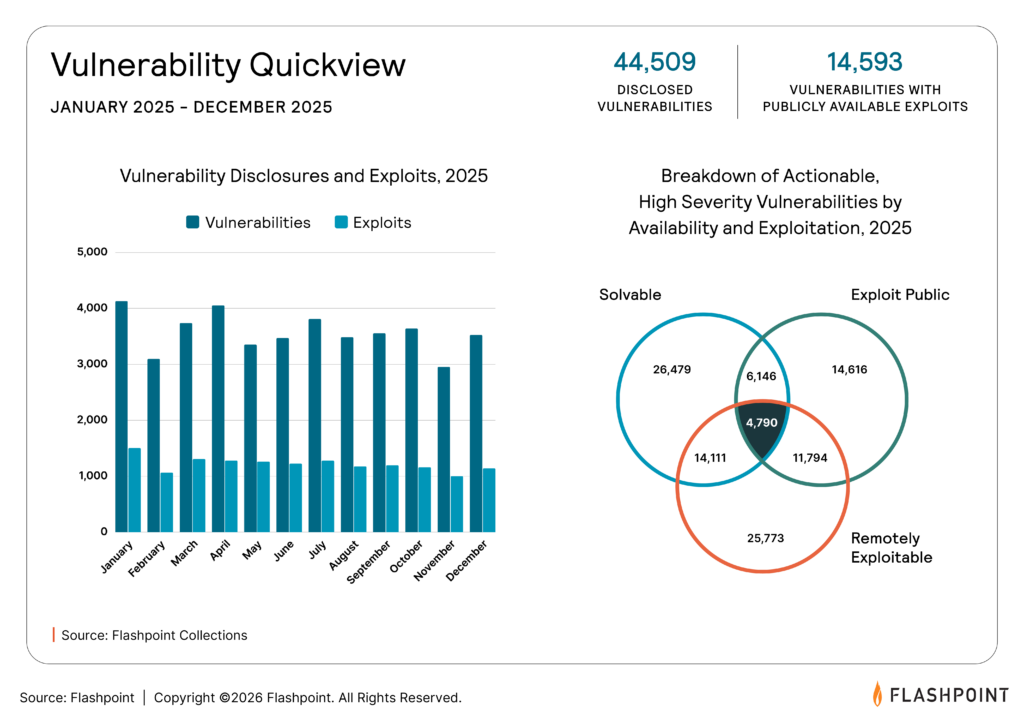
This pace is shaping how exploitation unfolds, with high-impact vulnerabilities being operationalized within hours or days, particularly when they affect widely deployed technologies or core infrastructure.
Security teams are operating within this compressed environment every day. They are reviewing more findings across open-source software, commercial applications, cloud environments, and third-party dependencies, while working within tighter timelines to assess impact and take action.
Flashpoint’s latest milestone of surpassing 7,000 known exploited vulnerabilities (KEVs) cataloged reflects that reality. It highlights how vulnerability management programs are evolving toward prioritization as a core capability, with a focus on vulnerabilities tied to active exploitation and real-world risk.
Security teams are operating in a high-volume environment. Vulnerabilities are disclosed continuously across open-source software, commercial applications, cloud environments, and third-party dependencies. At the same time, advancements in automation and code analysis are increasing the rate at which new findings are surfaced.
Each of these findings enters an already crowded workflow. Teams are expected to determine relevance, urgency, and impact quickly, often with limited context. This is where risk-based decision making becomes essential.
Flashpoint tracks hundreds of thousands of vulnerabilities across thousands of sources. Within that dataset, a much smaller percentage shows confirmed exploitation activity. That concentration of risk informs how effective programs allocate time and resources.
Crossing the 7,000+ KEV milestone goes beyond scale to provide greater precision, deeper context, and stronger confidence in how teams prioritize and act on the most critical vulnerabilities.
This level of clarity allows teams to move faster without sacrificing accuracy. It supports vulnerability management programs that are built around real-world attacker behavior and aligned to current risk.
Public vulnerability catalogs remain useful reference points for tracking disclosures and confirmed exploitation. The CISA Known Exploited Vulnerabilities catalog, for example, gives security teams a curated view into a limited set of vulnerabilities that have been exploited in the wild that impact U.S. government stakeholders.
For many organizations, though, that level of visibility is not enough.
Public catalogs capture only part of the picture. They tend to reflect a narrower slice of exploitation activity, with less detail on how vulnerabilities are being used, which actors are leveraging them, and what defenders should do next. They also rely heavily on CVE-based tracking, leaving gaps around non-CVE exposures and other vulnerabilities that still carry operational risk.
Flashpoint’s FP KEV and Vulnerability Intelligence provide a broader and more actionable view. The advantage is visible in both scale and depth. Of the 7,000 known exploited vulnerabilities in FP KEV, over 800 are missing from CVE. That expanded coverage is paired with the context security teams need to prioritize effectively, including exploit maturity, adversary mapping, affected product detail, and remediation guidance.
| Dimension | Public KEV Catalogs | Flashpoint FP KEV |
| Scope | Varies by provider, with coverage dependent on available sources and methodology | Global, cross-industry coverage |
| Coverage | CVE-based tracking | CVE and non-CVE vulnerabilities |
| Context | Limited enrichment | Exploit maturity, adversary mapping, remediation |
| Update Model | Periodic updates | Continuously updated with analyst input |
This is what separates a reference list from an operational dataset. Teams need vulnerability intelligence that supports triage, remediation, reporting, and broader risk reduction efforts. Wider visibility and deeper context make that possible.
Vulnerability data originates from a wide range of sources with varying levels of completeness and accuracy.
Flashpoint’s intelligence model includes analyst validation to ensure consistency and depth across the dataset.
This process includes:
Analyst input supports:
Vulnerability intelligence feeds multiple functions across an organization. Teams use this data to align technical actions with current threat activity.
Common use cases include:
Each of these functions relies on consistent, enriched intelligence to maintain alignment.
Vulnerability discovery continues to expand across software ecosystems, infrastructure, and identity layers.
Security teams require a clear understanding of which issues are relevant to their environment at any given time.
Flashpoint provides primary source intelligence that supports this need through:
This approach enables teams to maintain focus, allocate resources effectively, and respond to risk based on current threat activity. Request a demo and learn more today.
The post Flashpoint Surpasses Cataloging 7,000 Known Exploited Vulnerabilities as Disclosure Volume Accelerates appeared first on Flashpoint.
It’s one of those coincidences: independent university research teams stumble onto something new and prep their papers for publication — only to realize they’ve solved the exact same puzzle using slightly different methods. That’s exactly what happened with GDDRHammer and GeForge. These two studies describe Rowhammer-style attacks that are so similar the researchers decided to publish them as a joint effort. Then, while we were putting this post together, a third study surfaced — GPUBreach — detailing yet another comparable attack. So today we’re looking at all three.
All three theoretical attacks target graphics accelerators, though this term is not entirely accurate anymore since these devices are so good at parallel processing, they’ve moved far beyond just rendering frames in a game and are now the backbone of AI systems. It’s this industrial use case that is most at risk. Picture a cloud provider renting out GPU resources to all comers. These new attacks demonstrate how, in theory, a single malicious customer could go beyond seizing control of an accelerator to compromise the entire server, access sensitive data, and potentially hack the provider’s entire infrastructure. Let’s break down why this kind of attack is even possible.
We covered Rowhammer in-depth in previous posts, but here’s the quick version. The original attack was first proposed back in 2014, and it exploits the actual physical properties of RAM chips. Individual memory cells are simple components arranged in tight rows. In theory, reading or writing to one cell shouldn’t affect its neighbors. However, because these chips are packed so densely — with millions or even billions of cells per chip — writing to one spot can sometimes modify the cells next to it.
The 2014 study showed that this isn’t just a recipe for random data corruption; it can be weaponized. By repeatedly accessing (or “hammering”, hence the name) a specific area of memory, an attacker can intentionally flip bits in adjacent cells. If an attacker manages to flip the right bits, he can bypass critical security measures to snag sensitive data or run unauthorized code with full privileges.
Since that first discovery, we’ve seen a constant arms race between new Rowhammer defenses and clever ways to bypass them. We’ve also seen the attack evolve to target newer standards like DDR4 and DDR5. That’s a key takeaway here: for every new type of memory that hits the market, researchers essentially have to reinvent the attack from scratch.
The first Rowhammer attack on GPUs was presented back in 2025, but the results were relatively modest. At the time, researchers were able to force bit-flips in GDDR6 memory cells, and show how that data corruption could degrade the performance of an AI system.
These latest papers, however, warn of much more damaging attacks on video memory. Using slightly different techniques, GDDRHammer and GeForge manipulate the page tables — basically the master structures that track where data lives in the GPU’s memory. This enables an attacker to read or write to any part of the video memory, and even reach into the main system RAM managed by the CPU. Modifications to page tables are possible because the researchers have found a way to hammer memory cells much more efficiently. They pulled this off despite the hardware using Target Row Refresh, a core defense designed specifically to stop Rowhammer. TRR detects repeated access to specific cells, and forces a data refresh in the neighboring rows to hamper the attack. However, the researchers discovered a specific pattern of access that can bypass TRR.
As is usually the case with this type of research, pulling off these attacks in the real world comes with a lot of contingencies. First off, different GPUs behave differently. For instance, the GeForge attack was significantly more effective on the consumer-grade GeForce RTX 3060. On the industrial-strength Nvidia RTX A6000, the attack’s efficiency dropped by more than five times — even though both cards use the exact same GDDR6 memory standard. Going back to our hypothetical scenario of a malicious cloud customer: for an attack to work, they’d first need to identify exactly which accelerator they’ve been assigned, then profile their exploit specifically for that hardware. In short, this would have to be an incredibly sophisticated and expensive targeted attack.
It’s also worth noting that GDDR6 isn’t the latest and greatest anymore. Consumer devices are moving to GDDR7, while professional-grade hardware often uses high-speed HBM memory. These systems come with ECC (Error Correction Code), a built-in mechanism that checks data integrity. ECC can actually be enabled on cards like the Nvidia A6000; while it might take a small bite out of performance, it effectively makes both of these attacks impossible.
Another tool available to owners of AI-focused servers is enabling the IOMMU (input–output memory management unit) — a system that isolates the GPU’s memory from the CPU’s memory. This will prevent an attack from escalating from the graphics accelerator to the main processor and compromising the entire server. This is where the third study, GPUBreach, comes into play. Its main differentiator from GDDRHammer and GeForge is that it can actually bypass even IOMMU protection! It pulls this off by exploiting some fairly traditional bugs found in NVIDIA drivers.
So, despite the existing hurdles, these three studies prove that Rowhammer attacks remain a potent threat. This is especially true in our current AI boom, which relies on massive, expensive, and potentially vulnerable infrastructure packed with dozens or even hundreds of thousands of computing devices. The Rowhammer timeline goes to show that technical barriers almost never hold for long. In standard RAM, researchers have managed to bypass not only basic fixes like Target Row Refresh, but also more advanced — and theoretically bulletproof — solutions like ECC memory. While the extreme complexity of these exploits means they’ll likely never become a mass-market threat, for anyone running expensive computing systems, they’re definitely a risk factor that can’t be ignored.




At the NDSS Symposium 2026 in San Diego in February, a group of respected researchers presented a study unveiling the AirSnitch attack, which bypasses the Wi-Fi client isolation feature — also commonly known as guest network or device isolation. This attack allows connecting to a single wireless network via an access point, and then gaining access to other connected devices, including those using entirely different service set identifiers (SSIDs) on that same hardware. Targeted devices could easily be running on wireless subnets protected by WPA2 or WPA3 protocols. The attack doesn’t actually break encryption; instead, it exploits the way access points handle group keys and packet routing.
In practical terms, this means that a guest network provides very little in the way of real security. If your guest and employee networks are running on the same physical device, AirSnitch allows a connected attacker to inject malicious traffic into neighboring SSIDs. In some cases, they can even pull off a full-blown man-in-the-middle (MitM) attack.
Wi-Fi security is constantly evolving; every time a practical attack is made against the latest generation of protection, the industry shifts toward more complex algorithms and procedures. This cycle started with the FMS attacks used to crack WEP encryption keys, and continues to this day: recent examples include the KRACK attacks on WPA2, and the FragAttacks, which impacted every security protocol version from WEP all the way through WPA3.
Attacking modern Wi-Fi networks effectively (and quietly) is no small feat. Most professionals agree that using WPA2/WPA3 with complex keys and separating networks based on their purpose is usually enough for protection. However, only specialists really know that client isolation was never actually standardized within the IEEE 802.11 protocols. Different manufacturers implement isolation in completely different ways — using Layer 2 or Layer 3 of network architecture; in other words, handling it at either the router or the Wi-Fi controller level — meaning the behavior of isolated subnets varies wildly depending on your specific access point or router model.
While marketing claims that client isolation is perfect for keeping restaurant or hotel guests from attacking one another — or ensuring corporate visitors can’t access anything but the internet — in reality, isolation often relies on people not trying to hack it. This is exactly what the AirSnitch research highlights.
The name AirSnitch doesn’t just refer to a single vulnerability, but a whole family of architectural flaws found in Wi-Fi access points. It’s also the name of an open-source tool used to test routers for these specific weaknesses. However, security professionals need to keep in mind that there’s only a very thin line between testing and attacking.
The model for all these attacks is the same: a malicious client is connected to an access point (AP) where isolation is active. Other users — the targets — are connected to the same SSID or even different SSIDs on that same AP. This is a very realistic scenario; for example, a guest network might be open and unencrypted, or an attacker could simply get the guest Wi-Fi password by posing as a legitimate visitor.
For certain AirSnitch attacks, the attacker needs to know the victim’s MAC or IP address beforehand. Ultimately, how effective each attack is depends on the specific hardware manufacturer (more on that below).
After the WPA2/WPA3 handshake, the access point and the clients agree on a Group Transient Key (GTK) to handle broadcast traffic. In this scenario, the attacker wraps packets destined for a specific victim inside a broadcast traffic envelope. They then send these directly to the victim while spoofing the access point’s MAC address. This attack only allows for traffic injection, meaning the attacker won’t receive a response. However, even that is enough to deliver malicious ICMPv6 routing advertisements, or DNS and ARP messages to the client — effectively bypassing isolation. This is the most universal version of the attack working on any WPA2/WPA3 network that uses a shared GTK. That said, some enterprise-grade access points support GTK randomization for each individual client, which renders this specific method ineffective.
This version of the attack doesn’t even require the attacker to authenticate at the access point first. The attacker sends packets to the AP with a broadcast destination address (FF:FF:FF:FF:FF:FF) and the ToDS flag set to 1. As a result, many access points treat this packet as legitimate broadcast traffic; they encrypt it using the GTK, and blast it out to every client on the subnet, including the victim. Just like in the previous method, traffic specifically meant for a single victim can be pre-packaged inside.
This attack exploits an architectural gap between Layer 2 and Layer 3 security found in some manufacturers’ hardware. The attacker sends a packet to the access point, setting the victim’s IP address as the destination at the network layer (L3). However, at the wireless layer (L2), the destination is set to the access point’s own MAC address, so the isolation filter doesn’t trip. The routing subsystem (L3) then dutifully routes the packet back out to the victim, bypassing the L2 isolation entirely. Like the previous methods, this is another transmit-only attack where the attacker can’t see the reply.
The attacker connects to the network using a spoofed version of the victim’s MAC address, and floods the network with ARP responses claiming, “this MAC address is on my port and SSID”. The target network’s router updates its MAC tables, and starts sending the victim’s traffic to this new port instead. Consequently, traffic intended for the victim ends up with the attacker — even if the victim is connected to a completely different SSID.
In a scenario where the attacker connects via an open, unencrypted network, this means traffic meant for a client on a WPA2/WPA3-secured network is actually broadcast over the open air, where not only the attacker but anyone nearby can sniff it.
In this version, the attacker connects directly to the victim’s Wi-Fi adapter, and bombards it with ARP requests spoofing the access point’s MAC address. As a result, the victim’s computer starts sending its outgoing traffic to the attacker instead of the network. By running both stealing attacks simultaneously, an attacker can, in several scenarios, execute a full MitM attack.
By combining several of the techniques described above, a hacker can pull off some pretty serious moves:
To pull off these attacks effectively, a hacker needs a device capable of simultaneous data transmission and reception with both the victim’s adapter and the access point. In a real-world scenario, this usually means a laptop with two Wi-Fi adapters running specifically configured Linux drivers. It’s worth noting that the attack isn’t exactly silent: it requires a flood of ARP packets, it can cause brief Wi-Fi glitches when it starts, and network speeds might tank to around 10Mbps. Despite these red flags, it’s still very much a practical threat in many environments.
As part of the study, several enterprise and home access points and routers were put to the test. The list included products from Cisco, Netgear, Ubiquiti, Tenda, D-Link, TP-Link, LANCOM, and ASUS, as well as routers running popular community firmware like DD-WRT and OpenWrt. Every single device tested was vulnerable to at least some of the attacks described here. Even more concerning, the D-Link DIR-3040 and LANCOM LX-6500 were susceptible to every single variation of AirSnitch.
Interestingly, some routers were equipped with protective mechanisms that blocked the attacks, even though the underlying architectural flaws were still present. For example, the Tenda RX2 Pro automatically disconnects any client whose MAC address appears on two BSSIDs simultaneously, which effectively shuts down port stealing.
The researchers emphasize that any network administrator or IT security team serious about defense should test their own specific configurations. That’s the only way to pinpoint exactly which threats are relevant to your organization’s setup.
The threat is most immediate for organizations running guest and corporate Wi-Fi networks on the same access points without additional VLAN segmentation. There are also significant risks for companies using RADIUS with outdated settings or weak shared secrets for wireless authentication.
The bottom line is that we need to stop viewing client isolation on an access point as a real security measure, and start seeing it as just a convenience feature. Real security needs to be handled differently:





On March 4, 2026, Google and iVerify published reports about a highly sophisticated exploit kit targeting Apple iPhone devices. According to Google, the exploit kit was first discovered in targeted attacks conducted by a customer of an unnamed surveillance vendor. It was later used by other attackers in watering-hole attacks in Ukraine and in financially motivated attacks in China. Additionally, researchers discovered an instance with the debug version of the exploit kit, which revealed the internal names of the exploits and the framework name used by its developers — Coruna. Analysis of the kit showed that it relies on the exploitation of many previously patched vulnerabilities and also includes exploits for CVE-2023-32434 and CVE-2023-38606. These two vulnerabilities particularly caught our attention because they had been first discovered as zero-days used in Operation Triangulation.
Operation Triangulation is a complex mobile APT campaign targeting iOS devices. We discovered it while monitoring the network traffic of our own corporate Wi-Fi network. We noticed suspicious activity that originated from several iOS-based phones. Following the investigation, we learned that this campaign employed a sophisticated spyware implant and multiple zero-day exploits. The investigation lasted for over six months, during which we disclosed our findings in connection to the attack. Kaspersky GReAT experts also presented these findings at the 37th Chaos Communication Congress (37C3).
Although all the details of both CVE-2023-32434 and CVE-2023-38606 have long been publicly available, and other researchers have developed their own exploits without ever seeing the Triangulation code, we decided to closely investigate the exploits used in Coruna. Some of the exploit kit distribution links provided by Google remained active at the time the report was published, which allowed us to collect, decrypt, and analyze all components of Coruna.
During our analysis, we discovered that the kernel exploit for CVE-2023-32434 and CVE-2023-38606 vulnerabilities used in Coruna, in fact, is an updated version of the same exploit that had been used in Operation Triangulation. The images below illustrate a high-level overview of the two attack chains. The exploit in question is highlighted with a red rectangle.
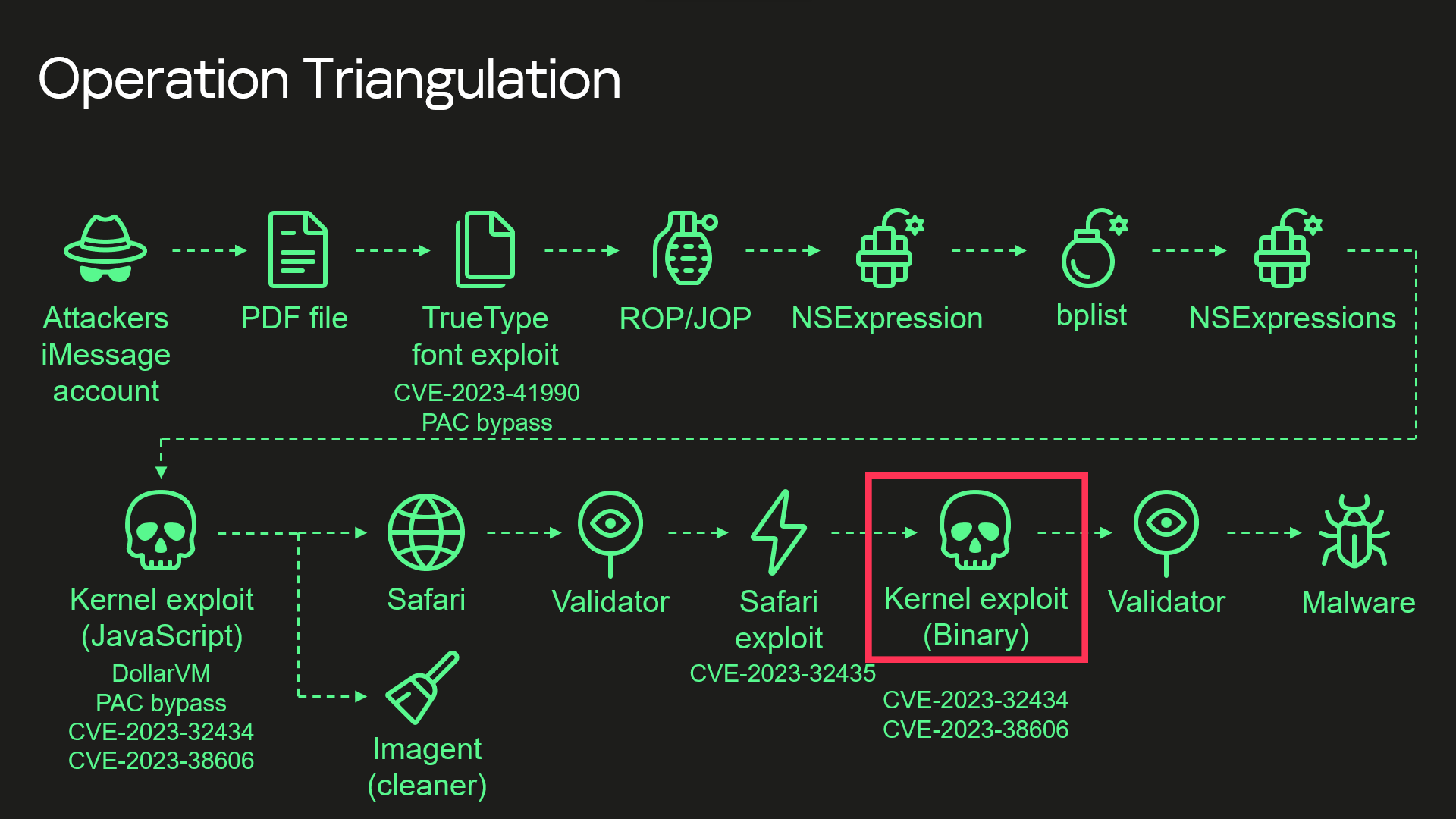
Attack chain of Operation Triangulation (simplified)
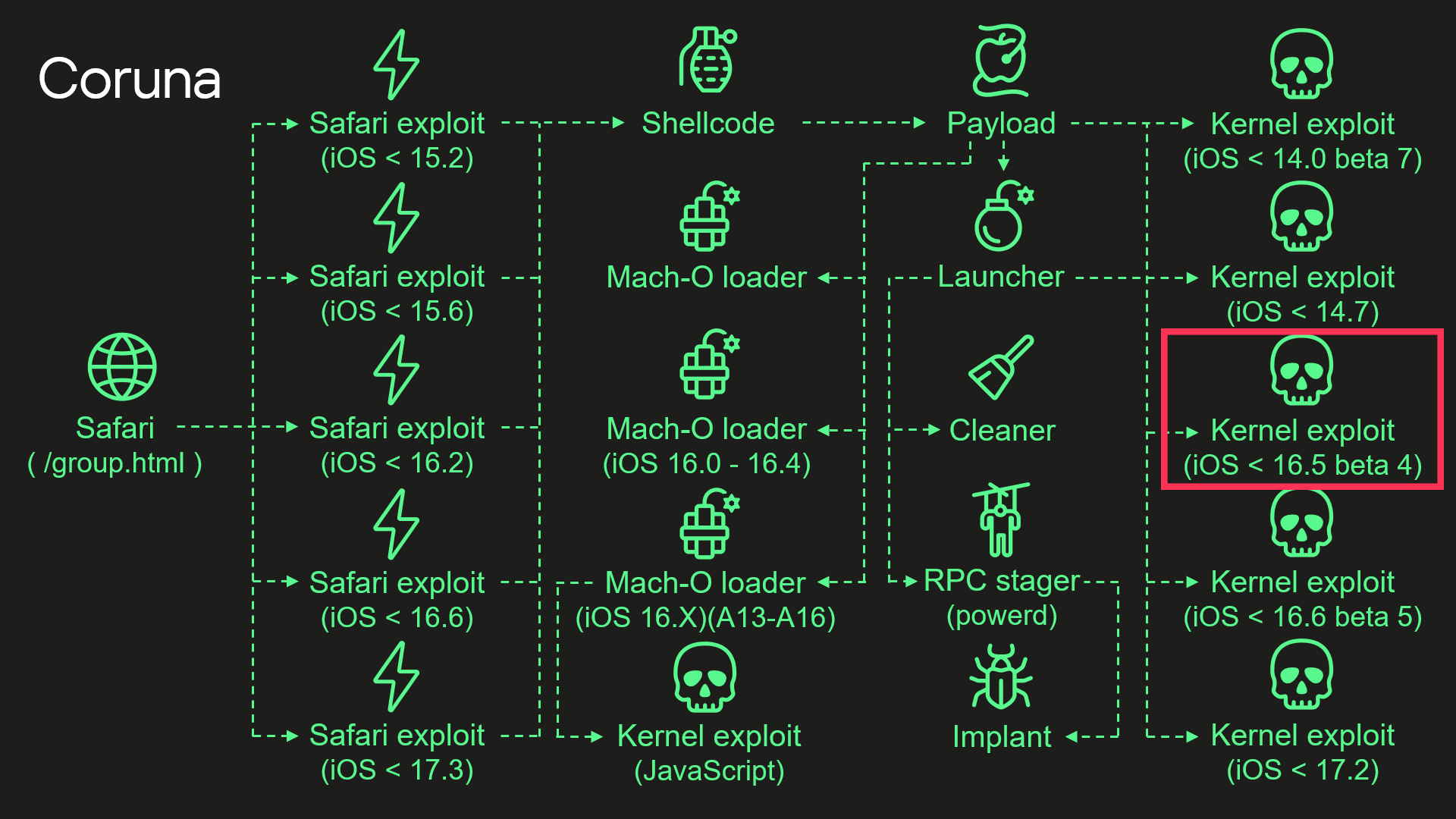
Attack chain of Coruna (simplified)
Moreover, we discovered that Coruna includes four additional kernel exploits that we had not seen used in Operation Triangulation, two of which were developed after the discovery of Operation Triangulation. All of these exploits are built on the same kernel exploitation framework and share common code. Code similarities from kernel exploits can also be found in other components of Coruna. These findings led us to conclude that this exploit kit was not patchworked but rather designed with a unified approach. We assume that it’s an updated version of the same exploitation framework that was used — at least to some extent — in Operation Triangulation.
While we continue to investigate all exploits and vulnerabilities used by Coruna, this post provides a high-level overview of the exploit kit and attack chain.
Exploitation begins with a stager that fingerprints the browser and selects and executes appropriate remote code execution (RCE) and pointer authentication code (PAC) exploits depending on the browser version. It also contains a URL to an encrypted file with information about all available packages containing exploits and other components. The stager also includes a 256-bit key used to decrypt it. The URL and decryption key are passed to a payload embedded in PAC exploits.
The payload is responsible for initiating the exploitation of the kernel. After initialization, the payload first downloads a file with information about other available components. To extract it, the payload performs several steps processing multiple file formats.
First, the downloaded file is decrypted using the ChaCha20 stream cipher. Decryption yields a container with the magic number 0xBEDF00D, which stores LZMA-compressed data.
The file format used by the exploit kit to store compressed data
| Offset | Field |
| 0x00 | Magic number (0xBEDF00D) |
| 0x04 | Decompressed data size |
| 0x08 | LZMA-compressed data |
The decompressed data presents another container with the magic number 0xF00DBEEF. This file format is used in the exploit kit to store and retrieve files by their IDs.
The file format used by the exploit kit to store files
| Offset | Field |
| 0x00 | Magic number (0xF00DBEEF) |
| 0x04 | Number of entries |
| 0x08 | Entry[0].File ID |
| 0x0C | Entry[0].Status |
| 0x10 | Entry[0].File offset |
| 0x14 | Entry[0].File size |
We provide a description of all possible File ID values below. At this stage, when the payload gathers information about all available file packages, this container holds only one file, and its File ID is 0x70000.
Finally, we get to the file with information about all available file packages. It starts with the magic value 0x12345678. The exploit kit uses this file format to obtain URLs and decryption keys for additional components that need to be downloaded.
The file format used by the exploit kit to store information about file packages
| Offset | Field |
| 0x00 | Magic number (0x12345678) |
| 0x04 | Flags |
| 0x08 | Directory path |
| 0x108 | Number of entries |
| 0x10C | Entry[0].Package ID |
| 0x110 | Entry[0].ChaCha20 key |
| 0x130 | Entry[0].File name |
The components required for exploiting a targeted device are selected using the Package ID. Its high byte specifies the package type and required hardware. We’ve seen the following package types:
The payload code also supports additional package types, such as 0xF1, an exploit for older ARM devices that do not support 64-bit architecture. Interestingly, however, the files for such exploits are missing.
Other bytes of the Package ID define the supported firmware version and CPU generation.
Some of the observed Package IDs (those with unique content)
| Package ID | Description |
| 0xF3300000 | Kernel exploit (iOS < 14.0 beta 7) and other components |
| 0xF3400000 | Kernel exploit (iOS < 14.7) and other components |
| 0xF3700000 | Kernel exploit (iOS < 16.5 beta 4) and other components |
| 0xF3800000 | Kernel exploit (iOS < 16.6 beta 5) and other components |
| 0xF3900000 | Kernel exploit (iOS < 17.2) and other components |
| 0xA3030000 | Mach-O loader (iOS 16.X) (A13 – A16) |
| 0xA3050000 | Mach-O loader (iOS 16.0 – 16.4) |
The files inside these packages are also stored in encrypted and compressed 0xF00DBEEF containers, but this time compression is optional and is determined by the second bit in the Flags field. Different packages contain different sets of files. A description of all possible File IDs is given in the table below.
Observed File IDs
| File ID | Description |
| 0x10000 | Implant |
| 0x50000 | Mach-O loader (default) |
| 0x70000 | List of additional components |
| 0x70005 | Launcher config |
| 0x80000 | Launcher in 0xF2/0xF3 packages, or Mach-O loader in 0xA2/0xA3 |
| 0x90000 | Kernel exploit |
| 0x90001 | Kernel exploit (for Mach-O loader) |
| 0xA0000 | Logs cleaner |
| 0xA0001 | Mach-O loader component |
| 0xA0002 | Mach-O loader component |
| 0xF0000 | RPC stager |
After downloading the necessary components, the payload begins executing kernel exploits, Mach-O loaders, and the malware launcher. The payload selects an appropriate Mach-O loader based on the firmware version, CPU, and presence of the iokit-open-service permission.
We analyzed all five kernel exploits from the kit and discovered that one of them is an updated version of the same exploit we discovered in Operation Triangulation. There are many small changes, but the most noticeable are as follows:
Why does the exploit need to check for iOS 17.2 and newer CPUs if the targeted vulnerabilities were fixed in iOS 16.5 beta 4? The answer can be found by examining other exploits: they are all based on the same source code. The only difference is in the vulnerabilities they exploit, so these checks were added to support the newer exploits and appeared in the older version after recompilation.
The launcher is responsible for orchestrating the post-exploitation activities. It also uses the kernel exploit and the interface it provides. However, since the exploit creates special kernel objects during its execution that provide the ability to read and write to kernel memory, the launcher simply reuses these objects without the need to trigger vulnerabilities and go through the entire exploitation path again. The launcher cleans up exploitation artifacts, retrieves the process name for injection from a config with the 0xDEADD00F magic number, injects a stager into the target process, uses it to execute itself, and launches the implant.
This case demonstrates once again the dangers associated with such malicious tools that lie in their potential wide usage. Originally developed for cyber-espionage purposes, this framework is now being used by cybercriminals of a broader kind, placing millions of users with unpatched devices at risk. Given its modular design and ease of reuse, we expect that other threat actors will begin incorporating it into their attacks. We strongly recommend that users install the latest security updates as soon as possible, if they have not already done so.




On March 4, 2026, Google and iVerify published reports about a highly sophisticated exploit kit targeting Apple iPhone devices. According to Google, the exploit kit was first discovered in targeted attacks conducted by a customer of an unnamed surveillance vendor. It was later used by other attackers in watering-hole attacks in Ukraine and in financially motivated attacks in China. Additionally, researchers discovered an instance with the debug version of the exploit kit, which revealed the internal names of the exploits and the framework name used by its developers — Coruna. Analysis of the kit showed that it relies on the exploitation of many previously patched vulnerabilities and also includes exploits for CVE-2023-32434 and CVE-2023-38606. These two vulnerabilities particularly caught our attention because they had been first discovered as zero-days used in Operation Triangulation.
Operation Triangulation is a complex mobile APT campaign targeting iOS devices. We discovered it while monitoring the network traffic of our own corporate Wi-Fi network. We noticed suspicious activity that originated from several iOS-based phones. Following the investigation, we learned that this campaign employed a sophisticated spyware implant and multiple zero-day exploits. The investigation lasted for over six months, during which we disclosed our findings in connection to the attack. Kaspersky GReAT experts also presented these findings at the 37th Chaos Communication Congress (37C3).
Although all the details of both CVE-2023-32434 and CVE-2023-38606 have long been publicly available, and other researchers have developed their own exploits without ever seeing the Triangulation code, we decided to closely investigate the exploits used in Coruna. Some of the exploit kit distribution links provided by Google remained active at the time the report was published, which allowed us to collect, decrypt, and analyze all components of Coruna.
During our analysis, we discovered that the kernel exploit for CVE-2023-32434 and CVE-2023-38606 vulnerabilities used in Coruna, in fact, is an updated version of the same exploit that had been used in Operation Triangulation. The images below illustrate a high-level overview of the two attack chains. The exploit in question is highlighted with a red rectangle.
Attack chain of Operation Triangulation (simplified)
Attack chain of Coruna (simplified)
Moreover, we discovered that Coruna includes four additional kernel exploits that we had not seen used in Operation Triangulation, two of which were developed after the discovery of Operation Triangulation. All of these exploits are built on the same kernel exploitation framework and share common code. Code similarities from kernel exploits can also be found in other components of Coruna. These findings led us to conclude that this exploit kit was not patchworked but rather designed with a unified approach. We assume that it’s an updated version of the same exploitation framework that was used — at least to some extent — in Operation Triangulation.
While we continue to investigate all exploits and vulnerabilities used by Coruna, this post provides a high-level overview of the exploit kit and attack chain.
Exploitation begins with a stager that fingerprints the browser and selects and executes appropriate remote code execution (RCE) and pointer authentication code (PAC) exploits depending on the browser version. It also contains a URL to an encrypted file with information about all available packages containing exploits and other components. The stager also includes a 256-bit key used to decrypt it. The URL and decryption key are passed to a payload embedded in PAC exploits.
The payload is responsible for initiating the exploitation of the kernel. After initialization, the payload first downloads a file with information about other available components. To extract it, the payload performs several steps processing multiple file formats.
First, the downloaded file is decrypted using the ChaCha20 stream cipher. Decryption yields a container with the magic number 0xBEDF00D, which stores LZMA-compressed data.
The file format used by the exploit kit to store compressed data
| Offset | Field |
| 0x00 | Magic number (0xBEDF00D) |
| 0x04 | Decompressed data size |
| 0x08 | LZMA-compressed data |
The decompressed data presents another container with the magic number 0xF00DBEEF. This file format is used in the exploit kit to store and retrieve files by their IDs.
The file format used by the exploit kit to store files
| Offset | Field |
| 0x00 | Magic number (0xF00DBEEF) |
| 0x04 | Number of entries |
| 0x08 | Entry[0].File ID |
| 0x0C | Entry[0].Status |
| 0x10 | Entry[0].File offset |
| 0x14 | Entry[0].File size |
We provide a description of all possible File ID values below. At this stage, when the payload gathers information about all available file packages, this container holds only one file, and its File ID is 0x70000.
Finally, we get to the file with information about all available file packages. It starts with the magic value 0x12345678. The exploit kit uses this file format to obtain URLs and decryption keys for additional components that need to be downloaded.
The file format used by the exploit kit to store information about file packages
| Offset | Field |
| 0x00 | Magic number (0x12345678) |
| 0x04 | Flags |
| 0x08 | Directory path |
| 0x108 | Number of entries |
| 0x10C | Entry[0].Package ID |
| 0x110 | Entry[0].ChaCha20 key |
| 0x130 | Entry[0].File name |
The components required for exploiting a targeted device are selected using the Package ID. Its high byte specifies the package type and required hardware. We’ve seen the following package types:
The payload code also supports additional package types, such as 0xF1, an exploit for older ARM devices that do not support 64-bit architecture. Interestingly, however, the files for such exploits are missing.
Other bytes of the Package ID define the supported firmware version and CPU generation.
Some of the observed Package IDs (those with unique content)
| Package ID | Description |
| 0xF3300000 | Kernel exploit (iOS < 14.0 beta 7) and other components |
| 0xF3400000 | Kernel exploit (iOS < 14.7) and other components |
| 0xF3700000 | Kernel exploit (iOS < 16.5 beta 4) and other components |
| 0xF3800000 | Kernel exploit (iOS < 16.6 beta 5) and other components |
| 0xF3900000 | Kernel exploit (iOS < 17.2) and other components |
| 0xA3030000 | Mach-O loader (iOS 16.X) (A13 – A16) |
| 0xA3050000 | Mach-O loader (iOS 16.0 – 16.4) |
The files inside these packages are also stored in encrypted and compressed 0xF00DBEEF containers, but this time compression is optional and is determined by the second bit in the Flags field. Different packages contain different sets of files. A description of all possible File IDs is given in the table below.
Observed File IDs
| File ID | Description |
| 0x10000 | Implant |
| 0x50000 | Mach-O loader (default) |
| 0x70000 | List of additional components |
| 0x70005 | Launcher config |
| 0x80000 | Launcher in 0xF2/0xF3 packages, or Mach-O loader in 0xA2/0xA3 |
| 0x90000 | Kernel exploit |
| 0x90001 | Kernel exploit (for Mach-O loader) |
| 0xA0000 | Logs cleaner |
| 0xA0001 | Mach-O loader component |
| 0xA0002 | Mach-O loader component |
| 0xF0000 | RPC stager |
After downloading the necessary components, the payload begins executing kernel exploits, Mach-O loaders, and the malware launcher. The payload selects an appropriate Mach-O loader based on the firmware version, CPU, and presence of the iokit-open-service permission.
We analyzed all five kernel exploits from the kit and discovered that one of them is an updated version of the same exploit we discovered in Operation Triangulation. There are many small changes, but the most noticeable are as follows:
Why does the exploit need to check for iOS 17.2 and newer CPUs if the targeted vulnerabilities were fixed in iOS 16.5 beta 4? The answer can be found by examining other exploits: they are all based on the same source code. The only difference is in the vulnerabilities they exploit, so these checks were added to support the newer exploits and appeared in the older version after recompilation.
The launcher is responsible for orchestrating the post-exploitation activities. It also uses the kernel exploit and the interface it provides. However, since the exploit creates special kernel objects during its execution that provide the ability to read and write to kernel memory, the launcher simply reuses these objects without the need to trigger vulnerabilities and go through the entire exploitation path again. The launcher cleans up exploitation artifacts, retrieves the process name for injection from a config with the 0xDEADD00F magic number, injects a stager into the target process, uses it to execute itself, and launches the implant.
This case demonstrates once again the dangers associated with such malicious tools that lie in their potential wide usage. Originally developed for cyber-espionage purposes, this framework is now being used by cybercriminals of a broader kind, placing millions of users with unpatched devices at risk. Given its modular design and ease of reuse, we expect that other threat actors will begin incorporating it into their attacks. We strongly recommend that users install the latest security updates as soon as possible, if they have not already done so.