 Login

Apple Patches iOS Flaw Allowing Recovery of Deleted Chats
Apple rolled out the security patches for dozens of iPhone and iPad models and generations.
The post Apple Patches iOS Flaw Allowing Recovery of Deleted Chats appeared first on SecurityWeek.

Apple rolled out the security patches for dozens of iPhone and iPad models and generations.
The post Apple Patches iOS Flaw Allowing Recovery of Deleted Chats appeared first on SecurityWeek.
The flaw allows attackers to access the SAM database, extract NTLM hashes, and gain System privileges.
The post Recent Microsoft Defender Vulnerability Exploited as Zero-Day appeared first on SecurityWeek.
In this post, we examine what NVD’s shift to selective enrichment means for vulnerability workflows and how security teams can maintain visibility and prioritization at scale.

 Table Of Contents

The National Vulnerability Database (NVD) is changing how it processes and enriches vulnerability data in response to sustained growth in CVE submissions.
Under a new model announced by the National Institute of Standards and Technology, NVD will no longer enrich every CVE. Instead, enrichment efforts will focus on a defined subset, including vulnerabilities in the CISA KEV catalog, software used by the federal government, and software designated as critical.
All other CVEs will remain in the database without additional context unless specifically requested.
Rising disclosure volumes are placing pressure on public vulnerability infrastructure, and it has direct implications for how security teams consume and act on vulnerability data.
For years, NVD aimed to provide consistent enrichment across all CVEs, including severity scoring, affected product data, and supporting context for prioritization.
That approach has not been sustainable since late 2023.
In 2025, Flashpoint tracked 44,509 disclosed vulnerabilities, 14,593 of which had publicly available exploits (and 1,944 more with proof-of-concepts).
CVE submissions increased by 263% between 2020 and 2025, with 2026 already tracking higher year-over-year. Even with increased throughput, NVD has not been able to keep pace.
Under the updated model:
This introduces a significant structural change in how vulnerability data is published and maintained.
Many security programs rely on NVD enrichment to operationalize CVE data. That enrichment provides the context needed to evaluate risk and determine remediation priorities.
With enrichment applied selectively, teams will encounter a growing number of CVEs that include:
At the same time, disclosure volume continues to rise, and exploitation timelines remain compressed. This creates a gap between what is disclosed and what can be acted on efficiently.
Security teams will need to account for:
These changes affect vulnerability management, threat intelligence, and security operations workflows simultaneously.
NVD’s updated model focuses enrichment on a defined set of criteria, including known exploited vulnerabilities and software relevant to federal systems.
These categories represent important segments of risk, but they do not encompass the full set of vulnerabilities that organizations encounter in practice.
Modern environments include:
Many vulnerabilities affecting these environments fall outside formal prioritization frameworks or lack immediate classification within public datasets. As a result, security teams will continue to face exposure from vulnerabilities that are:
As public enrichment becomes more selective, organizations will rely more heavily on alternative sources to maintain visibility and context.
Effective vulnerability intelligence requires:
This level of detail supports faster and more accurate decision-making in environments where both volume and speed are increasing.
Flashpoint’s vulnerability intelligence model is built to address these requirements, with a dataset that includes over 7,000 known exploited vulnerabilities and ongoing analyst-driven enrichment across global sources.
This shift in NVD operations does not change the need to track CVEs. It changes how that data can be used. Security teams should evaluate how their current workflows depend on:
From there, teams can take steps to strengthen resilience:
For many teams, NVD has been a default source of vulnerability context. This change makes clear that its role is narrowing at a time when disclosure volume and prioritization demands are increasing.
At the same time, the role of vulnerability intelligence is expanding.
Security teams need access to data that supports prioritization, not just identification. They need consistent enrichment, faster turnaround, broader coverage, and context tied to real-world activity. As disclosure volumes continue to grow, those requirements become more central to how organizations manage risk.
Flashpoint’s Vulnerability Intelligence provides this level of coverage and context, with analyst-driven enrichment, global visibility across CVE and non-CVE vulnerabilities, and a dataset that includes over 7,000 known exploited vulnerabilities.
Request a demo to see how Flashpoint helps security teams prioritize and act on vulnerability risk with greater precision and confidence.
The post National Vulnerability Database (NVD) Shifts to Selective Enrichment as CVE Volume Surges appeared first on Flashpoint.
Last week, Anthropic pulled back the curtain on Claude Mythos Preview, an AI model so capable at finding and exploiting software vulnerabilities that the company decided it was too dangerous to release to the public. Instead, access has been restricted to roughly 50 organizations—Microsoft, Apple, Amazon Web Services, CrowdStrike and other vendors of critical infrastructure—under an initiative called Project Glasswing.
The announcement was accompanied by a barrage of hair-raising anecdotes: thousands of vulnerabilities uncovered across every major operating system and browser, including a 27-year-old bug in OpenBSD, a 16-year-old flaw in FFmpeg. Mythos was able to weaponize a set of vulnerabilities it found in the Firefox browser into 181 usable attacks; Anthropic’s previous flagship model could only achieve two.
This is, in many respects, exactly the kind of responsible disclosure that security researchers have long urged. And yet the public has been given remarkably little with which to evaluate Anthropic’s decision. We have been shown a highlight reel of spectacular successes. However, we can’t tell if we have a blockbuster until they let us see the whole movie.
For example, we don’t know how many times Mythos mistakenly flagged code as vulnerable. Anthropic said security contractors agreed with the AI’s severity rating 198 times, with an 89 per cent severity agreement. That’s impressive, but incomplete. Independent researchers examining similar models have found that AI that detects nearly every real bug also hallucinates plausible-sounding vulnerabilities in patched, correct code.
This matters. A model that autonomously finds and exploits hundreds of vulnerabilities with inhuman precision is a game changer, but a model that generates thousands of false alarms and non-working attacks still needs skilled and knowledgeable humans. Without knowing the rate of false alarms in Mythos’s unfiltered output, we cannot tell whether the examples showcased are representative.
There is a second, subtler problem. Large language models, including Mythos, perform best on inputs that resemble what they were trained on: widely used open-source projects, major browsers, the Linux kernel and popular web frameworks. Concentrating early access among the largest vendors of precisely this software is sensible; it lets them patch first, before adversaries catch up.
But the inverse is also true. Software outside the training distribution—industrial control systems, medical device firmware, bespoke financial infrastructure, regional banking software, older embedded systems—is exactly where out-of-the-box Mythos is likely least able to find or exploit bugs.
However, a sufficiently motivated attacker with domain expertise in one of these fields could nevertheless wield Mythos’s advanced reasoning capabilities as a force multiplier, probing systems that Anthropic’s own engineers lack the specialized knowledge to audit. The danger is not that Mythos fails in those domains; it is that Mythos may succeed for whoever brings the expertise.
Broader, structured access for academic researchers and domain specialists—cardiologists’ partners in medical device security, control-systems engineers, researchers in less prominent languages and ecosystems—would meaningfully reduce this asymmetry. Fifty companies, however well chosen, cannot substitute for the distributed expertise of the entire research community.
None of this is an indictment of Anthropic. By all appearances the company is trying to act responsibly, and its decision to hold the model back is evidence of seriousness.
But Anthropic is a private company and, in some ways, still a start-up. Yet it is making unilateral decisions about which pieces of our critical global infrastructure get defended first, and which must wait their turn.
It has finite staff, finite budget and finite expertise. It will miss things, and when the thing missed is in the software running a hospital or a power grid, the cost will be borne by people who never had a say.
The security problem is far greater than one company and one model. There’s no reason to believe that Mythos Preview is unique. (Not to be outdone, OpenAI announced that its new GPT-5.4-Cyber is so dangerous that the model also will not be released to the general public.) And it’s unclear how much of an advance these new models represent. The security company Aisle was able to replicate many of Anthropic’s published anecdotes using smaller, cheaper, public AI models.
Any decisions we make about whether and how to release these powerful models are more than one company’s responsibility. Ultimately, this will probably lead to regulation. That will be hard to get right and requires a long process of consultation and feedback.
In the short term, we need something simpler: greater transparency and information sharing with the broader community. This doesn’t necessarily mean making powerful models like Claude Mythos widely available. Rather, it means sharing as much data and information as possible, so that we can collectively make informed decisions.
We need globally co-ordinated frameworks for independent auditing, mandatory disclosure of aggregate performance metrics and funded access for academic and civil-society researchers.
This has implications for national security, personal safety and corporate competitiveness. Any technology that can find thousands of exploitable flaws in the systems we all depend on should not be governed solely by the internal judgment of its creators, however well intentioned.
Until that changes, each Mythos-class release will put the world at the edge of another precipice, without any visibility into whether there is a landing out of view just below, or whether this time the drop will be fatal. That is not a choice a for-profit corporation should be allowed to make in a democratic society. Nor should such a company be able to restrict the ability of society to make choices about its own security.
This essay was written with David Lie, and originally appeared in The Globe and Mail.
CVE-2023-33538 allows for command injection in TP-Link routers. We discuss exploitation attempts with payloads characteristic of Mirai botnet malware.
The post A Deep Dive Into Attempted Exploitation of CVE-2023-33538 appeared first on Unit 42.

In this post we explore Flashpoint’s latest milestone of surpassing cataloging 7,000 known exploited vulnerabilities and what this means for security teams.
 Table Of Contents
Flashpoint Vulnerability Intelligence has surpassed cataloging 7,000 known exploited vulnerabilities, surpassing another major milestone as vulnerability disclosures accelerate across the global attack surface.
In 2025, Flashpoint tracked 44,509 disclosed vulnerabilities, a pace that continues to accelerate into 2026. Of those, 14,593 had publicly available exploits (1,944 more with proof-of-concepts), giving threat actors immediate pathways to weaponization.
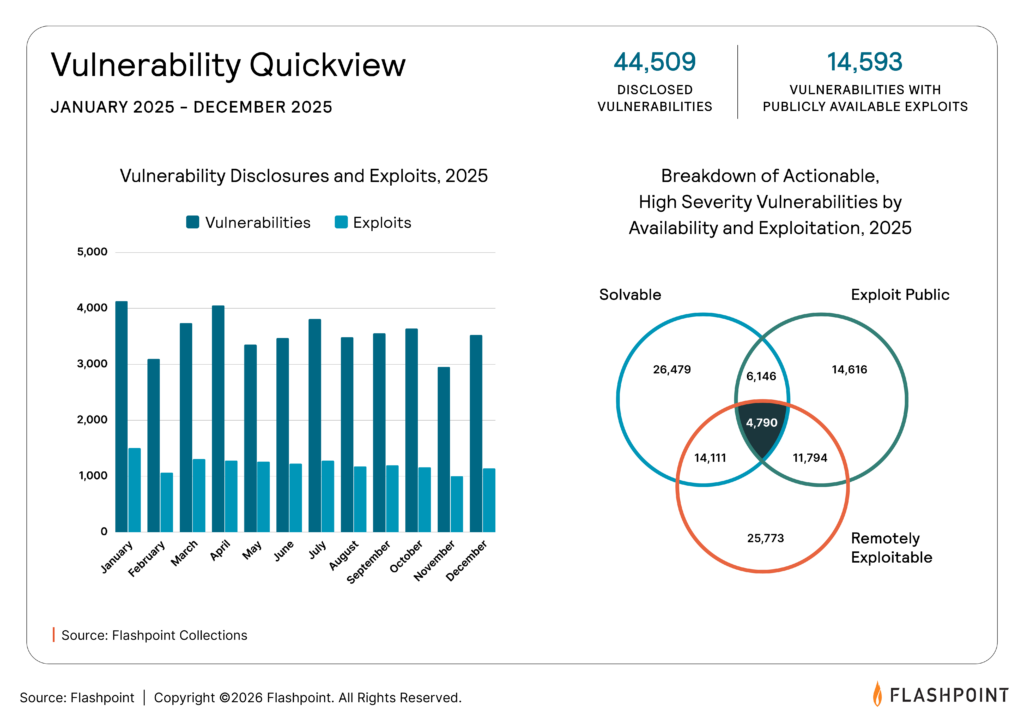
This pace is shaping how exploitation unfolds, with high-impact vulnerabilities being operationalized within hours or days, particularly when they affect widely deployed technologies or core infrastructure.
Security teams are operating within this compressed environment every day. They are reviewing more findings across open-source software, commercial applications, cloud environments, and third-party dependencies, while working within tighter timelines to assess impact and take action.
Flashpoint’s latest milestone of surpassing 7,000 known exploited vulnerabilities (KEVs) cataloged reflects that reality. It highlights how vulnerability management programs are evolving toward prioritization as a core capability, with a focus on vulnerabilities tied to active exploitation and real-world risk.
Security teams are operating in a high-volume environment. Vulnerabilities are disclosed continuously across open-source software, commercial applications, cloud environments, and third-party dependencies. At the same time, advancements in automation and code analysis are increasing the rate at which new findings are surfaced.
Each of these findings enters an already crowded workflow. Teams are expected to determine relevance, urgency, and impact quickly, often with limited context. This is where risk-based decision making becomes essential.
Flashpoint tracks hundreds of thousands of vulnerabilities across thousands of sources. Within that dataset, a much smaller percentage shows confirmed exploitation activity. That concentration of risk informs how effective programs allocate time and resources.
Crossing the 7,000+ KEV milestone goes beyond scale to provide greater precision, deeper context, and stronger confidence in how teams prioritize and act on the most critical vulnerabilities.
This level of clarity allows teams to move faster without sacrificing accuracy. It supports vulnerability management programs that are built around real-world attacker behavior and aligned to current risk.
Public vulnerability catalogs remain useful reference points for tracking disclosures and confirmed exploitation. The CISA Known Exploited Vulnerabilities catalog, for example, gives security teams a curated view into a limited set of vulnerabilities that have been exploited in the wild that impact U.S. government stakeholders.
For many organizations, though, that level of visibility is not enough.
Public catalogs capture only part of the picture. They tend to reflect a narrower slice of exploitation activity, with less detail on how vulnerabilities are being used, which actors are leveraging them, and what defenders should do next. They also rely heavily on CVE-based tracking, leaving gaps around non-CVE exposures and other vulnerabilities that still carry operational risk.
Flashpoint’s FP KEV and Vulnerability Intelligence provide a broader and more actionable view. The advantage is visible in both scale and depth. Of the 7,000 known exploited vulnerabilities in FP KEV, over 800 are missing from CVE. That expanded coverage is paired with the context security teams need to prioritize effectively, including exploit maturity, adversary mapping, affected product detail, and remediation guidance.
| Dimension | Public KEV Catalogs | Flashpoint FP KEV |
| Scope | Varies by provider, with coverage dependent on available sources and methodology | Global, cross-industry coverage |
| Coverage | CVE-based tracking | CVE and non-CVE vulnerabilities |
| Context | Limited enrichment | Exploit maturity, adversary mapping, remediation |
| Update Model | Periodic updates | Continuously updated with analyst input |
This is what separates a reference list from an operational dataset. Teams need vulnerability intelligence that supports triage, remediation, reporting, and broader risk reduction efforts. Wider visibility and deeper context make that possible.
Vulnerability data originates from a wide range of sources with varying levels of completeness and accuracy.
Flashpoint’s intelligence model includes analyst validation to ensure consistency and depth across the dataset.
This process includes:
Analyst input supports:
Vulnerability intelligence feeds multiple functions across an organization. Teams use this data to align technical actions with current threat activity.
Common use cases include:
Each of these functions relies on consistent, enriched intelligence to maintain alignment.
Vulnerability discovery continues to expand across software ecosystems, infrastructure, and identity layers.
Security teams require a clear understanding of which issues are relevant to their environment at any given time.
Flashpoint provides primary source intelligence that supports this need through:
This approach enables teams to maintain focus, allocate resources effectively, and respond to risk based on current threat activity. Request a demo and learn more today.
The post Flashpoint Surpasses Cataloging 7,000 Known Exploited Vulnerabilities as Disclosure Volume Accelerates appeared first on Flashpoint.

On March 4, 2026, Google and iVerify published reports about a highly sophisticated exploit kit targeting Apple iPhone devices. According to Google, the exploit kit was first discovered in targeted attacks conducted by a customer of an unnamed surveillance vendor. It was later used by other attackers in watering-hole attacks in Ukraine and in financially motivated attacks in China. Additionally, researchers discovered an instance with the debug version of the exploit kit, which revealed the internal names of the exploits and the framework name used by its developers — Coruna. Analysis of the kit showed that it relies on the exploitation of many previously patched vulnerabilities and also includes exploits for CVE-2023-32434 and CVE-2023-38606. These two vulnerabilities particularly caught our attention because they had been first discovered as zero-days used in Operation Triangulation.
Operation Triangulation is a complex mobile APT campaign targeting iOS devices. We discovered it while monitoring the network traffic of our own corporate Wi-Fi network. We noticed suspicious activity that originated from several iOS-based phones. Following the investigation, we learned that this campaign employed a sophisticated spyware implant and multiple zero-day exploits. The investigation lasted for over six months, during which we disclosed our findings in connection to the attack. Kaspersky GReAT experts also presented these findings at the 37th Chaos Communication Congress (37C3).
Although all the details of both CVE-2023-32434 and CVE-2023-38606 have long been publicly available, and other researchers have developed their own exploits without ever seeing the Triangulation code, we decided to closely investigate the exploits used in Coruna. Some of the exploit kit distribution links provided by Google remained active at the time the report was published, which allowed us to collect, decrypt, and analyze all components of Coruna.
During our analysis, we discovered that the kernel exploit for CVE-2023-32434 and CVE-2023-38606 vulnerabilities used in Coruna, in fact, is an updated version of the same exploit that had been used in Operation Triangulation. The images below illustrate a high-level overview of the two attack chains. The exploit in question is highlighted with a red rectangle.
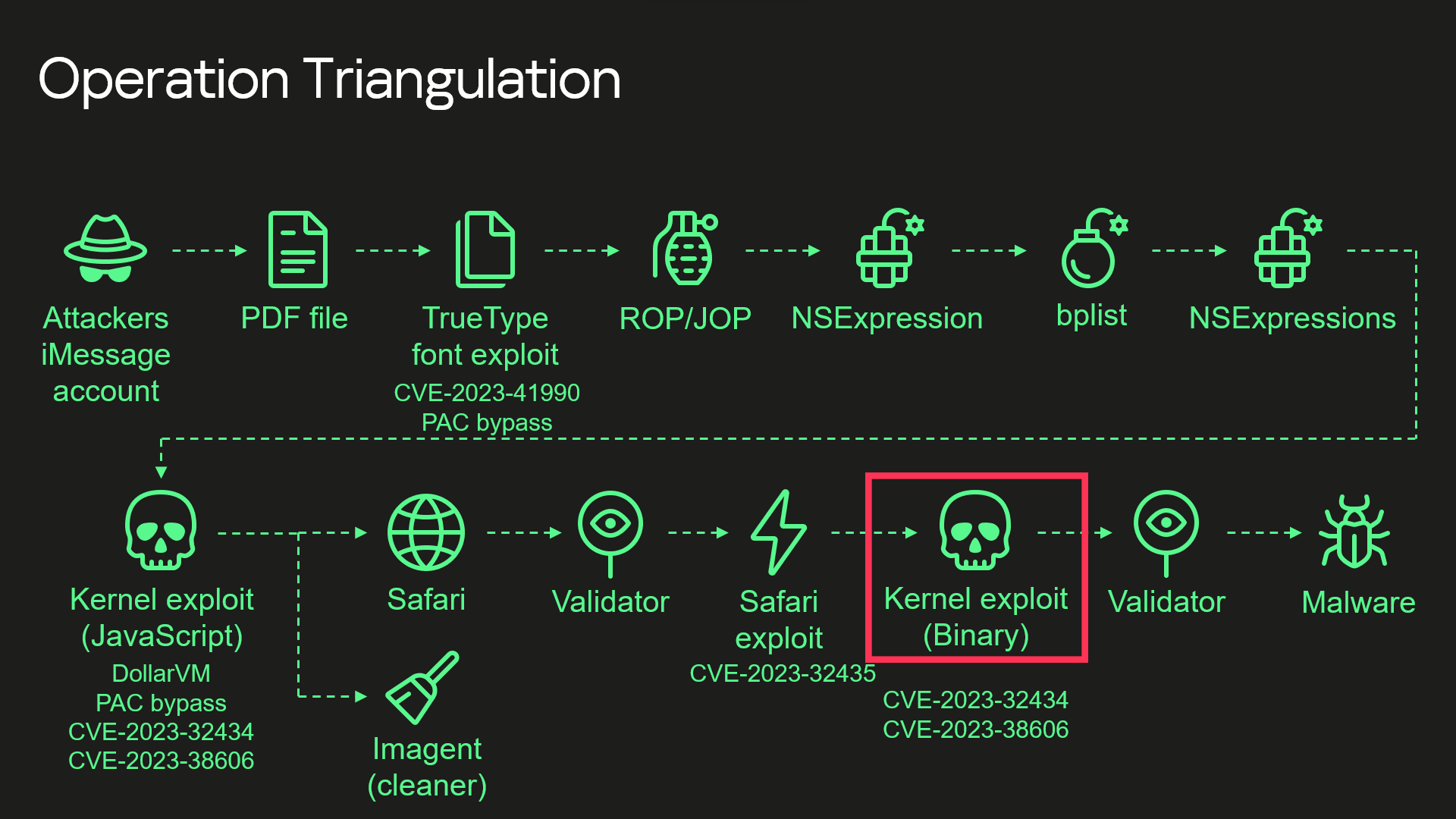
Attack chain of Operation Triangulation (simplified)
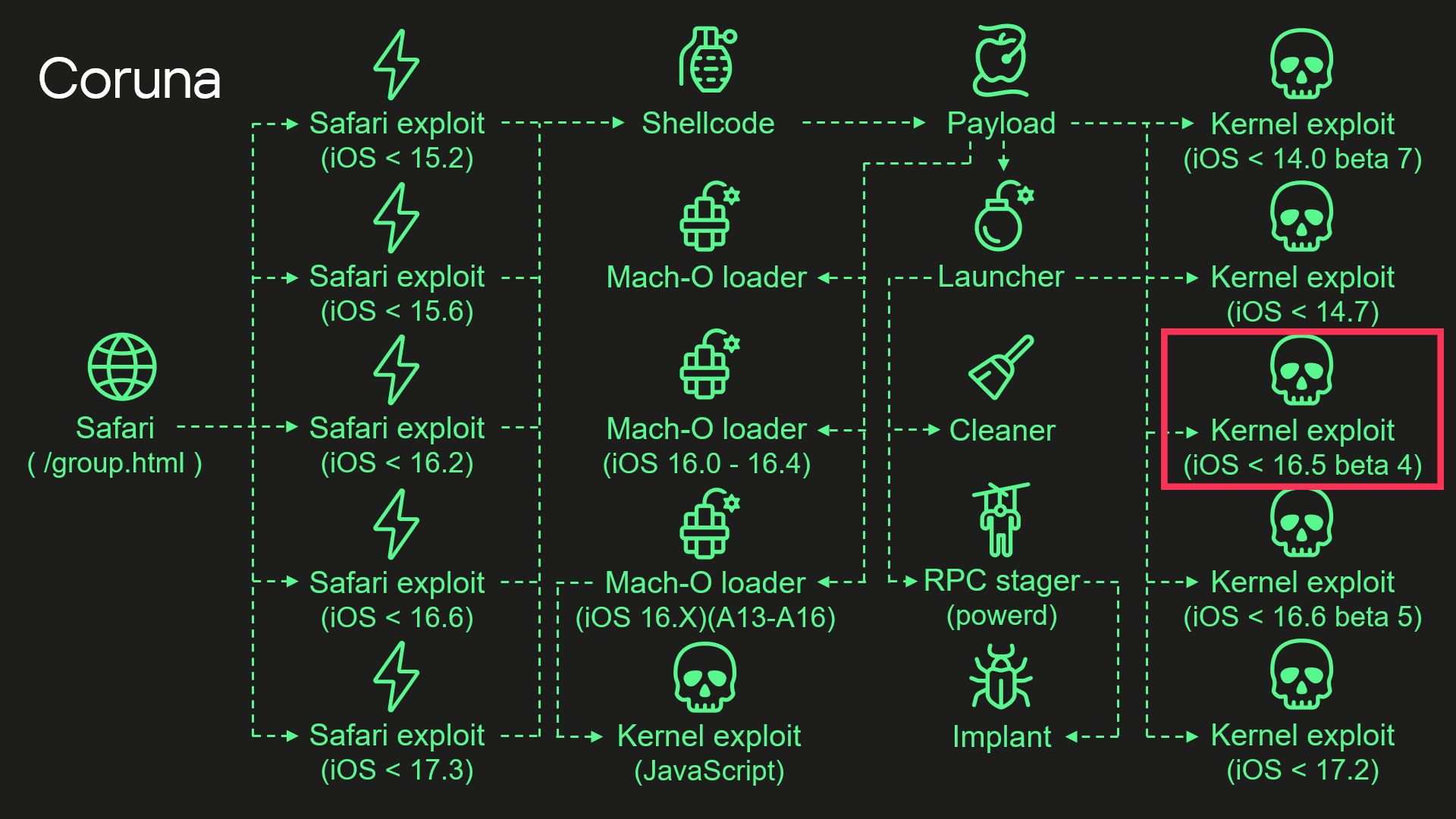
Attack chain of Coruna (simplified)
Moreover, we discovered that Coruna includes four additional kernel exploits that we had not seen used in Operation Triangulation, two of which were developed after the discovery of Operation Triangulation. All of these exploits are built on the same kernel exploitation framework and share common code. Code similarities from kernel exploits can also be found in other components of Coruna. These findings led us to conclude that this exploit kit was not patchworked but rather designed with a unified approach. We assume that it’s an updated version of the same exploitation framework that was used — at least to some extent — in Operation Triangulation.
While we continue to investigate all exploits and vulnerabilities used by Coruna, this post provides a high-level overview of the exploit kit and attack chain.
Exploitation begins with a stager that fingerprints the browser and selects and executes appropriate remote code execution (RCE) and pointer authentication code (PAC) exploits depending on the browser version. It also contains a URL to an encrypted file with information about all available packages containing exploits and other components. The stager also includes a 256-bit key used to decrypt it. The URL and decryption key are passed to a payload embedded in PAC exploits.
The payload is responsible for initiating the exploitation of the kernel. After initialization, the payload first downloads a file with information about other available components. To extract it, the payload performs several steps processing multiple file formats.
First, the downloaded file is decrypted using the ChaCha20 stream cipher. Decryption yields a container with the magic number 0xBEDF00D, which stores LZMA-compressed data.
The file format used by the exploit kit to store compressed data
| Offset | Field |
| 0x00 | Magic number (0xBEDF00D) |
| 0x04 | Decompressed data size |
| 0x08 | LZMA-compressed data |
The decompressed data presents another container with the magic number 0xF00DBEEF. This file format is used in the exploit kit to store and retrieve files by their IDs.
The file format used by the exploit kit to store files
| Offset | Field |
| 0x00 | Magic number (0xF00DBEEF) |
| 0x04 | Number of entries |
| 0x08 | Entry[0].File ID |
| 0x0C | Entry[0].Status |
| 0x10 | Entry[0].File offset |
| 0x14 | Entry[0].File size |
We provide a description of all possible File ID values below. At this stage, when the payload gathers information about all available file packages, this container holds only one file, and its File ID is 0x70000.
Finally, we get to the file with information about all available file packages. It starts with the magic value 0x12345678. The exploit kit uses this file format to obtain URLs and decryption keys for additional components that need to be downloaded.
The file format used by the exploit kit to store information about file packages
| Offset | Field |
| 0x00 | Magic number (0x12345678) |
| 0x04 | Flags |
| 0x08 | Directory path |
| 0x108 | Number of entries |
| 0x10C | Entry[0].Package ID |
| 0x110 | Entry[0].ChaCha20 key |
| 0x130 | Entry[0].File name |
The components required for exploiting a targeted device are selected using the Package ID. Its high byte specifies the package type and required hardware. We’ve seen the following package types:
The payload code also supports additional package types, such as 0xF1, an exploit for older ARM devices that do not support 64-bit architecture. Interestingly, however, the files for such exploits are missing.
Other bytes of the Package ID define the supported firmware version and CPU generation.
Some of the observed Package IDs (those with unique content)
| Package ID | Description |
| 0xF3300000 | Kernel exploit (iOS < 14.0 beta 7) and other components |
| 0xF3400000 | Kernel exploit (iOS < 14.7) and other components |
| 0xF3700000 | Kernel exploit (iOS < 16.5 beta 4) and other components |
| 0xF3800000 | Kernel exploit (iOS < 16.6 beta 5) and other components |
| 0xF3900000 | Kernel exploit (iOS < 17.2) and other components |
| 0xA3030000 | Mach-O loader (iOS 16.X) (A13 – A16) |
| 0xA3050000 | Mach-O loader (iOS 16.0 – 16.4) |
The files inside these packages are also stored in encrypted and compressed 0xF00DBEEF containers, but this time compression is optional and is determined by the second bit in the Flags field. Different packages contain different sets of files. A description of all possible File IDs is given in the table below.
Observed File IDs
| File ID | Description |
| 0x10000 | Implant |
| 0x50000 | Mach-O loader (default) |
| 0x70000 | List of additional components |
| 0x70005 | Launcher config |
| 0x80000 | Launcher in 0xF2/0xF3 packages, or Mach-O loader in 0xA2/0xA3 |
| 0x90000 | Kernel exploit |
| 0x90001 | Kernel exploit (for Mach-O loader) |
| 0xA0000 | Logs cleaner |
| 0xA0001 | Mach-O loader component |
| 0xA0002 | Mach-O loader component |
| 0xF0000 | RPC stager |
After downloading the necessary components, the payload begins executing kernel exploits, Mach-O loaders, and the malware launcher. The payload selects an appropriate Mach-O loader based on the firmware version, CPU, and presence of the iokit-open-service permission.
We analyzed all five kernel exploits from the kit and discovered that one of them is an updated version of the same exploit we discovered in Operation Triangulation. There are many small changes, but the most noticeable are as follows:
Why does the exploit need to check for iOS 17.2 and newer CPUs if the targeted vulnerabilities were fixed in iOS 16.5 beta 4? The answer can be found by examining other exploits: they are all based on the same source code. The only difference is in the vulnerabilities they exploit, so these checks were added to support the newer exploits and appeared in the older version after recompilation.
The launcher is responsible for orchestrating the post-exploitation activities. It also uses the kernel exploit and the interface it provides. However, since the exploit creates special kernel objects during its execution that provide the ability to read and write to kernel memory, the launcher simply reuses these objects without the need to trigger vulnerabilities and go through the entire exploitation path again. The launcher cleans up exploitation artifacts, retrieves the process name for injection from a config with the 0xDEADD00F magic number, injects a stager into the target process, uses it to execute itself, and launches the implant.
This case demonstrates once again the dangers associated with such malicious tools that lie in their potential wide usage. Originally developed for cyber-espionage purposes, this framework is now being used by cybercriminals of a broader kind, placing millions of users with unpatched devices at risk. Given its modular design and ease of reuse, we expect that other threat actors will begin incorporating it into their attacks. We strongly recommend that users install the latest security updates as soon as possible, if they have not already done so.




On March 4, 2026, Google and iVerify published reports about a highly sophisticated exploit kit targeting Apple iPhone devices. According to Google, the exploit kit was first discovered in targeted attacks conducted by a customer of an unnamed surveillance vendor. It was later used by other attackers in watering-hole attacks in Ukraine and in financially motivated attacks in China. Additionally, researchers discovered an instance with the debug version of the exploit kit, which revealed the internal names of the exploits and the framework name used by its developers — Coruna. Analysis of the kit showed that it relies on the exploitation of many previously patched vulnerabilities and also includes exploits for CVE-2023-32434 and CVE-2023-38606. These two vulnerabilities particularly caught our attention because they had been first discovered as zero-days used in Operation Triangulation.
Operation Triangulation is a complex mobile APT campaign targeting iOS devices. We discovered it while monitoring the network traffic of our own corporate Wi-Fi network. We noticed suspicious activity that originated from several iOS-based phones. Following the investigation, we learned that this campaign employed a sophisticated spyware implant and multiple zero-day exploits. The investigation lasted for over six months, during which we disclosed our findings in connection to the attack. Kaspersky GReAT experts also presented these findings at the 37th Chaos Communication Congress (37C3).
Although all the details of both CVE-2023-32434 and CVE-2023-38606 have long been publicly available, and other researchers have developed their own exploits without ever seeing the Triangulation code, we decided to closely investigate the exploits used in Coruna. Some of the exploit kit distribution links provided by Google remained active at the time the report was published, which allowed us to collect, decrypt, and analyze all components of Coruna.
During our analysis, we discovered that the kernel exploit for CVE-2023-32434 and CVE-2023-38606 vulnerabilities used in Coruna, in fact, is an updated version of the same exploit that had been used in Operation Triangulation. The images below illustrate a high-level overview of the two attack chains. The exploit in question is highlighted with a red rectangle.
Attack chain of Operation Triangulation (simplified)
Attack chain of Coruna (simplified)
Moreover, we discovered that Coruna includes four additional kernel exploits that we had not seen used in Operation Triangulation, two of which were developed after the discovery of Operation Triangulation. All of these exploits are built on the same kernel exploitation framework and share common code. Code similarities from kernel exploits can also be found in other components of Coruna. These findings led us to conclude that this exploit kit was not patchworked but rather designed with a unified approach. We assume that it’s an updated version of the same exploitation framework that was used — at least to some extent — in Operation Triangulation.
While we continue to investigate all exploits and vulnerabilities used by Coruna, this post provides a high-level overview of the exploit kit and attack chain.
Exploitation begins with a stager that fingerprints the browser and selects and executes appropriate remote code execution (RCE) and pointer authentication code (PAC) exploits depending on the browser version. It also contains a URL to an encrypted file with information about all available packages containing exploits and other components. The stager also includes a 256-bit key used to decrypt it. The URL and decryption key are passed to a payload embedded in PAC exploits.
The payload is responsible for initiating the exploitation of the kernel. After initialization, the payload first downloads a file with information about other available components. To extract it, the payload performs several steps processing multiple file formats.
First, the downloaded file is decrypted using the ChaCha20 stream cipher. Decryption yields a container with the magic number 0xBEDF00D, which stores LZMA-compressed data.
The file format used by the exploit kit to store compressed data
| Offset | Field |
| 0x00 | Magic number (0xBEDF00D) |
| 0x04 | Decompressed data size |
| 0x08 | LZMA-compressed data |
The decompressed data presents another container with the magic number 0xF00DBEEF. This file format is used in the exploit kit to store and retrieve files by their IDs.
The file format used by the exploit kit to store files
| Offset | Field |
| 0x00 | Magic number (0xF00DBEEF) |
| 0x04 | Number of entries |
| 0x08 | Entry[0].File ID |
| 0x0C | Entry[0].Status |
| 0x10 | Entry[0].File offset |
| 0x14 | Entry[0].File size |
We provide a description of all possible File ID values below. At this stage, when the payload gathers information about all available file packages, this container holds only one file, and its File ID is 0x70000.
Finally, we get to the file with information about all available file packages. It starts with the magic value 0x12345678. The exploit kit uses this file format to obtain URLs and decryption keys for additional components that need to be downloaded.
The file format used by the exploit kit to store information about file packages
| Offset | Field |
| 0x00 | Magic number (0x12345678) |
| 0x04 | Flags |
| 0x08 | Directory path |
| 0x108 | Number of entries |
| 0x10C | Entry[0].Package ID |
| 0x110 | Entry[0].ChaCha20 key |
| 0x130 | Entry[0].File name |
The components required for exploiting a targeted device are selected using the Package ID. Its high byte specifies the package type and required hardware. We’ve seen the following package types:
The payload code also supports additional package types, such as 0xF1, an exploit for older ARM devices that do not support 64-bit architecture. Interestingly, however, the files for such exploits are missing.
Other bytes of the Package ID define the supported firmware version and CPU generation.
Some of the observed Package IDs (those with unique content)
| Package ID | Description |
| 0xF3300000 | Kernel exploit (iOS < 14.0 beta 7) and other components |
| 0xF3400000 | Kernel exploit (iOS < 14.7) and other components |
| 0xF3700000 | Kernel exploit (iOS < 16.5 beta 4) and other components |
| 0xF3800000 | Kernel exploit (iOS < 16.6 beta 5) and other components |
| 0xF3900000 | Kernel exploit (iOS < 17.2) and other components |
| 0xA3030000 | Mach-O loader (iOS 16.X) (A13 – A16) |
| 0xA3050000 | Mach-O loader (iOS 16.0 – 16.4) |
The files inside these packages are also stored in encrypted and compressed 0xF00DBEEF containers, but this time compression is optional and is determined by the second bit in the Flags field. Different packages contain different sets of files. A description of all possible File IDs is given in the table below.
Observed File IDs
| File ID | Description |
| 0x10000 | Implant |
| 0x50000 | Mach-O loader (default) |
| 0x70000 | List of additional components |
| 0x70005 | Launcher config |
| 0x80000 | Launcher in 0xF2/0xF3 packages, or Mach-O loader in 0xA2/0xA3 |
| 0x90000 | Kernel exploit |
| 0x90001 | Kernel exploit (for Mach-O loader) |
| 0xA0000 | Logs cleaner |
| 0xA0001 | Mach-O loader component |
| 0xA0002 | Mach-O loader component |
| 0xF0000 | RPC stager |
After downloading the necessary components, the payload begins executing kernel exploits, Mach-O loaders, and the malware launcher. The payload selects an appropriate Mach-O loader based on the firmware version, CPU, and presence of the iokit-open-service permission.
We analyzed all five kernel exploits from the kit and discovered that one of them is an updated version of the same exploit we discovered in Operation Triangulation. There are many small changes, but the most noticeable are as follows:
Why does the exploit need to check for iOS 17.2 and newer CPUs if the targeted vulnerabilities were fixed in iOS 16.5 beta 4? The answer can be found by examining other exploits: they are all based on the same source code. The only difference is in the vulnerabilities they exploit, so these checks were added to support the newer exploits and appeared in the older version after recompilation.
The launcher is responsible for orchestrating the post-exploitation activities. It also uses the kernel exploit and the interface it provides. However, since the exploit creates special kernel objects during its execution that provide the ability to read and write to kernel memory, the launcher simply reuses these objects without the need to trigger vulnerabilities and go through the entire exploitation path again. The launcher cleans up exploitation artifacts, retrieves the process name for injection from a config with the 0xDEADD00F magic number, injects a stager into the target process, uses it to execute itself, and launches the implant.
This case demonstrates once again the dangers associated with such malicious tools that lie in their potential wide usage. Originally developed for cyber-espionage purposes, this framework is now being used by cybercriminals of a broader kind, placing millions of users with unpatched devices at risk. Given its modular design and ease of reuse, we expect that other threat actors will begin incorporating it into their attacks. We strongly recommend that users install the latest security updates as soon as possible, if they have not already done so.

