
Reading view

How cyberattacks on companies affect everyone

If you use the internet, you’ve likely been affected by cybercrime in some way. Even when an attack is aimed at a company, the fallout usually lands on ordinary people.

The most obvious harm is stolen data. When attackers break into a business, it is usually customer information that ends up in criminal hands, and that can lead to identity theft, tax fraud, credit card fraud, and a long tail of scam attempts that can continue for months or years. For consumers, the breach itself is often just the start of the cleanup.

That work is annoying, time-consuming, and sometimes expensive. People may have to freeze credit, replace cards, change passwords, be on the lookout for suspicious transactions, and dispute charges. The Federal Trade Commission (FTC) specifically advises consumers to use IdentityTheft.gov after a breach and recommends steps like credit freezes and fraud alerts to reduce the chance of further abuse.

When sensitive data is exposed, the harm is not only financial. Medical, insurance, and other deeply personal records can be used to create more convincing phishing or extortion attempts, and the stress of knowing that private information is circulating among criminals can linger long after the technical incident is over. In other words, breach victims are not just cleaning up a data problem, they are dealing with a loss of trust.


Breaches happen every day. Don’t be the last to know.


Cybercrime also hits consumers through service disruption. Ransomware and intrusion campaigns can interrupt payment systems, telecom services, shipping, energy distribution, booking platforms, and other infrastructure people rely on every day. In those cases, the consumer impact is immediate: you may not be able to pay, travel, call, buy, or even work normally. The CSIS timeline and Canada’s cyberthreat assessment both show that these disruptions are increasingly tied to high-value targets and can be part of broader state or criminal campaigns.

Not all these incidents are driven by cybercriminals. Recently, Britain’s cybersecurity chief warned that the UK is handling 4 nationally significant cyberincidents every week, with the majority now traced back to foreign governments rather than cybercriminal groups.

Another cost is easy to overlook: disinformation and confusion. When attackers steal data, disrupt services, or impersonate trusted brands, they can also flood the public with fake support messages, scam calls, refund schemes, and phishing emails pretending to be the breached company. The breach becomes a launchpad for more fraud, and consumers are left trying to separate legitimate notifications from those sent by attackers.

Then there is the security backlash. After a breach, companies usually tighten access rules, add more multi-factor authentication prompts, force reauthentication, shorten sessions, and increase fraud checks. Those measures are often necessary, but they also make ordinary digital life more cumbersome. The consumer ends up paying with time and frustration for security problems they did not create.

That is why company-targeted cybercrime is not really only a business problem. It is a consumer issue, a public-trust issue, and sometimes even a national security issue. A single breach can leak data, trigger fraud, interrupt essential services, amplify scams, and make using the internet more frustrating for everyone else. The real cost is rarely confined to the company that got hit.

Knowing this, it’s worth thinking carefully about which companies to trust with your data and how much you’re willing to share . You cannot stop every attack against every company you deal with, but you can limit the fallout by being more selective. Some considerations:

  • Do they need all the information they are asking for?
  • Would it hurt anything if you leave some fields blank or give less specific answers?
  • Has this company been breached in the past, and how did they handle it?
  • How long will they store the data you provide?
  • Can you easily have your data removed at your request?

Your name, address, and phone number are probably already for sale.  

Data brokers collect and sell your personal details to anyone willing to pay. Malwarebytes Personal Data Remover finds them and gets your information removed, then keeps watch so it stays that way. 
  •  

How cyberattacks on companies affect everyone

If you use the internet, you’ve likely been affected by cybercrime in some way. Even when an attack is aimed at a company, the fallout usually lands on ordinary people.

The most obvious harm is stolen data. When attackers break into a business, it is usually customer information that ends up in criminal hands, and that can lead to identity theft, tax fraud, credit card fraud, and a long tail of scam attempts that can continue for months or years. For consumers, the breach itself is often just the start of the cleanup.

That work is annoying, time-consuming, and sometimes expensive. People may have to freeze credit, replace cards, change passwords, be on the lookout for suspicious transactions, and dispute charges. The Federal Trade Commission (FTC) specifically advises consumers to use IdentityTheft.gov after a breach and recommends steps like credit freezes and fraud alerts to reduce the chance of further abuse.

When sensitive data is exposed, the harm is not only financial. Medical, insurance, and other deeply personal records can be used to create more convincing phishing or extortion attempts, and the stress of knowing that private information is circulating among criminals can linger long after the technical incident is over. In other words, breach victims are not just cleaning up a data problem, they are dealing with a loss of trust.


Breaches happen every day. Don’t be the last to know.


Cybercrime also hits consumers through service disruption. Ransomware and intrusion campaigns can interrupt payment systems, telecom services, shipping, energy distribution, booking platforms, and other infrastructure people rely on every day. In those cases, the consumer impact is immediate: you may not be able to pay, travel, call, buy, or even work normally. The CSIS timeline and Canada’s cyberthreat assessment both show that these disruptions are increasingly tied to high-value targets and can be part of broader state or criminal campaigns.

Not all these incidents are driven by cybercriminals. Recently, Britain’s cybersecurity chief warned that the UK is handling 4 nationally significant cyberincidents every week, with the majority now traced back to foreign governments rather than cybercriminal groups.

Another cost is easy to overlook: disinformation and confusion. When attackers steal data, disrupt services, or impersonate trusted brands, they can also flood the public with fake support messages, scam calls, refund schemes, and phishing emails pretending to be the breached company. The breach becomes a launchpad for more fraud, and consumers are left trying to separate legitimate notifications from those sent by attackers.

Then there is the security backlash. After a breach, companies usually tighten access rules, add more multi-factor authentication prompts, force reauthentication, shorten sessions, and increase fraud checks. Those measures are often necessary, but they also make ordinary digital life more cumbersome. The consumer ends up paying with time and frustration for security problems they did not create.

That is why company-targeted cybercrime is not really only a business problem. It is a consumer issue, a public-trust issue, and sometimes even a national security issue. A single breach can leak data, trigger fraud, interrupt essential services, amplify scams, and make using the internet more frustrating for everyone else. The real cost is rarely confined to the company that got hit.

Knowing this, it’s worth thinking carefully about which companies to trust with your data and how much you’re willing to share . You cannot stop every attack against every company you deal with, but you can limit the fallout by being more selective. Some considerations:

  • Do they need all the information they are asking for?
  • Would it hurt anything if you leave some fields blank or give less specific answers?
  • Has this company been breached in the past, and how did they handle it?
  • How long will they store the data you provide?
  • Can you easily have your data removed at your request?

Your name, address, and phone number are probably already for sale.  

Data brokers collect and sell your personal details to anyone willing to pay. Malwarebytes Personal Data Remover finds them and gets your information removed, then keeps watch so it stays that way. 

  •  

‘Scattered Spider’ Member ‘Tylerb’ Pleads Guilty

A 24-year-old British national and senior member of the cybercrime group “Scattered Spider” has pleaded guilty to wire fraud conspiracy and aggravated identity theft. Tyler Robert Buchanan admitted his role in a series of text-message phishing attacks in the summer of 2022 that allowed the group to hack into at least a dozen major technology companies and steal tens of millions of dollars worth of cryptocurrency from investors.

Buchanan’s hacker handle “Tylerb” once graced a leaderboard in the English-language criminal hacking scene that tracked the most accomplished cyber thieves. Now in U.S. custody and awaiting sentencing, the Dundee, Scotland native is facing the possibility of more than 20 years in prison.

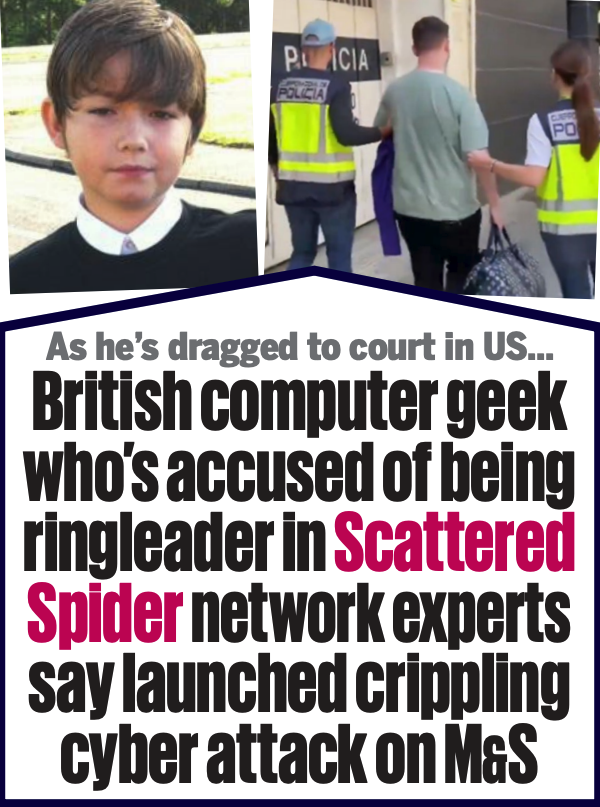
A screenshot of two photos of Buchanan that appeared in a Daily Mail story dated May 3, 2025.

Two photos published in a Daily Mail story dated May 3, 2025 show Buchanan as a child (left) and as an adult being detained by airport authorities in Spain. “M&S” in this screenshot refers to Marks & Spencer, a major U.K. retail chain that suffered a ransomware attack last year at the hands of Scattered Spider.

Scattered Spider is the name given to a prolific English-speaking cybercrime group known for using social engineering tactics to break into companies and steal data for ransom, often impersonating employees or contractors to deceive IT help desks into granting access.

As part of his guilty plea, Buchanan admitted conspiring with other Scattered Spider members to launch tens of thousands of SMS-based phishing attacks in 2022 that led to intrusions at a number of technology companies, including Twilio, LastPass, DoorDash, and Mailchimp.

The group then used data stolen in those breaches to carry out SIM-swapping attacks that siphoned funds from individual cryptocurrency investors. In an unauthorized SIM-swap, crooks transfer the target’s phone number to a device they control and intercept any text messages or phone calls to the victim’s device — such as one-time passcodes for authentication and password reset links sent via SMS. The U.S. Justice Department said Buchanan admitted to stealing at least $8 million in virtual currency from individual victims throughout the United States.

FBI investigators tied Buchanan to the 2022 SMS phishing attacks after discovering the same username and email address was used to register numerous phishing domains seen in the campaign. The domain registrar NameCheap found that less than a month before the phishing spree, the account that registered those domains logged in from an Internet address in the U.K. FBI investigators said the Scottish police told them the address was leased to Buchanan throughout 2022.

As first reported by KrebsOnSecurity, Buchanan fled the United Kingdom in February 2023, after a rival cybercrime gang hired thugs to invade his home, assault his mother, and threaten to burn him with a blowtorch unless he gave up the keys to his cryptocurrency wallet. That same year, U.K. investigators found a device at Buchanan’s Scotland residence that included data stolen from SMS phishing victims and seed phrases from cryptocurrency theft victims.

Buchanan was arrested by Spanish authorities in June 2024 while trying to board a flight to Italy. He was extradited to the United States and has remained in U.S. federal custody since April 2025.

Buchanan is the second known Scattered Spider member to plead guilty. Noah Michael Urban, 21, of Palm Coast, Fla., was sentenced to 10 years in federal prison last year and ordered to pay $13 million in restitution. Three other alleged co-conspirators — Ahmed Hossam Eldin Elbadawy, 24, a.k.a. “AD,” of College Station, Texas; Evans Onyeaka Osiebo, 21, of Dallas, Texas; and Joel Martin Evans, 26, a.k.a. “joeleoli,” of Jacksonville, North Carolina – still face criminal charges.

Two other alleged Scattered Spider members will soon be tried in the United Kingdom. Owen Flowers, 18, and Thalha Jubair, 20, are facing charges related to the hacking and extortion of several large U.K. retailers, the London transit system, and healthcare providers in the United States. Both have pleaded not guilty, and their trial is slated to begin in June.

Investigators say the Scattered Spider suspects are part of a sprawling cybercriminal community online known as “The Com,” wherein hackers from different cliques boast publicly on Telegram and Discord about high-profile cyber thefts that almost invariably begin with social engineering — tricking people over the phone, email or SMS into giving away credentials that allow remote access to corporate internal networks.

One of the more popular SIM-swapping channels on Telegram has long maintained a leaderboard of the most rapacious SIM-swappers, indexed by their supposed conquests in stealing cryptocurrency. That leaderboard previously listed Buchanan’s hacker alias Tylerb at #65 (out of 100 hackers), with Urban’s moniker “Sosa” coming in at #24.

Buchanan’s sentencing hearing is scheduled for August 21, 2026. According to the Justice Department, he faces a statutory maximum sentence of 22 years in federal prison. However, any sentence the judge hands down in this case may be significantly tempered by a number of mitigating factors in the U.S. Sentencing Guidelines, including the defendant’s age, criminal history, time already served in U.S. custody, and the degree to which they cooperated with federal authorities.

  •  

Booking.com breach gives scammers what they need to target guests

Travel companies love telling you your data is safe. Booking.com just reminded everyone why that’s a hard promise to keep.

The Amsterdam-based booking giant began notifying customers on April 13 that “unauthorized third parties” had accessed guest reservation data.  The compromised information includes booking details, names, email addresses, physical addresses, and phone numbers—essentially everything you’d need to convincingly impersonate a hotel contacting a guest. 

The criminals appear to have accessed the data by compromising Booking.com’s hotel partners. A Microsoft report blames the ClickFix phishing technique, which gets victims (in this case, hotel employees) to install malware disguised a computer “fix.”

Microsoft blames a criminal group called Storm-1865 for the caper, and caught it running exactly this kind of campaign against hotel workers across across North America, Oceania, South and Southeast Asia, and Europe, deploying nasty malware like XWorm and VenomRAT through fake CAPTCHA pages. 

Booking.com’s customer notification warned that the exposed data could be used for phishing and said it would never ask for sensitive information or bank transfers.

But scammers have a proven playbook for turning stolen booking data into cash. They can hijack a reservation by impersonating a hotel, message guests demanding a further payment, or credit card details for “payment verification.” The stolen data gives them everything they need to convince the hotel customer they’re legit.

The UK’s Action Fraud received 532 reports of Booking.com scams like this between June 2023 and September 2024, with victims losing £370,000 (around $470,000).

This has happened to Booking.com partners and customers before. In 2018, criminals phished hotel employees and accessed data belonging to Booking.com customers.  Scammers also conducted a voice phishing campaign later that year that targeted 40 hotels in the UAE. Over 4,000 customers’ data was stolen, including credit card data from 300 people. Booking.com was late reporting the breach to the Dutch privacy regulator, which imposed a €475,000 fine (around $560,000) in 2021. 

The travel industry’s recurring breach problem

Breaches like these are a pattern in the travel business. In January 2026, Eurail disclosed a breach that spilled passport numbers, addresses, and, for some travelers, photocopies of IDs and health data. KLM and Air France had customer data swiped in August 2025. Hertz, Dollar, and Thrifty were all caught in the Cl0p gang’s exploitation of Cleo file transfer software, with criminals pilfering drivers’ licenses and credit card data.

What’s interesting about all of these incidents is that like the Booking.com data heist, all involve compromise of third parties rather than the travel operations themselves. The travel industry sits on enormous troves of passport numbers, payment cards, and itineraries. And its security posture of sprawling supply chains, franchised operations, and third-party platforms makes it a soft target.

What you can do

How many customers were affected? Booking.com isn’t saying.  For a platform with over 100 million active mobile app users and 500 million monthly website visits, that silence is concerning. 

If you’ve used Booking.com recently, here’s the practical guide to protection. Don’t trust messages asking you to “verify” payment details, even if they arrive through the platform itself.

Here is Booking.com’s own advice about these scams, issued before this latest incident:

“If there is no pre-payment policy or deposit requirement outlined, but you’re asked to pay in advance to secure your booking, it is likely a scam.”

Check your booking confirmation email for what you actually owe and when. If anything seems off, contact the property directly, rather than through a link someone sends you. And watch your bank statements. The scammers who exploit this kind of data don’t always strike immediately.


Something feel off? Check it before you click.  

Malwarebytes Scam Guard helps you analyze suspicious links, texts, and screenshots instantly.  

Available with Malwarebytes Premium Security for all your devices, and in the Malwarebytes app for iOS and Android.  

Try it free → 

  •  

Booking.com breach gives scammers what they need to target guests

Travel companies love telling you your data is safe. Booking.com just reminded everyone why that’s a hard promise to keep.

The Amsterdam-based booking giant began notifying customers on April 13 that “unauthorized third parties” had accessed guest reservation data.  The compromised information includes booking details, names, email addresses, physical addresses, and phone numbers—essentially everything you’d need to convincingly impersonate a hotel contacting a guest. 

The criminals appear to have accessed the data by compromising Booking.com’s hotel partners. A Microsoft report blames the ClickFix phishing technique, which gets victims (in this case, hotel employees) to install malware disguised a computer “fix.”

Microsoft blames a criminal group called Storm-1865 for the caper, and caught it running exactly this kind of campaign against hotel workers across across North America, Oceania, South and Southeast Asia, and Europe, deploying nasty malware like XWorm and VenomRAT through fake CAPTCHA pages. 

Booking.com’s customer notification warned that the exposed data could be used for phishing and said it would never ask for sensitive information or bank transfers.

But scammers have a proven playbook for turning stolen booking data into cash. They can hijack a reservation by impersonating a hotel, message guests demanding a further payment, or credit card details for “payment verification.” The stolen data gives them everything they need to convince the hotel customer they’re legit.

The UK’s Action Fraud received 532 reports of Booking.com scams like this between June 2023 and September 2024, with victims losing £370,000 (around $470,000).

This has happened to Booking.com partners and customers before. In 2018, criminals phished hotel employees and accessed data belonging to Booking.com customers.  Scammers also conducted a voice phishing campaign later that year that targeted 40 hotels in the UAE. Over 4,000 customers’ data was stolen, including credit card data from 300 people. Booking.com was late reporting the breach to the Dutch privacy regulator, which imposed a €475,000 fine (around $560,000) in 2021. 

The travel industry’s recurring breach problem

Breaches like these are a pattern in the travel business. In January 2026, Eurail disclosed a breach that spilled passport numbers, addresses, and, for some travelers, photocopies of IDs and health data. KLM and Air France had customer data swiped in August 2025. Hertz, Dollar, and Thrifty were all caught in the Cl0p gang’s exploitation of Cleo file transfer software, with criminals pilfering drivers’ licenses and credit card data.

What’s interesting about all of these incidents is that like the Booking.com data heist, all involve compromise of third parties rather than the travel operations themselves. The travel industry sits on enormous troves of passport numbers, payment cards, and itineraries. And its security posture of sprawling supply chains, franchised operations, and third-party platforms makes it a soft target.

What you can do

How many customers were affected? Booking.com isn’t saying.  For a platform with over 100 million active mobile app users and 500 million monthly website visits, that silence is concerning. 

If you’ve used Booking.com recently, here’s the practical guide to protection. Don’t trust messages asking you to “verify” payment details, even if they arrive through the platform itself.

Here is Booking.com’s own advice about these scams, issued before this latest incident:

“If there is no pre-payment policy or deposit requirement outlined, but you’re asked to pay in advance to secure your booking, it is likely a scam.”

Check your booking confirmation email for what you actually owe and when. If anything seems off, contact the property directly, rather than through a link someone sends you. And watch your bank statements. The scammers who exploit this kind of data don’t always strike immediately.


Something feel off? Check it before you click.  

Malwarebytes Scam Guard helps you analyze suspicious links, texts, and screenshots instantly.  

Available with Malwarebytes Premium Security for all your devices, and in the Malwarebytes app for iOS and Android.  

Try it free → 

  •  
❌