Attackers are increasingly targeting collaboration platforms like Microsoft Teams. Learn the risks and key steps to strengthen your organization's security.
The 2026 World Cup presents major cyber risks from ransomware groups, state-aligned actors, and other groups targeting critical infrastructure. Learn more here.
Not hours. Not days. It takes thirty-nine seconds from initial access to data exfiltration.
That stat, pulled from Unit 42® research, isn't hypothetical. It's what defenders are up against right now, while most organizations are still building security teams around manual detection and response workflows that were never designed to operate at machine speed.
Wendi Whitmore, Chief Security Intelligence Officer at Palo Alto Networks, put it plainly in a recent conversation on the Threat Vector podcast, recorded live at RSA this year:
If you're applying a manual detection and response capability, you are going to be beat by the attacker every day.
It's the kind of sentence that should make security budgets move faster.
The Threat Landscape Doesn't Wait for Organizational Consensus
Whitmore has spent nearly 25 years tracking nation-state actors, and she's unequivocal about what's changed. The adversaries today aren't just better funded and more sophisticated. They're faster, and increasingly AI-powered.
Consider what's converging right now:
Chinese nation-state groups like Volt Typhoon and Salt Typhoon have been operating with near-surgical patience inside critical infrastructure, leveraging existing administrative tools to avoid detection. Volt Typhoon is focused on military prepositioning in power grids, water systems and telecommunications. Salt Typhoon has been systematically collecting intelligence from those same networks. Neither group announces itself with novel malware. They disappear into environments using the tools already there.
Meanwhile, threat actors tied to Iran are operating with entirely different objectives: tactical disruption and destruction. And financially motivated cybercriminal groups are automating ransomware campaigns at a pace that has compressed attack timelines from weeks to minutes.
Every CISO is being asked to defend against all of them simultaneously, while also managing their organization's AI expansion, and doing it without adding headcount.
Speed Is the New Perimeter
When Whitmore references the 39-second exfiltration window, she's pointing at something structural, not just alarming. It reflects how completely the attacker's operational tempo has shifted.
The 72-minute data breach figure from Unit 42 Incident Response data is equally striking: From initial access to full data theft in the time it takes to sit through a decent movie. A 400-times year-over-year increase in exfiltration speed isn't a trend. It's a fundamental change in the physics of an attack.
"There is no way that we are going to defeat these adversaries if we are working at manual speed," Whitmore explained. The answer isn't just more analysts. It's fighting AI with AI, letting machines handle the volume and velocity, so humans can focus on the problems that actually require human judgment.
Two Sides of the Same AI Problem
Here's where the conversation gets more nuanced and more important.
Most of the AI-in-security conversation focuses on the offensive side: adversaries using generative AI to craft convincing phishing lures, accelerate reconnaissance and automate attack sequences. That's real, and it's accelerating.
But Whitmore raised the other half of the problem, one that gets far less attention: The attack surface that organizations are creating by deploying AI without securing it.
Innovation of AI doesn't so far outpace the security of AI.
This is the outcome she wants to see. Right now, that's not what's happening. Business pressure to deploy AI quickly is outrunning the security architecture required to protect it. Every new AI deployment touching production data, cloud APIs and enterprise systems expands the attack surface. Shadow AI, prompt injection, model poisoning: These are not future threat vectors. They're present tense.
The distinction Whitmore draws is useful: AI for cybersecurity (faster detection, automated response, reduced analyst burden) needs to advance in parallel with cybersecurity for AI (securing the models, prompts and data pipelines that organizations are building on). One without the other creates exactly the kind of asymmetry attackers will exploit.
Visibility Is Where It Starts
Whether the conversation is about defending against nation-state actors or securing AI deployments, Whitmore keeps returning to the same foundation of visibility.
Not complexity. Not more tools. Visibility is a single, unified view of what's happening across endpoints, networks, cloud and AI systems, that’s fast enough to matter when the window is measured in seconds, not days.
For SOC teams, that means being able to detect and contain a threat before a compromise of one system becomes an enterprise-wide event. For CISOs thinking about AI governance, it means understanding what's being deployed, what's being prompted, and where the data is going before an incident surfaces for them.
The organizations Whitmore sees succeeding aren't the ones with the largest security budgets. They're the ones with the clearest picture of their environment, and the architecture to act on it in real time.
The Win Looks Different Now
Perhaps the most important reframe in the conversation is that the objective is no longer to prevent every attack. That goal is not achievable against adversaries operating at AI speed with nation-state resources.
The win is resilience. Detecting fast and containing fast. Keeping one compromised endpoint from becoming an enterprise-wide breach.
That shift in framing, from prevention to rapid recovery, has significant implications for how security teams are built, how AI is integrated into workflows, and how CISOs make the case for investment to leadership that still thinks in terms of keeping attackers out.
The adversaries already know the perimeter is gone. The question is whether your defense strategy has caught up.
The Unit 42 2026 Global Incident Response Report goes deep on the threat trends shaping how modern attacks unfold. If you want the data behind the headlines, start here. Download the Report →
OK, RSA 2026 is over. If my record keeping is correct, I first attended RSA in 2006. At that time, I was annoyed by … AI? XDR? NIDS? …. noooo… I was annoyed by NAC (“As many other RSA observers agreed, under each tree you now see a NAC.” NAC rapidly arose from the “wormy” early 2000s and quickly vanished inside network infrastructure devices).
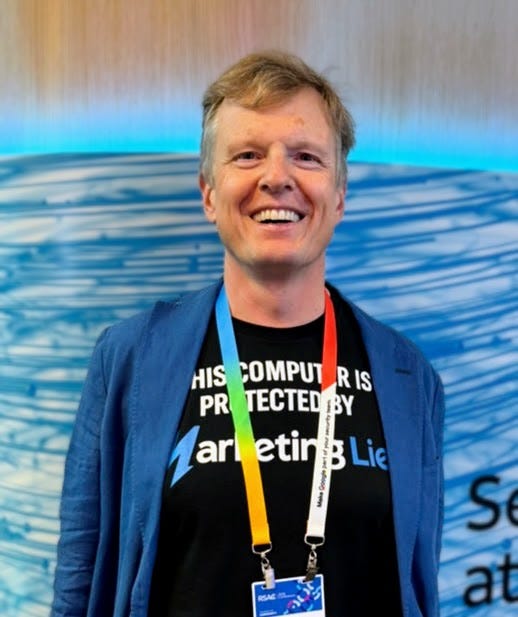
That t-shirt
Anyhow…
If the RSA Conference is the annual, sprawling theme park of the cybersecurity industry, then RSA 2026 was the year the park owners unveiled the shiny, terrifying, and utterly bewildering “AI Rollercoaster.” But as my co-host Tim Peacock and I sniffed around the expo floor, a familiar suspicion crept in: half the queue signs were blatant fabrications, and the ride itself might only be half-built.
For decades, we’ve attended this annual security pilgrimage expecting consolidation, disruption, and an industry growing up. And every year, we leave with the same truth: the more things change, the more they stay the same (and no, I am not old enough to be called “a curmudgeon”). This year, the force of AI agents was everywhere, yet the industry’s response — the good, the bad, and the baffling - revealed more about our collective inability to do the fundamentals than it did about the technology itself.
The first thing you notice about the AI Rollercoaster is the marketing. It’s less about engineering excellence and more about colorful claims that would make a 1890s snake oil salesman blush. Our first, unavoidable observation was the sheer breadth of the AI Hype Spectrum, a problem of which AI washing is one of the levels.
We saw vendors across the spectrum: from those quietly using AI for genuine, impactful security tasks to those who merely “spray painted an AI” onto their 2021 marketing materials and called it a new platform. This latter group — the “AI touch-up” artists — are everywhere, simply adding a comma and the word “agents” to their identity management tools description, firewalls, anti-virus and calling it a day (I have booth pictures, yes)
Look, you are not an AI native company if you launched in 2003 and have a “talk to docs / manuals” chatbot in 2026. BTW, your chatbot can be easily convinced to spout political propaganda because your RAG sucks and you think “restrict via system prompt” is AI security…
This brings me to the first core truth of RSA 2026: to succeed, the buyer must be the expert. It is profoundly disappointing — though not surprising — that in an industry claiming to be on the cusp of a technological revolution (AI AI AI!), our most potent advice for a CISO is a throwback to the days of dial-up: due diligence. BTW, see this quote:“The problem is that most of the people attending the RSA Conference can’t understand what the products do or why they should buy them.” This is…. OH HORROR! .. Bruce Schneier in 2008.
The genuine use of AI in a product is now almost entirely disconnected from the glossy message on the vendor’s booth. You, the buyer, need to dig deep, get technical, and understand what they are actually selling. If they claim AI makes their firewall (or: your SOC) better, tell them to show you the numbers (Better how? Better where? By how much? Depending on what?). If they can’t produce data and solid metrics on how AI improved their thing, you must assume they are not credible and are essentially lying. Sorry, but “cloud native firewall” is not a thing.
And speaking of gloss, a related phenomenon was what we called the “Wiz Effect.” We saw a notable rise in whimsical, information-free booths — lots of pinks, purples, superheroes, and non-security-related sports figures. While a tasteful aesthetic is welcome, this strategy only works if you are already a $32 billion company named Wiz. It did work- and it still does work — for Wiz! Wiz can have soup cans in the booth, and it will sell CNAPP by the million. For others, a fantastical booth merely meant your booth was remembered, but your message was utterly lost. Goats! Also, its low-information density approach compounds the problem of AI washing.
In the past, some clowns predicted that our industry will consolidate and only a dozen large vendors will remain. In 2026, many fear a different Vendor Apocalypse where the large AI labs will simply run over existing security vendors. If a massive LLM can run on an endpoint and perform vulnerability analysis, why do you need a standalone vulnerability scanner? To me, this risk is absolutely real, particularly for product categories like Static Analysis (SAST), which seems custom-made for LLM decimation (reminder: I am not an appsec expert). The same logic applies to firewall rule analysis, policy writing, and many simple IAM/PAM decisions. However, it is not yet clear (my gut says “no”, my brain says “wait for RSA 2027, then ask again”) that the entire industry is vulnerable though…
And this is where the industry’s legendary IT inertia kicks in. The persistence of “The Old” is a stunning, annual lesson in the industry’s resistance to disruption. We saw large booths from vendors whose heyday was decades ago — the fifth best firewall and antivirus vendors are still alive and well as if the calendar still shows 2006. Do you believe that Checkpoint sells “AI security”? They do now! Anyhow, they are still collecting hard-earned money from buyers. This proves that the promised AI disruption has not yet killed off even the “number six” player in a market., much less hurt the #1. “Last vendor on the list is … still ON the list” was my insight here.
Why such epic survival skills? I think it comes down to enterprise knowledge and IT inertia. We debated whether the security industry would survive based on the same concept that keeps human analysts relevant against a giant LLM: the possession of “tribal knowledge.” This is the accumulated, aggregated, and integrated gossip … eh … customer data…that good security vendors hold about their clients’ specific environments. This tacit knowledge, the context of why things are done, is not public, and an AI robot won’t have it today (theoretically, there are ways for them to gather it, to be sure). If your security operation relies on this copious chunk of tribal knowledge, a super-intelligent chatbot won’t replace your vendor — at least not yet.
Another odd observation here. For some vendors, promoting “openness” seems like a signaling maneuver for weakness, not strength. We walked past booths proclaiming “open data lake,” “open detection,” and “open ecosystem.” While I believe openness has inherently positive value, my cynical analyst brain immediately wondered: are they more open or are they just not better? See, vendor A sells EDR, and it is really good. Vendor B EDR sucks compared to vendor A. So they market it as “open EDR” because they cannot market it as “the better EDR” (it ain’t better, even according to them). Reactions?
While the hype around AI for security was overwhelming, there was a positive and genuinely exciting shift: the rise of securing AI and agents. Last year, I lamented the lack of focus on protecting AI systems. This year, I was pleasantly surprised to see vendors focusing on securing agents, securing agent identity, and doing data security for the AI supply chain and training data.
The third pilar of this is the bad guy with AI. To me, the real fear isn’t the “Bad Guy with AI” or even the coming “Bad AI”; the fear is the acceleration of the inevitable. If your security posture is bad before AI, it’s just going to be bad — and faster — after AI. As attackers modernize their business with AI, the average time to compromise will drop even further and — IMHO more importatny — a chance of a compromise will go up (ref this week suppy chain hits)
The ultimate takeaway here is the “boring” lesson: Get the fundamentals right (and, yes, AI can help here too). No amount of AI from a threat actor will exploit your cloud misconfiguration if you don’t have one (well, either cloud or misconfiguration). If your defenses against misconfigured systems, containers, and instances are robust, it doesn’t matter that the bad guy has AI; your stuff is more secure. The acceleration brought by AI will simply kill off “luck-based security.” The old adage is true: if your app has no obvious exploitable holes, there’s nothing for the AI-armed attacker to find. Magic!
So my single piece of advice for dealing with this reality, whether you are a buyer, a seller, or an analyst, is simple: demand the data. Do not let vendors get away with buzzword bingo. If a vendor says AI helps, make them prove it with solid metrics. The time for “trust-me-bro” security better be over!
Finally, some reactions from my 3 sessions. The most shocking reactions came from my “AI SOC” peer discussion on Thursday. I noticed a shocking, near-total lack of enthusiasm about AI SOC startups (total) and AI SOC concepts (near total). The best I got was “AI in a SOC sounds great, we will just wait for our SIEM/SOAR vendor or MDR to build it” and “this is better SOAR and we want this, but later.” And think about it: this was for people biased in favor of AI SOC (because they showed up for the session)… Not sure yet what to think of it!
Fun takes from other people(and there are many) are here (key quote: “Perhaps I’m being overly dramatic but I was surprised with the generally relaxed tone about the impending wave of vulnerabilities and the extent of industrialized attackers coming in the coming quarters. Everyone seems to know vulnerability management isn’t where it needs to be in most companies and what’s coming will pile on the pressure.”), here, here.
I’m skeptical about—and not qualified to review—this new result in factorization with a quantum computer, but if it’s true it’s a theoretical improvement in the speed of factoring large numbers with a quantum computer.
The RSAC 2026 Conference brings together thousands of professionals, practitioners, vendors, and associations to discuss issues covering the entire spectrum of cybersecurity—a place where innovation meets collaboration and the industry’s brightest minds converge to shape its future. This March, Amazon Web Services (AWS) returns to the annual RSAC Conference in San Francisco to share how unifying security and data empowers teams to protect AI-driven workloads while maximizing existing security investments.
Experience innovation at the AWS booth
Visit us at booth S-0466 in South Expo to experience three interactive demo kiosks:
The AWS Security Solutions kiosk features live demonstrations of AWS security services including new launches showcasing the latest cloud security innovations and how they work with partner solutions to provide comprehensive protection for your organization. Meet with AWS Security Specialists to discuss your specific security challenges.
The AWS Security Partners kiosk showcases live demos from more than 20 AWS Partners showcasing how these partners integrate seamlessly with AWS to address your most critical security challenges.
The Humanoid Security Guardian kiosk offers an interactive AI-powered experience that generates customized well-architected framework guides, delivered through QR code for implementation reference.
Partner Passport program: Stop by the AWS booth to pick up your playbook to start exploring integrated AWS Partner security solutions across the show floor. Visit participating partner booths throughout the conference to learn about joint solutions that combine AWS infrastructure with partner innovations. After you’ve received all partner booth visit stamps, you’ll receive AWS swag and entry into a daily raffle to win an exclusive prize.
Beyond the booth: Deep dive sessions and hands-on workshops
AWS security experts will be sharing insights across four sessions throughout RSAC 2026 Conference. These sessions cover the most pressing challenges in AI security, from privacy-by-design principles to preparing for AI-native incidents. Don’t miss learning directly from AWS experts in these sessions.
Privacy by Design in the AI Era | Reserve a seat Monday, March 23, 2026 | 8:30 AM–9:20 AM PDT Attendees will learn how to design AI systems with privacy embedded from the start. This session will cover data minimization strategies, architectural patterns for consent-aware decision-making, and practical approaches for building privacy-respecting AI in dynamic environments. Speakers: Juan David Alvares Builes, Senior Security Consultant, Amazon Web Services and Zully Romero, Security and Solutions Architect, Bancolombia.
Trusted Identity Propagation for Autonomous Agents Across Cloud & SaaS | Reserve a seat Monday, March 23, 2026 | 9:40 AM–10:30 AM PDT This session will explore trusted identity propagation for autonomous agents across cloud, SaaS, and multi-domain environments. Compare AWS, Azure, Apple, and Cloudflare approaches, focusing on identity continuity, credential management, and privacy-aware designs for secure, agent-driven enterprise systems. Speakers: Swara Gandhi, Senior Solutions Architect, Amazon Web Services and Vijeth Lomada, Lead AI Engineer, Adobe.
How to Secure Containerized Applications from Supply Chain Attacks | Reserve a seat Monday, March 23, 2026 | 1:10 PM–2:00 PM PDT Software supply chain attacks target development pipelines to inject malicious code into container images and dependencies. This session demonstrates how to secure containerized applications through automated scanning, Software Bill of Materials (SBOM) generation, and image signing. Learn to implement security controls in CI/CD pipelines using open-source and commercial solutions. Speakers: Patrick Palmer, Principal Security, Solutions Architect, Amazon Web Services and Monika Vu Minh, Quantitative Technologist, Qube Research & Technologies
From Prompt to Pager: Preparing for AI-Native Incidents Now | Reserve a seat Wednesday, March 25, 2026 | 1:15 PM–2:05 PM PDT AI incidents start as prompts and end as actions like code edits, SQL writes, workflow changes, yet most playbooks are not ready. This talk will explain why AI incidents differ, show where classic guardrails miss, and share field-tested steps to prepare now: log model-generated actions, add pre/post-conditions, capture provenance, limit blast radius, and rehearse one AI-native scenario. Speaker: Aviral Srivastava, Security Engineer, Amazon
AWS activities and events
AWS will host events at Cloud Village, an interactive community space where security practitioners explore offensive and defensive cloud security through hands-on activities, technical talks, and collaborative discussions. AWS is hosting two technical workshops that provide hands-on practical skills security teams can implement immediately. AWS has also crafted multiple capture the flag (CTF) community challenges at both RSAC 2026 Conference and BSidesSF that advance the broader security community’s capabilities – built by the same team behind the AWS Vulnerability Disclosure Program, where researchers can responsibly report security concerns directly to AWS. Cloud Village will be located in Moscone South, Level 2, Room 204 and is open to All Access Pass and Expo Plus Pass holders.
Finally, you can also join us at a customer soiree AWS is co-hosting with CrowdStrike, on Wednesday, March 25 at The Mint, for an evening of discovery, where artists, thinkers, and leaders gather to challenge convention, shape the future and have some fun. Register to join us
If you’re looking for opportunities for meaningful connections across the security community, AWS is hosting several events including;
Whether you’re exploring how to secure AI workloads, seeking to unify security across distributed environments, or looking to optimize your security data strategy, the AWS team at RSAC 2026 Conference is ready to collaborate. Visit booth S-0466 in South Expo, attend our technical workshops at the Cloud Village, or join AWS-led sessions. You can also schedule time to meet with AWS experts for more in-depth discussions. Together, we’ll demonstrate that when it comes to cybersecurity, we’re all on the same team.
Learn more about AWS Security solutions at aws.amazon.com/security See you in San Francisco, March 23–26, 2026.
This blog is perhaps a little bit more like an ad, so if you don’t want to check the ads, consider not reading it.
a very cyber image (Gemini)
But this year at RSA 2026, I’m speaking on three topics: securing AI, using AI for SOC, and sharing lessons about how Google applies AI and other technologies to D&R.
Here are these 3 fun things!
First, I’m doing a presentation on governing shadow AI agents. Believe it or not, this presentation was created mostly before OpenClaw became a thing (but updated for it!). So you may be surprised how well the content aged (think wine!) Attend this if you are struggling with shadow AI, specifically shadow agents at work.
It is not the APT! The new threat is the “shadow AI agents” employees already use for work, leaking data and making decisions. Banning them is a losing game. This session will offer a better way: turn this organic behavior into a catalyst for secure progress. Learn to discover, assess, and channel unsanctioned agents into a formal strategy that empowers a team rather than force it underground.
The second is probably the most detailed discussion about how we use AI for detection and response at Google. You probably read our blogs and listen to our talks (especially this), but this time we are revealing a lot more interesting details about the machinery and also how we arrived at the state we’re in. I promise you this will be fun! And detailed too.
Presenters will share the playbook for building and scaling AI agents in cybersecurity. Attendees will learn four core lessons: Building trust with the team, prioritizing real problems, measuring value, and establishing solid governance foundations for the agentic SOC.
Finally, the third isn’t a presentation but a discussion that would help you understand the real state of AI in security operations / SOC. This would not be about the slides, but about sharing lessons on what works and what doesn’t.
Attendees in this peer-led discussion will share stories from the AI-powered SOC trenches. Explore real adoption journeys from manual processes to autonomous agents. Share practical use cases on analyst retraining, workflow auditing, malware analysis, remediation automation, RAG pipelines and more. Trade notes on what’s working, what’s breaking, trust gaps, AI hallucinations, and career redesign.
All in all, join me for securing AI and Shadow Agents, learning from Google about detection and response, and comparing the state of practice of AI in the SOC.
Lawrence Hoffman // As I previously mentioned I’m on vacation this week and next. As I like to go for long cross-country drives I’ve not had much time to keep […]

 Login
Login